




Introduction
In 2017, a teacher education reform was implemented in Norway, extending the generalist teacher education programme to a five-year master’s degree. The reform aimed to enhance the integration of theory and practice, strengthen the connections between campus-based education and classroom teaching, and establish a stronger research-informed foundation for school teaching (Advisory Panel for Teacher Education, 2020).
Despite the reform, pre-service teachers (PSTs) in early stages of training experience a lack of integration between theory and practice (Høgheim & Jenssen, Reference HØGHEIM and JENSSEN2022). Towards the end of their training, they feel more prepared for the profession, although they still suggest programme improvements (Springer, Reference SPRINGER2020). Jakhelln et al. (Reference JAKHELLN, BJØRNDAL and STØLEN2016) describe the impact of master’s theses as fostering in-depth knowledge, research competence, independence, and a sense of pride. A longitudinal study (Borgström-Källén & Lindgren, Reference BORGSTRÖM-KÄLLÉN and LINDGREN2024) shows that PSTs’ identities evolve over the course of their five-year education, while Kvam et al. (Reference KVAM, HELLEVE, ULVIK and RONESS2024) find that newly qualified teachers with a master’s degree enter the workforce with ambitions and see themselves as valuable resources, despite their limited experience.
Several studies have investigated pre-service music teachers’ (PSMT) development of professional identity. Ballantyne et al. (Reference BALLANTYNE, KERCHNER and ARÓSTEGUI2012) demonstrate that PSMTs’ identity development is both dynamic and fluid, while Mateos-Moreno (Reference MATEOS-MORENO2022) highlights a range of concerns expressed by PSMTs regarding their future professional roles. Kenny (Reference KENNY2017) argues that PSMTs are given opportunities to shape their emerging identities in ways that influence their approach to music education as future teachers. Similarly, Draves (Reference DRAVES2021) emphasises the importance of incorporating identity learning and addressing tensions in identity development within teacher education programmes.
Studies have also examined the transition from music teacher education to professional practice. For example, Bladh (Reference BLADH2004) conducted interviews with music teachers after ten years in service, while de Bruin (Reference DE BRUIN2025) and Dabback (Reference DABBACK2018) explored professional identity formation and the concept of possible selves among early-career music teachers. These studies reveal considerable variation in confidence and perceived preparedness for professional life after completing teacher education. Bartolome (Reference BARTOLOME2017) emphasised the significance of teaching practicum and fieldwork experiences embedded within music teacher education programmes as critical for professional readiness. Conversely, Miksza and Berg (Reference MIKSZA and BERG2013) reported that novice teachers often face numerous challenges during their first year of teaching, and Fredriksen (Reference FREDRIKSEN2017) documented cases of music teachers leaving the profession within their initial years of service. Building on this body of research, there is a clear need to investigate how professional identity as a music teacher can be developed in a robust and sustainable manner, starting already in teacher education training.
Against this background, we conducted a qualitative study of eight music teacher candidates in their final year of pre-service education to examine how teacher education and the master’s thesis influence professional identity and development. Specifically, we ask: How do PSTs in their final year of education reflect on future professional identities and career trajectories?
Although our focus is on music education, participants’ development as music teachers forms only part of their emerging professional lives. Because data collection occurred during a transitional phase, from teacher education to professional practice, our analytical framework incorporates a spatio-temporal perspective that treats participants’ reflections as part of their ‘stories-so-far’. We refer to this approach as spatially situated possible selves, drawing on Markus and Nurius’ (Reference MARKUS and NURIUS1986) concept of possible selves and Massey’s (Reference MASSEY2005) theorisation of space.
The article is based on two group interviews – one conducted during the writing of the participants’ master’s theses and another shortly after submission while they were applying for teaching positions. We begin by outlining the theoretical framework, followed by the methodological approach. We then present thematically organised findings and conclude with a discussion of how music teacher education can be understood as a multiplicity of ‘stories-so-far’.
Spatially situated possible selves
Possible selves denote how individuals think about their potential and future: who they want to be, who they can be, and who they fear becoming. They represent specific hopes, fears, and fantasies (Markus & Nurius, Reference MARKUS and NURIUS1986, p. 954). We all have a repertoire of possible selves, including the good selves (fondly remembered), bad selves (those we would rather forget), hoped-for, feared, not-me, ideal, and ought selves (Markus & Nurius, Reference MARKUS and NURIUS1986, p. 957). In music education, the concept has been explored in diverse contexts, though still relatively sparingly. Researchers such as Powell (Reference POWELL2016) and Freer (Reference FREER2014) examined how adolescent boys’ and men’s participation may be shaped by their (in)ability to envision themselves as singers. Varvarigou et al. (Reference VARVARIGOU, CREECH and HALLAM2014) explored how musical partnerships may enrich the possible selves of pupils, teachers, musicians, and students, while Creech et al. (Reference CREECH, HALLAM, VARVARIGOU, GAUNT, MCQUEEN and PINCAS2012) studied musical selves in relation to well-being in later life. Dabback (Reference DABBACK2018) and de Bruin (Reference DE BRUIN2025) are especially relevant, highlighting the role of possible selves in the transition from student to early career music teacher.
In our context: What kind of (music) teachers would our participants (not) want to be, and how might that influence their current lives and future trajectories? Using possible selves as an analytical concept helps explore changing professional spaces and roles. However, the possible selves theory is psychological, grounded in cognition, motivation, and self-regulation. This orientation tends to individualise professional development, often overlooking broader social, institutional, and material conditions that shape what futures are imaginable or attainable. While we draw inspiration from the concept, we diverge from its psychological grounding, opting for a socio-spatial framework informed by Massey (Reference MASSEY2005). Massey describes space as a ‘meeting-up of histories’ (Reference MASSEY2005, p. 4), where multiple and heterogeneous trajectories intersect. Space is not a static container for events, but a dynamic configuration of interactions, movements, and power relations. Massey’s spatial thinking allows us to conceptualise music teacher education not merely as a setting, but as a processual and contested space shaped by institutional structures, cultural norms, and lived experiences.
Massey outlines three key propositions about space relevant to this study. First, space is interrelational, constituted through interactions between people, institutions, discourses, and material conditions. Second, space allows for multiplicity, enabling the coexistence of different trajectories, perspectives, and identities. Third, space is always under construction, constantly being remade through practice and encounters (Massey, Reference MASSEY2005, pp. 9–10). These propositions help us understand our participants’ trajectories not as linear progressions from student to teacher, but as situated movements through overlapping and sometimes conflicting educational, professional, personal, and geographic spaces.
This spatial lens also foregrounds the role of power in shaping possible futures. Spaces are not neutral; they are structured by hierarchies, exclusions, and affordances. For example, the institutional space of teacher education may privilege certain musical practices, pedagogical values, or career paths. By attending to these dynamics, we can better understand how imagined futures are not simply internal projections, but responses to the conditions participants inhabit and encounter.
Methodology
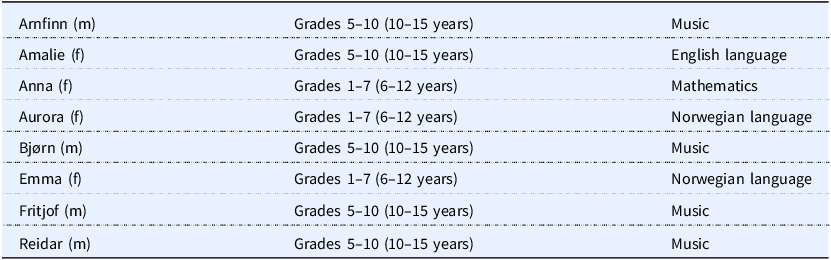
Participants were recruited from a cohort of PSTs in their fifth and final year of teacher education, who had previously taken music courses together during the first three years of their programme. To ensure variety, we recruited eight participants. The sample was strategic: participants were male and female, specialising in grades 1–7 (lower and upper primary school, age group 6–12 years) and grades 5–10 (upper primary and lower secondary school, age group 10–15 years). Half of the participants majored in music and were writing a master’s thesis in music education; the other half majored in other school subjects, see Table 1. All were formally qualified to teach music in schools, though. PSTs in Norway are known to be a homogenous group (Nysæther et al., Reference NYSÆTHER, CHRISTOPHERSEN and SÆTRE2021), which was also partly reflected in the group of participants enrolled in this study: They were all white and in their mid-twenties. However, they came from different parts of the country – some from urban and some from rural areas, they had different musical backgrounds and experiences, and there was some variety regarding their socio-economic background.
Both authors were involved in master’s thesis supervision, and the second author also taught a course for the music majors. Due to these dual educator – researcher roles, potential participants were explicitly informed they could decline without penalty (one of the approached PSTs did and thereby opted out of the study). They were assured that participation would not affect assessment, they signed informed consent forms, and chose their own pseudonyms. Our research followed the Norwegian national guidelines for research ethics (NESH, 2024), and the legal basis for the study was approved by the Norwegian Agency for Shared Services in Education and Research (project ref. no. 672369).
The interviews were conducted on campus during the participants’ final six months as PSTs while writing their master’s theses. One participant was unable to join a group interview and was interviewed individually. During the two interviews, participants were asked about their views on teacher education and the music programme, their own development, the relevance of their education for future teaching, suggested improvements, their choice of specialisation and thesis relevance, thoughts on music teaching in schools, and plans for the coming year and future.
Recognising our dual role as educators and researchers, we assembled participant groups to include a mix of music majors and students majoring in other subjects. This grouping aimed to support the expression of potentially critical perspectives from the music majors. All participants had previously taken part in an earlier research project led by the same researchers, which invited critical reflections on the institution’s music programme. Based on previous interactions, it was our impression that PSTs were comfortable voicing their experiences and opinions. During the first round of interviews in January 2023, the first author, who was not involved in coursework, conducted all interviews except one with her own supervisee, which was conducted by the second author. The second round took place in May 2023, after thesis submission, and was conducted by the second author, as the first author was on leave. The authors accessed the raw data after grading was finalised in summer 2023.
The analysis was conducted as an abductive thematic analysis (ATA). This approach combines thematic analysis with abductive reasoning by iteratively moving between data, existing concepts and theories, and new insights. Abduction can be conceptualised as ‘a series of excursions into the literature occasioned by seeing something in the empirical material that warranted an explanation’ (Burch, Reference BURCH2020, p. 58 in Boyd, Reference BOYD2024, p. 7). In this study, ATA provided an appropriate analytical logic because it enabled us to remain close to participants’ articulated experiences while also engaging theoretically with patterns that required conceptual development (Thompson, Reference THOMPSON2022; Khurshid et al., Reference KHURSHID, VEEN, THOMPSON and HEGAZI2025). This combination aligned with both our research questions and our aim to account for the situated transition processes described by the participants.
We began by close readings of the data, generating initial codes and early thematic structures. For example, participants’ career awareness and hybrid positioning between pre-service and in-service teacher identities were evident during the initial readings. A subsequent engagement with the literature indicated that the theory of possible selves offered a compelling analytical lens, particularly for capturing temporal aspects of the transition trajectories participants described. However, the cognitive approach embedded in the concept did not sufficiently account for the situated and relational conditions shaping these trajectories. Continued coding and refinement of themes revealed that spatial structuring, such as hierarchies, institutional arrangements, and affordances, played an important role in how participants could envision their future selves.
Rather than shifting to a reconstructive analytic approach, which is designed to uncover latent meaning structures beyond participants’ own meaning-making (Carspecken et al., Reference CARSPECKEN, DRESSMAN, HARDCASTLE, USHER, HOLMES and KORTH2008), we found that ATA allowed us to identify and theorise these spatial dynamics while remaining grounded in the empirical articulation of experiences. We therefore expanded the possible-selves framework by integrating conceptions of space, resulting in what we term ‘spatially situated possible selves’, which we explore further when discussing the findings.
Findings
Findings from the interviews are organised into four themes that emerged from the abductive analysis. When the eight PSMT in their final year of education reflected on their future professional identities and career trajectories:
-
1. they demonstrated varying levels of future career awareness,
-
2. they drew on past experiences to imagine possible future selves,
-
3. they emphasised how different elements of their education shaped their envisioned futures, and
-
4. their situatedness between different spaces influenced how they perceived themselves as potential future professionals.
Future career awareness
The participants expressed a range of hopes and fears (Markus & Nurius, Reference MARKUS and NURIUS1986) when reflecting on their future professional identities and career trajectories. Regarding their educational portfolios and choice of Master’s specialisation, Emma and Amalie argued that majoring in ‘core subjects’ like Norwegian and English increased their chances of securing a teaching position. Future visions of themselves as employable teachers thus served as a strategic motivation for their academic choices.
In contrast, Arnfinn selected his subject portfolio based purely on personal interest and reflected on the possibility of facing unemployment as a result. Those specialising in music, however, argued that in the long run, a music specialisation may open alternative career paths, such as music teachers outside of primary schools. Fritjof, on the other hand, did not explicitly link his choice of master’s subject to any career ambitions, either positively or negatively. Instead, he justified his decision with a desire to enjoy his education alongside others who share his interests.
Bjørn took a different approach, using policy arguments to explain his decision to write a master’s thesis in music education: ‘Music is a subject that is not very strong in schools compared to other subjects, so to have music teachers with a master’s degree is very important to strengthen the subject in school’. In this way, Bjørn appeared to envision himself as a future advocate for music education in schools.
The results show that participants had varied views on their future careers. Some chose subjects strategically for future employability, while others followed personal interests and passions. The music majors in general saw broader future career opportunities, and one participant aimed to advocate for music in schools.
Past experiences and possible future selves
When participants reflected on their future professional trajectories, they drew on past experiences from their own school time and their encounters – or lack thereof – with role models in the teaching profession. In this way, they compared themselves with previous ‘salient others’ (Markus & Nurius Reference MARKUS and NURIUS1986, p. 954) when reflecting on who they could become.
Arnfinn identified positively with his former music teachers: ‘I had very good music teachers and got inspired by them. It seemed like they had fun at work, and I would like to do the same’. Emma, on the other hand, lacked role models in music education and struggled to envision herself as a successful music teacher. Her possible teacher identity was shaped by fears, particularly of not knowing how to organise music activities for large groups with diverse musical skills:
I don’t think I had much music education in primary school, really. It was so rare that I can remember the individual instances. So, I actually have very few ideas about primary school, what I should do, because I haven’t experienced it myself in the past.
Bjørn did not enjoy his own time in school, and one of his main worries was ‘to become that teacher’, the kind of teacher who makes school an unpleasant experience for some pupils. In this sense, we see how the informants’ own schooling experiences shaped their perceptions of themselves as future teachers, influencing both their hopes and their fears for the future.
The participants’ own experiences of schooling shaped their perceptions of themselves as future teachers, influencing both their hopes and fears. Both inspiration from positive role models and uncertainties and negative memories shaped their self-perceptions as future teachers.
Music teacher education – shaping possible futures
As a space structured by hierarchies, exclusions, and affordances, music teacher education may privilege certain musical practices, pedagogical values, or career paths over others. When the participants described their experiences from music teacher education, we can see how it shaped their understanding of themselves as future teachers. For instance, Anna and Aurora had a conversation during one of the focus groups where they discussed the prioritised musical activities in education and how useful they were for their coming profession:

From Anna and Aurora’s experiences of band playing during their music teacher education, we can see that the educational space shaped a ‘not-me self’ or even a ‘bad self’ (Markus & Nurius, Reference MARKUS and NURIUS1986) for them as future music teachers, at least for becoming band leaders in the music classroom. As band playing was ranking high in the prioritised educational practice, and Anna and Aurora were not skilled in this practice, they felt excluded from developing their musical skills enough to be confident to teach band playing themselves in the future. This illustrates how educational hierarchies and institutional cultures can constrain the development of certain teacher identities while enabling others.
Another example of structural limitations is the way practicum (school placement) was organised at their university. Because PSTs always study multiple subjects, the practicum office had to consider their subject combinations when assigning mentor teachers. As a result, music was often deprioritised in favour of other subjects in the mentors’ portfolios. As was evident in the interviews, this meant that the PST’s opportunities to gain experience with music teaching during their practicum varied greatly. While Reidar stated that his practicum placement had involved a lot of music teaching, others were quite disappointed. Anna did not feel that she had a chance to dive into music teaching during practicum, as her school-based mentor did not have music as a subject: ‘The focus was mostly on maths and Norwegian’, she said. Similarly, Aurora expressed that the quality of the mentoring in different subjects during practicum was varied: ‘In other subjects, the mentor was more knowledgeable and could suggest ways to improve my teaching. But in music, it was just: “Okay, what do you want to do”?’
These examples show how structural arrangements in music teacher education, both in coursework and practicum, influence the kinds of teacher identities that can develop. Hierarchies of valued practices and institutional priorities in teacher education not only distribute opportunities unevenly; they also shape what feels possible or impossible for the PSTs as future music teachers. When music is given low priority in practicum or when certain musical activities dominate the curriculum, some students imagine themselves as confident teachers, while others struggle to see such futures as attainable. In this way, the educational space and its temporal organisation open some trajectories while closing others, making certain identities more likely than others.
Pre-service music teachers between spaces
The data showed that the participants embodied a hybrid position in-between spaces of university and school, and in-between positions of learners/students and professionals. The participants’ statements in the then-present (January and June 2023) were almost always expressed in relation to time, in a continuous movement towards an unknown professional life.
In the final interviews, when the participants were on the threshold of a new phase in life, this hybrid position became particularly evident. The interviews took place at the university, yet the PSTs had completed their exams and were in the process of seeking employment. Some had already secured positions, while others had not. Their reflections were coloured by the uncertainties and expectations associated with the next chapter of their lives, which some of them still knew little about. Consequently, their considerations of the content of the education they had just completed were often shaped by this simultaneous sense of uncertainty and anticipation. The following quote from Aurora illustrates this hybrid position in-between spaces: ‘I think that teacher education – especially with a master’s degree, opens up for many trajectories. I believe I will work as a teacher, but it is possible to choose other directions as well’.
Beyond this hybrid position, the act of completing a master’s thesis was perceived as a tangible symbol of the final transition from educational space to professional life, with the aim of assuming the role of a competent professional. Some informants chose to learn from experienced music teachers to shed light on pressing issues for their survival as novice music teachers, such as classroom management, justifications of music in relation to planning and preparation, diversity and power in the music classroom: ‘These are teachers who have spent a total of 60 years in school, so they have experiences that I don’t have’ (Fritjof). Some informants viewed their master’s thesis work as a way of learning useful personal skills such as structuring their work (Fritjof), developing confidence in making decisions as a teacher (Emma), or assessing classroom-relevant research (Anna). Amalie envisioned that the competence she has acquired through her master’s thesis could make her be a resource for future colleagues: ‘We can also bring [our findings] to our colleagues, for instance by saying, ‘So we found this, or that answer’. In that way, we can raise colleagues’ awareness’.
For Reidar, the master’s thesis gave him a new perspective as a researcher on a music school project he previously had experienced both as a pupil and as an assistant teacher: ‘This gave me an outsider perspective and quite a different focus on the whole thing’. For the future, he could see himself taking initiative to develop a similar music project in other schools. Aurora, on the other hand, wanted to do more research, which makes her master’s thesis a steppingstone for pursuing Ph.D. studies: ‘I hope I’ll get a Ph.D. fellowship (…). I believe I’ll work as a teacher [in the future], but there are other paths as well’. It should also be noted that some of the participants expressed a critical viewpoint on the impact of the master’s thesis on their future profession. For instance, Anna stated: ‘I have struggled to see the point in writing a master’s thesis – what it is useful for in school’.
The informants also emphasised school-based practicum placements as crucial for the transition from education to professional work. For instance, Fritjof stated:
‘What has been the most important thing in my education is how to teach music. It was about finding the teacher’s role, becoming comfortable standing in front of a class. I’m naturally a rather modest person, so that’s been an adjustment. I’ve grown more confident with it every year, thanks to the teaching practicum’.
Through his teaching practicum, Fritjof gained experiences that made it possible for him to envision himself as a teacher in the future. Although practicum placements were considered important, they also varied in quality and focus for the participants. The sense of hybridity and anticipation were evident in the final interviews, showing that they were still in the process of negotiating identity between being a student and becoming a teacher. After completing their thesis, the PSTs viewed themselves as novices, yet simultaneously as ‘experts’ on their chosen topic, positioning themselves as potential contributors to their future colleagues and schools.
This reflection on identity reveals that the hybrid position was shaped by both the master’s thesis and practicum. The participants thus seemed to embody a hybrid position between that of the student and the teacher, and the completion of the master’s thesis became a tangible symbol of their anticipated transition from education to professional life. Together, practicum and thesis contributed to this process, combining embodied teaching experience with practical skills such as structuring work and decision-making, as well as conceptual knowledge from research. This process seems to have equipped the participants not only with skills and knowledge but also with the ability to envision themselves as teachers, shaping their sense of professional identity. Rather than representing a complete transformation, this transition remained partial and uncertain, reflecting the ongoing negotiation between student and teacher roles.
Music teacher education as a multiplicity of stories-so-far
Our participants’ statements highlight the importance of previous experiences with schooling, music education, and role models – positive and negative – for the formation of possible selves as music teachers. Prior research has shown that PSTs’ identities are shaped by past experiences, role models, and institutional structures (e.g., Dabback, Reference DABBACK2018; Powell, Reference POWELL2016). Our study builds on this by introducing a spatial lens that reveals how these influences interact within contested educational spaces.
Massey writes that ‘space can never be that completed simultaneity in which all interconnections have been established, and in which everywhere is already linked with everywhere else. […]. This is a space of loose ends and missing links’ (Reference MASSEY2005, pp. 11–12). This looseness is also evident in our findings: although teacher education can be understood as a structured space, it is also a fluid space that allows for different pathways. The findings suggest that there is a diversity of trajectories within teacher education, manifest in different subject specialisations, career ambitions, and personal circumstances. Within this space, different motivations for subject choices came to light: Amalie and Emma selected core subjects (English and Norwegian) for strategic employment reasons, while Arnfinn and Fritjof chose music out of personal interest. Aurora envisioned a research career, while others focused on classroom teaching. These divergent paths illustrate how music teacher education can accommodate multiple trajectories, stories, and identities, such as the advocate (Bjørn), the anxious novice (Emma), the pragmatist (Amalie), and the researcher-in-the-making (Aurora). Similar diversity was evident in the study by Borgström-Källén and Lindgren (Reference BORGSTRÖM-KÄLLÉN and LINDGREN2024), which highlighted the multitude of social positions available to preservice music teachers during their education.
At the same time, the space of music teacher education seems contested, with tensions emerging between personal aspirations and institutional routines. Bjørn, for example, positioned himself as an advocate for music education, aligning closely with institutional goals of strengthening the subject in schools, potentially fostering a sense of identification and belonging. In contrast, the emphasis on band-playing created dissonance for participants such as Anna and Aurora, who both lacked prior experience and felt unsupported in developing the necessary competence. Their reflections reveal how institutional routines can marginalise certain learners, shaping ‘not-me’ or ‘bad’ possible selves and limiting their imagined futures as music educators. Our findings add nuances to Nysæther et al. (Reference NYSÆTHER, CHRISTOPHERSEN and SÆTRE2021), who observed that the dominance of rock band playing as a pedagogical practice in Norwegian music teacher education may exclude or even alienate some PSTs, particularly female students. These accounts suggest that some music teacher roles and identities are more accessible or encouraged than others, and that such spatial politics, intentional or not, may shape which possible selves feel viable to different participants. In this way, our study extends other studies who highlight how micropolitics and educational cultures shape the formation of professional identities (De Bruin, Reference DE BRUIN2025; Kvam et al., Reference KVAM, HELLEVE, ULVIK and RONESS2024; Borgström-Källén & Lindgren, Reference BORGSTRÖM-KÄLLÉN and LINDGREN2024; Fredriksen, Reference FREDRIKSEN2017).
Our findings show that the participants were obviously influenced by past experiences and role models when envisioning their future professional selves. While possible selves are individual, they are also socially constructed. Markus and Nurius (Reference MARKUS and NURIUS1986) note that ‘possible selves are the direct result of previous social comparisons in which the individual’s own thoughts, feelings, characteristics, and behaviors have been contrasted to those of salient others. What others are now, I could become’ (p. 954). Still, our data suggest that the contested space of teacher education allows participants to exercise agency in shaping their own stories. Aurora’s aspiration to pursue a Ph.D. and Amalie’s vision of sharing thesis findings with future colleagues are examples of how participants imagined themselves as contributors to the profession. These reflections suggest that PSTs can actively shape their own trajectories and possible selves, rather than simply following a predetermined path – also through their work with the master’s thesis. Fritjof used his thesis to learn from experienced teachers about classroom management, while Emma saw her thesis work as a way to build confidence in decision-making. The thesis thus appears as a tool for professional development and a bridge between student and teacher identities. These findings echo earlier research on the role of the master’s thesis in fostering professional identity and confidence (Jakhelln et al., Reference JAKHELLN, BJØRNDAL and STØLEN2016) and extend recent work showing that newly qualified teachers with a master’s degree view themselves as valuable resources, despite their limited experience (Kvam et al., Reference KVAM, HELLEVE, ULVIK and RONESS2024).
The school-based practicum was also described by the participants as a significantly important part of their education. This resonates with Bartolome’s (Reference BARTOLOME2017) study emphasising how critical such field experiences embedded within music teacher education programmes are for professional readiness. Both the participants’ experiences with the master’s thesis and with practicum illustrate how teacher education functions as a space in-between positions, marked by a continuous movement toward an unknown professional future (Christophersen, Reference CHRISTOPHERSEN, Aróstegui, Christophersen, Nichols and Matsunobu2024).
In other words, the master’s thesis and the school-based practicum operate as spatial and temporal nodes, what Massey (Reference MASSEY2005) might describe as a ‘meeting-up of histories’. In this hybrid space between university and school, and between student and teacher, the thesis and the practicum experience become a site where past experiences, present negotiations, and imagined futures converge. It enables participants to inscribe their own trajectories into the evolving space of music teacher education, which, as Massey reminds us, is always under construction. At the same time, the thesis work and the teacher practicum become media through which participants articulate and rehearse their possible selves (Markus & Nurius, Reference MARKUS and NURIUS1986), hoped-for, feared, or ideal, within the constraints and affordances of the institutional and professional spaces they inhabit.
The PSTs who participated in this study came from diverse backgrounds and geographical locations. They converged temporarily in teacher education and, at the time of the interviews, were on the cusp of moving forward in different directions. In this sense, music teacher education can be understood as a ‘simultaneity of stories-so-far’ (Massey, Reference MASSEY2005, p. 89) as well as a ‘multiplicity of trajectories’ (p. 77). While the findings offer a snapshot of a brief period in the participants’ personal and professional lives, they also reveal how their reflections are shaped by a temporal layering of past schooling, current education, and imagined futures (see De Bruin Reference DE BRUIN2025; Borgström-Källén & Lindgren Reference BORGSTRÖM-KÄLLÉN and LINDGREN2024; Dabback Reference DABBACK2018).
Conclusion
This study contributes new insight to the field of music teacher education by combining Markus and Nurius’ (Reference MARKUS and NURIUS1986) concept of possible selves with Massey’s (Reference MASSEY2005) spatial theory. This theoretical approach, spatially situated possible selves, offers a lens through which to explore how professional identities are imagined, negotiated, and constrained within the institutional and social spaces of teacher education. It allows us to trace how imagined futures are shaped not only by individual agency but also by the spatial politics and pedagogical priorities embedded in the teacher education context.
The study also offers insight into the transitional phase between pre-service education and professional life, a period often underexplored in music education research. The empirical examples provided in this article reveal that both school-based practicum and the master’s thesis played an important role for the students in their transition from education to professional life. The findings highlight the master’s thesis as a transitional tool, not only as an academic requirement but as a space where PSTs can begin to develop a sense of expertise and thereby position themselves as contributors to the music teacher profession.
By capturing participants’ reflections during the final year of their education, the study provides a snapshot of how future teacher identities are actively negotiated in real time. The findings indicate that music teacher education is a layered and complex space where multiple dimensions of students’ lives intersect. It is a space for being, learning, and developing – both as individuals and as prospective (music) teachers. Additionally, it serves as a gateway to professional life, making it an arena for strategic choices and actions that shape future career paths. In this way, we suggest that music teacher education can be approached as a living archive (Hall Reference HALL2001). Unlike a conventional archive, which preserves the past as a static collection, a living archive is dynamic and generative, i.e. ‘present, on-going, continuing, unfinished, open-ended’ (p. 89). It is therefore an evolving space in which experiences, identities, and aspirations are continually documented, interpreted, and reactivated. As such, the space of music teacher education holds personal histories, educational encounters, and imagined futures that are always in motion.
Our findings shed light on some of the spatial and temporal dynamics of this evolving space, including what may happen when stories and trajectories clash or harmonise within it. At the same time, questions remain about how these stories unfold over time, how future identities take shape through educational experiences, and what imprints participants leave on the space itself; these are questions that points towards the need for a longitudinal study of the transition from music teacher education and to professional life. The study also raises important considerations for teacher educators, particularly regarding the subtle ways in which they may influence or ‘nudge’ participants’ future selves. This invites reflection on the ethical responsibilities that come with such influence, especially in a space that is both formative and contested.
Participant pseudonyms, sex, programme specialisation, and master’s thesis orientation

Acknowledgements
Artificial intelligence tools (Microsoft Copilot and ChatGPT 5.1) were employed in a limited capacity for language checking and minor idea development. These tools were not used for data analysis, interpretation, or drafting substantive content. All outputs were critically evaluated and edited by the authors, who accept full responsibility for the final manuscript and its conclusions.
Competing interests
The authors declare none.
Catharina Christophersen (Ph.D.) is a Full professor of music education at Western Norway University of Applied Sciences, and Chair of the Norwegian Forum for Research in Music Education. Her research includes music in schools, music teacher education, and creative partnerships. Her work is regularly presented in international conferences and published in international journals and volumes. She is one of the editors of The Sage Handbook of School Music Education (2024).
Silje Valde Onsrud (Ph.D.) is a Full professor of music education at Western Norway University of Applied Sciences. She teaches and supervises bachelor- and master students in generalist music teacher education. She also teaches and supervises on ph.d. level. Beside publishing in national and international scientific journals, Onsrud has co-edited the book Gender Issues in Scandinavian Music Education (2021). Together with colleagues, she is one of the editors of the podcast MusikkPedPodden.

 Open access

