




1. Introduction
Evidentiality is classically defined as the linguistic expression of the source of the information a speaker conveys in a proposition. About a quarter of the world’s languages encode evidentiality in the grammar, most frequently morphologically, as part of the verbal system (Aikhenvald Reference Aikhenvald, Heine and Narrog2011: 606; De Haan Reference De Haan, Dryer and Haspelmath2013), but in English and many other languages the expression of evidentiality is optional, and communicated by a range of different forms. For English these forms have been assumed to be mainly lexical. For example, direct evidentiality, which the classic definition sees as referring to an event or activity a speaker has directly perceived through their senses (such as sight, hearing or touch), may be expressed by perception verbs such as see and hear. Indirect evidentiality refers to an event the speaker has not directly witnessed but has learned about either from hearsay or by logical inference from the available information. Forms that can express this in English include adverbs such as apparently and relational verbs such as seem. However, Mélac has recently argued that evidentiality is partly grammatical in English, so that it is ‘a necessary concept for a thorough description of English grammar’ (Mélac Reference Mélac2022: 352). He gives as one example the inflectional difference between the modal auxiliary forms shall and should: shall can express deontic modality but should – the so-called ‘past inflection’ of shall – can also encode an indirect evidential meaning for a present or future state of affairs, as in (1).

Here he should know well could be paraphrased as ‘I suppose he knows’ (Mélac Reference Mélac2022: 351).
In this article we discuss another modal auxiliary that can express indirect evidentiality but that has recently developed a new direct evidential sense in one of its forms, the modal plus perfect aspect form must have +V-en. As far as we know, the new meaning has developed in only one variety of English, the new London dialect known as Multicultural London English, or MLE (Cheshire et al. Reference Cheshire, Kerswill, Fox, Torgersen and Bolton2025). Our data comes from a corpus of recordings of the informal speech of working-class speakers from East London in conversation with a fieldworker (Kerswill et al. Reference Kerswill, Cheshire, Fox and Torgersen2004–7, 2010–14). We describe the data more fully in section 3; for now we simply illustrate the new meaning. It is seen in (2), which is an extract from a conversation between the fieldworker and two 17-year-old male speakers whom we call Alex and Zack. Alex begins to tell a narrative about an occasion when he had been stabbed. Must have occurs at the beginning of the narrative, when Alex sets the scene for the actions he is about to relate. He uses must have plus the participles been and (nonstandard) see where the simple preterite forms was and saw might have been expected (I was in the chicken shop; I saw some rivals).Footnote 1

In general English usage must have can signal a lack of certainty, as in (3), also from our London data. Here the speaker has to estimate the age of a boy he saw smoking, since he has no direct knowledge of it.

In (2), however, must have does not suggest that Alex is unsure about whether he was in the chicken shop nor whether he saw members of a rival gang. On the contrary, he is responding to the fieldworker’s question by beginning a specific story about being stabbed in the shop, directly reporting what he experienced on this occasion. The perception verb see communicates lexically the classic sense of direct evidentiality in the phrase I must have see some rivals and, we will argue, Alex reinforces this meaning with must have. His first must have, in the phrase I must have been in the chicken shop, encodes his direct experience, although not in the classic sense of visual or auditory perception. We argue that it fits instead with a definition used in discourse studies of evidentiality, which focuses on social motivations for evoking sources of knowledge, in terms of the speaker’s authority over knowledge and the responsibilities of the speaker for the validity of what they say (Mushin Reference Mushin2013: 628). This definition includes the direct perception of events which, of course, gives the speaker authority to claim knowledge of them, but it encompasses additional grounds for claiming authority and responsibility, including the speaker’s direct experience of the event. We discuss this definition of evidentiality further in section 2.2.
We propose that the use of modal must plus perfect aspect as a direct evidential in this sense is a coherent further step in the changes the verb has undergone during its history. Since Old English, speakers have extended the meanings of must along a well-known semantic pathway whereby meanings increasingly adopt the perspective of the speaker (Traugott Reference Traugott1989: 39–45). The new meaning can be seen as further movement along such a pathway. Because it is a recent innovation, we can witness its development at first hand, unlike earlier semantic changes in the history of must. Our aim in this article is therefore to advance our understanding of how and why a semantic change begins by analysing how must plus perfect aspect is used by MLE speakers, and to provide further evidence in support of Mélac’s argument that the English evidential system is not purely lexical. In doing so we also show a previously undocumented pathway for the grammaticalisation of evidentiality. In what follows we refer to must plus perfect aspect either as must have +V-en or simply as must have (which excludes, of course, must followed by the lexical verb have).
The article is organised as follows. In section 2 we briefly detail the semantic history of must and discuss some relevant previous research. We briefly describe the data we analyse in section 3, together with details of the participants and our methodological procedures. The results of our analyses are given in section 4, and section 5 discusses what these results reveal about why and how the new evidential meaning of must have has emerged. Our conclusion, in section 6, discusses the more general implications of our analysis.
2. Background
2.1. Meanings of must
English must in present-day English is usually described as a modal verb expressing obligation or necessity, or both. Like all modal auxiliaries it can have both deontic and epistemic meanings (Biber et al. Reference Biber, Johansson, Leech, Conrad and Finegan1999: 485). In the necessity domain, deontic meaning refers directly to obligation, usually with reference to actions and events that humans directly control. An example is (4).

The meaning of epistemic modals relates to the logical and therefore necessary status of events or states, usually relating to assessments of likelihood (again, see Biber et al. Reference Biber, Johansson, Leech, Conrad and Finegan1999: 485). Coates (Reference Coates1983: 31, 41) and many other linguists further consider epistemic modals to convey the speaker’s confidence in the truth of what they are saying, based on inference via a process of deduction from facts known to them, which may or may not be specified. We saw one such example in (3). A further example is (5), where Will expresses his high degree of confidence in what he is saying, based on his inference that anyone will have seen and heard a cartoon figure of a frog that very frequently appears on TV.

The deontic meaning of must dates from Old English (Traugott Reference Traugott1989: 40), but the epistemic meaning is thought to have not been established until about 1300 (Traugott & Dasher Reference Traugott and Dasher2002: 121). Traugott (Reference Traugott1989: 51) suggests that it developed from the older deontic senses through the conventionalising of an invited implicature. We can see how this could have happened by considering must in (6).

Here Kieran uses must with the lexical verb have to express an externally imposed obligation to wear a white shirt at school. His you must have a white shirt expresses an obligation to wear a white shirt, but at the same time there is an implication that he believes it is true that students at his school actually do wear a white shirt. The ‘likelihood’ meaning becomes conventionalised when the implied meaning becomes so frequent that must can be used where the deontic meaning is no longer available, as in (3) and (5). What was once a simple implicature is now an intrinsic second meaning of a polysemous form.Footnote 2
The gradual development of an epistemic meaning for must represents the recurrent pattern of semantic change mentioned in the Introduction, whereby meanings become increasingly subjective; obligation is imposed by some outside authority, but your belief in the likelihood of the event that you refer to is your own. Note that in this article we use the concept of subjective meaning in Traugott’s sense of a property of linguistic forms that refer to the speaker’s evaluation of ‘“things” in the world around us (objects, events and their properties)’ (Nuyts Reference Nuyts2015: 107) in contrast with forms that have a more inherently objective reference to things.
In present-day spoken English deontic meanings of must are becoming less frequent, with must replaced by the semi-modals (have) got to, got to and need to. This is attested in corpus linguistic research on, for example, the Australian and British components of the International Corpus of English (Collins Reference Collins2009), the 1994 and 2014 British National Corpus (for example, Love & Curry Reference Love and Curry2021) and the Longman Spoken and Written English Corpus, which contains both spoken American English and British English (Biber et al. Reference Biber, Johansson, Leech, Conrad and Finegan1999). Research on spoken English dialects notes a similar decline in deontic must. One example is a diachronic study of Tyneside English over a fifty-year period from the 1960s to the 2010s (Fehringer & Corrigan Reference Fehringer and Corrigan2015). Fehringer & Corrigan report that in recordings from the 1960s and 1970s, deontic meanings were already expressed most frequently by have got to and have to, with must accounting for only 9.3 per cent of these meanings. In data from 1991 to 1994, must accounted for only 2.5 per cent of deontic meanings, falling to just 0.7 per cent in recordings made between 2007 and 2010. Other relevant corpus and smaller-scale dialect studies showing a similar rapid decline in deontic must are discussed by Tagliamonte & D’Arcy (Reference Tagliamonte and D’Arcy2007: 52–5).
In contrast, corpus linguistic research finds that epistemic meanings of must are frequent in present-day spoken English, particularly in informal conversation. Only in spoken Toronto English have the semi-modals have to and have got to been found to occur to any reasonable extent with an epistemic sense (approximately 18 per cent of the time; Tagliamonte & D’Arcy Reference Tagliamonte and D’Arcy2007: 52–5). Unlike deontic meanings, epistemic meanings of must may be increasing; for example, Leone’s (Reference Leone2022) comparison of the two spoken English components of the 1994 and 2014 British National Corpus finds a marked increase in epistemic must in the 2014 corpus relative to the 1994 corpus.
Must have does not receive much attention in corpus linguistic research other than brief mentions by Biber et al. (Reference Biber, Johansson, Leech, Conrad and Finegan1999: 499–500) and Leone (Reference Leone2022). Biber et al. note that must (together with should) is the most frequent of all the modal verbs in English to occur with perfect aspect and that must have is in ‘surprisingly frequent use’ in conversation to mark epistemic necessity. Leone notes an increasing use of must in the 2014 British National Corpus relative to the 1994 corpus in patterns such as must be and must have (been) which, she claims, confirms a rise in the epistemic meanings of must.
We have not been able to find any mention in previous work of the new meaning of must have illustrated in (1), and speakers of other dialects of British, American and Australian English that we have informally consulted do not know how to interpret the meaning of must have in examples such as this. We take this as confirming our view that the direct evidential sense is a recent innovation.
2.2. Epistemic modality and evidentiality
There is a vast literature on epistemic and evidential meaning, too large to review here (for a recent comprehensive account see Mélac Reference Mélac2024). The dominant view is that these two types of meaning should be treated separately, but they can overlap (as we illustrate below for must) and many linguists see them as semantically linked. Some see epistemic and evidential meanings as related types of modality (see, for example, Anderson Reference Anderson, Chafe and Nichols1986; Palmer Reference Palmer1986: 51–2; Westmoreland Reference Westmoreland1998; or Matthewson et al. Reference Matthewson, Davis and Rullmann2007), while for others they are distinct but overlapping semantic domains (Van der Auwera & Plungian Reference van der Auwera and Plungian1998: 85–6; Palmer Reference Palmer1990: 53; see further De Haan Reference De Haan, Tsangalidis and Facchinetti2009, for discussion). Others consider them to be part of a broader taxonomy that includes some epistemic modals as a subbranch (von Fintel & Gillies Reference Fintel, Gillies, Gendler and Hawthorne2007, Reference Fintel and Gillies2010, building on Willet Reference Willett1988), while for yet others they are subcategories of the semantic domain of epistemicity. Carretero, Marín-Arrese & Ruskan (Reference Carretero, Marín-Arrese and Ruskan2022), for example, define the broader category of epistemicity as the expression of justificatory support for a communicated proposition, which may be in the form of kind or source of evidence, or degree of probability or extent of belief (Reference Carretero, Marín-Arrese and Ruskan2022: 18; see also Boye Reference Boye2012, Bergqvist & Grzech Reference Bergqvist and Grzech2023, and others).
The prevailing definition of evidentiality in terms of information source stems mainly from typological studies where researchers work with informants (Nuyts Reference Nuyts2001: 397). Linguists who analyse the expression of evidentiality within a spoken or written discourse context have tended to consider this definition too narrow. Tournadre & LaPolla (Reference Tournadre and LaPolla2014), for example, consider that evidentials refer not only to sources of information but also access to information. Berqgvist (Reference Bergqvist and Grzech2023) and Bergqvist & Grzech (Reference Bergqvist and Grzech2023: 2) point out that a definition in terms of information source is based on the idea that evidential forms encode the perception and cognition of a solitary speaker, but that this is an inadequate basis for analysing their use in spoken interaction (as we do in this article). Like many others analysing evidentiality from a discourse perspective they define evidentiality in terms of epistemic authority; in other words, in terms of the rights and responsibilities of speakers to claim ownership of knowledge, and whether or not the knowledge is shared with their interlocutors. This definition includes the classic understanding of direct evidentiality since authority may be claimed on the basis of the speaker’s direct perception of an event, but speakers may also claim authority on the basis of their internal experience or factors such as the speaker’s internal sensations, being a member of a community, or their internalised beliefs about themselves and the social world (Bergqvist & Grzech Reference Bergqvist and Grzech2023: 2). Ownership of knowledge may also be a consequence of the speaker’s close relations to the people involved in an event (Bergqvist Reference Bergqvist2023: 192). This is illustrated by (7). Here Tau is explaining to the fieldworker that his father had been in the army in Zaire, and that his family was forced to leave Zaire for political reasons related to events in which his father had participated. One such event involved his father escorting prisoners to their execution.

When evidentiality is seen in this way, there is often an additional layer of pragmatic meaning associated with the use of direct evidential forms, so they ‘must be understood in terms of a speaker’s motivations (rhetorical, interactional, intentional, etc.)’ for choosing to use them (Mushin Reference Mushin2013: 635; see also Bergqvist Reference Bergqvist, Foolen, de Hoop and Mulder2018, Biber & Finegan Reference Biber, Johansson, Leech, Conrad and Finegan1999, Carretero et al. Reference Carretero, Marín-Arrese and Ruskan2022, and many others). We discuss this in relation to the new meaning of must have in the London data in section 4.
2.3. Semantic change in must
How do these approaches to epistemic and evidential meaning apply to the change we have observed in the meaning of must have? We note first that there are many observations in the literature on the overlap of epistemic and indirect evidential meanings for the modal auxiliary must, especially in must have constructions. Chafe (Reference Chafe, Chafe and Nichols1986: 266) sees must have in utterances such as the toast must have burned as an evidential of ‘belief or induction’. Anderson (Reference Anderson, Chafe and Nichols1986: 275) considers must have a signal of circumstantial evidence for an unwitnessed event. Mélac (Reference Mélac2022: 335–6) argues that epistemic must necessarily involves ‘some interpretation of the speaker’s belief state’ since it implies that the speaker had some evidence for the proposition expressed. He further argues that since it refers to an implied inference, epistemic must could equally be considered an (indirect) evidential. We agree, and in the rest of this article we use the term ‘epistemic/indirect evidential’ to refer to this meaning of must. Seen in this way, the new use of must have in (1) represents a semantic change from an existing indirect evidential meaning to a direct evidential meaning, with Alex claiming epistemic authority over the events he directly experienced and that he is now reporting.
Our view of this semantic change is in line with recent accounts of must in the formal semantics literature. There is a long-standing puzzle in the semantics of must: it has typically been analysed (following Kratzer Reference Kratzer1977 et seq.) as a modal involving universal quantification over possible worlds, but at the same time it appears to be weaker (in terms of commitment on the part of the speaker to the truth of the proposition) than a simple non-modal statement. Take the examples in (8), from von Fintel & Gillies (Reference Fintel and Gillies2010):

In a context where the speaker is looking out of the window (8a) is acceptable, but using must in (8b) is odd. However, if the context involves the speaker seeing people coming in with wet clothes and umbrellas, instead of directly observing the rain, it becomes completely felicitous. Von Fintel & Gillies (Reference Fintel and Gillies2010), and also Matthewson (Reference Matthewson, Alonso-Ovalle and Menendez-Benito2015), have argued that the apparent modal weakness of must is not modal weakness at all, but a presupposition encoded in its lexical meaning which rules out particular forms of evidence. Epistemic must, under these analyses, has universal quantificational force, but it has an (indirect) evidential component: a presupposition of an inference or deduction rather than of a direct observation. This means, then, that a non-modal statement such as (8a) only appears stronger because it comes with no such presupposition. The speaker is still as strongly committed to the truth of the underlying proposition it is raining (termed, in formal semantics, the prejacent) in (8b) as in (8a), but the evidence base for it’s raining in (8b) must be indirect. This is why (8b) is odd in the context of seeing the pouring rain.
For von Fintel & Gillies, a truth value can be assigned to a phrase containing must only if what they call the kernel (K), the set of propositions representing direct information that the speaker has in context, does not settle the prejacent (i.e. does not allow the speaker to directly assign truth or falsehood to the underlying proposition). Matthewson (Reference Matthewson, Alonso-Ovalle and Menendez-Benito2015) argues, through a more fine-grained analysis of the data, that the presupposition contained in the meaning of must in examples such as (8b) is a ruling out of evidence of the highest epistemic authority. That is, not only direct sensory evidence, but also high levels of confidence or certainty are ruled out as an evidence base.
Under either of these closely related semantic accounts, the new use of must have amongst speakers of MLE represents a shift from epistemic/indirect meaning to a direct evidential meaning. Speakers are replacing the presupposition of indirect inference with one of direct evidence or, in Matthewson’s terms, reversing a presupposition of a requirement of only low-level evidence to a requirement of the highest level of evidence or epistemic authority.
Traugott & Dasher (Reference Traugott and Dasher2002: 279) assume that speakers draw on existing meanings of a form to innovate a new use for a specific communicative purpose. Addressees who encounter the form used in an unexpected way will pay particular attention to the section of the interaction where it occurs, in order to infer a meaning that is pragmatically enriched. Seeing the speaker as the initiator of semantic change explains why meanings tend to become increasingly based in the speaker’s subjective belief state or attitude towards the proposition they are expressing (Traugott Reference Traugott1989: 34–45). By considering the interactions in which an innovative meaning occurs, therefore, we can gain some understanding of why a speaker might use a lexeme in a new way. This can be difficult for historical accounts of semantic change, which must necessarily rely on assumptions about the kinds of spoken interactions where a new meaning emerges, but our analysis of the emergence of a change in present-day spoken English allows us to explore the relevant interactions in some detail.
3. Data and methods
3.1. Data
Kerswill & Torgersen (Reference Kerswill, Torgersen, Beaman, Buchstaller, Fox and Walker2021: 264) find that Multicultural London English (MLE) began to emerge during the 1980s amongst the children of immigrants from a wide range of countries, speaking a large number of different languages. It is thought to now be the new vernacular variety of English for many young people in these areas, including those without a recent immigrant background, and perhaps also for older speakers (Kircher & Fox Reference Kircher and Fox2019). Although some of the characteristic vocabulary may be due to direct language contact, its phonological and grammatical linguistic characteristics do not result from direct language contact with any one language but instead from the extreme linguistic diversity of the areas in which it is spoken, where second-generation immigrant children acquire English in large part from each other by processes of unguided group second-language acquisition. Young people without a recent immigrant background then acquire the characteristic MLE features in multiethnic friendship groups (Cheshire et al. Reference Cheshire, Fox, Kerswill and Torgersen2008, Reference Cheshire, Kerswill, Fox and Torgersen2011). Similar varieties, often termed multiethnolects, are documented in other European cities where recent immigration has been particularly diverse (Cheshire, Nortier & Adger Reference Cheshire, Nortier and Adger2015).
The data we analyse are taken from two research projects that were the first to document and analyse MLE. Linguistic Innovators (Kerswill et al. Reference Kerswill, Cheshire, Fox and Torgersen2004–7) explored the language of working-class adolescents aged between 16 and 19 who were attending vocational courses such as bricklaying or hairdressing in local Further Education colleges. One hundred adolescents were recorded by a fieldworker with, usually, at least two of their friends. Fifty were from a multilingual and multiethnic area of Hackney in inner London; the other fifty were from the outer London borough of Havering. In each location there were roughly equal numbers of young men and young women. The Census data for 2011, which contains the relevant figures for the period when the research was conducted, lists 94.4 per cent of those aged 16+ in Havering speaking English as their main language, compared to 70.4 per cent in Hackney (Office for National Statistics 2012: table KS206EW). In Hackney friendship groups were ethnically and linguistically mixed, including both bilingual speakers from families with recent immigrant backgrounds and speakers from families that had lived in London for many generations. Almost all young people in Hackney were recorded with a friend from a different linguistic background to their own. There were also some self-recordings but most of the recorded speech consists of lively, spontaneous conversation between friends and, sometimes, the fieldworker. In order to provide a baseline for comparison, eight older working-class Londoners aged between 70 and 83 were also recorded in each location. These older speakers were not recent immigrants. They do not use must have with the new meaning. The main finding was that young people in Havering (the outer London area) were following patterns of language change typical of southern and south-eastern England, whereas the speech of young people in Hackney (the inner London area) was replete with linguistic innovations that we now know to be characteristic of MLE – including the new meaning of must have. Like the older speakers, the young Havering speakers do not use must have with the new meaning.
The aims of the second project, Multicultural London English (Kerswill et al. Reference Kerswill, Cheshire, Fox and Torgersen2007–10), were to discover how MLE patterns in terms of its acquisition, the use of innovative features across ethnic groups, and its status as an ethnically neutral variety. This time the focus was only on linguistically diverse inner-city areas, with 127 speakers from the London boroughs of Hackney, Islington and Haringey. Again, participants were recorded together with one or more friends. They were from a range of age groups: 4–5, 8–9, 12–13, 16–19, 25-30 and about 40–50 with, again, roughly equal numbers of men and women or girls and boys. We confine our analyses here to speakers who were fluent in English, excluding therefore the 4–5-year-olds, many of whom were only beginning to acquire English, and the 40–50-year-olds. The latter group were mainly the caregivers of the children we recorded, and many had just begun to learn English. No speakers in these two age groups used must have with a direct evidential meaning.
Recordings were made in 2004–5 for the first project and 2008–9 for the second. In total approximately 2.8 million words were transcribed from the two projects.Footnote 3
3.2. Analytical procedures
We first extracted all tokens of must in the two London corpora, discarding one token where must was a noun (tight jeans obviously is a must) and four tokens where must was part of the fixed expressions I must admit, I must say and you must be joking. We then excluded all tokens that occurred in repetitions, in unclear phrases, or in false starts.
Must is not a frequent word in our data. There were only 304 tokens in total (106.11 per million words, compared, for example, to 411.06 per million words in the much larger spoken component of the 2014 British National Corpus, which contains 4,864 tokens).Footnote 4 The relatively low number of tokens in our data allowed us to determine the meaning of must by carefully examining each token in its interactional context.
We encountered no problems in distinguishing between deontic and epistemic/indirect evidential meanings in this way. Similarly, for most of what appeared to us to be new meanings of must have we were able to assign a direct evidential meaning from the discourse context, as in examples (2) and (7). A further example is seen in (9), where Adam begins to tell a story about a specific occasion when he thinks the police were justified in arresting him. Our earlier assertion that the direct evidential must have corresponds to a simple preterite is justified by Adam’s repetition of his statement I must have got arrested as I got arrested in his following clause.

Must have in (9) refers to Adam’s direct experience of being arrested, which he goes on to relate in the rest of his narrative. From the perspective of evidentiality as epistemic authority, using must have allows Adam to demonstrate his authority about the knowledge of what happened, and his responsibility for the validity of the story he is introducing.
However, for some tokens of must have we were unable to decide whether the form expressed direct or epistemic/indirect evidential meaning. An example is (10).

In response to the fieldworker’s question, Tau gives further details to his friend and the fieldworker about an occasion he had previously mentioned when the police came to his house in London to arrest his father. Tau was now 17, so the event occurred four or five years ago. Perhaps, therefore, he cannot be completely certain that he is remembering accurately when he says he was asleep when the police knocked at the door. In that case his must have in I must have been sleeping would have an inferential meaning, indicating Tau’s assessment of the likelihood that he was asleep. Alternatively, or perhaps in addition, must have could have a direct evidential meaning, used in the second of two clauses setting the scene for the actions he experienced (I was stressed, I must have been sleeping) in the same way as Adam’s use of must have in (9). In this case it has a direct evidential and assertive meaning.
We assume that ambiguous cases such as must have in (10) are bridging contexts, typical of the early stages of semantic change. Heine (Reference Heine, Wischer and Diewald2002: 84) assumes that in the early stages, ambiguous meanings trigger an inference that there is a plausible interpretation of the utterance other than the conventional meaning. As interactional contexts supporting the innovative meaning become more frequent, the new meaning conventionalises and eventually occurs in contexts that are incompatible with the original meaning (Evans & Wilkins Reference Evans and Wilkins2000: 550; Larrivée & Kallel Reference Larrivée and Kallel2020). Example (2) occurs in such a context: here the conventional epistemic meaning for must have makes no sense. We will see further examples in section 5.
4. Results
4.1. Overall distributions of must forms
We begin by showing the distribution of must have relative to other must forms in the London data. We analysed the two corpora separately, since they represent slightly different time periods and contain speakers from different age groups.
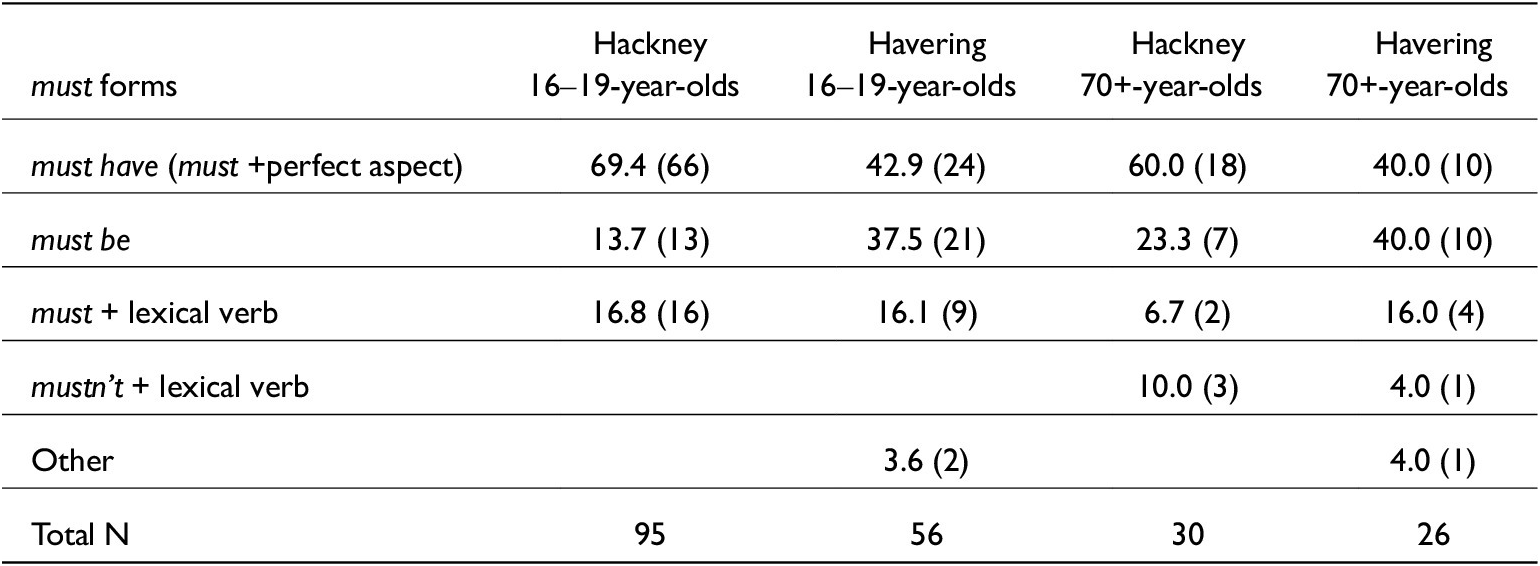
Table 1 shows the distribution of different must forms in the speech of older and younger people in the Linguistic Innovators corpus.
Percentage (N) must patterns used in the Linguistic Innovators corpus

There are three main patterns: modal must plus perfect aspect (must have V-en) as already seen in (2), (3), (4), (7), (9) and (10), must plus be, with be used either as a copula (11) or, more rarely, to form the progressive tense (must be V-ing, as in (12)), and must or, occasionally, mustn’t with a following lexical verb, as in (13) and (14); see also you must have a white shirt in (6), where have is a lexical verb.

In addition, must or mustn’t occasionally occurred alone in a tag question as in (15).

In Havering (the outer-city location), must have and must be are the most frequent must forms, for both older and younger speakers, used with approximately the same frequency. This conforms to the general pattern of use of must forms in British English: in the spoken component of the British National Corpus, the proportions of must have and must be relative to other must patterns are of approximately the same order of magnitude (34.5 per cent versus 34.1 per cent respectively). In Hackney, on the other hand, must have is the most frequent form for both the older and, especially, the younger group. The difference between the relative proportions of must have and other must forms in the speech of young speakers in Hackney and young speakers in Havering is statistically significant (chi square value with Yates correction 9.2902, df 1, p-value 002306, p<.01). For older speakers in these locations the difference does not reach significance (note, though, that the number of tokens is low for these groups).
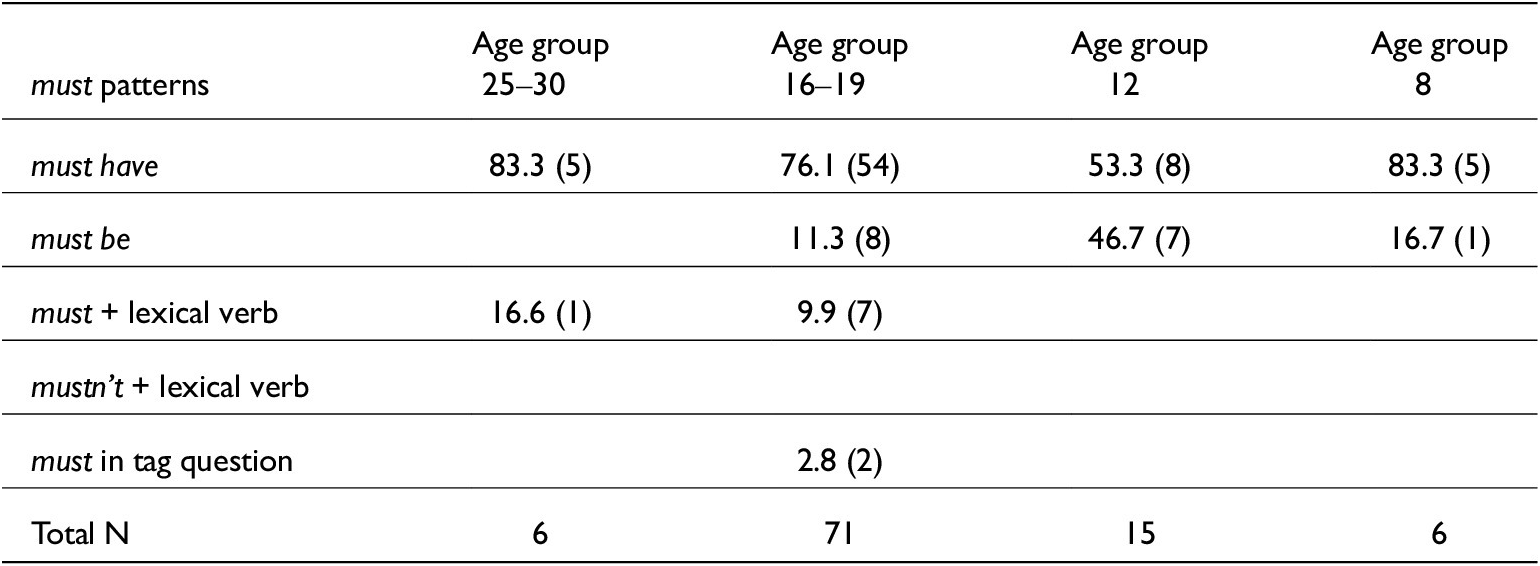
Speakers in Havering did not use MLE features. Table 2 now shows the distribution of must patterns in the speech of the different age groups represented in the MLE corpus, all of whom were speakers of Multicultural London English.
Percentage (N) must patterns in the Multicultural London English corpus
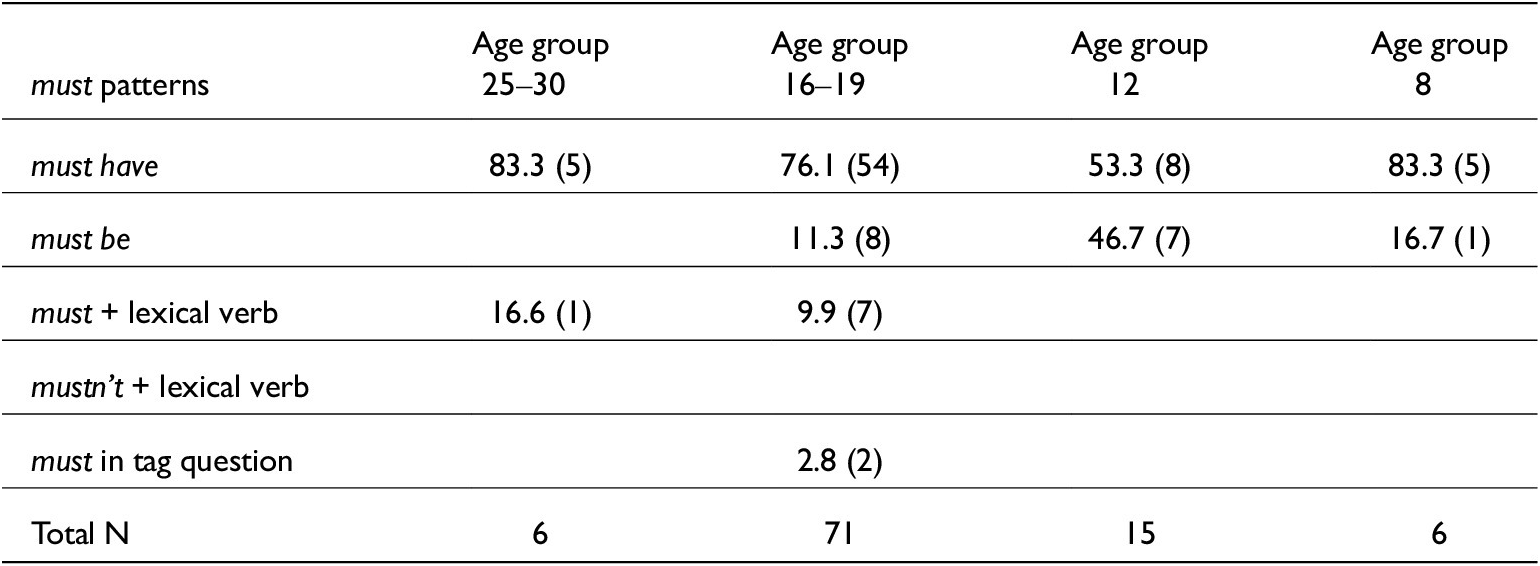
More speech was recorded for the 16–19-year-old group than for other age groups, so it is only the 16–19-year-old age group for which the figures are reliable. Nonetheless, it is worth noting that the most frequent must form for all age groups is must have. For 16–19-year-olds must have represents an even higher proportion of their total must forms than for 16–19-year-old MLE speakers in the earlier Linguistic Innovators corpus (76.1 per cent versus 69.4 per cent), though the difference is not statistically significant.
Overall, then, must have occurs more often in the speech of MLE speakers than other speakers (and perhaps also amongst older speakers in Hackney, who are speakers of traditional London English). We argue in section 5 that this is relevant in accounting for the development of the new meaning.
4.2. Meanings of must and must have
We next analysed the meaning of the different must forms in the two corpora. The new direct evidential meaning occurs only with must have, and almost exclusively in the speech of the 16–19-year-old MLE speakers, in both corpora (just two tokens of direct evidential must have are uttered by a single speaker aged 25–30). Our main focus from now on, therefore, will be the use of must have in the speech of the 16–19-year-olds in the two corpora.
We first note, however, that twelve must forms in the two corpora express deontic meanings. Two were uttered by 16–19-year-old speakers in Havering (the earlier example (6) was one of these) and ten by speakers aged over 70 (five speakers in Hackney and five in Havering (one is the earlier example (4)). We take this age distribution and the low numbers as confirmation of the general declining use of deontic must in present-day English. It means that apart from the new meaning conveyed by must have, the majority of must forms in the corpora express epistemic/indirect evidential meaning.
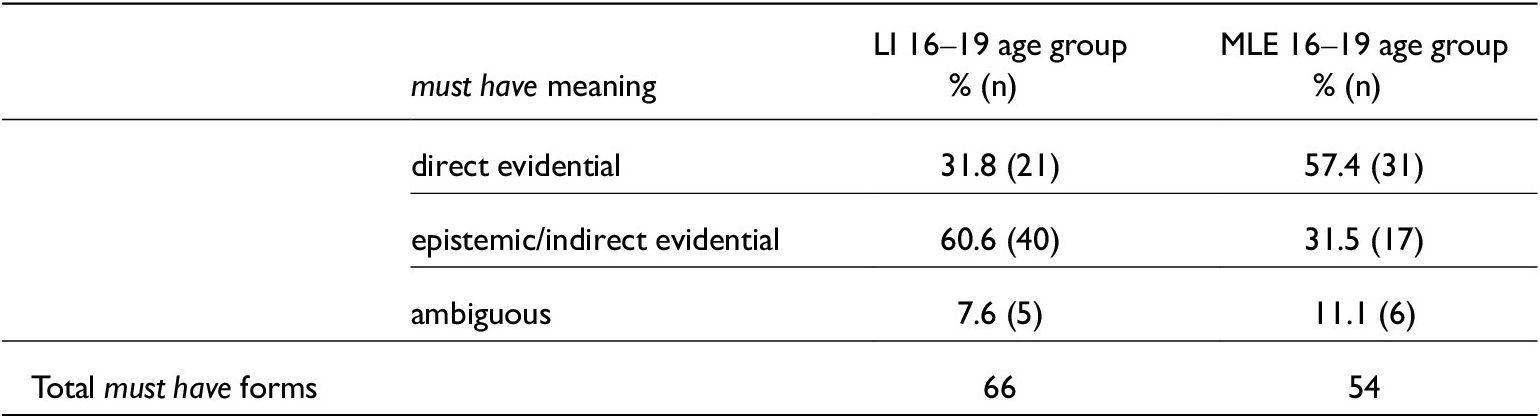
Table 3 shows the relative frequency of the direct evidential meaning of must have in the speech of 16–19-year-olds in the two corpora, together with the relative frequencies of clearly epistemic/inferential meanings of must have and of ambiguous meanings which, as mentioned earlier, we assume represent bridging contexts.
Meanings of must have for 16–19-year-olds: Linguistic Innovators (LI) and Multicultural London English (MLE) corpora
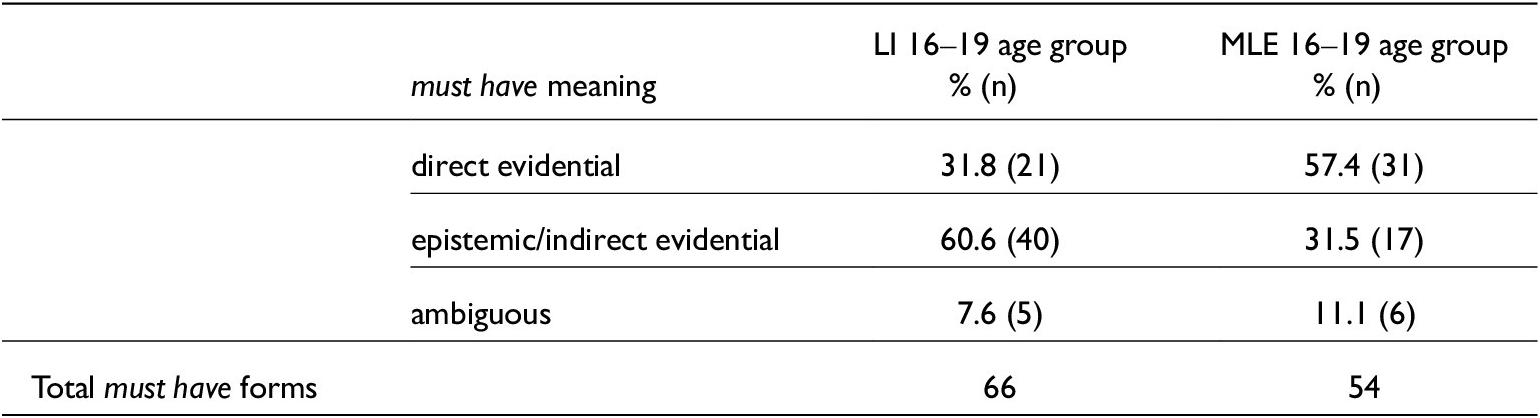
It is striking that direct evidential meanings for must have are nearly twice as frequent in the later MLE corpus than the Linguistic Innovators corpus (57.4 per cent versus 31.8 per cent), a statistically significant difference (chi square value with Yates correction 6.9121, df 1, p-value .008561, p<.01). For 16–19-year-olds in the later corpus these meanings, together with meanings that are ambiguous, are now more frequent than the initial epistemic/indirect evidential meaning of must have. Although the recordings for the two projects were only three or four years apart, the increase in the new meaning of must have during this period may indicate that it is stabilising amongst MLE speakers.
Although the data contain roughly equal amounts of speech from male speakers and female speakers, must have with a direct evidential meaning almost always occurs in the speech of young men. Between them, six young men in the Linguistic Innovators corpus produced twenty tokens of must have with this meaning, while only one token was uttered by a young woman. In the MLE corpus, thirty tokens were uttered by six young men with, again, just one token from a young woman. We do not know at present how to satisfactorily explain this pattern. Since we do not have space to consider it further here we simply note the distribution.
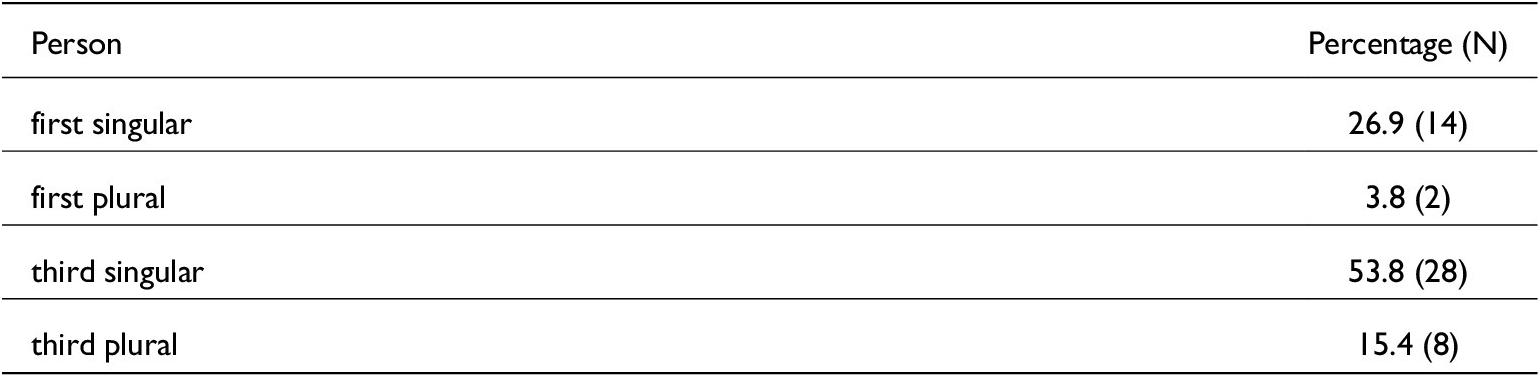
There is an assumption in the literature that evidential meanings are used most often in third-person contexts (see, for example, Aikhenvald Reference Aikhenvald and Aikhenvald2018: 27), although as Bergqvist & Grzech (Reference Bergqvist and Grzech2023: 27) point out, this assumption is rarely supported by frequency counts and in any case the grammatical subject will depend on contextual factors. Table 4 shows the grammatical subjects of the direct evidential forms of must have in our data.
Percentage (N) grammatical person of must have with direct evidential meaning
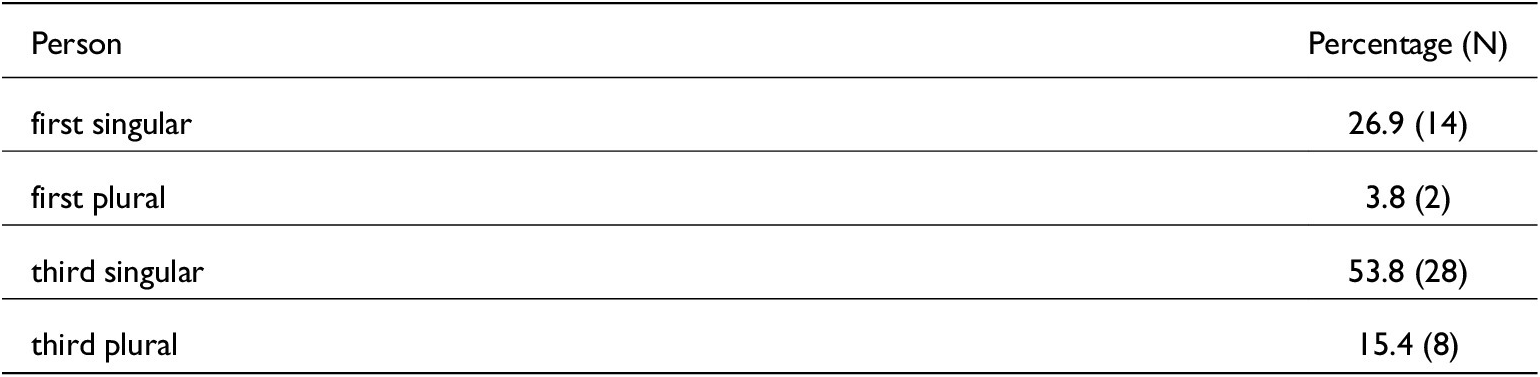
Evidential must have does indeed occur more often in third-person contexts, but a close examination of the discourse context found that seven of the 36 third-singular and plural subjects refer to actions performed by or to close friends or family of the speaker, as in (7) above, and that the remaining 29 third-person subjects occurred in narratives recounting events in which the speaker was directly involved. For example, (16) occurs in a narrative about an occasion when Leon and his friends were misbehaving at school in an empty classroom and were discovered by a teacher. Example (17) is part of a story about a fight between Jake and a young man from a rival gang.

In the following section we consider in more detail the interactional contexts in which direct evidential must have occurs.
5. Interaction
We mentioned in section 1 that the recent emergence of the direct evidential meaning of must have provides an opportunity to understand how semantic changes emerge during spoken interaction. In this section therefore we consider some examples to illustrate why speakers may have chosen to use must plus perfect aspect rather than a ‘neutral’ form that simply refers to past time. Although we were not always able to attribute a motivation to the speaker’s use of must have, wherever possible we used the discourse context to guide our interpretations of the rhetorical effect of using must have in a new way. Nonetheless we accept that our interpretations in this section may be open to discussion.
First, we note that every one of the direct evidential meanings occurs in a section of discourse where the speaker is recounting a personal narrative of past experience. To an extent this is unsurprising, since must have is typically used as the past tense of must, but speakers refer to past time in other text types too, without using must have, and narrative texts do not occur more frequently than other text types in the corpora. Furthermore, other MLE innovations are distributed across different text types. Cheshire, Adams & Hall (Reference Cheshire, Adams and Hall2024), for example, analysed utterance-final still in the same corpora we analyse here. They found the innovative meaning emerged in discussions, opinions, explanations and factual texts as well as in narratives, with narratives the least frequent text type for this feature.
We do not know of other research documenting the emergence of a direct evidential, but it seems possible that direct perception evidentials typically develop in narratives of personal experience because speakers must tap into their own memories of events they have experienced. Other text types tend to involve more general types of knowledge or subjective stances. Additionally, in narratives speakers typically express their involvement and emotional response to the events they are relating (Chafe Reference Chafe and Tannen1982; Bruner Reference Bruner1986; Tannen Reference Tannen1989; Brown & Tagliamonte Reference Brown and Tagliamonte2012, amongst others), so forms that allow them to do this may be particularly likely to emerge in narrative contexts. Brown & Tagliamonte (Reference Brown and Tagliamonte2012), for example, found innovative intensifiers emerged first in narrative discourse before spreading to non-narrative discourse. Labov (Reference Labov1994: 158) writes with respect to sound change that in his interview data the most advanced tokens characteristically appeared in emphatically stressed words in personal narratives. Evidentials can also express speaker involvement (De Haan Reference De Haan, Dryer and Haspelmath2013) since, like deictics, they mark the place of the speaker in the event they describe. Whereas indirect evidentials distance the speaker from the event, direct evidentials place speakers firmly in the same sphere as the event (De Haan Reference De Haan, Tsangalidis and Facchinetti2009).
A further reason for the emergence of direct evidential must have in narratives could be that the form highlights the present relevance of the past event to which the speaker refers. Depraetere & Reed (Reference Depraetere, Reed, Aarts, McMahon and Hinrich2021) argue that must have with its conventional epistemic/indirect evidential sense expresses the speaker’s subjective viewpoint on the basis of an inference they make in the present time about an activity that is temporally located in the past. Must have with direct evidential meaning, similarly, refers to the speaker’s mental processes in the present time whilst simultaneously referring to a past event. We saw earlier that must have with an indirect evidential meaning is the most frequent form of must heard by young people living in Hackney. Their familiarity with the use of indirect evidential must have to link a past event to the present conversation may influence them to also use the form with a direct evidential meaning.
Blending the past and the present in this way can add drama and a performance element to a narrative. It is a well-known function, for example, of the conversational historic present tense which, rather similarly, refers to a past event with a present tense verb (Wolfson Reference Wolfson1978: 217). In several narratives we observed speakers using the innovative meaning in a way that seemed to add drama to key moments in their narratives. In (2), for example, must have with its new meaning occurs at the beginning of a narrative that makes an important social point. It is well known that narratives are complex discourse events, allowing speakers to construct, display and reinforce their desired sense of self (Schiffrin Reference Schriffrin1996), and to structure and make sense of their everyday life experiences (Labov & Fanshel Reference Labov and Fanshel1977). Seen in this way, the narrative with which (2) begins allows the speaker, Alex, to make sense of the violent and dangerous experiences that young men from the local areas encounter on a daily basis, in particular about when it is necessary and acceptable to use violence. We suggest that Alex uses a form with an innovative meaning at the start of his narrative in order to ensure that his addressees pay special attention to what he is about to recount. It may also allow him to take the floor for long enough to tell his story without interruption. We repeat the example as (18), this time including a little more of the interaction between Alex and his friend Zack, and dividing the interaction into three sections. The narrative is not concluded because the young men digress into a discussion justifying the use of violence.

In the first section, which we saw in section 1, Alex presents key information that will ultimately justify his use of violence, showing that he was trapped in the chicken shop where he was eventually stabbed. His first must have is the third of a series of clauses in the section of his story where he sets the scene. He begins simply with I was there, then gives more specific information – I was in the chicken shop – and then elaborates further using must have (I must have been in the chicken shop eating my chicken wings). We suggest that using must have with a new, unexpected meaning draws his addressees’ attention to the third clause, where Alex not only stresses where he was (by repeating this information for a third time) but also emphasises his innocence: he was simply doing what you might expect any person in a chicken shop to do – eating his chicken wings. He then explains, again using must have with its new meaning, that he saw some rival gang members and that because they also saw him, he was unable to leave. Here he is not simply telling a story about what happened in the chicken shop but staging the fact that seeing a rival about to enter the shop triggered a reaction within him, so that he had to do something. This section of the narrative, and these interactional moves in particular, portray Alex as both innocent and in trouble – he was trapped, unable to go anywhere. They are important moves because they justify what Alex goes on to recount in the second section of the narrative: he had no alternative but to ask the man in the shop to lend him a knife.
By using must have with an innovative meaning, Alex ensures that his addressees pay special attention to these important moves, as well as involving them in the discourse and adding drama to his story. In the third and final section of the interaction, he explains further his reason for wanting the knife: if necessary, he would kill someone in self-defence. Note that his friend Zack agrees (obviously you have to). Together, then, the two friends have established that violence is sometimes justified, particularly in danger of death situations where there is no alternative but to defend yourself. The narrative shows that there is a morality governing the use of violence in the peer group street culture, and the two young men present themselves as moral people. Perhaps Alex’s judicious use of must have with a new meaning helps to guide listeners to make these kinds of interpretations.
The narrative in (19), also from Alex, illustrates a further aspect of the morality governing violent behaviour in his peer group. He relates an occasion when members of a rival gang boarded the bus in which he was travelling. They first stole some money from him and then stole a bus pass from one of the young boys from Alex’s neighbourhood. Again we divide the narrative into three sections. This time direct evidential must have occurs in the middle of the narrative.

In the first section Alex describes his reaction to the gang stealing his money: he decided that the amount involved was too trivial to be worth fighting about. Must have in the second section highlights the fact that as a result the gang members took his money. It also marks an important juncture in the story, between an occasion when it was not worth getting into a fight, and the occasion he goes on to report when, on the contrary, Alex invited the gang to attack him (“do whatever you gotta do to me”). His reported speech in this section makes it clear that older boys must defend younger boys from their neighbourhood, and that violence should involve only young men of the same age (and size).
The young men whose speech was recorded felt strongly that despite the violent and often criminal activities of their local street culture, they were doing their best to be moral, good people. They knew, however, that their behaviour was often misunderstood. Alex and Zack’s digression at the end of the unfinished narrative in (18) went on to include a discussion of the point that if they killed someone in self-defence they would own up and go to prison because they would have deserved the prison sentence, but that no one would recognise that by doing so they were behaving honourably. They conclude their discussion with (20):

No wonder, then, that they choose to draw attention to key moments in their narratives that will demonstrate the morality of their behaviour. In terms of the definition of evidentiality we have worked with in this article, Alex claims epistemic authority on the basis not only of his direct experience of the events he describes but also of his internal belief that he is an honourable person and of the nature of his social world, in which there is a moral dimension that others do not recognise.
A third example illustrates how the direct evidential meaning of must have may have developed from the original epistemic/indirect evidential meaning. It occurs in a context where the conventional meaning of must have makes sense in that it could refer to the speaker’s lack of complete certainty about the events he recounts, but where the context indicates that in fact the speaker is completely certain. In (21), Tau is talking about his experiences on an occasion when he had been arrested by the police. He had been recounting being hit by five police officers during the night he spent in a cell at the police station, and explains in (21) that this was because he had broken the camera in the ceiling of the cell that allowed officers to monitor their prisoners.

Tau hedges the extent of the damage to the camera with a bit. His must have could be understood as signalling his lack of certainty about whether the glass had cracked, but the rest of the utterance makes it clear that the damage involved more than just a small crack in the glass, and that Tau knows full well how much damage he had done (the bad thing I did .…. that’s the thing that got me in big trouble). Presumably his addressees also knew this (since he told them he was in ‘big trouble’). In this context it seems that must have introduces a stylistic effect of irony.Footnote 5 Must have in its conventional sense could indicate that the speaker is evading responsibility for his action, but since the context makes it clear that he accepts that he did a ‘bad thing’ he is in fact using must have with a direct evidential meaning, claiming knowledge and taking responsibility for the event. It is not unusual for linguistic forms with an indirect evidential meaning to be used in this way. Mishun (Reference Mushin2013: 632) describes how in Wanka Quechua, a language with obligatory morphological markers of evidentiality, the indirect evidential marker is used to express irony in a context where speakers clearly have direct evidence. This is one reason, she argues, why information source is an inadequate characterisation of evidential meaning.
We suggest that the new meaning of must have may first develop in contexts such as (21) where, although the discourse context makes it clear that only the new meaning is intended, the clash of potential meanings results in a pragmatic overlay of irony, sarcasm or humour. The next step is for must have to occur in bridging contexts such as (10), where both the original meaning and the new meaning make sense. As the new use generalises, speakers use direct evidential must have in contexts such as (18) and (19), where the original meaning is no longer possible and the pragmatic effects are lost, although the new meaning is still unusual enough for addressees to pay special attention to the stretch of discourse in which it occurs and for speakers to use it for rhetorical effect. We assume that if must have becomes used more frequently with the new meaning, speakers will begin to use it in non-narrative text types.
6. Conclusions
We conclude with brief mention of what we see as three broad implications of our analysis.
First, we found that the new meaning of must have in MLE fits straightforwardly with treatments of evidentiality by linguists analysing language within a discourse perspective. Our analysis lends support to the view that the classic definition of evidentiality in terms of information source is too narrow to explain the expression of evidentiality in spoken interaction. A broader definition in terms of epistemic authority, in Bergqvist & Grzech’s more inclusive sense (Reference Bergqvist and Grzech2023: 2), was better able to characterise the new meaning of must have in our data.
Secondly, our analysis confirms Mélac’s argument that the expression of evidentiality in English is not purely lexical. We found that not only indirect but also direct evidentiality is encoded in the grammar of at least one variety of English. Although English does not fit with traditional approaches that see evidentiality as a ‘verbal category in its own right’ (Aikhenvald Reference Aikhenvald, Heine and Narrog2011: 606) with evidential meanings conveyed obligatorily by special forms, it can be included as one of the languages said by Lazard (Reference Lazard2001: 360) to ‘occasionally’ express these meanings by forms whose central meaning is something else. Lazard assumes that such languages do not yet possess a grammatical evidential category but that they are on the way to grammaticalising one. We would not go so far as to propose that English will eventually possess a grammatical evidential category. Some (but by no means all) of the innovative MLE features used in the data we analyse have already disappeared. But whether or not the new meaning of must have survives in MLE, its emergence endorses Mélac’s argument that English shows the force of evidentiality to attract forms towards the grammatical end of the lexical–grammatical continuum (Mélac Reference Mélac2022: 334–5).
Finally, we have been able to document the early stages of a semantic change. We see the emergence of a direct evidential meaning for must have as a change that was waiting to happen, since it represents a further step in the history of must along a well-attested semantic pathway whereby meanings become increasingly based in the speaker’s subjective belief state or attitude towards the proposition they are expressing (Traugott Reference Traugott1989: 39–45).We assume that well-attested pathways of change such as this are related to general human cognitive processes of invited inferencing, as described by Traugott & Dasher (Reference Traugott and Dasher2002). Speakers invite their addressees to draw on inferences (conscious or unconscious) that are available and recurrent in the community. This happened roughly one thousand years ago when epistemic/indirect evidential meanings developed from deontic meanings of must, and it now seems to be happening again with the development of direct evidential meanings from the epistemic/indirect evidential meanings.
Space has allowed only three illustrations of the discourse contexts in which must have is used with its new meaning, but they confirm Traugott & Dasher’s assumption that speakers draw on existing meanings of a word to innovate a new use for a specific communicative purpose. The new meaning must be sufficiently close to the original meaning for addressees to be able to infer what is meant, but the unusual use means that addressees pay special attention to the discourse and may, as in (21), infer an additional pragmatic function.
The literature shows that evidential grammatical categories derive from a large number of different linguistic forms (Aikhenvald Reference Aikhenvald, Heine and Narrog2011; Friedman Reference Friedman and Y. Aikhenvald2018; Mélac & Bialek Reference Mélac and Bialek2024) but it is often mentioned that indirect and, sometimes, direct evidential markers in many different languages develop from tense–aspect forms, including perfect forms (see, for example, Aikhenvald Reference Aikhenvald, Heine and Narrog2011: 611; Lazard Reference Lazard2001: 363; Friedman Reference Friedman and Y. Aikhenvald2018: 145). An example rather similar to must plus perfect aspect in MLE occurs in Eastern Armenian, which Lazard (Reference Lazard2001), citing Kozintseva (Reference Kozintseva1995), describes as keeping the traditional uses of the perfect but as also expressing evidentiality. We do not know of any studies other than our own that suggest a pathway from epistemic/indirect evidential meanings to direct evidential meanings, but research on the historical development of the expression of evidentiality mostly considers morphological markers of evidentiality, and considers evidentiality in the narrow sense of information source. However, the references in this article illustrate a growing number of studies of evidentiality in a discourse context, in many different languages, some of which take a historical perspective (for example, Bergqvist Reference Bergqvist2023). We hope that more will follow, and that they will uncover further pathways of change in this semantic domain.


 Open access

