


The phenomena of excess weight and obesity are prevalent and their prevalence continues to increase. Environmental factors contribute to the obesity epidemic through promoting energy intake and limiting opportunities for energy expenditure(Reference Swinburn, Eggar and Raza1). A strong environmental factor influencing energy intake is food portion size(Reference Matthiessen, Fagt and Biltoft-Jensen2–Reference Steenhuis and Vermeer6).
A substantial body of evidence shows that people’s energy intake increases when they are offered larger portions(Reference Steenhuis and Vermeer6). The effects of at least 30 % higher consumption levels due to portion size are frequently reported(Reference Dilliberti, Bordi and Conklin7–Reference Wansink, Painter and North13). The effects have been shown for a variety of foods, such as macaroni(Reference Rolls, Morris and Roe9), pre-packaged snacks(Reference Rolls, Roe and Kral14), beverages(Reference Flood, Roe and Rolls15) and popcorn offered in a cinema setting(Reference Wansink and Park11). This also applies to foods with an unfavourably perceived taste, such as stale popcorn(Reference Wansink and Kim12). Furthermore, research has shown that the effects of portion size on energy intake can persist at least over several days, with no indication of meal-to-meal compensation(Reference Rolls, Roe and Meengs16, Reference Rolls, Roe and Meengs17).
It is widely assumed that food portion sizes have increased during recent decades. Combined with the evidence on how portion size affects energy intake, this trend is harmful from a public health perspective. However, research regarding the actual development of food portion sizes is scarce. Studies have been conducted in the USA(Reference Nielsen and Popkin3–Reference Young and Nestle5, Reference Young and Nestle18), the UK(Reference Wrieden, Gregor and Barton19) and Denmark(Reference Matthiessen, Fagt and Biltoft-Jensen2). Young and Nestle(Reference Young and Nestle5) showed that the portion sizes of numerous foods offered in the USA have increased, and that current sizes of, for example, French fries, hamburgers or soda are two to five times larger than the original sizes. They also illustrated that since the 1970s, there has been a tremendous increase in the number of available ‘large’ and ‘super’ sizes. Food portions in the USA tend to be larger than in Europe; however, portion sizes have also increased in Europe(Reference Matthiessen, Fagt and Biltoft-Jensen2, Reference Rozin, Kabnick and Pete20). A study conducted in Denmark showed that portion sizes of particularly high-energy-dense foods and beverages such as chocolate bars, ice creams, and sugar-sweetened beverages have increased during the past decades. In parallel to this trend, sales of these foods and beverages have sharply increased(Reference Matthiessen, Fagt and Biltoft-Jensen2). Finally, a study conducted in the UK confirmed the increased availability of king and giant sizes, and increasing portion sizes, especially in fast-food chains(Reference Wrieden, Gregor and Barton19).
As mentioned, only a very limited number of studies are available concerning the development of portion sizes and the presumed increase in portion sizes in Europe. In The Netherlands, there is a complete lack of evidence, although it is often assumed in the public health debate that portion sizes have increased in The Netherlands as well. The present study aims to describe trends in portion sizes in The Netherlands during past decades.
Methods
Product selection
A total number of twelve products were selected by the research team for inclusion in the study. To be included, a product had to be a high-energy-dense product, because these can easily lead to an overall increased energy intake(Reference Swinburn, Eggar and Raza1) and previous research conducted outside The Netherlands has shown that especially portion sizes of foods that are high in fat and/or sugar tend to increase over time(Reference Matthiessen, Fagt and Biltoft-Jensen2–Reference Young and Nestle5). Further criteria were that products had to be generally well-known and consumed frequently in The Netherlands. Based on these criteria, four products in fast-food restaurants were selected (burgers, croquette, French fries and milkshake); five products sold in supermarkets (sugar-sweetened soft drink, beer, crisps, pizza, cheese slices); and three products sold as single servings in various point-of-choice settings (confectionery bars, two types of large biscuit). Then, two popular brands of each product were selected using the most recent available public market-share data from The Netherlands (2003)(Reference Bijman, Pronk and de Graaff21). For large biscuits, only one brand was selected, because the market leader in that segment was the best-selling brand by far.
Data collection
Information on the portion sizes of the selected products was obtained by various means. First, the manufacturers of the selected foods were contacted directly by email or telephone and were asked to provide the information needed (i.e. product weight/volume and portion size portfolio in 2008, year of introduction and termination of the product in The Netherlands, and changes made in weight/volume in the last decades). Second, professional journals, marketing and the manufacturers’ advertising and websites were consulted. Around half of manufacturers could not provide the information, either because they did not have it or were unwilling to disclose it. Finally, after the data collection was complete, manufacturers were contacted again by email to allow them the opportunity to respond to the information gathered from alternative information sources. Five manufacturers made use of this opportunity and confirmed the information collected.
Results
Obtained data
We were able to obtain data on eight food products (see Table 1). For four products (French fries, milkshake, pizza and beer), only the product weight/volume and portion size portfolio in 2008 could be obtained; past information was unavailable. These data are not further reported. For the remaining eight products, data for both selected brands was available for all products except cheese, on which data concerning only one of the two selected brands was available. For some products, the exact year of introduction could not be identified.
List of products studied

Trends in food portion sizes
The results obtained from comparing the data between food products currently available and those same products sold in earlier years revealed several trends in portion sizes. First, an increase in the variety of portion sizes in the product assortment could be observed. A second trend was the enlargement of portion sizes of some products. Third, an increase in the number of products contained in multi-packs was established.
The increase in the variety of portion sizes in the product assortment can be demonstrated by the example of Coca-Cola (see Table 2). The 0·75 litre family bottle was introduced in The Netherlands in 1957. Since then three larger sized multiple-serve bottles were introduced. In 1968 the 1 litre bottle became available; 10 years later the 1·5 litre bottle was added to the assortment. Subsequently, the 2 litre bottle was introduced in 1985 and sold nationwide in 1993. All family bottle sizes are still available, except for the 0·75 litre bottle which was no longer available after 1975.
Introduction of new sizes in soft drinks

*No longer available in The Netherlands, year of termination 1975.
†First introduced in 1985, but sold nationwide in 1993.
‡First introduced in The Netherlands during the 1928 Olympic Games, from 1930 onwards Dutch Coca-cola enterprise.
§No longer available in The Netherlands, year of termination 1976.
||In 1966 solely used in vending machines; withdrawn from the Dutch market by 1972. Available again from 1983 to 1989; and again from 2008 onwards.
¶Mostly only available in multi-packs.
**No longer available in The Netherlands, year of termination 1968.
††No longer available in The Netherlands, year of termination unknown.
Within the single-serving bottle and can segment of Coca-Cola, some varieties have been introduced. The 0·5 litre bottle, for example, was added in 1981. In 1992, a smaller can of 0·15 litres was introduced as well, mostly only available in multi-packs. We can see that not only has the size of the bottles available become larger overall, but also that the number of different bottles and cans available has increased. The other brand included, Pepsi Cola, showed a comparable trend. However, the 2 litre bottle of Pepsi Cola, which was introduced in 1993, is no longer available in The Netherlands. The trend of increasing the portion size portfolio is also noticeable in the fast-food industry. Introductions of new burgers in the two largest fast-food companies in The Netherlands show an increase in the variety of burgers, with newly introduced burgers being up to three times larger than the burgers originally introduced (see Table 3).
Introduction of new burgers at McDonalds and Burger King
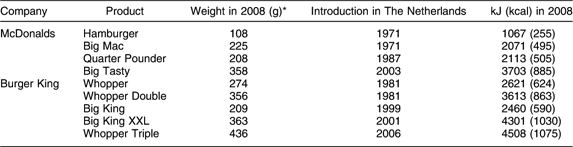
*No information is available about the weight of the products at the year of introduction.
The second trend that was found is an increase in the portion sizes of a number of products over recent years. Thus, the product sold originally has been replaced by a larger variant. This applied to a number of products available in the supermarket. Family bags of Smiths potato chips, for instance, have increased from 75 g in 1990 to 110 g in 2008. For most of the products studied, a combination of the two trends described above was indicated. That is: the portion size portfolio was enlarged with new portion size varieties, and the smallest product in the assortment has been either replaced with a larger option or has been dropped from the assortment. This combination of trends can be observed in the data of Lays potato crisps, for example (see Table 4). In 1987 a family bag weighed 175 g. This 175 g bag was later removed from the assortment, while larger bags were added, resulting in a present range of three (200 g, 225 g, 300 g) family bags of potato crisps to choose from. Another example is packaged sliced cheese. A larger package of 400 g was added to the assortment, and the weight of the original package increased from 170 to 190 g. At the same time, the weight of the single slices within the package also increased (see Table 4).
Trends in portion sizes of different products available in supermarkets

*No longer available in The Netherlands.
The development of larger portion sizes was not seen in all products. Single confectionery bars, available at different point-of-choice settings, underwent slight changes in weight over the years (see Table 5), with smaller sizes in 2008 than in 1991 (7 g smaller). Some products have not changed with regard to portion size over the years. The croquette (Febo), a popular snack in The Netherlands, weighed 100 g when introduced in 1941 and still weighs the same today. A large biscuit, pre-packed in a single-size serving weighed 100 g fifteen years ago, and still remains the same (see Table 5).
Trends in single-serving portion sizes of different products available in different point-of-choice settings

*Apart from the regular size Mars and Snickers, a king size was introduced in 1994. This was turned into a two-pack in 2006. Weight in 1994 unknown. Currently, the Mars two-pack is 70 g and the Snickers two-pack is 80 g.
†No longer available in The Netherlands.
The third trend observed indicates that the multi-packs of the studied products have increased in size (see Table 6). Overall, the total weight and number of items in multi-packs have increased considerably, while the weight of the separate items has decreased slightly. For instance, the Lay’s multi-pack with single-serving bags of crisps was reduced in weight by 2·5 g per bag between 1990 and 2008. The number of bags in the multi-pack, however, was increased from six to fifteen bags, meaning that the total weight of the multi-pack increased by more than 200 %. The same effect had occurred with the Mars multi-pack, and the weight of the multi-pack had increased by 45 g.
Trends in multi-packs

*No longer available in The Netherlands.
Discussion
The aim of the present study was to describe food portion size developments in The Netherlands. A number of trends were observed, all indicating an increase in portion sizes of energy-dense food products during the past decades. Larger sizes have been added to the portion size portfolio. Also, the portion sizes of a number of products have increased since their introduction, although this did not apply to all the products included. For example, single confectionery bars became slightly smaller. Most likely, this is due to the fact that prices of commodities have risen, and by decreasing the size, the same market price could be maintained (oral communication, anonymous). Finally, multi-packs have been introduced and the number of items contained in multi-packs has also increased. Our findings are in accordance with studies into the development of portion sizes in other countries, which also found a general increase in portion sizes(Reference Matthiessen, Fagt and Biltoft-Jensen2–Reference Young and Nestle5, Reference Young and Nestle18, Reference Wrieden, Gregor and Barton19).
The extension of the portion size portfolio seems to enhance the freedom of choice of consumers. However, often larger portions are made attractive by offering more value for money, i.e. having a lower price per unit (value size pricing instead of proportional pricing)(Reference Steenhuis and Vermeer6, Reference French22, Reference Wansink23). In this way, consumers are steered towards larger portions(Reference Steenhuis and Vermeer6, Reference French22, Reference Wansink23).
Further, the observed increase in portion sizes of energy-dense food products may contribute to higher energy intake levels and thereby cause weight gain. For instance, the calorific value of a slice of 48+ cheese increased by 142 kJ (34 kcal), from 377 kJ (90 kcal) in 1983 (24 g slice) to 519 kJ (124 kcal) in 2008 (33 g slice; same product composition assumed). This represents an increase of 38 %. To add another example, the difference in energy between 330 ml of cola and 500 ml is 276 kJ (66 kcal), 540 kJ (129 kcal) v. 817 kJ (195 kcal), which is of relevance in the case of repeated consumption.
Although the size of sub-items in multi-packs seems to have decreased (−2·5 g for crisps and −9 g for a Mars confectionery bar), the number of items within a multi-pack increased noticeably, and thereby their total weight as well. For instance, the number of items in a multi-pack of crisps more than doubled. Earlier research has shown that having more food in stock (as is the case with large multi-packs) leads to higher consumption levels(Reference Wansink24). Another aspect of the multi-packs is that they may undermine self-control mechanisms. A study by Coelho do Vale et al. showed that more self-regulatory mechanisms are activated when confronted with one larger package compared with multiple single-serving packages(Reference Coelho do Vale, Pieters and Zeelenberg25). In this respect, it is also worth mentioning a new trend that is emerging in The Netherlands: 419 kJ (100 kcal) snack packages. These packages are being introduced as a way to promote self-control and help people regulate their energy intake. However, since these 419 kJ (100 kcal) packs are typically available in multi-packs, it seems questionable whether they will regulate consumption levels or, once again, increase consumption levels. More studies into the way people use these packages is needed.
The trends observed may be harmful from a public health perspective, as they could lead to higher energy intake levels. Although they may meet the wishes of consumers and benefit food producers and retailers in the short term, larger portion sizes could have a negative influence on brand appreciation in the long term because of this threat to public health(Reference Taylor Quilliam26). However, short-term benefits now seem to be prevailing over long-term consequences and societal consequences as well.
This was the first Dutch study into developments in portion sizes. The results should be interpreted with caution because of two factors. First, only a small range of products was included in our study, and no data could be obtained for some products. Research into more products and a wider range of products is recommended; for instance, ready-to-eat meals could be included. Also, studying these trends in a larger variety of settings is recommended, such as for example restaurants. Second, we were dependent on secondary data sources for a considerable amount of the data, such as marketing material. The data obtained through these secondary sources seems to be accurate, however, as some of the manufacturers confirmed the data when it was presented to them. Despite these limitations, the data revealed some interesting trends in food portion sizes during recent decades in The Netherlands. With that, it provides evidence to be used in the public health debate regarding excess weight and obesity. Since food portion sizes are still changing and new trends are developing, it is recommended that these changes be monitored carefully and that their effects on food intake be studied.
Acknowledgements
This work was supported by ZonMW (the Netherlands organization for health research and development; 61300033). There are no conflicts of interest. I.H.M.S., F.H.L. and W.M.V. designed the study. I.H.M.S. wrote the introduction and discussion and edited the methods, results and tables. I.H.M.S. also supervised the whole study. F.H.L. collected the data and wrote the methods, results and tables. W.M.V. supervised data collection and commented on the draft article.



