



The nutritional value and quality of the Brazilian peoples’ diet have deteriorated over the last few decades(Reference Monteiro, Levy and Claro1–Reference Louzada, Martins and Canella6): the consumption of ultra-processed food increased, while the intake of unprocessed and minimally processed food decreased(Reference Martins, Levy and Claro4). Simultaneously, the number of overweight and obese people increased in the country; in 2019, 55·4 and 20·3 % of the adults living in Brazilian capitals were, respectively, affected(7).
To understand the reasons for these dietary changes, studies have focused on the influence of the food environment on individuals’ food consumption and nutritional patterns(Reference Perez-Ferrer, Auchincloss and de Menezes8,Reference Turner, Kalamatianou and Drewnowski9) . The food environment is defined as the consumer’s interface with the food system that encompasses the availability, affordability, convenience and desirability of foods(Reference Glanz, Sallis and Saelen10–Reference Downs, Ahmed and Fanzo12). With internet access eased greatly by mobile phones and changes in the lifestyles of urban populations, some features of the food environment have been digitalised. The digital food environment goes beyond social media, digital health promotion interventions and digital food marketing and covers food delivery apps as well(Reference Granheim, Opheim and Terragni13).
In Brazil, a few studies have assessed the food environment,(Reference Mendes, Nogueira and Padez14–Reference Menezes, Costa and Oliveira17) but none have described food availability through food delivery apps. In Brazil, in 2017, one in every three internet users had downloaded a food delivery app on their smartphones(18). Almost half the app users (49 %) are from least disadvantaged groups, whilst 44 and 7 % are from the middle and most disadvantaged groups, respectively(19).
People use these apps to order food mostly when they are at work, unwilling to go out, lack of time/skill to cook, are attracted by sales promotions and/or are experiencing bad weather(Reference Maimaiti, Zhao and Jia20). The main attraction of food delivery apps is their practicality and convenience, enabling the purchase of food without having to leave the house or workplace(Reference Yeo, Goh and Rezaei21). Although traditional telephone ordering remains a common method of ordering food(Reference Yeo, Goh and Rezaei21), food delivery apps are more convenient and user-friendly as the desired items can be selected and ordered easily through the mobile app, which are then delivered in a short time(Reference Maimaiti, Zhao and Jia20).
These apps also use various marketing strategies to boost sales, such as price discounts, combos and free shipping. They make direct contact with their customers by sending Short Message Service and e-mails and by advertising on social media(Reference Yeo, Goh and Rezaei21).
This study aimed to examine food availability and the use of marketing strategies by two food delivery apps in a Brazilian metropolis.
Methods
This is an exploratory study conducted in the city of Belo Horizonte, Minas Gerais. Primary data came from restaurants registered with two food delivery apps. Belo Horizonte is the sixth largest city in Brazil and the eighth in Latin America, with an estimated population of 2 512 070(22).
To avoid publicising the two selected platforms to the detriment of the others, the names of the services from which the data were obtained are withheld and remain undisclosed.
Two neighbourhoods from each of the nine administrative regions of the city were randomly selected (n 18), and all of them were covered by the two delivery apps studied.
For data collection, we tested the apps coverage of the eighteen selected neighbourhoods in February 2019. The tests were carried out on one weekday and on one day of the weekend and during three different periods representing lunchtime (11:00 hours to 13:00 hours), snack time (16:00 hours to 18:00 hours) and dinner (20:00 hours to 22:00 hours).
In each data collection period, researchers registered the ten best-rated restaurants in each neighbourhood and each app. This represented the first wave of data collection in which 2160 restaurants were identified. However, most of them announced offers more than once a day and on both days of data collection. In addition, the restaurants were not restricted to a single neighbourhood and could be registered on both apps. After excluding the repeated restaurants, a total of 415 different establishments composed the sample.
Then, we conducted the second wave of data collection that consisted of capturing all the restaurants’ menus. This occurred 15–30 d after the first wave. Of the 415 restaurants included in the study, 53 (12·8 %) were considered sample loss either because their menu was no longer available for review or because the restaurant was not covering the neighbourhood in the second wave of data collection. Thus, the final sample comprised 362 restaurants.
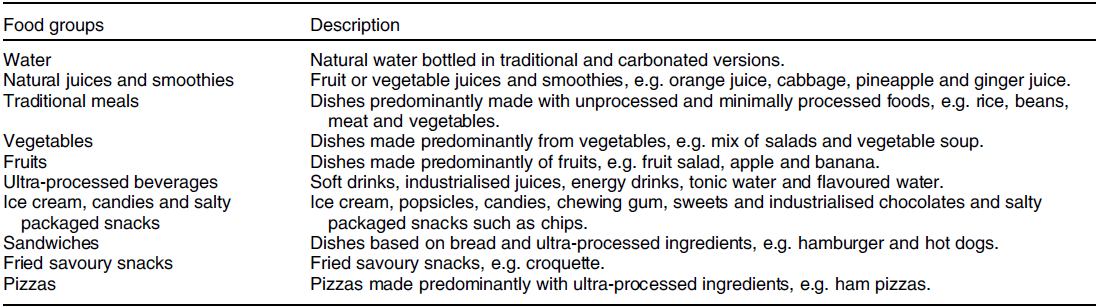
Foods announced on the restaurants’ menus were classified into the following food groups: traditional meals (dishes predominantly made with unprocessed and minimally processed foods very typical in Brazil); water; natural juices and smoothies; vegetables; fruits; ultra-processed beverages; ice cream and candies; sandwiches; fried savoury snacks and pizzas (Table 1).
Description of the food groups, Brazil, 2019
Data tabulation was conducted by four trained researchers. A subsample of 10 % of the restaurants was selected, and data were compared with test data consistency. The comparisons between both databases resulted in 100 % consistency.
Data analysis entailed estimation of the representation (%) of food groups and the use (%) of price discounts and photos at 95 % CI. Food groups were equally distributed across the days and the times of data collection. Data were organised with the aid of the EpiInfo version 7 program, and the statistical analysis was conducted using the Stata version 12.0.
Results
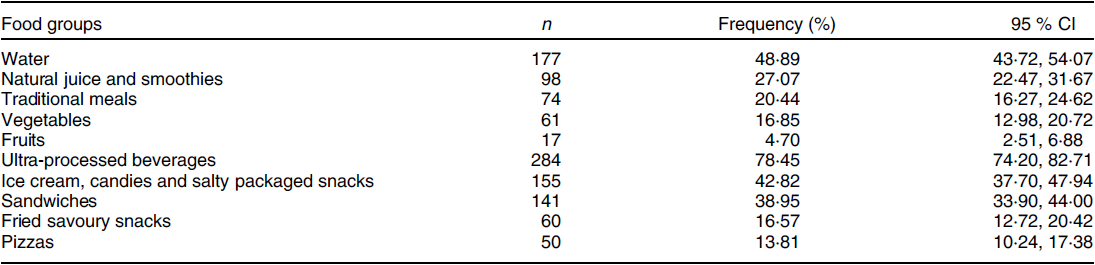
Ultra-processed beverages offered in the apps were higher at 78·45 %, than water (48·89 %) and natural juices or smoothies (27·07 %). Ice cream, candies and salty packaged snacks comprised 42·82 % of the menus, whilst fruits were at 4·70 %. Sandwiches, fried savoury snacks and pizzas made up almost 70 % of the offers in the establishments’ menus. In contrast, traditional meals and vegetables comprised 20·44 and 16·85 %, respectively, of the menus (Table 2).
Participation of food groups on menus of restaurants registered in food delivery apps, Belo Horizonte, Minas Gerais, 2019
As for marketing strategies, restaurants used photos when presenting 35·36 % of the ultra-processed beverages, 29·00 % of the ice cream, candies and salty packaged snacks and 28·45 % of the sandwiches. On the other hand, only 2·76 % of fruits were presented with photos in the menus (Table 3).
Marketing strategies participation on menus of restaurants registered in food delivery apps, in accordance to food groups, Belo Horizonte, Minas Gerais, 2019
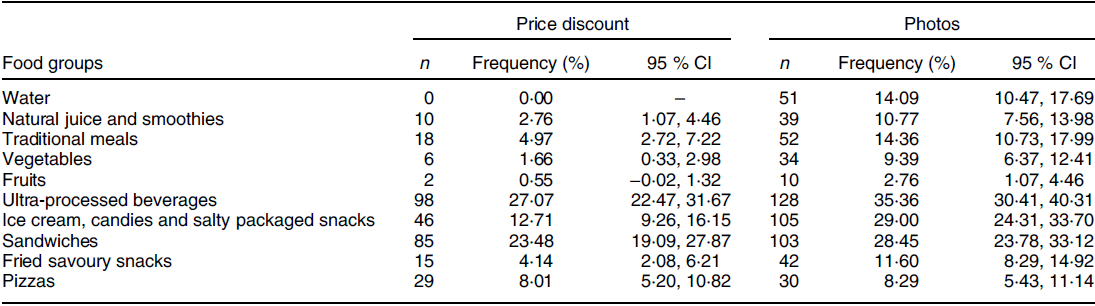
The majority of price discounts were also offered on ultra-processed beverages and sandwiches on the menus: 27·07 and 23·48 %, respectively. For water, vegetables, natural juice and smoothies and traditional meals, discounts offered on the restaurants’ menus were below 5 % for each (Table 3).
Discussion
This study is the first to review the profile of food offered in restaurant menus registered on food delivery apps in Brazil. A significant number of ultra-processed foods were offered with price discounts and complemented by photos.
When performing a simple comparison between the presence of food groups on the menus, some points stand out: the higher presence of ultra-processed beverages instead of unprocessed beverages like water, natural juices and smoothies. Similarly, more ultra-processed ready-to-eat meals, such as sandwiches, pizzas and fried savoury snacks, were available on the menus, in comparison with traditional meals and vegetables. Moreover, there were more ice cream and candy varieties available on the menus than fruits. Also, marketing strategies were mainly directed to ultra-processed foods.
The literature points to a direct relationship between the use of advertising strategies and food consumption(Reference Boyland, Nolan and Kelly23,Reference Buchanan, Kelly and Yeatman24) , and the results of this study indicate that food delivery apps promote the consumption of ultra-processed foods in Brazil, which goes against Brazilian dietary guidelines(25).
To date, there is only one study that has examined the food delivery app environment in the three cities of Chicago, Amsterdam and Melbourne. The authors sampled ten addresses in each city and found 4323 delivery options; like this study, they found that most deliveries were of unhealthy items, such as burgers and pizza(Reference Poelman, Thornton and Zenk26). Considering both study results, it can be surmised that strategies to deal with obesogenic environments must also extend to the digital food environment and policies should focus on initiatives that limit the wide availability and advertising of ultra-processed foods.
Finally, we present the study limitations and their implication on the results. First, the study was conducted in a state capital; for smaller cities, the profile of food supplied by delivery apps may be different. In addition, the study did not describe the menus offered by all the restaurants registered on the apps, since data were collected for 6 h/d and included only the best rated restaurants. Also, some foods could not be classified in any group. This happened with Japanese food and could have occurred with other types of dishes too. The study did not evaluate all the marketing strategies used by the apps, free shipping, combos and others. Similarly, the impact of food pricing was not factored in. All these limitations may have restricted this study by describing the entirety of the food delivery apps environment. Despite this, the study methodology was defined in ways to limit bias, such as collecting data from different neighbourhoods, on different days of the week and with varied mealtimes. Further investigations on the digital food environment are necessary to better describe the meals offered on food delivery apps. These should focus on the profile of food available on these platforms as well as on consumer involvement with marketing strategies.
Acknowledgements
Acknowledgements: Not applicable. Financial support: This research did not receive any specific grant from funding agencies in the public commercial or not-for-profit sectors. Conflict of interest: None. Authorship: P.M.H. made substantial contributions to the conception or design of the work, participated in the interpretation of data for the work and drafted the article; J.P.M.S. made substantial contributions to the conception or design of the work, participated in the acquisition, analysis and interpretation of data for the work and revised it critically for important intellectual content; L.L.R. participated in the interpretation of data for the work and revised it critically for important intellectual content; L.L.M. made substantial contributions to the conception or design of the work, participated in the interpretation of data for the work and revised it critically for important intellectual content. All authors gave final approval of the version to be published. Ethics of human subject participation: This study does not involve human participants.



