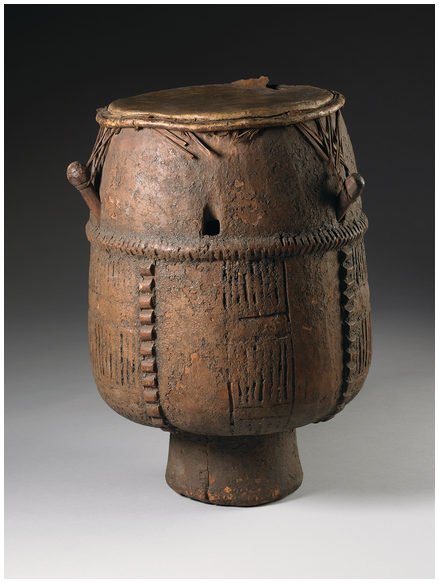


The gods may be considered patrons of the arts.
Creative arts drive Ghanaian social life. Singing, drumming, dancing, drama, body art, sculpture, painting, textile design and other art forms are woven into significant life events such as the celebration of births, the marking of puberty, the formalisation of marriage and the mourning of death.
In many Ghanaian communities, the arts also inform everyday practices in ways that generate well-being and health at individual and social levels.
In Fante communities along the southern coast, women who supported warrior Asafo companies – military groups that led battles against European slavers and colonists – belonged to singing groups called adzewa.Footnote 1 Initially formed to exhort male warriors and to fight alongside them when the situation demanded, they now perform for themselves and their broader communities, telling stories about community and women’s health through satire, song and dance.Footnote 2
In Sirigu, in the Upper East Region, women have painted on walls for centuries, in a tradition called “bambolse”, meaning “embellished, decorated, or made more attractive” in the Nankam language.Footnote 3 These muralists use clay, tree barks, rocks and other natural materials sourced in their local environment. They draw in geometric shapes that trace the contours of bodies and everyday objects and paint only with the colours red, brown, black and white, creating public art that beautifies their households and communities.Footnote 4 As they paint their walls, they sing and dance, drawing comfort and strength from their social bonds in similar ways to the Fante adzewa groups.Footnote 5
Every ethnic group in Ghana commemorates its origin story and notable achievements through annual festivals. Festivals run over several days – following weeks of preparation – and bring people of all ages and social statuses together into the public domain: children, youth, adults, the elderly, chiefs, priests, local political figures and in some cases community outcasts such as individuals living with mental illness or physical disabilities.
American art historians Herbert M. Cole and Doran H. Ross (Reference Cole and Ross1977) describe these festivals as ‘art events’.
[T]ime, people and scale are the components which lift individual objects and festival activities into the realm of art. […] Multitudes of objects, decorated people, dances, skits and sacrifices transform a once quiet space into an arena of [colour], sound and motion. The festival embraces the community, raising both people and place onto a plane marked by aesthetic, spiritual and social values.
They observe, rightly, that it is during festivals that indigenous art forms come to life. Static objects with circumscribed functions for specified groups of people such as chiefs, healers, youth and new mothers shift to “kinetic sculpture” (p.200), taking on new, dynamic meanings and functions for all present:
[A]rt […] becomes kinetic sculpture during a festival. Asafo flags are thrown and swirled in dance; pottery, stools, and chairs are carried in processions, architecture becomes a backdrop in shrine rituals and sometimes as sculpture to climb on. Drums tell of history, sing praises, and beat out proverbs. Jewellery and dress shift constantly – flowing in dance, blending with other patterns of personal decoration or setting them off. This activation of Ghanaian art is an important form of its quality.
Festivals are also spaces for subverting social and cultural norms for personal and community health and well-being. Individuals and social groups can speak truth to power without fear of punishment and seek redress for past psychosocial harms. “When a man has spoken freely thus”, notes Peter Kwasi Sarpong (Reference Sarpong1967) citing R. S. Rattray (Reference Rattray1955), “he will feel his sunsum (‘personality, character, energy’) cool and quieted, and the sunsum of the other person against whom he has now openly spoken will be quieted also”.
Activating Art in Healing
The ‘aesthetic, spiritual and social values’ displayed in festivals are embodied in indigenous healing systems. These systems also “activate art” to serve their professional purposes. Traditional shrine architecture and artefacts are designed to prepare clients psychologically for the healing process. Wall reliefs in Asante and Tallensi shrines, for instance, depict animals associated with health and protection in local folklore.Footnote 6 Mural art on Ewe shrines depicts symbols of healing through abstract motifs painted with mixed materials, some ordinary (paint), some symbolic (mud, blood, alcohol).Footnote 7 Diagnostic and healing objects in various ethnic traditions such as amulets and wooden figurines are imbued with the dynamic energy of small gods.
Diagnosis by an Asante shrine priest, Dagomba diviner or Ewe priestess might be accompanied by performance: a song, dance or drumming by master drummers using specific sets of communicative (‘talking’) drums – the Asante atumpan or Dagomba lungi. The healer might wear art on their body, such as intricate patterns drawn or stamped into skin with white clay, or a specially designed attire stitched with ritually significant artefacts such as beads, cowrie shells or feathers. The treatment processes may likely involve a similar deployment of bodily art on the client or guided ritual performance.
Specially trained artists are commissioned to produce indigenous healing arts. Fante Posuban shrines are built only by artists who have been trained to understand the customs of the target Fante community as well as the importance of ecological balance in their spiritual lives (Labi, Reference Labi2019). Asante woodcarvers know what kinds of wood to select for stools (ↄsɛsɛ) or drums (tweneboa), due to the ‘intrinsic supernatural character’ of each wood, and how to propitiate the gods before felling trees (Sarpong, Reference Sarpong1967). The women who paint murals on Ewe shrine walls master abstract painting techniques of “dripping, soak-staining, smudging, sprinkling, stencilling, dabbing, splattering and splashing” as well as an understanding of the spiritual dimensions of the materials – “mud, blood, alcohol” – they use (Adjei, Reference Adjei2020, p.172).
A central feature of arts traditions is that they are driven by strategic cultural borrowing. Dagomba drums beat Akan proverbs (Kinney, Reference Kinney1970). Akan art forms – for example, gold weights, stools, textiles and ceramic pots – incorporate elements “actively borrowed” through cross-cultural encounters, including with itinerant Muslim traders from West African countries (Cole and Ross, Reference Cole and Ross1977, p.214). Strategic cultural borrowing is also a core feature in indigenous healing arts. Ghanaian historian Irene Odotei (Reference Odotei and Nketia2016) provides a clear example in her juxtaposition of arts in Ga social life and arts in Ga healing traditions:
[T]he Ga people give us a good example of borrowing and utilising materials from other sources. If you go to the annual Homowo festival of the La people, they have the category of the Kpa songs, which have their characteristic rhythms played by drums supposed to be deities and played only once a year. [They] are supposed to be vessels which narrate the history and expound the philosophy of the people. The proverbs used to embellish a song are usually borrowed from Akan, Ewe, or even English. When you look at our traditional religion too, […] you will find nme, kplee, akon, otu and tigare.Footnote 8 [The deities] will show you the origin of the people who composed a song. They are all now Ga. When the singers are not possessed, they cannot speak the special language of mediums. It is only when they are under possession that you will discover this creativity. I think that the gods may be considered patrons of the arts, in this sense that they are making sure that human beings express what is in them and sing to that effect.
Masters of Re-Inventing (Healing) Traditions
Indigenous healing systems and the arts they activate are as old as the oldest Ghanaian community. These systems existed before coastal communities engaged with European imperial trade in the late fifteenth century. During the brutal and dehumanising era of the transatlantic slave trade, spanning the late fifteenth century until the early nineteenth century, indigenous arts tempered chronic suffering and strengthened social bonds. Psychotherapeutic art forms like drumming, singing and trance-induced dancing helped enslaved men, women and children cope during the journey from the hinterland to the coast and through the Middle Passage (see Figure 1.1).Footnote 9
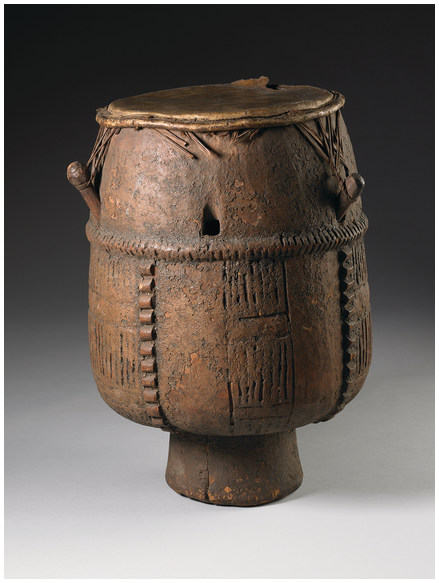
Art forms used in battles and wars, such as messages communicated through drums, horns, song and dance, were also used as communication tools during the many revolts that were executed by the enslaved on slave ships during the Middle Passage. These arts traditions were transported to the New World and formed the basis of healing traditions in the Caribbean and among African-American communities in the American South.Footnote 10
Initially, indigenous healing systems co-existed peacefully with the medical systems of imperial traders and, further down the line, with colonial medicine. American anthropologist Adam Mohr (Reference Mohr2009) describes an example of a “therapeutically inclusive model” between the Akan indigenous healing system (what he terms ‘Akan therapeutics’) and colonial medicine in nineteenth-century Akwapim towns –present-day Eastern Region – where the first Basel missionaries from Germany settled and converted Akan communities to Christianity. The prevalent conditions in these towns were smallpox, measles, whooping cough, malaria, skin infections, leprosy and dysentery. Akan therapeutics was a highly structured system with four categories of specialists, whose practices often intersected:
(1) Priests (asofo, sing. osofo) served old deities (abosom, sing. obosom) and performed ritual duties to appease the guardian spirit;
(2) Prophets (akomfo, sing. okomfo) served some old deities and were conduits of spirit possession and communication;
(3) Medicine makers (aduruyefo, sing. oduruyefo) specialised in making medicines (aduru) to treat a broad range of ‘personal afflictions and social situations’;
(4) Herbalists (adunsifo, sing. odunsifo) made medicine from roots and herbs, focusing on pharmacological properties, although the spiritual element could also be used.
Healing involved diagnosing and treating the underlying spiritual dimensions of disease and social crises. This system was more effective than biomedicine for the local population as well as for the European missionaries. Mohr tells the story of two Basel missionaries – Andreas Riis and Johannes ZimmermanFootnote 11 – who were cured of their illnesses through Akan therapeutics after treatment by biomedical doctors failed. One of them, Andreas Riis, claimed that “Dr. Tietz, the European physician in Christianborg, was useless [because] all patients [he] treated died, while those treated by the local healer survived” (p.445).
In other locations across the country, a subset of medicine makers and herbalists, such as bonesetters and midwives, provided superior treatment that rivalled biomedical systems.
However, as colonial medicine absorbed the systemic race-based shift in Western sciences – the era of scientific racism – collaboration turned to violent domination.Footnote 12 Throughout the colonial era, from 1874 to 1957 (in the Gold Coast), there were sustained attempts to devalue and destroy indigenous healing knowledge systems and practices, even as new medical methods and materials drew on these very systems. Successive colonial administrations banned drumming, singing, dancing and other arts-based traditions underpinning healing rituals and practices, as well as social customs such as puberty rites.Footnote 13 ‘Colonial subjects’ who defied the bans faced hefty fines and, in extreme cases, imprisonment, exile and state-sanctioned killings.Footnote 14 The same methods of violent domination and erasure, it is worth noting, were deployed over the same period by plantation owners and colonial authorities in the Caribbean and the American South.Footnote 15
Anthropologists observe that African indigenous healers are masters of re-inventing tradition. The core motivation to re-invent, it is argued, is a response to the critical demands of communities with health needs. British anthropologist Murray Last (Reference Last1981) notes, in his ethnographic study of Hausa medicine in Northern Nigeria in the 1960s, that where healing was concerned, people voted with their feet, and healers who did not deliver solutions became irrelevant and eventually went out of business. Similar observations have been made of the precarious lifespans of shrines in colonial Gold Coast (Field, Reference Field1937; Goody, Reference Goody1987). Among the Dagara in Ghana’s Upper West Region, the weaknesses of existing healing systems drove “the search for new shrines, new curing agencies” (Goody, Reference Goody1987, p.156). Across several ethnic groups, there is a cultural imperative to ‘sell one’s sickness in order to get a cure’: “wo ton wo yareε a na wonya n’ano aduro” (Twi). When illness strikes, this imperative drives healer-shopping: the use of multiple healers without referral from previous healers for a single episode of illness (Kroeger, Reference Kroeger1983). Healer-shopping is in turn shaped by assessment of the best options available in the pluralistic health marketplace: clients assess healers’ technical knowledge of health conditions, their diagnostic and treatment expertise, and how accessible they are geographically as well as culturally and financially. Healing environments are therefore co-constructed by healers and their clients, and these environments are dynamic because they respond to societal health needs, which are in turn shaped by wider epidemiological and socio-economic trends.
But it is important to note that the motivation to re-invent healing traditions is not only driven by internal sociopsychological factors. It is also shaped by external socio-political forces. Before and during the colonial era, communities and chiefs rebelled against the excesses of British governance, using strategies of non-compliance, defiance and physical battle (Addo-Fening, Reference Addo-Fening2013).Footnote 16 In the same way, indigenous healers had to change and innovate with an eye to material and existential threats from adversarial and increasingly violent colonial European administrative policies. And because they were under constant threat, they had to be creative, and their creativity had to be subversive. Indigenous healing systems have survived and thrived in large part, particularly over the last century, due to these creative strategies.
Selling Healing
In Selling Healing, I aim to tell a polyvocal story of how the arts intersect with health, illness and healing in Ghana at multiple levels of social organisation, from the local to the geopolitical. The story will have three intersecting strands.
The first strand will build on my opening argument – that arts drive Ghanaian social life – by demonstrating that arts are a core feature of health communication in Ghanaian communities. Following social psychologists Catherine Campbell and Kerry Scott (Reference Campbell, Scott, Derek, Bradley and Martin2011, p.267), I define health communication as “any form of communication that seeks to empower people to take control over their health”. I include arts as a fundamental form of communication in healing environments.
Daisy Fancourt and Saoirse Finn (Reference Fancourt and Finn2019, p.1) offer a succinct definition of art, from the arts and health field:
[T]he art object (whether physical or experiential) [is] valued in its own right rather than merely as a utility; provid[es] imaginative experiences for both the producer and audience; and compris[es] or provoke[es] an emotional response. In addition, the production of art is characterized by requiring novelty, creativity or originality; requiring specialized skills; and relating to the rules of form, composition or expression.
While this definition draws on cross-cultural references, the sources are predominantly Euro-American. In the interdisciplinary field of African art history, art, as defined by indigenous African (arts) communities, has some features that are aligned with the Euro-American characterisation, and others that diverge. The production of art in African contexts is also “characterized by requiring novelty, creativity or originality and specialized skills relating to the rules of form, composition or expression”. But depending on the kind of art being produced, other forces are at play. To produce sacred art objects, for example, specialised skills are required, as we saw for Asante woodcarvers and Fante Posuban shrine artists. But these art forms truly come to life when spirits and forces of the invisible world move the artist. As Odotei (Reference Odotei and Nketia2016, p.165) observed of Ga ritual singers, “when the singers are not possessed, they cannot speak the special language of mediums. It is only when they are under possession that you will discover this creativity”. Similarly, the Malian historian Amadou Hampate Ba (Reference Ba1976, p.16) observes of the Nyamakala, a class of Bambara craftsmen that include woodworkers (who make ritual objects including masks) and griots (public entertainers who compose music, sing, dance and tell stories): “the craftsman needed to be in a state of mind which matched the moment of its creation. Sometimes, he would go into a trance, and when he emerged from it, he would create”. The difference between the secular and sacred art object, Ba (Reference Ba1976, p.16) notes, is that the “secular object is not ‘consecrated’ and therefore not ‘loaded’ with spiritual energy”.
Secondly, theorists observe that the distinctions created between art and craft in European contexts do not exist in African contexts: “the unpredictable, culture-transcending element of creativity in artistic production” operates on the same plane as craftwork which is “predictable, traditional, competent but limited by precept and technique” (Polakoff, Reference Polakoff1978, p.22). Therefore, the art object, whether physical or experiential, can be valued in its own aesthetic right (art for art’s sake, arts as essential for survival) as well as a utility (art for everyday use).
Thirdly, the production of art is participatory. In the realms of healing, for example, American art historian Suzanne Preston Blier (Reference Blier, Bates, Mudimbe and O’Barr1993) observes “the complex interweave of individuals who both participate in the creative process as artists – diviners, ritual activators and the like – and bring signification to the work through their divergent roles as viewers, users, worshippers and caretakers” (p.147). The art object therefore provides imaginative experiences for both the producer and a participating audience. And across several communities, participating audiences express a preference for multi-form arts: for example, “visual arts […] music, dance and oral performance” (Ben-Amos, Reference Ben-Amos1989, p.39) in combination, rather than in isolation.
Finally, art is “grounded in social life […] fully entrenched in the variant and varying societal roots which make and frame it” (Blier, Reference Blier, Bates, Mudimbe and O’Barr1993, p.154). Art therefore communicates at the various registers of social life – such as political, economic, educational, recreational and religious (Ba, Reference Ba1976; Barber, Reference Barber1987). Because social life operates on cognitive, emotional, physical, social and spiritual levels, art comprises and provokes these multilayered responses. In moments of deep connection between artists and their participating audience, these multilayered responses may transform the functions of the art object in unexpected ways. The power of ‘popular art’ lies in this synergy, as British anthropologist Karin Barber (Reference Barber1987, p.7) describes: “truly popular art […] is art which furthers the cause of the people by opening their eyes to their objective situation in society. It conscientizes them, thus preparing them to take radical and progressive action”.
My working definition of art extends the definition by Fancourt and Finn (Reference Fancourt and Finn2019), to include these contextual African features:
The art object (whether physical or experiential) is produced through a process requiring novelty, creativity or originality, and specialized skills. It is valued in its own aesthetic right (art for art’s sake) and/or as a utility (art for functional use). It provides imaginative experiences for both the producer and (participating) audience, and comprises or provokes emotional, cognitive, physical, social and/or spiritual responses that may drive societal transformation.
The second strand of Selling Healing will examine the value of arts applied to health communication interventions. The field of health communication has been described as a transdisciplinary field. Concepts and methods are drawn from the social and health sciences, humanities and arts, “to combine and integrate disciplinary perspectives and build new scientific perspectives and applications” (Kreps and Maibach, Reference Kreps and Maibach2008, p.732). This transdisciplinary position requires an ecological outlook – an understanding that communication occurs within complex environments and across multiple levels of social organisation. The ‘people and places framework’ proposed by Edward Maibach and colleagues (Reference Maibach, Abroms and Marosits2007), who write from a North American perspective, captures the accepted ecological model of health. The framework focuses on three elements:
(a) the attributes of the people in the population; (b) the attributes of the environments – or places – in which members of the population live, work, go to school, shop and so forth; and (c) important interactions between the attributes of people and places.
Through levels of analysis or ‘fields of influence’ these attributes and their interactions “typically influence health through their impact on health behaviour and through direct effects on physical functioning and well-being” (p.2).
Similarly, Campbell and Scott (Reference Campbell, Scott, Derek, Bradley and Martin2011, p.267), writing from the European perspective, list five ways, ranging from the personal to the structural, through which people can be empowered to take control of their health:
engaging in health-enhancing behaviour change; accessing health services and support; developing health-enabling social capital; engaging in collective action to tackle obstacles to health; and developing health-related social policy (locally, nationally or globally).
Despite a general acceptance of the ecological nature of health and the multi-layered dimensions of health communication, the health communication field – applied across many country settings including Ghana – is dominated by the use of social cognition models. Developed in ‘mainstream’ health and social psychology, social cognitive models such as the Health Belief Model (HBM) and the Theory of Planned Behaviour (TPB), operate on the assumption that individuals are driven by a common rational desire to preserve health.Footnote 17 A typical hypothesis suggests that better individual knowledge and motivational intent will lead to desirable attitudinal and behavioural change. Researchers working from critical disciplinary perspectives argue that this assumption is simplistic. First, an exclusive focus on ‘rationality’ neglects “‘irrational’, unconscious forces and emotions” (Crossley, Reference Crossley2000, p.38), which underpin human behaviour. Second, people and places have cultures and histories – therefore health knowledge and behaviours are underpinned, not by a singular rationality but, by multiple rationalities embedded in these cultures and histories. What might be deemed irrational in one setting will be deemed rational in another. Third, people and places are shaped by structured power relations in society that undermine health-enabling behaviours, such as poverty and social isolation. These multilayered factors shape the ways people engage in health-enabling behaviour or in health-damaging behaviour “even when they are in possession of accurate factual information and the resources about health risks and how to avoid them” (Campbell and Scott, Reference Campbell, Scott, Derek, Bradley and Martin2011, p.267). For example, despite full knowledge of the long-term health-damaging effects of smoking, individuals make a ‘rational’ choice to smoke as a means of coping with adverse social and material circumstances; or despite full knowledge and understanding of the protective value of condoms, individuals make a ‘rational’ choice not to use condoms as a symbolic and emotional commitment to long-term relationships (Campbell, Reference Campbell2003; Crossley, Reference Crossley2000).
Researchers working at the interface of arts and health communication push these arguments further by considering the multi-layered functions of social memory and social creativity. Brazilian social psychologist Sandra Jovchelovitch (Reference Jovchelovitch, Glăveanu, Gillespie and Valsiner2015), in her work with favela communities in Rio de Janeiro, demonstrates how health knowledge, healing practices and community health development are shaped by ‘the creativity of the social’: the capacity of individuals and communities ‘to imagine alternative possibilities’ and to reconfigure current realities and accumulated traditions through ‘creative practices of the imagination’ in ways that offer healing or catalyse ‘social action for change’ (p.86). In the first comprehensive scoping review of arts and health promotion in Africa, Christopher Bunn and colleagues (Reference Bunn, Kalinga and Mtema2020) make a similar observation of “the negotiation of social change in Chewa and Manganja communities” in Malawi: “artistic forms and methods facilitate participants to step outside of their everyday lives to use imagination and play to reconfigure how they understand and act on an aspect of life, such as a disease” (p.2). Social creativity during the HIV/AIDS pandemic offers an instructive illustration of how the arts mediate health communication at multiple levels of social organisation and, by extension, expose the limitations of the dominant social cognition models.
During the early decades of the HIV/AIDS pandemic in Africa, the dominant health communication approach was the KAB (knowledge-attitude-behaviour) approach, which was operationalised through the ABC (Abstain Be Faithful use a Condom) message. Across many countries ABC messages created awareness of HIV risks, but awareness did not translate to the desired sexual health protective behaviours (Kalipeni et al., Reference Kalipeni, Craddock, Oppong and Ghosh2004). This social cognition approach failed because it ignored the emotional, social and structural contexts in which intimate relationships operate, such as love, gender and class (Campbell, Reference Campbell2003). Meanwhile, the visceral reality of risk, suffering and loss ignited an explosion of creative responses, particularly in countries hardest hit by the disease, and in countries where political responses were slow and inadequate. In Ethiopia, Ghana, Nigeria, Kenya, Malawi, Morocco, Tanzania, South Africa, Uganda and Zimbabwe, communities responded to HIV/AIDS through song, dance, theatre and comedy (Barz and Cohen, Reference Barz and Cohen2011). These creative responses – some new, some reconfigured from local artistic traditions – expanded lay understanding of health promotion imperatives, but also eased the anxieties and stresses brought on by the material and psychological impact of HIV/AIDS. Crucially, communities also engaged in grassroots action, such as lobbying for access to anti-retroviral treatment and social care for families in need. As Thembela Vokwana (Reference Vokwana, Falade and Murire2021, p.121) observes, of the South African context, “music performance functioned as a soundtrack in grassroots struggles to anti-retroviral care”. In the Ugandan context, ethnomusicologists Gregory Barz and Judah Cohen (Reference Barz and Cohen2011) observe that ‘music as medical intervention’ worked in part because “when technical, scientific, or medical ‘AIDS talk’ was abandoned in favour of ‘un-translated’ localized terminologies […] audiences appeared much less threatened and anxious (p.8). Heads nod[ded] in agreement or hands clap[ped] in laughter when particular lines resonate[d] with the audience’s experience” (p.10). In countries like Uganda, it was the blend of creative expression and empowered action from the grassroots that forced leaders to act on developing and implementing equitable HIV policies. The second strand of the story will track the socio-psychological functions of arts and social creativity in health communication as valuable in and of themselves – for generating well-being, for example – as well as for empowering people to take control over their health in Ghanaian settings.
The final strand of Selling Healing will make a case for incorporating arts traditions, whether applied by lay communities or by indigenous healers, into official health communication models and interventions. In African countries, long-standing art traditions intersect with health, illness and healing, such as I have described for Ghanaian communities. Bunn and colleagues (Reference Bunn, Kalinga and Mtema2020, p.2) list five functional applications of the arts in health promotion and argue that these functions “have indigenous roots in African communities”:
creative processes have been harnessed to enquire into local experiences and understandings relating to health, to intervene in drivers of health problems, to provide a discreet form of therapy for a range of conditions and to disseminate and validate health research findings.
A major challenge for arts-based health interventions in African settings is that concepts and methods are driven largely by models developed in the dominant Euro-American arts and health field, which are in turn influenced by culturally specific Euro-American art history and art theory traditions. For example, the Euro-American arts and health field creates distinct categories between art forms: performing versus visual versus literary arts (Bunn et al., Reference Bunn, Kalinga and Mtema2020). In contrast, across many African communities, multi-form arts are preferred: performing and visual and literary arts (Barber, Reference Barber1987; Ben-Amos, Reference Ben-Amos1989; Bunn et al., Reference Bunn, Kalinga and Mtema2020). The activation of multiform arts in Ghanaian festivals provides a clear example of this preference. When dominant Euro-American models are applied in African contexts without appropriate cultural grounding, this can lead to poor reception of interventions or negative health outcomes.
Theorists argue that to develop culturally grounded arts-based health interventions in African settings, there has to be a nuanced understanding of what is indigenous to communities and what is alien to them. As Bunn and colleagues (2000, p.11) observe, when an art form that “is assumed to be ‘of’ a community”, such as a traditional dance, is in fact “alien”, the art form is treated “as a spectacle and not met with participation”.
However, as the preliminary Ghanaian examples show, arts traditions and healing traditions are shaped by strategic cultural borrowing. Jack Goody’s (Reference Goody1975, Reference Goody1987) analysis of knowledge production in LoDagaa (Dagara)Footnote 18 communities provides a useful example.Footnote 19 Goody observed that knowledge production in LoDagaa was shaped by the interdependency between visible (known, familiar) and invisible (unknown, unfamiliar) worlds. There were three intersecting modes of knowledge and knowledge production tied to distinct social groups: (1) basic knowledge drawn from everyday relations and activities, which was the domain of all members of society; (2) traditional knowledge drawn from traditional beliefs and myths, which was the domain of traditional leaders and traditional history reciters; and (3) transformational knowledge drawn from the invisible world of supernatural “powers, spiritual forces, agencies” (Goody, Reference Goody1975, p.157), which was the domain of priests, healers and other legitimate social agents with access to the invisible world.
In LoDagaa society, Goody argues, “innovation [was] authorized by outside agencies” (p.165) and religious faith decreed that “in the ambiguity of the creator God [lay] the possibility of change” (p.105). Outside agencies were innovators because they were different and separate from what was known: “they [were] distinct from human society; they [were] importers of new messages, new techniques of the outside world” (p.95). God was powerful precisely because God was ambiguous and unpredictable.
But the psychological draw to the power of outside agencies was also driven by empirical failures in everyday life revealed by basic and traditional knowledge: family relations shifted between strength and fragility, cults and shrines promised but failed to deliver healing. It is through this tension between the familiar and unfamiliar, that the “process of religious creation [was] rendered almost essential” (Goody, Reference Goody1987, p.131) and new deities emerged, healers gained their mysterious powers, and cults and shrines proliferated.
Similar phenomena have been reported in medical anthropological studies in other African societies that are “open to the unfamiliar, the alien, the unknown” (Rekdal, Reference Rekdal1999, p.458) and for whom, as a consequence, a strong correlation exists between geographical distance and supernatural power. The Norwegian anthropologist Ole Bjørn Rekdal (Reference Rekdal1999) observed that healing and ritual expertise among the Iraqw people of Tanzania was driven by the “the power inherent in the ambiguity of the culturally distant” (p.470, emphasis added). This power operated hand-in-glove with reflexive awareness of weaknesses within Iraqw socio-cultural structures and relationships. At the level of specific groups, there was a tendency for local healers to challenge local political authority in their quest to expand professional expertise. Respect and dissent framed the relationships between healers and political authorities. In broader society, daily social relations were shaped by emotional tensions, such as loyalty and mistrust, based on a reflexive awareness that “the intimacy so highly valued between neighbours render[ed] them vulnerable to each other” (p.468). The complexities of intra-cultural relationships and practices, as well as scepticism about these relationships and practices framed the very nature of cultural openness in Iraqw society. It is within this context, Rekdal argues, that the acceptance of biomedical systems by Iraqw society had to be understood: “biomedicine as a way of understanding and approaching illness was certainly new to the Iraqw; what was not new was the incorporation of an alien way of looking at and acting on illness” (p.472, emphasis added). Rekdal speculated that in similarly open African societies, individuals would accept biomedicine, and other foreign medical systems, “precisely because they ‘believe in’ and ‘cling to’ their ‘native medicine’, with its emphasis on the healing power of the culturally distant” (p.473).
In African settings, healing arts, to extend Suzanne Preston Blier’s (Reference Blier, Bates, Mudimbe and O’Barr1993) observation, are grounded in social life. We can argue, therefore, that: (1) in some settings, indigenous arts traditions will have alien elements; and (2) some arts traditions evolve by actively ‘incorporating an alien way of looking at’ and producing art. Both arguments apply to the production of healing arts in Ghanaian contexts. The stories told and sung by Fante Adzewa groups incorporate cross-cultural elements, borrowed from the Asantes and the English. The lyrics of the ritual songs sung during the Ga Homowo festival blend Ga, Akan, Ewe and English words. Dagomba drums beat Akan proverbs in secular and sacred gatherings. This social psychological character of art production and engagement by lay people and indigenous healers requires systematic analysis in concrete healing contexts. I consider how the arts – whether indigenous, strategically borrowed, or externally imposed – shape representations, imagination, memories, emotions, embodied experiences, relationships and actions along healing journeys across pluralistic healthcare systems.
The Chapters
To understand what works in health communication in Ghanaian contexts, and how creative arts are ‘activated’ in this sphere, indigenous ways of communicating health and illness and navigating healing journeys have to be understood. In Chapter 2, I will discuss how these dynamics play out in two communities in which I have conducted chronic illness research: Nkoranza, an Akan community in the Bono East (formerly Brong Ahafo) region, and Ga Mashie, a Ga community in the capital Accra. Akan and Ga communities subscribe to a cultural imperative to ‘sell one’s illness in order to get a cure’: “wo ton wo yareε a na wonya n’ano aduro” (Twi); “ke ohoo ohela, onaa ehe tsofa” (Ga). The ‘selling’, I will argue, is health communication. The ‘cure’ covers a range of therapeutic options including diagnosis, pharmacological, psychological or spiritual treatment, and social advice, support and care. Communities are also hypervigilant about risk in intimate relations, as captured in another proverb: “Aboa bi reka wo a, öfiri wo ntoma mu”/ ‘if an animal is biting, it is from inside your cloth’. This risk is heightened in contexts of illness and crises. These competing theories complicate the imperative to sell one’s sickness. Individuals engage in strategies of partial disclosure and non-disclosure, modulated by levels of trust, especially when illness is chronic or terminal or likely to be stigmatised. Indigenous healers navigate this complicated psychosocial terrain in creative and subversive ways – their goal, to ‘sell healing’ for all conditions. Signature methods include advertising using multi-form arts, storytelling in diagnostic encounters, and the use of artefacts, costume and performance in healing processes. At the extreme end of this creative enterprise, the category of the ‘fake healer’ has emerged: a shrine priest, herbalist or pastor whose claims to healing are viewed by society as purely performative and also potentially harmful. I will illustrate where ‘selling sickness’ meets ‘re-inventions of healing traditions’ in healing environments and healing encounters, and signpost where specific art forms are activated in these spaces.
Colonial era arts-based interventions in the Gold Coast focused on a range of health conditions, including prevalent infectious diseases like malaria and conditions of modernisation such as sexually transmitted diseases in mining towns. I begin Chapter 3 with the example of Mr Wise and Mr Foolish go to Town, an ill-conceived educational film on syphilis prevention dispatched from the Colonial Office at Downing Street, London to the Gold Coast Governor’s office in Accra in June 1944. This project and other arts-based interventions were embedded in the colonial medicine system which, in turn, was shaped by the ‘psychic life of the colonial encounter’ (Fanon, Reference Fanon1963): the conditioning of African psychological realities by colonial relations of racialised power, violence and resistance. I contrast the colonial case studies with contemporary global health approaches to arts-based health communication. I argue that the intersection of psychological and political dynamics underpinning encounters between global health actors and local communities, as well as local experts who (claim to) represent, or advocate for, local communities, creates a “psychic life of the global health encounter”. This psychic life is also double-edged. When intervention models are imported wholesale into Ghanaian contexts, without cultural grounding and with unexamined prejudices, a range of problems emerge including the imposition of methods and policies that, at best, do not work and, at worst, can cause symbolic and material harm. But in the same way that Ghanaian communities resisted health communication interventions associated with colonial medical violence, communities resist present-day global (arts-based) health interventions that are perceived to be harmful. Strategies of resistance are driven in part by creative practices of the imagination.
Arts-mediated HIV/AIDS education received significant funding from Ghana’s donor partners and global health institutions during the first two decades of the pandemic. Yet these interventions had a mixed impact. On the one hand, there was – and continues to be – near universal awareness of HIV/AIDS, including risk factors and health outcomes. On the other hand, low condom use and persistent stigma suggest that knowledge has not translated to sexual health protective behaviours and psychosocial support. In Chapter 4, I will examine how arts were incorporated into HIV/AIDS interventions, focusing on the use of mass media campaigns to raise awareness and educate, and on ‘folk media’ to educate and empower communities. I discuss a study that applied a narrative approach to examine local knowledge and lived experience – the findings of which illustrate important contrasts between community and indigenous healing system responses to HIV/AIDS and official health service responses. Against the backdrop of recent reports of a resurgence of HIV infections among young Ghanaians, I will end with reflections on what these insights yield for developing more robust arts-based HIV interventions in the future.
In Chapter 5, I focus on the Regenerative Health and Nutrition (RHN) Programme, an intervention that was developed in 2006 by Ghana’s Ministry of Health in collaboration with the African Hebrew Development Agency (AHDA), an agency established by a community of African-Americans who had settled in Dimona, Israel and lived a holistic lifestyle. The RHN Programme, piloted in nine districts in the country’s (then) ten regions,Footnote 20 applied slogans and signposts and the celebrity campaign for its messaging. At its core was the re-imagining of local recipes through the lens of AHDA’s trademarked Edenic Divine Diet. While the programme promoted ‘food is medicine’ through arts-based methods, a competing representation of ‘food is poison’ prevailed across the RHN communities. This representation, developed from “slow observations” (Davies, Reference Davies2022) of the “slow violence” (Nixon, Reference Nixon2011) of toxic agricultural practices and environmental degradation, undermined acceptance of the RHN message and intentions to cook and eat more healthily. The arts could not cut through these competing representations. I consider how these broader structural factors interfere with the hybridisation of Ghanaian food cultures and present conceptual challenges for public health nutrition interventions, whether they apply the arts or not.
Ghanaian artist and academic Bernard Akoi-Jackson developed and led a multi-year art therapy programme with patients at Pantang Psychiatric Hospital – one of Ghana’s three psychiatric hospitals. Chapter 6 focuses on an exhibition I co-curated with Akoi-Jackson on mental health promotion at the Nubuke Foundation, Accra, in 2009, that was inspired by this programme. Sketches, paintings, screen prints, and fabric work produced by patients were exhibited alongside commissioned paintings on a pre-determined theme of ‘mental health’ from established Ghanaian contemporary artists and photographs from an anthropological study on mental healthcare in shrines and prayer camps conducted by British anthropologist Ursula Read. Through a photo story approach, I detail the rationale and process of curating the exhibition and discuss visitors’ responses, which converged on two themes: the art exhibition as a viable approach for mental health promotion; and arts therapies as methods of rehumanising the psychiatric space. I reflect on the curating process and what this revealed about the multi-layered challenges that face individuals and families affected by severe chronic mental illness and where the arts can play a role in forging more robust collaborations between psychiatric and indigenous healing systems.
In 2019, the NCD Alliance – the global civil society network dedicated to noncommunicable diseases (NCD) advocacy – developed a project called Our Views, Our Voices. Training on NCD storytelling was organised in a number of countries including Ghana, with the aim to “enable individuals living with NCDs to share their views to take action and drive change”. The local Ghanaian advert called for English speakers (only) to apply for limited spaces for training. My research team applied for two members of Jamestown Health Club – a patient support group based in Ga Mashie – to participate in the training. Their analysis of the workshop was captured in a rhetorical question: “we tell the stories – and then what? We cannot eat the stories”. In Chapter 7, I examine the encounter between the NCD Alliance storytelling project and the local patient advocacy movement and discuss the scope and limits of storytelling for ‘taking action and driving change’ for NCD prevention and control in Ghana. I argue that the NCD Alliance project builds on a chequered history of global health storytelling, such as the HIV confessional technology (Nguyen, Reference Nguyen2010), where cultural appropriation meets corporate branding. Narrative is central to social life, and stories of lived experiences of illness have reported benefits, including for educating communities at risk, and facilitating coping and conscientisation in patient groups. But the culture and politics of storytelling also matter: in Ghanaian communities affected by chronic conditions, careful considerations are made about why a story must be told in the first place, who to tell the story to, and when, where and how to tell the story. Crucially, investing in narrative health at the expense of structural and political solutions to complex health problems can have harmful consequences, particularly for marginalised communities.
During the first year of the global COVID-19 pandemic, Ghana’s creative arts communities captured its complex facets through various art forms. In Chapter 8, I focus on how these spontaneous artistic responses afforded the opportunity to examine in real time how grassroots arts and bottom-up social responses to health crises influenced health communication. Working with a local team, I tracked and collated various art forms of this genre of ‘COVID arts’ including comedy sketches, cartoons, songs, textile designs and murals. I outline the methods used to define and track COVID-19 arts, detail their communicative functions, and reflect on insights these new art forms present for pandemic health communication. Artists channelled ‘creative practices of the imagination’ regarding COVID-19, highlighting a mutually constitutive relationship between lay responses to the pandemic and what artists produced. The COVID arts they produced functioned in three arts and health domains: health education and knowledge production, disease prevention, and (indirectly) COVID-19 policy development. These intersecting functions converged on the science, culture and politics of COVID-19. I will outline the subtle and radical ways artists translated the science, culture and politics of the COVID-19 pandemic to Ghanaian communities at home and abroad. I reflect on the insights these new art forms present for health communication during the COVID-19 pandemic and beyond.
In the concluding Chapter 9, I return to the three narrative strands of Selling Healing through a synthesis of cross-cutting themes emerging from the case studies. I explore the possibilities of operationalising the Akan concept of Sankofa for indigenising health communication models. Sankofa means ‘to retrieve’. The concept is captured in the proverb: “Se wo were fi na wosan kofa a yenkyiri” / ‘It is not taboo to fetch what is at risk of being left behind’ (Appiah et al., Reference Appiah, Appiah and Agyemang-Duah2008). It is also represented visually, in gold weights, wood sculptures and textile designs by a bird that moves forward while turning its head back (see Frontispiece). Sankofa has become an organising interdisciplinary principle for developing a decolonial and indigenising approach to identity, agency, and social change for continental and diaspora African communities (Matemba, Reference Matemba2020; Pence et al., Reference Pence, Makokoro, Ebrahim and Barry2023). I define Sankofa from a social psychological perspective, as a creative practice of the imagination and memory – a vital process of remembering and reclaiming lost or contested traditions within the boundaries of self, society and culture and activating these traditions to serve contemporary needs.