





Policy Significance Statement
The framework proposes an approach that allows the acceleration of adopting AI solutions in the public sector by offering a set of techniques that facilitate the adaptation and reuse of AI-based use cases. The benefits of adopting the framework are twofold. First, the policymakers are able to disseminate the use cases in the public sector that have been solved through the use of AI, so that they can be reused by additional public entities. Second, the documentation approach of different components that constitute the whole solution is bound with the specifications and the relevant code that enables its responsible reuse. Therefore, the documentation initiatives that support the regulatory objectives of building AI systems should be translated into actionable operations that enhance public policy processes.
1. Introduction
With the increasing ubiquity of digital technologies, companies and organizations constantly restructure their processes to generate and capture value. This is considered a transformative routine that affects fundamental changes by leveraging existing competencies or developing innovative ones (Liu et al., Reference Liu, Chen and Chou2011; Alvarenga et al., Reference Alvarenga, Matos, Godina and C O Matias2020). Innovation encompasses various forms such as novel practices, ideas, service delivery methods, or technologies that generate value including Artificial Intelligence (AI). When it comes to public innovation, it specifically pertains to innovation within the context of public administration (van Noordt & Misuraca, Reference Van Noordt and Misuraca2022). The benefits of public innovation result in significant impacts such as increased citizen engagement, enhanced decision-making processes, and broader influence on businesses (Bertot et al., Reference Bertot, Estevez and Janowski2016).
Currently, in the context of public administration, there is increased evidence of the utilization of AI tasks (Mehr, Reference Mehr2017) using techniques, such as, Machine Learning (ML), Computer Vision (CV), Natural Language Processing (NLP) and Automatic Speech Recognition (ASR). Similar techniques that address the problems of digital transformation may combine diverse models or tasks that interact with each other as part of a system that solves a larger problem (Martie et al., Reference Martie, Rosenberg, Demers, Zhang, Bhardwaj, Henning, Prasad, Stallone, Lee, Yip, Adesina, Paikari, Resendiz, Shaw and Cox2023; Kamal Paul & Bhaumik, Reference Kamal Paul and Bhaumik2022).
Prior studies emphasize that the utilization of AI technologies within public administration has the potential to enhance policy-making processes, improve the delivery of public services, and optimize the internal management of public administrations (Madan & Ashok, Reference Madan and Ashok2023). Furthermore, they demonstrate the current utilization of AI technologies for various objectives, such as virtual agents, recommendation systems, cognitive robotics and autonomous systems, and AI-driven process automation systems (Mikalef et al., Reference Mikalef, Fjørtoft, Torvatn, Pappas, Mikalef, Dwivedi, Jaccheri, Krogstie and Mäntymäki2019). However, limited empirical evidence exists regarding their impact due to a large number of barriers to the implementation and evaluation of AI (Bérubé et al., Reference Bérubé, Giannelia and Vial2021).
Previous research findings into aspects that hamper AI adoption elicit concern about the lack of a unified integrated approach to deploying AI solutions in the public sector. Given the significant lag compared to the private sector, it is crucial to ensure the effective and consistent progression of AI in public organizations. Factors thought to be influencing AI adoption in the public sector have been explored in several studies (Mikalef et al., Reference Mikalef, Lemmer, Schaefer, Ylinen, Fjørtoft, Torvatn, Gupta and Niehaves2022). For (Mikalef et al., Reference Mikalef, Fjørtoft, Torvatn, Pappas, Mikalef, Dwivedi, Jaccheri, Krogstie and Mäntymäki2019) the main hindering aspects to adopting AI technologies are of four kinds: (1) lack of expertise, (2) organizational implementation challenges, (3) inability to integrate systems and data, and (4) data availability and privacy concerns. On the other hand, (John et al., Reference John, Holmström Olsson, Bosch, Klotins and Wnuk2021) and (Zhang et al., Reference Zhang, Liu, Liang, Wang, Shahin and Yu2023) argue that there are architecture decisions, such as technology, component and data decisions, that affect the success of AI-based systems in terms of deployment and maintenance. In relation to insufficient expertise, AI technologies are not fully embraced due to the lack of trained staff, AI engineers and practitioners, which requires dedicated specialization and deep expertise in building and maintaining AI tasks. In addition, organizational challenges in implementing AI solutions often stem from a combination of uncertainty about where to begin and resistance to changing existing work practices (Medaglia et al., Reference Medaglia, Gil-Garcia and Pardo2023; Desouza et al., Reference Desouza, Dawson and Chenok2020).
Consequently, despite the groundbreaking potential of AI, its implementation in the public sector is struggling due to the fact that it currently considers AI applications in isolation and fragmentation (Wirtz et al., Reference Wirtz, Weyerer and Geyer2019). This is mainly because public authorities may not be aware of the full range of AI application opportunities and do not have a governance scheme to guide the AI adoption process in different domains. Moreover, the complexity of developing AI-based systems increases as a result of the absence of a recognizable pattern, particularly when transferring or adapting the same AI task across different domains or settings in public administration.
The challenge of transferring AI products across different domains arises mainly due to the varying statistical characteristics of production data compared to the data encountered during training. Traditional learning algorithms often exhibit limitations when reused in dissimilar conditions due to data distribution shifts, commonly known as domain shifts (Sun & Saenko, Reference Sun and Saenko2016; Ganin & Lempitsky, Reference Ganin and Lempitsky2015; Cobb & Looveren, Reference Cobb and Looveren2022).
Although the potential benefits of deploying AI-based systems are enticing, effectively assessing their successful deployment and utilization in different contexts remains an unresolved challenge (Wirtz et al., Reference Wirtz, Weyerer and Geyer2019). Given the potential benefits of leveraging existing solutions and best practices, it is not necessary for every local government to independently develop an AI-based solution (Madan & Ashok, Reference Madan and Ashok2023). Instead, they can draw upon the experiences and successes of other jurisdictions that have faced similar challenges. By doing so, they can avoid reinventing the wheel and expedite the adoption of AI technologies in their own organizations. To achieve this objective, classifying, categorizing, and documenting AI solutions employed in public administration could facilitate the sharing of common scenarios among various administrative bodies. The sharing of software in the public sector has been implemented in different countriesFootnote 1 with the intention of transforming the way public administrations work. For example, the E-Government Action Plan 2016–2020Footnote 2, Sharing and Reuse of IT solutionsFootnote 3, and the European Interoperability FrameworkFootnote 4 initiatives promote the reuse of information and solutions in member countries in order to reduce costs, facilitate interoperability and develop services more quickly and transparently by using existing components.
Several studies have highlighted the importance of documentation in achieving transparency and accountability (Königstorfer & Thalmann, Reference Königstorfer and Thalmann2022) in AI systems. The AI community has put a substantial amount of effort towards standardised approaches for documenting models (Mitchell et al., Reference Mitchell, Wu, Zaldivar, Barnes, Vasserman, Hutchinson, Spitzer, Raji and Gebru2019), data (Gebru et al., Reference Gebru, Morgenstern, Vecchione, Vaughan, Wallach, Iii and Crawford2021; Pushkarna et al., Reference Pushkarna, Zaldivar and Kjartansson2022; Holland et al., Reference Holland, Hosny, Newman, Joseph and Chmielinski2018), use cases (Hupont et al., Reference Hupont, Fernández-Llorca, Baldassarri and Gómez2023), systemsFootnote 5 as well as their related potential risks (Derczynski et al., Reference Derczynski, Kirk, Balachandran, Kumar, Tsvetkov, Leiser and Mohammad2023).
However, existing studies have failed to address the need for using the documentation of AI systems as a means to the reuse and rapid deployment of AI products in different contexts. There is still little research on documentation that considers the AI product as a whole (Micheli et al., Reference Micheli, Hupont, Delipetrev and Soler-Garrido2023) in order to ensure its responsible deployment and offer a basis for evaluating adherence to regulatory standards. Despite efforts to create documentation protocols that increase transparency in the development of various AI system components, there is currently a gap in documenting how to reuse the entire product in compliance with regulatory requirements. The main aim of this manuscript is therefore to address the following research question: How can documentation be utilized as a means to facilitate the rapid deployment of AI-driven systems in contexts that allow their effective and responsible reuse?
In this paper, we aim to provide a framework for reusable AI solutions suitable for the public administration sector. For this purpose, our approach builds upon preliminary studies on AI documentation initiatives in order to provide a comprehensive view of a complete AI product that is able to be adapted and reused in different contexts.
Furthermore, our proposal caters to the needs of policymakers and AI practitioners who would be able to systematize and classify AI applications for public sector-specific use cases. Overall, the main contributions of our work are as follows:
-
• Given that typical activities in the context of public administration exhibit substantial uniformity or similarity we propose standardised documentation protocols that facilitate the reuse and adaptation of AI solutions.
-
• An AI system is made up of different components, including models and data, that are utilized to solve a problem. Therefore, merely disclosing the documentation for each component’s individual functioning is insufficient for leveraging them within a system that integrates them. We propose to formalize a documentation procedure that offers a holistic perspective on the elements constituting the final AI product, as opposed to focusing solely on individual and fragmented pieces of documentation.
-
• We aim to align the documentation with functional code that enables the automation of AI product design, reuse, and deployment in order to use the documentation as a tool to build AI-based systems.
The remainder of this paper is structured in the following manner. We offer background information that our work relies on in Section 2. In Section 3, we detail the components that make up the AI Product Card and provide a sample to demonstrate how it should be completed. Lastly, in Section 4, we draw conclusions and identify some limitations of our proposed framework.
2. Related work
In this section, we discuss the state-of-the-art AI systems documentation approaches from the perspective of the need for reuse and adaptation of typical public sector AI use cases.
A number of methodologies for documentation practices have emerged in recent times. Their primary objective is related to the enhancement of transparency, quality or discoverability in the design, deployment and evaluation of trustworthy AI solutions. The initial wave of documentation initiatives is dedicated to more horizontal and general-purpose disclosure of the information regarding the AI models and the characteristics of the data used during the training and validation phases. In light of the growing demand for transparency and accountability in the creation of AI-based applications, the concept of a Model Card has been proposed as a response (Mitchell et al., Reference Mitchell, Wu, Zaldivar, Barnes, Vasserman, Hutchinson, Spitzer, Raji and Gebru2019). Model Card takes a descriptive approach to provide detailed information regarding the way the model was built, its architectural type, the intended purpose, and the performance metrics that influence its behavior. Additionally, it may provide general descriptions of the datasets employed for both training and testing the model. In this regard, to offer more comprehensive information about the data employed in constructing AI systems, various specialized data documentation initiatives have been suggested such as DataSheets for datasets (Gebru et al., Reference Gebru, Morgenstern, Vecchione, Vaughan, Wallach, Iii and Crawford2021), Data Cards (Pushkarna et al., Reference Pushkarna, Zaldivar and Kjartansson2022), and the dataset nutrition labels (Holland et al., Reference Holland, Hosny, Newman, Joseph and Chmielinski2018).
While models and data cards adopt a broad focus, the recent trends in documenting AI systems tend to narrow down the level of the details provided for its elements. Customization and adaptation of documentation approaches are becoming more prevalent. They tend to tailor and adjust the documentation approaches based on specific domain requirements, data categories or risk-oriented regulations. To address the needs of specific domains, documentation protocols for AI systems have been proposed in healthcare (Rostamzadeh et al., Reference Rostamzadeh, Mincu, Roy, Smart, Wilcox, Pushkarna, Schrouff, Amironesei, Moorosi and Heller2022) and educational (Chaudhry et al., Reference Chaudhry, Cukurova and Luckin2022) sectors. On the other hand, to accommodate diverse data categories, initiatives to document particular images (Prabhu & Birhane, Reference Prabhu and Birhane2020) and text (McMillan-Major et al., Reference McMillan-Major, Osei, Rodriguez, Ammanamanchi, Gehrmann and Jernite2021) datasets have been implemented. Lastly, Risk Cards (Derczynski et al., Reference Derczynski, Kirk, Balachandran, Kumar, Tsvetkov, Leiser and Mohammad2023) have been proposed to create a common knowledge base for understanding and mitigating risks associated with language models.
However, although these initiatives contribute to the further adoption of documentation practices over a wide range, they can not provide a global perspective on how each component contributes to the overall system. While model and data cards place emphasis on the single component description, the need for a different perspective that focuses on the final system or service provided has been addressed by recent studies (Königstorfer & Thalmann, Reference Königstorfer and Thalmann2022). To offer a thorough overview of an AI service, FactSheets (Arnold et al., Reference Arnold, Bellamy, Hind, Houde, Mehta, Mojsilovic, Nair, Ramamurthy, Reimer, Olteanu, Piorkowski, Tsay and Varshney2019) have been suggested as a standardized method for service creators to convey how they have tackled various concerns in a deployed version (Hind et al., Reference Hind, Houde, Martino, Mojsilovic, Piorkowski, Richards and Varshney2019). Alternatively, the proposition to document the entire pipeline (Tagliabue et al., Reference Tagliabue, Tuulos, Greco and Dave2021) of the process of designing, developing and deploying the AI solution has gained interest, especially from an industrial point of view. Although more recent studies state the need for a fully dynamic documentation protocol for tracking AI system’s behavior over time (Mehta et al., Reference Mehta, Rogers and Gilbert2023), they consider models and data cards as narrowly focused and unable to provide actionable insights over a composed AI system. From this perspective, work still needs to be done to consider documentation as an active tool for constructing AI-based solutions.
On the other hand, recent advancements in AI systems documentation call for the involvement of a larger set of stakeholders in a participatory manner in order to respond to the various needs they may have toward complex AI systems. Recent initiatives include Use Case Cards (Hupont et al., Reference Hupont, Fernández-Llorca, Baldassarri and Gómez2023) and System CardsFootnote 6 which aims to provide an overview of the ways different components of the system interact with each other or how the system interfaces with the end users. Regarding the impact this interaction may have on citizens, a series of tools and checklists have been proposed for assessing and mitigating biases and ethical issues in AI systems in the public sectorFootnote 7. These proposals have a positive impact in terms of the increased transparency and explainability they provide to a broad audience. However, they lack the ability to provide the designers, engineers or policymakers with the right approach and directives that enable the reuse of the AI solution.
Current documentation methods generally adopt either a descriptive approach (Mitchell et al., Reference Mitchell, Wu, Zaldivar, Barnes, Vasserman, Hutchinson, Spitzer, Raji and Gebru2019), which seeks to describe an existing system or a prescriptive approach (Adkins et al., Reference Adkins, Alsallakh, Cheema, Kokhlikyan, McReynolds, Mishra, Procope, Sawruk, Wang and Zvyagina2022), which focuses on creating or replicating the system under identical conditions. Nevertheless, these approaches often neglect the need for adapting and reusing solutions to different target data and task characteristics.
Table 1 summarizes the works discussed so far. For each approach, we provide the following information:
-
• Card Name: the name of the documentation type proposed by the paper’s authors.
-
• Fragmented perspective: indicates that the documentation methodology focuses on a single component of the AI product, such as the model or the dataset.
-
• System perspective: indicates that the documentation approach is concerned with aspects that consider the AI system as a whole.
-
• Adaptation perspective: specifies whether the documentation approach is designed to meet the system’s adaptation requirements or specifies its intention otherwise.
Categorisation of state-of-the-art AI/data/system documentation approaches. The black circle indicates the compliance of the documentation approach with the relevant perspective. The white circle indicates a lack of adherence to the relevant perspective of the documentation approach

In sum, the existing body of knowledge related to the AI documentation approaches lacks to provide guidance regarding the adaptation techniques in place for reusing an AI-based system, highly advantageous characteristics for use cases specific to the public sector and beyond. On the other hand, there is a need to integrate and formalize the proposed methodologies into a unified machine-readable representation of the final reproducible solution in similar use cases. Only a few documentation initiatives incorporate partial automation, focusing solely on automating the documentation generation processFootnote 9 (Tagliabue et al., Reference Tagliabue, Tuulos, Greco and Dave2021), while overlooking the automation of deploying the components that the documentation aims to cover. In accordance with insights from recent research (Micheli et al., Reference Micheli, Hupont, Delipetrev and Soler-Garrido2023), the majority of documentation methodologies center mostly on data and AI models, neglecting crucial aspects associated with the overall AI system.
This paper proposes a new documentation framework, called AI Product Card, dedicated to mitigating the shortcomings of current documentation practices in relation to the reuse and accelerated adoption of AI-based solutions. Furthermore, it aims to provide a new method of documentation focusing on both aspects of a system’s proper functioning—the descriptive side, as well as the machine-readable format that aligns the descriptions with the corresponding executable scripts or artefacts.
3. AI Product Cards
In this manuscript, we introduce AI Product Cards as a descriptive and declarative documentation approach tightly coupled with the necessary code that drives the reuse and adaptation of AI products across diverse contexts. The novelty of our proposed framework lies in its emphasis on providing a comprehensive and holistic approach to the development of AI products, taking into account the entire system as a whole. The framework addresses the fragmented nature of available documentation approaches (Micheli et al., Reference Micheli, Hupont, Delipetrev and Soler-Garrido2023) and advances them in order to automate the deployment and verification of the AI product’s transferability.
An AI product undergoes various phases throughout its lifecycle (Li et al., Reference Li, Qi, Liu, Di, Liu, Pei, Yi and Zhou2023), including data validation and data processing, model development, evaluation, and monitoring. According to the challenges mentioned in the Introduction Section, from a public sector perspective, this process may require time and effort that can be reduced by adopting a shared framework that discloses AI product documentation and implementation references for each of these phases in an integrated manner. To achieve this objective, we introduce a structure for the AI Product Card as depicted in Figure 1.
Schema of the AI Product Card structure.
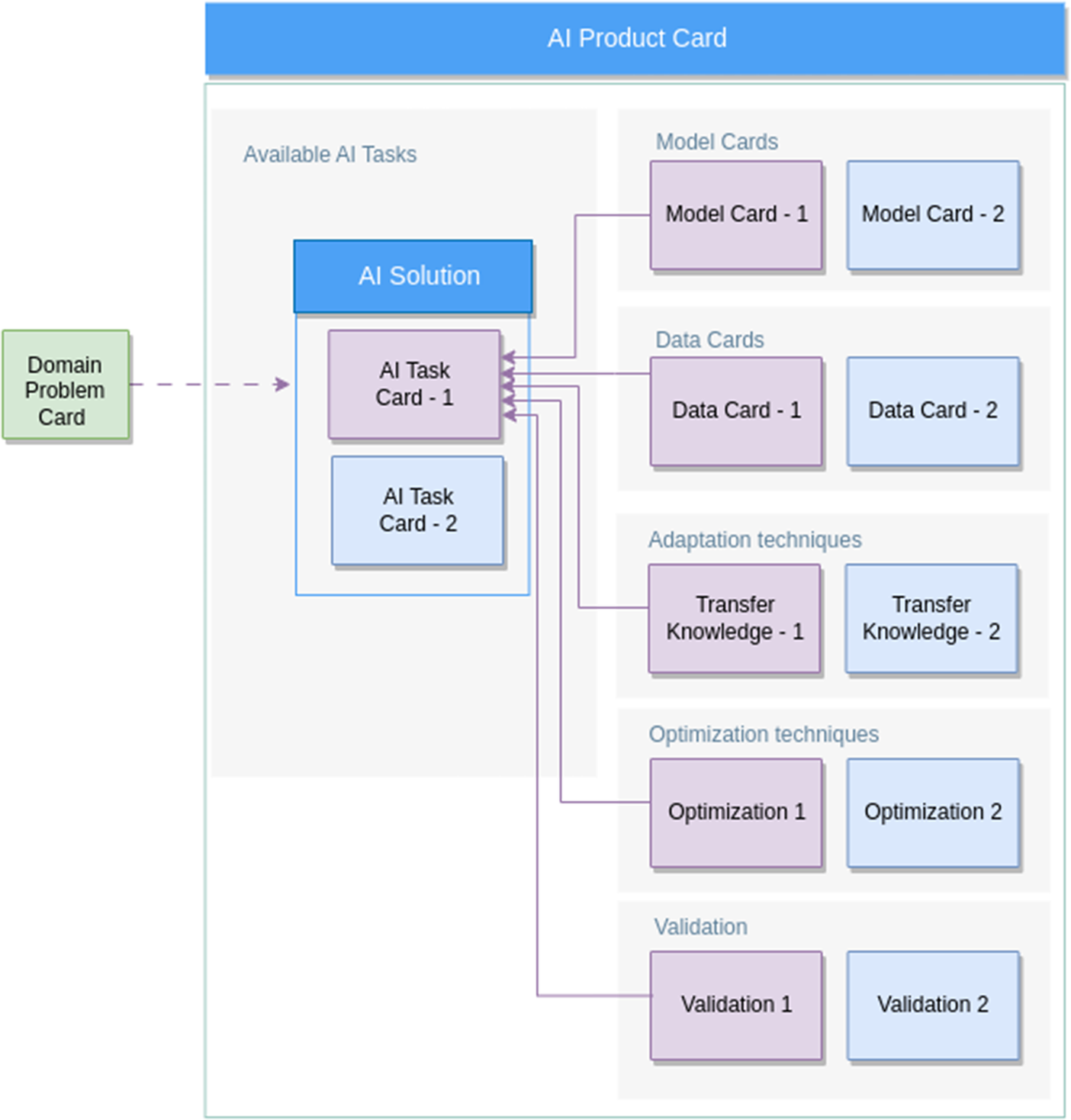
First of all, the conceptualization of the final AI product starts by framing the problem explicitly, focusing on the possibility of reusing existing solutions in place. The card’s goal is to assist policymakers in exploring past instances of similar issues encountered by other public entities or proposing a new problem definition, enhancing its potential for future reuse. The proposed framework is designed to function as a repository of potential use cases in public administration that are addressed by existing AI products produced by other public sector organizations. It is important to note that the AI Product Card is a comprehensive system including various elements that make up the AI product. The Domain Problem Card, which is responsible for determining the context in which the AI product will be used, serves as a single instance in the future catalog of problem definitions within the public sector. This means that once the framework is integrated into a platform, policymakers, acting as AI product consumers, will have the ability to search for and identify relevant use cases that they can repurpose for their specific scenario. This will enable them to take advantage of already implemented solutions for their problem. The attributes within the Domain Problem Card, including name, description, and tag, make the AI product easily discoverable, accessible, and reusable. Consider, for example, a scenario in which a specific municipal administration is implementing a solution that utilizes computer vision to determine whether drivers are holding their mobile phones. It would be beneficial if this problem were defined in a unique manner including relevant tags, its input data, the category of the AI task it employs, a detailed description, and the context in which it has been used. In future scenarios, another governmental entity would find and reuse the solution to the same problem that has been faced in similar circumstances.
Second, one of the primary concerns that must be addressed by the AI Product Card is the validation of the target data to which the model will be applied, in terms of quantity and characteristics they may have. Based on the outcome of the data validation, the stakeholders are able to decide whether to reproduce the same solution or to adapt their model according to the proprietary data. As a result, they are able to validate the transferability level of the found solution.
Third, due to the continually evolving nature of real-world data and the diverse characteristics of various governmental entities, it is necessary for the AI product to be adapted to suit the aspects of production data. This is achieved through the dedicated section for the adaptation procedure which may encompass fine-tuning techniques that have to be disclosed through the completion of the Adaptation specification section. This entails providing the necessary fine-tuning script that specializes the model according to the production data. On the other hand, the specifications should cover also aspects that drive the optimization phase of the solution so as to improve the time and resources employed during the training and inference time. These stages of the AI Product should be taken into account when populating the documentation and specification sections of the framework. The policymakers need the tools that facilitate the implementation of adaptation strategies, thereby guiding the model towards an optimal state or specializing it in order to conform to the characteristics of the available data.
The sections that compose the AI Product Card are the metadata representation of the documentation of each component of the solution, putting the main focus on the transformation of the documentation into a tool that drives the design and evaluation of the AI system. Given the diverse range of stakeholders utilizing AI systems, their transparency requirements exhibit various perspectives, necessitating a thorough and cohesive alignment in documenting each component of the system. According to the literature (Mehta et al., Reference Mehta, Rogers and Gilbert2023), for the framework to achieve success, it must strike a balance between being comprehensive enough to encompass the majority of use cases for public sector-specific AI solutions and being adaptable and extensible to accommodate specific customizations.
To date, there is no unified AI documentation approach focusing on metadata specification that allows for seamless integration and deployment of the components of an AI-based system. To demonstrate our approach, we present metadata definitions of the Cards and show how these formal definition paves the way towards the implementation and deployment of the AI Solution.
3.1. An AI Product Card template
In accordance with the suggested descriptive and prescriptive documentation methodologies, we identify certain components as indispensable for the formation of a final AI product that can subsequently be reused in a comparable context. In this section, we describe the components of the AI Product Card, a novel documentation approach that presents a comprehensive overview of an AI system by incorporating documentation techniques for each of its constituents and expressing it as a set of metadata specifications. The paper proposes a way to formalize the stages of the lifecycle of an AI product to promote its reuse across various contexts. By establishing standardized procedures and necessary components, the approach aims to accelerate adoption and enhance the productivity of engineering teams. The systematic methodology not only offers a descriptive framework but also includes implementation and artefact references, enabling the potential deployment of the AI product. On the whole, a standard AI Product Card typically comprises a range of components that facilitate the prototyping, reuse, and deployment of AI solutions, as per the specific use case.
This work builds upon earlier work that emphasized the importance of dynamic documentation (Mehta et al., Reference Mehta, Rogers and Gilbert2023) by incorporating metadata specifications for each component. This approach allows the documentation cards to become more dynamic and be ready for deployment by associating declarative specifications with each documentation section and aligning them with their corresponding implementation. Each part of the code is able to solve a modular and well-defined piece of the system that is accompanied by dedicated documentation that describes the same functionalities that the code implements. The necessary specifications that may be included in each of these components are organised in the following eight sections.
3.1.1. Domain problem specification
The AI Product Card approach offers the advantage of examining the AI system from various viewpoints, including those of policymakers, AI practitioners, and domain experts with specialized knowledge in AI. The Domain Problem specification is the portion of the AI Product Card that serves to outline the domain problem that the Card aims to address. It provides a comprehensive explanation of the use case from the perspective of the policymaker who will utilize the solution offered by the Card.
The catalogue containing the list of the Domain Problems that have been formulated and used by diverse public institutions may be considered a potential contribution to the implementation of the FAIR principles (Huerta et al., Reference Huerta, Blaiszik, Brinson, Bouchard, Diaz, Doglioni, Duarte, Emani, Foster, Fox, Harris, Heinrich, Jha, Katz, Kindratenko, Kirkpatrick, Lassila-Perini, Madduri, Neubauer and Zhu2023) within the public sector. Providing open access to commonly used governmental use cases, the catalog with the Domain Problems aims to facilitate their reuse, thereby reducing the time and effort required for their adoption and realization of benefits. While existing efforts to provide open access to datasets and AI modelsFootnote 10 are important (Feurer et al., Reference Feurer, van Rijn, Kadra, Gijsbers, Mallik, Ravi, Müller, Vanschoren and Hutter2021; Chard et al., Reference Chard, Li, Chard, Ward, Babuji, Woodard, Tuecke, Blaiszik, Franklin and Foster2018), further work is needed to contextualise these models and data to the public administration domain in order to transform them into real AI products.
This section describes the problem within the context of public administration and aims to make it easily discoverable for future reuse by other public authorities. The catalog of Domain Problems contained within our proposed framework will enable policymakers to quickly identify and access previously solved problems within their own domain. Additionally, the framework offers indicators of the applicability level of the AI solution that addresses the Domain Problem , based on mechanisms for detecting, measuring, and reporting deviations in target domain data distribution. Some of the attributes of the formal definition of this specification may include the unique name of the problem, its description, available input data specifications, output data specifications, and regulatory requirements needed. This section of the AI Product Card contains the following attributes, among which ‘regulatory requirements’ is optional:
-
• id-1: Unique identifier of the domain problem;
-
• name-1: Name of the problem;
-
• description-1: Provide some description of the problem;
-
• tags-1: Label the problem so that it can be easily filtered and accessible;
-
• input-data-specifications: Define input data specifications that the domain problem should expect to work with;
-
• output-data-specifications: Define the produced output data specification;
-
• regulatory-requirements: Validation requirements to use as a certification for the solution.
3.1.2. AI solution specification
An effective AI documentation system must establish a structure that allows for a balance between considering the big picture and focusing on the details, aligning general objectives with specific design choices (Mehta et al., Reference Mehta, Rogers and Gilbert2023). Therefore, the AI solution serves as a comprehensive wrapper for a series of cooperative AI tasks that work together to tackle a complex issue outlined in the Domain Problem Specification. It comprises a collection of AI tasks designed to address a larger problem. This section of the Card can be likened to the Domain Problem , as it has the ability to address its requirements and solve the specified challenge. On the other hand, this section of the Card achieves a balance between the broader perspective and the finer details of implementing a final AI product that effectively addresses the problem at hand. This section of the AI Product Card contains the following mandatory attributes:
-
• id-2: Unique identifier of the AI solution;
-
• name-2: Name of the solution;
-
• description-2: Provide some description of the solution;
-
• tags-2: Label the solution so that it be easily filtered and accessible;
-
• domain-problem-id: Domain problem the solution implements;
-
• implementation-reference: Definition of the entry point for the solution as the implementation of the domain problem functionality;
-
• input-data-specifications: Define input data specifications that the solution should expect to work with;
-
• output-data-specifications: Define the produced output data specification.
3.1.3. AI task specification
The AI task specifications encompass the formal documentation of the various components that have been proposed in the literature such as data, model, validation, optimization, and adaptation techniques. An AI task constitutes the discrete elements of an AI solution . It serves as the primary building block for a complex system that can be integrated into different AI solutions to address specific Domain Problems.
The goal of the AI Product Card framework is to facilitate a wide range of AI tasks, with a focus on ease of reuse and adaptability. This section contains the metadata that matches the descriptive documentation parts of the task with the corresponding executable scripts or commands. In other words, it provides different scripts that implement the logic behind running inference on a particular model or executing a training phase. This section pertains to the practical details and resources required for the training and inference phases of the AI task . Additionally, the validation-reference attribute offers a means to assess the quality and compliance of the available data, ensuring that it aligns with the characteristics and distribution of the data used to train the model. This is an essential step in ensuring trustworthy AI development, as it helps to prevent the incorrect use of the task on data that exhibit different characteristics or distributions. Furthermore, the AI task should reference the adaptation techniques that may be employed to specialize the model for its specific use case. This section of the AI Product Card contains the following attributes, among which ‘adaptation-reference’ and ‘optimization-reference’ are optional:
-
• id-3: Unique identifier of the AI task;
-
• name-3: Name of the task;
-
• description-3: Provide some description of the task;
-
• task: AI domain task categories, such as image classification, object tracking, and text classification. A value from a predefined, yet extendable, domain;
-
• inputs: Define input data specifications that the task should expect to work with;
-
• outputs: Optionally define the output data specification produced as a result of the task;
-
• model-reference: Reference to the ML model specification; it contains the reference ID of the Model Specification that makes up the AI task;
-
• validation-reference: Validation specification to be applied in order to check whether the task may be engaged in the context; it contains the reference ID of the Validation Specification that makes up the AI task;
-
• adaptation-reference: Adaptation specification that defines when the task may be adapted to the given context and how; it contains the reference ID of the Adaptation Specification that makes up the AI task;
-
• optimization-reference: Optimization specification that defines how the solution may be optimized to a context; it contains the reference ID of the Optimization Specification that makes up the AI task
-
• resources: Specification of the resources required or recommended for the task.
3.1.4. Model specification
The appropriate specifications inside this section include the formalised version of the proposed Model Card (Mitchell et al., Reference Mitchell, Wu, Zaldivar, Barnes, Vasserman, Hutchinson, Spitzer, Raji and Gebru2019). Some related work has already been done to provide a formalised and machine-readable format for the representation of the Model CardFootnote 11. Additional studies aim to build the ontology corresponding to the details within the sections of the Model Card (Amith et al., Reference Amith, Cui, Zhi, Roberts, Jiang, Li, Yu and Tao2022; Naja et al., Reference Naja, Markovic, Edwards, Pang, Cottrill and Williams2022). Considering that the Model Card discloses information about different aspects of model development and evaluation, we propose the following attributes as part of the declarative specifications for replicating it in an automated manner. This representation of the model facilitates seamless integration into the AI task definition:
-
• id-4: Unique identifier of the model;
-
• name-4: Name of the model;
-
• description-4: Description of the model;
-
• library-name: Name of the library underlying the model, such as keras, spacy, pytorch;
-
• training-data: Reference to the data used during the training phase;
-
• training-script: The path to the training script;
-
• validation-data: Reference to the data used during the validation phase;
-
• metrics: Metrics of the model specific to the type of the library
3.1.5. Data specification
The Data Specification section contains the set of parameters that represent the sections of a typical Data Card (Pushkarna et al., Reference Pushkarna, Zaldivar and Kjartansson2022) documentation approach. Data Cards play a crucial role in understanding the structure and content of the dataset used for training and validating the model. They are used to assess the discrepancies between the characteristics of the training data and the characteristics of the production data, which may be utilized by public administrations. The specifications for a dataset should not only provide its structural schema but also include any necessary constraints that the dataset must meet. The metadata for the data specifications encompasses the attributes that facilitate its preparation for the training phase of the AI product. As per the data card template, we have incorporated the specifications for the data format, schema, one instance of the dataset, and a set of constraints that the dataset must meet. The list of these attributes is essential to achieve transparency and promote the reuse of the solution. This section of the AI Product Card contains the following mandatory attributes:
-
• id-5: Unique identifier of the dataset
-
• name-5: Name of the dataset
-
• tags-5: label the domain dataset so that it can be easily filtered and accessible
-
• dataset-format: Specify the category of data to be used, such as text, audio, video or tabular data
-
• schema: Depending on the type of the dataset, reference to its schema
-
• reference-data-implementation-example: Reference the dataset implementation example
-
• constraints: Define the criteria that the dataset needs to meet
3.1.6. Validation specification
The validation specification enables the provider to develop a certifiable AI solution that encompasses all crucial aspects for assessing the suitability of existing solutions from the catalog. It is essential to guarantee that the solution can be effortlessly adapted to a new context. The validation outcome provides a percentage of confidence for the repurposing of the solution, enabling policymakers to evaluate its applicability and efficacy. Data validation is often considered an iterative process that addresses the quality and distribution of real-world data that are continuously evolving, leading to a phenomenon known as domain shift. Research on how to deal with domain shift has been extensively conducted in the literature (Rabanser et al., Reference Rabanser, Günnemann and Lipton2019). However, systems incorporating AI solutions in the public sector nowadays require a mechanism to identify, measure, and notify deviations in terms of changes in data distribution and other profiling features, including the quantity of data accessible. In our work, the framework will provide AI practitioners with the ability to design AI Product Cards with a domain shift mindset, aimed at breaking the assumption that source and target data are independent and identically distributed (i.i.d).
To this end, the framework will integrate and establish mechanisms to identify the level of data drifting and offer essential assistance to alleviate its impact for the purpose of developing models that are robust to domain change or domain shift. As a potential open-source library for detecting data drifting in specific categories of data types, it evidentlyFootnote 12 may be well-suited for conducting test suites on relevant data sets. This section of the AI Product Card contains the following mandatory attributes:
-
• id-6: Unique identifier of the validation
-
• library: The name of the library the framework uses for running the validation procedures
-
• description-6: The description of the validation type
-
• implementation: Definition of the implementing function for the validation ready for execution
-
• input data: The data to be considered for validation
-
• reference data: Some referring data used for testing or benchmarks
3.1.7. Adaptation specification
This section of the AI Product Card aims to address the issues related to the efficient adaptation of the AI solution into a different context. When referring to context, we are describing different target domain data characteristics. Taking into account the intended reuse of the same AI system, this section will outline the necessary steps and specifications for the reference implementations of the specialized solution. Considering the use case of object classification and detection from traffic cameras in the city of Tallinn (van Noordt & Misuraca, Reference Van Noordt and Misuraca2022), it is highly beneficial to reproduce the same AI solution in a different context, whether it is in another urban area or even another city (Wei et al., Reference Wei, Zheng and Yang2016). On the other hand, when addressing Natural Language Processing (NLP) tasks, domain adaptation techniques are commonly used to minimize the disparity between different domains. For example, the task of classifying legal documents with multilingual Eurovoc thesaurus descriptors (Avram et al., Reference Avram, Pais and Tufis2021) is commonly employed by various EU institutions, each of which employs distinct concepts that are categorized into distinct areas or subareas. Although the same document classification task may be applicable in diverse domains, it may result in incorrect classification due to domain shifts caused by disparate distribution of target labels or classes. It would be highly advantageous in terms of time-saving and optimizing resource usage to adapt or fine-tune an existing AI solution for document classification to a different government body, rather than creating a new system from scratch that would perform the same task. This section of the AI Product Card contains the following attributes, among which the ‘base-opensource-model’ is optional:
-
• id-7: Unique identifier of the adaptation procedure
-
• description-7: The name of the library the framework uses for running the validation procedures
-
• implementation: Definition of the implementing function for the adaptation ready for execution
-
• compliance-check: Validation specification to be applied in order to check whether the task may be engaged in the context with this adaptation spec
-
• prepare-local-dataset: In particular cases, each model may employ distinct tokenizers, leading to minor variations in the preprocessed datasets.
-
• base-opensource-model: The baseline pre-trained open-source model the AI task is going to use (optional)
3.1.8. Optimization specification
This section presents the metadata format for the optimization techniques that may be utilized for AI-based solutions. It includes the machine-readable version of the prescriptive approach outlined in the Method Card (Adkins et al., Reference Adkins, Alsallakh, Cheema, Kokhlikyan, McReynolds, Mishra, Procope, Sawruk, Wang and Zvyagina2022), which provides AI engineers with the necessary guidance to optimize the system. Smaller public sector institutions might encounter challenges when fine-tuning a pre-trained model since it will maintain all the parameters of the original model resulting in high resource utilisation. Many recent studies have put forth an array of optimization techniques that could potentially influence the efficacy of the AI product in terms of time and resources allotted to it. Parameter-efficient fine tuning (Houlsby et al., Reference Houlsby, Giurgiu, Jastrzebski, Morrone, de Laroussilhe, Gesmundo, Attariyan and Gelly2019) and Low-rank adaptation (LoRA) (Hu et al., Reference Hu, Shen, Wallis, Allen-Zhu, Li, Wang, Wang and Chen2021) are widely recognized and highly effective techniques for adapting custom LLMs in an efficient manner on downstream tasks. Accordingly, the optimization section will contain the most effective configurations for implementing them in various applications. These configurations may encompass the base model, the batch size, the matrix rank, the alpha parameter, the target dataset, and the adaptation scripts that need to be applied to it. This section of the AI Product Card contains the following attributes, among which ‘range’ is optional:
-
• id-8:Unique identifier of the optimization technique
-
• description-8: Description of the optimization technique
-
• implementation: Definition of the implementing function for the optimization ready for execution
-
• metric: The metric specification
-
• range: Possible value ranges
3.2. An example of an AI Product Card
The AI Product Card provided in this section exemplifies how a team of different stakeholders in the public sector, including policymakers, AI engineers and functional specialists can populate the attributes of the specifications provided in Section 3.1. The card describes the task of text classification for legal documents (Rovera et al., Reference Rovera, Aprosio, Greco, Lucchese, Tonelli and Antetomason.d.). From an industrial perspective, many practical tools have been developed for orchestrating Machine Learning (ML) applications lifecycle. Our objective is to establish a connection between the orchestration of these applications and the specifications outlined in the AI Product Card documentation framework. The different stages of the code-bound documentation can be interpreted as the various steps of the ML pipeline, which may include services, datasets, functions or other executable code or artifacts. In this context, MLRunFootnote 13 has been deemed suitable for experimenting with the proposed framework as its organizational structure of a Machine Learning (ML) project conforms to the modular documentation concepts presented in the AI Product Card. The Figure 2 and Figure 3 represent the suggested sections of the AI Product Card for the problem of legal document classification. We provide an initial version of the AI Product Card specifications, along with accompanying reference implementations on an openly accessible github repository.Footnote 14
Example of domain problem specification for legislative text classification.

Example of AI product card for legislative text classification.

4. Conclusion
In contrast to other commonly employed methodologies for AI documentation that aim to provide descriptive or prescriptive documentation directives to the AI system design, we have proposed a machine-readable declarative framework that allows the adaptation of the same solution in different contexts. Indeed, the proposed AI Product Cards framework aims to improve the reuse and adaptation of AI products in public administration by leveraging the machine-readable specifications obtained by the descriptive documentation cards. Specifically, the framework encompasses necessary descriptive and declarative specifications that orchestrate the execution of the accompanying code references and other artifacts that allow for the seamless reuse of the entire AI product. As an example, we have discussed in detail an AI Product Card designed for the legal document classification task.
The framework allows to accommodate diverse AI tasks in a generalizable template. The initial specification template is capable of capturing the needs of the lifecycle of an AI solution. However, one limitation of our proposed framework is the difficulty of formalizing each phase of AI-based solutions due to their diverse needs that vary on a per-task basis. To address this, it may be necessary to extend the metadata specifications over time using a repeatable approach, in order to accommodate the specific needs of training procedures or optimization parameters. Another limiting aspect of the framework, in certain situations, is the absence of a well-defined pattern which can make its representation difficult in a concise and explicit manner. For instance, evaluating the output generated from Large Language Models (LLM) may require manual and empirical processes that involve human feedback.
A possible future extension of the proposed framework could be the exploitation of the recent advancements in the research direction of formalising model card report information through semantic representation (Amith et al., Reference Amith, Cui, Zhi, Roberts, Jiang, Li, Yu and Tao2022; Naja et al., Reference Naja, Markovic, Edwards, Pang, Cottrill and Williams2022) as well as in the application to scenarios outside the public administration.
Data availability statement
We provide an initial version of the AI Product Card specifications, along with accompanying reference implementations on an openly accessible GitHub repositoryFootnote 15.
Author contribution
A.C. wrote the paper. A.C. and R.K. conceptualised and designed the proposed approach. B.L. and R.K. supervised the research direction and the writing process. A.C and A.P.A. contextualised the example of the proposed AI Product Card. All authors read and approved the final manuscript.
Provenance
This article is part of the Data for Policy 2024 Proceedings and was accepted in Data & Policy on the strength of the Conference’s review process.
Funding statement
The authors acknowledge the support of the “AIxPA—Artificial Intelligence in the Public Administration system” area of Flagship Project—Progetto Bandiera PNC-A.1.3 “Digitalizzazione della pubblica amministrazione della Provincia Autonoma di Trento.” Bruno Lepri also acknowledges the support of the PNRR project FAIR—Future AI Research (PE00000013), under the NRRP MUR program funded by the NextGenerationEU.
Competing interest
The authors declare no competing interests exist.


 Open access


Comments
No Comments have been published for this article.