

On July 13, 1571, King Philip II of Spain, via a real cédula, authorized the Audiencia of Santo Domingo to enact plans to “conquer” a community of African cimarrones (maroons, runaway slaves) located about 36 miles from the city of Santo Domingo. The king offered to those who ventured forth compensation in the form of the cimarrones they captured as slaves.Footnote 1 At face value, the substance of this order was not particularly unique. Since the 1520s, runaway African slaves had formed maroon communities in remote regions bordering Spanish conquests. By the 1570s, African maroons could be found in practically every part of Spanish America.Footnote 2 The uniqueness of Philip's order comes from the choice of language, in particular the decision to label the expedition a conquest. In most cases, the monarch or his officials used words like ‘reduce’ (reducir/reducciones), ‘pacify’ (pacificar/pacificación), ‘castigate’ (castigar), or ‘dislodge’ (desechar) to describe the goal of such campaigns. By describing an anti-maroon campaign as a conquest, this cédula went against the dominant Spanish narrative of the sixteenth century, in which resistance, especially by Africans or native groups, signified a punctuated disturbance of an ostensibly stable and coherent postconquest colonial order. The wording of the cédula, and the maroon movements to which it responded, explicitly link anti-maroon campaigns to the process of Spanish conquest. This article suggests that Spanish-maroon contestation on Hispaniola should be construed as an integral piece of a prolonged and often incomplete Spanish conquest. More importantly, this reevaluation of the conflict reveals maroons to be conquerors in their own right.
The English word ‘maroon’ derives from the Spanish cimarrón. Dating from the earliest years of Spanish settlement in the Caribbean, cimarrón could be applied to indigenous groups, Africans, and even livestock that had ‘gone wild' or fled outside of Spanish control. The word derives from the Taino root símara meaning arrow. Within decades after contact, Spaniards had appropriated a derivation, símaran, meaning ‘wild, savage, gone astray,’ as cimarrón.Footnote 3 On Hispaniola, the first significant use of the term came in 1519 when an indigenous leader, Enrique, fled with members of his community to a remote region named the Bahoruco where they lived outside Spanish control for over a decade. In the years that followed, runaway slaves who chose to establish themselves in remote communities came to be known as cimarrones.
Marronage constitutes one of several forms of resistance to the institution of slavery.Footnote 4 Scholars divide marronage into two forms: ‘petit marronage’ and ‘grand marronage.’Footnote 5 Slaves engaging in petit marronage typically fled for short periods, individually or in small groups. Absences lasted days to weeks, and slaves often returned of their own accord. Grand marronage differed from petit marronage in scale and intent: it involved large groups of slaves, who having fled slavery, banded together to form autonomous communities.Footnote 6
This article examines African individuals who engaged in both forms of marronage. In looking back at sixteenth-century Hispaniola, the division between petit and grand marronage appears blurry. Spanish sources often use negros cimarrones (black maroons), negros alzados (black rebels), and negros huidos (runaway blacks) to refer to Africans who had fled Spanish masters and resisted recapture, at times interchangeably. The first two terms correspond to manifestations of grand marronage, whereas the third is more commonly associated with petit marronage. Sadly for the historian, the documents do not allow for fine-grained differentiation between slaves engaged in short-term flight and those seeking a more permanent escape.Footnote 7 Moreover, the documents suggest that on Hispaniola petit marronage could transition into grand marronage quite fluidly as individual slaves or small groups became incorporated into long-standing maroon communities. Consequently, in order to assess marronage in its varied forms I use the term maroon to refer to individuals engaged in both forms of flight.
This article challenges traditional assumptions about slavery, slave resistance, and colonialism. Most scholars of maroons on Hispaniola and elsewhere view marronage as a problem of colonialism, not a problem of conquest.Footnote 8 Following this view, African slaves were colonial subjects, forcibly brought into the Americas through the developing transatlantic slave trade. Within the colonial setting, marronage represented a powerful form of resistance to the colonial institution of slavery and its abusive and dehumanizing assault on the enslaved. While this view honors the economic, social, and cultural forces that brought Africans to the Americas and contributed to their resistance, such an interpretation overlooks the reality that once outside of Spanish control African maroons established self-governing, autonomous communities—and at times kingdoms—that challenged the attempted consolidation of Spanish conquests. Importantly, this article expands our understanding of marronage by suggesting that such activities embodied both a form of resistance and, at least in some contexts, an act of conquest.
In reconfiguring Spanish-maroon conflict as part and parcel of the Spanish conquest of the Americas, this article expands on what has come to be known as New Conquest History.Footnote 9 Since at least the 1990s, scholars have begun to reappraise the Spanish conquest and the traditional triumphalist narrative constructed by Spanish conquistadors and perpetuated by many historians. By engaging in more critical readings of Spanish sources, often in conjunction with indigenous sources, these scholars have revealed that Spanish military, political, social, and religious conquests often took decades, if not centuries, to achieve. As Matthew Restall argues, Spanish ideologies of conquest conflated actions that established ‘claims to possession’ with actual possession.Footnote 10 Consequently, conflicts occurring after the imposition of Spanish dominion and the founding of settlements were not recognized as aspects of the conquest itself but instead became rebellions and uprisings, even when those conflicts involved groups untouched by earlier campaigns of conquest.Footnote 11 In most cases, New Conquest History has turned our attention to the important roles played by indigenous people as allied conquistadors or persistent opponents of Spanish conquest efforts. Yet, Africans slaves and servants accompanied most Spanish conquest expeditions. Like their Spanish counterparts, these black conquistadors frequently sought remuneration for their services, and a handful of studies have revealed the significance of their participation in the process of Spanish conquest and colonization.Footnote 12
Although other scholars have examined the history of early maroon activity on Hispaniola, this article seeks to reframe the narrative of these events in the lens of New Conquest History.Footnote 13 In his study of black conquistadors, Matthew Restall categorized members of maroon communities as “counter-conquistadors.”Footnote 14 Following Restall's proposition, this analysis emphasizes that maroon communities were not just antagonists to Spanish colonialism but also represented sites of conquest that undermined Spanish claims to possession in the sixteenth century and beyond.
Constituting a Maroon Conquest
The concept of ‘conquest’ poses a particularly troublesome problem for scholars of the Atlantic world. All European powers who claimed territory in the Americas did so by some combination of warfare, settlement, negotiation, and at times alliances, with Native Americans. Yet, only Spaniards labeled their acquisitions “conquests.”Footnote 15 Consequently, many of our views regarding conquest remain grounded in Eurocentric (here, Spanish) expressions of this process. Works of New Conquest History have expanded our understanding of the meanings of conquest by revealing how indigenous groups approached alliance or resistance to Spanish campaigns of conquest. This article adds to a more diverse understanding of conquest in early Latin America by positing that maroons engaged in distinctive conquests and that these can be understood in relation to European and African traditions of conquest.
Spaniards did not conquer land, they conquered people—and only by extension the lands occupied by the conquered. This emphasis on people, not land, can be seen in a variety of ways. Spaniards justified a right to conquer based on an association between preaching Christianity to newly discovered people and European notions of a ‘just war.’ From 1493 onward, the papacy supported Spanish claims in the Americas, on the condition that Spaniards spread Christianity among the people of those lands. If the people Spaniards encountered in the Americas refused to convert or opposed Spanish claims through war, the Spanish could engage in a just war to subdue those recalcitrant groups and establish dominion over their people and lands.
In 1513, the Spanish monarchy entrenched this link between conquest and religion in a document called the requerimiento. Intended as an ultimatum to be read in the presence of indigenous people, the requerimiento demanded, in a thoroughly Spanish-European manner, that indigenous people acknowledge the superiority of the Christian faith and consent to predication by missionaries.Footnote 16 Ideally, the crown required conquistadors to pronounce the requerimiento, although not necessarily in an indigenous language, prior to the start of military conflict. In practice, conquistadors rarely engaged in the formal process demanded by their monarchs.Footnote 17 Nevertheless, the requerimiento and its legalism constitute one context for the Spanish association of conquest with the subjugation of people.
More practically, the process of Spanish conquest demonstrates that Spaniards consciously targeted populous regions of the Americas inhabited by sedentary agriculturalists.Footnote 18 After the initial settlement in the Caribbean, Spanish expeditions routinely bypassed dispersed, semi-sedentary, and non-sedentary groups.Footnote 19 Only when the exploitation of resources drew Spaniards into such regions did conquests occur, and in general those regions proved the most prone to protracted campaigns of pacification. In so far as Spanish dominion extended over territory, it did so as a consequence of the conquest of its inhabitants. In fact, the Spanish perceived uninhabited lands as useless, not worth conquering. Such places received the label despoblado. Nevertheless, few areas of the Americas lacked any human presence. Instead, Spaniards frequently applied the term despoblado to areas they could not or did not wish to conquer.Footnote 20
Although the process of Spanish conquest reveals the intimate links between conquest and people, colonial and modern definitions of “conquistar” tend to emphasize the primacy of territorial acquisition to this process. In 1611, Sebastián de Covarrubias Orozco defined the term: “to acquire through force of arms a kingdom or state.”Footnote 21 The eighteenth-century Diccionario de autoridades included a similar definition: “to subjugate, dominate, gain, or acquire a kingdom, province, city, or plaza, through force of arms.”Footnote 22 Even the current version of the Diccionario de la Real Academia Española retains a territorial focus in its definition: “to gain, through an act of war, a territory, settlement, position, etc.”Footnote 23 Although these definitions tend to use language that references territory, the linkage to people cannot be removed, and all of them reference warfare as essential to conquest. Intuitively, war requires an opposing side. Similarly, the Iberian concept of kingdom (reino) encompasses land and people. Bringing together these various strands of evidence—religious, historical, and semantic—Spanish conquest can be understood as the subjugation of a people and the territory they occupy by force of arms.
Just as the Spanish concept and practice of conquest grew out of Spain's own historical-cultural tradition, so too did Africans have patterns and practices of warfare that offer insights into the applicability of the term ‘conquest’ to maroons. Unfortunately, the historic documentation does not allow the establishment of direct connections between the practices and concepts of specific African peoples and those of early maroons. While scholars of the African diaspora have made great strides in mapping the ethnic contours of forced African migration to the Americas, the documents that record the early maroons of Hispaniola rarely reference specific African ethnicities.Footnote 24 Nevertheless, certain patterns of warfare among the inhabitants of Atlantic Africa appear sufficiently widespread to justify their inclusion in a framework of conquest that would be familiar to most Africans engaged in marronage.
The link between warfare and conquest among Atlantic African groups can be seen most clearly in the central role of slavery in the political economy of the region.Footnote 25 Most importantly, Atlantic African societies generally did not recognize the private ownership of land. Instead, as John Thornton has argued, most African cultures relied on the control of people, through slavery and other forms of bondage, as the primary institution for generating wealth and revenue.Footnote 26 Consequently, Atlantic African warfare centered on the capture and redistribution of labor, not the forceful acquisition of land.Footnote 27 Thornton further argues that Atlantic African practices of enslavement through war functioned as conquest: “Just as slavery took the place of landed property in Africa, so slave raids were equivalent to wars of conquest.”Footnote 28
While the Spanish claimed dominion over the lands of those they conquered, African warfare generally relocated defeated captives to territories already controlled by the victorious side. The lands occupied by defeated groups were not necessarily taken by the victors.Footnote 29 As a result, the boundaries between African states appeared quite amorphous to European observers since the occupation of land could shift depending on which state had the population sufficient to exploit a region.Footnote 30 Nevertheless, the primacy of slavery to African warfare does not negate that expansionist states necessarily acquired territory as they came to control an ever larger population. The growth of the kingdom of Kongo and the Songhay empire both demonstrate the process by which African patterns of warfare, inexorably linked to slavery, resulted in territorial growth, even in a cultural region that did not prioritize private ownership of landed property.Footnote 31 Thus, one might construe conquest in the Atlantic African context as the acquisition of slaves through force of arms, and at times acquisition of lands occupied by the conquered.
The application of the term conquest to maroons follows from this discussion of Spanish and Atlantic African forms of conquest along interpretive and rhetorical lines. The interpretive argument for maroon conquests derives from the observation that maroons' escape from slavery and their occupation of regions claimed by Spaniards reflects a negation of Spanish and Atlantic African forms of conquest. If enslavement in an Atlantic Africa was conquest, flight from enslavement reversed that conquest. Such a claim does not suggest that slave owners or the Spanish crown recognized slave flight as a means of escaping the legal status of slave—they, of course, did not. Nevertheless, structurally marronage could be interpreted as an act of ‘self-conquest,’ a reversal and negation of the original conquest by enslavement.Footnote 32 Similarly, maroon occupation of lands claimed by Spain functioned as a negation of Spanish claims to conquest. Spaniards claimed dominion over American lands by virtue of the conquest of their original inhabitants. By occupying lands, and defending those lands by force of arms, maroons negated earlier Spanish conquests.
More importantly, having negated the conquests that had enslaved them and the conquest that had established Spanish claims to land, maroons engaged in activities consistent with Atlantic African forms of conquest. Maroons regularly raided Spanish estates and communities to free other slaves and acquire resources. Such raids removed laborers from the control of Spanish slave owners and added them to the maroon community. Although maroons do not appear to have enslaved those they captured, the transfer of labor from one group to another through raids mirrors African practices. Some Spanish accounts claimed that maroons raided and enslaved neighboring indigenous groups.Footnote 33 Such a practice would be consistent with Atlantic African warfare; nevertheless, Spanish stereotypes of Africans as violent and oppressive may have influenced their observations that maroons enslaved native people.Footnote 34 The use of raids to deprive enemies of labor and resources represents an enduring feature of African conquest and warfare that maroons adapted to their needs in the Americas.Footnote 35
Moving from the interpretive to the rhetorical, the application of the term “conquest” to maroon actions on Hispaniola serves to underscore the significance of the maroons' actions in rejecting their enslavement and commodification in the Atlantic slave trade and opposing Spanish colonialism. If the Spanish conceived of at least some anti-maroon campaigns as conquests, they also tacitly acknowledged that maroons had used force of arms to establish and defend dominion over the lands they occupied. Rhetorically, recognizing that maroons could engage in conquests serves to decouple the notion of conquest in the Americas from an exclusively Spanish-European mode. Maroons certainly did not conquer in the way that Spaniards did. Drawing from African traditions, their connection to land could be transitory. Maroon communities and the lands they occupied shifted as their needs changed and as Spanish anti-maroon campaigns threatened their livelihood. Moreover, maroon conquests could be ephemeral and short-lived. In the discussion that follows one can identify a pattern of repeated maroon conquests on Hispaniola, but outside of the region of the Bahoruco few maroon communities lasted for prolonged periods. For most of the sixteenth century, Spaniards fought against maroons, regularly capturing, killing, and dispersing specific groups. Yet, even when Spaniards claimed victory, they rarely succeeded in capturing or killing all the maroons they encountered. Those who remained, joined by a constant trickle of runaway slaves, re-formed communities that occupied new spaces on the landscape, threatened Spanish interests, and became targets for renewed Spanish campaigns of conquest.
Yet, while maroon conquests draw our attention to the actions and choices of maroons as counter-conquistadors and conquerors, their experiences cannot be rendered as a triumphalist narrative of success. Maroons and their communities experienced perilous material conditions and were the target of near-constant military campaigns by determined and better armed adversaries. Many died or faced a return to slavery when the campaigns against them succeeded. In short, even if understood as conquerors, maroons faced uncertain futures and a constant struggle for survival. Cognizant of the perilous position of maroons and their communities, this article offers a reappraisal of early African maroons on Hispaniola, demonstrating that early Spanish colonialism, with its reliance on African labor and the transatlantic slave trade, directly contributed to a pattern of African conquest in the Americas, and that their conquests in turn rendered Spanish conquest efforts inadequate and incomplete. Thus, while maroon communities grew out of colonial relationships, they are nothing less than sites of African conquest.
The Indigenous Maroons
The formation of the Bahoruco, Hispaniola's largest and most stable maroon enclave, typifies the processes of maroon communities and conquest. Prior to the Spanish arrival on the island, the indigenous inhabitants were governed by hereditary rulers or caciques whose claim to leadership was intimately tied to their ancestral lands, often termed cacicazgos.Footnote 36 At the time of the Spanish arrival, the Bahoruco fell within the cacicazgo of Maguana forming a frontier with the cacicazgo of Xaragua to the southwest (see Figure 1).
Indigenous Cacicazgos of Hispaniola and Spanish Campaigns of Conquest, 1493–1503
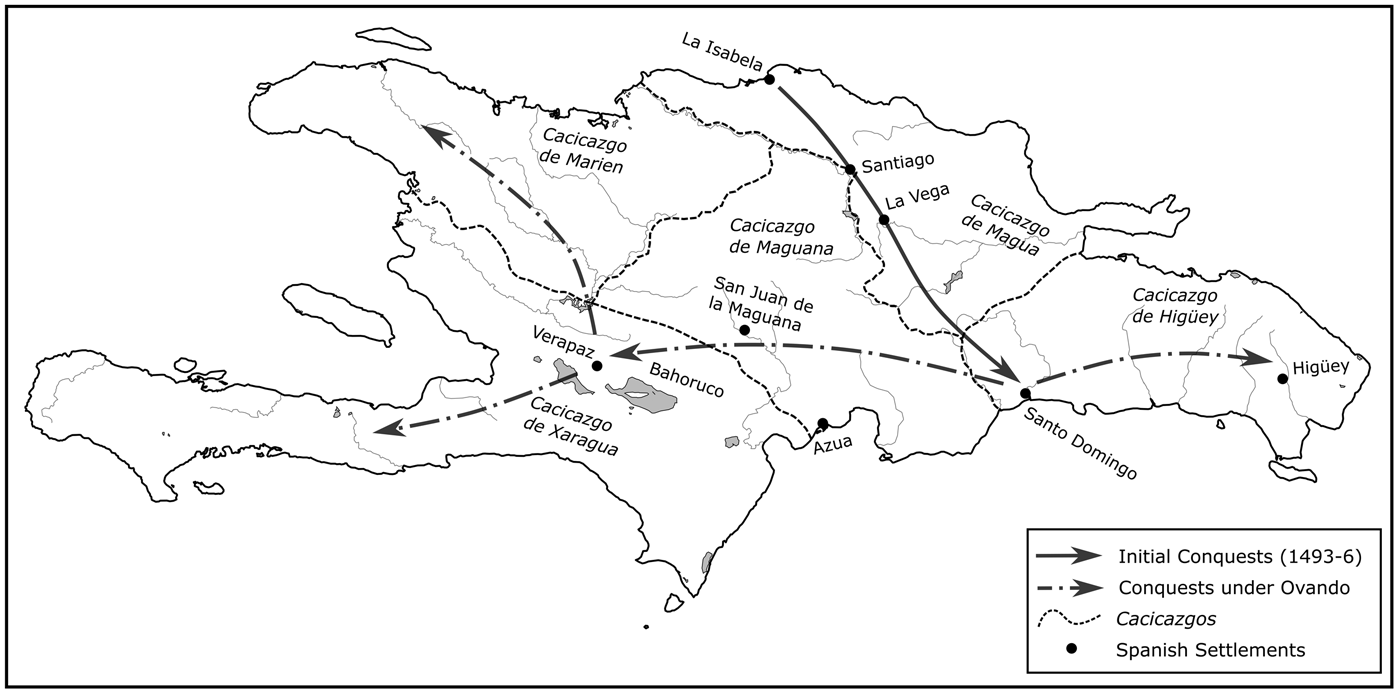
Until 1503, most early Spanish-indigenous conflict occurred in the cacicazgos of Maguana and Magua.Footnote 37 During this time Spanish settlement expanded along a north-south axis through the center of the island. After defeating the indigenous leaders of these regions, Spaniards imposed the institution of the encomienda on defeated indigenous communities, often relocating them closer to Spanish settlements. These disruptions allowed the cacique of Xaragua to annex the Bahoruco from the cacicazgo of Maguana.Footnote 38 In July of 1503, the island's governor, Nicolás de Ovando, initiated a new series of campaigns that targeted the cacicazgos of Higüey, Marien, and Xaragua.Footnote 39 After defeating Anacaona, the cacica of Xaragua, Ovando consolidated the indigenous residents of the cacicazgo in the town of Santa Maria de la Vera Paz.Footnote 40 Enrique, the grandnephew of Anacaona and a future maroon leader, spent his youth at the settlement of Vera Paz. In 1514, Spanish authorities initiated a widespread program of indigenous relocation that reassigned indigenous communities to new Spanish encomenderos in an attempt to accommodate the labor demands of the remaining gold mines and the burgeoning sugar industry.Footnote 41 This program weakened the indigenous elites by removing them from their ancestral cacicazgos and emptied wide swaths of the island. As part of this plan, Enrique and his people were relocated from Vera Paz to San Juan de Maguana and distributed among Spanish encomenderos.Footnote 42
In emptying previously conquered areas, this plan transformed conquered lands controlled through Spanish and indigenous communities into unoccupied territories devoid of Spanish settlement and oversight. The community of Vera Paz soon disappeared; its few Spanish inhabitants relocated westward, to a harbor known as Yaguana.Footnote 43 Consequently, from around 1515 onward Spanish control of the former cacicazgo of Xaragua rested solely in the communities of San Juan de Maguana, Yaguana, and Azua, a port on the eastern edge of the region. The rugged terrain of the Bahoruco lay vacant and beyond the immediate interests of Spanish authorities and settlers. In 1519, tensions between Enrique and his encomendero led the indigenous leader to flee the encomienda with 30 to 40 followers. The indigenous maroons' greater knowledge of the region allowed them to evade capture and reestablish a self-sufficient community in a region they knew intimately. For more than ten years, Spanish forces repeatedly failed to conquer the Bahoruco or capture Enrique.Footnote 44
By the 1520s, the geopolitical balance on the island had begun to shift. Spanish settlement and exploitation concentrated in coastal sugar regions and along the north-south corridor of settlements established in the 1490s. This geographic clustering of Spaniards, along with their slaves and indigenous encomiendas, created space for maroons, first indigenous and then African, to seek out vacant territory and establish communities.Footnote 45 Enrique's community became the first of many maroon communities that would carve out territories across the island. During the 1530's, the Bahoruco remained the primary refuge for maroons, including increasing numbers of Africans. In 1533, negotiations with Enrique bore fruit and the Bahoruco maroon problem appeared open to a solution. Enrique and many of his indigenous followers agreed to surrender and in return were allowed to establish their own self-governing community about 20 miles from Azua.Footnote 46 Yet, in relocating Enrique's community, the Spanish authorities once again left the Bahoruco devoid of Spanish subjects. Almost immediately, new waves of African maroons flocked into the region to establish communities.
The Rise of African Maroons (1530 to 1540s)
Across the island, a similar pattern emerged as maroons, mostly runaway African slaves, established communities in other uncontrolled areas (see Figure 2).
Areas of African Maroon Activity on Hispaniola, 1520s–1550s
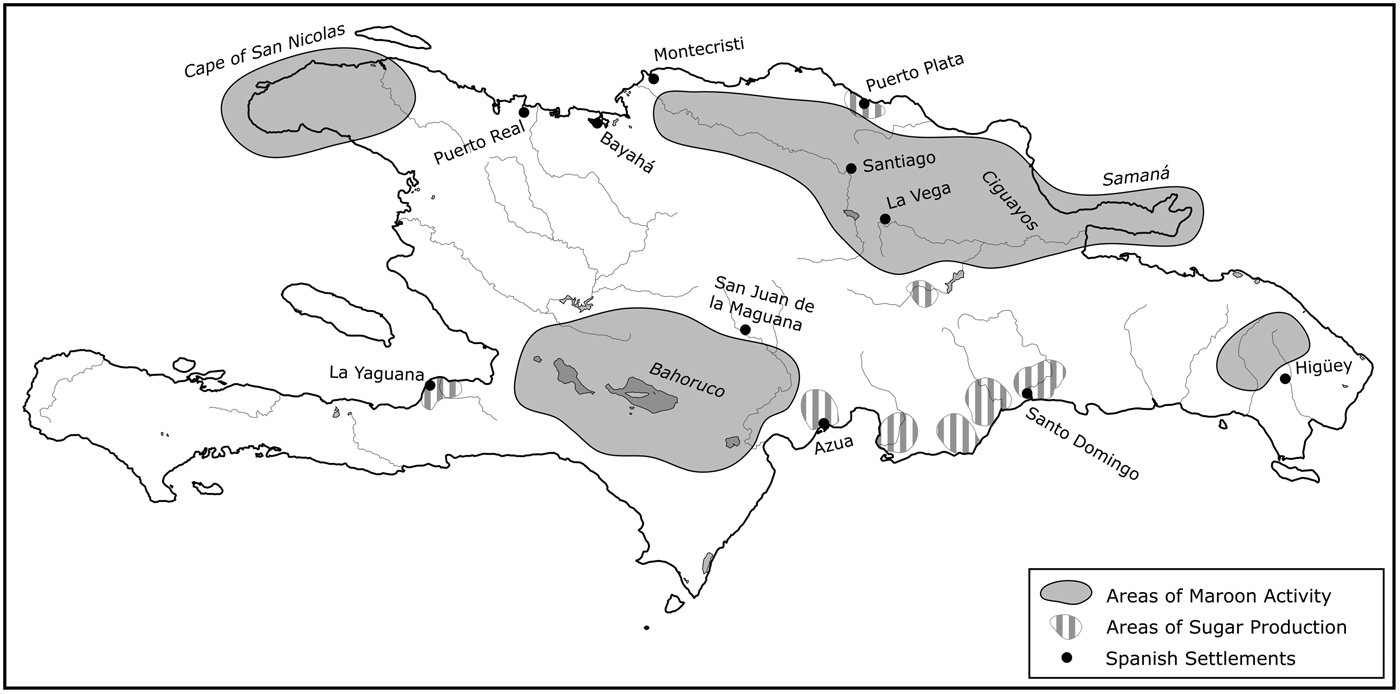
In 1532, the Audiencia of Santo Domingo warned that indigenous maroons had established a community near Puerto Real.Footnote 47 Ten years later, the archdeacon Álvaro de Castro reported that between 2000 and 3000 African maroons were occupying Cabo San Nicolás, Ciguayos, the Samaná peninsula, and the cape of Higüey.Footnote 48 For their part, the audiencia lamented that the townspeople (vecinos) of La Vega, Puerto de Plata, and Santiago dared not leave their homes, and that the region's miners slept with their lances out of fear of maroon raids.Footnote 49 Another report from this period claimed that various bands of maroons wandered the entire northern cordillera from Santiago to Montecristi.Footnote 50 During his stay on the island in 1545, the Milanese conquistador and chronicler Girolamo Benzoni estimated that the island housed 7000 maroons.Footnote 51 Although hyperbolic, Benzoni's account appears to reflect widespread fears of the maroon presence on the island.
The explosion in the number of African maroons during this period reflects two interdependent trends. First, the focus of Spanish exploitation of the island had begun to change, from mining to sugar.Footnote 52 This led to the abandonment of many settlements and the consolidation of Spaniards, natives, and Africans in a handful of sites. Second, the indigenous population continued to decline as more and more African slaves arrived on the island.Footnote 53 As slaves began to recognize the limits of Spanish territorial control, resistance through flight, individual or collective, fueled the growth of maroon communities.
Numerous and widespread groups of maroons severely disrupted Spanish commerce and trade. By the 1540s, the maroons of the Bahoruco had effectively cut off the overland road connecting the port of Yaguana to San Juan de Maguana.Footnote 54 In 1543, Melchor de Castro, the escribano de minas, noted that the maroons had occupied the depopulated interior of the island, where they survived on the wild cattle and boar found there.Footnote 55 Some reports even noted that the maroons' control of the interior and its roadways had become so decisive that Spaniards traveled only in groups as large as 15 to 20.Footnote 56
In addition to controlling these rural resources, maroons established their own commercial networks connecting maroon communities to each other and to Africans still living in Spanish communities. In his letter of 1542, Archdeacon Castro lamented that maroons conspired with urban slaves, especially women termed ganadoras, to sell stolen goods back to Spanish cities. By 1545, Spanish officials feared that maroons could take the entire island if they chose. During this era, several maroon leaders gained notoriety for their exploits. Spanish officials regularly lamented the attacks undertaken by Diego Ocampo, Diego de Guzmán, and Sebastián Lemba.
These men and their followers generally operated in specific areas. For example, Lemba appeared to use the Bahoruco as his primary sanctuary, while Diego de Guzmán roved near la Vega. Nevertheless, they often raided across the island, relying on equestrian skills to travel great distances. Oidor Alonso de Grajeda noted: “The great part of their vigor comes from their having been raised among the cattle herds of the vecinos of this island, where they ride on horseback and become brazen and skilled in the saddle as with the lance.Footnote 57 Of these leaders, Diego Ocampo appears to have used this mobility to greatest effect. His raids took him from La Vega to Azua, then into the Bahoruco. From the Bahoruco he and his men raided San Juan de la Maguana and Azua, moving back to La Vega and then to Puerto Plata.Footnote 58 The ease with which Ocampo moved across the island demonstrates the inability of Spanish officials to control roadways and rural areas. Moreover, the scope of maroon activities during this time speaks to their successful conquests in the island's interior. Not only did maroons control various enclaves, but they were able to use these enclaves as bases from to challenge Spanish interests far and wide.
Over the next few years, the Spanish-maroon balance would shift once again. After arriving on the island in 1543, the new president of the audiencia, Alonso López de Cerrato, commissioned two squads of Spaniards charged with capturing or killing maroons. This strategy replicated a policy first established in 1528 as part of an expansive set of slave codes created to stem the tide of African resistance.Footnote 59 The two squads attempted to reestablish Spanish authority outside of Hispaniola's beleaguered cities. In 1545, the king authorized the audiencia to entertain the possibility of negotiation with maroons, which further expanded the options available to local authorities.Footnote 60 Within a year, López de Cerrato's roving patrols bore fruit. In 1546, two maroon leaders, Diego Ocampo and Diego de Guzmán both approached Spanish authorities and sued for their freedom.Footnote 61 Ocampo negotiated his surrender via a resident of Puerto Plata.
Ocampo's knowledge of possible pardons and his choice to approach a Spaniard in Puerto Plata to negotiate for him suggests that maroons' networks of communication not only crisscrossed the geographic space of the island but connected them to Spanish cities and estates. Unlike Enrique's negotiated surrender of his entire community, Ocampo requested freedom only for himself, his wife, and two cousins.Footnote 62 Nevertheless, as had Enrique, he agreed to work alongside Spaniards as a slave catcher. Soon after, Diego de Guzmán followed suit, negotiating a personal pardon and agreeing to combat maroons on behalf of the Spanish.Footnote 63 López de Cerrato informed the crown that Spanish residents felt great contentment after recruiting Ocampo.Footnote 64
These surrenders followed several major victories by Spanish authorities against maroon bands. After a series of engagements around San Juan de Maguana, a Spanish force described as “a grand squad” succeeded in capturing or killing more than 100 maroons. The Spanish imposed severe penalties on the maroons they defeated, executing some, amputating the limbs of others, and exiling women and children from the island.Footnote 65 These strategies did not eradicate the maroon presence in the hinterlands, although they did suppress maroon raids of Spanish estates. Importantly, the new squads focused on patrolling the island's roads and providing a fast- reaction force to reports of maroon raids. By late 1546, African maroon-catchers, like Ocampo and Guzmán, were supporting these squads. Spanish authorities offered freedom to slaves that served with distinction in these campaigns. In October 1547, the oidors López de Cerrato and Grajeda credited these new African allies with suppressing the maroons active around la Vega and Santiago.Footnote 66 Similarly, the new mixed units helped reduce a maroon settlement near Higüey that possibly had existed for more than 15 years.Footnote 67
Nonetheless, the remote Bahoruco remained a haven for maroons. From 1546 to 1548 the maroon leader Sebastián Lemba used the region as a base for raids on Spanish estates near San Juan de Maguana and Azua. After evading Spanish patrols for the better part of a year, Lemba was cornered and successfully defeated in September of 1548 by a Spanish-African squad. In their report, the oidors noted that the killing blow had been dealt by a slave ally, who thereby received his freedom and a license to bear arms.Footnote 68 The defeat of Lemba appeared to signal an end to maroon activity on the island. In January of 1549, the audiencia reported that “this matter of negro rebels has now been completely settled, this has been a great boon for the island and for the other [slaves] who now know they cannot rise up.”Footnote 69
There is reason to question the audiencia's elation over the apparent pacification of maroons. Earlier reports had placed maroons in Cabo San Nicolás, Ciguayos, the Samaná peninsula, and the entire northern cordillera, regions peripheral to the anti-maroon operations of the 1540s. The most contentious conflicts occurred in the region bounded by Santo Domingo, San Juan de Maguana, La Vega, and extending northeast to Puerto Plata. Spanish squads responded to threats as they appeared and entered the hinterlands only while in pursuit. Except for the destruction of the community located in Higüey, none of the squads' reports describe efforts to destroy established maroon communities. Finally, even though the reports of 1545–49 clearly indicate that Spanish tactics had suppressed maroon raids, the number of maroons caught or killed during this period pales in comparison to the number of suspected maroons reported in the early 1540s. While those numbers may have been exaggerated, the limited territorial range of Spanish patrols, the mobility of maroons, and the continued existence of vast regions devoid of Spanish development suggest that by 1550 maroons had not been eradicated but had likely gravitated away from areas of intense Spanish conflict.
Official reports corroborate a period of maroon retrenchment. In July 1549, Oidor Grajeda reported that only a small band of eight to ten maroons moved around the Bahoruco, “without harming anyone.”Footnote 70 Interestingly, in the same letter, Grajeda noted that in La Vega a band of 20 to 25 indios cimarrones had taken up operations under the leadership of an indigenous captain and a black man named Dieguillo Ocampo, possibly the same maroon who had negotiated a pardon three years earlier.
An Interlude of Depopulation, Cattle, and Contraband
During the middle decades of the sixteenth century, the island of Hispaniola underwent significant demographic and economic changes. Simultaneously, the island faced new pressure in the form of foreign interlopers seeking to establish a foothold there. While many of these changes occurred independently from the maroon wars of the period, they increasingly destabilized Spanish colonial authority and furthered the process of undoing Spanish conquests. Collectively, these changes and pressures, in combination with a renewal of maroon activity in the last third of the century, would lead colonial authorities to voluntarily cede all pretense of colonial dominion by ordering the destruction of Spanish communities and estates in the north and west of the island.
At its peak in the 1510s, the island was home to 10,000 Spaniards.Footnote 71 From the 1520s onward, the island's population decreased dramatically. As the gold boom subsided, the native population declined, and new conquests lured adventurous men away, many early settlements on the island disappeared. Between 1514 and the early 1520s, six settlements were abandoned, and only one founded.Footnote 72 By the 1540s, the peak of early maroon conflict, the island's Spanish population likely numbered around 4,500.Footnote 73 Spanish settlement concentrated primarily in Santo Domingo with significantly smaller clusters in the various towns and villas located near the coast. From the 1540s through the end of the century, the overall Spanish population remained largely static, growing slowly to around 6,000 in 1606.Footnote 74
Africans bolstered the sparse Spanish population. In 1542, the island held as many as 30,000 slaves.Footnote 75 While this number might be exaggerated, it would not be unreasonable to assume that African slaves numbered between 10,000 and 20,000 in the 1540s.Footnote 76 For most of the sixteenth century, Africans dominated the sugar-producing region stretching from Santo Domingo west toward Azua and San Juan de Maguana. The slave population peaked at mid century, and began to decline during its final decades. In 1568, Oidor Juan Echagoian reported a total slave population of 20,000.Footnote 77 In 1571, the chronicler Juan López de Velasco claimed the island had just over 12,000.Footnote 78 Following a smallpox epidemic in 1586, the number of slaves dropped further, to below 10,000 by 1606.Footnote 79 The decline in the number of slaves can be further attributed to the slowing of the sugar economy and the island's increasing isolation from major commercial routes.
By mid century, sugarcane dominated the island's economy. However, sugar estates required large expenditures for both constant upkeep to their infrastructure, especially the mills, and capital to purchase slaves.Footnote 80 From the 1550s onward, changes in trading patterns slowed the economy and made import and export difficult. As sugar struggled, new industries developed, most notably livestock production and ginger. Ranching entrepreneurs used slave labor to produce hides for export. Over time, the increasingly depopulated interior of the island became home to thousands of heads of livestock.Footnote 81 Between 1565 and 1574, the cultivation of imported ginger root took hold. Ginger proved a boon for the struggling island; more valuable than sugar by weight, it required less capital outlay and could be produced with slave labor.Footnote 82 During the last quarter of the century, many Spanish entrepreneurs shifted into ginger production and the island even sought to establish an empire-wide monopoly on its production.Footnote 83 Despite the shifts toward livestock and ginger, effective export to European markets was limited by changing trade patterns and foreign threats.
As early as the 1520s, English and French ships had begun to enter the region in the hopes of capturing Spanish ships and their precious cargo. During the 1530s and 1540s, war with France led to the capture of more than 60 Spanish trading vessels in the Atlantic, more than 17 of those taken in the Antilles.Footnote 84 The frequency of interlopers' assaults increased dramatically from the 1560s through the 1590s.Footnote 85 Not content with capturing trading vessels at sea, pirates, including Francis Drake, John Hawkins, and John Oxenham, conducted daring raids against Spanish cities, ports, and fleets. In 1586, Drake successfully sacked Santo Domingo and occupied it for a month, receiving a ransom of 25,000 ducats and stockpiled hides, sugar, and other exports.Footnote 86 English privateers predominated during open wars between Spain and England from 1585 through 1604. After 1600, French and Dutch interlopers rose in prominence.Footnote 87
In response to foreign incursions, the king established a new system of convoys (flotas) that would protect merchant vessels to and from the Americas. This system mandated that commercial vessels travel with commissioned military escorts for protection.Footnote 88 From the 1540s through the 1570s, the flota operated irregularly.Footnote 89 By the 1570s, the flota became regularized, escorting merchants into Caribbean through the Lesser Antilles and on to their destinations before reuniting the fleet in Havana for a return voyage. The flota system tended to sideline Santo Domingo for several reasons. First, the Seville consulado (merchants' guild) regulated the outfitting of ships, their cargoes, and their destinations.Footnote 90 Second, the desire to trade European goods for silver specie resulted in most trading vessels departing for the silver-exporting ports of the mainland. This meant that ships bound for Santo Domingo had to travel for some of their journey outside the safety of the larger flota and its military escorts. Third, by the 1580s, the timing of the fleet's arrival and departure did not correlate to that of the ginger harvest, meaning that merchants often had to ship green ginger, much of which spoiled en route.Footnote 91 Although the flota system made shipping safer, fewer ships frequented Hispaniola.
As Hispaniola became more peripheral to the empire's trading patterns, the continued presence of foreign ships led to mutually beneficial, albeit illegal, contraband trade. On Hispaniola, most contraband was transferred along the banda del norte (the northern coast), which included the ports of Bayahá, Montecristi, and Puerto Plata.Footnote 92 Illicit trade in the region involved locals desperate to sell goods outside the highly regulated and infrequent flota system.Footnote 93 Royal officials considered contraband trade to be the most pernicious problem on the island. Not only did the trade bypass royal taxation and trade monopolies, but it encouraged the continued presence of foreign interlopers in the region and exposed Catholic subjects to Protestant heresy. During the last quarter of the century, contraband trade grew to the point that officials and observers began to consider the drastic step of forcibly depopulating the settlements of the banda del norte.
Maroon Resurgence
For several decades following the maroon campaigns of the 1540s, maroon activity remained subdued. However, Spaniards did not attempt to reclaim the vast stretches of the island they controlled, and various reports from this period afford glimpses into the continuing perseverance of maroons throughout the island. In 1554, Lorenzo Bernáldez reported finding maroon bands composed of negros and indios near Nagua.Footnote 94 In 1566, the audiencia reported that negros cimarrones had been reported wandering close to Santo Domingo.Footnote 95 In 1571, the king authorized the conquest of a “pueblo de negros huidos” located about 36 miles from the capital.Footnote 96 Although reports remained sparse, earlier patterns reemerged: the audiencia reiterated the close connection between maroons and the urban population of free and enslaved negros.Footnote 97 Officials lamented that the presence of maroons in the hinterlands emboldened slaves and contributed to slave flight and unrest.Footnote 98
In response to maroon activity, Spanish officials continued to mobilize regular patrols of roads and hinterlands. By the 1560s, the patrols, once an ad hoc solution, had become a permanent policy. The cost of these patrols fell on the Spanish residents, with new taxes on taverns, wine, and wheat proposed to raise the funds necessary to pay for their operation.Footnote 99 In 1565, the city of Santo Domingo asked for and received royal authorization for the creation of “alcaldes visitadores de negros.” These magistrates were charged with visiting slave estates to insure that masters were not inciting slaves to unrest or marronage through excessive cruelty or inattention.Footnote 100 Although active conflicts remained limited, Spanish policies suggest that the maroon communities continued to pose a threat to Spanish interests.
During the last quarter century, Spanish-maroon conflict became more frequent and more intense. The long-standing sanctuary of the Bahoruco featured prominently in these renewed campaigns (see Figure 3).
Areas of African Maroon Activity on Hispaniola, 1570s–1610s

In 1578, the president of the audiencia warned that the region had taken in so many runaways that it had become troublesome to manage.Footnote 101 Oidor Aliaga estimated its size at 300 vecinos and growing.Footnote 102 By 1585, President Cristóbal de Ovalle warned that the community was becoming too temerarious and threatening surrounding areas.Footnote 103 In December 1585, a maroon named Pedro Criollo raised a force of 70 slaves from a sugar mill near Cazui and began a march on Santo Domingo.Footnote 104 Only through the timely intervention of a Spanish resident named Diego Caballero Bazán was the uprising put down. Caballero Bazán and 11 other Spaniards broke the uprising, but failed to capture Pedro, who remained at large with an unknown number of survivors.Footnote 105 Although it was thus saved from a widespread slave rebellion, the capital city would be sacked and occupied by Francis Drake only days later.
Drake's successful attack appears to have increased the Spanish fears of fighting enemies “by sea and by land.” The island's authorities may have been aware of Drake's earlier exploits among maroons on the Isthmus of Panama and feared future maroon alliances with foreign interlopers.Footnote 106 The cabildo of Santo Domingo knew enough about events in Panama to request that the king authorize it to pursue a negotiated peace with the islands' maroons, to be modeled after one used to pacify maroons in that region.Footnote 107 Nevertheless, calls for military expeditions increased in the years that followed. In March 1587, the cabildo of Yaguana painted a bleak picture of the maroons' control of the Bahoruco and their ability to disrupt Spanish communities on the island:
On this island there have rebelled various negros and there are many now and their numbers have grown such that they have made a settlement or settlements called the Bahoruco, where we have received word that there are a large number of people. Every day they come to the mills and steal negros, some are taken by force, others go willingly. They even communicate secretly with negros mansos. They continue building up and fortifying themselves, having so much temerity and imprudence that they now come to take us from our homes without our being able to resist them.Footnote 108
The lure of the Bahoruco stretched farther than Spaniards in Yaguana may have realized. In 1590, slaves fleeing the pearl fisheries on Margarita reportedly planned to use their canoes to reach the safety of the Bahoruco.Footnote 109 The reputation of the Bahoruco as a refuge for runaway slaves had spread almost a thousand miles across the Caribbean. These growing fears led to action. Between 1592 and 1598, the Spanish made at least four entradas (armed expeditions) into the region.Footnote 110 Although the two governors during this period praised the campaigns, the surviving documentation does not indicate how many maroons were encountered, killed, or recaptured. Interestingly, Antonio de Ovalle, the captain of the first two entradas, succeeded in convincing several slaves to surrender in return for their freedom, provided they resettled themselves at the former site of San Juan de Maguana.Footnote 111 In return for his service, Ovalle received the community as a corregimiento (a district under Spanish rule) with an income of 100,000 maravedís. This community appears to have remained coherent through 1606, when it numbered 25.
Maroons and the Devastaciones de Osorio
As the new century dawned, efforts to prevent contraband trade reignited and even expanded the territorial conflict between Spaniards and maroons. Just as renewed campaigns swept through the Bahoruco, royal officials on the island initiated a series of intense investigations into contraband trade. In 1594 and 1595, these investigations resulted in scores of convictions against some of the most prominent figures in the colony.Footnote 112 To curb the widespread, endemic contraband, royal officials considered extreme measures. Since at least 1573, the king had received proposals for relocating communities along the banda del norte to prevent contraband trade.Footnote 113 The final shape of such a policy appears to have come from two long missives sent by the audiencia's escribano de cámara (clerk of the court), Baltasar López de Castro, in 1598.
The letters detailed a program for relocating the residents of the contraband ports of Bayaha, Puerto Plata, and Yaguana to the interior near Santo Domingo.Footnote 114 Initially the proposals were ignored, but following the ascension of Phillip III the Council of the Indies moved to implement them.Footnote 115 In 1603, a series of royal cédulas commissioned the newly appointed governor of the island, Antonio de Osorio, to undertake the plan proposed by López de Castro. Most scholars have rightly emphasized that this project primarily targeted contraband trade.Footnote 116 Notably, but unremarked by scholars, López de Castro's recommendations also considered the island's maroons as justification for the policy.
In his first letter, López de Castro mused that as contraband traders became more aware of the island's inhabitants they would make allies of the maroons. He claimed that with only the aid of the Bahoruco the entire island could be taken.Footnote 117 In his second letter, López de Castro emphasized that the remoteness of the communities in the banda del norte put them at risk of attack by both corsairs and “the negro slaves who wish to rebel and make themselves lords of [the communities].”Footnote 118 López de Castro went on to recount a long history of maroon leaders, including Juan Vaquero, Lemba, and Juan Criollo, before proposing that relocated communities would be better able to defend against corsairs and negros because they could unite their Spanish residents more quickly in an emergency. Many contemporary opponents of this policy noted astutely that such a dislocation would actually benefit Spain's enemies, opening up the coast and interior to both foreigners and maroons.Footnote 119 Despite local opposition, Osorio proceeded with the depopulation, which would become known as the Devastaciones de Osorio, and in so doing opened the island to new waves of maroon conquest and settlement.
Foreshadowing the future course of events, the cabildo of Santo Domingo wrote to the king in 1604, vehemently objecting to the implementation of the plan. They opined that some slaves in the banda del norte would use the disruption to stay in the region and continue the contraband trade, while others would flee to seek liberty in the depopulated lands.Footnote 120 These fears came to be realized as soon as Osorio enacted the depopulation. In January 1605, Osorio informed the king that a group of citizens from Bayaha had refused to relocate and had fortified themselves in the valley of Guaba. He warned that this group of Spanish rebels could be joined by the negros “who regularly run away.”Footnote 121 In August 1605, Osorio reported that between 60 and 70 slaves had fled to the banda del norte, where they supported themselves by raising livestock on hidden ranches and trading hides with foreign ships, and enjoyed the liberty they desired.Footnote 122 This report likely underestimates the number of slaves who used these dislocations to their advantage by seeking freedom in newly vacated areas. One cannot forget that slaves from the banda del norte knew the region and its resources, and may have already had contact with maroons living in nearby communities.
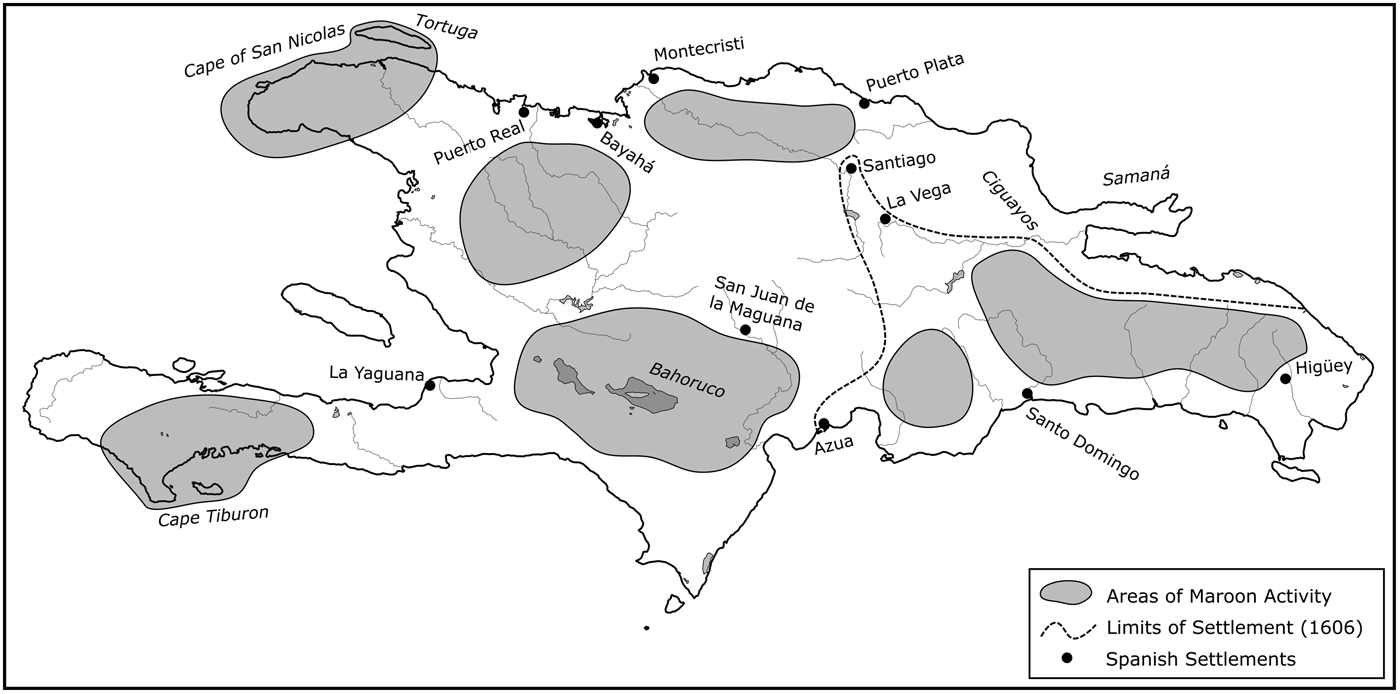
To address resistance by Africans and Spaniards, Osorio expanded the practice of sending out roving patrols. By mid 1606, at least three patrols scoured the banda del norte. One operated between Yaguana and San Juan de Maguana, another between Yaguana and Guaba, and a third roamed the areas between Bayaha, Montecristi, and Puerto Plata. In the month of September 1606, Osorio documented the capture of nearly 70 slaves, of whom 46 were captured by the patrol roving along the western coastline between Yaguana and Bayaha.Footnote 123 By October 1606, five squads comprised of 200 soldiers scoured the banda del norte.Footnote 124 Over the winter, these patrols captured more than 150 slaves and executed more than 30 contraband traders.Footnote 125 Osorio's successor, Diego Gómez de Sandoval, maintained four squads totaling 200 men, through at least 1610.Footnote 126 These squads appear to have focused on the coast, regularly checking the ports frequented by foreign ships and contraband traders. When maroons were reported, existing patrols were dispatched, or ad hoc squads deployed.Footnote 127 For example, in mid 1609, a 40-man squad patrolled the far side of the salvarayas (line of demarcation) with orders to execute maroons who resisted and return those who surrendered peacefully to their owners (see Figure 3).Footnote 128
In the years following the Devastaciones de Osorio, encounters between these patrols and maroons revealed an island abounding in maroons, some living in long-standing sanctuaries, others in communities newly formed by the depopulation. In 1607, Osorio reported an expedition to capture a mixed group of “hombres blancos y negros” who had fled to the island of Tortuga. Members of this band later fled from Tortuga to Cabo San Nicolás, where some were captured and taken to Santiago de Cuba.Footnote 129 In 1608, the newly arrived governor Diego Gómez de Sandoval complained that the Bahoruco served “as a cave for thieves and for collecting [slaves] that flee this city.”Footnote 130 The description of the region as a cave may reference the maroons' strategy of using caves as hideouts, a practice that appears to have Taino roots.Footnote 131
In late 1608, Oidor Villalobos investigated reports of a sizable maroon population near Puerto Plata. A squad sent to explore the countryside discovered a settlement numbering more than 30 persons, with huts and cultivated fields of yucca, banana, sweet potatoes, corn, rice, beans, tobacco, and cotton.Footnote 132 After a brief battle, the squad captured ten of the 30 or so residents.Footnote 133 Similarly, in late 1610, a patrol led by Captain Esteban Peguero stumbled across a community of more than 70 maroons in the Sierra de la Cabuyas, about 20 miles from Santo Domingo. The discovery occurred one evening after sunset, when Peguero “heard the drumming of the Angolans' dances followed by those of the creoles' dances.”Footnote 134 Once alerted, the patrol entered a settlement they found to be at least 30 years old, complete with homes, fields, and corrals for keeping pigs. After a brief engagement, Peguero succeeded in negotiating an agreement with the community's leaders. The two leaders, a creole and an Angolan, would be freed, along with their wives. The remaining residents were obliged to return to their previous owners and promised that would be treated well; if not, they could be granted a license from the governor to be sold to new masters. These arrangements secured the surrender of 64 of the community's 76 residents, nine maroons chose to flee. The others did not fare well: despite his promises, Gómez de Sandoval ordered that the newly surrendered maroons be sold off the island.
In 1611, the capture of a French sailor, Guillermo Pereya, revealed the location of a maroon community on Cabo Tiburón in the far west of the island. Interviewed personally by Gómez de Sandoval, Pereya recounted a harrowing tale that wove together piracy, contraband, and maroons.Footnote 135 After Pereyra left Le Havre in 1606, an English ship attacked and captured his ship taking the crew prisoner. For more than a year, Pereya lived as a prisoner of the English. Eventually, the English abandoned him on Hispaniola, near Cabo Tiburón. There he encountered four maroons who took him to their community. For four years he lived among 50 maroons, who managed wild livestock in the region, tanned hides, and salted pork. Sometime in early 1611, two English ships and a Dutch vessel visited Cabo Tiburón to trade. In return for 200 hides and salt pork, the maroons received ten muskets, powder, shot, cord, lances, Rouen cloth, canvas, knives, thread, and 23 slaves who had been stolen from a Portuguese slave vessel. Pereya convinced one of the English captains to take him aboard. After more changes of fortune, Pereya found himself aboard a Spanish vessel bound for Santo Domingo, where he testified to his experiences. In response, Gómez de Sandoval sent patrols to conquer the maroon settlement on Cabo Tiburón. The efforts continued through 1612 and resulted in the capture of more than 40 maroons, suggesting that between 20 and 30 remained at large.Footnote 136
After the flurry of anti-maroon activity between 1610 and 1612, Spanish-maroon conflicts diminished from 1613 through the end of Gómez de Sandoval's tenure. In 1622, Gómez de Sandoval submitted a long información de oficio y parte in which his anti-maroon activities featured prominently. He claimed personal credit for Captain Peguero's successful campaign, but he did not mention the entradas made in Cabo Tiburón. His recounting included reference to several campaigns undocumented in his official correspondence. Most notably, he claimed to have personally led a campaign into the mountains of the Bahoruco at great personal cost. Although he made much of the hardships of a 40-day expedition, he and his men managed to kill only five maroons and capture eight, a somewhat meager result for a region that had held at least 500 maroons prior to the dislocations and marronage caused by the devastaciones. Gómez de Sandoval also claimed credit for recovering more than 50 runaway slaves from scattered settlements located on the Río Ozama; near the source of the Río Yuna; on the Río Baní; on the Río Casuí; near the settlement of Seibo; and on the arroyo hondo near the settlement of Higuey, among others. As with his claims for the Bahoruco, 50 seems a modest number, given the many settlements listed. Moreover, all the sites mentioned were located within the boundaries established after the devastaciones. The clustering of these sites suggests that after the anti-maroon activities of 1606–12, continuing operations had turned inward, ignoring the banda del norte beyond the salvarayas and focusing on the territories that now constituted the Spanish colony.
Overall, the island during the first quarter of the seventeenth century seemed a bifurcated colony. In the wake of the devastaciones, Spanish settlement and economic interests had further consolidated in the interior and along the southeastern coast. Royal law and the island's officials enforced this isolation under penalty of death. The west and north of the island sat officially depopulated and off limits. In these areas, and remote parts of the east, a constant trickle of African runaways joined long-resident maroons living in isolated settlements. In the Bahoruco such communities likely numbered in the hundreds. Elsewhere, evidence suggests that communities of several dozen to several score had carved out spaces in the landscape. Importantly, many of these settlements appear to have sustained themselves by cultivation of diverse agricultural goods and the pastoral management of wild European livestock. By the late sixteenth and early seventeenth centuries, many of Hispaniola's maroons appear to have eschewed raiding of Spanish settlements and commerce, opting instead to pursue quiet isolation far from the eyes of Spanish officials.
The apparent cooling of open Spanish-maroon conflict after 1612 likely reflects the establishment of a new norm. Spanish officials maintained patrols, although these appear to have focused more on pursing runaway slaves than hunting down remote maroon settlements.Footnote 137 Those maroons who continued to inhabit the Bahoruco and other remote communities faced periodic but largely ineffective campaigns of suppression.Footnote 138 Those that remained beyond the salvarayas would soon find themselves increasingly caught up in French expansion. Unfortunately, the experiences of maroons in the island's west between the devastaciones and early French settlement appear nebulous. Nevertheless, as the French implemented an increasingly harsh sugar regime, runaways began to flow into Spanish territory. The flow of slaves across the border between French Saint-Domingue and Spanish Santo Domingo would eventually feature prominently in the conflicts between those colonial powers. While the experiences and actions of seventeenth and eighteenth century maroons profoundly shaped colonialism on both sides of the island, a discussion of that period is beyond the scope of this work.
Conclusion
African resistance strongly shaped the first century of Spanish Hispaniola. Although that resistance is often considered a byproduct of economic and labor arrangements imposed by Spanish colonialism, this article emphasizes that maroons, first indigenous and then African, occupied broad swaths of the island, establishing self-sufficient subsistence communities. The ability of maroons to free themselves from the bonds of slavery, claim suitable locations, construct a subsistence base, liberate other slaves from Spanish captivity, and defend their communities by force of arms must be understood as a unique form of conquest.
The recasting of maroons as conquerors calls into question the timeline of Spanish conquest on Hispaniola. In general, scholars have considered Ovando's 1503 campaign to be the decisive conquest that brought the island fully under Spanish dominion. Yet, this article suggests that maroon activity from as early as 1519 belied the completeness of the initial Spanish conquest. From 1519 through the devastaciones and beyond, maroons consistently challenged Spanish claims to sovereignty over the island's people and lands. Moreover, the constant conflicts between maroons and Spaniards cannot be divorced from the seventeenth-century decision to depopulate the north and west of the island. Spanish-maroon conflict may not have been the primary impetus for the devastaciones, but it did shape the initial proposal of such a policy, just as decades of maroon conquests had laid bare the inability of Spanish authorities to control the territorial expanse of the island.
For over a century, maroons proved to be a persistent challenge to Spanish authorities. The persistence and proliferation of maroon activities during the sixteenth century contributed to the radical decision in 1603 to abandon the western and northern bands of the island. Ultimately, this reappraisal of Spanish-maroon conflict reveals the Spanish conquest of Hispaniola as an incomplete and prolonged process that lasted well into the seventeenth century. Given these realities, the entire sixteenth century can be recast as a period of contested conquests, with early Spanish efforts undone by maroons and challenged by foreign interlopers. In this light, the devastaciones can be understood as a Spanish attempt at retrenchment and consolidation during an ongoing, incomplete conquest. In fact, one might argue that the Spanish conquest of Hispaniola remained incomplete until at least the Treaty of Ryswick in 1697, recognizing that maroons continued to pose problems to Spanish control even after the colony's territorial bounds were solidified. In recasting maroons as conquerors, this article adds to our understanding of the Spanish conquest by recognizing the role played by Africans in contesting Spanish claims to land, people, and resources. In Hispaniola, African resistance to slavery resulted in more than just a rejection of European colonial institutions—it actively challenged Spanish claims of conquest. Recognizing that maroons could conquer allows for a greater recognition of the many actors that contributed to the complex, drawn-out ebb and flow of European conquests in the Americas.
Finally, recognizing maroon conquests affords us a more nuanced view of colonial landscapes. Europeans claimed broad swaths of land by virtue of conquest and occupation. Recasting maroons as conquerors challenges Spanish projections of authority over the Americas. Maroon communities may have represented fragile enclaves of resistance. Their existence could be at times fleeting and their locations transitory, their security dependent on careful planning and constant vigilance. They always faced a better armed and equipped foe. Nevertheless, their persistent presence on the landscape demonstrates that despite Spanish claims to sovereignty, Spaniards did not effectively control all the lands they purported to have conquered. To the contrary, runaway African slaves had become conquerors in their own right.