





Early onsets and stable courses of internalizing (emotional) and externalizing (behavioral) problems among children and adolescents are major lifetime predictors of mental disorders later in life (Kessler et al., Reference Kessler, Berglund, Demler, Jin, Merikangas and Walters2005; Repetti et al., Reference Repetti, Robles and Reynolds2011). Normative developmental trajectories of internalizing and externalizing symptoms across childhood and adolescence show considerable variability (Kjeldsen et al., Reference Kjeldsen, Nes, Sanson, Ystrom and Karevold2021; Sterba et al., Reference Sterba, Prinstein and Cox2007). During this developmental phase, family dynamics play a vital role in explaining this variability (e.g., Galambos et al., Reference Galambos, Barker and Almeida2003). Thus, we need to improve our knowledge about the family circumstances in which child adjustment problems occur and that predict their longitudinal course. However, family dynamics are themselves constantly in flux and intertwined in complex ways, which developmental family scientists must also take into account. One powerful tool for how we can do this is to use growth mixture modeling (GMM) to identify distinct trajectory subgroups of families based on initial levels and growth of codeveloping family relationships.
To our knowledge, there are no longitudinal studies that have examined profiles of codevelopmental trajectories of interparental and parent-child interactions over an extended period through childhood and adolescence, nor have any studies explored the implications of these heterogeneous trajectory subgroups for the longitudinal development of child adjustment problems. The present study, thus, has two main objectives: First, we aim to identify distinct family trajectory profiles of how one of the strongest family risk factors, i.e., destructive interparental conflict (van Eldik et al., Reference van Eldik, de Haan, Parry, Davies, Luijk, Arends and Prinzie2020), codevelops with one of the primary family protective factors, i.e., emotional warmth in the parent-child relationship (Cooke et al., Reference Cooke, Deneault, Devereux, Eirich, Fearon and Madigan2022), over five years. Second, we examine whether these codevelopmental trajectory profiles of interparental conflict and emotional warmth are longitudinally linked with the development of youth internalizing and externalizing problems through childhood and adolescence.
Family factors associated with child mental health outcomes
The family relationships children experience early in life have important health ramifications across their lifespan (Chen et al., Reference Chen, Brody and Miller2017). There is growing evidence that the parents’ romantic relationship is pivotal to children’s well-being (Davies & Cummings, Reference Davies and Cummings1994). Specifically, a large body of research shows that children who witness destructive interparental conflict, manifested by verbal aggression and angry interactions between parents, have an increased risk of developing internalizing and externalizing problems through childhood and adolescence (e.g., Rhoades, Reference Rhoades2008; van Eldik et al., Reference van Eldik, de Haan, Parry, Davies, Luijk, Arends and Prinzie2020).
Besides the interparental relationship, the parent-child relationship contributes significantly to child development too. There are a large number of parenting practices identified in the literature, which can be broken down into a few core dimensions that essentially reflect the quality of parent-child interactions. Amongst them, emotional warmth has prevailed as a key parenting dimension, from the early seminal taxonomy of parenting styles (Baumrind, Reference Baumrind1966) to notable recent contributions (Bülow et al., Reference Bülow, Neubauer, Soenens, Boele, Denissen and Keijsers2022; Goagoses et al., Reference Goagoses, Bolz, Eilts, Schipper, Schütz, Rademacher, Vesterling and Koglin2023). Emotional warmth, defined as warm, supportive, and sensitive parental behavior towards the child, has a positive impact on children’s psychological development (Cooke et al., Reference Cooke, Deneault, Devereux, Eirich, Fearon and Madigan2022), while low levels of warmth have pernicious effects on the development of youth internalizing (McLeod et al., Reference McLeod, Wood and Weisz2007) and externalizing symptoms (Pinquart, Reference Pinquart2017).
Taken together, the previous literature suggests that destructive interparental conflict and emotional warmth in the parent-child relationship are among the strongest family factors predicting children’s development of internalizing and externalizing problems. However, family dynamics occur and develop in combination, rather than in isolation. Against this backdrop, increasing attention is being paid to the joint predictive power of these two family factors with respect to child developmental outcomes.
A holistic, systemic view on families
Guided by key assumptions of interdependency between family subsystems and relationships from family systems theory (FST; Cox & Paley, Reference Cox and Paley2003), much evidence documents associations between the interparental relationships and parenting (Krishnakumar & Buehler, Reference Krishnakumar and Buehler2000; van Dijk et al., Reference van Dijk, van der Valk, Deković and Branje2020). Growing literature supports the spillover hypothesis (Erel & Burman, Reference Erel and Burman1995), which proposes that anger and hostility arising from interparental conflict may impair child well-being by undermining parents’ abilities to provide warm and sensitive parenting. According to this hypothesis, couples with high interparental conflict become increasingly involved with their own relationship distress, depleting the emotional resources necessary to respond sensitively to their children’s needs (Sturge-Apple et al., Reference Sturge-Apple, Davies and Cummings2006). Conversely, compensation patterns (Erel & Burman, Reference Erel and Burman1995) depict family processes in which family members seek specific experiences in one relationship to balance deficiencies or lack of affection in another. Accordingly, parents may try to compensate for their couple conflicts through warm and positive parent-child interactions (Kouros et al., Reference Kouros, Papp, Goeke-Morey and Cummings2014).
Prominent perspectives in family psychology recognize that processes at the interparental and parent-child level are inextricably intertwined and must, therefore, be considered simultaneously for more fulsome insights into child development (Chen et al., Reference Chen, Brody and Miller2017). Nevertheless, most studies have used a variable-centered approach. By (artificially) disentangling these two subsystems of the family and examining their linear relations with child outcomes, the variable-centered approach does not sufficiently address the multidimensional nature of family interactions. In contrast, person-centered typological approaches focus on nonlinear configurations of variables and use this information to cluster individuals; hence, they offer a convenient way to systematically capture qualitatively different family profiles from a systemic perspective (Lanza, Reference Lanza2016).
Family patterns of interparental conflict and emotional warmth
Fueled by FST, scholars have increasingly advocated the use of typological approaches, applied primarily by latent class techniques, since they provide unique insight into the multidimensional characteristics of families and their diverse ways of functioning (Mandara, Reference Mandara2003). Toward this objective, recent studies have illustrated the utility of cluster-analytic approaches to identify distinct profiles of family functioning across multiple subsystems that have specific effects on child development. This research consistently found one class of families characterized by high family functioning, such as warm, emotionally close relationships, harmonious interactions, and negative affect being effectively managed. These families were often referred to as harmonious, cohesive, or adequate and have been associated with low levels of internalizing and externalizing symptoms in children (Belsky & Fearon, Reference Belsky and Fearon2004; Davies et al., Reference Davies, Cummings and Winter2004, Reference Davies, Pearson, Cao and Sturge-Apple2023; Johnson, Reference Johnson2003; Sturge-Apple et al., Reference Sturge-Apple, Davies and Cummings2010, Reference Sturge-Apple, Davies, Cicchetti and Fittoria2014). According to the large body of literature focused on at-risk families (e.g., Repetti et al., Reference Repetti, Taylor and Seeman2002), some studies identified distressed families, reflected in poor interparental and parent-child relationships, with negative effects for different outcomes of child development (Belsky & Fearon, Reference Belsky and Fearon2004; Hooper et al., Reference Hooper, Hustedt, Slicker, Hallam and Gaviria-Loaiza2023). Disengaged families, as identified by Davies et al. (Reference Davies, Cummings and Winter2004) and Sturge-Apple et al. (Reference Sturge-Apple, Davies and Cummings2010), had unsupportive, cold and emotionally withdrawn family relationships with low levels of interparental hostility. In comparison with children growing up in cohesive families, children in disengaged families displayed greater internalizing and externalizing symptoms (Davies et al., Reference Davies, Cummings and Winter2004; Sturge-Apple et al., Reference Sturge-Apple, Davies and Cummings2010).
Empirical support was also found for the spillover processes (i.e., high levels of interparental conflict coupled with low warmth; Sturge-Apple et al., Reference Sturge-Apple, Davies, Cicchetti and Fittoria2014) as well as compensatory processes (i.e., high support and warmth in the face of relatively high levels of interparental conflict; Davies et al., Reference Davies, Pearson, Cao and Sturge-Apple2023; Sturge-Apple et al., Reference Sturge-Apple, Davies, Cicchetti and Fittoria2014). Compared to the latter, outcomes for children experiencing spillover in the family system were less beneficial, with some evidence that externalizing problems were a particularly sensitive indicator of conflict levels in the family (Sturge-Apple et al., Reference Sturge-Apple, Davies, Cicchetti and Fittoria2014).
Advancing the field: Linking family trajectory profiles to longitudinal child outcomes
The majority of previous research examined latent family profiles based on distinct configurations of several indicators of family functioning at one time point and did not track longitudinal change in family functioning and child outcomes. Hence, most research has focused on qualitative differences of presumably static family profiles. This is a limitation because we assume that the longitudinal trajectories of interparental conflict and emotional warmth are not unrelated to each other. Family trajectories are dynamic and constantly changing, correlated across domains, and likely characterized by considerable heterogeneity. This codevelopmental heterogeneity might be summarized in terms of a finite number of family profiles that have specific implications for children’s development.
To address this gap, our first goal was to investigate how interparental conflict and emotional warmth codevelop within families over time, categorizing them into conceptually meaningful profiles using GMM (Petras & Masyn, Reference Petras, Masyn, Piquero and Weisburd2010). This method allowed us to detect distinct family classes based on their simultaneously modeled codevelopmental trajectories (initial levels and changes) of interparental conflict and emotional warmth. However, identifying developmental subtypes of family patterns is not an end in itself. Rather, it is only useful, from the perspective of developmental psychopathology, if these patterns meaningfully differ in their implications on the child’s long-term psychological development. Along this line, we think examining the codevelopmental trajectories of interparental conflict and emotional warmth is a novel issue that might be particularly relevant for predicting the course of children’s internalizing and externalizing problems across time.
In sum, there is a growing number of studies assessing interparental conflict and emotional warmth (usually together with other family system variables) using a pattern-based approach. However, to our knowledge, no study has captured the potential variability in longitudinal trajectories of these family factors and examined whether these were linked with youth psychological outcomes across childhood and adolescence. The examination of joint developmental patterns of interparental conflict and emotional warmth in families and their longitudinal effects on children will expand our knowledge about the dynamic associations between multiple family relationships and child development. Identifying heterogeneous trajectory classes of family patterns and linking them to longitudinal data of child development is particularly relevant to practice, because this kind of analysis may yield more specific information about how changes within families affect child adjustment over time. Such knowledge can serve the development of tailored prevention and intervention programs targeting the different needs of families.
The current study
We used longitudinal panel data collected annually over a five-year period from Waves 2 to 7 (W2-W7) from the German Family Panel (pairfam) study (Brüderl et al., Reference Brüderl, Drobnič, Hank, Nauck, Neyer, Walper, Alt, Bozoyan, Buhr, Finn, Garrett, Greischel, Gröpler, Hajek, Herzig, Huyer-May, Lenke, Minkus, Müller, Peter, Schmiedeberg, Schütze, Schumann, Thönnissen, Wetzel and Wilhelm2019; Huinink et al., Reference Huinink, Brüderl, Nauck, Walper, Castiglioni and Feldhaus2011) to answer two preregistered research questions (RQs). RQ 1: Are there distinct family patterns of conjoint trajectories of interparental conflict (IPC) and emotional warmth (EW) in the parent-child relationship over time? RQ 2: How are these codevelopmental trajectories of IPC and EW related with the longitudinal development of children’s internalizing (INT) and externalizing (EXT) problems? For both RQs, we could not derive hypotheses directly from previous literature due to our novel analytical approach and use of longitudinal data, but we expected that the results found in cross-sectional data might manifest in our study in a similar way. Hence, based on previous research summarized above, for RQ 1, we hypothesized that some of the following family patterns would be identified using GMM: We assumed a class of (a) harmonious families characterized by low IPC and high EW across time (Davies et al., Reference Davies, Pearson, Cao and Sturge-Apple2023) and a class of (b) distressed families displaying constantly moderate to high IPC and low EW (Repetti et al., Reference Repetti, Taylor and Seeman2002). Further, we anticipated a pattern of (c) disengaged families that would have low values in IPC and EW across time (Sturge-Apple et al., Reference Sturge-Apple, Davies and Cummings2010). We hypothesized a class of (d) families that exhibit compensation effects manifesting in moderate to high IPC over time with concomitant high EW to balance deficiencies (Kouros et al., Reference Kouros, Papp, Goeke-Morey and Cummings2014). Based on the findings by Davies et al. (Reference Davies, Pearson, Cao and Sturge-Apple2023), another compensatory profile could emerge in which (e) families show an increase in IPC but relatively stable moderate to high EW levels across time. A pattern of (f) spillover effects over time was expected in the form of increasing IPC and decreasing EW, i.e., that an increase in couple conflicts (in contrast to constantly moderate to high IPC among distressed families) would act as a corrosive process, undermining parents’ emotional resources to provide warm parenting over time (Stroud et al., Reference Stroud, Durbin, Wilson and Mendelsohn2011). In addition, a subgroup of (g) families with fluctuating or volatile levels of IPC and EW across data waves was plausible given previous reports using the same panel data as the present study found considerable variability in family functioning over time and in families experiencing parental relationship dissolution (Fang et al., Reference Fang, Galambos and Johnson2021; Zemp et al., Reference Zemp, Johnson and Bodenmann2018).
Using latent growth curve models (LGCM), we then examined whether parents’ latent trajectory classes were associated with the longitudinal trajectories of children’s self-reported internalizing (INT) and externalizing (EXT) problems. From earlier cross-sectional findings we extrapolated assumptions regarding the longitudinal course of child adjustment problems for RQ 2: Specifically, we hypothesized that children from harmonious families (pattern a) would display few initial INT and EXT that remain relatively low over time (Davies et al., Reference Davies, Pearson, Cao and Sturge-Apple2023; Sturge-Apple et al., Reference Sturge-Apple, Davies and Cummings2010, Reference Sturge-Apple, Davies, Cicchetti and Fittoria2014), whereas children from distressed families (pattern b) would show moderate to high initial INT and EXT that worsen over time due to reinforcing allostatic processes in at-risk families (Repetti et al., Reference Repetti, Robles and Reynolds2011). We assumed that disengaged families (pattern c) would be associated with moderate to high initial INT and EXT that, in the absence of amplifying processes, remain relatively constant over time, in contrast to children from distressed families (Davies et al., Reference Davies, Cummings and Winter2004). We further expected that pattern (d) would be linked with moderate to high initial INT that, due to the compensation effects of high EW, remain relatively constant over time, but moderate to high initial EXT that worsen over time according to the sensitization hypothesis postulating that children’s behavioral problems progressively increase when they face repeated and enduring interparental conflict (Davies & Cummings, Reference Davies and Cummings1994). Families showing an increase in IPC but relatively stable moderate to high EW levels (pattern e) were expected to have children with stable few INT due to the compensation effects at work, and few initial EXT that worsen (sensitize) over time (Davies et al., Reference Davies, Sturge-Apple, Winter, Cummings and Farrell2006). Families characterized by increasing IPC and decreasing EW (pattern f) were assumed to be associated with few initial INT and EXT that worsen over time, as past research found similar effects of family spillover patterns on child outcomes (Sturge-Apple et al., Reference Sturge-Apple, Davies, Cicchetti and Fittoria2014). Last, we hypothesized that children from the volatile family profile (pattern g) would be linked with moderate to high INT and EXT that fluctuate over time, as a previous study using pairfam data suggests (Zemp et al., Reference Zemp, Johnson and Bodenmann2018).
We preregistered our RQs, study hypotheses, and all analytical procedures prior to analysis at: https://doi.org/10.17605/OSF.IO/GF82Y. Thus, the analyses presented here largely represent a confirmatory effort. However, some components of the focal analyses were exploratory by nature (e.g., number of model specifications to arrive at the best latent class solution, determination of the optimal number of latent classes in GMM), as detailed in the preregistration. In addition, we expected that some, and most likely not all, of the family patterns described above would be identified. Given our sample size, we did not expect to find all seven hypothesized profiles as some may only represent a very small proportion of families in the general population. Our hypotheses for both RQs are therefore a mixture of exploratory and confirmatory in an effort to meaningfully combine relevant past research that has used different methodological approaches with a novel analytic procedure (i.e., GMM).
Method
Procedure
This study used longitudinal data from the German Family Panel (pairfam; Huinink et al., Reference Huinink, Brüderl, Nauck, Walper, Castiglioni and Feldhaus2011). The first author (MZ) accessed data from W1 to W10 (release 10.0; Brüderl et al., Reference Brüderl, Drobnič, Hank, Nauck, Neyer, Walper, Alt, Bozoyan, Buhr, Finn, Garrett, Greischel, Gröpler, Hajek, Herzig, Huyer-May, Lenke, Minkus, Müller, Peter, Schmiedeberg, Schütze, Schumann, Thönnissen, Wetzel and Wilhelm2019) after paying a small administrative fee (30 Euros). The protocol for this report was preregistered on February 8, 2023 (https://doi.org/10.17605/OSF.IO/GF82Y). Thus, research questions and hypotheses, sample selection, eligibility criteria, focal study variables, analysis plan, and handling of missing data were specified in advance.
Pairfam is a multi-disciplinary, prospective longitudinal study funded by the German Research Foundation (DFG) that gathered 14 total waves of data between 2008 and 2022. Survey data were collected annually from anchors (focal participants), their current partners, and their children in four thematic areas: couple relationships, childbearing, parent-child relationships, and intergenerational family ties. A nationally representative sample of 12,402 anchors from three birth cohorts were recruited: adolescents (15–17 years), young adults (25–27 years), and adults in early midlife (35–37 years). In the first stage of the sampling procedure, municipalities of the Federal Republic of Germany were drawn by stratified random sampling. In the second stage, persons from the target population with their main residence in the selected municipalities were sampled by the municipality administrations using local population registers. Starting in W2, child interviews were conducted annually with the youngest child between 8 and 15 years living in the anchors’ household. At W2 only the youngest child was included in the study, but as additional children in the same household reached their 8th birthday, they were interviewed in future waves. Also from W2, the parenting questionnaire was presented each wave to anchors and their partners with at least one child selected for the child interview. Anchor data were gathered via computer-assisted personal interviews (CAPI) and computer-assisted self-interviews for sensitive questions. Child information was gathered with CAPI. Further information and a detailed description of the study design can be found in the pairfam concept paper (Huinink et al., Reference Huinink, Brüderl, Nauck, Walper, Castiglioni and Feldhaus2011) and on the project website: www.pairfam.de.
Informed consent was obtained from all participants. The third author (MDJ) received ethics approval for the present research from the Research Ethics Board of the University of Alberta (Proposal Title: Family Relations in the Pairfam Study; Pro00060173).
Sample
The target population for the German Family Panel includes all German-speaking persons (irrespective of nationality) living in private households in Germany who were born within one of the three birth cohorts (see above). For the current study, we included all families with a participating child at W2 who were living in the same household. The participating child at W2 (i.e., the youngest child aged 8–15 years) was designated the index child in the current study and was followed across subsequent waves. We used data from W2 to W7 across five years (2009–2014) in the current report. As preregistered, we started pre-analyses with data from W2 to W10, but excluded W8 to W10, because missing data in the child sample exceeded 70% in these waves (a large percentage of the index children grew out of the predefined age range for the child survey). W1 was excluded from the outset because some target variables of this study (i.e., parenting and child variables) were first introduced in W2 and children were not recruited until W2.
For each wave, we first checked whether anchors were cohabitating with current partners. Anchors’ data on interparental conflict of non-cohabiting couples were excluded at the respective wave because children would likely not witness couple interactions in everyday family life to the same degree as those whose parents lived together. Parenting and child data were not excluded at these respective waves, because these variables were not directly related to the anchors’ cohabitation status with the current partner. Moreover, we did not exclude anchors with breakup experiences from all waves, but if the partner changed (anchors reported a new partner at one wave), we referred to these dyads as “break-up couples” (n = 13; 1.8%) to indicate that these families have experienced changes in the anchors’ couple relationship. We used this breakup information as an auxiliary variable to condition the missing data estimation process. This approach was chosen to obtain the highest possible statistical power for the longitudinal analysis.
The parenting questionnaire was presented starting in W2 to anchors and their partners with an index child. We only included anchor-reports about their own parenting behavior in reference to the index child (hence, excluded partner-reports). As GMM is based on longitudinal trajectories of within-person change, the examination of heterogeneity within one person precluded combining different perspectives (i.e., anchor- and partner-reports). We opted against including separate trajectories for partner-reports given only a small proportion of partners participated with higher longitudinal attrition rates. Furthermore, we excluded all families without any valid anchor data on interparental conflict or emotional warmth across all waves, as they could not contribute to the analysis in a meaningful way. Overall, we analyzed data from 722 parent-child dyads at W2, 593 at W3, 556 at W4, 496 at W5, 449 at W6, and 409 at W7.
This sample size provided adequate power for our focal analyses. First, for GMM (RQ 1), the sample size requirement varies depending on multiple factors (e.g., the number of latent classes and time points, the degree of class separation). It has been argued that N = 200 is the minimum sample size required to use GMM with four time points when there are at least two classes with high degree of class separation, and at least N = 300 is required when there are increases in missing data and the number of classes and/or time points (Kim, Reference Kim2012). In case of a low class separation, it is still possible to identify a true two-profile solution with N = 600 (Tolvanen, Reference Tolvanen2007). Second, for LGCM (RQ 2) with small effects (standardized regression coefficient ≈ 0.1), the sample size requirement is 600 to achieve statistical power of .80 on the basis of Monte Carlo simulations (Muthén & Muthén, Reference Muthén and Muthén2002).
At W2 (baseline for the current study), the average age of the index children was 10.03 years (SD = 1.90, range = 8–15) and 48.3% were girls (the rest were male, no other gender identity was assessed in the pairfam study). The majority of these children (95.1%) were the biological children of anchors; the remaining were anchors’ adoptive, step-, or foster-children. There were, on average, 2.29 children (SD = .94, range = 1–10) living in the anchors’ household. The anchors’ age averaged 36.46 years (SD = 2.82, range = 26–39) and 67.9% were female (the rest were male, no other gender identity assessed). The majority (73.3%) were native Germans, and the remaining were ethnic-German immigrants (5.8%), half-Germans (5.4%), of Turkish background (6.5%), or of other non-German origin (9.0%). Germany was the first nationality for 87.8% of anchors and all had to have a good knowledge of German as an inclusion criterion for this study. Accordingly, most of them (73.5%) had no migration background, 16% belonged to the first generation of migrants, and 10.5% to the second generation. With regard to highest educational attainment for anchors (based on the International Standard Classification of Education [ISCED-97]), 12.8% achieved lower secondary education or below, 54.9% completed upper secondary education, 9.1% earned post-secondary non-tertiary education, and 23.2% completed tertiary education. Rounded average net household income was 2,989 EUR (3,219 USD approximately) per month (SD = 2,501.64 EUR). Rounded equivalence income according to the modified OECD equivalence scale that assigns a value of 1 to the first household member, 0.5 to each additional adult, and 0.3 to each child below the age of 14 was 1,349 EUR (1,453 USD approximately) per month (SD = 993.35 EUR). The current employment status was full-time employment (35.0%), part-time employment (29.0%), marginal employment (6.8%), self-employed (5.6%), and the rest (23.6%) had another status (e.g., unemployed, homemaker, in education). Regarding the size of municipality, 19.3% of the families lived in municipalities with < 5,000 inhabitants, 56.8% lived in municipalities with 5,000–50,000 inhabitants, and 23.9% lived in municipalities with > 50,000 inhabitants. Eighty-seventy percent (rounded) of the couples were married, 97.3% were cohabiting with the current partner. Mean duration of the current couple relationship was 14.33 years (SD = 5.77) and couples had been living together for 13.03 years (SD = 5.00) on average. With one exception (n = 1) all couples were heterosexual.
Measures
Interparental conflict (IPC)
We combined two measures to assess destructive interparental conflict from the anchors’ perspective in each wave of the study. First, we used the anchors’ reports of the verbal aggression subscale of the Marital Communication Questionnaire (MCQ; Bodenmann, Reference Bodenmann2000). For this measure, we used anchor-reports about their own and about their current partner’s verbal aggression. Before answering the conflict items, the following prompt was provided to the participants: “What happens when you have a disagreement with your partner? Please indicate how often you engaged in the following behaviors in the past six months.” The self-report about the anchors’ own verbal aggression items were “Insult or verbally abuse your partner” and “Yell at your partner.” Additionally, the anchors reported about their current partner’s verbal aggression (anchors’ self-report about their partner: “My partner insults or verbally abuses me”; “My partner yells at me”). Second, the frequency of angry couple interactions was assessed by the anchors’ perspective using two items adapted from the conflict subscale of the Network of Relationships Inventory (NRI; Furman & Buhrmester, Reference Furman and Buhrmester1985; i.e., “How often do you and your current partner disagree and quarrel?”; “How often are you and your partner annoyed or angry with each other?”). Since both measures (MCQ and NRI) were rated on the same 5-point frequency scale (almost never/never to always), we used the mean value across these six items to achieve an overall interparental conflict score, whereby higher scores indicate greater interparental conflict. These variables were presented to anchors in each wave of the pairfam study (for the current report: W2 through W7). We opted to select and combine these two measures out of others in the pairfam project given our focus on destructive forms of interparental conflict. Past research has shown that verbal aggression and angry interactions between parents, rather than a global measure of conflict behavior, are particularly relevant to the development of adjustment problems in children (e.g., Rhoades, Reference Rhoades2008; van Eldik et al., Reference van Eldik, de Haan, Parry, Davies, Luijk, Arends and Prinzie2020). A similar measurement approach was used in a previous study that supported the convergent validity of the composite score (Zemp et al., Reference Zemp, Johnson and Bodenmann2019). Cronbach’s alpha ranged from α = .86 to .88 for the overall interparental conflict score in the current report.
Emotional warmth in the parent-child relationship (EW)
Emotional warmth in the parent-child relationship was assessed using anchor-reports on three items about one’s own warm interaction behavior towards the index child (i.e., “You show your child with words and gestures that you like him/her,” “You cheer up your child when he/she is sad,” and “You praise your child;” Jaursch, Reference Jaursch2003). Item responses were rated on a 5-point scale ranging from 1 (never) to 5 (very often). Average scores were computed, with higher values indicating greater emotional warmth. These variables were presented to anchors in each wave (W2 through W7). The convergent and discriminant validity of this brief three-item measure have been supported in previous studies using pairfam data (Boele et al., Reference Boele, Nelemans, Denissen, Prinzie, Bülow and Keijsers2023; Gniewosz et al., Reference Gniewosz, Katstaller and Gniewosz2023; Lux & Walper, Reference Lux and Walper2019). Cronbach’s alpha ranged from α = .73 to .80 across waves in the current report.
Children’s internalizing (INT) and externalizing (EXT) problems
Children completed the five-item emotional problems (e.g., “I am often unhappy, depressed, or tearful”) and conduct problems subscales (e.g., “I get very angry and often lose my temper”) of the Strengths and Difficulties Questionnaire (SDQ; German version by Woerner et al., Reference Woerner, Becker, Friedrich, Klasen, Goodman and Rothenberger2002) to assess children’s internalizing and externalizing problems. Responses were rated by children as 0 = not true, 1 = somewhat true, or 2 = certainly true. Average scores were computed with higher values reflecting greater internalizing and externalizing problems. These variables were presented to the index children in each wave (W2 through W7). The validity of the German self-report version of the SDQ has been supported in prior research (e.g., Becker et al., Reference Becker, Hagenberg, Roessner, Woerner and Rothenberger2004; Essau et al., Reference Essau, Olaya, Anastassiou-Hadjicharalambous, Pauli, Gilvarry, Bray, O’Callaghan and Ollendick2012; Klasen et al., Reference Klasen, Woerner, Wolke, Meyer, Overmeyer, Kaschnitz, Rothenberger and Goodman2000; Woerner et al., Reference Woerner, Becker, Friedrich, Klasen, Goodman and Rothenberger2002). For the pairfam study, the SDQ subscales for internalizing and externalizing symptoms have evidenced construct validity through meaningful associations with other child and family outcomes and substantial stability effects across data waves (e.g., Zemp et al., Reference Zemp, Johnson and Bodenmann2018, Reference Zemp, Johnson and Bodenmann2019), and in an item response theory analysis of the psychometric properties (Keller & Langmeyer, Reference Keller and Langmeyer2019). In the current report, Cronbach’s alpha ranged from α = .62 to .66 across waves for internalizing problems and from α = .45 to .51 for externalizing problems, respectively.
Control variables
For RQ 1, we considered gender of anchor parent (W2; 0 = female, 1 = male), household income (W2), and the indicator variable for breakup couples (i.e., whether the couple separated sometime between W2 and W7; 0 = no change in partner; 1 = change(s) in partner) as covariates, since they are known correlates of interparental conflict and parent-child interaction (e.g., Conger et al., Reference Conger, Conger and Martin2010; van Dijk et al., Reference van Dijk, van der Valk, Deković and Branje2020). Household income was assessed by one item reported by anchors assessing monthly income. Responses spanned 14 income categories: 1 = under 250 Euros to 14 = 4,500 and more Euros. For RQ 2, we included child age and gender (W2; 0 = female; 1 = male), household income (W2), and the indicator variable for breakup couples as time-invariant covariates, given past research suggests that these variables affect child internalizing and externalizing problems (Lansford et al., Reference Lansford, Malone, Tapanya, Tirado, Zelli, Alampay, Al-Hassan, Bacchini, Bornstein, Chang, Deater-Deckard, Giunta, Dodge, Oburu, Pastorelli, Skinner, Sorbring and Steinberg2019; Zemp et al., Reference Zemp, Johnson and Bodenmann2019).
Missing data
Overall, in the pairfam panel more than half of the original pairfam sample were lost to attrition by W6, and only one-third of the initial respondents were still participating by W10 (Brüderl et al., Reference Brüderl, Schmiedeberg, Castiglioni, Arránz Becker, Buhr, Fuß, Ludwig, Schröder and Schumann2022). Consent rates varied substantially across waves and by cohort, as detailed in the relevant technical paper (Brüderl et al., Reference Brüderl, Schmiedeberg, Castiglioni, Arránz Becker, Buhr, Fuß, Ludwig, Schröder and Schumann2022). In longitudinal family research, missing data can arise from normal attrition or from parental couples’ separation. In our sample, 51.9% of the families (375 out 722) were lost to attrition throughout the entire period (from W2 through W7) and 13 couples (1.8%) broke up at some wave. Note that, as stated above, we did not exclude anchors with breakup experiences from all waves, but used breakup information as a control variable. We compared continuing families, attriters, and families who separated concerning the main study variables at baseline (W2), using variance analysis (ANOVA) with post-hoc tests. The only significant difference was found between attriters and continuing families with respect to household income categories indicating lower income of attriting families (F(2, 662) = 14.96, p < .001). Additionally, we compared participating anchors and children to nonparticipating participants at each wave separately using independent samples t-tests. These analyses revealed a largely consistent attrition pattern across waves: First, anchors from households with higher income were more likely to remain in the study (W3 through W7). Second, older children were more likely to drop out of the study (W3 through W7), which was to be expected given the index children grew out of the predefined age range for the child survey, as soon as they were older than 15 years. Hence, our child sample decreased sharply due to the high dropout rate of adolescents aged > 15 years over the long-term course of the study. We used full-information maximum likelihood estimation to handle missing data in our focal analyses which allows us to include all available information to compute model parameters.
Analytic plan
Main analyses were conducted using Mplus 8.3 (Muthén & Muthén, Reference Muthén and Muthén1998–2017). According to our preregistration, for RQ 1, we first estimated unconditional LGCMs for IPC and EW. This informed us about the average growth trajectories of IPC and EW, the number of growth factors, and the amount of variability in each growth factor. Given there were significant variabilities in the intercepts and slopes, we then proceeded to the investigation of heterogeneity in these trajectories. Next, we estimated a series of GMMs to determine the optimal number and size of latent classes based on trajectories of IPC and EW. Following Petras and Masyn (Reference Petras, Masyn, Piquero and Weisburd2010), we considered a series of model specifications ranging from restricted to unconstrained. The exact number of model specifications and how variances and covariances were specified were determined by the number of growth factors and the amount of variability in the growth factors. Under each specification, we estimated a set of models with an increasing number of classes (1, 2, 3, …k). Models were evaluated and compared within each specification, through which a final model was retained for each specification. Then the retained models were compared across specifications to arrive at the best latent class solution. We considered both statistical and substantive aspects in determining which models under what specifications proceeded to final model comparison and selection (Petras & Masyn, Reference Petras, Masyn, Piquero and Weisburd2010). Statistically, we consulted commonly used fit indices, including the Bayesian Information Criterion (BIC), the Vuong–Lo–Mendell–Rubin likelihood ratio test (VLMR-LRT), and the bootstrapped likelihood ration test. Models are considered better fit if they have lower BIC values or significant p-values from likelihood ratio tests when compared with a model with one less class under the same specification. For classification quality, we examined entropy and average posterior class probability, with higher values in both indicative of better classification accuracy and certainty. Substantively, we also took into account prior research and the interpretability of the classes extracted. Last, we planned to follow the manual 3-step method (Asparouhov & Muthén, Reference Asparouhov and Muthén2014) and use multinomial logistic regression to examine associations between covariates (parent gender, household income, indicator for breakup couples) and class membership. Figure 1 is a graphical illustration of the GMM to examine RQ 1.
Growth mixture model to identify distinct patterns of trajectories of interparental conflict and emotional warmth in the parent-child relationship (RQ 1). The model is depicted only for three waves for simplicity, but was conducted using data from W2 to W7. Covariates, considered as predictors of class membership, were household income and anchor parent gender at W2 and a variable indicating whether the couple separated (sometime between W2 and W7). W = wave; i = intercept; s = slope; c = categorical latent class variable; IPC = interparental conflict; EW = emotional warmth in the parent-child relationship.

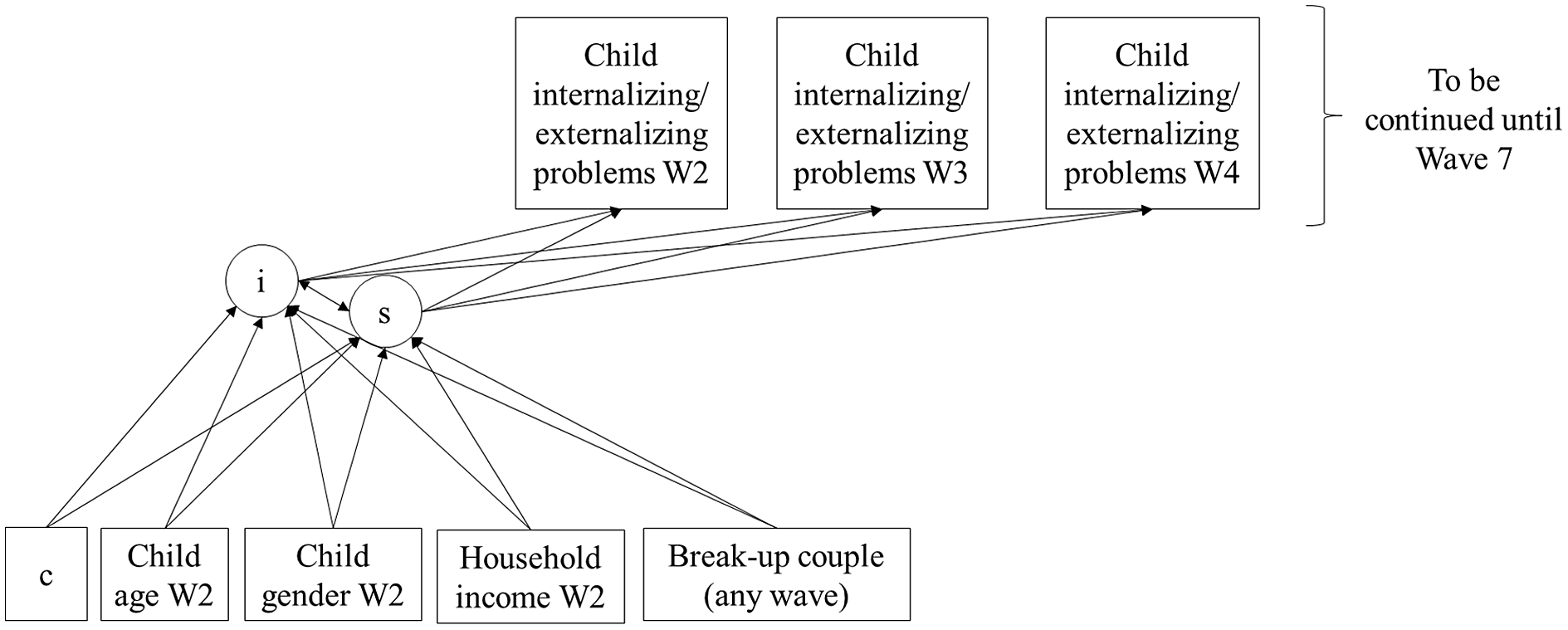
For RQ 2, we first estimated unconditional LGCMs for children’s internalizing (INT) and externalizing (EXT) problems. This informed us about the average developmental trajectories of INT and EXT, and whether there was significant variability in growth factors that warrants further investigation. Next, we obtained modal class assignments for each participant based on the best latent class solution of parental IPC and EW trajectories. For k classes, we would dummy-code k − 1 variables representing each class except for the reference class. Last, we estimated conditional LGCM for INT and ENT. Dummy-coded class membership variables were included in the conditional growth models as predictors of growth factors. In addition, baseline child age and gender, household income, and the indicator variable for breakup couples were included in the conditional models as time-invariant covariates of growth factors. Figure 2 is a graphical illustration of the LGCM to examine RQ 2. Analytic code necessary to reproduce the present analyses are openly available at: https://osf.io/nfjgk.
Latent growth curve model to examine parents’ latent trajectory classes as a predictor of the longitudinal development of children’s self-reported psychological problems (RQ 2). The model is depicted only for three waves for simplicity, but was conducted using data from W2 to W7. Models were estimated separately for children’s internalizing and externalizing problems. Time-invariant covariates, considered as predictors of growth factors, were child age, child gender, and household income at W2 and a variable indicating whether the couple separated (sometime between W2 and W7). W = wave; i = intercept; s = slope; c = categorical latent class variable of parental patterns of joint trajectories of interparental conflict and emotional warmth (see Figure 1); IPC = interparental conflict; EW = emotional warmth in the parent-child relationship.
Results
Research question 1: Family trajectory profiles of interparental conflict and emotional warmth
Descriptive statistics (all waves) and bivariate correlations (W2) for all study variables are reported in Supplemental Table S1. To answer RQ 1, i.e., to identify distinct family patterns of conjoint trajectories of interparental conflict (IPC) and emotional warmth (EW) in the parent-child relationship over time, we began by estimating a series of unconditional univariate latent growth curve models for IPC and EW. Model comparisons revealed that changes in IPC and EW could best be captured by the growth model with random linear slope and with fixed cubic slope, respectively (see Supplemental Table S2). Based on the best fitting univariate models, we estimated the unconditional bivariate latent growth model that fit the data well. To reduce the computational burden of growth mixture models, we tested a bivariate growth model with additional constraints. As none of the within-time residual covariances between IPC and EW were significant, we fixed concurrent residual covariances to zero. In addition, we constrained residual variances of observed variables to be equal across time. We found no significant difference in model fit relative to the model with freely estimated residuals and residual covariances (ΔCFI = .00). Thus, we retained it as the final unconditional bivariate growth model.
The final bivariate model fit the data well, χ 2(67) = 108.21, p = .001, RMSEA [90% CI] = .03 [.02, .04], CFI = .99, TLI = .99, SRMR = .05. IPC growth factors were not associated with EW growth factors in the final bivariate model. On average, parents reported low levels of IPC at the outset of the study (intercept mean = 2.07, p < .001), with no significant change over time (linear slope mean = .01, p = .196). At the same time, parents reported high initial levels of EW towards their children (intercept mean = 4.31, p < .001), with significant ups and downs over time (linear slope mean = .09, p = .007; quadratic slope mean = −.06, p = .001; cubic slope mean = .01, p = .005). There were significant variabilities in intercepts and slopes for IPC (intercept variance = .38, p < .001; linear slope variance = .004, p < .001) and EW (intercept variance = .20, p < .001; linear slope variance = .04, p = .001; quadratic slope variance = .001, p = .007), suggesting meaningful interindividual differences from average trajectories that warranted further examination using GMM.
Following Petras and Masyn (Reference Petras, Masyn, Piquero and Weisburd2010), we tested models with different variance-covariance specifications with increasing complexity to explore family profiles of codevelopmental trajectories of IPC and EW (for a complete list of specifications, see Supplemental Table S3). We began with the most restricted specification, in which we estimated class-varying growth factor means, and fixed growth factor variances and covariances to zero. Building on the basic specification, we estimated class-invariant or class-varying growth factor variances in the next sets of specifications. Then, we further estimated class-invariant or class-varying growth factor covariances in the final sets of specifications. Under each specification, we started with a one-class model and increased the number of classes estimated until models were not well-identified. To facilitate model identification, we fixed EW quadratic and cubic slopes’ variances to zero in all models. A full discussion of the selection process and relevant tables (Supplemental Tables S3 and S4) can be found in the supplement. After careful statistical and substantive consideration, we retained the 2-class model with class-varying growth factor means and class-invariant growth factor variances and covariances as our final unconditional growth mixture model. In the final 2-class GMM, IPC and EW intercepts and quadratic slopes were not significantly related, but their linear slopes were (r = −.45).
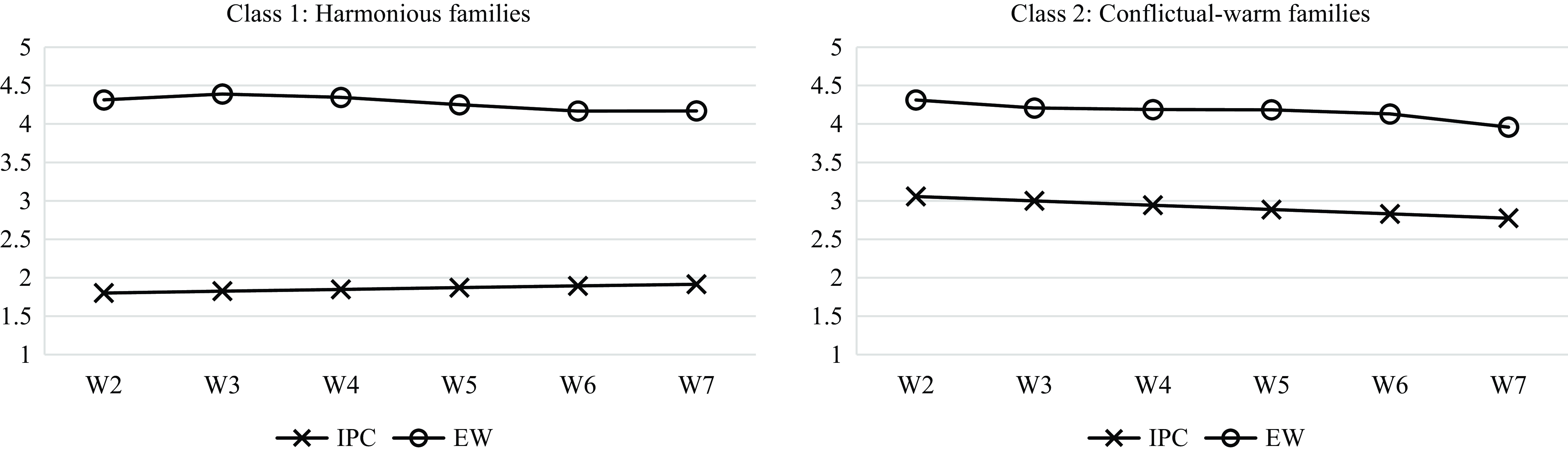
Table 1 and Figure 3 present estimated growth factor means and trajectory plots based on the final 2-class model. The larger class consisted of 80% of the sample reporting low IPC with a small increase and high EW with fluctuation (Class 1: Harmonious families). The smaller class consisted of 20% of the sample reporting moderate, decreasing IPC and high-stable EW (Class 2: Conflictual-warm families). Although there were some ups and downs in the plot of the EW trajectory for Class 2, all three slopes were not statistically significant (ps = .099–.212). Using Wald tests, we found that Class 1 and 2 had similar baseline EW at W2, but Class 2 had a significantly higher initial level of IPC at W2 than Class 1. They also differed on IPC linear slope, and EW linear, quadratic, and cubic slopes.
Estimated growth trajectories based on the final 2-class unconditional growth mixture model. W = wave; IPC = interparental conflict; EW = emotional warmth. Class 1 = harmonious families (IPC low, increasing and EW high, fluctuating; n = 580, 80%); Class 2 = conflictual-warm families (IPC moderate, decreasing and EW high, stable; n = 142, 20%).
Growth factor means based on the final 2-class unconditional growth mixture model
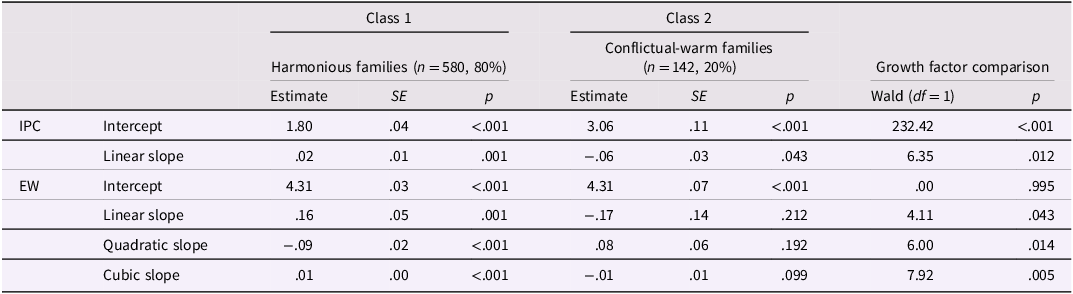
Note. IPC = Interparental conflict; EW = Emotional warmth.
We preregistered to use the manual 3-step approach to examine covariates as predictors of class membership. Due to missingness (n = 95 missing on covariates and hence excluded from the analysis), this method resulted in an unstable classification solution. Therefore, we used the BCH method to examine whether there were mean differences in parent gender (W2), household income (W2), and breakup status (W2 to W7) between the two classes. Results showed that the proportion of fathers was higher in Class 1 (32%) than in Class 2 (22%), χ 2(1) = 6.39, p = .011; the two classes did not differ with respect to household income or breakup status.
Research question 2: Associations between family trajectory profiles and children’s development of internalizing and externalizing problems
In order to examine RQ 2, i.e., how the classes of codevelopmental trajectories of IPC and EW were related with the longitudinal development of children’s internalizing (INT) and externalizing (EXT) problems, we first estimated a series of unconditional univariate latent growth curve models INT and EXT, respectively. Model comparisons revealed that the growth model with random quadratic slope captured changes in both INT and EXT (see Supplemental Table S2). On average, children reported low initial levels of INT (intercept mean = .60, p < .001), with significant curvilinear changes over time (linear slope mean = −.06, p < .001; quadratic slope mean = .01, p = .012). Children also reported low initial levels of EXT (intercept mean = .35, p < .001), with no significant changes on average over time (linear slope mean = −.01, p = .375; quadratic slope mean = −.001, p = .430). Nevertheless, there were significant variabilities in intercepts and slopes for INT (intercept variance = .09, p < .001; linear slope variance = .02, p = .011; quadratic slope variance = .001, p = .009) and EXT (intercept variance = .04, p < .001; linear slope variance = .02, p = .001; quadratic slope variance = .000, p = .001) suggesting meaningful interindividual differences from average trajectories that warranted further examination.
We then used modal class assignments and covariates as predictors of children’s INT and EXT intercepts and linear slopes, respectively. The quadratic slopes were included in the model but not regressed on class membership or covariates given their small variances. Table 2 presents parameter estimates based on the conditional growth model for children’s INT and EXT. The conditional model for INT fit the data well, χ 2(39) = 44.64, p = .247, RMSEA [90% CI] = .01 [.00, .03], CFI = .99, TLI = .99, SRMR = .03. Class membership was not associated with the intercept or linear slope of children’s INT trajectory, suggesting that children’s initial levels and change of INT did not vary as a function of the family profiles. Concerning covariates, girls were more likely to report higher initial levels of and less steep declines in INT relative to boys. Older children were likelier to show less steep declines in INT than younger children. Last, children from high-income households tended to report lower initial levels of INT.
Parameter estimates based on the final conditional latent growth curve models for children’s internalizing and externalizing problems

Note. Breakup couple = Variable indicating whether the couple separated (sometime between W2 and W7). Significant values are in bold.
aClass 1 = 0, Class 2 = 1. Class 1 = Harmonious families (n = 580, 80%); Class 2 = Conflictual-warm families (n = 142, 20%).
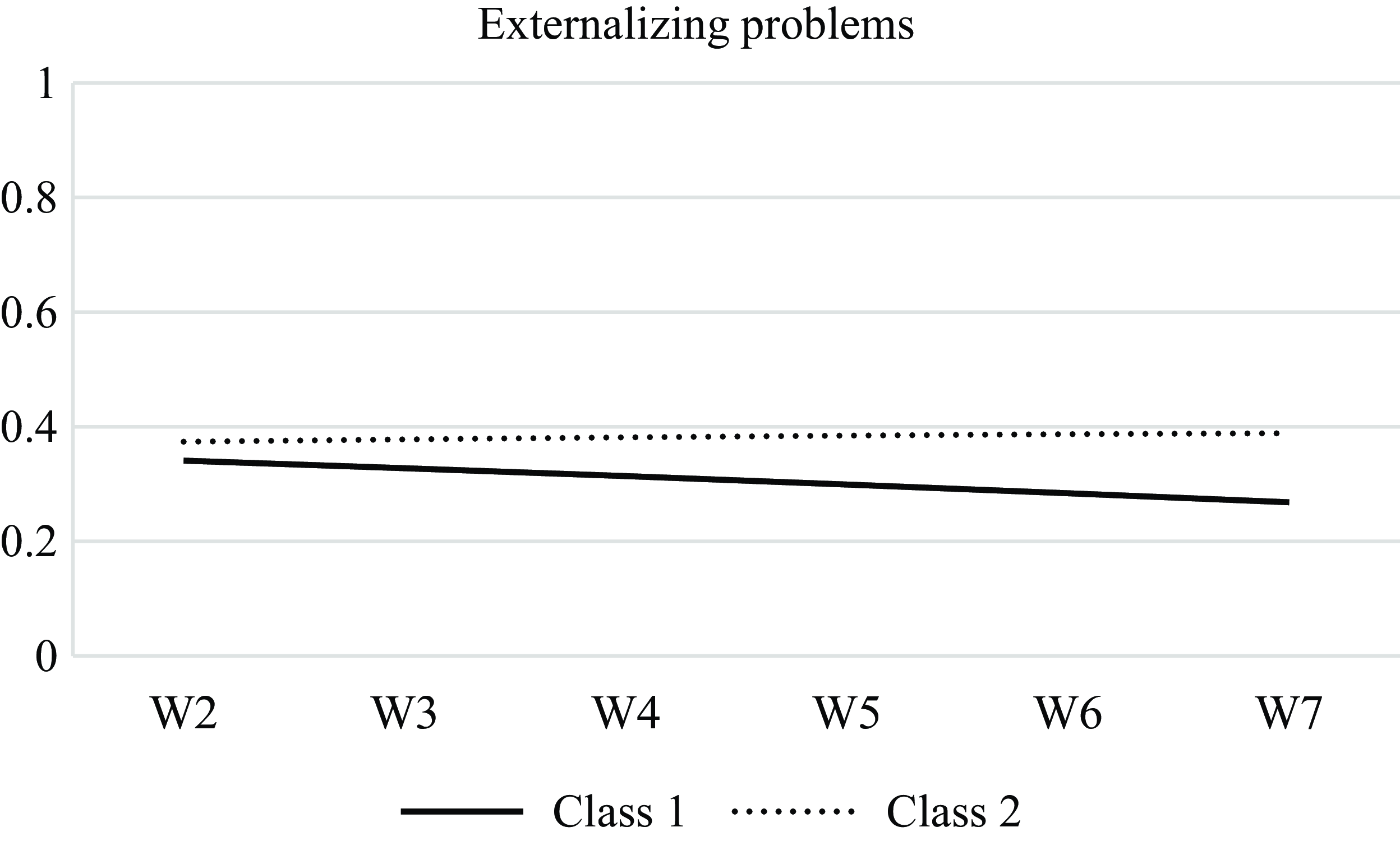
The conditional model for EXT also fit the data well, χ 2(39) = 57.60, p = .028, RMSEA [90% CI] = .03 [.01, .04], CFI = .97, TLI = .97, SRMR = .04. The results showed that the children in the two classes did not differ in their initial levels of EXT. However, a significant difference in the linear slope was found between the two classes: Children in Class 2 were more likely to report less steep declines in EXT than children in Class 1. Thus, family profiles of codevelopmental trajectories of IPC and EW seemed to have implications for the slope of children’s EXT (see Figure 4 for estimated EXT trajectories by class). We further conducted simple slope tests to determine whether the estimated trajectories of children’s EXT by class were significantly different from zero. These tests revealed that the simple slopes were not significantly different from zero in the two classes (Class 1: b = −0.035, p = .236; Class 2: b = −0.018, p = .549). Regarding covariates, older children reported lower initial levels of EXT than younger children. In addition, children with parents who had experienced breakups were more likely to show less steep declines in EXT.
Estimated trajectories of children’s externalizing problems by class. Significant differences in children’s externalizing problems linear slope were found between classes 1 and 2. W = wave; Class 1 = harmonious families (n = 580, 80%); Class 2 = conflictual-warm families (n = 142, 20%).
To further examine the possibility that differences in children’s INT and EXT trajectories were explained by composite levels of family functioning across the waves rather than codevelopmental patterns of family dynamics, we added mean IPC and EW scores (averaged across waves) as additional predictors of children’s INT and EXT intercepts and slopes in a supplementary analysis (see Supplemental Table S5). Results suggest that for children’s INT, average IPC and EW were not associated with the intercept and slope. For children’s EXT, higher average IPC was associated with higher initial levels of EXT, and higher average EW was associated with lower initial levels of EXT; but average IPC and EW were not predictive of the linear slope. Moreover, family profile (i.e., class membership) remained a significant predictor of children’s EXT linear slope even after accounting for composite levels of IPC and EW. All other results also remained largely the same compared to the models without consideration of average IPC and EW. These findings indicate that codevelopmental patterns of family dynamics matter for the development of children’s EXT above and beyond levels of separate aspects of family functioning.
Discussion
Applying a truly systemic approach to the study of child development represents a formidable challenge. Linking pattern-based analyses claimed by FST to a developmental psychopathology framework requires the use of new methods that can identify nonlinear configurations of tangled codevelopmental family trajectories and examine their joint effects on children’s adjustment over an extended period of their development. Given the many ways in which such an approach can complement the existing literature, the aims of this study were (1) to identify distinct classes of codevelopmental trajectories of destructive interparental conflict (IPC) and parental emotional warmth (EW) in families, and (2) to examine whether these family trajectory profiles were associated with the development of children’s internalizing and externalizing problems over time.
Drawing from longitudinal panel data, our pattern-based analyses revealed two subgroups in our sample characterized by qualitatively different family profiles of IPC and EW trajectories across six annual data waves. Class 1 comprised four fifths of our sample that showed low IPC at the start of the study with a significant but small increase over time along with high EW with minor fluctuations over the course of the study. We labeled this class the harmonious families referring to Davies et al. (Reference Davies, Pearson, Cao and Sturge-Apple2023) who used this name for families displaying low interparental hostility and high support in parenting. A similar group of parents showing low discord and high warmth (referred to as harmonious, cohesive, or adequate families) has also been found in several other studies (Belsky & Fearon, Reference Belsky and Fearon2004; Davies et al., Reference Davies, Cummings and Winter2004; Hooper et al., Reference Hooper, Hustedt, Slicker, Hallam and Gaviria-Loaiza2023; Johnson, Reference Johnson2003; Sturge-Apple et al., Reference Sturge-Apple, Davies and Cummings2010, Reference Sturge-Apple, Davies, Cicchetti and Fittoria2014). In view of this largely consistent pattern reported in earlier research, we expected to identify a subgroup of low-conflict, warm families, as we had preregistered.
Class 2, which we named the conflictual-warm families, made up 20% of our sample, showing moderate IPC with a slight decrease over time and high-stable EW. This pattern mirrored the findings by Belsky and Fearon (Reference Belsky and Fearon2004) who identified a “good parenting/poor marriage” profile that comprised around a fifth of their sample as well. Similar family profiles characterized by high support and warmth in parenting in the face of moderate or relatively high levels of interparental conflict were reported in other previous studies (Davies et al., Reference Davies, Pearson, Cao and Sturge-Apple2023; Sturge-Apple et al., Reference Sturge-Apple, Davies, Cicchetti and Fittoria2014). We preregistered this pattern as one anticipated profile following considerations of compensation processes in families (Erel & Burman, Reference Erel and Burman1995). Although parents may experience elevated levels of interparental conflict, some of them are able to continue to provide warm and sensitive caregiving to their children. From this perspective, one possible explanation of the specific trajectory pattern in Class 2 is that parents in that class may strive to compensate for their moderate, albeit declining couple conflicts by investing in warm parent-child interactions. However, the opposite direction is also plausible: Parents who invest a lot of energy and time in raising children have fewer resources left over to invest in the long-term care of their couple relationship. It is important to note that, on the basis of our analyses, we cannot make any statements about causal effects from one family domain to the other (interparental to parent-child relationships or vice versa). Therefore, this family profile may also reflect a compartmentalization pattern according to which parents are able to separate their roles as spouses and parents (Sturge-Apple et al., Reference Sturge-Apple, Davies, Cicchetti and Fittoria2014). Such a reading would imply that parents from Class 2 can effectively establish boundaries between their couple relationship problems and their parenting behavior.
The current results suggest that the heterogeneity in families in our study could be succinctly captured by two higher-order profiles differentiated by the starting points and long-term changes of interparental conflict and emotional warmth. Comparing IPC between the two classes, we found that the conflictual-warm families had higher starting values, but it slightly decreased over time, while there was a small increase in IPC in the harmonious family profile. Emotional warmth started and remained high in both classes, although there was significant fluctuation in the harmonious families only. Regarding covariate effects, only parent gender was related to class membership (fathers were slightly overrepresented in Class 1). However, given fathers were underrepresented in the entire sample (32%) and Class 1 was significantly larger than Class 2, this could be a purely statistical artifact. Household income and breakups were similarly distributed between the two family profiles. Taken together, the two classes were alike; it’s the initial level and change in the couple conflicts that differed substantially. In fact, this allowed us to investigate whether the long-term course of interparental conflict affected children’s adjustment problems while controlling for the trajectory of emotional warmth in a rigorous way.
From a developmental psychopathology perspective, the inherent value of family profile classifications is contingent on their ability to explain variance in children’s mental health outcomes. We found evidence that the codevelopmental trajectories of IPC and EW matter for children’s development of externalizing problems, while controlling for child age and gender, household income, and breakup experiences. As expected, children growing up in harmonious families (Class 1) showed a more favorable long-term developmental pathway of externalizing problems compared to Class 2, indicated by a smooth, although non-significant decline. In a similar vein, children in high-functioning families have also showed low levels of externalizing symptoms in previous studies (Belsky & Fearon, Reference Belsky and Fearon2004; Davies et al., Reference Davies, Cummings and Winter2004, Reference Davies, Pearson, Cao and Sturge-Apple2023; Johnson, Reference Johnson2003; Sturge-Apple et al., Reference Sturge-Apple, Davies and Cummings2010, Reference Sturge-Apple, Davies, Cicchetti and Fittoria2014). Our longitudinal analysis suggests that even though it occurred in the context of slowly increasing IPC, the low IPC starting levels and high, fluctuating EW in Class 1 apparently provided a beneficial developmental context for these children. These findings align with emotional security theory’s (Davies & Cummings, Reference Davies and Cummings1994) assertion that children’s felt security and adjustment depend on the broader family functioning, i.e., on the quality of both the interparental and parent-child relationships. Related to our findings, slightly increasing IPC over time may only have minimal implications for child externalizing problems when occurring in the presence of a warm parent-child relationship. However, one must remember that the simple slope of the trajectory of children’s externalizing problems in Class 1 was not significant. This means that the pathway of externalizing problems of children in harmonious families was not decreasing in absolute terms, but only relatively compared to children from Class 2.
Importantly, we cannot claim causal effects of family dynamics on child development. Although we examined class membership of family trajectory profiles as a statistical predictor of children’s INT and EXT initial levels and changes, a complex temporal dimension is inherent in our models given parent and child trajectories used data collected from the same period. Thus, the specific nature of our analyses leaves open the possibility of bidirectional effects between family profiles and child development. The reverse narrative according to a “child effects model” would be that children’s adjustment problems are precursors of subsequent changes in family dynamics. This view is also plausible considering the evidence of reciprocal effects between children’s internalizing and externalizing problems and the parenting or couple system, respectively (e.g., Serbin et al., Reference Serbin, Kingdon, Ruttle and Stack2015; Zemp et al., Reference Zemp, Johnson and Bodenmann2018).
Externalizing problems of the children from conflictual-warm families started with similar initial levels at baseline, but they showed less steep declines over time than children from Class 1. The most obvious explanation for the less favorable growth of externalizing problems in children from Class 2 would be that these children experienced greater composite levels of interparental conflict (averaged across waves). We investigated this possibility and found that the codevelopmental trajectory profiles remained a significant predictor of the slope of externalizing problems above and beyond the average levels of IPC and EW. This robust finding speaks to the rigor and viability of our approach: What matters to the kids is not just the average level of conflict and warmth, but how they develop simultaneously over time. Interparental and parent-child interactions are inextricably interwoven in a variety of ways and are also in a constant state of flux, and this mélange in its entirety appears to be related to child behavior problems.
In contrast to the effects found for externalizing outcomes, we found no associations between the family profiles and children’s internalizing problems. It is conceivable that behavioral problems are particularly linked to the (different) IPC trajectories that were the main distinguishing factor between the two classes. Social learning theory (Bandura, Reference Bandura1977) postulates that children learn ways of social interaction by observing their parents. In light of destructive, verbally aggressive conflict tactics, which were central ingredients of our measure of interparental conflict, children may imitate these behaviors in other relationships and act out greater hostility and aggression towards peers and siblings (e.g., Stocker & Youngblade, Reference Stocker and Youngblade1999). These results match with prior research showing that this form of destructive interparental conflict is a more salient predictor of externalizing than internalizing problems in children (van Eldik et al., Reference van Eldik, de Haan, Parry, Davies, Luijk, Arends and Prinzie2020), even though there is no consensus on this issue (Rhoades, Reference Rhoades2008). Similar to our study, Belsky and Fearon (Reference Belsky and Fearon2004) reported that children from the “good parenting/poor marriage” profile displayed more externalizing problems, but their internalizing symptoms did not differ across profiles. Assuming bidirectional effects between family dynamics and child outcomes, there is evidence that children’s externalizing problems are more markedly associated with challenges in parenting and the interparental relationship than internalizing problems (Reitz et al., Reference Reitz, Deković and Meijer2006; Zemp et al., Reference Zemp, Johnson and Bodenmann2018). These findings indicate that the dynamic interplay between the couple relationship and parenting might be linked with some features of child development in unique ways, although we expect that this may vary depending on the age and gender of the child. We controlled for these child characteristics in our analysis and found that older children reported lower initial levels of externalizing problems and less steep declines in internalizing problems than younger children. Additionally, relative to boys, girls were more likely to report higher initial levels of internalizing problems. These effects fit in well with the current knowledge of developmental psychopathology in the general population (Kjeldsen et al., Reference Kjeldsen, Nes, Sanson, Ystrom and Karevold2021; Sterba et al., Reference Sterba, Prinstein and Cox2007), but future studies should investigate the interactions between child demographics and family trajectory profiles more precisely.
One must also bear in mind the shortcomings of our child outcome measures, as we exclusively relied on children’s self-report on a few items. Internal consistency for child outcomes ranged from α = .45 to .66, which might have undermined the analytic power for our statistical models. The validity of the German SDQ (self-report version) has been demonstrated (Becker et al., Reference Becker, Hagenberg, Roessner, Woerner and Rothenberger2004; Klasen et al., Reference Klasen, Woerner, Wolke, Meyer, Overmeyer, Kaschnitz, Rothenberger and Goodman2000; Woerner et al., Reference Woerner, Becker, Friedrich, Klasen, Goodman and Rothenberger2002), and previous studies using pairfam data also supported the validity and psychometric properties of the internalizing and externalizing symptoms subscales (Keller & Langmeyer, Reference Keller and Langmeyer2019; Zemp et al., Reference Zemp, Johnson and Bodenmann2018, Reference Zemp, Johnson and Bodenmann2019). Low reliability scores are yet not uncommon (Essau et al., Reference Essau, Olaya, Anastassiou-Hadjicharalambous, Pauli, Gilvarry, Bray, O’Callaghan and Ollendick2012; Lohbeck et al., Reference Lohbeck, Schultheiß, Petermann and Petermann2015). They can be plausibly explained by the heterogeneous, multidimensional nature of this screening tool. For example, when children fight a lot (EXT item no. 1), it does not necessarily mean that they often lie or cheat (EXT item no. 3). The scores must therefore be interpreted as indices rather than scales. We cannot completely exclude the possibility that these measurement limitations, combined with our complex analytical approach, may have contributed to our results, particularly regarding the non-significant findings for internalizing problems. We deem it prudent to wait for further research that replicates our own findings with measures that have assured reliability.
We acknowledge that many of our hypothesized family profiles were not evident in the data. Although we preregistered that any, and not necessarily all, of the expected family patterns would be identified in our sample, we suggest several explanations for the discrepancies between our hypotheses and the final results. Notably, what distinguishes the present findings from the majority of previous studies using a pattern-based approach with data gathered at only one time point is the identification of family profiles based on longitudinal codevelopmental trajectories of family dynamics. Since we had to base most of the longitudinal elements of our hypotheses on previous cross-sectional findings, our assumptions were a pragmatic mixture of exploratory and confirmatory. As such, discrepancies between the preregistered hypotheses and the results are not surprising. Moreover, most family research using cluster-analytic techniques investigated interparental conflict and emotional warmth together with other family-wide process and system variables (e.g., support, cooperation, cohesiveness, disengagement). One explanation for why we did not find a disengaged family profile might be, for instance, that we did not assess withdrawal behaviors (Sturge-Apple et al., Reference Sturge-Apple, Davies and Cummings2006). Furthermore, our pattern of results revealed good family conditions with high parental warmth in both classes. This indicates that parents who included their children in the German Family Panel were predominantly well-functioning families, as was also apparent in other studies using these panel data (e.g., Fang et al., Reference Fang, Galambos and Johnson2021). In fact, based on the sociodemographic characteristics of our sample, the participating families were relatively privileged in terms of socioeconomic status (parental income and education level), family constellation, and place of residence with little migration background. This circumstance limits both the generalizability of our results and their comparability with earlier studies that formed the basis for our hypotheses, most of which were conducted with more diverse samples (e.g., Davies et al., Reference Davies, Pearson, Cao and Sturge-Apple2023; Hooper et al., Reference Hooper, Hustedt, Slicker, Hallam and Gaviria-Loaiza2023).
The current findings must be interpreted in light of some limitations. First, we must concede some methodological disadvantages that are often associated with large-scale panel studies. Our main study variables were all assessed by brief, few-items self-report measures, some of which had low internal consistency. These methodological limitations might undermine the statistical power for the complex statistical approaches we adopted. Even though we had reports from different family members (one parent and a child), which reduced the risk of shared method variance, the use of proxy-report of child outcomes or observational data of family interactions is strongly recommended to replicate our results. A related limitation is the lack of assessing both partners’ perspectives in form of dyadic analyses. Our overall IPC score included anchor-reports about their own and their partners’ verbal aggression, but we still could not examine possible compensatory effects of mothers’ and fathers’ emotional warmth. Second, GMM requires modeling choices (e.g., selection of and stopping criteria for number of classes, estimation of within-group variances) that can affect class identification. However, we tried to specify our analytic procedure as precisely as possible in advance (see preregistration). Additionally, the use of modal class assignments as predictors of child outcomes introduces classification error into subsequent analysis.
Third, albeit mostly representative of the population from which it was drawn, our sample was a cohort in a specific sociocultural and geographical context. We studied predominantly heterosexual, biological families with a moderate to high SES and German origin. The lived experiences of many families around the world were not adequately represented, such as minority and financial stress, experiences of discrimination or racism, migration-related burdens (associated with a possible lack of access to language and culture), and intersections of these variables. This circumstance may have affected our results (e.g., classes of family profiles, child outcomes) and limits the generalizability of our results to potentially less privileged families with different sociocultural backgrounds, ethnic origins, and more diverse family constellations. Fourth, despite our prospective design and the consideration of important control variables in our analyses, we assume that other, unmeasured variables (e.g., other family or parenting processes, relationships outside the family, biological and genetic factors) affected our outcomes.
With the above caveats in mind, this study shows that considering the codevelopmental trajectories of interparental conflict and emotional warmth is a fruitful avenue for researchers and practitioners in the field. The concert of multiple family relationships is the primary pivot for understanding child development. Our focus on the blend of cluster-analytic techniques and latent growth curve modeling opens up a novel and intriguing way of examining complex family interaction patterns. We believe this method is highly effective for coupling pattern-based approaches claimed by FST and developmental psychopathology frameworks at a conceptual level. The conclusions drawn from this powerful approach have several practical implications, as they can provide some guidance for tailoring programs based on specific interparental and parent-child relationship dynamics. The way in which parents interact with each other and with their children is subject to constant change, which in turn interacts with the child’s development. Clinical practice can be enhanced by considering elements of interparental conflict, parenting, and child behavior in concert with each other. Systemic perspectives on family relations have long posited that these domains do not unfold in a vacuum. The efficacy of enhancing the parents’ intimate relationship and positive parenting to reduce child behavior problems has been found repeatedly and led to the development of a variety of evidence-based parenting programs (Sanders et al., Reference Sanders, Kirby, Tellegen and Day2014; Zemp et al., Reference Zemp, Milek, Cummings, Cina and Bodenmann2016a). Conversely, programs aimed at reducing child problem behavior can also have positive effects on the quality of the interparental relationship (Zemp et al., Reference Zemp, Milek, Davies and Bodenmann2016b). Now that these reciprocal associations have been demonstrated in basic and applied research, we need to systematically investigate whether a holistic perspective in treatment, one that consequently addresses different family subsystems simultaneously as in the present study, can further increase the effectiveness of family-oriented prevention and intervention. Ultimately, getting to the bottom of the pathways underlying family dynamics and their associations with child developmental outcomes is key to identifying leverage points to improve the well-being of all family members.
Supplementary material
The supplementary material for this article can be found at https://doi.org/10.1017/S0954579424001524.
Data availablity statement
The pairfam data and all relevant associated study materials (questionnaires, codebooks, etc.) are publicly accessible on the project website (www.pairfam.de). Additionally, we make our analytic code necessary to reproduce the present analyses openly available at: https://osf.io/nfjgk. Analyses were also preregistered. The preregistration for this research is available at: https://doi.org/10.17605/OSF.IO/GF82Y
Funding statement
The current study received no specific grant from any funding agency, commercial or not-for-profit sectors. However, this study used data from the German Family Panel pairfam, coordinated by Josef Brüderl, Karsten Hank, Johannes Huinink, Bernhard Nauck, Franz Neyer, and Sabine Walper. The pairfam study is funded as long-term project by the German Research Foundation (DFG).
Competing interests
None.


 Open access

