




British Colonial Strategy and the Divide-and-Rule System
The British invasion of the Zulu kingdom in 1879 and the subsequent imposition of colonial rule, which dismantled the Zulu monarchy throughout the late nineteenth and early twentieth centuries, have been widely discussed in historical literature. Much of the focus has been on the British efforts to undermine key figures, particularly King Cetshwayo and King Dinuzulu kaCetshwayo, often emphasising their sieges and political downfall. However, existing scholarship has largely overlooked the broader British hostility towards other senior members of the royal family, notably Prince Ndabuko and Prince Shingana kaMpande. This oversight results in an incomplete understanding of the full extent of British efforts to neutralize the Zulu royal house.
Scholars such as Robert Dlomo, Jeff Guy, and Harriette Colenso have briefly mentioned these figures, but their treatment remains cursory, often overshadowed by the kings’ narratives.Footnote 1 A more thorough examination of the fates of Shingana and Ndabuko reveals a crucial aspect of British colonial strategy: targeting not just the kings, but dismantling the entire senior lineage of the Zulu royal family, particularly the Usuthu faction. The princes’ incarceration from 1889 to 1898, followed by Shingana’s exile and Dinuzulu’s subsequent banishment, were key parts of this strategy. Re-evaluating these overlooked events offers a more comprehensive understanding of the Zulu kingdom’s destruction under British rule.
This study expands the scope of analysis by examining the Usuthu and Onkweni sections of the Zulu royal family, tracing how the British—through a combination of military defeat, political manipulation, legal persecution, and administrative restructuring—sought to extinguish the political influence of these royal houses. It demonstrates that the repression of the royal family ironically fostered new political alliances between African traditional elites, a mission-educated African intelligentsia, and liberal-minded white allies—particularly the Colenso family—whose activism helped lay the intellectual and organizational foundations for African nationalism and the formation of the South African Native National Congress (SANNC) in 1912.
Dividing the narrative into four chronological and thematic sections, this article provides a clearer narrative structure, restores the often-overlooked role of the Colenso family, and situates the struggles of the Usuthu and Onkweni within broader debates about colonial authority, African resistance, and emerging political consciousness. Each section deepens the analysis of how colonial policy, local conflicts, and shifting alliances shaped the Zulu political landscape from the 1880s through the creation of the Union of South Africa in 1910 and the banishments of 1913.
Onkweni was the territory governed by Shingana, while Usuthu was the kraal of Dinuzulu, from which he led and administered his followers. Shingana—who was a politically influential uncle to Dinuzulu and a half-brother to Cetshwayo—shot to prominence during the early 1880s when he, Prince Dabulamanzi kaMpande, and Ndabuko of the kwaMinya royal homestead served as political advisors during the Zulu monarch’s confrontation with invading British colonial forces. Guy describes him as the next in line, in terms of seniority, to Prince Ndabuko. Furthermore, he is described as quicker in mind and body than Prince Ndabuko, and as less morose.Footnote 2 His chiefdom and original royal homestead were at kwaNobamba near the Emakhosini valley, the place of the kings where the original Zulu leaders had lived and were buried.Footnote 3 King Mpande ka Senzangakhona allocated him land at the Emhlabathini plains—to the southeast of King Cetshwayo’s Ondini royal residence—where he established his Onkweni residence.Footnote 4
The Anglo-Zulu War, Wolseley’s Settlement, and the Political Landscape of the 1880s
The Anglo-Zulu War of 1879 fundamentally altered the political structure of the Zulu Kingdom. After defeating the Zulu forces at the Battle of Ulundi in July 1879, the British dismantled the monarchy and subdivided the kingdom into thirteen artificially created chieftaincies (see Fig. 1, below).Footnote 5 These were ruled by iziphakanyiswa (those who were colonially-elevated into positions of influence and authority) with the aim of extending the Natal Secretary of Native Affairs Theophilus Shepstone’s “divide and rule” strategy to the north of the Thukela River.Footnote 6 This arrangement, introduced by Sir Garnet Wolseley, was designed to destroy the centralized Zulu polity and replace it with small, mutually hostile units incapable of unified resistance.Footnote 7 Wolseley’s settlement must be understood as part of a broader imperial pattern across Africa and Asia: conquering powers often weakened centralized indigenous systems by installing multiple competing authorities, thereby ensuring the colonial government’s security and economic advantage.Footnote 8 Two of the iziphakanyiswa were members of the Zulu royal family who had defected to the side of the British towards the end of the Anglo-Zulu War: Prince Hamu kaNzibe kaSenzangakhona and Zibhebhu kaMaphitha, of the Ngenetsheni and the Mandlakazi sections of the Zulu royal family, respectively.Footnote 9 The British also sought to position Shingana and Chief Mnyamana Buthelezi as iziphakanyiswa. Initially, both of them rejected the offer although the latter later defected to the side of the British from 1887 until his death in 1893.
Partition of Zulu Land, 1879.

The Usuthu section of the Zulu royal family responded to these developments through armed resistance at the Battles of Tshaneni in 1884 and Ndunu Hill (kwaNongoma) and Hlophekhulu in 1888.Footnote 10 Shingana emerged as a key figure in this early political resistance. He led the delegation to Pietermaritzburg in 1880, articulating concerns about livestock seizures, harassment by Hamu and Zibhebhu, and the breakdown of traditional authority.Footnote 11 The colonial authorities dismissed his delegation, but the interaction also marked the Usuthu’s first sustained contact with the Colenso family. During the 1880 deputation and again in the 1882 visit, the Usuthu leaders stayed at Ekukhanyeni, the Colenso residence at Bishopstowe, which provided them with a sympathetic base of support. While the full significance of this relationship became clearer only in later years, these early encounters laid the foundations for a deeper political collaboration between the Colensos and the Zulu royal family.Footnote 12
John Dunn also played a crucial yet contradictory role. Initially a British ally—and later appointed chief—Dunn was positioned between colonial authorities and African communities. His territory became both a refuge and a site of surveillance. His complex relationship with the Zulu, involving marriage alliances and his role in enforcing colonial directives, made him a controversial figure whom the Usuthu regarded with suspicion.Footnote 13 Dunn played a pivotal role in suppressing the Usuthu by acting as a loyal collaborator and local enforcer of British colonial policy after the Anglo-Zulu War. As a state-appointed chief, he helped reinforce the Wolseley settlement by assisting in the violent suppression of resistance—such as aiding Chief Mlandela in crushing Stimela Mthethwa’s revolt—and by using these incidents, alongside Hamu and Zibhebhu, to justify renewed persecution of Usuthu supporters.Footnote 14 Dunn also exercised strict control over the movement of Usuthu people in his territory, with Governor Henry Bulwer reprimanding delegates in 1882 for travelling to Pietermaritzburg without Dunn’s permission, while Dunn attended the meeting specifically to identify men for potential punishment.Footnote 15 Furthermore, he benefited materially from the dispossession of the Usuthu through confiscations of cattle and land, and he actively shaped colonial narratives by reporting on supposed “rebellious” behaviour, thereby influencing officials like Melmoth Osborn and Bulwer to view Ndabuko, Ziwedu, and others as dangerous agitators.Footnote 16 In all these ways, Dunn functioned as a key African agent of the colonial administration, helping to undermine the Zulu royal family and suppress efforts to restore Cetshwayo’s authority.
By 1889, British colonial authorities had resolved to neutralize the most influential leaders of the royal family. Dinuzulu, Shingana, and Ndabuko were arrested following the conflicts involving the Mandlakazi and banished to the island of St. Helena.Footnote 17
1889–1905: Imprisonment, Political Reconfiguration, and the Impact of Gelejane’s Death
After Shingana and Dinuzulu were deposed and exiled by the colonial government, their polities and land were reallocated to chiefs loyal to the colonial authorities. Dinuzulu’s dominion was handed out to chiefs who were hostile to the Usuthu section of the Zulu royal family: Mchitheki kaZibhebhu, who was serving as the acting chief of the Mandlakazi polity while Zibhebhu kaMaphitha’s heir and successor, Bhokwe, was still a minor; Mpikanina kaZiwedu, whose father, Prince Ziwedu kaMpande Zulu, had defected to the British side in 1888; Mkhandumba kaTshanibezwe Buthelezi, a grandson of Mnyamana Buthelezi (discussed above); and Moya kaMgojana, a descendant of King Zwide kaLanga of the Ndwande Kingdom, whose father named Mgojana was appointed by the British colonial authorities as one of the thirteen iziphakanyiswa in 1879 but killed by Cetshwayo and the Usuthu in 1888.Footnote 18
The Onkweni chiefdom was also subdivided and its territories allocated to chiefdoms loyal to the British. One of these chiefdoms was the Mlaba chiefdom which the British had created in the Mahlabathini area as a reward to the Ximba people for their conspicuous military services to the British colonial forces during Anglo-Zulu War.Footnote 19 The Mlaba chief named Mqundane moved over from Natal, with a number of his followers, after the British colonists had created chieftainship for him in the Mahlabathini area in the late 1880s. The Ximba/Mlaba people were allocated a piece of land to the east of the Ulundi plain where the chiefdom still exists. Their main responsibility was to keep an eye on the Zulu people under the leadership of Shingana “whose loyalty could not be relied upon.”Footnote 20 Mqundane Mlaba died in about 1890 and his son named Sigungu Mlaba succeeded him as the chief of the Ximba people at the Mahlabathini Magisterial District.Footnote 21 Other Ximba chiefdoms are found at the Mkhambathini and Ntembeni areas in the Thekwini Metro and the Umgungundlovu District Municipality. Historically, the Ximba people originated in Lesotho under the leadership of Mabhoyi kaNondlolo Ximba in the early nineteenth century. They pledged their loyalty (ukukhonza) to the abaMbo polity of Zihlandlo kaGcwabe in the uThukela area of the western boundary of the Zulu Kingdom.Footnote 22
The main Zungu chiefdom in the Mahlabathini area—one of the hereditary chieftaincies which King Shaka kaSenzangakhona conquered and incorporated into the Zulu Kingdom during the early nineteenth century—was ruled by Mdabula Zungu until the early 1900s. He ascended to power following the killing of his father, Chief Mfanawendlela Zungu, during the British-inspired Zulu civil war in December 1883.Footnote 23 The Zungu people, whose leaders were aligned to the Mandlakazi section of Zibhebhu kaMaphitha had fled into John Dunn’s territory south of the Umhlathuze River after the Usuthu forces of Dinuzulu defeated the Mandlakazi at the Battle of Tshaneni in June 1884. They only returned to their chiefdom in 1888 and remained loyal to the British colonial administration in Zululand. Mdabula Zungu was directly succeeded by Magojela kaMfanawendlela Zungu as ibambabukhosi (regent).Footnote 24 As we will see below, the Zungu became the second polity to acquire parts of Shingana’s chieftaincy in 1911—as part of the continuing fallout from the 1906 killing of magistrate and commissioner Herbert Stainbank.
The British colonial authorities created the other two Zungu chiefdoms, found in Lower Mfolozi area, in 1890. The first was an offshoot of the Dube people created when the British recognised Chief Lokothwayo Zungu as its chief in 1890. After his death he was succeeded by his son, Zanya Zungu.Footnote 25 The second was a comparatively smaller offshoot of the first, constituted by people who had severed ties with Chief Lokothwayo during the war involving the Usuthu and the Mandlakazi groups in 1888. The British also recognised Ndabayakhe Zungu as this community’s chief in 1890. While Lokothwayo's chiefdom was made up of approximately 443 huts, the followers of Ndabayakhe Zungu populated some 146 huts in 1903.Footnote 26
It is unclear when the Ntombela people established themselves at KwaNobamba, where Shingana’s original Onkweni homestead was located.Footnote 27 The Ntombela are the descendants of a prominent line of loyal Zulu chiefs which include among them, Chief Ndabankulu kaLukhwazi Ntombela—who Jeff Guy has described as an independent and aggressive Usuthu supporter from the north-western district of the Zulu kingdom during the reigns of King Cetshwayo and his son and successor, Dinuzulu.Footnote 28 Chief Ndabankulu Ntombela had formed part of the Zulu deputation to Pietermaritzburg which Shingana led in May 1880. He emerged as one of the key Usuthu leaders after the killing of most of its senior leaders during the Mandlakazi raid and burning of King Cetshwayo’s Ulundi royal homestead on 21 July 1883.Footnote 29
Oral traditions and official archival sources suggest that the main, and the only hereditary Mpungose chiefdom in the KwaZulu-Natal Province, is presently found in the Eshowe and the Mthonjaneni areas of the Uthungulu District Municipality.Footnote 30 The main Mpungose section originally came from the Thalaneni area near Inkandla. This section in particular, and the other Mpungose people in general, are said to have ancestral links with the Zulu royal family through undlunkulu uNozinja, the wife of Malandela, who was the mother of Qwabe and Zulu. While Reggie Khumalo suggests that the founder of the Mpungose people, named Phahla Mpungose, secured a piece of land at the Thalaneni area near Inkandla because he was a blood relative of undlunkulu uNozinja, the officials of the Native Affairs Department (NAD) described Phahla as the domestic servant (translated imprecisely as isinqila) of undlunkulu uNozinja.Footnote 31 Baleni kaSilwana Mpungose, on the other hand, informed James Stuart that it was his ancestors—named Khuba and Ndlovu—who pledged Mpungose loyalty (khonza’d) to Senzangakhona kaJama. They helped him fight and defeat Makhasana kaJama during a conflict over the Zulu chieftainship. They subsequently formed part of the Zulu armed forces which fought and conquered the Chunu people during the reign of Senzangakhona. The Chunu were consequently incorporated into the Mpungose chieftainship in the Thalaneni area near Inkandla.
These claims, however, require further interrogation. The notion that Zulu forces under Senzangakhona “fought and conquered” the Chunu people would be contested by Chunu historians—especially those who are familiar with the later movements of Macingwane during Shaka’s reign. The concept of “conquest” arguably oversimplifies the complex interactions between the Zulu and the Chunu, offering an alternative view of resistance, negotiation, and shifting power dynamics that challenges the narrative of a straightforward military victory. Baleni notes that Senzangakhona again conquered and incorporated the Xulu people into the newly created Mpungose chiefdom after they had provided conspicuous military services to the Zulu triumph over Gxabhashe.Footnote 32
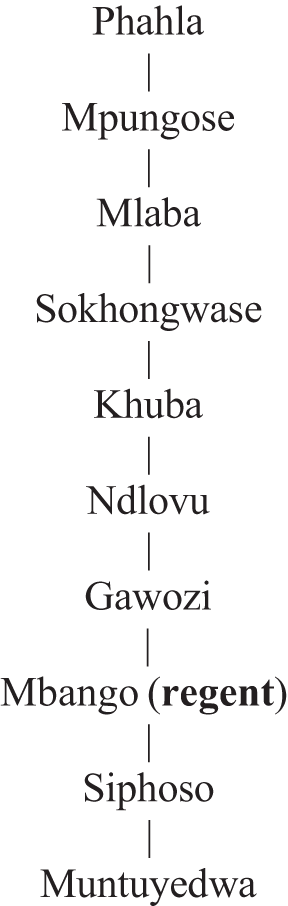
However, both Arthur Bryant and Carolyn Hamilton have disputed this view. They have argued that it was Dingiswayo kaJobe of the Mthethwa Kingdom who had the neighbouring Xulu chief, Gxabashe, kaDanda murdered in the early nineteenth century, and then raised up a new dynasty under Mapholoba of the Ngcobo.Footnote 33 So if Senzangakhona led the raid against the Xulu chiefdom, he did this at the behest of the Mthethwa king. Whether this gave Senzangakhona the power and authority to appoint the Mpungose to chieftainship is therefore questionable. What seems more likely is that it was Shaka who elevated Ndlovu kaKhuba Mpungose to chieftainship in the Thalaneni area and Mpande kaSenzangakhona who incorporated the Xulu territory into the Mpungose chiefdom in the Mthonjaneni area.Footnote 34 Both Baleni kaSilwana Mpungose and Magojela kaMfanawendlela Zungu informed James Stuart that the Mpungose people sprang from the Zungu people.Footnote 35 Magojela says the name Mpungose comes from the impunga (grey) bull that the Zungu people gave to the people of Phahla when they came over to the Zungu royal household to cleanse themselves at the end of the mourning period following the death of one of the Zungu chiefs.Footnote 36 Whatever its origins, the main Mpungose chiefdom was well established by the advent of British colonialism in Zululand in 1879. Its territory stretched from Eshowe to Emthonjaneni and the Nkandla areas. It had a total of 1157 huts recorded in 1903 tax returns.Footnote 37 The British appointed its leader, Chief Gawozi kaSilwane kaNdlovu kaKhuba Mpungose, as one of the thirteen iziphakanyiswa in 1879.Footnote 38 For its genealogy, see Fig. 2, below.
The Genealogical Tree of the Main Mpungose Chieftaincy.

The second Mpungose chiefdom was located in the Nkandla area of Zululand at the turn of the twentieth century. It was comprised of people who took refuge in the John Dunn reserve during periods of warfare—first between Usuthu forces that supported Cetshwayo and the Zibhebhu in 1883–84, and later between Dinuzulu kaCetshwayo and Zibhebhu kaMaphitha during the battles at Hlophekhulu and Ndunu Hill in 1888. When Chief Gawozi Mpungose died in 1880, the British appointed his brother, Siyunguza Mpungose, as chief. It only had a total of 469 huts recorded in 1903 tax returns.Footnote 39 It was the third Mpungose chiefdom which directly benefited from the deposition and banishment of Shingana. It is situated in the Mahlabathini area of the Zululand District Municipality in present-day KwaZulu-Natal Province. This chiefdom was originally made up of the largest number of African refugees from the Vryheid District who had fled the area after the Boers acquired it in the Battle of Tshaneni in June 1884 and turned it into private commercial farms.Footnote 40 The resident commissioner and chief magistrate of the British Colony of Zululand, Melmoth Osborn, appointed Ngobozana kaVukuza Mpungose—the paternal cousin of Gawozi kaSilwane, chief of the main section of the Mpungose chiefdom—to lead the Mpungose chiefdom in the Mahlabathini area. This decision was made on the recommendation of Shingana after he, and Dinuzulu and Prince Ndabuko, had been arrested for their roles in the Battles of Hlophekhulu and Ndunu Hill in 1888.Footnote 41
Mvayisa kaTshingili kaNqaba kaJingwe Shange traces the abakwaShange to the Esiklebheni area of Mahlabathini in the KwaZulu-Natal Province in the 1850s.Footnote 42 They were displaced from that locality during the Battle of Ndondakusuka, fought between the Usuthu forces of Cetshwayo and Prince Mbuyazi kaMpande.Footnote 43 They migrated south and it is not known exactly where they subsequently settled and established their chiefdom. Magema Fuze says that the abaMbo of the Mkhize and the Shange were blood relatives.Footnote 44 It is unclear how the Shange benefited from Prince Shingana’s lands since one part of his former chiefdom was allocated to the Nqodi Mbatha—and not to the Shange people—when Ngobozana Mpungose was deposed and his chiefdom was divided into three parts in 1911.Footnote 45
John Locke Knight, the assistant commissioner and resident magistrate for the Mthonjaneni Magisterial District, had suggested the appointment of Sikhandi Shange as a regent (ibambabukhosi) during the incarceration of Shingana at St. Helena prison. However, the latter objected and recommended that Ngobozana Mpungose should instead be appointed to this position.Footnote 46 This was for two reasons. First, prior to this appointment, Ngobozana Mpungose had served as an induna (headman) for King Mpande kaSenzangakhona and Cetshwayo. He consequently became one of the three senior Zulu officials who accompanied Cetshwayo to meet Queen Victoria in England from July to September 1882.Footnote 47 Second, Ngobozana’s five sons had fought in Shingana’s forces at Hlophekhulu in 1888.Footnote 48 Seemingly, Shingana arrived at this position after close discussions with Ndabuko, and Dinuzulu. They apparently concluded that since Ngobozana Mpungose was loyal to the Usuthu section of the Zulu royal family, he would hand over the chieftainship when required to do so. This turned out to be a great miscalculation on their part: the Mpungose chieftaincy is to this day still in charge of the lands that previously belonged to Prince Shingana’s Onkweni chieftaincy.
Shingana, Ndabuko, and Dinuzulu were released from St. Helena prison and returned to Zululand in 1898.Footnote 49 At first Shingana recommended that Ngobozana continue to serve as his regent while he recuperated from his long incarceration. Thereafter he and his family tried unsuccessfully to have their chieftainship restored to them. But the chieftaincy was instead handed down to the descendants of Ngobozana. For the genealogical tree of this Mpungose chieftaincy, see Fig. 3, above.Footnote 50
Genealogical Tree of the Mpungose Chieftaincy at the Mahlabathini Area of the KwaZulu-Natal Province.

Shingana tried to have his son and heir, Prince Gelejana kaShingana Zulu, appointed inkosi—on the advice of Herbert Munro Stainbank, the native commissioner and magistrate for the Mahlabathini Magisterial District—for two reasons. The first was that Gelejana had just come of age in 1900. The second was that Stainbank was unhappy with Ngobozana Mpungose’s leadership.Footnote 51 However, Gelejana Zulu was killed during a stick-fighting contest (umgangela) at the Simelane wedding ceremony in Mthonjaneni on 12 December 1900—an event that became a significant source of trauma for the Shingana family.Footnote 52 Umgangela is a form of organised refereed “inter-district” stick fighting designed as a social release valve for the violence of ukuphindisela (to avenge), even if not always successfully.Footnote 53
The reports of the medical practitioner, who examined the corpse of the deceased, and the police officer, who conducted the investigation at the scene, concluded that he had died from multiple injuries to the head and other parts of the body as a result of an attack by number of assailants.Footnote 54 Maqubhana kaNomahala was accused of having started the fight which led to the death of Prince Gelejana.Footnote 55 Witnesses stated that the men from Shingana and Prince Sitheku’s side appeared to be only defending themselves when the men from Chief Ngobozana Mpungose’s side attacked. The Mpungose men were fully armed on the occasion of this wedding and were not dressed formally for a wedding ceremony, unlike the people from Shingana and Sitheku’s side.Footnote 56 Chief Ngobozana Mpungose’s induna, Nyosana kaMasiphula, confirmed that the men of Shingana and Sitheku fled when they were attacked. He added that during the inquiry that he and Chief Ngobozana Mpungose held, one of the Mpungose men admitted that he had thrown the stone which hit Gelejana at the back of his head while he was running away. The other Mpungose men then fatally wounded him.Footnote 57 Seemingly this act was aimed at eliminating the possible threat to the Mpungose’s hold on the chieftainship in the Onkweni/Mahlabathini area. However, the trial court focused on the charge of “faction fighting” and found five of the Mpungose men guilty. They were each sentenced to a four-month term in prison with hard labour and a fine of twenty pounds.Footnote 58
The remainder of Chief Ngobozana Mpungose’s men who had participated in the fighting were sentenced to fines of one hundred pounds each, Shingana’s men were fined forty-five pounds each, and Sitheku’s followers were fined fifty-four pounds each. No one was charged and sentenced for the murder of Gelejana Zulu.Footnote 59 The colonial administration in Zululand made a sum of eighty-five pounds from the fines and considered the matter closed. Shingana—who was undoubtedly heartbroken and outraged by the killing of his son and heir—could not do anything as he had made an oath to live peacefully after his release from St. Helena prison. The death of Gelejana set back the initial efforts to have the ubukhosi basOnkweni returned to its rightful owners by a number of years.
1906–13: The Poll Tax Uprisings, Stainbank Murder, and Union of South Africa
The 1906 Poll Tax Uprisings, often associated with Chief Bhambatha Zondi, marked a watershed moment. For many African communities, the new tax symbolized deepening colonial intrusion into African life—compelling men into wage labour, enforcing new forms of surveillance, and reducing African autonomy.Footnote 60 In 1909, Dinuzulu and Shingana were re-arrested and put on trial for their ostensible role in the uprisings.Footnote 61 Dinuzulu was charged with twenty-three counts of treason and found guilty on four—including that he had allowed rebel leaders, Bhambatha kaMancinza Zondi and Mangathi, to visit his home, and that he had harboured Bhambatha’s wife and children at his Osuthu royal homestead.Footnote 62 Despite strong evidence that Dinuzulu had neither personally planned nor participated in the uprising, he was detained at the Pietermaritzburg old prison and later sentenced to a four-year term which he began serving at Newcastle prison beginning in March 1909. In addition, he was fined a total of one hundred pounds or a twelve-month prison sentence.Footnote 63
Charles Saunders, the chief magistrate and civil commissioner and later the native commissioner for the Ndwandwe Magisterial District in Zululand between 1897–1909, testified to Dinuzulu’s innocence when he said: “It would have been no use demanding guns from Dinuzulu or sending to search unless such search would have been successful. Only act when sure of success in finding what one wants.”Footnote 64 The first prime minister of the Union of South Africa, General Louis Botha, released Dinuzulu from prison in 1911 and banished him to a farm called Rietfontein in Middelburg in the eastern Transvaal. His royal residence in Middelburg became known as KwaThengisangaye, which literally means a place where he was sold-out or betrayed. He died there on 18 October 1913.Footnote 65
There are strong indications that the Natal colonial authorities were obsessed with fuelling divisions and factionalism as part of their divide-and-rule strategy aimed at undermining and possibly removing Dinuzulu from the leadership of the Zulu royal family, especially during the last decade or so of his life. For example, Saunders identified Prince Manzolwandle kaCetshwayo as a good trump card against Dinuzulu while contemplating fomenting a dispute over the Zulu throne in December 1906. He added that “there should by rights be a civil war between Dinuzulu and Manzolwandle, for succession is not guided by principle of law but by might.”Footnote 66 Prince Manzolwandle was Dinuzulu’s half-brother and his main political rival.Footnote 67 He collaborated with Mchitheki kaZibhebhu of the Mandlakazi section of the Zulu royal family in their efforts to topple the king. In June 1907, S. O. Samuelson, the Undersecretary of Native Affairs in the Natal Colony, described this collaboration as “Manzolwandle and Mchitheki hobknobbing together against Dinuzulu.”Footnote 68 Colonial authorities also arrested other influential members of the Zulu royal family as retribution, including Mankulumana kaSomaphunga Ndwandwe, King Dinuzulu’s main induna. He was only released from prison shortly before the formation of the Union of South Africa in May 1910.Footnote 69 He was, however, prohibited from returning to Zululand.Footnote 70
The killing of Stainbank, the native commissioner and resident magistrate for Mahlabathini Magisterial District, was a major setback for the efforts to restore the ubukhosi basOnkweni to Shingana and his family. Unknown gunmen shot and killed the magistrate at his camp near the White Mfolozi River during the night of 3 May 1906.Footnote 71 After a long and unsuccessful investigation, the Natal colonial authorities strongly suspected that Shingana and his nephew, Dinuzulu, had hatched the plan to have Stainbank assassinated. Saunders informed the Natal Prime Minister that, “there is evidence … to attach grave suspicion that Tshingana, an uncle of Dinuzulu’s and those exiled with him, if not the instigator of the whole affair was cognizant of all that was going on, and that the plot… was discussed at one of his kraals from whence the murderers set forth.”Footnote 72
The Natal colonial authorities expressed grave concern about the political influence which Shingana wielded within his former chiefdom between the death of his son, Gelejana Zulu, in 1900 and the outbreak of the Poll Tax Uprisings in 1906.Footnote 73 Failure to obtain incriminating evidence against him in the murder of Stainbank did not stop the authorities from taking action against the prince: he was formally deposed as inkosi yasOnkweni and, on 27 April 1910, banished—along with 75 members of his family—to the kwaThoyana chiefdom of Chief Ogle Zembe, near Amanzimtoti. He lived in poverty there despite the wealth he held in Mahlabathini.Footnote 74 This case of banishment to Zembe lands was part of a broader strategy of expunging abatshokobezi (rebels) to Highflats, Ixopo, and areas of southern Natal. AmaZondi—certainly those closely allied to the late Chube/Shezi Sigananda during the armed eNkandla fighting—were hauled down there too, some after serving prison time with lashes and hard labour.Footnote 75 Harriette Colenso tried desperately to have the banished prince’s cattle and goats transferred from Mahlabathini to Amanzimtoti to provide food, milk, and amasi (sour milk) for the sustenance of Shingana and his children.Footnote 76 Natal Authorities refused to change their stance, despite the numerous petitions from Colenso in 1910 and 1911. They prohibited the transfer of the prince’s cattle on the grounds that there was an outbreak of East Coast Fever.Footnote 77 They even refused to purchase any cattle for him around Durban when Colenso suggested this as an alternative option, on the grounds that he should pay for any expenses he incurred despite the fact that he was living under house arrest and unable to secure any income in Amanzimtoti.Footnote 78
Shingana died a pauper on 22 March 1911 and was buried at Ndulinde.Footnote 79 His descendants suspect that he was poisoned. The first motive cited is that he had contributed to the death of many British troops by fighting at Isandlwana in 1879 and Hlophekhulu in 1888. The second was the lingering British hostility rooted in their suspicion of the prince’s involvement in the murder of Stainbank.Footnote 80 After Shingana’s death, the state discontinued paying his stipend, forcing his destitute family to apply for permission to return to Mahlabathini.Footnote 81 They were ultimately allowed to return conditionally to live as the subjects of the Mpungose, Zungu, and Mbatha chiefs named Bhulingwe, Majojela, and Nqodi, respectively.
The Native Affairs Department also deposed Chief Ngobozana kaVukaza Mpungose in 1911 for his failure to help identify the murderers of Stainbank. His chiefdom was subdivided and allocated to Chief Bhulingwe Mpungose in the Mthonjaneni area, Chief Magojela (and later Mqiniseni) Zungu at Mahlabathini, and Chief Nqodi Mbatha also at Mahlabathini.Footnote 82
Only in July 1912 was someone—Mayatana kaSintwangu Cele—brought to trial and convicted for the murder of Stainbank.Footnote 83 It took an additional sixteen years before applications for the resuscitation of the Mpungose chieftaincy and the reinstatement of Shingana’s descendants to the Onkweni chieftaincy were resubmitted.
Ultimately, the continued colonial persecution turned the Usuthu and the Onkweni sections of the Zulu royal family into symbols of political resistance, especially during the 1906 Poll Tax Uprisings.Footnote 84 Indeed, Saunders complained to Stuart in December 1906 that “all Natives in Natal saw the Usuthu as their head.”Footnote 85
The Genesis of Multi-Class Cooperation and Non-Racial Resistance Politics, 1880s–1910
Another important unintended consequence of colonial persecution of the royal family was the seeding of non-racial and cross-class resistance politics in Natal, notably in the cooperation between the Zulu royal family, the Colenso family, and prominent members of the African intelligentsia—in both Natal and the Eastern Cape—who would play a pivotal role in founding the SANNC in 1912.Footnote 86 In addition to the cross-racial ties between the Usuthu section and the white Colenso family mentioned above, the legal struggles pushed members of the monarchy closer to African members of the mission-educated middle class, notably including Chief Martin Luthuli from Groutville and Josiah Tshangana Gumede from Pietermaritzburg.
Luthuli served as the personal secretary to King Dinuzulu during the 1880s.Footnote 87 He was consequently involved in the negotiations between the Usuthu and the British colonialists at the Government House in Pietermaritzburg in the mid-1880s.Footnote 88 He was also present when the British conveyed their plan for the dismemberment of the Zulu kingdom to the King’s closest advisors.Footnote 89 However, there was always a possibility of the distortion of the essence of the discussions and agreements because the Zulu people were an oral society at the time. André Odendaal has shown how “as members of an oral culture, the Zulu had conventionally expressed their positions through the spoken word, which the British colonial authorities could manipulate and misrepresent.”Footnote 90 Guy notes that the formal official report of the meeting between the Zulu royal delegation and the colonial government officials held in Pietermaritzburg on 26 May 1880, for example, was only written ten months later and only in response to questions which Harriette Colenso had raised.Footnote 91 Senior members of the Zulu royal family later questioned the (mis)representation of the proceedings of this meeting when they met with Bulwer in 1882.Footnote 92
In order to circumvent the possibility of future misrepresentation of the proceedings of their meetings with the Natal colonial authorities, the royal family engaged the services of Chief Martin Luthuli and Josiah T. Gumede. From that point onwards Chief Martin Luthuli, according to Odendaal, could put down for posterity what Shingana, the trusted advisor to the Zulu king, “dictated to him.”Footnote 93 Shingana is quoted as saying: “We bear earnest witness that this cutting off of the Zulu, without our having been given an opportunity.”Footnote 94
Josiah Gumede, who at the time was a young teacher at the Amanzimtoti Institute at the Adam’s Mission, helped Martin Luthuli.Footnote 95 He later became the president-general of the African National Congress (ANC, the successor to the SANNC in 1923) from 1927 to 1930.Footnote 96 Gumede served as the main negotiator over land between the Zulu royal family and the Afrikaners of the New Republic before and after the Battle of Tshaneni in June 1884.Footnote 97
Chief Martin Luthuli, Josiah Gumede, Saul Msane (later the deputy president of the ANC in 1912 and its general secretary from 1917 to 1923), and Harriette and Agnes Colenso, among others, explored setting up the Natal Native Congress (NNC) as a political formation that would focus on the political rights of the African people who were under siege from the British colonial authorities in Natal in 1899.Footnote 98 Luthuli was elected the chairperson of the NNC in the early 1900s and Josiah Gumede served as its general secretary. Martin Luthuli was also the paternal uncle of future ANC president, and 1960 Nobel Peace Prize winner, Albert John Luthuli.
Pixley kaIsaka Seme, the British- and American-trained lawyer and one of the founding fathers of the ANC, also supported Dinuzulu and the members of the Usuthu in their political trials and tribulations. He ultimately married one of the king’s daughters named Princess Phikisinkosi kaDinuzulu.Footnote 99 Most of these early activists had firm links with their counterparts from the Cape Colony and the Orange Free State. Gumede, Msane, and other early political activists such as Bryant Cele, Cleopas Kunene, and Mark Radebe had attended mission schools in the Cape Colony.Footnote 100 Gumede went to school at Lovedale in Grahamstown while Saul Msane studied at Healdtown, where Walter Rubusana also studied. Odendaal says these schools fulfilled the same grooming role in southern Africa that Oxford and Cambridge did for the ruling class in England.Footnote 101 Non-racialism and African unity, despite diverse ethnic backgrounds, were inculcated as essential during their school years. They subsequently became the key foundations on which the national movement would be founded in 1912.Footnote 102
Conclusion
This article has shown that the expansion of British imperialism significantly reshaped the political landscape of the region. Independent African polities, such as the Zulu kingdom, were conquered, and their royal families were subjugated and oppressed. Larger chiefdoms were also politically harassed, and disloyal chieftaincies were weakened through divide-and-rule initiatives, which often involved subdividing them and placing them under leaders loyal to the British-backed colonial authorities of the Natal and Cape Colonies.
The Natal colonial administration deliberately targeted and oppressed the Usuthu and Onkweni chieftaincies from the late 1880s until the formation of the Union of South Africa in 1910. These political developments led to the imprisonment and banishment of Shingana and his nephew, King Dinuzulu kaCetshwayo, first from 1889 to 1898, and again during the Poll Tax Uprisings in Natal. Shingana was later banished to kwaThoyana near Amanzimtoti in 1910, where he died in 1911. King Dinuzulu kaCetshwayo was imprisoned at the Pietermaritzburg Old Prison from 1907 to 1909 and at Newcastle Prison from 1909 to 1911, before being banished to the kwaThengisangayo Zulu royal residence in the eastern Transvaal, where he died in 1913. Influential members of King Dinuzulu’s inner circle were also imprisoned and banished following the Poll Tax Uprisings. The second round of trials, convictions, and banishments demonstrates the hostile response of colonial authorities toward the Usuthu section of the Zulu royal family. The authorities recognized that the earlier imprisonment of senior members between 1889 and 1898 had produced unintended consequences: rather than diminishing their stature, the royal family had become a rallying symbol of resistance during the Poll Tax Uprisings, indicating that their support base had expanded among the African population in Natal. Indeed, the Usuthu section of the Zulu royal family became a rallying point for ordinary people of Natal who were feeling the indignity of colonial oppression and exploitation, which boiled over into the uprising against poll taxes in 1906 and, later, to the armed resistance to the whole architecture of apartheid from the 1960s through the early 1990s.
The victimisation of the members of the Usuthu section of the Zulu royal family further facilitated closer cooperation between the traditional leadership, on the one hand, and the emerging African middle classes, on the other. Martin Luthuli, Josiah Tshangana Gumede, and Pixley kaIsaka Seme, among others, helped the Usuthu section of the Zulu royal family between the 1880s and 1913. This paved the way for Dinuzulu’s support for the formation of the SANNC in 1912, which served as the main vehicle for the decades-long struggle that culminated with the birth of an inclusive South African democracy in April 1994.



 Open access

