


1. Introduction and problem definition
Global challenges such as rising raw material costs and the consequences of climate change are intensifying the complex economic situation of companies in resource-intensive industries (FöBu, 2024). Against this background, it is important to identify existing resource-saving potential in product development and use, exploit it to the maximum and thus maintain the resilience of companies (Reference CronenbergCronenberg, 2020). This can be achieved using resource-saving development approaches such as lightweight design. In lightweight product development, five lightweight strategies are used throughout the development process: conditional, conceptual, structural, material and manufacturing lightweight design (Reference Klein and GänsickeKlein & Gänsicke, 2019). Depending on the strategy, lightweight design measures are used, such as the lightweight requirements list by Busch et al. (Reference Busch, Lorenz, Schleicher, Malmqvist, Candi, Saemundsson, Bystrom and Isaksson2024a), the concept kit by Posner (Reference Posner2016), topology optimization (TO) or the material diagrams by Ashby (Reference Ashby2024). Despite the number of measures, many have not achieved widespread use - as they have only been developed in recent years (Busch et al., Reference Busch, Lorenz, Schleicher and Bauernhansl2024b; etc.) or their applicability needs to be validated first. In contrast, measures such as the TO are widely used. TO makes it possible to determine an optimal topology for the building space within boundary conditions. This is determined by discretizing the building space, which leads to undefined component contours. (Reference Bendsøe and SigmundBendsøe & Sigmund, 2004) Parametric CAD models can only be derived through a time-consuming geometry repatriation. In addition, the manufacturing process to be used should be considered during repatriation. As the integral structures can only be produced using primary forming processes, they are mostly casted or additively manufactured. (Subedi et al., Reference Subedi, Verma and Suresh2018; Mayer & Wartzack, 2024) This limits the choice of materials, is only economical for small or large quantities and requires machining post-processing. This results in a high resource consumption and deviations from the topology optimization results (TOE) (Reference Kühn, Fritz and SchmützKühn, 2022). To address these issues, a methodology is presented to efficiently convert the TOE into a production and lightweight-oriented differential design for any quantities. The methodology is applied and validated in Section 4.
2. State of the art
The following section presents the state of the art on lightweight design methods including a detailed clarification of the terminology differential design. Moreover, the disciplines of structural optimization, as well as approaches for the geometry repatriation of TOE into a production-oriented structure and approaches for the production-specific derivation of TOE are explained. Finally, research gaps and the resulting need for action are derived and used as a basis for the developed methodology.
2.1. Lightweight designs
There are different design methods in lightweight design, which can be differentiated based on technological features such as component design or the material used (Reference Ponn and LindemannPonn & Lindemann, 2011). One design method is the integral design, which aims to reduce the number of individual structure-forming parts to one. Several identical or different sub-functions are combined in one component, and function-forming elements such as bearing points or stiffeners are realized through suitable shaping. The integral design reduces the component mass, as connecting elements and superimposed structures are eliminated. However, there are disadvantages, such as poor repair properties and the limitation to one material per component. Therefore, it is preferred for large quantities. (Reference Ellenrieder, Gänsicke, Sandiano, Goede, Hermann and FriedrichEllenrieder et al., 2017; Reference Kopp, Burkhardt, Majić, Henning and MoellerKopp et al., 2020) The differential design, as a counterpart to the integral design, is characterized by separating structure-forming parts and their functionalities into subcomponents. Subsequently, the resulting subcomponents must be joined together to create an assembled part. Although joints lead to overlaps, this design offers the advantage of less complexity in the part design, due to less interdependencies between the functionalities, as well as the flexibility in the choice of materials. It also facilitates repairs and the recycling of individual subcomponents. In addition, differentially manufactured parts are easier to produce and handle. The choice of material and design can be adapted to the respective requirements, and increasing the number of identical subcomponents can reduce procurement costs. However, the necessary design of interfaces is a disadvantage. The differential design is mainly used for small to medium quantities. (Reference Ellenrieder, Gänsicke, Sandiano, Goede, Hermann and FriedrichEllenrieder et al., 2017; Reference Gumpinger, Jonas, Kraus, Norell, Grimheden, Leifer, Skogstad and LindemannGumpinger et al., 2009) The integrating design combines the advantages of the differential and integral design by reducing the number of interfaces, which avoids problems such as crack propagation. The composite construction method combines different materials and components inseparably in one component. This method aims to combine material properties to reduce weight or increase the range of functions. (Reference Klein and GänsickeKlein & Gänsicke, 2019) Composite construction is associated with multi-material design, in which each material is selected according to the specific requirements of a component to achieve a minimum weight. (Reference Kopp, Burkhardt, Majić, Henning and MoellerKopp et al., 2020)
2.2. Structural optimization
Structural optimization describes an approach for component optimization considering boundary conditions (Reference Ellenrieder, Gänsicke, Sandiano, Goede, Hermann and FriedrichEllenrieder et al., 2017). In contrast to multi-criteria optimization, where several objectives are pursued via objective functions, structural optimization considers one function. The starting point is always the specification list. (Reference SchumacherSchumacher, 2020) This includes design variables, target and restriction functions as well as load cases. The variable defines the possibilities for changing the structure, while the function should assume an extreme value (Reference Klein and GänsickeKlein & Gänsicke, 2019). The restriction functions describe the restrictions to which the component is subject (Reference SchumacherSchumacher, 2020). Depending on the type of design variables, disciplines, like topology (see Figure 1), shape or parameter optimization, arise.
Superordinate steps of a topology optimization (based on (Reference Bendsøe and SigmundBendsøe & Sigmund, 2004))

TO is a computer-aided process enabling the determination of the optimum number, position and shape of recesses and the connectivity of individual areas within a building space. The aim is to determine topologies suitable for the load. (Reference Harzheim, Graf, Klug and LiebersHarzheim et al., 1999) This is done using algorithms like the SIMP (Solid Isotropic Material with Penalization) or SKO (Soft Kill Option) method.
Shape optimization is applied to local areas of a component and is used to refine the design following a TO. The geometric changes achieved are minor but contribute to reducing stress peaks. Both material removal and material build-up are possible, allowing the structure to be specifically adapted to local requirements. Parameter optimization is carried out after the topology and shape of a component have been defined. This method enables the dimensioning of parameters, e.g. wall thicknesses. (Reference Bendsøe and SigmundBendsøe & Sigmund, 2004) Through this adaptation, design variants can be developed that reduce component mass.
2.3. Approaches for deriving production-oriented topology-optimized structures
In addition to the manual transfer of a topology-optimized structure into a finished component, there are methodical approaches that enable a systematic procedure for geometry repatriation. On the one hand, there are methods supporting the repatriation of a topology-optimized structure into a geometry suitable for production, regardless of the manufacturing process. On the other hand, some methods generate a topology-optimized structure adapted to a manufacturing process.
2.3.1. Approaches for geometry repatriation of TOE into a production-oriented structure
The simplest method for geometry repatriation from TOE consists of manual remeshing or smoothing of the component surface. Parametric design models cannot be achieved in this way, so approaches for geometry repatriation using automated skeleton, surface and volume-oriented methods are used. (Reference Subedi, Verma and SureshSubedi et al., 2018) In view of the large number of scientific methods, a selection of representative methods is shown below. For a deeper insight, the work from Subedi et al. (Reference Subedi, Verma and Suresh2018) is recommended. Commercial approaches, like solidThinking Inspire or TOSCA, are not mentioned further.
Skeleton-oriented
Skeleton-oriented methods extract a skeleton from the TOE. The resulting lines and points serve as guidelines for the generation of a volume-based construction geometry. These methods prove to be advantageous when modelling beam-like structures. However, the consideration of interfaces is a challenge, which is why not all TOEs can be modeled using this method. (Reference Subedi, Verma and SureshSubedi et al., 2018) Despite this limitation, skeleton-oriented methods are often used as a basis for area- or volume-oriented methods.
One of the most up-to-date methods is offered by Alves and Siefkes (Reference Alves, Siefkes, Binz, Bertsche, Spath and Roth2021). They focus on the derivation of a wireframe skeleton, where a skeleton is generated through an automated process that includes voxelization, thinning, node detection and the creation of node connections. By adding cross-sections, it is possible to create a parametric CAD model. Consequently, the method described only supports the post-processing of TOE up to the representation of a wireframe skeleton in the CAD system, which must be worked out manually. In contrast, the surface-oriented methods described below provide more in-depth support for the construction by reproducing individual structures.
Surface-oriented
Surface-oriented methods can be divided into three methodological categories: remeshing, sub-division and surface-fitting. These methods are based on the reconstruction of the surface mesh of a TO into a structure that comes as close as possible to the final contours of the component. The advantage of these processes is that they can be applied to all TOEs. One obstacle to their practical implementation is the retention of sharp-edged elements and the complex automation of the process. (Reference Subedi, Verma and SureshSubedi et al., 2018)
One surface-oriented method is presented by Tang and Chang (Reference Tang and Chang2001). They use a smoothed surface mesh, from which B-splines are applied to generate cross-sections that are transformed into enveloping structures. Expanding on surface-based methods, Denk et al. (Reference Denk, Rother and Paetzold2021) propose a skeletonization technique using a volumetric grid, followed by conversion of the surface skeleton into a subdivision surface control grid. Building on the concept of skeletonization, Amroune and Cuillière (Reference Amroune and Cuillère2022) integrate a curve skeletonization method with boundary triangulation to compute closed cross-sections along the skeleton’s branches and nodes at the branch bifurcations. The sections are interpolated using B-spline fitting curves, enabling the generation of a surface representation for the branches and nodes of the optimized shape. More recently, Mayer and Wartzack (2024) introduced a method for constructing the geometry of TOE models using surface skeletons. The geometry is abstracted through the surface skeleton and combined with cross-section parameters to create a parametric CAD model.
Volume-oriented methods
Based on the approximation of the TOE, volume-oriented methods use cross-sections and construction elements to create a volume model. This method is advantageous because it makes smaller features obsolete. However, more complex TOEs cannot be repatriated back in detail. (Reference Subedi, Verma and SureshSubedi et al., 2018)
In their volume-oriented method, Hsu and Hsu (Reference Hsu and Hsu2005) focus on extracting cross-sections from the TOE, using boundary points as control points to create B-spline boundary curves. These curves are utilized to generate parametric solids, formed by sweeping tensile structural elements along the boundary curves. Building on this method, Larsen and Jensen (Reference Larsen and Jensen2009) also use swept geometries, but they subtract these geometries from the given building space. However, their method focuses on three main coordinate axes, which limits the detection of structural features that are not parallel to these axes. This constraint complicates the creation of a parametric CAD model, as it overlooks geometric complexities.
In contrast to the aforementioned methods, Stangl & Wartzack (Reference Stangl, Wartzack, Weber, Husung, Cascini, Cantamessa, Marjanovic and Graziosi2015) propose a skeletal-based method that represents the surface mesh of a topology-optimized structure using a curve skeleton. This skeleton serves as the foundation for tensile construction elements, which are extruded from 2D cross-sections to create solid models. A similar method is presented by Cuillière et al. (Reference Cuillière, François and Nana2017), also using a curve skeleton to approximate the surface mesh. However, unlike Stangl, Cuillière et al. (Reference Cuillière, François and Nana2017) emphasize the importance of considering interface restrictions between beam elements, highlighting the need for attention to these interfaces during the modelling process to ensure an accurate structure representation.
2.3.2. Approaches for the production-specific derivation of TOE
Several studies have focused on incorporating production-specific constraints into TO, particularly for manufacturing processes such as casting, milling or additive manufacturing.
An overview of work on production-specific TO for castings is provided by Harzheim and Graf (Reference Harzheim and Graf2006) and Li et al. (Reference Li, Chen, Liu and Fan2018). The last mentioned also focus on multidirectional restrictions for castings and on the influence of extrusions on TOE in a previous work (Reference Li, Li, Gao, Zhang and WuLi et al., 2015). Like Li et al. (Reference Li, Chen, Liu and Fan2018), Vatanabe et al. (Reference Vatanabe, Lippi, de Lima, Paulino and Silva2016) examine a set of restrictions for various machining processes, such as casting or turning, within TO. Another manufacturing process is investigated by Liu and Ma (Reference Liu and Ma2016). They introduce the Optimization-for-Manufacture method, integrating production-related factors such as time, cost, and machining characteristics directly into the TO process for milled parts. This method removes the need for manual post-processing by assigning production-oriented features to the TOE.
In addition to methods for the more conventional manufacturing processes mentioned above, there are also methods for additive manufacturing, such as the method by Liu and To (Reference Liu and To2017). They focus specifically on the challenges of incorporating restrictions for additively manufactured topology-optimized structures. Supporting this line of research, Langelaar (Reference Langelaar2016) and Mezzadri et al. (Reference Mezzadri, Bouriakov and Qian2018) examine the need for support structures in the context of additive manufacturing, recognizing that the unique nature of 3D printing requires special considerations in the topology-optimization process.
In recent years, Helfesrieder et al. (Reference Helfesrieder, Lechler and Verl2020) proposed a method for producing topology-optimized structures using layer lamination. The procedure divides the optimized structure into layers of uniform thickness, which are mapped onto a production grid. An algorithm assigns cavities to grid cells based on material density, resulting in a manufacturable CAD model. This method offers a new manufacturing flexibility and considers general manufacturing constraints regarding the topology optimization process.
2.4. Research gaps and need for action
Various approaches in the scientific literature address the problems mentioned in Section 1. For example, there are skeleton, surface and volume-based methods for geometry repatriation or even for parametric geometry repatriation of TOEs into a production-oriented structure. There are also approaches for the production-specific derivation of TOEs or the subdivision of TOEs with subsequent production and joining of the individual layers to form a differentially constructed component. Even if some methods include automated (parametric) geometry repatriation, the component quantities to be manufactured and the associated economic manufacturing processes are not fully considered. Similarly, the approaches for the production-specific derivation of TOE do not manage to carry out a geometry repatriation that is as consistent as possible with the optimum TOE. In addition, the focus to date has been on deriving integral structures, which means that the advantages of differential design remain unused. For medium quantities, there is, therefore, a lack of options for economical geometry repatriation and the production of topology-optimized structures.
3. Methodology for transferring topology optimization results into a production- and lightweight-oriented differential design
The methodology is based on the methods of Alves and Siefkes (Reference Alves, Siefkes, Binz, Bertsche, Spath and Roth2021), Stangl and Wartzack (Reference Stangl, Wartzack, Weber, Husung, Cascini, Cantamessa, Marjanovic and Graziosi2015), and Larsen and Jensen (Reference Larsen and Jensen2009) and includes an innovative procedure for the use of modular construction kits, which enables the economical and quantity-independent production of topology-optimized structures in differential design (see Figure 2). Five steps are presented, starting with the subdivision and skeletonization of the topology-optimized structure by assigning semi-finished products to segments to integrate precisely fitting interfaces. The steps contain rules that enable systematic processing and form the basis for the pending automation of the methodology.
Structure of the methodology including the modular system

3.1. Subdivision of topology-optimized structures into segments
The first step is to subdivide the topology-optimized structure into segments based on the existing shape and load. This creates the basis for the skeletonization and cross-section determination described in the next section, which is necessary for using the construction kits. The subdivision process is based on seven rules, checked step by step. As soon as a decision rule is fulfilled, a separation into segments takes place. Otherwise, the next rule is checked. The first step is to analyze the cross-sections and dimensions of the structure. Areas in which the cross-section or dimensions deviate significantly from adjacent sections are separated (rule 1.1). The stress distribution in the structure obtained by the TO is then analyzed. There should be a uniform distribution in the individual segments, with preferably only tensile or compressive stresses occurring. Clear stress ranges such as 0 - 25 MPa and 50 - 75 MPa can be defined for this purpose (rule 1.2). In addition, the centerline of a segment should be linear, whereby curved centerlines are also permissible, considering the permissible bending radius of a segment (rule 1.3). The separation points between segments must not lie within a bending radius of the centerline, and preferably only two segments should meet at a separation point (rule 1.4). This procedure facilitates the design and manufacture of the joints. To minimize the number of interfaces as well as varying construction elements and the assembly effort, the number of segments should be kept as low as possible (rule 1.5). It must also be ensured that the separation point is not positioned in a highly stressed area (rule 1.6). Finally, the individual segments should be arranged at right angles to each other (rule 1.7).
3.2. Determining the skeleton and accurately fitting cross-sections
The segments obtained are used to determine the skeleton consisting of nodes and lines. Based on this, cross-sections are determined along the skeleton. By using the skeleton model and the cross-sections, design elements and interfaces can be extracted from the construction kits for geometry repatriation in the following section. Eight decision rules are used for the segmentation. The wireframe skeleton is constructed by drawing a centerline that is as linear as possible at the centroid of the cross-sections of each segment of the TOE and by deriving nodes at the interfaces. Care must be taken to ensure that the skeleton, whose number of centerlines and nodes is determined by the segment subdivision, is created based on the actual TOE (see Figure 2). For curved centerlines, make sure that the maximum permissible bending radius of the potential semi-finished products is not exceeded (rule 2.1). For segments with small curvatures, it is advisable to use segments that are not bent, as this simplifies the production of the topology-optimized structure and only leads to minimal deviations from the TOE. Finally, the centerlines are positioned considering the production conformity. The aim is to ensure that interfaces only exist between two segments that are not positioned at points with a bending radius (rule 2.2). The resulting wire mesh skeleton forms the basis for replicating the TOE in differential design, using standardized semi-finished products from the construction kit described below. A comprehensive investigation of commercially available semi-finished products was carried out to create the semi-finished product kit, using data from websites, catalogues and delivery programs of trading companies. The most common geometries include round and rectangular hollow and solid profiles as well as angle, T, U and I profiles, available in a wide range of materials such as aluminum, steel and plastic. A suitable semi-finished product is selected from the modular system by specifying a scanning dimension for each segment, which defines the distances between the cutting planes used to determine the final cross-section and, thus, the corresponding semi-finished product. A finer scanning dimension leads to a more accurate reproduction of the TOE. (Rule 2.3) The cutting planes are then generated perpendicular to the centerline at the distance of the scanning dimension for each segment (Rule 2.4). An enveloping sketch is generated in each of the section planes, as shown in Figure 2. The usable sketch geometries depend on the semi-finished products available in the semi-finished product kit and must be selected in such a way that the complete cross-section of the TOE is enveloped in each cutting plane. Circular or rectangular geometries are usually used for this purpose. The segment-dependent allocation of solids in the form of precisely fitting semi-finished products from the construction kit takes place after a mathematical adjustment of the dimensions determined from the cross-sections in comparison to the actual cross-sections of the TOE. Here, all cross-section values whose area is greater than or equal to the 3rd quartile of all drawn cross-sections are neglected, which prevents overdimensioning by considering individual, strongly deviating cross-sections (rule 2.5). After adjusting these values, an average value represents the final cross-section within a segment (Rule 2.6). Finally, a semi-finished product with the next largest suitable cross-sectional dimensions is selected from the kit, and the selected semi-finished product is checked based on its cross-sectional area. This must be at least as large as the median of the adjusted cross-sectional values. If the cross-sectional area of the selected semi-finished product is smaller than the median, a larger cross-section and a new semi-finished product are selected (rule 2.7).
3.3. Assignment of elements and interfaces
Both the cross-sections and the corresponding semi-finished products are known from the previous step. These are arranged and extruded along the defined centerlines. The length of the construction element is selected to be greater than the length of the center line to enable the development of target-oriented interfaces (rule 3.1). Once the elements have been created, they are integrated into an assembly, whereby the construction elements are aligned according to their position in the assembly. First, all elements with fixed positions, such as functional surfaces or bearing elements, are integrated, and then the elements protruding beyond the defined building space are repositioned in the assembly by adjusting the center line. The remaining internal elements can then be adjusted (rule 3.2). Once the positions of all elements are correctly aligned, the end faces of the elements are adjusted by trimming. It is important to ensure that the interfaces are designed in such a way that they are easy to manufacture and install. This is achieved when the end faces are aligned perpendicular to the center line. In addition, if possible, only one of the two elements should have to be machined after trimming to simplify production (rule 3.3). At the end of this process, an assembly is created without collisions between the elements, which are clearly positioned within the building space. Precisely fitting interfaces are integrated into the assembly to connect the individual elements. Both integrated connecting elements (such as screws, bolts, rivets, welding, etc.) and commercially available standard parts (e.g. brackets, angles, fork joints) can be considered. Like the standard parts kit, a special interface kit is also created for the interfaces. The assignment of the interfaces begins with an analysis of the contact surfaces of the respective interfaces. For this purpose, a finite element analysis (FEA) is carried out to determine the type and amount of loads occurring (rule 3.4). Based on this analysis, suitable interfaces are then selected from the modular system of defined interfaces. The selection criteria include the type of load, the geometries of the elements, the joint angle and the material of the semi-finished products used (rule 3.5). The load type plays a decisive role in narrowing down the possible interfaces. In addition to checking the suitability for different loading types, the amount of loading must also be considered. This is done using a decision matrix based on interface design principles. About the geometry, a distinction must be made between the side- and end-faces of the semi-finished products, as end faces are not suitable for certain interfaces with thin-walled geometries. Another decisive criterion is the joint angle of the two elements. Joints with an acute angle of less than 60° can only be realized in welded joints, for example, if reliable root capture can be guaranteed. In the case of screw connections, problems may arise with the screw-in depth if the angle is too acute, while in the case of bolt connections, the contact surface may not be sufficient to absorb the surface pressure. In addition, the interfaces must be suitable for the specific materials and, if necessary, their combination. Another criterion that can be considered when selecting is the loosenability of the connection. Finally, if there are several potential interfaces, a ranking must be determined about a weight- or cost-optimized solution. (Rule 3.6)
3.4. Optimization of the production- and lightweight-oriented differential design
An FEA simulation of the structure optimized according to the TOE, which is now available in differential design, is used to check whether the result exceeds the permissible stresses or the mass of the assembly exceeds that of the TOE. As part of the optimization, the cross-sections, materials and interfaces of the selected semi-finished products can be adjusted. The procedure assumes that an increase in the cross-sectional area or the yield strength, as well as the optimization of interfaces, can result in an increase in the load-bearing capacity. However, this assumption is only correct if the loads are tensile or compressive. Nevertheless, the development of the methodology has shown that the TO usually results in bar structures with predominantly tension and compression bars, so that the assumption leads to a sufficient load-bearing capacity in most cases. After adapting the semi-finished products and interfaces in accordance with the procedures presented in Sections 3.1 - 3.3, the structure is checked again. Based on iterative product optimization, a limit value can be defined for the newly generated mass optimization, under which a further optimization step is considered obsolete.
4. Application and validation of the methodology
The methodology presented was applied and validated on the component shown in Figure 3, which was optimized in a similar form in a development project with a machine manufacturer from the pharmaceutical industry. The component mass influences the dynamics of the machine and should, therefore, be reduced. Due to the low to medium quantities and the material to be used, manufacturing processes such as casting or additive manufacturing using SLM processes are out of the question. Nonetheless, the method described above was used to leverage the advantages of the TO.
Building space of the initial component and topology-optimization results

For the component to be optimized a building space with the dimensions 400 mm × 250 mm × 75 mm, was defined as shown in Figure 3. Two fixed supports are attached on the left-hand side of the component. A surface load (P) of 10 MPa is applied to the underside of the rectangle positioned at the bottom right. Stainless steel X5CrNi18-10 was chosen as the material, resulting in a mass of 61.0 kg. Figure 3 shows the result of the TO carried out, aimed at a minimum mass while maintaining a maximum von Mises stress coupled with a safety factor of 1.5. The mass of the topology-optimized structure is 8.9 kg. In Figure 4, based on the rules 2.1 - 2.7, the four segments and the corresponding wireframe skeleton consisting of centerlines and nodes are shown. The right-hand side shows the enveloping cross-sections in a segment. The right-hand cross-section is influenced by the neighbouring segments. Due to the rules, this cross-section becomes obsolete when the corresponding semi-finished product is selected.
Segments, wireframe skeleton and cross-sections in one segment

Figure 5 shows the replicas of the topology-optimized structure based on rules 3.1 - 3.6 and the presented construction kits. On the left is the unmodified structure, together with the available building space. The second graphic from the left shows the modified positions of the construction elements resulting from the correction of the centerlines and the trimming of the end faces. In the next step, the four welded and two bolted interfaces are inserted according to their design. The resulting structure has a mass of 10.7 kg. As this mass exceeds that of the original TO, optimization is required. The ratio of the maximum to the permissible stress in the individual elements is used to determine the necessary cross-sectional areas, after which new semi-finished products are selected. The illustration on the right shows the revised structure, including the newly designed interfaces. In the end, a mass of 9.0 kg was achieved with a von Mises stress below the maximum value, including the safety factor.
Reproduction of the topology-optimized structure in differential design

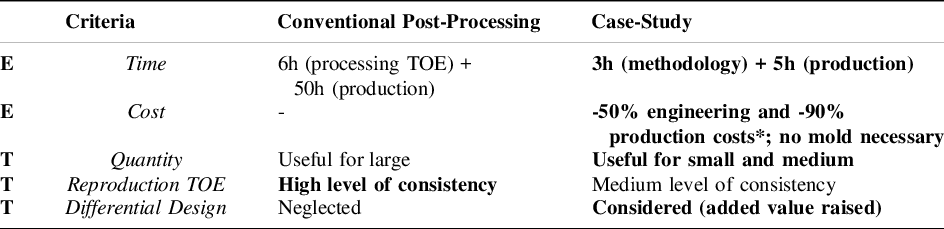
Several economic (E) and technical (T) criteria were defined to validate the methodology. As there are no other methods with the differential design, the criteria were evaluated for the application of conventional post-processing and production of the post-processed TOE via casting and the case study presented including manufacturing. Fifty hours were estimated for the production of the cast component, including the production of the mold, casting and post-processing. The production of one structure was considered in each case. Table 1 shows the validation criteria and the validation results.
Validation criteria and validation results

* costs related to working time; material consumption and machining assumed to be the same
5. Summary and outlook
The investigation carried out for this paper showed that despite the added value offered by TO, challenges such as the labor-intensive and time-consuming repatriation of the geometry into a production-oriented, parametric design limit its application. There are no approaches for the parametric repatriation of TOE into a production-oriented geometry, independent of the quantities and hardly deviating geometrically from the TOE. Therefore, a methodology for converting TOE into a production- and lightweight-oriented differential design was developed, offering an innovative procedure and using a semi-finished product and interface construction kit. The usability of the methodology was validated on a mechanical engineering component. By applying the methodology, a parametric design based on a TOE was derived that can be manufactured using standardized semi-finished products and interfaces. The mass of the component is almost the same as that of the original TOE. In addition, the topology-optimized structure could be implemented so that there is only a slight geometric deviation from the TOE. However, weaknesses and research needs were identified through the application: The predominantly manual application of the methodology and the user interventions required are time-consuming and increase the potential for errors. This should be reduced through the further development of the defined rules and the digitalization and automation of the methodology. Regarding the individual method steps, it became apparent that both the used material and the size of the topology-optimized structure represent a limitation for the semi-finished product kit used. An extension is necessary. In addition, the increasing use of multi-material designs requires the linking of the presented construction kits so that, depending on the varying materials used for individual elements, fitting interfaces for the connection of the elements should be proposed. Additionally, in this work assumptions were made that need to be validated by applying the methodology to other products. For example, it is necessary to check whether the assumption that TOEs are predominantly present in the form of lattice structures is always correct and therefore the simplification by wireframe skeletons is sufficient. Otherwise, the integration of surface skeletons and suitable components, like sheet metal, into the semi-finished product kit must be clarified. Finally, once the methodology has been digitized, it is necessary to carry out a comprehensive cost calculation. Only on this basis can the actual economic added value of the methodical development, production and use of a topology-optimized structure in differential design be objectively evaluated. An elaboration of these research gaps will be the focus of future work.
Acknowledgment
The authors would like to thank the “Technology Transfer Programm Leichtbau (TTP LB)” of the Ministry of Economic Affairs and Climate Protection (BMWK) for supporting the research work.



 Open access

