




1. Introduction
In many contemporary theories, derivational affixes tend to be studied vertically or semasiologically, picking up one specific affix and comparing its multiple usages. Studies of affixal rivalry, however, approach the matter horizontally and consider the way each affix is used in terms of its distributional relationships with its rival affixes. Ideally, the vertical and horizontal approaches should complement each other and deepen our understanding of morphology. Aronoff (Reference Aronoff1976) introduced the concept of rival affixes to address the paradigmatic relationship between -ness and -ity in abstract nominalization in English. Aronoff and his colleagues (Aronoff & Anshen Reference Aronoff and Anshen1981; Anshen & Aronoff Reference Anshen and Aronoff1988; Lindsay & Aronoff Reference Lindsay, Aronoff, Montermini, Boyé and Tseng2013) revealed that the two abstract nominalizers have different, if not complementary, base selectional properties, and morphological doublets such as curiousness and curiosity have different grammatical properties. It is easy to see how hard it would be to pin down the lexeme-formation rules of -ness and -ity if these suffixes were studied individually.
As a contribution to the paradigmatic word-formation research, the present paper addresses the domain of derivational morphology that so far has received much less scholarly attention than nominalization and verbalization: adjectivalization (see Trips Reference Trips2003; Arndt-Lappe Reference Arndt-Lappe2014; Lieber Reference Lieber2016; Santana-Lario & Valera Reference Santana-Lario and Valera2017; Bonami & Thuilier Reference Bonami and Thuilier2019; Rainer et al. Reference Rainer, Gardani, Dressler and Luschützky2019; Renner Reference Renner2020). Adjectival suffixes include many subtypes in terms of syntactic and semantic effects that they cause (Fradin Reference Fradin2007, Reference Fradin2017; Nagano Reference Nagano2013, Reference Nagano2016, Reference Nagano2018; Sleeman Reference Sleeman2019), such as deverbal participial adjectives (e.g. remaining issues, broken vase), deverbal dispositional adjectives (e.g. forgetful, forgettable), denominal relational adjectives (e.g. Chinese vase), proprietive adjectives (e.g. (well-)mannered), privative adjectives (e.g. cordless), similative adjectives (e.g. apish), and evaluative adjectives (e.g. oldish).
This paper also aims to fill in another missing piece in the paradigmatic word-formation research. In reviewing the history of pertinent studies, Aronoff & Lindsay (Reference Aronoff, Lindsay, Lieber and Štekauer2014: 72) regretfully remark as follows:

Adopting Gause’s principle of mutual exclusion as a central principle, Aronoff’s theory of morphological competition looks at affixal rivalry as the struggle for survival among affixes. Two stages should be distinguished: (i) the struggle for existence between competing species and (ii) the outcome of the struggle (Lindsay & Aronoff Reference Lindsay, Aronoff, Montermini, Boyé and Tseng2013; Aronoff Reference Aronoff2019, Reference Aronoff2021). The second stage is also called resolution of the competition if the competing species have successfully found their own ecological niches; in other cases, only one or a few species survive(s), and the others drop out of the race. In the case of language, the struggle between competing constructions can be resolved, in principle, phonetically, phonologically, morphologically, syntactically, semantically, pragmatically, sociolinguistically, or orthographically (for the last case, see Nagano & Shimada Reference Nagano and Shimada2014; Berg & Aronoff Reference Berg and Aronoff2017). Lexeme-formation rules working at a particular historical point, if devised richly enough, are different outcomes of the struggle for survival between competing affixes. The research question raised by (1) is to find a pair or set of English affixes whose ecological niches are semantically motivated.
Aronoff (Reference Aronoff, Körtvélyessy and Štekauer2020) claims that the privative adjectivalizers -less and -free in contemporary American English constitute such a pair. Importantly for the research question in (1), pairs such as the following suggest that the earlier rivalry between -less and -free was resolved semantico-pragmatically (examples taken from Dixon Reference Dixon2014: 258–259):

Both -less and -free express the absence of the base referent (X). However, compared to -less adjectives in (2a) and (3a), -free adjectives in (2b) and (3b) carry the additional assertion that not having X is good. Aronoff maintains that the additional pragmatic implication acquired by -free successfully distinguishes it from its traditional rival -less, which remains neutral on the speaker’s evaluation about the absence of X.
We agree with this argument, but the domain of resolution is limited to concrete noun bases, reflecting the once compound-second origin of -free. Footnote 2 This matters because if a pair or set of rival adjectivalizers are differentiated purely semantically, as is hoped in the passage in (1), the differentiation in question is expected to be observed both in denominal and deverbal adjectivalization. Indeed, we can find such a distribution if we turn our attention to the rivalry between -ed and -y among derived adjectives. We first look at their denominal adjectivalizing usage and then proceed to their deverbal adjectival usage.
First, -ed and -y both produce proprietive adjectives from inanimate concrete nouns:

As suggested in (4a) and (5a), the form Xed can be modified by well (Kennedy & McNally Reference Kennedy and McNally2005; McNally & Kennedy Reference McNally, Kennedy, Pustejovsky, Bouillon, Isahara, Kanzaki and Lee2013).Footnote 3 The combination with this adverbial item confirms that unmodified words of the form Xed, such as branched, are really adjectives. In many cases, adjectives of this form are used in the modified form Mod-Xed, where the Mod slot accommodates not only well but also other morphemes such as ill-, half-, over-, and under-:

In this paper, we largely focus on well-Xed, but similar observations can be made of ill-Xed, half-Xed, over-Xed, and under-Xed. We believe that these formations constitute a single abstract construction of the form Mod-Xed, and that each modifier (word-internally, see Note 3) functions as a degree morpheme that ‘modulates the degree to which an adjective holds and, in English, generally occurs to its left’ (Morzycki Reference Morzycki2016: 287). For example, in (4a), well assigns a ‘good’ value to the degree argument (d) of the unmodified adjective branched, which simply expresses ‘having a branch or branches’. From the interaction between the semantics of well and branched emerge the meanings of the modified construction cited in (4a). Different modifiers have different restrictions on the degree argument of the Xed adjective and yield a series of Mod-Xed constructions (see Figure 1 on the next page).
Mod-Xed construction in English (R is stated very roughly).

Turning to (4b) and (5b), it seems safe to say that derived adjectives of the form Xy do not occur with the items in Figure 1. As suggested in (7), Xy should be used in the unmodified form, and the contrast between the well-formedness of the form well-Xed and the non-occurrence of the form *well-Xy is striking and demands an explanation:

Another striking thing about (7) is that proprietive adjectives of the form Xy have their degrees fixed without any overt degree morpheme such as well. This is most clearly illustrated by (7e–f). Why can pricey mean ‘expensive’ or ‘high-priced’ in an unmodified form, when well-priced ‘cheap’ depends on well in modulating the degree of priced? Also, why can leggy mean ‘long-legged’ without any overt degree morpheme? The simplest hypothesis is that Xy adjectives lexically contain a covert degree modifier. Anticipating the upcoming discussion, suppose that Xy covertly contains yet another degree modifier much ‘greater than (an average) by a large amount’ (Kennedy & McNally Reference Kennedy and McNally2005: 372–375). In much-deserved rest, for example, much modulates the degree of deserved to be appropriately large. If pricey contains this modifier covertly (i.e. much), then we can explain its ‘high-priced’ meaning as a result of the setting of the priced-ness degree as appropriately large. The dictionary meanings of branchy and leggy cited in (4b) and (5b) suggest the same. Thus, branchy ‘full of branches’ can be seen as a reading from ‘greatly exceeding an average on the scale associated with having a branch or branches’.
In deverbal adjectivalization also, adjectives of the form Xed occur with modifiers in Figure 1, as in (8a)–(10a), but the counterparts of the form Xy occur without such a modifier (8b)–(10b).

Again, the formal contrast between (a) and (b) and the semantics of (b) suggest that the latter, unmodified Xy adjectives lexically contain a covert degree modifier.
In the following pairs, Xed is deverbal, while Xy is denominal, according to the etymology of the OED Online:
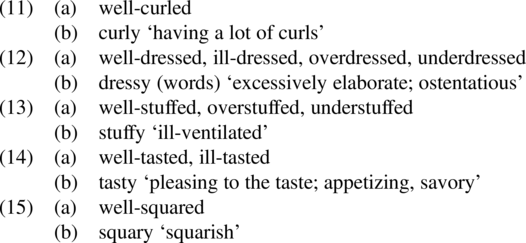
The existence of these categorially mixed pairs is understandable if the distribution between -ed and -y is purely semantic.
In the next section, we consider why Xed accepts well while Xy does not and show that the contrast comes from the scalarity difference between the two adjectivalizers: -ed derives closed-scale adjectives, while -y derives open-scale adjectives. This will be our fundamental answer to the research question raised by (1), but in Section 3, we further probe into the open-scaledness of adjectives of the form Xy. In Section 4, we observe that deverbal Ved/Vy doublets are not so common as denominal Ned/Ny doublets and argue that the fact is related to an independently motivated principle of verb semantics. Section 5 summarizes our findings and clarifies future tasks.
2. Scale types of derived adjectives
2.1 Affixal rivalry between -y and -ed
Bauer, Lieber & Plag’s (Reference Bauer, Lieber and Plag2013: 305) corpus-based study describes -y as among the most productive suffixes of contemporary English, but, thus far, no major theoretical analysis has been proposed in the literature about this suffix.Footnote 4 My observations to be presented greatly benefit from Fradin’s (Reference Fradin2007, Reference Fradin2017) research on the French adjectivalizer -eux. The English suffix -y exhibits a surprising similarity to -eux in the denominal usage. As summarized in Table 1, French denominal adjectives suffixed with -eux consist of two major groups in terms of base selection, one group derived from abstract nouns and the other group from concrete nouns; and the latter further divides into two types based on the semantic relationship between the derived adjective and the head noun. In addition to this classification, Fradin (Reference Fradin2007, Reference Fradin2017) shows that the derivation from concrete nouns is subject to a semantic constraint, which we call the Natural Origin constraint and introduce later in this section.
Classification of French -eux adjectives; (*) To be introduced below and spelled out in (53).

In Table 1, the Concrete Noun Base region is important for us.Footnote 5 English -y adjectives are also rich in the types based on concrete nouns, expressing either of the two relationships with respect to the head noun. Proprietive -y adjectives (already introduced in Section 1) correspond to the ciel nuageux type in Table 1, whereas similative -y adjectives (see Section 3.3) correspond to the champignon laiteux type. While -eux and -y clearly differ in the possibility of deverbal adjectivalization (see Section 5), it seems safe to say that they share certain fundamental characters.
If so, Fradin’s (Reference Fradin2007: 24n9) remark should also be relevant for -y:
A more thorough study of the suffixation by -EUX would require examining at least two other denominal suffixations, namely the one by -É (étoilé ‘starred’< étoile ‘star’) and the one by -U (joufflu ‘chubby-cheeked’ < joue ‘cheek’).
We apply this paradigmatic perspective to English. Indeed, everyday body-part nouns in English produce doublets ending in -y and -ed, as in (16a). In addition, nouns denoting inanimate objects’ parts (16b) and dimensions (16c) also generate such doublet adjectives.
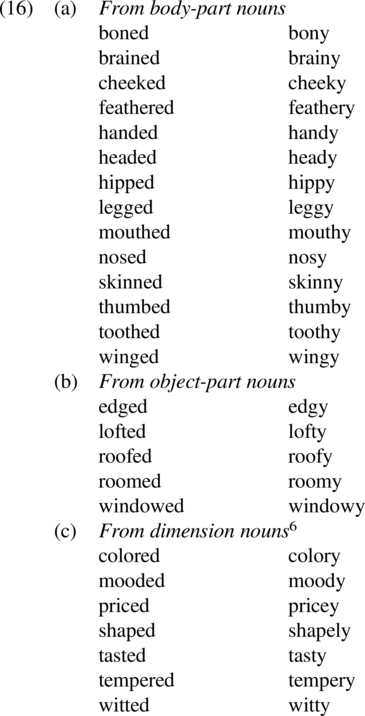
As we observed in Section 1, the Ned type in (16) usually accompanies a modifier. The modifier’s variety indicates that -ed attaches to two different levels of nouns in Acquaviva’s (Reference Acquaviva2016) structural analysis: (i) Number Phrase (many-legged, three-legged) and (ii) Division Phrase (well-legged, a left-handed batsman). In (ii), the unmodified Ned carry a non-individuated sense of the noun, unlike the counterpart in (i). In our lexicalist approach, we assume that Acquaviva’s Division-Phrase level correspond to noun lexeme. This is our target type, and ‘Ned’ in this paper refers to it.
Proceeding, similar doublets are widely observable when derived adjectives observe the Natural Origin constraint: ‘the relationship between the HdN’s (head noun) referent and the BseN’s (base noun) referent must have a natural origin’ (Fradin Reference Fradin2007: 22). Denominal adjectives from part and dimension nouns such as (16) clearly observe this constraint because the base nouns refer to an inherent part/dimension of the head noun referent. As a second instantiation, consider the following doublets:

These adjectives all express topographical or mereological existence of the base referent and thus describe naturally occurring phenomena. For example, in clouded sky conditions, the relationship between clouds and sky is a natural occurrence. Since weather verbs such as to cloud are non-agentive, the natural relation between the cloud and sky is easy to understand, but caution should be taken in that causative verbs can yield an -ed adjective whose semantic relationship to its head noun is internal in the sense of Fradin (Reference Fradin2007: 12). Examples include:

In (18), denominal verbs of the locatum- or goal-types (Clark & Clark Reference Clark and Clark1979) give rise to resultant-state passive participial adjectives (Kratzer Reference Kratzer2000) that are semantically devoid of causality and purely express possession. Such -ed adjectives often have a semantically closely related -y counterpart.
In brief, Xed and Xy adjectives are similar in observing the Natural Origin constraint. We return to it in Sections 3.3 and 4. Meanwhile, the morphological doublets exhibit systematic differences also. The most important difference is what we observed in Section 1. Xed adjectives are overtly degree-modified by well or other similar items in Figure 1, while Xy adjectives do not take them.
Second, Xed and Xy adjectives differ in the compatibility with very:

Fradin also observes that -eux adjectives accept très (Doetjes Reference Doetjes, McNally and Kennedy2008: 134–138), as follows (Fradin Reference Fradin2007: 4):

A third difference is the existence of a morphological antonym. Xed has an antonym sharing the same base and marked with -less or un-, as in legged: legless and dressed: undressed. However, it is hard to find such an antonym for the Xy type.
These differences can be explained if we assume that the affixal rivalry between -ed and -y is resolved along the output adjective’s scale type. Below, we first show that Xed adjectives are closed-scale adjectives, while Xy adjectives are open-scale adjectives (Section 2.2). Then, we proceed to the overt and covert degree modification (Section 2.3).
2.2 Examining the scale type
Kennedy & McNally (Reference Kennedy and McNally2005) assert that gradable adjectives display a four-way typology of scale structure: (i) totally open scales, (ii) lower closed scales with minimum values, (iii) upper closed scales with maximum values, and (iv) totally closed scales with minimum and maximum values. Relative adjectives possessing (i) use a contextually determined relative standard to determine the semantic interpretation of their unmodified positive form, whereas absolute adjectives possessing one of (ii–iv) do not. When the latter take an unmodified form, their standard of comparison defaults to the minimum or maximum value specified on their scale. Since totally closed scales contain both minimum and maximum values, adjectives possessing this type of scale behave either as minimal standard or maximal standard adjectives.
Kennedy & McNally (Reference Kennedy and McNally2005) use several tests to prove the presence or absence of scalar endpoints. For example, maximality modifiers such as completely and fully are compatible with adjectives that have a scale with the upper endpoint (Kennedy & McNally Reference Kennedy and McNally2005: 352–355). If both an adjective and its antonym shun this type of modification, as in (21a), they are associated with a totally open scale. If both accept it, as in (21b), they are associated with a totally closed scale (Doetjes Reference Doetjes, McNally and Kennedy2008: 150).

The scale is partially closed (ii or iii) if only one member of an antonymic pair accepts maximality modification. Expressions whose scale is closed only at the lower endpoint are incompatible with a maximality modifier themselves, but their antonyms should accept it. If so, the following data suggest that the antonymic pairs in (22a–b) and (22c–d) have lower closed scales, respectively (Kennedy & McNally Reference Kennedy and McNally2005: 355; Doetjes Reference Doetjes, McNally and Kennedy2008: 150):

In (22), the minimum values of the said scales are employed as the standard of comparison.
Turning to our data, whether denominal or deverbal, -ed adjectives have a lower closed scale.Footnote 7 , Footnote 8 First, consider the following deverbal examples (Kennedy & McNally Reference Kennedy and McNally2005: 347):

In (23), we see un- prefixation to the form Ved, an indication that the prefixless Ved is an adjective. As for the scalarity, Kennedy & McNally (Reference Kennedy and McNally2005: 365) observe that ‘all deverbal [-ed] adjectives prefixed with un-, which reverses the polarity of the adjectival scale, accept modification by endpoint-oriented modifiers such as completely’. Since un- reverses the polarity of the adjectival scale, this observation means that the prefixless -ed adjectives have a scale that is closed at least at the lower endpoint.
As noted in Section 2.1, proprietive -ed adjectives also have a morphological antonym derived by -less or un-, as in:

Each negative antonym naturally accepts maximality modification, as in completely cloudless, totally unclouded, and completely undressed. Therefore, the scale structure of proprietive -ed adjectives is closed (at least) at the lower endpoint.
In contrast, -y adjectives have a totally open scale. First, -y adjectives do not accept maximality modifiers, as indicated by ??completely dressy, ??completely cloudy, ??completely leggy. Footnote 9 Since many do not have an antonym, the maximality test cannot be employed to check for the presence of an endpoint at the opposite end of the scale.Footnote 10 However, the entailment test (Kennedy & McNally Reference Kennedy and McNally2005: 358–359) confirms that -y adjectives have a totally open scale. Adjectives with a totally open scale use a relative standard, so the truth conditions for tall, for example, entail only that the degree of height it attributes to its holder falls above a contextually determined standard of comparison. Hence, the denial x is not tall should not entail that x possesses no amount of height at all. At the same time, an assertion of x is tall should not entail that nothing can be taller than x. Hence, there are no contradictions in the following sentences (Kennedy & McNally Reference Kennedy and McNally2005: 359):

When this test is applied, -y adjectives behave in the same way, as follows:

Since Xed and Xy adjectives differ in the scale type, they differ in the compatibility with very, as observed in (19). As widely assumed in the literature (Doetjes Reference Doetjes, McNally and Kennedy2008), the modification by very is a hallmark of totally open-scale adjectives. Compare (27) with (28) ((28a–b) from Kennedy & McNally (Reference Kennedy and McNally2005: 370); (28c–d) from (19)).

Based on the above data, we conclude that Xed and Xy adjectives have closed and totally open scales, respectively.
2.3 Degree modification
2.3.1 Overt degree modifiers
Moving on to the issue of degree modification, Kennedy & McNally (Reference Kennedy and McNally2005) argue that deverbal closed-scale Ved adjectives are degree-modified either by well or much (Kennedy & McNally Reference Kennedy and McNally2005: 345):

According to their analysis, well is a degree morpheme that combines with a closed-scale gradable predicate. Based on the evaluative scale of goodness, well-Xed composite measures ‘the goodness of the event that is related to the degree to which the subject has the property named by the adjective’ (Kennedy & McNally Reference Kennedy and McNally2005: 377). For example, in (29a), well positively evaluates the degree to which Martin becomes acquainted with the facts.
The closed scalarity of Xed is not the only restriction for well modification. Thus, well allows both a degree modifier reading and a manner adverb reading in (30a), but only a manner reading in examples like (30b) (McNally & Kennedy Reference McNally, Kennedy, Pustejovsky, Bouillon, Isahara, Kanzaki and Lee2013: 247–248, hyphens added).

This suggests another restriction for the degree reading of well: it should occur with a minimal standard -ed adjective, i.e. -ed adjective whose standard is at the bottom of its scale (McNally & Kennedy Reference McNally, Kennedy, Pustejovsky, Bouillon, Isahara, Kanzaki and Lee2013: 251). The -ed adjectives in (30b) employ maximal standards because they crucially involve incremental theme arguments.
Proceeding to (29b), much as a degree morpheme also combines with closed-scale minimal standard adjectives. In particular, the denotation of much in (31) contains the restriction d >!! min (SG), which says that the degree of a gradable adjective G is greater by a large amount than the minimum value of its scale (min (SG)) (Kennedy & McNally Reference Kennedy and McNally2005: 373).

For example, in (29b), the unmodified needed contains min (Sneeded), which is equal to the minimum portion of the relevant event that is large enough to support the statement x needs y. Hence, it can be an input to the modification by much.
Now, the selectional properties of well and much summarized above predict that denominal proprietive -ed adjectives are also compatible with these degree modifiers because they have a lower closed scale (Section 2.1) and thus behave as minimal standard adjectives.
First, in Section 1, we saw that the said prediction is borne out with respect to well. See the data in (4)–(7). In some cases, the goodness of Ned adjectives implies a high degree of N’s quantity. Thus, a well-brained vertebrate refers to a vertebrate possessing intelligence to the amount that counts as good. In others, the goodness scale within well evaluates a non-quantitative dimension of N. Thus, well-branched in (32a) is concerned with N’s quantity, but (32b) employs a qualitative dimension of measurement.

2.3.2 Covert degree modification
Proceeding to much, the predicted much-Ned construction, such as much-branched or much-brained, seems very marginal. However, this apparent problem disappears once we assume that the semantic function of much in (31) is cumulatively expressed by the suffix -y. A cumulative expression (also called fusion) is ‘the expression of multiple morphological meanings simultaneously by a single un-analyzable element’ (Haspelmath & Sims Reference Haspelmath and Sims2010: 324). That is, we do not have overtly modified adjectives such as much-branched or much-brained most probably because cumulative expressions such as branchy and brainy block (Aronoff Reference Aronoff1976, 2021) them.
If Xy adjectives lexically contains the function of (31), their open-scaledness naturally follows. Here, it is important to notice that (actually-occurring) much-Ved composites exhibit totally open scales. Thus, while unmodified Ved adjectives are incompatible with very, as in (33a), much-modified counterparts accept it (33b).

This fact is explained as follows. Example (33a) is ungrammatical because very is sensitive to a relative standard (Section 2.2), which -ed adjectives do not have (except those derived from causative psychological predicates and lexicalized examples such as dogged). Example (33b) is grammatical due to the relative standard introduced by the function in (31), i.e. ‘greater than by a large amount’. As a result of applying this function, much-Ved composites obtain a relative standard and become compatible with very (see also Kennedy & McNally Reference Kennedy and McNally2005: 373n21). The totally open scalarity of -y adjectives can be explained following the same logic, if the suffix cumulatively expresses the function in (31).
2.4 Summary
This section introduced a new set of data into the study of affixal rivalry and showed that they can fill in the missing gap observed in (1). The rival adjectivalizers -ed and -y are differentiated purely semantically in terms of the scale type of the derived adjective. Whether deverbal or denominal, Xed adjectives are degree-modified by well because they are closed-scale adjectives. In contrast, Xy adjectives do not accept well because they are totally open-scale adjectives. We also argued that Xy contains a covert degree modifier and that it leads to the totally open-scale structure of this form and the marginality of much-Ned constructions.
3. Degree measurement
3.1 Observations
Let us consider the issue of measurement dimension. For example, long can be used in two ways as a measure of temporal or linear extent. Similarly, in the much-Ved composite, the dimension is indeterminate. Consider the following examples (Kennedy & McNally Reference Kennedy and McNally2005: 364, hyphens added):

Kennedy & McNally (Reference Kennedy and McNally2005: 364–365) observe that most of the much-Ved composites can be paraphrased as Ved for a long time, but the temporal duration is not the only way to gauge admiration, need, regret, etc. Thus, much admired (34a) is also paraphrasable as admired by many people, in which case each admiration could be short. Further, it can mean the intensity of one person’s admiration toward the subject of the adjective. Therefore, we observe that in Japanese, much in (34) is translated by several lexical adverbs catering to different dimensions, such as nagaku ‘long’, hiroku ‘widely’, and hukaku ‘deeply’.
As predicted from our analysis, dimensional indeterminacy also holds for -y adjectives. First, let us consider the measurement dimension with windowy in (16b). Witness the following example:

In (35), the proprietive reading of the derived adjective is based on a number-based scale, expressing ‘having more windows than the standard degree’.
However, unlike the number of windows of a room, the number of body parts does not vary. For example, the number of legs of a human body is universally the same: two. In such a case, number-based measurement is not meaningful. As predicted, when leggy is used to describe a person or a plant, it is usually interpreted in the sense of long-legged:

Like window, leg is a count noun, which explains why it yields an -ed adjective that is modifiable by a quantifier, as in three-legged and many-legged. However, leggy does not exhibit a number-based scale because ‘having more legs than the standard degree’ is virtually impossible due to our world knowledge about human bodies and pansies. Instead, leggy employs an amount-based scale, and its ‘long-legged’ sense comes from ‘having a larger amount of leg than the standard’.
This analysis applies not only to leggy but also to other -y adjectives in (16a). Consider why brainy ‘clever, intelligent’, handy ‘dexterous’, and nosy ‘inquisitive, prying’ express such senses, as illustrated below.

Significantly, in (37a), brainy is based on mass plural brains ‘one’s intellectual capacity’. The degree of ‘having brains’ in this sense can be meaningfully specified as ‘greater than the standard by a large amount’ by (31), unlike the universally same degree of ‘having a brain’. The same applies to (37b, c) because the bases of handy and nosy do not refer to physical, atomic body parts either.
Next, consider an example from (16c):

Again, a number-based interpretation is very difficult because each selling article is attached with only one price. Rather, what can be meaningfully degree-specified by the function in (31) is a degree on the amount dimension inherent in price. In lexical semantics, price is defined as ‘the amount of money expected, required, or given in payment for something’. If the adjective in (38) uses this base lexical information for degree measurement, together with (31), its ‘high-priced’ reading ensues.
Ambiguity can be explained in a similar way. Toothy differs slightly from the items discussed above in that the standard number of human or animal teeth is not so obvious. Biologically speaking, there should be a standard number for each species, but such knowledge is not as common or obvious as knowledge about the number of human eyes or legs. Moreover, animal species may be compared to human beings in the number of teeth, while such a comparison would be unrealistic concerning the number of eyes, a head, or a brain. As a result, toothy is ambiguous between amount-based and number-based proprietives. Being predicated of an animal or a person, it expresses ‘having numerous, large or prominent teeth’:

In fact, leggy is also ambiguous. When it is predicated of an animal whose leg count is unidentified, it may employ a number-based scale:

3.2 much in the lexicon
How can we explain the observations in the previous section?
In Section 2.3, we introduced much (Wellwood Reference Wellwood2019) in the lexicon.Footnote 11 This analysis faces a challenge about much’s argument selection. A predicate is measurable if its domain has a non-trivial structure and is non-measurable otherwise (Wellwood Reference Wellwood2019: 6). Thus, in syntax, mass NPs and plural count NPs can be measured by much (41a, b), but singular count NPs cannot (41c) (Wellwood Reference Wellwood2019: 99–100).

Wellwood, Hacquard & Pancheva (Reference Wellwood, Hacquard and Pancheva2012) observe a similar contrast between atelic and progressive/imperfective/habitual predicates (which are measurable) and perfective telic predicates (which are non-measurable).
What does this mean for the degree measurement in the lexicon? Lexical derivation and compounding do not involve grammatical plural or aspectual morphology. As pointed out by Borer (Reference Borer2005: 133), the first item of the compound flea-infested cannot take the plural form (*fleas-infested) but receives a generic plural interpretation. A single flea does not represent an infestation. Lexemes underlying -y adjectives can also be interpreted as semantically plural even though they are not morphologically plural-marked. To examine this issue, we look at Wellwood et al. (Reference Wellwood, Hacquard and Pancheva2012) and Acquaviva (Reference Acquaviva2016) in this order.
Discussing nominal and verbal comparatives, Wellwood et al. (Reference Wellwood, Hacquard and Pancheva2012) argue that the presence or absence of number or aspectual morphology correlates with the variability of the measurement dimension. As first observed by Bale & Barner (Reference Bale and Barner2009), in nominal comparatives, when much takes a plural-marked NP as its argument, the measurement dimension is in terms of cardinality only. (This generalization excludes lexical plurals; see below.) Thus, (42) is compared in terms of the number of servings or kinds or of some other individuated quantity (Wellwood et al. Reference Wellwood, Hacquard and Pancheva2012: 212).

In contrast, when much takes non-plural-marked NPs, the measurement dimension is variable, and it is determined by the properties of the nominal predicate. Usually, such comparatives are evaluated in terms of portions of matter measured by volume or weight, as in (43) (Wellwood et al. Reference Wellwood, Hacquard and Pancheva2012: 212).

However, when comparatives are based on luggage and furniture, as below, what is compared is typically the number of individuals satisfying each NP’s description (Wellwood et al. Reference Wellwood, Hacquard and Pancheva2012: 212).

Examples (42–44) suggest that ‘the absence of plural morphology underdetermines the scale, so that it is idiosyncratic to the NP’s “lexical” properties’ (Wellwood et al. Reference Wellwood, Hacquard and Pancheva2012: 212). What needs to be clarified here are the contents of the NP’s ‘lexical properties’ that are supposed to distinguish (43) from (44). Following Borer’s (Reference Borer2005) non-lexicalist exoskeletal approach, Acquaviva (Reference Acquaviva2016) examines furniture and other fake mass nouns and proposes a derivation involving functional head Div(ision). Div divides the set of sums denoted by a mass predicate into a set of mutually disjointed elements. Acquaviva (Reference Acquaviva2016: 223) states:
the elements of Div are individuals in the sense that they are cut up in a determined way … but not in the sense that they are atoms in any sense. The elements of a partition are not necessarily similar to each other in size, or based on a uniform criterion.
Thus, furniture differs from beer/wine in the positive function of Div in their underlying structures; the former, but not the latter, refers to an aggregate of non-uniform individuals (chairs, desks, tables, etc.), which results from Div’s partitioning function. However, ‘[t]he partition introduced by Div is a necessary but not sufficient condition for countability’ (Acquaviva Reference Acquaviva2016: 223). Hence, furniture is uncountable and rejects -s. Nouns such as table are countable because their semantics are not only partitioned into individuals but also contain a specific criterion for atomicity: ‘the domain of its denotation is partitioned into stable atoms, each of which is named as a table-entity’ (Acquaviva Reference Acquaviva2016: 223). Although Acquaviva (Reference Acquaviva2016) does not discuss the contrast between (42) and (43), we assume the following line of thought: Beverage nouns are ambiguous between atomic and non-atomic readings, with the atomic nouns corresponding to the reading containing a piece of world knowledge about how the beverage is served.
Adopting the above analysis of furniture, we assume that much is sensitive to the lexical semantic property [±Div] of its argument when it is not plural marked. We also assume the significance of the property [±animate] based on the work of Corbett (Reference Corbett2000). Then, as predicted from the lack of grammatical plural morphology, -y adjectives are under the influence of these lexical properties. Concretely, such adjectives exhibit amount-based or number-based scales, depending on the base noun’s [Div] and [animate] properties. First, let us consider the case when the base noun is [-animate, -Div], as in the following:

The proprietive reading ‘having more {rust …/greed …} than the standard degree’ is based on the amount scale, just as we saw for the measurement in (43). The examples we saw in (36)–(38) belong to this type.
Next, the base noun is of type [-animate, +Div] below.

In (46a), much inside the -y adjectives use the same type of scale as employed for (44). As a result, they express a proprietive reading that involves an aggregate of small objects. The number-based readings we observed in (35) and (39)–(40) belong to this case.
The items in (46b) seem limited to similative readings because the base denotes something unique (moon) or very large (church). The proprietive/similative polysemy is discussed in the next section.
Base nouns of type [+animate, +Div] are interesting in that animals are quantity-measured in the semantics of the -y adjective. Therefore, as in (47a), animal-based adjectives allow a proprietive reading.

We assume that the sense ‘infected with mice’ of mousy is a variant of ‘having more mice than the standard degree’, and the sense ‘addicted to horses’ of horsy is a variant of ‘having more horses than the standard degree’. Human-based adjectives, however, are usually limited to similative readings. The items in (47b) do not have a proprietive reading comparable to those found in (47a).
Before closing this section, let us consider the following colloquial examples where -y attaches to -s marked nouns:

Those cited as ‘cf.’ do not contain -s and may or may not be a near-synonym to the one containing -s. Footnote 12
Despite the appearance, (48) does not involve the Number-Phrase level because except for (48h–i), all the underlying -s forms are lexical plurals (Acquaviva Reference Acquaviva2008; Gardelle Reference Gardelle2019). In fact, the bases in (48a–g), suds, guts, nuts, roots, woods, tricks, and (the) outdoors are all used as independent lexemes (rather than word-forms) with their own semantics and grammar. Lexeme-creating -s is not a marker of atomicity-based plurality (‘many a one’), but can be seen as a marker of property partitioning. That is, the -s marked bases in (48) are morphologically complex [+Div] lexemes.
For (48h), ants does not seem to have lexical plural use, but significantly, antsy is based on the following idiom involving a plural-marked form:

Being a possessive construction, this idiom makes perfect sense as a base of a proprietive adjective.
In brief, proprietive adjectives use amount- or number-based scales depending on the lexical semantics of the base noun. Crucially, this observation is consistent with what has been noted with nominal comparatives based on non-plural-marked NPs.
3.3 Proprietive/similative polysemy
As discussed by Beard (Reference Beard1995: 219–227), proprietive adjectives, whose base noun is the possessee with respect to the head noun, and similative adjectives, which express ‘similar to the base noun’, are cross-linguistically the most productive and widely distributed semantic types of denominal gradable adjectives. In Section 2.1, we observed this point among French -eux adjectives based on concrete nouns, which consist of the ciel nuageux type (proprietives) and the champignon laiteux type (similatives) (see Table 1).
Often, a particular adjective is polysemous with the two readings; thus, rusty can be proprietive (50a) or similative (50b).Footnote 13 , Footnote 14

Using a lexical semantic decomposition that is reminiscent of today’s more familiar qualia structure (Pustejovsky Reference Pustejovsky1995), Beard analyzes the polysemy as follows (Beard Reference Beard1995: 224–225):


First, (51a) and (52a) represent the extensive and intensive readings of rust, respectively. As indicated in (51b) and (52b), the derived adjective’s prenominal modification is done differently based on the compatibility of the semantics of rust and the head noun. Details aside, the proprietive reading in (50a) arises when the R-representation of rust as a whole combines with any of the semantic features of the head noun, as indicated by the connecting lines in (51). However, the similative reading in (50b) is explained as a case in which rust’s semantic feature brown combines with the R-representation of the head noun, as depicted in (52).
In our view, this line of analysis leaves the role of the adjectivalizing suffix totally unclear and does not explain what makes the two ways of composition possible. Instead, suppose that our analysis of -y is correct. Then, given the context sensitivity of much, the derivative is polysemous because much picks a suitable dimension of measurement so that the following semantic constraint introduced in Section 2.1 (Fradin Reference Fradin2007: 22) is satisfied:

Fradin (Reference Fradin2007) proposes this constraint for French -eux adjectives produced from concrete nouns. Significantly, all English denominal adjectives examined thus far also follow this constraint, whether the suffix is -ed or -y. A proprietive reading of Ny results when much picks a quantitative dimension (such as volume, weight, number, etc.). In contrast, a similative reading of Ny is obtained when much picks a qualitative dimension (such as color, taste, texture, form, manner, etc.) to maintain the natural part–whole relationship between the base and the head.
Specifically, in (50a), the base noun rust (w) is a natural occurrence in the head noun knife (z), and its volume is measured by much. After the degree argument of much (w) = d is supplied by (31), the value is ascribed to z because w is part of z. As a result, the denominal adjective denotes that the head noun has the base noun as an inherent part, and its volume exceeds the standard volume. Next, similative readings may arise from the same process. In (50b), the measure function gauges the state of the color brown and returns a degree argument. Such a qualitative scale is employed so that the intrinsic relationship between the base and head nouns suggested in (53) is maintained. The rest is the same as what we said above about (50a).
4. Double-layered semantic differentiation
Xy adjectives we discussed so far are denominal ones. In this section, we address deverbal data.
4.1 Observations
Since much is cross-categorially available (Doetjes Reference Doetjes, McNally and Kennedy2008; Wellwood et al. Reference Wellwood, Hacquard and Pancheva2012; Wellwood Reference Wellwood2019), our analysis correctly predicts that -y produces not only denominal but also deverbal open-scale adjectives. However, a closer observation reveals that Ny and Vy adjectives are not completely parallel in their base selection. As we observed in Sections 1 and 2, there are many Ned/Ny doublets, that is, the suffixes may attach to identical base nouns. However, Ved/Vy doublets, such as (8)–(10), are very limited in number. In fact, more productive types of Vy adjectives are based on the verb types which are complementary to the verb types selected by -ed.
To be specific, it is widely agreed that productive -ed adjectives are based on verbs whose lexical semantics contain a result component (Gehrke Reference Gehrke2012); see -ed adjectives based on change of state verbs and incremental theme verbs in (29)–(30). Incremental theme verbs such as to load and to write do not possess a result component themselves, but their internal argument introduces it, so strictly speaking, we should say that -ed adjectives are based on result verbs or result verb phrases. Such result verbs (Rappaport Hovav & Levin Reference Rappaport Hovav, Levin, Hovav, Doron and Sichel2010) are not productive inputs to -y, so we do not find Vy adjectives such as *acquainty. Rather, the majority of Vy come from non-result verbs. Particularly profitable for -y are verbs of body-internal motion and verbs of emission. The first class includes verbs describing movements of particular body parts (Levin & Rappaport Hovav Reference Levin and Hovav1995: 226):

The second class consists of verbs that describe ‘non-voluntary emission of stimuli that impinges on the senses’ (Perlmutter Reference Perlmutter1978: 163) and take the stimulus emitter as the subject (Levin & Rappaport Hovav Reference Levin and Hovav1995: 91):

Neither (54) nor (55) are result verbs. Levin & Rappaport Hovav (Reference Levin and Hovav1995) observe certain syntactic behaviors shared by these verb classes, such as generally unergative properties and participation in locative inversion. However, they miss the morphological fact that both are highly prolific of -y adjectives. As shown in (56) and (57) in bold, almost all verbs in (54)–(55) have the adjectivalized form in the OED Online.


In addition to the lack of a result component, the verb classes in (54)–(55) share the lack of a volitional agent. Thematically, the subject of verbs of body-internal motion is the Experiencer, and the emitter subject of emission verbs is the Causer (see Potashnik Reference Potashnik2012 for details). In our view, this is one reason for their productivity with -y: non-agentive verbs can easily satisfy the constraint in (53), read with ‘BseV’ instead of ‘BseN’, when they adjectivalize. Verbs of sound and light emission may occur with an agentive subject, as in The postman buzzed the doorbell/We shone the flashlight (Levin & Rappaport Hovav Reference Levin and Hovav1995: 115), but more fundamental is the usage taking a stimulus-emitter subject, as in The doorbell buzzed/The flashlight shone (see Potashnik Reference Potashnik2012; Rappaport Hovav & Levin Reference Rappaport Hovav and Levin2012: 170–172; Isono Reference Isono2013: chs 5, 6).
As evidence for the totally open-scale structure, deverbal -y adjectives can be naturally modified by very:

To summarize the observed tendency, -ed produces closed-scale adjectives from result verbs, whereas -y produces totally open-scale adjectives from non-agentive non-result verbs. In principle, the semantic resolution of affixal rivalry can take place at the base and/or derivative level(s). Thus, according to Aronoff & Cho (Reference Aronoff and Cho2001), -ship is semantically differentiated from -dom and -hood in its base selection, as suggested in (1). However, the rivalry between -less and -free (Aronoff Reference Aronoff, Körtvélyessy and Štekauer2020) are resolved in the semantico-pragmatics of their derived adjectives (see Section 1). What we saw above is the third case because -ed and -y attaching to verbs are doubly differentiated, both at the base and derivative levels. This is why Ved/Vy doublets are limited in number. A question is, why the rival affixes are distributed this way when deverbal?
4.2 Verbs specifying scalar and non-scalar changes
The above observations suggest that the rival suffixes are sensitive to the Manner/Result Complementarity, according to which ‘[m]anner and result meaning components are in complementary distribution: a verb lexicalizes only one’ (Levin & Rappaport Hovav Reference Levin, Hovav, Arsenijevič, Gehrke and Marín2013: 50). According to Rappaport Hovav & Levin (Reference Rappaport Hovav, Levin, Hovav, Doron and Sichel2010: 28), ‘all result roots specify scalar changes, while all manner roots specify non-scalar changes’. If so, it is expected that result verbs, but not manner verbs, produce gradable adjectives using their inherent scalarity. Below, we discuss this possibility based on Kennedy (Reference Kennedy2012).
A representative type of result verb is change of state verbs such as to widen, to warm and to heat. First, let us observe that such verbs produce -ed adjectives, as in well-warmed soup and well-heated room. Kennedy (Reference Kennedy2012: 107) demonstrates that this type of verb specifies a scalar change using various data, including:

In (59), widen is morphologically derived from totally open-scale adjective wide, and 30 kilometers is a measure phrase. Example (59a) is atelic because the verb possesses a scale directly mapped from the totally open scale associated with the base adjective (Kennedy Reference Kennedy2012: 109); in contrast, (59b) is telic because the measure phrase adds a bound to the verb’s scale. Concerning the scale-to-scale mapping in deadjectival verbalization, Kennedy develops a hypothesis that the base adjective’s measure function is converted into a measure of change function. While a regular measure function measures a degree in the absolute term, a measure of change function provides differential measure. Thus, the measure phrase in (59b) does not indicate that the canyon became 30 km wide; rather it indicates that the difference between the degree to which the canyon manifests width at the beginning and end of the event is 30 km.
The analysis above crucially depends on the morphological relationship between wide and widen (A > V derivation). Then, if the ‘conversion’ between measure function and measure of change function is not limited to this case, as argued by Kennedy, it is natural to assume that the morphological relationship between result verbs (or result verb phrases) and -ed adjectives involve the same functional conversion working in the opposite direction: measure of change function (associated with to warm, to heat, and to load hay) converted into measure function (associated with (well-)warmed, (well-)heated, (well-)loaded). This line of thought brings us to a deeper question about the source of the measure function of derived gradable adjectives in general. A default position would be to assume that the adjectivalizing suffix introduces a general purpose or parameterized measure function of the sort discussed by Wellwood (Reference Wellwood2019). In Section 3, we tacitly employed this assumption, using her concept of much (see Note 11). Maintaining this position, we further posit that the parameterized measure function introduced by -ed should be substantiated in such a way to align itself with the measure of change function found in the host result verb (or verb phrase). In contrast, -y is exempt from this constraint. This idea, while awaiting further articulation, can explain the observations in Section 4.1. That is, in the deverbal domain, the rival suffixes are distributed in the way they are because -ed, but not -y, is subject to a constraint that refers to the scalarity inherent in the host verb.
4.3 Deriving -y adjectives from non-result verbs
In this section, we clarify how deverbal -y adjectives are derived from verbs expressing non-scalar changes.
4.3.1 Manner verbs
Manner verbs are adjectivalized by -y rather than -ed, as evidenced by (54) > (56). Verbs of bodily movement are characterized by a semantic component that ascribes a particular manner to the core motion event. Concretely, in the framework taken by Rappaport Hovav & Levin (Reference Rappaport Hovav, Levin, Hovav, Doron and Sichel2010) and Levin & Rappaport Hovav (Reference Levin, Hovav, Arsenijevič, Gehrke and Marín2013), the lexical conceptual structure (LCS) of manner verbs integrates the manner as a modifier of a core predicate (Rappaport Hovav & Levin Reference Rappaport Hovav, Levin, Hovav, Doron and Sichel2010: 25); thus, the verbs in (54) share the following LCS (and differ from one another in the manner contents):

Based on this LCS, the derivation from rock to rocky (58a) proceeds as follows:

Example (61) depicts a derivational process in which transposition (Beard Reference Beard1995) changes MOVE to BE, while much selects the shaded manner component as the measurand. The resulting adjective rocky and similar formations in (56) express the conspicuous manifestation of the manner in question by the subject or head noun referent.
In English, there are many ambiguous manners of motion verbs that exhibit usages with or without a volitional agent (Levin & Rappaport Hovav Reference Levin and Hovav1995), such as:

These verbs are useful to test our analysis. As predicted from what we said so far, they undergo -y adjectivalization:

Furthermore, they do so with non-agentive usage – let us recall (53). Compare:

The participial prenominal modifier in (64a) is agentive and does not accept the modification by very (Meltzer-Asscher Reference Meltzer-Asscher2010: 2216, 2233). In contrast, (64b) accepts very and is totally independent of the notion of agency; the -y adjective merely expresses the conspicuous manifestation of the manner lexicalized in the base verb. This is further confirmed by the way runny and swimmy are used:

In both sentences, the -y adjectives are linked with a non-agentive entity and ascribe to it only the manner component within the base verb.
4.3.2 Emission verbs
Parallel to the proprietive/similative polysemy of denominal adjectivalization, (56) and (57) differ from each other in the dimension of measurement tracked by much. Providing in-depth analyses of emission verbs, Isono (Reference Isono2013) and Fleischhauer & Neisani (Reference Fleischhauer and Neisani2020) suggest that the emitted substance is integrated as a constant argument within the verb semantics. Thus, in the following decomposition of German bluten ‘bleed’ (Fleischhauer & Neisani Reference Fleischhauer and Neisani2020: 72), the emittee argument (y) is existentially bound and is specified as being blood:

We propose that emission verbs produce -y adjectives such as (57) via the same operation that Fradin (Reference Fradin2007: 17–18) proposes for denominal proprietive -eux adjectives such as:

In (67), the spatial coexistence between the base (nuage) and the head noun (ciel) is an instance of a naturally occurring linkage required by (53). Formally, it is captured by the rule in (68a) involving spatial localization. Example (68b) illustrates how it works for (67) (Fradin Reference Fradin2007: 18; a slight adjustment in (68b)).

Turning to our case, -y adjectives from emission verbs are also linked to an NP that is thematically the Ground and express that it is filled with the emitted stimulus. For example, consider buzzy derived from to buzz:

We propose that the operation in (68a) is applied to a base semantic representation equivalent to (66) and binds the emittee constant within, such as buzz, as the Figure argument (y in (68a)). Then, the localization function links it to the adjective’s subject or head noun which acts as the Ground (x in (68a)). Crucially, in this process, much selects the same emittee constant as its measurand and gives rise to the ‘filled with buzz’ sense. Since the measurement dimension is the amount of buzz, this type is parallel to denominal proprietive -y adjectives.
4.4 Summary
For our major concerns in (1), it seems safe to conclude that in the deverbal usage, -ed and -y are doubly differentiated. That is, semantically, these rival affixes differ not only in the output scale type, but also in the input base selection. Primarily, -ed base-selects result verbs, and -y non-agentive manner and emission verbs. This is why doublets in the forms Ved/Vy are much less frequent than doublets in the forms Ned/Ny. Also, the base-level differentiation is far from random; rather, it is done aligned with the independently motivated lexical semantic principle of the manner/result complementarity.
5. Conclusion
To summarize this paper, we set (1) as our research question within the research paradigm of affixal rivalry and closely examined the competition between -ed and -y. Compared with the privative pair -less and -free studied by Aronoff (Reference Aronoff, Körtvélyessy and Štekauer2020), the proprietive pair has the advantage of enabling us to examine semantic differentiation cross-categorially. Indeed, we found that whether denominal or deverbal, -ed and -y are purely semantically differentiated in terms of the scale type of the derived adjective. Also, we found that the rival affixes base-select semantically complementary types of verbs.
The findings of this paper provide fruitful inputs to more formal semantic analyses. In particular, scale structures of derived adjectives are worthy of in-depth research. Syntactically inclined researchers would be interested in how high in a multi-layered structure of the base item each affix can be attached to. In a non-lexicalist view, legged in well-legged would be produced at the Division-Phrase level while legged in many-legged at the Number-Phrase level. Such analyses are in fact popular when dealing with multi-faceted deverbal participial adjectives.
In our own research paradigm, the findings can be tested using various data and methods suggested by Aronoff (Reference Aronoff, Körtvélyessy and Štekauer2020) for the -less/-free pair. Also, considering the breadth of Lieber’s (Reference Lieber2016) study of English nominalization and how intricately a multitude of nominalizing suffixes are interrelated with one another and live side by side in their ecological niches, we can proceed to the ecology of various adjectivalizing suffixes in the future study.
We believe that this paper successfully broadened the research perspective by examining the target affix cross-linguistically (Renner & Nagano Reference Renner and Nagano2019). While awaiting an in-depth cross-linguistic comparison, it seems safe to say that the English Ny and French Neux adjectives are basically similar. In Section 2.1 (see Table 1), we observed their similarity in the base/derivative types and, in Section 3.3, we further saw that they obey the same semantic constraint shown in (53). The summary of comparison is shown in Table 2.
Summary of the French–English comparison in this paper.

However, -eux also raises a serious challenge for our analysis. Although it predicts the existence of Veux as the counterpart of Vy, this prediction is not empirically borne out. According to Fradin (Reference Fradin2007: 3–4), -eux does not attach to any eventive verb.Footnote 17 Why is -eux limited to denominal adjectivalization? We leave this question for future research.Footnote 18


 Open access

