





Introduction
Experiencing family-related adversity in the early years of life can have profound and long-lasting impacts on an individual’s mental health, such as depression and anxiety (Bhattarai et al., Reference Bhattarai, King, Adhikari, Dimitropoulos, Devoe, Byun, Li, Rivera, Cunningham, Bulloch, Patten and Duffy2023; Schroeder et al., Reference Schroeder, Slopen and Mittal2020). Family adversity, ranging from material hardship and family conflict to caregiver mental health challenges, often co-occurs (McLaughlin et al., Reference McLaughlin, Green, Gruber, Sampson, Zaslavsky and Kessler2012). Most of the prior studies focused on either singular or cumulative effects of childhood adversity using a variable-centered approach (e.g., Bhattarai et al., Reference Bhattarai, King, Adhikari, Dimitropoulos, Devoe, Byun, Li, Rivera, Cunningham, Bulloch, Patten and Duffy2023; Schroeder et al., Reference Schroeder, Slopen and Mittal2020; Uddin et al., Reference Uddin, Alharbi, Uddin, Hossain, Hatipoğlu, Long and Carson2020), and less is explored whether experiencing co-occurring different types of early adversity trajectories may have varied long-term impacts on young adults’ mental health. For instance, experiencing contextual insecurity (e.g., material hardship, witnessing family violence, which elicits a sense of insecurity at home) and relational adversity (e.g., parenting stress, maternal depression, which influence the direct interactions between parent and child) may have varying mechanisms influencing an individual’s mental health. A person-centered approach recognizes that individuals could experience unique co-occurring patterns and trajectories of early adversities, allowing us to identify vulnerable subgroups that capture the heterogeneity in developmental pathways (Grimm & Ram, Reference Grimm and Ram2009). Disentangling and identifying the continuity and changes of individuals’ multifaceted early adverse environments could have implications for targeted prevention and interventions.
Although emerging studies have sought to explore the unique patterns of early adversities at a particular time point or over the past 18 years using a person-centered approach (Brieant et al., Reference Brieant, Clinchard, Deater-Deckard, Lee, King-Casas and Kim-Spoon2023; Wang et al., Reference Wang, Heath, Majewski and Blake2022), no prior research has examined the co-occurring patterns and developmental trajectory of contextual insecurity and relational adversity across early childhood using a longitudinal perspective. Furthermore, few studies have explored how these early adversity trajectories impact the mental health outcomes of emerging adults from a life course perspective. To bridge these gaps, the current study utilized a racially and socioeconomically diverse sample from the Future of Families and Child Wellbeing Study (FFCWS). First, we aimed to identify the distinct patterns of continuity and changes in family adversity in early childhood (across ages 1, 3, and 5). We then examined how child and family characteristics were related to class membership in the identified adversity trajectory classes. Lastly, we investigated how different early adversity trajectories were associated with mental health (depression and anxiety) in emerging adulthood.
Theoretical framework
Our study is grounded in the life course health development (LCHD) and the social–ecological systems framework, offering an integrated developmental perspective of understanding how early adversity shapes long-term mental health outcomes in emerging adulthood. The LCHD framework emphasizes that the first five years of life are a sensitive period during which environmental exposures and early interactions set a foundation for later health and psychological well-being (Halfon et al., Reference Halfon, Larson, Lu, Tullis and Russ2014). Due to rapid neurodevelopment and social–emotional growth in this period, exposure to chronic family-related adversity can disrupt foundational processes, such as cognitive functioning, and also increase vulnerability to mental health difficulties later in life (Iruka, Reference Iruka2025). Although many longitudinal studies have documented associations between adversities experienced in the first five years and later mental health outcomes, most have focused on adolescent outcomes (e.g., Hardi et al., Reference Hardi, Peckins, Mitchell, McLoyd, Brooks-Gunn, Hyde and Monk2024; Negriff, Reference Negriff2021). More broadly, systematic reviews show that childhood adversity (up to age 18) is significantly linked to adult depression or other mental disorders (e.g., McKay et al., Reference McKay, Kilmartin, Meagher, Cannon, Healy and Clarke2022; Watson et al., Reference Watson, Sharpley, Bitsika, Evans and Vessey2025). However, it remains critical to examine how exposure to adversity in early childhood contributes to longer-term mental health trajectories, extending into emerging adulthood, a distinct developmental stage characterized by instability, exploration, and feeling “in-between” (Arnett et al., Reference Arnett, Žukauskienė and Sugimura2014). This period may represent a developmental stage of vulnerability, during which the enduring consequences of early adversity reemerge.
Complementing the developmental timing emphasized in the LCHD framework, Bronfenbrenner’s social–ecological theory highlights that children develop within interconnected systems, from proximal caregiving relational processes to broader environmental contexts (Bronfenbrenner & Morris, Reference Bronfenbrenner, Morris, Damon and Lerner2007). Early family-related adversities rarely occur in isolation (McLaughlin et al., Reference McLaughlin, Green, Gruber, Sampson, Zaslavsky and Kessler2012); instead, they tend to co-occur and collectively shape children’s development. This framework also emphasizes the person–context interactions over time, aligning with the LCHD emphasis on health development as a product of ongoing transactions between individuals and their environments. Guided by these frameworks, this study examines contextual insecurity, which reflects broader environmental conditions (i.e., material hardship and exposure to intimate partner violence), and relational adversity within the caregiving environment, which affects parent–child interactions more directly (i.e., maternal depression and parenting stress). Moreover, by identifying distinct patterns of continuity and changes in these adversities during the first five years of children’s lives, we examine how timing, persistence, and fluctuation in early adversity shape mental health in emerging adulthood.
Contextual insecurity and mental health
Contextual insecurity refers to structural conditions undermining the household environment’s stability, safety, and predictability. Material hardship is a salient indicator of contextual insecurity, bringing an unstable environment for child development. Material hardship is defined as families’ difficulties meeting basic needs such as food, housing, medical care, and utilities (Heflin et al., Reference Heflin, Sandberg and Rafail2009). Experiences of material hardship could include food insecurity, inability to pay rent or bills, and living in unstable housing. In the past, income poverty has traditionally been used to measure economic hardship based on household income (Brooks-Gunn & Duncan, Reference Brooks-Gunn and Duncan1997; Duncan et al., Reference Duncan, Ziol-Guest and Kalil2010). However, recent research recognizes that income poverty does not fully capture the breadth or depth of economic deprivation within households (Heflin, Reference Heflin2016; Iceland et al., Reference Iceland, Kovach and Creamer2021). Instead, material hardship provides a more direct assessment of families’ struggles to meet basic financial needs (Heflin, Reference Heflin2016). Approximately one-third of children in the United States experience at least one form of material hardship, with young children facing the most significant exposure to material hardship compared to other age groups (Rodems & Shaefer, Reference Rodems and Shaefer2020). Given its prevalence and direct impact on day-to-day family functioning, material hardship provides unique insights into early childhood contextual insecurity, with implications for long-term developmental and mental health vulnerabilities.
As such, existing studies have documented that exposure to material hardship during childhood is linked to anxiety and depression during adolescence (Edmunds & Alcaraz, Reference Edmunds and Alcaraz2021) and increases the likelihood of depression and suicidal ideation in early adulthood (Huang et al., Reference Huang, Heflin and Validova2021). This may be because individuals facing economic instability often experience chronic stress and limited access to mental health resources (Conger et al., Reference Conger, Conger and Martin2010). Notably, material hardship is dynamic and fluctuates over time with distinct patterns, particularly during early childhood (Bellair et al., Reference Bellair, McNulty, Roscigno and Lei2021; Liu et al., Reference Liu, Merrin, Vasilenko and Razza2024a). However, much of the existing literature has relied on aggregated scores of material hardship across early childhood, often without accounting for the distinct developmental trajectories of hardship (Zhang et al., Reference Zhang, Zhang and Vasilenko2022).
Another prominent form of contextual insecurity is childhood exposure to intimate partner violence (IPV), which can impose a lasting, detrimental impact on mental health. Childhood exposure to IPV refers to children witnessing, seeing, or observing violence, conflict, or aggression between caregivers within the home (Wathen & MacMillan, Reference Wathen and MacMillan2013). Such exposure disrupts a child’s sense of safety, emotional security, and environmental predictability, as IPV can activate a chronic stress response, such as heightened vigilance, fear, and emotional dysregulation (Berg et al., Reference Berg, Evans, Powers, Moore, Steigerwald, Bender, Holmes, Yaffe and Connell2022; Stiller et al., Reference Stiller, Neubert and Krieg2022). These disruptions can lead to difficulties in coping with stressors in early life and increase vulnerability to internalizing psychopathology symptoms, such as depression and anxiety, over time (Cater et al., Reference Cater, Miller, Howell and Graham-Bermann2015; Negriff, Reference Negriff2021). Burgeoning systematic reviews and meta-analyses have documented the enduring psychological impact of IPV exposure during childhood. For example, a meta-analysis by Vu et al. (Reference Vu, Jouriles, McDonald and Rosenfield2016) synthesizing 74 longitudinal studies demonstrated the salient associations between children’s exposure to IPV and both internalizing and externalizing problems. The connections become stronger over time, such that the earlier the report of IPV and the later the measurement of child outcomes, the stronger the links between IPV exposure and child behavioral outcomes.
Despite consistent evidence linking contextual insecurity (i.e., material hardship and IPV exposure) to mental health risks, most existing studies rely on retrospective reports in adulthood and often fail to account for the co-occurrence of other early adversities, such as relational adversity. As a result, they may obscure substantial heterogeneity in the timing, persistence, and cumulative burden of childhood adversity. A more nuanced, developmental approach is needed to identify distinct patterns of early adversities and understand the differential early risk pathways to mental health outcomes in emerging adulthood.
Relational adversity and mental health
A burgeoning body of research on longitudinal studies highlights the enduring influence of early relational adversities, such as high levels of parenting stress and maternal depression, on individuals’ mental health outcomes later in life (Goodman et al., Reference Goodman, Rouse, Connell, Broth, Hall and Heyward2011; Hattangadi et al., Reference Hattangadi, Cost, Birken, Borkhoff, Maguire, Szatmari and Charach2020). The quality of early caregiving environments and the stress experienced by parents during early childhood play a formative role in shaping parent–child interactions and the development of children’s emotional and behavioral outcomes, with effects that persist throughout their life course. The impaired parent–child interactions, insecure attachment, and lack of emotional support due to caregivers’ mental health challenges may contribute to emotional dysregulation and heightened risk for depression and anxiety symptoms in children’s later life, particularly in vulnerable populations (Evans & Cassells, Reference Evans and Cassells2014; McLaughlin et al., Reference McLaughlin, Sheridan and Lambert2014).
Maternal depression is defined as mothers experiencing persistent sadness, loss of interest or pleasure, fatigue, feelings of worthlessness, and impaired functioning in daily life (American Psychiatric Association, 2013). It is well-documented that exposure to maternal depression puts children at greater risk for increased behavioral and emotional problems (see review, Goodman et al., Reference Goodman, Rouse, Connell, Broth, Hall and Heyward2011; Huang et al., Reference Huang, Chazan-Cohen and Carlson2024). Compared to non-depressed mothers, depressed mothers tend to provide less emotional support, be emotionally unavailable during parent–child interaction, and respond inconsistently to children’s everyday needs. These patterns could lead to heightened difficulties in children’s behavioral adjustment and mental health problems (Hopkins et al., Reference Hopkins, Lavigne, Gouze, LeBailly and Bryant2013). Using a latent class analysis, van der Waerden et al. (Reference van der Waerden, Galéra, Larroque, Saurel-Cubizolles, Sutter-Dallay and Melchior2015) found that persistent high levels of maternal depression in early childhood were associated with the greatest levels of emotional and behavioral problems at age five compared to those whose mothers had low levels of, or inconsistent, depressive symptoms. However, less is known about whether consistent exposure to maternal depression in early childhood or its combinations with other co-occurring relational adversities have long-lasting impacts on emerging adults’ mental health.
Parenting stress, identified as distress that arises from the demands of being a parent, could lead to inconsistent and harsh parenting, increasing risks for caregivers’ and children’s mental health (Deater-Deckard, Reference Deater-Deckard1998). For instance, Hattangadi et al. (Reference Hattangadi, Cost, Birken, Borkhoff, Maguire, Szatmari and Charach2020) found that higher levels of parenting stress during infancy were associated with increased mental health problems in children by age three, indicating that stress in the early caregiving context can quickly translate into early signs of emotional difficulties. Extending from this work, Lee et al. (Reference Lee, Bernstein, Ip and Olson2024) examined 17-year longitudinal data spanning from age 3 to 19. They found that early life relational adversities, such as parenting stress and negative parenting practices, predicted depression and anxiety symptoms in emerging adulthood. Considering the close connections between contextual insecurity and relational adversities, Uddin et al. (Reference Uddin, Alharbi, Uddin, Hossain, Hatipoğlu, Long and Carson2020) suggested that parenting stress can be a potential mechanism explaining the impacts of contextual childhood adversities on children’s mental health conditions.
Past studies have extensively examined the singular or cumulative effects of different childhood adversities on an individual’s mental health (Hattangadi et al., Reference Hattangadi, Cost, Birken, Borkhoff, Maguire, Szatmari and Charach2020; Schroeder et al., Reference Schroeder, Slopen and Mittal2020). These adversities are not equal and may not operate in isolation, which means their combined effect may exacerbate mental health risks. Although contextual insecurity and relational adversities may co-occur and influence each other, little is known about how their interactions work to influence child mental health later on. It is essential to distinguish between the two dimensions of family adversity and examine their distinct and enduring impacts on the mental well-being of emerging adults.
The current study
Grounded in the life course theory, which emphasizes that early life experiences set the foundation for future developmental outcomes, this study examines the longitudinal patterns of early family adversities in both contextual insecurity (material hardship and witnessing intimate partner violence) and relational adversity (parenting stress and maternal depression) from infancy to preschool years and explores their long-term influence on young adults’ mental health well-being at age 22. Specifically, we proposed three research aims:
1) Identify distinct trajectories of early contextual and relational adversity among economically at-risk children and characterize how these patterns evolve from ages 1 to 5. Although we do not presuppose the exact number of classes that will be identified, given the data-driven nature of the person-centered approach, prior studies applying mixture modeling to adversity indicators (Barboza, Reference Barboza2018; Liu et al., Reference Liu, Wang, Razza and Vasilenko2024b; Wang et al., Reference Wang, Heath, Majewski and Blake2022) suggest the emergence of several distinct early adversity classes. Extending from existing literature to a longitudinal framework, we expect that we will identify one class featuring multidimensional adversity over time (i.e., experience both high levels of contextual and relational adversities); one class experiencing low adversities over time; at least one contextual insecurity-driven class (i.e., experiencing high levels of material hardship/IPV exposure but low parenting stress/maternal depression) over time; and one relational adversities driven class over time.
2) Examine child and family characteristics as predictors of trajectory class membership. Based on prior literature (Harron et al., Reference Harron, Gilbert, Fagg, Guttmann and Van Der Meulen2021; Thomas-Giyer & Keesler, Reference Thomas-Giyer and Keesler2021; Yoshikawa et al., Reference Yoshikawa, Aber and Beardslee2012), we expect that higher maternal education, older maternal age, and non-poor family status would be associated with membership in lower adversity trajectories. However, given the limited and inconsistent evidence regarding how demographic factors differentially predict contextual versus relational adversity, analyses involving child sex, maternal race/ethnicity, and family structure remain exploratory.
3) Investigate associations between early adversity trajectory classes and emerging adults’ psychopathology (i.e., depression and anxiety). Supported by prior research (Brieant et al., Reference Brieant, Clinchard, Deater-Deckard, Lee, King-Casas and Kim-Spoon2023; Schroeder et al., Reference Schroeder, Slopen and Mittal2020), we expect that individuals in multidimensional adversity classes (high contextual and relational adversity) would have the highest levels of depression and anxiety in emerging adulthood compared to those in the low adversity class. We also expect that individuals in the contextual insecurity or relational adversity classes alone may show intermediate levels of depression and anxiety compared to those in the low adversity class. Whether differences exist between contextual insecurity and relational adversity classes in predicting mental health outcomes remains exploratory.
Method
Participants
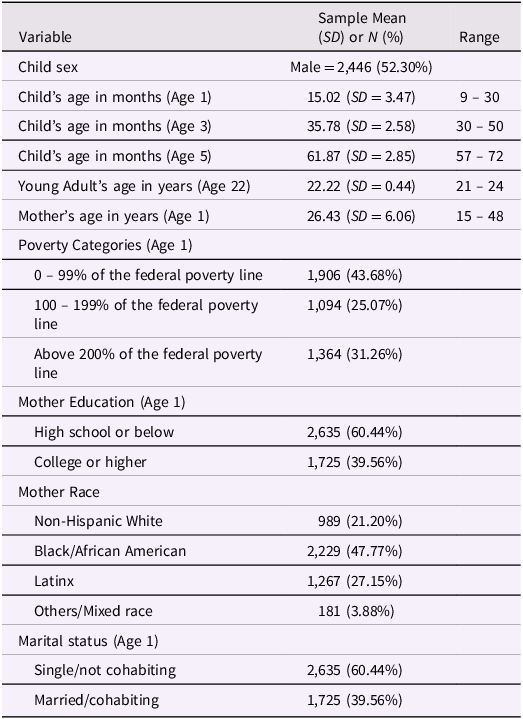
Data for the present study were drawn from the FFCWS, a longitudinal birth cohort study following the development of 4,898 children born in 20 large U.S. cities between 1998 and 2000. The FFCWS was designed purposefully to oversample children born to unmarried mothers (N = 3,711) compared to those of married parents (N = 1,187; Reichman et al., Reference Reichman, Teitler, Garfinkel and McLanahan2001). At baseline, biological mothers were interviewed in the hospital within 48 hours of the child’s birth, and biological fathers were subsequently contacted. Subsequent data collection was conducted when the focal child was approximately 1, 3, 5, 9, 15, and 22 years old. The analysis used four waves of data: early childhood adversity indicators were assessed when children were ages 1, 3, and 5, and mental health outcomes were reported during emerging adulthood at age 22. Families included in this sample had to have valid data for the adversity measure at least at one time point. Table 1 summarizes the demographic information of the analytic sample, with nearly 69% families living below 200% of the federal poverty line, and over 60% of mothers had a high school education or less.
Descriptive statistics for demographic (N = 4,677)
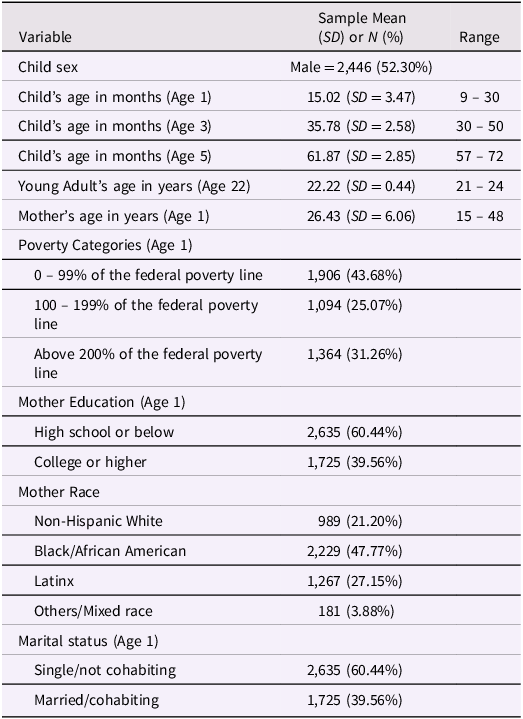
Note. Means and standard deviations are reported for continuous variables, and percentages are reported for categorical variables.
Measures
Material hardship at ages 1, 3, and 5
Material hardship was assessed at the one-, three-, and five-year follow-ups using a ten-item scale adapted from the Survey on Income and Program Participation (Bauman, Reference Bauman1998). At each time point, mothers reported their challenges in affording necessities, paying bills, and managing financial obligations over the past 12 months. Example items included: “In the past 12 months, were you evicted from your home or apartment for not paying the rent or mortgage?” and “In the past 12 months, did you not pay the full amount of the gas, oil, or electricity bills?” Consistent with prior research (Liu et al., Reference Liu, Merrin, Vasilenko and Razza2024a), we first created binary indicators for five distinct material hardship domains: food, housing, bill-paying, utility, and medical hardships. Each material hardship domain was coded dichotomously to indicate whether the hardship was experienced or not. To capture the accumulation of hardship across domains, following approach used in Heflin et al. (Reference Heflin, Sandberg and Rafail2009), individuals who experienced two or more distinct types of material hardship were further coded as high material hardship (1; 22% at age one, 24.8% at age three, and 25.8% at age five), and those who experienced fewer than two types of material hardship were coded as low material hardship (0) at each time point. The McDonald’s Omega (ω) Reliability for material hardship was 0.72, 0.72, and 0.76 for the three time points, respectively.
Maternal intimate partner violence victimization (IPV) at ages 1, 3, and 5
Maternal experiences of IPV were assessed by 14 items adapted from the Conflict Tactics Scale (CTS-2) for adults at year one, three, and five follow-ups (Straus & Douglas, Reference Straus and Douglas2004). Mothers reported on the frequency of physical violence, emotional/psychological abuse, and economic abuse perpetrated by the child’s biological father or current partner. Example items included: “He slaps or kicks you?” (physical violence), “He insults or criticizes you or your ideas?” (emotional/psychological abuse), and “He withholds money, makes you ask for it, takes it?” (economic abuse). Mothers responded on a 3-point Likert Scale, ranging from often (1), sometimes (2), and never (3). The IPV indicators across ages one to five were highly skewed in their continuous format, with skewness values above 2 in age one and three, and the skewness value above 3 in age five. Although the threshold is often considered acceptable in large-sample studies, highly skewed continuous variables may lead to spurious latent subgroups (Asparouhov & Muthén, Reference Asparouhov and Muthén2016; Bayly & Vasilenko, Reference Bayly and Vasilenko2021). A binary indicator was created at each wave, such that mothers experiencing IPV were coded as 1 if mothers reported often or sometimes for any of the 14 items (35.4% at age one, 29.5% at age three, and 25.7% at age five) and coded as 0 if mothers reported never, following prior approach (Zhang et al., Reference Zhang, Liu and Wang2024). The McDonald’s Omega (ω) Reliability for IPV was 0.76, 0.76, and 0.79 for the three time points, respectively.
Parenting stress at ages 1, 3, and 5
Parenting stress was assessed by a four-item scale adapted from the Parent Stress Inventory at year one, three, and five follow-ups (Abidin, Reference Abidin1990). At each time point, mothers self-reported the degree to which they agreed or disagreed with the emotional and physical strain associated with parenting, including (1) “Being a parent is harder than I thought it would be”; (2) “I feel trapped by my responsibilities as a parent”; (3) “I find that taking care of child(ren) is much more work than pleasure”; and (4) “I often feel tired, worn out, or exhausted from raising a family.” The original response was rated on a 4-point scale, ranging from strongly disagree (1) to strongly agree (4). The current study first summed item scores to create composite parenting stress scores at each time point. By viewing the distribution graphs of parenting stress, a mean-split approach was used to recode them into binary indicators. It enabled us to represent the high or low levels of an adversity indicator of parenting stress and derive conceptually distinct classes with a more parsimonious solution. Composite scores greater than the mean at each respective wave were recoded as high parenting stress (1), and scores lower than the mean value (including the mean value) were recoded as low parenting stress (0). Thirty-six percent indicated yes at age one, 40.6% yes at age three, and 36.2% yes at age five. The McDonald’s Omega (ω) Reliability for parenting stress was 0.64, 0.68, and 0.70 for the three time points, respectively.
Maternal depression at ages 1, 3, and 5
Maternal depression was constructed as a binary variable from the FFCW team based on mothers’ self-reported responses to the Composite International Diagnostic Interview-Short Form (CIDI-SF) at year one, three, and five follow-ups (Kessler et al., Reference Kessler, Andrews, Mroczek, Ustun and Wittchen1998). This constructed binary variable was created to capture whether mothers met the criteria for a probable diagnosis of a major depressive episode within the past year (15.5% yes at age one, 20.6% yes at age three, and 17% yes at age five). Mothers were first screened for core symptoms of depression, including persistent dysphoria or anhedonia lasting at least two weeks. If yes, they were asked follow-up questions regarding symptom frequency, duration, and associated impairments (e.g., decreased energy). Details of this constructed variable are available in the FFCWS documentation (Bendheim-Thoman Center for Research on Child Wellbeing, 2018).
Emerging adulthood mental health at age 22
Mental health outcomes were assessed by young adults’ self-reports to the CIDI-SF during the Year 22 survey. Based on their responses, the FFCWS research team constructed two binary indicators representing probable diagnoses of depression and anxiety in the past 12 months. For depression, young adults were first screened for core symptoms, including dysphoria or anhedonia lasting two weeks or more. If endorsed, they answered follow-up questions regarding symptom frequency, duration, and associated impairments (e.g., trouble sleeping, trouble concentrating, thoughts of death). Based on these responses, the FFCWS team constructed a binary variable (yes/no) indicating whether the respondents met the criteria for a probable major depressive episode in the past year (12.7% indicated yes at age 22), following scoring guidelines from the CIDI-SF (Kessler et al., Reference Kessler, Andrews, Mroczek, Ustun and Wittchen1998). For anxiety, young adults answered questions about Generalized Anxiety Disorder derived from the CIDI-SF (Kessler et al., Reference Kessler, Andrews, Mroczek, Ustun and Wittchen1998), including experiences of persistent worry lasting six months or longer, along with related symptoms. The FFCWS constructed a binary variable (yes/no) indicating whether the participant met the criteria for probable generalized anxiety disorder in the past year (38.6% indicated yes at age 22). Details of these two constructed variables are available in the FFCWS documentation (Bendheim-Thoman Center for Research on Child Wellbeing, 2024). Because the depression and anxiety measures were assessed by self-reports and scored using a diagnostic algorithm as binary variables, internal consistency and interrater reliability are not applicable in this sample. However, the CIDI-SF has demonstrated satisfactory reliability and validity in prior validation studies (e.g., Kessler et al., Reference Kessler, Andrews, Mroczek, Ustun and Wittchen1998) and is frequently used in large-scale community surveys to assess depression (Patten et al., Reference Patten, Brandom-Christie, Devji and Sedmak2000).
Covariates
A set of child and family characteristics reported by mothers was included as covariates. These variables served as predictors of early adversity trajectory classes and were controlled in the final model predicting young adults’ mental health outcomes. Child sex was reported by mothers and coded as boy (0) and girl (1). Maternal age was measured continuously in years, based on mothers’ self-reports at the year one interview. Maternal education was self-reported as the highest degree achieved, which was coded into high school or below (0) and college or higher (1). Mothers’ romantic relationship status at year one was coded as married/cohabiting (1), including mothers who were in a legal marriage or cohabiting with a current romantic partner, and single/not cohabiting (0), including mothers who were single, separated, divorced, or in a relationship but not cohabiting. Maternal race/ethnicity was self-reported and categorized as non-Hispanic white (reference), Black, Latinx, and Others. Dummy variables were created to represent each race/ethnicity. Family poverty status was assessed based on household income reported by the mother at year 1, divided by the federal poverty threshold for that year, while accounting for family size. Income-to-needs ratios were categorized into five tiers: (1) < 50% of the federal poverty threshold, (2) 50 – 99%, (3)100 – 199%, (4) 200 – 299%, and (5) 300%+. For analytic purposes, these categories were collapsed into three groups: poor (categories 1 and 2), near-poor (category 3), and non-poor (categories 4 and 5; reference group). In our sample, family poverty status and material hardship were weakly correlated (rs = −.19, −.17, and −.13 at age 1, age 3, and age 5; all ps < .001), indicating that they capture related but distinct dimensions of economic adversity.
Analytic plan
To assess missing data patterns, we conducted Little’s missing completely at random (MCAR) test. The MCAR test yielded a significant result (χ2 = 1328, df = 1,112, p < .001), indicating that the missingness in the data was not completely at random (Enders, Reference Enders2022). We further examined missingness patterns among key variables to evaluate the plausibility of the missing at random (MAR) assumption and to examine potential missing data biases. Specifically, missing data for the material hardship indicators were 11.4% at age one, 14.2% at age three, and 15.8% at age five. For the IPV indicators, missingness was similar, with 11.2% at age one, 13.7% at age three, and 15.5% at age five. Parenting stress indicators showed slightly higher missingness rates, with 23.7% at age one, 15.6% at age three, and 17.7% at age five. For maternal depression indicators, missing data were 10.9% at age one, 13.8% at age three, and 15.7% at age five. In contrast, measures collected at age 22 showed a substantially higher proportion of missing data, with 36.7% missing for depression and 50.3% missing for anxiety. These missingness were mainly attributed to attrition over time.
We further examined whether missingness on the MGMM indicators was related to the demographic characteristics measured at year one (Enders, Reference Enders2022). We found that maternal education at age one was associated with missing data on several adversity indicators, including material hardship at age three (χ2 (1) = 7.01, p < .001), IPV at age three (χ2 (1) = 4.54, p = .03), parenting stress at age one (χ2 (1) = 24.61, p < .001), at age three (χ2 (1) = 10.73, p = .001), and age five (χ2 (1) = 7.47, p = .006), as well as maternal depression at age three (χ2 (1) = 5.80, p = .02). In addition, mother’s romantic relationship status at age one was associated with missing data on IPV at age one (χ2 (1) = 10.98, p < .001). Poverty status at age one was associated with missing data on material hardship at age three (χ2 (2) = 7.25, p = .03), IPV at age three (χ2 (2) = 7.37, p = .03), parenting stress at age one (χ2 (2) = 65.78, p < .001) and at age three (χ2 (2) = 8.85, p = .01). To account for potential bias from differential missingness in demographic variables, these variables were included as covariates (Enders, Reference Enders2022). All models were estimated using Full Information Maximum Likelihood to handle missing data and the Robust Maximum Likelihood estimator to address non-normality in Mplus 8.7.
The analyses proceeded in three sequential stages to (1) determine latent trajectory classes of early adversity, (2) examine demographic predictors of class membership, and (3) compare mental health outcomes across latent trajectory classes. First, a Multidimensional Growth Mixture Model (MGMM) was employed to identify conjoint longitudinal trajectory classes of four binary early adversity indicators (i.e., parenting stress, material hardship, maternal depression, and maternal IPV) assessed at years one, three, and five (Wickrama et al., Reference Wickrama, Lee, O’Neal and Lorenz2021)Footnote 1 . MGMM was selected over other mixture models due to its unique capacity to model concurrent trajectory classes across multiple co-occurring adversities, addressing a gap in previous adversity research. We fitted latent growth models for each adversity with intercept and linear slope factors. Then we estimated a higher-order latent class variable representing the conjoint trajectories across all four adversities. Class enumeration began with a one-class model and sequentially added classes until further improvements in fit were not statistically significant or the model failed to converge. The optimal model was selected based on multiple fit criteria: lower values in the log likelihood (−2LL), Akaike’s Information Criterion (AIC), Bayesian Information Criteria (BIC), and Consistent Akaike Information Criterion (CAIC), a statistically significant adjusted Vuong-Lo-Mendell-Rubin likelihood ratio test (adjusted-LRT), alongside substantive interpretability of classes (Grimm & Ram, Reference Grimm and Ram2009).
Second, we examined demographic predictors (i.e., child sex, maternal age, maternal education, maternal race/ethnicity, mothers’ romantic relationship status, and family poverty status) of latent class membership using the Bolck–Croon–Hagenaars (BCH) three-step approach. The BCH procedure fixes the latent class structure by using logits to preserve class assignments when covariates are introduced, thereby reducing bias from classification uncertainty (Asparouhov & Muthén, Reference Asparouhov and Muthén2021). In the third stage, we applied BCH-based probability-weighted regression analysis to examine associations between latent trajectory classes and the likelihood of having depression and anxiety at age 22. This approach retains the original class structure while providing unbiased estimates of class differences in distal outcomes.
Results
Distinct early adversity trajectory classes in early childhood
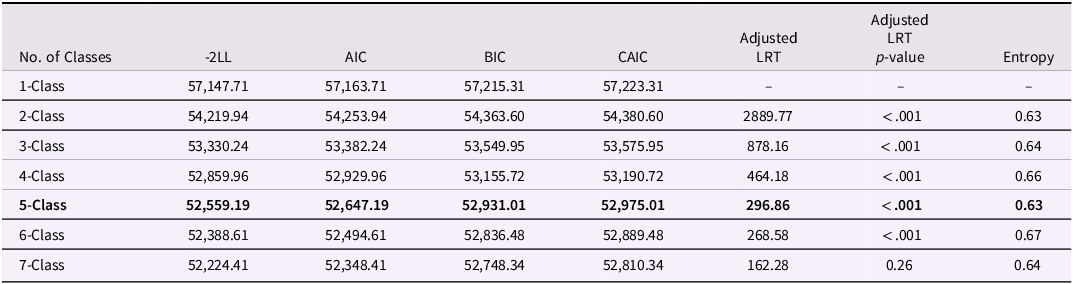
To identify distinct patterns of early adversity across four indicators during early childhood (across ages 1, 3, and 5), models ranging from a 1-class solution to a 7-class solution were estimated. The five-class solution was selected as the optimal number of latent classes, based on the considerations of fit indices and substantive interpretation (see Table 2). Specifically, the five-class solution yielded comparatively lower AIC and BIC values than models with fewer classes and a statistically significant adjusted-LRT value. Additionally, the five classes showed conceptually coherent and meaningful patterns of adversity. Although the six-class solution (see Figure S2 in Supplemental) showed further improvement in fit indices and maintained a significant adjusted-LRT value, the additional class represented a small subgroup (less than 5% of the sample) that split from an existing class and did not provide substantively new or theoretically distinct information. Additionally, classes representing fewer than 10% of the total sample may lack adequate statistical power to allow for meaningful comparisons across groups (Nylund-Gibson & Choi, Reference Nylund-Gibson and Choi2018). Therefore, we decided to proceed with the five-class solution.
Fit indices for class enumeration of multidimensional growth mixture model of material hardship, parenting stress, intimate partner violence, and depression trajectory across ages 1, 3, and 5
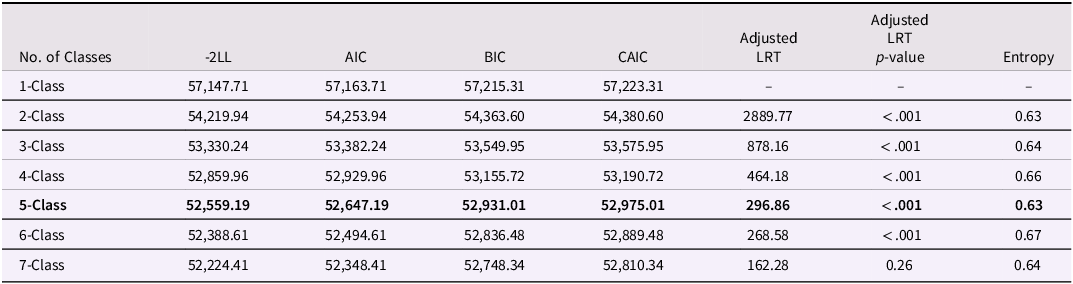
Note. AIC = Akaike Information Criterion; BIC = Bayesian Information Criterion. CAIC = Consistent Akaike Information Criteria. Adjusted LRT = Adjusted Lo-Mendell-Rubin Likelihood Ratio Test. Bold indicates the selected model.
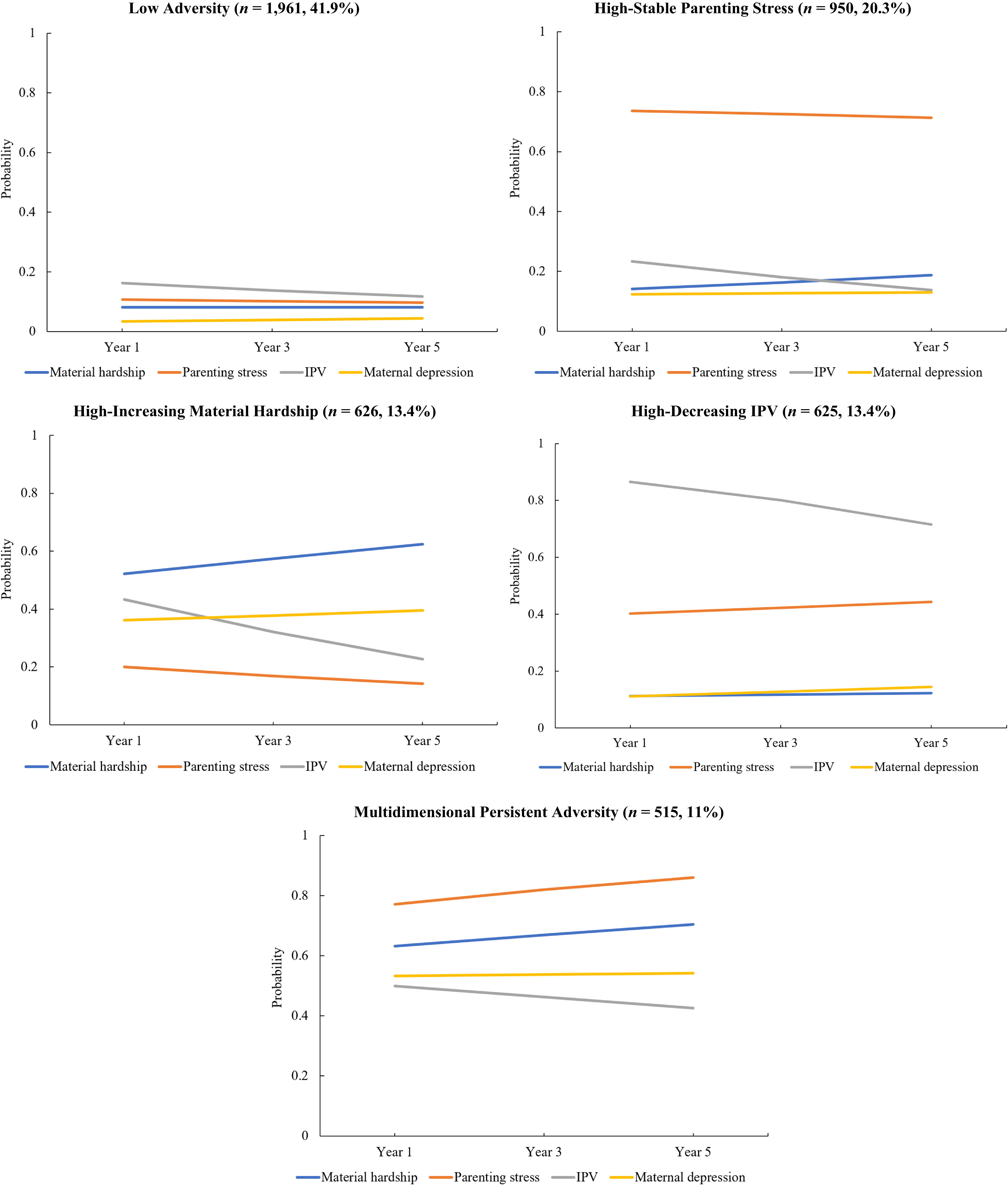
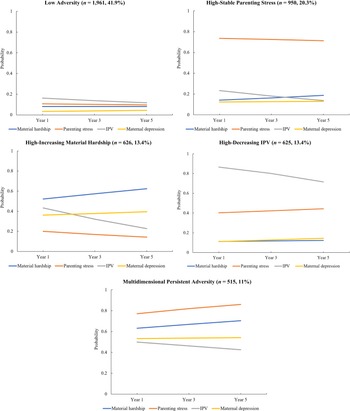
Figure 1 illustrates the five distinct patterns of co-occurring adversities experienced by children from age one to age three, and to age five. The largest class, labeled as the Low Adversity class (n = 1,961, 41.9%), showed consistently low likelihoods of experiencing adversity throughout early childhood. The second largest class, High-Stable Parenting Stress (n = 950, 20.3%), was marked by experiencing persistent and elevated levels of parenting stress over time, with probabilities exceeding 70% at each time point. Other adversity indicators in this class remained relatively low and stable over time. Furthermore, the High-Increasing Material Hardship class (n = 626, 13.4%) was featured by a notably increasing likelihood of experiencing material hardship over time, rising from 52.2% in infancy to 62.4% by preschool age. Children in this class also had a moderate exposure in maternal depression which increases over time (changes from 36% year 1 to 40% year 5), a decrease in IPV exposure (changes from 43% year 1 to 23% year 5), and relative low slightly decrease parenting stress (changes from 20% year 1 to 14% year 5). Next, the High-Decreasing IPV class (n = 625, 13.4%) exhibited high initial exposure to IPV in infancy (87%), with the probabilities decreasing to 72% in year 5. In this class, children also had a probability of experiencing moderate but increasing parenting stress, while both material hardship and maternal depression remained at relatively low levels throughout early childhood. Lastly, the Multidimensional Persistent Adversity class (n = 515, 11%) was characterized by chronic and co-occurring exposure to multiple forms of adversity in early childhood. Children in this class had a high probability of experiencing persistently high and increasing parenting stress, material hardship, and maternal depression, along with high levels of IPV, but with slightly decreasing trends over time.
Estimated probabilities of five-class multidimensional growth mixture model of material hardship, parenting stress, intimate partner violence, and maternal depression trajectory across ages 1, 3, and 5 (N = 4,677).
Demographic characteristics of the early adversity trajectory classes
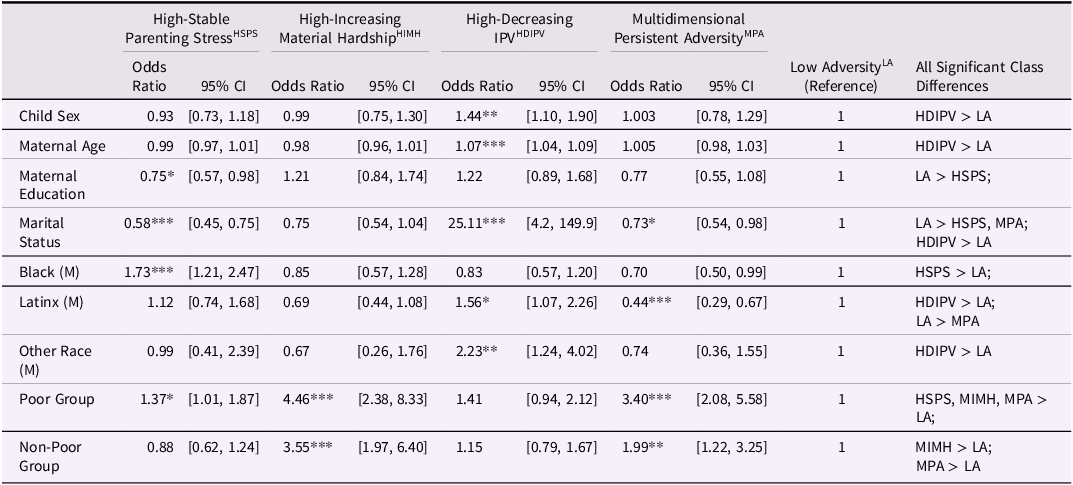
Multinomial logistic regression was conducted to examine the associations between demographic variables and early adversity class membership. Table 3 presents the odds ratios (OR) and 95% confidence intervals (CI) for the five-class comparisons. Unlike boys, girls had higher odds of being in the High-Decreasing IPV class (OR = 1.44, 95% CI [1.10, 1.90], p = .01) than the Low Adversity class. Each additional year of maternal age was associated with 7% higher odds of being in the High-Decreasing IPV class (OR = 1.07, 95% CI [1.04, 1.09], p < .01) than the Low Adversity class. Compared to mothers with high school or less education, those with college or higher degrees had lower odds of being in the High-Stable Parenting Stress class than the Low Adversity class (OR = 0.75, 95% CI [0.57, 0.98], p = .04). Compared to single mothers, married/cohabiting mothers had lower odds of being in the High-Stable Parenting Stress class (OR = 0.58, 95% CI [0.45, 0.75], p < .001) or Multidimensional Persistent Adversity class (OR = 0.73, 95% CI [0.54, 0.98], p = .04), than the Low Adversity class. In contrast, married/cohabiting mothers had higher odds of being in the High-Decreasing IPV class than the Low Adversity class compared to mothers who were single/not cohabiting (OR = 25.11, 95% CI [4.2, 149.9], p < .001).
Odds ratios and 95% confidence intervals from multinomial logistic regression model of covariates on material hardship, parenting stress, intimate partner violence, and depression multidimensional growth mixture trajectories
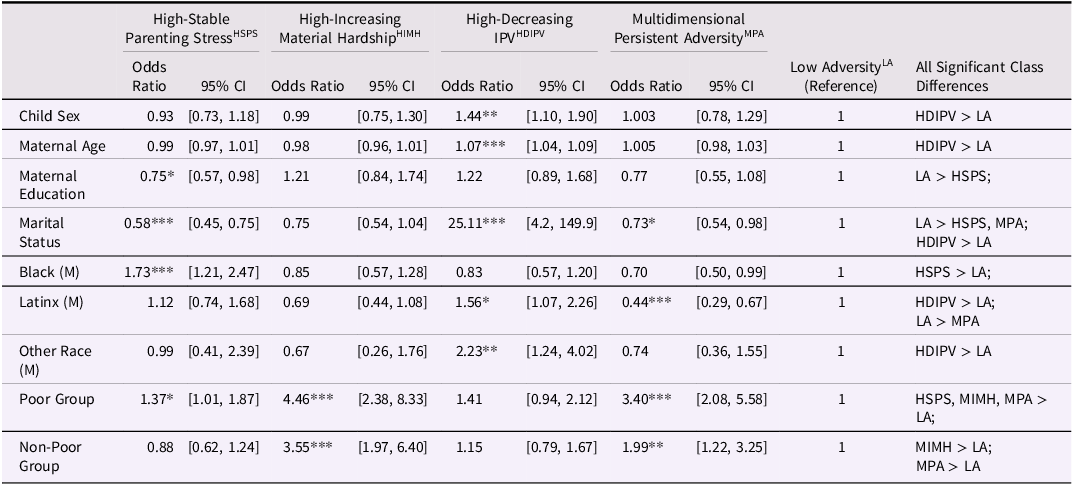
Note. The values represent the odds ratio with a 95% confidence interval. All covariates were controlled at age 1. The reference category for child sex is boy, for marital status is single, for maternal education is high school or less, for poverty status is the non-poor group (i.e., families with income above 200% of the federal poverty threshold), for mother (M) race/ethnicity is White; dummy-coded groups included Black, Latinx, and Other Race. The Low Adversity class is the reference class. All significant comparisons are included in the “All Significant Class Differences” column.
*p < .05, **p < .01, ***p < .001.
Regarding race/ethnicity, compared to White mothers, Black mothers had higher odds of being in the High-Stable Parenting Stress class than the Low Adversity class (OR = 1.73, 95% CI [1.21, 2.47], p < .001). Latinx mothers had higher odds of being in the High-Decreasing IPV class (OR = 1.56, 95% CI [1.07, 2.26], p = .02), but lower odds of being in the Multidimensional Persistent Adversity class (OR = 0.44, 95% CI [0.29, 0.67], p < .001) than the Low Adversity class. Lastly, mothers of other races had higher odds of being in the High-Decreasing IPV class than the Low Adversity class (OR = 2.23, 95% CI [1.24, 4.02], p = .01).
Regarding family poverty status, compared to the non-poor families, families in the poor group had higher odds of being in the High-Stable Parenting Stress class (OR = 1.37, 95% CI [1.01, 1.87], p = .04), the High-Increasing Material Hardship class (OR = 4.46, 95% CI [2.38, 8.33], p < .001), and the Multidimensional Persistent Adversity class (OR = 3.40, 95% CI [2.08, 5.58], p < .001), relative to the Low Adversity class. Similarly, families in the near-poor group also had higher odds of being in the High-Increasing Material Hardship class (OR = 3.55, 95% CI [1.97, 6.40], p < .001) and the Multidimensional Persistent Adversity class (OR = 1.99, 95% CI [1.22, 3.25], p = .01) than the Low Adversity class.
Links between early adversity trajectory classes and emerging adults’ mental health
Chi-square tests of equality were conducted to examine whether the predicted probability of experiencing depression and anxiety at age 22 differed across the five early adversity trajectory classes. Table 4 presents the estimated probabilities, standard errors, and results of the pairwise chi-square comparisons. For depression, the overall chi-square test indicated a significant difference across the five classes, χ2(4) = 13.29, p = .01. Individuals in the Multidimensional Persistent Adversity class had a higher probability of experiencing depression at age 22 (45%, SE = 0.04) compared to those in the Low Adversity (37%, SE = 0.02), χ2(1) = 3.73, p = .05, and the High-Stable Parenting Stress classes (32%, SE = 0.03), χ2(1) = 7.02, p = .008. Similarly, individuals in the High-Decreasing IPV class had a higher probability of experiencing depression at age 22 (46%, SE = 0.03) than those in the Low Adversity, χ2(1) = 5.02, p = .025, and the High-Stable Parenting Stress classes, χ2(1) = 9.70, p = .002.
Probabilities of material hardship, parenting stress, intimate partner violence, and depression multidimensional growth mixture trajectory classes on emerging adulthood mental health outcomes at age 22 (N = 4,677)

Note. All significant comparisons are included in the Chi-square Comparisons column. The final model controlled for demographic variables in year 1 (i.e., child gender, maternal age, maternal education, marital status, maternal race/ethnicity, and family poverty status).
* p < .05, **p < .01, ***p < .001.
For anxiety, the overall chi-square test was also significant, χ2(4) = 16.23, p = .003. Individuals in the Multidimensional Persistent Adversity class had a higher probability of experiencing anxiety at age 22 (20%, SE = 0.03) compared to those in the Low Adversity class (12%, SE = 0.01), χ2(1) = 6.62, p = .01), and in the High-Stable Parenting Stress class (7%, SE = 0.02), χ2(1) = 11.02, p = .001). Additionally, individuals in the High-Decreasing IPV class had a higher probability of experiencing anxiety at age 22 (17%, SE = 0.03) than those in the High-Stable Parenting Stress class (6.8%, SE = 0.02), χ2(1) = 8.33, p = .004. Finally, individuals in the High-Increasing Material Hardship class (14.5%, SE = 0.03) had a higher probability of experiencing anxiety at age 22 (15%, SE = 0.03) than those in the High-Stable Parenting Stress class (6.8%, SE = 0.02), χ2(1) = 4.86, p = .028. Sensitivity analyses excluding family poverty status as a covariate produced results that were substantively unchanged from the primary models; all effect directions and significance patterns remained consistent. We also examined whether attrition on the anxiety and depression outcomes at year 22 was associated with class membership. Chi-square tests indicated that missingness in anxiety (χ2(4) = 2.86, p = .58) and depression (χ2(4) = 6.41, p = .17) was not significantly associated with class membership. Thus, differential attrition across classes does not appear to bias the year 22 outcome analyses.
Discussion
This study provides a comprehensive examination of the continuity and changes in early contextual insecurity (i.e., material hardship and IPV) and relational adversity (i.e., parenting stress and maternal depression) in an economically at-risk sample’s first five years. Using MGMM, we identified five distinct trajectory classes, varied in specificity, chronicity, and co-occurring adversities that young adults could be exposed to in early childhood. This variability highlights the multifaceted nature of adversity and elucidates how these early adversity trajectory classes are differentially related to young adults’ depression and anxiety in emerging adulthood. Specifically, young adults’ exposure to Multidimensional Persistent Adversity was strongly linked to adverse mental health outcomes compared to the other four trajectories. Additionally, witnessing IPV emerged as the strongest predictor of emerging adults’ mental health outcomes, with material hardship showing a smaller but significant association. These effects were more pronounced than those observed for relational adversities, specifically parenting stress.
Early adversity trajectories: patterns and processes
Generally, five distinct adversity trajectory patterns emerged in the economically at-risk sample, which we interpret as broadly consistent with our hypothesis and conceptual framework. Specifically, we identified a Low Adversity class and a Multidimensional Persistent Adversity class, as expected, alongside one relational adversity-driven group and two contextual insecurity-driven groups. The largest group was children who experienced Low Adversity overall across early childhood (41.9%). Although living in a low-income household, most parents did not feel a high level of contextual and relational adversities, providing their children with a supportive and low-stress environment. The large size of this pattern challenges the deficit-only perspective of poverty, as not all low-income families experience compounded adversities (Frankenhuis & De Weerth, Reference Frankenhuis and De Weerth2013). These families may also demonstrate resilience and draw upon support, such as strong family ties or community resources.
Children who experienced Multidimensional Persistent Adversity from age 1 to 5 make up 11% of the sample. Although slightly decreasing over time, the high levels of co-occurring contextual and relational adversities are consistent with the perspectives of cumulative risks. It represents the highest risk group as they experience risks across multiple domains. Experiencing multidimensional persistent adversity in early childhood may be due to multiple family characteristics. For instance, further analysis indicated that children with single/not cohabiting moms and living in poor and near-poor households are more likely to experience multidimensional forms of adversity in early childhood compared to the Low Adversity class, consistent with previous studies (Halfon et al., Reference Halfon, Larson, Lu, Tullis and Russ2014; Yoshikawa et al., Reference Yoshikawa, Aber and Beardslee2012). Compared to mothers living with a partner, single mothers tend to experience an overload of responsibilities (i.e., balancing working and parenting alone) and receive less financial and emotional support (Jackson et al., Reference Jackson, Brooks-Gunn, Huang and Glassman2000; McLanahan & Percheski, Reference McLanahan and Percheski2008). Similarly, when mothers had more economic difficulties, they were more likely to experience both contextual insecurities, such as multiple levels of material hardship (i.e., insecure food and unstable housing), and had a higher level of relational adversity, such as depression and parenting stress (Conger et al., Reference Conger, Conger and Martin2010; Yoshikawa et al., Reference Yoshikawa, Aber and Beardslee2012).
Although different adversities tend to correlate with each other, they are not always co-occurring. Rather than a single contextual insecurity-driven class in our hypothesis, two distinct contextual insecurity-driven groups emerged: the High-Increasing Material Hardship class (13.4%) and the High-Decreasing IPV class (13.4%). Although material hardship and witnessing IPV are both part of the broader structural context, this split suggests that contextual insecurity may be a heterogeneous construct in the economically at-risk sample. For instance, some families facing chronic economic strain or food/house insecurity may nevertheless maintain healthy and stable intimate relationships, whereas other families with toxic intimate relationships may be intact due to independence on the financial support the partner provides. In this sense, the two distinct contextual insecurity-driven patterns offer a more nuanced picture of how different forms of contextual insecurity cluster and evolve in early childhood. This expanded understanding underscores the importance of examining contextual insecurity in greater detail in future research, and replication is necessary to investigate whether these distinctions hold across diverse samples and contexts.
Different child and familial factors contribute to each of these two classes. For instance, we found that poverty status (i.e., being in the poor or near-poor group) was the only significant factor contributing to being in the High-Increasing Material Hardship class, which is expected and aligns with previous studies (Duncan et al., Reference Duncan, Ziol-Guest and Kalil2010; Heflin, Reference Heflin2016). However, children of mothers living with a partner, older mothers, and girls (compared to children of single mothers, younger mothers, and boys, respectively) were more likely to be in the High-Decreasing IPV group than the Low Adversity class. This challenges the common assumption that older maternal age and marriage/in relationship commitment tend to be protective against IPV risk compared to younger maternal age and single status (Coll et al., Reference Coll, Wendt, Santos, Bhatia and Barros2023; Yakubovich et al., Reference Yakubovich, Stöckl, Murray, Melendez-Torres, Steinert, Glavin and Humphreys2018). In this sample, daily economic strain and relational stress experienced by mothers may have constrained their ability and options to leave abusive relationships, in turn, elevated the risks of IPV experience. Although IPV levels in the High-Decreasing IPV group declined over time, the reduction was modest, and continued IPV exposure was associated with higher depression and anxiety in young adulthood. Another possible explanation is the binary categorization of the mother’s romantic relationship status. Some studies have found that cohabiting women are more likely to experience IPV compared to married women (Capaldi et al., Reference Capaldi, Knoble, Shortt and Kim2012; Yakubovich et al., Reference Yakubovich, Stöckl, Murray, Melendez-Torres, Steinert, Glavin and Humphreys2018). However, we were unable to capture this distinction because our study combined married and cohabiting mothers into a single category. It is possible that the elevated risk of experiencing IPV we observed in the married/cohabiting group was primarily driven by cohabiting mothers. Further research is warranted to investigate this possibility.
Additionally, Latinx mothers were more likely to be in the High-Decreasing IPV class, but less likely than White mothers to be in the Multidimensional Persistent Adversity class, compared to the Low Adversity class. This is an interesting finding, and one possible explanation for the elevated likelihood of being in the High-Decreasing IPV class may be reflected in distinct patterns in relationship dynamics (Zolnikov et al., Reference Zolnikov, Guerra, Furio, Dennis and Ortega2023). Meanwhile, Lantix culture emphasizes close family ties and support (familismo) and a community-oriented culture (Calzada et al., Reference Calzada, Tamis-LeMonda and Yoshikawa2013), which provides protective effects for accumulating multiple adversities over time, especially lowering the chance of depression and parenting stress.
The last identified pattern is the High-Stable Parenting Stress class (20.3%), characterized by high levels of parenting stress over time, but low levels of maternal depression and contextual insecurity in early childhood. This aligns with the one relational adversity-driven pattern we hypothesized. Parenting stress is a subjective concept reflecting parents’ own perceptions of their competencies in raising children; thus, parents in this group may be relatively stable economically, relationally, and emotionally; however, they still feel the strain related to being a parent and experience challenges of raising children, rather than broader contextual hardships. We identified that maternal education was an important factor contributing to being in this group. Specifically, mothers with a college degree or higher were less likely to be in the High-Stable Parenting Stress class than those with a high school education or less. One possible explanation is that higher educational attainment may provide mothers with greater access to resources, such as stable employment, available healthcare, social support networks, and parenting knowledge, which can buffer against sustained parenting stress (Jackson et al., Reference Jackson, Brooks-Gunn, Huang and Glassman2000; Parkes et al., Reference Parkes, Sweeting and Wight2015). In addition, living in a poor status, but not near-poor status, was also related to a higher likelihood of being in the High-stable Parenting Stress class, which aligns well with the family stress model and prior studies (Conger et al., Reference Conger, Conger and Martin2010; Jackson et al., Reference Jackson, Brooks-Gunn, Huang and Glassman2000). However, it is essential to note that this group also exhibited low levels of material hardship, which suggests that poverty status is not necessarily consistent with material hardship (Iceland et al., Reference Iceland, Kovach and Creamer2021). Additionally, single mothers showed a higher chance of being in the High-Stable Parenting Stress class. As we discussed earlier, single moms often face greater financial difficulties and less caregiving support (Jackson et al., Reference Jackson, Brooks-Gunn, Huang and Glassman2000). Considering the increased responsibilities without additional support, it is reasonable that single moms often experience higher levels of chronic parenting stress (Nomaguchi & House, Reference Nomaguchi and House2013).
Interestingly, we did not find a pattern featuring high levels of depression over time in the sample. It is very likely that other adversities are so overwhelming in this sample, making the depression indicator not stand out in parent reports. For instance, material hardship and exposure to IPV are acute and tangible contextual insecurities that require parents’ immediate attention in their daily functioning, such as securing basic needs and maintaining physical safety. Similarly, parenting stress is reflected by child-rearing challenges and requires constant management of child behaviors. On the contrary, depression may still exist, but has been internalized or overlooked by the parents, making it less likely to be reported unless it reaches severe levels. The subtle characteristics related to depression, such as fatigue and irritability, may be easily misattributed to stress and exhaustion from the contexts they were in. Although maternal depression did not form a stand-alone trajectory class in the present analysis, it showed consistent, moderate-level prevalence and an increasing trend in both the Multidimensional Persistent Adversity and High-Increasing Material Hardship classes. This pattern suggests that maternal depression may be more likely to emerge within broader constellations of adversity, particularly when combined with rising material hardship or sustained contextual or relational adversities. These findings align with prior research highlighting the co-occurring nature of maternal depression within family risk factors (Barker et al., Reference Barker, Copeland, Maughan, Jaffee and Uher2012; Ogbonnaya et al., Reference Ogbonnaya, Keeney and Villodas2019), rather than as a discrete or isolated form of early adversity.
Early adversity trajectory classes relate to mental health in emerging adulthood
Although it is well-established that early childhood adversities are important predictors of children’s later developmental outcomes and mental health, less is known about how identified chronic and persistent adversities patterns in early childhood are associated with emerging adults’ depression and anxiety. Our current study found that children in the Multidimensional Persistent Adversity class had a higher chance of suffering depression and anxiety in emerging adulthood than children in the Low Adversity and High-Stable Parenting Stress classes. It suggests that experiencing accumulative and chronic early adversities, including both contextual insecurities and relational adversities, in early childhood was the most detrimental and had long-lasting adverse effects on both depression and anxiety issues. This finding is consistent with our hypothesis and the cumulative risk perspective, highlighting that the aggregated adversities often lead to a higher chance of mental health concerns over time compared to exposure to any single adversity (Evans et al., Reference Evans, Li and Whipple2013). It also suggested that early childhood adversities can have long-lasting effects, even when examined in emerging adulthood. However, our findings refute the assumption that different types of adversities may have similar effects on psychopathology.
When examining the different effects of contextual insecurities and relational adversities on emerging adults’ psychopathology, we found that experiencing high levels of contextual insecurities, such as IPV and material hardship in early childhood, was associated with greater mental health difficulties in emerging adulthood compared to those experiencing leading relational adversities, especially parenting stress. Specifically, children in the High-Decreasing IPV class had stronger associations with both depression and anxiety in emerging adulthood compared to the High-stable Parenting Stress class. This is consistent with the specificity model of adversity proposed by Hardi et al. (2024), which suggests that each specific adversity may have a distinct effect on development. Here, we argue that witnessing IPV consistently in early childhood may be a more fundamental risk influencing later development and psychopathology than parenting stress, as it may affect the everyday functioning in the household and destroy children’s security in their living environment. Additionally, experience of IPV may also facilitate the relational adversities – parenting stress, which further impacts their children’s mental health in the long run (Conger et al., Reference Conger, Conger and Martin2010; Uddin et al., Reference Uddin, Alharbi, Uddin, Hossain, Hatipoğlu, Long and Carson2020).
Interestingly, the High-Increasing Material Hardship class also showed significantly higher levels of anxiety, but not depression, compared to the High-Stable Parenting Stress class. Although depression and anxiety are highly correlated, they are distinct constructs (Kalin, Reference Kalin2020; Stavrakaki & Vargo, Reference Stavrakaki and Vargo1986). A growing body of studies supports this finding that high levels of prolonged material hardship in early childhood are the immediate stressors that create constant uncertainty about basic needs, which often leads to anxiety symptoms, such as elevated worrisome, anxiety, and hypervigilance about the daily threats, which can be functional to facilitates actions to reduce anxiety symptoms, such as seeking extra work, budget tightly, etc. (Edmunds & Alcaraz, Reference Edmunds and Alcaraz2021). However, material hardship was not necessarily predictive of depression in emerging adulthood. Individuals likely tend to treat material hardship as an external or systemic threat, which leads to future-oriented worries, while depression is more attributed to past failures or losses, and is featured by internalized helplessness or negative self-evaluation (“I am worthless”), leading to more internal causes (Cummings et al., Reference Cummings, Caporino and Kendall2014).
Lastly, it is worth noting that the High-Stable Parenting Stress group did not show elevated risk for anxiety or depression in emerging adulthood compared to the Low Adversity group. Considering that the FFCWS sample is oversampled with children from economically disadvantaged backgrounds and the majority of the children were living in single-parent households (Reichman et al., Reference Reichman, Teitler, Garfinkel and McLanahan2001), one possible explanation is that elevated parenting stress may be relatively normative in this high-risk sample and thus does not differentiate children’s long-term mental health outcomes in the same way as more severe or acute adversities. Prior work suggests that while parenting stress is linked to poorer child mental health outcomes in general samples (Deater-Deckard, Reference Deater-Deckard1998; Hattangadi et al., Reference Hattangadi, Cost, Birken, Borkhoff, Maguire, Szatmari and Charach2020), its predictive value for later mental health outcomes in children may be attenuated in contexts where high parenting stress levels are common. This may suggest that the developmental impacts of parenting stress may be highly context-dependent, highlighting the need to consider relational challenges within the broader ecological context.
Implications
Our findings have significant implications for research and practice. While our findings are primarily data-driven, they provide novel evidence of heterogeneity in family adversity beyond existing frameworks. The emergence of two distinct contextual insecurity-driven classes extends prior conceptualizations of risk and underscores the need for future research to more carefully examine the variability within seemingly similar adversity experiences. Identifying five distinct trajectory classes in this predominantly low-income sample also calls for replication in other diverse samples. Future research could test the robustness of these classes, refine their conceptual underpinnings, and examine their predictive validity for later developmental outcomes.
From a practical and policy perspective, the study supports the development of more tailored and effective prevention and intervention programs for children who have experienced varied patterns of early adversity. Rather than viewing early adversities as isolated events or cumulative counts, this study identified five distinct conjoint adversity trajectories, calling for interventions tailored to the type, timing, and changing patterns of adversity exposure. First, the Multidimensional Persistent Adversity trajectory class suggests that some children are persistently exposed to multiple, co-occurring risks across both contextual insecurity and relational adversity in early childhood. This pattern reaffirms early childhood as a critical window for intervention, given the heightened developmental sensitivity to adversity during this period (Iruka, Reference Iruka2025). The interventions should target both contextual insecurity (e.g., material deprivation and violence exposure) and relational adversity (e.g., elevated parenting stress and maternal depression). Developmentally informed, multi-component interventions that simultaneously address caregiver well-being, parenting practices, and structural disadvantages are critical to disrupting adversity-linked pathways and promoting resilience among children and families facing persistent adversity (Walsh, Reference Walsh and Ungar2021).
Second, the findings indicated that contextual insecurity was associated with worse mental health outcomes in emerging adulthood compared to relational adversities. This emphasizes the need to intervene early to prevent the accumulation of adversity and mitigate its psychological effects. Intervention should integrate economic support with trauma-informed services to reduce children’s chronic stress stemming from contextual insecurity. For example, to address IPV, the nurse-home visitation program could enhance caregiver interactions and reduce family violence (Catherine et al., Reference Catherine, MacMillan, Jack, Zheng, Xie, Boyle, Sheehan, Gonzalez, Gafni, Tonmyr, Barr, Marcellus, Varcoe and Waddell2025). Simultaneously, to mitigate material hardship, poverty alleviation programs should also be implemented, such as housing and food assistance, and a universal cash program can help stabilize families’ deprivation and reduce economic stress (Hardy et al., Reference Hardy, Hill and Romich2019).
Third, the findings highlight that mental health treatment for emerging adults should incorporate an understanding of early adversity backgrounds and histories. Given that contextual insecurity and multidimensional adversity are linked to elevated depression and anxiety in young adulthood, clinicians and therapists should screen for early childhood adversity as part of diagnostic evaluation and treatment planning (Bartlett, Reference Bartlett2020). It is also crucial to incorporate trauma-informed care that acknowledges the enduring impact of early adversity (Menschner & Maul, Reference Menschner and Maul2016), which could be effective in helping individuals process traumatic experiences, develop emotional regulation skills, and reduce symptoms of depression and anxiety.
Limitations and future directions
Despite the strength of this study, several limitations should be considered when interpreting the findings. First, due to the constraints of the secondary data set, all four adversity indicators were derived from maternal reports. While maternal reports provide valuable perspectives of young children’s experiences, particularly in early childhood, they may be subject to reporting bias and reflect only a partial perspective of the child’s ecological context. Future research should adopt multi-method and multi-informant approaches, such as incorporating observational data or administrative records, to more comprehensively capture the multidimensional nature of children’s exposure to adversity. Another limitation of our approach is the dichotomization of indicators, which may reduce variability and obscure developmental change over time. While this strategy minimized spurious subgrouping and yielded conceptually distinct profiles, future work could apply robust continuous-variable approaches to better capture the full range of information in these measures.
Additionally, mothers’ romantic relationship status was categorized as “single/not in a relationship” or “married/in a relationship.” Grouping these contexts may obscure important distinctions in IPV risk profiles. Interpretations relating to mothers’ romantic relationship status and adversity profiles should be approached with caution. Although this study drew on prospective, longitudinal data spanning 22 years, it was unable to establish causality between early multidimensional adversity and later mental health outcomes. Other biological and contextual factors (e.g., gene–environment interactions) that were not measured in this study may also contribute to the antecedents of psychopathology in emerging adulthood. Future research should incorporate designs that account for these complex developmental processes. Lastly, the FFCWS sample reflected urban birth cohorts, which could limit the generalizability of the findings to children in suburban or rural contexts. Children growing up in different geographic contexts may be exposed to distinct patterns of early adversity, with variations in the onset, continuity, and persistence of risk factors. Future research should examine how adversity trajectories vary across diverse geographic regions to better understand the contextual specificity and developmental consequences of early adversity on psychopathology.
Conclusion
Early family adversity among at-risk children manifests in varied and complex forms, with significant implications for mental well-being in emerging adulthood. The findings from this study identified distinct trajectories and changes of early adversity, underscoring the importance of timing, persistence, and types of adversities in shaping long-term mental health outcomes. Notably, different adversity trajectories were associated with different mental health problems for emerging adults, emphasizing the need for tailored early interventions. Addressing contextual insecurities (e.g., exposure to IPV and material hardship) may hold greater promises for mitigating future mental health risks than focusing solely on relational adversities (e.g., parenting stress). Future research should explore the mechanisms underlying these associations to inform more precise prevention strategies.
Supplementary material
The supplementary material for this article can be found at https://doi.org/10.1017/S0954579425100989.
Data availability statement
The study used secondary data analysis of data derived from the Future of Families and Child Wellbeing Study (FFCWS; https://ffcws.princeton.edu). The analytical data, statistical code, and script materials necessary to reproduce the analyses presented here are publicly accessible on OSF: https://osf.io/8gyjk.
Funding statement
This research received no specific grant from any funding agency.
Competing interests
The authors declare none.
Pre-registration statement
The study, including the analysis plan, was pre-registered on Open Science Framework (OSF; https://doi.org/10.17605/OSF.IO/KTVDG) on January 26, 2025, prior to conducting the study. The preregistration includes study design, hypotheses, materials, and planned statistical analyses.
AI statement
Portions of this manuscript were assisted by ChatGPT (OpenAI, GPT-5) to improve language clarity and readability. The authors reviewed and edited all AI-generated text to ensure accuracy and accept full responsibility for the content of this publication.



 Open access

