


The bush dog Speothos venaticus is a short-legged, medium-sized Neotropical canid weighing 4–7 kg (Beisiegel & Zuercher, Reference Beisiegel and Zuercher2005; Oliveira et al., Reference Oliveira, Michalski, Botelho, Michalski, Calouro and Desbiez2016). Occurring in Central and South America (Beisiegel & Zuercher, Reference Beisiegel and Zuercher2005; DeMatteo & Loiselle, Reference DeMatteo and Loiselle2008), it is strictly carnivorous and highly social, living in packs that roam through extensive territories (Lima et al., Reference Lima, DeMatteo, Jorge, Jorge, Dalponte, Lima and Klorfine2012). Because of its elusive nature, irregular distribution and specific habitat preferences, our knowledge of the bush dog’s biology is limited (Eisenberg & Redford, Reference Eisenberg and Redford1999; Zuercher et al., Reference Zuercher, Swarner, Silveira, Carrillo, Sillero-Zubiri, Hoffmann and Macdonald2004; DeMatteo & Loiselle, Reference DeMatteo and Loiselle2008). Despite its wide geographical range, the species is challenging to observe and monitor. It is categorized as Near Threatened on the IUCN Red List (DeMatteo & Loiselle, Reference DeMatteo and Loiselle2008) and as Vulnerable on the Brazilian National Red List (MMA, 2003).
In Brazil, the bush dog has been documented in the Pantanal and Cerrado of Mato Grosso (Lima et al., Reference Lima, Jorge and Dalponte2009, Reference Lima, DeMatteo, Jorge, Jorge, Dalponte, Lima and Klorfine2012) and Mato Grosso do Sul states (Teribele et al., Reference Teribele, Concone, Godoy, Bianchi, Santos and Mauro2012), and in Amazonia (Oliveira et al., Reference Oliveira, Michalski, Botelho, Michalski, Calouro and Desbiez2016). In the Atlantic Forest, the bush dog has been documented in the states of São Paulo, (Beisiegel, Reference Beisiegel2009), Paraná (Fusco-Costa & Ingberman, Reference Fusco-Costa and Ingberman2013; Tiepolo et al., Reference Tiepolo, Quadros and Pitman2016), Santa Catarina and Rio Grande do Sul (Fick et al., Reference Fick, Hendgen, Kunzler and Da Silva2021). In Minas Gerais state, the bush dog is categorized as Critically Endangered (COPAM, 2010; Jorge et al., Reference Jorge, Beisiegel, Lima, Jorge, Leite-Pitman and De Paula2018), and recent discoveries have revealed its persistence in Cerrado and Caatinga habitats in the state (Ferreira et al., Reference Ferreira, Oliveira, Paula, Rodrigues and Carmos2015; Azevedo et al., Reference Azevedo, Lemos, Costa, Rocha and Freitas Junior2016; Machado et al., Reference Machado, Serafim, Rocha, Fonseca and Ferreira2022) and in an unprotected patch of Atlantic Forest in the south-east (Soto-Werschitz et al., Reference Soto-Werschitz, Mandujano and Passamani2023). The latter record was the first documented occurrence of the bush dog in the Atlantic Forest of Minas Gerais. Here, we present the first documented occurrence of the bush dog within Rio Doce State Park, further to the north in Minas Gerais state.
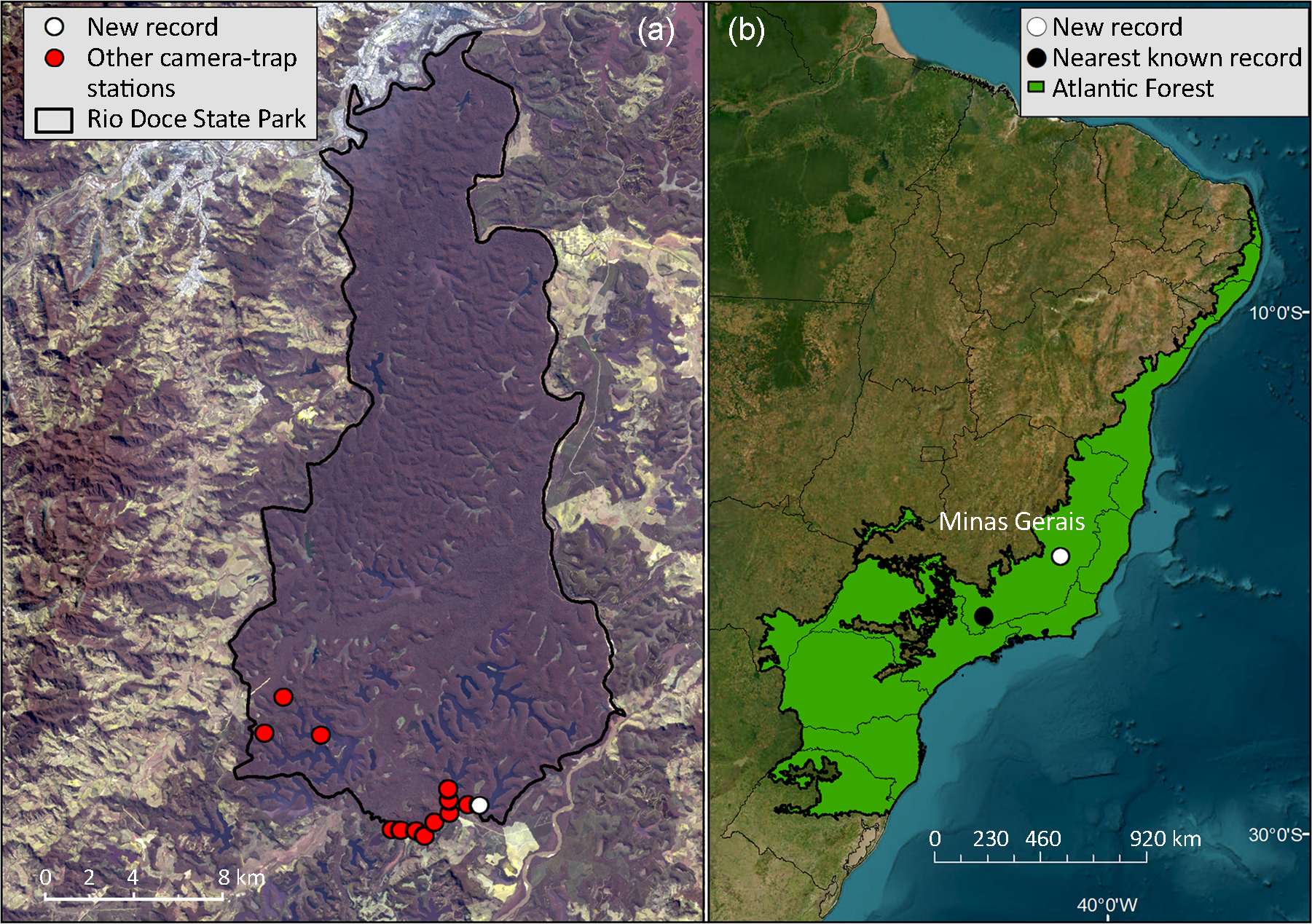
The c. 36,000 ha Rio Doce State Park (IUCN Protected Area Management Category II) is the largest expanse of protected Atlantic Forest in Minas Gerais, one of the most extensive remnants of this biome in Brazil (Gontijo & Britto, Reference Gontijo and Britto1997) and an important area for biodiversity conservation in the Atlantic Forest (da Silva Junior et al., Reference da Silva Junior, de Melo, Moreira, Barbosa and Meira-Neto2010) (Fig. 1). The Park has 42 natural lakes, mostly in the south, three streams and stretches of the Piracicaba and Doce rivers. Human-modified habitats, including pastures, eucalyptus plantations and urban areas surround the Park, which is under threat from mining activities, pollution and illegal hunting (Neves et al., Reference Neves, Nunes, de Carvalho and Fernandes2016, Yves et al., Reference Yves, Lima, Bassetti, Andrade, Sousa and Marques2023).
(a) Location of the new bush dog Speothos venaticus record in Rio Doce State Park, Minas Gerais state, Brazil, and of other camera-trap stations, and (b) the location of this record with respect to the Atlantic Forest and to the nearest known previous record of the species, in southern Minas Gerais (Soto-Werschitz et al., Reference Soto-Werschitz, Mandujano and Passamani2023).

We employed a systematic survey design in a continuous 24-month survey during 2020–2021, in the south of the Park, using 13 camera-trap stations (Fig. 1) covering c. 50 km2 (14% of the Park). To ensure adequate spatial coverage, we maintained a minimum of 0.52 km between stations (mean 1.10 ± SD 0.58 km, range 0.52–1.84 km). Each station comprised a pair of camera traps (Trophy Cam Natureview, Trophy Cam Standard or Trophy Cam Essential, Bushnell, USA) mounted at 40–50 cm height on trees, facing each other. This allowed us to capture both sides of an animal, facilitating individual identification. Cameras were programmed to record 10–30 s HD videos, with a 60 s interval between triggers. All cameras operated continuously throughout the survey, and were without bait or other attractants.
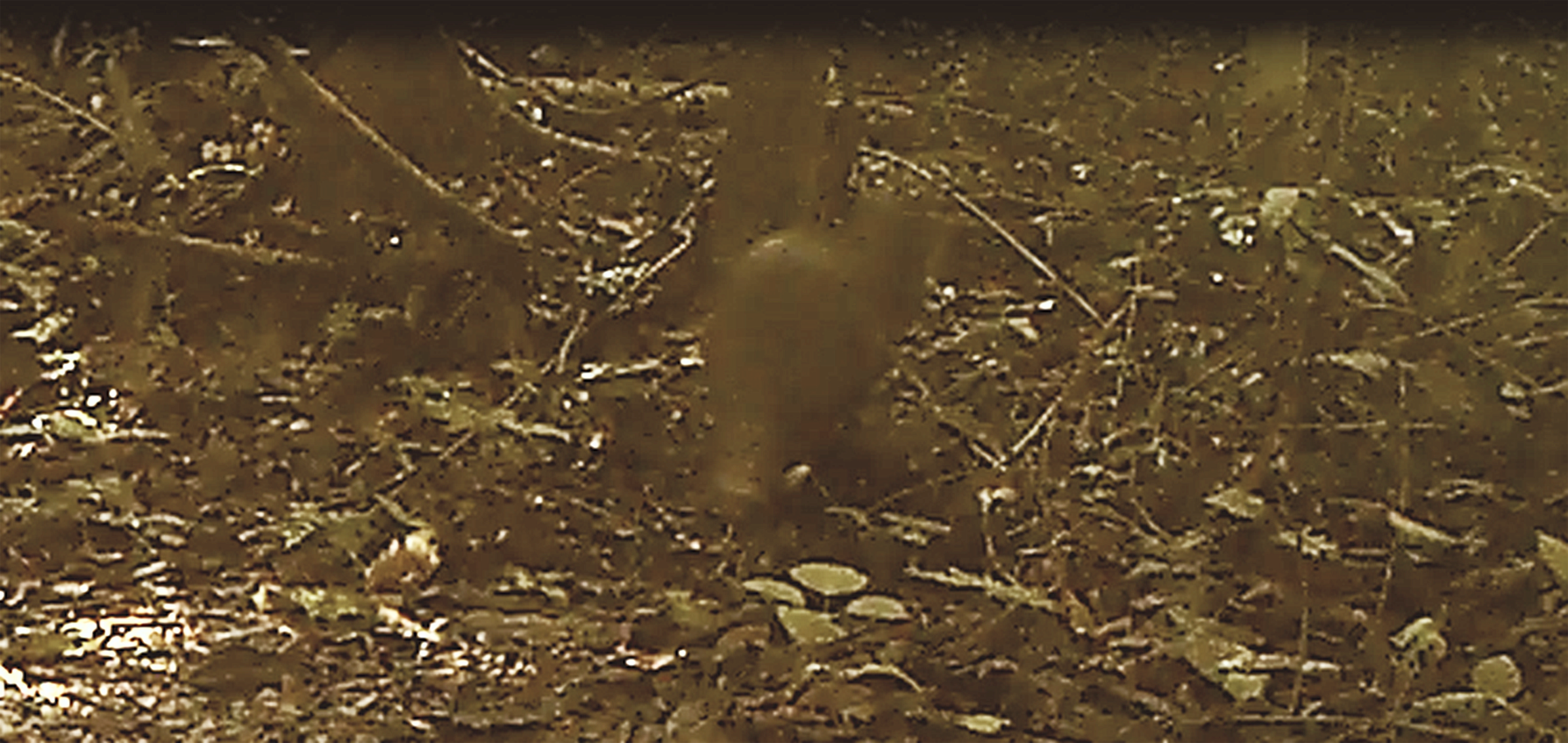
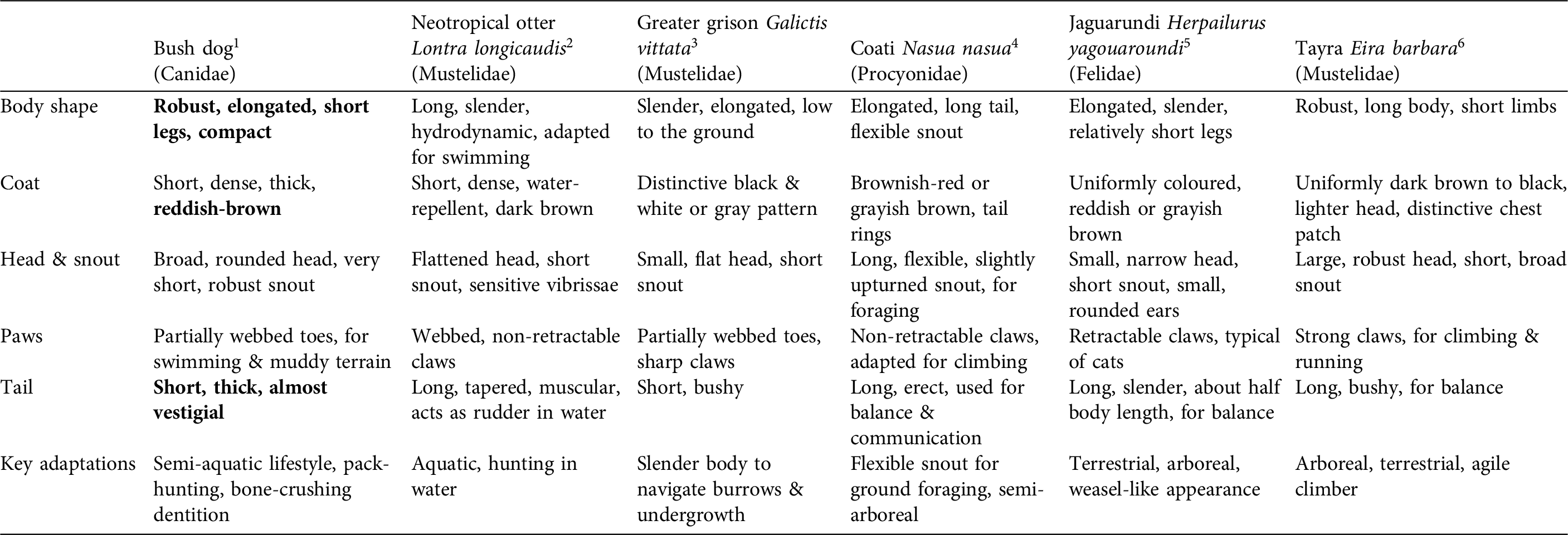
We recorded a bush dog after 7,744 trap-days along an unpaved road near Lagoa dos Patos, one of the Park’s lakes. A single video of the animal (Plate 1, Supplementary Material 1) was captured at 15.25 on 21 December 2021 (19o48’24’’S, 42o32’21’’W). Only one of the two cameras captured the movement. Although the video quality is limited because of the animal’s speed and the camera resolution, key characteristics such as its brown color, short legs, typical body shape and distinctive tail shape are discernible, indicating it was a bush dog rather than any of the other carnivore species of similar size occurring in the Park (Table 1). Two experienced carnivore specialists assisted us in the identification: Júlio César Dalponte (Rastos Consultoria Ambiental/Instituto Pró-Carnívoros) confirmed the identification, and Frederico Gemésio Lemos (Universidade Federal de Catalão) noted it was most likely a bush dog. The nearest known record of the bush dog in the Atlantic Forest of Minas Gerais is c. 420 km south of this new finding (Fig. 1), making the new record the northernmost documented occurrence of this canid in the Brazilian Atlantic Forest and a novel addition to the carnivore community of Rio Doce State Park.

Characteristics of the bush dog Speothos venaticus and of the other five wild carnivore species of similar size occurring in Rio Doce State Park (Fig. 1). In bold are the principal characteristics of the recorded bush dog that distinguish it from the other carnivore species.

1 Mello Beisiegel & Zuercher (Reference Mello Beisiegel and Zuercher2005). 2Lariviere (Reference Larivière1999). 3Yensen & Tarifa (Reference Yensen and Tarifa2003). 4Gompper & Decker (Reference Gompper and Decker1998). 5De Oliveira (Reference T.G.1998). 6Presley (Reference Presley2000).
Renowned for its rich biodiversity, the Park supports a diverse Neotropical mammalian carnivore community (Keesen et al., Reference Keesen, Nunes and Scoss2016). The new record of the bush dog significantly extends the species’ known range within the Atlantic Forest. A previous survey, in 2016–2017, across the entire Park, did not record the bush dog (Azevedo et al., Reference Azevedo, Pasa, Arrais, Massara and Widmer2022), emphasizing the importance of this new finding. Given the fragmentation of the Atlantic Forest surrounding the Park, the bush dog’s presence could potentially indicate a previously unknown population in this region. Recent anecdotal reports had suggested the presence of bush dogs in the southern area of the Park, and we believe it is likely this new record indicates a small established population, rather than an individual dispersing from a nearby population. Forested areas surrounding the Park are highly fragmented, which would impede the survival of a viable population outside the Park, and there are no anecdotal reports of bush dogs in these surrounding areas.
The presence of the bush dog underscores the significance of Rio Doce State Park for conserving rare species, providing high-quality habitat for the bush dog, and facilitating scientific research and maintenance of biological diversity. Considering the bush dog is most common in well-preserved areas (Lima et al. Reference Lima, DeMatteo, Jorge, Jorge, Dalponte, Lima and Klorfine2012), we recommend intensification of long-term surveys of this and other medium-sized and large mammal species in Rio Doce State Park and other preserved Atlantic Forest remnants.
Author contributions
Study conception, design: FCCA, CEW; writing first draft, partial funding, final revision: FCCA; data collection, writing, revision: JBP, LFDK, BMC, TSB, MAR, GGN, JGD, TRB; writing, revision: CEW.
Supplementary material
The supplementary material for this article is available at doi.org/10.1017/S0030605325102299
Acknowledgements
We thank the staff of Instituto Estadual de Florestas–Parque Estadual do Rio Doce and Instituto Prístino for their collaboration and help with project administration, the bush dog specialists who helped with identification, two anonymous reviewers for their helpful comments, and we acknowledge the Ministério Público de Minas Gerais, Plataforma Semente and Universidade Federal de São João del Rei for partially funding the research.
Conflicts of interest
None.
Ethical standards
This research abided by the Oryx guidelines on ethical standards. The camera-trapping survey was approved by the Instituto Estadual de Florestas, Minas Gerais state, under license number 053/2012 Renovação VIII. Our data collection with camera traps was conducted in a socially responsible manner that did not violate peoples’ privacy or cause other unnecessary harm, following Sharma et al. (Reference Sharma, Fiechter, George, Young, Alexander and Bijoor2020). Any images inadvertently obtained of people have been stored securely and privately.
Data availability
The data used in this study (a camera-trap video) is available in the Supplementary material and can be obtained from the corresponding author upon reasonable request.


 Open access

