


Fruit and vegetables (F&V) are essential components of a healthy diet. High daily F&V intake is associated with lower risks of becoming overweight and other diet-related chronic diseases(Reference Boeing, Bechthold and Bub1,Reference Slavin and Lloyd2) . Despite these positive health effects, many university students around the world do not meet F&V guidelines(Reference Keller, Maddock and Hannöver3–Reference Teschl, Nössler and Schneider8). This is also the case in the Netherlands, where only 28 % and 7 % of a university student sample adhered to the Dutch dietary guidelines(9) of two portions of fruit per day and 250 g of vegetables per day, respectively(Reference van den Bogerd, Maas and Seidell10).
There is increasing recognition that the food environment is an influential determinant of healthy food choices(Reference Brug, van Lenthe and Kremers11–Reference Sleddens, Kroeze and Kohl13), among other factors. Given that students spend a great deal of time on the campus of their university, the campus environment potentially has a big influence on what students eat. However, studies conducted in Australia(Reference Grech, Hebden and Roy14,Reference Roy, Hebden and Kelly15) , the USA(Reference Horacek, Erdman and Byrd-Bredbenner16,Reference Leischner, McCormack and Britt17) and Brazil(Reference Pulz, Martins and Feldman18) have suggested that the food environments of university campuses, which include vending machines, cafeterias and other kinds of food outlets on campus, do not support healthy choices. Unhealthy foods have been found to be more often available and readily accessible on campus than healthy food options such as fruit and salads(Reference Grech, Hebden and Roy14–Reference Tseng, DeGreef and Fishler19). Moreover, a study of fifteen tertiary-education institutes in the USA showed that on-campus convenience stores sell far less F&V than convenience stores off campus(Reference Horacek, Erdman and Reznar20). This is concerning because it may have a negative impact on the quality of students’ diets. It has been found that the diet quality of students is influenced by on-campus food purchases, with more on-campus food purchases associated with less healthy dietary practices(Reference Roy, Rangan and Hebden21,Reference Pelletier and Laska22) .
Student food purchases on campus are mainly based on taste, value for money, cost and convenience(Reference Tam, Yassa and Parker23). The high price and poor availability (e.g. not readily available, seasonal influences) of healthy foods are major barriers to students’ consumption of healthy foods such as F&V(Reference Graham, Pelletier and Neumark-Sztainer24–Reference Munt, Partridge and Allman-Farinelli27). According to Bandura’s Social Cognitive Theory(Reference Bandura28,Reference Bandura29) , people who experience more barriers to performing a certain health behaviour have lower levels of self-efficacy, which is needed to perform and maintain such behaviour. This theory also proposes that health behaviour is not only affected by personal factors, such as self-efficacy, but also interacts with environmental factors. This suggests that the likelihood of people engaging in healthy behaviour is greater when their physical environment offers the opportunity to do so. According to Bandura(Reference Bandura28,Reference Bandura30) , a key component of interventions aiming to change unhealthy behaviour is facilitating the intended health behaviour by providing resources or changing the environment. Facilitating the availability of healthy foods or F&V on a university campus may remove students’ perceived barriers and therefore stimulate healthy eating. In previous studies, students reported that the improved availability of healthy foods and F&V on their university campus could positively influence their diet(Reference van den Bogerd, Maas and Seidell10,Reference Hartman, Wadsworth and Penny25,Reference Deliens, Clarys and De Bourdeaudhuij26) . For example, Belgian university students indicated that if healthy foods were more readily available on campus, they would make healthier choices, especially if the healthy foods were free(Reference Deliens, Clarys and De Bourdeaudhuij26). Dutch university students also reported that if affordable F&V were available in their study environment they would eat more F&V(Reference van den Bogerd, Maas and Seidell10).
Thus, on-campus availability of free F&V might be a solution to students’ low F&V intakes. To date, there are only a limited number of studies that have explored the effects of free on-campus F&V. A Belgian study showed that visitors to a university canteen (students and university staff) improved their daily F&V consumption after they were given two free portions of fruit and one free portion of vegetables during their hot meal at lunch in the university canteen(Reference Lachat, Verstraeten and De Meulenaer31). Another Belgian study(Reference Deliens, Deforche and Annemans32) and a study in the USA(Reference Deliens, Deforche and Annemans32,Reference Michels, Bloom and Riccardi33) have also shown that price reductions on F&V in university canteens stimulate F&V purchases. Intervention studies in other settings, such as primary schools and in the workplace, have shown that the availability of free F&V can improve the F&V intake of pupils and employees(Reference Alinia, Lassen and Krogholm34–Reference Methner, Maschkowski and Hartmann36). Most of these studies investigated the effects in a total study sample. However, previous work has shown that there are differences in the F&V consumption of Dutch university students between different demographic subgroups: F&V consumption was generally higher in females, older students, students enrolled in a health-related programme and those living in a shared household(Reference van den Bogerd, Maas and Seidell10). It is, therefore, interesting to explore whether there are subgroups that benefit more (or less) from offering free F&V on campus. Additionally, exploring the effects within subgroups based on habitual intake may provide insight into the effectiveness of providing free F&V on campus for those at risk of low F&V intake and its negative consequences.
To counter low F&V intake among students, we created an F&V intervention that provided free fruit and snack vegetables for students in a mobile F&V stand at a university of applied sciences. There were three objectives. The first and main objective was to investigate the effects of the F&V intervention on Dutch students’ self-reported fruit intake and snack vegetable intake. The second objective was to investigate these effects in subgroups based on habitual F&V intake and demographic characteristics. The third objective was to investigate the effects on students’ total vegetable intake. Our first hypothesis was that the F&V intervention would increase students’ fruit and snack vegetable intakes. Our second hypothesis was that there would be differences in intervention effects based on habitual F&V intake and demographic characteristics. The third hypothesis was that total vegetable consumption would improve as a result of greater snack vegetable intake. We tested the effects of the stand in three different interventions to validate the findings. In each intervention, small changes to the appearance and the communication concerning the F&V stand were made. Additionally, we added a follow-up measurement after Intervention 3 to investigate the long-term effect of the intervention. This research is a first step in testing the possible effectiveness of offering free F&V on campus, and the results can be used to further develop and test food environment interventions that aim to improve students’ healthy food habits and increase their F&V consumption.
Methods
Three real-life F&V interventions were conducted at a university of applied sciences in the southern Netherlands. This university offers courses in agrifood and environmental subjects and is situated in a small education building. All lecture halls, offices, labs and the cafeteria are located in a single building.
Intervention
In this intervention, we focused solely on the aspect of facilitating the consumption of healthy foods(Reference Bandura28,Reference Bandura30) . We hypothesized that if we provided students with the ability and an additional opportunity to consume F&V, this would increase their F&V intake. The intervention involved a mobile stand in the form of a miniature wooden house that provided free fruit and snack vegetables (Fig. 1). The stand had a large shelf on two sides for trays that could be filled with F&V, which were offered separately on each side. The F&V stand was placed in a central hall near the entrance of the university building, which students regularly pass through on their way to lectures and the cafeteria. The F&V stand displayed multiple wooden signs pointing to the types of F&V that were on offer, and information such as ‘The fruit and vegetables are washed’ and ‘For students only’.
The mobile fruit and vegetable stand: (A) mobile stand; (B) close-up, fruit tray; (C) close-up, vegetable tray; (D) appearance during Intervention 1; (E) appearance during Intervention 2; and (F) appearance during Intervention 3.

Before Intervention 1 started, a non-systematic brainstorm with a group of six first-year students and interviews with seven other first-year students about the appearance and placement of the F&V stand were conducted. The brainstorm and interviews were conducted by two fourth-year students who were also responsible for the implementation of the intervention. This meant that they were responsible for filling the stand with F&V and keeping the stand clean, as well as being responsible for the appearance of the stand. Based on the brainstorm and interviews, it was concluded that students preferred F&V to be offered in the afternoon and it had to be ‘ready to consume’, with apples, bananas, pears, bite-sized tomatoes and bell peppers the preferred F&V. With regard to the appearance of the stand, there was little consensus (apart from all students liking a natural look for the stand) and therefore we created two concepts. During Intervention 1, a simple and quick version of the F&V stand was implemented. The stand was kept plain and posters with images of smiley F&V figures were placed throughout the building, announcing that free F&V were only a few steps away. With this version, we aimed to create a convenience or a take-away feeling for students, making it simple and easy for students to take F&V from the stand. During Intervention 2, a modified version was implemented, with potted plants placed on and around the F&V stand. A small carpet of artificial grass was also placed in front of the F&V stand along with stools, and bird sounds could be heard in the vicinity of the stand. However, the posters were no longer present. This concept was developed with the aim of creating a fresh, natural and serene experience and offering a place where students could take their time to eat their F&V and to relax.
In Intervention 3, we aimed to reproduce the results of Interventions 1 and 2 and to study long-term effects by adding a follow-up measurement after 6 weeks. Because the preliminary data analyses showed little differences in outcomes between Interventions 1 and 2, the appearance of the stand was kept simple, similar to the first intervention. The posters that were used in Intervention 1 were used again in Intervention 3. To encourage students to take F&V from the stand, free postcards displaying F&V combined with catchy phrases were also offered at the F&V stand. The images and phrases used on the postcards were also displayed on information screens throughout the building. Unlike Intervention 1, we also promoted the F&V stand on social media.
During all three interventions, fruit and snack vegetables were offered in the afternoon from Monday to Friday, with generally one sort of fruit and one sort of vegetable offered each day. There were no serving limits or suggested amounts. A variety of fruit and vegetables were offered, with apples, bananas, snack tomatoes and snack carrots offered on the majority of days. Other F&V that were offered included strawberries, tangerines, pears, grapes, cucumber, snack peppers, celery and radish. In Interventions 1 and 2, between 24 and 33 kg of fruit and 12 and 24 kg of snack vegetables were offered each day, while in Intervention 3, between 25 and 45 kg of fruit and between 23 and 44 kg of snack vegetables were offered each day.
Design and participants
All three F&V interventions were evaluated with a pre-test/post-test design and had a duration of 3 weeks. The post-tests were conducted in the third week of each intervention. Interventions 1 and 2 were conducted between March and June of the academic year 2016/2017. The pre-test for Interventions 1 and 2 was conducted 6 weeks before the first intervention. This means that the participants included in the evaluation of Interventions 1 and 2 were derived from the same pre-test. There was a 1-week break between the end of Intervention 1 and the start of Intervention 2. Please see the online supplementary material, Supplemental Fig. S1 for a schematic overview of the design of Intervention 1 and Intervention 2. Intervention 3 was conducted between October and February of the academic year 2017/2018. The pre-test was conducted 1 week before the intervention. In addition to a post-test, Intervention 3 was evaluated with a follow-up measurement 6 weeks after the intervention (see online supplementary material, Supplemental Fig. S2).
In order to recruit participants for the evaluation of Interventions 1 and 2, the researchers dropped in on several lectures for first- and second-year courses to ask students if they were willing to participate in an online questionnaire. As a reward for their participation, students received a piece of fruit. In the third week of the intervention, an email was sent to all students who participated in the pre-test asking them if they were willing to fill out another questionnaire. Free coffee or tea at the university (one for every five participants) and a power bank (one for every twenty-one participants) were raffled among the students who participated in the questionnaire at the post-tests. At the pre-test, 367 students accessed the online questionnaire, of whom six did not give informed consent and were excluded. Students who did not provide a student number, which was critical for matching with post-test data, were also excluded (n 23). This resulted in 338 students with complete data on the pre-test. After Intervention 1, of the initial 338 students, 124 (participation rate 36·7 %) completed the questionnaire and were included in the statistical analyses. After Intervention 2, of the initial 338 students, ninety-two (participation rate 27·2 %) completed the questionnaire and were included in the statistical analyses. There were seventy-two students who were included in the statistical analyses of Intervention 1 and Intervention 2.
Intervention 3 was evaluated only by first-year students. At the pre-test and post-test, data were collected in the same manner as the pre-test for Interventions 1 and 2. The data collection method at the 6-week follow-up was similar to the data collection method for the post-tests of Interventions 1 and 2 (via email). As a reward for filling out the questionnaire during the follow-up, students received an extracurricular credit. At the pre-test, 480 students accessed the online questionnaire, of whom five did not give informed consent and were excluded. Three students who did not provide a student number were also excluded. This resulted in 472 students with complete data at the pre-test. At the post-test, of the initial 472 students, 237 (participation rate 50·2 %) filled out the questionnaire. At subsequent follow-up, 129 students (participation rate 27·3 %) filled out the questionnaire. Students with complete data at the pre-test, and data on either the post-test or the follow-up, were included in the statistical analyses (n 237).
Questionnaire
Demographic characteristics
Demographic characteristics were assessed during the pre-tests and included gender (male, female), age, housing situation, study programme and study year (first year, second year). Age was measured in years and then dichotomized around the mean into younger than 20 years and older than 20 years because the variable age violated the assumption of linearity for some of the outcomes. Students were asked about their current housing situation. There were multiple answer categories; however, because the majority of students indicated that they lived with their parents or guardians, the housing situation was dichotomized as: living with parents/guardians or other (student housing, living with partner, living with housemates, living alone). In addition, the university offers eleven different study programmes, but because there was insufficient power to analyse the differences between these eleven programmes, they were categorized as: food-related studies (Food Innovation; International Food and Agribusiness; Food Technology), environmental studies (Applied Biology; Environmental Innovation; Horticulture and Arable Farming), green business studies (Horticulture and Business Management; Business Administration and Agri and Food Business; Animal Husbandry & Animal Care) and environmental design studies (Geo Media and Design; Spatial and Environmental Planning).
Fruit and vegetable intake
F&V intake was assessed by means of a food frequency tool, which was adapted from the Dutch Health Monitor(Reference Kim and Holowaty37–Reference Block, Gillespie and Rosenbaum39). To measure fruit intake, students were asked to indicate how many days per week they had consumed fruit in the previous 2 weeks on an eight-point scale ranging from ‘less than once a week’ (0) to ‘seven days a week’ (7). Students were then asked to indicate how many portions they usually consumed on the days that they consumed fruit. Four pictures were used to illustrate portion sizes (0·5, 1·0, 1·5 and 2·0 portions of fruit) and there was an option of less than the depicted portions (0 portions) and an option of more than the depicted portions (2·5 portions). In accordance with the Dutch Nutrition Center(9), one portion of fruit was illustrated as a medium-sized apple, two tangerines or a handful of grapes. Fruit intake in portions per day was calculated by multiplying the days per week students consumed fruit by the number of portions per day, divided by seven.
Vegetable intake was determined using separate questions for snack vegetable intake, cooked vegetable intake and side-dish vegetable intake. A definition of each type was given: ‘Snack vegetables include mini cucumbers, cherry tomatoes and mini carrots’, ‘Cooked vegetables include cooked and sautéed vegetables, vegetables included in rice, pasta and other dishes also count’ and ‘Side-dish vegetables include raw vegetables, spring onions, raw cabbage and salads’. In the Netherlands, potatoes are not considered a vegetable(9). Students first indicated how many days per week they had consumed snack vegetables, cooked vegetables and side-dish vegetables in the previous 2 weeks on an eight-point scale ranging from ‘less than once a week’ (0) to ‘seven days a week’ (7). Students then indicated how many portions they consumed on the days they consumed snack vegetables, cooked vegetables and side-dish vegetables. Pictures were used to illustrate portion sizes (50, 100, 150 and 200 g of vegetables) and there was an option of less than the depicted portions (0 g) and an option of more than the depicted portions (250 g). Intakes of total vegetables (snack vegetables + cooked vegetables + side-dish vegetables), snack vegetables, cooked vegetables and side-dish vegetables, in grams per day, were calculated by multiplying the days per week students consumed them by the number of portions per day, divided by seven.
Statistical analysis
Descriptive statistics are presented as percentages with numbers for categorical variables and as means with standard deviations for continuous variables. Differences in demographic characteristics between those who initially participated at the pre-tests and those who were actually included in the statistical analyses of Intervention 1, 2 and 3 were tested with Pearson χ 2 tests and t tests using the statistical software package IBM SPSS Statistics version 25 (see online supplementary material, Supplemental Tables S1 and S2). The effects of the F&V intervention on students’ fruit, snack vegetable, total vegetable, cooked vegetable and side-dish vegetable intakes were tested by means of longitudinal linear regression analyses to account for the clustering of time measurements within the students using MLwiN 2.36. A two-level structure was used, which included the measurement (Level 1) within the individual students (Level 2). First, a model that only included time as an independent variable was constructed to analyse the effects of the intervention in the complete study sample. Second, pre-test F&V intake categorized as tertiles and two-way interactions with time (time × pre-test intake) were added to the first model to investigate the effects within subgroups based on habitual intake. Third, demographic characteristics and interactions with time (time ×demographic characteristic) were added to the first model to investigate the intervention effects in subgroups based on demographic characteristics. Intervention effects are presented as unstandardized regression coefficients (B) with 95 % confidence intervals. Statistical significance was established if the 95 % confidence interval did not include zero.
Results
Table 1 shows the descriptive statistics for the students who were included in the evaluation of Interventions 1, 2 and 3. Intervention 1 included 124 students with a mean age of 19·7 (sd 1·9) years (range 17–28 years). Intervention 2 included ninety-two students with a mean age of 19·6 (sd 1·9) years (range 17–28 years). Intervention 3 included 237 first-year students with a mean age of 18·8 (sd 16·8) years (range 16–26 years). Overall, the majority of students who participated were female and lived with their parents.
Demographic characteristics of students from a Dutch university included in Interventions 1, 2 and 3 conducted in academic years 2016/2017 and 2017/2018

Supplemental Tables S1 and S2 in the online supplementary materials show the descriptive statistics of those who initially participated at the pre-tests and those who were actually included in the statistical analyses of Interventions 1, 2 and 3. Intervention 1 (n 124) and Intervention 2 (n 92) both included relatively more females, more students enrolled in a food-related study and fewer students enrolled in green business studies compared with the students who initially participated at pre-test (n 388). The students included in Intervention 1 and 2 also had a higher fruit intake than those who initially participated at pre-test. Intervention 3 (n 237) included relatively fewer students enrolled in environmental studies compared with the students who initially participated at pre-test (n 472). There were no noticeable differences in gender, age, housing situation, fruit intake or snack vegetable intake between the students who were included in Intervention 3 and those who initially participated at pre-test.
Intervention 1
Table 2 shows pre-test and post-test means and the results of the longitudinal regression analyses of Intervention 1. In the overall sample, fruit intake was 0·11 (95 % CI 0·03, 0·18) portions/d higher at post-test and snack vegetable intake was 12·85 (95 % CI 6·32, 19·38) g/d higher at post-test (third week of Intervention 1), compared with pre-test (6 weeks before Intervention 1). Subgroup analyses showed that, based on pre-test fruit intake, students in the first (lowest) tertile (0·29 (95 % CI 0·15, 0·42) portions/d) and the second tertile (0·16 (95 % CI 0·02, 0·29) portions/d) increased their fruit intake from pre-test to post-test. Based on pre-test total vegetable intake (i.e. sum of snack vegetable intake, cooked vegetable intake and side-dish vegetable intake in g/d), students in the first tertile (16·40 (95 % CI 5·52, 27·27) g/d) and second tertile (15·68 (95 % CI 4·42, 26·94) g/d) increased their snack vegetable intake from pre-test to post-test.For both fruit intake and snack vegetable intake, there were no statistically significant interactions between time and gender, age, housing situation, study programme or study year (see online supplementary material, Supplemental Table S3). There were no statistically significant changes in total vegetable intake, cooked vegetable intake and side-dish vegetable intake from pre-test to post-test.
Means and pre-test – post-test differences in fruit and vegetable intake of Dutch university students included in the evaluation of Intervention 1 conducted between March and June of the academic year 2016/2017
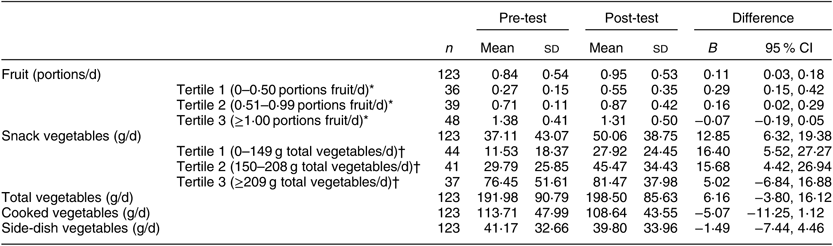
B, unstandardized regression coefficient.
* Tertiles based on pre-test fruit intake.
† Tertiles based on pre-test total vegetable intake (i.e. sum of snack vegetable intake, cooked vegetable intake and side-dish vegetable intake in g/d, and therefore some of the means of the snack vegetables fall outside the tertiles of total vegetables per day).
Intervention 2
Table 3 shows pre-test and post-test means and the results of the longitudinal multilevel analyses of Intervention 2. In the overall sample, snack vegetable intake was 13·82 (95 % CI 1·24, 26·40) g/d higher at post-test (third week of Intervention 2) than at pre-test (10 weeks before Intervention 2). Fruit intake did not change significantly from pre-test to post-test. Subgroup analyses showed that, based on pre-test fruit intake, only students in the first tertile increased their fruit intake from pre-test to post-test (0·32 (95 % CI 0·10, 0·54) portions/d). Based on pre-test total vegetable intake (i.e. sum of snack vegetable intake, cooked vegetable intake and side-dish vegetable intake in g/d), only students in the first tertile increased their snack vegetable intake from pre-test to post-test (19·95 (95 % CI 1·32, 38·59) g/d). For both fruit intake and snack vegetable intake, there were no statistically significant interactions between time and age, housing situation, study programme or study year (see online supplementary material, Supplemental Table S4). For fruit intake, there was also no statistically significant interaction between time and gender (0·15 (95 % CI −0·21, 0·51) portions/d), but for snack vegetable intake there was a significant interaction (−27·19 (95 % CI −53·03, −1·34) g/d). Females did not change their snack vegetable intake (4·95 (95 % CI −9·80, 19·71) g/d), while males increased their snack vegetable intake from pre-test to post-test (32·14 (95 % CI 10·93, 53·36) g/d). There were no statistically significant changes in total vegetable intake, cooked vegetable intake or side-dish vegetable intake from pre-test to post-test.
Means and pre-test – post-test differences in fruit and vegetable intake of Dutch university students included in the evaluation of Intervention 2 conducted between March and June of the academic year 2016/2017
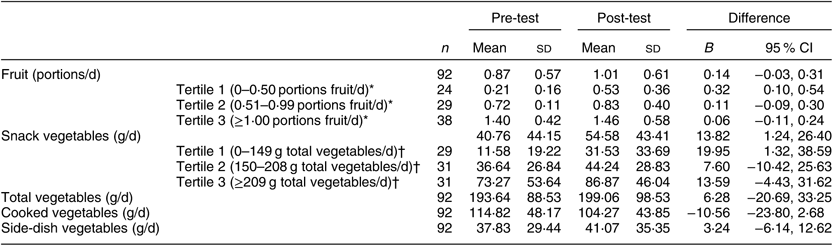
B, unstandardized regression coefficient.
* Tertiles based on pre-test fruit intake.
† Tertiles based on pre-test total vegetable intake (i.e. sum of snack vegetable intake, cooked vegetable intake and side-dish vegetable intake in g/d, and therefore some of the means of the snack vegetables fall outside the tertiles of total vegetables per day).
Intervention 3
Table 4 shows pre-test, post-test and follow-up means and the results of the longitudinal multilevel analyses of Intervention 3. In the overall sample, snack vegetable intake increased from pre-test (1 week before Intervention 3) to post-test (third week of Intervention 3; 10·90 (95 % CI 3·80, 18·00) g/d), but this effect was no longer present at follow-up (6 weeks after the intervention). No statistically significant differences in fruit intake were found. Subgroup analyses showed that, based on pre-test fruit intake, students in the first tertile (0·21 (95 % CI 0·09, 0·33) portions/d) and second tertile (0·13 (95 % CI 0·03, 0·23) portions/d) increased their fruit intake from pre-test to post-test. In the first tertile, this effect was still present at follow-up. Based on pre-test total vegetable intake (i.e. sum of snack vegetable intake, cooked vegetable intake and side-dish vegetable intake in g/d), students in the first tertile (12·71 (95 % CI 1·46, 23·96) g/d) and second tertile (18·13 (95 % CI 7·70, 28.57) g/d) increased their snack vegetable intake from pre-test to post-test. In the second tertile, this effect was still present at follow-up. For both fruit intake and snack vegetable intake, there were no significant interactions between time and gender, age, housing situation or study programme (see online supplementary material, Supplemental Table S5). There were no significant changes in total vegetable intake, cooked vegetable intake and side-dish vegetable intake from pre-test to post-test or follow-up.
Means, pre-test – post-test differences and pre-test-follow-up differences in fruit and vegetable intake of Dutch university students included in the evaluation of Intervention 3 conducted between October and February of the academic year 2017/2018
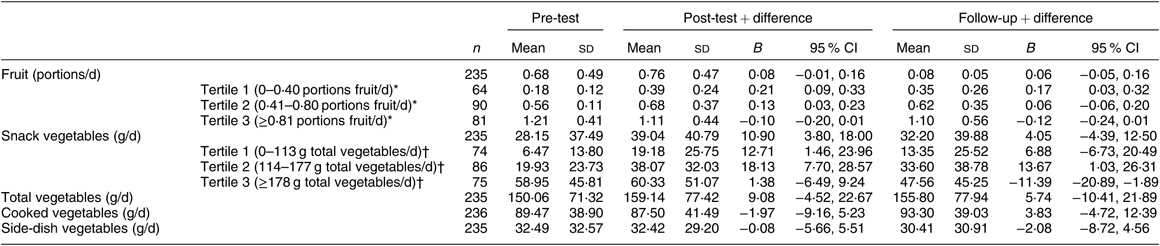
B, unstandardized regression coefficient.
* Tertiles based on pre-test fruit intake.
† Tertiles based on pre-test total vegetable intake (i.e. sum of snack vegetable intake, cooked vegetable intake and side-dish vegetable intake in g/d, and therefore some of the means of the snack vegetables fall outside the tertiles of total vegetables per day).
Discussion
The aim of the present study was to investigate the effects of providing free fruit and snack vegetables at a Dutch tertiary-education institute on student intake. The results showed that students’ snack vegetable intake increased when free fruit and snack vegetables were offered on campus, but no meaningful differences in fruit or total vegetable intake were found. Within subgroups based on pre-test intake, students with initially low intakes of fruits and snack vegetables reported higher consumption in these categories after intervention.
Snack vegetable intake was consistently higher at post-test than at pre-test: after the three interventions, snack vegetable intake was between 11 and 14 g/d higher (comparable to three bite-size tomatoes). The largest increase was seen in students who had a low habitual total vegetable intake before the intervention. This might imply that offering free snack vegetables is particularly beneficial for those with initial low habitual intake. Snack vegetable intake at the 6-week follow-up after Intervention 3 was similar to the pre-test for Intervention 3. This suggests that the short-term availability of free snack vegetables does not lead to a sustainable long-term improvement in students’ snack vegetable consumption. Continued availability of snack vegetables may be a sustainable solution to improve students’ vegetable intake. Nevertheless, only a small change in total vegetable intake was found (with confidence intervals failing to exclude the possibility of no difference). These findings contradict those of a Belgian study which showed that providing free salads at a university canteen successfully increased daily total vegetable intake(Reference Lachat, Verstraeten and De Meulenaer31). The small intervention effect on total vegetable intake found in the present study might be explained by compensation behaviour: students who consumed extra snack vegetables during the day might be tempted to consume fewer vegetables on other occasions.
Small differences in fruit intake between the pre-test and post-test were observed. These findings were unexpected, as increased availability of healthy foods has been shown to promote healthy dietary behaviours(Reference Caspi, Sorensen and Subramanian40,Reference Roy, Kelly and Rangan41) , and two Belgian studies have shown that free fruit or price reductions on fruit in university canteens successfully increased fruit intake(Reference Lachat, Verstraeten and De Meulenaer31,Reference Deliens, Deforche and Annemans32) . Previous studies in workplace settings have also shown that offering free fruit can increase the fruit intake of employees(Reference Alinia, Lassen and Krogholm34,Reference Backman, Gonzaga and Sugerman35) . A single component intervention, such as merely focusing on facilitation, might not have been sufficient to encourage all students to consume more fruit(Reference Geaney, Kelly and Greiner42). We recommend that future interventions target multiple determinants of behaviour change, such as knowledge and perceived self-efficacy, by for example combining the availability of free fruit with nutrition information or nutrition education(Reference Michels, Bloom and Riccardi33,Reference Roy, Kelly and Rangan41–Reference Allan, Querstret and Banas43) .
Similar to snack vegetables, students with a low fruit intake before the intervention showed the largest improvements in fruit intake after the intervention, whereas students with higher pre-test fruit intake did not change their fruit consumption. Again, this implies that it is students with initial low intake who benefit most from the availability of free F&V on campus. This is an important finding since these groups have the highest risk of developing diet-related chronic diseases. It is possible that students with low habitual intake have lower accessibility than those with higher intake. Providing free F&V at the university facilitates F&V consumption and mitigates barriers such as cost and convenience. We observed no differences within subgroups based on age, study programme or study year. There was an indication that males benefit more from the intervention than females. After Intervention 2, males reported higher post-test snack vegetable intake than their pre-test intake, whereas females did not change their snack vegetable consumption. Given that the pre-test snack vegetable intake of males was much lower than females, it might be that this difference between them simply reflects the fact that those males were in the subgroup with initially low habitual F&V intake.
Strengths and limitations
To our knowledge, the present paper is the first to report on the effects of offering free on-campus F&V to tertiary-education students in the Netherlands. Consequently, the paper contributes to existing knowledge in the field and lays the groundwork for future research and interventions on the availability of free F&V at tertiary-education institutes. A major strength of the intervention described herein is that it is easily implemented. Another strength is that each intervention included more than ninety students, while the follow-up measurement in the third study is also of importance. Despite small changes to the appearance of the stand and communication around the stand, the direction of the results was consistent and the magnitude of the effects comparable. This repetition of intervention effects helps reassure that observed results in each intervention were not due to chance.
The first important limitation of this research is the lack of a control group. We chose pre-test/post-test designs without a control group because all tertiary-education institutes in the Netherlands offer courses in a specific domain, which attract specific kinds of students. These institutes also have different academic year schedules. Therefore, matching with another institute would have led to an unrepresentative control group. Also, because the intervention was an environmental manipulation within an education institute with one single building, we could not include a control group within the education institute or employ another within-subject design.
A second limitation concerns the fact that due to logistical reasons (e.g. start of new academic semester), the pre-tests for the first two interventions were conducted 6 weeks before the start of the first intervention, while the pre-test for Intervention 3 was conducted only 1 week before the start of the intervention. As a result, the findings of the three interventions might not be comparable. In addition, students included in Intervention 2 were possibly exposed twice to the intervention because it was in the same period as Intervention 1. The findings of Intervention 2 thus reflect the impact of two interventions. However, Intervention 1 and Intervention 2 showed stable post-test effects in fruit and snack vegetable intakes despite the repeated doses. Post-test effects of Intervention 3 were somewhat lower than Intervention 1 and 2, and this effect diminished after the environmental intervention was removed. This furthers our confidence in the results.
The third limitation concerns the tool used to measure F&V intake, which involved self-report and was not validated. It determined vegetable intake using separate questions for snack vegetable, cooked vegetable and side-dish vegetable intake, which might have led to overestimations of the total vegetable intake. Nevertheless, the food frequency tool was based on another validated tool(Reference Kim and Holowaty37–Reference Block, Gillespie and Rosenbaum39) and the pictures to illustrate portion sizes have been used before in a comparable sample(Reference Teschl, Nössler and Schneider8).
The fourth limitation concerns loss to follow-up. Comparisons between students who initially participated at the pre-tests of Intervention 1, 2 and 3 and those who were included in the statistical analyses showed that there were differences between those two groups. Interventions 1 and 2 included relatively more woman and students enrolled in a food-related study compared with those who initially participated at pre-test. Woman and students enrolled in a food-related study may be more interested in healthy eating, which may have resulted in overestimations of the effect. This reasoning is partly supported because mean pre-test fruit intake was higher at Intervention 1 and Intervention 2 compared with the mean pre-test fruit intake of students who initially participated at pre-test. Intervention 3 included relatively fewer students enrolled in green business studies compared with those who were initially included in the pre-test.
The fifth and last limitation concerns the generalizability of the results. The intervention was tested at only one university of applied science, meaning the results are not generalizable to all Dutch (or international) university students. In addition, in the Netherlands, as in many high-income Western countries, access to healthy foods is generally high(Reference Helbich, Schadenberg and Hagenauer44). Providing free F&V on a university campus in countries with a high level of food insecurity might yield different results than those presented in the current paper. In these countries, the provision of free F&V might have a larger and more positive impact on students’ daily dietary intake. The results of the present study are therefore only representative for students in a high-income Western country.
Conclusion
Providing free fruit and snack vegetables in a produce stand at a university appeared to have a positive influence on students’ snack vegetable intake, but not on students’ fruit intake or total vegetable intake. However, the stand did appear to increase the fruit and snack vegetable intakes of students with initially low habitual intake. This is an important result, since the latter have the highest risk of developing diet-related chronic diseases. It is these students who might thus benefit most from the availability of free F&V on campus. Future studies should investigate how all students can be persuaded to consume more F&V.
Acknowledgements
Acknowledgements: The authors want to thank Ella Roelfsema, Noortje van Dijk, Annelijn Mäkel and Nena van de Louw for their efforts while carrying out the interventions and their help with the data collection. Financial support: This study was funded by the Topsector Horticulture and Starting Materials (grant number KV-1604-050), with co-funding of the Triodos Foundation and Royal FloraHolland. Conflict of interest: The fruits and vegetables used in the interventions were provided free or bought with financial support from the Topsector Horticulture and Starting Materials from several fruit and vegetable suppliers. These suppliers were not involved in the development or execution of the three studies. The authors have no other conflicts of interest to declare. Authorship: N.v.d.B., H.P., R.L., J.C.S. and S.C.D. were involved in the set-up of the study design. N.v.d.B., H.P. and R.L. supervised the students who were involved in carrying out interventions. N.v.d.B. was responsible for data collection. N.v.d.B. drafted the manuscript and the other authors revised it critically. H.P., J.M., J.C.S. and S.C.D. supervised the execution of the study and gave significant advice concerning interpretation of the results. All authors approved this manuscript for publication. Ethics of human subject participation: The design of the three interventions was approved by the Scientific and Ethical Review Board of the Faculty of Behavioral and Movement Sciences of the Vrije Universiteit Amsterdam, the Netherlands (VCWE-2017-034R1). All participants included in the three interventions provided informed consent. The study was retrospectively registered at the ISRCTN registry (ISRCTN13514901).
Supplementary material
To view supplementary material for this article, please visit https://doi.org/10.1017/S1368980019003574



