





1. Introduction
It has long been observed that neither syntactic nor phonological processes can operate over unbounded distances; rather, they are subject to locality constraints (see Belletti Reference Belletti2018 for a syntactic overview and Gafos Reference Gafos1999 and Chandlee & Heinz Reference Chandlee and Heinz2018 on phonological locality). Given the evidence for sensitivity to locality in multiple modules of the grammar, a topic that has garnered particular interest from theoretical linguists is the treatment of apparently long-distance phenomena that (at least on the surface) do not appear to conform to expected locality patterns. In this article, we explore what appears to be a very long-distance, nonlocal instance of a phenomenon that has been observed to generally display a highly local profile: harmony (Ohala Reference Ohala1994, Nevins Reference Nevins2010).
We present data showing evidence of what we term discontinuous harmony, which on the surface appears to be nonlocal, with multiple words intervening between the trigger and target of harmony. Our primary evidence for discontinuous harmony comes from a process of ATR vowel harmony in Guébie, a Kru language of Côte d’Ivoire. In verb focus constructions involving particle verbs, a verb and particle can be linearly separated by many intervening words and phrases yet still display vowel harmony with one another, despite the fact that none of the intervening elements harmonize. At first glance, this pattern appears to be highly problematic for phonological treatments of harmony, which rely on strict locality between the trigger and target of harmony at some level of representation. However, we argue that what is actually involved in discontinuous harmony is strictly local harmony followed by subsequent separation of the trigger and target of harmony by syntactic movement. This treatment of discontinuous harmony allows us to preserve existing conceptions of locality in this phonological process while also deriving the surface nonlocal pattern we see.
While the existence of discontinuous harmony does not weaken conceptions of locality, we demonstrate that it does necessitate a revision to assumptions about the interface between syntax and phonology. Specifically, our analysis involves a cyclic approach to spell-out in which syntactic information is preserved after spell-out occurs. This information is then referenced in later cycles of syntax to syntactically manipulate already phonologized material. We leverage this to allow elements that have already undergone harmony in a local relationship at one cycle of spell-out to be moved away from one another in a later cycle of the syntactic derivation to result in a surface-discontinuous harmony pattern. This approach in which already spelled-out material remains accessible to the syntax aligns with a growing body of literature that has questioned the strictest views of phase impenetrability (Fox & Pesetsky Reference Fox and Pesetsky2005, Truswell Reference Truswell2005, d’Alessandro & Scheer Reference d’Alessandro and Scheer2015, Newell Reference Newell, Newell, Noonan, Piggott and deMena Travis2017, Branan & Davis Reference Branan and Davis2019, Halpert Reference Halpert2019, Thivierge Reference Thivierge2021, Agarwal Reference Agarwal2022, Bešlin Reference Bešlin2024, Lee & Yip Reference Lee and Yip2024, Halpert & Zeijlstra Reference Halpert and Zeijlstra2025, among others). The idea that syntactic information may remain accessible at phonological form (PF) and that phonological information may be present during some cycles of syntax also adds to the increasing evidence that problematizes a strictly modular approach to the syntax–phonology interface in which information is unidirectionally transferred from syntax to PF and then replaced by phonological information. Instead, our findings corroborate approaches that assume that at least some phonological information may be available to the syntax or vice versa (Simpson & Wu Reference Simpson and Wu2002, Dobler et al. Reference Dobler, Newell, Noonan, Piggott, Sugimura, deMena Travis and Skinner2011, d’Alessandro & Scheer Reference d’Alessandro and Scheer2015, Gribanova & Harizanov Reference Gribanova, Harizanov, Gribanova and Shih2016, Richards Reference Richards2016, Newell Reference Newell, Newell, Noonan, Piggott and deMena Travis2017, Winchester Reference Winchester2017, Branan Reference Branan2018, Martinović Reference Martinović2019, among others).
The structure of the article is as follows. We first introduce basic information about various aspects of the structure of Guébie in Section 2, culminating in a demonstration of the pattern of discontinuous harmony that is our main empirical focus. In Section 3, we present evidence that the focus fronting involved in the construction that displays discontinuous harmony shows hallmarks of narrow syntactic movement rather than PF dislocation. We provide a basic analysis of the syntax of this predicate-fronting construction in Section 4 and demonstrate that alternative approaches to predicate fronting struggle to derive the full range of patterns found with focus fronting of predicates in Guébie. After establishing our syntactic assumptions, we then turn to a discussion of phonological analyses of harmony in Section 5, showing that existing approaches to harmony predict a strictly local profile to harmony, contra the attested discontinuous pattern of harmony in Guébie. Against this backdrop, we present our analysis of discontinous harmony in Section 6, arguing that harmony is strictly local in the spell-out of one phase but that the trigger and target of harmony are then separated by syntactic movement in a later phase of the derivation. We lay out the phonological and syntactic assumptions necessary for this approach and discuss the consequences these have for a model of the syntax–phonology interface. In Section 7, we expand our view beyond Guébie, demonstrating that Wolof displays a pattern of discontinuous harmony that conforms to the predictions of our analysis, and we suggest some other possible instances of discontinuous harmony before offering concluding remarks in Section 8.
2. Guébie focus fronting
Guébie (ISO 639-3: gie) is an Eastern Kru language spoken by about 7,000 people in the prefecture of Gagnoa in Côte d’Ivoire. For more on the sociolinguistic situation and demographics of the Guébie community, see Sande Reference Sande2020. The data presented here were collected between 2013 and 2025 with native Guébie speakers from Gnagbodgounoa, Côte d’Ivoire, and are available in the California Language Archive (Bodji & Sande Reference Bodji and Sande2021). Example sentences are labeled with a code of the shape XXX_YYYYMMDD, where XXX is a three-letter code that represents the speaker of the relevant utterance and YYYYMMDD is the date on which the utterance was recorded; recordings are labeled with the same information in the archival collection in the California Language Archive.
Before discussing the syntax of Guébie as it relates to the phenomenon of focus fronting, we first provide some background about the phonology of the language, and specifically about vowel harmony.
2.1. Vowel harmony and other phonological background
Guébie is a tonal language, with four contrastive level tone heights than can combine to form contour tones on short or lengthened vowels (Sande Reference Sande2017, Reference Sande2018). Tones distinguish lexical items and mark grammatical categories such as negation, aspect, and case. Tones are marked throughout the article with superscript numerals 1–4, where 4 is high and 1 is low.
Guébie has a ten-vowel system, shown in 1.

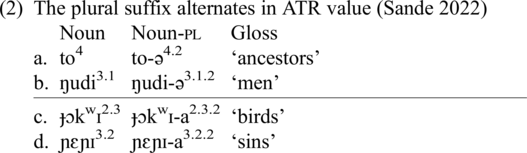
Vowels contrast in the feature ±ATR (Sande Reference Sande2017, Reference Sande2019). In general in Guébie, with the exception of a handful of proper names and loanwords, vowels within morphemes agree in ATR value. ATR harmony is also an active process in the language: affixes (but not clitics) agree in ATR value with root vowels (Sande Reference Sande2017, Reference Sande2019, Reference Sande2022). All vowels within a word are either +ATR [i, e, ǝ, o, u] or −ATR [ɪ, ɛ, a, ɔ, ʊ]. For words containing multiple morphemes, the ATR value of vowels in prefixes and suffixes varies with the ATR value of vowels in the root. This applies to number-marking morphology on nouns and valency-changing morphology on verbs. Clitics, which include the definite marker in the nominal domain, nominalizers on verbs, and a series of inflectional markers that attach to an auxiliary, if one is present, or the verb if there is no auxiliary, are not subject to harmony. Sande (Reference Sande2019) analyzes the domain of harmony as due to cyclic spell-out, where clitics are outside the syntactic phase that corresponds to prosodic word boundaries and the application of harmony.
An example of a nominal affix (plural) alternating with ATR is given in 2, and a verbal affix (applicative) alternating with ATR is given in 3.

To summarize, throughout the language there is regular, root-controlled ATR harmony that affects affixes (both prefixes and suffixes) within a word. Harmony never crosses word boundaries (though see Section 2.5).
2.2. Basic word order
Guébie basic word order is SAuxOV when an auxiliary is present, or SVO when there is no auxiliary, as seen in 4. Auxiliaries mark future, mood, and negation.Footnote 1

When an auxiliary is present, the verb is clause-final. It surfaces after objects, adpositional phrases, and adverbs, as in 5.

Additionally, both objects in a ditransitive construction come before the clause-final verb, as seen in 6.

On the basis of these word-order facts, we assume a head-final VP. Sande (Reference Sande2017) analyzes the alternation between SAuxOV and SVO as due to verb movement to a head-initial T when no auxiliary is present, plus an EPP (extended projection principle) feature on T, which requires subject movement to Spec,TP (cf. Koopman Reference Koopman1984 on Vata). Evidence that the verb moves to T rather than C comes from the fact that only the subject can immediately precede the verb in SVO clauses or the auxiliary in SAuxOV clauses, and in topic and focus constructions, multiple constituents can precede the verb: TopFocSAuxOV or TopFocSVO (this is not a V2 pattern). Evidence that the verb moves to T and not a lower position like v in SVO clauses comes from the fact that tense, aspect, mood, and polarity are exponed in that same position through auxiliaries, enclitics, or tone on verbs, and that adverbs and other elements cannot intervene between the subject and auxiliary in SAuxOV or between the subject and verb in SVO clauses. We adopt Sande’s assumption that the auxiliary in SAuxOV clauses and the verb in SVO clauses surface in T. We further assume that T is head-initial, while lower projections in the verbal extended projection are head-final. See also Sande et al. Reference Sande, Baier, Jenks, Clem, Jenks and Sande2019 for a discussion of how this mixed headedness underlies the type of SAuxOV order found in Kru and Mande languages more generally.
In addition to the clause-final position of verbs, there are other head-final properties in the language, such as postpositions and not prepositions (7), and determiners being final within noun phrases (8).


In SVO clauses, the verb inflects for aspect via systematic tone changes, as shown in 9. The first tone of an imperfective verb surfaces one step lower on the four-tone scale than its perfective counterpart. For more on this scalar tone process, see Sande Reference Sande2018, Reference Sande2022 and Sande et al. Reference Sande, Jenks and Inkelas2020.


2.3. Particle verbs
Guébie has a class of particle verbs, which involve a verbal element and a prefixing particle that together act as a phrasal idiom. The meaning of the verb and particle together is unpredictable and not compositional, as demonstrated in 10, similar to particle verbs in a number of other languages (Booij Reference Booij2002). In a corpus of about 10,000 utterances, of the unique verbs, about 25% of them are particle verbs.

The list in 10 contains stative, intransitive, transitive, and ditransitive verbs. Many particles can surface with multiple different verbs, and a few verbs can surface with multiple different particles (see e.g. /salɪ2.3/ in 10d and 10h). Meanings of the bare verbs are given in parentheses when it is possible for a given verb to surface without a particle. Some particles can be used on their own as postpositions, and these meanings are given with the particle where applicable. However, this postpositional meaning is not clearly retained in particle-verb constructions, nor is it obvious that any one of the particles adds a consistent meaning across all of the particle verbs it is a part of. That is, the meanings of particle-verb constructions are idiomatic and noncompositional.
In SAuxOV contexts, particles surface as prefixes on the clause-final verb, as in 11a. In SVO contexts, the verb surfaces immediately after the subject; particles surface clause-finally, forming a prosodic word unto themselves, as in 11b. Particles can never surface with the verb in the immediately postsubject position, as shown by the unacceptability of 11c.

In SAuxOV contexts, when particles surface as verbal prefixes, they are subject to ATR vowel harmony controlled by the verb root. In 12, we see the same particle surfacing on two different verbs, one with +ATR vowels in 12a, and another with −ATR vowels in 12b. The particle /jɔkʊ2.3/ has −ATR vowels in its default form, but surfaces with +ATR vowels when preceding a +ATR verb root in an SAuxOV clause. Other particles are +ATR by default but surface as −ATR before −ATR roots. For each particle (bold), the ATR value of its vowels varies with the ATR quality of the vowels in the verb root (underlined) in SAuxOV clauses.


In SVO contexts, when the verb moves to T and the particle remains clause-final, there is no vowel harmony between verb and particle. The particle surfaces with its default vowel quality (−ATR in 13), no matter the vowels of the verb root.


We assume following Sande Reference Sande2019 that the domain of vowel harmony corresponds with a syntactic domain, and we specifically adopt the analysis in Section 6 that the vP is the domain of root-controlled harmony that is relevant for the verbal word. In SAuxOV contexts, the verb and particle are both spelled out as part of a single prosodic word in the vP, while in SVO contexts only the particle is spelled out within vP and it does not form a prosodic word with the verb. Thus it is only in SAuxOV constructions that the conditions for vowel harmony application are met.
Particles differ from postpositions in their morphosyntactic and phonological behavior. Postpositions must always occur with an overt noun phrase complement, as in 14a, while particles need not, as shown in 14b. Unlike particles, postpositional phrases need not occur clause-finally in SVO clauses, as seen in 14c, nor need they appear immediately before the verb in SAuxOV clauses, as 14d shows. Additionally, postpositions never show ATR alternations, as shown in 14e, while particles do in SAuxOV constructions, as in 12. Thus, we treat particles as distinct from postpositions.


2.4. Verb focus
There is a clause-initial focus position in Guébie in both main and embedded clauses, as demonstrated in 15. Subjects, objects, postpositional phrases, and adverbs can fill the focus position, in which case the interpretation is focus on the fronted element. Focused elements are underlined.


We assume that clause-initial focused elements move to surface in Spec,CP.Footnote 2
Verbs can also be focused, in which case the verb surfaces twice, once at the left edge of the clause, and once in its position within the SVO or SAuxOV clause, as seen in 16.

Some verbal morphology can optionally surface on both copies of the verb, while other verbal affixes and clitics systematically do not surface on the fronted copy of the verb.Footnote 3 The generalization that emerges is that structurally low morphology can double with the verb, while structurally high morphology cannot. For example, low valency-changing affixes, like the applicative and reciprocal, must surface on the lower copy of the verb and can optionally also surface on the verb in the focused position, as seen with the applicative suffix /-li/ in 17a and the reciprocal construction—which involves reduplication and suffix /-li/—in 17b. These valency-changing morphemes are optionally copied in both SVO and SAuxOV verb-doubling contexts; we show only SVO clauses for reasons of space.Footnote 4


In contrast, there is a series of enclitics that surface on the element in T, including a past-tense marker, object enclitics, and polar question particles, and these never surface on the focus-fronted verb, as 18 demonstrates.

Objects are not fronted along with the verb in verb focus contexts, as shown in 19.

In the context of a verb focus interpretation, it is ungrammatical for adverbs, adpositions, or other adjuncts to front along with or instead of the verb. In the examples below, it is ungrammatical in verb focus contexts to front or double the adverb ‘ever’ (20a), the manner adverb ‘quickly’ (20b), or the postposition or postpositional phrase ‘with (a spoon)’ (20c).


Verb doubling in predicate-fronting constructions is widely attested within Africa (Ameka Reference Ameka1992, Manfredi Reference Manfredi, Byrne and Winford1993, Biloa Reference Biloa1997, Koopman Reference Koopman1997, Aboh Reference Aboh1998, Reference Aboh2006, Hiraiwa Reference Hiraiwa2005, Kropp Dakubu Reference Kropp Dakubu2005, Hein Reference Hein, Barnickel, Naranjo, Hein, Korsah, Murphy, Paschen, Puškar and Zaleska2016, van Putten Reference van Putten2016) and outside of Africa (Abels Reference Abels, Franks, King and Yadroff2001, Cable Reference Cable2004, Landau Reference Landau2006, Ürögdi Reference Ürögdi2006, Aboh & Dyakonova Reference Aboh and Dyakonova2009, Bondaruk Reference Bondaruk, Zybatow, Junghanns, Lenertov and Biskup2009, Reference Bondaruk, Cyran, Kardela and Szymanek2012, Trinh Reference Trinh2011). Such verb doubling is described for closely related Kru languages, including Bété de Guibéroua and Tépo (Marchese Reference Marchese1979) and Vata (Koopman Reference Koopman1984, Reference Koopman1997). However, there is no discussion in the Kru literature of how particle verbs pattern in verb focus constructions. In Guébie, at least, the behavior of particle verbs in verb-focus constructions presents an interesting syntactic and phonological puzzle, which we turn to now.
2.5. Particle verb focus
For particle verbs in verb focus constructions, we do not see verb doubling. Instead, as seen in 21a, the particle surfaces in the focus position and the verb surfaces in a lower position in the clause (either in T when there is no auxiliary or clause-finally when an auxiliary is in T). The verb and particle cannot both surface in the focus position, as shown in 21b, and verb doubling is impossible if a particle is present, as seen in 21c. The verb cannot surface in the focus position, leaving the particle behind (21d). The particle also cannot appear in both a low position in the clause and the focus position, as demonstrated by 21e.

The examples in 21 are SVO clauses. In SAuxOV clauses, we also see the particle surfacing in the focus position, and not in its base position (22).

As discussed in Section 2.3, particles in particle verbs are distinct from postpositions in morphosyntactic and phonological properties. Another way in which they differ is that postpositions, unlike particles, cannot surface alone in the left-edge focus position. An entire postpositional phrase can be focused (23b), or a postposition can be stranded low when its complement is focused (23c); however, there is no context in which a postposition can front and strand its complement (23d) (cf. 22, where a particle surfaces alone in the focus position).


There is no vowel harmony between particle and verb in SVO focus constructions, as seen in 21a, repeated in 24a. However, quite unexpectedly, the fronted particle in SAuxOV focus constructions still shows harmony with the verb, despite the intervening subject, auxiliary, and object, as shown in 24b.


This is a rare case of what we refer to as discontinuous harmony, where intervening material is unaffected. This kind of ‘ultra long-distance ATR agreement’, as Sy (Reference Sy2005) calls it, is previously described for only one other language that the authors are aware of, namely in Wolof relative clauses (Sy Reference Sy2005, Martinović Reference Martinović2019), discussed further in Section 7.
The behavior of particle verbs in focus constructions raises a number of analytical questions. Why do particles front, with no verb doubling, in particle-verb focus constructions? Why do we see discontinuous harmony in SAuxOV particle-fronting constructions but not SVO particle-fronting constructions? Before turning to an account of these puzzling properties, we first demonstrate that Guébie predicate fronting involves movement in the syntax.
3. Evidence for movement in Guébie focus constructions
This section aims to establish that Guébie predicate fronting involves movement rather than base-generation of the focused element in Spec,CP. We also present evidence that addresses the timing of this movement. The existence of discontinuous harmony in PartSAuxOV contexts might suggest a very late dislocation process at PF after vowel harmony applies. However, if the dislocation were postsyntactic, we would not expect it to be sensitive to narrow syntactic constraints on movement like islands, nor would we expect it to affect other narrow syntactic movement processes. Yet, as we show here, the movement involved in predicate fronting does show the profile of narrow syntactic movement rather than prosodic dislocation at PF.
Verb focus shows evidence for successive cyclicity, which is expected if verb focus involves movement, but not if it involves base generation of the focused verb. The verb or particle can front from an embedded clause to appear at the left edge of the matrix clause. When this happens, a copy of the fronted element can optionally also appear at the left edge of the embedded clause, as in 25 and 26.


Additionally, a doubled verb or fronted particle moving out of an island is judged as bad or odd, as shown by the degraded nature of 27b and 28b. We show only an SVO clause for reasons of space, but the same facts hold in SAuxOV clauses.Footnote 6


Further, verb doubling or particle fronting creates a structure that is an island for further movement, as shown in 29–30. When verb doubling or particle fronting occurs in an embedded clause, long-distance wh-movement out of the embedded clause is blocked, as in 29b and 30b, despite the general availability of long-distance wh-movement, seen in 29a and 30a.


The fact that predicate fronting is island-sensitive and also creates islands for wh-movement is evidence that the movement involved in predicate fronting takes place in the narrow syntax.
Based on the evidence presented here, we conclude that a base-generation account of predicate fronting is untenable for Guébie. Further, the empirical profile of this movement aligns with it occurring in the narrow syntax, rather than at PF. Given this evidence that Guébie predicate fronting involves narrow-syntactic movement, we now turn to a syntactic analysis of this focus-fronting construction.
4. The syntax of predicate fronting
In analyzing the syntax of predicate fronting in Guébie, we first focus on developing an analysis that can derive the correct surface distribution of elements. Of particular interest is how to derive verb doubling in cases of focusing regular verbs and particle fronting in cases of focusing particle verbs. We temporarily set aside the issue of how to account for vowel harmony in predicate-fronting constructions, though we return to this question shortly.
We first present our analysis of predicate fronting, which draws largely on the analysis of predicate clefts offered by Koopman (Reference Koopman1997). We then briefly outline some of the challenges faced by alternative analyses of predicate fronting.
4.1. Predicate fronting via remnant-VP movement
Koopman (Reference Koopman1997) offers an analysis of predicate clefts in Vata (Kru; Côte d’Ivoire) and Nweh (Grassfields Bantu; Cameroon). In these predicate clefts, the verb is pronounced in an initial focus position as well as a lower position in the clause. This pattern looks very similar to the verb doubling seen with verbs that lack associated particles in Guébie. Koopman argues that in Vata and Nweh, the object obligatorily evacuates the VP. The verb undergoes head movement in the syntax to T, and the remnant VP fronts to Spec,FocP to result in verb or VP focus. This creates two distinct movement chains, as the copy of the verb inside the fronted VP does not c-command the copy of the verb in T. The copy of the verb in T is the head of one movement chain, so it is spelled out. The verb inside the fronted VP is also spelled out, which Koopman assumes is for recoverability reasons to indicate that focus movement took place.
For verb-doubling constructions in Guébie, we can essentially adopt the same analysis offered by Koopman. For VSVO orders, we assume that the object undergoes object shift out of the VP,Footnote 7 and the verb undergoes head movement through v to T to appear in its position between the subject and object. To indicate verb focus, the remnant VP undergoes movement to Spec,CP.Footnote 8 This is schematized in 31.

In this structure, the verb will be pronounced in T as the head of the head movement chain. Since all material has moved out of the VP, the copy of the verb inside the remnant VP in Spec,CP will also be pronounced for recoverability reasons to indicate that focus movement has taken place. While subsequent work has questioned the need for this type of cross-modular recoverability constraint (Landau Reference Landau2006), we will see that purely phonological constraints cannot straightforwardly derive double pronunciation of the verb in the correct environments.
The derivation of VSAuxOV orders is very similar to what we saw above for VSVO orders. The only difference is that in these constructions, the main verb undergoes head movement only as high as v. The higher auxiliary surfaces in T immediately after the subject. In this type of structure, schematized in 32, the verb is pronounced in v as well as in the remnant VP in Spec,CP.

Koopman (Reference Koopman1997) does not discuss the behavior of particle verbs in predicate clefts in Vata and Nweh. However, her analysis can be straightforwardly extended to predicate-fronting constructions involving Guébie particle verbs. In PartSVO clauses, we can assume that, as in VSVO clauses, the verb undergoes head movement through v to T and the remnant VP fronts to Spec,CP. Because the object has shifted out of the VP and because the verb has undergone head movement out of the VP, the only material remaining in the fronted VP will be the particle. This is schematized in 33.

Because the particle remains in the fronted VP, there is no reason for a copy of the verb to be pronounced in the fronted VP for recoverability reasons. The fronted particle itself serves to indicate that there was focus movement of the predicate. Thus, with particle verbs, the verb is only pronounced as the head of the head-movement chain and we do not see verb doubling.
The final possible order that we consider is PartSAuxOV. In these constructions, like in VSAuxOV structures, the verb moves only as high as v due to the presence of the higher auxiliary. As in PartSVO structures, the fronted VP contains the particle, which is pronounced in the initial focus position, as shown in 34.

This analysis can derive both the pattern of verb doubling and the pattern of particle fronting, as desired. However, we have not yet considered the pattern of vowel harmony observed with particles. Recall that in PartSVO structures the particle does not harmonize with the verb, while in PartSAuxOV structures it does. This is puzzling since the particle is linearly separated from the verb in both of the constructions. We might assume that the unpronounced copy of the verb in the fronted VP is able to trigger harmony on the particle. However, this would predict that the fronted particle should always harmonize with the verb since there is always a copy of the verb local to the particle. This suggests that the source of harmony cannot be the copy of the verb in the remnant VP. We instead suggest that it is the overt copy of the verb in the head-movement chain that governs whether harmony applies to the particle. We offer the details of this analysis in Section 6, but first we demonstrate that alternative approaches to the syntax of predicate fronting face challenges in accounting for the full range of patterns found in Guébie.
4.2. Problems for alternative approaches to predicate fronting
Multiple approaches to predicate fronting have been entertained. In this section we do not intend to provide an exhaustive overview of previous proposals but rather to demonstrate that modifying various of the assumptions we have made causes issues.
One of the first aspects of the approach we adopt here that has received scrutiny in the literature is the appeal to recoverability to drive double pronunciation of the verb. Landau (Reference Landau2006) criticizes cross-modular recoverability constraints and instead suggests that cases of verb doubling should be driven by purely phonological pressures. He offers an analysis of two minimally different patterns of verb doubling in Hebrew. The first, which he calls phrasal-infinitive fronting (shown in 35a), involves an infinitival verb and the internal argument appearing in a fronted position, while the fully inflected verb appears lower in T. The second pattern, bare-infinitive fronting (shown in 35b), involves an infinitival verb appearing alone in a fronted position and a fully inflected form of the verb appearing lower in T.


Landau (Reference Landau2006) argues that in both of these constructions the lower copy of the verb must be pronounced in T to host inflection, since Hebrew lacks do-support. To ensure pronunciation of the higher copy of the verb, Landau notes that there is special intonational prosody associated with verb-doubling constructions. He argues that the highest copy of the verb must be pronounced in order to realize this prosody.
It is difficult to see how the type of phonological constraints that Landau appeals to could derive the pattern of verb doubling in Guébie predicate fronting. The Guébie verb doubles even when the lower copy of the verb has not undergone head movement to T and an auxiliary instead hosts inflection, and it is also possible for inflection to match on both copies of doubled verbs. Further, Guébie, unlike Hebrew, does seem to allow do-support, as seen in 36, where there is a focused nominalized VP and the embedded clause surfaces with the verb no 2 ‘do’ to host the tonal inflection.Footnote 9

These facts are difficult to reconcile with an approach that would assume that the lower verb is pronounced due to phonological constraints that require a suitable host for inflection. Similarly, it is unclear what phonological motivation there would be for pronouncing the higher copy of the verb, as there is no characteristic prosody or tone pattern associated with predicate-fronting constructions in Guébie.Footnote 10
Another aspect of the analysis offered here that could be modified is the decision to treat the head movement of the verb in Guébie as syntactic movement. Harizanov and Gribanova (Reference Harizanov and Gribanova2019) propose that heads can undergo displacement via two separate mechanisms: syntactic movement and postsyntactic amalgamation. They argue that word-building head movement involves amalgamation that is triggered by features that cause heads to raise or lower onto structurally adjacent heads in the postsyntax. Harizanov and Gribanova (Reference Harizanov and Gribanova2017) demonstrate that when this postsyntactic displacement occurs in remnant-fronting configurations, it can result in multiple copies of the head that undergoes displacement being spelled out. They offer an analysis of Russian predicate fronting where AspP is fronted, yielding double pronunciation of the verb: once in the fronted AspP and once lower in the clause, as shown in 37.

They analyze this doubling as the result of postsyntactic raising of the copy of the verb out of the lower copy of AspP to a higher Aux head. Because the lower instance of the verb moves out of the lower copy of AspP marked for nonpronunciation and because it is treated as distinct from the higher copy of the verb in the higher copy of AspP due to a lack of c-command between the two, both the higher and lower copies of the verb will be pronounced.
Were we to pursue this type of analysis for Guébie, we could assume that there was postsyntactic head movement of V in both VSVO and VSAuxOV orders, resulting in double pronunciation of the verb. As in our analysis, we would have to assume that the verb always raises at least as high as v (though in the postsyntax) and that a constituent smaller than vP (such as VP) is what undergoes predicate fronting. However, under this type of analysis we run into an issue with how to block double pronunciation of the verb in constructions that involve a fronted particle, assuming that the fronted constituent contains a copy of the verb.Footnote 11 The copy of the verb in the fronted remnant VP should be pronounced, since the entire fronted copy of the constituent that contains it is marked for pronunciation, following Harizanov and Gribanova’s assumptions. Appealing to some general economy condition to avoid double pronunciation is not straightforward under these assumptions, since, following the arguments made by Harizanov and Gribanova, the two copies of the verb should be treated as distinct objects after movement operations have taken place. We see, then, that with a postsyntactic account of head movement in Guébie, it is challenging to derive all of the attested patterns involved in predicate fronting under a consistent set of assumptions.
A final modification to our analysis of predicate fronting that we consider is a change in the assumption about the size of the constituent that undergoes fronting. We have assumed that the moved constituent in predicate-fronting constructions is a remnant VP, that is, a constituent large enough to contain both the verb and the particle. However, an alternative would be to assume that the surface patterns reflect more transparently the underlying structure. We might assume that when the verb appears in initial position, the verb alone is fronted, while when a particle appears in initial position, the particle alone is fronted.
Under this type of approach, one issue that arises is how to derive double pronunciation of the verb. If VSVO and VSAuxOV orders involve long head movement of the verb to the initial focus position, it is not clear what the motivation would be for pronouncing a lower copy of the verb in the movement chain. Analyses involving remnant-VP fronting can appeal to the fact that there are two movement chains involving the verb, resulting in two pronounced copies of it. However, if it is the verb alone that is moved to the focus position and not some larger constituent containing the verb, there would be only one movement chain.
Another question that arises under such an account is what drives movement of the fronted constituent if the moving element is not of a consistent category. As discussed in Section 2.4, both verb-doubling and particle-fronting constructions yield an interpretation of verb focus. Under our analysis, it is consistently the remnant VP containing the focused verb that undergoes movement to the left periphery. However, under a long head-movement analysis, the relationship between focus and fronting is less straightforward. Particularly puzzling are the particle-fronting cases, as it is the entire verb+particle combination with a noncompositional meaning that receives the focus interpretation, rather than the fronted particle alone. This can be seen in 38.Footnote 12

Here the same particle is used in the particle-verb constructions in the first clause (bold) and second clause (underlined). In the second clause, however, the particle is fronted to indicate contrastive focus on the entire particle-verb construction. The availability of fronting for a subconstituent of the focused particle-verb construction is reminiscent of the phenomenon of Germanic subpart-of-focus fronting,Footnote 13 where it has been shown that even a subconstituent of idiomatic expressions can undergo focus fronting (Fanselow & Lenertová Reference Fanselow and Lenertová2011).Footnote 14 However, Fanselow and Lenertová argue that movement in subpart-of-focus fronting is driven by prosody, rather than focus features. This possibility does not seem fitting for Guébie, as there is no special prosodic marking associated with the fronted particle. Thus we can see that an analysis involving fronting only a syntactic head and not a larger remnant VP is not able to provide a satisfactory account of the range of Guébie patterns.
To summarize what we have seen in this section, the general picture that emerges is that modifying any of the core assumptions of our syntactic analysis results in significant challenges in accounting for the four word-order patterns attested in Guébie predicate fronting. We have considered modifications to the assumptions about (i) the type of constraints that derive double pronunciation, (ii) the timing of head movement, and (iii) the size of the fronted constituent. All of these modifications yield analyses that are unable to straightforwardly account for the full range of patterns in Guébie.
As we noted in Section 4.1, our analysis of predicate fronting does not provide a straightforward way to derive the discontinuous harmony pattern found in particle-fronting constructions under typical assumptions about vowel harmony and the syntax–phonology interface. This is a challenge that is also faced by the alternative syntactic analyses of predicate fronting discussed here. Before offering our solution to this puzzle in Section 6, we first turn to a discussion of why existing phonological approaches to harmony struggle to capture the discontinuous nature of the harmony pattern found in Guébie.
5. Previous phonological accounts of harmony
Harmony arises when the features of one speech sound (such as tongue height, rounding, or nasality) spread to and affect the production of the features of nearby sounds. Harmony is often argued to be motivated, at least diachronically, by coarticulation, where the speech gestures used to produce one sound are activated early or deactivated late, influencing nearby sounds (Ohala Reference Ohala1994:491). For example, you must retract your tongue root to pronounce a −ATR vowel, and moving your tongue root back to its advanced position takes time. If your tongue remains retracted too long after a −ATR vowel, following vowels may be pronounced as −ATR, too. Because harmony is said to be due to coarticulation, it is predicted to be local: we would not expect the properties of the first vowel in a word to affect the third vowel without also affecting the second one, and we certainly would not expect the vowels of the final word in the clause to affect those in the initial word in the clause without also affecting intervening vowels. That is, if /C/ is −ATR and /A/ and /B/ are not, in a sequence ABC we would not expect the −ATR value of C to affect A without also affecting B: * A B C . However, as we have seen in Guébie, harmony is not always local, and it can be discontinuous on the surface.
There are many purely phonological analyses of (local) harmony, including but not limited to autosegmental spreading (Clements & Sezer Reference Clements, Sezer, van der Hulst and Smith1982, Steriade Reference Steriade1987), coarticulation in Articulatory or Gestural Phonology (Gafos Reference Gafos1998, Reference Gafos1999), and Agreement by Correspondence (Hansson Reference Hansson2001, Rose & Walker Reference Rose and Walker2004). Each of these existing phonological models of harmony predicts that harmony should be strictly segmentally local, or at least local on a specific tier.
5.1. Autosegmental approaches to harmony
In an autosegmental spreading account assuming feature geometries, the features of a segment may associate to an adjacent node on some tier, as in the spreading of the [−ant(erior)] feature in the depiction of sibiliant harmony in 39, adapted from Hansson Reference Hansson2020.

In an autosegmental approach like that in 39, the initial /s/ is underlyingly associated with a [+ant] feature, and the final /ʒ/ with a [−ant] feature. The [−ant] feature spreads (indicated with a dotted line) to the preceding adjacent element on the coronal tier, namely the /s/. Any previously linked [±ant] feature is delinked. Despite the fact that /s/ is not local to /ʒ/ on the segmental tier, it is local on the [anterior] tier since nothing between /s/ and /ʒ/ is coronal, and thus nothing intervening is specified for anteriority. Only segments with a coronal specification are predicted to participate in anterior harmony on this approach, and even more specifically, only (tier-)adjacent coronal segments.
The only possible exception to tier-local harmony in an autosegmental model would be so-called transparent segments. Some segments are described as being transparent to harmony, meaning that they neither participate in harmony nor block features from spreading past them. For example, /i, e/ do not participate in backness harmony in Finnish, but backness harmony can apply across intervening /i, e/ (van der Hulst & van de Weijer Reference van der Hulst, van de Weijer and Goldsmith1995, Ringen & Heinämäki Reference Ringen and Heinämäki1999). In 40a we see that a root with front vowels triggers a front vowel in the essive suffix. A root with back vowels as in 40b triggers a back vowel in the same essive suffix. In 40c the root contains a back [o] followed by a transparent [i]. The backness spreads from the [o] to the suffix, despite the intervening transparent [i], and the [i] does not itself trigger harmony.

One solution for Finnish transparent vowels is to prohibit a [+back] feature from spreading to a [−round] vowel (Ringen & Heinämäki Reference Ringen and Heinämäki1999). Or one could say that, phonologically, transparent vowels do undergo harmony (the [+back] feature in Finnish spreads to /i, e/ in the phonology), but with no phonetic effect (Finley Reference Finley2008, Jurgec Reference Jurgec2011) due to a Finnish-specific phonology/phonetics interface rule. Both approaches predict that vowels intervening between a trigger and target that are eligible to harmonize will do so. Only vowels that are phonetically incompatible with the harmonizing feature can be transparent to harmony, resulting in potentially nonlocal harmony, as in 40c.
In Guébie, however, vowels that intervene in cases of discontinuous harmony are not transparent. That is, all vowels in Guébie participate in ATR harmony. All ten vowels in the system are eligible to harmonize (+ATR /i, e, ǝ o, u/, −ATR /ɪ, ɛ, a, ɔ, ʊ/). All affixes, such as the plural suffix [-a/ǝ2], and some clitics alternate in ATR quality depending on the vowels in the word they attach to. This means that these affixes and clitics are demonstrably eligible to harmonize. Words containing these morphemes can intervene between a fronted particle and low verb in PartSAuxOV contexts—as is the case for ɟɔkwɪ-a 2.3.2 ‘birds’ in 41, where the plural suffix is [-a] rather than [-ǝ] because the root contains −ATR vowels—but they do not agree in ATR quality with the clause-final verb that triggers +ATR harmony on the clause-initial fronted particle.

In 41, the vowels of the subject pronoun, prospective auxiliary, object ‘bird’, and the plural suffix on the object all surface as −ATR despite intervening between the clause-final verb that triggers +ATR harmony and the clause-initial target of harmony, the particle.
This is to say that intervening vowels between the verb and particle in Guébie PartSAuxOV clauses are not transparent in the traditional sense: vowels of the same quality are subject to harmony in other morphosyntactic contexts, and the same intervening morphemes are demonstrably subject to harmony, and in fact undergo word-internal harmony even in PartSAuxOV clauses, but are not affected by the ATR quality of the verb. Vowels of the subject, auxiliary, object, and other intervening material do not participate in harmony triggered by the clause-final verb, even though the clause-initial particle does.
5.2. Articulatory or gestural approaches to harmony
Gestural or articulatory accounts of harmony explicitly rely on coarticulation, or overlap of articulatory gestures, to derive harmony. For example, a tongue-root gesture may begin earlier or persist later than its target, resulting in harmony, as with the +ATR gesture of the [i] vowel in Nandi (Kalenjin; Kenya) (Smith Reference Smith2018). In 42 the ‘Tongue Root advanced’ gesture is associated with the /i/ vowel; however, it is activated before the onset of the syllable containing the /i/, and deactivated after the offset of the [i], as indicated by the dark gray bar that spans the entirety of the word [kakikas].

If the early or late advanced tongue root gesture overlaps with a vowel that is compatible with being produced with an advanced tongue root, the surface result will be ATR harmony. If, as in the Nandi example in 42, the relevant vowels are incompatible with an ATR gesture or that gesture would have no noticeable effect, there is no surface alternation. In other words, if vowels are transparent to ATR harmony, they may overlap with a tongue-root gesture with no noticeable effect. Intervention of transparent vowels of this sort is the only case in which an articulatory or gestural account could predict harmony that is not strictly local. However, as discussed in the previous section, the vowels that intervene in the case of discontinuous harmony in Guébie are not transparent to ATR harmony (cf. 41). Thus the type of discontinuous harmony seen in Guébie is not predicted by a gestural or articulatory account.
5.3. Agreement-by-correspondence approaches to harmony
In agreement by correspondence (ABC) (Rose & Walker Reference Rose and Walker2004:494–95), the interactions of Correspondence, Identity, and Proximity constraints in an Optimality Theory framework ensure that harmony applies locally, if at all.
Correspondence constraints ensure a correspondence relationship between similar segments in the output. In 43, the two consonants C are in a correspondence relationship, indicated by their shared coindices, x. Identity constraints ensure that corresponding segments are identical (in some feature), as indicated by the [αF] linked to the two Cs in 43. Proximity constraints limit the domain within which correspondence applies.

Building on previous work by Ní Chiosáin and Padgett (Reference Ní Chiosáin, Padgett and Lombardi2001) and others, Rose and Walker (Reference Rose and Walker2004) propose that ‘strict segmental locality’ will hold between corresponding harmonizing segments, and they implement this proposal with the three constraint types listed above.
For ATR harmony, then, vowels within a word or spell-out domain could be in correspondence, and an Id-Corr(ATR) constraint (‘Corresponding segments must agree in the value of the feature [ATR]’) could ensure identity of ATR features among corresponding vowels. Like autosegmental or gestural approaches, in ABC only vowels that are local (or tier-local) are expected to interact with respect to harmony. Without allowing a novel mechanism by which vowels on opposite ends of the clause could be in correspondence without also corresponding with intervening vowels, discontinuous harmony as seen in Guébie (cf. 41) would not be predicted.
5.4. Summarizing the problems for phonological approaches
While any of these phonological approaches could handle the ‘regular’ continuous harmony in Guébie discussed in Section 2.1, none of them, on their own, can account for the discontinuous harmony we see in particle-verb focus contexts as in 24b or 41.
In each phonological approach to harmony, only segments consecutive on some representational tier should be able to affect each other’s features or gestures. This is problematic for the discontinuous harmony we have seen in Guébie, since intervening material is unaffected by the ATR quality of the vowels in the verb, including vowels that are eligible to harmonize, and only the particle is affected. For example, in 41 the particle and verb surface on opposite ends of the clause, but the particle still shows +ATR vowels, triggered by the verb root, despite the intervening nonharmonizing subject, auxiliary, and object. The subject, auxiliary, and object all contain vowels that are in principle able to harmonize, but they do not alternate in this particular syntactic construction. While any of the purely phonological approaches discussed in this section could account for the local harmony patterns found in Guébie, discontinuous harmony of the type found in particle-verb focus constructions is not predicted by any purely phonological model of harmony.
6. Discontinuous harmony and the interleaving of phonology and syntax
We have now arrived at what would appear to be a problematic state of affairs. Phonological approaches to harmony require relatively strict locality between the trigger and target of harmony. Under our syntactic analysis of predicate fronting, the harmonizing particle in PartSAuxOV constructions is not local to an overt copy of the verb, but it is local to an unpronounced copy of the verb within the fronted VP. If this local silent copy of the verb were able to trigger harmony, this could explain how the particle shows vowel harmony with the verb. However, this would then create problems for analyzing the nonharmonizing particle in PartSVO structures, as discussed in Section 4.2, since there is also a local unpronounced copy of the verb to trigger harmony in these constructions.
It would seem, then, that the local (silent) copy of the verb cannot be responsible for triggering harmony in particle-fronting constructions, and yet a local harmony trigger is needed under standard phonological approaches to harmony. Rather than abandon locality constraints on harmony, we suggest instead that it is a different local configuration of verb and particle that results in harmony. Namely, it is the local configuration of the verb and particle lower in the clause, within the vP, that determines whether harmony applies. We argue that if the verb and particle are sufficiently local low in the clause, when the vP phase is spelled out, the particle will harmonize with the verb. When the particle later undergoes focus fronting it will retain the established ATR value. If, by contrast, the particle and the verb are not local when the vP phase is spelled out, due to head movement of the verb to T, the particle and verb will not harmonize. Thus we derive the sensitivity of harmony in focus constructions to the position of the verb within the clause. This approach is also able to straightforwardly account for why we always see harmony between the verb and particle in SAuxOV clauses, independent of whether there is focus movement, but never in SVO clauses.
As we will see, one consequence of this approach to Guébie discontinuous harmony is that we must allow material that has already been spelled out in a lower phase to be accessible to syntactic operations such as movement in higher phases. This requires a reexamination of some existing assumptions about the syntax–phonology interface, such as the availability of syntactic features at PF and the nature of the Phase Impenetrability Condition (PIC). In laying out our analysis, we address these issues and offer a perspective on them that is informed by the particular set of challenges the Guébie data present.
6.1. Guébie harmony via cyclic spell-out
As mentioned above, the basic intuition of our analysis lies in the fact that it is the verb’s position within the clause that determines whether the particle undergoes harmony with the verb. In SAuxOPartV orders and in PartSAuxOV orders, the particle harmonizes with the verb. What these two orders have in common is the fact that the verb does not undergo movement to T but rather is spelled out within the vP phase. In SVOPart and PartSVO orders, both of which involve the verb being spelled out in T and not in the vP, the particle does not undergo harmony. We thus connect the availability of harmony to whether the verb is spelled out in the lower phase where the particle is located. This is summarized in 44.

We adopt a cyclic model of spell-out, with vP and CP constituting phases in the clause (e.g. Chomsky Reference Chomsky, Martin, Michaels and Uriagereka2000). Following Chomsky Reference Chomsky and Kenstowicz2001, we assume that a phase is spelled out upon Merge of the next highest phase head. For our purposes, spell-out of the phase will include the phase head and its complement (Newell Reference Newell2008, Skinner Reference Skinner2009, Newell & Piggott Reference Newell and Piggott2014, Coon Reference Coon2017, Sande et al. Reference Sande, Jenks and Inkelas2020, Felice Reference Felice2022, among others). Thus, the lower vP phase, including v itself, will be spelled out when C is merged. We also assume, following Sande Reference Sande2019, that vowel harmony in Guébie applies to material that is spelled out within the vP phase.
With these assumptions in place, we turn to the derivation of PartSAuxOV structures with harmony. Recall that, under our analysis, in PartSAuxOV structures the verb moves only as high as v. Recall also that we assume object shift of the object out of the VP. Thus when the vP phase is spelled out upon Merge of C, it will contain the verb in v and the particle (by virtue of the fact that the remnant VP will not yet have undergone movement to Spec,CP). Because the verb and particle are local to one another in the vP, vowel harmony will apply, as schematized in 45.

The specific implementation of local harmony within the vP is not crucial to our analysis; in fact, any of the approaches to local harmony discussed in Section 5 could derive local ATR harmony in Guébie equally well. Here we adopt the constraint-based ABC approach to Guébie local harmony proposed by Sande (Reference Sande2019).
Sande (Reference Sande2019) shows that valency-changing affixes on verbs agree with the verb root in ATR quality, while outer suffixes do not. She proposes that ATR harmony applies within the vP (Voice) phase before outer affixes are present in the derivation, and she adopts the constraints in 46 and 47 to derive ATR harmony.


The constraint in 47 is a modified ABC constraint that combines the effects of correspondence and identity constraints (cf. Section 5.3) in a framework called Agreement by Projection (ABP) (proposed by Hansson (Reference Hansson2014), and illustrated in Walker Reference Walker2016 and Lionnet Reference Lionnet2016, Reference Lionnet2017). ABP constraints evaluate only those segments with a particular feature (here +syllabic), on a separate tier from the rest of the word or phrase under evaluation, much like the tier-based locality of autosegmental phonology (cf. Section 5.1). Within the vP domain, the harmony-inducing constraint in 47 outranks or outweighs the identity constraint in 46, resulting in surface harmony within this domain. When particles and verbs are both spelled out within the vP, the particle is sufficiently local to the verb to be subject to verb-controlled ATR harmony.
After the spell-out of the vP phase, the next step in the narrow syntactic derivation will be to move the remnant VP to Spec,CP.Footnote 15 We assume that this movement is able to apply to material that has already been fully spelled out in the lower phase. Since the particle within the remnant VP has already been spelled out and has already had its ATR value determined via harmony with the verb in the vP, it will retain this ATR value when it undergoes focus fronting. Thus the fronted particle will display harmony with the clause-final verb, despite no longer being local to it on the surface.
We can contrast this with the derivation of PartSVO structures, in which the particle does not harmonize with the verb. Recall that these constructions involve head movement of the verb all the way to T. Because of this head movement, when the vP is spelled out, it will contain only the particle. Thus, the particle will be spelled out with its default ATR value since there is no sufficiently local harmony trigger, as illustrated in 48.

When the remnant VP subsequently undergoes fronting to Spec,CP, the particle will surface with this default ATR value and will not show harmony with the verb in T.
To summarize, in both types of constructions involving fronted particles, the particle undergoes spell-out first as part of the lower vP phase. If the verb is present in the vP phase as a trigger for harmony, the particle harmonizes, and if not (as in SVO clauses), the particle surfaces in its default form. Once the ATR value of the particle is set in the lower phase, the particle subsequently undergoes focus movement as part of the remnant VP to arrive in its surface position.
6.2. Guébie harmony and the syntax–phonology interface
This account of discontinuous harmony crucially relies on the assumption that material that has already been spelled out can remain accessible to further syntactic operations. This assumption is incompatible with views of the syntax–phonology interface that assume that syntactic features are no longer accessible once morphophonological processes have applied (cf. bracket erasure in Lexical Morphology and Phonology (Kiparsky Reference Kiparsky, van der Hulst and Smith1982, Reference Kiparsky1985) and Stratal OT (Bermúdez-Otero Reference Bermúdez-Otero1999, Reference Bermúdez-Otero and Trommer2012), and discharge or rewrite of morphosyntactic features when phonological content is inserted in Distributed Morphology (Harley & Noyer Reference Harley and Noyer1999, Bobaljik Reference Bobaljik2000, Embick & Noyer Reference Embick, Noyer, Ramchand and Reiss2007)). Because, as we have argued, it must be the position of the verb inside or outside of the lower vP phase that determines whether harmony applies, Guébie provides evidence that the ATR value of the particle must be determined in a different position from the one in which the particle actually surfaces. Thus it is necessary that movement be able to apply after harmony.Footnote 16 By interleaving syntax and phonology in the way we propose here, we can capture this pattern. However, in order for syntax to still be able to manipulate objects that have been spelled out, we must assume that spell-out does not result in the immediate deletion of all syntactic information. At a minimum, information-structural features, syntactic labels, and information about constituency and hierarchical structure must be preserved for later cycles of the narrow syntactic derivation.
The idea that narrow syntactic movement can apply to material that was already spelled out would also seem to run afoul of the PIC (Chomsky Reference Chomsky, Martin, Michaels and Uriagereka2000). Strict versions of the PIC often rely on the idea that spell-out freezes the material in a phase, making it entirely inaccessible to further syntactic manipulation (Chomsky Reference Chomsky, Martin, Michaels and Uriagereka2000, Reference Chomsky and Kenstowicz2001, Reference Chomsky, Freiden, Otero and Zubizarreta2008, among others). However, there has been a growing critique of the PIC, ranging from those who argue that the PIC can be parameterized, weakened, or obviated in some way (d’Alessandro & Scheer Reference d’Alessandro and Scheer2015, Agarwal Reference Agarwal2022, Lee & Yip Reference Lee and Yip2024, among others) to those who argue that the PIC can be dispensed with altogether (Fox & Pesetsky Reference Fox and Pesetsky2005, Truswell Reference Truswell2005, Newell Reference Newell, Newell, Noonan, Piggott and deMena Travis2017, Branan & Davis Reference Branan and Davis2019, Halpert Reference Halpert2019, Thivierge Reference Thivierge2021, Bešlin Reference Bešlin2024, Halpert & Zeijlstra Reference Halpert and Zeijlstra2025, among others). One thing these accounts have in common is the observation that not all phrases we assume to be phasal exhibit the type of opacity we would expect under the PIC, with only the phase edge being visible to further derivational steps. This is precisely what we have observed in Guébie. While we have evidence for a low phase that constitutes a spell-out domain in which harmony applies, elements within that domain seem to be visible for syntactic manipulation, despite not being the specifier of the phase head. For the accounts that reject the PIC entirely, they typically assume that effects that have classically been associated with the PIC, such as successive cyclic movement, can actually be reduced to other independent factors of the grammar, making the type of freezing associated with the PIC unnecessary. We argue that the Guébie harmony pattern provides support for an alternative approach to phases along these lines that does not assume that material becomes inaccessible upon spell-out.
One option for deriving phasehood effects without the strict PIC that appears promising given the Guébie data is Cyclic Linearization (Fox & Pesetsky Reference Fox and Pesetsky2005; see also Sabbagh Reference Sabbagh2007, Ko Reference Ko2007, Reference Ko2011, Reference Ko2014, Branan & Davis Reference Branan and Davis2019, Davis Reference Davis2020, Reference Davis2021, Lee Reference Lee2021, among others). Under this view, the constraints on movement typically associated with phase impenetrability are due to the fact that the linearization algorithm cannot result in conflicting linearization statements in different cycles of spell-out. For example, if A precedes B in the linearization of one phase, the linearization of a subsequent phase cannot result in an order where B precedes A. This has the effect of allowing only the leftmost element in a phase to undergo movement in a later cycle, deriving the apparent phase edge ‘escape hatch’.
In Guébie focus fronting, the spelled-out particle must be free to undergo subsequent movement. The particle is consistently the leftmost overt element in the vP phase upon spell-out due to the fact that objects undergo shift out of the VP. This means that the remnant VP that contains the particle as the only remaining overt element will be free to undergo movement without creating any conflicting linearization statements when the higher CP phase is spelled out. Thus, this linearization-based approach to the PIC seems to allow sufficient flexibility to derive the Guébie patterns of predicate fronting while preserving a constrained view of movement out of lower phases.
7. Discontinuous harmony beyond Guébie
The analysis presented in Section 6 makes predictions about where we might see other instances of discontinuous harmony across languages. Specifically, it predicts that the target and trigger of harmony must be local at some point in the derivation, namely at an instance of spell-out. It also predicts that the target or trigger must be subject to syntactic movement after spell-out. In this section we consider another case of discontinuous harmony in Wolof, demonstrating that it displays the same profile as the pattern found in Guébie: local harmony within a spell-out domain, followed by movement. Thus the Wolof facts not only confirm the existence of discontinuous harmony, but also support the analysis proposed for Guébie based in a cyclic model of spell-out.
Wolof is the most widely spoken language in Senegal. Urban and rural varieties of Wolof vary quite drastically. For more on the status of Wolof in Senegal, see McLaughlin Reference McLaughlin2001, Reference McLaughlin, Vigouroux and Mufwene2008. The data presented here represent rural Wolof; the examples originally come from Sy Reference Sy2005 and were confirmed by Wolof speaker and teacher Paap Sow in online elicitation sessions with authors Sande and Dąbkowski in 2021.
In Wolof, mid and low vowels agree in ATR harmony. High vowels are transparent to harmony in that they never alternate in ATR quality and they do not block ATR harmony alternations when they intervene between mid or low vowels. ATR harmony applies across word boundaries in certain contexts. For example, nouns control ATR harmony on demonstratives, as in 49. Wolof orthography is used in the examples in this section, in which diacritics are present on +ATR but not −ATR vowels. Additionally, words with +ATR vowels are in bold, and words with −ATR vowels are underlined.

Within relative clauses, the head noun surfaces at the left edge of the clause, and a distal demonstrative surfaces at the right edge (50). The relativizer contains a high vowel and so is predicted not to alternate. Stative verbs, which intervene between the noun and demonstrative, can share ATR values with (50a,b) or differ in ATR values from (50c,d) the noun and demonstrative.

The distal demonstrative is present in all of the examples in 50, but the ATR quality of its vowels varies with those of the noun at the left edge of the clause, despite intervening nonharmonizing words. Just as in Guébie, then, we see a situation in Wolof where the target and trigger of harmony are nonlocal; intervening material does not alternate, despite containing vowels that could alternate in harmony (the mid vowels in the stative verb).
Relative clauses in Wolof are said to involve movement of the head noun (Torrence Reference Torrence2005); thus, like verb focus in Guébie, relative clauses involve syntactic movement that separates the target and trigger of harmony from one another. The head noun, the trigger of harmony, is argued to originate locally to the demonstrative, the target of harmony. In some constructions, the two are in fact surface-local, like in 49. When there is a relative clause, however, the harmony-triggering noun moves to the left edge of the relative clause, away from the demonstrative.
The analysis presented for Guébie in Section 6 can straightforwardly be extended to discontinuous harmony in relative clauses in Wolof. The DP containing the noun and demonstrative is a phase, so the two are spelled out in a sufficiently local configuration for harmony to apply. Later, the head noun undergoes A′-movement to the left edge of the relative clause. Thus we find that the Wolof pattern conforms to the predictions of our account of discontinuous harmony, providing additional support for analyzing the phenomenon via a cyclic interleaving of syntax and phonology.
While Guébie and Wolof are the only two languages we are currently aware of that show clear cases of discontinuous harmony, we expect that many other such cases exist and simply have not been described as such. Another potentially relevant case comes from Atchan, a Kwa language spoken in Abidjan, Côte d’Ivoire. Russell (Reference Russell2023) describes nasal harmony that affects both consonants and vowels in Atchan. A nasal singular subject pronoun triggers nasal harmony on auxiliaries and verbs. Focusing a verb results in verb doubling, as seen in 51a, much like in Guébie. If the lower copy of the verb is in a local nasal harmony relationship with a nasal subject pronoun, then the higher copy of the verb, in the focus position, also surfaces as nasal, as 51b demonstrates.


We currently do not have access to enough data to definitively show whether the Atchan verb-doubling construction involves syntactic movement, so we leave a full investigation of the Atchan facts and whether they indeed constitute another example of discontinuous harmony for future work.
8. Conclusion
This article has shown that discontinuous harmony, where the trigger and target of harmony are surface-nonlocal, exists in at least two languages, Guébie and Wolof. Discontinuous harmony is unexpected given predicted locality restrictions on both phonological and syntactic operations. However, we have shown that by interleaving syntactic and phonological operations, locality assumptions can be maintained in accounting for discontinuous harmony patterns.
Both attested cases of discontinuous harmony involve elements that are adjacent in related constructions, and arguably at earlier stages of derivation in the relevant discontinuous harmony constructions. Both cases are also shown to involve syntactic (A′-)movement of the target or trigger of harmony away from the other. While purely syntactic approaches to predicate fronting and purely phonological approaches to local harmony cannot derive the discontinuous harmony facts, with a cyclic architecture of grammar where some syntactic structure is built, then phonology applies, then further syntactic operations such as A′-movement apply, we can derive the discontinuous harmony facts presented here.
The transfer of information from syntax to PF has traditionally been considered to be unidirectional. However, a growing body of literature questions the strictest views of modularity, arguing that syntactic information is available later in the derivation or phonological information is available earlier in the derivation than what has often been assumed (Simpson & Wu Reference Simpson and Wu2002, Dobler et al. Reference Dobler, Newell, Noonan, Piggott, Sugimura, deMena Travis and Skinner2011, d’Alessandro & Scheer Reference d’Alessandro and Scheer2015, Gribanova & Harizanov Reference Gribanova, Harizanov, Gribanova and Shih2016, Richards Reference Richards2016, Newell Reference Newell, Newell, Noonan, Piggott and deMena Travis2017, Winchester Reference Winchester2017, Branan Reference Branan2018, Martinović Reference Martinović2019, among others). On our proposed analysis, syntax and phonology are interleaved such that certain syntactic domains (which we identify with phases) are phonologized before the rest of the syntactic structure is built (cyclic spell-out). Crucially, we argue that already spelled-out material can remain visible to the syntactic computation for manipulation in later cycles of syntax. This requires a departure from strict conceptions of phase impenetrability, following a growing literature suggesting the same (Fox & Pesetsky Reference Fox and Pesetsky2005, Truswell Reference Truswell2005, d’Alessandro & Scheer Reference d’Alessandro and Scheer2015, Newell Reference Newell, Newell, Noonan, Piggott and deMena Travis2017, Branan & Davis Reference Branan and Davis2019, Halpert Reference Halpert2019, Thivierge Reference Thivierge2021, Agarwal Reference Agarwal2022, Bešlin Reference Bešlin2024, Lee & Yip Reference Lee and Yip2024, Halpert & Zeijlstra Reference Halpert and Zeijlstra2025, among others). Specifically, a subpart of a spelled-out constituent must later be moveable in the syntax. Elements moved after spell-out retain properties of their originally phonologized forms, which can result in apparent discontinuous phonological interactions like discontinuous harmony, as well as other cases where the phonological form of an element reflects the application of phonological processes that should have been able to apply only in a lower position than its surface position (see Dobler et al. Reference Dobler, Newell, Noonan, Piggott, Sugimura, deMena Travis and Skinner2011 for a discussion of such cases).
This analysis predicts that all cases of discontinuous harmony will involve (A′-)movement of the target or trigger of harmony. We have seen examples of discontinuous harmony in focus constructions (in Guébie) and relative clauses (in Wolof). A′-movement also applies in wh-questions, suggesting that wh-questions would be another reasonable place to look for discontinuous harmony of the type described here.
The proposed account also predicts that we might find other cases of discontinuous phonology, not just harmony, in similar types of constructions. In fact, at least one such case has been reported. Simpson and Wu (Reference Simpson and Wu2002) present an example of tone sandhi in Taiwanese where the target and trigger are discontinuous on the surface in certain constructions. They analyze this pattern as evidence for movement of the trigger away from the target, defending, as we do based on the Guébie facts, the need for cyclic spell-out (see also Bošković Reference Bošković2017 for a response to Simpson & Wu Reference Simpson and Wu2002). The Taiwanese discontinuous tone sandhi facts, like Guébie discontinuous harmony, require movement of a subpart of a previously spelled-out syntactic phase (Simpson & Wu Reference Simpson and Wu2002:91), with implications for phase impenetrability.
While we expect that there are more cases of discontinuous phonology across languages than those presented here, it may not be a particularly widespread phenomenon because it requires a confluence of otherwise orthogonal phonological and morphosyntactic properties. Namely, it requires (i) that a language display phonology that spans elements that can be prosodically and syntactically separated from one another (such as, for example, cross-word ATR harmony in Wolof, or tone sandhi in Taiwanese), and (ii) syntactic movement targeting previously spelled-out material. In languages that show phonological processes that affect separable words or morphemes, we encourage the investigation of those phenomena in constructions involving syntactic movement.
Data availability statement
All Guébie data cited here and used in this study are publicly available at the California Language Archive: http://doi.org/10.7297/X208639V.
Acknowledgments
Enormous thanks to the Guébie community of Gnagbodougnoa, Côte d’Ivoire, for a decade of collaboration and friendship, and for sharing the data discussed in this article. In particular, examples come from the speech of Agodio Badiba Olivier, Sylvain Bodji, Serikpa Gnadja Emile, and Gnakouri Boris. Thanks to Katherine Russell and the Atchan community of Abidjan, Côte d’Ivoire, for sharing the Atchan data presented here. Thanks to Wolof speaker Paap Alsaan Sow, may he rest in peace, for sharing his time and knowledge of Wolof, confirming the data presented here. Thanks to Mitcho Erlewine, Robert Frank, Boris Harizanov, Johannes Hein, Heather Newell, Harold Torrence, Coppe van Urk, Jim Wood, Ka Fai Yip, anonymous referees, and audiences at a Stanford Linguistics colloquium, AMP 2022, OCP 2023, and NELS 55 for comments on various versions of this work. [Full editorial history: Received 12 June 2023; revision invited 06 June 2024; revision received 24 September 2024; accepted pending revisions 01 December 2025; revision received 19 December 2025; accepted 24 January 2026.]
Funding disclosure statement
Thanks to NSF grants #1760302 and #2236768, awarded to Hannah Sande, for funding the Guébie work presented here.
Competing interests
The authors have no conflicts of interest to declare.
Ethics statement
This work was approved by UC Berkeley’s Human Research Protection Program. The relevant IRB protocols are 2021-01-13964 ‘Documenting and describing Guébie’ and 2023-02-16051 ‘Documentation, description, and analysis of multiword tone and harmony systems in four languages of Cote d’Ivoire’. Oral consent was obtained from all participants, and all participants have chosen to be acknowledged by name in print.


 Open access

