


Members of the Back-to-Africa Heritage and Archaeology Project (BAHA) excavate on Providence Island, Liberia: Abraham Fokoe, Craig Stevens, Oliver Sackey (front, left to right), Gayflor Wesley (back left), and Chrislyn Laurore (back right). In 1822, Black Americans arrived on Providence Island to settle what would become, in 1847, the Republic of Liberia. BAHA is the first archaeology project to investigate the Back-to-Africa movement, exploring the nineteenth-century settlement of Liberia by Black Americans (at Providence Island and Edina) and West Indians/Afro-Barbadians (at Crozierville). The project is a collaboration between US-based researchers and Liberian professionals and students, exploring the Black/African Diaspora and associated processes of freedom making in the Atlantic world (see www.bahaliberia.com; photograph © Matthew C. Reilly/BAHA Research Project).

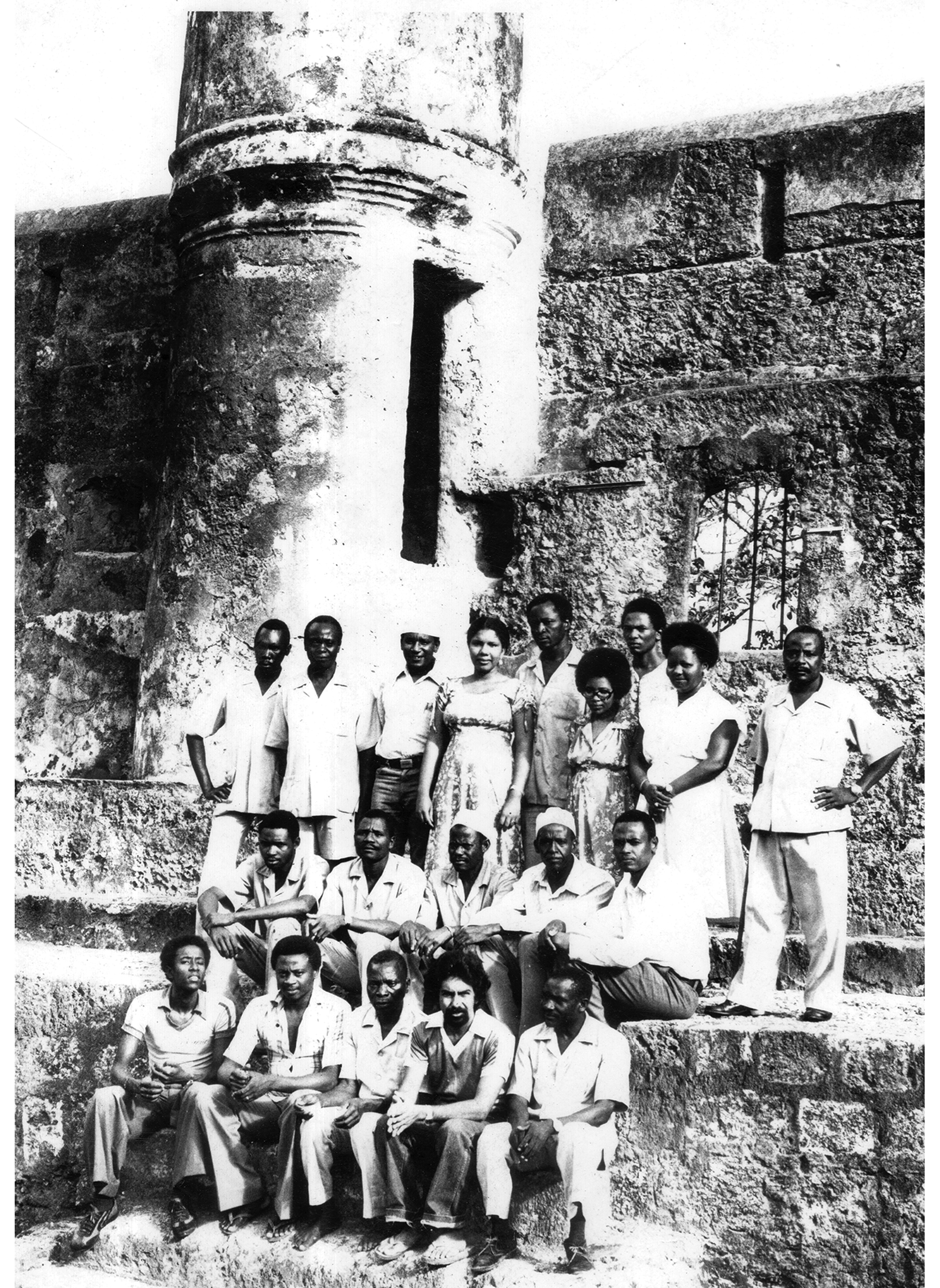
Photograph of the excavation team at Fort Jesus, Kenya, in the 1970s—one of a series of images featured in the ‘Ode to the Ancestors’ exhibition at the Horniman Museum and Gardens, London (8 December 2022 to November 2023) and at a mirror exhibition organised by National Museums of Kenya at Fort Jesus. Intended to highlight the role of African Kenyan archaeologists, whose names are absent from archaeological archives, it shows: top) Charo Chengo, Joel Kang'ethe, Ali Abubakar (former Chief Curator), Khifa Soud, Tingali Ngoa, Susan Taki, Wazwa Mwadime, Mary Mwakundia, Charo Tsuma; middle) Ali Kamwaga, Mambo Banju, Babu Mwamwero, Mohammed Issa Loo, Abdulrahman Mwinzangu; bottom) Harith Swaleh Baile, Francis Taki, Mitsanze Mramba, Azaad Nassir, Kenga Nzai (photograph © National Museums of Kenya).
Chit-chat
 The launch, in late 2022, of the prototype chatbot known as Chat Generative Pre-trained Transformer, or ChatGPT, has excited much discussion—indeed, panic in some quarters—about the potential impact of this and other forms of artificial intelligence (AI) on humanity's future. But despite the recent flurry of attention, the presence of AI in our lives has been slowly increasing for some time. If you visit the Antiquity website on the Cambridge Core platform to read any of the articles in this issue, for example, you'll also be offered a selection of related content suggested by an AI algorithm. The same technology is used to assess all aspects of our personal lives, in order to tailor content and advertising to our interests, and to extract money from our bank accounts. In fact, such technology has become so omnipresent that we often only really notice it when things go awry. The hurried launch of Google Bard in response to ChatGPT saw $100bn wiped off the share price of Google's parent company, after the bot gave a factually incorrect response to a question during a public launch event.Footnote 1 On a more modest scale, based on my viewing habits, the Netflix app thinks I'd be interested in watching the so-called ‘docuseries’ Ancient Apocalypse (one can only imagine former Antiquity editor Glyn Daniel's editorial on that particular series!).
Much of the conversation around ChapGPT has been a reactionary discussion of whether, how, and when, AI might render jobs redundant, as well as concern over its potential exploitation by students to write assignments and pass exams. In many respects it is unsurprising that much of the anxiety seems to relate to the idea of students ‘cheating’—not least, because much of the verbiage churned out by ChatGPT reads like an archetypal undergraduate assignment, mechanically rehearsing strengths and weaknesses, before concluding that ‘it's complicated’. Indeed, although ChaptGPT claims to have been trained on some 300bn words from the internet, how many of these words actually come from student essays? In short, we have no idea, as there is no publicly available information about the nature of the material ‘scraped’ from the internet to train the bot, nor the direction provided by the algorithms to process it all. So, less chatbot and more blackbox. If context is everything, ChatGPT and its like raise important questions about how we should engage with AI output (Figure 1).
An image produced using the DALL-E artificial intelligence model with the prompt: “Photograph of an archaeologist excavating a site in a busy urban environment”.

Alongside the techno-prophecies of the impact on AI on the future, what is its potential significance for the study of the past? Artificial intelligence has established itself within various aspects of archaeological practice, most obviously in relation to the analysis of remotely sensed imagery and in the classification of artefacts. Over the past couple of decades, a growing number of articles have explored the use of deep learning, machine learning and AI for the (semi-)automated recognition of features in satellite imagery, for example, seeking to scan vast landscapes and systematically extract the signatures of ancient tells or modern looting pits.Footnote 2 There is also growing use of AI for the automated dating of pottery sherds through identification of their ceramic fabrics and forms.Footnote 3 As in many disciplines, great expertise often rests with a few individuals, such as pottery specialists, who may not have the time or resources to do all of the work that is needed. Moreover, the retirement of such experts can have a significant effect on collective skillsets; how many times has someone uttered the plea, ‘If only we could download the contents of X's head?’. AI is one increasingly viable approach to maintaining such knowledge and, indeed, applying it more widely and systematically. This seems like a good time to ask ChatGPT to add its two penn'orth:
How will AI affect the theory and practice of archaeology?
Artificial intelligence (AI) is likely to have a significant impact on the theory and practice of archaeology. AI algorithms and technologies such as machine learning, computer vision, and geographic information systems can automate tedious and repetitive tasks, such as data collection and analysis. This will free up more time for archaeologists to focus on other aspects of their work, such as fieldwork, interpretation, and hypothesis testing. AI can also provide new insights into archaeological data by identifying patterns and relationships that might not be immediately apparent to human observers. However, it's important for archaeologists to be cautious about relying solely on AI and to approach their work with a critical and interdisciplinary perspective, taking into account the limitations and potential biases of AI technologies.
In these dark days of—to use the Collins Dictionary word of 2022—‘permacrisis’, the suggestion that AI will free up time for archaeologists to focus on fieldwork and interpretation is a tantalising prospect to cling to. Still, the breezy dismissal of data collection and analysis as “tedious and repetitive tasks” in need of automation can only inflame your editor's inner Luddite. Are these tasks not an essential part of what inspires specialists and the wider public alike: the process of discovery? The detailed methodical work needed not simply to accumulate ‘data’ but through which to develop knowledge? Is data collection not the ‘hands-on’ engagement with the very stuff of the past that drives us? Or perhaps this is all an irrational human reaction to the unfortunate choice of the adjective ‘tedious’? Where would Homo sapiens be today if we had rejected such innovations as the stone axe, farming and the stocking frame? It's a rhetorical question, but the temptation to seek ChatGPT's opinion is too great:
It is difficult to predict where Homo sapiens would be today if we had rejected such innovations as the stone axe, farming, and the stocking frame. These innovations were critical to the development of human society, and rejecting them would likely have resulted in significant changes to the course of human history. Without the stone axe, for example, early humans would have had a much more difficult time hunting and gathering food, and may not have been able to survive in some environments. The development of farming allowed humans to settle in one place and build complex societies, while the stocking frame, an early knitting machine, helped to mechanize the textile industry and paved the way for the industrial revolution. If humans had rejected these innovations, it is possible that we would have continued to live as nomadic hunter-gatherers, moving from place to place in search of food and shelter. Our societies may have remained relatively small and simple, without the specialization and complexity that arose from the development of agriculture and industry. However, it is important to note that human societies are adaptable and creative, and we likely would have found other ways to survive and thrive without these specific innovations. The rejection of one innovation may have led to the development of another, and humans may have found new ways to solve the challenges they faced. In short, it is difficult to predict where Homo sapiens would be today if we had rejected these specific innovations, but it is likely that our history and development as a species would have been significantly different.
OK, OK, silly question. More importantly, will AI help archaeologists? Or replace them?
AI has the potential to help archaeologists in a variety of ways, but it is unlikely to replace them. While AI can be programmed to perform certain tasks more efficiently than humans, such as analyzing large datasets, identifying patterns, and making predictions, it does not have the ability to fully replace the expertise, knowledge, and intuition of human archaeologists. It is important to note that AI is not a magic bullet, and its findings and predictions need to be critically evaluated and contextualized by human experts in order to be fully understood and appreciated. Additionally, AI cannot replace the interpretive and contextualizing skills that are essential to the practice of archaeology, and human archaeologists will continue to play a critical role in analyzing, interpreting, and communicating the findings of archaeological research. In summary, while AI has the potential to help archaeologists in a variety of ways, it is unlikely to replace them. AI can be a powerful tool for analyzing and interpreting archaeological data, but it is ultimately up to human experts to evaluate and contextualize the findings and to incorporate them into broader narratives of the past.
Ah, narrative! At least the machines can't take away the stories that make us human. Or can they? In the words of Samantha, the sentient AI assistant in the 2013 film Her, “The past is just a story we tell ourselves”.
Wooden worlds
 Viewed from an age defined by plastic, steel and concrete, it is easy to underestimate the importance of wood in the pre-industrial past. Prior to the twentieth century, in most regions of the world, wood was used extensively, from Early Palaeolithic spears to the ocean-going ships that sparked the beginning of the modern era. Yet, compared with stone, ceramic and metal, wood is massively underrepresented in the archaeological record and hence whilst the discovery of wood is not rare, it frequently attracts attention for the unexpected insights it can provide into the materiality of past societies. Recent Antiquity articles, for example, have featured a fourth-millennium BC wooden door from a pile dwelling on Lake ZurichFootnote 4 and wooden vessels and vehicle components at the Late Bronze Age Must Farm site in eastern England.Footnote 5 In the current issue, no fewer than four articles focus on wood and wooden objects.
We start with the Mesolithic peatbog site of Krzyż Wielkopolski 7 in northern Poland, where excavations have yielded a rich assemblage of objects, including various tools made of antler and wood. From among these, Jacek Kabaciński and colleagues report on one particularly notable find: a composite implement comprising a bone point hafted with tree bast to a wooden shaft and then carefully coated with birch resin. Using a battery of methods, the authors reconstruct the chaîne opératoire used to produce the implement, illustrating the range of materials and processes that are rendered invisible at sites where such organic finds have long since perished.
Moving on a few millennia, our next article takes us to Early Neolithic central Italy and the extraordinary site of La Marmotta. Discovered in 1989, the site is submerged beneath the waters of Lake Bracciano, a short distance north of Rome. Two decades of investigation have revealed a settlement of pile dwellings akin to, but slightly earlier than and far to the south of, the Alpine lake villages. Despite more than 20 years of investigation, the site remains relatively poorly known and a new initiative is working to publish the full results of the excavations, including analyses of the invaluable trove of well-preserved organic materials. Here, Mario Mineo and colleagues present the evidence relating to textiles, basketry and cordage, and the tools used to produce them. Among the latter are a series of wooden ‘weaving swords’ of a type well attested ethnographically from more recent times. The frequency of these tools across the site, as well as spindles, spindle whorls and loom weights, emphasises the importance of textile production (probably linen) at these early farming settlements, with some clustering of objects even hinting at specialisation. Despite the excellent preservation conditions, however, we still lack direct evidence of, for example, the wooden looms on which the textiles must have been woven. Perhaps future excavations of the uninvestigated portions of the site will furnish us with an early example of what must have been one of the most mundane and familiar of objects in prehistoric Europe.
The third of our quartet of wood articles presents another single, and singular, find from a site well known for its excellent preservation conditions: the Roman fort of Vindolanda in northern England. Located immediately south of Hadrian's Wall, the monumental north-western frontier of the Roman Empire, Vindolanda was home to a rotating garrison of auxiliary soldiers, along with a large civilian community housed in an adjacent settlement. Many decades of excavation have recovered an extraordinary assemblage of finds made of wood, leather and other organic materials, from sandals to boxing gloves. The object discussed here by Rob Collins & Rob Sands is unparalleled in the Roman world: a wooden phallus. Certainly, 2D and 3D phallic representations were widespread across the empire, painted on walls, sculpted in stone or cast in metal. That phalli were also carved from wood should therefore not surprise, even if none has previously come to light. But what function, or functions, might this object have served? In the absence of comparanda, the authors consider a range of possibilities raising, in the process, questions about archaeological inference and contemporary mores.
Our final wood article takes us to Greenland, a Subarctic environment where natural tree cover is limited but where, not coincidentally, the preservation conditions for archaeological wood are excellent. Lísabet Guðmundsdóttir focuses on assemblages of wood from five Norse settlements variously occupied between AD 1000 and 1400. Using microscopic anatomical features to identify the tree species of more than 8500 samples, the author explores the various geographic sources of these pieces of wood and, if not locally available, how they arrived in Greenland. The results show that approximately half the samples probably arrived as driftwood—a critical resource for larger construction projects, such as buildings and ships. In addition, approximately one sixth of the samples are species of tree that must have been intentionally imported. Notably, the latter all relate to an episcopal site, suggesting that the importation of this wood was related to status rather than necessity. Moreover, among these intentional imports is wood from trees that (then) grew only in either Europe or in North America, the latter clearly evidencing the sourcing of timber from across the Davis Strait, as described in some of the Norse sagas.
A 4 × 4m piece of wooden wreckage washed up on the Fire Island National Seashore, New York, after Tropical Storm Ian on 27 January 2023. The section of ship's hull may belong to the SS Savannah, which ran aground in 1821, en route to Savannah, Georgia. In 1819, the SS Savannah was the first ship to cross the Atlantic Ocean partly under steam power (www.fireislandlighthouse.com; photograph: © Leon Gurinsky).

Whilst the evidence for direct Norse connections with North America are eye-catching, the fundamentally important role of driftwood for life in the North Atlantic is equally noteworthy. In recent years, archaeologists have paid growing attention to the materials found on beaches, whether driftwood, ‘drift plastic’,Footnote 6 or amber,Footnote 7 emphasising the important role of these dynamic environments and the ambiguity of the materials found there—simultaneously local but foreign, valuable resource or toxic pollutant, and often part natural, part cultural, such as the timbers from a shipwreck (Figure 2).
Stone cold in Antarctica
 If wood is an elusive archaeological material, stone is one of the most abundant. Multiple articles in this issue explore the acquisition, working and interpretation of stone. In what may be a first for Antiquity, Metin Eren and colleagues take us to Antarctica, proposing a means of solving a long-standing problem: how to differentiate rigorously between lithic material fractured by natural processes versus that worked by humans or primates. This issue of equifinality is particularly acute for the identification of the earliest, and hence, most controversial, archaeological sites in any particular region. Here, the authors direct our attention to the potential of Antarctica—the only continent not to have been colonised by early humans—as the source of a reference collection of stone fractures of incontestably natural origins. Drawing on samples from the Polar Rock Repository, they identify fractures on a variety of stone types that resemble artefacts made by hominins. Systematically extending this work would provide an Antarctic ‘null dataset’ against which lithic finds from around the world could be compared and hence their archaeological status more confidently assessed.
In a second article that revolves around stone, Emily Jones and colleagues take us to El Mirón Cave in Cantabria. Here, in layers associated with Magdalenian occupation, the authors draw attention to an alignment of large stone blocks. What was the origin of this feature, how might it have been perceived and used during the Upper Palaeolithic, and how can we assess its function? Or, to borrow from the title of Eric Cline's history of archaeology, do “three stones make a wall”?Footnote 8 The larger blocks appear to represent a natural feature, perhaps a roof fall, but they were supplemented through the addition of smaller rocks and cobbles. Could this have been a bench of some kind, or perhaps a wall to partition different spaces? The authors use a statistical analysis of zooarchaeological material distributed around the feature to look for any patterning that might indicate a specialised structuring of space. The results, which align with analysis of stone tools from the area, suggest that the feature is possibly associated with bone-working, evidence for which is distributed all around the stones and not contained by them. The authors conclude that the feature served an ‘architectural’ function of some sort, though we cannot yet label this straightforwardly as a wall or bench. Indeed, perhaps these neat terms simply do not map well onto the practices of the Upper Palaeolithic.
In another article focused on the archaeology of stone, Anders Högberg and colleagues examine the acquisition of flint in southern Scandinavia during the Late Mesolithic and Early Neolithic. Focusing on south-western Sweden, the authors use the example of two overlapping traditions of flint extraction to explore how the continental-scale narrative of incoming farmers and new worldviews played out in one specific locality. During the final centuries of the fifth millennium BC, foraging groups shallow-worked beach ridges to extract coarse flint for producing tools. This source of flint continued to be worked well into the Early Neolithic period, when it was used to make a new type of tool associated with incoming farmers: point-butted axes. How should this evidence for continuity of place combined with technological innovation be understood? Does the ongoing extraction of flint from the beach ridges, combined with the production of a new type of axe, indicate foragers ‘becoming Neolithic’ under the influence of incoming farmers? Or were the foragers pushed out and entirely replaced by farmers who continued to work the beach ridges for flint? The latter might appear to be the obvious answer but the situation is complicated by the fact that, from c. 4000 BC, incoming farming groups opened hundreds of new deep mines to access a finer type of flint than that extracted from the beach ridges. Why would incoming farmers have continued to extract an ‘inferior’ type of flint from an old source when they had access to better flint and the technological know-how to extract it? These questions are currently easier to pose than answer. That both, and indeed other, interpretations are plausible within the broader narrative of ‘Neolithisation’, however, suggests that further investigation of these local case studies is essential if we are to understand the nuance of our grand narratives.
Moving to the northern Maya lowlands, Chelsea Fisher looks to the concept of traditional ecological knowledge, or TEK, to explore stone as a building material and the emergence of monumentality at Late Formative period Maya sites. Drawing on ethnographic examples of twentieth-century fieldstone clearance, and the results of the excavation of stone platforms at Tzacauil, Fisher links agricultural intensification and monument building, tracking the gradual transformation of natural stone into cultural structures, which, in turn, facilitated the emergence of social hierarchies. Meanwhile, Tony Brown and colleagues also explore the clearance of fieldstone and the engineering of the extensively terraced landscapes of northern England. Using a battery of techniques to document the construction of these terraces, the authors link these ‘mundane monuments’ to the demographic pressures, cultural choices and agricultural intensification of the Bronze Age.
Also in this issue
 Elsewhere in this issue, we feature late prehistoric burials in southern Europe, with an analysis of the aDNA from kinship groups buried at the Early Iron Age Dolge njive barrow cemetery in Slovenia (Ian Armit et al.), as well as a Project Gallery article detailing a newly discovered Late Bronze and Iron Age burial ground at Kopilo in Bosnia (Mario Gavranović et al.). In another of our Project Gallery articles, Henny Piezonka and colleagues present research on a new type of enclosure site in Qing-era Mongolia, which perhaps functioned as the bases for Chinese or Manchu military garrisons. Moving to South America, Christian Mesia-Montenegro & Angel Sanchez-Borjas introduce the site of La Seductora, which appears to have served as a small shrine connecting local families to the wider Kotosh religious tradition.
Returning to Europe, Emlyn Dodd and colleagues report on an extraordinary discovery in the suburbs of Rome. The ruins of the Villa of the Quintilii will be well known to anyone who has ever walked the first few kilometres of the Via Appia. Recent excavations at the site have revealed a highly unusual marble-clad winery, with dining areas to allow Roman aristocrats to watch the pressing of grapes and the storage of the vintage in large clay jars. The authors interpret this complex, with its wine waterfalls and ornate floors, as a ‘theatre of production’, leveraging the cultural and religious connotations of wine production as a show of social status by members of the very highest levels of Roman imperial society, probably by one of the emperors of the third-century AD Gordian dynasty. Other articles in this issue showcase research on China, India, Poland and North Macedonia. As always, we hope there is something of interest for all. If you would like to see your own research featured in the pages of Antiquity, please do get in touch with any questions at editor@antiquity.ac.uk.



