

Introduction
Frequently, readers are exposed to headlines outlining the significant crises that climate-induced high temperatures bring for the Arctic ocean, which may lead to an oceanic crisis with global ramifications for food security; or that fires in the Amazon rainforest will lead to a catastrophic loss of key forests needed for the containment of CO2 in the atmosphere. It is not uncommon to hear these transboundary environmental spaces referred to only in terms of how their unravelling will lead to the end of the world. However, these negative framings are matched by an interesting phenomenon where these transboundary spaces are not fully under the control of any one state. Yet, states that border these spaces have, to some degree, institutionalised cooperation around environmental change. For example, Bolivia, Brazil, Colombia, Ecuador, Guyana, Peru, Suriname, and Venezuela formed the Amazon Cooperation Treaty Organization (ACTO) in 1995. The United States, Russia, Canada, Finland, Sweden, Denmark, Iceland, and Norway formed the Arctic Council in 1996. We might expect states to create collective identity around constructed institutions such as the European Union in the face of shared threats or uncertainty, as a way to mitigate anxiety. But how do we make sense of states institutionalising around environmental spaces that are not inherently insecure, but are rather made so through specific framings – particularly when it is ambiguous what is being secured, for whom, and against what? While some scholars like Elana Wilson RoweFootnote 1 and Lucas de Oliveira PaesFootnote 2 have explored the complexities of conceptualising these large spaces by explaining them through a lens of ecosystemic politics,Footnote 3 we turn to ontological security as an alternative theoretical approach, specifically understanding how eco-anxiety may counter-intuitively lead to states creating ontological security. Environmental threats like climate change and ecological collapse are not easily stabilised, even with cooperation. Eco-anxiety differs from conventional security concerns not because it is more ‘real’ or more threatening, but because states often lack the routinised responses that typically help manage ontological insecurity. Moreover, it encompasses both physical and ontological elements, although here we centre the analysis on the ontological, and we turn to this distinction later in the paper. While states may maintain nuclear arsenals, alliances, or deterrence doctrines to stabilise existential threats, they have far fewer performative or institutional routines available to stabilise the chronic, diffuse unease linked to transboundary environmental change – even when cooperation mechanisms exist. So why, then, would states turn to institution building in response to environmental anxiety, even when the underlying condition remains unresolved? This is not to say that other existential threats – such as nuclear war or global terrorism – are ever fully ‘solved’. Rather, states often manage such anxieties through routinised practices that sustain a sense of order and identity. In the case of transboundary environmental degradation, those familiar strategies falter, in a way that it is not dissimilar to how climate change disrupts dominant security thinking.Footnote 4 What emerges instead is a paradox: the search for ontological reassurance in the face of a threat that resists stabilisation, containment, or narrative closure, as similarly shown by Pauline Heinrichs (this special issue).Footnote 5
In this article, we theorise the concept of ontologically insecure communities – groups of states bound by not shared values or stable identities but rather a shared insecurity linked to transboundary environmental spaces experiencing rapid change. This reframing highlights a core paradox: although these spaces intensify existential uncertainty, they can paradoxically catalyse the formation of cooperative frameworks. States, we argue, may seek ontological reassurance not despite insecurity, but through it – forging communities around shared anxiety. This challenges dominant understandings of institutional cooperation as driven primarily by interests or norms and instead places insecurity at the centre of community formation. We do not claim that anxiety always leads to institutionalisation – far from it. But in some contexts, the emotional weight of eco-anxiety may become a productive force that enables cooperation where rational incentives alone fall short. In other words, eco-anxiety may counter-intuitively lead to the creation of ontological security for states that find and successfully create an ontologically insecure community, akin to how security communities also reinforce a sense of we-ness and recognise members’ distinctiveness.Footnote 6 Building on work that conceptualises the struggle for recognition in the production of ontological security,Footnote 7 we argue that eco-anxiety becomes politically consequential when communities experience their environmental vulnerability as misrecognised or dismissed by relevant others. Ontologically insecure communities, then, can form around shared demands that particular forms of exposure, stewardship, and loss be acknowledged, and institutional projects around threatened environments become areas in which these claims to recognition are publicly staged and negotiated.
Definitions of eco-anxiety are wide-rangingFootnote 8 and can encompass the ‘physical’, such as whether one can obtain clean water in the future, or the ‘ontological’, which may be anxiety coded, such as how to handle a changing environmental materiality. We define eco-anxiety as the affective experience of states and other political actors that are confronted with environmental collapse, which threatens their ability to secure their identity, stability, and narrative coherence. In contexts where this anxiety is expressed through interaction – rather than experienced in isolation – it can become mutually recognised and politically consequential across actors. Accordingly, we define shared eco-anxiety as an intersubjective condition in which eco-anxiety becomes mutually recognised across multiple actors – states, communities, and/or groups of states – that come to treat ecological disruption in a shared space as a common source of existential unease and a basis for claims about responsibility, vulnerability, and authority. The space then becomes ontological and bound up with questions of protecting the Self’s situatedness in context rather than purely physical, in doing so creating existential meaning and thus threat. Our definition is purposefully broad as we do not seek to narrow it to the type of actor experiencing it or to presuppose how it is experienced. That said, for the purposes of this research, we have focused on the level of the state and groups of states. This is not to say that other collective groups do not experience eco-anxiety, as we outline in the more detailed section on eco-anxiety literature below. However, to make the project of interrogating how actors experience shared eco-anxiety, the level of state offers clear boundaries that allow for a better analysis, with the caveat that the state is a complex actor, made up of a variety of different departments and sub-actors. Thus, in this work we suggest that eco-anxiety can naturally involve fear of material harm, but our focus is on how environmental change disrupts and destabilises a state’s sense of self. As noted by McDonald,Footnote 9 this maps on to how climate change destabilises foundational ontological expectations such as control, predictability, and stable categories of threats. Eco-anxiety, then, emerges precisely because states cannot rely upon the traditional security scripts that are proven to be inadequate. As climate and ecosystem collapse disrupts assumptions from a state about predictability and control over nature, the collapse also unsettles taken-for-granted ontological foundations of how states understand themselves in a changing environmental world. In this sense, eco-anxiety manifests not in bodily fear but rather in the loss of narrative coherence of who ‘we’ are in a changing world.
We make two primary contributions to the literature on ontological security. First, while scholarsFootnote 10 have linked climate change to broader global insecurities and explored the notion of planetary anxiety,Footnote 11 little work has addressed environmental change writ large through the lens of anxiety, particularly as it relates to how groups of states respond. We argue that environmental change is distinctive in ontological security terms because it threatens not just a state’s identity but also its ability to locate itself within a stable environmental order – and it does so in ways that implicate others. This intersubjective nature of eco-anxiety may lead states to seek reassurance through institutional engagement. In some cases, such efforts lead to cooperative institutionalisation; in others, they do not. Ultimately, we suggest that eco-anxiety opens an unexpected path to ontological security – not through threat elimination but rather through the shared acknowledgement of uncertainty. This allows for the transformation of anxiety into institutional routines, narrative stabilisation, and new forms of community-making, even in spaces long seen as sources of insecurity. This follows the important work of tying together security communities and ontological security.Footnote 12
Second, we contribute by expanding the role of transboundary spaces in ontological security research. While existing work largely centres on the state as the primary site of ontological security seeking, we show how shared environmental spaces – such as the Amazon rainforest and the Arctic ocean – can become focal points for collective anxiety and institutional response. These spaces are neither fully within nor fully beyond national control, and their ambiguous status generates a distinct form of uncertainty. We suggest that it is precisely this spatial indeterminacy that enables the formation of ontologically insecure communities: groups of states that come together not despite insecurity but rather because of it. In doing so, we push ontological security scholarship to grapple more seriously with spatiality and relationality.
The paper proceeds as follows. The next section reviews existing literature on ontological security to situate our contribution within broader debates on institutional cooperation and anxiety. We then deepen the theoretical development of eco-anxiety, clarifying its conceptual distinctiveness and analytical relevance for international relations. Following this, we introduce the concept of ontologically insecure communities and outline the conditions under which eco-anxiety may catalyse institutional responses. Our methodology section explains the interpretivist approach and discursive indicators used to identify institutionalised anxiety. We then present two illustrative case studies – the Arctic and the Amazon – to explore how states have responded to shared ecological uncertainty through regional cooperation. In the final sections, we discuss the implications of our findings for theories of institutional formation, ontological security, and global environmental politics and conclude by outlining directions for future research.
Ontological security
The concept of ontological security was first developed in the field of cognitive psychology by R. D. Laing, who described an ontologically secure person as having a ‘sense of his presence in the world as a real, alive, whole, and, in a temporal sense, a continuous person’.Footnote 13 The concept was then expanded by Anthony Giddens, whose contributions constituted much of the foundations international relations currently employs.
Giddens defines ontological security as the confidence individuals possess in the continuity of their self-identity and the constancy of their social and material environments.Footnote 14 Yet much of the IR literature on ontological security has disproportionately emphasised the former – the continuity of identityFootnote 15 – often at the expense of attending to disruptions in social and material environments. This imbalance reflects one of the framework’s key limitations: its relative inattention to how environmental degradation, infrastructural collapse, or spatial dislocation can unsettle ontological security even when state identity narratives remain formally intact. This security, in people, originates in early childhood, as trust develops in caregivers, enabling individuals to trust themselves. Crucially, trust serves as an emotional defence that sustains the ongoing maintenance of ontological security. It enables actors to reproduce stable routines and avoid confronting overwhelming existential uncertainty. As Flockhart argues, trust is not merely a social lubricant but also a foundational mechanism for sustaining ontological security – shaping whether actors respond to uncertainty through withdrawal, confrontation, or community building.Footnote 16 Practical consciousness, for Giddens, refers to the habitual, taken-for-granted knowledge that individuals rely on to function in the world – not fully unconscious, but not typically reflected upon unless disrupted. It allows people to act as if they know who they are, what the world is, and how others will behave, without having to consciously examine these assumptions.Footnote 17 In this sense, practical consciousness suppresses existential questions that could otherwise provoke anxiety – such as the nature of the self, the reliability of others, or the coherence of the world. This suppression is sustained through everyday routines and social interactions, which collectively reinforce a stable sense of identity and reality.Footnote 18 Yet from an existentialist perspective – such as Sartre’s – this process may represent a form of bad faith: a flight from the responsibility to confront uncertainty, in which individuals (and by analogy, states) maintain the illusion of stability precisely by avoiding the deeper instability they inhabit.
Ontological security has often been conceptualised in explicit contrast to physical security. Whereas physical security in international relations typically refers to the protection of bodies, territory, and material survival in the face of threats, ontological security concerns what Giddens calls ‘security as being’: the confidence that self-identity is continuous across time and that the surrounding social and material world remains intelligible.Footnote 19 In Mitzen’sFootnote 20 conceptualisation, states seek both physical security and ‘security of the self’, but the latter is achieved through the maintenance of routinised relationships and narratives rather than the elimination of material danger. Subsequent work has underscored that ontological security rests on a different logic of protection, oriented towards the preservation of a coherent sense of ‘who we are’, and may at times be pursued even when it compromises physical safety.Footnote 21 This distinction has important analytical and normative consequences. RumeliliFootnote 22 shows that treating ontological and physical security as a single layer obscures how actors can desecuritise threats to bodily survival while still maintaining a distinct and stable identity, or conversely how persistent naming of an ‘enemy’ can provide ontological reassurance even as it reproduces physical danger. Ontological security is thus not reducible to objective risk levels but instead depends on whether actors can sustain narratives, routines, and relational positions that make their world feel continuous and recognisable.Footnote 23 In the context of environmental politics, this means that climate change unsettles not only expectations of physical safety but also the stories through which communities understand their place in a changing world – a point that underpins our later discussion of eco-anxiety and ontologically insecure communities.
In international relations, ontological security has found a fertile ground to flourish through the work of scholars seeking new approaches to the intersections between security and identity.Footnote 24 According to Von Essen and Danielson, three main reasons guided this process: 1) it provided a new approach to security studies, encompassing dynamics of rhetoric, routines, and habits as security seeking; 2) it expanded concepts of anxiety and uncertainty, linking them to states’ search for identity; and 3) it was approachable to both realists and idealist scholars, as both dynamics of cooperation and competition could be analysed through its framework.Footnote 25
Those characteristics led to many scholars employing ontological security as a framework for the study of migrations,Footnote 26 globalisation,Footnote 27 and membership in supranational organisations.Footnote 28 Ontological security scholars have also written about the nature of security communities. Some have explored how, in seeking ontological security to preserve a ‘long peace’ narrative in the EU, such strategies are actually making it more difficult for the EU as a whole to handle the thorny issue of migration.Footnote 29 Others have provided an account of inter-state relations – an adjacent issue to security communities – through an ontological security lens, emphasising the routinisation of relations via the actor’s self-definition, perception of that self, recognition, and adaptation.Footnote 30 Still others have written on how security communities have two tasks: 1) reinforcing a sense of we-ness in the community, but also 2) recognising individual members’ distinctiveness.Footnote 31 In other words, there is always an identity-level conflict whereby states seek recognition. Work on security communities shows that these recognition dynamics are not only institutional but also emotional, as shared affect and emotion norms help constitute community boundaries and sustain expectations of appropriate conduct.Footnote 32 The struggle for recognition can also result in states choosing to leave international institutions – even those formed with historical allies – when they feel that their identity, status, or normative preferences are no longer affirmed.Footnote 33 However, little attention has been given to how this dynamic operates in relation to shared environmental spaces. While much of the existing literature focuses on individual states and specific case studies, we still lack an understanding of how groups of states situated within shared ecosystems negotiate recognition – of not only themselves but also their interdependence, anxieties, and responsibilities. This relational form of recognition – rooted in ecological entanglement rather than discrete national narratives – remains under-theorised in the ontological security literature. That being said, ontological security scholars have explored climate change through understanding how certain insecurities emerge from climate change through displacement and migrationFootnote 34 and the existential threat framing of climate security discourse.Footnote 35 Within this literature, recognition has also emerged as a central mechanism in the production and contestation of ontological security. Scholars have shown how collective selfhood is stabilised when others acknowledge a community’s narrative about its past, present, and future, and destabilised when that narrative is denied, ignored, or appropriated.Footnote 36 For environmentally exposed states and regions, struggles over whether their vulnerability, stewardship, and sacrifice are recognised are thus inseparable from struggles over who they are, and over what kinds of responsibilities and rights follow from that identity.
Central to ontological security also is the management of anxiety – a concept that underpins much of the existential unease in international politics. The next section explores how anxiety has been theorised within ontological security studies and how it helps explain state behaviour under conditions of uncertainty.
Eco-anxiety
Eco-anxiety refers to a chronic sense of dread and existential unease originating from ecological degradation. While originally developed in the field of psychology,Footnote 37 we define it here in political terms as the affective experience of states and other political actors that confront slow and structural environmental collapse, which threatens their ability to secure their identity, stability, and narrative coherence. This, then, is situated in the ontological security tradition that explores anxiety.Footnote 38 In an ontological security understanding of anxiety, actors fear not only threats to their sense of biographical continuity but also a loss of meaning and narrative coherence.Footnote 39 Anxiety, then, is existential and often understood with a feeling of unease.Footnote 40 Within IR, anxiety has been theorised as a driver of those clinging to the status quo,Footnote 41 radical change,Footnote 42 or the romanticisation of bygone eras.Footnote 43 While some scholars draw a distinction between neurotic anxiety and existential (all-encompassing) anxiety, we do not draw that distinction here.Footnote 44 Still, there remains little work on anxiety as it relates to shared environmental spaces. This is where we locate the conceptual and empirical value of eco-anxiety.
Unlike fear, which is associated with identifiable threats that can be directly confronted or avoided, eco-anxiety is temporally dislocated and rooted in existential uncertainty, making it difficult to resolve through direct action. In short, it is about not one specific crisis, but rather the looming sense of dread that the ecological foundations under our very feet are unravelling. This makes responding to such anxieties challenging for states, as neither unilateralism nor deterrence solves the underlying problem. They may therefore turn to symbolic acts of reassurance such as institution building and ritualised cooperation. Thus, it is not merely fear about the loss of the status quo but also a broader sense of unease about the loss of meaning, stability, and identity in the context of ecological degradation. This distinction matters as it shifts how we could understand the behaviour of states. Eco-anxiety may motivate states towards symbolic reassurances and institutionalism, rather than a rational threat-motivated strategy. This is not to say that states will not sometimes securitise environmental changes to justify traditional security routines and rituals.Footnote 45
Like many broad concepts, eco-anxiety suffers from conceptual blurriness.Footnote 46 While some scholars understand eco-anxiety as an umbrella term, encompassing climate change anxiety and broadly any psychological change from the environmental crisis that causes increased anxiety, depression, or PTSD,Footnote 47 others remain with the traditional APA definition that it is a ‘chronic fear of environmental doom’.Footnote 48 Still others like Albrecht suggest that it is a ‘generalized sense that the ecological foundations of existence are in the process of collapse’,Footnote 49 and many use adjacent synonyms like climate guilt, grief, trauma, despair, and anger.Footnote 50
From a political science perspective, eco-anxiety can be recognised not by measuring individual psychological distress, but rather by examining how states frame environmental degradation as an existential, unmanageable threat instead of cost-heavy climate action. The prevalence of irreversible loss language, expressions of helplessness in the face of transboundary pollution, and the urgency to form institutions despite uncertain outcomes all serve as discursive markers for anxiety. These framings do not reflect fear alone – they signal a deeper disorientation about identity, control, and future continuity in a warming world. Thus, eco-anxiety becomes analytically visible in the structure and tone of state responses.
Anxiety, rather than fear, may lead to performance measures and reassurance. Consider for example the affective video messages from small island states such as Tuvalu, who have given speeches while they stand knee deep in water.Footnote 51 This emotional logic explains that states may form institutions around such crises not to solve them but rather to be seen doing something, aligning with work on the aesthetic dimension of security practices. It is also particularly linked to ontological security’s understanding of anxiety, as ecological degradation challenges national narratives of control, continuity, and environmental order, core elements of the self’s stability. While some may suggest that eco-anxiety and anxiety concepts as a whole may fall victim to the trap of presentism, the growing visibility and routinisation of the performance of eco-anxiety in the post–Cold War era suggests that eco-anxiety is not just felt but also publicly staged. This visibility makes understanding eco-anxiety important because it is no longer just an emotion, but rather a constitutive part of how international politics is conducted. This performative quality of eco-anxiety further aligns with Irem Cihan’s theorisation of aesthetic registers of ontological security.Footnote 52 According to Cihan, emotions like grief, dread, and despair are not only internal states but also aesthetic experiences that help constitute political meaning. In this light, eco-anxiety emerges as not simply a background effect but also an aesthetic expression that shapes how states engage with the world, perform their identity, and seek recognition in the face of collapse. The emotional tone of institutional discourse – often mournful, urgent, or tragic – reflects not just political calculation but also a deeper desire to aestheticise insecurity in ways that maintain coherence amid chaos.
These institutional or symbolic responses to eco-anxiety can also be understood through Cornelia Baciu’s concept of expressivist practices.Footnote 53 Rather than relying solely on routines or rational strategies, expressivist practices involve symbolic performances that aim to manage ontological insecurity through creative and mimetic actions. Climate summits, declarations of climate emergency, and regional treaties – often heavy in symbolism – may be less about solving environmental problems and more about expressing anxiety and preserving a coherent narrative of state identity in crisis. In this way, Baciu’s framework helps capture this performative dimension of eco-anxiety response.
Although eco-anxiety is conceptually blurry, we can see it in action through discourse, policy framings, and the emotional tone of routinised institutional interaction. For example, we might recognise eco-anxiety in state behaviour when actors invoke irreversible ecological loss, emphasise shared environmental dread, or build institutions with a clear motivating force that links directly to eco-anxiety. As we show in the Arctic and Amazon cases, this framing of both spaces as under environmental threat catalysed forms of cooperation that we might not have found otherwise.
Understanding eco-anxiety in political terms allows us to consider not only individual or societal responses but also collective formations. In the next section, we develop the concept of ontologically insecure communities, where states engage in community creation around shared environmental anxieties and construct institutional responses to navigate their insecurity.
Ontologically insecure communities
Based on the above literature, we propose that states form communities around not only shared identities but also shared anxieties. Here, we are specifically interested in the way that eco-anxiety can be one of these shared issues and what the implications are given that it operates using a logic of existential anxiety, meaning that it is uncertain, nebulous, and hard for states to grasp.Footnote 54 As KirkeFootnote 55 argues, political myths can generate ontological security by providing narrative templates that organise collective meaning and belonging in times of rupture. Here, ‘myth’ refers to the shared narrative forms through which communities interpret disruptions and position themselves and others within a moral order. We see shared eco-anxiety potentially functioning in this way: as a basis for narratives that recast regions such as the Arctic or the Amazon as spaces of vulnerability and obligation. These narratives help states (and communities) perform moral responsibility, construct collective memory, and reorient identity around stewardship, harm, and loss, thereby shaping who is recognised as a legitimate protector, victim, or responsible actor. We suggest that eco-anxiety leads states to perceive themselves, but not just themselves, as being under threat by changing environmental conditions in shared transboundary spaces. These spaces, such as the Arctic ocean and Amazon rainforest, are particularly anxiety-conducive for states as they are spaces that they cannot fully control alone. In contrast to functionalist accounts that emphasise efficiency gains, our notion of ontologically insecure communities highlights their recognitional dimension: they are constituted by practices through which members seek mutual acknowledgement of their exposure and responsibilities in a shared environment, and by the reassurance that others see and validate the risks they bear.
The study of community building is not a new one in ontological security. Yet much work thus far has focused on the larger level of security communities.Footnote 56 Patricia Greve,Footnote 57 for example, argues that security communities must both reinforce members’ sense of ‘we-ness’ in a community but also recognise their individual distinctiveness. In short, by denying a sense of individual recognition, members’ sense of self may be threatened and, in doing so, erode a sense of trust needed in community formation. Others have theorised on specific communities such as the NordicsFootnote 58 and, more broadly, offered theoretical contributions regarding an individual’s ontological security as a member of a community.Footnote 59 However, this work does not reckon with the fact that that anxiety is not a purely negative emotion, but in fact can lead to something creative: the formation of community. This is the broader scope of the special issue but is particularly salient in our contribution as we show in this article that the prevalence of eco-anxiety in a modern world may be an opportunity to live a more authentic life and create something that wasn’t there before.
That said, our argument is not that eco-anxiety automatically or inevitably leads to institutionalisation. Rather, we suggest that eco-anxiety can become a catalyst for institutional cooperation when states seek reassurance through routinised practices and narrative stabilisation. Institution formation, then, is aspirational in itself. Communities are seeking to transcend a state of anxiety by expanding their toolkit of possible solutions, even if they struggle to address the underlying drivers of climate change themselves. Here we do not seek to claim that institution building is simply hope, but rather that it is a strategy that states use to overcome overwhelming anxiety, using anxiety as fuel for productive change. As Kurylo,Footnote 60 building on the case of Ukraine, similarly argues, anxiety can be a trigger for community formation. Rather than the war in Ukraine leading to a fracturing of people, the war has instead catalysed the development of a community around the Ukrainian Railway, which has become a joint symbol of resistance. That said, states may also respond to eco-anxiety through denying climate change, deferral, or even symbolic gestures that do not represent meaningful cooperation. In some cases, for example, they may securitise ecological threats or retreat to unilateral action. HeinrichsFootnote 61 convincingly argues that these different responses demand a turn to reframing anxiety as transformative politics instead, including reflexive responsibility and emotive agency. Our focus in this article is on where eco-anxiety becomes legible in discourse and appears to drive institutional behaviour, as in the Arctic and Amazon cases. In short, we are not claiming that there is a linear relationship between eco-anxiety and institutions. In some contexts, institutional efforts may precede and even help frame eco-anxiety in shared discourse. In others, shared eco-anxiety can prompt states to seek institutions as shared solutions.
This dynamic helps explain why in other shared environmental spaces, such as the oceans or atmosphere, we have not seen similar institutionalisation despite comparable levels of environmental degradation. The global commons lacks the same constellation of regional identities and historical routines that transboundary spaces offer. In short, eco-anxiety may be insufficient on its own; institutional outcomes also rely upon political, historical, and geographic conditions.
Finally, we suggest that eco-anxiety does not operate in a vacuum. It clearly competes with other emotional and strategic logics, including economic anxiety, geopolitical rivalry, and identity-based fears. In moments of shared crisis, eco-anxiety may serve as an important frame, not in fully solving the climate crisis, but because it helps states make sense of and act within the uncertainty that it generates. We draw from the above literature on eco-anxiety and ontological security to explore two illustrative case studies below.
Methods
This article adopts a theory-building approach grounded in interpretivist methodology, using illustrative case studies to explore how states respond to environmental threats through institutionalisation. Our empirical focus is on the Arctic and Amazon regions, not as cases for comparison but rather as analytically rich examples of transboundary spaces where eco-anxiety appears to have catalysed regional governance. These cases were selected because they exhibit both institutional development and discursive patterns that align with our conceptualisation of ontologically insecure communities.
We rely primarily on state discourse – including diplomatic speeches, institutional founding documents, official communiqués, and treaty texts – as a window into the anxiety and identity that are performed, managed, and made legible in international politics. A core methodological challenge arises from the nature of these sources: state discourse is inherently strategic and performative, often shaped by domestic politics, diplomatic goals, or reputational concerns. As such, we do not treat speeches and documents as transparent reflections of state psychology. Instead, following scholarship in ontological security studies, we interpret discourse as a routinised expression of underlying anxieties about identity, continuity, and existential threat.Footnote 62 Thus, we do not claim to access or measure the ‘true’ emotional states of political actors. Instead, we interpret discourse as a site where both the genuine effect and strategic performance intersect – where eco-anxiety may be sincerely felt, politically useful, or both. Rather than attempting to disentangle ‘authentic’ from ‘instrumental’ motivations, we treat eco-anxiety as a discursive formation, a way of making sense of uncertainty, environmental loss, and ontological instability in routinised and publicly legible forms.
Eco-anxiety, in this context, is not observed directly but instead inferred through patterns of language and framing that convey unease about environmental degradation and loss of control over shared ecological spaces. We identify discursive indicators of eco-anxiety when states repeatedly reference irreversible loss, transboundary environmental threats, and the inability to address such threats unilaterally. Particular attention is paid to emotional tone, such as urgency, dread, and appeals to shared responsibility, as well as the presence of institutional solutions framed as necessary to cope with diffuse, uncontrollable threats. In short, we approach eco-anxiety as not a measurable psychological variable but rather a discursive formation that reveals how states cope with the ontological instability of a warming, collapsing world. Importantly, we also focus on the collective and discursive level of eco-anxiety as expressed by states and institutions, rather than more specific identities such as those of Indigenous peoples in Finland’s north. The ‘who’ of eco-anxiety, then, is the state-as-actor performing insecurity through official discourse.
The Arctic: Finland and the creation of the Arctic Council
In the early 1970s and 1980s, the Arctic was a region shrouded in geopolitical tension, primarily due to the Cold War rivalry between the USA and the USSR. So too were environmental issues on the rise, largely due to the fallout from Chernobyl, the rising awareness of pollution in the north, and the recognition of ozone depletion in the Antarctic. For Finland, eco-anxiety intersected with both its national identity and material existence. On one hand, eco-anxiety threatened Finland’s self-conception as a responsible and neutral bridge-builder between the East and West during the Cold War.Footnote 63 If pollution was uncontrollable and transboundary, Finland would no longer be able to perform environmental responsibility.Footnote 64 The prospect of transboundary pollutants offered a mechanism through which Finland could perform this bridge-building role and thus reassert its identity in this mechanism through recognition.Footnote 65 Thus, cooperation was an important opportunity for the creation of ontological security. On the other hand, while the physical status of Finland was not fully under threat, transboundary pollutants represented a risk to the physical environment of Finland and the Finnish people – one that did not come from Finland itself. Thus, the anxiety came directly from environmental degradation, specifically from pollutants in a physical and ontological sense. In short, Finland’s identity was directly threatened by transboundary pollution that undermined both its material environment and performative credibility.
Finland’s institutional push drew upon a shared sense of eco-anxiety as its primary motivation. Its drive for Arctic institutionalisationFootnote 66 began in 1988 as a reaction to the momentum spurred by Gorbachev’s Murmansk Speech of 1987, as Finland sought to decrease tension in the Arctic between the East and West, in which it found itself embroiled.Footnote 67 Perhaps the clearest indicator of this is how the Finns immediately took up Gorbachev’s call for cooperation, drawing upon environmental issues to do so. In other words, they sought ontological security by seeking out reassurance when given the opportunity to do so.Footnote 68 After some internal debate, Finnish government representatives sent an invitation to a 1989 conference titled ‘The Protection of the Environment in the Arctic’, alongside a working paper suggesting that the Arctic environment was experiencing rapid deterioration. This working paper and invitation highlight ‘significant threats to the Arctic environment’ and the danger of transboundary pollution.Footnote 69 These threats were framed in strikingly urgent terms, emphasising their irreversible nature and the need for a coordinated regional response. The invitation, for example, uses phrases such as ‘with deep concern’ and ‘the alarm caused by this development’ in reference to the deterioration of the environment.Footnote 70 Phrases like ‘deep concern’ and ‘alarm’ explicitly recognise that pollution is an existential challenge to the identity of Arctic states, particularly if states cannot control national boundaries. They signal a disruption of the normal state of affairs, a fear of irreversible loss, and a need to reassert responsibility and control. The working paper continued to use language that conveyed dread and concern, such as ‘urgent measures to protect the Arctic environment are necessary in the nearest future’ and ‘the area has become exposed to danger’.Footnote 71 Such expressions here go beyond technocratic concern. They convey dread, guilt, and obligation, emotions that map onto eco-anxiety. The working paper also uses terms like ‘fragility’, ‘danger’, ‘urgent measures’, ‘threats’ – evoking fears of irreversible loss and collective responsibility. Here, eco-anxiety took discursive shape through the language of ecological collapse, irreversible damage, and helplessness in the face of cross-border contamination.
Canada’s embrace of the Finnish initiative illustrated how eco-anxiety and strategic interests were bound up in one another. Canadian concerns about Arctic haze, transboundary pollutants, climate change, and global environmental legitimacy were long-standing.Footnote 72 Yet Canada’s approach to Arctic cooperation also reinforced its sovereignty claims, secured its leadership in the Arctic, and helped to promote Indigenous diplomacy.Footnote 73
The eventual first meeting between Arctic states, which took place in Rovaniemi in 1989, overtly focused on transboundary pollutants, a focus that continued at a later 1990 meeting in Yellowknife, at which the representatives drafted the Arctic Environmental Protection Strategy. Importantly, the first drafts of the document highlighted ‘threats to transboundary pollution in the Arctic’ – specifically focusing on the implication that environmental changes were occurring that one state alone couldn’t address and that ontological security seeking thus had to occur together.Footnote 74
In June 1991, the eight Arctic states drafted the Arctic Environmental Protection Strategy (AEPS), which set out shared objectives and principles, identified international mechanisms for protecting the Arctic environment, specified actions to be taken, and outlined next steps for continued cooperation. The extent to which Canadian and Finnish goals and agenda items are included in the AEPS is relatively easy to trace because it is so evidently clear. Not only do Finland’s top issues of climate change, pollution, resource exploitation, monitoring, and an overall goal to protect the Arctic environment find themselves in the document, but they are also mentioned many times. Climate change is mentioned four times, pollution fifty-eight times, and monitoring twenty-eight times. As for Canada’s concerns on climate change, the global nature of the Arctic, and Arctic haze, they too are present across the document. As above, climate change is mentioned four times and haze three times, and there are ten references to the global. Moreover, the Canadian voice in the AEPS is largely felt through the concept of ‘ecosystem’ – which was developed by Canadian negotiators in negotiations on the Great Lakes with the United States in the 1980s – as well as the place for Indigenous voices in the process.Footnote 75 Some have suggested that every example of pollution given in the AEPS is Canadian in nature.Footnote 76 Eco-anxiety is clear across the document in phrases such as ‘deeply concerned with threats to the Arctic environment’ and ‘this vulnerability of the Arctic to pollution requires that action be taken now, or degradation may become irreversible’.Footnote 77 These phrases indicate that states may lose the ability to effect changes in the future. The strategy also emphasises moral duty with lines such as ‘emphasising our responsibility to protect and preserve the Arctic’ and ‘which must be taken up in order to secure our common future’ – signalling anxiety about loss of continuity.Footnote 78
Eco-anxiety is painted as an anxiety that can be solved through cooperation, institutions, and monitoring mechanisms. Strategic anxieties, by contrast, appeared to offer no comparable solution in the early 1990s, particularly because states such as Canada and Finland could pursue their interests independently. In fact, unilateral strategies to ‘solve’ eco-anxiety and pollution were not considered, as the very nature of transboundary pollution in the Arctic meant that unilateral action would not be successful, and denying its existence, given the vast amount of scientific evidence, was also not feasible for either state. At the same time, the AEPS avoided direct references to militarisation, fossil fuel dependency, and Indigenous land rights, reflecting political trade-offs in the name of consensus.
Importantly, states including Norway, the United States, and the Soviet Union were not initially enthusiastic about the AEPS initiatives. It was only after significant negotiation and strategic calculations around political legitimacy in the region that they participated. This further underscores that eco-anxiety was not the only driver of institutionalisation, but it was an important frame that helped to justify cooperation without radical structural change. The scientific tone of the AEPS in tandem with its narrow environmental scope created an institution that performed responsibility and regional stewardship, which directly addressed the cause of climate harm. Here we can see how institutions may emerge as aesthetic and symbolic resources.
Anxiety here opens opportunities for cooperation, making some problems legible and urgent, which also allows actors to pursue their respective reputational and geopolitical goals. The Rovaniemi meeting in 1989 was a central moment illustrating this dynamic. It allowed eco-anxiety to be transformed into a shared discursive and institutional framework. However, it also meant states could externalise threats and legitimate themselves as responsible actors. Eco-anxiety thus opened the political door for Finland to pursue institutionalisation in an Arctic space, allowing strategic and emotional logics to better align.
The Amazon: Brazil and the promotion of the ACTO
In Brazil, eco-anxiety is intertwined with the centrality of the Amazon and other biomes to national self-understandings and with long-standing conflicts over development, race, and territory. Recent survey data indicate that nearly nine in ten Brazilian adults report being worried about climate change, with those who are worried more likely to describe sadness, fear, powerlessness, and anxiety and to voice thoughts that the future is frightening and that their families’ security will be threatened.Footnote 79 Further work in São Paulo shows how such feelings are unevenly distributed and racialised: Black women community leaders in peripheral neighbourhoods appropriate environmental slogans such as ‘no forest, no future’ to denounce elites who defend the forest while neglecting the poor, linking eco-anxiety to experiences of environmental injustice and climate insecurity in favelas.Footnote 80 At the national level, the Amazon functions simultaneously as developmental frontier, global environmental commons, and symbol of Brazilian nationhood, a tension reflected in the evolution of the environmental movement ‘socioambientalismo’ and shifting state narratives about Brazil as an environmental power.Footnote 81 Agribusiness-oriented storylines in foreign policy and presidential discourse that reframe the Amazon primarily as a resource to be exploited compete with socio-environmental framings that highlight protection and rights, generating contradictory emotional registers in which pride in Brazil’s ecological wealth coexists with anxiety about deforestation, international stigma, and the erosion of futures tied to land and forest. Precisely because these registers are produced in relation to others – within domestic publics, across Amazonian communities, and through Brazil’s engagement with international audiences – eco-anxiety becomes an intersubjective problem of recognition. In this context, eco-anxiety becomes a key affective axis along which Brazilian identity is negotiated, as different actors invoke ecological pride and existential unease to claim legitimacy, assign responsibility, and define whose losses and futures count. This is also a pathway through which eco-anxiety becomes shared, as it is stabilised (or disputed) as a common object of concern in a shared political space, anchoring competing projects of stewardship, development, and rights.
In the 1970s, Brazil led the creation of the Amazon Cooperation Treaty (ACT), signed in 1978, as a framework for environmental cooperation, development coordination, and the assertion of collective sovereignty over the region. Although originally limited in scope and institutionalisation, the ACT laid the groundwork for a regional governance architecture that would evolve into the Amazon Cooperation Treaty Organization (ACTO) in the mid-1990s. This shift from treaty to organisation is not merely bureaucratic – it represents a deeper transformation in how regional anxieties around ecological degradation, external interference, and sovereign control were framed, shared, and institutionalised.
Brazil’s promotion of the ACT was driven by a confluence of motivations that defy easy categorisation. On one level, it was clearly strategic. The 1970s were marked by mounting Brazilian fears of foreign encroachment in the Amazon, particularly through the purchase of land by multinational corporations and the possibility of US intervention. In this context, Brazilian officials invoked the notion of a cordão protetivo (protective barrier) – framing the treaty as a mechanism to preserve sovereignty by embedding the region within a multilateral structure that excluded external powers.Footnote 82 Brazil also faced regional rivalry, especially with Argentina, and saw the ACT as a means of asserting leadership and shaping the regional agenda on its own terms.Footnote 83
At the same time, Brazil was actively pursuing economic development in the Amazon – a strategy that generated both ecological risk and reputational vulnerability. As early as the 1970s, concern over deforestation, biodiversity loss, and long-term environmental sustainability had begun to take root in domestic and international discourse.Footnote 84 While these concerns may not have initially emerged from a discourse of eco-anxiety, they set the stage for the reframing of regional governance efforts as responses to a growing sense of ecological precarity. In this sense, Brazil’s push for institutionalisation was about not only controlling the region or developing its resources – but also managing the emotional and symbolic consequences of doing so.
With the formalisation of ACTO in the 1990s and its subsequent evolution into a more structured regional forum, these latent anxieties became increasingly visible in ministerial declarations and organisational mandates. While the ACT had emphasised ‘harmonious development’ and ‘rational use of natural resources’, ACTO documents moved further – articulating a shared sense of urgency, irreversibility, and regional vulnerability. For example, during the IX Meeting of Ministers in Iquitos (2005), Secretary-General Rosalía Arteaga explicitly referenced a ‘great debt to Amazonian populations and future generations’ stemming from the destruction of ‘a considerable part of the Amazonian Natural heritage, of incalculable value to the future of life on the planet’.Footnote 85 Such statements signal more than rhetorical posturing – they represent the discursive codification of eco-anxiety within regional cooperation.
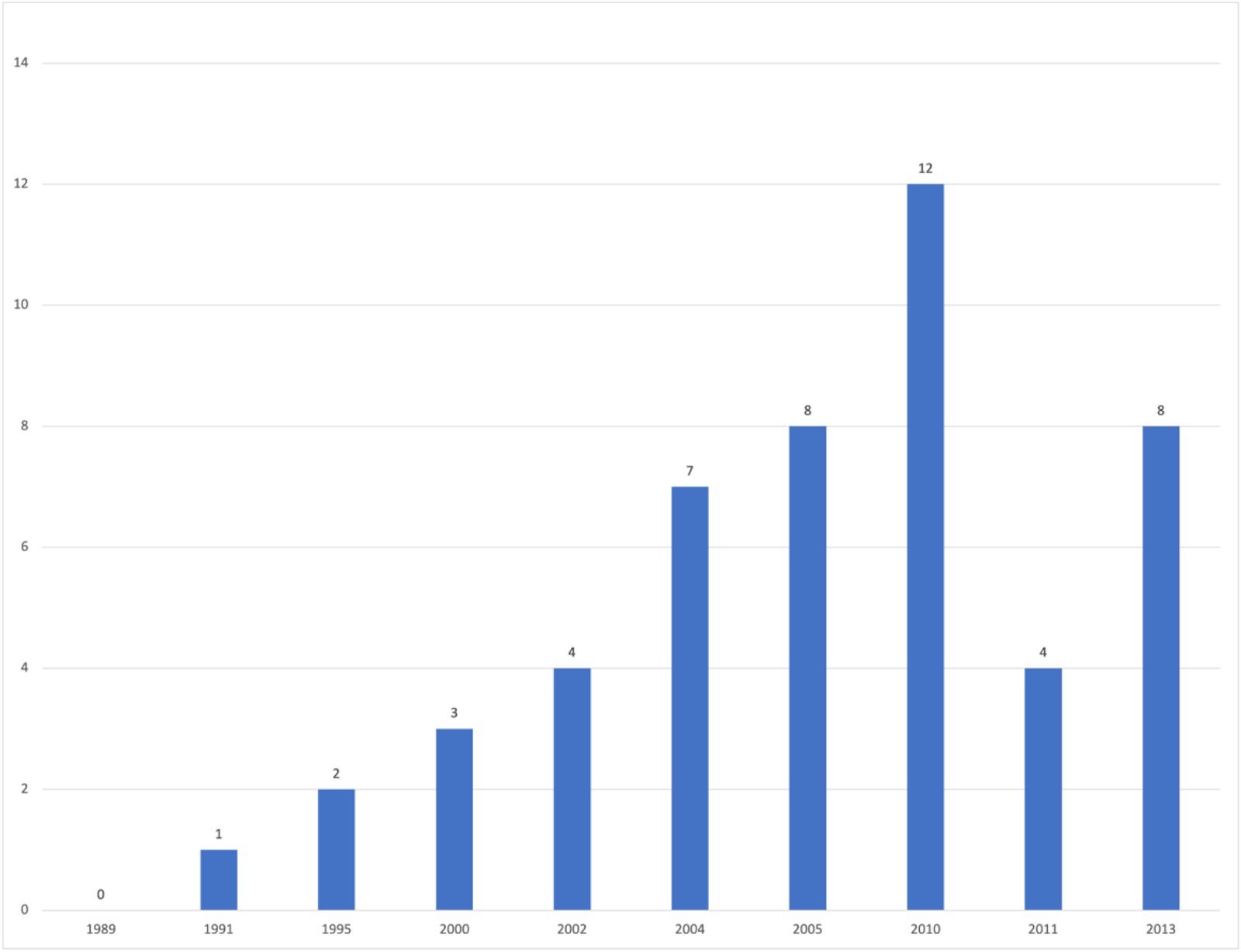
By the time of the XII Meeting in 2013, climate change and biodiversity loss had become central organising logics for ACTO’s strategic agenda. The ministers emphasised the ‘urgent necessity and priority to tackle the risks in store for the Amazon region and more vulnerable communities’ and called for expert meetings to institutionalise cooperation around climate risks.Footnote 86 These declarations reflect a transformation in how the region’s future is imagined – through not solely the lens of sovereignty or development but also a collective orientation towards environmental threat and uncertainty. This discursive evolution is further evident in the increasing frequency with which ACTO ministerial declarations reference climate change. As shown in Figure 1, mentions of ‘climate change’ in official meeting records were non-existent through the 1980s and sparse in the 1990s, but began to rise steadily after 2000, peaking in the 2010s. This trend suggests that eco-anxiety was becoming embedded as a central logic of regional governance, with institutional frameworks increasingly organised around the perceived urgency and irreversibility of environmental risk.
Mentions of ‘climate change’ in ACTO ministerial declarations by year.

Importantly, however, the presence of eco-anxiety in these documents does not necessarily mean that anxiety alone drove institutionalisation. Brazil’s actions must also be read through the lenses of strategic interest and reputational calculation. The ACTO framework provided Brazil with international legitimacy, access to climate finance (such as through the Amazon Fund), and a mechanism for managing perceptions of extractive overreach. The challenge, then, is not to prove whether Brazil was ‘truly’ anxious or simply strategic, but to recognise that anxiety and strategy often operate simultaneously – and that institutional expressions of environmental concern can reflect both emotional reality and political utility.
Discussion
The creation of the communities under study – the Arctic Council and the Amazon Cooperation Treaty Organization – is a clear result of growing eco-anxiety amongst transboundary states around both spaces. In short, environmental changes and concern about future change led to existential challenges regarding how key states interpreted their sense of where they existed in the world. Our above analysis of institutionalisation attempts around transboundary spaces offers key contributions to ontological security and global environmental politics. Shared anxieties – specifically, eco-anxiety – can be a productive basis for cooperation. Rather than framing cooperation as only originating from shared values or rational incentives, we have shown how eco-anxiety has generated institutional responses that seek to manage, contain, or make legible that insecurity. In the discussion we reinforce, first, the important role of eco-anxiety in both cases as driving institutional change, turning to how that eco-anxiety created the conditions through which ontologically insecure communities can be formed, which leads, we argue, to the creation of ontological security. Second, we expand on our concept of ontologically insecure communities, explaining that community formation creates ontological security amongst community members. Third, we address the important role of recognition, the grammar for states to see themselves as stewards of their own environments. That said, we also acknowledge that eco-anxiety alone is not responsible for full institutionalisation but can catalyse cooperation, even if it isn’t deterministic, and argue that performativity is another element that cannot be ignored when studying how eco-anxiety discourse is utilised.
First, in the case of the Arctic, eco-anxiety was not merely a latent background condition. Rather, it was mobilised through calls for environmental protection, shared references to pollution and climate change, and the urgent tone of institutional documents such as the AEPS. It became both a discursive frame and a political frame. Eco-anxiety, as we illustrate, did not guarantee cooperation, but it helped to make cooperation desirable and allowed the creation of an ontologically insecure community in the form of the AEPS, and eventually the creation of the Arctic Council. By foregrounding pollution, a threat that appeared exogenous, monitorable, and resolvable, Arctic states could navigate climate uncertainty through institutions that offered symbolic reassurance without demanding systemic transformation. Moreover, the institutional creation gave states a sense of ontological security that their challenges could be addressed in the appropriate forum and they could be recognised as the stewards of their own environment. In the case of the Amazon, eco-anxiety became an affective dimension through which Brazilian identity could be negotiated. It was mobilised in the creation of the Amazon Cooperation Treaty alongside other strategic concerns to eventually form an ontologically insecure community in the Amazon Cooperation Treaty Organization as a way for Brazil directly to address and create ontological security through the establishment of this institution. In creating an organisation that included only those states directly part of the Amazon Basin, Brazil also simultaneously created the conditions under which it could recognise itself as a key actor and steward in the Amazon’s future.
Second, we re-introduce our concept of ontologically insecure communities that may offer future pathways for researchers to explore the performative and material functions of institutions in the Anthropocene. By ontologically insecure communities, we refer to communities constituted through shared insecurity, held together by practices and institutions that render (eco-)anxiety mutually intelligible, channel it into recognised obligations, and stabilise a sense of collective self-understanding without eliminating underlying uncertainty. Institutions themselves may not alleviate all of a state’s eco-anxiety, but they do offer a grammar through which states can act and speak together in the face of environmental disruption. Whether these arrangements endure or evolve may depend less on the institution’s effectiveness and more on the ability to sustain shared emotional weight. While previous work has explored the nature of security communities and how members’ place within these communities is driven by a need to be part of that community and also maintain their own individuality, our work draws upon the creation of such communities in of themselves. Sustaining that emotional weight over time, then, and maintaining community formation may require different types of affective rhetoric, which name shared vulnerabilities, authorise responsibility, and cultivate trust and belonging in relation to a threatened space. Our contribution moves beyond simply identifying eco-anxiety as a motivating force for state behaviour. In doing so, we also show how a deeply negative emotion such as uncertainty, dread, or fear can be transformed into a productive force: community formation. In both cases under examination, actors reframed eco-anxiety as a call for cooperation, using shared insecurity as a foundation for collective institutionalisation. This conversion of anxiety into reassurance seeking may foreground questions of creating ontological security.
Third, in both cases, we also found clear discursive evidence that reflected environmental uncertainty, appeals to shared environmental vulnerability, and the desire for mutual reassurance. Our argument here is not necessarily that eco-anxiety alone can explain institutional formation, but specifically how eco-anxiety enables the framing of these spaces as sites of cooperation. It also provided a grammar of recognition through which particular states could be seen – and could see themselves – as appropriate stewards of these environments, partially addressing the misrecognition that had animated their anxieties. Anxiety here supplies a vocabulary through which vulnerability and responsibility are made commensurable, and through which claims to stewardship can be validated, contested, or refused. These criteria also intensify reputational exposure, as actors become accountable for not only what they do but also whether their conduct is legible as care, restraint, and obligation in relation to the space at stake. In that sense, shared eco-anxiety functions as a recognitional infrastructure that orders disputes over authority and responsibility, rather than dissolving them.
We also find that there is no deterministic link between eco-anxiety and institutionalisation. While we show in our cases that eco-anxiety can catalyse cooperation, this is not a guaranteed outcome. Other spaces that are transboundary in nature, such as the ocean or space, have not led to the same degree of institutionalisation, even when environmental change is clearly occurring and the space in question is not fully under the control of one state. This raises interesting questions about whether certain types of spaces, such as the global commons, are not conducive to cooperation. This suggests that geopolitical, historical, and geographic configurations matter. Because transboundary spaces have closer links between sovereignty, environmental harm, and reputational concerns, they may be more conducive to eco-anxiety–driven cooperation, whereas the global commons diffuses responsibility and weakens incentives.
Our analysis also highlights that institutionalisation is not just a sign of solidarity. While eco-anxiety may be sincere, it can also be performed, signalling responsiveness and dread without committing to transformational environmental action. There may be important nuances here regarding how institutions can become venues for managing difficult emotions but may not necessarily solve the root problem. This raises an important question: are states acting out of genuine eco-anxiety or just pursuing material and reputational interests? Our work argues that distinguishing between the two is difficult and not clear. Eco-anxiety can be genuinely felt, but it can also enable states to justify policy action and externalise threats. In short, emotional and strategic motivation cannot be unpacked through discourse analysis alone. Indeed, institutionalisation processes may encompass both motivations, and the ambiguity between the two is what makes institutions like the Arctic Council and the Amazon Treaty Cooperation Organization so durable.
Conclusion
Our analysis of institutionalisation in transboundary environmental spaces reveals the central role of eco-anxiety in fostering cooperation and the formation of ontologically insecure communities. We argue that eco-anxiety is a crucial driver of institutionalisation efforts, though its impact varies across different transboundary spaces. Sovereignty plays a significant role in shaping institutionalising mechanisms, influencing the success of these efforts by either encouraging responsibility and accountability or, in the case of global commons, hindering collective action. Eco-anxiety should be understood as not a transient emotional response but rather an enduring condition of political life in the Anthropocene. It reflects a deep ontological disorientation rooted in the recognition that existing political, ecological, and narrative orders are inadequate for addressing planetary crisis. Rather than disappearing, eco-anxiety is likely to become a baseline from which institutional and collective responses emerge.
Our analysis also clarifies how institutional responses to eco-anxiety combine performative and genuinely problem-oriented elements. On the one hand, institutions such as the Arctic Council and ACTO do not eliminate the physical threats that generate eco-anxiety; they lack robust enforcement capacities, their mandates remain limited, and their member states often continue practices that exacerbate ecological degradation. On the other hand, the practical elements of these forums cannot be understated. Precisely through the public performance of concern, responsibility, and stewardship – through declarations, rituals of consultation, and highly visible projects – they provide actors with routines and narratives that stabilise a sense of self in the face of environmental disruption. What may appear as ‘just’ being seen to act is therefore integral to the management of ontological insecurity, even when material risks remain only partially mitigated. Rather than treating performative and genuine responses as mutually exclusive, our cases suggest that institutionalised eco-anxiety works through their entanglement: institutions offer limited but real tools to address physical insecurity while simultaneously staging recognitional and emotional reassurance for communities who fear becoming strangers in their own environments.
Our findings suggest that targeted cooperation initiatives addressing specific environmental issues are more effective, especially in areas experiencing the direct impacts of climate change like the Arctic and the Amazon rainforest. States appear to favour institutional reassurance over unilateral action or denial of eco-anxiety, indicating an inherent link between transboundary environmental challenges and the pursuit of institutional solutions. The task ahead is not to eliminate eco-anxiety but rather to learn how to live and act through it. Doing so, however, requires a transformational orientation – one that sees anxiety as not only a symptom of crisis but also a signal of political and existential possibility. Rather than managing anxiety solely through reassurance, international institutions might foster practices that help communities reimagine their place in a disrupted world.
Looking ahead, future research should aim to delineate the ontologies under which eco-anxiety operates and explore the capacity to systematise this anxiety within various security sectors. Additionally, it is essential to assess the practical impacts of these institutions in mitigating eco-anxiety and their role in broader environmental governance. By tracing how eco-anxiety creates new spaces for security – not in the absence of threat but in its shared recognition – we contribute to a growing body of scholarship on the creation of ontological security. To better understand how actors navigate eco-anxiety, it is important to disentangle the roles of hope, productive power, and performativity. Hope functions as an affective resource that makes alternative futures thinkable, even amid crises. Productive power determines which responses are made visible, legitimate, or governable within institutional settings. Performativity, meanwhile, captures how actors stage their anxiety – often publicly and symbolically – to reaffirm identity or responsibility. Together, these elements help explain how eco-anxiety is not simply felt but also mediated, enacted, and regulated in international politics.
Acknowledgements
The authors wish to thank the editors of the special issue and the other authors for their valuable feedback across the peer review process. We also thank Brent Steele, Cornelia Baciu, Nina Krickel-Choi, Killian Spandler, Brendan Davidson, and Wilfrid Greaves for their feedback in earlier versions of the manuscript.
Competing interests
The authors declare none.
Dr Renato Fakhoury is an adjunct professor in the Department of Political Science and the Honors College at the University of Massachusetts in Lowell. He is also a research fellow at the North American and Arctic Defence and Security Network (NAADSN). He received his PhD from the University of Massachusetts in Lowell, where his dissertation analysed the role of narratives and identity in Arctic security dynamics.
Dr Gabriella Gricius is a postdoctoral fellow at the University of Konstanz and a fellow and the media coordinator with the North American and Arctic Defence and Security Network (NAADSN). She is also a senior fellow at the Arctic Institute. She received her PhD from Colorado State University’s Political Science Department, where her dissertation explored the prevalence of low-tension discourse in Greenland, Svalbard, the Northern Sea Route, and the Northwest Passage.

 Open access

