




Introduction
Research over the last two decades has yielded important insights into when and how hunter-gatherers successfully settled on the Tibetan Plateau (Brantingham & Gao Reference Brantingham and Gao2006; Meyer et al. Reference Meyer, Aldenderfer, Wang, Hoffmann, Dahl, Degering, Haas and Schlütz2017; Zhang et al. Reference Zhang2018). Agro-pastoralism—one of the most important subsistence strategies in this high-altitude environment (Rhoades & Thompson Reference Rhoades and Thompson1975; Goldstein & Beall Reference Goldstein and Beall1990; Bauer Reference Bauer2004)—has also been documented at archaeological sites across various parts of the Plateau (Dong et al. Reference Dong, Jia, An, Chen, Zhao, Tao and Ma2012, Reference Dong, Ren, Jia, Liu, Dong, Li, Wang, Xiao and Chen2016; d'Alpoim Guedes et al. Reference d'Alpoim Guedes, Lu, Li, Spengler, Wu and Aldenderfer2014, Reference d'Alpoim Guedes, Lu, Hein and Schmidt2015; Chen et al. Reference Chen2015; d'Alpoim Guedes & Hein Reference d'Alpoim Guedes and Hein2018; Zhang et al. Reference Zhang, Chen, Marshall, Lü, Lemoine, Wangyal, Dorje and Liu2019). Archaeological research in the central part of Tibet is limited to only a small number of systematically excavated sites (Figure 1). Thus, our understanding of local and regional cultural developments is restricted, with many unanswered questions concerning early, high-altitude subsistence economies.
The main prehistoric sites in central Tibet discussed in the text (map generated by X. Chen using Arcmap v. 10.6 and SRTM 1Arc-second DEM data; see https://www.usgs.gov/).

Here, we present evidence from recent excavations at the site of Bangga in central Tibet—the most comprehensively excavated prehistoric settlement in this region. We argue that the occupants of Bangga relied on an agropastoralist economic strategy, based on the herding of sheep (Ovis aries)/goats (Capra hircus) and possibly cattle (Bos taurus) or yak (Bos grunniens), as well as farming, predominantly of barley (Hordeum vulgare var. vulgare). Additionally, the archaeobotanical, zooarchaeological and material cultural remains from Bangga illustrate notable changes from nearby sites that pre-date Bangga. These changes suggest local varation in archaeological cultures, which correlates with the intensification of agropastoralism in central Tibet from the end of the second millennium BC to the beginning of the first millennium BC. Our results suggest a more dynamic system of subsistence in the first millennium BC, as the populations moved readily between economic modes, combining them in a variety of innovative ways.
Background
Compared with other regions of the Tibetan Plateau, the material culture and archaeological chronologies on the north-eastern Plateau are relatively well understood (Xie Reference Xie2002; Luo Reference Luo2011; Chen Reference Chen2015). Here, the prevailing regional Neolithic cultures include the Majiayao (3980–2050 BC) and Qijia (2183–1635 BC) Cultures. After the mid second millennium BC, the Qijia Culture is thought to have declined and was partially replaced by a number of regional cultural groups (Xie Reference Xie2002). Recent studies suggest that by the first millennium BC, people on the north-eastern and eastern Tibetan Plateau practised diverse forms of subsistence, including pastoralism, hunting and farming (d'Alpoim Guedes et al. Reference d'Alpoim Guedes, Lu, Li, Spengler, Wu and Aldenderfer2014, Reference d'Alpoim Guedes, Lu, Hein and Schmidt2015; Chen et al. Reference Chen2015; He Reference He2015; Dong et al. Reference Dong, Ren, Jia, Liu, Dong, Li, Wang, Xiao and Chen2016; d'Alpoim Guedes Reference d'Alpoim Guedes2018; Zhang et al. Reference Zhang, Chen, Marshall, Lü, Lemoine, Wangyal, Dorje and Liu2019). Although the archaeology of the eastern Tibetan Plateau is relatively well attested, firm conclusions are yet to be reached concerning cultural developments and the origin of agropastoralism in this region (Miehe et al. Reference Miehe, Miehe, Kaiser, Reudenbach, Behrendes, Duo and Schlütz2009).
The archaeology of the central and western parts of the Tibetan Plateau is much more poorly understood, even though the earliest evidence of human occupation at Chusang, in central Tibet, dates to the Early Holocene (Figure 1; Meyer et al. Reference Meyer, Aldenderfer, Wang, Hoffmann, Dahl, Degering, Haas and Schlütz2017). To date, there are only two occupation sites on the Central Plateau with published archaeobotanical or zooarchaeological analyses: Qugong and Changguogou—both excavated in the late 1990s and early 2000s. These two sites were considered to be the earliest Neolithic sites in this area, representing a regional material tradition of the second millennium BC (He Reference He1994; Chinese Academy of Social Science 1999; Chinese Academy of Social Science & Tibet Autonomous Region Cultural Relics Management Committee 1999). Animal remains from the Qugong site suggest the possible presence of yak and sheep, implying that pastoralism was already being practised at Qugong in the second millennium BC (Chinese Academy of Social Science 1999). At contemporaneous Changguogou, naked barley (Hordeum vulgare var. nudum), wheat (Triticum aestivum) and foxtail millet (Setaria italica) have been reported (Fu Reference Fu2001; Liu et al. Reference Liu2016; Lu Reference Lu2016). In the western and northern regions of the Tibetan Plateau sacrificial burials of sheep and horses at sites such as Butaxiongqu, Chuvthag and Gurugyam provide clear evidence for the management of herd animals by the late first millennium BC (Zhang et al. Reference Zhang, Wangdui, Lu and Sodnam2015; Chinese Academy of Social Science et al. 2015).
The Bangga site and excavations
Bangga (29°05′13.66″ north, 91°43′15.36″ east) is a settlement featuring multiple, large, stone enclosures. The ancient settlement lies adjacent to the modern agropastoral village of Bangga in the Yarlung Valley, approximately 10km north-east of Qonggyai County in the Tibetan Autonomous Region of China. At an elevation of approximately 3750m asl, Bangga is situated on an alluvial terrace, delimited to the south by a 10m-wide gully, and by a low mountain ridge to the north (Figure 2). Directly across this mountain ridge lies the summer pastureland used by residents of Bangga village today.
View of the Bangga site on an alluvial terrace, facing north-east (photograph by Z. Zhang).

The first excavations of the Bangga site took place in 1985, led by the Tibet Autonomous Region Cultural Relics Management Committee (Wangdue & Kang Reference Wangdue and Kang1986). Subsequent fieldwork led excavators to postulate that Bangga was occupied by agropastoralists, due to the similarities between the site's prehistoric stone architecture and analogous occupations of modern pastoralists in the region (Wangdue & Kang Reference Wangdue and Kang1986; Li Reference Li2001; Wangdue Reference Wangdue2001). From 2015–2018, a joint archaeological team of Sichuan University and Tibetan Autonomous Region Cultural Relic and Conservation Institute excavated a total area of 360m2 at Bangga. A robust programme of radiocarbon dating (see Table S1 in the online supplementary material (OSM) and Figure 3) and detailed stratigraphic excavation (Figure 4) illustrate two phases of occupation within the 19 archaeological layers exposed in the 2015–2018 excavations. The late phase is represented by archaeological layers 1–12, which date from c. 400 BC to the modern era. Despite displaying some variation in colours, the late phase layers (1–12) are relatively homogeneous, with a sandy texture. Few artefacts, faunal and botanical remains were recovered and few features (e.g. hearths) were identified from these layers, suggesting relatively low-intensity occupation.
Calibrated radiocarbon dates for Bangga (using OxCal 4.3.2 and IntCal13 calibration curve; Bronk Ramsey Reference Bronk Ramsey2009; Reimer et al. Reference Reimer2013); F = stone enclosure; H = pit; L = layer; R = room; T = trench; Z = hearth (figure by the authors).

Stratigraphy of the Bangga site, north wall: L = layer; F = stone enclosure; H = pit. Calibrated radiocarbon dates (at 95.4% confidence) are presented with the layers (photograph by H. Xu; dates calibrated using the IntCal13 calibration curve in OxCal 4.3.2; Bronk Ramsey Reference Bronk Ramsey2009; Reimer et al. Reference Reimer2013).

The earlier occupation phase is characterised by several stone enclosures and layers 13–19. Eight stone enclosures (F1–8) were revealed by the 2015–2018 excavations (Figure 5). Although their depositional complexity makes them difficult to date precisely, we can distinguish two subphases of construction. The first is featured by structures F5 and F7, which date to c. 1000–800 BC. The second subphase is characterised by the construction and usage of F1, F2, F4, F8 and possibly F3. These date to c. 800–400 BC (see Table S1).
Plan of the Bangga site. Features within the stone enclosures were not drawn. F = household; F2 overlays F5; F8 overlays F7 (photograph by H. Xu).

Most of the stone enclosures are concentrated in the northern part of the site, with two large, rectangular enclosures (F2 and F5) dominating the southern portion. The walls, variable in height between 0.10 and 0.80m, were built out of stone slabs, possibly brought in from the immediate vicinity of the site, as similar materials are visible and abundant outside the excavation area. Multiple depositional layers were identified within the stone enclosures. This, in combination with evidence of refurbishment, such as wall removal and reconstruction, along with radiocarbon dates, provides further evidence that the site was repeatedly used and modified.
The most informative and abundant findings came from the earlier phase of the site's occupation. Over 400 features of various construction phases were recorded within the stone enclosures, including hearths, pits and postholes (Table 1). These will be reported separately and in more detail in a monograph currently being prepared by Sichuan University. All eight of the early phase enclosures were sealed by layer 14. Layers 15–19 were only present in the eastern part of the site, on the exterior of, but contemporaneous with, the stone enclosures. While these external layers are probably associated with activities that took place outside of the stone enclosures, they yielded very few artefacts.
Number of features discovered in the stone enclosures at Bangga.

Material culture
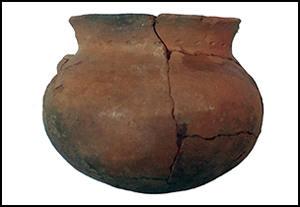
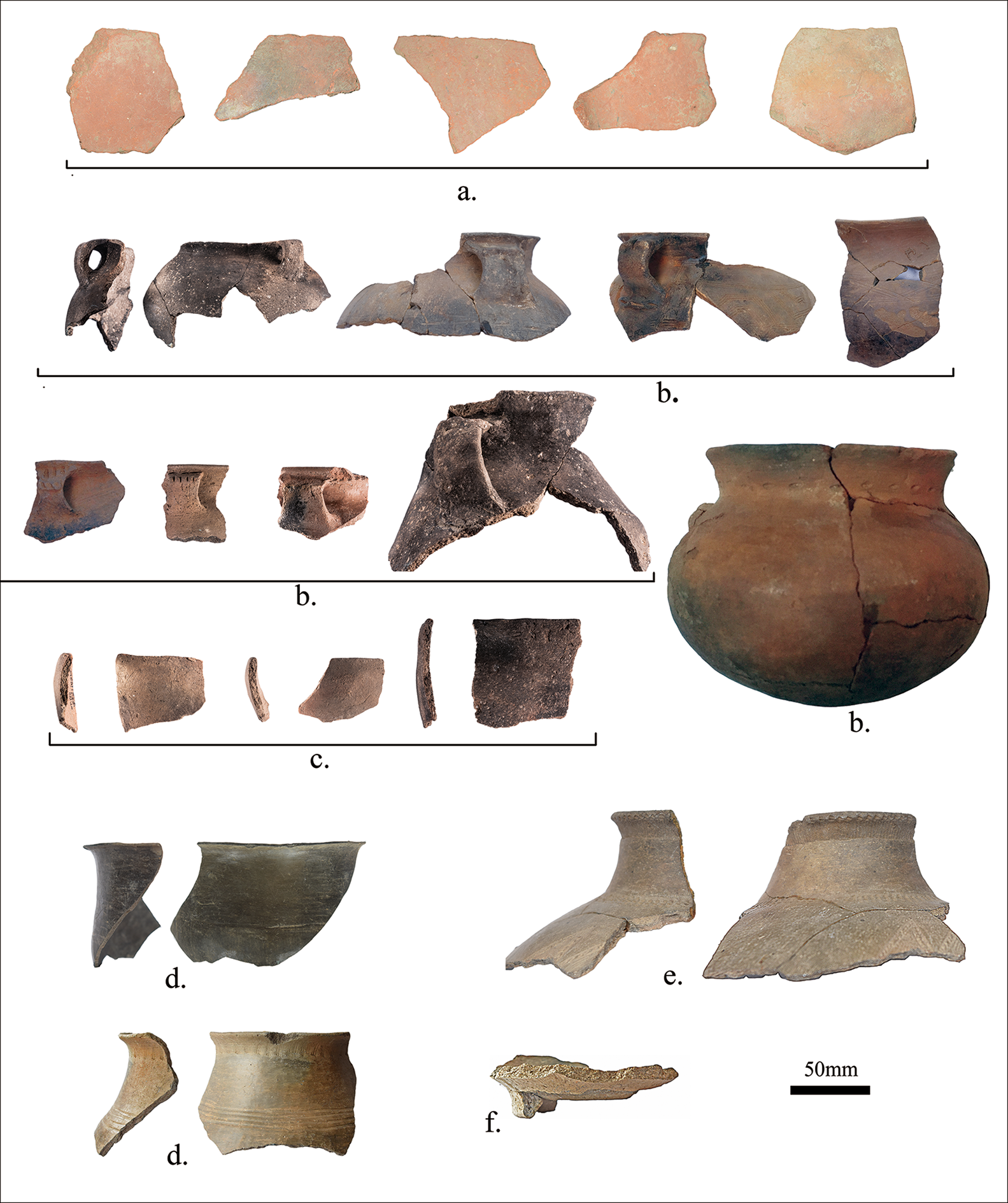
We analysed 7963 ceramic fragments from the 2015–2018 excavations. Pottery from the site is highly fragmented, with only one complete vessel. The upper levels (layers 1–12) yielded dozens of thick, red sherds (Figure 6a). This contrasts with a large quantity of relatively thin, brown sherds recovered from the lower levels and from within the stone enclosures (layers 13–19 & F1–8), the majority of which are hand-formed coarse ware. The early phase ceramics demonstrate a decline in the surface-polishing techniques associated with ceramics from the preceding Qugong Culture and documented in the early phases of occupation at Qugong and Changguogou (Figure 6d–f). Notably, only four per cent of ceramics from Bangga's lower levels are surface-polished (Table S2 & Figure S1). The surface decorations are generally dominated by zigzag and triangular curving lines that are mostly located on the vessels’ shoulders and upper bodies. Although there is a dearth of bases, the pottery from early phase Bangga primarily comprises round-based vessels. Handles are prevalent in the ceramic assemblage in the early phase, and typically include a lug attached to the middle of the vessel, a feature that is absent in the precedent Qugong Culture. At Bangga, we distinguished two ceramic forms: jars and bowls (Figure 6b–c), among which the open-mouthed jar predominates.
Ceramics at Bangga (a–c), compared with Qugong Culture ceramics from the Changguogou site (d–f): a) late phase red ceramics from Bangga; b) early phase open-mouthed jar from Bangga; c) early phase bowl from Bangga; d) surface-polished, open-mouthed jars collected from Changguogou; e) rim sherd of a surface-polished, ring-based jar collected at Changguogou; f) ring base collected at Changguogou (photographs by X. Chen, Z. Li & X. Zhang).
Twenty-four stone tools were recovered and analysed from the 2015 excavation at Bangga. These include stone weights, chipped stones, flakes, grinding stones and millstones (Figure 7). Some of the stone weights and millstones were painted red.
Early phase stone tools from Bangga: a) millstones; b) stone weight; c) grinding stone; d) chipped stone; e) flake (photographs by X. Chen, Y. Zhi & Z. Li).

Zooarchaeological and archaeobotanical remains
We collected more than 10 000 faunal remains from Bangga from 2015–2018, and zooarchaeological analysis is currently ongoing. Preliminary observations suggest that sheep and goats dominate the assemblage. Specimens that can be attributed to large-sized Bovinae, Equidae and various wild mammals, including musk deer, antelope and hare are also present. The wild animals, however, comprise a small proportion of the assemblage. The presence of large Bovinae specimens indicates the presence of cattle or yak, demonstrating similarities with the Qugong faunal assemblage (Chinese Academy of Social Science 1999).
We recovered charred botanical remains from the 2015–2017 excavation seasons via flotation. Here, we report the domesticated grains from the stone enclosures and layers 13 and 14 (Table 2). These include 128 barley grains and 16 wheat grains. Relatively intact barley rachises were recovered in 2018, indicating the practice of barley-dominant agriculture at Bangga (Tang et al. Reference Tang, Lu, Song, Wangdue, Chen, Zhang, Liu, Boivin and Spengler2021). The majority of wheat and barley remains from Bangga were retrieved from stone enclosure F1 in the north of the site, suggesting that F1 may be a domestic structure.
Domesticated grains from L13 and L14 and stone enclosures, from the 2015–2017 excavations at Bangga.

Discussion
Our results illustrate an integrated subsistence economy wherein both farming and pastoralism were used at Bangga throughout the two occupation phases. The multi-resource nature of subsistence at Bangga is also reflected in the site layout and artefact distribution. Across the site, domestic structures are associated both with storage facilities and animal enclosures. In the northern part of the site, large stone enclosures, such as F1, F7 and F8, are interpreted as domestic spaces due to their various internal features, including hearths, pits and postholes. The majority of macro-botanical remains were recovered from this area, and the main enclosures connect via doorways to smaller enclosures. These also contain numerous pits and were probably used as storage facilities. By contrast, domestic evidence is lacking in the southern part of the site. Here, the abundance of animal dung within structures F2 and F5 suggests they were probably used as animal enclosures.
Our findings suggest that Bangga was divided into two functional zones, with domestic, residential areas in the north and animal corrals in the south. This resembles the layout of agropastoralist houses in modern Bangga village, where each house is also divided into two functional areas with a domestic area connected to a semi-detached animal enclosure. Such layouts predominate in modern pastoral settlements across the Tibetan Plateau, and resonate with Bronze Age agropastoral settlements documented archaeologically from the Inner Asian Mountain Corridor (Frachetti & Mar'yashev Reference Frachetti and Mar'yashev2007; Jia et al. Reference Jia, Betts, Cong, Jia and Dupuy2017).
The faunal assemblage from Bangga comprises primarily domestic herd animals, mainly sheep and goats. Although zooarchaeological research is ongoing, preliminary results show the presence of large Bovinae taxa—probably cattle or yak. The mountain pastures to the immediate north of the site are still used today by sheep- and goat-herders from modern Bangga village. It is likely that the same strategy would have been used by ancient herders, although this hypothesis remains to be tested through ongoing survey and excavation in these pasture areas, and via analysis of stable carbon and oxygen isotopic compositions in tooth enamel.
Bangga's prehistoric economy was also characterised by local barley farming, as supported by the recovery of barley rachises, the by-products of crop processing. It is also notable that two cereal crops that originated in north China—broomcorn and foxtail millet—are absent at Bangga. Thus, the Bangga assemblage differs from those studied at Qugong cultural sites on the central Tibetan Plateau, such as Changguogou (1513–842 BC), where wheat and barley (South-western Asian crops), as well as the foxtail millet, were identified (Fu Reference Fu2001). The presence in central Tibet of both Eastern and Western Asian crops during the second and first millennia BC should be understood in the wider context of the trans-Eurasian exchange of cereal crops (Frachetti Reference Frachetti2012; Liu et al. Reference Liu2019). Nevertheless, the distinction in cropping systems between Bangga and Changguogou should be considered in the context of assemblage-formation processes, which tend towards routine food preparation of staple grains (Tang et al. Reference Tang, Lu, Song, Wangdue, Chen, Zhang, Liu, Boivin and Spengler2021). It could also be driven by a variety of social, economic and ecological factors, including issues related to crop cold-tolerance, flexibility in crop flowering times and the possibility of long-distance exchange of grains (d'Alpoim Guedes et al. Reference d'Alpoim Guedes, Lu, Hein and Schmidt2015; Liu et al. Reference Liu2017; d'Alpoim Guedes Reference d'Alpoim Guedes2018; Song et al. Reference Song2021), but also culinary choice, a potential driver that has been discussed elsewhere (Liu et al. Reference Liu2016).
We also document differences between the material cultural assemblages from second-millennium BC Qugong cultural sites (i.e. Qugong and Changguogou) and first-millennium BC Bangga. Indeed, the ceramic and lithic assemblages from Bangga exhibit aspects of both continuity of, and divergence from, the precedent Qugong Culture. At Qugong, the excavators divided the occupation into three: the early, late and ‘stone-cist burial’ phases (Table S1 & Table 3; Chinese Academy of Social Science 1999). Early phase Qugong material culture is characterised by its distinctive black fabric and finely polished surfaces, which comprised approximately 22 per cent of the Qugong ceramic assemblage (Chinese Academy of Social Science 1999). Ceramics at Bangga, however, appear to belong to a different pottery tradition, with the near absence of surface-polished sherds (only four per cent). This resonates with the final occupational phase at Qugong in the first millennium BC. In addition, the ring-based vessels with hollowed-out triangle decorations that are common at Qugong are completely absent in Bangga. Although these distinctions indicate changing material traditions between the second and the first millennia BC in central Tibet, we also observe aspects of continuity between Qugong and Bangga, such as in the diamond-shaped, curving-line decorations found at both sites. A new style of lug decoration on the handles, however, characterises pots at Bangga. Given the lack of evidence to suggest that these material changes resulted from external contact, we attribute them to local communities of practice, specifically within the context of ceramic production (Doumani Reference Doumani2014).
Comparison of prehistoric sites in central Tibet: Qugong, Changguogou and Bangga.

Ethnoarchaeological research across the globe has linked residential mobility to ceramic manufacturing time, and hence the overall investment of labour (Simms et al. Reference Simms, Bright and Ugan1997; Eerkens Reference Eerkens2003). Eerkens (Reference Eerkens2003), for example, argues that the quantity of ceramics with unpolished surfaces—which increases the heat efficiency of the ceramics and reduces the manufacturing time—is usually positively correlated with residential mobility and vice versa (Schiffer Reference Schiffer1990; Eerkens Reference Eerkens2003). From this perspective, the decrease of labour input in association with the lack of surface-polished ceramics at Bangga potentially signals higher residential mobility associated with increasing investment in pastoralism. This interpretation is consistent with the zooarchaeological evidence showing herding animals predominating the faunal assemblage.
Although stone tools are scarce at Bangga, three elements stand out when compared with the Qugong Culture (Table 3). First, the absence of microblades at Bangga is notable, and may indicate a final stage in the decline of microlithic traditions in this region (Chinese Academy of Social Science 1999). Microblades are present at both the Qugong and Changguogou sites, although in small numbers (He Reference He1994; Chinese Academy of Social Science 1999). Microblade technologies first appeared in East Asia around 28 000–24 000 BP and represent a very long and homogeneous technological tradition in the region until the Mid-Holocene (e.g. Yi et al. Reference Yi2013). Comparatively, microblade technology is often viewed in terms of its economic advantages, particularly for the hunting and processing of large- and medium-sized game animals (Elston & Kuhn Reference Elston and Kuhn2002). One possible explanation for the discrepancy in the presence of microblades between Qugong and Bangga is that hunting was the focus of animal-based subsistence at Qugong, whereas the inhabitants of Bangga engaged more intensively in herding. Despite this economic difference, however, there are also similarities between the Bangga and Qugong lithic assemblages.
First, red-painted stone stools are documented at both sites. Approximately 20 per cent of the Quagong stone tools were painted red, compared with 13 per cent at Bangga. That no red-painted stone tools have been found at contemporaneous sites in other parts of the Tibetan Plateau may indicate continuity in stone-tool decoration traditions between Qugong and Bangga. Second, grinding stones were recovered from the early phases of Bangga, Qugong and Changguogou. Such stones can be used in multiple food-production contexts, although a primary function is for making flour, typically from cereals originating from South-western Asia, such as wheat and barley (Fuller & Rowlands Reference Fuller, Rowlands, Sherrat, Wilkinson and Bennet2011). By contrast, East Asian cereals, such as millet (Panicum miliaceum and Setaria italica) and rice (Oryza sativa), were most often cooked by boiling and steaming. This deeply rooted distinction between East and West Asian culinary practices has been explored by various scholars, particularly in the context of early food globalisation (e.g. Fuller & Rowlands Reference Fuller, Rowlands, Sherrat, Wilkinson and Bennet2011; Liu et al. Reference Liu2016).
The presence of grinding stones and the absence of pottery vessels for boiling or steaming at Bangga hints at a flour-based culinary tradition. Such a cooking preference could have consequences for the selection of grain quality, with high-gluten content being the priority, as high-gluten grains go further in grinding (Liu & Reid Reference Liu and Reid2020: 17). This is consistent with archaeobotanical evidence showing barley to have been the main crop at Bangga, and resonates with recent discussion on the culinary driver behind the eastern dispersal of crops from the Fertile Crescent (Liu & Reid Reference Liu and Reid2020).
While current archaeological data are insufficient to illustrate comprehensively the changes in subsistence and material cultural traditions in central Tibet and across the Tibetan Plateau, our excavations at Bangga provide evidence for important differences (and similarities) between this site and the Qugong cultural sites in central Tibet. Bangga yielded distinct botanical and faunal assemblages that show diversity in subsistence strategies, variations in labour-input in ceramic manufacturing that indicate differences in residential mobility, and evidence for culinary practices focused on the preparation of flour-based food. The absence of microblade technology indicates less reliance on hunting and game animals. How, then, can we explain these differences in a wider regional perspective?
The climate of this part of the Plateau has changed significantly during the Holocene, and has been explored in the context of variations in Asian summer monsoon patterns (e.g. Wang et al. Reference Wang2005). We do not, however, consider the environment to have been a primary driver of the material changes at Bangga, as there was no drastic climatic shift in Central Tibet around 1000 BC (e.g. Duan et al. Reference Duan, Yao, Wang and Thompson2012). Furthermore, Chen et al. (Reference Chen2015) have demonstrated that climate change was only one factor, among several, which induced shifts in prehistoric subsistence and farming technology elsewhere on the Tibetan Plateau. Rather, we have framed the differences between Qugong and Bangga in the context of shifting cultural paradigms between the second and first millennia BC, particularly in relation to subsistence and material craft traditions. We argue that the differences were primarily driven by regional diversities, as populations move fairly readily between distinct modes of subsistence, combining those different modes in a variety of innovative ways, as illustrated in other parts of Tibet and across China (e.g. Zhang et al. Reference Zhang, Chen, Marshall, Lü, Lemoine, Wangyal, Dorje and Liu2019; Liu & Reid Reference Liu and Reid2020).
Conclusion
The results from our recent excavations at Bangga illuminate the emergence and development of agropastoralism on the Tibetan Plateau, especially in central Tibet. The architecture, material culture, zooarchaeological and archaeobotanical evidence from Bangga offers a detailed case study of settled agropastoralism in the first millennium BC, and illustrates innovations and continuities from earlier sites. The Bangga material assemblage exhibits a drastic decrease in surface-polished ceramics and the absence of microblades, indicating higher investment in pastoralism. Bangga's prehistoric economy features local barley farming and sheep/goat pastoralism—a subsistence strategy similar to that seen at Qugong Culture sites. Further questions remain regarding the seasonal regimes of pastoral mobility, and plant- and animal-management practices at Bangga. To understand seasonality in herding strategies, we are currently conducting sequential isotopic analysis of modern and archaeological sheep- and goat-tooth enamel from the site, as well as continuing archaeological survey and excavation at the prehistoric highland pastoral sites close to Bangga. Our results illustrate a more dynamic and diversified system of subsistence in the high-altitude regions than previously suspected as the populations moved smoothly between distinct economic modes, combining them in a variety of innovative ways.
Acknowledgements
Archaeobotanical and zooarchaeological identification was conducted at Sichuan University. Special thanks to Ha Bibu, Qiangba Ciren, Jixiang Song, Feng Yang, Xiaowen Zhang, Mao Zhou, Fang Han, Zhen Zhao, Hailun Xu, Dan Zhao, Zhengrong Li, Zhaxi Ciren, Lunzhu Qunpei, Xuepeng Wei, Yushi Zhi and the Bangga villagers, all of whom contributed to the research of the Bangga site.
Funding statement
The fieldwork was jointly funded by the Tibetan Autonomous Region Cultural Relic and Conservation Institute and Sichuan University. This research was also partially funded by the Strategic Priority Research Program of the Chinese Academy of Sciences (grant XDA20040000). We would also like to acknowledge the National Science Foundation in supporting the flora and fauna studies and the isotopic analysis at the site under grants 1826727 (The Origins and Spread of Millet Cultivation) and 2017247 (Animal-based Subsistence Strategy in Prehistoric Central Tibet, 3000–2000 BP).
Supplementary material
To view supplementary material for this article, please visit https://doi.org/10.15184/aqy.2020.185


 Open access

