




Introduction
The Linearbandkeramik (LBK, c. 5500–4950 cal BC) is considered one of the few examples of a Neolithic culture with an individualised, clearly gendered and elaborate mortuary tradition (Robb & Harris Reference Robb and Harris2018). LBK cemeteries are concentrated in Central Europe, and sometimes contain several hundred individuals (Bickle & Whittle Reference Bickle and Whittle2013a). In the past few years, a number of late LBK sites in Central Europe have been discovered, revealing evidence that, to the modern eye, may be viewed as unsettling methods of both putting the living to death and handling the dead. These sites include Herxheim in south-west Germany, which has yielded hundreds of cases of post-mortem manipulation (for contrasting interpretations, see Orschiedt & Haidle Reference Orschiedt, Haidle, Schulting and Fibiger2012; Boulestin & Coupey Reference Boulestin and Coupey2015; Zeeb-Lanz Reference Zeeb-Lanz and Zeeb-Lanz2019), and sites with clear evidence for severe inter-personal violence (Asparn-Schletz in Austria: Teschler-Nicola Reference Teschler-Nicola, Schulting and Fibiger2012; Talheim in south-west Germany: Wahl & Trautmann Reference Wahl, Trautmann, Schulting and Fibiger2012; Kilianstädten in central Germany: Meyer et al. Reference Meyer, Lohr, Gronenborn and Alt2015; Halberstadt in eastern Germany: Meyer et al. Reference Meyer, Knipper, Nicklisch, Münster, Kürbis, Dresely, Meller and Alt2018). It has been claimed that these sites reflect a state of crisis at the end of the LBK, during which increased tension between groups—sometimes posited to have stemmed from deteriorating climatic conditions (Gronenborn Reference Gronenborn, Pollard and Banks2007)—could only be resolved by violence (e.g. Farruggia Reference Farruggia2002; Wild et al. Reference Wild, Häusser, Stadler, Kutschera, Steier, Teschler-Nicola, Wahl and Windl2004). Others, however, have challenged this view on chronological grounds, and because the number of such sites is still limited and the patterns of violence very diverse (Link Reference Link, Link and Peter-Röcher2014a; Stäuble Reference Stäuble, Link and Schimmelpfennig2014; Zeeb-Lanz Reference Zeeb-Lanz and Zeeb-Lanz2019: 460).
Vráble is a newly discovered LBK site in south-west Slovakia that has yielded evidence for diverse ways of handling the dead. Some of the buried individuals show clear signs of post-mortem manipulation, and the overall context hints at the use of specific burial rituals. Vráble therefore adds a specific point of reference for interpretation of the previously mentioned examples, further sharpening understanding of the ways in which the first farmers in Central Europe engaged with death and the deceased. Vráble also adds to our understanding of the role that violence played in such practices and in the social dynamics within communities.
Archaeological features
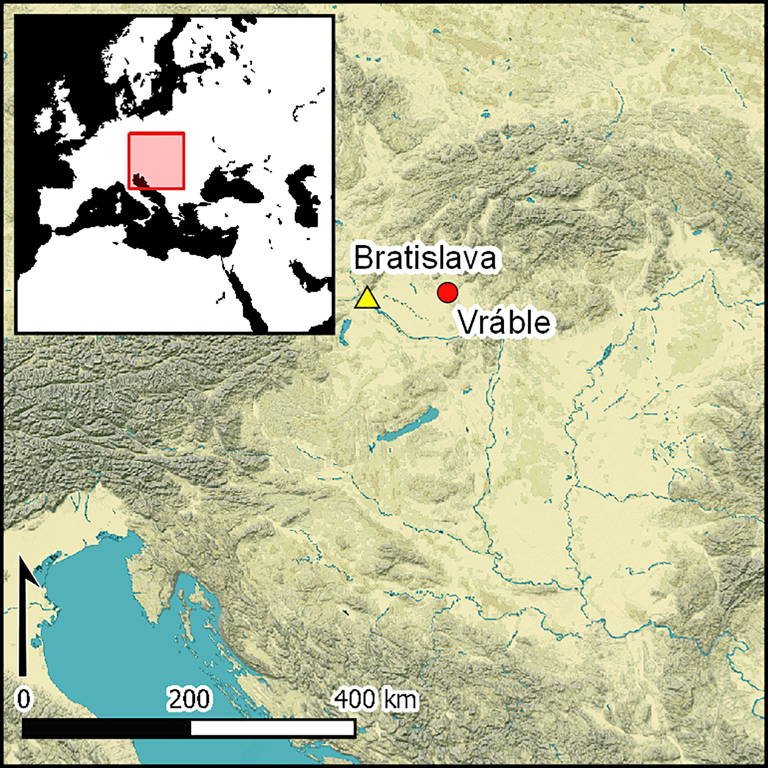
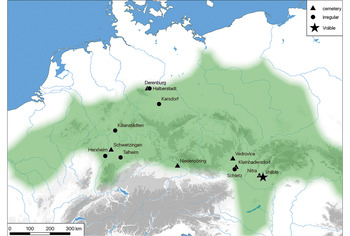
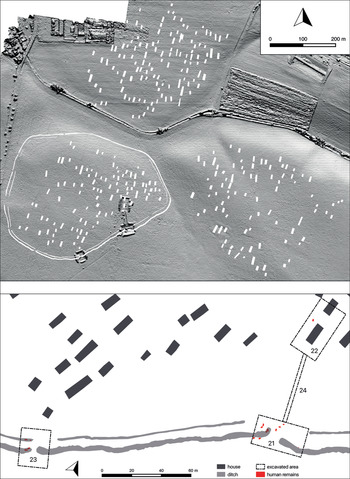
The site of Vráble is located in the valley of the upper Žitava River, one of the many north–south-flowing tributaries of the Danube (Figure 1). The site is situated on undulating terrain on a fertile loess river terrace. Large-scale magnetic surveys and subsequent excavations have shown that the site comprised three contemporaneous LBK house clusters (Furholt et al. Reference Furholt, Bátora, Cheben, Kroll, Rassmann and Tóth2014, Reference Furholt, Cheben, Müller, Bistáková, Wunderlich and Müller-Scheessel2020; Müller-Scheeßel et al. Reference Müller-Scheessel, Cheben, Filipović, Hukeľová and Furholt2016; Meadows et al. Reference Meadows, Müller-Scheessel, Cheben, Agerskov Rose and Furholt2019). Similar to practices elsewhere (e.g. Bogaard et al. (Reference Bogaard, Krause and Strien2011) for Vaihingen an der Enz), we refer to these spatially separated clusters—the largest social units within the settlement of Vráble—as ‘neighbourhoods’ (Wunderlich et al. Reference Wunderlich, Müller, Cheben, Bistáková, Furholt, Müller-Scheessel, Furholt, Cheben, Müller, Bistáková, Wunderlich and Müller-Scheessel2020). Only the south-western neighbourhood was enclosed by a ditch system, and most of the human remains discussed in this article were found in proximity to two of the five entrances of this enclosure (Figure 2).
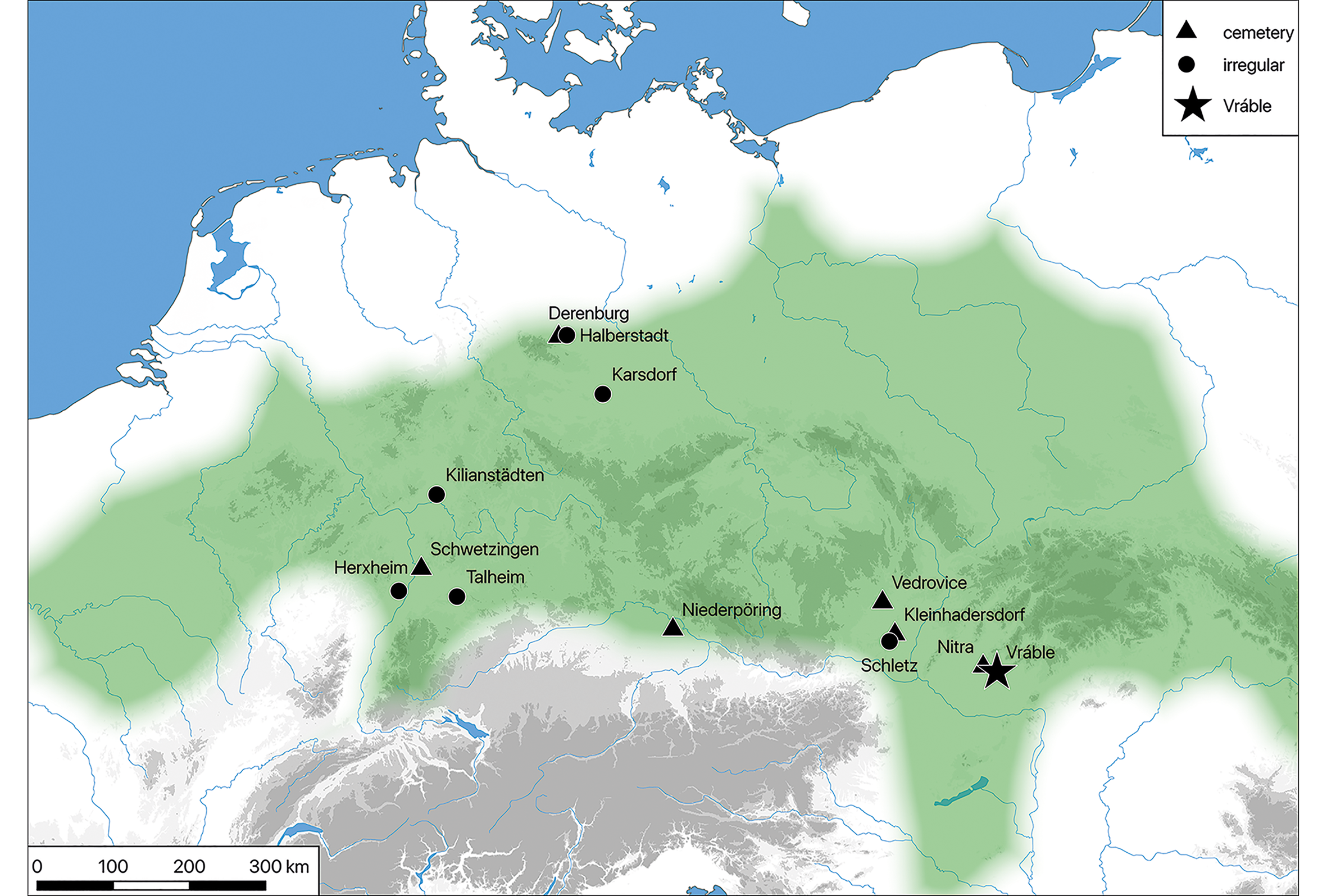
Vráble (star) and other sites mentioned in the text in relation to the general distribution of early LBK sites (shown in green, after Lüning Reference Lüning1988: 32 & fig. 4) (figure by N. Müller-Scheeßel).
Above) the three separate neighbourhoods of Vráble shown in the magnetic prospection data, with the interpreted houses as white rectangles, the ditches around the south-western neighbourhood as white lines and a high-resolution shaded elevation model as backdrop; the excavated areas in the south-western neighbourhood are clearly visible. Below) the southern entrances to the enclosure around the south-western neighbourhood of Vráble and the excavated areas (figure by N. Müller-Scheeßel).
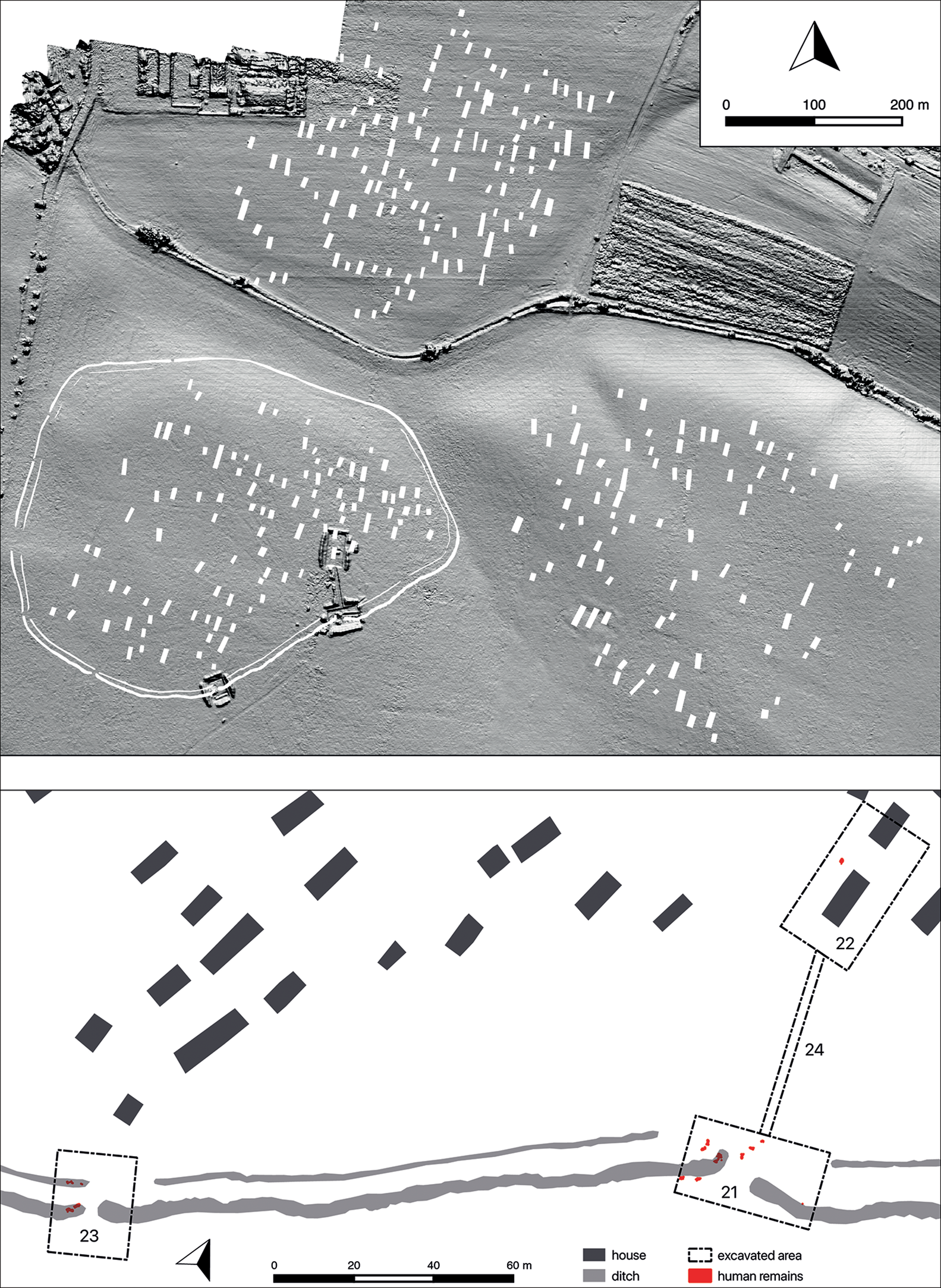
The settlement of Vráble dates to between c. 5250 and 4950 cal BC (Furholt et al. Reference Furholt, Bátora, Cheben, Kroll, Rassmann and Tóth2014; Meadows et al. Reference Meadows, Müller-Scheessel, Cheben, Agerskov Rose and Furholt2019). The enclosure surrounding the south-western neighbourhood has a maximum perimeter of approximately 1450m, and consists of three concentric components: two ditches and one palisade. The outer ditch is around 2.5–3.5m wide, and a distinct phase of re-cutting is visible in the profile sections. The inner ditch is smaller at only 1.5m wide.
Although the excavation of the ditches yielded no direct evidence concerning their temporal relationship, their parallel courses suggest either that they were contemporaneous, or that one was still clearly visible when the other was dug. The absence of fine-grained fill layers that would indicate slow silting suggests that the fills of the ditches formed rapidly. We therefore assume that the ditches were dug shortly before the oldest of the human burials were placed towards the bottom of the re-cut ditch deposits.
The human remains
Excavations in Vráble have so far yielded the remains of approximately 19 human individuals (see Table S1 in the online supplementary material (OSM)). Without extensive aDNA work, however, we cannot establish whether bones found considerable distances apart belong to the same individual, or whether disarticulated bones found close together originate from different individuals. The grouping of bone scatters was based on both proximity and plausibility, and was referenced against other evidence, such as the osteological analysis, stable isotope values and radiocarbon-dating of single bones.
One almost complete, articulated individual (G1/S14) was discovered in the south-eastern neighbourhood. A further relatively complete but disarticulated individual (G11/S22) was found associated with house 23 in the south-western neighbourhood, and an isolated frontal bone (I19/S10) was found in the northern neighbourhood. The remaining bones were found in or near the two entrances in the south-western neighbourhood's ditch system. Despite extensive geophysical surveys and systematic field walking in the locality (Falkenstein et al. Reference Falkenstein, Bátora, Eitel and Rassmann2008; Furholt et al. Reference Furholt, Bátora, Cheben, Kroll, Rassmann and Tóth2014), no evidence for a ‘regular’ LBK cemetery, as briefly described below, has so far been discovered.
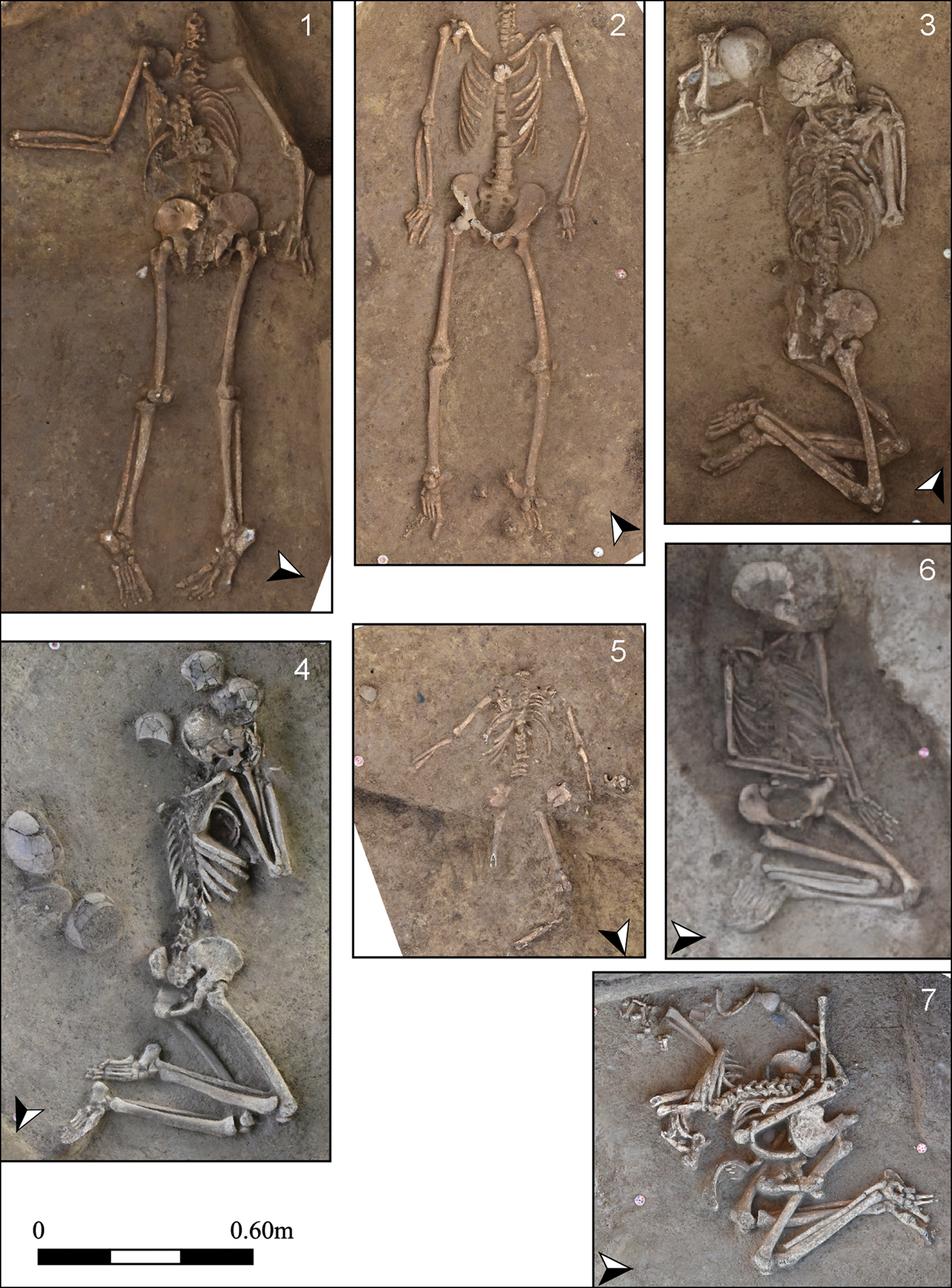
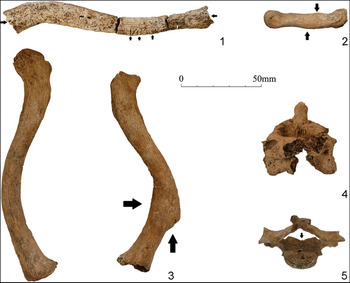
At least two distinct patterns in the treatment of human remains are apparent at Vráble (Figure 3). The first corresponds to the well-known LBK burial custom in which the deceased were placed in shallow individual burial pits in a crouched position on their left side, with a few grave goods (referred to here as the ‘regular’ burial type) (Bickle & Whittle Reference Bickle, Whittle, Bickle and Whittle2013b: 17–20). At Vráble, six of these ‘regular’ burials were placed on either side of the large outer ditch (G2/S21, G3/S21, G6/S21, G7/S21, G8/S21 & G9/S21; Figure 3.3–4 & 3.6). As is usual with LBK settlement burials (Hedges et al. Reference Hedges, Bickle and Whittle2013: 374), no dominant orientation is apparent. In three cases, ceramic sherds were found below the human remains (G2/S21, G3/S21, G6/S21). Additionally, the upper body of individual G2/S21 (Figure 3.7) seems to have sloped within the grave. The ceramic vessels associated with individual G8/S21 (Figure 3.4) were found on their sides and appear to have fallen from a raised level. Together, these observations suggest that the individuals were laid out within the graves on low, raised structures of perishable materials that have not survived. The presence of gnawing marks affecting individuals G2/S21 and G6/S21 (Figure 4.1) suggests that at least some of the bodies may not have been covered immediately, leaving them accessible to scavengers.
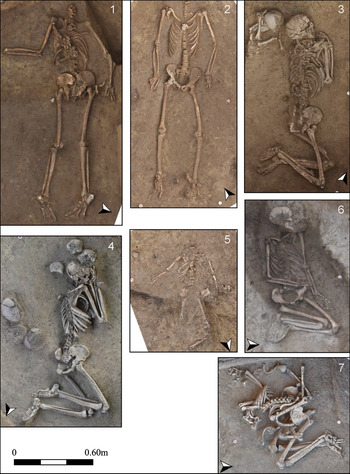
Selection of burials from Vráble: 1) G13/S23; 2) G12/S23; 3) G7/S21; 4) G8/S21; 5) G4/S21; 6) G9/S21; 7) G2/S21 (figure by N. Müller-Scheeßel).
Examples of skeletal pathology at Vráble: 1) left clavicle from G3/S21, with signs of animal activity (arrows); 2) probable fractured and healed right metacarpal bone (‘boxer's fracture’) of G13/S23 (Figure 3.1); 3) clavicles from G13/S23, with the fracture affecting the left clavicle marked by arrows; 4) fused cervical vertebrae from G5/S21; 5) notochord defect on a cervical vertebra from G12/S23 (Figure 3.2) (figure by Z. Hukeľová).

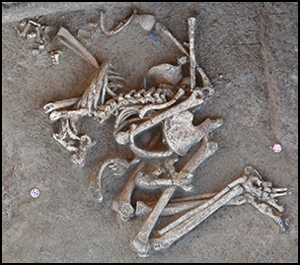
The second category of mortuary treatment (referred to here as the ‘irregular’ burial type) is represented by three headless individuals (G4/S21, G12/S23, G13/S23; Figure 3.1–2 & 3.5), who were each placed in an extended position at the bottom of the outer ditch. Stratigraphically, their deposition seems to have coincided with, or immediately post-dated, the re-cutting of the ditch. The individuals lack cut marks on their cervical vertebrae, and their atlases (first cervical vertebra) and mandibles are missing. The bodies were therefore probably sufficiently decomposed for the skulls to have been removed without the use of any tools, yet at the stage when the atlas (and perhaps also the mandible) were still held in position by tendons. One of the individuals (G13/S23; Figure 3.1) is also missing their left hand. Again, a lack of cut marks indicates that it was probably removed following a period of decomposition. The removal of the skulls and the single hand is also consistent with the hypothesis that the bodies were left uncovered for a period of time following deposition. A particularly heavily disturbed individual (G5/S21), with no skull or mandible, was also found at the bottom of the ditch, although it is unclear when these elements were separated from the post-cranial skeleton, due to extensive disturbance of the extant remains.
Depositions of single human bones and, sometimes, larger body parts (G10/S21, G14/S21, I15/S21, I16/S23, I17/S23 & I18/S21) were found in the fills of the ditches. These finds are more problematic to subsume under one specific burial custom, as they potentially result from a number of different depositional processes. They may, for example, originate from older burials that were disturbed and re-deposited during the digging of the ditches, or from corpses that were left exposed on the ditch bank for an extended period, so that only very few elements became incorporated into the ditch fill. It seems very likely that further excavation of the outer ditch will yield many more individuals, as only 50m of the 1450m circuit has so far been excavated.
Burial goods
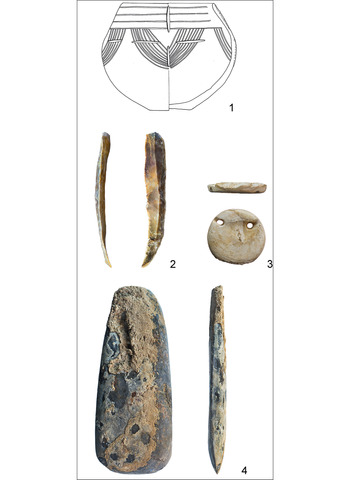
Table S1 in OSM1 provides an overview of the artefacts from Vráble that could be considered as grave goods (Figure 5). A strong disparity in associated goods between the individuals is immediately apparent. Two individuals—both older males—were comparatively richly equipped: G8/S21 (Figure 5.2) was accompanied by six ceramic vessels and a flint blade, while G7/S21 had one ceramic vessel, one adze (Figure 5.4), one rubbing or abrading stone, two flint blades and the left extremities of a sheep (the latter identified by U. Schmölcke). Three other individuals (G2/S21, G3/S21, G6/S21) had either one or two ceramic vessels in their burial pits, and an obsidian bladelet was found with individual G6/S21. One further obsidian bladelet was discovered close to the disarticulated bones of individual G10/S21.
Selection of grave goods from Vráble: 1) ceramic vessel from the upper layer of the outer ditch; 2) flint blade from burial G8/S21; 3) Spondylus medallion from an animal burrow; 4) flat adze from G7/S21. 1) Scale = 1:3; 2–4) scale = 1:2. (figure by E. Bakytová & G. Müller-Scheeßel).

In addition, a Spondylus medallion (Figure 5.3) was discovered in an animal burrow near the inner ditch. This cannot be directly associated with any of the individuals, but such medallions are characteristic burial items (Müller-Scheessel Reference Müller-Scheessel, Koch and Kirleis2019), and were almost exclusively associated with women (Bardec'kyj et al. Reference Bardec'kyj, Dębiec and Saile2016: 187). We suggest that the medallion probably derives from a now destroyed grave.
Osteological analysis
Most of the Vráble individuals are adults. Males outnumber females by eight to two, although the sex of eight individuals cannot be determined. Due to the relatively small sample size and the restricted excavation area, palaeodemographic analyses seem unnecessary, especially as only one child and no elderly adults (60+) were present. Most of the adult individuals died between the ages of 18 and 35 years, with only two males and one female surviving past 35 years of age (see OSM4 for the methods used to assess age, sex and pathologies).
One individual (G1/S14) exhibits degenerative changes to the spine, one displays a congenital spinal defect (G5/S21; Figure 4.4), and two individuals exhibit both types of pathological condition (G12/S23 and G13/S23; Figure 4.5). Healed trauma was observed in four individuals. In one case (male G1/S14), healed blunt-force trauma was recorded on the supero-posterior area of the cranium. Two individuals (males G8/S21 & G13/S23; Figure 4.3) exhibit poorly healed left clavicles. Although broken clavicles are common, the specific fracture type exhibited by the two Vráble individuals (Robinson's Type 1B and 2B1) is today usually associated with sporting activity or violence (Robinson Reference Robinson1998). Furthermore, one of these individuals (G13/S23) probably had a healed fracture affecting the right fifth metacarpal (Figure 4.2). This type of fracture is known as a ‘boxer's fracture’, as it “is most frequently seen in hand-to-hand combat” (Hedges et al. Reference Hedges, Bickle and Whittle2013: 371). A fully healed fracture of the mid-shaft of the right tibia was observed in one individual (female G12/S23).
Radiocarbon dating
Thirty-five human bones attributed to the 19 putative individuals were dated, either at the Poznan Radiocarbon Laboratory in Poland (Poz-, 26 samples), or at the Leibniz Laboratory in Kiel, Germany (KIA-, 9 samples; one of these was replicated at the Royal Institute for Cultural Heritage in Brussels, Belgium [RICH-]). Additionally, five animal bones—one from the ‘regular’ burial G7/S21, one associated with the dislocated ‘irregular’ burial G5/S21 and three from two shallow pits of unknown function near the inner ditch—were dated at Poznan. Brock et al. (Reference Brock, Higham, Ditchfield and Ramsey2010) and Meadows et al. (Reference Meadows, Müller-Scheessel, Cheben, Agerskov Rose and Furholt2019) describe the laboratory methods used in this study. Results are provided in Table S1, including collagen yields, which were, on average, significantly higher than those from animal bones elsewhere on the site, thus increasing the chances of obtaining reliable results (Meadows et al. Reference Meadows, Müller-Scheessel, Cheben, Agerskov Rose and Furholt2019). Figure 6 (OSM3) shows our chronological model for mortuary activity at Vráble based on a combination of stratigraphic, osteological and archaeological data. Created using the Bayesian modelling package in OxCal v.4.3 (Bronk Ramsey Reference Bronk Ramsey2009), the model suggests little, if any, chronological overlap between the ‘irregular’ burials, whose median dates cluster in the mid fifty-first century cal BC, and ‘regular’ burials, which span several decades either side of 5000 cal BC (Figure 7). The apparently rapid accumulation of human remains within the outer ditch fills, however, concurs with the lack of natural, fine-grained silting. It seems likely, therefore, that the ditch was intentionally, rather than naturally, filled, either immediately or in the few months or years following deposition of the human remains.
Bayesian model of mortuary activity at Vráble (cf. OSM1). For underlying assumptions, see OSM2. Full model code is provided in OSM3 (figure by J. Meadows).

Summaries of modelled radiocarbon data (cf. Figure 6) of crouched and non-crouched burials from Vráble, obtained using the OxCal function KDE_Plot (Bronk Ramsey Reference Bronk Ramsey2017) within each bounded phase of the model shown in Figure 6. Crosses indicate the median calibrated (grey) and modelled (black) date of each individual, and thus the number of dated individuals of each type (figure by J. Meadows).

Towards the end of, or immediately after, the deposition of the human remains in the ditches (but before 5000 cal BC), the first ‘regular’ burial was interred near the ditches. The latest ‘regular’ burial took place before 4950 cal BC (Figure 8), and more or less contemporaneously with the abandonment of the south-western neighbourhood (Meadows et al. Reference Meadows, Müller-Scheessel, Cheben, Agerskov Rose and Furholt2019: fig. 9). Regarding the chronological order of the crouched, ‘regular’ burials, G8/S21 appears to be the earliest (Figure 8). The next in the sequence may be G6/S21, followed by G9/S21 and G3/S21, G2/S21 and, finally, G7/S21. The richest burials in terms of grave goods seem to be restricted to the beginning and the end of the sequence. The timespan covered by these crouched burials, however, is too short for the order of the burials to be determined unequivocally.
Modelled dates of crouched burials (cf. Figure 6) from Vráble (figure by J. Meadows).

Discussion
Treatment of the dead
The treatment of the dead at Vráble—as attested by the burials in the vicinity of the ditch system—is remarkable. Firstly, possible open-air staging of the dead for a certain period of time presents a burial ritual not previously taken into consideration for the LBK. Such a practice could explain seemingly disturbed burials found elsewhere (e.g. at Sondershausen and Bruchstedt: Kahlke Reference Kahlke2004). Occasional reports of postholes in or near burial pits (Kahlke Reference Kahlke2004: graves SO24 & SO28, Bickle et al. Reference Bickle, Arbogast, Bentley, Fibiger, Hamilton, Hedges, Whittle, Bickle and Whittle2013b: 303), or wooden constructions (Baumann Reference Baumann1960), could therefore represent much more widespread practices than currently known. In Alsace, for example, Bickle et al. (Reference Bickle, Arbogast, Bentley, Fibiger, Hamilton, Hedges, Whittle, Bickle and Whittle2013b: 301) suggest that voids in grave fills created by perishable internal structures are a late LBK development (see also Thevenet Reference Thevenet2004). A thorough, in situ examination of the displacement of bones of LBK burials along the line of an ‘anthropologie de terrain’ (see Duday et al. Reference Duday, Courtaud, Crubézy, Sellier and Tillier1990; Duday Reference Duday2009) certainly warrants more consideration in the future.
Secondly, the differences in mortuary treatment at Vráble are striking. While some individuals were buried (with clear investment in terms of time, labour and grave goods), others were left exposed for a certain period of time. Furthermore, the skulls of at least three skeletons from the ‘irregular’ group were removed during the decomposition process. The true prevalence of this practice at Vráble cannot yet be assessed properly, as some of the bone scatters were too poorly preserved. Nevertheless, as the modus operandi with the three articulated skeletons was identical, this behaviour seems to have been part of a regular ritual practice within the Vráble community.
Similar finds of skeletons without skulls from LBK contexts are known, for example, from France, Germany and Hungary (Kahlke Reference Kahlke2004: 76; Lefranc & Boёs Reference Lefranc, Boёs and Zeeb-Lanz2009: 202; Bickle & Whittle Reference Bickle and Whittle2013a: 75). None of these cases, however, display such a clear modus operandi as at Vráble. A particular interest in the skull seems to be a universal human characteristic (Zalai-Gaál Reference Zalai-Gaál2009; Armit Reference Armit2012), and so we should be careful not to postulate too readily a pan-Neolithic skull-cult related to ancestor worship (Perschke Reference Perschke and Müller-Scheessel2013). Such ancestor worship seems particularly unlikely in the case of the child from Vráble (G4/S21).
Pathologies and trauma
Unfortunately, it is not easy to form a reliable overview of the general health of LBK individuals or the level of violence that they experienced. Four out of the eleven (36.4 per cent) well-preserved adult individuals from Vráble exhibit spinal defects. Tvrdý (Reference Tvrdý2016) reports a similar prevalence of spinal defects in 12 of the 37 (32.4 per cent) adult individuals from the nearby LBK cemetery at Nitra. Thus, it seems that the prevalence of degenerative pathologies was similar at both Vráble and Nitra (only degenerative conditions are reported for the latter site).
In terms of trauma, we compiled information from different datasets, differentiating between LBK individuals from cemeteries and those from settlement contexts (Figure 9). Accordingly, a cranial trauma rate of 2–6 per cent seems to be typical among LBK populations, and with one affected individual from among the eleven adults, Vráble is broadly within this range. The picture differs, however, for post-cranial trauma. Three Vráble individuals—one ‘regular’ and two ‘irregular’—exhibit a total of four post-cranial fractures. This is a much higher prevalence than observed in ‘regular’ LBK cemeteries elsewhere, but is similar to other datasets for settlement burials. While the skull trauma, the ‘boxer fracture’ and perhaps also the two broken clavicles could be associated with combat-related activities, we have no evidence that affected Vráble individuals were killed in conflict—as is reported, for example, for the individuals from the ditch in Asparn-Schletz (Teschler-Nicola Reference Teschler-Nicola, Schulting and Fibiger2012)—as they lack evidence of peri-mortem injuries.
Cranial and post-cranial trauma observed in adult individuals from LBK cemeteries and settlement contexts (figure by N. Müller-Scheeßel).

Absolute chronology
Chronological modelling places the dated human individuals towards the end of LBK settlement at Vráble. This is late in comparison to radiocarbon dates from other LBK sites (Figure 10; OSM4). The Nitra and Vedrovice cemeteries clearly begin in the fifty-third century cal BC. While both probably ended shortly after 5200 cal BC, formal cemetery burial continued elsewhere through the fifty-second and fifty-first centuries cal BC (e.g. at Schwetzingen, Niederpöring, Derenburg and Kleinhadersdorf). Settlement burials (e.g. at Halberstadt ‘Sonntagsfeld’ and Karsdorf) as well as unusual depositions (represented by the Tiefenellern Cave, Herxheim, Schletz, Halberstadt, Kilianstädten and Talheim), however, only begin after 5200 cal BC. Indeed, Herxheim (for a late dating, see Riedhammer Reference Riedhammer and Zeeb-Lanz2019), Halberstadt, Kilianstädten and Talheim could all date to shortly before or around 5000 cal BC.
Models of all available AMS radiocarbon dates of LBK human bone samples. All dates at each site are placed between uniform phase boundaries, and the OxCal function KDE_Plot (Bronk Ramsey Reference Bronk Ramsey2017) is used to summarise the modelled dates (figure by N. Müller-Scheeßel).

‘Violent breakdown’ vs diversity in burial rites
Vráble provides evidence with which to address two key current debates around LBK communities: their supposed ‘violent’ ends and, second, the variability of their burial practices. Some scholars envisage a direct connection between these two issues, seeing increasing mortuary variability towards the end of the LBK as further evidence for the violent termination of the LBK cultural model (e.g. Farruggia Reference Farruggia2001/2002: 120).
The prevailing paradigm of a violent breakdown of LBK communities has recently received criticism. This paradigm developed both in relation to sites such as Talheim or Schletz (e.g. Farruggia Reference Farruggia2002 [STP1]; Wild et al. Reference Wild, Häusser, Stadler, Kutschera, Steier, Teschler-Nicola, Wahl and Windl2004; Gronenborn Reference Gronenborn, Pollard and Banks2007) and to the existence of enclosures, which have been interpreted as defensive structures (Golitko & Keeley Reference Golitko and Keeley2007). Link (Reference Link, Link and Schimmelpfennig2014b), for example, points out that the end of the LBK phenomenon appears far less abrupt in the east than in the west. A recent evaluation of available radiocarbon dates (Riedhammer Reference Riedhammer and Zeeb-Lanz2019) attests a hiatus between LBK sites and those occupied by later groups in the western LBK area, while supporting a continuation of settlement after the end of LBK material culture in the eastern area. This accords with the evidence from Vráble, where settlement and burial activity seem to end after 5000 cal BC—50–100 years after the end of the LBK in the western areas (Riedhammer Reference Riedhammer and Zeeb-Lanz2019)—and some of the latest pottery in Vráble can be considered as early ceramic forms of the succeeding Lengyel Culture (Cheben et al. Reference Cheben, Bistáková, Wolthoff, Mainusch, Müller-Scheessel, Furholt, Furholt, Cheben, Müller, Bistáková, Wunderlich and Müller-Scheessel2020). While there is no direct continuation of settlement at Vráble itself, such as seen in Saxony (Link Reference Link, Link and Schimmelpfennig2014b), there are plenty of dispersed Lengyel settlements in the surrounding areas (Gabulová Reference Gabulová2015).
Although the prevalence of individual trauma at Vráble is comparatively high, none of the recorded traumatic lesions is clearly connected with the death of the affected individuals. Thus, they cannot directly support a primarily military function of the enclosure. On the contrary, we see the erection of the enclosure as driven by internal tensions between the three neighbourhoods, as it lacks entrances towards the other two neighbourhoods (Wunderlich et al. Reference Wunderlich, Müller, Cheben, Bistáková, Furholt, Müller-Scheessel, Furholt, Cheben, Müller, Bistáková, Wunderlich and Müller-Scheessel2020).
While the evidence from Vráble seems to confirm the wider observation of diversification in burial rites towards the end of the LBK, it counters the general assumption that, to the modern eye, gruesome methods of handling the dead must represent the last stage of burial activity at a site. At Vráble, crouched burials clearly post-date the headless individuals placed in the ditch. Nevertheless, we consider that the differential treatment of the dead was also probably driven by intra-community tensions.
Conclusion
One general chronological trend in LBK burial customs stands out: a decreasing emphasis on extramural burial over the course of the LBK (e.g. Hofmann Reference Hofmann, Devlin and Graham2015: 122). Although the practice did exist in later phases, most individuals were buried within settlement areas, or even in mass graves. While Herxheim, for example, is impressive in its scale, similar practices are found elsewhere, albeit on a much smaller scale (Hofmann Reference Hofmann, Devlin and Graham2015: 119; Zeeb-Lanz Reference Zeeb-Lanz and Zeeb-Lanz2019: 465). If we interpret the evidence from Herxheim and the other contemporaneous sites not as evidence of increasing inter-communal conflict, but as representing alternative forms of disposal of the dead, the situation at Vráble in south-western Slovakia—burial in and around the settlement rather than in a formal cemetery—could be seen as mirroring general trends elsewhere in the LBK world. Formal cemeteries seem to lose their importance during the later LBK, with deposition in and around settlements taking preference. The later LBK therefore seems to be characterised by greater variation in mortuary practice, and this also continues into the following period in both Slovakia (Lengyel: Pažinová & Bistáková Reference Pažinová, Bistáková and Müller-Scheessel2013), and elsewhere (Stichbandkeramik in Bohemia: Zápotocká Reference Zápotocká1998; see also Hofmann & Orschiedt Reference Hofmann, Orschiedt, Fowler, Harding and Hofmann2015: 994).
Vráble further emphasises the variability in motives for manipulating and depositing human bodies in enclosure ditches in LBK settlements. Traditional cultural-historical research tended to reify prehistoric cultural practices, assuming that they constituted strict rules that must be followed. Conversely, we see a proliferation of different LBK ways of handling dead bodies, including violence, rituals and acts of magic—all of which can be interpreted as experimental approaches. Conceptualising LBK methods of manipulating human bodies in this way allows us to avoid the automatic attribution of evidence of interpersonal violence to functional explanations, such as droughts, climate change or population pressure.
This is not intended to negate any of the suffering that some individuals of, for example, Talheim endured, but it calls into question a simplified differentiation between ‘war’—where people suffer violent deaths—and ‘peace’, where the dead are buried in neat burial pits. Vráble demonstrates much variation between the two.
Acknowledgements
We thank the two anonymous reviewers for their insights and helpful comments.
Funding statement
This research was funded by the Deutsche Forschungsgemeinschaft (DFG, German Research Foundation, project 2901391021–SFB 1266; PIs: M. Furholt & J. Müller) and the Vedecká grantová agentúra MŠVVaŠ SR a SAV (VEGA; project 2/0107/17; PI: I. Cheben).
Supplementary material
To view supplementary material for this article, please visit https://doi.org/10.15184/aqy.2020.103


 Open access

