





1. Introduction
The process of /l/-vocalization, referring to the phonetic process of transforming a lateral alveolar approximant into a vowel in certain positions, can be found in numerous languages and varieties around the world. It occurs in Old French (Gess, Reference Gess1998, Reference Gess and Eric Holt2003), Brazilian Portuguese (Noll, Reference Noll1999:53), Dutch (Kranzmayer, Reference Kranzmayer1956; Rein, Reference Rein1974:21), Serbo-Croatian (Kenstowicz, Reference Kenstowicz1994), Polish, Belearic Catalan, and Mehri (Walsh Dickey, Reference Walsh Dickey1997). Additionally, /l/-vocalization has been studied with regard to several varieties of English, including numerous British and American dialects, Australian and New Zealand English, and the English variety spoken on the Falkland Islands (Ash, Reference Ash1982; Borowsky, Reference Borowsky, Blair and Collins2001; Horvath & Horvath, Reference Horvath and Horvath2001; Johnson & Britain, Reference Johnson and Britain2007; Sudbury, Reference Sudbury2001), but also in a number of Mongolian, Uralic, Goidelic, and Slavic languages (Stadnik, Reference Stadnik2002) and, not least, in the German language. Particularly for English varieties, it is stated that the dichotomy between clear or alveolar and dark or velar /l/ promotes vocalization in the sense that it is more likely to appear where “dark /l/ has first developed” (Johnson & Britain, Reference Johnson and Britain2007:296). Albeit such a connection has not been proven for German in Austria, there is, in fact, a dichotomy of laterals and their vocalization processes.
Especially for German in Austria, it is a desideratum of research to further analyze the dissemination of the phenomenon of /l/-vocalization. Even though research has already been carried out in this field, prior studies predominantly made use of data gained through experimental settings and/or focused on the areas of Vienna and Lower Austria (as the core region of the Central Bavarian dialect). Since /l/-vocalization is regarded as an exclusive Central Bavarian dialect feature, located in the northern region of Austria encompassing the capital Vienna, Graz, or Styria (as being part of a transition zone between the Central and South Bavarian dialect area) has been overlooked for a long time. However, from time to time /l/-vocalization is mentioned to appear in more southern parts such as the area around Austria’s second largest city Graz as well (cf., Haas, Reference Haas, Werner Besch, Putschke and Ernst Wiegand1983; Hutterer, Reference Hutterer and Steinböck1978; Vollmann, Seifter, Hobel & Pokorny, Reference Vollmann, Seifter, Hobel and Pokorny2015). Though there are only a few studies dealing with this phenomenon (cf., Vollmann et al., Reference Vollmann, Seifter, Hobel and Pokorny2015). It becomes apparent that this area lacks further analyses—particularly by means of free conversational data. This is the starting point for our research. Contrary to traditional dialectological approaches, we use a different research design to get access to more natural speech. In order to set up a corpus of spoken language data, we recorded semi-structured interviews as well as free conversations to survey the use of a Central Bavarian dialect feature in Greater Graz (in contrast to Greater Vienna) and to argue that /l/-vocalization in this area serves a special purpose as it has become a means of social differentiation.
The following chapter first addresses the general dialect situation in Austria and the geographical distribution of /l/-vocalization, dissemination processes and sociolinguistic implicatures, before focusing on the phonological context and the research area itself. Afterwards, the research design, our hypotheses and research questions along with a description of the methodology of our study are introduced, followed by the presentation of our results and a related discussion in the framework of theoretical concepts. Finally, we end our article with a conclusion.
2. The dialect situation in Austria: geographical distribution of a phonetic feature
2.1 Alemannic and Bavarian dialects in Austria
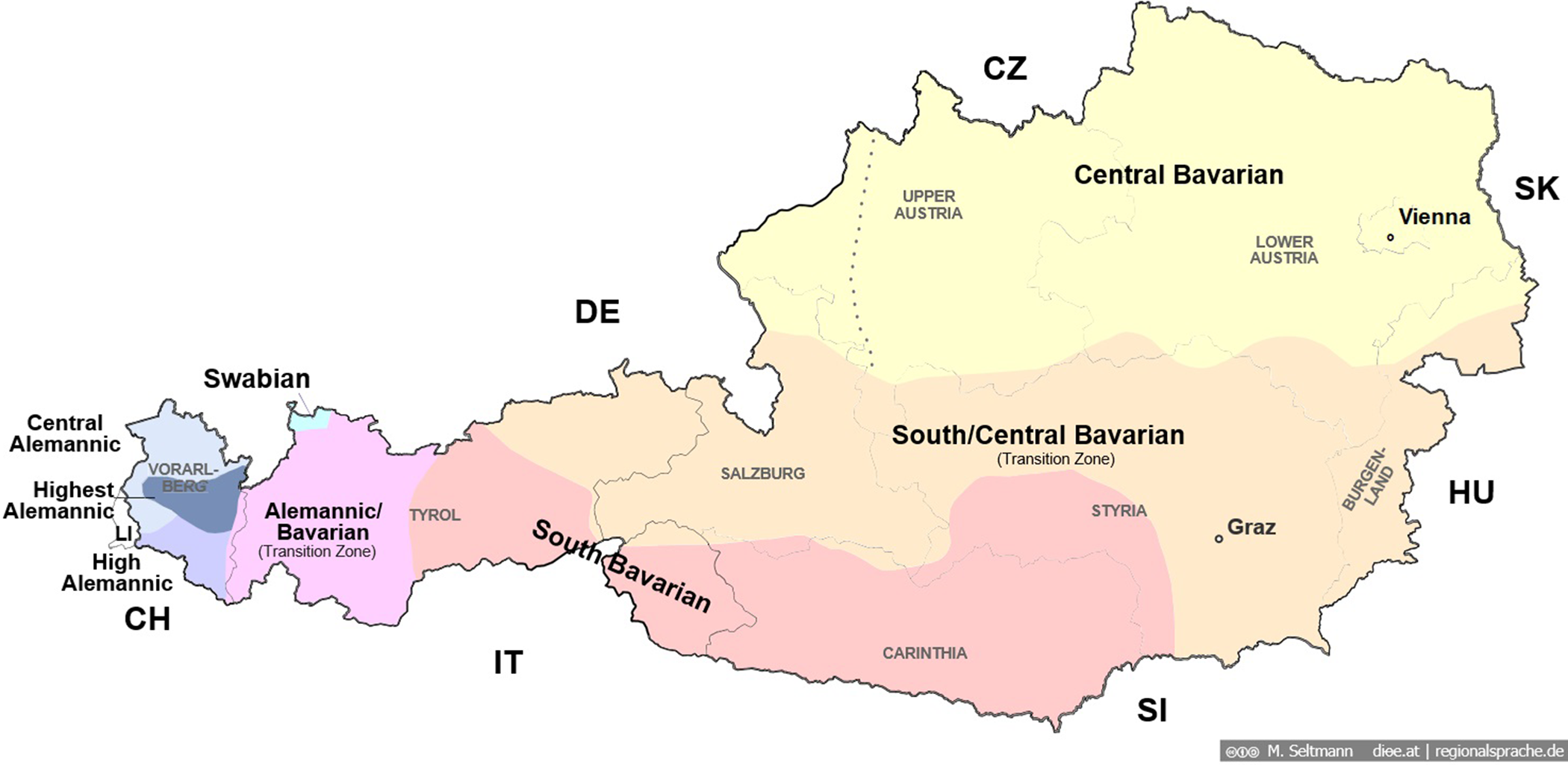
Austria is divided into two main dialect regions: Bavarian in the eastern, central, western and southern parts of the country and Alemannic in the far west covering a small part only. Particularly the Bavarian (sub)dialects can be further separated into the Central Bavarian region ranging from Upper (partially West- and East-Central Bavarian) and Lower Austria (East-Central Bavarian) to the capital Vienna, thereby covering the whole northern area of the country, and the South Bavarian region in the south of Austria reaching from (partially North and East) Tyrol to small southeastern parts of Styria with a transition zone (South/Central Bavarian) between Salzburg and Burgenland that covers Austria’s second largest city, Graz (see Map 1).
Illustration of the dialect zones in Austria.
One of the key features on which the division between Central and South Bavarian dialects is based is represented by the articulation of the lateral /l/. For the German standard articulation, which is said to dominate language use particularly in urban areas, the apical-alveolar formation of the lateral is common (cf., Luick, Reference Luick1904:21). Its vocalization is restricted to Central Bavarian dialect regions, being the phonetically most salient feature (cf., Rein, Reference Rein1974:22; Vollmann et al., Reference Vollmann, Seifter, Hobel and Pokorny2015:16).Footnote 1 However, the vocalization process itself is not an exclusively Bavarian feature, as Alemannic areas know it as well, though with a differing phonetic output. Within the Central Bavarian region, /l/ is changed to [i] (so-called [ i ]-vocalization), while in the Alemannic dialects (particularly of the western parts of Switzerland) a transformation to [u] is prevailing that, especially nowadays, shows great productivity not only in rural but also in certain urban areas (cf., Christen, Reference Christen2001; Leemann, Kolly, Britain, Werlen & Studer-Joho, Reference Leemann, Kolly, Britain, Werlen and Studer-Joho2014; Zihlmann & Leemann, Reference Zihlmann and Leemann2017).Footnote 2 For Central Bavarian vocalization, Vollmann et al. (Reference Vollmann, Seifter, Hobel and Pokorny2015:18) claim a higher interdialectal prestige, describing it as an expression of modernity. In contrast, South Bavarian dialects and, equally, those within the transition zone of South/Central Bavarian are said to keep the lateral in all (syllable- or word-related) positions, with the dialect variant constituting a retroflex articulation of it. Wiesinger (Reference Wiesinger1967:105–06), for example, describes the preservation of word-final /l/ for the whole of Styria with the Central Bavarian (vocalized) variant occurring along the border with Lower Austria only. Recent studies, however, indicate that /l/-vocalization is spreading at least a little farther east- and southward, covering, besides Salzburg, Upper and Lower Austria and also northern parts of Styria and the Mur- and Mürztal (Vollmann et al., Reference Vollmann, Seifter, Hobel and Pokorny2015:16).
2.2 /l/-vocalization in urban Austria: dissemination processes and sociolinguistic implicatures
For many parts of (Alemannic) Switzerland, Leemann et al. note that vocalized /l/ “shows social differentiation” (Reference Leemann, Kolly, Britain, Werlen and Studer-Joho2014:194), since it has usually been ascribed to the language use of urban speakers from lower socioeconomic classes or rather rural population groups. Correspondingly, it has shown lower prestige in urban regions and higher prestige in the countryside. Due to the status as a dialect feature rather than one of the (prestigious) German standard variety (which in the case of Bavarian applies to /r/-vocalization), /l/-vocalization faces this kind of stigmatization in (Bavarian) Austria as well. According to Moosmüller (Reference Moosmüller1991:38), it is certainly ascribed to dialect speakers, whereas speakers of a more standard-like German in Austria tend to avoid vocalization completely. In certain parts of Switzerland, however, vocalization is nowadays regarded as a sign of down-to-earthness (Zihlmann & Leemann, Reference Zihlmann and Leemann2017:203). This positive implication has led to a rise even in (certain) urban areas (Zihlmann & Leemann, Reference Zihlmann and Leemann2017:203).
In Austria, the situation may be different in that respect. It can be assumed that it is not the dialectal aspect of vocalization itself that causes its diffusion. In fact, its productivity within specific dialect areas, or, more precisely, within the Viennese dialect area, seems to be the most prominent reason. Vienna, as the capital of Austria, represents the political, cultural, and media center. In addition, mass media consumption and broader distribution, especially via digital media but also via television and radio, lead to a faster spreading not just of information but of linguistic change, too (e.g., Androutsopoulos, Reference Androutsopoulos2014:13; Hutterer, Reference Hutterer and Steinböck1978:340). Additionally, as Britain (Reference Britain, Ulrich Ammon, Mattheier and Trudgill2004:38) points out, it is the infrastructure between urban centers that supports interurban connections and communication. He argues:
[…] interaction between urban centres in modern societies is likely to be greater, and therefore a more frequent and effective channel for accommodation and transmission of innovations, than between urban and rural. Transportation networks tend to link urban with urban, the socio-economic and consumer infrastructure tends to be based in and oriented towards urban centres, with the ensuing consequences for employment and commuting patterns, and these obviously feed the hierarchical nature of diffusion. (Britain, Reference Britain, Ulrich Ammon, Mattheier and Trudgill2004:38)
As an innovative city, Vienna (like many other big cities) influences its periphery and—as the metropolis and the only city with over a million inhabitants in Austria—perhaps also the country as a whole (Lenz, Reference Lenz, Herrgen and Erich Schmidt2019:347–49). In general, the city as a complex sociocultural phenomenon is regarded as an area of high innovation, representing a space of manifold linguistic variance and, thus, seems suitable for investigating processes of linguistic change in vivo (Britain, Reference Britain, Chambers, Trudgill and Schilling-Estes2002:607–8; Vandekerckhove, Reference Vandekerckhove, Auer and Erich Schmidt2010:316). In particular, as the city represents a place of communication marked by internal and external multilingualism, it can show a wider range of variation in comparison to smaller places of rural character. At the same time the impact of influential forces from the cities to the surroundings or the periphery, which increases or decreases according to the geographical distance, has to be taken into account (Ernst, Reference Ernst2004). As changes are usually first transported from one center to another—imagining it as a selective leap until it becomes a wave-like spread (Ernst, Reference Ernst2004:20)Footnote 3 —and given the fact that /l/-vocalization is a prominent feature of the dialect in Vienna (as part of the Central Bavarian dialect conglomerate), it would not be surprising to find it in Graz as well. A fundamental factor may be that Austria lacks other cities with a size equaling Graz, so that Graz seems to be strongly oriented toward Austria’s capital. Moosmüller (Reference Moosmüller1991:56) argues, as indicated above, that Graz takes the presumed norm in the center of Vienna as an example and assimilates to the more prestigious Central Bavarian dialect. Nevertheless, she points out that /l/-vocalization is decreasing in Vienna just like other dialectally perceived processes (Moosmüller Reference Moosmüller1991:56).
According to Vollmann et al. (Reference Vollmann, Seifter, Hobel and Pokorny2015:18), however, Graz is said to behave differently with regard to the dichotomy vocalization versus nonvocalization, thereby contradicting the idea of a dialectal orientation toward the Viennese. As is reported by them, it is rather a standard orientation that is taking place especially among the younger well-educated people in Graz who avoid vocalization and keep the lateral (as an alveolar in all positions). This can be seen as a resemblance of the register spoken by members of the same age group in Vienna that prefer a nondialectal pronunciation near the standard articulation.
These approaches imply that, in this field of research, common conclusions have not been determined for Graz as a Non-Central-Bavarian region—especially not for the natural speech use. Therefore, we aim at scrutinizing whether /l/-vocalization can be attested within Graz, particularly in a surrounding in which it is not to be expected, and whether any correlation to a certain group of speakers can be drawn.Footnote 4
2.3 Forms of /l/-realization and their phonological context
The German standard articulation (applying to the whole of Austria) is conceptualized as an apical-alveolar lateral in syllable- or word-initial as well as syllable- or word-final position (Schmid, Moosmüller & Kasess, Reference Schmid, Moosmüller and Kasess2015). Additionally, for Vienna, Moosmüller (Reference Moosmüller2010:49) finds a unilateral variant.Footnote 5 Following velar consonants, /l/ tends to be velarized to [L], too (Dieth, Reference Dieth1968:143), which Vollmann et al. (Reference Vollmann, Seifter, Hobel and Pokorny2015:17) prove at least for the whole of Styria. In certain cases, /l/ can also be absorbed. Vollmann et al. (Reference Vollmann, Seifter, Hobel and Pokorny2015:15) describe this process especially in the context of German media language and function words such as als ’as’ or weil ‘because’ being reduced to as or wei (2015:17). Particularly in word-final coda position, /l/ varies with regard to the dialect regions. As was already stated, in the South Bavarian regions /l/ is preserved as a velar or retroflex variant, whereas Central Bavarian dialects tend to vocalize it. While vocalization in Romance languages, for example, appears as a consequence of co-articulation and is therefore dependent on the vowel quality (and subsequently omitted after back vowels), Bavarian vocalization to [i] does not equally rely on the vowel qualities of the phonetic surrounding (Rein, Reference Rein1974:22). Still, there are certain vocalic influences and positional restrictions constituting an implicational scale. This means that if “a dialect applies vocalization variably, people are more likely to vocalize in the contexts higher in the scale, and less in contexts lower in the scale” (Leemann et al., Reference Leemann, Kolly, Britain, Werlen and Studer-Joho2014:193).Footnote 6
We concentrated on these cases in which the lateral is most prone to vocalization. That is: /l/ → [i]/ V_{K, ##} as in Bavarian [ɔid̥] alt ‘old’ or [ʒd̥u:i] Stuhl ‘chair’. Still, this rule applies only to certain vocalic contexts: /o,u+l/ → [oɛ̯,uı̯]/V_{K, ##} as in [soɛ̯d̥ɔ:t] Soldat ‘soldier’ or [tuɪ̯pṃ] Tulpe ‘tulip.’ However, our data suggest an extension to this rule: /o,u,a+l/ → [oɛ̯,uı̯,aı̯]/V_{K, ##} as in [aı̯s] als ‘as‘ and so we focused on the lateral in these surroundings. This is because the vocalization of /l/ to [i], which is not typical and, hence, marked but still existing in the greater Graz area. It is undoubtedly taking place.
3. Data and methods
Starting point for our research interest is the lack of exhaustive studies concerning the /l/-vocalization to [i] for the area of Graz, especially with regard to natural speech data. As vocalized /l/ is typically associated with Central Bavarian (being a characteristic feature of this dialect area), its appearance in the South/Central Bavarian dialect area encompassing Graz is marked. Moreover, in terms of articulation, vocalized /l/ is most distant from the standard variant as most of the phonetic qualities change in the vocalization process, whereas the velar or retroflex variant remains a lateral. Therefore, vocalization of the lateral can be considered as the most dialectal variant within a dialect-standard-continuum. According to Moosmüller (cf. Reference Moosmüller1991), its wide-ranging appearance is not completely unusual due to the orientation toward the capital Vienna. According to the research approach of Vollmann et al. (Reference Vollmann, Seifter, Hobel and Pokorny2015) however, it is still not expected to be extensively distributed in terms of areal dissemination or among different social groups. In order to test which claim proves to be true, our main research question is: Does /l/-vocalization as an unusual (or marked) and most dialectal variant exist with or without sociolinguistic restrictions in the greater Graz area that does not belong to the Central Bavarian region? Additionally, as younger speakers commonly prove to be the linguistic innovators (Berroth, Reference Berroth2001:21; Kerswill, Cheshire, Fox & Torgersen, Reference Kerswill, Cheshire, Fox and Torgersen2007), we expect—as opposed to Vollmann et al. (cf. Reference Vollmann, Seifter, Hobel and Pokorny2015:18)—a certain tendency toward the /l/-vocalization in this age group (as an expression of modernity). On the other hand, we assume that older speakers who, conversely, tend to use variants most typical for their dialect region, favor the preservation of the lateral in form of retroflex or velar articulation. Furthermore, we argue that the type of conversation situation—formal or informal and unknown versus known conversation partner—plays a decisive role for the choice of /l/-variants. We hypothesize that both age groups show a predominant use of the standard alveolar realization of the lateral in a formal conversation situation. In an informal setting, however, we expect less /l/-variation in the younger age group but an increase of /l/-vocalization and other dialectal /l/-variants in the older age group.
In order to compare the two dialect regions (Central Bavarian and South/Central Bavarian), we apply the same research question to a smaller sample corpus of data from Greater Vienna. The informative value of the results is increased by using a corpus of data recorded in a rather formal and, therefore, unusual setting for the use of dialectal variants. The research areas are Austria’s two biggest cities, Vienna and Graz, as well as three surrounding sites each. This means that Greater Vienna/Lower Austria and Greater Graz/Styria are the main geographic areas of interest. The central criteria for the choice of test persons are the participants’ permanent primary residence within the city or in one of the surrounding locations and their native language, which must be German. Further criteria are also based on extralinguistic factors, such as age or gender.
The corpus mainly consists of spoken data from two different communication situations. The formal one, which is represented by an analytical interview (AI), is a conversation between the investigating person and the participant, who do not know each other. This aspect, as well as the fact that the investigator tries to maintain a personal distance, ensures a rather formal interaction situation. Accordingly, the AI is expected to yield characteristics located near the standard pole, which in the case of the lateral does not favor the vocalization process. To trigger linguistic data that can be situated at the other end of the continuum, interactions of a smaller sample of participants are recorded in an informal setting in form of a conversation among friends (CAF). Here the investigating person is absent, and the friends can talk freely. Additionally, all participants fill in a questionnaire that yields sociodemographic information as well as standardized data on language attitude and perception, which complement the analysis of the object language.
The study is divided into two parts. The first part serves the purpose of obtaining a general overview and test the productivity of the phenomenon of /l/-vocalization. Therefore, we auditory analyzed the interviews of 43 speakers from the greater Graz area, which comes to more than 26.5 hours of recordings in the rather formal setting for our main research area. These speakers can be further subdivided into 16 young speakers (between 20–30 years old) and 27 older speakers (65 years or older). The gender relation is almost 1:1 (23 female and 20 male participants). The interviews of 19 speakers (almost 14 hours of recordings) from Greater Vienna serve, as already stated, as a comparison group. For this smaller corpus, five younger and fourteen older speakers, ten male and nine female, were included.
In a next step, a smaller corpus for a subsequent in-depth study was created for the second part of the study. The corpus consists of eleven speakers from the greater Graz area recorded in both situations (AI and CAF). This makes a recording time of almost 15 hours. No gender or age balance could be achieved. The same is true for the corpus of the comparison group consisting of speakers originating from Greater Vienna. This corpus contains AIs and CAFs from nine speakers, covering a recording time of, once again, almost 15 hours.
4. Analyses
4.1 Preliminary study
As already pointed out, a corpus consisting of interviews of 62 speakers from Greater Graz and Greater Vienna serves as the main empirical database for the preliminary study. The recordings were transcribed, and, in a second step, a corpus of all transcripts was created and combined with metainformation of the speakers. For the analyses, tokens showing vocalized /l/ were searched. Thereby, we focused on those cases, in which /l/ is actually transformed into a vowel (namely [i]) and not arguably absorbed by the preceding vowel, which itself changes in quality (as in [gɛlḍ] > [gœɭd] > [gœ:d]), and, therefore, concentrated on postvocalic positions (syllable- or word-final or preceding a consonant). Even though there are other dialectal variants in use besides vocalization (namely velar and retroflex articulation of the lateral), we focus on vocalization in the first part of the study and take the other dialectal forms into account in the second part. This is due to the fact that, regarding all forms of /l/-articulation, the corpus of spoken data needs to be annotated manually, which requires a considerable amount of time. In order to compare the dichotomy of vocalization of /l/ to [i] versus nonvocalization, it is possible to search the corpus with a lexeme-based approach that offers results much faster.
We were able to gain a set of lexemes with a variable lateral (serving as the analytical base) as we applied a random selection process preventing the selection of the most common or popular ones only. Therefore, the first three hits of each speaker showing vocalized /l/Footnote 7 were gathered and a list of types was compiled offering a total of 20 formsFootnote 8 (see Table 1).
List of lexemes (main corpus)

Homonyms or word forms such as woi respectively wohl ‘though/probably/yes,’Footnote 9 which can either be used as an adverb or particle with differing meaning, or ois, which can, on the one hand, refer to the conjunction als ‘as/than‘ and to the pronoun all- ‘all’ on the other, are included. With respect to verbs, all inflectional forms and, regarding nouns and adjectives, all derivational forms as well as compounds comprising the type are included. Due to our data consisting of natural speech, word position and syllable stress are not balanced. In a next step, every type was analyzed separately by determining the base value for each variant (of each type)—the one showing the preserved lateral as well as the vocalized one—resulting in a total of n = 8,566 tokens. Finally, the relations between location, age, and gender, as well as co-occurrences with cases of vowel changes were calculated, and the results were tested with respect to statistical significance.
4.2 In-depth study
For the subsequent in-depth study, the speech data of 20 speakers were transcribed (AIs and CAFs, in total 35 recordings with an approximate recording time of 30 hours), and, in a second step, we annotated for each speaker at least 25 realizations of syllable- or word-final /l/ or postvocalic /l/ preceding a consonant, each at the beginning, the middle, and the end of the transcript. All /l/s that possibly could be vocalized were annotated. This results in at least 75 hits per speaker. To be more precise, we first included cases in which there was either standard alveolar realization of /l/ or the vocalized form originating from the Central Bavarian dialect. Additionally, as there is also nonstandard variation originating from the South Bavarian dialect for the area of Graz in the form of keeping the /l/ as a velar or retroflex variant, as already mentioned above, these variants were annotated as well. Therefore, all laterals showing a velar or retroflex place of articulation instead of vocalization (starting from the premise that, in general, it is possible to vocalize the /l/ in this place) were considered, too.
However, /l/ following a schwa in an unstressed syllable in foreign/loan words (e.g., lokal or total), (place)names and quotes (like the repetition of a preceding question posed by the interviewer) were excluded from the annotation as these positions are less prone to vocalization/assimilation (Traunmüller, Reference Traunmüller1982:313). Additionally, the function word also was excluded. According to Moosmüller (Reference Moosmüller1991:57), the function word also ‘well’ has an exceptional status as it is vocalized even by speakers who do not vocalize the /l/ in any other phonological context. First results of a pilot study including also in the interviews showed an almost 50:50 relation of vocalized versus nonvocalized /l/ for both age groups (with a slight tendency to more standard alveolar /l/ in case of the younger speakers). Without also, the standard alveolar articulated /l/s of the younger speakers clearly outweighed the nonstandard /l/ with 71%. The results for the older speakers remained rather stable. Compared to the conversation among friends, there was just a minor increase of use of standard alveolar /l/ among the younger speakers. This could be explained by the fact that also is used more frequently in the interview, as this is the setting in which the speakers are constantly confronted with questions and have to think about what and how to answer, including corrections and reformulations. These conditions are prone to the use of also as the speaker gains more time to think about the answer and/or phrasing.
In reference to the influence on the results of our pilot study, this little function word has, in fact, an exceptional status. The differences in the compared results for our pilot corpus were more (in case of the younger speakers) or less (in case of the older speakers) striking. Therefore, we removed all forms of also from the analyzed dataset.
5. Results
5.1 Results of the preliminary study
5.1.1. The influence of extralinguistic factors on /l/-vocalization
In general, /l/-vocalization proves frequent for the majority of speakers.Footnote 10 The form with the highest (total and relative) number of vocalization cases in Graz and Vienna, thereby being generally most frequent, is also, a particle and adverb often used to initiate the continuation of a contribution (e.g., after a pause). This is not surprising as the above-average high number of vocalization in function words (such as also or halt) results in its near restriction to unstressed positions (Moosmüller, Reference Moosmüller1991:57).
Regarding the spatial distribution, the results are rather astonishing. Even though /l/-vocalization does not outweigh nonvocalization in Graz and Vienna (but is outnumbered by the cases in which the lateral is preserved and thereby confirms Moosmüller’s assumption of this Central Bavarian feature decreasing in the Viennese dialect area), the relative number of vocalization cases remains stable with regard to the two cities in focus. It is 47% vocalization for Vienna and 44% for Graz, which constitutes a relative deviation of only 3%. Albeit it is significantly higher (with χ 2 = 9.8; p = 0.01) in Vienna, these results show that /l/-vocalization appears as a well-established feature in Graz as well. It thereby contradicts the assumption of Vollmann et al. (Reference Vollmann, Seifter, Hobel and Pokorny2015:13–18).
In order to gain deeper insights into the distribution patterns, extralinguistic factors such as age and gender are included, for which especially the first one proves to result in significant frequencies of occurrence. The analyses show that, overall, the younger age group vocalizes significantly less. Comparing the relative proportions of vocalization, it is only 27% in the case of the younger speakers against 54% in the case of the older speakers (with χ 2 = 357.9; p = 0.01) in Graz. For Vienna, the proportions point to a similar tendency with 12% of vocalization in the younger age group and 60% in the older one (showing a significant difference with χ 2 = 594.9; p = 0.01).Footnote 11 In case of older speakers in general, the vocalization of the lateral outnumbers its preservation and thereby appears as their usual realization of /l/. Comparing the age groups with each other, it becomes evident that vocalization among older female as well as older male speakers prevails significantly (χ 2 = 963.61; p = 0.01; df = 3) in comparison to their younger counterparts.
In terms of gender aspects, the age groups also behave differently with regard to spatial diffusion: While the proportion of vocalization regarding older male and female speakers remains (with above 60% and 40%) rather constant for both Graz and Vienna, the analysis of the younger speakers shows different results for the two cities. For Graz, a more homogenous distribution with 24% for young women and 29% for young men can be observed, whereas in Vienna there is a clear preference of 38% among young women to vocalize against 9% of young men (with χ 2 = 66.7; p = 0.01). Still, the younger speakers in every analyzed category show a tendency to use less vocalized /l/.
5.1.2 The influence of the phonological context on /l/-vocalization: vocalization and vowel change
As mentioned before, /l/-vocalization is regarded as the variant most distant from the German standard variety. This assumption is based on the difference in the changes of the phonetic qualities: While the vocalization process involves a holistic change of these qualities, the articulation of several more standard-oriented or dialectal variants of the lateral includes the mere change of the place of articulation. Due to the dialect proximity, a correlation with other dialectal transformation processes seems obvious. Therefore, the co-occurrence of /l/-vocalization and dialectal vowel changes (such as the labialization from /a/ > [ɔ] or palatalization from /o/ > [u]) was tested. The results point toward a correlation, since vowel changes co-occur with vocalized /l/ significantly more often (in 71% of the cases) than with the prevailed lateral.
However, the most common form is the near standard form completely lacking vocalization and vowel changes as pictured in the chart below (Figure 1). This high correlation between dialectal changes of vowels and laterals supports the assumption of /l/-vocalization as an indexical marker pointing to regional identity even more, since it proves the tendency of Bavarian dialect features often co-occurring and highlighting the regional aspect in language use.
Correlation between dialectal vowel change and /l/-vocalization.

5.2 Results of the in-depth study
Looking now at the analyses by widening the focus, we have two additional dialectal forms of /l/-realization typically found in the transition zone of South/Central Bavarian, besides the cases of the standard alveolar lateral approximant and the Central Bavarian dialectal /l/-vocalization. These are the velar and the retroflex articulation of the /l/. It is common in the German language and in the whole of Styria that the /l/ becomes a velar [ʟ] after velar consonants such as [g,k] (Vollmann et al., Reference Vollmann, Seifter, Hobel and Pokorny2015:17). Thus, these cases are not of interest for our analysis; moreover, the /l/ cannot be vocalized in this position. However, dark /l/, which follows velar vowels such as [a,o,u] as in all, voll, Stuhl is a kind of /l/-variation that appears in all dialects within Austria, according to Luick (Reference Luick1904:21f.). These cases and word-final /l/s respectively /l/s in coda position, where the lateral is preserved as a velar or retroflex variant, are considered.
5.2.1 Results of the AI
Looking at the overall results of /l/-articulation in the interviews of the speakers of the greater Graz area, it can be observed that the standard alveolar realization of the lateral approximant dominates with 68% (with χ 2 = 8.4; p = 0.01) (see Figure 2).
Distribution of all forms of /l/-articulation in the interviews of speakers from Greater Graz.

Focusing on the distribution, it becomes obvious that alveolar articulated and vocalized /l/ are the most frequent forms with 68% and 14%, followed by velar articulation with 10% and retroflex articulation with 8%.
Comparing this overview with data from Viennese speakers, we can see that the standard alveolar articulation of the lateral /l/ with 80% clearly outweighs all other forms (with χ 2 = 68.2; p = 0.01) (see Figure 3).
Distribution of all forms of /l/-articulation in the interviews of speakers from Greater Vienna.

Of course, it is not surprising that there is no single occurrence of a retroflex articulated /l/, as Greater Vienna is not part of the South Bavarian dialect area. In fact, we can observe 19% of vocalized /l/, which is said to be typical for the Central Bavarian dialect zone. With just 1%, velar articulation of /l/ occurs very rarely.
The high percentages of standard alveolar /l/ for speakers of both Vienna and Graz in the interviews match our expectations. As this setting is designed as a formal conversation situation, it is the aim to trigger language use close to the standard pole. In order to achieve this goal, the interviewer herself (as there are only female interviewers) sticks to the standard articulation of the German language in Austria. Following the concept of the communication accommodation theory (CAT) (Giles, Reference Giles1973), speakers adjust to their interlocutors in interaction. In particular, it can be assumed that the participants will therefore accommodate to the interviewer in the sense of upward convergence. This means that the speakers adopt the linguistic features of the more prestigious standard form used by the conversation partner (Auer & Hinskens, Reference Auer, Hinskens, Auer, Hinskens and Kerswill2005:335). The results of the formal interviews among speakers from Greater Graz and Greater Vienna confirm the theory, as they predominantly use the standard articulation.
In a next step, looking at the results divided according to the two analyzed age groups of speakers from Greater Graz, we see a different picture of the distribution (see Figure 4).
Distribution of all forms of /l/-articulation in the interviews of old speakers from Greater Graz.

Older speakers articulate the lateral approximant as alveolar in 53% of the cases (with χ 2 = 61.8; p = 0.01), vocalization to [i] happens in 26% and the retroflex /l/ is the third most frequently used form (17%). Only a small percentage of 4% articulates the lateral in velar position.
The younger speakers (depicted in Figure 5), in contrast, show a clear preference for the standard alveolar articulation of the lateral (78%). The second-leading form is the velar /l/ in 13% of the cases. Only 6% vocalized laterals and even less retroflex /l/ (3%) can be found.
Distribution of all forms of /l/-articulation in the interviews of young speakers from Greater Graz.

These results clearly point to age-related preferences. One explanation for the stronger tendency of the younger speakers to use standard alveolar /l/-articulation could be that they show a greater willingness to accommodate to the interlocutor compared to the older speakers. On the other hand, increasing standard orientation or even loss of the dialect competence are attributes said to be characteristic of younger speakers, especially in areas with a higher degree of urbanization (Glauninger Reference Glauninger, Kanz, Wildfeuer and Zehetner2009: 95; Oberdorfer & Weiß, Reference Oberdorfer, Weiß and Ziegler2018: 482).
Looking at the data of the Viennese speakers in the interview setting, the following distribution in Figure 6 and Figure 7 can be observed:
Distribution of all forms of /l/-articulation in the interviews of old speakers from Greater Vienna.

Distribution of all forms of /l/-articulation in the interviews of young speakers from Greater Vienna.

Even though the standard alveolar articulation dominates in both age groups, we can see in Figure 7 that this form is almost unrivaled among the younger speakers (with 92%), where only 7% vocalized /l/ and 1% velar occur. In contrast, among the older age group the proportion of vocalized /l/ to [i] accounts for 25% against 74% standard alveolar articulation and 1% velar /l/ (with χ 2 = 27.8; p = 0.01), as shown in Figure 6.
Again, the group of younger speakers in Vienna uses more standard realizations of the lateral in comparison to the older speakers. This behavior is even more pronounced compared to the younger age group in Graz. The higher degree of urbanization can serve as an explanation. Vienna, as the metropolis of Austria, is doubtlessly more urbanized than Graz, measured by common factors such as (increasing) population size and population density, infrastructure and public services, living conditions or average income. As a consequence, a higher degree of urbanization leads to a stronger reduction in network strength and therefore to less integration into close-knit groups (more to social networks and network structure in close-knit communities; Milroy & Milroy, Reference Milroy and Milroy1992). As network strength influences norm enforcement in terms of behavior (e.g., dressing, gestures, etc.) but also in terms of language use (including low-prestige linguistic features or covert prestige features), it can be concluded that language use in more loose-knit communities as in Vienna is open to more influences from outside the community and thus more prone to change (e.g., toward standard language use).
5.2.2 Results of the CAF
Now contrasting the findings derived from the AIs with the results of the second setting—the CAFs—we see for the research area Greater Graz an almost reversed picture comparing the old (Figure 8) with the young age group (Figure 9). In the CAF, nonstandard articulation of /l/ dominates significantly among the old speakers with 72% (χ 2 = 224.9; p = 0.01). They use the standard alveolar /l/ only in about a third of all possible cases. In contrast, the young speakers use the nonstandard /l/ only in 19% of all possible cases and therefore prefer the standard articulation (81%).
Distribution of all forms of /l/-articulation in the conversations among friends of old speakers from Greater Graz.

Distribution of all forms of /l/-articulation in the conversations among friends of young speakers from Greater Graz.

The informal character of the communication situation, including a familiar conversation partner (i.e., a close friend), is assumed to be responsible for these findings. Thus, accommodating to the interlocutor is very likely to play an important role. It can explain the reduced use of standard alveolar /l/ among the older speakers as well as maintaining standard preference among the younger speakers as each of them talks to a similarly competent dialect or standard speaker.
The results of the CAFs of the speakers belonging to Greater Vienna are surprisingly similar in both age groups. Old as well as young speakers articulate in about 60% of all cases standard alveolar /l/. The remaining 40% are—with minor exceptions (of 1-2% velar/retroflex /l/)—vocalizations of /l/ to [i], typical for the Central Bavarian dialect zone (cf. Figures 10 and 11).
Distribution of all forms of /l/-articulation in the conversations among friends of old speakers from Greater Vienna.

Distribution of all forms of /l/-articulation in the conversations among friends of young speakers from Greater Vienna.

Comparing these findings to those from the interview setting, it becomes obvious that standard /l/s are decreasing and in return, /l/-vocalization is increasing. Again, this can be due to the informal communication situation and the accommodation to the familiar conversation partner.
All in all, in light of our data, the claim that Central Bavarian postvocalic /l/-vocalization does not exist in the Greater Graz area (e.g., Hutterer, Reference Hutterer and Steinböck1978:32–46) is outdated. Even for colloquial speech, Hutterer (Reference Hutterer and Steinböck1978:46) claims that only sporadic and individually depending incidences can be detected. The statistics above show the opposite. Especially in colloquial speech, which is most likely to be used in a conversation with a friend, many occurrences of /l/-vocalization can be found in the speech data of speakers from the greater Graz area. Furthermore, Hutterer (Reference Hutterer and Steinböck1978:48) states that speakers tend to use the retroflex articulation of /l/ if the lateral is in medial or word-final position as a consequence of a “centralised” articulation. He points out that, in general, this form of /l/-articulation is considered as bauernsprachlich, or agricultural vernacular, and tends to be avoided in colloquial speech; it is more a specific feature of the older language and not of the younger dialect (Hutterer, Reference Hutterer and Steinböck1978:48). Hutterer does not define in more detail the terms older language and younger dialect. However, we can assume that he refers to the historical dimension of nonstandard language use in former times versus nowadays.
By looking more precisely at the city of Graz, Hutterer (Reference Hutterer and Steinböck1978:333) postulates in his description of the phonetic history of the “city dialect of Graz” that there is no evidence pointing to the existence of Central Bavarian /l/-vocalization along the timeline of the sixteenth to seventeenth centuries. When he comes to the description of the “Grazerisch” of the present, he accounts for only limited vocalization tendencies, although he calls attention to this phenomenon being part of an Austrian “interurban lingua franca,” on the one hand and widely distributed via auditory mass media on the other (Hutterer, Reference Hutterer and Steinböck1978:340). Therefore, he deduces that speakers from Graz do not regard /l/-vocalization as outstanding and even make use of all different forms including i hōl ∼ hūl ∼ hui ∼ ich hole or use the south Bavarian (dark) [L] (Hutterer, Reference Hutterer and Steinböck1978:340). Hutterer’s argument is reinforced by our data as we can observe these different forms of /l/-realization. Our data reveal that speakers from the greater Graz area make use of a broad spectrum of /l/-variants, adjusting the frequencies according to the communication situation. Additionally, age as sociolinguistic factor plays an important role as it is decisive for the choice/frequency of the occurring variants.
6. Discussion
As indicated in the results of our preliminary study, /l/-vocalization is already an established phenomenon in Greater Graz. 98% of the participants’ repertoires included the vocalized lateral that points toward an extended set of dialectal variants. Vocalization and nonvocalization show a nearly balanced relation with a slight tendency of keeping the lateral.
Further detailed analyses demonstrate that there are no remarkable differences concerning gender but clear preferences among the two age groups. Among the older speakers, vocalization even outnumbers the cases in which the lateral is kept. Younger speakers (regardless of gender) mostly avoid vocalizing the lateral. These findings contradict our assumption that younger speakers, as linguistic innovators, tend to vocalize the /l/ more frequently than older speakers.
For our second sub-corpus of speakers from the area of Vienna, the general distribution of /l/-vocalization shows very similar tendencies to those seen in Graz (about 50:50 relation of vocalization versus nonvocalization). Also, correlations concerning the age groups can be detected. The tendency of favoring vocalization in the older age group is even stronger in Vienna (with a difference of 48% between older and younger speakers). Therefore, the vocalization of /l/ to [i] in Graz and Vienna seems to be rather a sociolinguistic than a dialect marker, thinking of it “as being related to its speakers’ social background rather geographical background” (Trudgill, Reference Trudgill2003:122). This, in combination with a regularity in the occurrence with other dialectal change processes, leads to the assumption that /l/-vocalization serves as an indicator of regional/nationalFootnote 12 identity. Regarding gender differences, the results for Vienna stand out in comparison to Graz. Whereas female and male speakers in Graz show similar frequencies of /l/-vocalization within their age groups, the females of the younger age group in Vienna use the vocalized form more frequently compared to their male counterparts. Young women in Vienna vocalize in 38% and young men in 9% of the possible cases.
However, it has to be stressed that nonvocalization does not automatically mean standard-like realization of the lateral. In order to evaluate the different dialectal /l/-variants, we annotated all forms of /l/-realization in a second corpus. The results show that speakers of both research areas predominantly make use of the standard alveolar lateral approximant in the AI (in Greater Graz 68%; in Greater Vienna 80%). This verifies our hypotheses concerning the use of variants in the formal conversation situation of the AI. Nevertheless, there are, in total, 32% of dialectal forms of /l/ in the interviews of the speakers from Graz, which shows that they tend to use dialectal /l/ to a greater extent than Viennese speakers (with 20%). Hence, speakers from the greater Graz area have and make use of a broader dialectal spectrum of /l/-articulation and use the standard alveolar lateral approximant to a lesser degree.
Taking a look at age-related differences, our analyses show that over half of all laterals produced in the interviews by older speakers from Graz are alveolar (53%) compared to over three-quarters (78%) of cases among the younger speakers. Similar age differences are true for the Viennese speakers: 74% of older speakers versus 92% of younger speakers use the alveolar lateral approximant in their interviews. This shows a stronger orientation toward the standard language in Vienna, in general, while also demonstrating that older speakers of both research areas show a stronger willingness to use dialectal forms of /l/, as already proven in the preliminary study.
All in all, speakers of both age groups from Greater Graz show a considerably higher percentage of dialectally articulated /l/s in the interview than their Viennese counterparts. However, older speakers of both areas, Graz and Vienna, use more nonstandard forms of the lateral than the younger ones, and the younger speakers from Greater Vienna show an even stronger orientation toward the standard alveolar lateral than the younger speakers from Greater Graz.
In order to test the influence of sociosituative differences on the use of a feature such as the /l/-vocalization, we surveyed the frequencies of vocalized and preserved lateral in differing setting designs (differing in terms of the degree of formality; for the list of lexemes, see Table 2).
List of lexemes (subcorpus)

According to the results of this case study, no correlation between the sociosituative constituents and the frequency of occurrence of a vocalized lateral can be detected. Even though Moosmüller (Reference Moosmüller1991:56) demonstrates such interdependencies between degrees of formality and frequency patterns within her research particularly for Graz, no statistically significant tendency can be found in the subcorpus of AIs versus CAFs (χ 2 = 3.0). The relative deviation is below 3% (see Figure 12).
Frequencies of vocalized and preserved lateral in differing setting designs (AI and CAF).

These findings contradict our expectations, which were based on the popular opinion that, in informal conversation situations, natural phonological processes are favored just as other dialect features are more likely to appear. As, for instance, the perceptual character and possibly also the social assessment in those situations are pushed into the background (Moosmüller, Reference Moosmüller1991:39), it is more likely to find increased dialect features. To check if the deviation in our data could be due to the small sample size, we decided to further investigate the sociosituative differences in the extended corpus of the in-depth study.
Concentrating now on the results of the annotated laterals in the CAFs, we are able to present a more differentiated and meaningful view than in the lexeme-based case study.
A first look at the overall results of the speakers from Greater Graz in the CAFs shows just a minor deviation from the ones in the AIs. We see 61% standard alveolar /l/ versus 20% vocalized /l/ to [i], 10% retroflex and 9% velar articulated /l/.
The results of the CAFs from Viennese speakers, however, deviate more from those in the AIs. Here, it comes to 59% standard alveolar /l/ versus 39% vocalized /l/ to [i] and each 1% retroflex and velar articulated /l/. This shows a clear increase of dialect forms of /l/ in the CAFs.
Comparing the results split according to the age groups, it becomes apparent that the extralinguistic factor age accounts for significant differences. Concentrating in a first step on the speakers from the greater Graz area, we can see that the older speakers use the standard alveolar lateral approximant only in 28% of the cases in the CAFs. In contrast, the younger speakers use the standard /l/ in 81% of the cases. This is a striking difference—an almost reversed picture—pointing to a very strong standard orientation among the young speakers from Greater Graz. These results support our assumption of less /l/-variation in the younger age group and an increase of /l/-vocalization and other dialectal /l/-variants in the older age group in informal settings.
Looking at the younger age group in Vienna, which demonstrated a strong orientation toward the standard alveolar /l/ in the AIs (with 92%), the results of the CAFs make it clear that the young speakers switch in the informal setting to more dialectal /l/-usage by vocalizing the /l/ to [i] in 39% of the cases (1% retroflex articulation; 60% alveolar /l/). The results of the older Viennese speakers in the CAFs are almost alike. They use the standard alveolar /l/ in 58% and the vocalized form in 40% of the cases (2% velar articulation).
Older speakers in Graz make use of 72% nonstandard forms of /l/ in the setting of the CAF, thereof 34% vocalization, 22% retroflex, and 16% velar articulation. The younger speakers, who make use of dialectal /l/ only in 19% of the cases, prefer the vocalized form of /l/ to [i] with 11%. Six percent velar and only 2% retroflex articulation /l/s can be counted. Both age groups have the same range of /l/-variation at their disposal. However, younger speakers concentrate on the standard variant whereas older speakers mostly use a dialectal variant of the lateral.
The dialectal /l/-variant that is most often used in both age groups is the vocalized /l/ to [i] (for the older speakers: 34%, which is 47% of all dialect forms; for the younger speakers 11%, which is 58% of all dialect forms). This contradicts our assumption that older speakers favor the preservation of the lateral in form of retroflex or velar articulation. Furthermore, this seems to be a strong argument for the /l/-vocalization already being a well-established phenomenon in the greater Graz area.
7. Conclusion
The dialectal realization of the lateral as [i] postvocalic before a consonant or syllable final is a phenomenon said to be restricted to the Central Bavarian dialect area in Austria. Even if this phenomenon was selectively also accounted for Styria in the South/Central Bavarian dialect area, Graz, being near the South Bavarian dialect region, known for keeping the lateral, was said to rarely show /l/-vocalization (Hutterer, Reference Hutterer and Steinböck1978:340; Vollmann et al., Reference Vollmann, Seifter, Hobel and Pokorny2015:13–18). This thesis has not been verified or falsified empirically by means of free conversational data until now. Starting first with a corpus of AIs of n = 43 speakers from the greater Graz area and a comparison group of n = 19 speakers from Greater Vienna, we were able to show that /l/-vocalization not only occurs in Vienna but is also a well-established phenomenon in Graz. However, it is not equally used by all speakers as there is a clear preference among the older age group. This observation is further supported by the results of the analysis of a second corpus consisting of annotated AIs and CAFs of n = 11 speakers from Greater Graz and n = 9 speakers from Greater Vienna. In both settings, the older age group shows more dialect realizations of the lateral approximant than the younger age group. However, in the CAFs, older speakers from Graz show a particularly high number of nonstandard /l/s.
This leads us to the assumption that /l/-vocalization can (at least for urban areas and their surroundings) be regarded less as a dialect feature but more as a sociolinguistic characteristic, considering the fact that it is foremost used by older speakers. Subsequently, /l/-vocalization in Greater Graz seems to be an indicator of regional/national identity (further supported by the frequent co-occurrence with dialectal vowel changes), indexing membership within a population (Eckert, Reference Eckert2008:463). In this case, the use of /l/-vocalization signals a semantic meaning, a functionally added value of a linguistic unit that can be activated by the speakers within the concrete interaction, for instance by choosing specific free variants. In particular, dialect features in urban vernaculars are suitable for expressing indexical meaning. “Then they work as a label that can even carry a socio-symbolic function and finally channel—linguistically transferred—the speakers’ construction of social identity” (Ziegler, Reference Ziegler and Ziegler2018:60).
Extending the scope of our research, it will be of interest to take other forms of vocalization such as those of /l/ to [œ:], [y:] and [æ:] into account as well as to focus on intraindividual variation in the different communication situations. For this purpose, more extralinguistic factors have to be included. For instance, the speakers’ spatial and social mobility could prove to have a decisive impact on the choice of the linguistic variable.
Acknowledgments
All data used in this contribution stem from the ongoing research project Vienna and Graz – Cities and their influential force (F 6004-G23), which is part of the Special Research Programme German in Austria. Variation – Contact –Perception (F 060) funded by the Austrian Science Fund.


 Open access

