





Highlights
-
• Slight but discernable accentedness in HL-English speakers and L1-English immigrants
-
• Raters’ linguistic backgrounds had minimal effect on the perception of accentedness
-
• Raters are more lenient regarding the accentedness of speakers with similar backgrounds
-
• Parental/sibling input levels and lexical proficiency predicted adult accentedness
1. Introduction
One salient feature of adult heritage language (HL) speakers – bilinguals whose childhood home language differs from the societal language (SL) – is their near-native phonological proficiency. While HL speakers often show divergences in morphosyntax and lexicon, phonologyFootnote 1 remains largely intact (Chang, Reference Chang, Montrul and Polinsky2021; Rao & Polinsky, Reference Rao, Polinsky and Rao2024). Casual listeners may not even perceive a “foreign”Footnote 2 accent, likely because HL phonological systems develop early, before substantial SL exposure and cross-linguistic influence (Montrul, Reference Montrul2008; Rao & Polinsky, Reference Rao, Polinsky and Rao2024). However, subtler phonetic divergences appear in both HL and SL speech (Chang, Reference Chang, Montrul and Polinsky2021; Kornder & Mennen, Reference Kornder and Mennen2021; Kupisch et al., Reference Kupisch, Barton, Hailer, Klaschik, Stangen, Lein and van de Weijer2014; Polinsky, Reference Polinsky2018), even in preschoolers (Kupisch et al., Reference Kupisch, Kolb, Rodina and Urek2021; Marecka et al., Reference Marecka, Wrembel, Otwinowska, Szewczyk, Banasik-Jemielniak and Wodniecka2020; Nenonen, Reference Nenonen, Babatsouli and Ball2020; Wrembel et al., Reference Wrembel, Marecka, Szewczyk and Otwinowska2019).
Accentedness is a subjectively perceived trait, very much dependent on the linguistic background of the listener (Kornder & Mennen, Reference Kornder and Mennen2021; Kupisch et al., Reference Kupisch, Barton, Hailer, Klaschik, Stangen, Lein and van de Weijer2014; Kutlu, Reference Kutlu2020; Mayr et al., Reference Mayr, Roberts and Morris2020). It is often measured by asking a group of raters to what extent they detect a foreign accent. But studies have also shown that raters from different linguistic backgrounds often differ in their evaluations. Kornder and Mennen (Reference Kornder and Mennen2021), for example, found that monolingual German raters evaluated the L1-German accentedness of bilingual German/English speakers significantly higher than did bilingual L1-German/L2-English raters.
The current study, based on the less frequently examined dyad of English as the HL and HebrewFootnote 3 as the SL, investigated both speaker accentedness and rater perceptions in the English of monolingual and bilingual L1- and HL-English speakers. Elicited speech from 80 adult English speakers across four groups (L1-English speakers in the US; L1-English-speaking immigrants to Israel; HL-English speakers in Israel with two or one English-speaking parent) was evaluated by 60 English-speaking raters from three groups (L1-English speakers in the US; English-dominant bilinguals in Israel; and Hebrew-dominant bilinguals in Israel). We examined how speakers’ and raters’ backgrounds, and their interaction, influence perceived accentedness. We also explored individual differences in accentedness and their links to lexical and morphosyntactic proficiency, as well as childhood linguistic factors (e.g., age of onset of bilingualism (AoB), language spoken to parents, siblings, and friends). Identifying these associations can clarify the factors shaping accentedness and deepen our understanding of phonetic and phonological development in HL speakers.
2. Background
2.1 HL speakers and the phonological domain
Accentedness and production
Compared to divergences in the morphosyntactic and lexical domains of HL speakers, phonological divergence, such as a detectable foreign accent, is much less salient (for an overview see Chang, Reference Chang, Montrul and Polinsky2021). While morphosyntactic and lexical divergences can be attributed to the cross-linguistic influence of the SL and diminished HL input after the AoB, phonology appears to be less affected by post-AoB input. Kupisch et al. (Reference Kupisch, Barton, Hailer, Klaschik, Stangen, Lein and van de Weijer2014) suggest that this is due to the critical period hypothesis (CPH) (for more detail on CPH see the editorial paper by Abutalebi and Clahsen (Reference Abutalebi and Clahsen2018) in the special issue of Bilingualism: Language and Cognition dedicated to this topic, and related papers therein). This same CPH that asserts that reduced neural plasticity inhibits phonological development after a certain age, also makes it less vulnerable to the effects of the surrounding SL (exposure to which occurs mostly after the cutoff age of the CPH). Most previous research investigating the predictions of the CPH has focused on speakers of L2 with different ages of L2 onset. Long (Reference Long1990) surveyed a number of studies regarding what the critical age is for phonology, and claimed the closure “to be as early as age 6 for phonology” (p. 253) while pointing out that the “beginning of a decline in phonological abilities by age 6 in some learners is considerably earlier than has traditionally been assumed by those believing in maturational constraints” (p. 266). Scovel (Reference Scovel2000) reviewed the state of research in this area and also concluded that the question regarding the existence of such a critical period specifically for phonology “appears to be resoundingly affirmative” (p. 216), though he provides no cut-off dates.
Investigating the phonetics and phonology of HL speakers refines predictions of the CPH, as they receive naturalistic HL input from birth but differ in AoB (onset of SL input and shift in HL input). By AoB (around 4–5 years), HL phonetic and phonological foundations are largely established. Under the CPH, this suggests HL phonology is more robust than other domains early on. However, the concept of a fixed “critical period” remains debated (Lenneberg, Reference Lenneberg1967; Penfield, Reference Penfield1965). Flege et al. (Reference Flege, Munro and MacKay1995) found that perceived accentedness in L2 speakers increases gradually, implying no strict cutoff. Instead, Flege’s “speech learning model” (Reference Flege1995) proposes that L1–L2 interactions persist throughout life.
One of the potential mechanisms driving divergence in bilingual speakers` phonetic and phonological abilities is the cross-linguistic influence of the dominant SL on the HL. Godson (Reference Godson2004) found that HL-Armenian speakers in the US successfully produced the sounds of the 5-vowel system of their HL, but some vowels differed qualitatively from those of monolingual L1-Armenian speakers, resembling more the corresponding vowels in English. This phenomenon is not limited to HL speakers. Numerous studies have shown the effects of a late-acquired L2 on L1 accentedness across various language dyads (Kornder & Mennen, Reference Kornder and Mennen2021 (L1-Austrian-German/L2-English); Chang, Reference Chang2012 (English/Korean); Mennen, Reference Mennen2004 (Dutch/Greek); Dmitrieva et al., Reference Dmitrieva, Jongman and Sereno2010 (Russian/English); Mayr et al., Reference Mayr, Price and Mennen2012 (Dutch/English); Bergmann et al., Reference Bergmann, Nota, Sprenger and Schmid2016 (German/English); De Leeuw et al., Reference De Leeuw, Tusha and Schmid2018 (Albanian/English); Stoehr et al., Reference Stoehr, Benders, Van Hell and Fikkert2017 (Dutch/German)). These studies showed that while L1 speakers always sound more native-like in their L1 than late acquirers of L2 do in L2, the effect of the surrounding language on their L1 is often detectable for both HL speakers and sequential bilinguals.
Simultaneous bilinguals, including HL speakers and early L2 learners, develop and maintain separate sound systems for each language, leading to more monolingual-like production (Chang, Reference Chang, Montrul and Polinsky2021; Rao & Polinsky, Reference Rao, Polinsky and Rao2024), in line with the predictions of the CPH. However, bidirectional cross-linguistic effects between the two phonological systems are still apparent. Lleó (Reference Lleó2018) found that young HL-Spanish speakers (ages 1;4–3;0) in Germany did not develop certain HL-Spanish phonological features (spirantization and nasal assimilation) due to SL-German influence, approximating them with similar German phones, resulting in “incomplete” Spanish phonology, at least at this young age. Kehoe (Reference Kehoe2018) described a similar phenomenon among young (1;9–3;6) HL-Spanish/SL-German speakers regarding the /r/ sound (which is a uvular approximant [ʁ] in German, and an alveolar tap [ɾ] or trill [r] in Spanish). Rhotic sounds are frequently delayed in development even in monolinguals, but among HL speakers increased delay and transfer (from the competing language) were found, indicating cross-linguistic influence. These effects seem particular to sounds that are similar in the two languages. While strong contrasts between phones in different languages are generally maintained, a phonetic drift or phonetic attrition between the HL and the SL when the differences are more subtle is often reported (Celata, Reference Celata, Schmid and Köpke2019; De Leeuw, Reference De Leeuw, Schmid and Köpke2019). This blurring of small differences has been called “good-enough” pronunciation (Polinsky, Reference Polinsky2018, p. 136), and is sometimes detectable as a foreign accent.
Studies suggest L1 accentedness is more pronounced in phonemes similar to those in the L2/SL than in distinctly different phonemes. Asherov et al. (Reference Asherov, Fishman and Cohen2016) found weakened vowel differentiation in HL-Russian speakers in Israel. Darcy and Krüger (Reference Darcy and Krüger2012) reported that HL-Turkish speakers in Germany (AoB 2–4) differed from monolinguals in pronouncing SL-German vowels [a, aː] and [eː], but less so for [ı, iː] and [ɛ]. Kupisch and Lleó (Reference Kupisch, Lleó, Yavas, Kehoe and Cardoso2017) examined HL-Italian in Germany and HL-German in Italy, finding VOT differences more pronounced in German (long-lag VOT) than in Italian (short-lag VOT). However, Chang et al. (Chang et al., Reference Chang, Haynes, Yao and Rhodes2008; Chang et al., Reference Chang, Yao, Haynes and Rhodes2011) found HL-Mandarin speakers in the US did not struggle to differentiate similar English and Mandarin sibilants, unlike sequential bilinguals.
Several studies (e.g., Armon-Lotem et al., Reference Armon-Lotem, Joffe, Abutbul-Oz, Altman, Walters, Paradis and Gruter2014; Armon-Lotem & Meir, Reference Armon-Lotem, Meir, De Houwer and Ortega2019; Flores, Reference Flores2010; Flores et al., Reference Flores, Santos, Jesus and Marques2017) highlight that HL input quantity, quality, and timing influence accentedness, alongside cross-linguistic effects from the dominant language. AoB affects accentedness, as seen in Stangen et al. (Reference Stangen, Kupisch, Proietti Erguen, Zielke and Peukert2015), who found that HL-Turkish speakers in Germany typically had an accent in only one language, with an earlier SL AoB increasing the likelihood of an HL accent. Family type also plays a role; Kupisch et al. (Reference Kupisch, Kolb, Rodina and Urek2021) found significant associations between family composition and perceived accentedness, aligning with findings in other domains (De Houwer, Reference De Houwer2007; Flores et al., Reference Flores, Santos, Jesus and Marques2017; Sirén, Reference Sirén1991; Yamamoto, Reference Yamamoto2001). Firstborns, initially exposed only to the HL, may exhibit fewer SL influences than younger siblings, who acquire SL input earlier through older siblings. Additionally, interactions with older versus younger siblings may shape language development differently.
Beyond input and cross-linguistic influences, HL speakers’ accents may also diverge from monolingual peers due to linguistic changes in the home country that they have not acquired. Kang and Nagy (Reference Kang and Nagy2016) propose that Korean is undergoing a sound change – leveling of its three voiceless stops (VOT) – which varies by speaker gender and age. Since this shift has occurred only in Korea and not among HL-Korean speakers abroad, monolinguals in the home country would likely perceive their pronunciation as distinct.
In summary, previous studies have shown detectable accentedness in HL speakers (in specific features of the language), affected by AoB, by the nature of the SL-HL dyad and associated cross-linguistic influence, and by changes in the baseline in the home country which have not occurred in the local environment.
Accentedness and perception
Foreign accents are often examined in terms of comprehensibility and intelligibility (Munro & Derwing, Reference Munro and Derwing2020), using lexical decision tests and speech perception in noise. This study, however, focuses solely on raters’ subjective judgments of accentedness. Since perceived accentedness is inherently subjective, research often explores how “foreign” a speaker sounds to native listeners (Piske et al., Reference Piske, MacKay and Flege2001). Raters typically assess foreign accents on scales ranging from 3 points (Tahta et al., Reference Tahta, Wood and Loewenthal1981) to 9 (Flege et al., Reference Flege, Yeni-Komshian and Liu1999), or even continuous scales, such as Flege’s (Reference Flege1988) 0–255 analog measure. Some studies use binary accent judgments with a separate “certainty” scale (Stangen et al., Reference Stangen, Kupisch, Proietti Erguen, Zielke and Peukert2015), and the number of raters varies widely.
The characteristics of the raters, such as whether they are linguists or laypeople, bilinguals or monolinguals, and from the same country or different countries, also vary (Piske et al., Reference Piske, MacKay and Flege2001). The nature of the voice samples used is another consideration. Elicitations of long descriptive utterances may provide a more accurate picture of the subject’s “natural” accent. Alternatively, asking subjects to read a predefined text or wordlist, or identify a picture, while less natural than an elicited or spontaneously generated speech segment, allows us to evaluate their pronunciation of specific phonemes.
The effect of a rater’s linguistic background has been studied primarily in relation to L2 accents, as L1 was long considered nearly accentless. This has been examined by comparing monolingual and bilingual raters and assessing their exposure to foreign-accented speech, but findings remain inconsistent. Thompson (Reference Thompson1991) found that bilingual raters and those with greater exposure to foreign languages rated L2-English accents of L1-Russian speakers more leniently. Similarly, Kornder and Mennen (Reference Kornder and Mennen2021) reported that bilingual raters were less likely than monolinguals to perceive accentedness in L1-Austrian-German speakers in an L2-English setting. In contrast, Eger and Reinisch (Reference Eger and Reinisch2019) found that higher English proficiency among L2-English raters correlated with lower tolerance for German-accented English. Other studies (Flege & Fletcher, Reference Flege and Fletcher1992; Kennedy & Trofimovich, Reference Kennedy and Trofimovich2008; Major, Reference Major2007) found no significant effect on raters’ backgrounds. The CPH may also be relevant, as early exposure to a language could shape a rater’s sensitivity to accentedness.
Finally, we turn to the sociolinguistic aspects of accentedness evaluation. Language exposure in different social networks among monolinguals and bilinguals, leading to more or less experience with foreign and regional accents, influences the perception of speech and accentedness. Kutlu (Reference Kutlu2023) used a mixed guise test to show that accentedness judgments were affected by the speaker’s appearance (racial variety). Kutlu et al. (Reference Kutlu, Tiv, Wulff and Titone2022) also demonstrated differences in judgments between racially diverse and non-diverse groups, suggesting that “living in a more multilingual environment impacts speech perception and accentedness judgments, further suggesting that multilingualism contributes to perceptual openness” (Kutlu, Reference Kutlu2020, p. 124). He posited that exposure to various accents enables listeners to more easily accept variations in the phonetic aspects of speech production and emphasized the positive social effect of disassociating stigmas from non-native accents. Accordingly, raters with extensive exposure to different accents may be less likely to rate foreign accents as “heavy”.
2.2 HL-English speakers in Israel
HLs are typically spoken by children of immigrants who, upon early exposure to the SL, prioritize SL proficiency over HL maintenance (Joffe, Reference Joffe2018). However, HL-English is an exception. As a global lingua franca, English is essential for academic and professional success (Polinsky, Reference Polinsky2018). Widespread exposure through media and educational opportunities further supports its retention (Kachru & Nelson, Reference Kachru, Nelson, McKay and Hornberger1996). Moreover, a native-sounding English accent is often seen as prestigious and can influence perceptions of competence in social and professional settings (Joffe, Reference Joffe2018). Israel provides a unique environment for exploring accentedness in English, both for HL speakers and raters. It has a significant population of immigrants from English-speaking countries (Joffe, Reference Joffe2018). This population is relatively well-educated, with a high socioeconomic status (SES), which enables their children to receive formal English language training both within the standard educational system and privately through small groups or tutors (Joffe, Reference Joffe2018). Levine (Reference Levine1982) found that 96.7% of 1970s English-speaking immigrants used English at home, a trend that likely persists, as Kaya and Hirsch (Reference Kaya and Hirsch2012) confirm most still do.
Investigating the interactions between two languages in the phonological domain requires recognizing the fundamental differences and overlaps between their sound systems. Hebrew differs significantly from American English in its sets of vowels, consonants, and other phonological features (Bolozky, Reference Bolozky1997; Jones, Reference Jones2020; Laufer, Reference Laufer1990). English has a more complex vowel system with more phonemes and extensive use of diphthongs, whereas Hebrew typically uses a smaller system of five or six vowel phonemes (depending on the analysis) with minimal diphthong complexity. English also has a richer set of consonants (24–27 commonly used according to most counts, including /θ/, /ð/, and /ɻ/ which are absent in Hebrew). Hebrew, in contrast, has 19–21 consonants, including the voiceless uvular fricative /χ/ and the uvular fricative /ʁ/ (there are some small variations on this pronunciation), which are not used in English. Additionally, stress patterns differ, with English stress placement varying and affecting meaning, while Hebrew stress typically falls on the ultimate or penultimate syllable. English also allows more consonant clusters compared to Hebrew.
More subtle differences such as aspirated consonants and Voice Onset Time (VOT) can also be found (Jones, Reference Jones2020, Reference Jones and Rao2024). In English, voiced stops (/bdg/) have a short lag VOT, and voiceless stops /ptk/ have a long VOT. In Hebrew, the target VOTs are different (long pre-voicing for voiced stops, short lag VOT for /pt/ and long lag VOT for /k/ (Laufer, Reference Laufer1998; Lisker & Abramson, Reference Lisker and Abramson1964).
Both languages exhibit certain regional and ethnic variations in pronunciation. In Hebrew, variations are primarily based on ethnic origin, with regional differences being insignificant in Israel except in areas predominantly composed of a specific ethnic group. Note that in the current study, none of the Hebrew speakers or their parents spoke with these ethnic variations; instead, they used the dominant standard Ashkenazi Hebrew pronunciation.
Research on HL-English in Israel has so far been sparse, particularly with regard to the phonological domain and accentedness, with some exceptions noted above. The current study aimed to contribute to that area of research.
3. The current study
The current study compared the accentedness of four different types of English speakers (monolingual “natives”, immigrants to Israel influenced by their L2-Hebrew, HL speakers with one English-speaking parent, and HL speakers with two), as evaluated by three different types of raters (monolinguals, L1 English-speakers with late acquisition of L2-Hebrew, and L1-Hebrew speakers with late acquisition of L2-English). The group comparisons allowed us to judge to what extent a “foreign” accent (hereafter, sometimes shortened to “accent”) was detectable in HL and immigrant groups, relative to a baseline monolingual group of “native” speakers. We also compared the evaluations provided by different rater groups in order to determine to what extent the rater’s linguistic background affected their accent perception. In our analysis, consideration was also given to potential interactions between the speaker and rater – specifically, whether a rater who shares a linguistic background with the speaker might rate the speaker as less accented compared to a speaker from a different linguistic background. In addition, we examined the individual linguistic backgrounds of the speakers to determine which of these characteristics were likely to predict the extent of the accent of an individual.
We thus defined three distinct research questions related to perceived accentedness. The first two deal with broad group characteristics of different types of speakers and raters and the interaction between them. The third question concerns the individual background characteristics of HL speakers which may predict their level of accentedness (calculated as an average of all rater evaluations).
-
• RQ1: Do HL-English speakers with Hebrew as their SL, raised in families with one or two English-speaking parents, exhibit an accent in their HL, compared to monolingual L1-English and bilingual L1-English/L2-Hebrew speakers?
Based on the CPH, the null hypothesis in this case would assert that no differences should be expected between the speaker groups since all the groups were exposed to English since birth via naturalistic input. Alternatively, we predicted however that slight but significant accentedness would be exhibited for immigrant L1-English/L2 Hebrew speakers, and to a greater extent by HL speakers, due to cross-linguistic influences and reduced HL input towards the end of the critical period. We also expected that for this reason HL speakers with one English-speaking parent would be more accented than those with two.
-
• RQ2: To what extent is the perception of the accent dependent on the linguistic background of the rater (as suggest by Kutlu, Reference Kutlu2020; Mayr et al., Reference Mayr, Roberts and Morris2020 and other previously cited studies), and is there an interaction between speaker and rater backgrounds in evaluating accentedness in English as L1 and HL?
We considered two possible hypotheses here. One hypothesis, based on Kornder and Mennen (Reference Kornder and Mennen2021), suggests that monolingual L1-English-speaking raters living in the US, having greater familiarity and proficiency in English than L2-English-speaking raters, would be more sensitive to subtle phonetic and phonological speech differences, and therefore rate HL and L1-English/L2-Hebrew speakers (late immigrants to Israel), as “more accented”, compared to other raters. This hypothesis aligns with predictions of the CPH, which posits that L2 speakers are generally less attuned to divergences from target-like production. An alternative hypothesis based on Kutlu (Reference Kutlu2020) suggests that raters with more exposure to different languages and different accents (the bilingual raters living in Israel, either natives or immigrants) might be more likely to recognize different pronunciations as evidence of a foreign accent. In this case, Hebrew-dominant and English-dominant bilinguals in Israel would be more likely to recognize alternative pronunciations and prosody as being evidence of a foreign accent than monolingual English speakers.
-
• RQ3: What individual linguistic and background characteristics are likely to affect the extent of the accentedness of an HL-English speaker?
On the assumption that the level of detected accentedness varies among different HL speakers, the third research question aimed to evaluate what individual background and linguistic characteristics (listed below in Section 4.2) are likely to affect the extent of the accent of an individual. This research question was of an open-ended exploratory nature, and we hypothesized that characteristics related to childhood linguistic input, such as greater levels of English communication with parents, siblings, and friends; later AoB of Hebrew; and particularly family type (having one or two English-speaking parents), would correlate (negatively) with accentedness.
4. Method
4.1 Participants
Participants in this study each fulfilled one of the following two roles: speakers, whose speech samples were judged for accentedness; and raters, whose task was to determine to what extent they believed each of the speakers had a “foreign” (non-native) accent. Before beginning the experiment, participants completed a questionnaire in which they provided details about their linguistic background. Note that all speakers and raters were users of American English, to avoid confounds in which British English or American English might sound like a “foreign” accent to their English-speaking counterparts. None of the participants reported any history of hearing problems.
4.2 Speakers and their speech samples
The speakers consisted of 80 adult participants divided into 4 groups based on their linguistic backgrounds:
-
• SP-MonEng (n=20) consisted of monolingual English speakers living in the US.
-
• SP-EngDom (n=17) consisted of bilinguals with English dominance (L1) who immigrated from the US to Israel after age 18, and acquired Hebrew as a late L2, though many had some Hebrew familiarity before that.
-
• SP-HL2P (n=23) consisted of HL-English speakers who were born in Israel (or arrived before age 2) and whose parents were both immigrant L1-English speakers.
-
• SP-HL1P (n=20) also consisted of HL-English speakers born in Israel, but in this group one parent (maternal or paternal) was an immigrant L1-English speaker and one parent was an L1-Hebrew speaker.
Descriptive statistics concerning age, gender, years of education, age of onset of Hebrew, number of years of residency in Israel (where applicable), lexical proficiency and morphosyntactic proficiency were gathered for all speakers (see Table 1). Lexical proficiency for this dataset was measured (Gordon & Meir, Reference Gordon and Meir2024) using the Boston Naming Test (Goodglass et al., Reference Goodglass, Kaplan and Weintraub1983). Morphosyntactic proficiency was measured using a Grammatical Judgment Test developed in that study. All other descriptive statistics were provided by the speakers in an online questionnaire.
Characteristics of speaker participants by group

Note: Statistics are given as Mean (SD) Min-Max. The columns are ordered by increasing level of expected accentedness
a “Years of education” was self-reported by the Israeli groups. The education level provided by RUEG for the SP-MonEng group was given as either college/university or high school and these were coded as 16 and 12 years respectively.
b “Age of Onset of Hebrew” is the age they entered a framework where Hebrew is the primary language spoken, such as a nursery school or childcare center. For SP-EngDom, age of immigration to Israel.
c “Years of residency in Israel” is their age minus years spent outside of Israel. For SP-EngDom, this is the number of years since their immigration minus years spent outside of Israel during this period.
d Participants were asked to rate their own accentedness on a scale of 0 to 10 (0 = no accent, 10 = very heavy accent).
In addition, speakers (other than the SP-MonEng group) were asked to provide a subjective self-evaluation of their accent in English by indicating how much they believe it identifies them as a “non-native English speaker” on a scale of 0 to 10.
The online questionnaire for HL-English speakers was also used to collect data on their childhood linguistic backgrounds, including SES (based on years of mother’s education), age of onset of formal education in English, years of informal English education, number of older and younger siblings, language of communication with older and younger siblings, peers, and parents, and the extent of English use as an adult (with partners, children, and coworkers). These are shown in Table S1 of the Supplementary Materials document.
One-way ANOVAs and chi-square analyses were administered to compare the speakers’ background factors (see Table 1). When differences were found, pairwise comparisons were performed with adjusted alpha levels for multiple comparisons for a particular characteristic (not all characteristics were relevant for all groups, e.g., childhood characteristics were not measured for groups whose participants did not grow up in a bilingual environment). The detailed results of the pairwise comparisons are shown in Table S2 of the Supplementary Materials document. In general, no significant differences were found between groups, except for the SP-EngDom groups (late immigrants) who were considerably older and slightly more educated.
The elicited speech samples for the HL speakers and the bilinguals were originally recorded in a previous study investigating morpho-syntactic and lexical skills of the same participants, allowing us to examine these metrics as well (Gordon & Meir, Reference Gordon and Meir2024). The speech samples for the monolingual L1-English-speaking controls were taken from a corpus of samples compiled by the Research Unit for Emerging Grammars (RUEG) at Humboldt University (Wiese et al., Reference Wiese, Alexiadou, Allen, Bunk, Gagarina, Iefremenko, Esther, Klotz, Krause, Labrenz, Lüdeling, Martynova, Neuhaus, Pashkova, Rizou, Tracy, Schroeder, Szucsich, Tsehaye, Zerbian and Zuban2021). All speech samples, whether from the HL speakers or from the RUEG corpus, were elicited the same way, and consisted of the speakers describing in English an incident that took place in a parking lot, as shown to them in a video recording (for a description, see Wiese et al., Reference Wiese, Alexiadou, Allen, Bunk, Gagarina, Iefremenko, Esther, Klotz, Krause, Labrenz, Lüdeling, Martynova, Neuhaus, Pashkova, Rizou, Tracy, Schroeder, Szucsich, Tsehaye, Zerbian and Zuban2021; video available at https://osf.io/szfhd). The original samples ranged from 30 to 120 seconds (the recorded narratives elicited in this study are provided in the Supplementary Materials folder; for the narratives provided by the RUEG corpus a link is provided in the Supplementary Materials document). For the purpose of this experiment, an excerpt of between 27 and 32 seconds was taken from the original samples, removing any utterances that could identify the origin of the speaker, removing long pauses or other major disfluencies (as in Kupisch et al., Reference Kupisch, Barton, Hailer, Klaschik, Stangen, Lein and van de Weijer2014), balancing volumes between the samples, and as much as possible including a variety of words and sounds. While both segmental and suprasegmental cues remained and were expected to contribute to accent evaluation, code-switching, proper names, and salient grammatical and lexical errors were excised from the segments in order to avoid cues to the nationality of the speaker. Samples were matched for duration between groups, with the mean segment length for each group ranging between 29.3 and 30.1 seconds and a maximum SD of 1.5. Extraction of the samples was performed using Praat (Boersma & Weenink, Reference Boersma and Weenink2022).
4.3 Raters
The raters consisted of 60 adult participants divided into 3 groups based on their linguistic background.
-
• R-MonEng (n=20) consisted of L1-English speakers living in the US (having no familiarity with Hebrew). Most were monolingual, though some had familiarity with a second language, usually Spanish.
-
• R-EngDom (n=20) consisted of English-dominant bilinguals (L1) who immigrated from the US to Israel after the age 15 and acquired Hebrew as L2, though some had minimal familiarity with Hebrew before that.
-
• R-HebDom (n=20) consisted of Hebrew-dominant bilinguals born in Israel (or arrived before age 2). Out of the 20 raters in this group, 6 had at least one English-speaking parent with whom they spoke English at home. All of the raters began their formal English education in school at age 6–8 (except for two who started earlier).
Raters were recruited through advertisements on social network groups and through word-of-mouth. None of them were previously acquainted with either the speakers or the experimenter. The experimenter was an L1-English speaker (American) but all contact with the raters was via computer in written communications.
Raters completed an online questionnaire to provide descriptive statistics concerning age, gender, years of education, and SES (mother’s education level). In addition, for Hebrew-dominant raters living in Israel, this included years of formal and informal English education.
Table 2 provides statistical information about the raters. One-way ANOVAs and chi-square analyses were administered to compare the raters’ background factors (see Table 2). When differences were found, pairwise comparisons were performed with adjusted alpha levels for multiple comparisons for a particular characteristic. Not all characteristics were relevant for all groups; e.g., childhood characteristics were not measured for groups that did not grow up in a bilingual environment, and some data was unavailable for monolingual raters from the US. The detailed results of the pairwise comparisons are in Table S3 of the Supplementary Materials document. The R-MonEng group (monolingual raters living in the US) was significantly older and more educated than the two bilingual rater groups living in Israel (R-EngDom and R-HebDom). Furthermore, the R-MonEng group also tended to have a higher SES (as measured by years of education of the mother) than the bilingual groups, but the difference was significant only between R-MonEng and R-HebDom.
Characteristics of rater participants by group

Note: Statistics are given as Mean (SD) Min-Max. The columns are ordered by decreasing level of expected English proficiency.
a “Age of onset of formal English education” is the age when the participant began to learn English in an educational environment such as school or an external/pre-school framework.
b “Years of informal Eng. education” is the number of years they reported attending an informal educational English-speaking environment such as an after-school club or an English-speaking summer camp.
c “Years of residency in Israel” is their age minus years spent outside of Israel.
4.4 Procedure
Raters and speakers completed questionnaires providing data about their linguistic backgrounds, as well as indicating their agreement with the terms of the experiment. The questionnaires and the procedures were reviewed and approved by the Bar-Ilan University Ethical Review Board. Raters were paid a token cash remuneration of $15 or 50 Israeli shekels for their time (the speakers had already been compensated in a previous study). None of the raters were professional linguists, though some were undergraduate linguistics students. Those identified as Israeli bilinguals who are Hebrew-dominant, said they spoke English well and all scored very highly on the English matriculation exams.
After completion of the questionnaires, raters were sent a link through which they could activate an automated procedure from their own computers at a time and location of their convenience. The use of headphones was optional, provided the raters could hear the speech segments clearly and in an uninterrupted fashion. Raters underwent a short training session in which they heard a series of speech segments and were asked to indicate (by clicking on the appropriate button icon) to what extent they believed the speaker had a “foreign accent”. It was emphasized (both in the instructions and by way of examples) that they were to consider only foreign and not “regional” accents. Examples of speakers with a foreign accent (Israeli) and with a regional accent (Southern US) were played.
Six accent levels were possible (no accent / very slight / slight / moderate / heavy / very heavy). For each segment, the rater was also asked to indicate their level of certainty (not certain; somewhat certain; very certain), following the procedure in Kupisch et al. (Reference Kupisch, Barton, Hailer, Klaschik, Stangen, Lein and van de Weijer2014) (though this data was unused in this study).
Eighty speech samples from the four-speaker groups were included in this experiment (all 60 raters heard all 80 speech segments). The order of the segments played was randomized and different for each rater (Vaughn and Baese-Berk (Reference Vaughn and Baese-Berk2019) suggested that earlier speakers tended to be rated as more accented than later speakers, and this assertion was tested here as well). At the beginning of each iteration, a standard “play” widget appeared on the screen and the segment was played (see Figure 1). Raters were told they may respond to the question about accent level at any time in the course of the playing of the segment, or may wait until the entire segment is completed. Raters were not told to answer as quickly as possible. After the participant indicated their level of certainty, the next iteration began immediately.
User interface.

The procedure was developed and executed using the PCIbex platform (Zehr & Schwarz, Reference Zehr and Schwarz2018). All participants ran the experiment on their home computers except for one who used a smartphone. A link to the procedure is available in the Supplementary Materials document.
Although the experiment was conducted online without direct interaction with the experimenter during the test, the experimenter exchanged personal written communications with each participant before and after the test.
4.5 Data pre-processing and analysis
Accentedness evaluations for the 80 speakers (in four speaker groups) were collected from 60 raters (in three rater groups), as six categorical (ordinal) values (from “no accent” to “heavy accent”, as described above). These were also converted to numeric values (0 to 5) to allow correlation analysis, as well as to illustrate general trends in the mean accent value between speaker groups.
Rater responses were checked for plausibility issues indicating that the participant did not approach the experiment seriously. Raters for whom response time was less than 5 seconds for more than 25% of responses, and whose responses were more than one SD from the mean, would have been discarded, but no such issues were encountered. Further analysis of response times was considered beyond the scope of this study.
All statistical analysis was performed using (R Core Team, 2022), and the specific commands are provided in the R Scripts.pdf file found in the Supplementary Materials folder, in the order in which they are presented here. These include the generation of descriptive statistics for rater and speaker groups, as described above. The distribution of ordinal responses between speaker and router groups shown below was generated using ggplot (Wickham, Reference Wickham2016 ).
A mixed-effect regression model (Cumulative Link Mixed Model (CLMM)) (Christensen, Reference Christensen2022) was used to analyze the ordinal accent data (AccCat). This model considered the fixed effects of the speaker group and the rater group, the interaction between the speaker and rater group, and the random effects of individual speakers (SpeakerId) and individual raters (RaterId). The model (see (1)) also considered the random effect of the speech segment’s position in the sequence played during the experiment (SegOrder), along with its possible interaction with individual raters and speakers.
 $$ {\displaystyle \begin{array}{l}\hskip-0.2em clmm\_ model 1= clmm\Big( AccCat\sim SpeakerGroup\ast RaterGroup\\ {}\hskip-0.2em + SegOrder+\left( SegOrder| RaterId\right)+\left( 1| SpeakerId\right),\\ {}\hskip-0.2em data= ds\Big),\end{array}} $$
where AccCat is the ordinal dependent variable (ranging from no accent to heavy accent), while SpeakerGroup (4 levels: SP-Mon-Eng, SP-EngDom, SP-HL2P, SP-HL1P) and RaterGroup (3 levels: R-MonENG, R-EngDom, R-HebDom), along with their interaction, were fixed variables. SegOrder (playback sequence), RaterID and SpeakerID (identifying individual rater and speaker participants) were included as random variables.
Pairwise comparisons using the emmeans package (Lenth, Reference Lenth2023) were then performed on this model with Bonferroni adjustments to determine the source of the speaker group × rater group interaction. This was first performed by showing the contrast between the different rater group evaluations for the level of difference between each of the speaker group pairs, and then for the difference between each pair of rater groups in their evaluation of each of the speaker groups.
Spearman correlation tests were performed to determine demographic and linguistic variables affecting the accentedness of HL speakers. For each of the HL speakers, data was collected from questionnaires regarding personal and family characteristics and linguistic background, as described in Section 4.2 and shown in Table 1 and Table S1 (in the Supplementary Materials document). Data on lexical and morphosyntactic proficiency as measured by formal tests was also recorded from a previous study. We associated with each of the 43 HL speakers a numeric accent value calculated as the mean of the numeric equivalents of the accent values reported by each of the 60 raters (from all three rater groups) for that speaker. Spearman correlation tests were performed between the accentedness of the HL speakers and their associated characteristics. Based on the correlation values, a network diagram (Epskamp et al., Reference Epskamp, Borsboom and Fried2018) illustrating the interaction between the variables was generated, along with a centrality diagram indicating the more pivotal factors.
Finally, in order to test the contribution of the speakers’ background characteristics (HL speakers only) to accentedness, stepwise regression tests on the mixed-effect regression model were performed for the clmm_model1 model described above to a subset of the dataset, consisting of the 43 HL speakers. Subsequently, we added to this model in a stepwise fashion a series of HL speaker characteristics (individual effects) and after the addition of each new parameter, we tested the goodness of the model, using an Anova function to determine whether it improved the fit. The model shown in (2), which added the factors for communication with the mother and with siblings, as well as lexical proficiency (BNT), was determined to be the “best fit”.
 $$ {\displaystyle \begin{array}{l}\hskip-4.5em clmm\_ model 4\hskip-0.2em =\hskip-0.2em clmm\;\left( AccCat\sim SpeakerGroup\ast RaterGroup\\ + SegOrder\hskip-0.2em +\hskip-0.2em Spr\_ mother\_ com\hskip-0.1em +\hskip-0.2em Spr\_ AvgSibsComm\\ + BNT+\left( SegOrder| RaterId\right)+\left( 1| SpeakerId\right),\\ data= dsHL\right)\end{array}} $$
where AccCat, SpeakerGroup, RaterGroup, SegOrder, RaterID, and SpeakerID are described above, while Spr_mother_com and Spr_AvgSibsComm indicate the extent of English and Hebrew use with the speaker’s mother and siblings, respectively, measured on a 1–5 point scale, and BNT is a lexical proficiency score from the Boston Naming Test.
5. Results
5.1 Accent levels in different speaker groups by different rater groups
Figure 2 illustrates how the recorded accent values for each rater group / speaker group combination were distributed among the different ordinal accent levels. Figure 2 shows, for each rater group, what percentage of the speakers in each of the speaker groups were assigned a particular accent value. Higher accent values (more accented) are shown in a darker shade of grey.
Accentedness level (ordinal scale) by rater and speaker groups.

Table 3 shows the mean numeric accent level (AccValN) for each combination of rater and speaker groups, along with the SD. All of the three rater groups reported mean accent levels for the four-speaker groups in the same order of increasing accent, with L1-English speakers born in the US (SP-MonEng and SP-EngDom) having the lowest mean accent levels (or no accents) and the HL speakers (with two or one English-speaking parents) having the heaviest.
Mean numeric accent level by speaker and rater groups

Note: Possible values ranged from 1 (no accent) to 6 (very heavy accent).
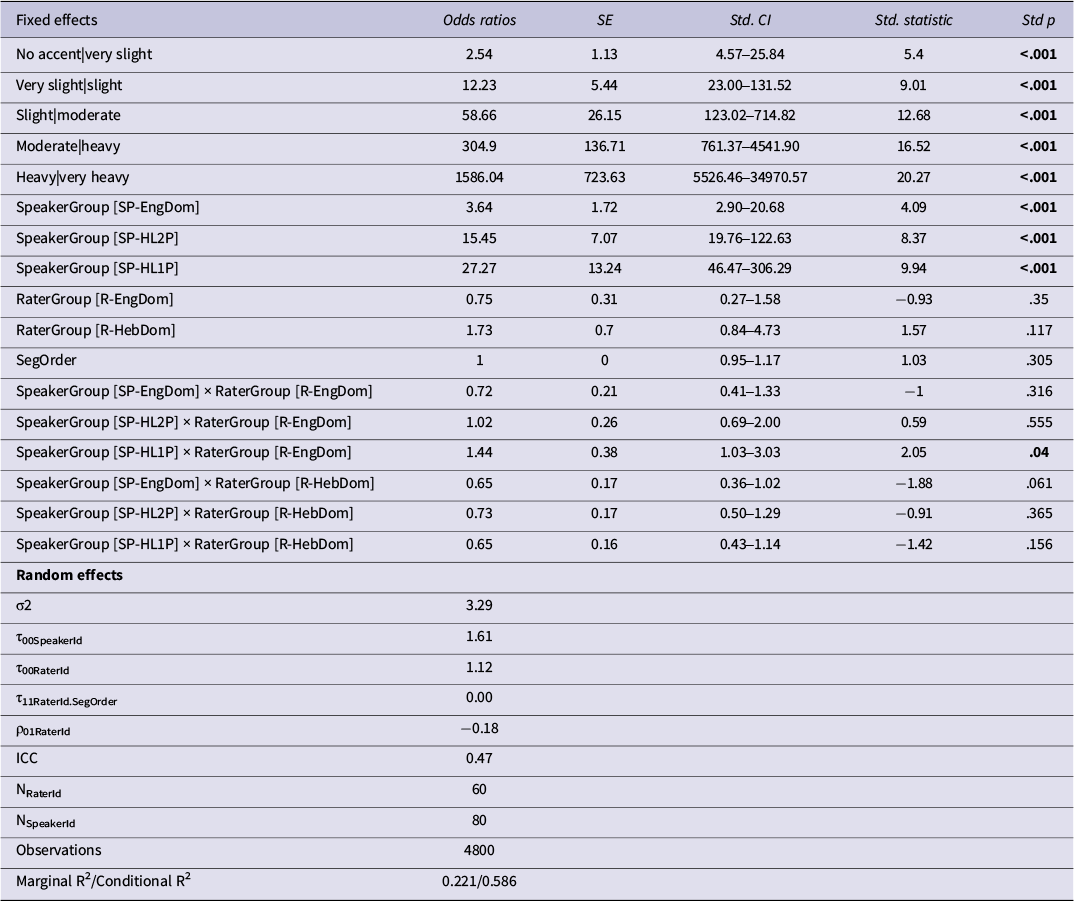
The results of the CLMM mixed-effect regression model revealed significant differences in perceived accent ratings across bilingual speaker groups compared to SP-MonEng (see Table 4). Both HL speaker groups were significantly more likely to be rated as accented, with SP-HL1P showing the strongest effect (OR = 27.27, p < .001), followed by SP-HL2P (OR = 15.45, p < .001). Notably, SP-EngDom speakers were also more likely to receive stronger accent ratings than SP-MonEng (OR = 3.64, p < .001), underscoring the influence of bilingualism on perceived accentedness. The rater group alone did not have a significant effect, although there was a trend suggesting that R-HebDom raters were slightly more likely to rate speakers as accented. Significant interaction effects indicated that ratings are contextually dependent. For instance, the interaction between SP-HL1P and R-EngDom is statistically significant (OR = 1.44, p = .04), suggesting that English-dominant raters may rate SP-HL1P speakers as more accented. The model’s marginal R2 was 0.221 (fixed effects only), while the conditional R2 (including random effects) was 0.586, indicating a significant contribution of both fixed and random effects to the model’s explanatory power. Random effects revealed variability across SpeakerId (τ00 = 1.61) and RaterId (τ00 = 1.12), with SegOrder showing no significant contribution. The intraclass correlation coefficient (ICC = 0.47) suggests that nearly half of the total variance was attributable to these random effects. This model provides a nuanced view of accent perception, showing that both speaker characteristics and rater interactions shape ratings, with individual variability in speakers and raters adding complexity to these evaluations.
Results of the CLMM model (1) for ordinal accent values for all speakers

Pairwise comparisons showed the source of the speaker group × rater group interaction. Table S4 in the Supplementary Materials document shows that practically all rater groups indicated significant differences in the accentedness for each pair of speaker groups. All rater groups agreed that the SP-MonEng group (the L1-English monolinguals) has mostly no accent, while the SP-EngDom group (the L1-English immigrants) was a mix between no accent and a very slight accent, and both HL groups (SP-HL1P and SP-HL2P) were noted to have greater variation in accentedness. The single exception showing a difference between the raters was found for the two HL speaker groups, in that only the English-dominant rater group (R-EngDom) reported a significant difference between these two speaker groups.
On the other hand, Table S5 in the Supplementary Materials document indicates that there were no significant differences in the way any pair of rater groups evaluated a particular speaker group.
Overall, all of the three rater groups presented the following increase in the accentedness in the speaker groups: (SP-MonEng<SP-EngDom<(SP-HL2P≈SP-HL1P)), with SP-MonEng having practically no accent (as expected), while SP-EngDom tending to be slightly more accented compared to SP-MonEng (the other English-dominant speaker group), and the HL-speaker group with two English-speaking parents (SP-HL2P) being similar to the group with only one. Here, an interaction was shown only from the English-dominant Israeli rater group, which saw a significant difference between accentedness in the SP-HL1P and SP-HL2P speaker groups.
5.2 Contribution of individual background parameters to perceived accentedness
To explore the third research question regarding what individual linguistic and background characteristics are likely to affect the extent of the accentedness of an HL-English speaker, we investigated whether the variations found in the accent values of the two HL speaker groups may be due to variations in the childhood linguistic characteristics as reported in the speakers’ questionnaires. We also compared the level of accentedness with metrics of linguistic proficiency in the morphosyntactic and lexical domains.
A matrix of the correlation levels for each pair of factors is provided in Figure 3. Only correlation pairs with significant p-values (p < .5) are shown, with the size of the circle indicating the strength of the correlation. The correlation coefficients R are provided in Table S6 in the Supplementary Materials document, along with the level of significance.
Correlation diagram.

Significant correlations emerged between accentedness and the percentage of time English was used in communication with parents, mother (not father), and siblings. Significant correlations were found between accentedness and lexical proficiency (as measured in the Boston Naming Test), but not with morphosyntactic proficiency (as measured in the Grammatical Judgment Test). The latter may be due to the fact that, as pointed out by (Gordon & Meir, Reference Gordon and Meir2024), most of the speakers performed at ceiling level in that test. Lexical proficiency also correlated with AoB (later AoB meant higher proficiency).
There were significant correlations between the number of English-speaking parents (1 or 2) and communication with parents/mother/father/siblings, which seems to indicate that when there are two parents it is more likely that English is spoken exclusively at home. These parameters also correlated with the likelihood that the speaker speaks English as an adult with their children/spouse/colleagues (Adult Language Use). The correlation between accentedness and the number of English-speaking parents (1 or 2) was not statistically significant, implying perhaps that the amount of English spoken in these homes is more important than the number of parents who speak it as their first language. Our results showed no effect of firstborn-ness or number of siblings on accentedness. We note parenthetically that, as expected, there was a strong and significant positive correlation between self-evaluated accents and rater-evaluated accents. We note also that speakers tended to underestimate their own level of accentedness.
The set of correlations points to the complex interaction between the different factors from the speaker’s childhood linguistic background, as well as the relationship between these factors and perceived accentedness. The clustering of these factors and the relative strength of the connections between them is illustrated in the network diagram shown in Figure 4 (Panel 1). The centrality analysis identified communication with parents as the pivotal factor driving change across the entire network, see Figure 4 (Panel 2).
Network and centrality diagrams.

The contribution of the speakers’ background characteristics (HL speakers only) to accentedness was determined by developing a mixed-effect regression model (Cumulative Link Mixed Model (CLMM)) (Christensen, Reference Christensen2022) as described above. The model shown in (2) above was determined to be the “best fit”. The results of the model are shown in Table 5.
Results of the CLMM model (2) for ordinal accent values for HL speakers

6. Discussion
The first goal of this study was to determine to what extent HL-English speakers are likely to have detectable “foreign accents” (RQ1), and how much of the individual differences in the perceived accentedness are dependent on the characteristics of the rater (RQ2).
As expected, the results were partially in line with the CPH, which predicted only minimal differences between the speaker groups, since all the speakers were exposed to English from birth via naturalistic input. Overall, the mean accent level for all of the speaker groups was low on the scale, averaging between “none” and “slight”. In this, the results were consistent with the phenomenon found in almost all the research in HL accents. While divergences in HL speakers are often found in the morphosyntactic and lexical domains (Polinsky, Reference Polinsky2018; Gordon & Meir, Reference Gordon and Meir2024), this is much less salient in the phonological domain. See for example, Chang (Reference Chang, Montrul and Polinsky2021, p. 582): “when they speak the HL, [they] can sound very much like a ‘native’ speaker (i.e., an ‘expert’ speaker who has reached some notional peak level of proficiency)”. These findings for “none” and “slight” accented in all the speakers, including HL speakers, can be taken as support for the CPH.
However, our data showed that they were far from being completely “accentless”: more than half of the HL speakers exhibited a “slight” or “very slight” accent. Thus, the observed group differences provide evidence against the CPH, indicating that the age of exposure to the language alone is insufficient to guarantee L1-accentedness, suggesting that additional factors play a significant role. This too is consistent with most previous studies (e.g., Kupisch et al., Reference Kupisch, Barton, Hailer, Klaschik, Stangen, Lein and van de Weijer2014 and others cited above). All of the rater groups reported the same trend towards increased mean accentedness along the speaker groups, with (SP-MonEng>SP-EngDom)<(SP-HL2P ≈SP-HL1P).
We begin by noting that the SP-EngDom speaker group (L1-English-speaking immigrants who have lived in Israel, on average, for over 30 years), showed increased accentedness relative to their monolingual peers. As previous studies have suggested (Bergmann et al., Reference Bergmann, Nota, Sprenger and Schmid2016; Chang, Reference Chang2012; De Leeuw et al., Reference De Leeuw, Schmid and Mennen2010; Kornder & Mennen, Reference Kornder and Mennen2021), the accents of adults in their L1 language can be affected by their L2. The results shown in this study support that assertion, despite the unique characteristics associated with English that might be expected to mitigate against that effect (namely, its ubiquitousness even in a society in which a different language is spoken primarily). Besides the general dominance of Hebrew in Israel, most English-speaking immigrants to Israel continue to live and socialize in English-speaking communities (Joffe, Reference Joffe2018); specifically in the current study, 94% of this group lived in one of four communities with a large number of English speakers (Jerusalem, Raanana, Efrat, and Beit Shemesh), where their native accents are reinforced, mitigating the SL cross-language influence. In addition, the extensive presence of English in accessible media from their native country might have been expected to help them maintain their native accents. But consistent evidence of this effect was not seen. See the “Limitations” section below for another possible explanation for the perceived accentedness of this speaker group.
With regard to the HL speakers, the results showing that they are more accented than monolingual L1-English speakers and bilinguals with late exposure to SL-Hebrew, are in line with many previous studies (e.g., Kupisch et al., Reference Kupisch, Barton, Hailer, Klaschik, Stangen, Lein and van de Weijer2014, demonstrating divergence in the phonology domain in the HL. Besides the cross-linguistic influence of the SL, HL speakers are often exposed to divergent phonological input even in the HL heard from their parents, since the monolingual-like L1 of the immigrants may have become attritted by prolonged exposure to the L2 of their adopted country (Bergmann et al., Reference Bergmann, Nota, Sprenger and Schmid2016; Chang, Reference Chang2012; De Leeuw et al., Reference De Leeuw, Schmid and Mennen2010). This is shown to a limited extent in the current study in the SP-EngDom immigrant speaker group (this group comprises a cohort very similar in SES and linguistic background to the parents of the HL speakers` groups, and in a few cases are the actual parents). However, the slightly elevated accentedness of this group does not in itself explain the accentedness of the HL speakers, which is influenced as well by the cross-language influence of SL-Hebrew and other input factors.
In the Research Question (RQ2), we asked how the linguistic background of the rater affects their evaluation. For the most part, there were no significant differences between the three rater groups (see Tables S4 and S5 in the Supplementary Materials document). The only exception was in the case of the difference between the two HL speaker groups (one-parent vs. two-parent) in that only the R-EngDom rater group (i.e., late bilinguals L1-English, L2-Hebrew) reported a significant difference in the accent levels between the two groups.
Other than that, all of the rater groups reported significant differences between each pair of individual speaker groups (Table 5), but for any given speaker group, there appeared to be no differences in the evaluations of the different rater groups. This result is somewhat surprising, given that in this study the differences in accentedness between the speaker groups are significant, but are not normally distributed among all the possible levels of accentedness. Despite this, almost all of the rater groups appeared to exhibit similar sensitivity in phonological perception. Contrary to the predictions of the Critical Period Hypothesis (CPH), the R-HebDom group did not significantly differ from other groups despite their late onset of English acquisition. This finding challenges the expectation that later exposure to a second language results in markedly different linguistic outcomes, suggesting instead that other factors, such as linguistic environment, use, or individual variability, may play a more substantial role in shaping language proficiency and accent perception.
We consider now our third research question (RQ3) concerning links between accentedness, proficiency (lexical and morphosyntactic) and childhood linguistic background factors. Unlike for the morphosyntactic and lexical domains for the same cohort of speakers (Gordon & Meir, Reference Gordon and Meir2024), we found little significant correlation between accentedness and some of the childhood linguistic characteristics of the HL speakers such as AoB, or formal and informal English education. While this result deviates from the correlation of accentedness with AoB that was found in some previous studies in the phonological domain (e.g., Stangen et al., Reference Stangen, Kupisch, Proietti Erguen, Zielke and Peukert2015 and others cited above), many of those studies had a greater range in AoB (e.g., between ages 0 and 9 in Stangen et al.’s study of HL-Turkish in Germany), whereas in this study exposure to the SL was much earlier (M=1.9 (SD=.9) or M=2.1 (SD=1.1) for SP-HL2P and SP-HL1P respectively).
The only predictive factors revealed by the correlation coefficient values were the frequency of communications (sometimes referred to here as HL “input”) in English, with parents and siblings. This suggests that the phonetic and phonological basis is established in early childhood, before other factors come into play, and remains largely unaffected by later social and educational factors. Lexical proficiency, as measured by the Boston Naming Test also predicted the level of accentedness (negative correlation), but it seems likely that this proficiency was affected by parental and sibling input as well, as shown in our previous study (Gordon & Meir, Reference Gordon and Meir2024), and in the interconnectedness of the various factors, as shown in the network diagram. Morphosyntactic proficiency, which showed no significant correlation with accentedness, was mostly at ceiling level, and in any case, tends to be affected by inputs and cross-linguistic influence at a much later age.
This result is also consistent with the effects of family input on accentedness reported by Kupisch et al. (Reference Kupisch, Kolb, Rodina and Urek2021). However, we found no correlation with family type in the form of numbers of older and younger siblings as reported in some previous studies for other domains (e.g., De Houwer, Reference De Houwer2007). This too may be explained by the ubiquity of additional English input (unlike for other HLs) besides that which is provided by the family. The number of English-speaking parents (which differentiated between the two HL speaker groups) was not in itself a significant factor, though it usually contributes to the general level of parental input in the HL. It would appear that the effect of “number of English-speaking parents” might be mitigated by more fine-grained effects of family language policy, while the cross-linguistic influence of the SL strongly influences both HL groups.
7. Limitations and future research
Though we believe these results provide evidence of the objective existence of accents among HL-English speakers, as well as some of the factors that affect their production and perception, we cannot discount the possible effects of additional sociolinguistic considerations and experimental limitations on both raters and speakers. Pains were taken to make sure the raters understood that they were to evaluate foreign and not regional accents and to remove elements of the speech segment that might provide non-phonological cues. But in many cases, there were suprasegmental characteristics in tone, speech speed, and prosody that raters were unsure whether to consider as “accents” (as indicated in informal post-experiment discussions with some of them). Some raters commented afterward about the existence of non-phonetic factors in English which they associated (culturally) with Jewish ethnic identity in both native monolinguals and HL speakers (e.g., intonation and audible non-verbal pauses), and it was unclear to them whether to include these in determining “accentedness”.
The existence of these ethnocultural accents, in this case usually associated with American Jews with a strong religious background (who tend also to make up a significant percentage of immigrants to Israel, both in the population and in this study) may also explain the perceived accentedness in the SP-EngDom speaker group, relative to the SP-MonEng group. The latter group, representing a cross-section of Americans, did not have this particular ethnocultural component in their speech. While there may have been other regional or ethnic accents in some of these segments, these were generally less salient, or recognized as regional. In future research, this factor should be neutralized if possible, in selecting both monolingual and bilingual speakers.
8. Conclusions
This study analyzed the accentedness levels in the English speech of HL-English speakers in Israel (compared to groups of monolingual English speakers and L1-English-speaking late immigrants), as evaluated by groups of raters from different linguistic backgrounds. Its novelty lies both in its examination of the less-frequently studied dyad of HL-English / SL-Hebrew (the former because of its unique status as a prestige language), and its simultaneous use of both different speaker groups and different rater groups to determine the interactions between them. We found evidence of slight but discernable accentedness among most HL speakers, and to a lesser extent even among the immigrants, despite the position of English as a prestigious and ubiquitous language in Israel. The perception of accentedness in most cases did not vary between the rater groups of different linguistic backgrounds, but there were interactions testifying to the effect of similar backgrounds between the speaker and the rater. Accentedness levels in individual speakers correlated significantly with parental and sibling input, as well as with lexical proficiency, but not with other factors related to exposure to the societal language. The results indicate that while the Critical Period Hypothesis predicts greater resilience of the phonetic and phonological systems to cross-linguistic influences of an L2, these systems are not entirely immune at the level of production. However, when it comes to the perception of accentedness, the influence of AoB appears to be less pronounced, suggesting a more nuanced interaction between AoB and linguistic outcomes.
Supplementary material
The supplementary material for this article can be found at https://doi.org/10.1017/S1366728925000288
Data availability statement
The data that support the findings of this study are openly available in the on-line supplemental materials folder referenced above.
Acknowledgements
The study was partially supported by the Israel Science Foundation (ISF) No. 552/21 “Towards Understanding Heritage Language Development: The Case of Child and Adult Heritage Russian in Israel and the USA” granted to Natalia Meir.
Author contribution
The authors assert that all procedures contributing to this work comply with the ethical standards of the relevant national and institutional committees on human experimentation and with the Helsinki Declaration of 1975, as revised in 2008.
Competing interests
The authors declare no competing interests.





 Open access

