





1. Introduction
Cognitive decline with age is a normal stage of human development. While older adults in general are expected to suffer decline in a variety of cognitive abilities (Salthouse, Reference Salthouse2000), cognitive decline is particularly observed in executive functions (Basak, Boot, Voss & Kramer, Reference Basak, Boot, Voss and Kramer2008), usually expressed as difficulties in processing speed, inhibition abilities and working memory. As a consequence, a considerable amount of research has been conducted to investigate whether, and how, cognitive decline can be postponed, counteracted or even reversed (Reijnders, van Heugten & van Boxtel, Reference Reijnders, van Heugten and van Boxtel2013). Studies have suggested that cognitive training programs enhance cognitive functioning and delay cognitive decline in healthy ageing adults, and also in adults with cognitive impairments (Gavelin, Dong, Minkov, Bahar-Fuchs, Ellis, Lautenschlager, Mellow, Wade, Smith, Finke, Krohn & Lampit, Reference Gavelin, Dong, Minkov, Bahar-Fuchs, Ellis, Lautenschlager, Mellow, Wade, Smith, Finke, Krohn and Lampit2021; Gavelin, Lampit, Hallock, Sabatés & Bahar-Fuchs, Reference Gavelin, Lampit, Hallock, Sabatés and Bahar-Fuchs2020). For instance, it has been suggested that cognitive training using video games can be beneficial to several aspects of mental health, including enhancing executive functions such as inhibition, working memory and switching (Boldi & Rapp, Reference Boldi and Rapp2021). However, other studies have identified limitations of training using computer tasks. For instance, Owen and colleagues (Reference Owen, Hampshire, Grahn, Stenton, Dajani, Burns, Howard and Ballard2010) observed improvements on the tasks themselves, but noted that these benefits are not global and do not transfer to untrained tasks (Stojanoski, Wild, Battista, Nichols & Owen, Reference Stojanoski, Wild, Battista, Nichols and Owen2021). More persistent cognitive benefits are reported to be related to life-long experiences, including years of education, occupational attainment and leisure activities (Stern, Reference Stern2012). Collectively, such benefits have been dubbed cognitive reserve, which is better-than-expected cognitive functionality in the face of healthy or clinical ageing (Voits, Robson, Rothman & Pliatsikas, Reference Voits, Robson, Rothman and Pliatsikas2022b).
Similarly, the life-long experience of bilingualism has been suggested to be one of those challenging experiences that may bring about adaptations in cognition (Anderson, Mak, Keyvani Chahi & Bialystok, Reference Anderson, Mak, Keyvani Chahi and Bialystok2018; Bialystok, Craik, Klein & Viswanathan, Reference Bialystok, Craik, Klein and Viswanathan2004) and the brain (DeLuca, Rothman, Bialystok & Pliatsikas, Reference DeLuca, Rothman, Bialystok and Pliatsikas2019; Pliatsikas, Reference Pliatsikas2020), and may lead to enhanced cognitive abilities in older adults (Bialystok et al., Reference Bialystok, Craik, Klein and Viswanathan2004; Samuel, Roehr-Brackin, Pak & Kim, Reference Samuel, Roehr-Brackin, Pak and Kim2018). It has even been suggested that the benefits of bilingualism in older age extend to increased cognitive flexibility and delay the onset of dementia symptoms (Bialystok, Reference Bialystok2021; Craik, Bialystok & Freedman, Reference Craik, Bialystok and Freedman2010), both of which can be considered forms of cognitive reserve (Voits, DeLuca & Abutalebi, Reference Voits, DeLuca and Abutalebi2022a). It has been shown that both languages are constantly active, and competing, in the bilingual mind (Bialystok, Craik & Luk, Reference Bialystok, Craik and Luk2012; Carlson & Meltzoff, Reference Carlson and Meltzoff2008), a situation that requires bilinguals to inhibit the non-target language and use the target language. This has led several researchers to suggest that the bilingual cognitive system develops benefits in executive functions not found in monolinguals (Kroll, Bobb, Misra & Guo, Reference Kroll, Bobb, Misra and Guo2008). Studies that investigate the bilingual advantage often focus on the three domains of executive functions identified by Miyake and colleagues (Miyake, Friedman, Emerson, Witzki, Howerter & Wager, Reference Miyake, Friedman, Emerson, Witzki, Howerter and Wager2000) – namely, inhibitory control, switching and updating of working memory. These studies have linked bilinguals’ ability to maintain attention to one language, and suppress interference from the non-target language, to superior performance in working memory and inhibition tasks (Hoshino & Thierry, Reference Hoshino and Thierry2011; Kroll et al., Reference Kroll, Bobb, Misra and Guo2008). Furthermore, bilinguals’ ability to switch from one language to another has been linked to increased language control and monitoring skills (Bialystok, Reference Bialystok2011; Kroll & Bialystok, Reference Kroll and Bialystok2013). Crucially, bilingual advantages in these domains have been reported more often in older adults than in young adults (Paap & Greenberg, Reference Paap and Greenberg2013). These findings have been attributed variously to the lifelong frequent experience of juggling two languages (Kirk, Fiala, Scott-Brown & Kempe, Reference Kirk, Fiala, Scott-Brown and Kempe2014), or to the consequences of bilingualism on cognition being less likely to be observed in younger bilinguals at their cognitive peak (Kroll & Bialystok, Reference Kroll and Bialystok2013).
A small portion of the available evidence comes from two very common linguistic situations that are similar, but not identical, to bilingualism; in bidialectalism and diglossia, speakers typically use two varieties of the same language. These largely overlooked, but quite common, situations are of particular interest to the field because they differ from bilingualism in several ways, with the most important of these being (a) the linguistic distance between the two spoken languages (which is typically smaller in diglossia and bidialectalism), and (b) the opportunities for code-switching that the different situations provide (which tend to be limited, especially in diglossia). Both these factors should modulate the language control needs of these situations, suggesting they merit a particular focus; however, the evidence from bidalectal and diglossic situations remains limited (Alrwaita, Houston-Price & Pliatsikas, Reference Alrwaita, Houston-Price and Pliatsikas2022a). While the benefits of bilingualism remain most pronounced amongst older adults (Berkes, Calvo, Anderson & Bialystok, Reference Bialystok2021), only a few studies have investigated whether bidialectal older adults exhibit an advantage in executive functions, and these studies have produced mixed results (Houtzager, Lowie, Sprenger & De Bot, Reference Houtzager, Lowie, Sprenger and De Bot2017; Hsu, Reference Hsu2021; Kirk et al., Reference Kirk, Fiala, Scott-Brown and Kempe2014). It has been previously argued that bidialectalism and diglossia both correspond to Single Language Contexts (see below), because of the social norms that impose a separation between the two varieties (Rowe & Grohmann, Reference Rowe and Grohmann2013; Scaltritti, Peressotti & Miozzo, Reference Scaltritti, Peressotti and Miozzo2017). The minimal opportunities for switching between the two varieties might explain the lack of cognitive benefits (Alrwaita et al., Reference Alrwaita, Houston-Price and Pliatsikas2022a).
Given this well-documented separation in the use of the two varieties, in this study we investigate whether there are effects of diglossia on executive function abilities in older adults. To this end, we compare the performance of Arabic speaking older adults on tasks tapping executive functions to that of bilinguals and monolinguals of similar age. Diglossia in the Arab world provides an ideal test case for investigating the effects that Single Language Contexts have on cognition, because of the highly rigid separation between the two varieties across contexts (Kaye, Reference Kaye2001). Specifically, in Arabic the high variety is strictly used for formal purposes, and the low variety is strictly used for informal purposes. Switching between these two varieties is generally unacceptable and regarded as a violation of social norms (Albirini, Reference Albirini2016). We chose to study older participants as this is a demographic group where effects of bilingualism on cognition are typically observed. Previous work with young diglossics failed to reveal any significant benefits of diglossia on cognition (Alrwaita, Meteyard, Houston-Price & Pliatsikas, Reference Alrwaita, Meteyard, Houston-Price and Pliatsikas2022b). Cognitive advantages associated with diglossia may be more likely to be observed in an older population, mirroring the pattern found in bilingualism. The remainder of this introduction reviews the available evidence on the effects of using more than one language on executive functions, with particular focus on the limited evidence from bidialectalism and diglossia.
1.1. Bilingualism and executive functions
Executive functions are generally defined as the ability to consciously control thoughts and actions. Miyake et al. (Reference Miyake, Friedman, Emerson, Witzki, Howerter and Wager2000) defined three main components of executive functions: inhibition, the ability to suppress attention to misleading information and focus on a specific target; switching, the ability to switch from one task to another; and updating, the ability to temporarily hold information in working memory for processing. General cognitive abilities, including executive functions, tend to decline with age (Nyberg, Lövdén, Riklund, Lindenberger & Bäckman, Reference Nyberg, Lövdén, Riklund, Lindenberger and Bäckman2012). Many studies have investigated whether decline in executive functions in older age can be reduced or even prevented. One form of mental exercise that has been recently suggested to enhance executive functions in older adults is bilingualism. Indeed, it has been reported that individuals speaking two or more languages have enhanced executive function abilities compared to monolinguals, usually expressed as smaller differences between more challenging and less challenging conditions in tasks that measure different components of executive functions (Valian, Reference Valian2015). The premises behind the bilingual advantage hypothesis stem from the assumption that the two languages in the bilingual mind are constantly active; as a result, bilinguals are ‘trained’ to resist interference from one language to another (Prior & Macwhinney, Reference Prior and Macwhinney2010). The increased cognitive control in bilinguals is derived from their effort and experience in separating their two languages, which leads to enhanced executive functions. While early studies, in general, reported bilingual benefits on executive function tasks (Portes & Schauffler, Reference Portes and Schauffler1994), these findings have often been difficult to replicate even using the same tasks in the same age groups (Valian, Reference Valian2015). Results are mostly mixed for young adults, while studies with children and old adults are more consistent in reporting bilingual benefits (Berkes et al., Reference Berkes, Calvo, Anderson and Bialystok2021; Kirk et al., Reference Kirk, Fiala, Scott-Brown and Kempe2014). One possible explanation is that cognitive abilities, including executive functions, are at their peak during young adulthood, which makes it difficult to find differences between groups (Bialystok, Martin & Viswanathan, Reference Bialystok, Martin and Viswanathan2005). As already mentioned, evidence from older adults appears more consistent (Berkes et al., Reference Berkes, Calvo, Anderson and Bialystok2021), with older bilinguals reported to perform better than aged-matched monolinguals in inhibition, switching and updating tasks (Bialystok et al., Reference Bialystok, Craik, Klein and Viswanathan2004; Gold, Kim, Johnson, Kryscio & Smith, Reference Gold, Kim, Johnson, Kryscio and Smith2013; Luo, Craik, Moreno & Bialystok, Reference Luo, Craik, Moreno and Bialystok2013). This suggests that lifelong experience of managing the two languages leads to improved executive functions in older bilinguals; however, it has also been argued that the benefit may depend on the context the bilinguals find themselves in, with contexts that encourage language switching and control more likely to yield such benefits (Kirk et al., Reference Kirk, Fiala, Scott-Brown and Kempe2014).
In a seminal paper, Green and Abutalebi (Green & Abutalebi, Reference Green and Abutalebi2013) introduced the Adaptive Control Hypothesis (ACH), which claims that language control processes adapt to the demands imposed on them by the particular interactional language context. Green and Abutalebi (Reference Green and Abutalebi2013) described a set of control processes that underlie executive functions and support conversations in different contexts. These processes are: (a) goal maintenance: maintaining a goal of speaking one language while ignoring the other. Goal maintenance processes require (b) interference control, which encompasses two sub-processes: conflict monitoring and interference suppression (c) Salient cue detection refers to detecting the cues that indicate that speakers should switch from one language to another. (d) Selective response inhibition refers to inhibiting speaking one language to speak the other. (e) Task disengagement refers to stopping the use of one language in conversations, while (f) task engagement refers to engaging in the other language. Finally, (g) opportunistic planning refers to adapting words from one language to fit the structure of another language. The ACH considers the different contexts in which bilinguals use their languages, and how these might affect executive functions differently. According to the ACH, three main conversational contexts can be defined: (a) the Single Language Context, where bilinguals use each of their languages in a separate context (e.g., at work or at home), leading to minimal switching between them; (b) the Dual Language Context, where bilinguals use both languages in one context (e.g., at home), causing more frequent switching between languages than in the Single Language Context; and (c) the Dense Code-switching Context, where switching between the two languages occurs even within one utterance. According to Green and Abutalebi (Reference Green and Abutalebi2013), because the Dual Language Context permits the use of both languages in close proximity but does not allow for switching within one utterance, it requires the highest levels of language control, followed by the Single Language Context (where some effort is required to separate languages) and finally, the Dense Code-switching Context (where languages need not be separated). Crucially, the higher need for control in the Dual Language Context is hypothesised to impose higher demands on executive functions than the other two contexts, and bilinguals who operate in Dual Language Contexts are expected to show the greatest enhancements in most of the control processes listed above. Bilinguals in Single Language Contexts, who constantly need to avoid switching to their other language, are expected to mostly engage with, and enhance, goal maintenance and interference control, but not other control skills; moreover, they are expected to show more enhanced cognitive control than bilinguals who operate in Dense Code-switching Contexts, who have limited needs for language control. Therefore, it is of particular value to differentially study the effects of dual language use on cognition in linguistic situations that best match the characteristics of those contexts.
1.2. Bidialectalism/diglossia and executive functions
Diglossia and bidialectalism provide good examples of Single Language Contexts, as they typically feature a clear separation of use between two varieties of the same language, with minimal opportunities for switching (Alrwaita et al., Reference Alrwaita, Houston-Price and Pliatsikas2022a; Kirk et al., Reference Kirk, Fiala, Scott-Brown and Kempe2014). Consequently, if there is any enhancement in executive functions in diglossics and bidialectals, this should be expected to be detected in tasks such as Flanker and Stroop that tap the process of goal maintenance, but not in other executive function tasks, as would be expected from populations in Dual Language Contexts. Crucially, it has been argued that diglossic environments impose more rigid rules for restricting use of each variety to its specific context than bidialectal environments (Alrwaita et al., Reference Alrwaita, Houston-Price and Pliatsikas2022a), which makes the former more representative examples of Single Language Contexts. Diglossia is characterized by the co-existence of a high (H) variety (Standard), which is used for formal purposes, and a low (L) variety (colloquial dialect), which is used for informal purposes and everyday communication (Ferguson, Reference Ferguson1959). On the other hand, bidialectalism has been suggested to feature the breakage of the typical separation between H and L varieties into a continuum of dialect usage (Rowe & Grohmann, Reference Rowe and Grohmann2013). In bidialectalism, speakers shift from one language variety to the other depending on the particular sociolinguistic situations – for instance, whether the addressee understands that variety (Masica & Sinha, Reference Masica and Sinha1986). However, the definitions of these situations, the extent to which they differ, and the effects they may have on cognition, remain controversial issues (Alrwaita et al., Reference Alrwaita, Houston-Price and Pliatsikas2022a). Of particular interest for our study is the extent to which these situations have an effect on the different domains of executive functions, and whether these are similar to the effects that have been reported for bilingualism.
Recently, a few studies investigated executive function abilities in bidialectalism and diglossia (Alrwaita et al., Reference Alrwaita, Houston-Price and Pliatsikas2022a). Amongst them, only three studies investigated bidialectal benefits in older adults. Kirk and colleagues (Kirk et al., Reference Kirk, Fiala, Scott-Brown and Kempe2014) used the Simon task to compare the inhibitory control abilities of various groups of bidialectals, bilinguals and monolinguals, all over the age of 60. Results revealed a significant Simon effect for all groups but no significant interactions with group; in other words, none of the groups showed a reduced Simon effect that would suggest enhanced executive functions (Bialystok et al., Reference Bialystok, Craik, Klein and Viswanathan2004). The authors interpreted their null findings with reference to the schooling contexts of their participants, none of which promoted switching between the language of instruction and participants’ second language/dialect, making it possible that none of the groups found themselves in a Dual Language Context. However, given that participants were older adults, their schooling context does not provide sufficient information about their current language use and switching opportunities.
In another study, Houtzager and colleagues (Houtzager et al., Reference Houtzager, Lowie, Sprenger and De Bot2017) used the Color-shape task to compare the switching abilities of 50 Frisian–Dutch bidialectals and 50 German monolinguals who were divided into two groups, a middle-aged group (35–56) and an older adults group (65–85). After controlling for the effects of age and working memory capacity, the authors reported a bidialectal benefit in switching cost, expressed as a smaller difference between repetition and switching trials for bidialectals compared to monolinguals. Additionally, it was found that older bidialectals were less affected by an age-related increase in switching costs than monolinguals. The authors concluded that the life-long experience of using two dialects leads to enhanced switching abilities in older age. More recently, Hsu (Reference Hsu2021) investigated whether there is a bidialectal benefit in Hakka–Mandarin and Minnan–Mandarin bidialectal older adults (Mean age =68.7), compared to age-matched Mandarin monolinguals, and whether this benefit was consistent across verbal and non-verbal tasks with different difficulty levels. Hsu reported benefits for bidialectals on different versions of the Stroop task (verbal and non-verbal), all of them characterized as of ‘intermediate’ difficulty. No effects were reported in other tasks tapping different components of executive functions. Hsu (Reference Hsu2021) concluded that some benefits for executive functions extend beyond bilingualism to bidialectalism, but these may only be found in tasks with appropriate levels of difficulty (not too easy or excessively difficult).
The limited evidence from studies on bidialectalism suggests that bilingual benefits in executive functions might extend to situations where two varieties of the same language are spoken. However, as already mentioned, bidialectalism may not be a clear example of a Single Language Context, at least in comparison to diglossia, which imposes stricter separation in the use of the two varieties (Kaye, Reference Kaye2001; Rowe & Grohmann, Reference Rowe and Grohmann2013). To date, there are no studies investigating potential diglossic benefits in older adults, and the two studies that have been conducted with young adults (20-30 years old) provide contradicting findings. Specifically, Antoniou and Spanoudis (Antoniou & Spanoudis, Reference Antoniou and Spanoudis2020) reported that Cypriot - Standard Modern Greek (SMG) diglossics outperformed monolinguals (but not multilinguals) in tasks tapping inhibition, updating, and switching. However, these patterns were not replicated in a recent study where Arabic diglossic young adults (aged 21-29) showed no benefits over monolinguals (Alrwaita et al., Reference Alrwaita, Meteyard, Houston-Price and Pliatsikas2022b). To explain the discrepancy in findings, Alrwaita and colleagues argued that Cypriot - Greek diglossia is amongst many diglossic situations that are transitioning into type B diglossia, or diaglossia: a state in which the standard variety is becoming used for spoken purposes, negating the clear separation of the two varieties (Auer, Reference Auer, Delbecque, van der Auwera and Geeraerts2005; Rowe & Grohmann, Reference Rowe and Grohmann2013). Therefore, the environment in Cyprus allows for more switching than typical diglossic environments, such as those in Arabic-speaking countries (Kaye, Reference Kaye2001; Pavlou, Reference Pavlou2004). However, the possibility remains that the lack of benefits reported by Alrwaita et al. (Reference Alrwaita, Meteyard, Houston-Price and Pliatsikas2022b) is linked to the testing of young adults, who rarely demonstrate benefits in studies on bilingualism. This suggests that investigation is warranted in an older age group where bilingual benefits are more consistently reported (Berkes et al., Reference Berkes, Calvo, Anderson and Bialystok2021).
2. This study
No study has investigated the effects of diglossia on executive functions amongst older adults, and the two available studies on the effects of diglossia in young adults provide contradictory results (Alrwaita et al., Reference Alrwaita, Meteyard, Houston-Price and Pliatsikas2022b; Antoniou & Spanoudis, Reference Antoniou and Spanoudis2020). The present study applies the methods used by Alrwaita et al. to Arabic diglossic older adults, aged 50-78. In contrast to the Cypriot context, Arabic provides clear separation between the two spoken varieties (Pavlou, Reference Pavlou2004; Rowe & Grohmann, Reference Rowe and Grohmann2013), allowing us to attribute the findings more confidently to the Single Language Context. The present study directly compares the performance of bilinguals and diglossics, allowing us to examine the predictions of the ACH in the different conversational contexts these present (Green & Abutalebi, Reference Green and Abutalebi2013). Participants were tested on tasks that tap inhibition (Flanker and Stroop tasks) and switching (Color-shape task) abilities. Both the Stroop and Color-shape tasks have been used in studies reporting bidialectal benefits (Houtzager et al., Reference Houtzager, Lowie, Sprenger and De Bot2017; Hsu, Reference Hsu2021), while the Flanker task was used as an additional measure of inhibitory control that does not involve a verbal element (as Stroop does). Based on the predictions of the ACH, and on the basis that diglossics belong to a Single Language Context while bilinguals belong to a Dual Language Context, we predicted the following: for the Flanker and Stroop tasks both diglossics and bilinguals will show enhanced performance compared to monolinguals, expressed as smaller Flanker/Stroop effects, because both Single and Dual Language Contexts make demands on these processes. For the Color-shape task, which taps processes of selective response inhibition, task engagement, and task disengagement, we expected enhanced performance by bilinguals, expressed as smaller switching costs, compared to the diglossic and monolingual groups. This is because Dual Language Contexts should increase demands on these processes, as bilingual speakers are required to speak one language only (task engagement) and switch to the other language (task disengagement), and draw on elective response inhibition when they need to change their goal (from speaking one language to the other).
Methods
2.1. Participants
Ninety-eight older adults participated in this study: 28 Arabic-speaking diglossics (22 females; M age 58.3, SD 7.08, range 50-78), 41 English-speaking monolinguals (25 females; M age 66.6, SD 11.4, range 51-84), and 29 bilinguals who spoke English as their second language (L2) (21 females; M age 59.6, SD 7.2, range 50-72;). Prior to testing, all participants gave written consent for participation. Arabic speaking adults were recruited from educational sectors in Riyadh, Saudi Arabia. English speaking monolinguals and bilinguals were recruited online and were tested at the School of Psychology and Clinical Language Sciences, University of Reading.
Diglossics lived in Saudi Arabia at the time of testing. The diglossic group reported acquiring Standard (High) Arabic through formal education, starting at the age of 6 or 7. The majority of the diglossic group were born in Saudi Arabia, although two were born in Lebanon but had lived in Saudi Arabia for more than 25 years. All of the diglossic group reported the low Arabic variety as their first and only proficient language. In terms of knowledge of additional languages, most of this group reported some exposure to English, mostly at school, and four participants reported occasional exposure to English when traveling abroad. None of the diglossic group reported daily exposure to English or any other language.
Bilingual participants lived in the UK at the time of testing and were non-native speakers of English. Bilinguals used English for everyday communication and were native speakers of a variety of languages, including German, Dutch, French, Polish, Swedish, Danish, Catalan and Ukrainian. In addition to English and their native language, 22 of the bilingual participants reported speaking an additional language. Most of this group were not born in the UK and moved there at different ages. Two bilingual participants were born in the UK but reported that English was not used at home. One participant reported that they were born in the Netherlands and grew up in a home where both Dutch and English were spoken. The majority of the bilingual group learned English through formal education (M age of acquisition = 10.64; SD 5.98). Finally, the bilingual participants were immersed in their L2-speaking environment for a long period (M years of residence in the UK = 27.1; SD 16.52), suggesting they were long-term active users of their L2.
Monolingual participants lived in the UK at the time of testing. Thirteen of the monolingual participants reported some exposure to an additional language, mostly at school. However, no one in the monolingual group reported that they were currently exposed to any additional language; any active communication in an L2 had taken place decades before testing.
2.2. Background and proficiency measures
To measure the language experience of our bilingual and monolingual groups, and to ensure correct group membership, both groups were tested using the standard version of the Language and Social Background Questionnaire (LSBQ) (Anderson et al., Reference Anderson, Mak, Keyvani Chahi and Bialystok2018). The LSBQ is a self-rating questionnaire examining the level of language use and exposure to one or more languages. The LSBQ comprises questions about the frequency that each language is used in various domains (e.g., at home with family, in social settings and social media) and participants are also asked to rate their language skills in reading, writing and listening. The LSBQ uses responses to provide a weighted composite score that reflects participants’ level of bilingual engagement: participants scoring −3.13 or below are classified as monolinguals, while participants scoring 1.23 or above are classified as bilinguals (Anderson et al., Reference Anderson, Mak, Keyvani Chahi and Bialystok2018). Monolinguals in our study had a mean score of −5.6981 (SD = 3.65), and bilinguals had a mean score of 17.368 (SD = 1.36), meaning that both groups scored as expected for their respective categories.
To ensure that our diglossic group had sufficient exposure to both the standard and the spoken varieties of Arabic, we created a version of the LSBQ that investigates the degree of language variety use, and the domains in which these varieties are used (see Appendix). The diglossics were asked to fill only the adapted version of the LSBQ, on which the group had a mean composite score of −0.21 (SD = 2.6). According to Anderson et al. (Reference Anderson, Mak, Keyvani Chahi and Bialystok2018), indviduals scoring between −3.13 and 1.23 have ambiguous language backgrounds, and are in a gray area between monolingualism and bilingualism. To further explore the language switching patterns of our bilingual and diglossic groups, we looked at their scores on those subscales of the LSBQ that focus on code-switching: “Switching with family” (allowable range: −1.11 to 1.65), “Switching with Friends” (allowable range: −0.44 to 1.09) and “Switching on social media” (allowable range: −0.47 to 1.76). For all scores, the lowest value is equivalent to a score of zero and therefore signifies a functional monolingual (for more details on how these scores were calculated, see Anderson et al., Reference Anderson, Mak, Keyvani Chahi and Bialystok2018). The two groups differed in the frequency of their code-switching with family (Bilinguals: M = 0.42, SD = 0.89, median = 0.27, range: −1.12 − 1.66; Diglossics: M = −0.37, SD = 0.75, median = −0.42, range = −1.12 − 1.66) and with friends (Bilinguals: M = 0.36, SD = 0.42, median = 0.33, range = −0.44, 1.09; Diglossics: M = −0.01, SD = 0.39, median = −0.05, range = −0.44, 0.71), but not on social media (Bilinguals: M = 0.55, SD = 0.72, median = 0.65, range = −0.47, 1.76; Diglossics: M = 0.55, SD = 0.63, median = 0.65, range = −0.47, 1.76). Although scores in these scales have not previously been matched to specific language contexts, we note that our bilingual group did not score very high on any of these scales, suggesting that their language use more closely resembles the Dual Language Context than a Dense Code Switching Context. However, we acknowledge that some participants may be dense code-switchers, judging by the ranges of the scores. With respect to the diglossic group, although the LSBQ has not yet been normed for diglossia, the observed scores are reflective of a situation where the opportunities for switching between the two varieties are very limited, as expected. While there is evidence for the use of more than language variety, scores are not in line with those seen in other forms of bilingualism.
Because knowledge of Standard Arabic depends on both the level of education and exposure to the standard dialect (Kaye, Reference Kaye2001), a vocabulary test was used to assess the proficiency of diglossic participants in Standard Arabic. The test was designed by Masrai and Milton (Reference Masrai and Milton2019), and took the form of a checklist including 100 words selected from the 50,000 most frequent Arabic words, 20 words per 10,000 frequency band, intermixed with 20 non-words. Participants were asked to tick the words they recognized, and were awarded 500 points for every correctly identified word and penalized 2500 points for every incorrectly recognised non-word. The resulting overall score is considered an index of their total vocabulary knowledge. Our diglossic group knew an average of 30,928.57 words (SD = 6780; range: 15,750−42,250). No participant was excluded based on their performance in the vocabulary test, as they were all deemed to have at least basic competency in Modern Standard Arabic (Masrai & Milton, Reference Masrai and Milton2019).
2.3. Executive functions tasks
The battery of executive function tasks included tasks measuring inhibition (Flanker and Stroop) and switching (Color-shape), which were delivered using E- prime 2.0 software (Psychology Software Tools, PA). All tasks were presented in a 15.6-inch computer screen, and all participants were tested in private rooms. Instructions were provided in Arabic to the diglossic group and in English to the bilingual and monolingual groups.
Inhibition – Flanker
This task had three conditions: Congruent, Incongruent and Neutral. In all conditions, a central arrow appeared on the screen and participants were asked to indicate if the arrow pointed to the right or left by pressing either (<) or (>) buttons on the keyboard. Participants were instructed to respond as fast and accurately as possible. In the Congruent condition, surrounding (flanking) arrows pointed in the same direction as the central target arrow (e.g., <<<<<). In the Incongruent condition, the surrounding arrows pointed in the opposite direction to the central target arrow (e.g., >><>>). In the Neutral condition, the target arrow appeared with dashes on its left and right sides (--<--). Forty-four trials of each type were distributed across four blocks, each including 33 trials, 11 per condition, presented in random order. Each trial began with a 250 ms fixation cross, followed by a stimulus lasting for 5000 ms or until a response was provided. Trials were separated by a blank screen, which appeared for 250 ms.
Inhibition – Stroop
In this task, a single word appeared on the screen and participants were asked to identify the color in which the word was written (red, green or blue). The task consisted of three conditions: Congruent, Incongruent and Neutral. In Congruent trials, words were color names that were consistent with the ink color; for example, the word ‘green’ was presented in green ink. In Incongruent trials, words were color names that were inconsistent with the ink color; for example, the word ’green’ was presented in red ink. In Neutral trials, non-color words were presented in different ink colors. The three different colors were assigned to three adjacent keyboard buttons, and participants responded by selecting the button corresponding to the ink color (see Figure 1).
Stroop and Color-shape tasks.
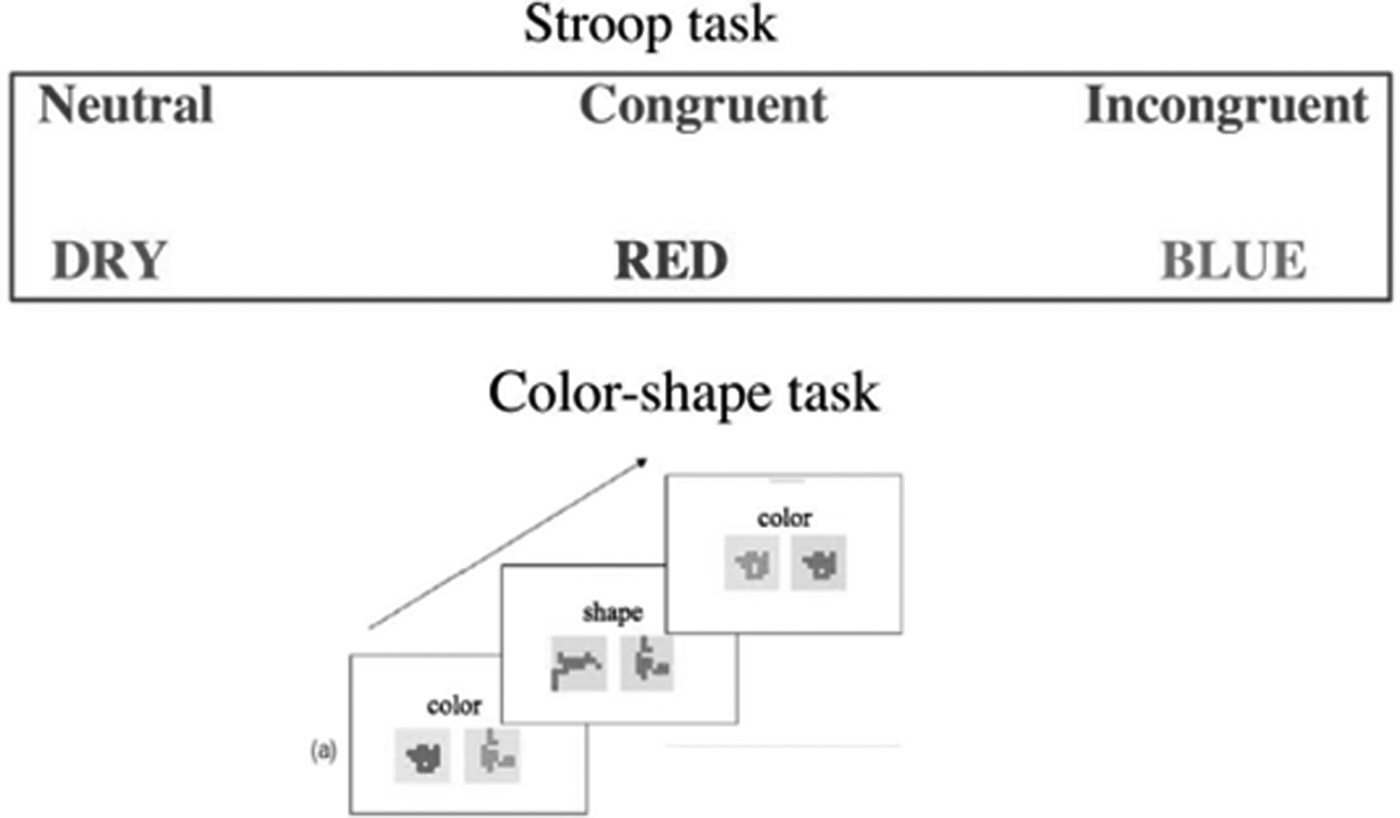
48 trials of each type were distributed across three blocks, each consisting of 48 trials in random order, a total of 144 trials. Each trial began with a 250 ms fixation cross, followed by the presentation of the word for a maximum of 5000 ms or until a response was provided. For the Arabic-speaking participants, the same task was administrated, translated into Arabic.
Switching – Color-shape
In this task, participants were presented with three possible patterns in either blue, green or red. There were three blocks. First, in the color block, two patterns appeared on the screen and participants had to identify whether the patterns were in the same or different color. Second, in the pattern block, participants were presented with two patterns and were asked whether they were the same or different. Third, in the switching block, participants had to switch between attending to the color or the pattern on different trials. On each trial, a word (‘color’ or ‘pattern’) was presented at the top of the screen, indicating whether color or pattern should be responded to. To respond, participants pressed the S button on the keyboard for ‘same’ or the D button for ‘different’ (see Figure 1).
There were a total of 124 trials. The color block and pattern block each included 31 trials. The switching block included 62 randomly ordered trials consisting of 31 ‘Repeat’ trials, where participants were asked to attend to the same property (color/pattern) as the previous trial and 31 ‘Switch’ trials, where participants had to switch to attending to the other property. Each trial began with a 100 ms central fixation cross, followed by stimulus presentation until a response was detected. There was a 250 ms blank screen between trials.
3. Results
3.1. Analysis approach
All data were analyzed using mixed-effect models with the statistical package lme4 (Bates, Maechler, Bolker & Walker, Reference Bates, Maechler, Bolker and Walker2014) in R Studio (version 4.0.3). Reaction time analyses used linear mixed effect models and Accuracy analyses used generalized linear mixed effects models (binomial link function). Sex (male/female) and Age were included as covariates in all analyses because of the wide age range of our participants (50-84 yrs) and to ensure that results were independent of the effects of Age and Sex. The inclusion of Sex reduced the sample size by 1, as one participant did not provide this information.
We interpreted the results on the basis of significant coefficients in the mixed models, rather than completing ANOVA tests for relevant factors. This approach enables comparisons between levels within groups and conditions, and identifies interactions with significant coefficients, providing a more complete description of the data (Meteyard & Davies, Reference Meteyard and Davies2020). To extract all comparisons for Groups and Conditions, we re-ran models after relevelling reference factor levels in the data. Following the recommendations of a reviewer, to interpret significant interactions we used the emmeans package (Lenth, Singmann, Love, Buerkner & Herve, Reference Lenth, Singmann, Love, Buerkner and Herve2018) to make post-hoc comparisons between Conditions (e.g., congruent vs neutral) for each Group (Bilingual, Diglossic, Monolingual).
Accuracy
We ran maximal models for Accuracy (correct/incorrect answers) with a slope for within Subjects experimental conditions. There were relatively few errors, which meant that maximal models gave convergence warnings. For example, in the Stroop task there were only n=103 errors compared to n=13393 correct responses. The number of model iterations was set to 100,000 to increase the chances that models could converge.
The maximal model for Accuracy for the Flanker task gave a warning that the model was close to singularity. When compared against a model with no slopes, there was one significant interaction that was not significant in the maximal model (but was significant in the intercept only model). We report the maximal model with slopes as this was a significantly better fit to the data (X2 = 57.062, df = 6, p<0.0001).
The maximal model for Accuracy for the Stroop task gave a warning that the model was close to singularity; an intercept only model also gave convergence warnings. The model with slopes was a significantly better fit to the data (X2 = 19.13, df = 4, p<0.001). Outputs for the models were similar, showing a significant effect of Incongruent vs Congruent conditions (see Table 5). We report the maximal model with a note in Table 5 about the significant condition effects found in the intercept only model.
The maximal model for the Color-shape data gave convergence warnings, while the intercept only model converged with no warnings. When these two models were compared, there was no significant difference in how well they fit the data (X2 = 0.2395, df = 2, p = 0.887) and both models found the same significant results. For consistency with other data, we report the maximal model in Table 8. Results show a perfect correlation between the intercept and the slope, which explains why the model with slopes did not fit the data better than the intercept only model (i.e., the slope does not provide additional information about the data).
Reaction times
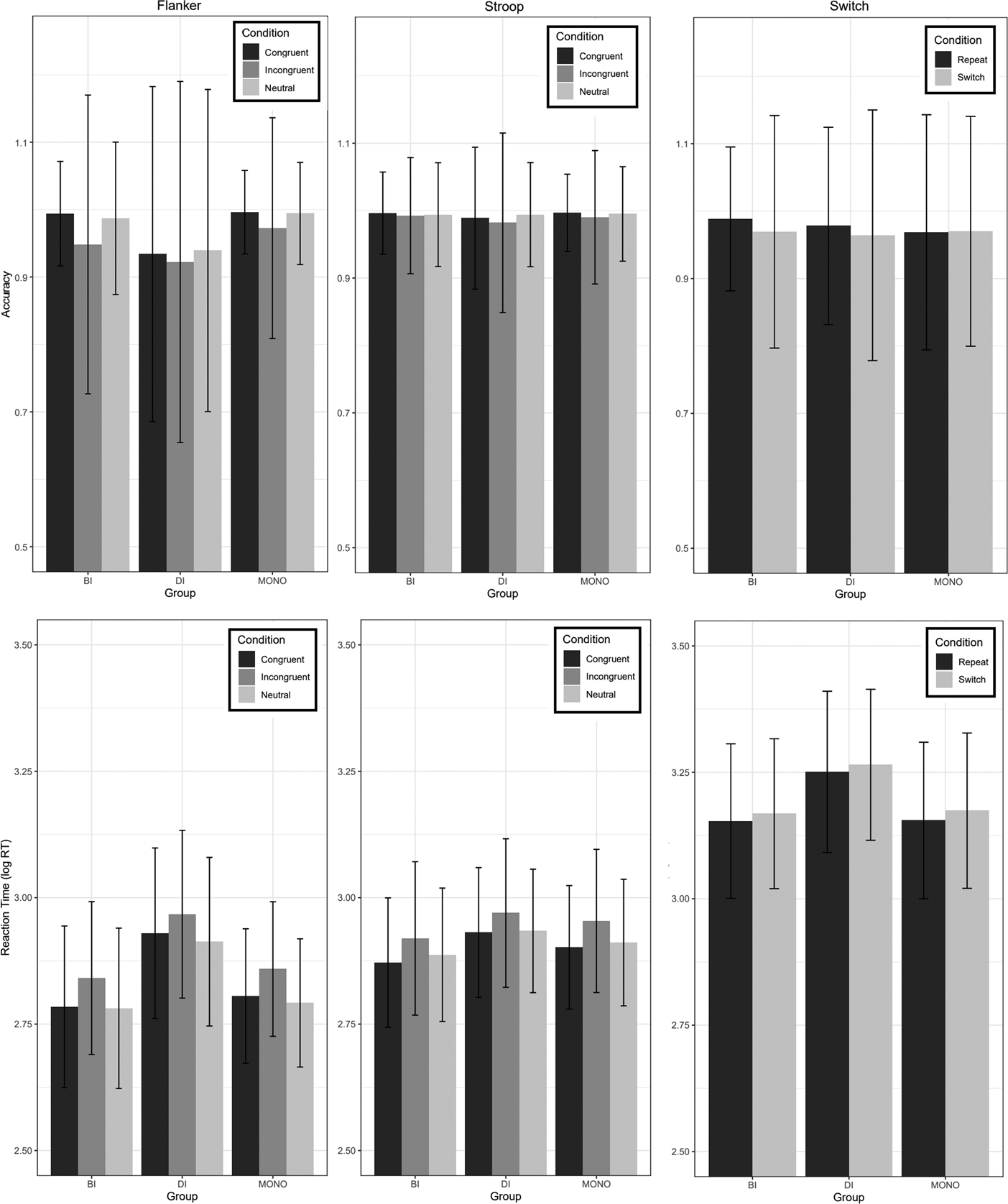
As Reaction times were not normally distributed, they were log-transformed for use as the dependent variable in a mixed-effects model. We ran maximal models for log Reaction Times, with a slope for the within-subjects experimental conditions (e.g., congruent, incongruent, neutral) that varied by Subject. The maximal model for reaction times from the Stroop experiment gave a warning that the model was close to singularity. When compared against a model with no slopes (i.e., Subject intercepts only), the significant results were unchanged, and the model with slopes was a significantly better fit to the data (X2 = 70.903, df = 5, p<0.0001); we therefore report the maximal model in the results below. Figure 2 illustrates mean accuracy and reaction times per condition and group for all tasks.
Mean accuracy and reaction times per group and per condition for the Flanker, Stroop and Color-shape tasks.
3.2. Flanker
The RTs from all groups were screened for extreme values, defined as RTs exceeding 2500 ms or less than 200 ms. Extreme values were excluded, affecting 4% of the Diglossics’ data, 1.2% of the Monolinguals’ data, and 1.6% of the Bilinguals’ data.
Accuracy
Table 1 illustrates the Accuracy data for the Flanker task, and Table 2 reports the maximal model of our analysis. In terms of Group effects, the analysis revealed that Diglossics were less accurate overall on the Flanker task than Bilinguals and Monolinguals. There was no significant main effect of Condition or Group x Condition interaction.
Mean percent accuracy (SD) per Group and per Condition for the Flanker task.

Generalized linear mixed effects model results for the Flanker task: Accuracy data.
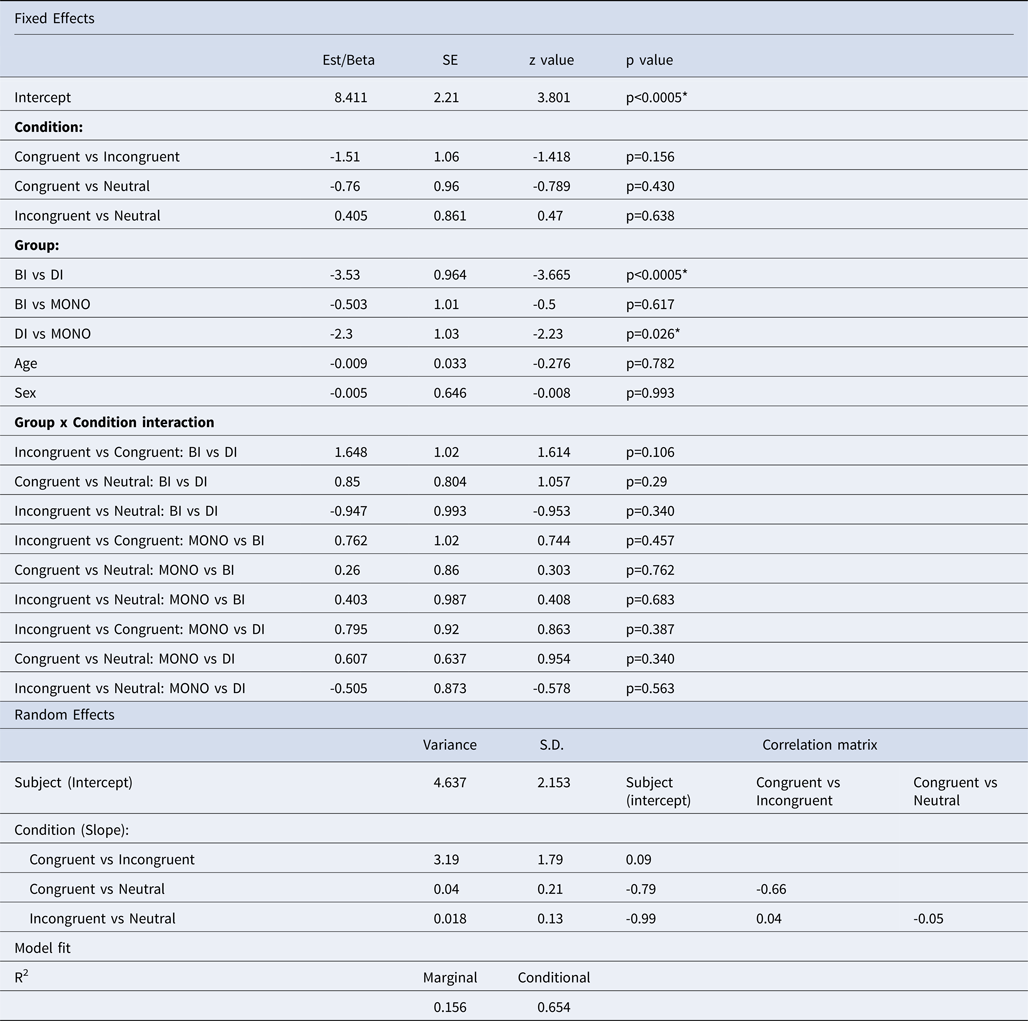
Key: p-values for fixed effects calculated using Satterthwaite approximation, and the Tukey method.
Model equation: glmer (Accuracy ~ Condition * Group + Age + Sex + (1 + Condition|Subject), data = Flanker, family = “binomial”)
Linear mixed effects effect model results for the Flanker task. Reaction time data.
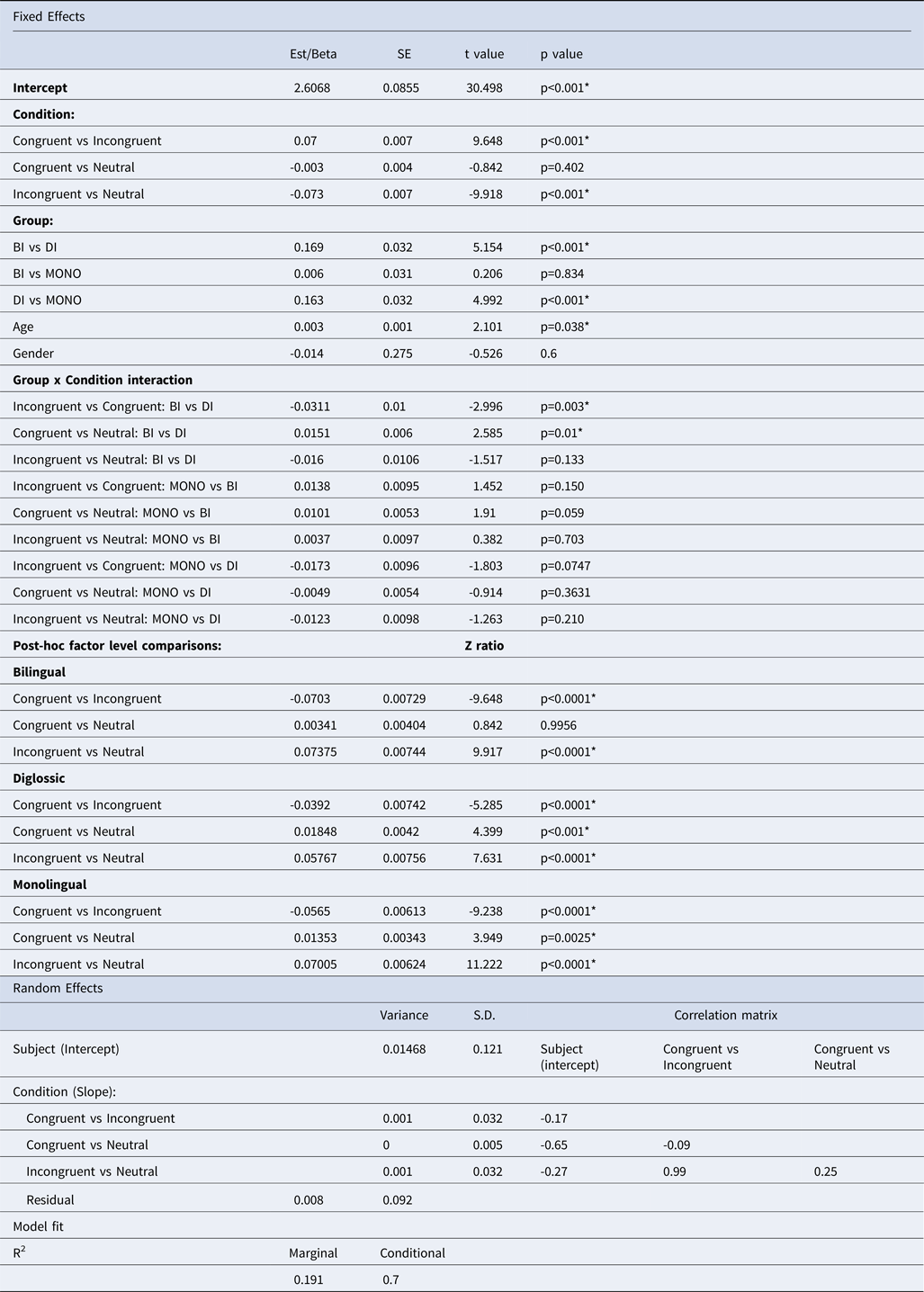
Key: DI: Diglossics, BI: Bilinguals, MONO: Monolinguals
P-values for fixed effects calculated using Satterthwaite approximation, and the Tukey method. Model equation: lmer(logRT ~ Condition * Group + Age + Sex + (1+Condition|Subject), data=Flanker)
Reaction times
For the analysis of the RTs, all incorrect trials were excluded, affecting 5% of the Diglossics’ data, 1% of the Monolinguals’ data and 2% of the Bilinguals’ data. Table 4 presents the analysis of the RT data for the Flanker task. The results revealed that Diglossics were significantly slower in their responses overall (MRT = 2.95 sec) than Bilinguals (MRT = 2.78 sec) and Monolinguals (MRT = 2.79 sec). Participants were also slower to respond on Incongruent trials (MRT = 2.88 sec) than Congruent (MRT= 2.83 sec) and Neutral (MRT = 2.83 sec) trials. A significant Group x Condition interaction was found; follow up analysis revealed that the difference in RTs between Incongruent and Congruent trials (i.e., the Flanker effect) was smaller for Diglossics than Bilinguals, and it only approached significance for Diglossics compared to Monolinguals. Moreover, Diglossics had significantly longer RTs for Congruent trials than Neutral trials; the same effect approached significance for the Monolingual but not the Bilinguals. This suggests that Diglossics found the Congruent trials challenging to process.
Mean percent accuracy (SD) per group and per condition for the Stroop task.

3.3. Stroop
The RTs were screened for extreme values, defined as RTs that exceeded 2500ms or were less than 200ms. Extreme values were excluded, affecting 1.2% of the Diglossics’ data, 1.2% of the Monolinguals’ data, and 0.6% of the Bilinguals’ data.
Accuracy
Table 4 presents the Accuracy data for the Stroop task, and the results of analyses are provided in Table 5. The analysis revealed that performance was less accurate on Incongruent trials than Congruent and Neutral trials. There was no significant main effect of Group or Group x Condition interaction.
Generalized linear mixed effects model results for the Stroop task: Accuracy data.
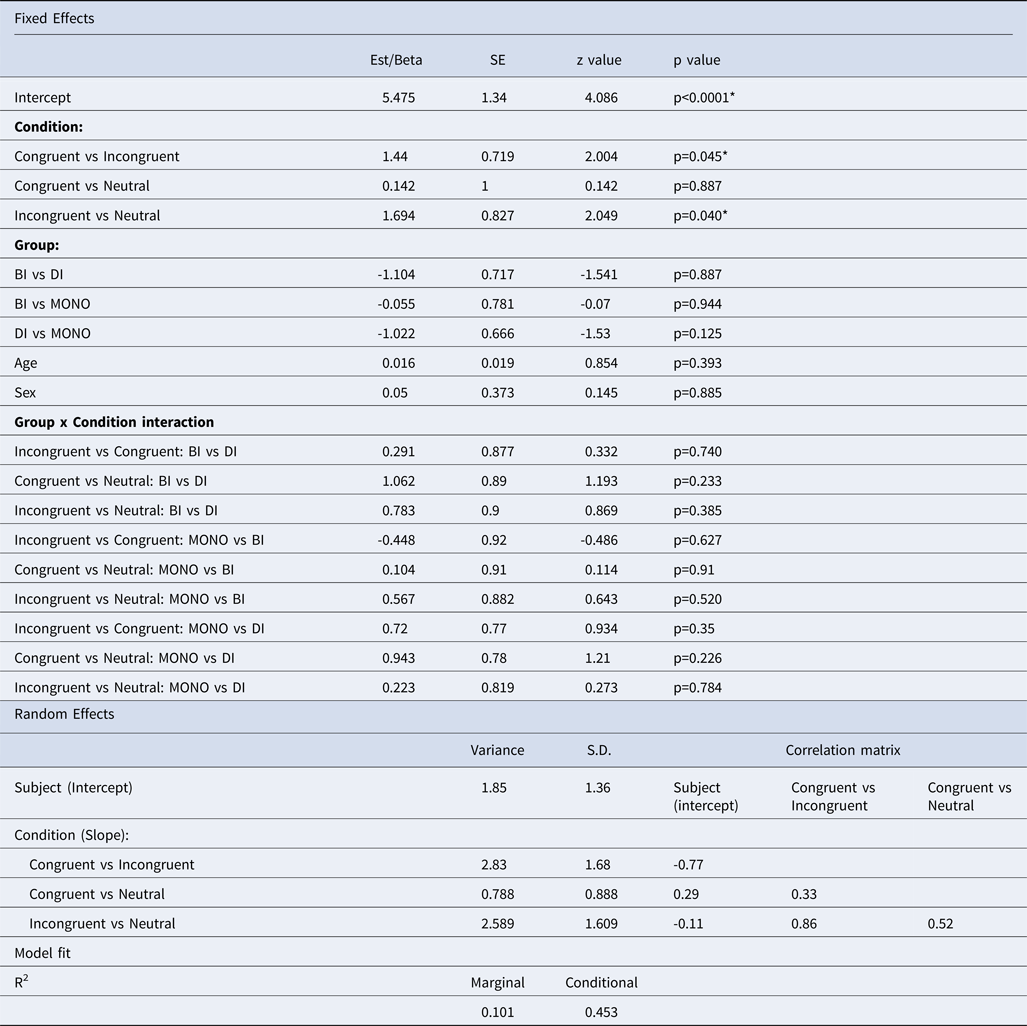
Key: DI: Diglossics, BI: Bilinguals, MONO: Monolinguals
P-values for fixed effects calculated using Satterthwaite approximation, and the Tukey method.
Model equation: glmer(Accuracy ~ Condition * Group + Age + Sex + (1+Condition|Subject), data= Stroop, family=“binomial”
Note: Effects in the Intercept Only model: Congruent vs. Incongruent: p=0.019*; Incongruent vs. Neutral: p=0.087
Reaction times
All incorrect trials were excluded from analyses, affecting 1.2% of the Diglossic’ data, 1% of the Monolinguals’ data and 1% of the Bilinguals’ data.
Table 6 reports the results of the analysis of the RT data for the Stroop task. This revealed that Diglossics were significantly slower to respond overall (MRT = 2.94 sec) than Bilinguals (MRT = 2.89 sec) and Monolinguals (MRT = 2.92 sec). As expected, responses to Incongruent trials were significantly slower (MRT = 2.95 sec) than responses to Congruent (MRT = 2.90 sec) and Neutral (MRT = 2.91 sec) trials, and responses to Neutral trials were significantly slower than responses to Congruent trials. A significant Group x Condition interaction also emerged. Subsequent analysis revealed that the RTs for the Congruent condition were faster than those for the Neutral condition for Bilinguals but not for Diglossics, suggesting a facilitatory effect of congruence for Bilinguals.
Linear mixed effects effect model results for the Stroop task: Reaction time data.
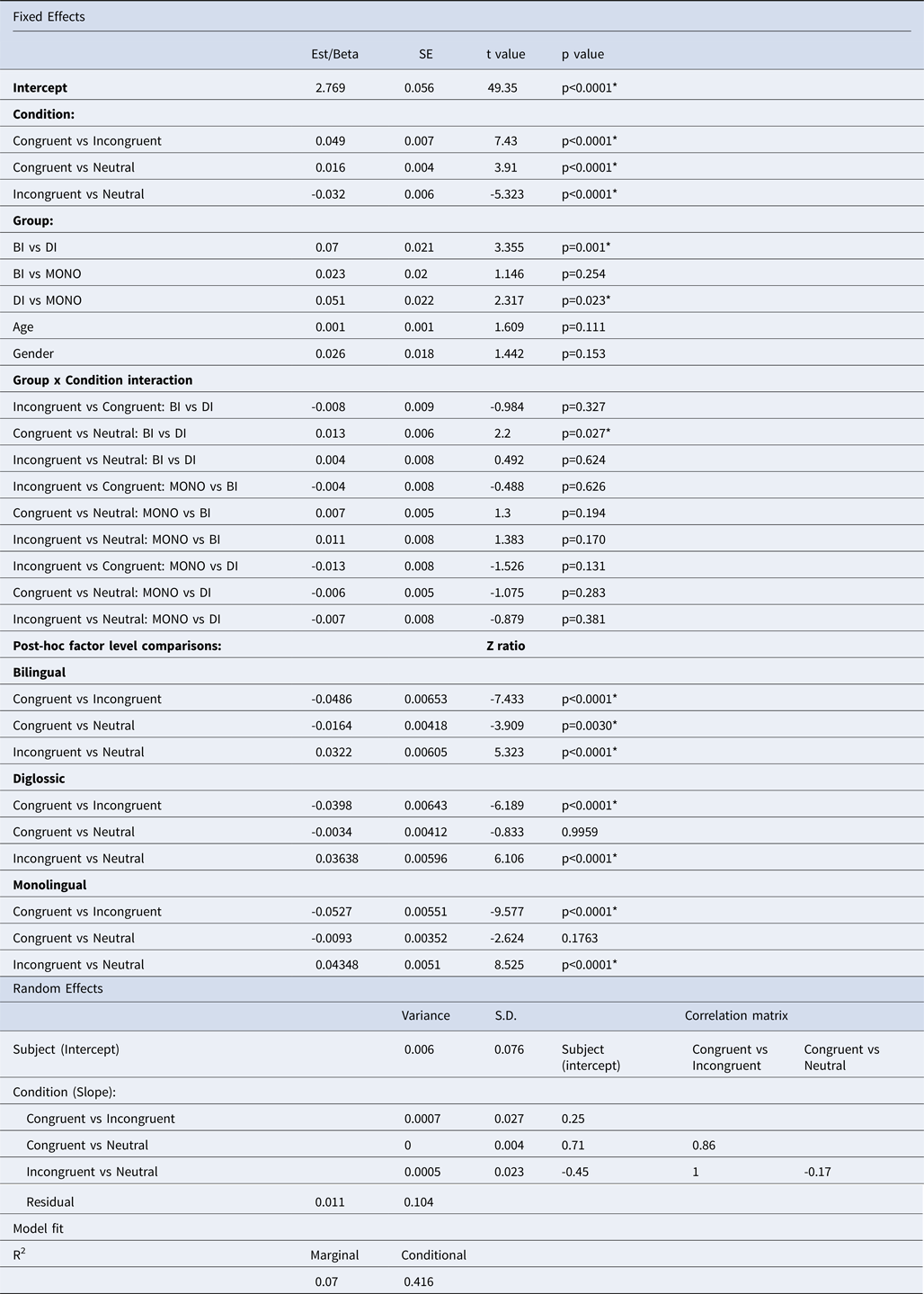
Key: DI: Diglossics, BI: Bilinguals, MONO: Monolinguals. P-values for fixed effects calculated using Satterthwaite approximation, and the Tukey method.
Model equation: lmer(logRT ~ Condition * Group + Age + Sex + (1+Condition|Subject), data=Stroop)
3.4. Color-shape task
The RTs from both groups were screened for extreme values, defined as RTs exceeding 6000ms or less than 300ms. Extreme values were excluded, affecting 2.9% of the Diglossics’ data, 2.4% of the Monolinguals’ data, and 2.1% of the Bilinguals’ data.
Accuracy
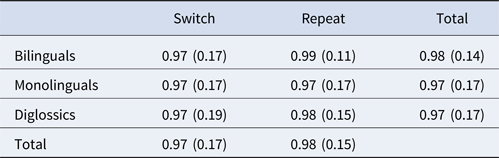
Table 7 presents the Accuracy data for the Color-shape task, and Table 8 presents the analysis. There was a main effect of Condition; performance on Switch trials was less accurate than on Repeat trials. A significant Group x Condition interaction was also revealed. Subsequent analyses showed that the difference between Switch and Repeat trials (the switching cost) was smaller for Monolinguals than for Bilinguals.
Mean percent accuracy (SD) per group and per condition for the the Color-shape task.
Generalized linear mixed effects model results for accuracy in the Color-shape task.
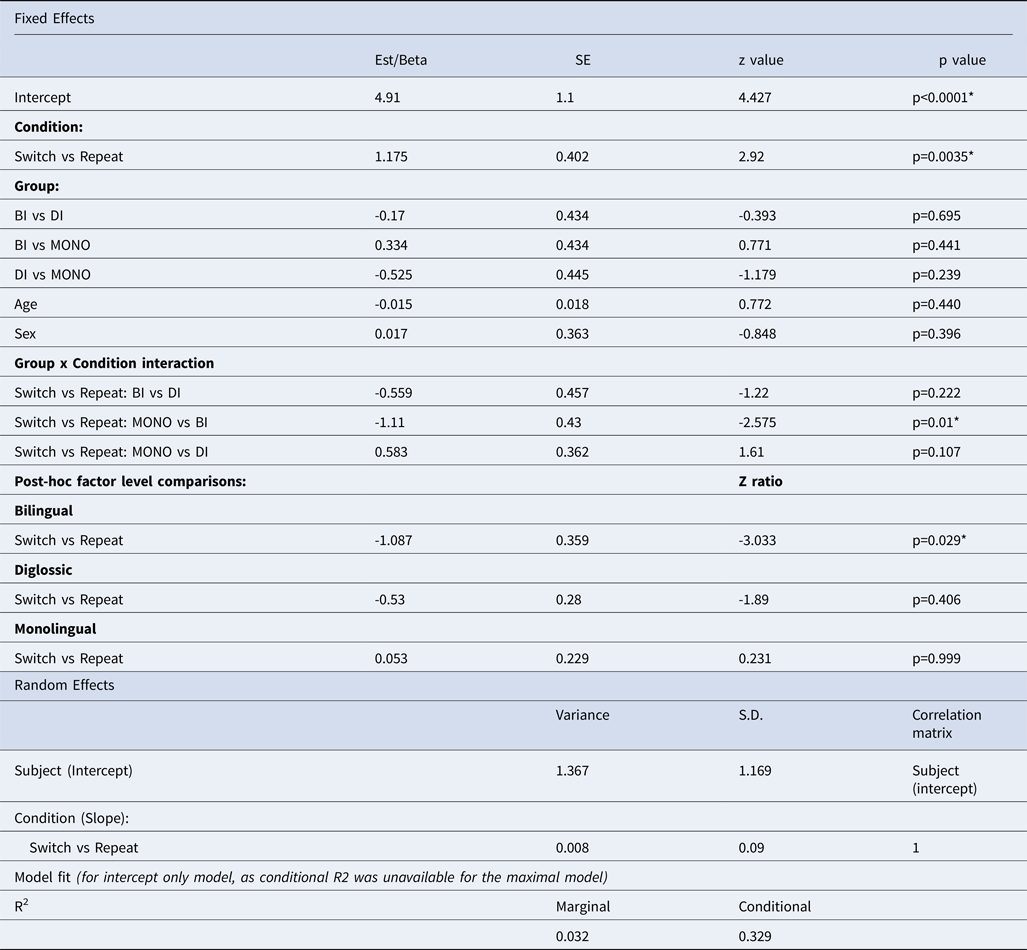
Model equation: glmer(Accuracy ~ Condition * Group + Age + Sex + (1+Condition|Subject), data=Switch, family = binomial)
Reaction times
Incorrect trials were excluded from analyses, in addition to trials with extreme values, affecting 3.2% of the Diglossics’ data, 3% of the Monolinguals’ data and 2.8% of the Bilinguals’ data. Table 9 presents the analysis of the RT data for the Color-shape task. Analysis revealed a main effect of Group, such that Diglossics were significantly slower (MRT = 3.26 sec) than Bilinguals (MRT = 3.16 sec) and Monolinguals (MRT = 3.16 sec). There was a significant main effect of Condition, as responses to Switch trials were significantly slower (MRT = 3.20 sec) than those on Repeat trials (MRT= 3.18 sec). No significant Group x Condition interaction emerged.
Linear mixed effects effect model results for reaction times in the Color-shape task.
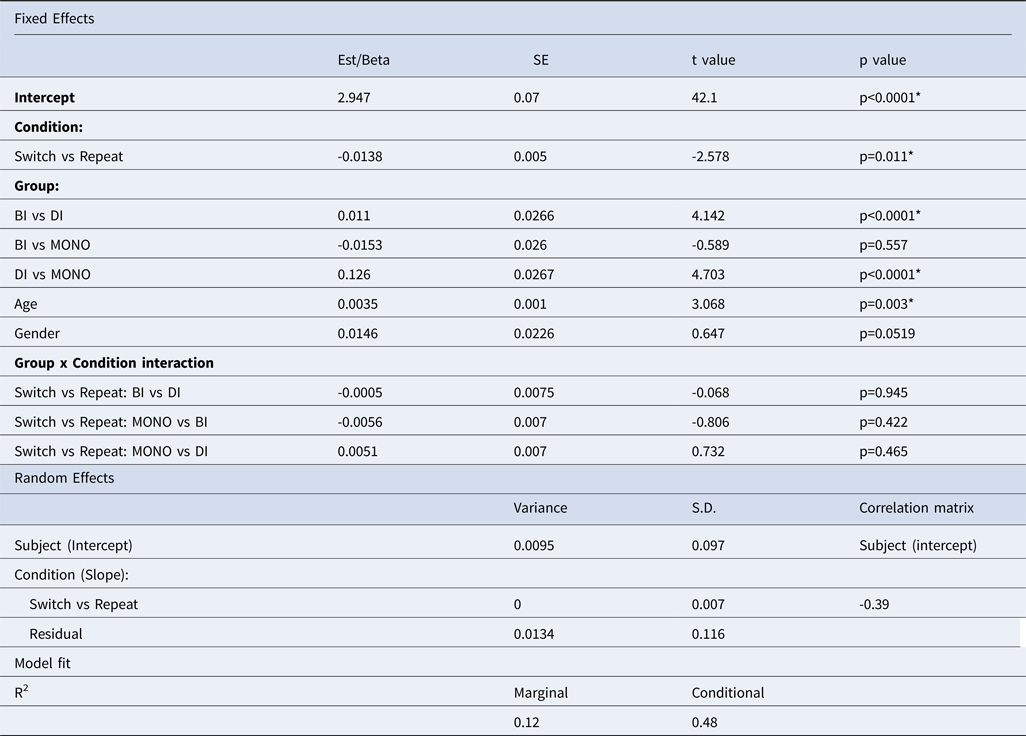
Model equation: lmer(logRT ~ Condition * Group + Age + Sex + (1+Condition|Subject), data=Switch)
4. Discussion
The effects of diglossia on cognition have rarely been investigated, and the two studies that have looked at the effects of diglossia on executive functions in young adults provided contradictory evidence (Alrwaita et al., Reference Alrwaita, Meteyard, Houston-Price and Pliatsikas2022b; Antoniou & Spanoudis, Reference Antoniou and Spanoudis2020). Investigation of individual differences in the abilities of young adults is challenging, due to the peak cognitive performance of this age group (Bialystok et al., Reference Bialystok, Martin and Viswanathan2005). Testing older adults is likely to provide a clearer picture of how diglossia affects cognition. In this study, we therefore investigated whether diglossia has measurable effects on executive functions in older age, and whether these effects are comparable to those reported for bilingualism. The design of the study allowed us to test the predictions of the ACH (Green & Abutalebi, Reference Green and Abutalebi2013), in terms of how Single Language Contexts affect executive functions, and whether this differs from the effects of Dual Language Contexts.
We compared the performance of diglossic, bilingual and monolingual older adults on tasks for which bidialectal benefits have previously been reported – namely, the Flanker and Stroop tasks, which measure inhibition, and the Color-shape task, measuring switching, measuring accuracy and RTs in each case. Crucially for the current investigation, we also measured the cognitive load of each task, which is computed as the difference in accuracy or RTs between conditions of high and low challenge; specifically Incongruent versus Congruent trials in the Flanker and Stroop tasks, and Switch versus Repeat trials in the Color-shape task. In all three tasks, the cognitively challenging conditions yielded longer reaction times than less challenging conditions across all groups, as expected. The challenging conditions also yielded lower accuracy in the Stroop and Color-shape tasks. More crucial for our research questions were the significant differences between our three groups, and the significant interactions between group and condition on each task. The following paragraphs consider our findings for each task in relation to the executive processes they tap, after which the findings are synthesized.
Perhaps the most informative results in our study emerged from those tasks tapping inhibitory control – namely, the Flanker and Stroop tasks, which yielded different patterns of effects. For the Flanker task, the diglossic group was less accurate and slower to respond in general than both other groups, while showing a smaller Flanker effect in their RTs. This is a very interesting pattern: versions of the Flanker task that present equal numbers of stimuli per condition (as used here) are thought to tax monitoring processes highly (Costa, Hernández, Costa-Faidella & Sebastián-Gallés, Reference Costa, Hernández, Costa-Faidella and Sebastián-Gallés2009). The generally poorer performance of the diglossic group may therefore indicate a disadvantage in conflict monitoring. At the same time, the smaller Flanker effect shown by this group is indicative of an advantage in inhibitory control (Valian, Reference Valian2015), in line with our predictions. The bilingual and monolingual participants showed no significant difference in RTs between congruent and neutral trials compared to Diglossics, for whom congruent had significantly larger RTs than neutral trials. This is an unexpected finding, as congruent trials would be expected to cause facilitation compared to neutral ones (DeLuca, Rothman, Bialystok & Pliatsikas, Reference DeLuca, Rothman, Bialystok and Pliatsikas2020). Results from the Stroop task also revealed that diglossics were slower to respond overall than the other two groups, corroborating the finding from the Flanker task in suggesting a disadvantage in monitoring. The bilingual group showed facilitation effects for congruent vs. neutral trials, which were not seen for diglossics. Neither the diglossics nor the bilinguals exhibited a smaller Stroop effect than monolinguals, an effect that would signify benefits for those groups. We discuss the implications of these discrepant findings from the two tasks in the next section.
The Color-shape task that tapped the switching component of executive functions provided limited evidence for differences between groups. Diglossics were again slower than the other two groups overall, corroborating the findings for the Flanker and Stroop tasks. Bilinguals also had larger switching costs in accuracy than monolinguals, suggesting a bilingual disadvantage, a finding counter to our predictions.
4.1. Implications for theories on the role of context on cognition
Overall, the findings from our diglossic group suggest that aspects of executive function are affected differently by the linguistic contexts that diglossics find themselves in. For example, the cognitive benefits seen in the Flanker task, which taps goal maintenance and interference control, may reflect diglossics’ long-term experience of using the appropriate language variety in appropriate contexts (goal maintenance) and of preventing intrusions from the non-target variety (interference control). Both processes are crucial in Arabic diglossia, where each language variety is strictly confined to specific environments, eliminating the opportunity for switching between varieties in one context (Albirini, Reference Albirini2016; Kaye, Reference Kaye2001). This clear separation of the two varieties makes Arabic diglossia a good example of a Single Language Context, and it is noteworthy that the executive function components that our study highlights as benefitted are the ones described by the ACH as especially taxed in such contexts. In contrast, we did not anticipate the absence of a similar benefit for the diglossics in the Stroop task, which is considered to assess the same executive control abilities. It is possible that the lack of a benefit can be attributed to the verbal nature of the task, or to the fact that the task was presented in Arabic only to this group (other groups completed the task in English). We therefore remain cautious about drawing conclusions from the lack of difference on this task.
An interesting finding that was not predicted was the general disadvantage in monitoring that the diglossics exhibited in all tasks, although a similar effect has been reported in young diglossics (Alrwaita et al., Reference Alrwaita, Meteyard, Houston-Price and Pliatsikas2022b). We hypothesize again that this disadvantage relates to defined separation of the two varieties in Single Language Contexts, which reduces the need to monitor conflict relative to Dual Language Contexts. However, this interpretation does not explain why diglossics are slower to respond than monolinguals.
The lack of diglossic benefits on tasks other than the Flanker task are similar to the findings of Kirk et al. (Reference Kirk, Fiala, Scott-Brown and Kempe2014), who reported no bidialectal advantages amongst older adults across a ranges of tasks tapping different components of executive functions. However, since the bidialectals in that study did not report patterns of dialect use they may not be comparable to the diglossics in the present study, who were immersed in a diglossic environment. It is also worth noting that the diglossic benefit on the Flanker task in the present study was not replicated in our earlier study with younger adults (Alrwaita et al., Reference Alrwaita, Houston-Price and Pliatsikas2022b). This benefit might be attributable to the years of experience older adults have of using their two varieties; it has been suggested that enhanced performance may depend on years of experience of juggling two languages (Anderson et al., Reference Anderson, Mak, Keyvani Chahi and Bialystok2018). The lack of a diglossic benefit in the Alrwaita et al. (Reference Alrwaita, Meteyard, Houston-Price and Pliatsikas2022b) study adds weight to the growing evidence of a lack of benefits in executive functions in young bilinguals (Berkes et al., Reference Berkes, Calvo, Anderson and Bialystok2021; Paap & Greenberg, Reference Paap and Greenberg2013). In all, the findings from the diglossic group suggest that, at least in older language users, cognitive enhancements should be expected in processes that are taxed in the contexts in which the individual uses their languages; we propose that this remains true whether the user is an (older) diglossic in a Single Language Context or a bilingual in a Dual Language Context.
However, if we now turn to the performance of the bilingual group in this study, we found little evidence for cognitive benefits, despite suggestions that such benefits are most commonly found in older adults (Berkes et al., Reference Berkes, Calvo, Anderson and Bialystok2021). The bilingual group was not advantaged in conditions inducing increased cognitive load, although there was evidence that it was facilitated by the congruent condition in the Stroop task, possibly reflecting their long-term immersion status (DeLuca et al., Reference DeLuca, Rothman, Bialystok and Pliatsikas2020). Our results are in line with other studies that have failed to find bilingual benefits in older adults across different domains of executive functions (Gathercole, Thomas, Kennedy, Prys, Young, Viñas Guasch, Roberts, Hughes & Jones, Reference Gathercole, Thomas, Kennedy, Prys, Young, Viñas Guasch, Roberts, Hughes and Jones2014; Kirk et al., Reference Kirk, Fiala, Scott-Brown and Kempe2014; Kousaie & Phillips, Reference Kousaie and Phillips2012). Similarly to Kirk et al. (Reference Kirk, Fiala, Scott-Brown and Kempe2014), we also failed to find the bilingual benefit in global reaction times that others have reported (Hilchey & Klein, Reference Hilchey and Klein2011). Notably, the predictions of the ACH (Green & Abutalebi, Reference Green and Abutalebi2013) for Dual Language Contexts were not confirmed by our bilingual group. Our bilinguals, assumed to operate in Dual Language Contexts, did not perform better than monolinguals on either inhibition or switching tasks.
One possible explanation of lack of a bilingual benefit in our study is that our assumption that all these participants were using their languages in a Dual Language Context may have been misplaced. Indeed, some participants scored quite highly on the code-switching scales of the LSBQ, suggesting that their environment might be better represented as a Dense Code-Switching context, for which more limited enhancements in executive functions are predicted. Another possible explanation for the lack of a bilingual benefit across domains is the age of our bilingual group (Mage=59.6, (7.2)), which is lower than in studies that have reported bilingual benefits in older adults. For example, Bialystok et al. (Reference Bialystok, Craik, Klein and Viswanathan2004) reported bilingual enhancements in working memory and inhibition amongst bilingual older adults in their seventies (Mage = 72.3(8.7)); switching and working memory benefits have been reported in samples in their mid sixties (Mage =64(4.4)) (Gold et al., Reference Gold, Kim, Johnson, Kryscio and Smith2013) and late sixties (Mage = 67.8 (4.4)) (Luo et al., Reference Luo, Craik, Moreno and Bialystok2013), respectively. If it is the lifelong experience of using two languages regularly that leads to enhanced executive functions (Kirk et al., Reference Kirk, Fiala, Scott-Brown and Kempe2014), it is reasonable to assume that the older the bilinguals are, the more experience of juggling the two languages they will have had, and the more enhanced their executive functions should be. It is important to note that the relationship between bilingualism and executive functions is complex, and it may be relevant to how one's languages are used and switched between. For example, Henrard and Van Daele (Reference Henrard and Van Daele2017) reported enhanced executive functions amongst bilinguals with professions that require daily and constant switching such as language translators and interpreters. While many of the bilinguals in our study reported to be (or have been) employed in professions such as education, health care, business analysts, etcetera, many were retired, and nobody reported currently being in an occupation that required daily switching between languages. As others have pointed out before, bilingual advantages interplay with life experiences that in many cases remain unexplored (Calvo & Bialystok, Reference Calvo and Bialystok2014; Samuel et al., Reference Samuel, Roehr-Brackin, Pak and Kim2018).
4.2. Limitations
It is important to acknowledge the limitations of our study, particularly in relation to the characteristics of the groups that could not be matched, such as cultural background. Culture has been suggested to drive some of the benefits seen in bilingualism (Samuel et al., Reference Samuel, Roehr-Brackin, Pak and Kim2018). Our three groups came from very different cultural backgrounds, and the bilinguals did not have a homogeneous background. It would have been difficult to find control groups that matched the Arab diglossic group more closely in terms of cultural background. A study comparing cognitive abilities of (young) British monolinguals, bilinguals with heterogeneous cultural backgrounds and bilinguals with a homogeneous background (Korean) reported no benefits that could be attributed to bilingualism, but some benefits that could be attributed to the cultural and educational background of the Korean group (Samuel et al., Reference Samuel, Roehr-Brackin, Pak and Kim2018). This pattern is reminiscent of our findings, suggesting that the diglossic benefits and disadvantages we observed might be attributable to specific cultural factors in Saudi Arabia.
However, it is not straightforward to separate cultural effects from the effects of language education and use, as they are intricately entwined in Saudi culture. For example, one possible explanation for the disadvantages shown by the diglossic group is the degree of challenge posed by both the high and low varieties of the Arabic language. Arabic is known to be a difficult language to acquire for several reasons: for example, as Arabic largely depends on vowels for meaning, un-vowelled Arabic text requires meaning to be inferred from context; there is also visual complexity in reading Arabic, as letters differ from each other only in dots (Eviatar & Ibrahim, Reference Eviatar, Ibrahim, Saiegh-Haddad and Joshi2014). The situation of diglossia adds further complexity to acquiring Arabic: when learning Standard Arabic, children often find it hard to access names that do not exist in the spoken variety, a dilemma that persists even in adulthood (Eviatar & Ibrahim, Reference Eviatar, Ibrahim, Saiegh-Haddad and Joshi2014). The representation of phonemes by letters in Arabic also poses a challenge for both children and adults, resulting in slower retrieval times (Eviatar & Ibrahim, Reference Eviatar, Ibrahim, Saiegh-Haddad and Joshi2014). It is also worth noting that native Arabic adult speakers read Arabic more slowly than native speakers of other languages (Azzam, Reference Azzam, Aaron and Joshi1989). In fact, successful reading is said to involve several cognitive processes, all of which rely heavily on executive functions (Christopher, Miyake, Keenan, Pennington, DeFries, Wadsworth, Willcutt & Olson, Reference Christopher, Miyake, Keenan, Pennington, DeFries, Wadsworth, Willcutt and Olson2012). For instance, it has been suggested that reading relies on inhibition, due to the need to inhibit eye movements to the next line while reading the current line (Booth, Boyle & Kelly, Reference Booth, Boyle and Kelly2014). Similarly, reading is known to tax working memory – for example, when holding a single sound representation until all the sounds are merged, and a coherent meaning is established (Kieffer, Vukovic & Berry, Reference Kieffer, Vukovic and Berry2013). The reliance of reading on switching abilities can be seen when transiting from reading one line of text to the next (Horowitz-Kraus, Vannest & Holland, Reference Horowitz-Kraus, Vannest and Holland2013). Therefore, it is possible that the slow language retrieval and reading caused by the complexity of the Arabic language underlie the slower reaction times in executive function domains even on non-linguistic tasks. This hypothesis is supported by studies reporting that individuals with lower reading abilities have slower processing speed in naming tasks (Nicolson & Fawcett, Reference Nicolson and Fawcett1994; Willcutt, Pennington, Olson, Chhabildas & Hulslander, Reference Willcutt, Pennington, Olson, Chhabildas and Hulslander2005).
Another factor that may be relevant in the interpretation of our findings is the immigration status of the bilingual group. Paap and colleagues (Paap, Johnson & Sawi, Reference Paap, Johnson and Sawi2015) argued that bilingual benefits are reported more often in studies where immigrant status is not matched between groups (Bialystok, Craik & Luk, Reference Bialystok, Craik and Luk2008; Gold et al., 2013; Lee Salvatierra & Rosselli, Reference Lee Salvatierra and Rosselli2011; Schroeder & Marian, Reference Schroeder and Marian2017). Specifically, benefits tend to be seen when bilinguals are immigrants and monolinguals are not; immigration in itself may be related to cognitive benefits that are confounded with those related to language status. If immigrant status is controlled for, differences between groups are no longer seen (Kirk et al., Reference Kirk, Fiala, Scott-Brown and Kempe2014; Kousaie & Phillips, Reference Kousaie and Phillips2012). This argument cannot account for the pattern of findings in this study, as although the bilinguals were immigrants they did not demonstrate cognitive benefits. Moreover, according to Kirk et al. (Reference Kirk, Fiala, Scott-Brown and Kempe2014), bilingual immigrants typically use their first language only at home with their family, meaning that they tend to operate in single language contexts. In contrast, the reports of the bilinguals in our sample about their language switching habits with friends and in social media do not clearly describe a Single Language Context. Besides, if their language use could be described in this way, we would have expected to see a similar pattern of benefits and drawbacks in our bilingual group as we saw in the diglossic group, which was not the case. Nevertheless, we concede that the lack of effects in the bilingual sample may relate to the heterogeneity of their immigrant status (e.g., years of residence in the UK), which was not systematically controlled in the current study, but should be controlled in future studies.
5. Conclusion
Studies investigating the role of dual language use in modulating executive functions have largely been conducted in bilingual environments (Hartanto & Yang, Reference Hartanto and Yang2016; Struys, Woumans, Nour, Kepinska & Van Den Noort, Reference Struys, Woumans, Nour, Kepinska and Van Den Noort2019), while little is known about such effects in other language situations, such as diglossia, where two varieties of the same language are spoken by the same person but separated by context (Ferguson, Reference Ferguson1959). The diglossic situation corresponds to a Single Language Context as defined by the ACH (Green & Abutalebi, Reference Green and Abutalebi2013). In this study, we compared the performance of Arab diglossic older adults to that of bilinguals and monolinguals of comparable ages in tasks tapping the executive function domains of inhibition and switching. Compared to the other two groups, diglossic participants showed enhanced performance in the Flanker task, which taps the processes of goal maintenance and interference control, confirming the predictions of the ACH for Single Language Contexts. No such effects were revealed for our bilingual group. We conclude that future studies, that investigate the effects of speaking more than one language or language variety on executive functions, should consider the control demands imposed on language users by the conversational contexts they encounter.
Competing interests statement
The authors declare none.
Data availability statement
Data availability: The data and the analysis code that support the findings of this study are openly available in OSF at https://osf.io/z6g2p/
Appendix


 Open access

