


The brown bear Ursus arctos is categorized as Least Concern on the IUCN Red List (McLellan et al., Reference McLellan, Proctor, Huber and Michel2017). It is the most widespread bear species, with a geographical distribution ranging from north-western North America, across the Bering Strait to the Russian Far East, across northern Asia, including Japan, to Fenno-Scandinavia, and extending southwards through the Tibetan Plateau to the Himalayas, south-western Iran, Turkey and western Europe (Hunter & Barrett, Reference Hunter and Barrett2018). This terrestrial carnivore occurs in a variety of habitats, from dry Asian steppes to Arctic shrublands and temperate rain forests (McLellan et al., Reference McLellan, Proctor, Huber and Michel2017), from sea level to 5,500 m (Nawaz et al., Reference Nawaz, Martin and Swenson2014). Its global population is estimated to exceed 200,000 individuals across c. 5,000,000 km2 in north-western North America and 1,200,000 km2 in Europe (excluding Russia) and significant portions of northern Asia (McLellan et al., Reference McLellan, Proctor, Huber and Michel2017). The species faces various threats, including habitat loss, low acceptance by humans, poaching (particularly in Russia and China), collisions with vehicles, persecution, and small population sizes in certain countries in Europe and Central Asia (McLellan et al., Reference McLellan, Proctor, Huber and Michel2017; Swenson et al., Reference Swenson, Ambarlı, Arnemo, Baskin, Ciucci, Danilov, Penteriani and Melletti2020). The brown bear is listed in Appendix I of CITES.
Within the Himalayan–Tibetan region, two subspecies of brown bear are known (Lan et al., Reference Lan, Gill, Bellemain, Bischof, Nawaz and Lindqvist2017). The Himalayan brown bear Ursus arctos isabellinus inhabits the north-western Himalayan region (India and Pakistan), and the Tibetan brown bear Ursus arctos pruinosus can be found in the south-eastern Tibetan Plateau (China and parts of northern Nepal; Pocock, Reference Pocock1941; Servheen et al., Reference Servheen, Herrero and Peyton1999; Galbreath et al., Reference Galbreath, Groves and Waits2007). Both subspecies are scarce and widely dispersed, with the Himalayan subspecies being particularly isolated (Swenson et al., Reference Swenson, Ambarlı, Arnemo, Baskin, Ciucci, Danilov, Penteriani and Melletti2020) and the Tibetan subspecies having sparse and poorly defined populations (McLellan et al., Reference McLellan, Proctor, Huber and Michel2017).
The brown bear is a priority protected species in Nepal (Government of Nepal, 1973), but there has been limited research on the species within the country. It is categorized nationally as Critically Endangered, with the national population estimated to consist of < 20 mature individuals (Jnawali et al., Reference Jnawali, Lee, Acharya, Upadhyay, Pandey and Shrestha2011). To date, brown bear research in Nepal has been primarily focused on central Nepal (Gurung, Reference Gurung2004; Chetri, Reference Chetri2008, Reference Chetri2022; Aryal et al., Reference Aryal, Sathyakumar and Schwartz2010, Reference Aryal, Hopkins, Raubenheimer, Ji and Brunton2012). There is limited information on the status of brown bears in western Nepal, although a few studies (Gurung, Reference Gurung2004; Aryal et al., Reference Aryal, Hopkins, Raubenheimer, Ji and Brunton2012) have suggested that the species could be present west of Upper Mustang, in Dolpa. Local reports and observations of digging signs also suggest the presence of brown bears in Humla district, west of Dolpa (Kusi & Werhahn, Reference Kusi and Werhahn2016), but no previous scientific evidence has confirmed this. Here we present the first verified records of the brown bear in Humla, extending the species’ global range south-westwards.
During 2021–2023, we carried out a camera-trap survey of the Himalayan wolf Canis lupus chanco in Limi Valley, in the northernmost part of Humla district in north-western Nepal. The study area is situated within the arid zones of the Himalayas, characterized by high-altitude Tibetan desert steppe and alpine grasslands with patches of shrubland (Miehe et al., Reference Miehe, Pendry and Chaudhary2016). The area shares a border with the Tibetan Autonomous Region of China to the north and is home to a variety of wild fauna including carnivores such as the Himalayan wolf, snow leopard Panthera uncia, Tibetan fox Vulpes ferrilata, red fox Vulpes vulpes, Altai weasel Mustela altaica, stone marten Martes foina, Eurasian lynx Lynx lynx and Pallas's cat Otocolobus manul (Werhahn et al., Reference Werhahn, Gurung, Lama, Tamang, Tamang and Pathakin press) and steppe polecat Mustela eversmanii (Gurung et al., Reference Gurung, Kusi, Lama, Lama, Tamang and Tamang2022). It also supports a variety of ungulates, including the wild yak Bos mutus, kiang Equus kiang, naur Pseudois nayaur, Tibetan argali Ovis ammon hodgsonii and Tibetan gazelle Procapra picticaudata, and small mammals such as the Himalayan marmot Marmota himalayana, woolly hare Lepus oiostolus, plateau pika Ochotona curzoniae, Stoliczka's mountain vole Alticola stoliczkanus and Tibetan dwarf hamster Urocricetus alticola.
We conducted our camera-trap surveys across a 336 km2 area during July–October 2021 and June 2022–October 2023. We laid a grid of 21 cells (each measuring 4 × 4 km) over a digitized map of the study area. In each grid cell we placed two camera traps randomly, in different locations (42 cameras in total). In addition, we deployed 19 camera traps opportunistically at locations chosen to maximize the detection of large carnivores. The 61 camera traps (Cuddeback X-Change Colour Model 1279, Cuddeback, USA, and Reconyx Hyperfire HC600, Reconyx, USA) were deployed over altitudes of 4,500–5,200 m. We configured the cameras to capture only photographs, and selected the shortest possible delay and five images per trigger. We deployed the cameras for 3,145 trap-nights in 2021 and 10,748 trap-nights during 2022–2023.
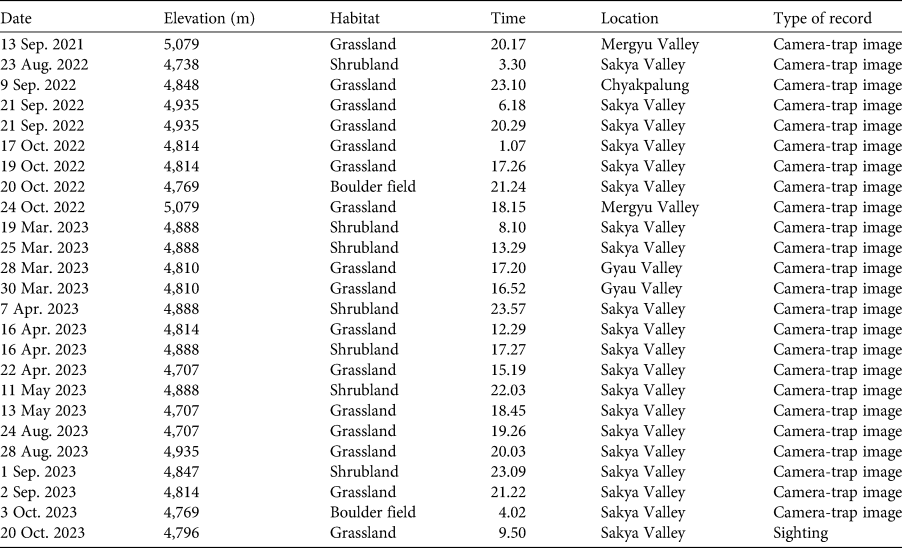
We captured a single independent image of a brown bear in 2021 and 23 independent images during 2022–2023. We considered images to be independent when there was at least a 1-minute interval between consecutive images. The relative abundance index (calculated as the number of captures divided by the total trap-nights multiplied by 100) of brown bears in Limi Valley was 0.0318 in 2021 and 0.214 in 2022–2023. We obtained camera-trap images of brown bears from 10 locations (Fig. 1) during spring and autumn but no images were captured in summer and winter. We also observed an adult brown bear in a remote corner of the study area during mid October 2023 (Table 1).
Camera-trap records of the brown bear Ursus arctos in Limi Valley, Upper Humla, north-western Nepal (Table 1), and record of a brown bear photographed by a camera trap in Chiyol, Musi village, Upper Dolpa (G. Khanal, unpubl. data, 2020). The inset map indicates the species' known range according to the IUCN Red List (McLellan et al., Reference McLellan, Proctor, Huber and Michel2017).

Details of brown bear records from Limi Valley, Upper Humla, north-western Nepal (Fig. 1) during July–October 2021 and June 2022–October 2023.

The current global south-western distribution range of brown bears in Nepal ends in Upper Mustang (McLellan et al., Reference McLellan, Proctor, Huber and Michel2017). Camera-trap images of brown bears were previously captured in Chiyol, Musi village of Dolpa district, in May 2020 (G. Khanal, pers. comm., 2021; Fig. 1), extending their geographical range westwards in Nepal. Our confirmation of brown bear presence in Limi Valley thus extends its range further west. These records have global significance because Chiyol and Limi Valley are connected to the Tibetan Plateau in western China where brown bears are rare (Harris, Reference Harris2008).
Brown bears in Limi Valley (Plate 1) display distinctive characteristics typical of the Tibetan brown bear U. arctos pruinosus, including dark fur, a white collar around the neck, a tan-coloured face and black ears (Pocock, Reference Pocock1941; Schaller, Reference Schaller2012). A previous genetic study identified all bear samples collected in the south-eastern Himalayas and Tibetan Plateau as U. arctos pruinosus, and all those from the north-western to western Himalayas as U. arctos isabellinus (Lan et al., Reference Lan, Gill, Bellemain, Bischof, Nawaz and Lindqvist2017). Our study area encompasses parts of the western end of the Tibetan Plateau, providing further support that the bears we recorded in Limi Valley are Tibetan brown bears. Considering the documented presence of Himalayan brown bears in Uttarakhand, India (Pal et al., Reference Pal, Thakur, Bhattacharya and Sathyakumar2016), immediately to the west of Limi Valley, it is possible that Limi valley is a contact zone between the Tibetan and Himalayan brown bears, but this requires genetic verification. The type locality of U. arctos isabellinus is specified as ‘mountains of Nepal’ (as Ursus isabellinus; Pasitschniak-Arts, Reference Pasitschniak-Arts1993). This presents an avenue for further research into the evolutionary history of brown bears in the Himalayan–Tibetan region, where the possibility of an unclassified bear species has been suggested (Sykes et al., Reference Sykes, Mullis, Hagenmuller, Melton and Sartori2014).
A brown bear Ursus arctos photographed by a camera trap in Limi Valley, Upper Humla, north-western Nepal, on 16 April 2023. Photo: Himalayan Wolves Project.

We conducted several research expeditions in Limi Valley during 2014–2023, primarily in the summer. We consistently observed signs of brown bear digging activities but had no direct sightings. This could be because Tibetan brown bears have extensive home ranges (> 7,000 km2 for males and 2,200 km2 for females) and low densities (McLellan et al., Reference McLellan, Proctor, Huber and Michel2017), making sightings rare. It could also be because brown bears tend to be mostly crepuscular and nocturnal in human-dominated landscapes (Kaczensky et al., Reference Kaczensky, Huber, Knauer, Roth, Wagner and Kusak2006; Seryodkin et al., Reference Seryodkin, Kostyria, Goodrich and Miquelle2013). This behaviour is reflected in our camera-trap records, with most brown bear images captured during the night-time, early morning or late evening (Table 1). A single sighting in a remote corner of the study area in mid October 2023 supports the suggestion by Klinka & Reimchen (Reference Klinka and Reimchen2002) that brown bears exhibit increased daytime activity in remote areas. Daytime images captured during March–April, when the valleys are devoid of people, also indicate increased diurnal activity in their absence. The absence of brown bear records during June–July, when herding activity is greatest, is probably further compounded by the mating period of these bears, which occurs during early May–July (Smith & Xie, Reference Smith and Xie2013). The absence of camera-trap images during November–early March could indicate that the brown bears in Limi Valley initiate hibernation during late October, with their spring arousal taking place in mid March (Pasitschniak-Arts, Reference Pasitschniak-Arts1993).
Currently, brown bears in Limi Valley do not appear to come into conflict with people as the area is remote and human activity is low and confined to the summer months. Nawaz (Reference Nawaz2007) noted that brown bears in Pakistan are less vilified compared to snow leopards and wolves because they are not aggressive and rarely attack people or prey on livestock. However, during a research expedition in 2016, local people reported to us the killing of a brown bear in Chuwa Khola, to the east of our study area within Humla district. Livestock herders killed the bear because they believed it to be a yeti and were afraid it might attack people and their livestock. Incidents such as this require attention and monitoring because the species is sometimes killed for its bile, which is traded for high prices in Asia (Sathyakumar, Reference Sathyakumar2001). There are also reports of hunters targeting brown bears for their body parts, which are sold as delicacies in Tibet (Schaller, Reference Schaller2012).
Brown bear populations in the Himalayan–Tibetan region are reported to have declined by > 50% during the 20th century as a result of habitat loss and fragmentation, poaching and hunting (Servheen et al., Reference Servheen, Herrero and Peyton1999; Bellemain et al., Reference Bellemain, Nawaz, Valentini, Swenson and Taberlet2007; Nawaz, Reference Nawaz2008; Abbas et al., Reference Abbas, Bhatti, Haider and Mian2015). There are few suitable areas for brown bears in Nepal and habitat loss could lead to the local extirpation of the species in the country (Dai et al., Reference Dai, Peng, Wen, Zahoor, Ma, Hacker and Xue2021). Given the rarity of the brown bear in Nepal, Limi Valley is a promising area for further research into the ecology of the species in the country. We support the recommendation of Kusi et al. (Reference Kusi, Manandhar, Senn, Joshi, Ghazali and Hengaju2021) advocating for the protection of the currently unprotected wildlife habitats of Limi Valley, which harbour specialized high-altitude fauna and flora in Nepal.
Acknowledgements
We thank the Department of Forests and Soil Conservation, Kathmandu, Division Forest Office, Humla, and Namkha Rural Municipality, Humla, for permitting this research; all field team members and the local communities of Limi Valley, Upper Humla for their support; and Gopal Khanal for providing us with the geographical coordinates of a brown bear captured by a camera trap in Dolpa district.
Author contributions
Study design: NK, SG, GW; fieldwork: NK, SG, DTL, GW; data analysis: NK, GW; writing: all authors.
Conflicts of interest
None.
Ethical standards
This research involved a non-invasive camera-trap survey and otherwise abided by the Oryx guidelines on ethical standards. Any camera trap images of people in the data set are used only for quantifying human presence as a variable potentially impacting wildlife. None of the camera trap images of people have been or will be used for any other purpose.
Data availability
The data supporting the findings of this study are available in Table 1.



 Open access

