




Introduction
Among Chinese canonical texts, the Analects (論語) is perhaps the text with the most wide-reaching influence, in great part because it is believed to record the words of Confucius (Kongzi 孔子, tr. 551–479 bce). A pillar of political and intellectual thought since its compilation in the Western Han dynasty (202 bce–9 ce), the Analects still occupies a distinguished role in any introduction to Chinese studies.Footnote 1
The text we read today is the Lu 魯 Analects, associated with the state of Lu. According to the oldest extant bibliographic catalogue from early China, the “Treatise on Arts and Letters” (藝文志),Footnote 2 the Lu Analects was one of three versions that circulated during the Han dynasty:
⟪論語⟫古二十一篇。出孔子壁中,兩⟪子張⟫。
如淳曰:「分⟪堯曰⟫篇後子張問『何如可以從政』已下為篇,名曰⟪從政⟫。」
齊二十二篇。多⟪問玉⟫、⟪知道⟫。
魯二十篇,傳十九篇。Footnote 3
The Old Script Analects, in 21 sections. It came out of the wall of the house of Confucius; it includes two “Zi Zhang” chapters. Ru Chun 如淳 comments: In the “Yao said” chapter, divide from where Zi Zhang asks “How should one be so that they can pursue government?” This constitutes a chapter, titled “Pursuing government.”Footnote 4
The Qi Analects, in 22 sections. It adds the “Asking about Jade” and “Knowing the Way.”
The Lu Analects, in 20 sections, with a commentary in 19 sections.
Both the Old Script Analects (古文論語)Footnote 5 and the Qi Analects (齊論語) were lost in subsequent centuries.Footnote 6 The emerging edition, the Lu, has been the standard, unique edition since around the early Tang dynasty.
Recoveries of ancient Chinese manuscripts in the last decades have revolutionized this picture by producing evidence of textual traditions that were long lost. Of primary importance are the recently discovered Anhui University (hereafter as Anda) manuscript *Zhongni said (仲尼曰; where Zhongni is the courtesy name of Confucius), and the Wangjiazui 王家嘴Footnote 7 *Kongzi said (孔子曰), whose publication is ongoing. These two manuscripts were produced around 300 bce, by the mid-Warring States era (457–221 bce), and they thus predate Western Han processes of organization, re-organization, and cataloging of textual sources which brought about the received Analects.Footnote 8
In this article, we review the newly discovered Anda and Wangjiazui manuscripts. In the parallels between the Anda and Wangjiazui manuscripts and the Analects, we see sections that present linguistic and organizational stability, which suggest that at least some sayings were learned and transmitted as stable units. According to the traditional narrative in the Writings of Han (Han shu 漢書), Confucius’ disciples recorded their exchanges with the master and called it the “Selected Sayings,” Lunyu 論語.Footnote 9 Neither manuscript analyzed here confirms that his followers were behind the compilation. The manuscripts bear no title of any kind, and provide no reason to think that the term “Lunyu” was already in use as a title. Rather, they confirm that by 300 bce there existed a tradition of recording Confucius’ words (factual or attributed) and grouping them together, as separate from narratives involving Confucius.Footnote 10 Further evidence of this tradition is the fact that the Wangjiazui *Kongzi said is organized into titled sections.Footnote 11 This indicates that Confucius’ words were not only meant to be preserved, but that some organizational principles were already emerging by mid-Warring States. While so far only the Wangjiazui manuscript bears section titles, we operate on the assumption that this is not the only instance in which this practice was followed, as it would be extraordinary if the only text that ever existed with this feature had reached us.
We define this kind of material as “Analects-like.” “Analects-like” material has two main characteristics: the content is presented as a list of sayings or dialectic exchanges to introduce or clarify a principle, with minimal to no framing context and no obvious sequence; and, the words are attributed to the Master himself, who is the authoritative voice. His sayings are introduced by the formulaic “Confucius said” (孔子曰), “Zhongni said” (仲尼曰), or “The master said” (子曰).
The key word in our definition is “like.” No manuscript so far mentions the term “Lunyu,” which we see in Han sources. Therefore, it may appear anachronistic to use this label for these Warring States manuscripts. Yet a genre of writing can exist across time regardless of how scholars labeled it. Furthermore, as will be discussed here, there are many connections between this material and sections of the transmitted Analects. In a manner that recalls the “Writings-like material,” shulei 書類, in the Tsinghua University corpus of Warring States manuscripts,Footnote 12 we adopt the phrase “Analects-like material” to recognize the Anda and Wangjiazui manuscripts as the manifestation of a tradition of attributing words to Confucius and recording them in lists, creating sources of citable dicta. These sources would later be organized through processes that we still understand only partially. In this sense, we see this material as relevant to two distinct historical processes: the cultural habit of writing down Confucius’ words and the formation of the transmitted Analects.
The lun 論 in the title Lunyu has been understood to mean “selected,”Footnote 13 “arranged,” or “organized,” among other interpretations.Footnote 14 Implicit in these definitions of Lunyu is the fact that there existed more sayings than those which we have in the transmitted text. In this sense too, “Analects-like material” is not a contradiction: with the Anda and Wangjiazui manuscripts, we are seeing material that was already considered as separate from other texts involving Confucius and was therefore in a sense “selected.” Furthermore, we believe it cogent to define this new evidence using a category, that of collected sayings, whose existence is already implied in the context in which the Analects text emerged.
We advocate for a nuanced categorization of this material to distinguish it from manuscripts such as Zigao 子羔 and *Kongzi’s Discussions of the Odes (Kongzi shi lun 孔子詩論).Footnote 15 These may be referred to as “Kongzi material,” as suggested by Michael Hunter,Footnote 16 of which the “Analects-like material” is a subgroup. While the figure of Confucius is present in both of these manuscripts, it appears according to different terms. Zigao is a central figure in the Zigao. Furthermore, the text includes narratives about the mythical figures of Xie 契 and Hou Ji 后稷, breaking from the pattern of dry, decontextualized “Confucius sayings” that we see in the manuscripts introduced here. In a first study in English on the subject, Sarah Allan in fact labeled Zigao “Not the Lun yu” because, while the text is a dialogue between Confucius and one of his disciples, it talks about “divine insemination and miraculous births,” topics that are not thought of as Confucian.Footnote 17 As for *Kongzi’s Discussions of the Odes, the text is primarily about the Odes, and secondarily about Confucius as an authoritative figure in providing some sort of guidance to these ancient poems; it has been defined in fact as a discussion that “invokes Confucius,” and some have even questioned whether the zi 子 in the text refers to Confucius.Footnote 18 More importantly from our perspective, the sayings are never decoupled from citations of the Book of Odes (Shi jing 詩經), of which they are explanations. Over 29 strips, the formulaic “Kongzi yue” appears only four times. Conversely, in the sayings in *Zhongni said, quotations from odes support a saying, rather than preceding it. *Kongzi’s Discussions also includes citations from the Odes itself without any comment by Confucius. Hence, where “Kongzi material” had ways to invoke Confucius that “var[ied] from text to text,”Footnote 19 “Analects-like material” has a fixed structure.
The text that most resembles the Analects is the “Black Robes” (Zi yi 緇衣; both the transmitted one in the Ritual Records [Liji 禮記] and the two manuscript versions). While the structure is indeed of the kind we observe in the “Analects-like” material, “Black Robes” presents a list of sayings, all of which concern governing, organized around citations from the Odes and texts eventually collected in the Exalted Writings (Shang shu 尚書), with only two exceptions. Conversely, there is no intelligible grouping principle in the grouping in the Analects or in the manuscripts discussed in this paper.Footnote 20
Finally, our definition of “Analects-like material” differs from those presented in Chinese scholarship. The most recent use is by Yu Houkai 尉侯凱 in A Study of “Analects”-like materials from the Shanghai Museum strips (Shangbo jian “Lunyu” lei wenxian yanjiu).Footnote 21 As Yu discusses, the first appearance of the term “Lunyu lei” 論語類 was in a study by Lü Simian 呂思勉 (1884–1957), who defined it as any recording of sayings, regardless of who uttered them. Earlier, Guo Yi 郭沂 had suggested using the same term to include manuscripts related to Confucianism in general. Somewhat similarly, Yu uses the term Lunyu lei in his study to bring together manuscripts from the Shanghai Museum corpus addressing the figure of Confucius. All of these definitions are, we believe, too broad, and they fail to underscore the different structures and styles that the manuscripts themselves present. For the writings selected by these three scholars, “Kongzi material” is more appropriate.Footnote 22
Besides textual parallels with the Analects, these new manuscripts include sayings attributed to Confucius that are otherwise either unattested or attested in Confucian texts other than the Analects. We consider the presence of material that does not appear in the transmitted Analects unproblematic for the category of “Analects-like material,” since, as mentioned, we use it to single out a stylistic way of representing and collecting words attributed to Confucius. In fact, the picture that emerges from these new manuscripts is coherent with what is known of the early Chinese literary environment around 300 bce: alongside texts with a degree of linguistic or organizational stability (e.g., the Odes,Footnote 23 the “Black Robes,”Footnote 24 and texts later collected in the Exalted Writings Footnote 25 ) circulated texts whose boundaries were less defined and whose content was less stable. As the manuscripts show, collections of Confucius’ sayings varied in size, while individual sayings varied in stability.
Our understanding of the Anda and Wangjiazui manuscripts leads us to address the debate regarding the existence of the Analects in any form before its redaction in the Western Han. The discussion has produced two main positions: one follows the ancient traditional accounts according to which the Analects has pre-imperial roots; the other, referred to as the “revisionist view,” sees Han scholars as responsible for the crafting of the Analects and creating the idea that this text was already influential in pre-imperial times.Footnote 26 The manuscripts now available to us tip the balance in favor of the traditional view,Footnote 27 in the terms presented throughout the article: the Anda and Wangjiazui manuscripts are evidence of a tradition of collecting sayings attributed to Confucius which were quoted in other sources, therefore suggesting a certain degree of authority attached to this material. This does not contradict the later role by Han scholars in creating a specific image of Confucius and usage of the Analects.
Other than confirming the importance of Confucius as an authoritative figure, the exact role his image played in the intellectual world of the Warring States remains difficult to ascertain, and many questions remain unanswered.Footnote 28 Who authored these texts? Who was the audience?Footnote 29 Features such as sight-copying errors and the alternation of scribes in the compilation of the Wangjiazui manuscript suggest that this was a copy by an individual who collected manuscripts written by others, though to what purpose remains unclear.
To contextualize the Anda and Wangjiazui manuscripts among the recent discoveries, we can begin by listing manuscript discoveries related to the Analects before to these last two. After an introduction of the material features of both manuscripts, we discuss selected passages from the Anda *Zhongni said and the Wangjiazui *Kongzi said. We have selected passages for what they tell us about these manuscripts and their relations to transmitted literature. In studying the manuscripts next to the transmitted literature, we refrain from creating a hierarchical relationship between these texts. We agree with previous statements by Li Rui 李銳 suggesting that *Zhongni said represents the kind of material from which the transmitted Analects was eventually compiled.Footnote 30
The Wangjiazui manuscript has not yet been published in full; only a quarter of the material that survived has been made available so far. The strips are badly preserved and fragmented, and the publication of the full manuscript will take between two to five years to complete.Footnote 31 Nonetheless, given the nature of the discovery, we include it here to begin a conversation on this material in Anglophone scholarship. In the last section of this paper, by way of conclusion, we discuss what this new manuscript evidence tells us about the formation of the Analects.
Contextualizing the Anda and Wangjiazui Manuscripts among Previous Manuscript Evidence
The *Zhongni said manuscript is part of a group of unprovenancedFootnote 32 manuscripts dated to the mid-Warring States era. The group was purchased by the Anhui University in 2015.Footnote 33 It was published in the second volume of the series Anhui University Collection of Warring States Bamboo Strips (Anhui Daxue cang Zhanguo zhujian 安徽大學藏戰國竹簡).Footnote 34 The title, assigned by the editors comes from the recurring “Zhongni said” (仲尼曰), which introduces each of its twenty-five sayings.
A second Warring States manuscript related to the Analects has been archeologically recovered in Wangjiazui, in Jingzhou 荊州, Hubei 湖北. This is referred to as the Wangjiazui *Kongzi said (孔子曰).Footnote 35 Like the Anda *Zhongni said, this manuscript also presents sayings attributed to Confucius, at times embedded in very short narratives about him.
To date, the Anda and Wangjiazui are the only two Warring States manuscripts whose format resembles what we see in sections of the transmitted Analects, with sayings attributed to Confucius listed in sequence without providing any context. They therefore present useful data to inquire into the textual history of the Analects. Prior to their discovery, manuscript evidence related to the Analects or presenting “Analects-like” features dated to imperial times. The four major sources are:Footnote 36
-
1. The Dingzhou Analects (定州論語), which was found in 1973 in the tomb of Liu Xiu 劉脩, sealed in 55 bce. The manuscript has fragments corresponding to each of the twenty chapters of the Lu Analects, although some sections differ considerably.Footnote 37 No sections are titled. Both the tomb and its content were severely damaged on more than one occasion, making it difficult to determine the original state.Footnote 38
-
2. The P’yo˘ngyang Analects, named after the location of the tomb in North Korea. The tomb was sealed in the first century bce. This also may have been a complete copy of the Lu Analects, but there is currently no complete publication of this manuscript.Footnote 39
-
3. The Analects of the Marquis of Hai Hun 海昏侯, recovered from his tomb. The tomb was discovered in 2011. “Marquis of Hai Hun” was the title taken by Han emperor Liu He 劉賀 (d. 59 bce) after being deposed in 74 bce. Initial publications describe 500 poorly preserved strips. One of the sections is titled “Knowing the Way” 知道, which led scholars to initially conclude that this was the Qi edition of the Analects.Footnote 40 However, the manuscript does not include any section titled “Asking about jade” 問玉, the second chapter that characterizes the Qi edition in the “Treatise on Arts and Letters.” It further includes sections unattested in the body of transmitted literature. Thus, more recent interpretations have suggested that this is a personal copy of Liu He that collected passages of interest, rather than being a copy of any editions of the Analects. It may also suggest that Analects chapters may have circulated both as a compilation and independently.Footnote 41
-
4. Several copies of the Analects were found in the Dunhuang corpus. Many were made by students, and for this reason they have been an important source of information about educational practices and institutions in the area. The Dunhuang corpus also included sections of the commentary by Zheng Xuan 鄭玄, lost during the Song dynasty. There are more than 60 Dunhuang manuscripts related to the Analects.Footnote 42
The Anda *Zhongni said Manuscript
This section introduces material features of the Anhui University *Zhongni said, which consists of 13 strips and records a total of twenty-five sayings attributed to Confucius. The strips are numbered on the verso side, with four exceptions:
-
on the verso of the seventh strip, the word ren 人 is written 5 times, possibly the result of an exercise;
-
the verso side of strip eight is not numbered. Instead, there is a graph believed to be an early form of yu 豫. It does not seem to bear any connection to the content recorded on the manuscript;
-
the verso side of strip 12 reads “guaren wen wen ming da. Wen ming da yi, wei gan sheng zhi wen yu bo” 寡人聞聞命大。聞命大矣,未敢陞(?)之聞玉帛。 The meaning is unclear. As the editors note,Footnote 43 there is a partial parallel with the expression “I, unworthy ruler, have heard the command” (寡君聞命矣), which appears in various occasions in the Zuo Commentary 左傳. The expression “jades and silk cloth,” yu bo 玉帛, often refers to precious materials in early Chinese texts.Footnote 44 What we see on the Anda strip may be an exercise in recalling these expressions;Footnote 45
-
the verso side of strip 13 is numbered as “two,” er 二. This may indicate that the strip was originally intended for some other usage, and only after being numbered was used as thirteenth strip for *Zhongni said.
There are no knife-cut incisions (kehua xian 刻劃綫). The strips are well-preserved overall, averaging 43 cm in length and 0.6 cm in width.
We believe that one person was responsible for the production of the entire manuscript. We reached this conclusion by looking at the alternation of graphic structures in writing the same word. For example, the word qi 其 “his, theirs” is written with four different varying forms.Footnote
46
On four occasions, a more conservative form expressed in two variants is used:  in strip one, and
  Footnote
47
in strips 6 and 10. In other sections of the manuscript, the scribeFootnote
48
uses its simplified versions 亓/ 丌.Footnote
49
A second word presenting two varying forms is wo 我 “I, we” (see Table 1).Footnote
50
Footnote
47
in strips 6 and 10. In other sections of the manuscript, the scribeFootnote
48
uses its simplified versions 亓/ 丌.Footnote
49
A second word presenting two varying forms is wo 我 “I, we” (see Table 1).Footnote
50
We mapped the recurrence of these graphic variants below. Because there are no typable correspondents of variants for 我, these are marked as shown in the legend (Figure 1). Taking each saying as a natural unit to divide the text (marked by horizontal lines), we see that these graphic structures alternate within the same saying. This is evidence that one person is behind the production of this manuscript, as it is unlikely that two people would repeatedly switch off mid-way the writing of a saying.Footnote 51
Varying forms for wo 我 “I, we”

Mapping of varying forms for qi 其 and wo 我 in the *Zhongni said manuscript.

While only three manuscripts from the entire Anhui University corpus have been published, some preliminary observations can be made by comparing this initial sample. Based on the writing style, we believe that the scribe responsible for *Zhongni said is a different person from the scribe behind the Anda *Book of Odes (published in the first volume of the Anhui Daxue cang Zhanguo zhujian 安徽大學藏戰國竹簡) and the scribe responsible for the Anda *Cao Mie’s Battle Arrays (*Cao mie zhi zhen 曹蔑之陣), published together with *Zhongni said. Of these, *Cao Mie’s Battle Arrays is the most consistent in its usage of graphic forms.Footnote 52
The Wangjiazui *Kongzi said Manuscript
In this section, we begin with the report of the discovery of the Wangjiazui manuscript *Kongzi said, discussing the material features of this manuscript to the extent that these can be discovered: so far, images have been made available of only a quarter of the extant strips.Footnote 53 The manuscripts were excavated between 2019 and 2021, from tomb M798 at the Chu 楚 cemetery complex at Wangjiazui, near Hongsheng village. The tomb has been dated to circa 300 bce. According to the archeological report, the tomb had a total of circa 800 strips, bronzeware objects, and lacquer objects.Footnote 54 The strips have been grouped in three sections:
-
1. A text that records the “Guo feng” 國風 section of the Book of Odes;
-
2. Sayings attributed to Confucius, introduced by the formulaic “Confucius said 孔子曰”; the text has therefore been titled *Kongzi said;
-
3. An annotation of what appears to be a music score. The format presents some challenges of interpretation. There are a few strips which refer to harmony (he 和) and sounds (喿, likely writing zao 噪, used to indicate chirping of birds, and by extension to producing sounds or noise).Footnote 55 This suggests that the text is related to music.
Here we are concerned with the second section, the *Kongzi said. An interesting aspect is the initial statement that the text was originally around 330 strips long, and only one third of it has been preserved. This would indicate a large collection of sayings attributed to the Master. The strips are reported to be very damaged, although what is present is well preserved and legible. Preliminary reports indicate that at least six scribes contributed to the production of *Kongzi said, with one case of alternation of writing mid-strip.Footnote 56 Based on the strips available, we can for now identify three variants in the graphic forms, as shown in Table 2, which may correspond to three scribes.
Three variants in the graphic forms

The title Lunyu does not appear in *Kongzi said, nor do any of the chapter titles used in the transmitted Analects. Footnote 57 However, the text is organized into units (juan 卷), with what appear to be either unit titles on the verso side or, at least, shortened references to what is recorded on the front side. One does find some of these expressions recurring in the sayings themselves: for example, one of the Wangjiazui strips on the back has “it can be known—lower” (可知也之下); “it can be known” appears in Analects 2.23, among others. One can imagine this being a title for a section where the first saying is characterized by this expression. If this is not an individual’s way to organize material, it would further imply that at least in the tradition represented by Wangjiazui *Kongzi said the content’s structure was fixed, as hinted in the introduction to this article.
The ends of sections in *Kongzi said are marked by a large black square, ▪. The same punctuation mark is also used to separate each saying, although on one occasion a thick black line is used.Footnote 58 Presumably, this is because different scribes used different forms of punctuation. One strip records: “two hundred [decimal unit] fifth section, 貳百(…)十又五篇.”Footnote 59 This also suggests that some of the sections circulated as textual units sequentially organized.
The information above can be summarized as follows. The Anda *Zhongni said bears signs that the strips may have been meant for a different use. In contrast, the Wangjiazui *Kongzi said seems more polished. Neither manuscript has knife-cut incisions; only *Zhongni said has numbered strips. By looking at the handwriting and graphic variations, we surmise that *Zhongni said was written by a single person, while it appears that at least three scribes were involved in the production of *Kongzi said. Where the former uses punctuation marks to separate sayings, the latter employs large squares.
Contextualizing New Manuscript Evidence in the Literature
In this and the following section, we contextualize the textual evidence that emerges through these new manuscripts, focusing on some selected sayings. For the Anda *Zhongni said, we also provide an overview of its entire textual content in the transmitted literature.
Overview of the Anda *Zhongni Said
Fifteen of the twenty-five sayings in the Anda *Zhongni said have parallels in the body of transmitted literature, primarily with the received Analects, the “Black Robes” in Ritual Records, and the Ritual Records of Dai the Elder (Da Dai Liji 大戴禮記, compiled during the Western Han).
Figure 2 maps the textual content of the Anda *Zhongni said against the body of transmitted literature. The Y axis is the percentage of linguistic overlap with other texts—in other words, how close a saying from the Anda manuscript is to its transmitted counterpart. To achieve a mechanical way to calculate this closeness, we adopted the following criteria:
-
We exclude the opening formulae “Zhongni said,” “Confucius said,” “the Master said.”
-
The length of a saying is determined by a word count. Given that the presence or absence of particles such as yi 矣 or er 而 does not affect the meaning of a sentence, we excluded them from the count. For example, by removing the formulaic “Zhongni said” and the particle er 而, the first saying “仲尼曰:華繁而實厚,天;言多而行不足,人” gives a total of 11 words.
-
Because we are interested in whether the text is stable overall, we allow for minor variations of wording which reflect differences in grammatical usages rather than textual differences. For example, the use of ji 己 “self” instead of the prepositional “by oneself” zi 自 does not count as a semantic variation, provided that the overall meaning remains the same.
-
Graphic variations to write the same word (such as the two forms to write wo 我 “I, we” presented above) do not count as variations.
-
Because we are situating the manuscript in the extant literature, in calculating the percentage we take the length of a saying in its transmitted version as the denominator. For example, the saying “君子溺於言,少人溺於水” has 10 words. This saying appears in the “Black Robes” as part of a longer statement, “The Master said: ‘The petty person drowns in water, the superior person drowns in their mouth. The great person drowns in people, this is where they are if they are disrespectful’” (子曰:小人溺於水,君子溺於口,大人溺於民,皆在其所褻也). Applying the rules listed above, the “Black Robes” passage has a total of 20 words. This means that Anda *Zhongni said saying #3 has a 50 percent overlap with the “Black Robe” passage.
Mapping of the Anda *Zhongni said in the transmitted literature

In Figure 2, the size of the circles is indicative of the length of a saying. The shorter the saying, the smaller the circle. Finally, the numbers within each circle indicate the sequence in which they appear in the Anda manuscript.
At a glance, the following can be observed: 1) Ten sayings are unattested in transmitted literature (top right corner). 2) The sayings with parallels in the Analects are not sequential or organized within the Anda manuscript; nor are those that we also find in texts traditionally considered Confucian (second column). Only one appears in Mozi, where it is not attributed to Confucius. 3) Only one saying, number 13, is a word-by-word parallel with the Analects. While saying 5 is also word-by-word, the Analects version of this saying is longer.
This overview suggests what the closer readings below will confirm. The Anda *Zhongni said bears a resemblance to the transmitted Analects, but it is clearly a different work. It directly testifies to the existence of a tradition of attributing words to Confucius, without representing an urtext of the transmitted Analects. Given that only one third of the sayings have close parallels with transmitted texts, it seems that linguistic stability varied considerably from one saying to another. The organization of this material also changed across time.
Close Readings of Anda *Zhongni Said and Wangjiazui *Kongzi Said
In this section, we analyze six sayings from *Zhongni said,Footnote 60 and fifteen of the complete sayings published so far from the Wangjiazui corpus.Footnote 61 For the Anda *Zhongni said, we list the sayings according to the sequence in which they appear in the manuscript. Since the Wangjiazui text has not been published in full, the identification numbers for the strips are those provisionally used by archeologists. They will differ in the final publication.
To keep the focus on the literary content in this section, we follow the interpretive transcription provided by the editors, except on those occasions where reproducing the graphic elements is necessary for the discussion. In those cases, we use the convention “direct transcription (interpretative transcription),” e.g., “又(或),” which means that the graph 又 is writing the word huo 或 “some.”Footnote 62 Uncertain transcriptions are signaled by a question mark in parenthesis, e.g., “教(?),” indicating that jiao 教 “to teach” is to date the best guess for what is written on the strip. Old Chinese reconstructions are given according to the system and notation of Baxter and Sagart, Old Chinese: A New Reconstruction.Footnote 63 We use a capitalized notation to refer to the types of syllabic values that can be written with a phonetic speller.
We begin with the Anhui University’s manuscript *Zhongni said.
*Zhongni said, saying 1
This first saying exemplifies the challenges presented by the Anda manuscript. It has close parallels in transmitted literature, except for two variations that alter the reading of this saying. In the manuscript, the saying is attributed to Confucius, and it presents heaven as capable of delivering what is promised, while humans fall short.Footnote 64 In the “Zengzi was Sick” (Zengzi jibing 曾子疾病) chapter of the Ritual Records of Dai the Elder, and the “Diligent Care” (Jing shen 敬慎) chapter in Garden of Eloquence (Shuoyuan 說苑, presented to the throne in 17 bce by Liu Xiang), the maxim is attributed to Zengzi 曾子, and presents both heaven and humans as falling short with their promises.
The manuscript reads:
仲尼曰「華繁而實厚,天;言多而行不足,人。」Footnote 65
Zhongni said: “If the flowers are many and the fruit is plentiful, that’s heaven. When the words are many, but the actions do not suffice, that is humanity.”
The Ritual Records of Dai the Elder and Garden of Eloquence read, respectively:
曾子曰:「夫華繁而實寡,天也;言多而行寡,人也。」Footnote 66
Zengzi said: “If the flowers are many, but the fruits are few, that is heaven. When the words are many but the actions are few, that is humanity.”
曾子曰:「夫華多實少者,天也;言多行少者,人也。」Footnote 67
Zengzi said: “If the flowers are many, but the fruits are few, that is heaven. When the words are many, but the actions are few, that his humanity.”Footnote 68
Linguistically, the three passages differ as follows: in the transmitted version, the particle fu 夫 opens the sentence; where the manuscript uses hou 厚 and bu zu 不足 to determine the outcome of heaven’s and humanity’s actions, the transmitted version has gua 寡 or xiao 小 “few.” None of these changes can be seen as motivated by graphic or phonetic similarities.
As for the difference in the efficacy of heaven’s and humans’ actions, one online user suggested reading the Anda saying taking the transmitted versions as the benchmark. They suggest that the scribe forgot a bu 不 before hou 厚, thus offering the final interpretative transcription “when the flowers are many by the fruit is [not] abundant, that is heaven” (華繁而實【不】厚,天). In this way, all three sayings convey the same message.Footnote 69
While this is possible, we need also to consider the possibility that the same saying was adapted differently depending on the context, or one’s belief in whether heavenly and human behaviors are the same or not. Is the human inability to deliver what is promised a shortcoming, or part of the functioning of the world, in the same way heaven’s one is? The fact that the Anda saying is not contextualized permits no more than speculation. We may also consider a more neutral interpretation: heaven and humanity are not contrasted, but simply placed next to each other,Footnote 70 with no implication that either interferes with the other, even though their modus operandi is similar.
*Zhongni said, saying 2
The second saying of the Anda manuscript requires a longer discussion because of its textual parallel. This saying also does not appear in the transmitted Analects. It is attested in the text “Black Robes,” for which we have one transmitted version (in the Ritual Records), and two manuscript versions.
The following are worth noting:
-
In all occurrences, the saying is attributed to Confucius.
-
All four share the same structure: a discursive passage followed by the same citation from the Odes (Mao 192). In the three versions from the “Black Robes,” the discursive passage is longer, and there is a second citation from a text referred to as “Jun chen” 君陳. This complicates the interpretation of this passage (see below).
-
We differ from the editors’ interpretative transcriptions, which reads yu ren 於人, whereas we normalize to jin ren 今人. Although the manuscript uses 含 to write jin “nowadays” in two occasions (sayings 13 and 14, on strip 7), the structural similarities between the graphic structures of yu 於 and jin 今 support the possibility of a graphic error.Footnote 71 A sentence that begins with yu ren would be uncommon.
-
The scribe of *Zhongni said omitted the word ze 則 in the citation from Mao 192. While it does not change the meaning of the line, it does break the rhyming pattern (則 “rule” *-ək rhymes with de 得 “to obtain” *-ək) of the quoted passage.
-
Where the three versions of “Black Robes” have qin 親 “to see [someone] as intimate,” the Anda *Zhongni said has xin 信 “to trust.” Perhaps the scribe of *Zhongni said, working from memory, anticipated the xin that appears in the following sentence. This also does not significantly alter the meaning of the passage.

In the three versions of the “Black Robes,” the additional passage “the instructions are thereby lost, and the people are thereby troubled” (教此以失,民此以煩) offers the possibility of reading the previous clause as conditional: if the gentleman (da ren 大人) does not trust those who they deem as worthy, then the instructions will be lost.Footnote 76 Yet this also opens a contradiction. The implication here is that the gentlemen’s judgment of others as worthy is reliable, and yet in proceeding, the gentlemen do not follow their own intuitions. The manuscript version, instead, reads linearly as “Nowadays, people do not trust those whom they value, but trust those on whom they look down.” In his analysis of this saying, Scott Cook has hypothesized that the Anda manuscript is preserving an earlier version of this saying, and that the line “the instructions are thereby lost, and the people are thereby troubled” was added later, as an explanation to the saying itself.Footnote 77 This would be in line with other observations in this paper about an early date for at least some of the sayings attested in the Anda *Zhongni said.
What, then, does the citation from Mao 192 add? The ode, titled “Zheng yue” 正月, has traditionally been interpreted as a critique of King You of Zhou 周幽王 (r. 781–771 bce), who became notorious for losing his noblemen’s trust by playing a trick to please his concubine Bao Si 褒姒. According to the Records of the Historian (Shi ji 史記), the king loved Bao Si’s laugh, but she did not laugh easily. One day, the king accidentally set on fire the beacon towers meant to alert of an invasion. All the nobles dashed to defend the court, only to find themselves without an enemy to fight. Bao Si found this hilarious. Noticing her reaction, King You repeatedly set the beacons on fire to amuse his lover, disrespecting the trust of his allies.Footnote 78 The poem singles out Bao Si as the cause for the ruin of the Zhou capital (Bao Si mie zhi 褒姒滅之).Footnote 79
Mao 192 therefore is understood to narrate the sadness that comes from the realization that the Zhou capital is soon to be lost. The point of view is that of an external narrator, possibly one of the nobles ridiculed by the king’s behavior. In the context of this saying, the reference to Mao 192 seems appropriate: if trust is broken, order is lost. The line “He, [the king], seeks me, as if he could not have me; having obtained me, he betrays me, and does not rely [on] me” (彼求我則,如不我得。執我仇仇,亦不我力) adds to the idea of recognizing someone valuable without, however, making use of their services.Footnote 80
*Zhongni said, saying 4
This saying is the first one in the Anda *Zhongni said manuscript that has a close parallel in the transmitted Analects. The manuscript reads:
仲尼曰「去仁,惡乎成名?造次,顛沛必於此。」
Zhongni said: “If [the superior person] does away with humanity,Footnote 81 how can [he] be called [that way]? When in haste, when in trouble, [the superior person] must be like this [i.e., humane]”
The transmitted version, in chapter “Li Ren” 里仁 (Analects 4.5), reads:
「君子去仁,惡乎成名?君子無終食之間違仁,造次必於是,顛沛必於是。」
If the superior person does away with humanity, how can [he] be called [that way]? The superior person does not violate humanity, even for a single meal. When in haste, [the superior person] must be like this; in trouble, [he] must be like this [i.e., humane].
The manuscript lacks the subject and topic of the entire saying, junzi 君子. Given the similarity between saying number 4 and the transmitted passage, we are inclined to suggest that this was an oversight by the scribe, and we therefore translate as if “junzi” were present. Naturally, there is the possibility that the text is simply saying “If one does away with humanity, how would [anyone] attain a name [for themselves]?”
As with saying number 2, the manuscript version is shorter than the transmitted one. Is this a case of accretion, deletion, or neither? The editors note a comment to Lord Xi’s 僖 twenty-third year in the Guliang Commenatry (Guliang zhuan 穀梁傳).Footnote 82 The passage similarly links status with behavior: “If a person who acts as ruler relinquishes his army, whom will his people take as ruler?!” (為人君而棄其師,其民孰以為君哉!). According to He Xiu 何休 (129–182), as cited by Jin commentator Fan Ning 范甯 (339–401), this is a reference to a defeat suffered by Duke Xiang of Song 宋襄公 (d. 673 bce) and his troops at Hong 泓. Even though the Duke was defeated, he lost the battle properly, without cheating or attacking. In support of his explanation, He Xiu quotes the Master:Footnote 83
孔子曰:「君子去仁,惡乎成名?造次必於是,顛沛必於是。」
Confucius said: “If the superior person does away with humanity, how can [he] be called [that way]? When in haste, [he] must be like this [i.e., humane]; when in trouble, [he] must be like this [i.e., humane].”
This quote was dismissed as incomplete by earlier commentators because it was compared against the version transmitted in the Analects.Footnote 84 With the publication of the Anda *Zhongni said, we can now consider the possibility that He Xiu was in fact quoting from a collection of sayings that differed from the Analects, or at the very least from other texts that cited a version of this saying close, but not identical, to Analects 4.5.
*Zhongni said, saying 9
This saying is another good example of the difficulties in interpreting this genre of writing, where each statement lacks contextualization. This is one of the factors behind centuries of exegesis of the Analects. Saying number 9 of *Zhongni said reads:
仲尼曰「回,汝幸,汝有過人不謹汝,汝能自改。賜,汝不幸,汝有過,人弗疾也。」
Zhongni said: “Hui, you are fortunate. If you make a mistake, the people are not weary of you, [because] you are able to correct yourself. Ci, you are not fortunate. If you make a mistake, the people are not sickened by it.”
Yan Hui 顏回 is fortunate both because he is surrounded of people who point out his errors, and because he is able to learn from his mistakes (as also expressed in Analects 6.3). Duanmu Ci 端木賜, better known as Zigong 子貢, is less fortunate: people put up with his mistakes, instead of offering critiques that would help him to improve.
This interpretation is strengthened by two passages mentioned by the editors. While neither mentions disciples Hui or Zigong, they convey a similar principle and share some vocabulary. The first one is from the “Wang pei jie” chapter of the Neglected Zhou Writings (Yi Zhou shu 逸周書):
王佩解:
不幸在不聞其過,福在受諫。Footnote 85
Being unfortunate lies in not hearing about one’s mistakes; fortune lies in receiving remonstrance.
As with saying number 9 and many other sayings attributed to Confucius, this line stresses the importance of communal learning. Anyone can be a source of learning, as in the oft-cited Analects 7.22, “Among three people walking [along], there will be a teacher for me. I select what is good and follow it; what is not good, I correct.”
The second passage relevant to saying 9 is from the chapter “Zengzi li shi 曾子立事” of the Ritual Records of Dai the Elder. It shares the expression “not being sickened by someone,” even though it presents the perspective of the superior person:
君子好人之為善,而弗趣也,惡人之為不善,而弗疾也。
The superior person likes that people act well but does not push them to do it; he dislikes people doing bad but is not sickened by them.
Here, the moral person wishes others to act properly but is not upset when they do not. Together with what appears in the Anda *Zhongni said, it reinforces another attested theme in early Confucian thought: learning cannot be forced onto others, it has to come from oneself.Footnote 86
*Zhongni said, saying 18
This saying reads as a truism. The content does not appear to be controversial, or particularly thoughtful. We include it because we propose a different transcription from the one published by the editors. We interpret the punctuation mark right under yi 易 “easy” not as a repetition mark (chongwenhao 重文號), but as a full stop. The scribe of *Zhongni said is rather consistent in using two small dots as a repetition mark, as in qiu qiu 仇仇 in strip 2 (Figure 3a), or to indicate a ligature, as in xiao ren 小人 on strip 4 (Figure 3b). On strip 9 yi 易 is followed by a simple dot, which in the manuscript recurs as punctuation to signal the end of a sentence (Figure 3c).
Punctuation marks in *Zhongni said (a) strip 2, (b) strip 4, (c) strip 9.

We see no reason to interpret this mark differently,Footnote 87 and we propose the following interpretive transcription:
仲尼曰「以同異,難;以異,易。」
Zhongni said: “For something that is the same, it is difficult to become different. For something that is different, it is easy.”Footnote 88
A more philosophical reading of this saying would be to see it as an assessment of how easy it is to discriminate: “To consider the same what is different, is difficult; to consider [what is the same] as different, is easy.”
*Zhongni said, saying 21
The final saying to be discussed for the Anda manuscript is number 21, on strips 10 and 11. This is a particularly interesting passage to show the connection between the material in this manuscript and the material that would eventually form the Analects. Saying 21 reads:
仲尼曰「見[善]如弗及,見不善如 。謹以避難靜居,以成其志。伯夷 、叔齊死於首陽,手足不弇(?),必夫人之謂乎!」
Zhongni said: “When seeing something good, be as if you [feared] not catching it; when seeing what is not good, be as if you [feared] it [would] catch you. Only by avoiding difficulties and living in retirement can one accomplish one’s aims. Bo Yi and Shu Qi died at Shou Yang. Their hands and feet were not covered (?). [This] must refer to these people.”
The first observation is of a paleographic nature, concerning the graph  , which we translated as “to catch; to catch up.” It components are 辵 + 絲 + 土. This graph is known from three other contexts: the fourth century bce mortuary plan of King Cuo of Zhongshan 中山, the Tsinghua manuscript The Retrospective Command of Duke Zhai, Zhai gong zhi gu ming (祭公之顧命),Footnote
89
and *States Holding a Position, *Bang jia chu wei (邦家處位), also part of the Tsinghua University corpus. In all these contexts, the word being written is within the semantic range of “to reach, to pursue.”
, which we translated as “to catch; to catch up.” It components are 辵 + 絲 + 土. This graph is known from three other contexts: the fourth century bce mortuary plan of King Cuo of Zhongshan 中山, the Tsinghua manuscript The Retrospective Command of Duke Zhai, Zhai gong zhi gu ming (祭公之顧命),Footnote
89
and *States Holding a Position, *Bang jia chu wei (邦家處位), also part of the Tsinghua University corpus. In all these contexts, the word being written is within the semantic range of “to reach, to pursue.”
-
1. The mortuary plan, where the word is written with the components 辵 and 絲, states:
進退兆窆者,死無赦。不行王命者,殃 子孫。Footnote
90
子孫。Footnote
90
Any who alters [this design for] the cemetery, will die without mercy. Any who does not carry out the King’s commands, calamity will reach his sons and grandsons.Footnote 91
Similar expressions written with ji 及 are attested in ancient literature, as in “blessings will reach [his] sons and grandsons 祿及子孫;”Footnote
92
“fortune will reach [his] sons and grandsons 福及子孫;”Footnote
93
or “calamities will reach [his] sons and grandsons, 禍及子孫.”Footnote
94
This confirms the semantic interpretation of  .
.
-
2. In The Retrospective Command of Duke Zhai,Footnote 95 King Zhao 昭王 is instructing Duke Zhai one last time. In doing so, he reminds his audience of his attitude towards his predecessors, and states:
“(…) 茲由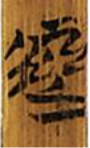 學于文武之曼德”
“From there, [I] reach and learn from the extended virtue of King Wen and King Wu.”
This would correspond to the expression zhui xue 追學 that we find in the transmitted “Command to Duke Zhai” 祭公, in the Neglected Zhou Writings, which presents several parallels with The Retrospective Command.Footnote 96
-
3. The manuscript *States holding a position is about governing.Footnote 97 It has several difficult points, and the interpretation of the text is still ongoing. The graph in question appears in the sentence “kindness and honors are not extended, [and] there is no end to flattery and envy” (恩寵不
 ,諂媢無數).Footnote
98
This passage has been understood on the basis of a similar expression found in Writings of the Later Han (Hou Han shu 後漢書), “today states lack morality, and kindness does not extend far” (今國家無德,恩不及遠).Footnote
99
,諂媢無數).Footnote
98
This passage has been understood on the basis of a similar expression found in Writings of the Later Han (Hou Han shu 後漢書), “today states lack morality, and kindness does not extend far” (今國家無德,恩不及遠).Footnote
99
 ,諂媢無數).
In all these three cases, the interpretations of this graph have been based on parallels with transmitted literature. Particularly in case (1), this motivated its transcription as ji 及.
If, on the one hand, saying 21 from *Zhongni said confirms the meaning of 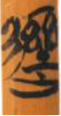 , on the other hand it provides a contrast between ji 及and the unknown graphic structure. This contrast rules out the possibility that the word written by the graph under discussion is a different, rarely occurring graphic form for the word ji 及 “to catch up, to reach, to extend,” which in saying 21 is written just a few words before. Furthermore, the graphic form for ji 及 “to catch up, to reach, to extend” (a hand grabbing a person) is well-attested from the time of oracle bone inscriptions and is used with a high frequency, making it unlikely that a second graphic representation would appear during the Warring States period.
What, then, is unattested graph writing? We suggest that it is a writing for dai 逮 “to reach; to catch”Footnote 100 based on the following considerations:
-
As stated above, all the examples suggest that the graph is writing a word in the semantic range of “to reach, to catch up.” Dai is therefore an apt candidate.
-
The Shuowen jiezi glosses dai 逮 as ji 及, “to catch up,” which again indicates a connection between the two words.
-
There are several passages in transmitted literature where ji 及 and dai 逮 appear as pairs, such as “with the gathering of many upright people, no blessings are not attained; when many evil people gather, no disasters are not reached” (眾正之積,福無不及也;眾邪之積,禍無不逮也);Footnote 101 “what the ultimate person does not manage to reach, and what the sage person cannot attain” (至人之所不得逮,賢人之所不能及).Footnote 102 Where the Exalted Writings has “may those who are too early be executed without mercy, may those who cannot keep up with [proper] timing be executed without mercy” (先時者殺無赦,不及時者殺無赦),Footnote 103 Xunzi, citing this passage, writes dai instead of ji.Footnote 104
Having identified an acceptable interpretative transcription, our second observation is about the meaning of the passage “When seeing something good, be as if you [feared] not catching it; when seeing what is not good, be as if you [feared] it [would] catch you” (見[善]如弗及,見不善如逮). The expression ru bu ji 如不及 means “as if you [feared] not catching it;” it suggests performing an action continuously, with commitment. For example, in Analects 8.17 the Master says “learn as if you could not grasp [the content]” (學如不及). The Anda saying means that when seeing goodness, one ought to pursue it incessantly, as if it could slip away.
On the other hand, when seeing something that is not good, one should move away from it. In the manuscript, this is expressed by the idea that badness will catch up with you if you do not distance yourself. Another saying in the *Zhongni said manuscript conveys a similar idea: “Zhongni said: ‘When the superior person sees something good, he reflects on it; when he sees something not good, he guards against it’” (仲尼曰:君子見善以思,見不善以戒).Footnote 105 Analects 16.11, closely parallel with *Zhongni said saying 21, uses the image of “touching boiling water”: when seeing the opposite of goodness, you should move away from it.Footnote 106
孔子曰:「見善如不及,見不善如探湯。」Footnote 107
Kongzi said: “When seeing something good, be as if you [feared] not catching [it]; when seeing what is not good, [be] as though you were touching boiling water.”
A narrative in the Biographies of Exemplary Women (Lie nü zhuan 列女傳) that ends by citing this saying confirms such an interpretation. In this story, a man named Qiu Huzi 秋胡子 returns home after serving for five years at the court of Chen. On his way home, he sees a beautiful woman picking mulberries. Attracted to her, he invites her to seek refuge from the hot sun under the shade of the mulberry tree. The woman does not respond to him, and so Qiu Huzi attempts to bribe her with money. The woman rebukes him for his offer and sends him away. Once home, Qiu Huzi offers the money to his mother, who has arranged for a woman to marry him while he was serving in Chen. As it turns out, the woman, Jie 潔,Footnote 108 is the same woman he tried to seduce on his way home. The wife again shames him for his readiness to forget about his duties towards his mother and spend money to indulge in desire. Qiu Huzi, mortified, throws himself in a river and dies. The story ends with this statement by the superior person:
君子曰:「潔婦精於善。夫不孝莫大於不愛其親而愛其人,秋胡子有之矣。」君子曰:「見善如不及,見不善如探湯。秋胡子婦之謂也。」Footnote 109
The superior person said: “Mrs. Jie mastered goodness. When it comes to being unfilial, nothing is more grave than not caring for one’s relatives while caring for strangers. Qiu Huzi had this [flaw].” The superior person said: “When seeing something good, be as if you [feared] not catching [it]; when seeing what is not good, [be] as though you were touching boiling water [i.e., reject it]. This describes Qiu Huzi’s wife.”
While both *Zhongni said saying 21 and Analects 16.11 convey in essence the same message, it is worth noting that the manuscript version seems more straightforward, in that both sentences have a parallel structure and rely in both cases on the idea of “reaching.”
This leads to the third observation about *Zhongni said saying 21, namely its relationship with Analects 16.11. In its entirety, saying 16.11 reads:
孔子曰:「見善如不及,見不善如探湯。吾見其人矣,吾聞其語矣。隱居以求其志,行義以達其道。吾聞其語矣,未見其人也。」
Kongzi said: “‘When seeing something good, be as if you [feared] not catching [it]; when seeing what is not good, [be] as though you were touching boiling water’. I have seen this [kind of] person, and I have heard this saying. ‘To live in retirement to seek one’s intentions, practicing righteousness to attain one’s way.’ I have heard this saying, but I have not seen this [kind of] person.”
It is followed by a saying, Analects 16.12, that underscores the importance of behaving morally by contrasting the story of Duke Jing with that of Bo Yi and Shu Qi. No amount of wealth matters if one lacks virtue, as in the case of Duke Jing. The brothers Bo Yi and Shu Qi, instead, continued to be celebrated long after their deaths, because they never failed to act morally.Footnote 110
齊景公有馬千駟,死之日,民無德而稱焉。伯夷叔齊餓于首陽之下,民到于今稱之。其斯之謂與?
Duke Jing of Qi had a thousand teams of horses, but when he died, people found no virtue to praise in him. Bo Yi and Shu Qi starved to death at the foot of Mount Shouyang, but people to this day praise them. Is it not an example of this?
This saying appears anomalous for two reasons. “Is this not an example of this” does not refer back to anything within the saying itself. Commentators have long noticed this: Zhu Xi 朱熹 (1130–1200), for example, suggested that this saying was incomplete or interrupted. To resolve this, commentator Cai Jie 蔡節 (active during the Southern Song) suggested to connect saying 16.12 with the previous one, so that Duke Jing, Bo Yi and Shu Qi served as examples of the principles described in saying 16.11.Footnote 111 Secondly, after collecting all these notes, Cheng Shude 程樹德 (1877–1944) added that it is one of the only two sayings in the chapter 16 that does not present any dialogue nor invoke the formula “Kongzi said.”Footnote 112
The *Zhongni said manuscript confirms that the two transmitted sayings are somewhat anomalous. Saying 21 presents the core parts of these two sayings as one single textual unit, as shown in Table 3.
Comparison between *Zhongni said saying’s 21 and Analects 16.11 and 16.12

Unlike other examples discussed in this paper, here we have a case where the manuscript presents a shorter, more coherent version of this narrative when compared to the transmitted. The two versions may derive from different traditions that shared the same core expressions and historical figures. On the strength of the commentarial tradition and the manuscript evidence, it is now reasonable to consider the two sayings in the transmitted Analects as once having constituted a single textual unit.
Wangjiazui *Kongzi said
To date, a couple dozens of strips have been published along with some fragments form the Wangjiazui corpus. We introduce here groups of sayings that most directly bear on discussion about the textual history of the Analects.Footnote 113 We refer to the strip numbers and grouping given in Zhao Xiaobin’s 趙曉斌 introduction to the Wangjiazui *Kongzi said.Footnote 114
The first group of stripsFootnote 115 presents an interesting use of punctuation. The inked squares that usually signal the end of a passage or a saying appear to separate what is presented as a single narrative in the transmitted Analects, the opposite situation from *Zhongni said number 21 analyzed above. To stress the role of punctuation in *Kongzi said, we retain the marks in the English translation as well. The manuscript reads:
子贛曰:「聞斯【行】諸?」。孔子曰:「聞而弗行,焉用聞?」子路曰:「聞斯行諸?」孔子曰:「有父兄在,如之何其聞斯行之也?▪ 公西華曰:「賜也問曰:『聞斯行諸?』子曰:『聞而弗行,焉用聞?』└ 由也曰:『聞斯行諸?』子曰:『有父兄在,如之何其聞斯行也?』赤也惑,請問之。」▪ 孔子曰:「賜也退,故進之;由也進, 故退之。」▪
Zigong asked: “Having heard about a course of action, [should one] carry it out?” Confucius said: “To hear about a course of action and not carry it out, what is the use of having heard about it?” Zilu asked: “Having heard about [a course of action], [should one] carry it out?” Confucius said: “If your father and older brothers are still alive, why should one [simply] carry out what they have heard?” ▪ Gong Xihua said: “When Ci asked, saying, ‘Having heard about a course of action, [should one] carry it out?,’ the Master said, ‘To hear about a course of action and not carry it out, what is the use in hearing about it?’ └ You also asked, ‘Having heard about a course of action, [should one] carry it out?’, the master said, ‘If your father and older brothers are still alive, why should one [simply] carry out what they have heard?’ I, Chi, am perplexed, and desire to ask about it.” ▪ Confucius said: “Ci is withdrawn, therefore I urge him forward; You is forthcoming, therefore I moderate him.” ▪
After the concluding section of this narrative, the strip is left blank. In the “Xian jin” 先進 chapter of the Analects, the narrative appears in a single unit, with a few minor variations in the names of the disciples interacting with Confucius, and in one of Confucius’ answers.Footnote 116
Punctuation and markings are important sources of information when studying manuscripts.Footnote 117 Here, however, there is no apparent reason for the use of inked squares in what reads as a single narrative. We see no variation in the writing style that would suggest an alternation of scribes. Each section seems obviously connected, if anything, by the verbatim repetitions. Perhaps marks were used to suggest a sense of temporal development in the story: first Confucius replies to Zigan and Zilu; Gong Xihua then hears about it and decides to ask the Master about it; the Master then offers his explanation.
The second group of strips, 738 and 771, allow the reconstruction of a complete saying, which appears in two different locations in transmitted literature. We mark this in Table 4 with the use of bold and double underlining.
Comparison between Kongzi’s saying on strips 738 and 771 and transmitted literature

While in the Analects the passage is taken to illustrate Confucius’ strong disapproval of greed, Mengzi quotes the story to support his argument that wars are wrong. If Confucius condemned someone who enriched their lords through taxes, so much more Mengzi and his peers should condemn those who fight for their lords, destroying fields and cities.Footnote 120 Lacking any context, the Wangjiazui saying has a more modest goal: an admonishment on how to behave once in office.
The most interesting feature is that the manuscript version is closer to the Mengzi than the Analects. This may indicate that Mengzi was drawing from a collection of sayings attributed to the Master similar to what we now have in *Kongzi said.Footnote 121 The changes in the attribution of the first half would be consistent with the changes we have seen in *Zhongni said. As with the example of *Zhongni said number four, this points to the existence during the Warring States of several collections of Analects-like materials. It further suggests that these collections were already believed to be a reliable, quotable source of Confucius’ wisdom, which was seen to carry authority that could underscore an argument, in this case the Mengzi’s assessment of Qiu.
The third groupFootnote 122 allows us to reconstruct ten complete sayings. This section is noteworthy because they appear in almost the same sequence in the Analects chapter “Li Ren”; two more appear as one single saying in “Xue er”; and one has echoes in “Yang Huo.” The remaining are unattested. The parallels are highlighted in Table 5. We offer here a translation of the manuscript sayings, followed by a few observations.
孔子曰:「事父母幾諫。見志弗从,又敬以毋違,勞而亡怨。」▪ 孔子曰:「君子造Footnote 123 之以敬,入之以安。父母在,不遠遊,遊必有方。」▪ 孔子曰:「君考召亡諾,君子不以其所亡孝。」▪ 孔子曰:「父母之年,不可不知也。壹則以懼,壹則以喜。」▪ 孔子曰:「君子不苟慮,不言不信。」▪ 孔子曰:「君子之勇也,氣於義。小Footnote 124 人之勇也,果於死。」▪ 孔子曰:「父在,觀其志也;父沒,觀其行也。」▪ 孔子曰:「三年亡改於又(父)之所,可謂孝也。」▪ 孔子曰:「道如衰苴Footnote 125 。」▪ 孔子曰:「苟非天道,人力與又能達歟?」▪
Kongzi said: “In serving one’s parents, one may slightly remonstrate [with them]. If they see the intention is not to follow, they will again be respectful without disobeying, toiling without complaining.” ▪ Kongzi said: “The superior person leaves a place with respect; he enters a place with reassurance. When the parents are alive, [the superior person] does not travel far. When he travels, he must have a place.” ▪ Kongzi said: “When rulers or the elderly summon, [respond] without hesitation. The superior person does not abandon filiality for [any] reasons.” ▪ Kongzi said: “One cannot not know one’s parents’ age. One reason is to worry [if they physically decline]; another reason is to rejoice [if they are long-lived].”Footnote 126 ▪ Kongzi said: “The superior person does not think frivolously and does not speak insincerely.” ▪ Kongzi said: “[When it comes to] the valor of the superior person, its substance comes from morality. As for the valor of the petty person, it results in death.” ▪ Kongzi said: “When the father is alive, observe [the son’s] intentions. When he has passed, observe [the son’s] actions.” ▪ Kongzi said: “Those who do not change from their father’s conduct for three years may be called filial.” ▪ Kongzi said: “The [appropriate] way follows mourning and hemp clothing.” ▪ Kongzi said: “If people oppose heaven’s way, how could human’s strength be granted and be able to attain [anything]?” ▪
Parallels with Wangjiazui *Kongzi said third group

As the transcription and the translation above indicate, we suggest that the graph 又 in “三年亡改於又之所” is a visual error for fu 父, “father,” due to their graphic similarities in Chu writing. This minor emendation aside, the interesting part of this group is the extent to which it matches four sayings in the Analects chapter “Li Ren,” in almost the same sequence. In Analects 1.11, two sayings that appear separately in the manuscript are brought together. Once the Wangjiazui *Kongzi said is published in full, it will be possible to gain a clearer picture of these phenomena. For now, the following can be said: it is likely that these sayings circulated as a group. As with previous examples, this corroborates the existence of more than one collection of sayings that circulated by the mid-Warring States, some of which were later organized by Han scholars. In this sense, again, we can speak of the Anda and Wangjiazui manuscripts as bearing on the formation of the transmitted Analects.
The next group discussed here (strips 843, 852) addresses a well-known event in Confucius’ life: his time between Chen 陳 and Cai 蔡. The episode does not appear in the Analects, but the setting “between Chen and Cai” is widely used as a prompt by many early Chinese thinkers to proffer their arguments. All the narrations share the basic setting of the story: Confucius is with his disciples (Zilu appears most frequently), unable to proceed with his journey, and without proper supplies.Footnote 127
The Wangjiazui saying presents Confucius between Chen and Cai, this time by himself. He is greeted by Gongxia Cheng 公夏乘, who is listed as one of his disciples in The School Sayings of Confucius (Kongzi jia yu 孔子家語), even though he does not appear in the Analects. Here, he gives Confucius a gift and offers to host him, presumably as a sign of respect. Confucius is, however, only concerned with his need for food:
孔子在陳蔡。公夏乘饋一櫜錦。孔子曰:「無食已。」饋,「曰:守也久不得視矣,請宿。」孔子曰:「無食也已。」
Confucius was in the Chen-Cai region. Gongxia Cheng gave him a bundle of embroideries as a present. Confucius said, “I have no food!” He gave [it all the same,] saying, “I, Shou, have not seen you for a long time. Please stay the night.” Confucius said: “I really have no food!”
A narrative recorded in the Outer Commentary on the Book of Odes by Master Han (Han Shi waizhuan 韓詩外傳) offers some insight to interpret the Wangjiazui anecdote. In the Outer Commentary story, Confucius meets a person named Cheng Muzi, with whom he stops to talk for the entire day. He then asks one of his disciples with him, Zilu, to put together a bundle of silk as present (similar to what Confucius is being offered in the Wangjiazui saying). Zilu responds:
昔者由也聞之於夫子,士不中道相見。女無媒而嫁者,君子不行也。
Previously, I have heard from the Master that scholars do not receive one another when on the road. It would be like a woman without a matchmaker who yet wants to marry, the superior person does not go along [with that].Footnote 128
In other words, Zilu is reminding Confucius of his own words about the inappropriateness of presenting gifts along the road, instead of in proper venues. With this story in mind, we may think of the Wangjiazui anecdote as an expression of the duress Confucius was under at the time, to the extent that he transgressed all formal greetings in order to communicate his need for food.
In the Outer Commentary, the story continues with Confucius’ response. He reminds Zilu that compromise is possible: “When it comes to significant virtues, there can be no transgressing of boundaries; with smaller virtues, there can be [a bit of] give and take” (大德不踰閑,小德出入可也). The same saying is then present in the Wangjiazui manuscript,Footnote 129 as a response to a question by Zai Wo:
宰我問德,孔子曰:「大德毋逾楝,小德出入可也。」
Zai Wo asked about virtue. Confucius said: “With the significant virtues, there must be no transgressing of boundaries. With the lesser virtues, there can be [a bit of] give and take.”
While in both the Outer Commentary and in *Kongzi said this saying is attributed to Confucius, in the transmitted Analects it is attributed to Zixia 子夏 (Analects 19.11).
We therefore see the same saying travel from one context to another, and from one person to another. The frame “between Chen and Cai” is known to be associated with Confucius, appearing almost as a catchline.Footnote 130 This would suggest that Confucius’ sayings operated like “building blocks”Footnote 131 or “traveling sayings,”Footnote 132 acting as compositional sections that moved from text to text, carrying the authority of the Master. At the same time, if the manuscripts represent attempts at organizing these aphorisms attributed to Confucius, one has to ask why the changes in attribution occurred. Our current hypothesis is that by the mid-Warring States period none of the collections of sayings carried more authority than the others. This led to attributions of the same saying to various actors, as was the case in this last example.
The final saying (strips 765 and 484) sees Confucius on the road again. This time he is in Chen, when he learns that two shrines in Lu have been burned down:
孔子在陳,聞桓、僖災。孔子喜。巫馬旗曰:“子新去夫魯,人其惑子。” 孔子曰:“夫文、武猶有毀,而桓、僖如毀者也而不毀,夫天毀之也。”
Confucius was in Chen when he heard that the shrines to Duke Huan and Duke Xi [in Lu] had burned down. He was delighted. Wuma Qi said: “You have only just left that country of Lu; people might think your attitude strange.” Confucius said: “Even the shrines to King Wen and King Wu were dismantled; yet the Huan and Xi shrines, which should have been dismantled, were not. And so, heaven dismantled them.”
The story of the burning of the Huan and Xi shrines is mentioned in the Annals,Footnote 133 and the Zuo Commantary 左傳 refers to Confucius hearing about it while in Chen.Footnote 134 As in the Wangjiazui narrative, Confucius rejoices when he hears this piece of news. In contrast, the Kongzi jia yu Footnote 135 and Records of the Historian Footnote 136 claim that Confucius hears about turmoil and fires in Lu, and hopes that the shrines have burnt, as the merits of Duke Huan and Duke Xi are not enough to preserve the shrines. Commentators would later read these words as prophetic, using one narrative to confirm the other.
A pre-Han Analects?
As the previous analysis shows, neither manuscript can be considered an early edition or version of the transmitted Analects. Nor, as we mentioned, is there any evidence of “Lunyu” used as title. The final strip of *Zhongni said includes the line “仲尼之耑 也,” for which several interpretations have been provided, without a resolution.Footnote
137
In the first publication that introduced the Anda manuscript, Xu Zaiguo and Gu Wangle interpreted this final line to mean Zhongni zhi lun yu 仲尼之論語, “The Collection of Sayings of Zhongni,” and suggested that what we see in the Anda manuscript derived from a collection of material most of which can be found in the “Lunyu” (zhuyao chu zi “Lunyu” 主要出自⟪論語⟫Footnote
138
), therefore implying that something like the Analects existed already by the time *Zhongni said was produced.
也,” for which several interpretations have been provided, without a resolution.Footnote
137
In the first publication that introduced the Anda manuscript, Xu Zaiguo and Gu Wangle interpreted this final line to mean Zhongni zhi lun yu 仲尼之論語, “The Collection of Sayings of Zhongni,” and suggested that what we see in the Anda manuscript derived from a collection of material most of which can be found in the “Lunyu” (zhuyao chu zi “Lunyu” 主要出自⟪論語⟫Footnote
138
), therefore implying that something like the Analects existed already by the time *Zhongni said was produced.
Xu and Gu’s first reading of 耑 indicates a desire to present the new manuscript material as having a direct link with the transmitted Analects, and several media outlets have in fact referred to the Anda manuscript as possibly the “earliest edition of the Analects to date.”Footnote
139
The excitement behind this identification is understandable, but as work by previous scholars as well as this article show, the relationship between manuscripts and the received edition is much more complex. We view as more likely that this material eventually led to the Analects as we know it, rather than deriving from it as Xu and Gu initially suggested. For if this were the case, we would expect *Zhongni said to have a higher percentage of textual overlap with the Analects, and more linguistic stability at the level of individual sayings.
indicates a desire to present the new manuscript material as having a direct link with the transmitted Analects, and several media outlets have in fact referred to the Anda manuscript as possibly the “earliest edition of the Analects to date.”Footnote
139
The excitement behind this identification is understandable, but as work by previous scholars as well as this article show, the relationship between manuscripts and the received edition is much more complex. We view as more likely that this material eventually led to the Analects as we know it, rather than deriving from it as Xu and Gu initially suggested. For if this were the case, we would expect *Zhongni said to have a higher percentage of textual overlap with the Analects, and more linguistic stability at the level of individual sayings.
As our analysis shows, the manuscripts’ material is closely connected to that of the transmitted Analects; but this connection indicates an intricate rather than direct history of transmission. The format of *Zhongni said and *Kongzi said is the same as that of most chapters in the Analects; with the Wangjiazui manuscript, we see more linguistic stability between these sayings and the received edition. Even when the parallels are only partial, it is clear that both manuscripts and the received edition derive from the same pool of material. Examples of this are *Zhongni said saying number 21, where the manuscript presents a version that proves how two sayings in the Analects were originally one textual unit, as commentators had predicted, as well as the sayings in the third cluster in Wangjiazui. In the case of Wangjiazui, we not only witness parallels with the transmitted sayings, but on one occasion so far their sequence is strikingly close to what appears in the Analects. At the same time, the manuscripts present several sayings that appear in texts other than the Analects (as in the case of *Zhongni said sayings number 1 and 4), as well as sayings that are otherwise unattested (for example, saying number 18 from *Zhongni said discussed above). Therefore, the new manuscript evidence is compatible with the understanding that the Analects as we know it was redacted during the Western Han,Footnote 140 based on material that predates imperial times,Footnote 141 which we have defined as “Analects-like.”
According to the traditional narrative, the Analects derives from the work of Confucius’ disciples, who collected his sayings over time. By Han times, only the Qi and Lu traditions of these collections circulated. These two editions were essentially versions of the same text, except for one or two chapters. This has led to reading the entry for the Analects in the “Treatise of Arts and Letters” as referring to a collection in the singular. On the basis of the manuscript evidence, we can reconsider the traditional narrative to read as follows:
論語者,孔子應答弟子時人及弟子相與言而接聞於夫子之語也。當時弟子各有所記。夫子既卒,門人相與輯而論篹,故謂之論語。漢興,有齊、魯之說。Footnote 142
The Analects are the sayings of Kongzi responding to his disciples and contemporaries, as well as disciples’ exchanges among themselves on what they heard from the Master. At the time, each disciple maintained their own records. When the Master passed away, his followers all participated in the gathering, selecting and compiling, therefore they called these [compilations] “Selected sayings.” When the Han rose, there were the interpretations of Qi and of Lu.
Here we emphasize “compilations” in the plural form. “Lunyu” was first a descriptive term to indicate collections of sayings, and then a title that identified a singular, determinate entity, the transmitted edition that we all refer to by the name “Analects.” The manuscripts now provide evidence for this plurality of collections, the kind of collections from which the Han version of the Analects eventually took form. In this article, we saw one example where the Wangjiazui *Kongzi said saying is closer to what appears in Mengzi than in the transmitted Analects, showing that, as the “Treatise” says, these collections differed from each other. It may also be the case that they continued to circulate after the process of consolidation of the Lu Analects had begun, as the parallel between *Zhongni said saying 4 and the saying provided by Eastern Han scholar He Xiu would suggest. At any rate, these early bibliographical accounts are overall reliable.Footnote 143 What remains unconfirmed (and possibly unknowable) is whether those who collected and/or wrote these sayings were indeed Confucius’ disciples.
At the same time, the new manuscripts support some aspects of the revisionist view. This view was most extensivelyFootnote 144 promoted in English by Michael Hunter in several publications.Footnote 145 Since his work is the most elaborate statement of this view, we will engage directly with his claims:
Whether or not one accepts that theory, what is clear is that the pre-Han textual record provides too little evidence of a pre-Han Lunyu text, or even a stable collection of proto-Lunyu Kongzi sayings, to justify the Lunyu’s status within early China studies as the earliest and most reliable source of Kongzi’s teachings.Footnote 146
[T]he more relevant question is not whether the Lunyu might predate the Western Han but whether enough evidence can be found to justify reading the Lunyu as the preeminent Kongzi text of the pre-imperial era or as a foundational work within the modern study of pre-imperial Chinese thought. Given the arguments offered here, the answer to that question must be no. Not only do sources composed prior to Emperor Wu’s reign exhibit little to no trace of a text resembling our Lunyu, but they also reflect a milieu in which no source of Kongzi material was felt to be uniquely trustworthy or authoritative.Footnote 147
Consequently, the traditional view of the Lunyu is best read as an invented backstory for a text whose status by the late Western Han had become unassailable.Footnote 148
Those who would insist on the Lunyu’s pre-imperial origins are obliged to acknowledge (1) the Lunyu’s striking lack of influence on the pre-Han textual record, (2) the abundance of non-Lunyu Kongzi material in those very same texts, (3) the crucial importance of the Han dynasty in the canonization of the Lunyu, and (4) the biases of the Han bibliographers ultimately responsible for the traditional view. Whether or not the Lunyu existed as a book prior to the Han, to grant it a privileged place in pre-Han studies is to perpetuate a Han anachronism.Footnote 149
We agree with Hunter that Western Han statemen and scholars had an interest in elevating the Analects and using it as an educational tool,Footnote 150 assigning to it an authority of a kind that we do not see for any of the Warring States “Kongzi material.” We concur with the understanding that the figure of Confucius already played a significant role by circa 300 bce, not just because Confucius figures so prominently in pre-imperial texts, but especially because collections of sayings exclusively dedicated to his person were circulating in the form of Analects-like texts. By mid-Warring States, Confucius was already the master to cite.
In that sense, we push back on the characterizations of trustworthiness and authoritativeness given by Hunter, because they are relative to the context and assessments of the textual evidence. We believe that Warring States Analects-like collections were authoritative, in the sense that they represented textual content to cite in one’s own discussions, as the example of Mengzi shows. But, we also do not see either collection as more authoritative than the other. As of now, *Zhongni said and *Kongzi said share only one saying.Footnote 151 Once the Wangjiazui manuscript is fully published, it will be important to compare the two Warring States manuscripts to understand their relationship and consider how changes in content and language across sayings impact the question of textual authority. If indeed the overlap between the two manuscripts is limited, we can conclude the importance of this material did not yet lead to the formation of a closed canon of Confucius’ sayings. This, in fact, supports Hunter’s claim that the Analects is not the single most reliable source for gaining insight into Confucius’ teachings. The transmitted edition became authoritative, perhaps because by Han times, other collections had been lost.Footnote 152 What can be attested is that the manuscripts present evidence of Analects-like material, and that this material was thought to represent Confucius’ philosophical ideas.
How these manuscripts may have been used during the Warring States remains to be understood. Some of the minor errors and variations discussed above can be explained as failures in recollection, and it is easy to imagine an intellectual world where Confucius’ sayings were to be memorized to be cited in one’s argument. The Anda *Zhongni said and the Wangjiazui *Kongzi said would then be products of an environment where memorization served the purpose of becoming conversant with the intellectual world of the time.Footnote 153 This practice coexisted with visual copyingFootnote 154 and written transmission.Footnote 155
Yet, this hypothesis about the usage of these manuscripts is far from comprehensive. Who authored these manuscripts? What was the motivation for collecting them in a list format?Footnote 156 Is there significance to changes in the formulaic introductions to sayings: “Zhongni said,” “Confucius said,” and “The Master said”? These questions remain unanswered. Nonetheless, these two new Warring States manuscripts bring us a step further in the understanding of both synchronic and diachronic intellectual developments that culminated with the production of the Analects.
In thinking about the formation of the Analects, this material invites a discussion of another long-debated feature: the diversity of material and the apparent “internal disarray”Footnote 157 of the transmitted edition. The new evidence highlights once again the contrast among chapters that list Confucius’ sayings without any context or framing (such as chapters “Wei zheng” 為政, “Ba yi” 八佾, “Li ren” 里仁, “Gongye Chang” 公冶長, and so on); chapters that have longer, elaborate narratives that incorporate his sayings (e.g., “Wei zi” 微子); and chapters that seem not to belong at all to a collection of Confucius’s sayings (such as “Yao yue” 堯曰, or “Zi Zhang” 子張). Throughout this article we have stressed that the *Zhongni said and *Kongzi said consist exclusively of Analects-like material, defined by features shared by the two manuscripts and some sections of the received Analects. Accordingly, we draw the following seemingly paradoxical conclusion: not all the material in the transmitted Analects is Analects-like material. As the manuscripts show, not all Analects-like material circulating by mid-Warring States period was preserved in the Qi and Lu editions. What will be interesting to see is whether any future discoveries will clarify why, by the Han, we end up with such a heterogenous edition, accepted to be the key to Confucius’ ideas even though some chapters do not include him at all. The publication of the Analects from the tomb of Marquis of Hai Hun, which includes textual content not seen in the received edition, will be no doubt cast new light on this issue.
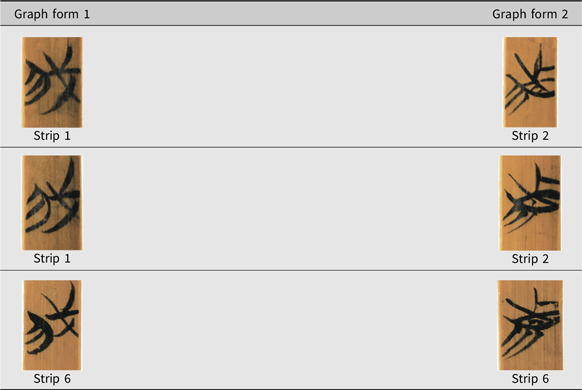
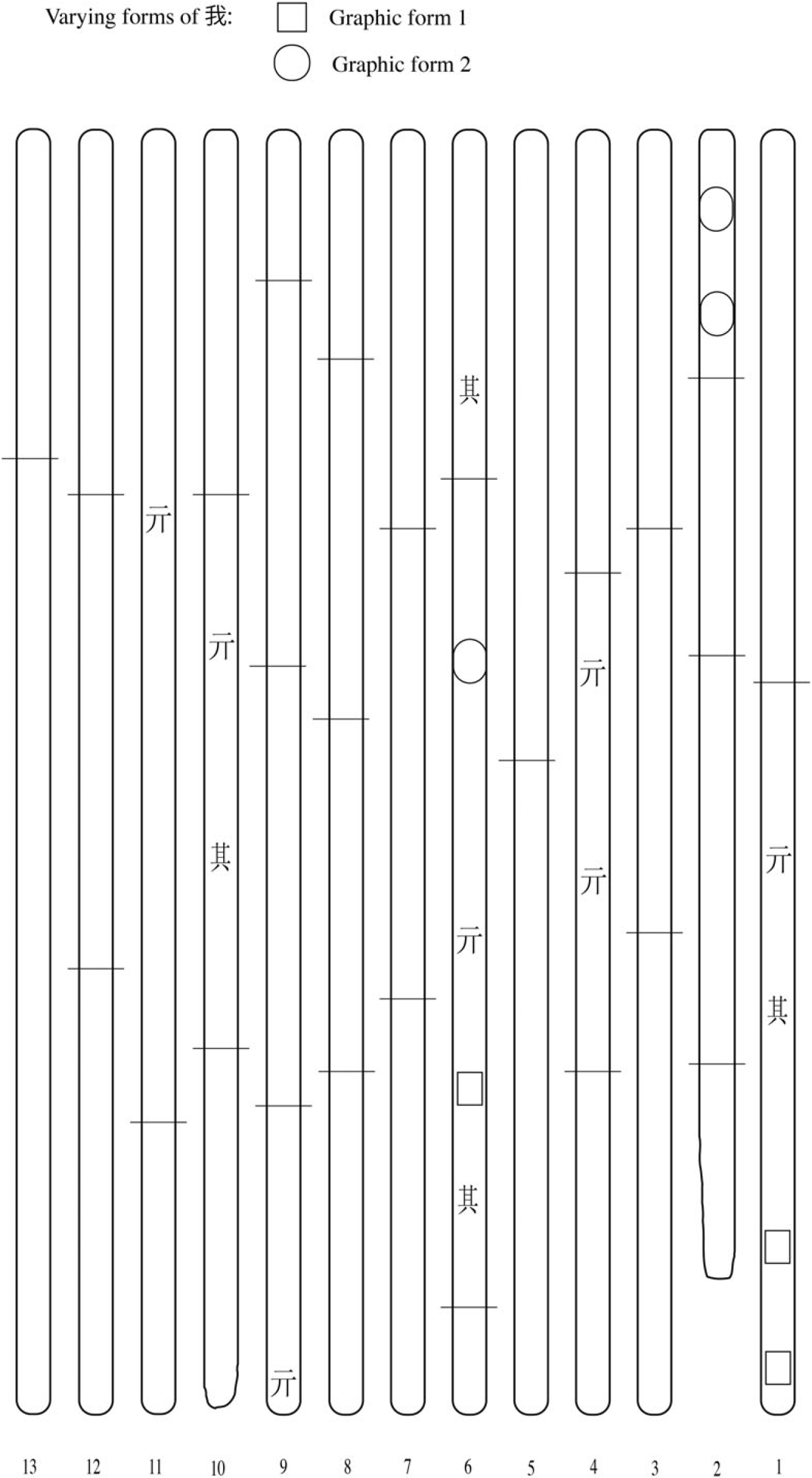
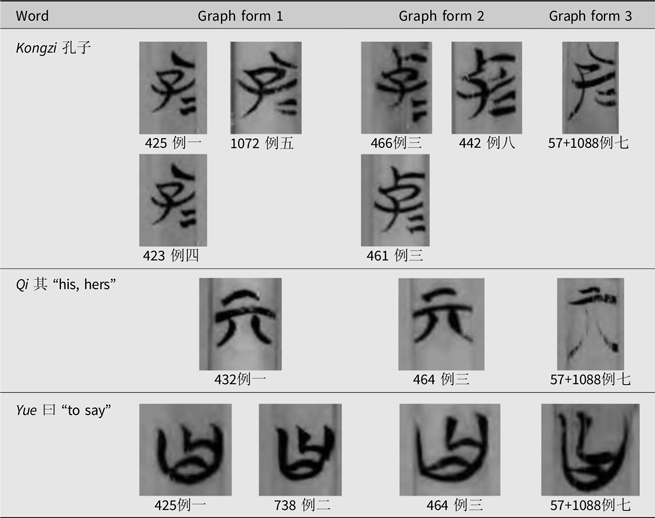
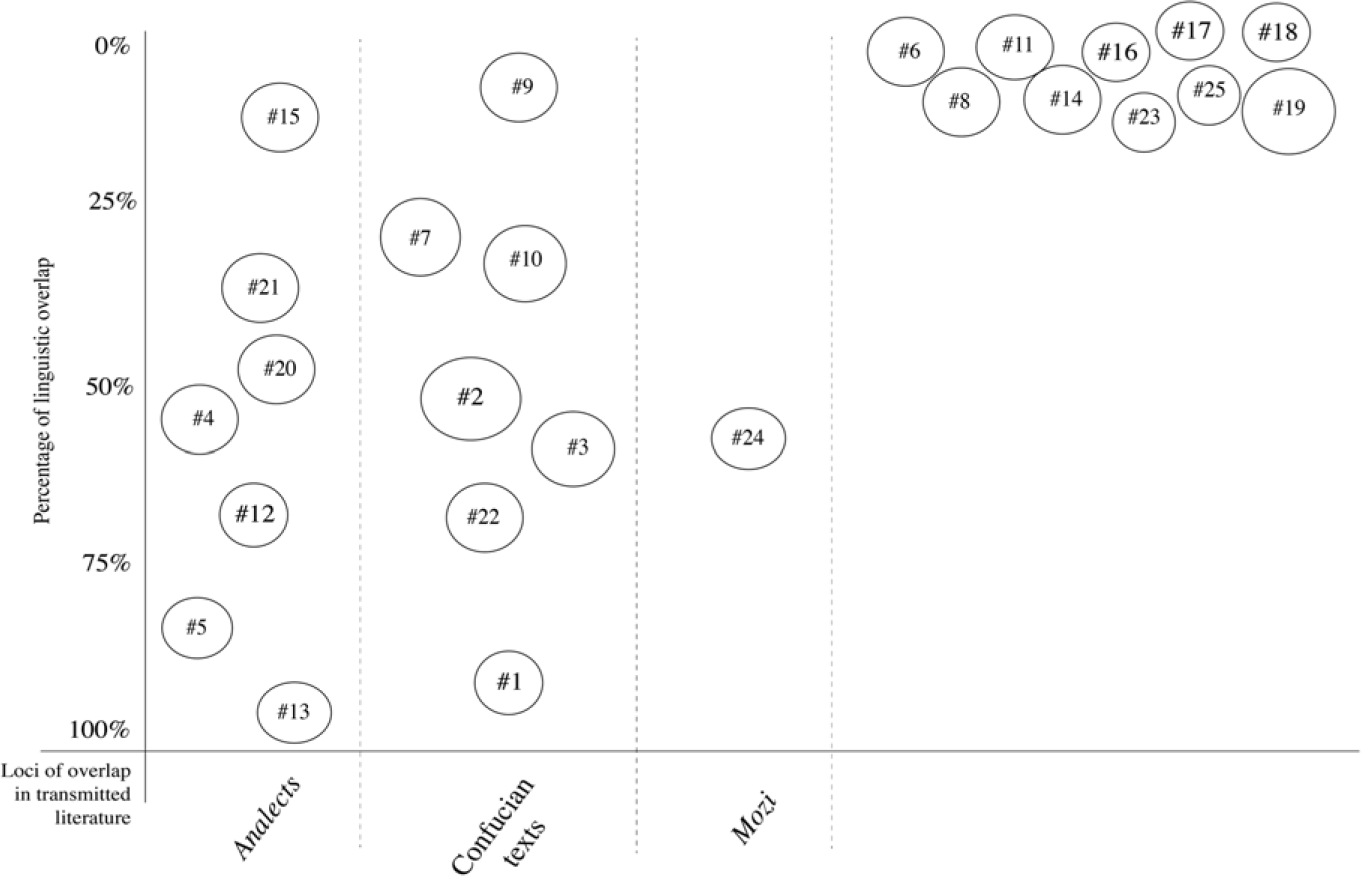

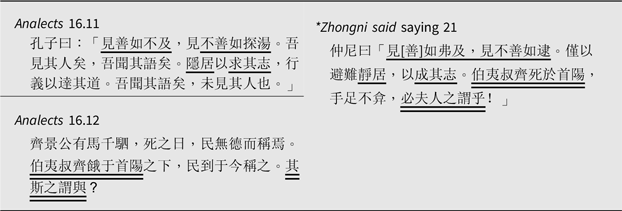
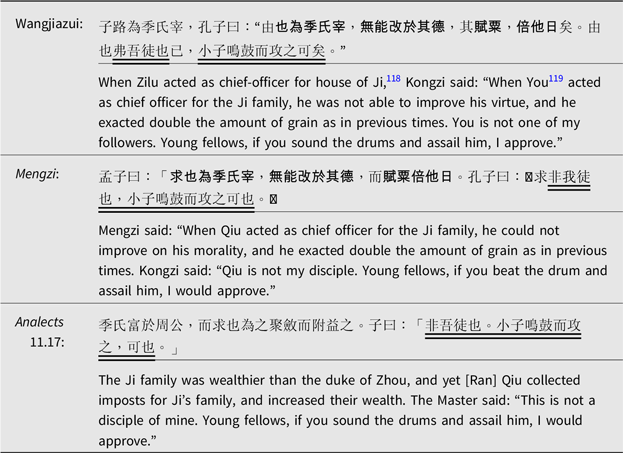
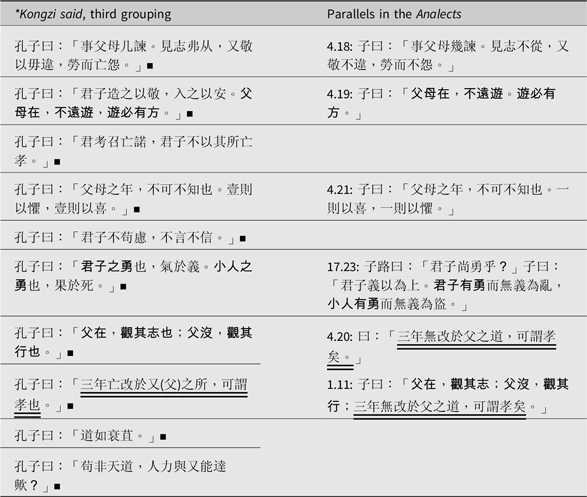

 Open access

