



Between 2013 and 2020, sales of vitamins and food supplements increased by 22·33 % in Western Europe, reaching a volume of 11 billion euros in the selected countries. In addition, daily consumption among Europeans has increased by 88·5 % over the last 5 years, standing at 32·8 % in 2021 compared with 2016’s 17·4 %. Spain exceeds the European average, with 35 % of Spaniards consuming food supplements on a daily basis(1). This ever-expanding health-related industry thriving in developed countries uses commercial strategies that aim to create a direct association between health and food. In these coordinates, the regulation, advertising and consumption of food supplements (dietary supplements in the USA) are matters of continuous debate, occupying a central place in academic and scientific research(Reference Binns, Lee and Lee2–Reference Starr4).
Previous studies have confirmed that consumers take food supplements to correct nutritional deficiencies and improve their general health(Reference Bailey, Gahche and Miller5,Reference Okleshen Peters, Shelton and Sharma6) . However, there are currently other reasons involved. Academics have shown that people’s perception of illness is the most significant predictor of food supplements consumption(Reference Pajor, Eggers and Curfs7). They have also shown a correlation between chronic illness and the consumption of supplements(Reference Okleshen Peters, Shelton and Sharma6,Reference Dickinson and MacKay8) as an alternative to conventional medicine(Reference Denham9), to save money or to postpone seeking medical attention(Reference Bailey, Gahche and Miller5,Reference Okleshen Peters, Shelton and Sharma6) . In this respect, Bailey et al. (Reference Bailey, Gahche and Miller5) analysed the data of 11 956 American adults to conclude that supplements were in most cases taken out of personal choice (77 %) rather than following the advice of a medical professional (23 %). Nevertheless, consumers are often unaware that their misuse can cause severe health issues such as organ harm from inherent toxicity, interactions or product contamination. This is linked to an increase in the attendance rates at emergency wards and number of hospital admissions(Reference Binns, Lee and Lee2,Reference Ashar, Miller and Pichard10,Reference Geller, Shehab and Weidle11) . In fact, scientific evidence supporting the real benefits and safety of food supplements is scarce(Reference Kreth3) and consumers remain inadequately informed(Reference Denham9,Reference Ashar, Miller and Pichard10) or lack the capacity to correctly interpret the information transmitted by health claims(Reference Mariotti, Kalonji and Huneau12,Reference Nocella and Kennedy13) . The public is misled by claims that present these types of products as an alternative to the chemicals of medication, although natural is not always synonymous with harmless(Reference Royne, Myers and Deitz14). Consumption of food supplements also has a negative impact on consumers’ economies, as products in many cases do not fulfil their promises. But perhaps, the most damaging aspect of food supplements has to do with the health-related expectations of users who take them to treat life-threatening illnesses instead of seeking professional medical care. All this justifies the prohibition of health claims not verified by public administrations(Reference Vladeck15) and motivates this research.
Advertising takes centre stage in the demand for food supplements, with advertisements that, directly or indirectly, encourage their consumption as a substitute for traditional medicine, while promoting self-care as opposed to professional care(Reference Chandra and Holt16). Growth industries and profit-driven markets continue to challenge advertisers’ ethical standards. All too often, veracity and the protection of consumer rights are secondary to the efficacy of persuasion. Marketing has striven in recent years to promote greater corporate social responsibility in its clients rather than fostering its own, acting with a ‘moral short-sightedness’(Reference Drumwright and Murphy17) which favours strategic thinking. However, the sector’s lack of concern for the social effects of their commercial actions entails unreasonable damage to consumers. In fact, given the abundance of misleading advertising, the rise of academic attention on advertisers’ corporate social responsibility is not surprising(Reference Ferrell and Ferrell18–Reference Serota and Doncan-Morgan20). As a result, most countries have implemented regulatory measures to control the marketing and promotion of food supplements and health-related claims (H-RC).
European regulation(21) establishes that food supplements are foodstuffs whose purpose is to supplement our normal diet. They are concentrated sources of nutrients or other substances with nutritional or physiological effects, marketed in dose form – capsules, pastilles, tablets, pills, sachets of powder, ampoules of liquids, drop dispensing bottles and other similar forms of liquids and powders designed to be taken in measured small unit quantities. Only vitamins and minerals are considered nutrient substances and listed in Annexes I and II of the Directive. Although food supplements are regulated differently from food(Reference Katan and de Roos22), they are a kind of foodstuff and the regulation of health claims made on food applies. European regulation considers three types of H-RC(21,23,24) in food supplements advertising:
-
So-called disease claims, which are not permitted in Europe under Article 2 (b) of Directive 2000/13/EC of the European Parliament and of the Council of 20 March 2000 on the approximation of the laws of the Member States relating to the labelling, presentation and advertising of foodstuffs(23). The article states that the labelling and methods used must not attribute to any foodstuff the property of preventing, treating or curing a human disease, or even refer to such properties. These prohibitions or restrictions also apply to advertising. Indeed, the same principle is applicable to the advertising of food supplements, under Article 6 of Directive 2002/46/EC of the European Parliament and Council of the 10 June 2002 on the approximation of the laws of the Member States relating to food supplements(21).
-
Function claims (structure–function claims in the USA), which state, suggest or imply that a relationship exists between a food category – or one of its constituents – and health. Article 13.1 of Regulation (EC) No 1924/2006 of the European Parliament and of the Council of 20 December 2006 on nutrition and health claims made on food(24) refers or describes the role of nutrients or other substances in the growth, development and functions of the body; in psychological and behavioural functions; and in slimming, weight-control, reduction in the sense of hunger or increase in the sense of satiety. These function claims are only permitted when based on and substantiated by generally accepted scientific evidence, authorised after scientific review by the European Food Safety Authority (EFSA) and listed in a register by the European Commission(Reference Mariotti, Kalonji and Huneau12). Food supplements are concentrated sources of nutrients or other substances with a nutritional or physiological effect.
-
Reduction of disease risk claims, and those referring to children’s development and health, is any H-RC that states, suggests or implies that the consumption of a food category, a food or one of its constituents significantly reduces a risk factor involved in the development of a human disease. According to Article 14 of the mentioned Directive(24), these claims may be made when they have been authorised after application for inclusion in a Community list of such permitted claims. The Process for the Assessment of Scientific Support for Claims on Foods (PASSCLAIM) has ‘the potential to increase public confidence in the role of diet in maintaining and improving health and wellbeing’ (p. 1214S)(Reference Asp and Bryngelsson25).
Most studies analysing H-RC and product information in dietary supplements advertising refer to the Dietary Supplement Health and Education Act of 1994 of the Food and Drug Administration of the USA. Previous research by Soller, Rice and Ambrose(Reference Soller, Rice and Ambrose26) and Ethan et al. (Reference Ethan, Basch and Berdnik27) has shown that function claims prevail in magazine dietary supplements advertisements, reaching 58 % and 79 %, respectively. However, Avery, Eisenberg and Cantor(Reference Avery, Eisenberg and Cantor28) found that 87 % of magazine dietary supplements advertisements contained function claims which referred to serious diseases and/or ailments such as cancer/risk of cancer, heart disease or deteriorating brain function. The work of Lee et al. (Reference Lee, Vásquez and Wong29) shows that prevalent claims in newspaper and television dietary advertisements referred to general health (40 %) were disease-specific (38·8 %), therapeutic (17·6 %) or were made for sexual, cosmetic or weight-loss purposes (14·7 %), while Chung et al. (Reference Chung, Hwang and Kim30) demonstrated that 84·5 % of newspaper advertisements included up to twelve different disease claims per product. On the other hand, although some studies have shown that most dietary supplements advertisements failed to provide accurate and comprehensive information(Reference Kava, Meister and Whelan31,Reference Shaw, Zhang and Metallinos-Katsaras32) and did not indicate the primary ingredient (79 %)(Reference Ethan, Basch and Berdnik27), others concluded that this type of advertising included an identifiable ingredient (91·1 %) of the product containing two or more components(Reference Lee, Vásquez and Wong29). Finally, Philen et al. (Reference Philen, Ortiz and Auerbach33) found that amino acids were the most frequently mentioned ingredient (21·7 %) in health and bodybuilding magazines, whereas in the work of Lee et al. (Reference Lee, Vásquez and Wong29), herbal ingredients were mentioned in 70·1 % of cases.
Outside the scope of the US regulatory framework, Hassali et al. (Reference Hassali, Saleem and Aljadhey34) evaluated the compliance of ingredients and functional claims made in women’s magazines with the guidelines established by the Malaysian Advertisements Board. They found that 13·3 % of advertisements in women’s magazines contained claims about restoring, improving or enhancing sexual health and that the most frequently mentioned ingredients were vitamins (17·8 %), proteins (10·2 %) and minerals (9·6 %).
In the European context, little research has been conducted to examine health-related information in food supplements advertising. Baudischova et al. (Reference Baudischova, Straznicka and Pokladnikova35) have paid attention to the adequacy of online information on the most consumed food supplements in the Czech Republic, analysing their active substances, general composition and the legitimacy of their health claims. They found that prohibited health claims were included in 8·5 % of Czech websites, with a prevalent presence of vitamins, minerals and non-herbal ingredients. Likewise, two studies by Perelló and Muela(Reference Perelló and Muela36,Reference Muela-Molina, Perelló-Oliver and García-Arranz37) are closely related to this research. In the first, they identified misleading claims in advertising of health-related products to quantify the presence of messages offering health benefits in Spain. In doing so, they analysed radio spots for products with intended healthcare purposes, from the perspective of Spanish regulation. The main result showed that health-related advertisements represent 69·09 % of unlawful claims(Reference Perelló and Muela36). In the second study, they analysed the presence of different types of endorsers, some of them prohibited by European Directives and related to H-RC and product content information(Reference Muela-Molina, Perelló-Oliver and García-Arranz37). This work revealed that celebrities prevail in function and reduction of disease risk claims (25 % and 11·4 %, respectively), while doctors frequently endorse food supplements in radio spots using disease claims (48·1 %). Additionally, 73 % of H-RC lack the compulsory substantiation of authorised ingredients. However, nothing so far has analysed H-RC and related product information in food supplements from the European regulatory perspective.
It is important to remember at this point that Regulation (EC) No 1924/2006 of the European Parliament and of the Council of 20 December 2006 on nutrition and health claims made on foods establishes in Article 3 that health claims shall not be false, ambiguous or misleading. Since all H-RC must be truthful and the European Directive on food supplements only allows vitamins and minerals for substantiation(21), the main objective of this work is to analyse the presence of misleading and false claims and non-authorised ingredients to establish whether food supplements advertising breaches these regulatory principles.
Methods
According to the American Marketing Association, an advertising claim is a statement about the benefits, properties and/or performance of a product or service, designed to persuade consumers to make a purchase. Likewise, a health claim states, suggests or implies that a relationship exists between a food category, a food or one of its constituents and health(24). Taking this into consideration, we have chosen to analyse mentions in radio advertising due to the descriptive nature of their verbal messages, usually broadcast live by radio personalities.
On the other hand, 44 % of Spanish citizens(Reference Toharia38) and 59 % of Europeans identify the radio medium as the news source they trust the most(39). In line with our decision, we selected Spanish news/talk radio stations providing informative content and up-to-date news. Two criteria were considered in the selection process: national coverage and transmission in Spanish.
According to data from the Estudio General de Medios(40), the stations with the highest audience levels are Cadena Ser, Cadena Cope and Onda Cero, which together total 9 000 000 daily listeners. The methodology used followed the quantitative approach of content analysis of all radio mentions broadcast throughout 2017. According to Krippendorff(Reference Krippendorff41), this technique allows researchers to make ‘replicable and valid inferences from texts (or other meaningful matter) to the contexts of their use’ (p. 24).
Empirical application
The constituent data of the analysis were obtained from Arce Media (incorporated to the Nielsen database in 2007), dedicated to the collection of data for analysis of advertising activity in mainstream media. Using specific software, the company monitors and registers all radio advertising broadcast in different formats. The authors have bought access to the database and therefore to the mentions of the required product category broadcast in the referenced year in mp3 format.
In this work, food supplements are part of a non-medication group within the health category which includes food and vitamin complexes, tonics, energy boosters, cell regeneration supplements, weight-loss supplements, vitamins and other health and nutrition products. Following these selection criteria, the final corpus is composed of 437 radio mentions, comprising the entire universe. The analysis and coding process was conducted by two trained coders according to the variables and attributes presented in Table 1. The coders are two researchers, members of the research project funded by the Spanish Government under which this investigation has been carried out.
Categories, variables, attributes, concepts and definitions for the coding process

* Non-exclusive category, since one or more claims can be included in an advertisement. Conceptualisation was based on EU regulation.
† To encode whether a claim or ingredient has been authorised by EFSA, it was verified in the official website of the EU register on nutrition and health claims. (http://ec.europa.eu/food/safety/labeling_nutrition/claims/register/public/?event=search).
Data reliability
The inter-codifier reliability was measured using Cohen’s Kappa(Reference Cohen42), which raises a variation between 0·785 and 1, calculated with SPSS (version 17). With regard to the variables included in the category Types of Health-Related Claims, for Disease Claims k = 0·785, for Function Claims k = 1 and for Reduction of Disease Risk Claims k = 0·955. Finally, k = 1 in the case of all variables integrating the Product content information category, i.e. Vitamins, Minerals and Others. To respond to the few differences detected, a third working session took place. The discrepancies are mainly concentrated in the non-structural variables that required a subjective interpretation of advertising content related to therapeutic functions or disease symptoms and risks factors. Once these contradictions were detected, the authors and the coders themselves evaluated each case to properly adjust it to the initial formulation of each variable. After evaluating the different situations, the final coding of the cases in question was decided. The results listed below are based on a value k = 1 for all variables. In addition, all crossed data for the analysis of variables have undergone relevant statistical significance tests using nonparametric χ 2 analysis.
Results
The content analysis of the 437 food supplements radio mentions shows a high presence of claims and product ingredients non-authorised by EFSA. It is worth noting that the analysed variables are non-exclusive, since one or more claims and/or ingredients can be mentioned in an advertisement, as shown in Fig. 1. In this regard, the presence of function claims has been detected in all advertisements, non-authorised in 80·3 % of cases (351). On the other hand, and although prohibited by European regulation, disease claims are present in 1 of 5 advertisements (20·4 %). Finally, the presence of reduction of disease risk claims is marginal (8·7 %), but none of the thirty-eight cases detected has been authorised.
Presence of Health-Related Claims and Product Content Information (%). Absence;
 Authorised;
  Non-Authorised

As previously mentioned, only vitamins and minerals are considered nutrient substances in food supplements, while other product ingredients need to be authorised through PASSCLAIM by EFSA. The results in Fig. 1 show that nearly half of all other substances are illicit (43·7 %). Vitamins and minerals show an inverse proportionality; that is, a high presence of non-authorised claims mentioning vitamins goes together with a low presence of authorised claims, while in the case of minerals, the opposite is true – mentions of authorised substances (14·2 %) are more frequent than those of non-authorised substances.
The unallowed use of disease claims in advertising is particularly significant. The property of preventing or curing a human disease cannot be attributed to a food supplement. Nevertheless, the presence of this type of claim has been detected in eighty-nine advertisements, which in all instances mention a substance responsible for the improvement of consumers’ health. Specifically, vitamins, minerals and other substances appear in 24·7 %, 22·5 % and 57·3 % of these claims, respectively, when it is not legally possible to use advertising arguments based on the presence of these substances in such claims (Table 2). The following are two examples of disease claims identified in the analysis: ‘[to prevent the early symptoms of memory loss due to aging]’ and ‘[for you who suffer from discomfort and knee and joint pain]’.
Disease claim and product content information
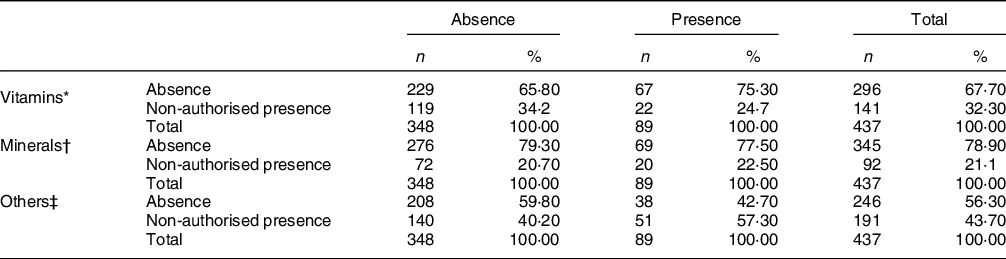
* Disease Claim and Vitamins χ 2: 3626; Significance: P < 0·0163.
† Disease Claim and Minerals χ 2: 55 539; Significance: P < 0·000.
‡ Disease Claim and Others χ 2: 8397; Significance: P < 0·004.
If we apply the same analytical approach to function claims, Table 3 also shows a predominant presence of non-authorised claims that mention vitamins, minerals and other substances as advertising arguments to reinforce the health benefits of the advertised product. Of the 351 advertisements that include a function claim, 54·10 % mention other substances which have not been authorised. The following extracts provide examples of the same product in different advertisements using function claims: ‘[in cases of fatigue, physical or mental exhaustion]’, ‘[Brand X increases physical and mental energy]’ and ‘[it is revitalising thanks to its exclusive formula which will help you overcome tiredness and fatigue]’. These examples do not refer to any substance, yet the following one, from the same brand, does: ‘[with royal jelly, ginseng and vitamins, which help us recover our energy and vitality]’. Indeed, in the case of royal jelly, the status of claims such as ‘helps in cases of fatigue; helps to support our body’s vitality; helps to make you feel more energetic; enhancement of vitality/energy’ is non-authorised. The same applies to vitamins, present in 36·80 % of non-authorised claims. However, in the case of minerals, their non-authorised presence is residual when compared with the rest of substances, with only 8·5 %. In fact, these inorganic components are adequately mentioned and authorised in 73·8 % of function claims. The next example presents two authorised function claims substantiated with different minerals: ‘[it contains zinc which contributes to normal DNA synthesis, and selenium which protects cells against oxidative stress]’.
Function claim and product content information

* Function Claim and Vitamins χ 2: 51 004; Significance: P < 0·000.
† Function Claim and Minerals χ 2: 304 578; Significance: P < 0·000.
‡ Function Claim and Others χ 2: 80 753; Significance: P < 0·000.
Table 4 shows that reduction of disease risk claims also has a significant non-authorised presence. So much so, that there is not one single instance of vitamins, minerals or other substances authorised by EFSA to support this type of claim. Brands use reduction of disease risk claims to advertise how the consumption of a certain product can reduce the risk of developing a disease, as in the following extract of one the analysed advertisements: ‘[Brand X decreases bad cholesterol levels and prevents the formation of cholesterol oxidation]’. Although this type of claim is not particularly relevant in the analysed sample – it is only included in thirty-eight advertisements – non-authorised other substances are present in 73·7 % of cases and non-authorised minerals and vitamins in 18·4 % and 15·8 %, respectively. As a final consideration, it is worth noting that not one single instance of authorised substance has been detected in the reduction of disease risk claims included in the sample.
Reduction of disease risk claim and product content information

* Reduction of disease risk claim and vitamins χ 2: 5469; Significance: P < 0·065.
† Reduction of disease risk claim and minerals χ 2: 14 037; Significance: P < 0·001.
‡ Reduction of disease risk claim and others χ 2: 15 201; Significance: P < 0·001.
Discussion
This work contributes to the scarce research on food supplements advertising in the European context(Reference Baudischova, Straznicka and Pokladnikova35,Reference Muela-Molina, Perelló-Oliver and García-Arranz37) , providing new insights. The analysis model proposed establishes a relationship between the different types of H-RC and the substances on which they are based, whether authorised or not by the different directives regulating food supplements in the EU. Thus, the main contribution of this work is that it analyses the compliance level of food supplements advertising in Spain with these regulatory principles, which must be respected by all European states.
Another distinctive contribution of this work is related to the selection of the analysed medium. This study has focused on news/talk radio stations due to their programming nature and audience, which is accustomed to news content. Indeed, radio is still considered the most trustworthy media source by Spaniards and Europeans(Reference Toharia38,39) . Although the main component of radio communication is verbal – as in the case of H-RC – product descriptions in advertising are always composed of verbal statements, so that this analysis model can be applied to any other type of media.
In line with previous research(Reference Avery, Eisenberg and Cantor28–Reference Chung, Hwang and Kim30,Reference Baudischova, Straznicka and Pokladnikova35,Reference Muela-Molina, Perelló-Oliver and García-Arranz37) , this work has shown a high presence of disease claims – in one out of five analysed advertisements. Overall, the findings reveal that these illegal claims do not mention illnesses directly, although they do refer to them indirectly. For instance, ageing is manifestly referred to as joint pain instead of osteoarthritis, and memory loss is mentioned instead of senile dementia. Likewise, this type of claim, beyond the promise of healing and eliminating pain, prescribes the consumption of the product as a preventive measure, as shown in the following example: ‘[Mental agility and memory deteriorate with aging, especially after the age of 45. Brand X is a supplement that prevents this deterioration of memory and mental agility]’.
This analysis strongly confirms the findings of previous studies in which function claims were the most prevalent typology in food supplements advertising(Reference Soller, Rice and Ambrose26–Reference Lee, Vásquez and Wong29,Reference Hassali, Saleem and Aljadhey34,Reference Muela-Molina, Perelló-Oliver and García-Arranz37) . The present work also concludes the absence of authorisation by EFSA in a striking majority of the claims (80·3 %). Describing health benefits as product attributes is another common practice in food supplements advertising: ‘[Brand X is the only product that normalises cholesterol]; [Brand Z looks after your memory]’. However, claims must only refer to the function of nutrients or other substances in terms of growth, development and functions of the body to preserve a healthy condition. Furthermore, our results have revealed claims that assure consumers of the alleged benefits of the product – ‘[Brand X is the solution]; [Brand X is a revitaliser of guaranteed effectiveness]’ – or appeal to a ‘[new, more powerful formula]’, ‘[exclusive formula]’, ‘[natural formula]’, ‘[effective formula tested by professional laboratories]’, or indicate that the product is available in pharmacies. These advertising practices influence consumer purchase decisions by omitting essential information about the product.
The high presence and ongoing repetition of false and unlawful claims(Reference Perelló and Muela36) can lead to misinformation about what food supplements are and how they must be used(Reference Okleshen Peters, Shelton and Sharma6–Reference Dickinson and MacKay8,Reference Mariotti, Kalonji and Huneau12–Reference Royne, Myers and Deitz14) . Consequently, and based on wrong beliefs, misled consumers buy and take food supplements which in most cases do not satisfy the health benefits advertised, often unaware of the health risks involved in their inadequate consumption.
Regarding the content information of food supplements advertising, and in line with previous studies(Reference Ethan, Basch and Berdnik27,Reference Lee, Vásquez and Wong29,Reference Kava, Meister and Whelan31–Reference Baudischova, Straznicka and Pokladnikova35) , the results reveal the prevalence of advertisements which do not mention any regulated substances. Other substances prevail in the sample (43·7 %), even though the claims in which they appear have not been authorised. Unlike previous works which indicate that vitamins are the most mentioned substance(Reference Hassali, Saleem and Aljadhey34,Reference Baudischova, Straznicka and Pokladnikova35) , in our analysis, they hold second place (32·2 %) and their use is again illicit in most cases. Finally, minerals are the substance which registers the highest number of authorised claims, despite having the lowest presence (21 %), appearing in only 14·2 % of the radio mentions. The use of vague and general arguments such as ‘[Brand X provides vitamins, minerals and nutrients]’ is common in food supplements advertising. Although these arguments have been included in the coding process, they cannot be considered authorised insofar as they do not specify the substance or the health benefit provided.
Advertising, now ubiquitous, informs consumers of the existence of products on the market that respond to many needs, with enormous speed and efficiency. However, consumers can make mistaken purchase decisions(Reference Denham9,Reference Ashar, Miller and Pichard10,Reference Mariotti, Kalonji and Huneau12,Reference Nocella and Kennedy13) as a result of malpractices in the commercialisation of food supplements – illicit, deceptive and false claims, or the omission of essential information about the product’s characteristics and/or benefits(Reference Perelló and Muela36). In this regard, it is important to consider that the current regulation(24) states as a general principle that health-related properties should not be uncertain, confusing or misleading.
Finally, the analysis shows a recurrent use of fear appeals and the inclusion of clinical or medical terms such as ‘symptoms’, or risk factors that contribute to the worsening of the quality of life; some statements even indicate the dosage to be taken, as if prescribed by a physician: ‘[Two capsules a day of Brand X relieves pain]; [two capsules a day is enough]; [one capsule a day reduces and normalises bad cholesterol levels]’.
Policy implications
While in a fast-growing market scenario, the demand for food supplements is expanding worldwide(1), legislation – relatively recent in the EU – and its compliance continue to be deficient. Food supplements advertising is controversial since it promotes and provides information about products which may pose a risk to consumers’ health or involve economic fraud(Reference Baudischova, Straznicka and Pokladnikova35,Reference DeLorme, Huh and Reid43) .
The presence of illicit H-RC is a matter of serious concern that can lead to false beliefs and inappropriate behaviour in consumers(Reference Mariotti, Kalonji and Huneau12–Reference Vladeck15). Many researchers and experts, e.g.,(Reference Starr4,Reference Denham9,Reference Ashar, Miller and Pichard10) have expressed their concern over these illicit practices and demanded more restrictive legislation and greater rigour in the supervision of manufacturers, given the administrative laxity, health problems caused and other issues detected since the application of the current legal text(Reference Binns, Lee and Lee2,Reference Starr4) .
Recent studies have raised awareness of the significant presence of deceptive H-RC(Reference Lee, Vásquez and Wong29,Reference Baudischova, Straznicka and Pokladnikova35,Reference Perelló and Muela36,Reference Parker44) , which often lack scientific support(Reference McCann45) and plausibility(Reference Soller, Rice and Ambrose26,Reference Brennan, Czarnecka and Dahl46) . Although eliminating all misleading claims is the main objective of EU regulation, this research has identified the use of frequent vague claims that can definitely be considered deceptive by omission. Given the vast consumption of food supplements(1) and the irregularities detected in their advertising, it seems relevant to implement the following mechanisms to improve consumer protection: increased sanctions and control from self-regulation systems; stricter government supervision of the advertising activity and, in media, the implementation of a preclearance system to ensure that all messages are truthful and comply with regulation before their dissemination. Such actions would censor misleading messages before they reach the public and thus eliminate or drastically reduce the purchase of products that do not meet consumer expectations and their advertised benefits.
In view of its complexity, the issue must be approached comprehensively to include all stakeholders involved(Reference Aschemann-Witzel47). The inclusion of food supplements in the market requires stricter regulation and monitoring by governments. For their part, public administrations and the media must monitor the content of food supplements advertisements to verify their compliance with legislation(Reference Denham9). The objective is to prevent unlawful, false or misleading H-RC from reaching consumers and to confront regulatory challenges in this area which continue to be disregarded(Reference Starr4). The effectiveness of self-regulation systems must be increased to include adequate sanctions for offenders in order to encourage advertisers to act with greater responsibility. Specifically, the Spanish self-regulation authority is constantly questioned because certain brands of food supplements have been advertising these types of unlawful H-RC for many years(Reference Perelló and Muela36) and continue to do so today with total impunity, despite having been the subject of complaints in the past(Reference Muela-Molina, Sánchez Hernández, Jiménez Morales and Carrillo Durán48,Reference Perelló-Oliver, Muela-Molina and Hormigos-Ruiz49) . In addition, administrations should improve public awareness of all aspects involved in the consumption of food supplements and other controversial products through educational campaigns, so future consumers can make informed purchase decisions.
Limitations and future research
The present work has addressed the radio medium and full-service broadcasting stations. Further research could extend the analysis to other types of radio stations and media. For example, it would be relevant to cross-nationally compare the presence of false and misleading H-RC of food supplements in selected European countries with a common regulatory framework, in order to gain insight into the impact of sociological and cultural factors on this framework.
The model developed in this research could be applied to the analysis of other types of claims included in Regulation (EC) No 1924/2006 of the European Parliament and of the Council of 20 December 2006 on nutrition and health claims made on foods. In this regard, it would be interesting to cross-check the variables of nutrition claims with those of nutrients in food advertising or in certain categories of food different from food supplements, and confirm whether they are permitted or not to verify compliance with regulation. This analysis could feasibly be conducted based on updated information published by EFSA.
Another limitation of this work is that it only analyses the presence of H-RC and substances authorised in the regulation for food supplements. Therefore, future research could approach the same subject but from the perspective of self-regulation, through the analysis of complaints and resolutions. Likewise, an analysis from consumers’ perspective would be of great relevance to find out their level of knowledge and ability to distinguish between the different types of H-RC(Reference DeLorme, Huh and Reid43).
The findings of our work may also be used as the starting point of future research that would provide continuity and resolve emerging hypotheses. For instance, one of the three analysed news/talk radio stations did not broadcast food supplements mentions, which triggers an interest to determine the causes of this behaviour. On the other hand, it would be interesting to interview radio owners, radio personalities and newscasters to gain information about the advertising management process, paying special attention to the acceptance, production, revision and dissemination of food supplements advertisements and the verification of the information they provided within the message. Finally, lines of future research could also include an analysis of self-regulation and accountability systems and of radio stations’ editorial line or style guide.
Conclusions
The constant use of health claims not allowed by law in food supplements advertising is a matter of serious concern. Advertisers are held accountable when the regulation is breached, but the responsibility must be extended to include media owners, who currently act with total impunity. The worrying presence of deceptive messages – vague or false claims, and the omission of essential information – in food supplements advertising demands stricter monitoring and control from public administrations and self-regulation systems, and the introduction of exemplary sanctions to deter offenders and protect consumers. The conclusions drawn from the analysis of the European framework strongly suggest the need for an effective action plan that would modify the current regulation on food supplements advertising, as well as a common framework of sanctions. This would allow policymakers across Europe to protect consumers from the potentially harmful effects of their consumption, in many cases encouraged by advertising malpractices. In this respect and to preserve consumer safety, it seems essential to change the current regulation so that everybody involved in this illicit health-related advertising can be held accountable for their actions.
Acknowledgements
Acknowledgements: The authors would like to acknowledge to Bárbara Castillo Abdul and Fátima Gómez Buil for assistance in coding process. Financial support: This work was supported by the Ministry of Economy and Competitiveness of de Government of Spain, State Program R&D Oriented Society Challenges, under Grant (CSO2017-82267-R). Conflict of interest: The authors confirm that they have no conflicts to report. Authorship: C.M.-M. suggested the research idea, designed the study and outlined the variables to be considered. She provided the theoretical background and prepared the first draft of the paper. S.P.-O. was responsible for the research design and the elaboration of the manual for coders. He led the coding of the data, the statistical analysis and interpreted the results. A.G.-A. was involved in data collection and was the second evaluator in cases of discrepancies. She edited the last drafts of the paper. All of the authors were involved in preparing and reviewing the manuscript. Ethics of human subject participation: The study did not involve human subjects.



