

Introduction
One challenge of government’s face is converting public spending into effective and sustainable economic development. However, despite the economic rationale behind investing in programmes to reduce long-term unemployment and support job seekers, these efforts frequently face significant budgetary limitations. In response to the need for expenditure rationalisation, which considers both efficiency and equity, there has been a move towards institutionalising the quantitative evaluation of Active Labor Market Policies (ALMP). The primary aim of governance is to assess whether the set objectives have been met, particularly in terms of improving beneficiaries’ situations in the labor market. Public expenditures refer to the financial resources allocated by the government for a range of activities and services. These expenditures cover areas such as social services, healthcare, transportation, education, defense, and employment. To effectively tackle the growing complexity of employment issues, a robust set of employment policies is crucial. To effectively address employment challenges, a holistic approach is needed that targets the supply, demand, and overall functioning of the labor market. This strategy is commonly complemented by the growth of ALMPs, which contain a range of public initiatives targeted at increasing the re-employment opportunities for the unemployed. Organisation for Economic Co-operation and Development (OECD) countries have made considerable efforts to implement a policy that primarily aims to improve youth employability through a range of measures that include active programmes. The aim of these ALMPs is to strengthen – through better readability, better targeting and better coherence – their social and economic performance; to strengthen the training-integration (reintegration) dimension; to harmonise the inherent advantages. ALMPs are social policy initiatives designed to boost labor market participation by promoting human capital development and providing job search assistance (Card et al., Reference Card, Kluve and Weber2018; Goulas and Zervoyianni, Reference Goulas and Zervoyianni2018; Sahnoun and Abdennadher, Reference Sahnoun and Abdennadher2022; Antonucci et al., Reference Antonucci, Seo and Strobl2024; Knapińska and Woźniak-Jasińska, Reference Knapińska and Woźniak-Jasińska2024; Rollnik–Sadowska, Bartkutė–Norkūnienė, Reference Rollnik–Sadowska and Bartkutė–Norkūnienė2024).
OECD countries conduct labour market policy evaluation studies to maximise the efficiency and impact of these policies and thereby promote better employment opportunities which can improve the overall performance of their labor market.
Ensuring the success of ALMPs hinges on good governance. It is crucial for policymakers to rationalise employment spending by implementing mechanisms that assess whether the objectives are being met with the resources provided. Credibility in governance is established when public funds are efficiently and allocated effectively to the targeted sectors (Castro and Lopes, Reference Castro and Lopes2022). According (Haque and Kneller, Reference Haque and Kneller2009; Blackburn et al., Reference Blackburn, Bose and Haque2010; Campos et al., Reference Campos, Dimova and Saleh2010), this credibility is instrumental in fostering economic development.
Indeed, governance shows a critical part in managing the labour market and consolidating public finances, creating a favourable business climate for both national and international investors. To achieve this, effective governance must actively address corruption, which is a major impediment to development (Mauro, Reference Mauro1995; Li et al., Reference Li, Xu and Zou2000; Tanzi and Davoodi Reference Tanzi and Davoodi2001; Aidt et al., Reference Aidt, Dutta and Sena2008; Campos et al., Reference Campos, Dimova and Saleh2010; Berdiev et al., Reference Berdiev, Kim and Chang2013; Bai et al., Reference Bai, Liu and Kou2014; Ugur, Reference Ugur2014). In addition, corruption consistently affects the distribution of public funds undermining economic progress (Dzhumashev, Reference Dzhumashev2014; Korneliussen, Reference Korneliussen2009).
Corruption reflects deeper political distortions and weaknesses in institutional structures in both developed and developing countries (Delavallade, Reference Delavallade2006). It exacerbates income inequality and poverty (Gupta et al., Reference Gupta, Davoodi and Alonso-Terme2002), hindering economic stability and reducing the efficiency of public spending.
It is, therefore, important to emphasise that corruption imposes substantial societal costs by slowing economic growth, increasing inequality, and eroding trust in government. In fact, corruption can affect certain social aspects (literacy rates, illiteracy rates, mortality rates, or life expectancy) and degrade the quality of services provided (Ablo and Reinikka, Reference Ablo and Reinikka1998; Mauro, Reference Mauro1998; Wei, Reference Wei2001). Corruption also undermines citizens’ trust in the public sector. It squanders taxes and fees meant for vital community projects, leading to subpar services or infrastructure, or even projects that never come to fruition. Additionally, corruption poses a significant barrier to development (Mauro, Reference Mauro1995; Aidt et al., Reference Aidt, Dutta and Sena2008; Berdiev et al., Reference Berdiev, Kim and Chang2013; Ugur, Reference Ugur2014). Corruption is indicative of underlying political distortions and the fragility of institutional structures in both developed and developing nations (Delavallade, Reference Delavallade2006). This issue leads to greater income inequality and poverty (Gupta et al., Reference Gupta, Davoodi and Alonso-Terme2002), posing significant challenges to economic stability and the efficient allocation of public resources and affects the share of expenditure in GDP allocated to different sectors of the economy (Lau et al., Reference Lau, Yang, Zhang and Leung2015, Khan and Murova, Reference Khan and Murova2015; Van Bon, Reference Van Bon2019, Albassam, Reference Albassam2020). In fact, corruption is a key aspect of institutional quality, so good governance institutions are essential for effectively implementing macroeconomic policies aimed at reducing unemployment and improving citizens’ quality of life. Effective institutions ensure better management of a nation’s resources, leading to higher returns on investment in public expenditure on ALMP. In contrast, poor governance can result in negative outcomes such as inefficient resource management due to rent-seeking behaviour and moral hazard. These issues can weaken government regulations, deter investment, and disturb economic decisions that support growth, thereby increasing unemployment (Butkiewicz and Yanikkaya, Reference Butkiewicz and Yanikkaya2006; Cieślik and Goczek, Reference Cieślik and Goczek2018; Arvin et al., Reference Arvin, Pradhan and Nair2021). More specifically, corruption can act as a mediating factor that influences the relationship between public expenditure on ALMPs and the unemployment rate.
The contribution of our paper is to examine the impact of corruption on efficiency of ALMP expenditures for sixteen OECD countries from 2005 to 2018 and illustrate how corrupt practices lead to the varying the effectiveness of the resource allocations (ALMPs).
The structure of our study is as follows: Section 2 presents the theoretical framework and existing empirical findings. Section 3 outlines the data and methodologies employed. Results from the empirical analysis are provides and discussed in Section 4. Finally, Section 5 summarises the conclusions and explores potential policy recommendations.
Literature review
The discussion on the nexus between ALMP and unemployment appears to be especially vibrant. The first aspect of the literature investigates the empirical relationship between unemployment rates and ALMP spending. Key studies in this area include those by Blanchard and Wolfers (Reference Blanchard and Wolfers2000), Bassanini and Duval (Reference Bassanini and Duval2006), Card et al. (Reference Card, Kluve and Weber2010, Reference Card, Kluve and Weber2018), Murtin and Robin (Reference Murtin and Robin2018), Escudero (Reference Escudero2018), Sahnoun and Abdennadher (Reference Sahnoun and Abdennadher2018a, Reference Sahnoun and Abdennadher2018b), Hur (Reference Hur2019), Vooren et al. (Reference Vooren, Haelermans, Groot and Maassen van den Brink2019), Sahnoun and Abdennadher (Reference Sahnoun and Abdennadher2020, Reference Sahnoun and Abdennadher2022), Fredriksson, (Reference Fredriksson2021), Ulku and Georgieva (Reference Ulku and Georgieva2022), Irandoust (Reference Irandoust2023), Rollnik–Sadowska, Bartkutė–Norkūnienė (Reference Rollnik–Sadowska and Bartkutė–Norkūnienė2024) and Giotis (Reference Giotis2024). A study conducted by (Card et al., Reference Card, Kluve and Weber2018) demonstrates that training programmes and private sector job initiatives are typically effective, especially over the medium to long term, though they tend to have modest short-term effects. In contrast, job placement assistance typically yields benefits in both the short and long term. However, public work programmes have not shown much success.
According to Vooren et al. (Reference Vooren, Haelermans, Groot and Maassen van den Brink2019), ALMPs exhibit varying time lags in their effectiveness. Their analysis of fifty-seven experimental and quasi-experimental studies conducted between 1990 and 2017 reveals that most ALMPs have negative short-term effects but yield positive results in the long term. Training programmes show positive effects on employment starting six months after the programme begins and continuing beyond thirty-six months. Moreover, the modest short-term impacts can evolve into substantially positive outcomes in the years to come (Card et al., Reference Card, Kluve and Weber2010, Reference Card, Kluve and Weber2018; Forslund et al., Reference Forslund, Fredriksson and Vikström2011; Fredriksson’s, Reference Fredriksson2021). Similarly, Fredriksson’s (Reference Fredriksson2021) carried out a study of nineteen welfare states between 1985 and 2013 and he found that subsidised employment, training, and Public Employment Services (PES) decrease unemployment in the short term. However, when considering long-term effects, PES and wage subsidies are associated with a more sustained reduction in unemployment. Additionally, employment services is observed to have indirect effects on various other policies, with higher spending on PES improving the long-term outcomes of training programmes.
The second aspect of the literature emphasises the role undertaken by quality of governance, such as the corruption and the effectiveness of governance in relation to the public expenditure on ALMPs. Robust governance builds trust in the accountable management of public funds, thereby enhancing both the allocation and the effective use of resources (Acemoglu and Robinson, Reference Acemoglu and Robinson2010; Nguyen and Bui, Reference Nguyen and Bui2022). As a result, effective governance institutions help address failures in the market system, such as rent-seeking behaviour and moral hazard. According to Dreher and Gassebner (Reference Dreher and Gassebner2013), public spending can be effective in terms of social efficiency as Barro (Reference Barro1990) highlights, countries with insupportable deficits often face ineffective spending coupled with high levels of corruption. Numerous studies (Mauro and Driscoll, Reference Mauro and Driscoll1997; Mauro, Reference Mauro1998; Haque and Kneller, Reference Haque and Kneller2009; De Vaal and Ebben, Reference De Vaal and Ebben2011; Finocchiaro Castro et al., Reference Finocchiaro Castro, Guccio and Rizzo2014; Arvin et al., Reference Arvin, Pradhan and Nair2021) have shown that corruption typically involves the fraud of public funds by corrupt officials. There had been no research to date that investigated how corruption influences the efficiency of spending to enhance employment. In fact, political regime or societies where corruption is high are likely to show limited interest to hire people. Improved institutional quality results in higher costs for illegal behaviour. This suggests that economies with more efficient governments require a larger optimal size of public spending compared to those with less efficient governments. Corruption undermines the effectiveness of government (Korneliussen, Reference Korneliussen2009, Mauro, Reference Mauro2017) by negatively impacting public spending performance and disrupting budgetary allocations (Delavallade, Reference Delavallade2006; Rajkumar and Swaroop, Reference Rajkumar and Swaroop2008; Aidt, Reference Aidt2009; Vaal and Ebben, Reference De Vaal and Ebben2011; Khan and Murova, Reference Khan and Murova2015; Albassam, Reference Albassam2020; Arvin et al., Reference Arvin, Pradhan and Nair2021; Sombie, Reference Sombie2023). In addition, corruption contributes to rising production costs, inefficiencies in decision-making, and poor allocation of national resources. Furthermore, Albassam (Reference Albassam2020) designed a model to evaluate how public spending affects unemployment and economic growth, analysing data from seventy-one countries spanning from 1996 to 2017. The authors determine that effective public spending, which contributes to the success of programmes and projects, requires robust governance of the public financial system to support economic and human development.
However, a few different researchers (e.g. Leff, Reference Leff1964; Lui, Reference Lui1996) concluded that corruption has positive effects. They argued that corruption has a significant impact because it enables keep away from administrative rigidities. Yet, corruption may be a supply of performance to overcome the government-imposed rigidities that hinder investment and interfere with other economic decisions that support growth. Thus, the analysis further explores the influence of governance on the relationships between active labor market spending and unemployment.
Methodology and data
Data
The pillar of this empirical study is a sample of sixteen OECD countries (Canada, Ireland, United Kingdom, United States, Denmark, Finland, Norway, Sweden, Austria, Belgium, France, Germany, Netherlands, Italy, Portugal, and Spain) and covers the period 2005–2018.
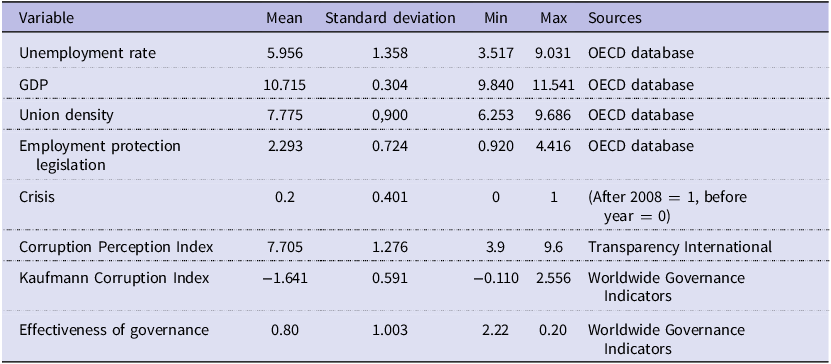
The selection of countries and the coverage period depend on the availability of data. Several variables in the database have substantial missing data over time. Table 1 provides the descriptive statistics and data sources for our sample. The dependent variable is the unemployment rate measured by the number of the unemployed aged fifteen to sixty-four. A set of control variables are introduced from OECD database: ALMP (per centage of gross domestic product [GDP]), annual real GDP data, the employment protection legislation, the number of adherents on union density and crisis period. ALMP is defined as public expenditure on the labour market policies measured (as per centage of GDP). The next control variable is the annual real GDP data which are used as an indicator of economic growth. The employment protection legislation which is another control variable is defined as the strictness of regulation on the use of temporary contracts, version 1 (1985–2008) of the stringency of employment protection legislation. Lastly, the union density presents the number of adherents, i.e. the number of workers affiliated to a trade union.
Descriptive statistics

We used also the data of governance indicators as moderator variable. Two measures of corruption are used. The first is Corruption Perception Index (CPI) which is defined as the abuse of a power delegated for private purposes. The index is assembled from surveys of business professionals, risk analysts, and academics, both within the countries assessed and internationally. According to Transparency International, the CPI compiles data from various sources to capture the insights of business people and country experts regarding the level of corruption in the public sector. The CPI is derived from thirteen data sources provided by twelve different institutions, capturing perceptions of corruption over the past two years (for more details see Corruption Perceptions Index, Reference Index2022). Data sources are standardised from a zero to 100 scale by adjusting each country score with the mean and standard deviation of each source from the baseline year. Specifically, the mean of each source is subtracted from each country score, and the result is divided by the standard deviation of that source. This standardisation ensures CPI scores are comparable across years since 2012. After standardisation, the scores are transformed to the CPI scale by multiplying them by the CPI standard deviation from 2012 (20) and adding the CPI mean from 2012 (forty-five) to fit the dataset to the zero to100 scale. Each country is scored on a scale from zero to 100, where zero indicates the highest level of perceived corruption and 100 indicates the lowest level (very clean). To calculate the CPI score for a country or territory, an average is computed from all standardised scores available for that country, provided that at least three sources have assessed it. The final CPI score is rounded to the nearest whole number. See Alfaro, Reference Alfaro2022; Corruption Perceptions Index, Reference Index2022, for more details.
In sum, the CPI is the most widely used index in corruption research and has gained international authority primarily due to its extensive sample size and the aggregation of surveys, which enhances its coherence and reliability. Additionally, it has gained practical significance because of the political influence it has acquired, not only from Transparency International but also from numerous other international organisations that reference it. On the other hand, this index has some limitations. The indicator offers a single score, but corruption is a complex and multifaceted phenomenon that can differ significantly across contexts, such as between rural areas and the business sector. In addition, the indicator focuses solely on corruption within the public sector of a given country and does not consider fraud by private companies. In advanced countries, where the public sector tends to be less prominent, this approach can skew perceptions and result in lower corruption indices. As a result, developing countries, which often have a more significant public sector presence, may appear to have higher levels of corruption.
The second is Kaufmann Corruption Index (KCI), which is one of the six aggregate indicators of the Worldwide Governance Indicators (WGI). It measures the perception of how public power is used for private gain, encompassing both petty and grand corruption. This includes the capture of the state by elites and private interests. To construct this measure, individual variables from each data source were used (for more details see Kaufmann et al., Reference Kaufmann, Kraay and Mastruzzi2010). The index data covers 200 countries and territories over the period from 1996 to 2022. It is sourced from over thirty think tanks, international organisations, non-governmental organisations, and private companies worldwide. These sources are chosen based on three key criteria: they are produced by credible organisations, offer comparable data across countries, and are regularly updated. This data reflects the diverse perspectives on governance from a wide range of stakeholders worldwide, including tens of thousands of survey respondents and experts. It measured on a scale of minus two point five (totally corrupt) to two point five (not corrupt). Although KCI is a relevant indicator for measuring corruption, it has some limitations. The WGI rely on perceptions rather than empirical data, primarily because accurately measuring governance is challenging. These limitations in comparing governance across countries underscore the need to supplement these indicators with more precise and objective data. Another significant criticism of the aggregative methodology used to define the WGI is that each data source focuses on different perspectives or concepts. For instance, in the context of control of corruption, various issues such as influence peddling, kickbacks, government corruption, political corruption, donations, and waiting times are all grouped under the same label. This broad approach may not accurately reflect a country’s specific perception of corruption, leading to the inclusion of issues that are not truly related to corruption but rather to other phenomena.
Econometric methodology
In this econometric analysis, we introduce a moderating variable to assess the effect of ALMP expenditures in relation to corruption on labor market outcomes. To achieve this, we conduct a moderation analysis to examine the interaction between the main independent variable (ALMP expenditure) and the moderating variable (CPI). Specifically, the CPI interacts with ALMP expenditure to influence the unemployment rate, which is the dependent variable in the model.
We used the generalised system method of moments (GMM-SYS). More specifically, we take into account the following statistical models:
 $$U{N_{it}} = U{N_{it - 1}} + \gamma ALM{P_{it}} + \beta {X_{it}} + \alpha CP{I_{it}} + {\mu _t} + {v_t} + {\varepsilon _t}$$
 $$U{N_{it}} = U{N_{it - 1}} + \gamma ALM{P_{it}} + \beta {X_{it}} + \alpha CP{I_{it}} + \gamma ALM{P_{it}}*\alpha CP{I_{it}} + {\mu _t} + {v_t} + {\varepsilon _t}$$
where $U{N_{it}}\;$
denotes the unemployment rate for country
$U{N_{it}}\;$
denotes the unemployment rate for country $i\;$
in period
$i\;$
in period $t$
,
$t$
, $U{N_{it - 1}}\;$
is the lagged dependent variable,
$U{N_{it - 1}}\;$
is the lagged dependent variable, $ALM{P_{it}}$
indicates the variable of interest,
$ALM{P_{it}}$
indicates the variable of interest, $X$
denotes the control variables, such as the employment protection legislation (EPL), union density (UD), crisis period, and GDP. Moreover,
$X$
denotes the control variables, such as the employment protection legislation (EPL), union density (UD), crisis period, and GDP. Moreover, $CP{I_{it}}$
denotes the CPI as moderator variable. The interaction term
$CP{I_{it}}$
denotes the CPI as moderator variable. The interaction term $\gamma ALM{P_{it}}*\alpha CP{I_{it}}$
is entered into the above specification to investigate desired differential effects.
$\gamma ALM{P_{it}}*\alpha CP{I_{it}}$
is entered into the above specification to investigate desired differential effects.
The usual econometric methods such as ordinary least squares (OLS), fixed effects and quasi-least squares do not provide us with the means to obtain efficient estimates. The GMM-SYS overcomes the problems of simultaneity bias, reverse causalityFootnote 1 , and possible omitted variables. It also makes it possible to control the specific individual and temporal effects. In particular, the problem of endogeneity of policies and institutions with respect to unemployment, linked to a reverse causality, can be neutralised by the use of techniques of instrumental variables generated by the lags of the variables. Furthermore, GMM-SYS has an additional comparative advantage: unlike traditional instrumental variable methods, it generates instruments from the explanatory variables themselves.
The validity of the GMM-SYS estimate relies on two key factors: the quality of the chosen instruments, evaluated using the Sargan test, and the assumption of no second-order autocorrelation in the errors of the difference equation (AR2). The Durbin-Wu-Hausman endogeneity test provides additional insights. Initially, we conduct a validity test of our instruments to address concerns about endogeneity. Since the number of instruments exceeds the number of endogenous variables, over-identification is clearly present. We employ the Sargan criterion to test for overidentifying restrictions. A significant Sargan test would reject the null hypothesis, which posits that the instruments are uncorrelated with the error term. If the null hypothesis is not rejected, the instruments are considered valid. Furthermore, we apply Arellano-Bond (Reference Arellano and Bond1991) statistics to test for first-order and second-order autocorrelation in the first differences of the residuals. The model is rejected if second-order autocorrelation is detected. To verify the exogeneity of the instruments, we also use the Durbin-Wu-Hausman test (Durbin, Reference Durbin1954; Wu, Reference Wu1974; Hausman, Reference Hausman1978).
Empirical results
The preliminary results
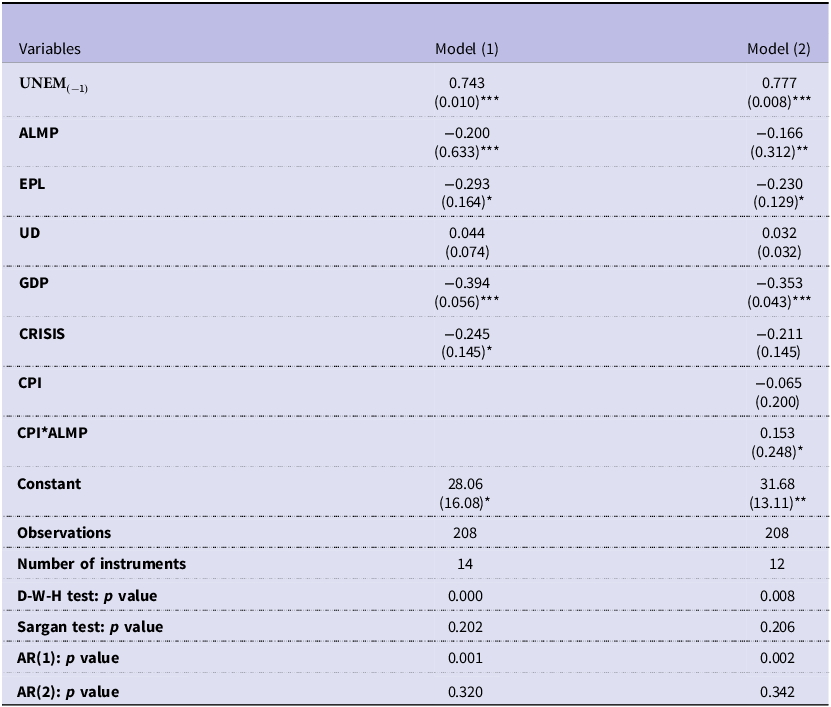
This article aims to explore how ALMP relate to unemployment, with a focus on the influence of corruption as an aspect of institutional quality in OECD countries. Due to structural changes in the labor market, ALMPs have increasingly been integrated into national governments’ efforts to combat unemployment. Specifically, the effect of ALMP expenditures, as estimated in Model 1, is significantly negative at the 1 per cent level in relation to the unemployment rate. An increase of 1 per centage point in ALMP expenditures is associated with a reduction in the unemployment rate by 0.20 per centage pointsFootnote 2 .
The effect of employment protection legislation on unemployment is not straightforward and largely relies on empirical research for its determinationFootnote 3 . Our results reflect this ambiguity, showing a negative but only marginally significant relationship (at the 10 per cent level). We have good reason to believe that employment protection legislation has more complex effects on the natural rate of unemployment. Because these regulations impose costs on companies that dismiss employees, firms typically agree to lower wages as compensation for these dismissal expenses. Simultaneously, insiders enjoy greater protection against the risk of dismissal, which enhances their bargaining power and allows them to negotiate higher wages. As a result of these wage pressures, companies respond by hiring less, which effectively lengthens the job search period for job seekers. As the direct and indirect costs of job searching rise, existing workers (insiders) are likely to accept lower wages to retain their positions, thus restoring equilibrium in the labor marketFootnote 4 .
Consequently, the overall impact of employment protection legislation on aggregate unemployment rates remains unclear. While this regulation helps decrease layoffs and job destruction, it also raises business costs and reduces job creation. Additionally, our econometric analysis highlights the growing critical discourse on evaluating employment protection legislation, focusing on issues of equity and justice. Blanchard and Tirole (Reference Blanchard and Tirole2003) present a theoretical framework for optimising employment protection, advocating for the use of legal regulations as a substitute for monetary incentives in managing labor market policies. The impact of union density on labor market performance – whether structural or cyclical – is challenging to determine due to significant variations in density and coverage across countries. Additionally, the role of centralisation and coordination of wage negotiations, which is often linked to lower unemployment rates, further complicates this relationship. As a result, our findings align closely with the conclusions drawn by the OECD. Our results notably reveal that GDP per capita has a statistically significant negative effect on the unemployment rate. Additionally, recent empirical research suggests that ALMPs are more effective in recessionary markets, as their effectiveness tends to decrease with higher GDP. Others, however, nuance this conclusion by suggesting that the effectiveness of ‘active’ labor market programmes is more determined by the specific characteristics of the implemented policies than by contextual factors like the phase of the economic cycle, the country’s income level, or its institutional capacity (Kluve, Reference Kluve2010; Abadia et al., Reference Abadia, Bencheikh, Borel and Gurgand2017; Burić and Mrnjavac, Reference Burić and Mrnjavac2017; Card et al., Reference Card, Kluve and Weber2018; Scarpetta, Reference Scarpetta2022). In fact, policies effectiveness depends on the type, design, coverage, and targeting of ALMPs and how they are implemented (e.g. planning, coordination, monitoring, evaluation, decision making). Indeed, the government must intensify its efforts to adapt the design of ALMPs and enhance the institutional capacity for their implementation, focusing on the comprehensiveness of services, support, and the development of implementation structures.
Durbin–Wu–Hausman test indicate that the effects of endogenous regressors on the estimates are significant and that instrumental techniques seem to be imposed. Sargan tests suggest that the overidentifying restrictions are valid and therefore, the statistics of the test do not allow us to reject the null hypothesis, implying that the instruments used in this study such as the lagged variable ( ${{\rm{U}}_{{\rm{it}} - 1}}$
) are appropriate. AR(1) and AR(2) tests indicate that the null hypothesis of the first-order autocorrelation test AR(1) (respectively of the second order autocorrelation test AR(2)) is that the errors in the first difference regression exhibit no first but rather a second order serial correlation. Therefore, AR (2) tests have no proof of autocorrelation at the standard significance levels and the statistics seems to be appropriate for the estimation of the first and the second order serial correlation tests, which provide good a statistical performance.
${{\rm{U}}_{{\rm{it}} - 1}}$
) are appropriate. AR(1) and AR(2) tests indicate that the null hypothesis of the first-order autocorrelation test AR(1) (respectively of the second order autocorrelation test AR(2)) is that the errors in the first difference regression exhibit no first but rather a second order serial correlation. Therefore, AR (2) tests have no proof of autocorrelation at the standard significance levels and the statistics seems to be appropriate for the estimation of the first and the second order serial correlation tests, which provide good a statistical performance.
The effect of the financial crisis (2007–2008) variable on the unemployment rate is ambiguous. Our results attested to this ambiguity insofar as they confirmed a negative but marginally significant relationship (at the level of 10 per cent). Labor markets in OECD countries react differently during a crisis, with varying levels of resilience. Although unemployment rates increased sharply at the beginning of the 2007 crisis across most OECD nations, the extent and nature of this rise differed significantly between countries (World Economic Forum, 2015, 2016, and 2017).
In the second model, we estimate the effect of the CPI as a proxy for corruption, which we found to be non-significant. According to (Carte and Russell, Reference Carte and Russell2003; Dawson, Reference Dawson2014; Borau et al., Reference Borau, El Akremi, Elgaaïed-Gambier, Hamdi-Kidar and Ranchoux2015), the significance of the link between the moderating variable and the dependent variable is not a necessary condition to attest to the existence of a moderating effect. In particular, we notice that the effect of ALMP expenditure is more attenuated than that found in Model 1. But the result that appealed to us the most relates to the interaction between ALMP and CPI which supports the conjecture by a positive moderating effect from the CPI on the relationship between ALMPs and the unemployment rate. This result suggests that CPI remains very harmful. The importance of institutional quality will be found at the heart of the interpretation of the results obtained. In this regard, corruption distorts the structure of public spending on defense and on general public services and decreases the share of spending on education, health, leisure, and culture. This shows that the increase of corruption (the fall of the CPI score) reduces spending on active employment policies, which is considered as social protection expenditure. In this perspective, good governance makes public resources more efficient, while bad governance reduces the accumulation of factors of production, which leads to wastage in the use of existing resources and retards growth and developmentFootnote 5 . Khan and Murova (Reference Khan and Murova2015) argue that the efficiency of public expenditure is crucial for the government, as it improves internal production and influences public policies. This efficiency impacts various services, including public security, education, health care, transportation, and welfare.
Robustness checks
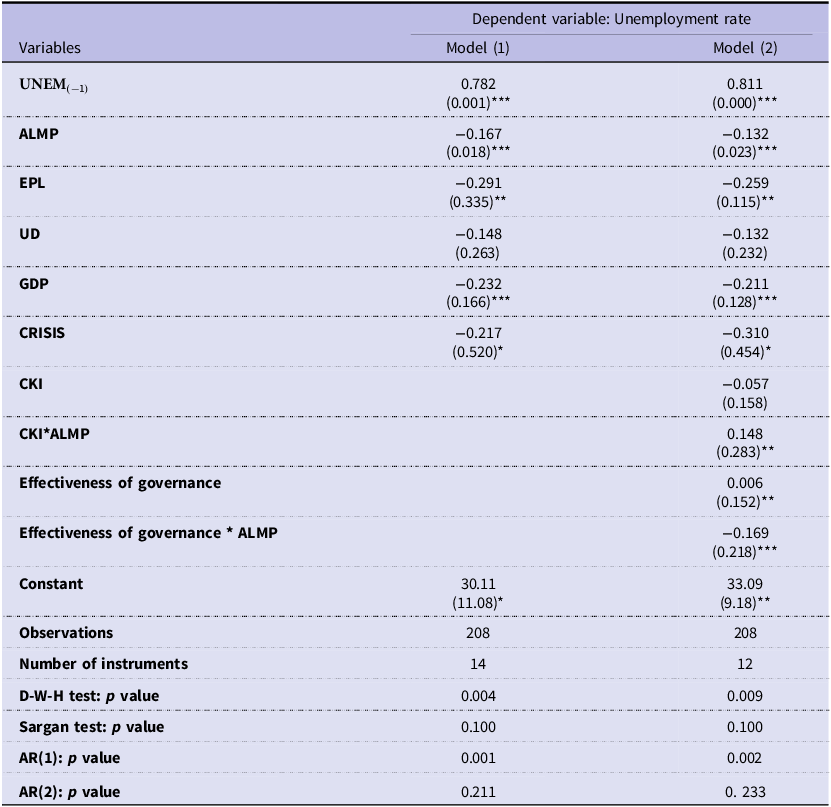
We incorporate an additional governance variable notably, the Kaufmann Corruption Index and the effectiveness of governance. Our findings in Table 3 are consistent with those presented in Table 2. It similarly appears that the results for most of the control variables remain consistent. The most of our earlier results hold for the change in the measurement of corruption. In this case, the interaction between ALMP and CKI, which supports the conjecture by a positive moderating effect from the CKI on the relationship between ALMPs and the unemployment rate. This finding confirms that higher levels of corruption contribute to reducing the effectiveness of ALMPs on the unemployment rate. Furthermore, we found that the interaction between the effectiveness of governance and ALMP expenditure is negative, this result supports the findings of the World Bank (2019), which highlighted that the effectiveness of a country’s government is crucial in evaluating the impact of public spending. Specifically, the efficiency of ALMP spending is closely linked to government effectiveness. Consequently, ALMP expenditures are more effective at reducing the unemployment rate in OECD countries with strong governance.
Baseline model

Standard-error is in parentheses. *, ** and *** denote significance at the 10, 5 and 1% level, respectively.
SGMM indicate the system generalised method of moments.
Durbin–Wu–Hausman test indicate that the effects of endogenous regressors on the estimates are significant and that instrumental techniques seem to be imposed. Sargan tests suggest that the overidentifying restrictions are valid and therefore, the statistics of the test do not allow us to reject the null hypothesis, implying that the instruments used in this study such as the lagged variable ( ${{\rm{U}}_{{\rm{it}} - 1}}$
) are appropriate. AR(1) and AR(2) tests indicate that the null hypothesis of the first-order autocorrelation test AR(1) (respectively of the second order autocorrelation test AR(2)) is that the errors in the first difference regression exhibit no first but rather a second order serial correlation. Therefore, AR (2) tests have no proof of autocorrelation at the standard significance levels and the statistics seems to be appropriate for the estimation of the first and the second order serial correlation tests which provide good a statistical performance.
${{\rm{U}}_{{\rm{it}} - 1}}$
) are appropriate. AR(1) and AR(2) tests indicate that the null hypothesis of the first-order autocorrelation test AR(1) (respectively of the second order autocorrelation test AR(2)) is that the errors in the first difference regression exhibit no first but rather a second order serial correlation. Therefore, AR (2) tests have no proof of autocorrelation at the standard significance levels and the statistics seems to be appropriate for the estimation of the first and the second order serial correlation tests which provide good a statistical performance.
Estimation results with alternative measures of the variables of interest

Conclusion
This paper analyses the impact of ALMP on unemployment rates, considering the effects of corruption and governance effectiveness. It employs the generalised method of moments (GMM-SYS) to assess a sample of sixteen OECD countries from 2005 to 2018. It seeks to explore how the quality of institutions, including governance effectiveness and control of corruption, influences the effectiveness of ALMP expenditure. Our estimation results show that ALMPs have led to a reduction in the unemployment rate. Furthermore, a significant and positive ALMP*CPI interaction term has come to attest to a positive moderating effect of the CPI on the relationship between public expenditure on ALMPs and the unemployment rate. This result suggest that corruption decreases the effects of ALMP on the unemployment rate. Moreover, in countries with high levels of corruption, tracking mechanisms do not function effectively. As a result, increased corruption related to ALMP expenditure can lead to changes in the unemployment rate. If corruption levels are high, an increase in ALMP expenditure can lead to higher unemployment. However, when corruption is low, the unemployment rate is less likely to rise with increased ALMP spending. On the alternative hand, the interaction terms between ALMP and effectiveness of government suggest that higher effectiveness of government enhances the effects of ALMP on the unemployment rate and provides more opportunity for jobseekers.
Based on these consequences, there are significant implications for economic policy. First, ALMPs seem to be an effective strategy for addressing unemployment in OECD countriesFootnote 6 . In fact, policies effectiveness depends on the type, design, coverage, and targeting of ALMPs and how they are implemented (e.g. planning, coordination, monitoring, evaluation, decision making). Indeed, the government must intensify its efforts to adapt the design of ALMPs and enhance the institutional capacity for their implementation, focusing on the comprehensiveness of services, support, and the development of implementation structures. Furthermore, to reduce long-term unemployment, policymakers should focus on either selecting ALMP measures that are well-suited to the current institutional structure of the labor market or modifying the institutional structure to improve the effectiveness of ALMP programmes.
Second, addressing corruption and improving government effectiveness can boost the impact of ALMPs on reducing the unemployment rate. Given that public spending is crucial for development, it is recommended that social spending and employment benefits be optimised to minimise the impact of corruption in OECD countries. This means that OECD governments should implement measures to improve and strengthen governance quality, ensuring robust and effective public institutions capable of achieving their set objectives. To improve the efficiency of active labor market policies, we further recommend focusing on enhancing institutional quality of governance. Good governance will positively impact national performance by fostering a business environment conducive to investment and entrepreneurship, strengthening labor market institutions to better guide and support young job seekers, and improving the employability of first-time job hunters. This, in turn, will boost economic growth and employment. This study is limited by its focus on only three mediating factors of institutional quality’s effect on unemployment. To broaden the analysis, future research should examine other transmission channels, such as an institutional quality index that integrates six measures from the WGI, to better understand how institutional quality influences labor market outcomes. Additionally, this analysis is limited to the direct effects of all ALMPs and does not take into account the effect of each type of ALMP (eg. training, incentives employment, direct job creation …) on unemployment. Also, labour market outcomes of interest are determined by a number of complex factors, such as the overall context of economic and social development, policy changes, labour market institutions, institutional quality, and so on. Thus, it is a challenge to establish the extent to which changes in such outcomes can be attributed to a particular intervention. So, the aim of impact evaluation is precisely to overcome this attribution difficulty by measuring the extent to which ALMP contribute to changes in the outcomes of interest. Therefore, other factors may be excluded (such as measures of the sectoral composition of economies; the basic education level of the national workforce) because their presence may not bias the results. In our study, we have considered ALMPs as the factor of interest that influences any changes in the measured outcomes over the given period. It should be noted that the selection of countries and the coverage period depend on the availability of data. Several variables in the database have substantial missing data over time. Within this sample, corruption levels do not vary significantly across highly developed countries, whereas the level and composition of ALMPs show greater variation. Future research could enhance the empirical data on this issue by distinguishing between different groups of countries. Specifically, it could decompose OECD countries into four social models based on geographical regions: Anglo-Saxon countries (Canada, Ireland, United Kingdom, and United States), Continental countries (Austria, Belgium, France, Luxembourg, Germany, and the Netherlands), Scandinavian countries (Denmark, Finland, Norway, and Sweden), and Mediterranean countries (Greece, Italy, Portugal, and Spain).

 Open access

