





1. Introduction
Orientational metaphors, expressed in language by metaphorical linguistic expressions, are defined as utterances in which concepts are spatially related to each other, for instance, in UP versus DOWN, IN versus OUT, FRONT versus BACK, or ON versus OFF manners. More specifically, they are ‘metaphorical concepts that involve spatial relationship that are binary-structured (such as UP-DOWN, IN-OUT, ON–OFF, (…)’ (Kóczy, Reference Kóczy2018, p. 116). Importantly, orientational metaphors have been found to communicate valence, whereby UP metaphors (e.g., ‘Her hopes are high’) prototypically represent positively valenced meanings, while DOWN metaphors (e.g., ‘Her qualifications are low’) represent negative utterances (e.g., Hampe & Grady, Reference Hampe and Grady2005; Krzeszowski, Reference Krzeszowski, Geiger and Rudzka-Ostyn1993). This valence–space association aligns with the assumption of embodied cognition, holding that affective words are grounded in the physical world and the body-environment interactions (e.g., Lakoff & Johnson, Reference Lakoff and Johnson1980; Xie et al., Reference Xie, Wang and Chang2014). Yet, metaphors that seem to violate this valence–space congruency are also found in everyday language (e.g., ‘Prices of milk are increasing’ – BAD IS UP; ‘Cancer mortality is on decline’ – GOOD IS DOWN). What is more, with the abundance of such linguistic expressions in everyday language use, it remains unclear how such an incongruency between valence and space influences metaphor comprehension, and whether the same pattern of results could be observed for both the native (L1) and non-native languages (L2). Thus, the aim of this study is to test how Polish (L1) – English (L2) bilinguals process L1 and L2 orientational metaphors when these either adhere to or violate the valence–space congruency, as reflected in accuracy rates and reaction time (RT) patterns.
Valence–space metaphoric associations have been addressed by the Conceptual Metaphor Theory (CMT), which states that metaphors are mechanisms of the mind (Lakoff & Johnson, Reference Lakoff and Johnson1980; see also Dyrmo, Reference Dyrmo2023; Kövecses, Reference Kövecses2017, Reference Kövecses2020), manifested in various modalities, for example, in spoken and written language (e.g., Cameron Reference Cameron2007; Fabiszak, Reference Fabiszak2007; Musolff, Reference Musolff2006, Reference Musolff2016) and gestures (e.g., Cienki, Reference Cienki, Cienki and Müller2008, Reference Cienki2016; Dyrmo, Reference Dyrmo2022; Jelec, Reference Jelec2014). One of the most extensively discussed tenants of CMT is that metaphorical meaning emerges from the embodied experiences of the world (e.g., Bergen, Reference Bergen, Dąbrowska and Divjak2019; Gibbs, Reference Gibbs2006, Reference Gibbs2017; Górska, Reference Górska2009). For instance, whenever we say that ‘we are on cloud nine’ to express happiness, we use a lexical reflection of the conceptual metaphor GOOD IS UP. Consequently, as stated by Gibbs (Reference Gibbs2017, p. 145), ‘just as people speak metaphorically because of recurring bodily and cultural experiences, so too they think metaphorically in specific ways, partly because of the guiding force of metaphorical language’. Furthermore, just like our behavior is affected by our feelings, so are metaphoric meanings influenced by the valence they communicate (Müller, Reference Müller and Hampe2017), which is particularly important in the context of the axiological evaluations of metaphorical meanings. These evaluations, in the vein of CMT, are often carried out with the use of orientational metaphors, namely those signaling a particular axiological stance on the said issue and expressing it in spatial terms.
Thus far, much scholarly attention has been devoted to studying orientational metaphors in the monolingual context. Early studies in the field suggested, for example, that mismatching space–valence stimuli prompts participants to react differently than when they are presented with matching space–valence stimuli (e.g., Crawford et al., Reference Crawford, Margolies, Drake and Murphy2006; Sopory, Reference Sopory2005). For Crowford et al. (Reference Crawford, Margolies, Drake and Murphy2006), who investigated the way space placement of visual stimuli modulates memory, the intrinsic associations of positive concepts with UP and negative concepts with DOWN suggest ‘the metaphorical mediation of affect’, which is a direct consequence of human sensory-motor experience (Crawford et al., Reference Crawford, Margolies, Drake and Murphy2006, p. 1166). They have investigated the way the placement of negative and positive visual stimuli influences memory resources, and found that negatively valenced visual stimuli are reported by the study participants to be lower than originally presented, with the same effect present for positively valenced visual stimuli but in the opposite direction.
This metaphorical mediation of affect was further attested by, for instance, Casasanto (Reference Casasanto2009) who examined how right- versus left-handed participants comprehend GOOD IS RIGHT and BAD IS LEFT metaphors. To this end, left- and right-handed participants were asked to draw a picture of an animal in either a left-side or right-side box, depending on where they thought the bad and the good animal would fit best. The aim of the study was thus to investigate the relationship between the handedness and the perception of emotion concepts by checking where ‘a good animal’ and ‘a bad animal’ are assigned (left versus right). The results showed that participants were more likely to assign a prototypically good animal to their dominant side, which therefore indicates that handedness has an influence on semantic processing, as the mappings that participants generated were in accordance with their dominant side. In another study, Meier and Robinson (Reference Meier and Robinson2004) tested the relationship between the placement of a verbal stimulus on the screen (i.e., upper or lower part of the screen) and the perceived valence associated with the position. Participants were instructed to judge whether the presented words were positive (e.g., hero) or negative (e.g., liar), while randomly assigned to a top-screen or bottom-screen position. The results showed that words denoting positive meanings elicited faster reactions when placed in the upper position, which indicates that the valence–space congruency (GOOD-UP/BAD-DOWN) facilitated ‘affective judgment’ (Meier & Robinson, Reference Meier and Robinson2004, p. 246), lending more direct evidence for the relationship between affective meanings and spatial distribution of words. On a similar note, Castaňo et al. (Reference Castaño, Gilboy, Feijóo, Serrat, Rostan, Hilferty and Cunillera2018) measured RTs to test how the location of the response buttons influences metaphor interpretation. Participants’ task was to, similarly to Meier and Robinson’s study, judge the affective value of negatively and positively valenced adjectives (e.g., lucky versus bored), with the placement of the response button being manipulated (the up-placed button or a down-placed button). The results revealed a facilitation effect in the congruent conditions (the up-button: positive meaning; the down-button: negative meaning), as reflected in faster RTs. Altogether, experimental approaches to valence–space association have generated consistent evidence for the claim that ‘[p]hysical verticality is one of the most basic and structural human experiences, so it is of theoretical and practical relevance to study what it entails and which metaphors it holds’ (Cian, Reference Cian2017, p. 456).
The role of valence and space in metaphor comprehension was also investigated by Spatola et al. (Reference Spatola, Santiago, Beffara, Mermillod, Ferrand and Ouellet2018), who asked their participants to make valence (positive or negative) judgments regarding the presented sentences by choosing the left or right response key. The results showed that the stimuli were perceived as more negative when participants were asked to respond to the negative utterances with the left key, and, at the same time, more positive when responded to with the right key, which therefore confirmed the left-negative and right-positive congruency effects. Such effects thus point to the automatic activation of metaphorical mappings and further corroborate the important role of both valence and space dimensions in metaphor comprehension.
Interestingly, the valence–space effect was also observed in neuroimaging studies. Namely, by examining neural oscillations evoked in response to valence–space congruent and incongruent metaphors, Tse et al. (2021) found that the processing of valence–space metaphorical associations engages more taxing cognitive mechanisms, including inhibition, attention, working memory and semantic processes. On a similar note, Xie et al. (Reference Xie, Wang and Chang2014) employed an event-related potential analysis and observed a facilitatory effect of positive words in discriminating upper arrows, and of negative words in discriminating lower arrows. Such results therefore additionally suggest that affective stimuli activate spatial information, which in turn facilitates attention allocation toward corresponding locations. More recent studies have also investigated the way spatial concepts carry valenced meanings. In Tse et al. (Reference Tse, Huang, Zeng, Zhou and Chan2021), the spatial organization of valenced meanings has been proven to influence reaction times. It turned out that positively valenced words prompt faster reaction times than negatively valenced words when presented in a spatial position prototypically associated with positive concepts, namely, the up position. The same is true for those concepts that convey negative valence: they were reacted to faster whenever they appeared at the bottom of the screen. A recent study by Urlich et al. (Reference Ulrich, De La Vega, Eikmeier, Günther and Kaup2023) provides further support for the space–valence congruency. The researchers investigated the way valence is dependent on time concepts and found that present-positive and past-negative pairings were reacted to faster than those of the reverse patterns, suggesting that spatial associations also engage extralinguistic resources, likely drawn from the embodied experience of time and space.
Nonetheless, so far, the comprehension of orientational metaphors has been little tested in the bilingual context, even though there is a rapidly developing interest in the interplay between metaphor processing and bilingualism. Previous studies have suggested that there is a change in conceptualization strategies depending on the bilinguals’ language used. For instance, in one of the studies, Lai and Boroditsky (Reference Lai and Boroditsky2013) examined the influence of time-related metaphors to the perception of time among Mandarin-English speakers, who were asked to choose one of the time-related answers: whether the meeting was moved from Wednesday to Friday (ego-moving perspective: the conceptualizer is moving through time) or from Wednesday to Monday (time-moving perspective: the time is moving and the conceptualizer is stationary). The results showed that Mandarin speakers tend to take a different time-oriented perspective than English speakers, namely that they take the time-moving perspective more often, thus indicating that metaphorical conceptualizations of time employed by bilinguals are different from monolingual speakers. These results might be interpreted in line with CMT as indicative of linguistically encoded conceptualization patterns varying across linguistic backgrounds and cultures (cf. Huang & Tse, Reference Huang, Tse, Ardila, Cieślicka, Heredia and Rosselli2017). Furthermore, previous psycholinguistic experiments have pointed to a decreased sensitivity to metaphoric meanings in the non-native relative to the native tongue (Jankowiak et al., Reference Jankowiak, Rataj and Naskręcki2017, Reference Jankowiak2019; Mashal et al., Reference Mashal, Borodkin, Maliniak and Faust2015). At the same time, however, it has been claimed that the ability to arrive at a correct figurative meaning might be modulated by L2 proficiency level, with more advanced L2 learners being capable of interpreting figurative language as effectively as native language users (Cieślicka, Reference Cieślicka2006; Heredia & Cieślicka, Reference Heredia, Cieślicka, Heredia and Altarriba2014; Jankowiak, Reference Jankowiak2019; Matlock & Heredia, Reference Matlock, Heredia, Heredia and Altarriba2002; Zhao et al., Reference Zhao, Yu and Yang2014).
The aim of this study is to examine whether and how the valence–space congruency effect is modulated by the language of operation. To this end, highly proficient unbalanced Polish (L1) – English (L2) bilinguals performed a metaphoricity judgment task in response to L1 and L2 sentences representing valence–space congruent (i.e., GOOD-UP; BAD-DOWN) and incongruent (i.e., GOOD-DOWN; BAD-UP) metaphorical sentences, as well as literal utterances (a control condition). In line with previous monolingual research on valence–space metaphoric associations (e.g., Castaňo et al., Reference Castaño, Gilboy, Feijóo, Serrat, Rostan, Hilferty and Cunillera2018; Meier & Robinson, Reference Meier and Robinson2004; Spatola et al., Reference Spatola, Santiago, Beffara, Mermillod, Ferrand and Ouellet2018), we expected higher accuracy rates and faster RTs for the valence–space congruent relative to incongruent sentences in L1. In L2, on the other hand, we hypothesized that the decreased sensitivity toward metaphoric meanings in L2 (e.g., Jankowiak, Reference Jankowiak2019; Jankowiak et al., Reference Jankowiak, Rataj and Naskręcki2017; Mashal et al., Reference Mashal, Borodkin, Maliniak and Faust2015) might mask the space–valence congruency effect, as a result of which there might be no modulations in RTs and accuracy rates as dependent on the congruency effect. This would indicate that linguistically encoded conceptualization patterns might vary across linguistic backgrounds (i.e., L1 or L2; cf. Huang & Tse, Reference Huang, Tse, Ardila, Cieślicka, Heredia and Rosselli2017).
2. Methods
2.1. Participants
Our original sample included 60 Polish (L1) – English (L2) bilingual speakers; yet, 3 of them were excluded from the analyses due to the lack of correct responses in at least one condition. The final sample therefore consisted of 57 native speakers of Polish (39 females, 15 males, 2 nonbinary and one person that preferred not to reveal their gender) aged 20–34 (M = 23.96 years, 95% CI [23.23, 24.69]), who were students or graduates of English Studies at the Faculty of English, Adam Mickiewicz University, Poznań. Consistent with de Groot (Reference De Groot2010), participants were classified as highly proficient unbalanced late bilinguals who had not lived in the L2 (English) environment and had acquired their L2 in an instructional yet immersive learning context (see Table 1). Participants were randomly divided into two language groups: L1 (n = 29) and L2 (n = 28). Scores from an online Handedness Questionnaire (Cohen, Reference Cohen2008) based on the Edinburgh Inventory (Oldfield, Reference Oldfield1971) indicated right-hand preference for all participants but one (M = 86.25, 95% CI [82.40, 90.09]). All participants had normal/corrected-to-normal vision and no language or attention disorders. For their participation, participants received a gift card of 50 PLN.
Participants’ linguistic profiles (means with 95% confidence intervals)
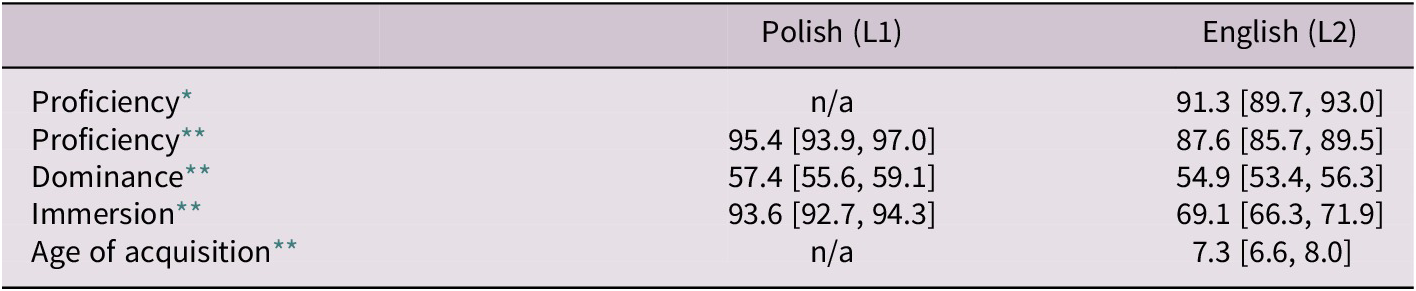
* LexTALE (Lemhöfer & Broersma, Reference Lemhöfer and Broersma2012; percentages).
** Language History Questionnaire 3.0 (Li et al., Reference Li, Zhang, Yu and Zhao2020, as translated into Polish by Naranowicz & Witczak): the proficiency, dominance and immersion scores (percentages); age of acquisition (years).
2.2. Materials
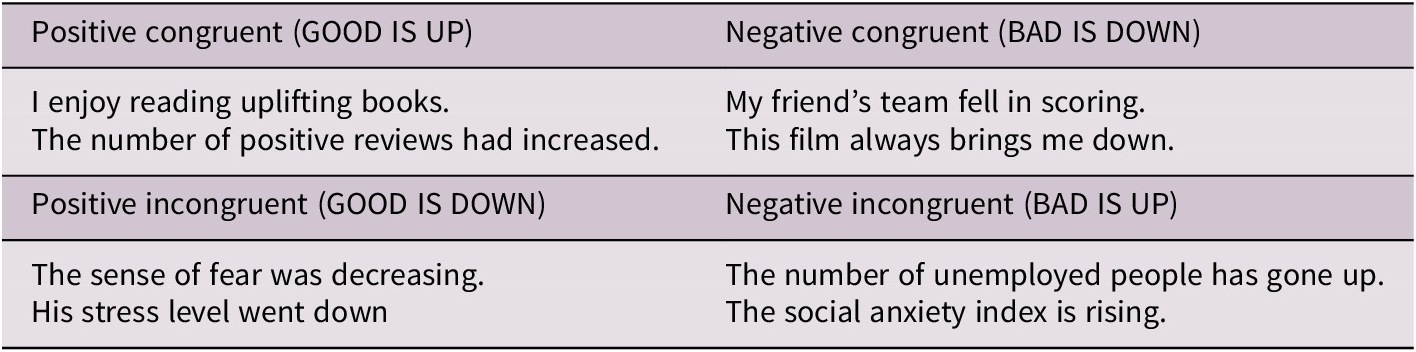
The materials used in the study included 40 positively and 40 negatively valenced orientational metaphors in each language (Polish and English). All the metaphors were conventional in their nature. Within each valence category, half of the metaphors were congruent with the schematic component of GOOD IS UP and BAD IS DOWN (i.e., positive-up; negative-down) and the other half were incongruent (i.e., positive-down; negative-up). The mean length of the sentences was standardized (M = 5.4, SD = 1.2 for Polish sentences; M = 6.6, SD = 1.08 for English sentences). A larger number of words in Polish compared to English metaphors were due to Polish having a more synthetic structure than English, as reflected in the higher morpheme-per-word ratio. Specifically, due to a high degree of inflection in Polish, subject pronouns are often omitted, unlike in English (Jankowiak & Korpal, Reference Jankowiak and Korpal2018). Table 2 provides examples of the stimuli used in this study.
Examples of experimental stimuli
English sentences were translation equivalents of Polish sentences. Even though metaphorical meanings vary cross-culturally and cross-linguistically (e.g., Kövecses, Reference Kövecses2005, Reference Kövecses2015), in our study, we decided to deploy close semantic equivalents to keep the sentences as similar in meaning as possible, as similar axiological conceptual mechanisms have been found to be present largely irrespective of language (see Winter, Reference Winter2014 for a multimodal analysis). Consequently, the generated Polish sentences were translated into English by three independent Polish native speakers.
Importantly, all the sentences were semantically and syntactically simple, therefore ensuring that the cognitive load required for processing each sentence was minimized and consistent across conditions. This was confirmed by their readability indices (Jasnopis for Polish sentences and the Flesch Reading Ease Score for English sentences). In Polish, the readability index for equaled M = 3.2, 95% CI [2.06, 4.34] (1 – very easy; 7 – very difficult), thus confirming that the sentences were relatively easy. Similar, in English, the readability index equaled M = 61.38, 95% CI [51.52, 71.24] (0 – extremely difficult; 100 – extremely easy), also showing that the sentences were relatively easy to comprehend. By developing sentences with low semantic and syntactic complexity, we aimed to create a uniform baseline that would allow us to more accurately attribute any observed differences in the behavioral measures to the space–valence congruency status or the affective load conveyed by the sentences (i.e., positive versus negative).
Before the main experiment, the Polish stimuli were evaluated by Polish native speakers on sentence metaphoricity and valence. Respondents were recruited from social media platforms, research mailing lists, language forums and from among students of the Faculty of English, Adam Mickiewicz University, Poznań. Altogether, 103 volunteer participants (76 women, 24 men, 3 nonbinary; Mage = 22.75, SD = 5.29) took part in the surveys, whose education varied from high school to higher education.
The normative studies were conducted using an online survey-development cloud-based software that enabled designing web-based surveys and collecting survey responses. For the normative tests, the sentences were counterbalanced and divided into four surveys. First, participants read the instructions and were asked to evaluate each sentence on either its metaphoricity level on a 7-point rating scale from 1 (very literal) to 7 (very metaphorical) or valence on a 7-point rating scale from 1 (very negative) to 7 (very positive). The instructions were presented together with examples and explanation of the scale. After evaluating all the sentences, the respondents were asked to fill out demographic questions. The results of the two scales were analyzed by means of repeated measures ANOVAs with 2 Valence (Positive versus Negative) × 2 Congruency (Congruent versus Incongruent) as within-subject factors.
The analysis conducted on metaphoricity ratings revealed a main effect of congruency, F(1, 45) = 83.47, p < .001, ηp2 = .65, with higher metaphoricity ratings for congruent (M = 4.90, SE = .17) than incongruent (M = 3.95, SE = .18) sentences. Importantly, such values indicate that the metaphors were evaluated as only slightly metaphorical, confirming that they were conventional in their nature. In contrast, literal (filler) sentences were rated as highly literal (M = 1.57, SD = 1.04).
The analysis conducted on valence ratings revealed a main effect of valence, F(1, 56) = 318.13, p < .001, ηp2 = .85, with positive sentences assessed as more positive (M = 5.64, SE = .09) than negative (M = 2.40, SE = .11) sentences.
2.3. Procedure
The procedures applied in the experiment were in accordance with the ethical guidelines for research with human participants, as recommended and followed by Adam Mickiewicz University, Poznań. Participants were informed about the procedures of the experiment and were asked to sign the informed consent form before the experiment began, in accordance with the Declaration of Helsinki.
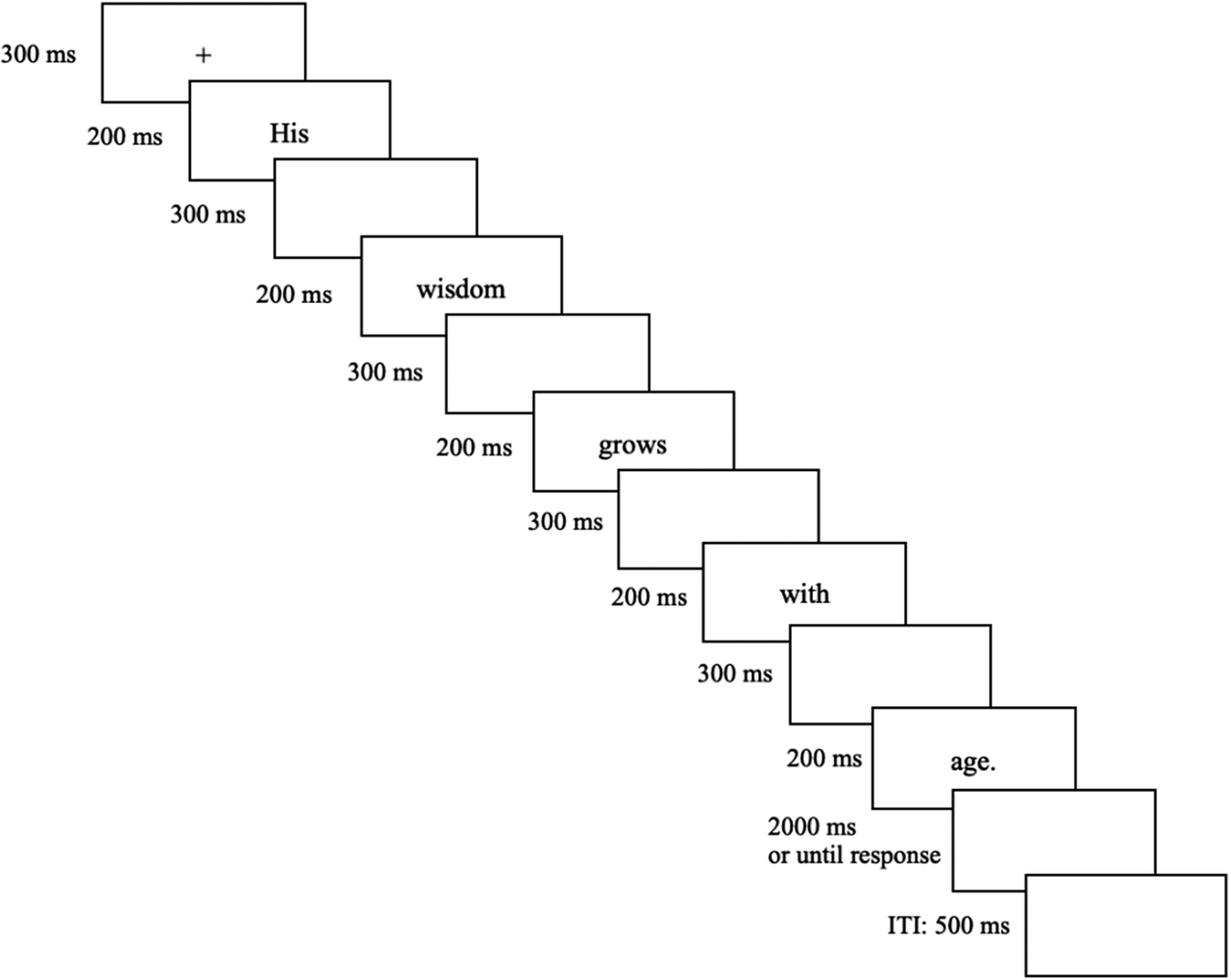
The experiment was conducted in the Language and Communication Laboratory at the Faculty of English, Adam Mickiewicz University, Poznań. Participants were asked to perform a metaphoricity judgment task, whereby they decided whether the sentences displayed on a computer screen were metaphorical or literal (i.e., a binary metaphoricity decision task). Given the nature of the task, in addition to the experimental (metaphoric) sentences, literal (filler) sentences were included in the experiment proper. Sentences were randomly displayed word-by-word, with the final word of each sentence ending with a full stop, upon the presentation of which, participants were instructed to make their decision using the corresponding keys, whose designation was counterbalanced across participants. The participants used arbitrarily assigned keys (‘P’ and ‘Q’ on the keyboard) so as not to prompt any left–right or front-back associations with the presented stimuli. The time sequence of stimuli presentation is depicted in Figure 1.
Time sequence of stimuli presentation.
Every participant was presented with 160 sentences (40 metaphorical congruent, 40 metaphorical incongruent and 80 literal filler) in Polish or English. The assignment of language blocks was randomized across participants.
3. Results
Both accuracy ratings and RTs were analyzed using repeated measures ANOVAs, with 2 Valence (Positive versus Negative) × 2 Congruency (Congruent versus Incongruent) as within-subject factors and 2 Language (L1: Polish versus L2: English) as a between-subject factor.
3.1. Accuracy rates
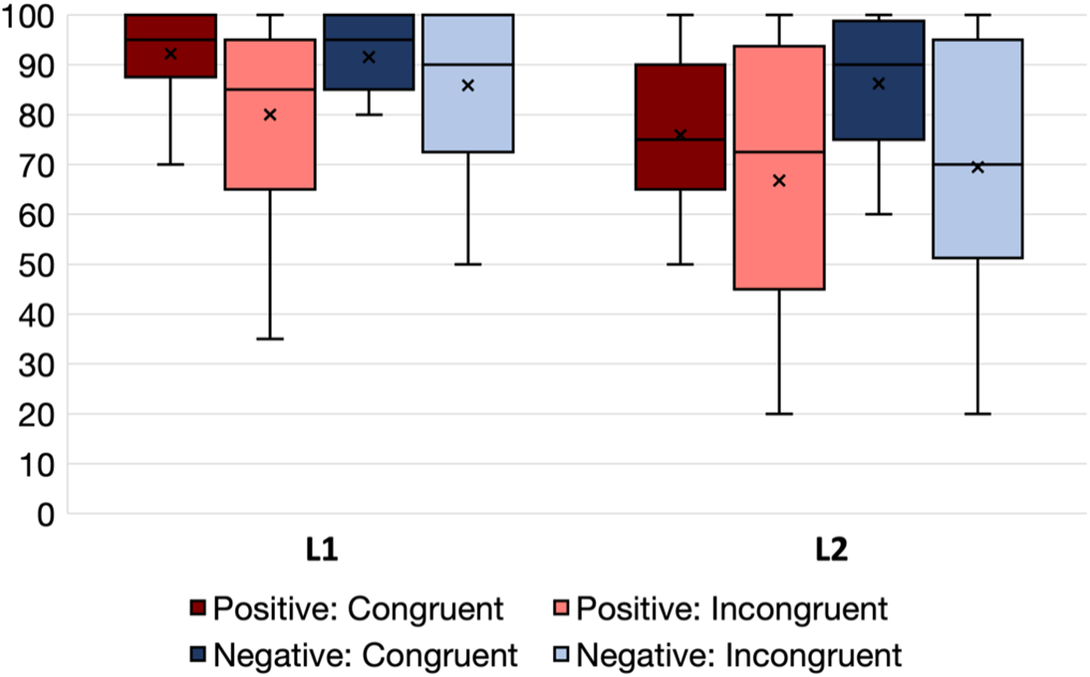
Accuracy ratings are reported as the percentage of correct responses observed in the metaphoricity judgment task. For statistical analyses, the accuracy rates were arsin-transformed. The results revealed a main effect of valence, F(1, 55) = 17.69, p < .001, ηp2 = .24, with higher accuracy rates for negative (M = 83.3, SE = 2.0) than positive (M = 78.7, SE = 2.2) sentences. Then, the analysis showed a main effect of congruency, F(1, 55) = 35.24, p < .001, ηp2 = .39, with higher accuracy rates for congruent (M = 86.5, SE = 1.4) than incongruent (M = 75.5, SE = 2.9) sentences. Also, we observed a main effect of language, F(1, 55) = 10.60, p = .002, ηp2 = .16, with higher accuracy rates for Polish (L1) (M = 87.4, SE = 2.9) than English (L2) (M = 74.6, SE = 3.0) sentences. Finally, an interaction was found between valence, congruency and language, F(1, 55) = 9.58, p = .003, ηp2 = .15. Post hoc analyses were conducted separately for each language.
In Polish (L1), the analysis showed only a main effect of congruency, F(1, 27) = 17.33, p < .001, ηp2 = .38, with higher accuracy rates for congruent (M = 91.9, SE = 1.5) than (M = 82.9, SE = 3.3) incongruent sentences.
In English (L2), the analysis showed an interaction between valence and congruency, F(1, 28) = 12.90, p = .001, ηp2 = .32, demonstrating higher accuracy rates for congruent (M = 86.2, SE = 2.4) than incongruent (M = 69.5, SE = 4.7) sentences, yet only of negative valence (p < .001). In the case of positive sentences, there was no statistically significant difference between congruent (M = 75.9, SE = 2.8) and incongruent (M = 66.8, SE = 5.1) sentences (p = .122). Furthermore, the analysis conducted on English (L2) revealed a main effect of valence F(1, 28) = 21.28, p < .001, ηp2 = .44, with higher accuracy rates for negative (M = 77.9, SE = 3.4) than positive (M = 71.3, SE = 3.8) sentences. In addition, a main effect of congruency was found, F(1, 28) = 17.87, p < .001, ηp2 = .40, with higher accuracy rates for congruent (M = 81.1, SE = 2.4) than (M = 68.1, SE = 4.8) incongruent sentences (Figure 2).
Mean accuracy rates (%) for positive and negative congruent and incongruent metaphors in L1 and L2 (with CI 95%, mean markers and median line).
3.2. Reaction times
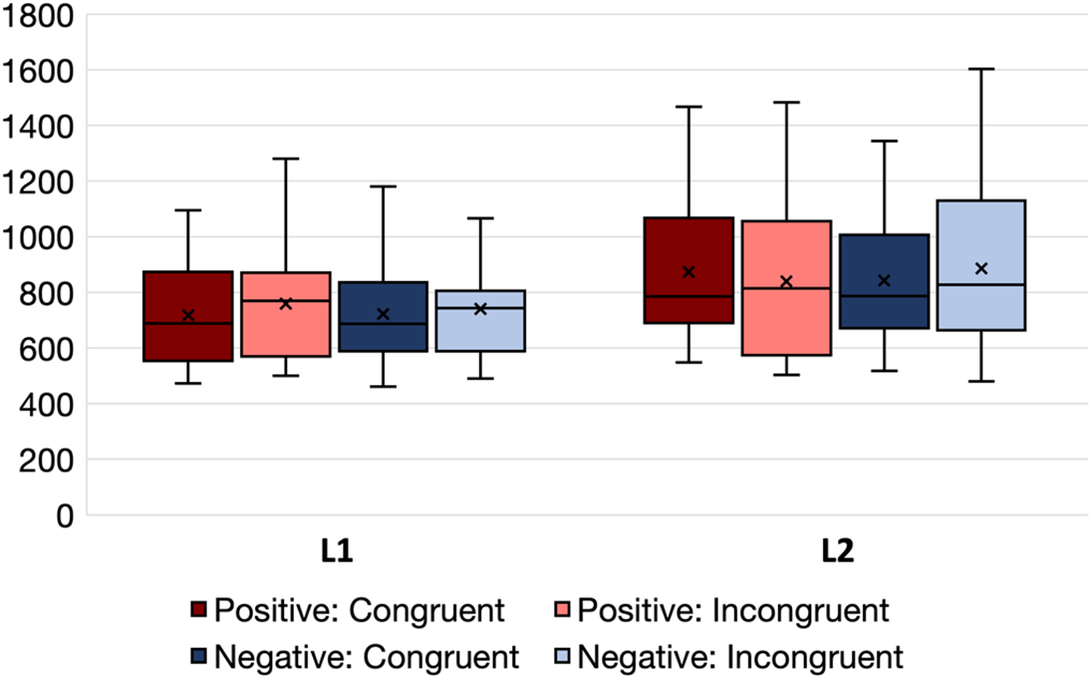
The RT analyses revealed a marginally significant main effect of congruency, F(1, 55) = 3.69, p = .06, ηp2 = .06, with shorter RTs for congruent (M = 788.96, SE = 28.83) than incongruent (M = 806.37 SE = 32.77) sentences. Also, we observed a main effect of language, F(1, 55) = 4.22, p = .045, ηp2 = .07, with shorter RTs for Polish (L1) (M = 734.97, SE = 42.80) than English (L2) (M = 860.36 SE = 43.55) sentences. Finally, an interaction was found between valence, congruency and language, F(1, 55) = 8.31, p = .006, ηp2 = .13. Post hoc analyses were conducted separately for each language.
In Polish (L1), the analysis showed a main effect of congruency, F(1, 28) = 7.11, p = .013, ηp2 = .20, with shorter RTs for congruent (M = 720.17, SE = 34.24) than (M = 749.77, SE = 36.00) incongruent sentences.
In English (L2), the analysis showed an interaction between valence and congruency, F(1, 27) = 10.79, p = .003, ηp2 = .29, demonstrating shorter RTs for congruent (M = 842.17, SE = 45.24) than incongruent (M = 886.25 SE = 56.53) sentences, yet only of negative valence (p = .022). In the case of positive sentences, there was no statistically significant difference between congruent (M = 873.34, SE = 50.11) and incongruent (M = 839.69, SE = 54.92) sentences (p = .089), p > .05 (Figure 3).
Reaction times (ms) for positive and negative congruent and incongruent metaphors in L1 and L2 (with CI 95%, mean markers and median line).
4. Discussion
The present RT study aimed to investigate the relationship between space and valence in bilingual orientational metaphor comprehension. To this end, Polish (L1) – English (L2) speakers were presented with space–valence congruent and incongruent orientational metaphors in either L1 or L2 and performed a metaphoricity judgment task. In line with our hypotheses, we observed that space–valence congruency affects positively and negatively valenced sentences in a language-dependent manner.
First, the accuracy rate results revealed a valence effect, whereby negatively valenced sentences were evaluated more accurately than positively valenced ones. This effect aligns with the well-documented negativity bias assumption (Kanouse & Hanson, Reference Kanouse, Hanson, Jones, Kanouse, Kelley, Nisbett, Valins and Weiner1972), which posits that unpleasant stimuli demand heightened attentional resources due to their perceived threat (Ito & Cacioppo, Reference Ito and Cacioppo2005; Vieitez et al., Reference Vieitez, Haro, Ferré, Padrón and Fraga2021; Vogt et al., Reference Vogt, De Houwer, Koster, Van Damme and Crombez2008). Consequently, negative stimuli tend to engage more attention and undergo more thorough analysis, thus facilitating their perceptual detection (automatic vigilance hypothesis; Pratto & John, Reference Pratto and John1991; Taylor, Reference Taylor1991; Wentura et al., Reference Wentura, Rothermund and Bak2000). Here, the accuracy rate results replicate this effect within the context of a metaphorical judgment task, suggesting that the negativity bias effect extends beyond affective domains into non-affective tasks (Gao et al., Reference Gao, Wedell and Shinkareva2022). Therefore, it seems that our participants subconsciously evaluated the affective value of the presented sentences, despite its task-irrelevance. Consequently, such a more extended analysis of negatively valenced stimuli facilitated participants’ decision-making processes, leading to higher accuracy rates, irrespective of the language of operation (L1 or L2).
Second, the results showed an interaction between valence, congruency and language, whereby the interplay between valence and congruency was modulated by the language of operation (L1 or L2). Specifically, in both L1 and L2, we observed a main effect of congruency, such that positive-up and negative-down metaphors were easier and faster to process relative to the sentences that violated such congruency patterns (i.e., positive-down and negative-up sentences). These results align with the previous experimental studies (e.g., Castaňo et al., Reference Castaño, Gilboy, Feijóo, Serrat, Rostan, Hilferty and Cunillera2018; Meier & Robinson, Reference Meier and Robinson2004; Spatola et al., Reference Spatola, Santiago, Beffara, Mermillod, Ferrand and Ouellet2018) showing that valence-congruent stimuli are conceptually privileged over noncongruent stimuli, as a result of which they are processed faster and more accurately. Moreover, such findings indicate that the well-entrenched, prototypical metaphorical mappings of GOOD IS UP and BAD IS DOWN are cognitively privileged over the less well-entrenched and prototypical mappings of a reverse pattern. In accordance with CMT (e.g., Kövecses, Reference Kövecses2005, Reference Kövecses2014), our results also show that this effect is not modulated by one language, as these metaphorical mappings have already been attested both in English (e.g., Hampe & Grade, Reference Hampe and Grady2005; Lakoff & Johnson, Reference Lakoff and Johnson1980) and in Polish (e.g., Muszyński et al., Reference Muszyński, Durlik and Bukowski2014; Rutkowski, Reference Rutkowski2017).
Importantly, the obtained results may point toward a more grounded view of the human conceptual system, in accordance with the grounded cognition approach (e.g., Barsalou, Reference Barsalou2010, Reference Barsalou2023), which states that concepts are not amodal but instead they are grounded in the way people interact with the world. Grounded cognition postulates that ‘cognition emerges from grounding classic cognitive mechanisms in the perceptual modalities, body, physical environment and social environment’ (Barsalou, Reference Barsalou2010, p. 2), and some of them have been made visible in our study. The fact that the congruent space–valence pairings elicited faster responses suggests the prototypical character of GOOD IS UP and BAD IS DOWN primary metaphorical mappings. These mappings are theorized to emerge from the embodied experiences of space and an intrinsic mental association between spatial orientation and valence. As has been frequently noticed in cognitive linguistic literature (e.g., Grady, Reference Grady1997, Reference Grady2005), primary metaphorical mappings (or primary metaphors), ‘are motivated by tight correlations in experience, rather than features shared between source and target’ (Grady, Reference Grady2005, p. 1600). These primary metaphors come directly from cognitive primitives or image schemas. They ‘structure visual perception, motor action and mental images and they are used in the semantics of natural language’ (Lakoff, Reference Lakoff2012, p. 3), such as UP and DOWN, and serve as the basic conceptual structures in the metaphor comprehension and recognition. These basic cognitive mechanisms seem to also directly influence metaphor processing in L2, as shown by the results obtained in this study, which indicate that figurative language processing is modulated by the way these basic spatial concepts are contextually embedded with valence (congruently or not).
In L2, alongside the main effects of valence and congruency elaborated above, we also found an interaction between valence and congruence. Notably, we observed higher accuracy rates and shorter response times for congruent than incongruent sentences, yet only of negative valence. This suggests that the congruency effect was more pronounced when processing content requiring greater cognitive resources, such as negative sentences. We consequently interpret this interaction as evidence of a dynamic interrelation between spatial and valence processing, influenced by the depth of linguistic analysis. Specifically, the extended semantic analyses required by negative sentences (Taylor, Reference Taylor1991; Wentura et al., Reference Wentura, Rothermund and Bak2000) might have facilitated the impact of space–valence congruency. Furthermore, the fact that such an interaction was exclusively evident in L2 further supports this claim, as previous research has suggested that processing L2, relative to L1, demands increased cognitive load (Cargnelutti et al., Reference Cargnelutti, Tomasino and Fabbro2019; Kim et al., Reference Kim, Liu, Liu and Cao2020; Naranowicz et al., Reference Naranowicz, Jankowiak and Behnke2022). Altogether, it seems that the increased cognitive resources engaged when processing negative sentences in a less dominant language (i.e., L2) evoked a more pronounced impact of space–valence metaphor congruency.
Finally, we also observed a main effect of language, reflected in higher accuracy rates and shorter RTs for L1 than L2. These results are in line with previous research on bilingual language processing, showing that lexico-semantic processing is less automatic and more cognitively demanding in a non-native language, particularly if it is not the individuals’ dominant language (e.g., de Groot et al., Reference de Groot, Borgwaldt, Bos and Van Den Eijnden2002; Dijkstra & van Heuven, Reference Dijkstra and Van Heuven2002; Jankowiak et al., Reference Jankowiak, Rataj and Naskręcki2017, Reference Jankowiak, Naranowicz and Rataj2021).
Crucially, it is important to note that this study examined the space–valence congruency effect by means of employing behavioral measures (RTs, accuracy rates) only. Although behavioral data allow us to gain preliminary insights into cognitive processes, it may be beneficial to complement these findings with other types of measures, such as neuroimaging data (e.g., electroencephalography). This approach would allow for a more comprehensive understanding of the cognitive and neural processes underlying space–valence congruency effects in research on orientational metaphors in both monolingual and bilingual contexts. Furthermore, study replication with more diverse samples, including bilinguals at different L2 proficiency levels, can further validate the findings obtained and address potential concerns about finding generalizability. Future research might also explore a wider range of metaphorical meanings, including not only conventional but also novel metaphors, to provide more thorough insights into the interplay between the space–valence congruency and metaphoricity levels.
Additionally, with a chief focus on Polish-English bilinguals in the current study, ample space is left for further research across typologically distant languages. This, in turn, should help to establish whether space–valence congruency effect is also present in different, typologically distant languages and among speakers with diverse linguistic backgrounds. It should also be noted at this point that typological differences between English and Polish may potentially play a role in metaphor processing as these languages differ in metaphorical conceptualizations (e.g., Dobrzyńska, Reference Dobrzyńska1995; Dyrmo, Reference Dyrmo2023; Marhula & Rosiński, Reference Marhula, Rosiński, Nacey, Dorst, Krennmayr and Reijnierse2019), and some of the differences should necessarily be reflected in the metaphor identification procedure at the level of discourse, for example, the way lexical units are marked or how reflexive verbs are treated (Marhula & Rosiński, Reference Marhula, Rosiński, Nacey, Dorst, Krennmayr and Reijnierse2019). These factors should be considered in future studies on space–valence congruency effect across the languages.
5. Conclusion
In the present RT study, we investigated the role of space–valence associations in native (L1 Polish) and non-native (L2 English) orientational metaphor comprehension. In line with studies on the negativity bias assumption (Kanouse & Hanson, Reference Kanouse, Hanson, Jones, Kanouse, Kelley, Nisbett, Valins and Weiner1972), our results revealed a valence effect within accuracy rates, showing that negatively valenced sentences demanded heightened attention thus resulting in a more accurate evaluation in comparison to positively valenced sentences. We also found an interaction between valance, congruency and language, where, regardless of the language of operation, congruent metaphors evoked faster RTs in comparison to incongruent metaphors. Additionally, for L2, we observed higher accuracy rates and shorter RTs for congruent metaphors in comparison to incongruent metaphors, the effect being limited only to negatively valenced stimuli. This result can indicate the heightened cognitive resources allocated to the processing of negative sentences in a less dominant language. Altogether, our results extend the scope of existing research on orientational metaphors, providing space for further investigation into the role of space–valence domains in bilingual language processing.
Data availability statement
The data that support the findings are available at https://osf.io/63495/.
Funding statement
This research was supported by the School of Languages and Literatures at Adam Mickiewicz University, Poznan.


 Open access

