





Impact statement
As spaces dedicated to biodesign practices continue to emerge, the deliberate work that sustains these spaces will become increasingly consequential to recognise and support. Understanding biodesign lab managers’ work and roles has important implications for how future biodesign environments are designed, facilitated and maintained, and for better supporting current and future professionals in similar roles.
Introduction
In the face of pressing environmental issues, the last decade has seen a renewed attention on biological processes to develop novel, more sustainable and regenerative design solutions (Karana et al. Reference Karana, McQuillan, Rognoli and Giaccardi2023; Nicolae et al. Reference Nicolae, Roussel, Koelle, Huron, Steimle and Teyssier2023; Zhou et al. Reference Zhou, Barati, Giaccardi and Karana2022). Under this light is the emerging field of biodesign (Myers Reference Myers2012), an interdisciplinary ‘hybrid’ field that draws together diverse practitioners and researchers from different epistemic spaces – foremost, yet not limited to, design and sciences (Camere and Karana Reference Camere and Karana2018; Cogdell Reference Cogdell, Ball, Huaccho Huatuco, Howlett and Setchi2019; Crawford Reference Crawford2021; Gough et al. Reference Gough, Tomitsch and Ahmadpour2021; Pollini Reference Pollini2024). A key particularity of biodesign is the involvement of non-human organisms into design processes and outcomes (Camere and Karana Reference Camere and Karana2018; Chayaamor-Heil et al. Reference Chayaamor-Heil, Houette, Demirci and Badarnah2024). These organisms – most commonly fungi, algae, bacteria and plants – essentially operate across vastly different spatial scales (i.e. micro to macro), as well as occupy diverse habitats and temporal rhythms (Kim et al. Reference Kim, Kim, Martins and Karana2024; Zhou et al. Reference Zhou, Barati, Giaccardi and Karana2022). It can be argued that it is precisely this ongoing convergence of stakeholders who come with a multitude of practices, discourses, perspectives and rhythms, which shapes biodesign into what it is today. Recognising this, an increasing number of biodesign researchers have investigated practices and methods for productive interdisciplinary collaborations (e.g. Bandoni et al. Reference Bandoni, Almendra and Forman2022; Crawford Reference Crawford2021; Marseglia et al. Reference Marseglia, Cantini, Celli, Brunelli and Lotti2026), as well as collaborations with non-humans by examining notions of care, temporalities and agencies of the organisms involved (e.g. Chen et al. Reference Chen, Cachat and Pschetz2025; Kim et al. Reference Kim, Kim, Martins and Karana2024).
In parallel, shared spaces dedicated to biodesign are emerging as crucial hubs to support creative work with living organisms, providing conditions for hands-on experimentation, research, teaching and dissemination (Ihls and Pollini Reference Ihls and Pollini2025; Naito and Botero Reference Naito and Botero2024). These environments are situated within diverse organisations – from higher education institutions to public makerspaces, citizen science labs, community centres and entrepreneurial hubs (Aldulijan et al. Reference Aldulijan, Scheifele and Mansouri2025; Chappell et al. Reference Chappell, Perez and Takara2023; Naito and Botero Reference Naito and Botero2024; Naito et al. Reference Naito, Arias, Farias, Pollini and Ozkan2026; van der Leest Reference van der Leest2022), manifesting in various configurations and currently resisting a fixed ‘blueprint’ of what it should look like (Naito and Botero Reference Naito and Botero2024). Due to the diversity of these spaces, this study uses the term ‘Biodesign Laboratories’ (BioLabs)Footnote 1 to refer broadly to these dedicated, shared and (temporally and physically) resilient spaces, designed to accommodate a multiplicity of simultaneous projects and the continual reuse across different users. Fundamentally, BioLabs enable designing with living matter by providing access to appropriate equipment, environments, materials, organisms and expertise (Naito and Botero Reference Naito and Botero2024), supported by interdisciplinary knowledge and, often, collaboration (Crawford Reference Crawford2021). In this vein, recent studies have also begun to examine the hybrid character of BioLabs, which brings together living organisms, laboratory protocols and design-orientated creative practices (Ihls and Pollini Reference Ihls and Pollini2025; Naito and Botero Reference Naito and Botero2024). However, while existing research has begun to consider how BioLabs can be set up to navigate such hybridity, little attention has been paid to the ongoing work required to keep these spaces functioning.
Indeed, BioLabs do not function autonomously, as they depend on the largely ‘invisible’ work (Star and Strauss Reference Star and Strauss1999) of those who are maintaining the day-to-day conditions in which biodesign practice becomes possible. In this light, biodesign lab managers (LMs) – used in this paper as an umbrella term to encompass those also identifying as ‘lab leads’, ‘technicians’, ‘technical instructors’ and ‘workshop masters’ amongst others – emerge as crucial figures. However, biodesign LMs’ work and roles have not received focused scholarly attention so far. This gap presents an opportunity to begin thinking carefully about this role, particularly as the continued growth of biodesign as a field suggests that the number of BioLabs – and those responsible for managing them – is likely to increase in the coming years.
To respond to this gap, based on tour-and-interviews with 19 LMs in BioLabs across Europe, this paper aims to develop an initial understanding of what biodesign LMs’ everyday work entails. This study is broadly guided by the following research question: What kinds of work are enacted by lab managers to support the day-to-day functioning of biodesign laboratories, and how do they approach their own roles?
The key contributions are twofold. Empirically, this paper advances emerging research on biodesign infrastructures by offering grounded insights on the activities and efforts through which biodesign LMs support the functioning of BioLabs, categorised across three broad dimensions. In doing so, it also reveals how the hybrid and emergent nature of the biodesign field characteristically shapes the ‘hybrid’ role of biodesign LMs. Practically, the findings point to the need for institutions, organisations and communities to more intentionally and structurally support these roles, recognising that the capacities of the LMs and those of the BioLabs are ultimately inseparable. As such, this study is of interest to the design community to better support, communicate, acknowledge and make resilient the current, emerging and future BioLabs and professionals in similar roles, as well as to surface new opportunities for design research.
Background
Biodesign laboratories
Emerging research collectively shows that biodesign has been practiced across a variety of settings. Alongside designers entering professional ‘hard-sciences’ laboratories to conduct their design work (e.g. Quijano et al. Reference Quijano, Jing, Ferrero-Regis, Navone, Golberg and Zhang2026; Sawa Reference Sawa2016), together with practices in domestic kitchens (e.g. Paterson Reference Paterson2021) and industrial and commercial settings (e.g. Naito et al. Reference Naito, Arias, Farias, Pollini and Ozkan2026; Pedroso-Roussado Reference Pedroso-Roussado2024), biodesign experiments are being extended to the general public through rapid-prototyping facilities (Forman et al. Reference Forman, Santos, Ferreira and Bandoni2022), amateur research labs (de Lange et al. Reference de Lange, Youngflesh, Ibarra, Perez and Kaplan2021), garage labs (Scroggins Reference Scroggins2017), community biology labs (Aldulijan et al. Reference Aldulijan, Scheifele and Mansouri2025), as well as citizen science labs, makerspaces and gardens (Chappell et al. Reference Chappell, Perez and Takara2023). Simultaneously, these capacities are increasingly becoming incorporated into formal educational facilities of various disciplines, including human–computer interaction (HCI) (Kuznetsov et al. Reference Kuznetsov, Barrett, Fernando and Fowler2018), design studio (Naito et al. Reference Naito, Arias, Farias, Pollini and Ozkan2026; Vuylsteke et al. Reference Vuylsteke, Dumon, Detand and Ostuzzi2022), artistic research (Willet Reference Willet2023) and STEM (Butterfield Reference Butterfield2020; Hawkins et al. Reference Hawkins, Ferzli and Paciulli2017; Yao et al. Reference Yao, Lucero and Facciotti2017) environments.
Recent research has also begun to examine the hybrid character of these spaces, suggesting that BioLabs share qualities with both life sciences and fabrication laboratories (Ihls and Pollini Reference Ihls and Pollini2025). With scientific laboratories, they share characteristics such as enforcement of biological safety protocols, specialised equipment and controlled experimental workflows (Crawford Reference Crawford2023; Ihls and Pollini Reference Ihls and Pollini2025). BioLabs also borrow elements from fabrication labs such as makerspaces and Fablabs, including the DIY, tinkering and open-source ethos, hands-on learning-by-doing and (digital) fabrication techniques (Naito Reference Naito, Mateus, Leonor and Paoliello2026; Parisi and Rognoli Reference Parisi, Rognoli, Clèries, Rognoli, Solanki and Llorach2020; Rognoli and Ayala-Garcia Reference Rognoli, Ayala-Garcia, Pedgley, Rognoli and Karana2021). However, BioLabs require specific spatial, material and regulatory conditions that neither conventional scientific laboratories nor fabrication spaces are individually equipped to provide (Ihls and Pollini Reference Ihls and Pollini2025; Naito and Botero Reference Naito and Botero2024).
In being such ‘hybrid’ infrastructure, BioLabs must navigate divergent expectations on infrastructural and spatial requirements (Crawford Reference Crawford2023). This sometimes makes for a contradictory landscape where, for instance, standard (‘scientific’) laboratory infrastructure and strict regulations may not accommodate open-ended creative work, whereas in turn, a conventional fabrication or design studio set-up may not create effective conditions for cultivating living matter (Ihls and Pollini Reference Ihls and Pollini2025; Kim et al. Reference Kim, Nicenboim, Martins and Karana2025). In this vein, Naito and Botero (Reference Naito and Botero2024) examine some of the infrastructural strategies for navigating these heterogeneous demands and expectations. Grounded upon data gathered through site-visits to 12 BioLabs, they have found, for example, that gradient aseptic zones can simultaneously support practices that require different sterility levels. Moreover, modular and multipurpose spaces that can be easily reconfigured have shown to enhance flexibility to accommodate the diversity of practices that users bring. Ultimately, they argue that BioLabs are a set of ‘conditions’, which can be cultivated differently based on available resources and needs. More recently, Ihls and Pollini (Reference Ihls and Pollini2025), based on a survey of 24 BioLabs worldwide, illustrate how these spaces are uniquely structured to converge the ‘scientific’ dimensions with the more ‘exploratory’ practices of biodesign. Their study analysed each space on six axial dimensions, including degrees of sterility, level of technical infrastructure, scale of operation, knowledge-sharing philosophy, epistemic orientation and primary working mode. From this, the authors propose three broad profiles to capture the most common operational and epistemic tendencies of current BioLabs. However, while these bodies of work have been critical for understanding the material and spatial configurations of BioLabs, what has been overlooked is the ongoing work required to sustain these hybrid spaces functional. A vantage point to begin filling this gap is by examining the work of biodesign LMs.
Across literature, biodesign LMs are, at times, briefly acknowledged for supporting research projects (e.g. Soares da Costa et al. Reference Soares da Costa, Simoes, Duarte and Nisi2025; Zhou et al. Reference Zhou, Doubrovski, Giaccardi and Karana2024), co-leading workshops (e.g. Lui et al. Reference Lui, Kafai, Walker, Hanna, Hogan and Telhan2019), ensuring safety (e.g. Scroggins Reference Scroggins2017) and providing mentorship (e.g. Ihls and Pollini Reference Ihls and Pollini2025 appendix). Beyond this, only a limited number of studies have pointed out the work of biodesign LMs thus far. One such study is by de Lange et al. (Reference de Lange, Dunn and Peek2022), which involved interviewing individuals in managerial roles in DIYBioLabs. In their context, LMs’ role focused primarily on safety, including conducting training and advising, intervening when necessary, and overseeing material and chemical control. Their findings also revealed that, in most cases, lab management was a voluntary activity. In the aforementioned study by Naito and Botero (Reference Naito and Botero2024), the authors also offer a section on the expertise and work of the 12 individuals managing the BioLabs they examined and identify ‘maintaining’, ‘growing’ and ‘nurturing’ work as central to the operation of BioLabs. Nevertheless, despite their seemingly ‘vital role’ (Naito and Botero Reference Naito and Botero2024), scholarly discussions surrounding the work of LMs is still sparse.Footnote 2 Moreover, the roles and responsibilities that particularities of biodesign bring to their work remain largely underexplored.
Lab managers and challenge of visibility
The scarcity of discussions around LMs’ work is neither new nor unique to the field of biodesign. Rather, it mirrors a broader historical pattern of the ‘invisibility’ of the technical workforce and others who participate in maintenance, repair and care-work (Denis et al. Reference Denis, Mongili and Pontille2015; Star and Strauss Reference Star and Strauss1999; Vinck Reference Vinck2019). A classic work by Steven Shapin (Reference Shapin1989) highlights how laboratory technicians remain largely absent in historical scientific reports and literature, as well as being overlooked by modern historians. Barley and Bechky (Reference Barley and Bechky1994) further claim that such ‘invisibility’ of technicians also stems from skewed academic analytical interest, e.g. in the sociology of knowledge rather than sociology of work (Barley and Bechky Reference Barley and Bechky1994). In other descriptions of laboratories, technicians have been represented as indistinguishable from the equipment and spaces (Winberg Reference Winberg2021). Across decades, research has called for better understanding of the roles played by the technical workforce, as well as how their work had been organised (Russell et al. Reference Russell, Tansey and Lear2000; Tansey Reference Tansey2008).
Recent studies have also persistently shown the ‘invisibility’ of laboratory and technical managers across not only science disciplines, but also engineering and creative arts (Anscomb Reference Anscomb2020; Harris Reference Harris and Vere2024; Savage Reference Savage and Vere2024; Wragg et al. Reference Wragg, Harris, Noyes and Vere2023). These bodies of research also suggest that a key reason why their work remains difficult to understand is due to the wide-ranging scope of tasks, responsibilities and contributions within and across technical roles and careers (Wragg Reference Wragg2024). Part of the challenge also lies in the varied terminologies and descriptions, as well as degrees of formality (i.e. volunteer roles (de Lange et al. Reference de Lange, Dunn and Peek2022)), which refuse reduction to a simple and universal ‘job title’ (Wragg Reference Wragg2024).
Across these accounts, scholars have emphasised the importance of understanding the work of LMs. One strand of argument pertains to the observation that decisions made by LMs regarding the infrastructure (e.g. purchasing equipment, rule enforcement) have extensive implications for the practices being afforded within laboratories (Savage Reference Savage and Vere2024). At the same time, while researchers come and go, LMs provide stability by ‘maintain[ing] the very culture’ of the laboratory (Tansey Reference Tansey2008). The second strand argues that in order to better understand the creative and/or scientific disciplines themselves, we must also pay attention to the ‘people and the work that lead to [knowledge]’, including the LMs and their ‘contribution to the production of a work, and the particular artistic and epistemic significance of this’ (Anscomb Reference Anscomb2020). Taking both arguments together, it underscores the importance of attending to the work of biodesign LMs to better understand how BioLabs are made to function and sustained, as well as the forms of work through which specific knowledge and practices in biodesign emerge.
Lab managers in science and fabrication laboratories
Given the lack of focused research on biodesign LMs, examining the work of those running related spaces may offer a useful, if partial, basis for contextualising what biodesign LMs’ work may distinctly entail. Taking cue from previous studies that position BioLabs as sharing elements with both scientific laboratories and design-orientated fabrication environments (Ihls and Pollini Reference Ihls and Pollini2025; Naito and Botero Reference Naito and Botero2024), what follows is a brief synthesis of existing scholarly research on scientific and fabrication laboratory managers.
Research on scientific laboratory technicians, though itself is relatively sparse as outlined above, points to a core set of responsibilities centred on creating and maintaining the conditions under which scientific work can be carried out. This includes the preparation, maintenance and operation of equipment (Iliffe Reference Iliffe2008; Vinck Reference Vinck2019), procurement of materials (Wragg Reference Wragg2024) and in biological settings, the preparation of living cultures for experimental use and their ongoing care (Vinck Reference Vinck2019; Winberg Reference Winberg2021). Technicians are equally responsible for maintaining cleanliness and sterile environments in the laboratory (Barley Reference Barley1996) as well as resolving technical problems, to proactively ‘avoid the failure of experiments and accidents’ (Vinck Reference Vinck2019). Importantly, laboratory technicians bear responsibility for ensuring safety routines (Sims Reference Sims2005) and regulatory compliance, such as through organising audits, managing documentation, reporting accidents and risks and enforcing biosafety protocols (Wragg Reference Wragg2024). In some accounts, their role extends to assisting the very conduct of experiments and recording data on behalf of the practicing ‘scientist’ (Barley and Bechky Reference Barley and Bechky1994). Financial and administrative responsibilities have been noted by some literature (Wragg Reference Wragg2024), as have training and knowledge transfer, where technicians are seen as crucial for passing on tacit and practical knowledge to incoming researchers (Iliffe Reference Iliffe2008).
The accounts of those taking care of day-to-day operation in fabrication spaces have comparatively less consensus, likely reflecting their diverse contexts from university-based Fablabs (Galuppo et al. Reference Galuppo, Kajamaa, Ivaldi and Scaratti2019) to makerspaces in public libraries (Koh and Abbas Reference Koh and Abbas2015), and even sites governed by bottom-up structures without a ‘clearly defined role’ (Kostakis et al. Reference Kostakis, Niaros and Giotitsas2015) of a managerial figure. Nevertheless, across such scattered literature, those who identity as makerspace and Fablab managers share some of the operational and maintenance responsibilities of the scientific laboratory technicians, such as overseeing, upkeeping and troubleshooting of equipment, most commonly digital fabrication tools such as 3D printers and laser cutters (Gil Reference Gil2022; Jaksic Reference Jaksic2015). Additionally, they are often involved in advocating for their spaces to external stakeholders (Koh and Abbas Reference Koh and Abbas2015), coordinating projects across users (Lhoste Reference Lhoste2020) as well as community-building in local contexts (Galuppo et al. Reference Galuppo, Kajamaa, Ivaldi and Scaratti2019; Gil Reference Gil2022). Equal emphasis is on financial work involving grant writing and fundraising (Brun et al. Reference Brun, Cheng and Alcudia2018; Koh and Abbas Reference Koh and Abbas2015; Rahman and Best Reference Rahman and Best2024) and selecting and purchasing equipment and materials (Koh and Abbas Reference Koh and Abbas2015). Pedagogy emerges as a central responsibility in literature, as many also design curricula and deliver teachings and workshops to diverse, typically non-expert users (Aydeniz and Stone Reference Aydeniz and Stone2026; Demirata and Sadik Reference Demirata and Sadik2023; Koh and Abbas Reference Koh and Abbas2015). Notably, much of the scholarship on managing fabrication spaces attends less to technical tasks and responsibilities than to broader competences that enable effective facilitation of these spaces, including instructional, social and personal skills (Demirata and Sadik Reference Demirata and Sadik2023; Koh and Abbas Reference Koh and Abbas2015).
Data and methods
This study aims to understand the work of biodesign LMs, particularly in dedicated biodesign laboratories which host rotating users across sustained periods of time, rather than serving a fixed individual/group or a single project. Because these sites continuously absorb new practitioners and expose them to shared practices, tools, norms and ways of doing biodesign, they simultaneously accumulate and contribute to transmitting practices over time. Studying LMs in these BioLabs therefore offers insights into how the heterogeneity of biodesign practices and practitioners can be supported and maintained through LMs’ ongoing work, beyond efforts tailored to making a particular biodesign workflow possible. For this reason, single-use, exclusive, or temporary set-ups (e.g. ad-hoc classroom arrangements, ‘pop-ups’ at events, domestic kitchens, independent design studios, commercial research laboratories) are out of the scope for this current study.
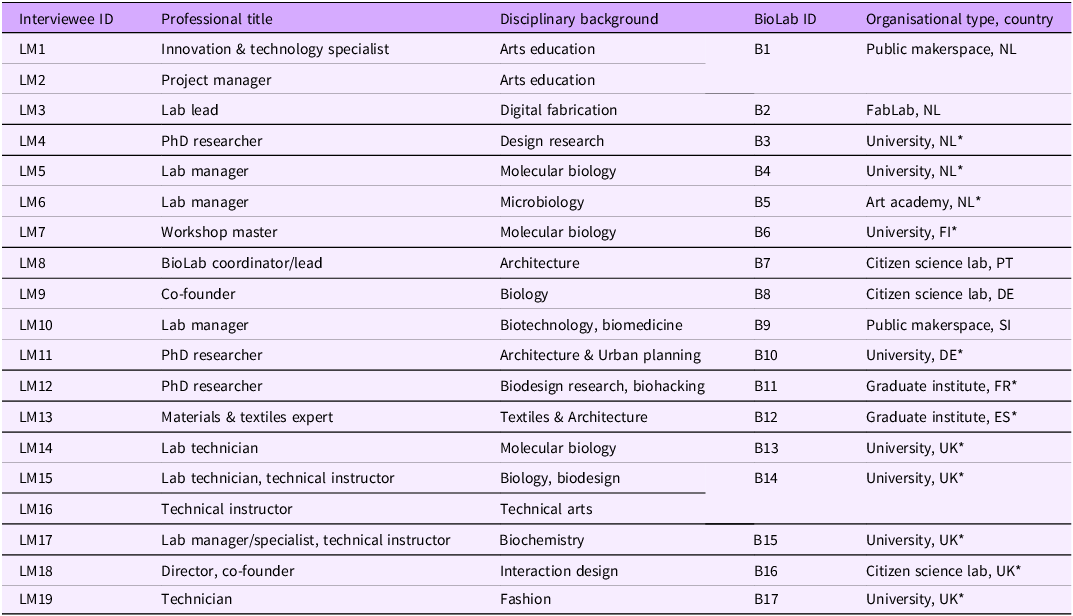
This study followed a purposeful sampling approach (Emmel Reference Emmel and Seaman2013). First, the author conducted a global mapping of BioLabs (n = 65) through desktop research and professional networks that fit the sampling criteria. From this global sample, 17 European BioLabs were selected to visit in-person, based on geographical accessibility, relevance for research questions and availability for a LM to participate in research. During the 22 months of this study, the author actively grew their network and followed newly emerging BioLabs, as more interviewees were identified. The selected interviewees were approached via email to schedule in-person visits to their respective BioLabs. From 2023 to 2025, the author conducted 19 semi-structured interviews (Roulston and Choi Reference Roulston, Choi and Flick2018) with biodesign LMs responsible for routine day-to-day operation at these sites. Table 1 presents an overview of the 19 biodesign LMs interviewed.
Overview of interviewed biodesign lab managers (LM) and their BioLabs (B). Formal educational institutions are marked with an asterisk*

Table 1. Long description
Interviewees are labelled LM (Lab Manager) 1 to 19. Each row indicates the interviewee’s professional title (e.g. Lab manager, innovation & technology specialist), disciplinary background (e.g. biology, design, education), biolab ID (B 1 - 17), and organisational type and country (e.g. public makerspace in the Netherlands). 12 BioLabs out of the 17 are educational institutions.
The interviewees identified themselves under various professional titles, including those that emphasised leadership (e.g. ‘Lab Manager’, ‘Lab Lead’, ‘BioLab Lead’, ‘BioLab Coordinator’, ‘Project Manager’), expertise (e.g. ‘Innovation and Technology Specialist’, ‘Materials and Textiles Expert’, ‘Workshop Master’) and pedagogical roles (e.g. ‘Technical Instructor’, ‘Specialist Technical Instructor’). Day-to-day responsibility also fell to those who established the BioLabs (e.g. ‘Co-founder’, ‘Director’), who subsequently came to operate the space due to personal motivations, or due to a lack of resources to hire an external figure. Five LMs were running their BioLabs whilst their primary role lay elsewhere (i.e. PhD student (LM4, LM11, LM12), design studio employee (LM9), manager of another facility (LM19)). The disciplinary backgrounds of LMs could be categorised into three broad fields: Design (n = 9, textiles, architecture, product design, digital fabrication), Biology (n = 8, molecular biology, biochemistry, biomedicine) and Education (n = 2, art education).
For BioLabs located in formal educational institutions (n = 12, marked with asterisks in Table 1), primary users were design students and researchers, broadly spanning material design, HCI, architecture, fashion and digital media. Other BioLabs (n = 5) were also open to the public to various extents, in addition to more specific design- and fabrication-orientated users and members. All BioLabs provided conditions to grow one or more living organism(s), predominantly mycelium, followed by bacterial cellulose, other bacteria (e.g. for bioluminescence, bacterial colour), algae and plants. Moreover, all facilitated additional conditions for working with ‘inert’ organic materials, such as food waste (e.g. eggshells, seashells, coffee grounds, banana peels), abundant or invasive plant species (e.g. Japanese knotweed) and bioplastics from processed bio-sources (e.g. alginate, gelatine).
Data gathering was conducted in-person at their respective BioLabs, through a tour-and-interview method. This method combines conversational semi-structured interviews (Roulston and Choi Reference Roulston, Choi and Flick2018) alongside interviewee-led tours of the spaces (see e.g. guided tours, Everett and Barrett Reference Everett and Barrett2012). The interview protocol consisted of a set of core thematic questions on the interviewees’ roles and responsibilities, everyday routines and challenges, which were integrated into the flow of the conversations to support a more context-responsive dialogue. In addition, the tour-and-interview method aimed to probe more organic conversations on the ongoing tasks that LMs partake in, which may be seen as too ‘mundane’ to discuss in a formal sit-down interview setting. Beyond spoken insights, this method also surfaced material traces of LMs’ work (e.g. half-prepared material samples left on the table) and work-in-action (e.g. returning equipment to their designated place as they talked; users asking them ‘how-to’ questions during the interview). The tour-and-interviews took place between December 2023 and September 2025 and averaged approximately 95 minutes long. Each tour-and-interview was audio-recorded with consent, and the key observations and insights were documented in fieldnotes written by the author during and immediately after the visits. To supplement and contextualise the interview data, photographs of their spaces were also taken during the tours. Interviews were initially transcribed using an AI-assisted transcription toolFootnote 3 , then thoroughly reviewed against the original recording and manually corrected by the author.
Analysis was conducted thematically (Miles and Huberman Reference Miles and Huberman1994). First, the interview data was prepared by reading through the transcripts in three rounds, highlighting relevant text segments that explicitly or implicitly referred to LMs’ activities and roles. These segments underwent an initial round of open coding. In this stage, a set of codes around common practical activities emerged, such as ‘cleaning’, ‘mentoring’, ‘overseeing’, ‘maintaining inventory’ ‘budgeting’, ‘designing workshops/courses’ and ‘caring for organisms’. These codes and their associated quotes were organised into a digital code book, which was used to cluster the codes into larger themes, such as ‘health & safety’, ‘technical & routine maintenance’, ‘developing the lab’, ‘troubleshooting’, ‘teaching & guiding’ and ‘outreach’. Informed by these themes, the transcript segments underwent a second cycle of coding alongside analytic memoing (Wicks Reference Wicks2017). The aim of this stage was to refine and extend the identified themes and to ensure that no relevant codes and details were overlooked. In parallel to the refinement of the themes, the memoing process in this stage also revealed overarching yet less ‘visible’ LM roles and practices that were resonant in the data. Examples include ‘creating space for failures’, ‘understanding needs of users’, ‘boundary-setting’ and ‘personal commitments’. In the third cycle, these second sets of codes and their corresponding quotes were examined in relation to the refined themes on biodesign LMs’ activities to develop a more comprehensive thematic account of LMs’ work, capturing both their physical and social activities, as well as their conceptualisations or their own roles and responsibilities. Finally, the themes and sub-themes were cross-checked and revised against the original data. The findings are presented below.
Work of biodesign lab managers
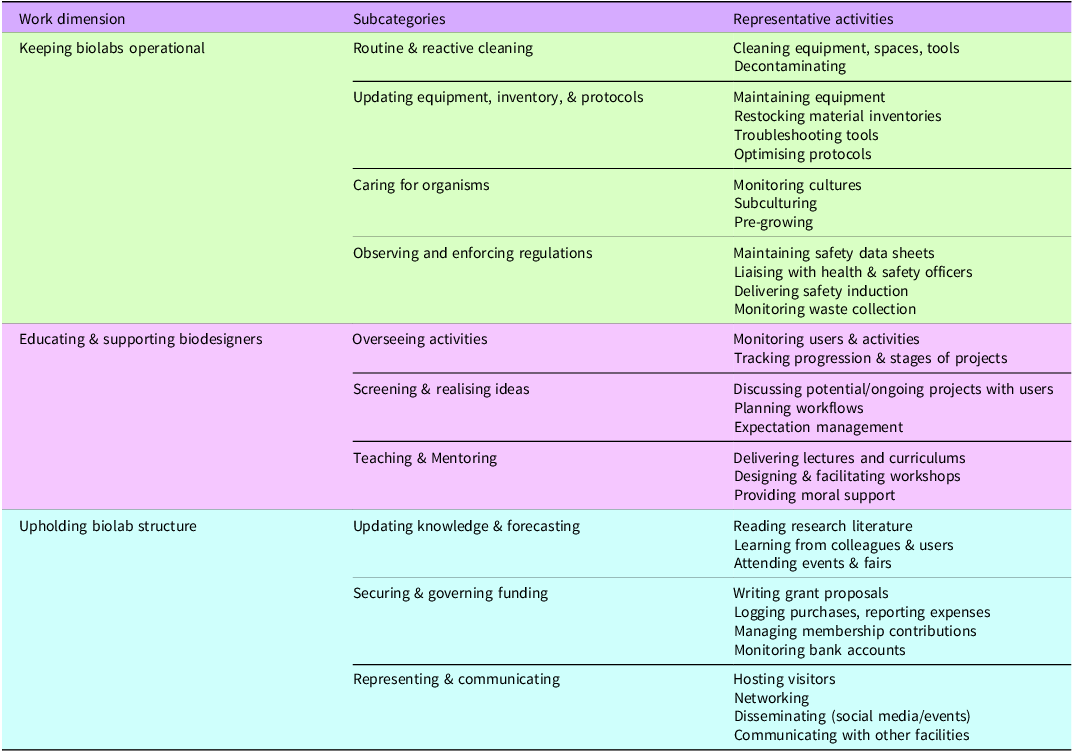
What do biodesign LMs do? When interviewees were asked to describe their day-to-day work, a frequent response to begin with, was ‘everything’ (e.g. ‘I’m doing everything’ (LM11), ‘I’m working on everything’ (LM1) ‘I manage everything’ (LM10)). As they claim themselves, the interviewed LMs occupy multiple roles and engage in a wide range of activities, rather than being confined to a single description of work. While recognising the contextual nature of work which may be influenced by institutional arrangements and day-to-day circumstances, these insights foreground the most prevalent resonances across the data in order to better elucidate the shared features of biodesign LM work. What follows unpacks the predominant activities involved in biodesign LMs’ work as they emerge from the empirical material: the work of (1) Keeping BioLabs operational; (2) Educating and supporting biodesigners; and (3) Upholding BioLab structure. These are also summarised in Table 2.
Summary of biodesign lab managers’ day-to-day work activities
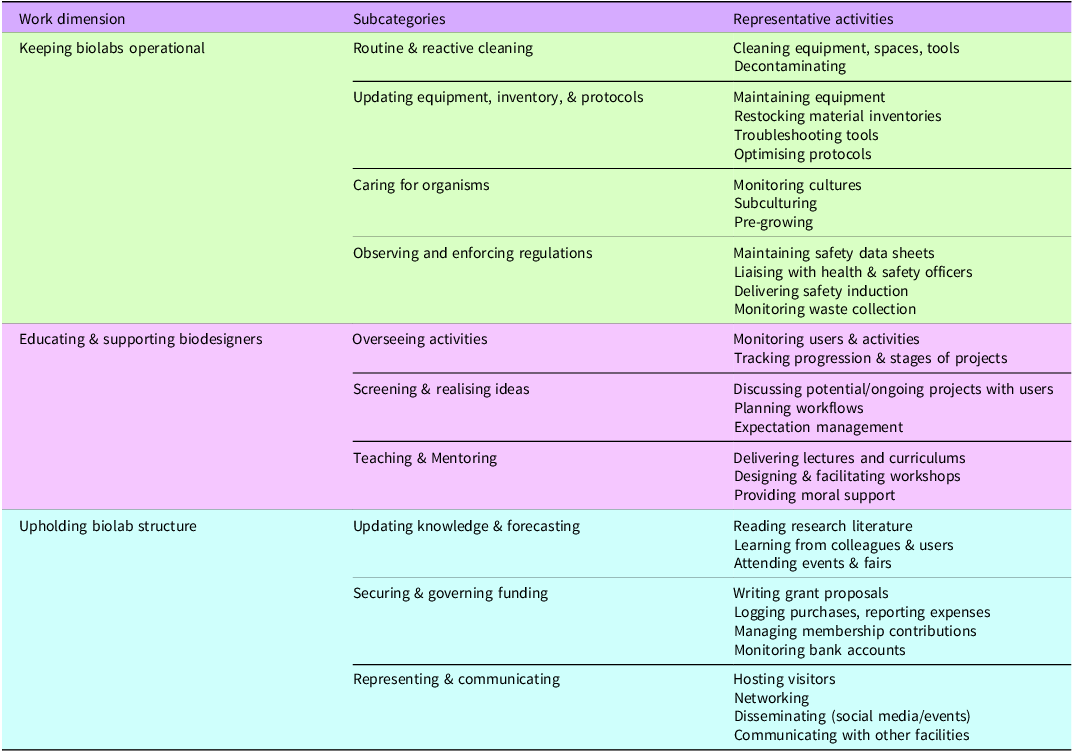
Table 2. Long description
The table shows three work dimensions derived from the findings. The first is “Keeping Biolabs Operational”, which includes subcategories including cleaning, updating equipment and protocols, caring for organisms, and regulations. The second is “Educating and Supporting Biodesigners”, which includes overseeing user activities, realising ideas, and teaching. The third is “Upholding BioLab Structure“, which involves updating knowledge, securing funding, and representing their workspaces.
Keeping biolabs operational
The responsibility to keep the BioLabs fundamentally operational was presented as the primary role by most interviewees. This dimension encompasses practical and often routine tasks that ensure that ‘everything works’ safely (LM9).
Routine and reactive cleaning. All 19 interviewees described proactively cleaning the space as a major part of their work to ‘make sure that the spaces are looked after’ (LM16). For many, these are important routinised actions worth allocating fixed times (e.g. ‘daily re-clean at the end of the day, plus two half-days a week for deeper cleans’ (LM15); monthly deep clean days (LM5)). In addition to cleaning routines, biodesign LMs may face situations requiring reactive cleaning, such as mycelium sporulation in the lab environment, which involves immediate decontamination of the entire space (LM5, LM11). Most interviewees emphasised that cleaning responsibilities should ideally be collectively shared among all individuals using the space, instead of falling solely on themselves. Despite this, many also expressed frustration in the difficulty to enforce this: ‘[the users] have to clean /…/ but they just don’t clean /…/ and it starts to be really, really a mess’ (LM12). Improper cleaning of shared equipment and tools or the lack thereof, means that the additional workload lands on the LMs to keep the BioLab space operational for other users (LM5, LM8). Additionally, this issue is made complex in spaces where ‘messiness’ and ‘tinkering’ are integral to their organisational ethos and seen as a catalyst for creativity (LM1, LM3, LM5, LM6, LM12). Biodesign LMs in such spaces frequently grapple with the tension between maintaining hygiene standards for effectively dealing with living organisms and accommodating the ‘creative openness’ (LM5) of design engagements.
Updating equipment, inventory and protocols. Interviewees regularly carry out maintenance and upgrades of equipment, attending to both the functionality and suitability for specific workflows and users. Unreliable equipment can significantly hinder the ability to conduct biodesign work, such as for LM11 who explained how ‘non-working autoclave was one year of my life wasted /…/ we were getting a lot of contamination’. In addition, biodesign LMs also ensure that consumables, (living and non-living) material and chemical inventories are sufficiently stocked (LM7, LM11, LM16). These activities involve making purchases from trusted suppliers (LM6, LM11) and leveraging professional networks to acquire shares of living organisms (LM17) and second-hand tools (LM3, LM9). Several interviewees described collecting materials from their everyday consumption, including coffee grounds, eggshells and SCOBY (Symbiotic Culture of Bacteria and Yeast) cultures (LM1, LM8, LM15).
Furthermore, interviewees often dedicated their independent time to troubleshooting and/or simplifying protocols (LM11, LM14), help optimise users’ experiments (LM14) and test out new equipment (LM1, LM17) so that the users ‘don’t have to figure out too much’ (LM14). For instance, LM11, described optimising a protocol for propagating mycelium for 3D printing architectural structures. Considering the scale, they wanted to achieve volume and speed rather than prioritising growing ‘pure’ strains of mycelium. Thus, while they had initially developed their mycelium protocol with local biologists, after rounds of iteration in their BioLab, their current protocol is ‘not really close to what [the biologist] proposed /…/ [as] it turned out you can do things more efficiently’.
Caring for organisms. In addition to material upkeep, LMs also perform ongoing care and monitoring of living organisms housed in their BioLabs. This includes routine practices such as subculturing, as well as regular observations to assess organism health (e.g. changes in colour, smell, texture). Accordingly, many rely on their embodied knowledge of organisms as their ‘expertise is very much hands on, tactile, experience of doing things’ (LM11). Preparatory work of organisms (i.e. ‘starting a culture’ (LM14) for workshops and courses) was a resonant responsibility across the interviewees, so that the organisms can reach the appropriate stage for the activity.
LMs described working with the organisms as ‘care’ work, which, unlike ‘inert materials’ in other design workspaces, necessitates structuring their own schedules around the biological rhythms of the organisms. Consequently, for several interviewees, the responsibility of caring for organisms extended beyond what they framed as a ‘conventional job’. Some of this work was described as taking place during evenings or weekends, as with LM7, who regularly runs introduction sessions for working with bacteria: ‘Many times, I come on Sunday evenings to set up the bacteria for the (Monday) course, because [bacteria] don’t care. You just come’. LM7 further reflected on the case of their illness: ‘If your mycelium is growing, … it doesn’t give a **** if you are sick. You have to be there’. Similarly, LM11 noted, ‘you cannot keep [the organisms] on hold, the samples keep growing [even if] I have a sick child’.
Observing and enforcing regulations. Safety was a critical concern and responsibility of all interviewees. In terms of technical work, biodesign LM’s work involves ensuring that the technologies and activities within the spaces follow wider (institutional or legal) regulatory governance, such as Biosafety regulations and institutional audits. Responsibilities such as maintaining safety data sheets (LM15, LM16, LM18), updating equipment certifications (LM1, LM16), liaising with health and safety officers (LM4, LM15, LM16), organising regular safety inductions for new users (LM5, LM6, LM9, LM7) and arranging waste collection from appropriate companies (LM8, LM18) are critical. In many cases, biodesign LMs must navigate the institutional and regulatory ‘hard-core biosafety priorities’ (LM14) with the practices within their spaces. For instance, LM16 described how even though the waste produced in their BioLab is treated to be safe, ‘laboratory-looking’ items such as petri dishes and syringes in a bag triggered concern for their institution. To navigate this, they have implemented colour-coded bags and expanded their waste contract to ‘match’ the waste’s perceived identity, ‘just to make sure people feel safe, even though it is already safe’ (LM16).
Others have described how standards that may be taken for granted in life sciences laboratories (e.g. hygiene protocols, equipment handling, documentation practices) may be experienced as restrictive by users from non-scientific backgrounds who are unfamiliar with these conventions (LM5, LM9). In this context, LM17 emphasised the importance of explaining the ‘whys’ behind protocols and rules: ‘When you actually break down the reasons why we do all the things, it is quite mundane. We wear gloves because we don’t want to accidentally irritate our skin because we’re using some really salty liquid, or we don’t want to accidentally expose someone to touching the door because we were working with fermented onion, and it’s just gross’. Similarly, LM6 explained how they adjusted their biosafety training to be ‘more visual, more practical’ for the arts and design users of their BioLab, rather than theory-heavy training sessions. In this respect, interviewees described one of their most important roles as ‘demystifying’ (LM3, LM8, LM9, LM7, LM17) the perception of the BioLab in order to lower the psychological barriers to entry while promoting safe experimentation.
Educating and supporting biodesigners
BioLabs are peopled spaces, and many users require guidance and support to carry out their work. Most biodesign LMs are thus also educators, instructors and mentors who not only make the space physically operational, but also socially functional by directly interacting with the users.
Overseeing activities. Biodesign LMs described constantly maintaining acute awareness of the users present at their BioLabs and the activities that are happening in real-time, to anticipate potential risks and readily intervene if necessary. Simultaneously, they also maintain a broader awareness of the range of projects being conducted over time, including tracking the progression of each work and ‘know[ing] exactly which culture belongs to whom’ (LM15). While some BioLabs require users to document their processes, interviewees typically internalise this information as they follow each project. As LM14 noted, this could become a challenge; ‘a big mental load to remember what each [user] is doing and to provide the /…/ best help to each of them. There’s a limit of names and projects and timeframes that my personal brain can take while attending meetings, having calls, etc’.
For this reason, many interviewees explicitly restrict the number of users at a given time: ‘we can’t have this [space] full of people with just one member of staff. It’s not safe. And also the quality because [the LM] knows tonnes, but [they] can only contribute that to so many [users]’ (LM16). Moreover, while interviewees positioned themselves as overseers and supporters of biodesign practices, they emphasised that they are ‘not here to do your project for [the users]’ (LM12). As LM15 reflected, ‘one thing that I learned is, yes, I’m a ‘nanny’, but don’t take too much responsibility. If the [culture] goes bad, it’s not my responsibility. I’ll [sterilise] it or slow down the growth if it’s going too bad, but if the project doesn’t work, it’s [the users’] responsibility’. Similarly, LM14 used a nautical metaphor to describe balancing guidance and distance: ‘I’m up in the sail saying, ‘this is a good route’, or ‘the weather’s not nice, let’s go back’. But [the users] will do the driving /…/ they will crash the boat, pick up the pieces, and start over’.
Screening and realising ideas. An important aspect of biodesign LMs’ work involves screening the activities to be conducted in the spaces – whether formally through ‘intake interviews’ (LM18) or more informally through project discussions – as some users may come with ideas which may not be feasible (or legally permissible) to be conducted in their spaces. In this vein, LM15 described how before explicitly delineating the boundaries of their BioLab, ‘anything “bio”’ had come to them, including ‘very strange requests, like “can I bring a hundred ox eyeballs, because it’s bio?”’. Key to this process is managing expectations around what materials are possible to work with, ‘how long things take, the scale of work, how much it costs’ (LM15) before the users enter the BioLab, through, for instance, ‘spoken word advertisements’ within their institution (LM15, LM16) and online inductions (LM7) to potential user groups. This ensures that ‘expectations are reasonable once they enter the space’ (LM16).
Interviewees often engage in what they described as ‘consultations’, ‘mentoring’, ‘reviews’, ‘conversations’, or ‘discussions’. These interactions typically take place in one-to-one or small-group tutoring set-ups, where users discuss potential or ongoing projects. During these sessions, biodesign LMs ‘tak[e] a look at what your project request is /…/ what kinds of activities you want to do, interrogating a little bit the meaning behind these things and why you want to do it’ (LM17). They also assist users in planning their workflows, performing calculations, reading research literature and addressing practical considerations such as material end-of-life and transport logistics (e.g. to exhibition venues) (LM7, LM11, LM14, LM15). Central to this role is the ability to help translate creative or abstract concepts into ‘something realistic and feasible’ (LM15). One illustrative story was told by LM16, who described a user who envisioned making paint from their own blood. As this could not legally be carried out in their BioLab, through discussions with the user, the LM proposed purchasing institutionally pre-approved dried edible blood powder for the project, which could still fulfil the projects’ conceptual aim. To this end, interviewees highlighted the necessity to maintain openness to users’ ideas and curiosities and to flexibly develop workarounds to make ideas materialisable within the available time, resources, knowledge and regulatory frameworks. As put by LM14, ‘I think I’ve said many ‘no’s. And in the ‘no’s, we’ve figured out some solutions that are quite great’.
Teaching & Mentoring. All 19 interviewees assume an educational role to various extents. In formal educational institutions, biodesign LMs are often deeply involved in teaching activities, including curriculum input and lecturing, as well as conducting foundational courses and laboratory skills beyond induction sessions. In other settings, biodesign LMs similarly take on instructional responsibilities by designing and facilitating (public) workshops (LM1, LM2, LM8, LM9, LM10). Many biodesign courses and workshops require extensive preparatory work, including cultivating, replicating and preserving organisms in advance of teaching sessions (LM7, LM11). Interviewees described this work as time-consuming, and not always efficient as explained by LM11: ‘we were only taking care of cultivating materials for students /…/ so it was a big chunk of what we were doing’ and less attention could be given to developing other research work. Beyond practical teaching, some interviewees described giving ‘moral support’ to their users, by becoming ‘a bit of a therapist when [the students] are graduating and it’s very stressful’ (LM14).
Interviewees also emphasised that those in biodesign LM roles must ‘understand that [the users] are still learning, and they are allowed to make mistakes’ (LM7). In this vein, empathy and approachability were raised as crucial qualities to create conditions in which users feel empowered to experiment, openly ask questions and report mistakes (LM1, LM5, LM6, LM17). This orientation was further articulated by LM7: ‘I think my whole mission [as a LM] is to make it easy for people to approach me, make them easy to come [to the BioLab], /…/ to create the atmosphere that no mistake is fatal, and nothing dangerous happens here. /…/ And really, we’re not using anything overly expensive or overly dangerous in our lab setting. It’s an experimental space.’
Upholding biolab structure
This dimension encompasses the work involved in sustaining BioLabs’ structural resilience over the long term, beyond making them operational in-the-moment.
Updating knowledge and forecasting. Several interviewees reflected on how their own scope of knowledge defines what practices are possible within their BioLab: ‘I’m just one person, so that forms a body of the work that we can invite people in’ (LM17). This also extends to the use of equipment which cannot be operationalised if ‘there’s no one with the skills to even use it’ (LM19). Many interviewees were explicit about their knowledge gaps, such as LM14, who ‘know[s] how to handle bacteria and yeast very well, but not plants and algae’. In order to expand their own knowledge capacities of ‘all these different topics, equipment, chemicals… everything’ (LM10) necessary to keep their BioLabs functional, biodesign LMs continuously engage in ongoing self-education. Many emphasised the importance of setting aside time to read new research papers and literature, actively seeking new knowledge from their colleagues and users, as well as participating in external events.
Interviewees also articulated how ‘staying contemporary’ (LM16) on the ongoing advancements of the biodesign field enables ‘forecasting’, which is an ‘important part of being able to ensure the longevity of the space and keep it flexible’ (LM17). This also has implications on decision-making within the BioLabs, as LM17 further elaborates: ‘[Thinking about longevity] did also influence my decisions when I was thinking about what kinds of equipment we want in here /…/ for this potential future step up into a new area, which would then welcome new kinds of research as well’. In this respect, some have considered integrating or upgrading their spaces to meet BSL-2 standardsFootnote 4 , even if current practices do not demand these capacities (LM8, LM17). Moreover, many proactively discussed potential next steps for their BioLabs, such as separating their space according to teaching versus research work (LM6, LM18).
Securing and governing funding. Especially for emerging BioLabs, one of the most challenging aspects was maintaining a sustainable source of funding to maintain their BioLab’s existence. Within formal institutions, biodesign LMs frequently mentioned the need to ‘prove’ the Biolabs’ relevance and viability in order to secure continued financial support from the larger governing body (e.g. university) (LM2, LM16, LM17, LM19). Similarly, in spaces that rely (partially) on governmental funding, interviewees stressed the importance of continual engagement with governmental decision-makers to maintain visibility and to communicate their ‘impact’ (LM8, LM10). In cases where the BioLabs rely on temporary research project funds, interviewees described how they must carefully choose which grants to apply and with what project, as the funded projects greatly determine in which ways the BioLab can grow (LM11, LM12). In addition, most LMs were also responsible for logging purchases and reporting expenses.
In self-organised spaces, biodesign LMs’ work appears to involve a higher degree of personal stake and responsibility as they must ‘take over the role of the institution’ (LM9). Some interviewees initiated and developed the spaces themselves, often through self-funding in the early stages, and continues to sustain the BioLab through a mix of financial sources, such as community lab grants (LM18), fees from public workshops (LM9), social commercial projects (LM18) and governmental funds (LM8). LM9 described having to personally manage membership contributions by ‘chas[ing] everybody to pay [their monthly fees]’, monitor the BioLab’s bank account and ensure that rent of the space is paid to the landlord on time. This responsibility could become emotionally and physically demanding, as further expressed by LM9: ‘[if I leave], it would be a catastrophe, because then everything is going to collapse /…/ so I feel it, everything is on me’.
Representing and communicating. Biodesign LMs take active roles in expanding and consolidating organisational and community networks, which were articulated as crucial for the continued existence and relevance of the BioLabs. Interviewees were typically responsible for hosting visitors and/or organising regular ‘open days’ (LM3, LM8), establishing new collaborations (LM2, LM6, LM7, LM8, LM11, LM17, LM18, LM19), representing their BioLab at events (LM10, LM15, LM17) and disseminating their activities through social media (LM7, LM18). Beyond external representation, biodesign LMs saw themselves as responsible for building a robust user community to ensure ‘social sustainability’ (LM9) of their spaces. Importantly, LMs act as connectors and touchpoints within their community of users as reflected by LM17: ‘At the end of the day, the lab /…/ it’s still me, it’s my name, my face attached to it. So immediately, whoever I’m speaking to will be developing that relationship with each other as individuals’. In building such community, interviewees frequently described the need to readjust their communication to lower the psychological barriers to entry into their BioLabs, for instance, by using everyday language and familiar analogies to bridge expert and non-expert understandings: ‘[The incubator] is a ‘heated cupboard’, [the ultra-low temperature freezer] is a ‘really cold box’; and [the autoclave] is a ‘pressure cooker’’ (LM17).
Many LMs are also responsible for communicating with those managing other facilities within their organisations – for instance in the case of LM1 and LM2, where their BioLab is ‘also part of a museum and part of a library’ to co-organise events under a shared theme. Furthermore, many also encouraged cross-pollination across adjacent facilities. For LM3, ‘the most beautiful things come out when you combine things in the Fablab and the textiles lab and the BioLab’, such as by combining 3D printing with algae biomaterial experiments for costume design. In this respect, the idea of developing ‘a discourse for documentation’ was raised by LM8, LM16 and LM17 to support trackability of user projects between the different facilities, ‘so [LMs in other facilities] have got an understanding of how to best support’ their incoming projects from the BioLabs (LM16).
Discussions and implications for biodesign
A rich body of research has already shown that biodesign, being an interdisciplinary field, inherently involves navigating a complex mix of diverse needs, standards and epistemologies (Chen and Pschetz Reference Chen and Pschetz2024; Crawford Reference Crawford2021; Kim et al. Reference Kim, Kim, Martins and Karana2024; Pollini Reference Pollini2024). This has tangible consequences for the spaces that support such hybrid practice (Ihls and Pollini Reference Ihls and Pollini2025; Naito and Botero Reference Naito and Botero2024) and inherently for the people who sustain them on a day-to-day basis. Within this context, biodesign LMs play a central role by navigating a breadth of work activities to maintain ongoing conditions for biodesign, attending simultaneously to the material dimensions of the BioLab such as equipment, space, waste, organisms and data sheets, the social dimensions through user support and the broader structural dimensions including funding, representation and futureproofing. Cutting across these work dimensions, the following discussion draws out key implications from the findings and begins to identify possible avenues for better supporting biodesign LM roles.
Biodesign lab managers perform a ‘hybrid’ role
This study suggests that biodesign LMs’ work shares elements with management and technical work in related settings, yet are not fully covered by either. Echoing studies in scientific laboratory management (Barley Reference Barley1996; Iliffe Reference Iliffe2008; Sims Reference Sims2005; Vinck Reference Vinck2019; Winberg Reference Winberg2021; Wragg Reference Wragg2024), the interviewees’ work involves responsibility for biosafety and regulatory compliance, maintaining cleanliness, organism handling, equipment maintenance and training. Yet biodesign LMs must perform such responsibilities within user communities that are typically neither scientifically trained (Cogdell Reference Cogdell, Ball, Huaccho Huatuco, Howlett and Setchi2019) nor orientated towards purely ‘scientific’ outcomes and sometimes in spaces not originally designed for biological work (Naito and Botero Reference Naito and Botero2024). On the other hand, they facilitate and support ‘tinkering’ functions of fabrication settings, and, paralleling scholarly accounts on fabrication space managers (Brun et al. Reference Brun, Cheng and Alcudia2018; Galuppo et al. Reference Galuppo, Kajamaa, Ivaldi and Scaratti2019; Gil Reference Gil2022; Jaksic Reference Jaksic2015; Koh and Abbas Reference Koh and Abbas2015; Rahman and Best Reference Rahman and Best2024), take active part in pursuing funding, promoting their spaces through outreach, running workshops and support non-expert users. However, they do so with living organisms that carry unique protocols, ethical and safety obligations and temporal constraints that many (rapid) prototyping materials do not (de Lange et al. Reference de Lange, Dunn and Peek2022; Naito Reference Naito, Mateus, Leonor and Paoliello2026). The result is a form of ‘hybrid’ management work that is technically and epistemically more complex than merely a combination of existing management activities.
A further layer of complexity emerges around organisational alignment, as many of the BioLabs are embedded within larger institutions, which are not primarily concerned with, or well-informed about biodesign (Naito and Botero Reference Naito and Botero2024). Biodesign LMs must therefore continue to ‘prove’ the viability and impact of their spaces in order to legitimise their existence within respective organisations, whether through aligning activities with institutional priorities, bringing in funding, or ensuring governmental visibility. In some cases, LMs must devise strategies to navigate institutional tensions, as illustrated by LM16’s account of deliberately classifying their biodesign waste outputs as ‘hazardous’ – despite their waste being non-hazardous – in order to actively align their space’s identity to the institutional assumptions about what a ‘laboratory’ is and does. Thus, in addition to the many ‘hats’ that biodesign LMs must assume, the insights highlight the multi-scalar nature of biodesign LM work, as it spans both the intimate, situated engagements with the everyday practices of their spaces and users and the broader context in which the BioLab is embedded.
However, it is yet unclear how such hybrid, multi-scalar roles should be supported, and what knowledge base is required to effectively perform them. Notably, this study shows that current biodesign LMs come with various backgrounds, from the sciences to design and education. This diversity, while enriching and reflective of the biodesign field, also means that no single, uniform knowledge base or skillset can be assumed at the point of entry into such a role. One implication may be a need for modular, adaptive training frameworks and resources, which could accommodate the particular skills and knowledge gaps present in individual’s backgrounds, while simultaneously building upon the strengths and affordances that their prior expertise already provides. To this end, the types of work and roles that biodesign LMs share in this study are valuable starting points for such work.
Biosafety and creative openness are being balanced by biodesign lab managers
Echoing prior research (Chen and Pschetz Reference Chen and Pschetz2024; Ihls and Pollini Reference Ihls and Pollini2025; Naito and Botero Reference Naito and Botero2024; Quijano et al. Reference Quijano, Jing, Ferrero-Regis, Navone, Golberg and Zhang2026), biodesign LMs highlighted the tension between balancing safety with creative openness within BioLabs. In this particular study, the interviewees’ explicit efforts ran predominantly in the direction of opening up spaces for creativity, rather than toward safeguarding the ‘rigour’ of scientific practice. This likely reflects the primary users of the sampled BioLabs – largely art and design users and/or the general public – who often find access to conventional scientific laboratories challenging (de Lange et al. Reference de Lange, Dunn and Peek2022; Naito Reference Naito, Mateus, Leonor and Paoliello2026; Naito and Botero Reference Naito and Botero2024; Willet Reference Willet2023). Simultaneously, this also reflects the biodesign LMs’ awareness that biosafety and institutional regulatory frameworks are largely non-negotiable. These constraints are, in a sense, already built into the biodesign infrastructure, and thus creative openness are being cultivated more deliberately and carefully through the day-to-day work of biodesign LMs.
In this respect, one key effort is in demystifying the perception of the BioLab. For LM17, ‘demystifying’ involves deliberate choices around the use of language, such as explaining their laboratory equipment in accessible terms, as well as the reasoning behind laboratory rules rather than arbitrarily enforcing them. In a similar vein, LM6’s approach involves redesigning safety introductions with ‘visual language’ and hands-on approaches, to better meet the needs of users from arts and design backgrounds. For LM9, this entails explicitly reassuring users that what they are experimenting in their space is not dangerous, and that mistakes will not carry legal or financial consequences. By simplifying, illustrating and breaking down laboratory practices and its identity, biodesign LMs also foster an atmosphere of openness for creative experimentation.
Another predominant effort is in expectation management. At its core, this involves delineating what is possible within their BioLab and doing so at multiple stages of user engagement. In positioning the BioLab, this takes the form of establishing a clear identity for the space and communicating the scope of feasible projects to prospective users. This may be done broadly through online pre-inductions, ‘spoken word advertisements’ within their institutions, or through open days, and then more specifically through intake ‘interviews’ or discussions. This ensures, in LM16’s words, that ‘expectations are manageable once the users enter the space’, which supports a smoother facilitation of making creative ideas realisable within the resource and safety constraints. As users begin to work in the BioLabs, expectation management becomes an ongoing effort of assessing feasibility through formal meetings or informal conversations.
While prior work on interdisciplinary collaboration in biodesign has begun to address similar epistemic gaps (Bandoni et al. Reference Bandoni, Almendra and Forman2022; Crawford Reference Crawford2021; Marseglia et al. Reference Marseglia, Cantini, Celli, Brunelli and Lotti2026) through, for instance, designing tools to facilitate cross-disciplinary collaborations (Välk et al. Reference Välk, Chen, Dieckmann and Mougenot2022) and outlining ideal interdisciplinary competences of biodesigners (Vuylsteke et al. Reference Vuylsteke, Detand and Ostuzzi2025), these contributions have largely attended to the practitioner levels. For biodesign LMs, navigating these epistemic gaps manifest within practical daily activities, from the use of language when explaining protocols, to strategically delineating the scope and limits of their BioLabs. In this respect, there is an opportunity for developing resources compiling best practices for effective LMs’ work that balances biosafety whilst accommodating creative flexibility. This may include examples of more ‘visual’ and hands-on induction materials which also explains the reasons behind certain rules, protocols and constraints; strategies for positioning the BioLab within an institution or a community; and compilation of practical workarounds for tools, materials and processes within biosafety guidelines. In addition, the interviews suggest that a large proportion of the efforts to balance epistemic differences are inherently social endeavours. Infrastructural designs of BioLabs should therefore account for the social dimensions of biodesign LMs work, particularly by delegating dedicated time, physical space and resources that facilitate one-on-one or group discussions.
Capacities of biodesign lab managers shape capacities of Biolabs
Previous research has shown that physical capacities of BioLabs are constrained by the material affordances of the environment itself, such as the availability of incubator and laminar air flow cabinets (Naito and Botero Reference Naito and Botero2024). The present study extends this understanding by identifying the capacity of biodesign LMs as a parallel and equally consequential affordance and constraint. Given that the interviewed LMs often function as the sole or primary responsible within their BioLabs, the capacities of the spaces are directly tied to what each LM can realistically oversee, supervise and sustain simultaneously. When capacity is exceeded, consequences may extend to (bio)safety risks, and as a result, findings also show that interviewees must explicitly restrict the number of users at a given time.
Beyond physical capacity, this study reveals that the breadth of knowledge of biodesign LMs equally define what practices are possible within each BioLab. For instance, equipment can remain unused if the LMs lack the expertise to operate and maintain it – a limitation that similarly applies to biological literacy to handle specific organisms. In this respect, order to support the growing range and number of projects and users that their BioLabs can accommodate, LMs engage in ongoing self-directed learning and research, which manifests in, for instance, testing how a new organism can be grown in their space, figuring out new equipment and reading research to keep up with contemporary research developments. This has been a form of professional practice that has received limited attention in previous literature on lab management, yet becomes particularly visible in emerging fields such as biodesign, where the knowledge base remains nascent and continues to evolve at a rapid pace (Gough et al. Reference Gough, Tomitsch and Ahmadpour2021; Pollini Reference Pollini2024).
In addition, some interviews point towards personal capacities as a critical dimension of sustaining a BioLab. While some recounted instances of having to attend the BioLab on weekends or prioritise caring for the organisms over personal commitments, others described how their space’s dependency on themself had become physically and emotionally burdensome over time. This becomes particularly consequential for the biodesign LMs who must divide their LM responsibilities and time alongside primary commitments elsewhere, whether as doctoral researchers, design studio employees, or managers of multiple facilities. This suggests that the demands placed on biodesign LMs could extend well beyond what might be formally recognised or institutionally anticipated, with implications not only for individual wellbeing but also for the long-term sustainability of the BioLab itself.
Several directions could help address this, such as dedicating funding and resources for full-time biodesign LM positions, establishing realistic user-to-LM ratios, sharing management positions across multiple LMs, as well as outsourcing aspects of their work. However, pursuing any of these directions foremost demands a greater recognition of what biodesign LM role entails – which this paper begins to address – followed by a better understanding of which aspects of their current activities are genuinely integral to the biodesign LM role itself, and which aspect may be effectively shared or redistributed. Ultimately, those in the planning or development stages of BioLabs must recognise that scale and scope of a BioLab are inseparable from decisions about staffing. Therefore, current and future BioLab designs should not simply consider the amount of equipment, size of the space and user demand, but crucially, also account for the physical, knowledge and personal capacities of the LMs, who are critical for keeping these spaces literally and figuratively ‘alive’.
Limitations and future work
Given biodesign LMs have thus far received limited and largely unfocused attention within biodesign research, this study presents one of the first attempts to examine their work and roles more specifically. Thus, rather than offering an exhaustive or fixed ‘job description’, this paper aimed to surface and unpack the initial resonant features of their work as they emerge across 19 biodesign LMs in European BioLabs. It must be noted, however, that this does not represent the full range contexts where biodesign can happen, nor the scope of people who keep BioLabs functional. As the dataset expands – both in terms of interviewee numbers and geographical scope – additional work activities and resonances may become visible, particularly those shaped by specific circumstances, location and organisational structures. Such would allow for a better understanding of how biodesign LM practices may be configured differently across various environments. Furthermore, while the current paper does not set out to be a comparative study, there is also a further opportunity to compare differences in LM roles between formal vs informal organisational settings (e.g. universities vs grassroots labs), LMs’ disciplinary backgrounds (e.g. sciences vs arts vs education) and/or more nuanced comparison of biodesign LMs with other kinds of managers in related workspaces, including science and fabrication LMs.
Methodologically, the tour-and-interview method provides a situated ‘snapshot’ of the current conditions and circumstances. The analysis also relies primarily on interviewees’ accounts of their own work, complemented by in-situ observations during the tours. While this method enables covering a wider range of BioLabs (and thus to identify shared characteristics across interviews), it offers limited in-depth insights into how their articulated work activities are enacted in practice. Future studies would benefit from longitudinal ethnographic approaches such as qualitative shadowing (McDonald Reference McDonald2005), which would allow for a deeper examination of nuances in their work responsibilities and practices, as well as the particular competences required to navigate them.
Towards a better understanding of biodesign lab managers
As the field of biodesign continues to grow, so will the number of spaces where biodesign is practiced. Yet there is still uncertainty in how biodesign laboratories (BioLabs) should be developed, operationalised and maintained. In this context, it is pivotal to understand not only the material, spatial and epistemic elements that produce these spaces, but to also pay attention to the ongoing work necessary to keep BioLabs functioning and viable. Based on tour-and-interviews with 19 biodesign lab managers (LMs) in BioLabs across Europe, this paper identified the wide range of work that they perform, articulated through three interdependent dimensions: (1) Keeping BioLabs operational, which spans maintaining the spatial, material and regulatory dimensions; (2) Educating and supporting biodesigners, including the social dimensions to support their users; and (3) Upholding BioLab structure, encompassing the administrative and representative work that reaches beyond the ‘walls’ of the individual BioLabs.
This study confirms that BioLabs embody the hybrid nature of the biodesign field, which, in this study, is reflected in the ‘hybrid’ role of biodesign LMs. Arguably, it is such hybrid nature of their work that enables LMs to effectively hold spaces that balance biosafety with creative openness inherent within biodesign practice. Consequently, the capacity of a BioLab is not simply a matter of available equipment or physical space, but is also strongly shaped by the physical, knowledge and personal capacities of the person ‘managing’ it. Sustaining current and future BioLabs therefore entails maintaining conditions under which biodesign LMs themselves can effectively perform their roles. In this vein, future research should examine how biodesign LMs’ hybrid roles can be better recognised and supported – including not only how institutions might develop more intentional professional frameworks that reflect the distinctive demands of managing workspaces for a dynamic interdisciplinary field, but also how the research and user communities can better recognise and advocate for the value of these hybrid roles. To this end, this paper is a call to open a discourse on biodesign LMs’ work – the work which supports the growth of the biodesign field in very contingent ways, and which current biodesign LMs continue to approach with generosity, passion and care.
Data availability statement
The data that support the findings of this study consist of in-depth qualitative interviews containing potentially identifiable information and cannot be fully anonymised without compromising the integrity of data. Due to the conditions of informed consent and ethical guidelines under which the data were collected, these materials are not publicly available. Access may be considered on a case-by-case basis upon reasonable request to the author, subject to additional ethical review and agreement to confidentiality safeguards.
Acknowledgements
I would like to thank all the biodesign LMs for generously sharing their time, experiences and insights, and for their dedication to fostering the conditions that support the biodesign community. I am also grateful to the reviewers for their thorough comments, as well as my colleagues and peers who provided feedback on drafts of this paper.
Author contributions
The first author is the sole author of this paper.
Financial support
The work reported here has been partly funded by the European Union’s Erasmus+ Forward-looking Projects (Grant no. 101087204) and the Department of Design at Aalto University.
Competing interests
None.
Ethical standards
The research meets all ethical guidelines and adheres to the legal requirements of the study country. All participants provided informed consent prior to participation. In the consent process, participants were informed that full anonymisation could not be guaranteed due to the contextual nature of the study and the potential for identification through role, organisation, or location. Accordingly, data have been handled, stored, and reported using strict confidentiality procedures in accordance with applicable data protection regulations.

 Open access

