


Introduction
The Adriatic region is rich in archaeological material from the Palaeolithic (c. 3.3 million–12 000 years ago) through later periods. The earliest available radiometric dates for hominin activity in the region were obtained by electron spin resonance (ESR) and indicate that layer XXIV at Crvena stijena in Montenegro aligns with Marine Isotope Stage (MIS) 5a (c. 85 000–71 000 BP), in the Middle Palaeolithic (Mercier et al. Reference Mercier and Whallon2017), although some layers at this site are stratigraphically older but are still undated. In Dalmatia (located in the east-central Adriatic region), available radiometric dates (radiocarbon and ESR) and geochronology point to occupations occurring during MIS 3 (c. 57 000–29 000 BP); while surface lithic finds are reported that suggest an earlier Middle or Lower Palaeolithic human presence (Batović Reference Batović1988) but remain chronologically questionable. Critical dates for Mousterian artefacts mainly come from the stratigraphic sequence of Mujina pećina (Rink et al. Reference Rink2002; Boschian et al. Reference Boschian2017), a 10 × 8m cave situated north of the towns of Trogir and Kaštela, approximately 280m above sea level (Figures 1, 2 & 3).
Map showing the locations of sites mentioned in the text. VPK: Velika pećina in Kličevica; MP: Mujina pećina; CS: Crvena stijena. Basemap from NASADEM data (www.earthdata.nasa.gov) (figure by M. Banda).

View of the entrance of Mujina pećina (marked by red circle) (photograph by I. Karavanić).

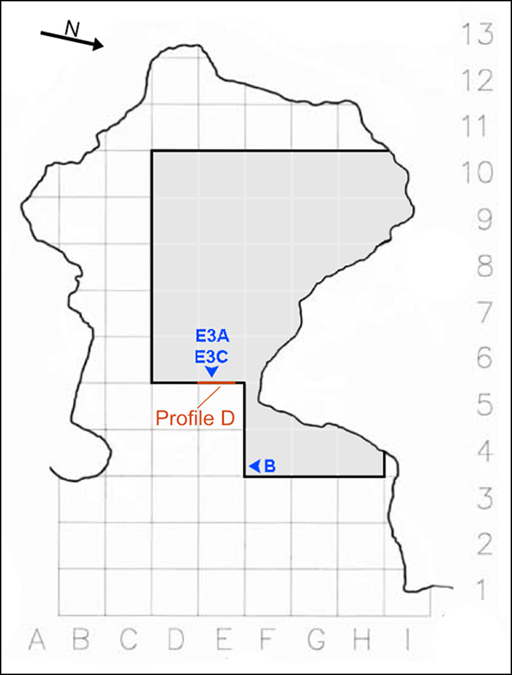
Plan of Mujina pećina showing the locations where samples were taken from the profile. The extent of the trench is marked by light grey (figure by M. Banda).

This is the first systematically excavated and radiometrically dated site in Dalmatia with an unequivocal Middle Palaeolithic stratigraphic sequence. The stratigraphic layers (Figure 4) are composed of Quaternary sediments including large limestone clasts and gravel, as well as sand grains of silicate minerals, silt and some clay. Fine to medium-sized gravel predominates throughout the sequence, which contains different types of Mousterian industries (denticulated, Balkan Charentian) and faunal remains. The sequence was previously dated in full by radiocarbon and partially by ESR to between 49 000 and 39 000 cal BP (Boschian et al. Reference Boschian2017). However, the results of some samples collected from the lowest layers were beyond the limit of radiocarbon dating. To clarify this earlier chronology, samples were taken from the lower layers (E3C and E3A) and the topmost Middle Palaeolithic layer (B, see Figures 3 & 4) for optically stimulated luminescence (OSL). The results provide radiometric ages for the earliest layers of Mujina pećina, indicating a human presence in Dalmatia much earlier than previously documented and improving the Middle Palaeolithic chronology of the Adriatic and beyond.
Eastern stratigraphic profile D (face of square E5) (figure by M. Banda).

Materials and methods
Standard procedures for OSL sampling were implemented. Following the cleaning of the profile by scraping away its surface, samples were taken by inserting opaque, 300mm-long tubes (so that the sediment was not exposed to light). Small amounts of sediment from within a 150mm radius of the tubes were also collected in plastic bags. Samples were taken in 2020 from layers B (square E4, southern profile), E3A and E3C (square E5, eastern profile D) (Figures 3, 4 & 5). Dating was conducted at the Luminescence Dating Laboratory, Institute of Physics, Silesian University of Technology (Gliwice, Poland) (see Moska et al. Reference Moska2021 for full procedure). Quartz grains, 45–65μm in size, were etched in 40% hydrofluoric acid for 45 minutes and the radioactivity of the sample was measured by a germanium spectrometer. Equivalent dose determination was conducted by the OSL-SAR (single aliquot regenerative) technique (Murray & Wintle Reference Murray and Wintle2000). All calculated ages are based on Central Age Models of multiple aliquots (Galbraith et al. Reference Galbraith1999).
Sampling in layer E3A (photograph by I. Karavanić).

Results
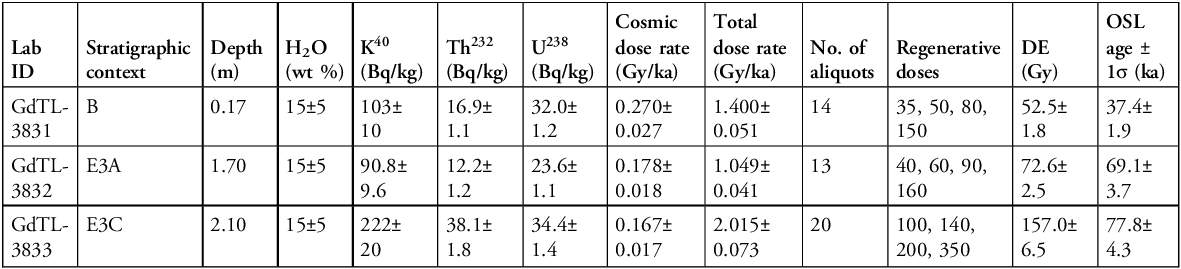
Sample GdTL-3831 from layer B provides an age of c. 35–39 ka (Table 1), corresponding to the second half of MIS 3. The results from the E3 stratigraphic complex indicate older ages, with layer E3A being c. 65–73 ka (MIS 5a–4 transition) and layer E3C being 73–82 ka (MIS 5a).
Results of OSL dating of Mujina pećina layers.

Table 1 Long description
The table presents OSL dating results of Mujina pećina layers, showing various measurements and calculations. It has 4 rows and 12 columns. Column headers are Lab ID, Stratigraphic context, Depth (m), H2O (wt %), K40 (Bq/kg), Th232 (Bq/kg), U238 (Bq/kg), Cosmic dose rate (Gy/ka), Total dose rate (Gy/ka), No. of aliquots, Regenerative doses, DE (Gy), and OSL age ± 1σ (ka). Row 1: Lab ID, GdTL-3831; Stratigraphic context, B; Depth (m), 0.17; H2O (wt %), 15±5; K40 (Bq/kg), 103±10; Th232 (Bq/kg), 16.9±1.1; U238 (Bq/kg), 32.0±1.2; Cosmic dose rate (Gy/ka), 0.270±0.027; Total dose rate (Gy/ka), 1.400±0.051; No. of aliquots, 14; Regenerative doses, 35, 50, 80, 150; DE (Gy), 52.5±1.8; OSL age ± 1σ (ka), 37.4±1.9. Row 2: Lab ID, GdTL-3832; Stratigraphic context, E3A; Depth (m), 1.70; H2O (wt %), 15±5; K40 (Bq/kg), 90.8±9.6; Th232 (Bq/kg), 12.2±1.2; U238 (Bq/kg), 23.6±1.1; Cosmic dose rate (Gy/ka), 0.170±0.018; Total dose rate (Gy/ka), 1.049±0.041; No. of aliquots, 13; Regenerative doses, 40, 60, 90, 160; DE (Gy), 72.6±2.5; OSL age ± 1σ (ka), 69.1±3.7. Row 3: Lab ID, GdTL-3833; Stratigraphic context, E3C; Depth (m), 2.10; H2O (wt %), 15±5; K40 (Bq/kg), 222±20; Th232 (Bq/kg), 38.1±1.8; U238 (Bq/kg), 34.4±1.4; Cosmic dose rate (Gy/ka), 0.167±0.017; Total dose rate (Gy/ka), 2.015±0.073; No. of aliquots, 20; Regenerative doses, 100, 140, 200, 350; DE (Gy), 157.0±6.5; OSL age ± 1σ (ka), 77.8±4.3.
Conclusions
The date range obtained for layer B is consistent with earlier radiocarbon dates (Boschian et al. Reference Boschian2017) and confirms the possibility that the latest Mousterian finds at Mujina pećina postdate the Campanian Ignimbrite (39 000–40 000 cal BP). The shallow depth of this sample (170mm) does, however, mean that contamination with later sediment is possible; a similar scenario is proposed for a radiocarbon date from layer D2 (Ox-A-8150, 34 200±100 BP; Rink et al. Reference Rink2002) whose calibrated age at 95.4% confidence (37 690–37 214 cal BP, Intcal 20) had been previously considered an outlier and discarded from subsequent analyses (Boschian et al. Reference Boschian2017).
The results obtained for layers E3A (around 70 kya) and E3C (around 80 kya) show that the initial part of the stratigraphic sequence at Mujina pećina is substantially older than previously thought. The dates indicate that these layers would have been deposited in MIS 4 (c. 71–57 000 BP) or even MIS 5a (layer E3C), not MIS 3. This age agrees with the still unpublished oldest OSL result from another Dalmatian site, Velika pećina in Kličevica (layer 22), and is also close to the oldest ESR date obtained for layer XXIV at Crvena stijena (Mercier et al. Reference Mercier and Whallon2017). Although some indications for an even earlier human presence in Dalmatia exist (Batović Reference Batović1988) and need to be tested, these OSL dates undoubtedly show that Mousterian occupations occurred in this region at least c. 30 000 years earlier than previously suggested. As the earliest layers of Mujina pećina belong to complex E3 and contain a high proportion of transverse scrapers (indicating an attribution to the so-called Balkan Charentian; Šprem et al. Reference Šprem, Karavanić and Kamenjarin2020), the new dates presented here will also enable better diachronic comparisons with the Mousterian artefacts from other sites in the region and beyond.
Funding statement
OSL dating was funded by the grant ‘Establishing the precise chronology of archaeological sites from the Middle Palaeolithic, late Roman and the early medieval period in the eastern Adriatic’ obtained from the University of Zagreb, Faculty of Humanities and Social Sciences.
Data availability statement
All data supporting the conclusions presented are available within the article.
Author contributions: CRediT categories
Ivor Karavanić: Conceptualization-Equal, Funding acquisition-Equal, Investigation-Equal, Project administration-Supporting, Writing - original draft-Equal. Slobodan Miko: Funding acquisition-Supporting, Investigation-Equal, Methodology-Equal, Writing - original draft-Supporting. Marko Banda: Investigation-Equal, Project administration-Equal, Writing - original draft-Equal. Giovanni Boschian: Investigation-Equal, Writing - original draft-Equal. Rory Becker: Investigation-Equal, Writing - original draft-Supporting. Fred H. Smith: Investigation-Equal, Writing - original draft-Equal.





 Open access

