

At the beginning of 1945, shortly before the war ended, a small group of London anarchists associated with the radical anti-militarist and anti-war publication War Commentary Footnote 1 were arrested and prosecuted. Given that this group was hitherto considered to be too marginal and uninfluential to raise official concern, this at first appears to be a surprising and anomalous set of events. The government decision to suppress a minor publication at such a late stage in the war using controversial emergency legislation has been described as “rather curious” and “difficult to understand” by commentators.Footnote 2
War Commentary was an anarchist paper published by the Freedom Press group in London between 1939 and 1945. Whilst the bulk of the British socialist movement in the mid-twentieth century was effectively structured by the choice between the Labour Party and the Communist Party,Footnote 3 the Freedom Press group belonged within an archipelago of groupings on the left that polemicized against both Moscow and the British Labour leadership. This included remnants of interwar pacifist socialist movements, the Anti-Parliamentary Communist Foundation (APCF) associated with Glasgow anarchist Guy Aldred, and others such as Sylvia Pankhurst’s Communist Workers’ Party (CWP).Footnote 4 The Freedom Press group and Aldred’s Glasgow anarchists opposed World War II along anti-state and anti-capitalist lines. Allied and Axis powers were understood to be defending militarized capitalist hierarchies whether they called themselves fascist or not. Anarchist groups such as these pointed to the plight of the republicans in the Spanish Civil War in particular in order to cast serious doubt on the sincerity of the British establishment’s hostility to fascism. Links between the various anti-parliamentary groups, left communists, anarchists, and war resisters were established in meetings such as the Workers’ Open Forum, advertised by the APCF as “a workers’ council for eliminating error” and addressed by independent radicals, anarchists, socialists, members of the Peace Pledge Union, and others.Footnote 5
British officials pursued conflicting policies towards the activities of War Commentary during the war. Despite the virulent anti-war stance of the paper, the government was reluctant to engage in overt censorship of the anarchists until April 1945, when it drew on the full force of the available wartime defence regulations to curtail their publishing activities. At the height of the strategic bombing campaign in Germany the authorities had been carefully monitoring the material which appeared in War Commentary. At this point, however, the government had decided not to invoke any special measures (or emergency powers) to suppress a group which had not seemed to pose a credible threat either to the war effort or to public order on the home front. Among other things, the government had been concerned about the possible publicity that a crackdown on an otherwise obscure movement might produce. However, when the war was in its final stages, the government’s attitude toward censoring anarchist propaganda changed significantly. As this article will show in detail, the authorities decided to begin acting against the British anarchists in late 1944 because they were concerned that the revolutionary messages being disseminated in the pages of War Commentary might find a much wider and more receptive audience once the fighting ended and soldiers began returning home.
The apparent change in policy towards the anarchists should be viewed in the context of official fears about the potential political turmoil associated with the endings of wars in which civilian populations have been mobilized into a military establishment. Tensions and fears associated with the process of demobilization after World War II have rarely been highlighted in British social and political histories. Nonetheless, military demobilization was socially fraught and politically controversial.
Globally, the two world wars had a profound impact on the temporal pattern of worker dissent. Using a key database on world labour unrest, Beverly Silver has demonstrated that the years following the endings of the two world wars coincided with the “two highest peaks in overall world labor unrest” since 1870, these being periods of “explosive world-scale outbreaks of labor militancy”.Footnote 6 The period following World War I had demonstrated the potential for social unrest surrounding the management of mass demobilization to coalesce into mutinous dissention. Across Europe, citizen-soldiers had returned home armed with weapons and revolutionary ideas to foment rebellion and revolution. Insubordination and “whiffs of revolutionary ferment” broke out in hundreds of British Army camps following World War I. In 1919 over 10,000 soldiers on leave in Folkestone refused to embark on troopships returning them to France, a patrol vessel at Milford Haven raised the Red Flag, and Calais was overrun by striking military personnel.Footnote 7 Given the historical precedent, the government was sensitive to potential problems around demobilization.
These events, both the anarchist activities and the government response to them, reveal a less consensual relationship between state and society in the period than is usually perceived to be the case. The historiographical consensus about the British people at war has traditionally centred around the notion of a nation united across class in solidarity and community. Richard Titmuss’s Problems of Social Polity, published in 1950, portrayed a level of wartime social solidarity that he claimed laid the groundwork for postwar welfarism.Footnote 8 The first major challenge to this orthodoxy was Angus Calder’s social history of wartime Britain, The People’s War, which used the recently rediscovered wartime material of Mass Observation to present a picture of life in wartime Britain that included panic, looting, class conflict, xenophobia, strikes, and absenteeism.Footnote 9 The popular image of national unity against the foe was criticized as a myth, with strikes commonplace, the government often unpopular, and Churchill frequently disparaged.Footnote 10 Further revisions, for example Paul Addison’s The Road to 1945, detailed a range of political tensions in wartime Britain.Footnote 11 Nonetheless, the popular, mainstream view of the war has proved consistently resilient to these challenges and revisions. David Cesarani has argued that the cultural constriction perpetrated by these myths still hampers informed national debate on matters related to the war such as the failure to prosecute Nazi collaborators and the assessment of Allied bombing strategies.Footnote 12 One consequence of this constricted national debate is that mainstream histories of the period tend to obscure the tensions between government and serving personnel that were a marked feature of the later months of the war – an obfuscation that makes government sensitivity to the anarchist commentary of these months difficult to understand.Footnote 13
Anarchism offers a particular interpretation of the relationship between state and society underlying warfare between nations. Scott Turner, in a recent edited collection of work to emerge from the field of anarchist studies, notes that in this tradition the words “governmental” and “military” are often used synonymously. Anarchists reject the legitimacy of war because they resist the very idea of state sovereignty.Footnote 14 So, whilst anarchism historically encompasses a variety of opinions on the use of violence as a revolutionary strategy, its stance on war between nation states is generally consistently hostile. It is a philosophy that endorses horizontal models of political engagement and envisions a social order that is sustained and coordinated without coercion or enforcement. Anarchist anti-militarism, questioning war and the state together, attacks the politically centralized character of relationships in war-ready societies as much as it resists war itself. The anarchist editors of War Commentary applied this analysis to their critique of state policy during World War II, and to the expression of their doubts about the postwar settlement that was being shaped.
This article will first outline the trial of the editors and the controversies it created. Then it will explore the position of the Freedom Press anarchists on the war. It will contextualize this position within the revisionist approach to British government and society in the mid-century period, particularly drawing on recent commentaries on the military priorities of the British state at that time. Following this, it will look at the policy of government towards the publication of War Commentary and why this changed. Lastly it will examine the issue of demobilization in an international context, focusing both on the concerns it created for the state and the opportunities it seemed to offer to the anarchists. Both the state authorities and the anarchists had a series of international examples and references in mind when considering the dangers and opportunities presented by the demobilization moment. It is argued here that the British government decided to suppress the publication of War Commentary because officials feared that, in the context of demobilization, such anti-militarist polemic could foment unmanageable political turmoil.
THE STRANGE CASE OF THE THREE ANARCHISTS JAILED AT THE OLD BAILEYFootnote 15
The Freedom Press group denounced the war from the outset and persistently highlighted the continued existence of class privilege in wartime Britain. It was thus, according to Ward “an obvious candidate for the attentions of the Special Branch”.Footnote 16 It is, however, towards the end of the war that overt interference with, and then prosecution of, the anarchists began. In fact, the Freedom Press anarchists enjoyed what Stammers terms the “dubious distinction” of being involved in one of the last “political prosecutions” of the war.Footnote 17
In December 1944 officers of the Special Branch, the police unit concerned with political and other matters of national security, raided the Freedom Press Office and the private houses of four editors and sympathizers. Search warrants were issued under Defence Regulation 39b which declared that no person should seduce members of the armed forces from their duty, and regulation 88a which enabled articles to be seized if they were evidence of the commission of such an offence. At the end of December, Special Branch officers led by Detective Inspector Whitehead, searched the belongings of soldiers in various parts of the country, including Ward at Stromness in Orkney. On 22 February 1945 Marie Louise Berneri, Vernon Richards, and John Hewetson were arrested at 7.30 in the morning. They were joined at the court by Philip Sansom who was brought from Brixton Prison, and the four were charged with the dissemination of three seditious issues of War Commentary under Defence Regulation 39a.
They appeared four times at Marylebone Magistrates’ Court and their trial took four days at the Old Bailey, England’s Central Criminal Court. The evidence used in the trial included articles from War Commentary dated 1, 11, and 25 November 1944 covering spontaneous councils or soviets in post-World-War-I Germany and Russia, soldiers’ councils in the French Revolution, the British rail strike of 1919, unrest in British industry, and bad conditions in military training camps. Central to the prosecution case was a Freedom Press circular letter dated 25 October sent to subscribers in the military, asking contacts to introduce “new comrades” to the publication. Also presented at the trial were lists of subscribers in the forces found at the offices of Freedom Press, a manuscript signed by a number of soldiers disapproving of the government’s policy on Greece, and a leaflet containing the following poem, entitled “Fight! What For?”:Footnote 18
You are wanted for the Army,
Do you know what you’ll have to do?
They will tell you to murder your brothers,
As they have been told to kill you.
You are wanted for the Army,
Do you know what you’ll have to do?
Just murder to save your country
From men who are workers, like You.
Your country! Who says you’ve a country?
You live in another man’s flat,
You haven’t even a back yard,
So why should you murder for THAT?
You haven’t a hut or a building,
No flower, no garden, it’s true,
The landlords have grabbed all the country,
Let THEM do the fighting – NOT YOU.
In the event, the case made by the prosecution was to connect the above-mentioned circular letter sent to the members of the forces who were subscribers to War Commentary with articles on the history of soldiers’ councils in Germany and Russia in 1917 and 1918, and on the European resistance movements which, as the Allied armies advanced in 1944, were being urged to hand over their arms to the governments then being set up under military auspices. One of the headlines in War Commentary urged resistance movements in Europe to “Hang onto Your Arms!”, and this was used by the prosecution to show that the paper was telling British soldiers to keep their rifles for revolutionary action. On 26 April Richards, Hewetson, and Sansom were found guilty and sentenced (Berneri was acquitted on a legal technicality that allows that a wife cannot be guilty of conspiracy with her husband). The judge was Norman Birkett, and the prosecution was conducted by the Attorney General, Sir Donald Somerville. A Freedom Press Defence Committee was organized to raise funds for the defence and this won the support of many public figures including George Orwell, Herbert Read, Harold Laski, Kingsley Martin, Benjamin Britten, Augustus John, and Bertrand Russell.
Coming right at the end of the war, the use of emergency defence regulations caused public controversy, stoked by the coordinated public protests of these prominent individuals. A letter condemning the impending charge and the police raids which preceded it was published in the New Statesman of 3 March 1945, and included the signatures of T.S. Eliot, E.M. Forster, and Stephen Spender. On 31 March the New Statesman, the political and cultural magazine founded in 1913 by prominent members of the Fabian Society, published a further letter which announced that a Freedom Defence Committee had been set up to organize and fund the defence of the anarchists. The officers of the committee included Herbert Read and Fenner Brockway, and the list of sponsors included Aneurin Bevan, Gerald Brenan, Vera Brittain, Alex Comfort, Cyril Connolly, Clifford Curzon, Victor Gollancz, H.J. Laski, J. Middleton Murry, George Orwell, J.B. Priestley, Reginald Reynolds, D.S. Savage, and George Woodcock. The committee was also broadly concerned to guard free speech and went on to oppose the continuance of military and industrial conscription after the war. The anarchists found that their profile was raised from magazines of very low circulation to representation in the high-distribution daily tabloids in which the case was publicized. A special role in this campaign was played by Herbert Read, a writer and art critic who linked the more specifically anarchist milieus with a broader intellectual public.Footnote 19 Read noted that “[a] certain weight of opinion has formed behind […] [the anarchists], particularly among members of the younger generation”.Footnote 20
It was significant to the defence that the editors were being charged under special wartime regulations in 1944 when it was clear that the war was nearing its end. This indicated to concerned intellectuals the scope of state ambition to regulate printed opinion after the war. In April 1945 Common Wealth printed an article on the state of political censorship in Britain which was fiercely critical of the War Commentary prosecution, which it saw as “a test case” in the use of emergency legislation to “crush political opposition”, and evidence that “the Government could easily stifle all opposition together”. Also, it was noted in Common Wealth (a left-wing publication aligned with cooperative, syndicalist, and guild socialist traditions), “there is every sign of terror at the prospect of a political awakening in the Services”. If the prosecution was successful, it was argued, “the way will be clear for the Government to make further and wider application of its powers to suppress opinion and to imprison its political opponents”.Footnote 21
Read addressed the public protests about the prosecution with sweeping condemnations of the government, and the class oppression underpinning the trial. “Our statesmen have made a chaos and call it victory”, he charged, “[m]illions of men are dead, and their silence is called peace”.Footnote 22 Read claimed that, whilst the anarchists prosecuted were a small group, the implications of the prosecution were of national significance, declaring that “I speak to you as an Englishman, as one proud to follow in the tradition of Milton and Shelley”. The trial of the anarchists had implications for anyone, he argued, who valued their native rights of free speech, and anyone who sought to resist the growth of “that foul and un-English institution, the political police”.Footnote 23 The invocation of war regulations at such a late stage in the war was interpreted as a warning of the authoritarian shape that the postwar state would take, and Read claimed that the use of Defence Regulation 39a was being prolonged into peacetime in a covert spirit of increasing censorship.Footnote 24 The prosecution thus turned into the kind of cause célèbre that the government had been carefully trying to avoid throughout the war by refraining from formal and direct censorship. At the same time, the case of the anarchists came to be presented as one of traditional British liberties under siege, even by the anarchists themselves. Commentators have found it curious that the authorities chose to risk this controversy at such a late stage in the war by invoking emergency regulations against a seemingly obscure group of writers. It is to this group, and the arguments that they advanced, that this discussion will now turn.
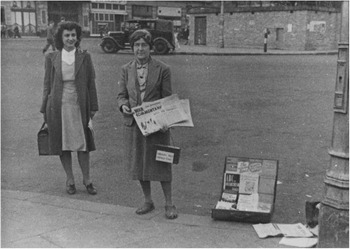
Marie Louise Berneri (left) continued to work on the publication of War Commentary and raise funds for the Freedom Press Defence Committee after her acquittal. Collection IISH
ANARCHIST ANTI-MILITARISM: WAR, DISORDER, AND THE STATE
The noticeable revival of interest in anarchism in Britain had been triggered in the 1930s by the Spanish Civil War, which had led to the publication in Britain of Spain and the World, a fortnightly journal produced by the anarchist Freedom Press publishing house. Part of the active core of the editorial group had its origins in the Italian anarchist movement, which had “always flourished in London”, and had, since the 1920s, developed with a vigorous anti-fascist tradition.Footnote 25 The publication emerged in 1936, edited by Vero Recchioni (later Vernon Richards), the son of an Italian anarchist, and Marie Louise Berneri, daughter of Italian anti-fascist activist Camillo Berneri (who was assassinated in Spain the 1930s). Spain and the World changed its name to Revolt! in the period between the war in Spain and the beginning of World War II, and Revolt! became War Commentary early in the war, reverting back to the traditional title Freedom in August 1945.
War Commentary stood outside the pro-war consensus of mainstream parties and political groupings in Britain and consistently opposed the fundamental assumptions of government policy throughout the war with its virulent anti-militarist line. However, as anarchist historian of the period Albert Meltzer notes, the paper was soon “well in demand by various peace groups, coming into contact with anarchist ideas for the first time”.Footnote 26 Historically, whilst pacifism refers to opposition to war, and to positive efforts to create peace between nations, anti-militarism identifies intra-state warfare with the political and economic interests of elites. For anarchists, anti-militarism represents an objection not just to war itself but to the underpinning political logic of top-down “chains of command” that inhere in centralized war-ready nation states. Shared concerns about conscription drew anarchists and pacifists together in World War II, and anarchist and pacifist agendas began to merge from that point onwards (this convergence having a significant impact on later twentieth-century anti-nuclear movements).
The medical doctor John Heweston came to the editorial group of War Commentary via this pacifist connection, moving over from the Forward Group of the Peace Pledge Union. During the war he and Berneri periodically worked full-time (unwaged) on the editorship of War Commentary. Artist Philip Sansom was drawn to the Freedom Press editorial group in 1943 following the publication of Herbert Read’s Education through Art. He edited and wrote a great deal of the political analysis and commentary found in Freedom in the postwar years. Sansom was part of the beginning of the campaign against capital punishment and led the occupation of the Cuban Embassy in July 1963 to protest against Castro’s treatment of Cuban anarchists. He also found an active role in most of the postwar protest movements, including CND and anti-apartheid activities.
Within the wider literature in the field of anarchist studies this anti-militarist current within anarchism is recognized as one of the most important links between the anarchism of the 1930s and the renewal of interest in anarchism in the late 1950s and early 1960s, particularly as expressed in relation to technologies of war such as aerial bombing and nuclear weapons.Footnote 27 The editors of War Commentary raised objections to the policies of the wartime establishment from the outset, consistent with anarchist anti-militarist accounts of the social relationships underpinning the state’s propensity to engage in warfare. According to this anti-militarist analysis, militarism tends to transcend strictly military purposes to define social and political relationships, imposing military values upon civilian life even in peacetime. Militarism is thus understood as an embedded hierarchical political logic of uniformity and “chains of command” derived from military sources, as opposed to a heterogeneous participatory logic of shared decision making. It represents the esteeming of centralized political power as well as the belief in the importance of war and the glorification of violence. According to anarchists, these vertical chains of command feed the logic of blindly obeying orders, whilst horizontal and egalitarian social structures foster empathy, humanity, and responsibility for actions and outcomes. This anti-militarism thus blurs the distinction between the politics of warfare and the dynamics of social relations: hierarchical power both in wartime and during peace is considered to be destructive of social cohesion and erodes the human capacity to resolve conflict.
“War is the health of the State” argued American sociologist Randolph Bourne, and following his analysis, the anarchists understood war to be desirable for the state, bolstering the full culmination of collective identification and “hierarchy of values” upon which it depended.Footnote 28 As far as the anarchists were concerned, the political mobilization of individuals and communities as a collective national entity reinforced the core pernicious features of the nation-state as they saw them. These features were its sovereign territoriality, with the maintenance of territorial borders, the exclusive jurisdiction over people and property within that territory, the monopoly over the means of force, the system of law which overrides all other codes and customs, outside of which no rights or obligations are seen to exist, and the idea of the nation as the principle political community.Footnote 29 The wholesale militarization of that political community was implied, they argued, as soon as the state came to be seen as based on the nation and subjects were transformed into citizens. As Geoffrey Ostergaard remarks in this respect, highlighting the historical link between the nation-statehood and militarism: “Bayonets were thrust into the hands of citizens often before they were given the ballot.”Footnote 30 Globally, as the support of worker-citizens became more crucial for the successful prosecution of industrialized wars, nationalism and patriotism formed a basis for mobilizing soldiers and citizens.Footnote 31
The anarchists around War Commentary iterated their anti-militarist arguments in relation to World War II, claiming that, “[g]overnments need wars to survive and without them they would collapse”.Footnote 32 In the pages of War Commentary the war was a symptom of the state in its most recent and dangerous implications.Footnote 33 Colin Ward, a witness during the trial, and later a prolific anarchist author, expressed this sentiment clearly: “War is the expression of the State in its most perfect form: it is its finest hour.”Footnote 34 Resistance to the war-making powers of the state was a dominant theme in the anarchist commentary and intellectual output of the late 1930s and 1940s. According to a 1941 edition of War Commentary, anarchists must “concentrate all their energies” against war “in fighting against the State”.Footnote 35 The Freedom Press writers urged disobedience even before the war started: “Refuse to serve ‘your’ country!”, and “Refuse to assist the state in its manoeuvres for murder!”.Footnote 36 In order to resist the war, they claimed, it was necessary to resist the militaristic policies of national service and conscription regardless of “the fall of France”, “Dunkirk”, or the “Stalinist switchover”.Footnote 37
In 1938 and 1939, when signs of war seemed already evident, the Freedom Press turned against official claims to be waging war in the name of democracy or international justice, repeatedly referring to the Spanish experience. Looking at British policy towards the Spanish republic in the 1930s, they argued, “we discover that the policy of the present government has in every respect been one of active support for fascism”, and further “not once was it suggested that we should go to defend Spanish democracy”.Footnote 38 Equating fascism with centralized, militarized, authoritarian state government, the anarchists argued that it was “just as rampant here as abroad”.Footnote 39 Alongside War Commentary, anarchist writer Alex Comfort argued that fascism was a characteristic of militarized German and British states alike, which are “sitting on the Press ‘because this is Total War’”, and “making our soldiers jab blood bladders while loudspeakers howl propaganda at them”.Footnote 40
Anarchist polemic like this meant that War Commentary writers were highly sensitive to the “mechanised, highly organised, technical” characteristics of British state policy, under which ordinary soldiers were drafted.Footnote 41 “Being obstinate people”, they argued in War Commentary in 1942 “we refuse to believe that there is the slightest trace of human emancipation in the fact of working at maximum output, consuming as little as possible and leaving the daily lives of millions of people in the hands of a state power over which they have no control whatever”.Footnote 42 Anarchist anti-militarism in the 1940s was particularly hostile towards the policy of conscription, as a “tremendous weapon in the hands of reaction”, and under capitalism, “simply a reversion to chattel slavery”.Footnote 43
The anti-militarism of the Freedom Press anarchists was a clearly identifiable feature of their publications, campaigns, and public meetings throughout the 1930s and 1940s. Police Special Branch highlighted “opposition to militarism” and “opposition to the war” as the group’s main political orientations. A Special Branch report dated November 1941 underlined that the sentiments expressed at this event were that “Churchill is as much a brigand as Hitler”.Footnote 44 In a detailed report of one London meeting on the 7 July 1942, Special Branch noted that 400 people attended, including servicemen and 3 American soldiers. The police report noted “loud applause” when one speaker said he considered that there was no enthusiasm for the war, especially in the services, and another speaker drew attention to the “thousands of deserters”.Footnote 45 In January 1944, Special Branch reported that “[t]he contents of War Commentary are extremely anti-war, and condemn British bombing”.Footnote 46
As well as condemning conscription and Allied bombing strategies, the anarchists paid particular attention to the wartime experiences of serving personnel, the “workers in arms”. In the spring of 1944 this focus particularly concerned the prospect of demobilization. In May 1944, an article entitled “Mutiny in the British Army” appeared in War Commentary which argued that “[p]resent discussion of post war demobilization should naturally recall the discussion of the subject in 1918”,Footnote 47 when “[t]he soldiers’ movement proved to be one of the most successful strikes ever attempted”. A subsequent edition of War Commentary concerned the “British Mutinies in France”, claiming that “[e]verywhere such organisations were victorious. Briefly, the fruits of victory were: 1. Rapid demobilization of millions of soldiers 2. Pay was doubled 3. Food, shelter and other conditions were improved 4. Stupid parades and discipline were relaxed.”Footnote 48 The July 1944 feature, “How Wars End” argued that revolutionary and mutinous sentiments accompany the ending of wars, and more so with those that have engaged a civilian army.Footnote 49
In August 1944 the paper ran an advertisement for special subscription rates for soldiers. These features accompanied articles attacking proposed social insurance schemes, and expressing doubts about postwar conditions, especially regarding employment, housing, health, and civil liberties.Footnote 50 In November 1944 the paper adopted a large format newspaper style, a more accessible and immediate form which the anarchists claimed was necessary in order to report effectively on the fast pace of events in the months approaching the end of the war. The Freedom Press writers, well versed in anarchist anti-militarist socio-political analysis, had clear ideas about the opportunities presented by the imminent end of the war and strong doubts about the postwar settlement that was being shaped.
THE BRITISH WARFARE STATE
For many historical commentators the prosecution and trial of the Freedom Press group has seemed incongruous. These events, however, appear in a different light when the dominant historiography of the period is challenged. Writing from the revisionist approach to traditional historiographies of the war, David Edgerton argues that established histories of Britain between 1920 and 1970 neglect to show the dominance of military logic in the policymaking of the period, overlooking the significance of active “readiness for international war” in the social and economic activities of the British state, even during the war.Footnote 51 This oversight obscures dissonant social experiences of military policy in 1940s Britain, notably conscription and demobilization.
According to Edgerton, the failure or refusal to recognize the British warfare state is “longstanding, systematic, and deeply entrenched” in political commentary and historical writing, and he argues that “by contrast the welfare state loomed large”.Footnote 52 Edgerton focuses on the development, acceleration, and entrenchment of military industries, technologies, and infrastructure in the mid- and later twentieth-century period. Edgerton contrasts his image of a “British military-industrial complex” with the dominant “welfare-state” image found in the majority of economic histories, social histories, labour histories, and cultural histories: “[T]he welfare state has come to define the British state as a whole even for the most ideologically discerning of historians.” As he notes, “[i]n these histories the warfare state does not appear to exist, even in wartime”.Footnote 53
Edgerton argues that the exclusively “welfarist” image of the twentieth-century British state explains the “jarring effect that contemporary dissident views still have today”.Footnote 54 His revisions to the exclusively “welfarist” image of the British state in the twentieth century are connected to the challenges posed by Angus Calder, Paul Addison, Rex Pope, and Alan Allport to the political mythologies associated with World War II. In their attempts to revise these historiographical orthodoxies, Edgerton and other historians point to the gap in British social history regarding the experience of militarized civilians. “Much has been written about civilian life in wartime”, notes Addison, “but the social history of the armed forces has yet to be written in depth.”Footnote 55 As Allport notes, this also means that “the demobilisation experience of 1945 and all the powerful hopes and fears that it generated has curiously vanished from our collective memory”.Footnote 56
An important omission in the strangely de-militarized account of mid-century Britain is the genuine fear of mass unrest that surrounded the demobilization of conscripted personnel. Allport writes that there were real concerns that “soldierly anger would be too volatile for parliamentary democracy, and that ex-servicemen would take literally the call for organised resistance in the form of political extremism”.Footnote 57 Novelist and journalist J.L. Hodson made a similar observation in his 1945 war diary The Sea and the Land: “They’ve had a bellyful of being ordered about, and are not going to put up with it when the fighting is finished.”Footnote 58 These conscripted civilians, according to the Daily Mirror correspondent with the British army in Germany, had become a “League of Angry Men”. On returning from Germany he wrote: “I came home with the feeling that the serviceman needs his own resistance movement if he is to get justice.”Footnote 59
Historiographical orthodoxy has obscured the telling of dissonant accounts of militarism like these and the fears they generated within government, and this means that both the anarchist engagement with militarized civilians and the government response to it have appeared peculiar and incongruous. The work of revisionist historians, especially Edgerton’s contribution to this debate, provides an important corrective to these oversights and omissions, enabling a fuller and more satisfying account of the prosecution of the Freedom Press anarchists.
WAR COMMENTARY AND THE HOME OFFICE
“it can perhaps be safely ignored”
Ewing and Gearty emphasize “the degree to which emergency rather than ordinary law was the normal state of affairs” between 1914–1945.Footnote 60 As they and other authors argue, emergency powers, as a means of legally restricting liberties, were used during this period to temper political democratization. This includes the attempt to dilute the impact of full adult suffrage on the established hereditary hierarchies associated with the old order, which had perceived the “triple shock” of World War I, the Irish secession, and the Russian Revolution as evidence of what it might expect from the democratic transformation of society. However, despite the fact that “the government were involved in a process designed to stifle forms of political opposition more or less continuously throughout the war”, both the Chamberlain and the Churchill governments were careful to employ informal tactics rather than public policy methods to control and censor dissident political organization, precisely in order to “maintain a democratic image”, and avoid publicizing undesirable views and organizations.Footnote 61
In a Cabinet memo concerning anti-war propaganda it was argued that if prosecutions were brought against anti-war groups those groups might attract more sympathy than they would otherwise have done.Footnote 62 Sir John Anderson, the Home Secretary (minister of the interior), explicitly stated, regarding the use of the law in this context, that “it was contrary to our traditions to use this method against a purely political organisation”.Footnote 63 Instead, it was recommended that a policy of covert action and normal law was employed to control anti-war and anti-government propaganda, such as the use of section 5 of the Public Order Act, regarding behaviour likely to cause a breach of the peace.Footnote 64 The Public Order Act was indeed used as a political weapon to suppress, for instance, the Communist Party leaflet “The People Must Act”, and the communist Daily Worker, following instructions by the War Cabinet to chief constables.Footnote 65
War Commentary was published throughout most of the war, without attracting overt censorship. This was despite some strong opinions within government ministries that it ought to be censored, expressed for example by George Thomson of the Ministry of Information in a letter to George Griffith of the Ministry of Home Security in relation to the anarchist attacks on the Allied bombing campaigns: “[I]t does seem to me extraordinary that this sort of disgusting material is allowed to be published in this country.”Footnote 66 This careful approach to their publication was recognized by the anarchists. In a letter included with the dispatch of Freedom Press publications by post in 1942 (and which was intercepted by the authorities), Hewetson wrote: “The Home Secretary does not think ours and a number of other periodicals of sufficient influence to justify any drastic action on his part, more so as he is so unpopular, and presumably does not want to be even more so.”Footnote 67
The reluctance to prosecute the anarchists until 1944 is indeed a marked feature of the Home Office files on the matter and of its responses to pressure from other ministries, institutions, and individuals to pursue a prosecution. Although it was noted by Special Branch that War Commentary was overtly “obstructionist in its attitude to the present war effort”,Footnote 68 senior staff at the Home Office took the position that “poisonous as it is, it can perhaps be safely ignored”.Footnote 69 Notes on the Home Office files for this period regard the publication as “rather academic”, and “confined mainly to pacifists”.Footnote 70 The prevailing opinion seems to have been that whilst “[t]his group has a violently revolutionary programme”, “it is too detached from real life to cause much trouble”.Footnote 71 Likewise, in response to concerns from employers’ organizations concerning War Commentary’s celebration of railway strikes in 1943, the Home Secretary replied: “This publication is in fact known to the Department, but no action against it under the Defence Regulations has as yet seemed called for.”Footnote 72
On 3 May 1943 the attention of Home Office staff was drawn by the Ministry of Information to an article in War Commentary entitled “Democracy in the Army”, which focused on class inequalities in the military and “the abuse of power by officers”.Footnote 73 The Scrutiny Censor was reassured by the Home Office that they saw the paper “from time to time”.Footnote 74 Even Special Branch reports of a Huddersfield meeting in which anarchist Tom Brown apparently told the audience that “they were all capable of doing sabotage”Footnote 75 did not sway official opinion that “[i]t is often undesirable to prosecute a propagandist for expressions of opinion which may technically offend the law, as it only gives him the advertisement he desires”.Footnote 76 In April 1944, the Home Office position towards War Commentary was still consistent with its earlier view:
[...] it would appear undesirable to take any steps against it for the following reasons: 1) It would afford publicity for an obscure publication which by reason of its small circulation is unlikely to have much influence. 2) Any attempt to suppress it could be represented as an attack on a) democratic liberties b) the working classes.Footnote 77
In response to an article in War Commentary that caused particular concern at the Ministry of Labour and National Service in May 1944 entitled “Bevin Declares War on Miners”, the Home Office again argued against proceedings on the grounds that they “would provide an opportunity for the Anarchists to try to justify their statements in Court and to repeat their misrepresentations with a chance of reaching a very much wider public than they otherwise reach”.Footnote 78 In light of this argument, Home Office staff regarded action against War Commentary under the Defence Regulations as “wholly out of the question” almost throughout the war.Footnote 79
“nip these activities in the bud”
Whereas taking further action against War Commentary was not an agreed option among the wartime governmental institutions until late 1944, the group’s activities started to attract increasing attention from various departments from the end of 1943. It was in relation to contact with serving troops towards the end of World War II that more serious Home Office interest was aroused in the activities of the Freedom Press.
On 29 October 1943, the Postal and Telegraph Censor, working within the Ministry of Information, intercepted a multigraphed circular letter to “Friends of the Freedom Press”. In the circulation notes assessing the intercepted material, which were attached to the Home Office file, the authorities noted: “[I]t appears that special efforts are being made to keep in contact with members of the ‘Friends of the Freedom Press’ who are serving in the armed forces.”Footnote 80 The letter in question was explicitly directed to members of the forces sympathetic to the Freedom Press and pointed to “a more alert critical mood”, and even “justified aggressive cynicism” among “workers in uniform”. It went on to state that “the spirit of liberty of men and women in uniform is developing”. The Freedom Press anarchists claimed that “[d]iscontent grows with the increase of hardships and will grow with the coming intensive suffering of the next phase of war”.Footnote 81
Home Office circulation notes testify to increasing government awareness of Freedom Press activities: “In view of the fact that Friends of Freedom Press think that they are gaining increasing support in the forces, it may be worth watching to see what line War Commentary follows.”Footnote 82 From February 1944 to January 1945 the Home Office regularly scrutinized War Commentary. Particular attention was paid to criticisms of military policy, industrial strikes, and material relating to discontent and radicalism among serving troops. In February 1944 for example, Home Office notes record: “This number contains a mischievous leading article on the folly of bombing.”Footnote 83 In May 1944 staff at the Home Office noted that War Commentary “describes mutinies in the British Army in 1919”, which, in the anarchists’ view, “are recalled by the present discussions about demobilisation”.Footnote 84 These articles, alongside the circular letter, were seen at the Home Office as “indicative of the interest which the anarchist movement is taking in the Forces”.Footnote 85 Related to this, in July 1944, “[e]xcerpts from soldiers’ letters commenting on alleged unrest in the forces” are observed, as well as “an article on mutinies which points out that mutinies cannot be organised but arise from minor discontents continued over a period, plus frustration and disillusion”. “One gathers”, commented Home Office staff, “that the mutinies which will occur at the end of this war will have a better chance of success than their predecessors”.Footnote 86
In August 1944, Home Office notes record: “An article signed ‘from the ranks’ purports to show that the British army is ripe for revolution and says that the officers are the counter revolutionaries.” In September, Home Office staff commented with concern on a War Commentary review of a book on the revolts in the German Navy in 1918 and quoted from the review itself: “[S]uch knowledge we must all have for the coming stormy days that are ahead. For all who are weather-wise can see that the storm clouds are gathering.” However, it was also noted that “War Commentary does not dare to print hints on how to mutiny, so it projects them into the past, cf. articles on mutinies in France after the armistice in 1918 in previous numbers.”Footnote 87 It was in conjunction with further Freedom Press attempts to communicate with the forces that the anti-war material precipitated concerns at MI5, the agency for domestic intelligence.
Early in November 1944, it became known to the police that a further circular letter, dated 25 October 1944, had been distributed by the Freedom Press to its members serving in the forces. Reference was made to this in the October 1944 number of War Commentary which called attention to the “Soldiers’ Page” quoting letters from serving men who had visited political meetings. “It is apparent from the circular letter”, notes the police report written by Chief Inspector Whitehead, “that War Commentary is widely circulated among members of the Forces”. The report draws attention to key passages in the Freedom Press’s October letter which urged readers to circulate their copies of War Commentary among their units and pass names and addresses of potential sympathizers to the Freedom Press. The report quotes the letter in detail on the subject of discussion groups in the military and their potential to become embryonic “Soldiers’ Councils”. “In view of the seemingly dangerous material from a security angle, contained in this circular letter”, wrote Whitehead, “a special watch was kept on the subsequent editions of ‘War Commentary’.”Footnote 88
Particular issues of War Commentary were highlighted for special attention by Whitehead. This included an issue from the beginning of November 1944, notably the feature “All Power to the Soviets”, which concerned revolutionary action. He noted in particular those articles in War Commentary which provided historical surveys of postwar insurrectionary activities in Germany, France, and Russia, entitled “Spontaneous Insurrections”, “Soldiers’ Councils during the French Revolution”, and “Councils as Instruments of Politics”. Whitehead’s extensive quotes from War Commentary in his report include the following, which featured in the paper under a sub-heading referring to the “Lessons of 1917”:
[...] the decline of Army discipline was a sort of natural process, long before the revolutionary left began to take a hand. Wholesale desertions, complete disregard of orders, attacks upon and even murders of unpopular officers, fraternization with the German troops, blank refusal to go into attack; these were spontaneous manifestations of revolutionary feeling.Footnote 89
Whitehead also drew attention to the War Commentary issue dated 11 November 1944 which leads with the article “People in Arms”, and refers to the situation in France when armed bands of Maquis seized control in the provinces. In this article, under the sub-heading “Similar Conditions Elsewhere”, which addresses the relationship between Allied liberation forces and popular movements in Greece and Belgium, the anarchists expressed a sentiment which was to be highly significant for the prosecution of the Freedom Press editors. Whitehead drew particular attention to the anarchist assertion of, in their words, “the revolutionary potentialities inherent in the closing period of the war”, and in particular the assertion in War Commentary that “[i]t is the duty of Anarchists to urge the workers everywhere, as Connolly did the Irish workers of the Citizen Army to ‘hold onto your arms’”.Footnote 90 As Whitehead noted, the sentiment was reiterated in the subsequent issue of War Commentary, dated 25 November 1944, in an article entitled “The Workers’ Struggle in Belgium”: “We are emphatically on the other side, that of the armed workers. And we repeat again what we said in our last issue – ‘Hold on to your rifles!’.”Footnote 91 The same issue included further discussion of the 1917 Wilhelmshaven mutiny in the German Navy and the 1918 Kiel Naval Mutiny. Whitehead concludes with the conviction that: “the reading by Service men, of the circular letter dated 25.10.44, taken in conjunction with the articles appearing in the War commentary dated 1.11.44 and 25.11.44, would amount to ‘An incitement to mutiny’”.Footnote 92
In line with Whitehead’s conclusion, in November 1944, MI5 also raised concerns about the content of War Commentary and forwarded what it considered to be mutinous material to the Service Departments. In a letter concerning this material written by G.R. Mitchell, on behalf of MI5, to J.J. Nunn at the Home Office, Mitchell stated “We [MI5] feel it our duty to bring the articles in War Commentary which appear to have as their main or sole purpose the presentation of mutiny in a favourable light, to the notice of the Service Departments.”Footnote 93 This material, in conjunction with the changed layout of the publication to a more accessible newspaper style, and particularly in relation to the letters circulated in the forces, convinced Home Office staff that the anarchist publication was pursuing “what might be described as a forward policy”.Footnote 94 “There is a prima facie”, noted staff at the Home Office,
[...] that copies of the circular issues by the Freedom Press on the 25th Oct have been distributed to serving soldiers and there is reasonable cause to suspect that the object of such distribution is not to enlighten H.M.’s forces on the causes of past mutinies and revolutions but to encourage them to prepare themselves to take similar action when the right moment comes.Footnote 95
Thus, the activities of Freedom Press were considered to be “a more direct incitement to mutiny”.
It was decided, in light of this “forward policy” to “nip these people’s activities in the bud before the end of the war with Germany”. “Otherwise”, argued Home Office staff in the following significant observation, “they might have a dangerous influence after the armistice when men in the forces were weary of military life and were perhaps not particularly eager to police Germany, or to fight in more distant theatres of war, and had more time at their disposal for reading and discussion”.Footnote 96 This comment neatly encapsulates the anxieties underpinning the decision to prosecute the anarchists so late in the war. The decision was made in light of anticipated tensions concerning the demobilization of conscripted civilian personnel at the end of the war, and not in response to concerns about the successful prosecution of the war itself. This reflects well-entrenched fears concerning the possibility of postwar dissention and mutiny. Prosecution became desirable because of official concerns about the social tensions likely to be precipitated by large-scale demobilization. In the eyes of the government, the police, and MI5 the concern was the following – with the second part of the sentence revealing the degree to which the authorities were fearing unrest during the impending period of demobilization: “[I]f no action is taken now it will be more difficult to take action later on when the position may have seriously deteriorated.”Footnote 97
“SPECTRES OF MUTINY” AND THE “FORWARD POLICY” OF THE FREEDOM PRESS
“Welfarist” accounts of World War II focus exclusively on the non-serving civilian social experience. As a result, the impact of military life on a conscripted population that nonetheless saw itself as predominantly civilian remains largely unwritten. A focus on the social history of conscripted armed forces, particularly in relation to the ending of wars, most notably demobilization, provides a key context for understanding the perceived threat posed by the War Commentary anarchists, and the changed reaction to it which came from government ministries and security services at the end of the war. Indeed, the Home Office files on the matter make it clear that it was the particular “forward policy” of the Freedom Press regarding access to the armed services that made the critical difference and finally broke the government resolve not to impede overtly the activities of the anarchists. “There is no more promising material for revolution”, writes David Lamb, “than soldiers returning from wars, careless to danger and accustomed to risks and to taking collective action.”Footnote 98 Yet, as noted by Rex Pope in the mid-1990s, “relatively little” has been written about the planning of demobilization and the resettlement of military personnel after World War II. He argues that these plans deserve closer attention because the arrangements that were made reflect policies which were “the product of the moment”, and as such reflect wartime and immediate postwar attitudes more directly than longer-term policy objectives relating to education or health.Footnote 99
In wider historical context, Stephen Graubard has commented that conscription, “the conscriptive method”, addressed the manpower problem associated with modern warfare, creating, at the same time, challenges of its own.Footnote 100 The tendency for citizen conscript armies to engage in mass social unrest after wars had been a noted feature of European warfare already in the age of revolution, yet by the end of the nineteenth century, states were increasingly dependent on the cooperation of their worker-citizens for successful imperial expansion and war, and workers on the front and behind the lines became “critical cogs” in the war machine.Footnote 101 The destructiveness of modern warfare, however, had an even greater incendiary effect on worker-soldiers, even in the face of extended democratic rights. At best, as Graubard notes, a conscript soldier will accept military rule for a temporary period to secure a specific objective, but after that “his first thought is to his immediate release”.Footnote 102 In line with this argument Allport reports that, after World War II, “[w]artime servicemen were generally emphatic that they were short-term citizen-soldiers rather than regulars – not ‘faceless khaki pieces of a great game of Ludo’, as the novelist Anthony Burgess put it, but ‘civilians in temporary fancy dress’ whose time was now served”.Footnote 103
Following both world wars, demobilization was “a delicate and potentially explosive affair”.Footnote 104 In the case of World War I, as early as 1916, strikes, desertions, and revolts were rife, and by the time of the Russian Revolution in 1917 anti-war feeling among the populations of Europe was widespread. In turn, the elites of Europe experienced a pervasive sense of fear of revolution. According to Lamb, in Britain the possibility of internal revolution became a distinctly pressing anxiety: “That winter of 1918–1919 was the nearest Britain ever came to social revolution.”Footnote 105 The fear of mutiny which marked government policy-making after World War I also significantly shaped official decisions towards the end of World War II. “The spectres of mutiny and social unrest, vividly recalled from 1919”, writes Addison, “were never far from the minds of the authorities.”Footnote 106 Rex Pope also highlights the very careful management of demobilization policy, and shows how the potential volatility of demobilization thwarted wider government aims in the immediate postwar situation, in this case maintaining a centrally planned labour force for controlled economic reconstruction.Footnote 107 The rise of nationalist movements in Asia and Africa further increased tensions around demobilization, threatening to merge with social revolutions and destabilize the imperial powers in their structural dependency on colonial resources.Footnote 108
Anarchist sensitivity to the militarized features of the British state in the 1940s meant that they were primed and ready to pluck at the raw nerves of the political elite regarding the contentious process of large-scale demobilization. One of the convicted Freedom Press editors, Philip Sansom, imprisoned after the trial, recorded his impressions of the tense atmosphere surrounding demobilization and the acute official anxieties around slipping military discipline: “Once we got inside”, he recalled “we found the nicks full to overflowing” with soldiers sentenced to long terms of imprisonment by military courts for desertion and related offences. “None of this was known to the people at home”, wrote Sansom, adding, with significant emphasis, “[b]ut the government knew it!”Footnote 109
There was indeed a pervasive fear of mutiny within government after World War II. Allport has made it clear that, towards the end of the war, “[t]here was real fear that mass unrest would result if demobilisation was not handled well”.Footnote 110 Lord Woolton, who served war-time roles as Minister of Food and Minister of Reconstruction, attests to this anxiety in his diary entry for 1 November 1940: “I think there is going to be grave trouble”, he fretted, “and the danger is that if the machine of government which can spend money so recklessly in engaging in war, fails to be equally reckless in rebuilding, there will be both the tendency and the excuse for revolution.”Footnote 111 In May 1945 Ernest Bevin, Minister of Labour, warned his colleagues of potential chaos in the services.Footnote 112 In the eyes of senior Home Office personnel, the anarchists’ apparent efforts to stir up demobilizing soldiers’ feelings against the establishment might have met with some success. As Allport writes, “[d]isillusioned and resentful, ex-servicemen would, it was feared, be easy prey for extremists bearing false promises”.Footnote 113
In the event, in “one of the largest acts of collective indiscipline in British military history”, there were a significant number of protests, mutinies, and “demob strikes” that challenged military authority after World War II, particularly in India and the Middle East. In fact, as Silver notes, the intensity and duration of the post-World-War-II wave of labour unrest in colonial and post-colonial arenas was far higher and longer than the post-World-War-I wave, an important social revolutionary message from the decolonizing non-Western world.Footnote 114 In the tense atmosphere building up to these events, British officials decided to reverse their policy towards the Freedom Group’s subversive publication, risking controversy by pursuing a prosecution that would silence their anti-militarist polemic.
Cartoon by John Olday from War Commentary, 5 May 1945, protesting against the use of emergency regulations to silence political dissent.Collection IISH

CONCLUSION
This article has attempted to clarify the positions taken by the government and the anarchists in the course of the events leading to the prosecution and trial of the editors of War Commentary in 1945 by placing them in wider political and economic contexts. It casts an unfamiliar light on the relationship between state and society in the final stages of the war and in the immediate postwar period, highlighting the official perception of anarchist anti-militarist polemic as potentially incendiary in a context of an increasingly hostile civil response to the militarization of life.
The actions of the Freedom Press group and the government were embedded in the British social experience of war and in the international dynamics of relations between capital and labour, demonstrating the extent to which radicalism and dissent has been enmeshed in the dynamics of world politics and war. The experience of World War I had shown that a militarized establishment has reason to be particularly concerned about the end of wars, especially when they involved conscripted personnel. The focus of government concern towards the end of the war was the breakdown of military regulation and official sources of authority as the soldiers reclaimed their civilian identities. It is at this moment that the seemingly insignificant group, hitherto regarded as unthreatening, caused serious enough concern for the Home Office to decide to take action.
Similarly, for the anarchists, the emerging prospect of demobilization was the precipitous moment for accelerating their anti-militarist polemic, particularly targeting soldiers. Their rhetoric drew on key anarchist ideological points concerning militarism and social order. They were well-placed ideologically to address many of the anxieties and aspirations among both civilians and soldiers, by consistently associating government military policy with the experiences of violence and dislocation during war. In terms of British social history, the trial of the anarchists invites us to re-examine the impact of military experience on the civilian population in Britain and widen the “welfarist”, “consensus” paradigm, by which relations between society and the government of the period have traditionally been viewed.



