


Medog County, in the south-east of the Tibetan Autonomous Region, China, within the Eastern Himalaya biodiversity hotspot, is a globally important region for conservation (CEPF, 2005). The area was almost entirely isolated, without permanent road access, before 2014, retaining rich and diverse intact ecosystems. The natural forest cover in the region harbours threatened species of high conservation concern. The Bengal tiger Panthera tigris tigris was reported in the area in the 1990s based on indirect evidence of livestock depredation (Qiu & Bleisch, Reference Qiu and Bleisch1996; Qiu et al., Reference Qiu, Zhang and Liu1997; Zhang et al., Reference Zhang, Schaller, Zhi and Zhang2002). Recently, a new primate species, the white-cheeked macaque Macaca leucogenys, was reported from Medog, based on camera-trap surveys (Li et al., Reference Li, Zhao and Fan2015). However, biodiversity in the region remains poorly known as a result of the area's long isolation and the difficulties of access. Subsistence hunting, expansion of pasture, fuelwood consumption and farming have all threatened the region's biodiversity in the past (Qiu & Bleisch, Reference Qiu and Bleisch1996), and a new access road constructed in 2014 is likely to exacerbate these threats. To inform efforts to protect any globally or regionally threatened species in the area, information is required on their occurrence and status.
The Medog region supports diverse natural ecosystems, with a marked zonation of vegetation over altitudes of 850–7,782 m. The main vegetation types comprise tropical monsoon forests (500–1,100 m), subtropical montane broadleaved forests (1,100–2,500 m), temperate coniferous forest (2,500–3,000 m), dark coniferous forests (3,000–3,700 m) and alpine shrubland (3,700–4,200 m). Bare rock, scree and ice occur above 4,200 m. The area of the survey receives some protection as it lies within the Yarlung Zangbo Grand Canyon National Nature Reserve. Tree felling and hunting are not permitted and the reserve management office occasionally organizes patrolling in the area.
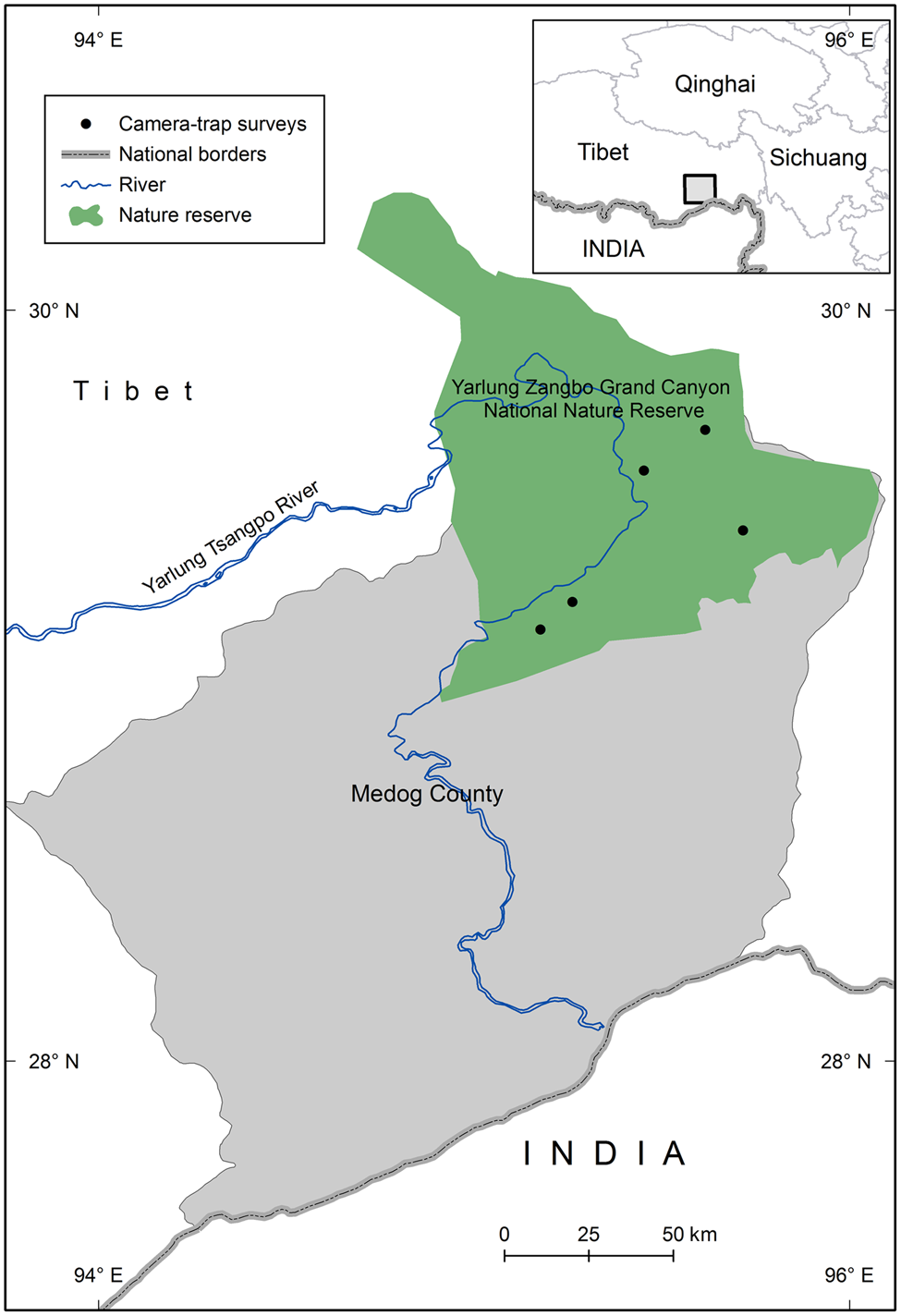
Here we present data from a survey along an altitudinal gradient in Medog County, with the objective of ascertaining the occurrence and occupancy of ground-dwelling medium to large mammal and pheasant species and the potential importance of the region for conservation. We conducted camera-trap surveys during October 2018–May 2019 in five areas (Fig. 1) east of the Yalong Zangpo River, with 5–8 camera traps set in each area (total number of camera-trap sites = 33). We placed cameras (Model E1B, Shenzhen Ereagle Technology Co., Shenzhen, China) singly along an altitudinal gradient of 1,050–3,900 m, with a minimum of 500 m between camera-trap stations (mean 1,128 ± SD 886 m), c. 1 m off the ground. Habitat heterogeneity such as vegetation type, altitude, slope gradient and position on slope were considered when selecting camera-trap sites. We set camera traps away from areas obviously visited by people and away from any trails apparently used by people, to minimize any bias in the detection of people, livestock or domestic dogs.
Locations where camera-trap surveys were conducted in Medog County, south-east Tibet, during October 2018–May 2019.
As it is difficult to identify muntjac to species based on camera-trap photographs, we pooled all photographs of the genus. Consecutive captures of the same species at the same site were considered to be independent records when there was at least a 1 hour interval between them. We used a multi-species variant of Royle–Nichols occupancy modelling (Tobler et al., Reference Tobler, Hartley, Carrillo-Percastegui and Powell2015) to estimate the probability that each species occurred in the area sampled by a camera-trap station during the survey period. To reduce data heterogeneity, we pooled every 7 days of camera-trapping occurrence data into a single sampling occasion. Our Royle–Nichols model closely followed the occupancy model used by Li et al. (Reference Li, Bleisch and Jiang2018), and assumed species occupancy was affected by elevation and human disturbance (defined as the presence of camera images of people, livestock or domestic dogs). The complete model specification is presented in Supplementary Material 1.
In a total survey effort of 4,570 trap days we detected 23 medium and large-sized terrestrial mammal species and six pheasant species. Of the 29 species detected, three (Bengal tiger, black musk deer Moschus fuscus and red panda Ailurus fulgens) are categorized as Endangered on the IUCN Red List, eight as Vulnerable, and two as Near Threatened (IUCN, 2019). Nineteen species (65.5%) are categorized as regionally threatened on the China Species Red List (six as Critically Endangered, four as Endangered and nine as Vulnerable; Supplementary Material 2). Carnivora was the most diverse order, with 14 wild species recorded.
Mean probabilities of occurrence (the modelled % of camera-trap stations at which each species was predicted to occur) varied markedly among species, ranging from 6.6% for Chinese goral Naemorhedus griseus to 60.0% for yellow-throated marten Martes flavigula. Per-individual detection probability (which can be thought of as the modelled probability of detecting an individual animal if it occurs in the vicinity of a given camera trap station) ranged from 5.0% for mainland clouded leopard Neofelis nebulosa to 10.0% for muntjac (Muntiacus spp.). The mean effects of human disturbance for most species were negative (21 out of 29 species, 72.4%; Fig. 2, Supplementary Material 2).
Number of independent records, mean individual detection probability and mean occupancy for the 23 medium and large terrestrial mammal species, six pheasant species, and livestock, people and domestic dogs in the camera-trap surveys in Medog County (Fig. 1).

The detection of 13 species categorized as Endangered, Vulnerable or Near Threatened on the IUCN Red List suggests that Medog County is a stronghold for threatened fauna. A large portion (65.5%) of the detected species are threatened in China. The distribution ranges of these species have shrunk and populations have declined dramatically in many areas of China (MEP & CAS, 2015) and throughout their range (IUCN, 2019).
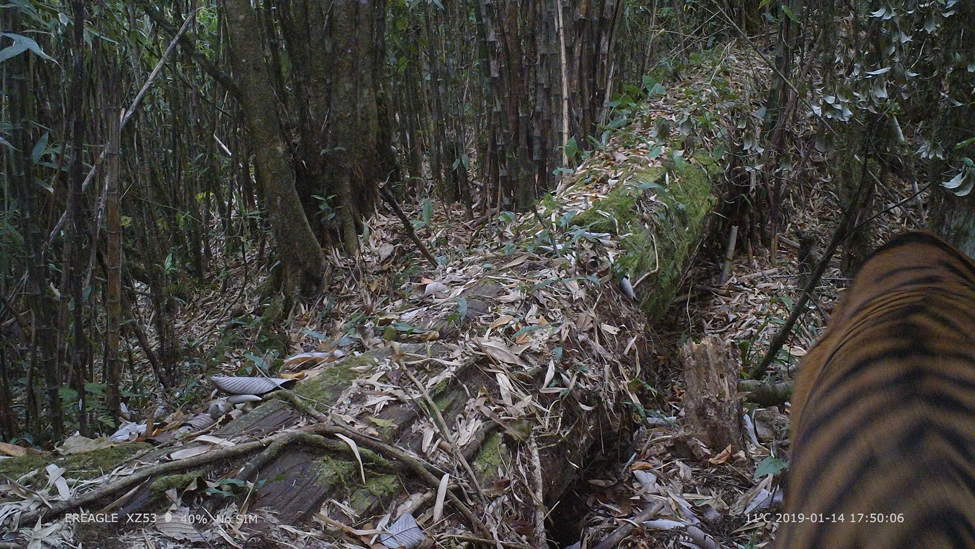
Of particular significance is the first camera-trap photographic evidence of the Bengal tiger in China (Plate 1). We detected tigers at two camera-trap stations in one study area at c. 2,000 m. It has previously been suggested, based on indirect evidence of livestock depredation, that this species occurs in the region (Qiu & Bleisch, Reference Qiu and Bleisch1996; Qiu et al., Reference Qiu, Zhang and Liu1997; Zhang et al., Reference Zhang, Schaller, Zhi and Zhang2002). Our detections confirm its presence and are significant for species conservation and recovery in China. Recent reports of at least 11 tigers in Dibang Valley and Mishmi Hills in India (known as the Zangnan region in China; Adhikarimayum & Gopi, Reference Adhikarimayum and Gopi2018), < 100 km from Medog County, suggests there could be a small transboundary population of tigers. The tiger is a flagship and umbrella species, and our recording of the species could have conservation benefits for the region.
Camera-trap photograph of Bengal tiger Panthera tigris tigris in Medog County (Fig. 1).
In general, the richness of large carnivores in a given area is determined by the abundance of prey species. We obtained a high number of independent records of muntjac, which is a primary prey for large predators such as the tiger. The high occupancy of muntjac (52.7%) and other prey apparently supports a diverse carnivore assemblage in the region, including other threatened predators (dhole Cuon alpinus, golden cat Catopuma temminckii, marbled cat Pardofelis marmorata, and leopard cat Prionailurus bengalensis), highlighting the conservation importance of this region. However, records of people and associated livestock and dogs frequently occurred throughout the area, as indicated by a high occupancy for anthropogenic events (Fig. 2, Supplementary Material 2).
Our study presents evidence for the importance of Medog County for a diverse assemblage of mammals and pheasants. Long-term camera-trap surveys and monitoring, over a wider area, are required to provide more comprehensive knowledge of the presence and range of these species in the region and to inform management. According to our local guides, illegal muntjac hunting (mainly with snares) is already prevalent in the region; with improved road access this may lead to depletion of carnivore prey. We frequently observed tree felling, apparently for fuelwood, during our survey, which could lead to habitat degradation and fragmentation. Hunting is illegal throughout the Nature Reserve, and needs to be controlled by strengthened patrolling, especially in tiger habitats. We did not observe any patrolling during our field survey, but our field guide reported that patrols are occasionally organized by the reserve management office, with collaboration between local forest guards and wildlife conservation authorities.
Acknowledgements
The study was supported by the Second Tibetan Plateau Scientific Expedition and Research programme (Grant No. 2019QZKK0501), the National Natural Science Foundation of China (#31601874), the Strategic Priority Research Programme of Chinese Academy of Sciences (#XDA20050202) and the Second National Survey on Terrestrial Wildlife Resources in China. We thank Pengfei Zhang, who helped to coordinate the surveys, and Fei Wu for his help with identification of pheasant species.
Author contributions
Study design, fieldwork: XLi, XLiu, XJ; data analysis, writing: XLi, WVB.
Conflicts of interest
None.
Ethical standards
This study was approved by the Tibetan Autonomous Region's Forestry and Grassland Bureau, and abided by the Oryx guidelines on ethical standards.


 Open access

