


Introduction
On the morning of Russia’s full-scale invasion of Ukraine in February 2022, Ukraine’s national railway company, Ukrzaliznytsia, confronted an unprecedented challenge. As Russian tanks and troops surged across the border, railway workers arriving for routine shifts found themselves transformed into rescue workers, evacuating civilians from cities under attack and sustaining mobility amid the violent disruption. Some scholars have described the invasion as precipitating ‘a deep state of existential anxiety’.Footnote 1 However, while the invasion clearly constituted a ‘critical situation’ marked by extreme physical insecurity, it did not generate widespread uncertainty over Ukrainian national identity. Instead, however, it disrupted the social and material environment through which that identity had previously been lived in everyday life. Beyond the immediate and devastating effects of physical violence, displacement, and destruction unleashed by Russia, the invasion radically unsettled the routines, expectations, and infrastructures through which Ukrainians’ daily life had previously been organised. Against this backdrop, the shared experiences of evacuation, repair, and continued operation associated with Ukrainian Railways became crucial for reestablishing a sense of normality and continuity of the collective Self. These experiences became woven into Ukraine’s national autobiography – the evolving story Ukrainians tell about their past, present, and future, helping to maintain ontological security in the wake of an existential threat to their national survival.
This paper argues that the resilience of critical infrastructure can enable the generation of ontological security through the interaction of material practices and autobiographical narratives. Within this setting, ontological insecurity refers less to the uncertainty about national identity than the destabilisation of the routinised material and social conditions through which that identity is ordinarily lived as continuous. This can prompt intensified efforts to re-anchor an already consolidated sense of Self in everyday social and material life. While ontological security scholarship has predominantly focused on discursive practices and identity narratives,Footnote 2 it has paid less attention to how socio-technical systems contribute to the production of ontological security. Importantly, I do not treat physical infrastructure itself as an autonomous agent. Rather, I understand infrastructure as a socio-technical assemblage, in the Latourian sense, in which agency is distributed across workers, technologies, organisational routines, and narratives.Footnote 3 In so doing, the paper also speaks to the literature that has begun to shift attention away from the state as the principal bearer of ontological security.Footnote 4
Ukrainian Railways exemplifies how railway infrastructure can function as a medium for ontological security, having evolved from a routine transportation provider into what is sometimes called ‘Ukraine’s second army’.Footnote 5 I show that the creation of ontological security within this context has proceeded through four key mechanisms. These include the maintenance of everyday operations under attack as an embodiment of collective resilience; the mythic elevation of railway workers as heroic ‘saviours’ of the nation; the railways’ physical integration with European rail networks as a form of international relationship-building; and the cultivation of homecoming symbolism that connects mass displacement with the promise of eventual return. More broadly, alongside other contributions of this special issue,Footnote 6 the paper contributes to reconceptualising ontological security as a creative process of becoming. Ontological security, in this account, arises through the collective effort to navigate and contain disruption, being underpinned, in significant part, by the functioning of critical infrastructure. This, moreover, challenges the existing assumption that resilience needs ontological security in order to emerge,Footnote 7 instead highlighting their co-constitutive relationship.
The study employs a multi-modal narrative analysis to investigate how Ukrainian Railways serves as a site for the construction of the nation’s ‘biographical narratives’Footnote 8 with a focus on how these narratives emerge across multiple communicative modes.Footnote 9 Rather than confining analysis to linguistic discourse alone, this approach recognises that ontological security narratives also take shape across visual, sonic, and material dimensions. Multi-modal narrative analysis proves valuable for examining the role of wartime infrastructure as it captures how technical operations (material mode) combine with media representations (visual mode), official communications (linguistic mode), and artistic interventions (sonic mode) to transform railway infrastructure into the central character in Ukraine’s evolving national story. Tracing how these different modes intertwine highlights, for example, how the material reality of maintained train schedules validates linguistic claims about national resilience, or how sonic environments at stations create an emotional backdrop for homecoming stories.
The paper draws on a purposively sampled corpus of materials produced between February 2022 and June 2025. The corpus comprises five main categories: 1) official communications from Ukrzaliznytsia and government officials across websites and social media platforms; 2) media productions including the ‘Train to Life’ documentary, YouTube videos, and news coverage from Ukrainian and international outlets; 3) social media discourse with attention to posts using railway-related hashtags on Instagram, Facebook, and X/Twitter (n ≈ 80); 4) cultural and artistic productions documented through media coverage, including station art installations, musical compositions, and commemorative initiatives; and 5) documentation of material and spatial infrastructure changes like the gauge conversion project and station redesigns. These materials were supplemented by fifteen semi-structured interviews with railway workers (five interviews), passengers (eight interviews), and Ukrzaliznytsia senior officials (two interviews), which I conducted in June 2025. The analytical process proceeded through iterative coding in three stages. First, I identified the main narratives about railways. I then traced how these narratives circulated between elite discourse, media productions, and grassroots testimonials. Finally, I analysed how each narrative gained meaning through the interplay of linguistic, visual, sonic, and material dimensions.
The paper makes three primary contributions. First, it advances ontological security studies, infrastructure studies,Footnote 10 and resilience literature by strengthening the understanding of the nexus between ontological security, material infrastructures, and resilience. Second, it offers a methodological contribution by illustrating how a multi-modal narrative approach can capture the ways in which infrastructures acquire political and sensory-semiotic meaning through the interaction of linguistic, visual, sonic, and material registers. Third, it provides new empirical insights into the Russia–Ukraine war by documenting how the continued performance of railway operations helps maintain a sense of normalcy for civilians living under conditions of acute insecurity and uncertainty.
The paper proceeds in two main parts. The first section develops a theoretical account of critical infrastructure as a site where ontological security and resilience are co-constituted through the coming together of socio-technical practice and public storytelling. The second, empirical section unpacks the four mechanisms through which the Ukrainian railway system has helped nurture ontological security during wartime. The conclusion draws out the paper’s broader theoretical implications, positing that the security of the Self is found in adaptive processes rather than achieved end states.
Critical infrastructure, ontological security, and resilience
Critical infrastructures can be understood as ‘materialised governance arrangements that exert spatial and social control through inclusion and exclusion, connection and disconnection’.Footnote 11 By organising who and what can move, they shape the circulation of people, goods, and resources and enable ‘the possibility of exchange over space’, functioning as ‘physical networks through which goods, ideas, waste, power, people, and finance are trafficked’.Footnote 12 Infrastructures possess the power to structure the everyday routines through which the social order comes to feel normal, predictable, and secure. However, while taking its materiality seriously, critical infrastructure should not be reduced to a collection of technical objects. Instead, following Bruno Latour’s actor–network theory, I conceptualise infrastructure as a socio-technical assemblage, in which agency emerges from the relations among heterogeneous human and non-human actors.Footnote 13
In the case of railways, this assemblage includes human actors, non-human technologies, organisational routines, and narrative practices. It is through their patterned interactions that infrastructure is stabilised and its social meaning produced. From this perspective, the infrastructural order and reliability are not pre-given properties of technical systems but ongoing achievements of coordinated work, being ‘the consequence of […] work rather than its cause’.Footnote 14 When such systems function smoothly, they normally recede from view but then become visible when they break down. As Latour put it, ‘When a machine runs efficiently, when a matter of fact is settled, one need focus only on its inputs and outputs and not on its internal complexity’.Footnote 15 Hence, critical infrastructure often remains invisible during peacetime, only becoming visible when disrupted or threatened in wartime.
The rest of this section lays the theoretical foundations necessary for understanding how critical infrastructure can become an anchor for ontological security through creative practices of resilience. I explore three interconnected aspects of this phenomenon: the way technical systems provide material grounding for ontological security; the role of critical infrastructure in enabling identity transformation; and the idea that resilience and ontological security are interconnected and mutually constitutive.
Technical systems as material anchors of ontological security
Anthony Giddens’s conceptualisation of ontological security provides an essential foundation for understanding how modern societies maintain their security of being with the help of technical systems.Footnote 16 He famously defined ontological security as ‘the confidence that most human beings have in the continuity of their self-identity and in the constancy of the surrounding social and material environments of action’.Footnote 17 Ontological security, accordingly, represents an ‘emotional phenomenon’ rooted in basic trust or the faith in the reliability of persons and things.Footnote 18
Although identity instability (i.e., challenges to one’s self-conception) has received much attention as a source of ontological insecurity, the latter need not always manifest in that way. Ontological insecurity can equally appear as an intensified need to reassert, perform, and materially anchor an already consolidated Self where there is a rupture in the continuity of a community’s social and material life. Ontological insecurity can, thus, take the form of a disruption of the routines, practices, and material conditions through which a collective identity is ordinarily sustained. In this sense, a community may remain relatively certain about who it is, while still experiencing ontological insecurity when the everyday routines and temporal rhythms that underpin this identity are violently unsettled. In question is an ontological disruption – a breakdown in the continuity and predictability that ordinarily allow individuals and collectives to experience the world as stable and intelligible. The widespread reassertion of Ukrainian national identity following the Russian full-scale invasion should, therefore, be read as an active response to the severely disrupted conditions that make the collective selfhood liveable and durable. As Poberezhna et al. show, Ukraine saw an intensified consolidation of national self-narratives and collective unity, including the rapid emergence of wartime myths that reaffirmed collective selfhood.Footnote 19 It is within such a context that the continued functioning of critical infrastructure becomes central to restoring ontological security.
Giddens himself argued that modern life depends fundamentally on trust in ‘expert systems’ – that is, ‘systems of technical accomplishment or professional expertise that organise large areas of the material and social environments in which we live today’.Footnote 20 Railways represent one such type of expert systems, where passengers entrust their lives to the complex interactions of engineering, scheduling, and maintenance. The railway timetable is an embodiment of ‘a time–space ordering device’ that ‘permits the complex coordination of trains and their passengers and freight across large tracts of time–space’, exemplifying how expert systems achieve the ‘dis-embedding’ central to modernity.Footnote 21 Critical infrastructure provides the material conditions that Giddens identifies as essential for ontological security, with predictable routines contributing to psychological stability. As Giddens put it, the ‘predictability of the (apparently) minor routines of day-to-day life is deeply involved with a sense of psychological security. When such routines are shattered – for whatever reason – anxieties come flooding in.’Footnote 22 Railway systems help sustain stabilising routines by providing scheduled services and standardised procedures, representing the ‘access points’ where abstract systems become tangible through encounters with system representatives.Footnote 23 These prove crucial because ‘displays of manifest trustworthiness and integrity, coupled with an attitude of “business-as-usual”, or unflappability’, help maintain faith in the technical system.Footnote 24
The need to make sense of the role of critical infrastructure in ontological security-making processes is further amplified by Giddens’s argument that ‘trust in abstract systems is the condition of time–space distanciation and of the large areas of security in day-to-day life which modern institutions offer as compared to the traditional world’.Footnote 25 This requires recognising that, as Kirsch argues in this special issue, ontological insecurities arise from the structural conditions of modernity rather than inherent human anxiety.Footnote 26 In other words, the capacity of infrastructure to provide ontological security is historically specific to the dependence of modern societies on large-scale technical systems. At the same time, while Giddens lays the groundwork for grasping infrastructure as a source of ontological security, he does not fully explore how infrastructure can creatively generate collective rather than individual security – the gap this paper addresses.
Despite Giddens’s insights, IR scholarship on ontological security has tended to overlook the role of critical infrastructure. Scholars like Mitzen, Steele, and Rumelili have notably explored how states seek ontological security through foreign policy routines and identity narratives, yet their analyses remain predominantly discursive and state-focused.Footnote 27 However, as Berenskoetter elucidates, nations’ biographical narratives rely on institutions that ‘lend the narrative a material infrastructure that can sustain it across generations’.Footnote 28 Going beyond discourse, Lupovici has begun to explore the connection between ontological security and technological environments by examining how cyber technologies challenge states’ ability to maintain a stable sense of Self and home, thereby constraining their monopoly over the provision of ontological security.Footnote 29 His analysis supports Zarakol’s argument that the role of the state as the primary ontological security provider is historically contingent.Footnote 30 These insights open theoretical space for examining how expert systems and large technical institutions embedded in material infrastructures can become central to sustaining ontological security in conditions of disruption. Indeed, scholars of infrastructure increasingly show that infrastructure is a key terrain where struggles over political authority, sovereignty, and territorial belonging unfold, often involving a range of actors beyond the state.Footnote 31
The relationship between critical infrastructure and ontological security becomes clearer if we recognise that, as Jabareen et al. observe, ontological security is founded ‘upon the construction of trusting relationships with the people [with] whom we share our places but also with “things” – the physical and abstract systems […] that assure the ongoing function of people’.Footnote 32 This provides the ‘infrastructure for well-functioning routine’, necessary to establish ‘congruency between one’s needs and one’s conduct’.Footnote 33 Moreover, Ejdus shows that material environments serve as vital anchors for ontological security narratives.Footnote 34 Through processes of ‘projection’ and ‘introjection’, as he calls them, societies project identity narratives onto infrastructure systems while, in parallel, incorporating the material presence of infrastructure into their collective self-understanding.Footnote 35 In the Ukrainian case, therefore, railways exemplify how technical systems provide a sense of material continuity. Institutions such as Ukrzaliznytsia actively narrate and maintain this continuity as a source of collective ontological security.
To argue for the need to account for the material is not to diminish the importance of the narrative in the production of ontological security, but rather to emphasise their intertwined relationship. On the one hand, infrastructure in its materiality alone cannot create ontological security without narratives that give it meaning. On the other hand, in the case of infrastructure, narratives on their own are insufficient to stabilise collective selfhood unless they are continuously corroborated by the material performance of technical systems. Instead, I view ontological security as emerging through their mutual alignment. As such, discursive claims about national resilience gain credibility and stabilising force when they become embodied in infrastructural performance. For example, transport systems anchor movement and travel patterns, power grids keep electricity flowing so routines can continue, and communication networks reconnect communities separated by war, all of which help sustain a feeling of ‘normality’. Because material is always entangled with meaning, attending to the materiality of infrastructure reveals its central role in shaping the sensory, somatic, and affective registers through which narratives are rendered believable.Footnote 36 Crucially, this does not mean that infrastructure represents identity or narrates meaning on its own. The question is not whether objects speak, but what speaks through them, with them, and thanks to them.Footnote 37 I therefore maintain that infrastructure is an important medium through which autobiographical narratives about national selfhood can be transformed into lived, repeatable, and emotionally resonant forms of ontological security.
Material and sensory-semiotic dimensions of infrastructure
Understanding the full significance of critical infrastructure for ontological security studies requires recognising its duality: it operates simultaneously as a material system enabling physical circulation and as a sensory-semiotic repository carrying collective meanings and embodied experiences. Infrastructure studies traditionally foreground the materialist dimension, defining infrastructure as ‘material forms that allow for the possibility of exchange over space’.Footnote 38 While this captures the enabling function infrastructure plays, it overlooks how technical systems simultaneously operate as, in Larkin’s words, ‘concrete semiotic and aesthetic vehicles oriented to addressees’, which emerge from and store ‘forms of desire and fantasy’.Footnote 39 Conceptualised this way, infrastructure never operates purely as a technical system; it is always embedded in social relations, signifying meanings, aspirations, and identities. According to Appel et al., infrastructures ‘are dense social, material, aesthetic, and political formations that are critical both to differentiated experiences of everyday life and to expectations of the future’, carrying the promise of modernity, development, and progress as well as the inequalities inherent in them.Footnote 40
Infrastructures form the backbone of international relations because they link actors and facilitate flows and transactions across borders.Footnote 41 As Bueger et al. argue, ‘the background infrastructures that enable, sustain, and stabilise global interactions from underneath are the precondition for international politics’.Footnote 42 Bakonyi and Darwich also state that infrastructures play ‘a constitutive role in rendering distinctions and differentiations legible as units, states, societies, and communities’.Footnote 43 But because infrastructures equally foster interconnection, they can blur or rework boundaries by reorganising patterns of movement, access, and interaction. It is in this sense that infrastructures possess a capacity for ‘infrastructural crafting’, where technical systems can actively shape identities by ‘choreograph[ing] mobilities while holding things and people in place and simultaneously aligning identities with these spaces’.Footnote 44 This paper is thus broadly positioned within this ‘infrastructuring’ style of theorising infrastructures that approaches them as not merely a technical backdrop for politics but rather fluid socio-material arrangements and relational processes that actively shape political relations and everyday conduct.Footnote 45 As already noted, however, I do not treat infrastructure as having agency of its own, like this strand of literature may sometimes imply.Footnote 46 Rather, I see it as exerting political agency only insofar as it operates within a heterogeneous assemblage of human and non-human actors.
The impact of infrastructure goes beyond shaping individual experience, as it can foster a sense of collective ontological security by reflecting relations of shared vulnerability and mutual dependence. As Star and Ruhleder note, infrastructure represents a ‘relational property’ that is ‘embedded in organised practices and connected to membership in communities’.Footnote 47 Infrastructure, accordingly, provides a material substrate for ‘a social or collective experience, rather than only an individual state’.Footnote 48 As the literature on northern European experiences shows, Nordic countries view infrastructure as supporting ‘vital societal functions’, whereby its disruption threatens societal existence as such.Footnote 49 Railways, in particular, possess several important social qualities, wherein their networked nature creates national and international connectivity, scheduled operations provide a sense of temporal structure, and physical presence offers material evidence of state capacity. For as long as infrastructure continues operating notwithstanding the presence of an existential threat, its maintenance constitutes a performative act of collective selfhood. Correspondingly, when infrastructure systems face attack, it is experienced as not merely material damage but also a threat to the national Self.
Attending to the sensory, somatic, and affective properties of infrastructure is essential for understanding how technical systems can contribute to ontological security by shaping the ‘experience of being’.Footnote 50 Infrastructure creates ‘atmospheric attunements’ in everyday life, comprising distinct rhythms, moods, sensations, and tempos that ‘become the live background of living in and living through things’.Footnote 51 These attunements arise from the multiplicity of embodied sensations that permeate everyday encounters with infrastructure that collectively produce an embodied sense of place and movement, whether it is the familiar rumble of approaching trains or the rhythmic clacking of wheels on tracks. In the Ukrainian wartime context, these atmospheric qualities have become heightened, being felt through air raid sirens mixing with train departure announcements, the tension of boarding during alerts, and the relief of arrival despite danger. These emotional experiences accumulate into ‘expectant temporalities’, referring to the structured anticipations that commuting and travel infrastructure create.Footnote 52 In wartime conditions, these expectancies become more fraught yet ever more significant, as technical reliability becomes highly emotionally charged.
The familiarity generated by repeated sensory encounters and the learnt confidence in how infrastructure works is closely tied to the notion of ‘home’, which emerges as a central ontological security concern in wartime. Home is understood here as not only a fixed territorial dwelling but also a ‘site of constancy in the social and material environment’, where routines are performed, identities are constructed, and individuals experience a sense of control over their lives.Footnote 53 War violently disrupts these environments by bringing mass displacement, destruction, and the suspension of everyday routines. The loss of home – both physical and ontological – causes affected populations to experience a deep sense of dislocation marked by impermanence and discontinuity. Railway infrastructure matters because it can partially restore a feeling of ‘home’ by mimicking the stability and familiarity of home. Moreover, in wartime Ukraine, as I will illustrate later, railways evoke the experience of ‘returning home’, even if the physical return to one’s actual home is impossible. This reshapes what counts as home, extending it beyond a fixed territory into mobile yet reliable socio-material environments.
The role played by infrastructure in sustaining the security of being is, consequently, particularly pronounced during crises, when normally taken-for-granted systems gain visibility and acquire new meanings. One example of this is how London’s Underground during the Blitz transformed from a transport system to a communal shelter, embodying the resilience of British society. The question then becomes not whether infrastructure continues operating but rather how its meaning transforms in the process of maintaining operations during a crisis. This phenomenon is, moreover, not limited to situations of armed conflict or to railway systems alone. It can also become apparent across other forms of critical infrastructure, such as energy networks, water systems, or digital communication platforms, during more routine episodes of disruption, breakdown, or prolonged uncertainty.
Co-emergence of resilience and ontological security
The transformation of infrastructure from a technical system to an ontological anchor requires a certain degree of socio-technical resilience. Logically, infrastructure that fails catastrophically as a result of the disruption cannot provide ontological security. However, when infrastructure demonstrates the capacity to absorb the disruption and successfully maintains ‘business-as-usual’ despite extraordinary circumstances, it transforms from a site of potential vulnerability into a key locus through which ontological security can be generated. Resilience here operates through both material dimensions (e.g., repaired damage) and sensory-semiotic ones (e.g., visible repair crews). The interplay between physical persistence and narrative construction enables what Giddens calls ‘re-embedding’, denoting the process that grounds trust in concrete experiences of reliability.Footnote 54 This suggests that resilience is the key quality enabling infrastructure to support ontological security.
Examining critical infrastructure in wartime conditions thus reveals an interconnected relationship between ontological security and resilience, which has not been sufficiently explored in the corresponding bodies of literature. One exception is Flockhart’s work, which establishes a sequential understanding of how the two concepts are connected.Footnote 55 She claims that resilience – defined as ‘the capacity to continuously cope with, and adapt to change to overcome adversities in order to remain fit for purpose’ – depends ‘on agents having a sufficient level of ontological security to be able to invoke their agency when needed’.Footnote 56 In other words, she positions ontological security as a necessary foundation for agents’ adaptive capacity. When identity becomes threatened, Flockhart maintains, ‘the “bandwidth” available for strategically adapting to a changed environment simply is not available and agents will have diminished motivation, and a pernicious incapacity, for taking the required adaptive action’.Footnote 57 She concludes that ‘ontological security is a precondition for resilience’.Footnote 58
Nevertheless, this sequential understanding, underpinned by the assumption that ontological security is a necessary precondition for adaptive action, can be problematised in light of the creative potential latent in ontological insecurity. A number of scholars have demonstrated that agency and adaptation can arise from the condition of ontological insecurity. Rumelili argues that ontological insecurity ‘carries the potential for the emergence of a radical, potentially emancipatory, politics driven by an active, wilful agency that embraces anxiety’.Footnote 59 Kinnvall and Mitzen similarly observe that ‘insofar as existential anxiety dislodges old certainties, the subsequent ontological insecurity potentially opens up political space, whether for resistance or new thinking’.Footnote 60 What Berenskötter also terms ‘emancipatory agency’ emerges precisely from disruption rather than stability.Footnote 61 The literature shows that ontological insecurity does not always eliminate agency, with anxiety and disruption sometimes being productive in generating joint action, learning, and transformation. However, unlocking this creative potential is likely to require a channel for its realisation, and the argument I make here is that infrastructural resilience can provide such a channel. In demonstrating resilience under extreme conditions, infrastructure systems enable new meanings and collective identities that would not otherwise be possible within prior contextual constraints.
The reversal of the relationship between ontological security and resilience becomes further necessary if we consider Giddens’s concept of ‘critical situations’ – the circumstances that ‘threaten or destroy the certitudes of institutionalised routines’.Footnote 62 Such situations obliterate the ‘protective cocoons’ that normally shield individuals from existential anxiety, calling for a resilient response to prevent a community from descending into ontological insecurity.Footnote 63 With this in mind, Flockhart’s proposed causal sequence presumes a stable baseline of self-identity from which agents can act – an assumption that cannot always hold under conditions of rupture. Instead, we should consider the possibility that resilience can itself create the psychological resources it was previously claimed to require. For instance, Brent Steele’s conception of ontological security as ‘flow’ reimagines it as an experience formed through the very immersion in responding to a challenge.Footnote 64 By this measure, resilient infrastructural practices of coping and adapting during wartime can create the conditions where flow-like experiences become possible. Therefore, I argue that resilience and ontological security should be seen as mutually constitutive processes that can unfold together in critical situations, rather than one being a precondition for the other. The Ukrainian Railway’s persistence under fire is a testament to this.
‘My home is Ukrzaliznytsia’: Ukrainian Railways and ontological security
The Ukrainian railway system physically embodies the country’s complex historical position at the crossroads between East and West. The system’s very structure carries within it the legacy of imperial powers, with tracks inherited from the Austro-Hungarian empire, the Russian empire, and the Soviet Union. During the Soviet period, railways facilitated forced population movements and mass deportations, while technical specifications like the distinctive broad gauge were designed to facilitate connections with Moscow rather than Western Europe. The infrastructure’s imperial design worked to maintain the dependence of peripheral territories on the metropolitan centre. After independence, Ukraine faced the significant challenge of operating and modernising this inherited railway system simultaneously with pursuing European integration and developing new transportation corridors that would serve national rather than past imperial priorities.
Between 1991 and 2022, Ukrainian Railways evolved from a Soviet industrial relic into an essential element of democratic mobility, altering its social function within Ukrainian society. Despite chronic underinvestment and organisational inefficiency,Footnote 65 this state-owned enterprise became vital to how Ukrainians maintained family connections and social networks, transporting 50 per cent of the nation’s passengers.Footnote 66 Elektrychky suburban trains provided affordable connectivity for commuters, creating daily rhythms of mobility that sustained economic activity and social relationships. Platzkart third-class carriages created temporary communities through their open-plan design, where food sharing became essential etiquette and collective oversight provided safety for vulnerable passengers.Footnote 67 Seasonal migration patterns formed predictable temporal rhythms that maintained extended family bonds despite any geographical distance. These cultural norms provided stability throughout post-Soviet economic transitions, transforming what used to be a Soviet infrastructure of control into a Ukrainian infrastructure of social cohesion.
Since its full-scale invasion of Ukraine in 2022, Russia has been systematically targeting Ukraine’s railways, seeking to destabilise civilian life and turn spaces of safety and movement into scenes of terror. For example, the April 2022 missile strike on Kramatorsk railway station killed 61 people and wounded 121 at a time when 4,000 civilians awaited evacuation trains.Footnote 68 A similar attack at Chaplyne station in August 2022 killed twenty-five civilians.Footnote 69 In June 2025, Russia launched a missile strike on Dnipro, hitting civilian infrastructure and a passenger train, killing 21 people and injuring over 300.Footnote 70 Ukrainian Railways reported roughly 1,200 strikes on railway infrastructure in 2025 alone.Footnote 71 Russian forces increasingly target moving passenger trains by using drones, forcing trains to halt mid-journey and evacuate passengers into surrounding areas, sometimes multiple times per trip.Footnote 72 Travellers may wait for hours beside the tracks before reboarding, as railway staff prioritise moving passengers away from carriages that can rapidly ignite if struck. Consequently, routine train journeys have become punctuated by interruption, exposure, and the constant anticipation of Russia’s attacks.
The Ukrainian response to Russia’s attempts to weaponise Ukraine’s infrastructure vulnerability captures how creative adaptability can emerge from a state of ontological insecurity. In a larger perspective, Ukraine’s creativity stands in sharp contrast to Russia’s non-creative response to its own ontological insecurity, which drives it to seek the restoration of its past imperial greatness. Curanović and Szymański show that the central motif of Russia’s autobiographical narrative is the emphasis on maintaining its great-power status that is rooted in its imperial past.Footnote 73 Russia does so by using ‘narratives with messianic overtones’ in its foreign policy as a ‘mechanism of ontological self-help’ that creates a coherent self-image as an ‘“eternal” major power pursuing [a] mission in the world’.Footnote 74 Consequently, Russia leans towards a backwards-looking identity construction, where it looks to the past. In contrast, Ukraine looks to the future, and its very existence as an independent nation destabilises Russia’s own autobiographical narrative. This backwards orientation essentially limits Russia’s capacity for creative adaptability, which explains its destructive approach to infrastructure during the war. Russia’s rigid pursuit of complete domination over Ukraine likely makes it feel threatened by Ukraine’s evident creativity and adaptability, revealing the ‘emancipatory’Footnote 75 potential inherent in Ukraine’s relationship with infrastructure.
Indeed, the response of the Ukrainian railway system to Russia’s full-scale invasion exhibits transformative resilience in action. Ukrainian Railways has implemented a flattened, decentralised command structure that enables rapid decision-making, with distributed authority replacing the rigid hierarchy inherited from Soviet organisational models.Footnote 76 This allows railway managers to improvise and respond autonomously to local challenges.Footnote 77 Railway stations throughout Ukraine have established ‘points of invincibility’ that provide warmth, electricity, and internet access during recurring power outages caused by Russian strikes on energy grids. Passenger carriages have been converted into hospital trains equipped with intensive care units, surgical capabilities, and specialised facilities for different patient categories.Footnote 78 ‘Iron Land’ children’s play areas have been established at stations to help children associate railways with safety rather than evacuation trauma. These adaptations illustrate the way infrastructure can be creatively transformed into a site for community support. According to Serhiy Shchur, a senior official in Ukrzaliznytsia’s Department of Information Policy and Public Relations, ‘before the war, Ukrzaliznytsia was mostly perceived as a slow system that didn’t want to change: old carriages, poor service… During the war, Ukrzaliznytsia has become a “love brand”’ – a brand that consumers feel a strong emotional attachment to, identify with, and trust deeply.Footnote 79
The emergence of railway systems as a source of ontological security has involved multiple narrative producers that operate across elite discourse, grassroots testimonials, and institutional communications. President Zelenskyy has repeatedly emphasised that railway movement ‘is the movement of all Ukraine – our defence, our economy, even our communication with the world’, linking railway operations directly to national continuity and survival.Footnote 80 Famous Ukrainian poet and now soldier Serhiy Zhadan declared that ‘the railway sews the country together, they are great fellows and heroes’, connecting railway workers’ daily labour to a broader narrative of national unity.Footnote 81 Social media has amplified these narratives through grassroots testimonials, with users proclaiming: ‘My home is Ukrzaliznytsia.’Footnote 82 Railway workers contribute to these narratives through their everyday storytelling, and organisational leadership within Ukrzaliznytsia emphasises worker heroism through their official communications. These actors collectively create multiple reinforcing layers of meaning that coalesce into a form of collective autobiography. It is the story Ukrainians tell themselves about their capacity to endure as a nation – a narrative that connects their Soviet past (infrastructure constraints to be overcome), wartime present (resilience being demonstrated), and European future (belonging to be materialised).
This paper is, therefore, concerned primarily with the ontological security of the Ukrainian national collective, which entails the existence of a shared sense of continuity, resilience, and future-oriented selfhood in the context of existential threat. Rather than treating ontological security as a property of the state as a unitary actor, I focus on how collective ontological security is sustained through a range of infrastructural and institutional practices that structure everyday life. Ukrainian Railways, as a state-linked but socially embedded institution, does not replace the state as an ontological security provider. Instead, it mediates and enacts ontological security by sustaining shared routines, material continuity, and autobiographical narratives through which the national Self is reasserted.
In what follows, I identify four mechanisms through which Ukrainian Railways functions as a site for the generation of ontological security by transforming the war into a creative opportunity. Each mechanism demonstrates how resilient infrastructural practices help reaffirm the national Self, coming together with a distinctive autobiographical narrative. Notably, the linguistic narratives attached to each mechanism gain force through their interaction with visual evidence (e.g., images of functioning trains), material reality (e.g., evacuation operations), and embodied experiences (e.g., physical journeys), creating reinforcing layers where each mode validates the others.
Operational continuity as national resilience
The emergence of Ukrainian Railways as a symbol of national resilience began within hours of Russia’s full-scale invasion. The immediate obsolescence of annual scheduling systems forced a fundamental shift to daily schedule publications as a response to the rapidly changing frontline conditions. As the head of Ukrzaliznytsia’s communications division noted, ‘from the first hours of the full-scale invasion, we set ourselves a communication standard that, despite the chaos in the country, Ukrzaliznytsia is something that is predictable and reliable. […] The railway still moves according to schedule.’Footnote 83 The maintenance of predictability amid the chaos can be interpreted as an act of ‘resistance through normality’,Footnote 84 where continuing routine operations themselves become a form of mobilisation against Russia’s systematic violence against civilians.
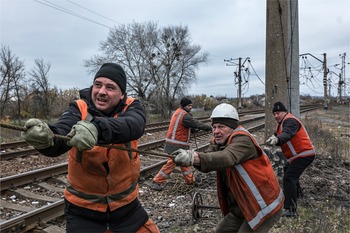
The scale of Ukrainian Railways’ operational achievements in wartime conditions demonstrates how technical systems become essential for national resilience. Despite seventeen major bridges destroyed, 507 kilometres of track damaged, and approximately 20 per cent of its network under Russian occupation, Ukrainian Railways maintained 90 per cent on-time performance in 2024, according to CEO Yevhen Liashchenko.Footnote 85 This involves a constant process of adapting to extraordinary circumstances, as captured in an image of railway repair workers restoring a track damaged by shelling (see Figure 1). Indeed, repair crews often work at night under blackout conditions to minimise visibility to Russian drones, operating in zones recently devastated by shelling in order to restore vital connections. In 2023 alone, Ukrzaliznytsia renewed 1,308.3 kilometres of tracks (a 19.6 per cent increase over 2022) and repaired eighty-six freight locomotives.Footnote 86 These achievements serve as proof that Ukrainian society continues functioning effectively despite Russian attacks, being incorporated into collective narratives about national resilience and determination. In 2023, the European Railway Award honoured Ukrzaliznytsia as the ‘Rail Champion’, bringing the company some international recognition.Footnote 87
Railway repair workers restoring a track damaged by shelling. Photograph by Jelle Krings/Panos Pictures.

Passengers actively contribute to this narrative about operational continuity. For example, one of the interviewees said that ‘even when there’s shelling or an air raid, Ukrzaliznytsia is right there’, which demonstrates how the reliability of critical infrastructure helps cultivate a sense of basic trust.Footnote 88 Another passenger’s Facebook post suggests that the routine travel itself provides psychological support during wartime:
The road is a strong anchor for my psyche. […] In this train compartment, I am calm for the FIRST TIME in the last thirty days. Movement gives the illusion of salvation from any danger, because you are in the middle of a manoeuvre. The rhythmic railway knocking and soft light – a throwback to pre-war times and such naive vacations.Footnote 89
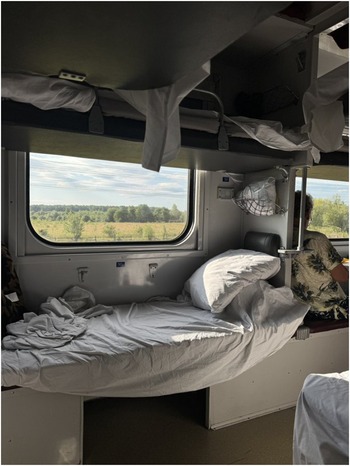
This passenger’s testimony demonstrates how maintaining familiar sensory-semiotic train experiences can create a bridge between the past normalcy and the present crisis. The predictable rhythm of wheels on tracks evokes a sense of calm as an affective response that accumulates into longer-term emotional attachments. The sense of calm can also be derived from the recognisable aesthetic of Ukrainian rail travel: crumpled white bedding, an open-plan sleeper carriage, stacked bunks with other passengers resting nearby, muted utilitarian interiors, and the slow unfurling of the landscape through the window (see Figure 2). The passing horizon of vast fields and blue sky evokes the Ukrainian traditional cultural repertoire, in which land-and-sky references feature as a shorthand for the homeland. This convergence of the familiar atmosphere, patterned motion, and homeland vistas helps produce a flow-like experience,Footnote 90 in which anxiety dissolves through absorption in the present, bracketing the chaos of war. The mentioned ‘illusion of salvation’ reveals the paradox of flow, where in losing self-consciousness, one simultaneously emerges with a stronger sense of self.
Ukrzaliznytsia aesthetic. Photograph by Nika Mastierova.

Artistic interventions reinforce the significance of Ukrainian Railways as a symbol of national resilience. For instance, Barbara Kruger’s 2025 installation ‘Untitled (Another Again)’ reimagined trains as moving meditations on persistence. Kruger’s typographic intervention reads: ‘another day another night another darkness another light another kiss another fight another loss another win another wish another sin another smile another tear another hope another fear another love another year another strife another life’.Footnote 91 The visual rhythm of text mimics the auditory rhythm of train movement. Moreover, the semantic oppositions (‘darkness’/‘light’, ‘loss’/‘win’) mirror the physical back-and-forth of train travel, embodying the national resilience narrative through a combination of linguistic, visual, and kinetic modes. When the train bearing Kruger’s work was damaged in a Russian attack in June 2025, Ukrzaliznytsia repaired it, and it departed on schedule, performing continuity through the act of immediate restoration.Footnote 92 The train’s repair can be read as a certain meta-commentary on resilience, where the artwork about persistence itself embodies Ukrainians’ capacity to persist through its own destruction and restoration.
Improvements to the railway infrastructure have been interpreted by citizens as signs of the national capacity for vitality and renewal during wartime. In the words of one passenger: ‘The railway didn’t just endure, but it’s improving. For me, this is an allegory for our entire country.’Footnote 93 This captures how citizens construct meaning in the process of interacting with the railway infrastructure. One X (Twitter) post also humorously expresses how ‘Ukrzaliznytsia’ has become used as a shorthand for infrastructural reliability:
But how are you going to take the train in the middle of an air raid?’
It’s Ukrzaliznytsia
Oh [fair enough]Footnote
The post suggests a form of basic trust and what might be described as citizens’ ‘faceless commitment’Footnote 95 in Ukrzaliznytsia, supporting my argument about the intertwinement of resilience and ontological security.
Mythic elevation of railway workers
The mythic elevation of railway workers into protectors of civilian lives represents the second mechanism through which critical infrastructure has enabled the generation of ontological security during the war. Since February 2022, Ukrainian railway workers have evacuated over 4 million civilians from combat zones, being dubbed ‘Iron People’ – a term that reflects both their material practices of transporting civilians to safety and the moral qualities of courage, dedication, and sacrifice characterising their labour under extreme danger.Footnote 96 This heroisation has altered the public perception of railway workers, making them a moral archetype that carries the nation’s autobiographical narrative. As of November 2024, 751 railway workers had been killed, and over 2,000 were wounded, with almost 700 losing their homes – figures that attest to railway workers’ willingness to risk personal safety for the sake of civilian protection.Footnote 97
The ‘Iron People’ designation emerged from a specific moment of international recognition during Ukraine’s darkest hour. On 8 April 2022, then-British Prime Minister Boris Johnson travelled to Ukraine on the same day Russian forces bombed the Kramatorsk station. During his railway journey, Johnson recorded an address to Ukrainian railway workers, declaring: ‘I gather you’re called “Iron People” – men and women of Iron – because that’s the trade, the industry you work in. But I think it also reflects the spirit that you’re showing and the spirit of Ukraine in standing up to the appalling aggression that we’re seeing.’Footnote 98 Following this, Ukrainian society and Ukrzaliznytsia itself rapidly adopted this term, with President Zelenskyy reinforcing the ‘political myth’Footnote 99 underpinning it through his official communications. Documentary films contribute to this myth by discussing instances where railway workers dismantled rail connections with Belarus to prevent invasion routes and created artificial wagon elevations to defend Kyiv.Footnote 100
The ‘Iron People’ narrative has gained cultural legitimacy and widespread circulation through multiple promotion campaigns across multiple platforms. The Life Train documentary, produced by Ukrainian production company Kalyna Film, features testimony from over sixty railway workers alongside interviews with prominent international figures, like Johnson himself and Orlando Bloom.Footnote 101 The documentary chronicles railway workers’ extraordinary adaptations in response to the invasion that blur the line between technical operations and military defence, including instances when workers positioned trains as physical barriers to stop the advance of Russian forces and swiftly dismantled rail connections with Belarus to prevent potential invasion routes from the north.Footnote 102 Via the documentary, we also learn the stories of individual railway workers, like that of train conductor Iryna, who continues evacuation work even after the capture of her soldier son by Russian forces. The documentary’s producer, Nick Olak, characterised railway workers as the ‘invisible front’ of Ukraine’s resistance,Footnote 103 while its director, Halyna Khrapko, added that ‘our whole nation found its spot aboard one resilient train’.Footnote 104
Railway workers themselves actively emphasise their important role as the ‘Iron People’ through their daily storytelling and public communications.Footnote 105 Examples include statements such as ‘If we had stopped, the whole country would have stopped’ and ‘They shoot at us, but we repair ourselves and keep moving forward’.Footnote 106 Technical roles appear to have acquired a new meaning, with train attendants saying ‘We now have to be doctors [and] therapists for our passengers’.Footnote 107 In a special report published by one YouTube channel, a train conductor echoed the railway workers’ sense of duty, stating: ‘I don’t have any days off, […] not until we win the war’.Footnote 108 This resonates with the words of another railway worker, Danylo, during an interview: ‘We work regardless of any circumstances, whether air raid or shelling. There were hits even several meters from the locomotive, after which work still continued.’Footnote 109 This normalisation of extraordinary risk through its portrayal as a routine duty illustrates how infrastructural resilience has become dependent on individual workers accepting danger as an inherent aspect of their work.
Passengers also contribute to the circulation of the ‘Iron People’ narrative. In an interview, a passenger named Andriy expressed his trust in the railways’ ability to guarantee family safety: ‘I trust Ukrzaliznytsia. I don’t worry when I put my wife and children on the train to Poland. It’s convenient, it’s excellent service, everything happens so smoothly.’Footnote 110 Social media users also often share emotionally resonant stories about their individual encounters with railway workers. One Instagram post reads:
Do you believe in angels? Svitlana is a train hostess on [an] evacuation train. […] She spent [the] last 12 days […] working [non-stop]. […] Her own home in Chernihiv is under russian bombing. […] Thanks to Svitlana and all train hosts and hostess[es], thousands of Ukrainians are safe now.Footnote 111
These are some examples of how the mythic elevation of railway workers’ role multiplies across different platforms and voices. This shows that resilience can operate at multiple scales, as individual workers’ resilient practices become aggregated into the broader autobiographical resilience narrative at a societal level.
European integration and international relationship-building
At a time when Russia persistently seeks to deny Ukraine’s European belonging, Ukrainian Railways participates in constructing Ukraine’s place within the European community of nations. The ‘Iron Diplomacy’ programme exemplifies this, as Ukrainian Railways is a key facilitator of secure transportation for international delegations through active war zones.Footnote 112 An Instagram post by the Ukrainian Ministry of Foreign Affairs from November 2024 notes that since the invasion began, ‘over 1,000 foreign delegations’ have relied on Ukrainian trains, turning routine transportation into a form of ‘steel diplomacy’.Footnote 113 This has created a set of predictable routines and practices that reinforce Ukraine’s continued membership in the international community despite Russian attempts to isolate Ukraine from it.
The establishment of diplomatic corridors supports ontological security by maintaining consistent patterns of Ukraine’s international relationship-building. According to Oleksandr Shevchenko, who oversees communications and customer experience at Ukrzaliznytsia: ‘We are the only railway carrier in the world that has transported all G7 leaders.’Footnote 114 Each diplomatic journey becomes a performative act affirming Ukraine’s reliability as a European partner and its continued statehood. For instance, during his train journey in January 2023, the European Council president, Charles Michel, filmed a video message while aboard: ‘Ukrainians are fighting for their land, for the future of their children. But they are also fighting for our common European values.’Footnote 115 Yet, many more informal moments of intercultural and interpersonal bonding in railway settings stay unseen. A good example is a story told by a train attendant responsible for carriages designated for foreign officials: ‘There were times when, for whatever reason, there was no food available, so we even shared our own homemade meals – varenyky [Ukrainian dumplings] – with them. […] The second time we transported them, they asked us for varenyky again.’Footnote 116
Ceremonial practices and creative interventions additionally demonstrate how routine railway operations have been incorporated into public expressions of Ukraine’s future-oriented identity construction. Station displays, special announcements, and ceremonial decorations at EU-related events make the longing for European integration part of the everyday sensory experience. During Europe Day celebrations, for instance, Ukrainian railway stations displayed ‘Thank you, Europe!’ messages on departure boards.Footnote 117 Ukrzaliznytsia’s playful October 2022 announcement of a fictional ‘Ukraine–NATO Express’ train also illustrates how such imaginary connections can reinforce international relationship-building.Footnote 118 On the other hand, the fantasy created by the infrastructure’s creative capacity obscures the present unattainability of NATO membership.
The physical integration of Ukraine’s railways with European networks helps materialise the country’s European belonging. As already mentioned, the Soviet-era broad gauge (1,520 mm), which differs from the European standard gauge (1,435 mm), has long represented Ukraine’s liminal geopolitical position between the East and the West.Footnote 119 In light of this, the construction of a 22-kilometre standard-gauge railway between Chop and Uzhhorod near the Hungarian and Slovak borders is significant in that it physically dismantles Soviet-era infrastructural boundaries.Footnote 120 Launched ceremonially in April 2024, this 650 million euro project makes Uzhhorod the first Ukrainian regional centre directly connected to European railways.Footnote 121
This trend is reinforced by the rapid expansion of cross-border passenger links since 2022, including the resumption of the Kyiv–Bucharest train in October 2025 and the launch of a daily Lviv–Warsaw service in October 2023. These projects help stabilise ontological security by renewing relationships with the country’s allies. International passenger services have expanded dramatically, with traffic increasing from 40,000 to 2.1 million annually since the invasion began.Footnote 122 The new route launches are accompanied by ceremonial affirmations of European belonging, being extensively documented on social media with hashtags like #KeepRunning and #StandWithUkraine.
Beyond European integration, Ukrainian Railways has contributed to the ‘unforging’ of Ukraine’s relationship with Russia by rejecting the linguistic dominance of the Russian language. In December 2024, the company removed Russian from train tickets, replacing it with Ukrainian and English. As the head of Kyiv military administration, Tymur Tkachenko explained, this represents ‘not only symbolic but also a practical step for establishing Ukrainian as the only state language’ while using English to promote ‘integration into the international space […] and demonstrate European service standards’.Footnote 123 Likewise, the planned ‘Ukrainianisation’ of distance markers to calculate from Kyiv rather than Moscow represents an act of cultural decolonisation integral to Ukraine’s wartime identity transformation, eschewing imperial spatial ordering that positioned Ukrainian territory relative to the Russian centre.Footnote 124 Such mundane technical changes materially inscribe new identity narratives into everyday infrastructure encounters.
Symbol of homecoming and eventual return
Since Russia’s full-scale invasion, railways have become Ukraine’s main gateway for mass movement across borders following the closure of the country’s airspace. To compare, buses have also been indispensable to wartime mobility, but they have not acquired the same narrative weight in Ukraine’s wartime autobiography. Rail concentrates movement through a single nationally centralised expert system, whose stations, timetables, and mass departures and arrivals render mobility publicly legible. It is against this backdrop that Ukrainian Railways has become a symbol of homecoming, helping to sustain ontological security by connecting collective identities with physical spaces.
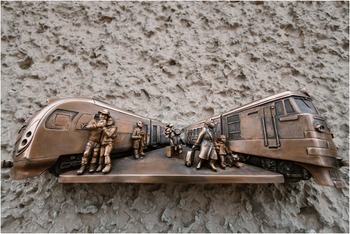
Physical manifestations of the homecoming mechanism turn railway spaces into sites of collective memory and anticipated reunion. The ‘We Bring You Back Home’ mini-sculpture at Kyiv’s central station, unveiled in November 2024, crystallises these themes through its artistic intervention (see Figure 3).Footnote 125 It depicts two trains arriving simultaneously – one carrying soldiers from Kramatorsk, the other bringing refugees returning from abroad – capturing the defining moments of wartime mobility. Upon closer look, we can see a soldier embracing his wife after returning from the front, a young boy reunited with a lost toy, and a family from Mariupol finding their way home. Positioned where thousands of passengers encounter it daily, the sculpture validates collective experiences of loss, separation, and reunion. Its presence provides a material focus for collective hopes about homecoming, even as it bears witness to the human cost of the war, as reminded by the haunting image of a bloodied children’s toy at the bombed Kramatorsk station.Footnote 126
Mini-sculpture ‘We Bring You Back Home’, part of the cultural–historic project ‘Search!’ by Yuliya Bevzenko. Photograph by Andriy Prots.

Individual creative expressions of homecoming also sometimes catalyse acts of collective meaning-making, as demonstrated by one passenger’s video about Ukrzaliznytsia that went viral. After evacuating to Poland with her infant child at the start of the full-scale war, Sofiya created a video documenting her train journey back to Ukraine in September 2024, set to the famous song ‘I’m Going Home’ [Я їду додому] by Okean Elzy.Footnote 127 The video captured the attention of Ukrzaliznytsia’s senior leadership, who contacted Sofiya to request permission to launch a broader ‘I’m Going Home’ social media campaign encouraging other Ukrainians to share railway journey videos using the same soundtrack.Footnote 128 Resonating with many displaced Ukrainians, the campaign generated numerous submissions. To quote Sofiya herself: ‘It was a video made just for myself – about my journey home to my sister and loved ones. That’s why it turned out so soulful. It wasn’t just a polished marketing reel, but a genuine story from the heart.’Footnote 129 Just like that, the railway became the common thread connecting individual stories of wartime separation and enabling shared emotional experiences around the narrative of eventual return home.
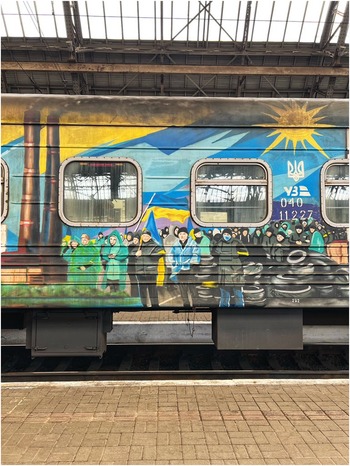
The hope for territorial liberation is also something manifested through Ukrainian Railways’ future-oriented initiatives, which reinforce ontological connections to the occupied territories. For example, the ‘Tickets to Victory’ initiative, which was launched in November 2022, sells advance tickets for the first trains to the currently occupied cities, allowing citizens to materially invest in the anticipated return.Footnote 130 Passengers can purchase these tickets as an act of faith in Ukraine’s eventual victory in the war, thereby contributing funds for last-mile transport vehicles needed in the de-occupied territories. The complementary ‘Train to Victory’ project features seven artist-painted train cars representing temporarily occupied territories, depicting local resistance stories: a Crimean activist painting Yevpatoriya’s city administration blue and yellow, Mariupol’s steel plant defenders, and Enerhodar residents confronting tanks unarmed (see Figure 4).Footnote 131 These aesthetic practices convey the aspirational and hopeful dimension of ontological security, as theorised by Cihan in this special issue.Footnote 132 As a result, occupied regions appear visually present in everyday life as a reminder that their return remains a future possibility.
Lviv–Kherson ‘Train to Victory’. Photograph by Felicity Spector.

A range of other cultural interventions work to embed the homecoming narrative into sensory-semiotic dimensions of railway travel. Since 2023, symbolic Ukrainian music plays at stations nationwide, with Kyiv Central Station featuring the city anthem and the Kyiv–Kramatorsk route playing Kolia Sierha’s composition ‘Home’ [Додому].Footnote 133 These songs function as auditory markers that trigger associations with home. Grassroots social media campaigns celebrate ‘Ukrzaliznytsia tea’Footnote 134 and railway-themed merchandiseFootnote 135 features schedules for occupied territories. This creates embodied experiences of autobiographical continuity, signifying an imagined connection to home despite the ongoing lived experiences of physical displacement. The notion of ‘home’ within this context notably goes beyond its basic meaning as a refuge.Footnote 136 Ukrainian Railways creates a permeable homespace that enables both ‘being’ and ‘becoming’.Footnote 137 The result helps maintain connections to the (home)land while simultaneously ‘re-embedding’ disrupted social relations through the promise of homecoming.Footnote 138
Conclusion
This paper has argued that critical infrastructure can function as a generative site for ontological security when its resilience enables the re-anchoring of collective selfhood in times of radical uncertainty. Infrastructure operates as a socio-technical assemblage in which workers, technologies, organisational routines, and narratives collectively sustain confidence in the shared capacity to endure wartime disruption. In the case of Ukrainian Railways, four main mechanisms facilitated the production of collective ontological security: the railways’ operational continuity as evidence of national resilience; the mythic elevation of railway workers into heroic protective figures; physical integration with European railway networks as a materialisation of Ukraine’s ties with its international allies; and railway homecoming initiatives that help maintain hope despite mass displacement. More research is needed into how other forms of critical infrastructure, like energy systems or digital communication platforms, may similarly function as sites of ontological security not only during armed conflict but also in more ordinary contexts of disruption.
The wider contribution of this paper to the study of ontological security lies in demonstrating that it is found in adaptive processes, one of which is resilience. In times of crisis, I argue, infrastructure can serve as a medium through which resilience and ontological security co-emerge in practice, rather than existing in a sequential or hierarchical relationship. Critical infrastructure constitutes the socio-technical environment that enables such adaptive processes to unfold. This reinforces the existing scholarly efforts to reconceptualise ontological security as becoming rather than being.Footnote 139 Ontological security, in other words, does not reside in the attainment of stability as an end-state but rather can be created through the ongoing process through which a community learns to navigate uncertainty and disruption. This view once more echoes Steele’s reading of ontological security as ‘flow’, which is rooted in an absorbed engagement with challenging circumstances, where the Self feels secure in the very process of acting.Footnote 140 More broadly, it resonates with Ralph’s pragmatist conception of global politics as itself a continual process of learning and adaptation, in which ‘the Self, and the environment in which it operates, is in a constant state of becoming’.Footnote 141
From this perspective, when war cannot be altered as the fundamental source of insecurity and uncertainty, ontological security can be cultivated instead by ameliorating the everyday lived experience of infrastructure as problems arise.Footnote 142 Security thus becomes grounded less in the promise of eliminating a given security threat and more in the shared confidence that the collective can adapt creatively and remain resilient together. In the words of one Ukrzaliznytsia official, ‘We want to convey to every Ukrainian that no matter what happens, the train will come for them, take them to safety, and then return them home’.Footnote 143 In this sense, Ukrainian Railways has helped sustain ontological security through its repeated demonstrations of resilience in motion. In such conditions, ontological security emerges less from knowing who one is than from trusting what one can do, even when the way home and all that once felt certain have been shattered.
Acknowledgements
I am deeply grateful to the special issue editors, Brent Steele and Cornelia Baciu, for their intellectual generosity and careful editorial stewardship throughout the development of this special issue. I would also like to thank all fellow contributors for their helpful comments, with particular appreciation to Martin Kirsch and Gabriella Gricius for their especially insightful feedback. I am further indebted to Tobias Liebetrau for his early guidance on the critical infrastructure literature. Finally, I thank the anonymous reviewers for their detailed suggestions and constructive engagement.
Bohdana Kurylo is a fellow in qualitative methodology at the London School of Economics and Political Science. Her work examines civilian security actors, infrastructural politics, and the international relations of Eastern Europe and the post-Soviet space. She also specialises in critical and creative methodologies, with a focus on the ethics of conflict research.

 Open access

