





I
International trade between China and western countries started hundreds of years ago.Footnote 1 With the removal of the ban on maritime trade early in the Qing Dynasty, the volume of trade grew enormously by the nineteenth century. There was great demand for Chinese porcelain, brocades, sugar, ginger, silk, tea and furs, but there was little demand for western goods in China. At the same time, there was no standard Chinese currency and commerce had to make do with a broad variety of bullion, metal coins, banknotes and other forms of money. Thus, increasingly large numbers of foreign silver coins (known as yang-yin 洋銀 or fanyin 番銀) were brought to China to facilitate trade. This form of money first appeared in China during the Ming dynasty (Peng Reference PENG1994). By the end of 1930, it was estimated that about 2.2 billion Chinese and foreign silver coins were circulating in China (Leavens Reference LEAVENS1939). Aside from the increase in foreign trade, silver had acquired importance in China since taxes were typically denominated in the metal (Lin Reference LIN2006).
Given the huge supply of silver from Spanish colonies in the New World that flowed into global circulation in coin form, the Spanish silver dollar became the de facto standard money for trade with China and was used in both domestic and international commerce throughout Asia. Containing about 78/100 of a troy ounce of pure silver, these coins were popular due to their familiarity, quality of minting, consistent purity and ease of detecting counterfeits. The Spanish silver dollar, also known as the ‘piece of eight’, and its Mexican descendant were, at times, valued greatly in excess of the melt value of the bullion they contained. There were many other dollar-sized silver coins circulating in China including those of Hong Kong, Japan, the UK, the US and France struck specifically for Chinese and colonial trade.Footnote 2 China’s central and provincial governments also minted silver coins at times, while small silver bars in a variety of shapes were produced by silver shops and silversmiths. Figure 1 depicts some of the coins that are the focus of this study.Footnote 3
Spanish, Mexican and US silver coins commonly used in China

Under the constant threat of poorly minted, underweight, or counterfeit coins, much effort went into assessing silver coins and bullion (Irigoin Reference IRIGOIN2009).Footnote 4 Chinese merchants were typically suspicious of all but the most well-known silver coins. Locals and foreigners seeking to buy Chinese products often purchased these coins at prices substantially greater than the value of the silver bullion they contained. These price premiums varied from one city to another (Greenfield and Rockoff Reference GREENFIELD and ROCKOFF1995) and coins were initially accepted only by weight. With the passage of time and growth in trade, Chinese merchants found the Spanish dollar increasingly convenient given their large supply, uniform weight and purity, and clearly marked year and mint. The opening of new ports and the end of the monopoly of the East India Company in 1834 both contributed to the rising demand for Spanish silver coins. They were collected worldwide to be used for trade with China (Willem Reference WILLEM1959). After gaining independence in 1821, Mexico started minting its own silver coins and stopped minting Spanish silver coins. The first recorded appearance of the Spanish dollar’s Mexican descendant in China was in 1854 (Sandrock Reference SANDROCK1995). The supply of Spanish silver coins was increasingly limited relative to the numbers of Mexican coins in circulation (Peng Reference PENG1994). These coins also saw use in local commercial and retail trade in China. For ordinary Chinese workers, a silver dollar was a substantial sum.Footnote 5
The aim of our article is to document and understand the time-varying premiums for Spanish and Mexican silver coins relative to their value if traded as bullion, an interesting feature of China’s economy in the late Qing dynasty and early Republican period. Foreign silver coins evidently served China well. Understanding these premiums can help illustrate the relationship between the form of currency and economic forces. Silver dollars were not consumable in the sense of commodity money based on food or cigarettes (Burdett, Trejos and Wright Reference BURDETT, TREJOS and WRIGHT2001). They offer an interesting venue to study the value of money and the effect of perceived differences in quality and desirability of different types of money based on the same underlying commodity, silver. Our work contributes to the literature on China’s economy during a turbulent era in the not-so-distant past.
II
During the period that we study, the basic local currency unit in Shanghai was the tael (liang 兩), a hypothetical amount of pure silver (about 1.08 troy ounces) that circulated in the form of silver bars and demand deposits. There were few tael-denominated banknotes and no coins. In contrast, silver dollar coins, fractional dollar silver coins and dollar banknotes of various issuers were common. Prior to this period, business accounts and transactions were typically denominated in Spanish silver dollars, but this became increasingly problematic as premiums for these coins rose and availability declined in 1856 and 1857. To simplify banking and commerce, the Shanghai foreign banking community defined the Shanghai tael in January 1857 and switched silver dollar accounts from Spanish to Mexican dollars. Commercial and financial transactions were denominated in Shanghai taels and settled in silver bullion, silver coins, tael banknotes and tael checks.
However, monetary confusion continued as different cities and government departments defined their own unique tael. While the Shanghai tael was the standard measure for commercial and financial transactions in Shanghai, many taels of different weights were in use in China during this period. Wagel (Reference WAGEL1914, p. 222) states that ‘Trade in China is thus a very complicated process. The merchant not only buys or sells the goods, but also buys or sells the silver which he has to receive or pay.’ Furthermore, he notes that ‘there are seventy-seven distinct varieties of the taels in China’ and offers an example (p. 223): ‘A merchant coming from Kweichow … will probably … use a scale on which the tael weighs 548.9 grains; a merchant from Kweifu – a town on the Yangtze 100 miles below Chungking – will buy and sell with a tael of 562.7 grains; and between these two extremes are at least ten topical weights of tael, all “current” at Chungking … [where] … three qualities of silver are in common use: “fine silver,” thousand fine …; “old silver,” about 995 fine; and “trade silver,” between 960 and 970 fine …’ King (Reference KING1965) refers to ‘imaginary money’, that is, units of account which governed transactions but did not exist in coin form. For example, the Haikwan tael and Kuping tael defined slightly different quantities of pure silver that denominated customs duties and taxes. Even within the modern banking sector in Shanghai, the exchange rates among hypothetical taels, taels in silver ingot form, and different types of domestic and foreign silver coins varied over time.
In the discussions that follow, we refer to the coin premium, that is, the difference between the price of a coin expressed in Shanghai taels and the value implied by the ratio of the coin’s silver content to the silver content that defines the Shanghai tael. The coin premium can be positive if there is a specific demand for silver in the form of a trusted type of coin. The coin premium can be negative if Shanghai tael-denominated payment methods are perceived as more convenient and less costly than coins.
Figure 2 includes scans of typical newspaper columns from the North China Daily News, a British publication produced in Shanghai which is the source of much of our data. The column for 4 May 1877 shows a variety of exchange rates and other data, much of which we explain in our discussion of the 5 July 1888 column below. Of immediate interest are the quotes for coins, ‘Mex. Dollars – 76.25’ and ‘Carolus – 83.00’. ‘Carolus’ refers to the old Spanish silver dollar featuring the portrait of King Charles. The quotes indicate the cost in Shanghai taels of 100 Mexican or Carolus coins, respectively. Given that the weight of pure silver in a Spanish or Mexican dollar was just about 73 percent of that of the Shanghai tael,Footnote 6 there are clearly substantial coin premiums, particularly for the older Carolus dollar.
Examples of financial columns from newspapers

The column for 5 July 1888 is also included in Figure 2 because it is different to and longer than the earlier column. The column reports spot, discount and forward exchange rates, prices in local currency for Mexican dollars and precious metal bars, and exchange rates and silver prices received from London by telegraph.Footnote 7 Following are descriptions of some of the more important items. ‘Tel. Transfers’ is the price, in British shillings and pence, for buying or selling Shanghai taels via telegraph to and from London. The quotation reflects the British monetary system of the time, in which one British pound equals 20 shillings and one shilling equals 12 pence. ‘Sight’ is the price, in British shillings and pence, for a bank draft for Shanghai taels that can be cashed immediately. Other rows in the first part of the newspaper column refer to spot and forward rates for drafts or transfers to and from other cities. ‘Mexican dollars’ is the price, in Shanghai taels, of 100 Mexican silver dollars. For example, the quotation, ‘73.2.675’, means that 100 Mexican dollar coins traded in a range of 73.2 to 73.625 taels.Footnote 8 No local price for the Carolus Spanish silver dollar appears at this time. ‘Copper Cash’ is the number of copper cash (方孔錢, a small copper coin with a square hole in the middle) per Shanghai tael. Therefore, the price of one such copper coin is the inverse of this number. The small copper coins were another form of commodity money, though their use was confined to very small transactions and was uncommon among foreigners.Footnote 9 ‘Bar silver’ at ‘42 1/16 d’ is the London price in British pence for one ounce of 92.5 percent pure sterling silver in ingot form.Footnote 10 There is also a price, 41 1/2 British pence, for Mexican dollars, though this series did not appear consistently in the newspaper. Given the relative weights of silver, the Mexican dollar also traded at London at a significant premium, which is consistent with historical accounts (Willem Reference WILLEM1959).
Figure 2 also includes a scan of a typical exchange rate column from the San Francisco Chronicle. At the time this column was published in 1877, two currencies, paper dollars and gold dollars, were in use in the US, a legacy of both the Civil War ‘greenback’ period and the lingering uncertainty about the course of the nominally bimetallic currency standard. ‘Legal Tenders’ at bid 94 3/4 and ask 95 1/2 indicate that paper dollars sold at a discount to gold dollars, which were more widely accepted in the western states. Prices for both US trade dollarsFootnote 11 and Mexican dollars are indicated, as is the previous day’s price of silver at London. The newspaper clipping indicates the previous day’s London silver quote is 53 3/4. When converted to dollars and adjusted for the weight and fineness of London silver versus dollar coins, the newspaper quotes at San Francisco on 4 May 1877 imply premiums of 2 or 3 percent for the coins.Footnote 12 We use the San Francisco data less extensively because, as detailed below, the time series are substantially shorter than those of Shanghai.
Figure 3 plots prices for the Spanish Carolus silver dollar coin and the Mexican silver dollar coin expressed in Shanghai taels. For example, the price of 83 for the Spanish coin in December 1876 means that 100 Spanish coins traded for 83 Shanghai taels. Given that 100 of the Spanish coins contain the same amount of pure silver as 72.7351 Shanghai taels, the coin price of 83 represents a premium of 14 percent (83/72.7351) over the silver value of the coin. The figure shows that, while the coins typically sell for more than their silver bullion value, there are times when they sell at a discount, which suggests that drafts, demand deposits and other non-physical forms of the Shanghai tael have convenience value. The plot also shows that the Carolus dollar is not always traded, but when its price does appear in the newspaper, it is often much larger than its silver bullion value and far beyond transactions costs.Footnote 13 The plot also highlights the extent of missing observations as detailed in Appendix 1. Our sample period ends when the Mexican dollar series disappears from our newspaper sources after December 1924.
Silver coin prices at Shanghai and San Francisco, June 1866 to December 1924

Figure 3 also includes prices for Mexican dollar coins and US trade dollar coins at San Francisco. Mexican coin prices were published in the San Francisco Chronicle for a period of less than 35 years. San Francisco prices resemble those from Shanghai. The US trade dollar was quoted in the newspaper for a period of less than a decade. Within a few years of its introduction in 1874, this coin typically traded at a price higher than that of the Mexican coin. While intended to facilitate Asian trade by American merchants, the coin posed a unique problem for US monetary authorities as many found their way back to the US and competed with ordinary US silver dollars in circulation. The trade dollar was demonetized for use in the US in July 1876 and the last significant quantities were minted in 1878. Paralleling the histories of other silver trade coins, it is ironic that the US trade dollar achieved its greatest success and highest prices after it lost its legal tender status in its country of origin.Footnote 14
III
We offer several predictions about the silver coin premiums observed for the Spanish ‘piece of eight’ and the Mexican silver dollar that gradually replaced it. First, we link coin premiums to broad global and Chinese economic conditions. Hypothesis ‘H1 (macro forces)’ predicts that Spanish and Mexican silver coin premiums are positively associated with Chinese and global economic and political forces which affect Chinese domestic consumption and demand for Chinese exports. For evidence consistent with H1, we relate time series of coin premiums to proxies for global economic activity. We predict that, when the global economy is healthy, demand for China’s exports is high and silver coin premiums increase. We also include changes in the London price of silver,Footnote 15 and predict that coin premiums rise when heightened demand for Chinese exports increases the pound sterling price of silver. We also include dummy variables for dates of several prominent Chinese and worldwide political events that increased uncertainty. We predict that the ‘safe haven’ premium for well-known silver coins rises in troubled times.
Second, we predict that the willingness to pay premiums for familiar silver coins rises at times when China’s banking system is perceived as riskier. ‘H2 (bank distress)’ predicts that Spanish and Mexican silver coin premiums are positively associated with the perceived risk of bank deposits, banknotes and other claims dependent on China’s financial system. For evidence consistent with H2, we regress the time series of coin premiums on dummy variables for key domestic Chinese banking events and on a proxy for risk in the local banking system. During our sample period, China’s financial system featured extensive but fragile connections amongst local and foreign controlled businesses and financial institutions. Exports by Chinese merchants were financed by so-called ‘native’ banks, which relied on ‘chop loans’ from foreign banks and balances left on deposit by dealers and merchants. Foreign banks also accepted retail deposits and handled most foreign remittances. Upcountry ‘Shansi’ remittance bankers arranged financing and domestic money transfers. King (Reference KING1987, p. 506) reproduces a diagram from Gardella (Reference GARDELLA1976) illustrating the financial links between foreign banks, native banks, agricultural middlemen, foreign traders, tea processors, buyers and farmers. Wagel (Reference WAGEL1914, p. 230) estimates that, in 1913, the total capital of all native banks in Shanghai was 600,000 taels, describing them as having ‘slender reserves [on which] the vast trade of this country is built’.
Economic uncertainty can increase the demand for ‘safe haven’ or ‘flight to quality’ assets (Longstaff Reference LONGSTAFF2004; Guerrieri and Shimer Reference GUERRIERI and SHIMER2014; Farhi and Gabaix Reference FARHI and GABAIX2016). Historical references indicate that Spanish and Mexican silver coins served as such assets in China. Hyde (Reference HYDE1973, p. 52) states that ‘the peasant cultivator had a natural propensity to hoard silver’. McElderry (Reference MCELDERRY1976) cites news reports that, with the onset of the 1911 revolution, paper money was exchanged for silver bullion and Mexican dollars, causing a substantial rise in coin premiums. Looking farther back in time, King (Reference KING1965, p. 172) notes that ‘holders [of Carolus dollars] in the silk districts are reported to have buried them as a precaution against the disturbances caused by the Taiping rebellion’. Mackenzie (Reference MACKENZIE1954, p. 106) describes how business failures in Singapore in 1865 weakened confidence in the colonial British banks whose operations spanned the region, leading to increased demand for silver coins and a rise in silver coin premiums throughout Asia.
Third, we predict that the silver coin premiums reflect trading in China’s exports as local and foreign merchants bid up the premiums on the coins needed to buy these commodities. Using the data tabled in Hsiao (Reference HSIAO1974) for 1895 which is roughly the midpoint of our sample, the largest contributors to China’s exports were ‘Total Raw Silk’ (27.0%), ‘Total Silk Piece Goods and Silk Products’ (8.3%), and ‘Total Tea’ (22.6%). The historical literature describes a legacy demand for the Spanish coin in silk-producing and trading areas of China.Footnote 16 Therefore, ‘H3 (silk supply)’ predicts that Spanish and Mexican silver coin premiums are associated with seasonals in the production of silk and shocks to the supply of silk. We look for evidence of H3 using dummy variables for periods of key supply shocks to the global silk market that decreased the volume of silk being traded and implying less need for silver coins.
Next, we note that opium played a key role in China’s economic history. During our sample period, legal imports of opium typically accounted for 10 percent of China’s total trade. Lin (Reference LIN2006) describes how the opium trade facilitated a vast infrastructure of distribution and payments across China, stimulating employment and investment.Footnote 17 Opium imported from India was paid for with silver. Lin (Reference LIN2006, p. 90) notes that ‘For the first half of the nineteenth century, the increase in opium imports … coincided with silver outflow ….’ If opium imports required coins, it is plausible that premiums for Spanish and Mexican coins increased with the opium trade. ‘H4a (opium)’ predicts that Spanish and Mexican silver coin premiums are positively correlated with measures of China’s opium trade. The alternative, ‘H4b (opium)’, predicts that if opium imports were not settled with coins, then premiums for Spanish and Mexican silver coins are not correlated with measures of China’s opium trade. By the mid nineteenth century, silver exports and opium imports were increasingly priced in silver bars (‘sycee’) rather than Spanish or Mexican coins (King Reference KING1965, pp. 141, 176). Additionally, the literature notes a growing reliance on bills of exchange rather than physical silver in China’s international trade (Willem Reference WILLEM1959). To test H4a and H4b, we include opium price changes in monthly regressions and the value of opium imports in a correlation matrix of annual variables. This tests whether the coin premiums are associated with the opium trade or whether alternative settlement methods diminished such an association.
Finally, we examine the value of copper cash coins, a type of money that was typically used for small transactions rather than for investments, wholesale trading, or large retail transactions.Footnote 18 For example, King (Reference KING1965) quotes a foreigner writing in the North China Herald in 1887: ‘We have cash for our dealings with the poorer natives, dollars in our social and retail dealings, and taels for our higher commercial affairs.’ Foreigners typically refused to handle copper cash (Notar Reference NOTAR, Werner and Bell2004). Furthermore, some authors describe an agriculture-induced seasonal for the value of copper coins, specifically, increased demand for these small coins in late summer and autumn due to the harvest of non-export commodities like grains and vegetables (Kuroda Reference KURODA2008a). This pattern differs from the prediction for silver coins.
Sargent and Velde (Reference SARGENT and VELDE2002) characterize small coins like copper cash as providing ‘liquidity services’ that facilitated small purchases. Under certain conditions, distinct but overlapping sets of economic forces affect the demand for small versus large coins. Sargent and Velde (Reference SARGENT and VELDE2002) confirm this both with their model and evidence from medieval European money markets. This motivates ‘H5a (copper)’ which predicts that associations between the tael price of copper cash and economic and political factors parallel those exhibited by Spanish and Mexican silver coin premiums. Alternatively, the forces that drive silver versus copper money are distinct and do not induce common patterns in their pricing. Put another way, the markets for silver and copper coins are segmented due to the different purposes each type of coin served. We refer to this alternative as H5b and it predicts different patterns across silver coin premiums and copper coin prices. To test H5a versus H5b, we include regressions with the copper cash price as dependent variable in the tables that test H1 (macro forces), H2 (banking distress) and H3 (silk supply). We also include the copper cash price in the table of annual correlations.
IV
In this section, we describe the data and methodology employed in the article’s empirical work. The testable hypotheses outline potential explanations for the observed silver coin premiums. As we detail throughout the article, we encountered many limitations (such as the lack of monthly data on China’s trade) in the construction of the data set. The maximum sample period for the series we collect is June 1866 to December 1924. The coin price series are collected for the end of each month from the North China Daily News, as is the price of copper cash and the London silver price. Our observations for coin prices at San Francisco are collected from the San Francisco Chronicle and other California newspapers. See Appendix 1 and Appendix 2 for details of other newspapers used for values missing from North China Daily News and San Francisco Chronicle.
In addition to the London silver price described in the previous paragraph, monthly series that proxy for general global economic conditions (H1) are as follows. The global trade volume proxy is the total British pound value of imports and exports of the UK and the US. The global stock return proxy is the British pound return on an equally weighted index of US and UK stock indexes, which can reflect expected future aggregate corporate earnings and the expected future business cycle (Fama Reference FAMA1981; Chen, Roll and Ross Reference CHEN, ROLL and ROSS1986). See Bailey and Bhaopichitr (Reference BAILEY and BHAOPICHITR2004) regarding construction of these two series. Dummy variables indicate the dates of key national and global political and economic events: the Boxer Rebellion (June to August 1900), the fall of the Qing Dynasty (October to December 1911)Footnote 19 and the start of World War I (June to August 1914). In addition to the ‘safe haven’ effect outlined above, the outbreak of the war could affect coin pricing due to increasing demand for Chinese exports of war materiel or substitutes for European products or through decreased exports to Europe (Kuroda Reference KURODA and Sugihara2005).Footnote 20
Monthly series that proxy for the degree of Chinese and regional banking distress (H2) are as follows. We construct dummy variables for windows spanning key events. From October to December 1883, failures of small local banks spread to larger local banks that, in turn, withdraw funds from Shanghai banks.Footnote 21 The collapse of New Oriental Banking Corporation evolved from June to August 1892. The failure of a small local bank was eventually resolved successfully (June to August 1909).Footnote 22 June to August 1910 includes a stock market crash in June, failures of merchant Ching Yue and Yuan Feng-Yun exchange bank in July, and government borrowing to cover local bank failures related to stock market trading.Footnote 23 October to December 1910 includes failures of local banks that spread to a number of cities and resulted in a total of 20 bank failures.Footnote 24 October to December 1911 featured more local bank failures, a bank depositor run on silver coins, suspension of silver coin payments and failure of a large regional bank.Footnote 25 Because this era offers little if any hard information on details of bank balance sheets or restructurings organized privately or by governments, we identify these events based on the prominence and frequency with which they are mentioned in the literature and news stories. We also use the price change for an equally weighted index of regional bank stocks (see Bailey and Bhaopichitr Reference BAILEY and BHAOPICHITR2004) because bank distress should be reflected in weaker bank stock prices.
For an additional measure of banking system distress, we collect a monthly series of money market interest rates (yinchai 銀拆) that represent the cost of very short-term interbank borrowing amongst local banks.Footnote 26 While these rates sometimes appeared in the North China Daily News (see the middle column in Figure 2), a more complete source is the table in Kong (Reference KONG1988, pp. 478–80). However, these numbers are monthly averages of daily quotes so we use them in lagged form to avoid potential econometric problems in our regressions. During times of financial distress, this interest rate rises and, thus, can serve as a proxy for default risk in the Chinese banking system.
Monthly indicators of the market for one of China’s key commodities, silk, are as follows. Dummy variables indicate the dates of three-month windows spanning key events: June to August 1879 failure of the Italian silk crop due to bad weather;Footnote 27 June to August 1883 failure of the Chinese silk crop and poor Italian silk crop; Footnote 28 and August to October 1885 floods in southern China that affect crops including silk.Footnote 29 Previous authors also refer to pronounced seasonal effects in the production and sale of silk and other Chinese commodities.Footnote 30 We include monthly seasonal dummies in our regression estimates and look for patterns consistent with the silk market cycle. We use the silver dollar price of Benares opium from Singapore’s Straits Times newspaper (see Bailey and Truong Reference BAILEY and TROUNG2001). To test H5, we use the silver tael price of copper cash as described previously.
The end-of-month series described to this point are available at monthly frequency. However, we have no monthly series on the state of China’s trade. Therefore, we also use annual data tabled in Yang (Reference YANG1931) and Hsiao (Reference HSIAO1974) and originally constructed from publications of China’s customs agency for the period from 1864 to 1948. Specifically, we collect the value of total Chinese exports, total imports, and exports of key commodities identified by Yang (Reference YANG1931) including silk, and the value of opium imports. Customs duties and statistics were denominated in yet another hypothetical currency unit, the Haikwan tael defined as 583.3 grains of pure silver and, thus, equal to 1.1140 Shanghai taels.
The monthly silver money coin premium series are related to the explanatory variables with linear regressions to test our predictions. Each monthly coin premium series, and the taels per copper cash price, is individually regressed on our set of continuous, dummy and monthly seasonal dummy variables:
 \begin{equation}P_{i,t}\;=\boldsymbol B'{\boldsymbol X}_{i,t}\boldsymbol\;+\boldsymbol\;\varepsilon_{i,t\;\;}\end{equation}
Pi,t is the log-difference of the coin premium from t-1 to t for the ith coin premium series. X i,t is a vector of continuous variables, dummy variables, monthly seasonal dummies and the first lag of the dependent variable. The continuous variables are expressed either as log-differences or differences from t-1 to t. Β is the vector of slope and intercept coefficients. To adapt to the presence of missing variables, we produce Bayesian estimates of (1) using Stata’s ‘bayesmh’ function with flat prior on the slope coefficients and inverse-gamma prior on the error variance.
As described above, we also collect a sample of annual data on several trade-related series that are not available at higher frequency. Given only several dozen observations for these series, we cannot use them in multivariate regressions with monthly seasonal dummies as in (1). Therefore, we present a table of simple pairwise correlations between these variables and two of our money series (Shanghai Mexican coin premium and copper cash price) to detect any associations that are consistent with our predictions. Throughout the results, note that the Mexican silver dollar premium from Shanghai is our most significant series due to its length and completeness.
V
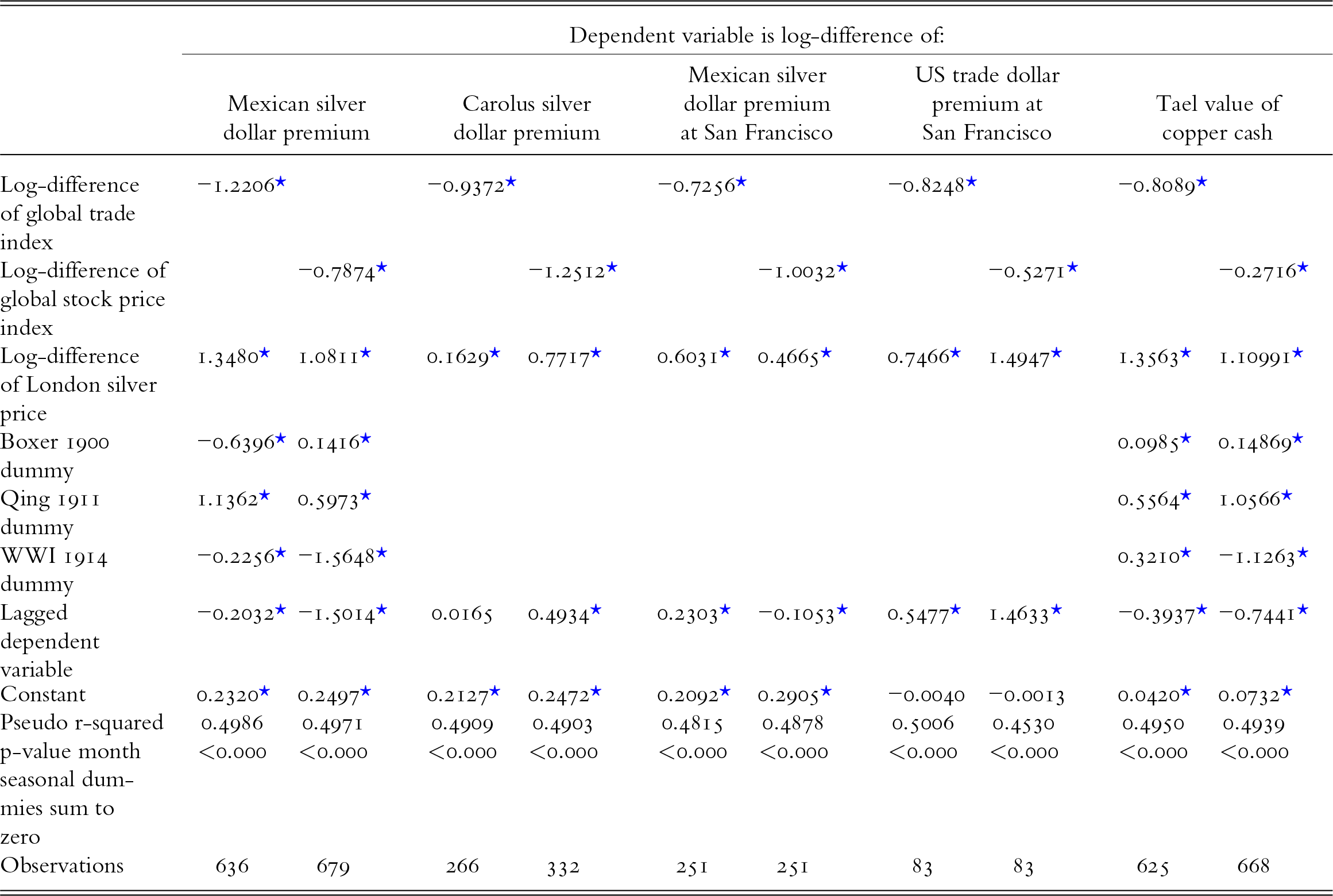
Table 1 reports regressions that relate coin premiums to global indicators, key events and monthly seasonal dummies. As mentioned previously and described explicitly in the captions of Tables 1, 2 and 3, we use Bayesian regressions to address the missing observations in our data and thus cannot offer conventional standard errors, t-statistics, or levels of statistical significance. We instead use an asterisk on coefficients for which the Bayesian ‘95 percent credible interval’ does not span zero, implying that the coefficient estimate is significantly different from zero.
Bayesian regressions relating coin premiums to global indicators, key events and monthly seasonal dummy variables

Notes: Sample is end-of-month June 1866 to December 1924. The table examines H1 (macro forces) and H5 (copper). We use Stata’s ‘bayesmh’ function with flat prior on slopes and inverse-gamma prior on error variance for regressions that simultaneously estimate missing values and for simulation-based tests of monthly dummy coefficients.
* indicates coefficient’s 95% credible interval does not span zero. Pseudo r-squared follows Gelman et al. (Reference GELMAN, GOODRICH, GABRY and VEHTARI2019).
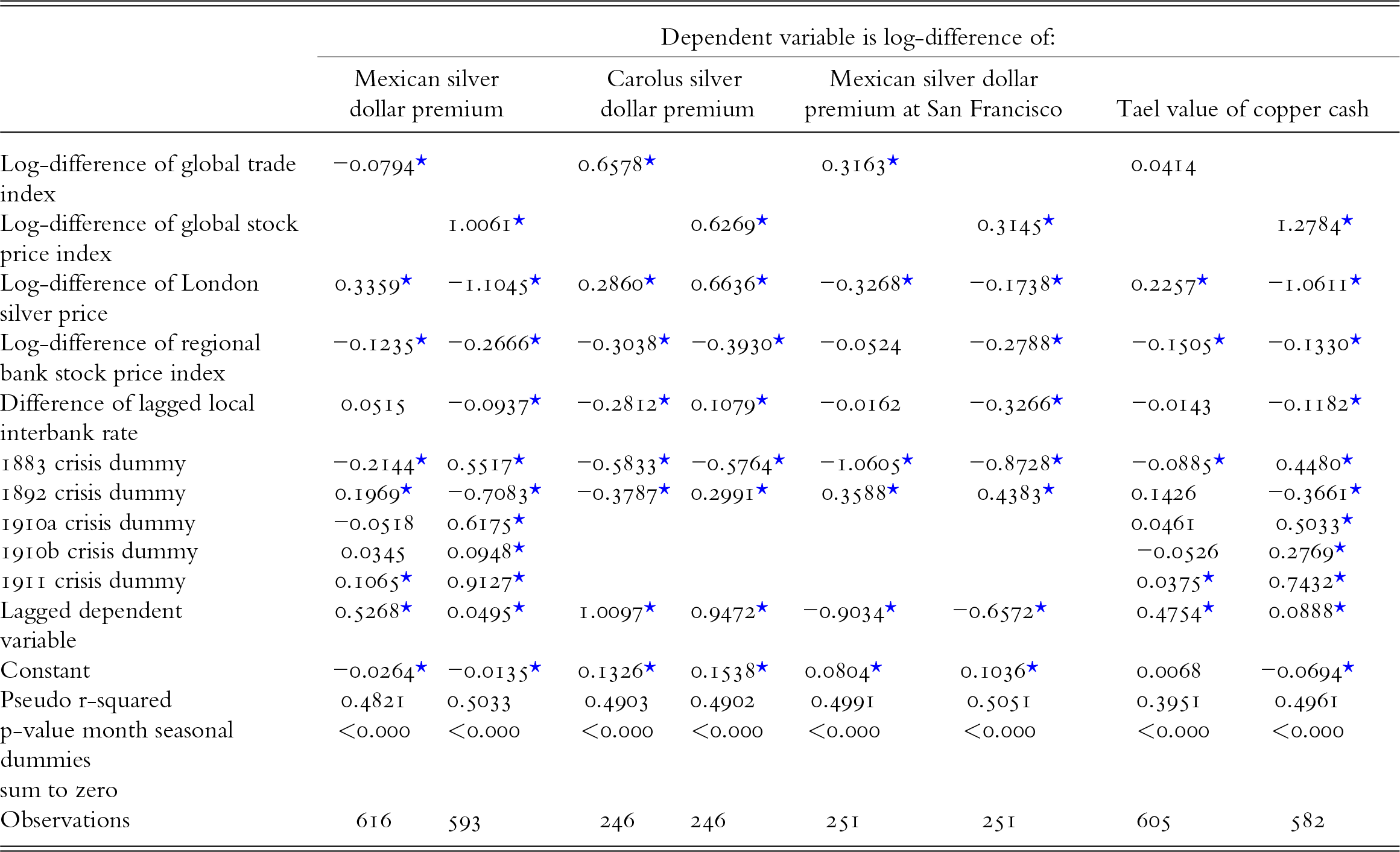
Bayesian regressions relating coin premiums to proxies for banking distress

Notes: Sample is end-of-month June 1866 to December 1924. The table examines H2 (bank distress) and H5 (copper). We use Stata’s ‘bayesmh’ function with flat prior on slopes and inverse-gamma prior on error variance for regressions that simultaneously estimate missing values and for simulation-based tests of monthly dummy coefficients.
* indicates coefficient’s 95% credible interval does not span zero. Pseudo r-squared follows Gelman et al. (Reference GELMAN, GOODRICH, GABRY and VEHTARI2019).
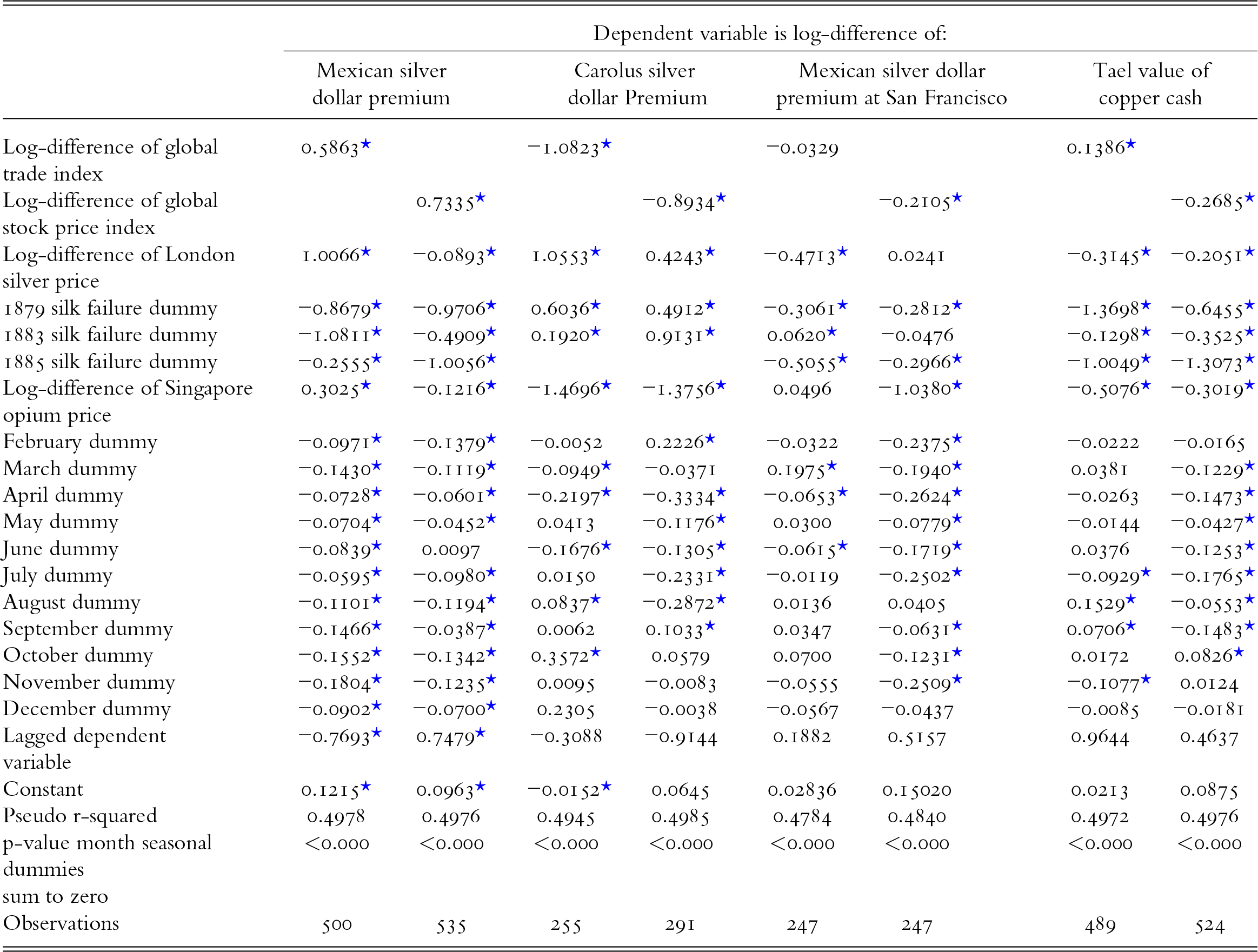
Bayesian regressions relating coin premiums to silk supply and opium prices

Notes: Sample is end-of-month June 1866 to December 1924. The table examines H3 (silk supply), H4 (opium), and H5 (copper). We use Stata’s ‘bayesmh’ function with flat prior on slopes and inverse-gamma prior on error variance for regressions that simultaneously estimate missing values and for simulation-based tests of monthly dummy coefficients.
* indicates coefficient’s 95% credible interval does not span zero. Pseudo r-squared follows Gelman et al. (Reference GELMAN, GOODRICH, GABRY and VEHTARI2019).
The table seeks evidence consistent with H1 (macro forces). There are strong associations between silver coin premiums and the global trade and stock price indices, but the negative slope estimates for the four pairs of silver coins are not consistent with H1. Significant positive slope coefficients on the London silver price for all four silver coin premium series are consistent with H1: increased global prosperity raises demand for Chinese exports and thus increases premiums for the silver coins needed to buy those exports. The size of the coefficients is economically significant. For example, the estimated slope of 1.348 on London silver in Table 1’s first specification indicates that a 1 percent increase in the pound sterling price of silver is associated with an increase of about 1.3 percentage points in the Mexican coin premium. We retain the global trade, global stock price and London silver price variables as controls in subsequent regression tests.
Across the Chinese and global event dummy variables, the sign on the Boxer event changes across the two specifications for the Mexican coin premium and we cannot draw conclusions about this event. In contrast, the Mexican coin premium slopes are both significantly positive for the 1911 revolution event and are economically large. For example, the coefficient estimate of 1.1362 for the first specification indicates that the Mexican coin premium grows by about 1.13 percentage points during each month in the three-month period defined by the 1911 event dummy. This is consistent with a ‘safe haven’ view, that is, the positive slopes indicate heightened demand for a well-known form of money at an uncertain time. In contrast, significant negative slopes on the World War I dummies do not support H1 but, as mentioned above, can reflect lower demand for coins due to wartime disruptions of Chinese exports. Note that we cannot present event results for Carolus silver dollar premiums or silver coin premiums at San Francisco because those series end prior to these events. We omit the US trade dollar coin premium in subsequent tables to conserve space given the small number of months (83) with non-missing data.
We defer presentation and detailed discussion of monthly seasonal effects to Table 3. For now, the test statistic included in Table 1 indicates that there are monthly seasonals for all silver coin premium series. Finally, the two righthand columns in Table 1 use the tael value of copper cash as the dependent variable. While the coefficient sizes and signs are not identical to the patterns for the silver coin premium series, there appear to be some similar associations, notably for the global trade and stock indexes, the London silver price and the 1911 revolution dummy. This is consistent with H5a rather than H5b’s prediction that the markets for silver and copper money are segmented.
Table 2 reports regressions that relate coin premiums to proxies for banking conditions to test for H2 (bank distress). Unlike what is reported for the specifications of Table 1, the slope coefficients on the global trade and global stock price measures are, except for the first specification, positive and thus consistent with H1. Among the financial distress variables, the regional bank stock index is typically significant but of the wrong sign relative to H2. The local interbank rate is not consistent in sign or significance across specifications or types of silver coins. Amongst the 1883, 1892 and first 1910 event dummy variables, slope coefficients are a mix of positive and negative. While this is not consistent with H2, it could, like the World War I results in Table 1, indicate decreased demand for coins to facilitate exports during a business crisis rather than a safe haven premium for silver coins. In contrast, slopes for the Mexican coin premium are positive and mostly significant for the second 1910 crisis and the 1911 financial crisis. This is consistent with H2. For example, the coefficient of 0.1065 on the 1911 dummy in the first specification of Table 2 indicates that the premium on Mexican silver coins grew by an average of more than one-tenth of a percentage point during each month of this crisis.
The two specifications at the righthand side of Table 2 test predictions for copper cash. As was reported in Table 1 for broad economic and political factors, the coefficients for the price of copper are not uniformly identical to those for the Mexican silver coin premiums but there are broadly similar reactions to many of the variables and crisis event dummies. This is consistent with H5a rather than H5b’s prediction that copper coins are priced very differently to silver coins.
3 reports regressions that examine key export and import commodities. First, consider the dummy variables reflecting silk supply events to test H3. A prominent effect in this table is negative statistically significant slopes on the 1879 silk failure dummy for Mexican silver dollars at Shanghai and San Francisco. For example, for each month during this three-month event window, the Mexican silver coin premium drops by close to one percentage point at Shanghai and nearly three-tenths of a percentage point at San Francisco. Significantly negative slopes are also observed in most specifications for Mexican coin premiums around the 1883 and 1885 silk crop failure events. These findings are consistent with H3 if, as the volume of trade in silk decreased with less supply, the premiums on the coins needed to buy silk declined as well. On the other hand, the sign is reversed for the shorter Carolus coin premium series.
Second, consider the individual month seasonal dummy coefficients with the silk production cycle in mind. Positive seasonal effects (that is, less negative slopes on the month dummies) for the Mexican coin premium at Shanghai are observed in spring and summer, specifically April through July. This corresponds to the silk cocoon cycle described by Kuroda (Reference KURODA2008a), von Glahn (Reference VON GLAHN2007) and other authors. This evidence is consistent with H3, though this pattern is not clear for the other silver coin premium series.
Third, the regressions of Table 3 include log-differences of the Singapore export opium price to test the opium prediction (H4). The slope coefficients are inconsistent in terms of sign and significance comparing the pair of Mexican coin premiums at Shanghai specifications and across the other silver coin series. Therefore, we cannot draw any conclusions about H4.
Finally, the two specifications at the righthand side of the table use log-differences of the value of copper cash as the dependent variable. Significant negative slopes on the three silk failure dummy variables parallel what is reported for the silver coin premiums and are consistent with H5a. On the other hand, monthly seasonals in the copper price differ in sign and significance from those for the silver coins, which is consistent with H5b. The coefficients are consistent with increased demand for these small coins in late summer and autumn due to the harvest and sale of non-export commodities like grains and vegetables (Kuroda Reference KURODA2008a). Therefore, there are both commonalities and differences in the markets for silver versus copper forms of money.
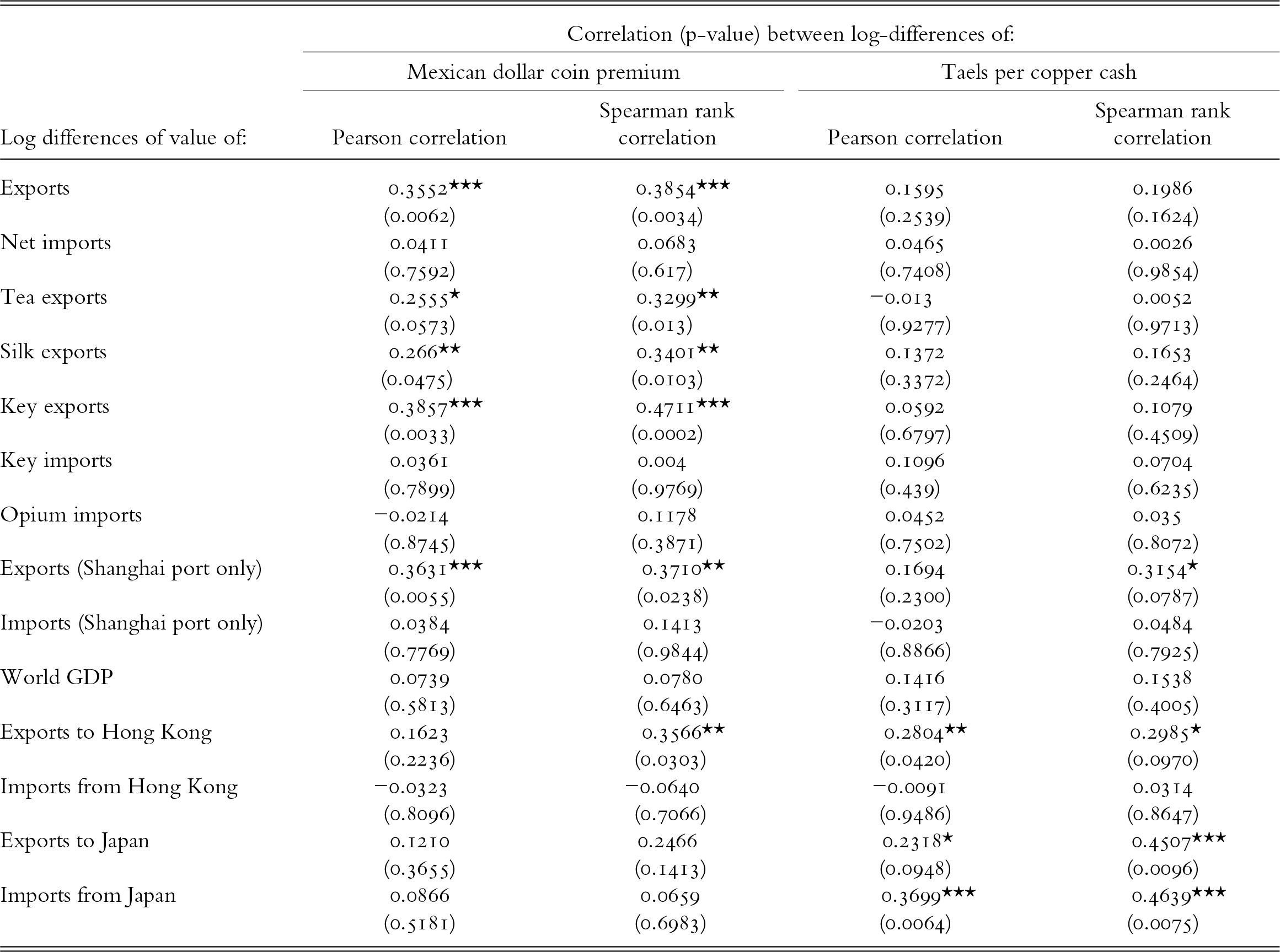
For a different viewpoint on the coin premiums, we turn to Chinese trade data which is only available annually. There are a total of 58 observations. Table 4 presents pairwise correlations between individual trade measure and the single coin premium series (the Mexican dollar at Shanghai) with enough observations to span all years from 1866 to 1924. We predict that the coin premium is correlated only with China’s export commodities which were bought with these coins (as in H3 regarding silk). We also test whether the coin premiums are correlated with the value of trade in opium and other goods imported in China (H4a, H4b). Finally, we examine whether associations between the tael value of copper coins and the value of trade differ from those observed for the Mexican coin premium (H5a, H5b).
Pairwise correlations of annual coin premiums and measures of China’s trade from 1866 to 1924

Notes: Annual trade data is compiled by Yang (Reference YANG1931) and Hsiao (Reference HSIAO1974) from Chinese Maritime Customs reports. Annual world GDP estimate is detailed by Bolt and van Zanden (Reference BOLT and VAN ZANDEN2020). Coin premiums and value of copper cash are end-of-year observations derived from end-of-month data used in Tables 1, 2 and 3. Asterisks indicate 10%, 5% or 1% significance. Results for Chinese trade with UK, US and India are insignificant and not reported.
Table 4 reports evidence consistent with these predictions. The Mexican coin premium is significantly positively correlated with total exports, tea exports, silk exports, key exports and total exports through the Port of Shanghai only. Thus, the coin premium is higher in times when more coins were needed to pay for a relatively large volume of exports. In contrast, the Mexican coin premium is not correlated with total imports, key imports or opium imports (H4b), suggesting that these businesses were not conducted with silver coins. Furthermore, the log-differences in the value of copper cash are not correlated with total exports, tea, silk, key exports or opium exports. This evidence is consistent with H5b.
The entries in the lower part of the table show that the Mexican coin premiums and the silver tael price of copper cash are not associated with a measure of world GDP growth. The value of copper cash is correlated with exports to Hong Kong and both exports to and imports from Japan. While we do not have a theory to explain these associations,Footnote 31 the substantial differences between correlations involving copper cash and those involving Mexican coin premiums are consistent with different uses and demands for silver versus copper money. Thus, Table 4’s annual evidence conforms more closely with the prediction that the pricing of silver money differs from other forms of money (H5b) relative to the monthly evidence in Tables 1, 2 and 3.
VI
We have examined premiums paid for the Spanish and Mexican silver coins that served as key currencies in China into the early twentieth century. It is not obvious why there should be significant price premiums for these coins, or larger premiums for the Spanish coin than for the Mexican coin which is identical in weight, purity, form and familiarity. An impediment to conducting research on this interesting historical period is the unevenness or outright absence of data. If, for example, there were further monthly observations back to the early 1800s when the Spanish silver dollar gained much popularity in China, our evidence could be more conclusive. The availability of Chinese trade data on only an annual, rather than monthly, basis further constrains our tests. Throughout the article, short time series, missing observations and other artefacts of the data are additional impediments. Nonetheless, during the period for which we do have data, the associations between coin premiums and macro-economic, banking and commodity-specific forces are often consistent with our predictions. The associations with seasonals and shocks in commodity production and trade are particularly interesting.
Some of the variation in the coin premiums can reflect more subtle or even irrational influences that go beyond economics. Von Glahn (Reference VON GLAHN2007) quotes a British official: ‘the arbitrary value given to the Spanish dollar in China, owing to the prejudices of the people in favour of that coin … departs from the general laws regarding the valuation of money.’ It is not likely that empirical economists can devise proxies and tests to reveal such influences. However, our findings suggest that rational economic forces were, at least in part, driving the observed premiums for these coins. The pricing of Spanish, Mexican and other foreign silver coins reflects their ‘localization’ (Kuroda Reference KURODA2020) and their usefulness in export markets for China’s commodities. Quoting Kuroda (Reference KURODA2008b), ‘an assortment of monies could do what any single money could not, and supply what the market required’. Furthermore, previous authors have uncovered substantial evidence of rational geographic arbitrage trading of these coins (Ho, Lai and Gau Reference HO, LAI and GAU2013; Ma and Zhao Reference MA and ZHAO2020). Indeed, transaction costs cannot bound the size and behavior of the coin premiums. There was no free coinage of these coins, the supply of genuine Carolus dollars was limited by the number of coins minted decades previously and the supply of new Mexican dollars was set by the Mexican government.
The interesting phenomenon of foreign silver coins circulating in China and trading at premiums to other forms of silver money gradually disappeared. Foreign silver coins lost popularity as trade with Europe was largely halted by World War I (Kuroda Reference KURODA and Sugihara2005). Growing production and circulation of Chinese silver dollars had ‘by 1919 … replaced the foreign dollars as the medium of exchange in the tea and silk areas’ (McElderry Reference MCELDERRY1976). The silver-denominated Shanghai tael gradually replaced by these new silver dollars was formally abolished by the Ministry of Finance in 1933. Much of our evidence suggests that the actions of rational currency traders, bankers, merchants, farmers and consumers contributed to the pricing of these peculiar but useful forms of money during an era of economic and political uncertainty.
Supplementary material
The supplementary material for this article can be found at https://doi.org/10.1017/S0968565025100103
Appendix 1. Newspaper sources for end-of-month data
Shanghai
1. The North China Daily News is the primary source for Carolus, Mexican, tael and copper cash values.
2. If missing, take the date closest to end of month from weekly sister publication The North China Herald.
3. For three dates (July, October, November 1924), ‘Chinese dollar’ from The North China Herald substitutes for missing Mexican dollar.
4. When Mexican dollar is missing from above sources, use The Celestial Empire, an English language weekly (September to December 1906, September to October 1908, April to May 1909).
5. If any value is missing from all English language sources, use Chinese language newspaper Shen Bao (see Appendix 2): Carolus (April 1879 to March 1880, June 1880 to February 1881, July 1881 to January 1883).
6. Using the sources described above, the Mexican dollar series is complete for the entire sample period from June 1866 to December 1924 after which the series disappears from the newspapers. The Carolus dollar series is complete for four subperiods (June 1866 to March 1880, June 1880 to February 1881, July 1881 to July 1885, September 1890 to December 1899). The copper cash price is complete over the sample period except for November 1905 to August 1906. Among the control variables, the London silver price is complete, the global trade measure is complete starting December 1871, and the global stock price measure is complete except for July 1914 to October 1915 and January 1916.
San Francisco
7. If value is missing in San Francisco Chronicle, use The Daily Alta California (Mexican dollar: December 1876, June and July 1879, September 1890; US trade dollar: April to December 1876, July to August 1878), The San Francisco Call (Mexican dollar: June 1893, March 1895, December 1897), or The Commercial and Financial Chronicle, a New York weekly (US trade dollar: May to July 1879).
8. For end of November 1905, no quote for Mexican dollar is available from any source. The Financial Times of 1 December 1905 (p. 7 ‘Bullion Markets’) indicates these coins were trading ‘at about their melting value…bought for China account’. Therefore, we use the melt value, 72.7351 taels per hundred Mexican dollars.
9. Mexican dollar series is complete from December 1876 to January 1898. US trade dollar series is complete from April 1876 to March 1883.
Appendix 2. Shen Bao newspaper
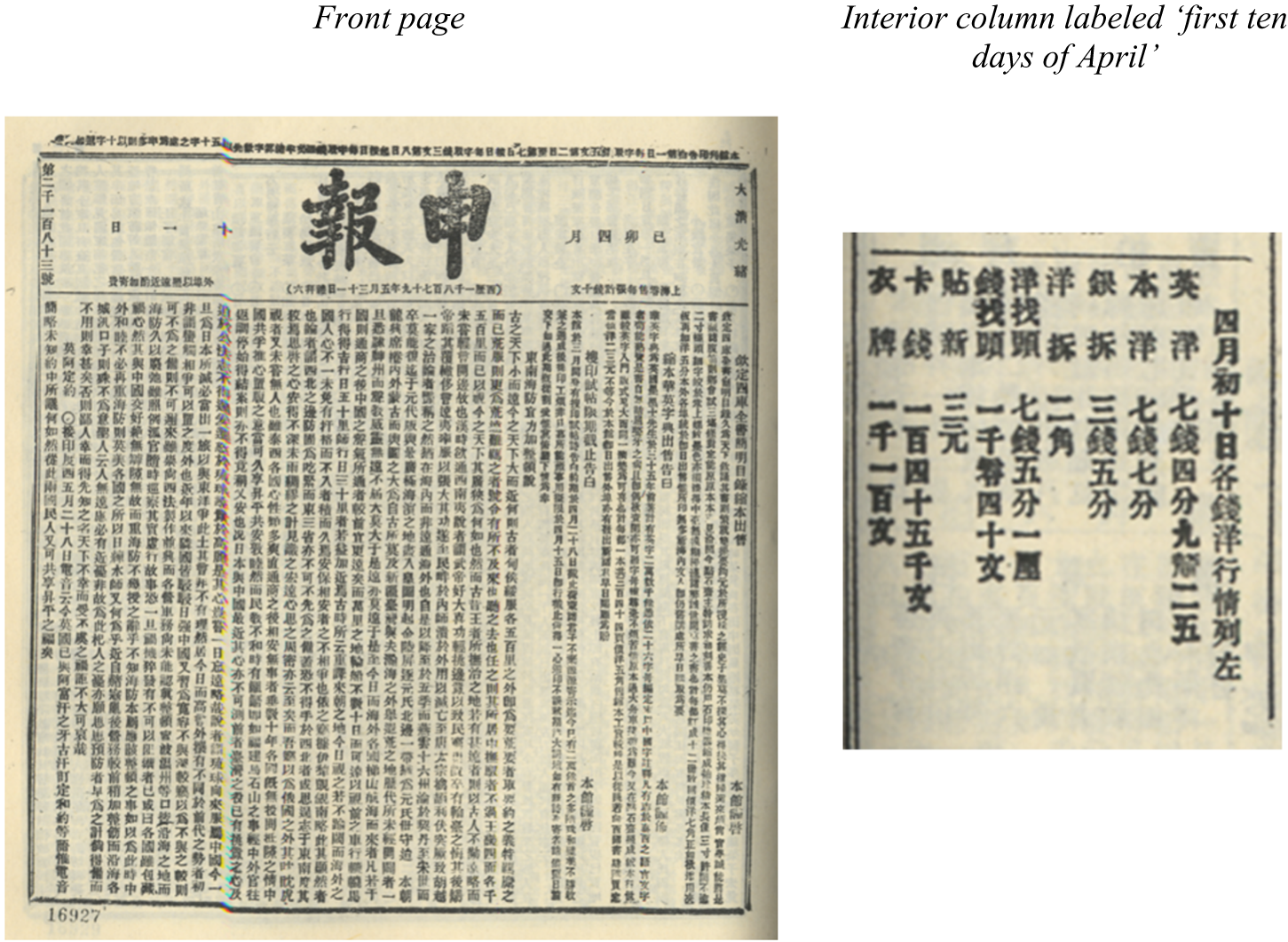
Shen Bao appeared from 30 April 1872 to 27 May 1949. Also known as Shun Pao, Shen-pao(申報; Shēn Bào) and Shanghai News, its full name is Shenjiang Xinbao. The masthead below is dated by Chinese and Western calendars as 11 April 1879 and 31 May 1879, respectively. Chinese characters for coins are 本洋 (‘local foreign’), i.e. Spanish dollar, and 鹰洋 (‘eagle foreign’), i.e. Mexican dollar. An alternative name for the Mexican dollar is 英洋 (‘English foreign’).




 Open access

