


Introduction
In the present discussion on climate change (Reference Reinwarth and Escher-VetterSolomon and others, 2007), the emphasis is placed more on air temperature than on precipitation scenarios. This choice recognizes the fact that the temporal and spatial distribution of precipitation is difficult to record, and consequently much more difficult to model than the distribution of air temperature, especially on heterogeneous, alpine terrain. In order to obtain a better picture of the temporal and spatial distribution of this hydrologic quantity, winter mass-balance series of glaciers can be used. In spite of the poor temporal resolution of these data which provide a temporal integral over the accumulation period, they improve the data basis somewhat as they represent areal averages up to a few square kilometres in rather remote regions where the density of precipitation-gauging stations is low. When using these data, it has to be considered, however, that winter mass balance differs from precipitation due mainly to melt losses and wind blowing snow from the glacier.
Worldwide, summer and winter mass-balance data have been determined on more than 150 glaciers (Reference DyurgerovDyurgerov, 2002), but continuous series of more than 10 years are available only for about 50 of them. Many of these long series are from Scandinavia where Storglaciären, Sweden, has the longest dataset for a complete glacier, starting in 1945/46 (Reference HoinkesHolmlund and Jansson, 1999). For the Alps, datasets for entire glacier surfaces are available for about ten glaciers, of which Glacier de Sarennes, France, is the most westerly (Reference SolomonVincent and others, 2004) and Wurtenkees in the Hohe Tauern, Austria, the most easterly (Reference Auer, Böhm, Schöner and LeymüllerAuer and others, 2002). The longest series, though it is not for a total glacier, is from Claridenfirn, Switzerland, where the measurements at two stakes span more than 90 years (Reference JanssonKappenberger, 1995).
For Hintereisferner and Kesselwandferner, two glaciers in the southern Oetztal, Austria, the annual determination of net mass balances was started in 1952 (Reference Kuhn, Markl, Kaser, Nickus, Obleitner and SchneiderKuhn and others, 1999), and for Vernagtferner, which is located about 10 km northeast of Hintereisferner, in 1964 (Reference Mauser, Ludwig and BenistonMoser and others, 1986). These series or parts of them have been analyzed by, for example, Reference KuhnKuhn and others (1985) and Reference Vincent, Kappenberger, Valla, Bauder, Funk and Le MeurWeber (2005). They are characterized by markedly different trends, as Hintereisferner displays the highest net mass losses, and Kesselwandferner the smallest, while the losses of Vernagtferner lie between these two. This individual behaviour is dominated by quite different summer mass balances, which are mainly caused by the different topographic features of the glaciers (Reference KuhnKuhn and others, 1985; Reference Plattner, Braun and BrenningReinwarth and Escher-Vetter, 1999). Nevertheless, the question arises whether differences which are also found between the winter mass-balance series of these two glaciers are due to climatic or topographic effects or result from the different methods used, as the net mass balance was determined with the same method for Hintereisferner and Vernagtferner, but not winter mass balance.
Up to now, the Vernagtferner total winter mass-balance series has been published by Reference Escher-Vetter, Braun and SiebersEscher-Vetter and others (2005), Reference Fischer and MarklHaeberli and others (2005) and Reference Escher-VetterEscher-Vetter (2007). Altitudinal mass-balance gradients for selected winter seasons were shown by Reference Mauser, Ludwig and BenistonMoser and others (1986) and Reference Escher-VetterEscher-Vetter (2000). All results were determined with the direct glaciological method, using the polynomial profile method for spatial integration as described below.
The Hintereisferner series up to 1996 was presented by Reference Kuhn, Markl, Kaser, Nickus, Obleitner and SchneiderKuhn and others (1999) based on energy-balance ablation modelling and measured net mass losses. The direct glaciological method has been applied by Reference BortenschlagerBortenschlager (2006) since 1992/93. Series for both glaciers are included by Reference DyurgerovDyurgerov (2002).
The main purpose of this paper is to provide detailed survey data for both glaciers in order to discuss the impact of various analytical methods on winter mass-balance determination with respect to the reliability of the resulting series.
Data Basis
Since annual fieldwork on Vernagtferner started in 1964, 1 : 10 000 scaled topographic maps from 1969, 1979, 1982, 1990 and 1999 and additional adjustments in 1974, 1994, 2002 and 2003 form the basis for determining mass balance. The size, shape and topography of this glacier has changed considerably in this period, as positive net mass balances in the 1960s and 1970s resulted in an advance of the glacier in the late 1970s and early 1980s (Table 1). After a major reduction of ice volume due to the consistently negative net mass balances since 1984/85, the glacier topography changed once more in the 1990s and 2000s.
Basic data for determining Vernagtferner winter mass balance. T 1: day on which spring surveys were completed; N d : number of snow-density measurements; N s: number of snow-depth soundings; rho (std dev.): average density and corresponding standard deviation; A: total glacier area; AZ: altitudinal zone where N d and N s were taken; S a: snowfall amounts between T 1 and 1 June based on the records at the Vernagtbach gauging station and determined according to Reference Escher-VetterEscher-Vetter and Siebers (2007)

In Figure 1, the locations of snow-density measurements and snow-depth soundings for the 2002 and 2004 spring surveys are shown on the 1999 map. As the Vernagtferner falls roughly into three sections (Reference Plattner, Braun and BrenningReinwarth and Escher-Vetter, 1999), the snow-depth soundings are made on the three tongues and accumulation basins since the early 1990s, but they do not follow a strict spatial pattern in every year. The spatial distribution of the density sites as shown in Figure 1, however, is typical for the surveys in most of the years, whereas the number of snow-depth soundings and snow pits varies to a larger extent. With the exception of 1995, when more than 1000 snow-depth soundings were performed but could not be located precisely as no global positioning system (GPS) was available, 2004 represents the year with the greatest data coverage, and all positions since then are determined with GPS.
1999 map of Vernagtferner, including locations of snow-density measurements (filled circles) and snow-depth soundings for the 2002 (crosses) and 2004 (triangles) winter mass-balance surveys.

In Table 1, basic data related to winter mass-balance determination are summarized in columns 2–7 for the Vernagtferner. The data as given in the last column are discussed later.
Significantly fewer observations were made before the mid-1990s than since. The share of the glacier area covered by the observations remained fairly constant, amounting to an average of 80% for all seasons other than 1978, 1979, 1982, 1986 and 2003, when AZ, the altitudinal zone in which the observations were made, covered less than 60% of the total glacier area.
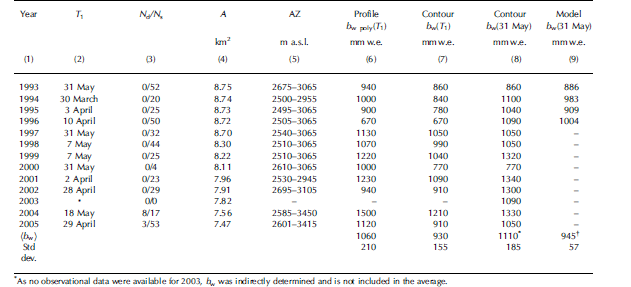
For Hintereisferner, Figure 2 shows the locations of snow-depth soundings and snow pits for the 2004 and 1994 winter seasons, and the latter sampling-site distribution is typical for most of the surveys on this glacier. In contrast to Vernagtferner, the observation sites are mainly located along a line in the centre of the tongue, and only for 2004 and 2005 are observations available in the upper part of the glacier. The date of survey, number of soundings, total glacier area and altitudinal zone as covered by the observations are summarized in Table 2 for the period 1993–2005, when the direct glaciological method was applied. The scatter in T 1 for the 12 years is somewhat larger than for Vernagtferner, and in most of the years the available snow-depth sounding sites cover not more than 60% of the total glacier area, which lost 1.3 km2 or 15% of its initial size during this period.
Table 2. Basic data and results from various determinations of Hintereisferner winter mass balance for the 1992/93 to 2004/05 winter seasons. Abbreviations in columns 2–5 same as in Table 1. In the bottom two rows, the averages 〈bw〉 and standard deviations of the four winter mass-balance series are included
1994 map of Hintereisferner, including the locations of sample sites for the spring surveys of 1994 (only snow depths (crosses)) and 2004 (snow-density measurements (filled circles) and snow-depth soundings (triangles)) (Fischer and Markl, in press).

Methodology
In this section, we concentrate on the analytical methods applied to the field data, as Reference Holmlund and JanssonJansson (1999) and Reference Moser, Escher-Vetter, Oerter, Reinwarth and ZunkeØstrem and Haakensen (1999) give ample evidence of the problems associated with field measurements.
Snow-density and water equivalent determination
For Vernagtferner, snow density is determined gravimetrically for each pit by weighing a core through the full column down to the summer horizon of the previous year and averaging over the whole depth. The average snow density for the entire glacier area is then calculated as the arithmetic mean from all the snow pits, and all snow-depth soundings of the respective surveys are converted to water equivalents on the basis of these annual densities. The density values vary between 327 and 480 kgm–3 from year to year. The small standard variations of most years show that the averaging error is small. For 1973, when no density measurements were available for Vernagtferner, a value of 380 kgm–3 was used.
On Hintereisferner, snow density was only measured during the spring surveys 2004 (eight snow pits, mean value 380 kgm–3; cf. Fig. 2) and 2005 (three snow pits, mean value 350 kgm3), with the same method as on Vernagtferner. The values of the other years were interpolated from density data observed in early spring and early summer (Reference LangMatzi, 2004), resulting in 350 kgm–3 for 1994, 1995, 1996 and 2001; 380 kgm–3 for 1998, 1999, 2002 and 2005; and 420 kgm–3 for 1993, 1997, 2000 and 2004.
Profile Method
For Vernagtferner, the determination of the mean winter mass balance b w at a given date is based on the assumption that a function f(z) exists which delivers the local accumulation values within the glacier range as a sole function of altitude, and b w is the result of the integration of this function over the total glacier area. Assuming f(z) = const. within each 50m altitudinal belt of the glacier area–altitude distribution A(z i) leads to

The area–altitude distribution is derived from the geodetic maps and the function f(z) is determined by a regression analysis of the water equivalent samples. This approach is called the ‘profile method’. On a regional scale, one would expect a monotonic increase of f(z) with altitude within the mixing layer (Reference Kuhn, Dreiseitl, Hofinger, Markl, Span and KaserLang, 1985; Reference Auer, Böhm, Schöner and LeymüllerAuer and others, 2002). Impacts of local snow redistribution, however, may be superposed on these basic trends, suggesting the application of a more sophisticated function type, such as a second-degree polynomial, which was applied to the Vernagtferner winter mass-balance series from 1966 to 1985 by Reference Mauser, Ludwig and BenistonMoser and others (1986). In this study, winter mass balance for regions without observations is assumed constant above (below) the altitude of the highest (lowest) measurement of each year for the polynomial function, whereas the linear regression is used throughout the whole altitudinal range. A great advantage of the profile method is that it can be applied to any glacier where an area–altitude distribution and local measurements of the water equivalent are available.
Contour Method
Another method to determine winter mass balance is based on the assumption that the glacier surface can be divided into subareas of constant water equivalent, which in turn allows the analysis of the winter mass-balance dependency on elevation and areal variation (Reference KappenbergerKaser and others, 2003). Ideally, this would represent the best analytical method for winter mass-balance determination, provided that the grid resolution of the analysis matches the scale of the local accumulation and ablation pattern. This ‘contour method’ approach is applied to Hintereisferner by manually drawn isopleths of water equivalent for the winter mass balance. Thus f(z i) results as the spatial mean for each altitudinal belt. The extrapolation of water equivalents to altitudes without observations, i.e. for the 1992/93 to 2002/03 winter seasons, is performed by adopting the accumulation pattern of the 2004 and 2005 spring surveys (Reference BortenschlagerBortenschlager, 2006; Fischer and Markl, in press).
Model Method
A third possibility to determine the total winter mass balance is provided by modelling total summer mass balance b s and calculating b w as the difference between modelled b s and measured total net mass balance, i.e., b w = b n–b s. Values of b s can be modelled, for example, with an energy-balance approach. For the Hintereisferner period 1952–96, the model of Reference Haeberli, Zemp, Frauenfelder, Hoelzle and KääbHofinger and Kuhn (1996) was applied. Although this approach avoids, at least in part, the lack of data and the uncertainties of the direct glaciological method, it includes all the errors of the parameterizations and approximations of the energy-balance modelling for b s. In addition, the errors of the net mass balance can compensate each other, but in the worst case lead to more than a doubling of the error of the winter mass balance.
Temporal System
As winter mass balance is analyzed as the integral over the period between the first snowfall in autumn and the day with maximum snow accumulation (Reference DyurgerovDyurgerov, 2002), all data denoted by T 1 are valid for the period between the end of September and this spring survey date, which is given in Table 1 (Table 2) for Vernagtferner (Hintereisferner). For the ‘Model method’ period 1952–96, the fixed-date system was applied to Hintereisferner with the seasons’ separation set on 31 May. In order to combine this series with the directly determined data since 1992/93, precipitation records at the Vent climate station were used to supplement the observed Hintereisferner data until 31 May (Reference BortenschlagerBortenschlager, 2006) by calibrating the precipitation amount from this valley station with observed water equivalent of the snow cover from 3000ma.s.l. A similar procedure was applied to the Vernagtferner data on the basis of the precipitation records from the Vernagtbach gauging station. The resulting data represent an upper bound for the winter mass balance, as melting processes were neglected during this period.
Results
In Figure 3, the polynomial and linear regression curves of the altitudinal distributions of winter mass balance from three spring surveys are displayed for Vernagtferner, and Figure 4 shows the Hintereisferner distributions for the same years. The respective area–elevation distributions A(z i) of each year are included in the figures.
Altitudinal distributions of the Vernagtferner winter mass balance for the days T 1 of 1996 (a), 2002 (b) and 2004 (c). The empty circles show the observed field data; the area–altitude distribution is given by horizontal bars (scale on top left). Thick lines represent the linear function, thin lines the polynomial function.

Same as Figure 3, but for the Hintereisferner winter mass balance.

All graphs in Figures 3 and 4 show that winter mass balance increases with altitude, and for the majority the pattern of the observations suggests the applicability of a linear regression to determine f(z). For both glaciers the profiles show some similar characteristics: (1) if sample points follow a central longitudinal track as, for example, on Hintereisferner in 1996 (Fig. 4a), the correlation between winter mass balance and altitude is closer; (2) if the sample points are distributed over a larger part of the glacier area, the standard deviations increase, as for example in 2004 (Figs 3c and 4c; cf. Tables 3 and 4).
For the Figure 3a dataset, the polynomial function shows a closer relation to the basic data than the linear function (r 2 lin = 0.68 mmw.e.; r2 poly = 0.71 mmw.e.). In applying the polynomial function, however, one assumes a deviation from the linear relationship, which is caused by additional deterministic processes such as snow redistribution by wind. These processes were analyzed by Reference Hofinger and KuhnHoinkes (1955), modelled by Reference Kaser, Fountain and JanssonKuhn (2003) and discussed by Reference Østrem and HaakensenPlattner and others (2006). The areal distribution of accumulation is the result of a combination of two effects: (1) the existence of a fairly constant areal accumulation pattern, and (2) deviations induced by the individual meteorological conditions. The scatter of observations in 2004 (Figs 3c and 4c) implies that the two processes contribute to the same order of magnitude.
The winter mass balances of the three years as calculated with Equation (1) for the linear (b w lin) and polynomial (b w poly) approach are given in Table 3 (Table 4) for Vernagtferner (Hintereisferner), together with the respective linear regression coefficients (slope and offset) and standard deviations. Slope and offset show a wide variation in time and space, but no interrelation. For Vernagtferner (Table 3), the difference between the linear and the polynomial profile approach is small in most of the years, hence the polynomial approach cannot be considered as a marked improvement of the profile method. On the other hand, its application to the Vernagtferner data for the results published previously (cf. Introduction) does not lead to significant deviations, a fact also demonstrated by the scatter plot in Figure 5. The close correlation for all winter seasons is obvious; it must be mentioned, however, that the regions where the polynomial function assumes a constant water equivalent lie in those altitudinal belts which do not contribute significantly to the total glacier area. This circumstance reduces the difference between the polynomial and linear profile approaches to some degree.
Selected data of three winter seasons for Vernagtferner: slope and offset of the linear relationship between winter mass balance and altitude; standard deviation between measured data; b w lin, the winter mass balance calculated for day T 1 (cf. Table 1) with Equation (1) and a linear function; and b w poly, the same but with a polynomial function


Scatter plot of Vernagtferner winter mass balance for the period 1966–2005, determined with the polynomial and the linear regression.

Reference Østrem and HaakensenPlattner and others (2006) applied an alternative version of the contour method to the Vernagtferner data for the 2003/04 winter season, based on 165 sample sites. They use a generalized-least-squares linear regression model in conjunction with an exponential model of spatial autocorrelation which delivers the frequency distribution from a more objective point of view. Their estimate of the 2003/04 winter balance is 3.4% greater than that obtained with the profile method, which is somewhat smaller than the averaged 14% for the 12 years on Hintereisferner (see below).
The application of the profile method to the Hintereisferner data, as performed in this study, leads to quite different results, and large differences between the linear and polynomial approaches are found in the b w results if significant portions of the glacier area are not covered by observations. This is clearly visible from Table 4 and Figure 4a and b for the 1996 and 2002 winter seasons. The 1996 dataset (Fig. 4a) covers an altitudinal range from the end of the tongue up to 3065 ma.s.l., and in 2002 the soundings start only at 2695 ma.s.l. (Fig. 4b). For 2004, a lower number of samples cover a larger portion of the glacier area (cf. Fig. 2), and winter mass balances using both approaches amount to 1500 mmw.e. As in the case of Vernagtferner, the standard deviation increases if the samples cover a larger area (Tables 3 and 4, winter 2004). On the whole, the determination of b w using the polynomial profile method (Table 2, column 6) leads to systematically higher values than those of the contour method (Table 2, column 7), the average difference amounting to 130 mmw.e. or 14% (std dev. 84 mmw.e.), which is somewhat smaller than the subjectively expected accuracy.
These analyses show that winter mass balance varies not only with altitude, but also in relation to the position on the glacier surface. A high correlation of the regression function f(z) indicates that the available observations only consider the altitudinal dependency of the winter mass balance. In contrast, mechanically induced snow redistribution causes a larger standard deviation and increases the uncertainty of the final result. Thus, a high correlation may be spurious if observations are only available along a central longitudinal section.
Summary and Conclusions
Figure 6 summarizes the previous analyses and shows the resulting winter mass-balance time series for Hintereisferner and Vernagtferner for the period 1975/76 to 2004/05, as precipitation records for the Vernagtbach catchment began only in 1975. For Vernagtferner, the total series is based on the linear profile method with the extension to 31 May. For Hintereisferner, the b w values of the model approach are used until 1991/92 and the contour method for the winter seasons until 2004/05, including the extension until 31 May (cf. Table 2, column 8). Hence, the Hintereisferner series is more heterogeneous than the Vernagtferner series, a fact illustrated by the different standard deviations of the various methods (Hintereisferner 1975–92: 340 mmw.e.; Hintereisferner 1993–2005: 180 mmw.e.; Vernagtferner 1975–92: 195 mmw.e.; and Vernagtferner 1993–2005: 180 mmw.e.). These standard deviations show that the variability is largest for the model period on Hintereisferner, but that the various methods applied to the data of the direct glaciological approach have quite similar variability.
Time series of Hintereisferner (HF) and Vernagtferner (VF) winter mass balance b w for the winter seasons 1975/76 to 2004/05 determined in the fixed date system (1 October to 31 May). For Hintereisferner, modelled winter mass balance is used until 1991/92, and directly determined values integrated with the contour method afterwards. Nine-year running means (9y-filter) are included for both series.

A 9 year running-mean filter was applied to the winter mass-balance data in order to reduce uncorrelated noise and interannual variability. Both filtered series display a similar wave-like structure with a minimum around 1990. Differences seem to be more systematic for the ‘contour line’ period since 1993. The error of the period with model results occurs randomly, whereas during the second period it is more systematic due to the superposition of the bias from the presumptions in the precipitation extension and contour method.
Assuming that there are no large differences in the mean winter balance within an altitudinal belt in closely neighbouring regions, a close agreement of the filtered series can be expected. From this point of view, Figure 6 reveals with a high confidence level that winter mass balances of about 1000±100mmw.e. are typical for
glaciers situated in the southern Oetztal.
The modelling of glacial processes in high alpine areas relies on this information resulting in realistic amounts of precipitation input. Only recently did the scale used for snow and ice models (1 ×1 km2) reach that of the redistribution processes, so that an areal average of the local snow accumulation is sufficient for most purposes. Modelling the water balance of the upper Danube catchment in the framework of the GLOWA-Danube project (Reference MatziMauser and Ludwig, 2002), for example, includes the evolution of the glacierized area on a scale of 1 ×1 km2, where operational climate data are not available. Long-term series of total winter mass balance as well as their altitudinal distributions could help to close this gap in remote regions with few observation sites. Our study shows that data published until now are suitable for this purpose, in spite of the inherent uncertainties.
To reduce the remaining uncertainties and learn about the interannual variability including the regional differences, further investigations must be accomplished which cannot be specified here in detail. The results of this study indicate that more observation points are only useful when they statistically represent the total areal variation of winter mass balance. Much better results can be expected by applying laser altimetry in spring and autumn, which delivers high-resolution data for the entire glacier area by remote sensing.
Acknowledgements
Countless colleagues have contributed to the compilation of the data used in this study. O. Reinwarth, H. Rentsch, E. Heucke, L. Braun and C. Mayer supervised most of the fieldwork. J. Jaenicke, C. Rosset, T. Plattner, M. Schulz and T. Rödder helped with the numerical processing. Valuable information on the Hintereisferner data was provided by A. Fischer. We are grateful to the two anonymous referees for constructive and extensive recommendations. Funding from the German Research Foundation (DFG), the Federal Ministry of Education and Research, Germany (BMBF), the Thiemig Foundation, the Hydrographic Office Tyrol, the GLOWA-Danube project, the Academy Research Programme III.B.1 of the Federal Republic of Germany and the State of Bavaria, and the Commission for Geophysical Research, Austrian Academy of Sciences, is gratefully acknowledged.



