





“Any qualitative researcher who is not asleep ponders moral and ethical questions” (Miles & Huberman, Reference Miles and Huberman1994, p. 288).
Qualitative research, as with all forms of scientific inquiry, is never simply a technical exercise; it is inherently bound to the values, judgments, and responsibilities of those undertaking it. Denzin and Lincoln’s (Reference Denzin, Lincoln, Denzin and Lincoln2005, p. 10) observation, “qualitative research is many things to many people,” remains a testament to the flexibility and diversity of such studies. Despite this plurality, the field is also defined by academic rigor: “research is disciplined inquiry” (Dörnyei, Reference Dörnyei2007, p. 15). What emerges, then, is a field of simultaneously expansive yet exacting scrutiny, with methods, data, and analyses grounded in context, meaning, and interpretation.
Despite its popularity across the social sciences, qualitative research resists a singular, universally accepted definition (Aspers & Corte, Reference Aspers and Corte2021). Concerns about whether it can be regarded as objective or generalizable, or if it risks being overly subjective, unstructured, or anecdotal, have long existed. Such debates prompt reflection on whether Holliday’s (Reference Holliday2004, p. 731) assertion still resonates after two decades of scholarly work: is it true that “boundaries in current qualitative research are [still] crumbling, and researchers are increasingly doing whatever they can to find out what they want”?
Thoughtful inquiry repudiates this apparent looseness, as qualitative studies are now widely argued to be grounded, systematic, reflexive, and principled (Denzin & Lincoln, Reference Denzin, Lincoln, Denzin and Lincoln2005; Tracy, Reference Tracy2010). Besides, scholars have emphasized that qualitative research, like any other systematic study, must be evaluated using robust criteria, including (but not limited to) trustworthiness through credibility, transferability, confirmability, authenticity, and dependability (Guba, Reference Guba1981; Guba & Lincoln, Reference Guba and Lincoln1989; Lim, Reference Lim2025).
Such recognition of the qualitative approach, more often than not, eludes many second language (L2) research contexts. Although linguists have adopted qualitative inquiries since the 1990s (Dörnyei, Reference Dörnyei2007), there remains a pressing need for procedural rigor and accountability in L2 qualitative contexts (Shohamy, Reference Shohamy2004). While the broader field has moved toward systematic approaches, a significant portion of L2 qualitative studies still fall short in attending to core evaluative criteria. For instance, Riazi, Rezvani, and Ghanbar (Reference Riazi, Rezvani and Ghanbar2023) reviewed 43 qualitative studies in L2 writing and found that concepts of quality and rigor were frequently left unaddressed. Despite theoretical advancements, more than half of the reviewed studies remained vague in their descriptions of the methodologies employed and struggled to demonstrate how claims were grounded in data. Similar issues also surfaced decades ago in cross-linguistic qualitative research. Squires (Reference Squires2009) reviewed 40 studies in the field and identified several methodological inconsistencies, including a lack of clarity regarding translation decisions and insufficient transparency about how data were analyzed.
The call for rigor and accountability emerges alongside a growing momentum toward open science (OS). This introduces both opportunities and tensions for L2 qualitative researchers. On the one hand, openness promises to enhance accountability, and on the other, it calls for practices such as data sharing or replicability that rest on assumptions that scholars argue do not clearly map onto qualitative epistemologies that respect the contextual, iterative, and emergent nature of qualitative research (see Chauvette, Schick-Makaroff, & Molzahn, Reference Chauvette, Schick-Makaroff and Molzahn2019). Thus, several procedural dilemmas arise: What does it mean to open data that is inseparable from the researcher-participant relationship? How can researchers disclose enough without breaching confidentiality or trust? Given the multimodal, multilayered, and multidimensional nature of language research (discussed further in the section Openness in and with L2 Research ), how does openness apply to and for qualitative L2 contexts?
Thus, a direction that respects the principles of OS and the particularities of qualitative inquiry in L2 settings is needed. In the sections that follow, we aim to introduce OS into the domain of qualitative and L2 research and to develop a phased framework to assist researchers in making informed decisions at different stages of second language qualitative research. Rather than advocating a pastiche of standards from quantitative research, the ultimate goal here is to uphold open research that values the reflexivity, depth, and sensitivity that are distinctive to L2 qualitative research.
Openness in qualitative research
The is and isn’t
Any attempts to define openness in qualitative research must begin by unsettling the assumption that openness simply involves making everything visible. In practice, openness cannot be reduced merely to transparency, nor can it be an all-or-nothing approach that is satisfied by uploading the materials, transcripts, or protocols online. Such practices might (in)advertently overlook the complex, relational nature of qualitative inquiry. Besides, this view risks reinforcing research as neutral, procedural, and universally reproducible, all of which stand as tensions within the foundations of the qualitative approach. Such tensions become further apparent when associating openness with replicability. Qualitative researchers have long argued whether replication, in its narrowest sense, is even relevant or possible (Makel et al., Reference Makel, Meyer, Simonsen, Roberts and Plucker2022; Pownall, Reference Pownall2024; Tuval-Mashiach, Reference Tuval-Mashiach2017). As Pownall (Reference Pownall2024, p. 106) asks, “Can any study that attempts to ‘recreate’ this approach ever, really, be considered a true ‘replication’?”. The question is rhetorical, but it points to a critical concern: qualitative research is rooted in specificity and is emergent from collaborative knowledge creation among the researcher, the research, and the participant (not ordinal but iterative).
Campbell et al. (Reference Campbell, Javorka, Engleton, Fishwick, Gregory and Goodman-Williams2023, p. 2) further clarify this perspective: “there is no expectation that a different analyst would necessarily interpret data the same way or that another researcher pursuing the same or similar research questions in another setting would obtain the same results.” What is more useful, therefore, is a shift in focus; instead of demanding sameness, qualitative openness calls for clarity “so that diverse stakeholder audiences can understand their research” (Campbell et al., Reference Campbell, Javorka, Engleton, Fishwick, Gregory and Goodman-Williams2023, p. 2). Researchers across paradigms are expected to make clear how decisions were made, what was prioritized, and under what circumstances the research took place, not as a claim to neutral or universally reproducible procedures, but as a way of making the reasoning and context of the study visible to readers. Such openness does not erase complexity but renders it legible, positioning openness as a component of broader accountability and contextual understanding (Caelli, Ray, & Mill, Reference Caelli, Ray and Mill2003).
Another important tension exists in the conflict between openness and confidentiality (Khalil, Shinwari, & Islam, Reference Khalil, Shinwari and Islam2022). In this regard, one major concern raised is the potential violation of the ethical principle of privacy, particularly for uninformed or non-consenting individuals and communities. However, considerations of data deposition of uninformed participants can be called a naïve approach to OS, as it is misleading to assume that OS entails breaches of privacy. Instead, ethical OS practices emphasize the necessity of obtaining informed consent when data are intended to be shared or reused in future research. Furthermore, responsible data sharing involves robust anonymization and remediation procedures to protect participant identities. For instance, Campbell et al. (Reference Campbell, Javorka, Engleton, Fishwick, Gregory and Goodman-Williams2023) recommend both automated and manual de-identification strategies that incorporate natural language processing, data blurring, categorization, redaction, and bracketing techniques. Complementing these approaches, the Qualitative Data Repository has also developed comprehensive guidelines for de-identifying and archiving narrative data (Demgenski et al., Reference Demgenski, Karcher, Kirilova and Weber2021), ensuring that openness can coexist with ethical rigor and participant confidentiality.
Yet another tension arises between flexibility and standardization. The introduction of concepts such as preregistration in qualitative contexts might superficially look like attempts to flatten the iterative nature of qualitative data collection techniques. However, as Al-Hoorie et al. (Reference Al-Hoorie, Cinaglia, Hiver, Huensch, Isbell, Leung and Sudina2024) suggest, preregistration can outline the provisional plans while leaving space for field-specific modifications, thereby serving as a scaffold rather than a script. When such modifications are openly acknowledged, flexibility doesn’t compromise openness or rigor; rather, it enhances trustworthiness.
Considering that openness is never unidimensional, it calls for a more nuanced understanding: one that resists being totalized by a single metric. Openness in qualitative research, therefore, includes processual (as against procedural) transparencyFootnote 1 (e.g., how and why the research unfolded in a particular way?) and relational transparency (e.g., how were participants involved in shaping meanings?), as well as ethical transparency (e.g., how confidentiality, consent, and power were considered?). Each of these invites a different kind of accountability, and each of these responds to a different yet equally important aspect of the research process.
Parenthetically, openness in qualitative contexts has several epistemic and practical benefits beyond enhancing accountability. It allows researchers to understand how conclusions were reached (Braun & Clarke, Reference Braun and Clarke2019; Tracy, Reference Tracy2010). Such openness supports methodological learning and knowledge building/sharing; it also helps identify divergences in interpretation (instead of treating them as errors). Moreover, transparency across all the stages of qualitative inquiry, from decision-making to post-hoc communal reciprocity, can help prevent selective reporting and develop trustworthiness and credibility. In this sense, openness in the qualitative paradigm, while not in pursuit of identical results, enables auditability by making rationales, logic, and interpretation visible and contestable.
Importantly, openness doesn’t emerge in a vacuum. It is influenced by the theoretical and epistemological stance of the research. For instance, a constructivist approach, as foregrounding reflexivity and knowledge co-construction, might involve documenting interpretive decisions, sharing emergent analyses with participants, or situating the researcher’s positionality as a part of the knowledge-making process (Cronin, Reference Cronin, Merriam and Grenier2019). A critical paradigm, on the other hand, demands transparency about whose voices are(n’t) represented (Wodak & Meyer, Reference Wodak and Meyer2001); openness, here, must serve not only clarity but also the social and ideological structures of the field. Meanwhile, post-structuralist approaches might encourage openness to be treated as an invitation to interpretation, rather than as finality in meaning (Williams, Reference Williams2014).
Taken together, these paradigmatic nuances point toward openness being epistemological; thus, OS becomes not a way of doing but a way of knowing and sharing. OS, therefore, views qualitative research as partial, situated, and relational. Taken from this perspective, openness does not mean revealing everything. It means acknowledging what can(not) be known and why, what the limits of research are, and what ethical aspects are at stake (Berger, Reference Berger2015).
Openness on and with
To understand the layered nature of openness in qualitative contexts, it is helpful to distinguish between openness on and openness with research, representing different ethical positions toward inquiry.
Openness on research refers to an outward-facing commitment; the act of making decisions transparent to external stakeholders such as reviewers, editors, funders, or the broader academic community (see discussions on reporting by Bringer, Johnston, & Brackenridge, Reference Bringer, Johnston and Brackenridge2004; O’Brien et al., Reference O’Brien, Harris, Beckman, Reed and Cook2014; Tong, Sainsbury, & Craig, Reference Tong, Sainsbury and Craig2007). Although these practices maximize clarity, they are usually unidirectional [researcher → public], performed post-facto, and shaped by institutional or journalistic standards of accountability. They represent an objective dissemination logic: here is what was done, and here is why it matters. Such versions of openness, although not without value, reassert hierarchies between the knowledge-holder and the knowledge-seeker, with the former deciding what to (not) share with the latter.
In contrast to this, we propose an openness with framework that comprises three levels. The first level, openness with research, refers to the transparent and reflexive addressal of the assumptions, decisions, and interpretations that surround the research process [researcher ↔ research] (Berger, Reference Berger2015). Second, openness with participants requires treating people not as data sources but as co-creators of knowledge [researcher ↔ participants], thereby valuing the interpretive authority and agency of participants through strategies such as informed consent, participant feedback, and information verification (Creswell, Reference Creswell2012; Tamminen et al., Reference Tamminen, Bundon, Smith, McDonough, Poucher and Atkinson2021). Finally, openness with communities involves opening up the very materials of inquiry (e.g., research plans, procedures, codebooks, and other remediated data) along with the products of inquiry (e.g., plain-language summaries, analytic outputs, and actionable policy briefs) through appendices, supplementary materials, and/or accessible repositories such that these resources are discoverable and usable for researchers, public audiences, community partners, and other stakeholders [researcher ↔ communities] (Campbell et al., Reference Campbell, Javorka, Engleton, Fishwick, Gregory and Goodman-Williams2023).
The parable of the six blind men and the elephant is a useful metaphor for clarity and rigor in the qualitative domain here (Daigneault, Reference Daigneault2013). Each man touches a different part of an elephant and draws a different conclusion about its nature. None is entirely wrong, but none has the full picture. Here, what the parable tells us is not only about the partiality of perception due to incomplete information but also the necessity of dialogue. If each man were to share, transparently, about their understanding with others, a more comprehensive picture might have emerged. Similarly, in qualitative studies, when researchers engage with, rather than simply report on their investigation, findings move from declarative to accountable (Steltenpohl et al., Reference Steltenpohl, Lustick, Meyer, Lee, Stegenga, Standiford Reyes and Renbarger2023; Tuval-Mashiach, Reference Tuval-Mashiach2017).
Openness in and with L2 research
Within L2 qualitative research, studies have examined learners’ lived experiences, linguistic identities, affective dimensions, communicative strategies, and the sociocultural, material, and multimodal contexts that shape language use and/or acquisition (Dörnyei, Reference Dörnyei2007; Ortega, Reference Ortega2014; Pavlenko & Lantolf, Reference Pavlenko, Lantolf and Lantolf2000). Such research is characterized by its unique situatedness, the diversity of its methods, and the multidimensional and multilayered nature of its data.
Researchers enter classrooms, homes, online communities, and other sites of language use to understand not only what is said or written but also how and in what context it is said. To document this, L2 researchers draw on a range of data sources, including, but not limited to, learner, teacher, and parent diaries; study logs; reflective blogs/vlogs; language-related episodes; progress charts and maps; mind maps; learner-generated records; and several other forms of input, ranging from interviews to field notes and observations (Griffee, Reference Griffee2018; Ortega, Reference Ortega2014). These sources are multidimensional; they often provide information from different data points, which are then compared and contrasted to understand the field. Such data are multilayered; researchers must decide whether to use language itself as data (e.g., analyzing the structure, meaning, or patterns through a particular lens), use language-related features within the data (e.g., measuring fluency or accuracy), or combine both approaches (Mackey & Gass, Reference Mackey and Gass2021). Finally, data is often multimodal in nature, with aspects such as visual, verbal, and non-verbal communication, phonetic and discourse markers, and pauses and hesitations (Paltridge & Phakiti, Reference Paltridge and Phakiti2015).
For example, a study on immigrant high school students learning English in a multilingual urban classroom might examine how they negotiate identity through teacher-mediated and peer interactions. The researcher might use audio/video recordings of classes (multimodal), student interviews (multimodal, multidimensional, multilayered), learning journals (multilayered), and teacher field notes and classroom observations (multidimensional) to capture how language is used, embodied, and reflected upon across contexts. Such methods of combining data sources are common in L2 contexts. However, in practice, although analysts draw on multiple inputs, the strategies, methodological decisions, rationales, or triangulation techniques employed are too frequently underreported or described only in passing (Riazi et al., Reference Riazi, Rezvani and Ghanbar2023; Squires, Reference Squires2009).
Openness in such contexts calls for detailed, reflexive accounts of methodological and analytical decisions. As discussed in the previous section, the three layers of openness with are especially relevant in L2 contexts. Firstly, openness with research in L2 contexts means reflexively documenting every methodological choice and interpretive turn. For instance, the illustrative case discussed above (immigrant learners) might preregister its initial research plan with a relevant journal, then log and justify the in-field adaptations (e.g., shifting from semi-structured to narrative prompts when students’ journals reveal unexpected themes). Secondly, openness with participants treats learners as co-creators; thus, the researchers return to learners to clarify the ambiguities identified in the data. Finally, openness with communities calls for depositing not only the final report but also codebooks, analytic memos, and transcription conventions; the researchers, here, after taking due consent from all the participants, deposit anonymized and remediated excerpts into repositories to enable peer critique, replication of analytic logic, and the cumulative refinement of research methods.
At present, a growing number of language journals encourage OS practices. Open Practice badges, for instance, appear in journals partnered with the Centre for Open Science, and preregistration or registered reports are invited and encouraged by journals such as Studies in Second Language Acquisition, Language Learning, Language and Speech, Bilingualism: Language and Cognition, and Journal of Child Language Acquisition (Al-Hoorie et al., Reference Al-Hoorie, Cinaglia, Hiver, Huensch, Isbell, Leung and Sudina2024). Besides, domain-specific repositories such as Instruments and Data for Research in Language Studies (IRIS) and general platforms such as the Open Science Framework (OSF) help researchers archive transcripts, coding schemes, interview guides, protocols, and related materials.
Despite these, uptake of OS practices remains uneven; many researchers engage with OS only when prompted by journal/funder requirements, and cite concerns about confidentiality, ethics, the lack of mandatory policies, or a lack of knowledge (Ollé et al., Reference Ollé, López-Borrull, Melero, Boté-Vericad, Rodríguez-Gairín and Abadal2023; Zuiderwijk, Shinde, & Jeng, Reference Zuiderwijk, Shinde and Jeng2020). Therefore, we seek to offer the first systematic, phase-by-phase guidelines for open qualitative research in second language studies. Through this framework, we aim to combine the depth of L2 inquiry, the reflexivity of qualitative research, and the accountability and clarity of OS practices. Importantly, since many issues of transparency and openness extend beyond method-specific boundaries, instead of grounding the framework in any single qualitative methodology, we adopt a broad interpretive orientation that accommodates the diverse approaches of second language qualitative research. Accordingly, the guidelines focus on openness across research phases and provide actionable recommendations for planning, data collection, analysis, reporting, and dissemination of qualitative studies in second language contexts.Footnote 2
The CLEAR-Qual framework
Developing the guidelines
To develop and ground guidelines in real-world experiences and established OS practices, we adopted a practitioner-informed approach to the CLEAR-Qual (i.e., Conducting L2 Ethical and Accountable Research) Framework. The Delphi method was employed to gather, refine, and validate expert consensus on best practices for the research process. This is a structured, iterative technique that collects and refines expert opinions over multiple rounds until consensus is reached (Hasson, Keeney, & McKenna, Reference Hasson, Keeney and McKenna2000; Linstone & Turoff, Reference Linstone and Turoff1975). As Sterling et al. (Reference Sterling, Plonsky, Larsson, Kytö and Yaw2023) illustrate, the process is somewhat like a group of friends trying to agree on a dinner time, wherein ideas are proposed, feedback is gathered, and revisions continue until most participants are satisfied.
Recognizing that methodological guidance must align with L2 practitioner expertise as well as broader qualitative research standards, an open call for participation was issued through professional networks and social media. From this, fourteen experts were recruited to form the core Delphi panel (Round 1). These panelists represented a diverse range of research experiences, methodological orientations, and areas of specialization. Table 1 summarizes the characteristics of the core panel. Since this panel played a central role in developing the framework, background data were collected only from these members.Footnote 3
Overview of the core Delphi panel.

Table 1. Long description
From the top row downward, the left column lists variables and the right column details distributions. Participation mode includes interviews with n equals 5 and surveys with n equals 9. Years of experience with L2 research are less than 2 years with n equals 4, 2 to 5 years with n equals 5, 6 to 10 years with n equals 3, 11 to 15 years with n equals 1, and greater than 15 years with n equals 1. Years of experience with qualitative research are less than 2 years with n equals 4, 2 to 5 years with n equals 4, 6 to 10 years with n equals 2, 11 to 15 years with n equals 3, and greater than 15 years with n equals 1. Areas of expertise in L2 research include applied linguistics and language education, phonetics and phonology, morphology, sociolinguistics, bilingualism and language attrition, and language-specific studies such as L2 French, Hebrew SLA, and Phoenician toponyms. Types of data participants engage with include linguistic data such as interviews, essays, recordings, and classroom interactions; non-linguistic data such as diaries, reflection journals, observation notes, questionnaires, and test scores; multimodal and digital inputs such as video, maps, and social media content; document-based sources such as curricula and syllabi; and qualitative methodological approaches including narrative, phenomenology, ethnography, and grounded theory.
Note. Separate summaries by participation mode (interview vs. survey) are provided in Appendix C.
The first round of the study offered a choice between an online, open-ended questionnaire and a structured interview. Questions were organized around five research phases: pre-study considerations, data collection, analysis, reporting, and post-study decisions. All qualitative responses were then abductively codedFootnote 4 using the initial phases as broad categories while remaining open to emergent themes. Two authors independently coded 20% of the documents,Footnote 5 and a third author validated and resolved discrepancies. The remaining data was analyzed by the first author in consultation with the research team. Based on this analysis, a draft set of guidelines was developed to represent the first consensus cycle.
In Round 2, the draft guidelines were circulated broadly for endorsement and validation. This round included both returning panel members and additional volunteer participants recruited through a renewed open call (see Boel et al., Reference Boel, Navarro-Compán, Landewé and van der Heijde2021). Participants provided quantitative ratings (5-point Likert scale: 1 = strongly oppose, 5 = strongly endorse) for each guideline item, along with qualitative comments.
Following established Delphi conventions, the ratings were analyzed using means, standard deviations, and interquartile ranges; consensus was defined as a standard deviation and an interquartile range of ≤1 (Franc et al., Reference Franc, Hung, Pirisi and Weinstein2023). Items meeting the threshold were retained, and those that did not were revised based on the qualitative feedback received. The modified guidelines were then sent back to the participants for follow-up comments (qualitative). After achieving agreement, the guidelines were finalized (see Figure 1 for the workflow). The full set of Delphi questions, anonymized codebook, analysis files, and de-identified excerpts from consenting panelists are available on the IRIS database (Shahiwala, Rahul, & Sidheeque, Reference Shahiwala, Rahul and Sidheeque2026a, Reference Shahiwala, Rahul and Sidheeque2026b).
Delphi study: workflow.

Figure 1. Long description
At the top is Questionnaire Development. The next box downward is Open Call for Phase-I L2 Qualitative Practitioners Panel, n equals 14. Below is First Delphi Round Open-ended Questionnaire or Structured Interview. From here, a dashed arrow leads right to Qualitative Analysis of Responses Abductive Coding, which points downward to Initial Framework Draft. Returning to the main vertical path, the next box is Open Call for Phase-II, n equals 18 plus Initial Panel from Phase-I, n equals 10, 28 percent attrition. Below is Second Delphi Round Endorsement 5-point Likert plus Qualitative Feedback. From this, two arrows branch right: one to Quantitative Analysis of Ratings mean, standard deviation, and inter-quartile range, and one further right to Qualitative Analysis Mapping Comments and Targeted Modifications. Both right-side boxes point downward to Modified Framework Draft, which reconnects to the main path. The next box is Returned to Panel for Final Review. At the bottom is The CLEAR-Qual Framework.
The framework
The CLEAR-Qual Framework comprises a set of phase-specific guidelines that articulate Core (C) and Advisory (A) aspects of practicing openness throughout an L2 qualitative study (as indicated by an asterisk in the Guideline Tables 2–6). Here, core practices denote essential steps researchers should undertake to uphold openness with L2 qualitative research, while advisory practices represent important enhancements that researchers are encouraged to adopt. This dual-tier approach mirrors Chong’s (Reference Chong2025) baseline vs. preferred practices model for systematic secondary research and allows clear differentiation between foundational requirements and benchmarks.
Pre-study guidelines.
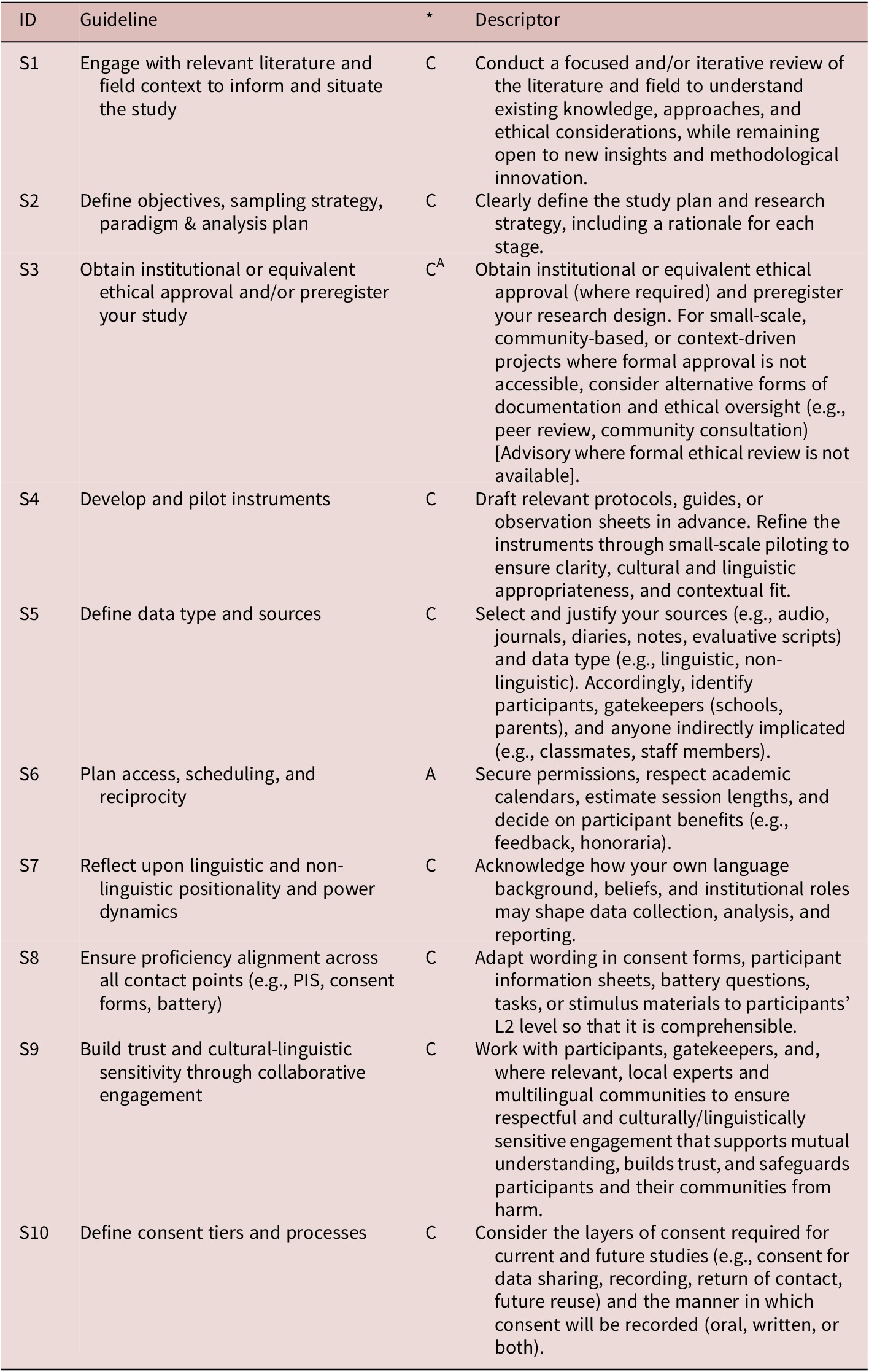
Table 2. Long description
The table consists of four columns labeled from left to right as ID, Guideline, asterisk, and Descriptor. The header row is followed by ten rows, each representing a guideline. Row one, S1, is marked as core and describes engaging with literature and field context, emphasizing iterative review and openness to innovation. Row two, S2, is core and details defining objectives, sampling strategy, paradigm, and analysis plan with clear rationale. Row three, S3, is core with advisory status and covers obtaining ethical approval or preregistration, including alternatives for projects lacking formal review. Row four, S4, is core and focuses on developing and piloting instruments, ensuring clarity and contextual fit. Row five, S5, is core and addresses defining data type and sources, identifying participants and gatekeepers. Row six, S6, is advisory and involves planning access, scheduling, and reciprocity, including permissions and participant benefits. Row seven, S7, is core and highlights reflecting on linguistic and non-linguistic positionality and power dynamics. Row eight, S8, is core and ensures proficiency alignment across all contact points, adapting materials to participants’ L2 level. Row nine, S9, is core and emphasizes building trust and cultural-linguistic sensitivity through collaborative engagement. Row ten, S10, is core and discusses defining consent tiers and processes, including consent for data sharing, recording, and future reuse, and methods of recording consent. The table footnote explains that C stands for core guideline and A stands for advisory guideline.
Note. C = Core guideline; A = Advisory guideline.
To ensure that the drafted recommendations align with existing standards, all guidelines are explicitly mapped to the pillars of trustworthiness in qualitative research (i.e., credibility, transferability, dependability, authenticity, and confirmability; see Guba, Reference Guba1981; Guba & Lincoln, Reference Guba and Lincoln1989; see Appendix A). Besides, the framework is grounded in theoretical assumptions of qualitative and second language methodologies and open science principles.Footnote 6
In practice, the framework provides items for each research phase (pre-study, data collection, analysis, reporting, and post-study). While we encourage authors to adopt the sequence as an integrated workflow, CLEAR-Qual is modular. Thus, each phase can also be used independently; for instance, a team may use the post-study phase as a guide to practice openness, or a journal editor might use the reporting-phase checklist to evaluate transparency in the methods section.
Pre-study decisions
This phase comprises 10 preparatory steps (see Table 2) that represent the researchers’ initial decisions and shape subsequent phases of the study. Commonly referred to as the planning or designing stage (Dörnyei, Reference Dörnyei2007; Maxwell, Reference Maxwell, Bickman and Rog2009), it can be understood as establishing a foundational framework prior to constructing a more complex structure.
Researchers must begin by conducting a targeted review of the field (both the literalFootnote 7 and conceptual field) (S1). Thus, a comprehensive understanding of the existing literature, conceptual gaps, methodologies, and concerns of the study, as well as the ground realities of where the study will be conducted (site) and its implications, should be formulated before beginning any qualitative research. Based on this, researchers must articulate study objectives and strategies (including sampling plans, methodologies, and provisional analyses) while also considering the epistemological stance and paradigmatic viewpoints that will guide the research (S2). Subsequently, researchers must obtain institutional or equivalent ethical approval and/or preregister their study (S3). Where formal processes are not accessible (e.g., in small-scale or community-based projects), alternative forms of documentation and ethical oversight, such as peer review or expert (or community practitioner) consultation, should be considered. As Hesse-Biber and Leavy (Reference Hesse-Biber and Leavy2011) caution, ethics too often become marginalized once “real” research commences. Thus, early attention to these elements helps integrate OS from the outset rather than as an afterthought, contributing to the reduction of research waste (Al-Hoorie et al., Reference Al-Hoorie, Cinaglia, Hiver, Huensch, Isbell, Leung and Sudina2024; Isaacs & Chalmers, Reference Isaacs and Chalmers2025).
Researchers should also develop and pilot their instruments (S4) while ensuring that any interview guides, observation protocols, batteries, or other materials (including consent forms and participant information sheets [PIS]) align with participants’ linguistic proficiencies (S8) and cultural contexts. Where appropriate, this may involve incorporating translations or multimodal formats (e.g., visuals or audios) to aid comprehension, particularly for participants with limited L2 competence. This also includes assessing materials for clarity, sensitivity, and relevance, and revising any terms or formats that might cause discomfort or misunderstanding. An explicit plan for data types and sources (see multilayered, multisource, and multidimensional data types in Openness in and with L2 Research ), and the roles of gatekeepers or indirectly involved stakeholders (e.g., classmates, staff, parents) must also be articulated (S5). Such planning and piloting not only tests for procedural aspects but also surfaces deeper linguistic or cultural nuances, such as the need for triangulation or translators, that could inform further refinement before entering the field (Dörnyei, Reference Dörnyei2007; Richards, Reference Richards2015).
Moreover, protocols for access, scheduling, and participant reciprocity should be defined (S6). If potential participants are students or teachers, alignment with the academic schedule is not only good practice but, in school-based contexts, a core requirement for ethical and reliable research. Factors such as proximity to examinations or peak workload periods can significantly influence both participation and the validity of the data collected. In all contexts, researchers should also consider how participants will be accessed, whether the institution, teachers, or parents will be contacted, and what benefit (monetary or non-monetary, if any) they will receive from the study.
The researchers must also engage in reflexive practices. They must examine how their own linguistic as well as non-linguistic positionalities may influence rapport, access, and interpretation (S7). This includes reflecting on how dominant ideologies and assumptions might shape the framing, design, and interpretation of research, potentially introducing epistemic bias in multilingual and multicultural environments. Thus, considerations over issues of access, such as those related to linguistic (non-)nativity, data contamination due to response biases such as the Pygmalion effect or the Hawthorne effect in classroom settings or instructor-led research (Costlow & Bornstein, Reference Costlow, Bornstein and Frey2018), or the impact of (non-) cultural assumptions on interview questions, should be made before beginning the study. Accordingly, researchers should actively engage with participants, gatekeepers, experts, or community members during this phase, particularly in the context of minority or endangered languages (S9). Such collaboration is ethically crucial and can strengthen the validity and reciprocity of the research. Besides, the focus should be on developing cultural and linguistic sensitivity and mutual respect.
Finally, yet most importantly, consent tiers and processes must be defined (S10). Before data collection begins, researchers should decide whether consent will be oral, written, or both, and specify which permissions will be sought (e.g., data collection, recording, future data sharing, data reuse). They must also identify any additional stakeholders (e.g., parents, teachers) whose permission is required (Cohen, Manion, & Morrison, Reference Cohen, Manion and Morrison2002; Dörnyei, Reference Dörnyei2007). To reiterate, consent documents should be structured according to participant proficiency so that they are easily understandable (S8), and participants can opt in or out of any permission tier at any time. To support this, we introduce a tiered participant-informed consent form (PICF-T), which separates permissions into independently selectable tiers so that participants can exercise granular and ongoing control over how their data will be used. Editable templates of the PICF-T and PIS are available in the Supplementary Materials. Researchers using the CLEAR-Qual framework are encouraged to employ them in order to streamline the consent process and enable participants to make fully informed choices.
Data collection
In the data collection phase, methodological transparency becomes integral to accountable research. As Holliday (Reference Holliday2004, p. 732) points out, “when the choices are more open, the procedure must be more transparent so that the scrutinizers of the research can assess the appropriateness of the researchers’ choice.” Thus, nine interconnected practices (D1–D9) (see Table 3) guide researchers in conducting ethical and accountable research in L2 qualitative contexts.
Data collection guidelines.
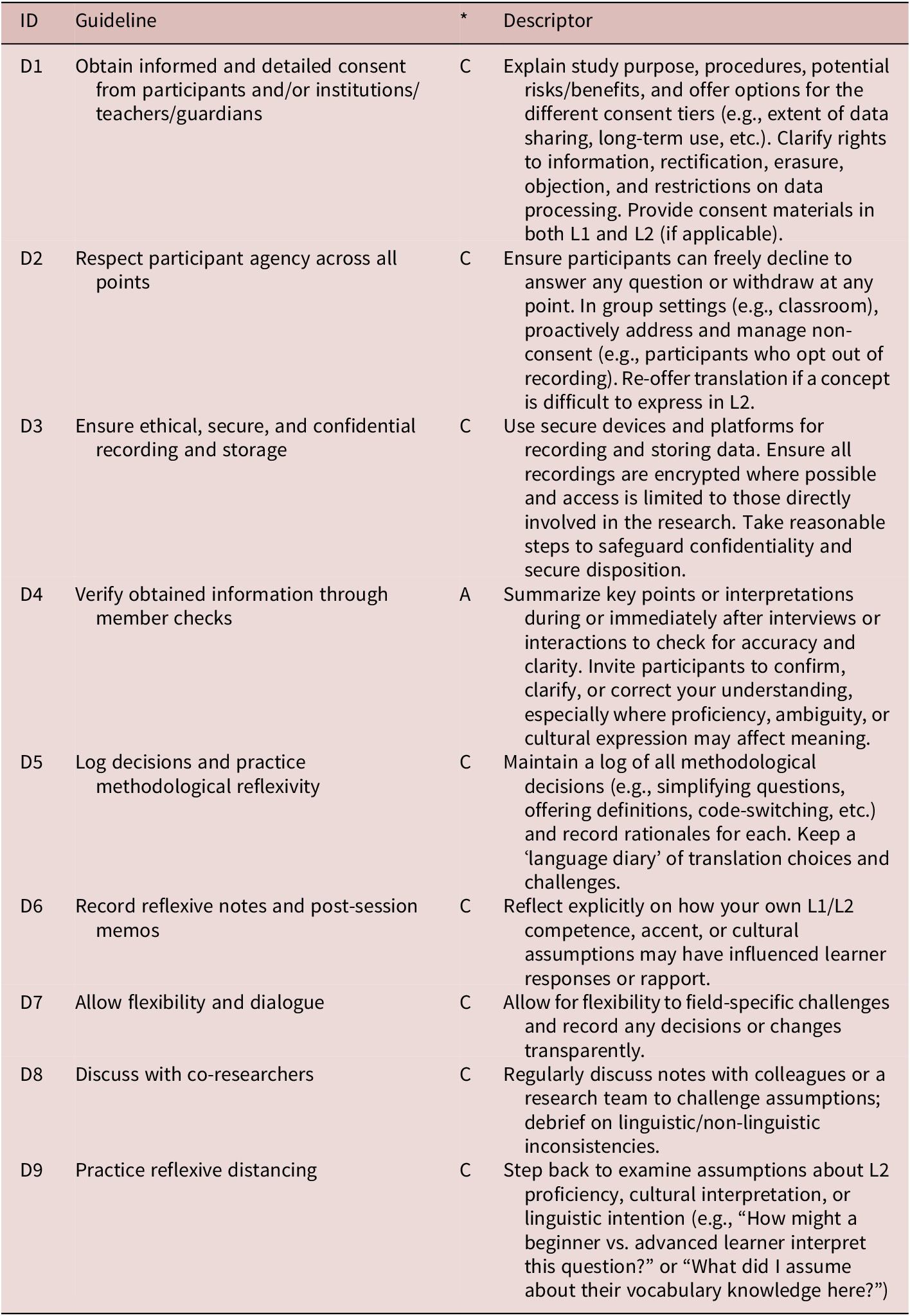
Table 3. Long description
The table has four columns labeled ID, Guideline, a symbol column, and Descriptor. From the top row downward, each row contains: D1, Obtain informed and detailed consent from participants and or institutions or teachers or guardians, C, Explain study purpose, procedures, potential risks or benefits, and offer options for the different consent tiers such as extent of data sharing and long-term use. Clarify rights to information, rectification, erasure, objection, and restrictions on data processing. Provide consent materials in both L1 and L2 if applicable. D2, Respect participant agency across all points, C, Ensure participants can freely decline to answer any question or withdraw at any point. In group settings such as classroom, proactively address and manage non-consent such as participants who opt out of recording. Re-offer translation if a concept is difficult to express in L2. D3, Ensure ethical, secure, and confidential recording and storage, C, Use secure devices and platforms for recording and storing data. Ensure all recordings are encrypted where possible and access is limited to those directly involved in the research. Take reasonable steps to safeguard confidentiality and secure disposition. D4, Verify obtained information through member checks, A, Summarize key points or interpretations during or immediately after interviews or interactions to check for accuracy and clarity. Invite participants to confirm, clarify, or correct your understanding, especially where proficiency, ambiguity, or cultural expression may affect meaning. D5, Log decisions and practice methodological reflexivity, C, Maintain a log of all methodological decisions such as simplifying questions, offering definitions, code-switching, and record rationales for decisions. Keep a language diary of translation choices and challenges. D6, Record reflexive notes and post-session memos, C, Reflect explicitly on how your own L1 or L2 competence, accent, or cultural assumptions may have influenced learner responses or rapport. D7, Allow flexibility and dialogue, C, Allow for flexibility to field-specific challenges and record any decisions or changes transparently. D8, Discuss with co-researchers, C, Regularly discuss notes with colleagues or a research team to challenge assumptions and debrief on linguistic or non-linguistic inconsistencies. D9, Practice reflexive distancing, C, Step back to examine assumptions about L2 proficiency, cultural interpretation, or linguistic intention, for example, How might a beginner versus advanced learner interpret this question or What did I assume about their vocabulary knowledge here. The table footnote states C equals Core guideline and A equals Advisory guideline.
Note. C = Core guideline; A = Advisory guideline.
Firstly, researchers must explain research aims, procedures, potential risks and benefits, and the complete gamut of participant rightsFootnote 8 to all participants (D1). Consent forms should be translated to participants’ L1 if necessary, and any ambiguities or misunderstandings regarding their rights should be clarified before the study begins (Dörnyei, Reference Dörnyei2007). Editable templates for the tiered consent form and PIS are available in the Supplementary Materials. Equally, participants’ agency must be protected at every moment; individuals may decline to answer specific questions or withdraw entirely, and in group settings, non-consenting members must be carefully accommodated (D2) while ensuring that power dynamics in classroom or group-based data collection settings do not overpower individual choice (Wilkinson, Reference Wilkinson1998).
Once consent is in place, all recordings demand ethical, secure, and confidential storage and management (D3). Audio/video files should be stored in encrypted, access-limited folders with clear destruction timelines (e.g., five years post-publication) to meet both institutional and GDPR standards. Here, it is advisable to consult the Data Management Plan (DMP)Footnote 9 to guide systematic governance of data throughout its lifecycle (Digital Curation Centre, 2013).
Member checks (D4) further help validate the accuracy and meaning of participants’ contributions. Researchers may clarify any understandings or confusions immediately after each session, in person, or send concise session summaries to solicit participant feedback on intended meanings. Moreover, to enhance dependability and confirmability of data, researchers should maintain a detailed log trail (D5), which is generally an electronic or physical journal that helps document in-field decisions (e.g., simplifying prompts, code-switching, offering definitions) alongside their rationale (Richards, Reference Richards2015). Parallel to this, reflexive memos (D6) capture how the researchers’ linguistic repertoire or positionality may have influenced participant responses throughout the data collection process. Such “post-session wrap-up” notes generally also aid in summarizing information when “memory is fresh” (Bachiochi & Weiner, Reference Bachiochi, Weiner and Rogelberg2004, p. 167).
It is a truth universally acknowledged that a qualitative study is, by definition, “messy” (Richards, Reference Richards2015, p. 38), and the mess and clutter are more often than not a mirror to the complexities of subjective, real-life data. Thus, it becomes undeniable that qualitative research embraces flexibility (Bachiochi & Weiner, Reference Bachiochi, Weiner and Rogelberg2004; Lim, Reference Lim2025). Researchers should, therefore, remain open to any in-field adaptations (D7), such as shifting from class-based discussions to interviews if rapport or noise becomes an issue, or switching to participant L1 during interviews to aid understanding. Such emergent design choices are natural in realistic qualitative studies and must be logged and justified to maintain transparencyFootnote 10 (Maxwell, Reference Maxwell2011).
If a study is conducted by a group of researchers, regular peer debriefing (D8) becomes essential to keep the team informed and to step back and analyze in-field decisions and resolve confusion. Finally, regular reflexive distancing (D9) is essential to question how assumptions influence the data collection methods. For example, in a study of L2 French learner diaries, the investigator might pause to ask, “Would beginner-level learners interpret the prompt ‘describe a memorable conversation’ the same way as advanced learners?” Reflecting on such choices and accordingly allowing for modifications helps researchers guard against inadvertently privileging one learner group over another (Berger, Reference Berger2015).
Analysis
“The ultimate power of field research lies in the researcher’s emerging map of what is happening and why” (Miles & Huberman, Reference Miles and Huberman1994, p. 65). In the analysis phase, this map is structured around seven practices (A1–A7, see Table 4). Researchers begin with meticulously transcribing and anonymizing raw records (A1). Any (direct or indirect) identifying information (e.g., participant names, institutions, or locales) must be replaced or modified to safeguard confidentiality. At the same time, where relevant, researchers may retain some linguistic markers (with caution) through contextually appropriate pseudonyms to preserve analytical depth.
Analysis guidelines.
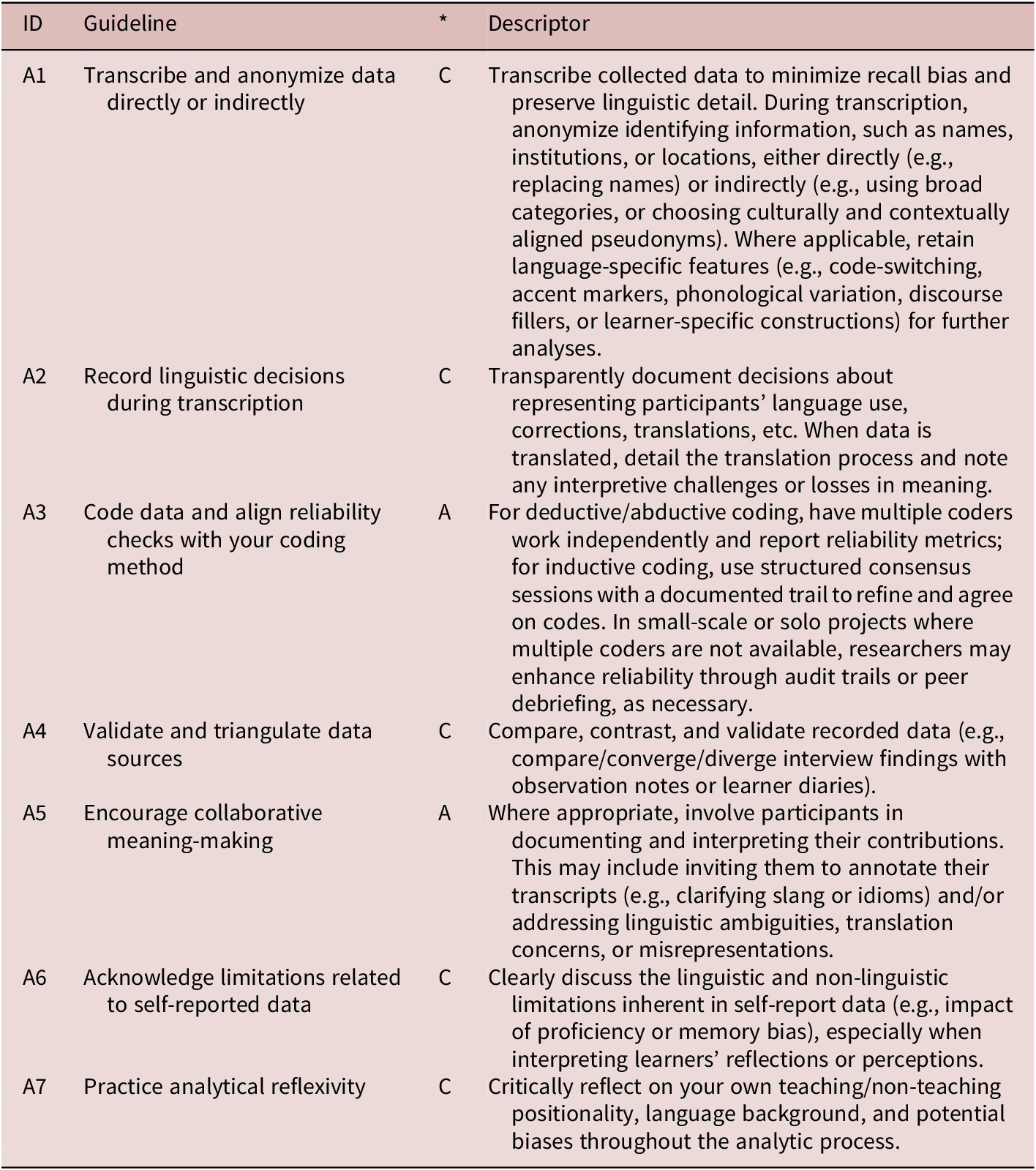
Table 4. Long description
The table has four columns labeled ID, Guideline, asterisk, and Descriptor. From the top row, the first entry is A1, Transcribe and anonymize data directly or indirectly, C, with a descriptor explaining transcription to minimize recall bias, anonymization of identifying information directly or indirectly, and retention of language-specific features for analysis. The second row is A2, Record linguistic decisions during transcription, C, with a descriptor about documenting language representation decisions and detailing translation processes and interpretive challenges. The third row is A3, Code data and align reliability checks with your coding method, A, with a descriptor outlining coding methods, reliability metrics for deductive or abductive coding, consensus sessions for inductive coding, and alternatives for small-scale projects. The fourth row is A4, Validate and triangulate data sources, C, with a descriptor about comparing and validating data sources such as interviews and observation notes. The fifth row is A5, Encourage collaborative meaning-making, A, with a descriptor on involving participants in annotating transcripts and clarifying ambiguities. The sixth row is A6, Acknowledge limitations related to self-reported data, C, with a descriptor discussing limitations of self-report data such as proficiency or memory bias. The seventh row is A7, Practice analytical reflexivity, C, with a descriptor about reflecting on positionality, language background, and biases. The table footnote states C equals Core guideline and A equals Advisory guideline.
Note. C = Core guideline; A = Advisory guideline.
Transcription should begin simultaneously or soon after data collection to minimize recall bias and capture para- and non-linguistic nuances (e.g., pauses, overlaps, code-switching, accent markers, or others as required) that often get lost in delayed transcription. Besides, if computer-assisted software transcription (CAST) is employed, researchers must assess their methodological and ethical implications,Footnote 11 and validate utterances, especially those influenced by mother-tongue interference or strong accents, in order to guard against misinterpretation of learner speech (Dörnyei, Reference Dörnyei2007). When made transparent and accessible, transcription would enable other researchers to “make their own checks and judgements as to the plausibility and coherence of the analysis” while supporting the empirical grounding required for qualitative validity (Wiggins & Potter, Reference Wiggins, Potter, Willig and Rogers2007, p. 85).
Closely linked to this process is the transparent documentation of all linguistic (and non-linguistic) decisions made in the process (A2). When normalizing disfluencies, expanding abbreviations, or translating utterances, each step must be logged while noting any challenges or potential losses in meaning (Bucholtz, Reference Bucholtz2007; Nikander, Reference Nikander2008). For example, when translating a learner’s L1 utterance, one might annotate, “Spanish: ‘¿Cómo va eso’ rendered as ‘How’s it going’; loss of idiomatic nuance noted.”
Once the anonymized files are ready for further analyses, researchers code the data to transform the “messy farm products” of linguistic information into structured parcels suitable for interpretation (Dörnyei, Reference Dörnyei2007, p. 250). Here, reliability checks can be aligned with the coding approach employed (A3). For instance, in deductive frameworks, multiple coders can independently apply a predefined coding framework to a portion of data and accordingly compute inter-coder agreements (e.g., see O’Connor & Joffe, Reference O’Connor and Joffe2020). On the other hand, for purely inductive designs in the absence of a coding framework, structured sessions, wherein coders can discuss coding strategies, definitions, inclusion/exclusion criteria, etc., may ensure that the emergent categories are transparently formed (Morse, Reference Morse1997, Reference Morse2015). In smaller-scale or single-researcher projects, reliability may be supported through systematic reflexive notes, consultations with peers or mentors, or external audits of coding decisions, as necessary.
Triangulation further helps validate analytical claims by bridging the different data points recorded (A4). In practice, researchers naturally (and inevitably) compare interview transcripts with field notes, diaries, logs, audit trails, and even quantitative measures (e.g., lexical analyses of utterances, proficiency tests, etc.) so as to triangulate not only sources and methods, but also investigators and data types (Denzin, Reference Denzin2015; Miles & Huberman, Reference Miles and Huberman1994). For instance, a researcher might align interview data with vocabulary level to reveal unexpected convergences, divergences, or contradictions; a learner’s self-report might claim that peer feedback was “very helpful,” but classroom recordings might show minimal peer interaction, leading to further potential probes by the researchers.
Such analytical understandings may further be extended to the participants by encouraging collaborative knowledge creation (A5). For instance, learners might receive their transcribed data in a shared Google Doc, where they can highlight “¿Cómo va eso” and add marginal notes explaining context ("this is what friends say when…"). Such participant-as-transcriptionist methods not only correct researcher misunderstandings but also help create thick data through metalinguistic commentary (Grundy, Pollon, & McGinn, Reference Grundy, Pollon and McGinn2003).
At this stage, researchers may also consider sending a brief overview of the themes or provisional findings and soliciting structured feedbackFootnote 12 to validate interpretations (McKim, Reference McKim2023). In second language contexts, however, the practice should be applied judiciously: not all participants may feel comfortable engaging with abstract thematic summaries, and language proficiency may constrain their ability to comment on the researcher’s interpretations. Meanwhile, researchers must also remain attentive to the additional time and effort these steps demand. Member checking constitutes extra labor for participants, and therefore, as a first step, explicit consent must be obtained (in the pre-study phase), and where feasible, their contribution should be recognized through compensation or reciprocity to avoid exploiting goodwill.
Finally, since “the research relies upon the (inevitably somewhat subjective) interpretation of a particular human being who will necessarily bring his or her own idiosyncratic experiences,” rigorous analyses must acknowledge the layered subjectivities at play (Taber, Reference Taber2013, p. 45) (A6). Learner accounts may be shaped by proficiency constraints (e.g., vocabulary gaps, L1 transfer, proficiency, etc.) or memory biases that may distort retrospective accounts. At the same time, researchers themselves bring positionalities, language backgrounds, and implicit assumptions about linguistic correctness or normative usage that can influence the coding and interpretation of the data. Reflectively attending to both participant and researcher subjectivities and transparently discussing such biases would, ultimately, help contextualize findings (A7).
Reporting
Transparency and reflexivity converge with all previous sections and become central to the reporting stage. Thus, the following guidelines (R1–R10, see Table 5) will help researchers bring accountability into their final reports.
Reporting guidelines.

Table 5. Long description
The header row contains ID, Guideline, asterisk, and Descriptor. The first row, R1, is ‘Acknowledge researcher positionality’, marked C, with descriptor stating researchers’ identities, roles, language backgrounds, and influence on research. R2 is ‘Report the research process comprehensively’, marked C, with descriptor detailing theoretical stance, research design, data collection, analysis, team composition, and transparent documentation of decisions. R3 is ‘Contextualize the method and findings of the study’, marked C, with descriptor situating findings within L2 learning contexts and describing linguistic, social, and institutional context. R4 is ‘Ensure evidence-to-interpretation traceability’, marked C, with descriptor establishing traceability from raw data to interpretation via codebooks, definitions, criteria, and examples. R5 is ‘Report linguistic and non-linguistic data features (as applicable)', marked C, with descriptor including verbal, non-verbal, and para-verbal communication details. R6 is ‘Ensure ethical representation of participants’, marked C, with descriptor emphasizing respectful, accurate participant representation, power dynamics, language proficiency, and gender-sensitive language. R7 is ‘Use only anonymized data excerpts’, marked C, with descriptor requiring removal of identifying information from participant quotes. R8 is ‘Provide an audit trail and include reflexivity statements’, marked A, with descriptor documenting analytic decisions, sharing audit materials, and reflexivity statements. R9 is ‘Create open methods resources’, marked A, with descriptor providing extended methods, coding grids, annotation systems, and rubrics via appendices or repositories. R10 is ‘Acknowledge reporting constraints reflexively’, marked C, with descriptor discussing limits on openness due to institutional sensitivity or participant discomfort. The table footnote states C equals Core guideline and A equals Advisory guideline.
Note. C = Core guideline; A = Advisory guideline.
Firstly, before drafting any research report, authors should foreground their positionality (R1). This should not be understood as mere academic self-disclosure. Since no story of data collection or analysis is neutral, acknowledging our subjectivity from the outset helps guard against unspoken biases. Thus, by explicitly addressing institutional roles, linguistic backgrounds, and other power positions, and reflecting on how these shaped earlier phases as well as how they will influence the writing process, researchers move toward clarity in their subsequent choices.
As Miles and Huberman (Reference Miles and Huberman1994, p. 301) remind us, “We all need to eschew obfuscation, er, uh… be clear about what we have to say.” Thus, researchers must create a systematic and comprehensive final report (R2). Unlike the standardized IMRaD (i.e., Introduction, Methods, Results, and Discussion) structure of quantitative studies, qualitative reports favor a vivid, flexible narrative (Dörnyei, Reference Dörnyei2007). Nevertheless, narrative vividness should not come at the expense of transparency. Every pivot from the original plan (preregistered) should be documented, justified, and linked to the aims of the study (Al-Hoorie et al., Reference Al-Hoorie, Cinaglia, Hiver, Huensch, Isbell, Leung and Sudina2024). Such a strategy not only enhances clarity but also allows the readers to understand how certain decisions shaped the findings. Besides, transparency also applies to the research process itself, including team-based collaborations; for example, in multi-authored works, specifying researchers’ contributions through established frameworks such as the CRediT taxonomy can support accountability (Allen, O’Connell, & Kiermer, Reference Allen, O’Connell and Kiermer2019).
Moreover, qualitative data is “inextricably linked to the context,” and removing it from its “true meaning” might impact its interpretation (Chauvette et al., Reference Chauvette, Schick-Makaroff and Molzahn2019, p. 3). Contextualization of reported data, therefore, becomes essential (R3). In practice, for example, while reporting that learners struggled with teacher feedback, it must be clarified whether this occurred in a high-stakes exam preparation course, a multilingual urban school, or a vocational program, and how the environment and academic calendars presented unique affordances to the responses.
Qualitative researchers are also often criticized for anecdotalism and cherry-picking (Dörnyei, Reference Dörnyei2007; Morse, Reference Morse2010). To avoid this and improve transparency, researchers must ensure a clear traceability from evidence to interpretation (R4). This means that a representative codebook, coding framework, or other relevant materials should be outlined in the report to help readers understand how raw data was transformed into analytical claims.
Importantly, studies must also comprehensively report the previously transcribed linguistic and non-linguistic nuances (R5). Ethical representations also demand that any quotes provided in the final report are respectful and accurate without overcorrections or exotification (R6). Here, gender-sensitive or neutral pronouns (as required) should be used throughout, and voices should be presented without reinforcing any power imbalances (Denham & Onwuegbuzie, Reference Denham and Onwuegbuzie2013). Finally, it is equally critical to verify the anonymity of all reported excerpts. Any direct (e.g., name, institution, or locale) or indirect (e.g., job title, classroom hierarchy) identifier that could trace back to any individual/institution should be further removed (R7).
Besides quotations or excerpts, transparency also extends to the researcher’s reflexivity (R8). Across the different phases in research,
we are not expected to be all-knowing …[or] ask all the right questions, make flawless decisions, or use the most advanced and sophisticated methods that exist. We are, however, expected to be honest and transparent in our research about what we did and why (Al-Hoorie et al., Reference Al-Hoorie, Cinaglia, Hiver, Huensch, Isbell, Leung and Sudina2024, p. 542).
Thus, in the final report, including decision trees or quotations from previously drafted field notes, reflexivity memos, or post-session notes can help readers follow through with the research (R8). In this regard, researchers might face limitations related to strict word limits and journal standards. To overcome this, we encourage the creation of open methods resources (R9) for any relevant methodological or analytical expansions and rubrics. Importantly, research also shows that such ‘extenders’ can significantly increase the visibility and readership of publications (Cavana & Jenkins, Reference Cavana and Jenkins2025).
Finally, institutional sensitivities, participant discomfort with certain disclosures, or resource limits are all inescapable limits of reporting qualitative data transparently; any such “omissions and compromises in transparency” (Al-Hoorie et al., Reference Al-Hoorie, Cinaglia, Hiver, Huensch, Isbell, Leung and Sudina2024, p. 541) must be acknowledged reflexively (R10). By openly discussing these limitations, we not only help prepare future researchers but also invite readers to critique existing barriers and reflect upon the limits of openness.
Post-study considerations
Engagement with research does not cease at publication; the post-study phase includes practices reflecting ongoing transparency that extend well beyond reporting. At this stage, scholars embrace openness as a commitment to the broader community while safeguarding participant interests and maximizing transparency (see P1–P7, Table 6).
Post-study guidelines.

Table 6. Long description
The table has four columns labeled ID, Guideline, asterisk, and Descriptor. From top to bottom: Row P1, Provide community reciprocity and updates, A, Share accessible summaries and project updates with participants. Row P2, Archive all data collection instruments, C, Deposit interview guides, questionnaires, stimulus materials, consent forms, and any task protocols alongside your data. Supply metadata for any deposited dataset to ensure reusability. Row P3, Ensure ethical alignment and context-sensitivity in data reuse, C, Before any secondary sharing or analysis, confirm that proposed uses align with your study’s original aims and respect the social or linguistic context of participants. If reuse was not covered by the original consent, either restrict deposit to aggregated or summary-level data or omit sensitive raw materials entirely. Row P4, Remediate study data and deposit in a trusted repository, A, Remediate all transcripts and associated materials to remove any identifying information that may have been inadvertently missed earlier. Once fully anonymized, deposit transcripts, field notes, codes, reflexivity statements, and other relevant documentation in a trusted open-access repository such as O S F, Q D R, or I R I S, in line with participant consent and institutional policies. Row P5, Specify terms for ethical reuse, A super C, Attach a data-use agreement that requires secondary users to uphold confidentiality and original ethics. Document how participants can request data removal, per G D P R or articulated consent. This is a core guideline if P4 is followed. Row P6, Explain access restrictions for sensitive data, C, If portions of your data must remain closed, for example with vulnerable populations, include a clear statement on why public access is precluded. Row P7, Engage with policy- and practice-oriented stakeholders, C, Proactively translate findings into recommendations for educators, policymakers, or professional associations in L2 contexts. Include practitioner-oriented summaries in plain language where possible. The table footnote states C equals Core guideline and A equals Advisory guideline.
Note. C = Core guideline; A = Advisory guideline.
Researchers must continue contact with participants and practice reciprocity (P1). In the simplest of terms, reciprocity can be viewed as a quid pro quo in the researcher–participant relationship. Communities share a part of their life with the researchers, and it is appreciated if a part of the research is sent back to the community in the form of infographics, summaries, or other accessible outputs (Mauro et al., Reference Mauro, Manià, Ubels, Holroyd, Towle and Murray2024). Here, platforms such as TESOLGraphics and Open Accessible Summaries in Language Studies (OASIS) provide established models for creating and disseminating research in accessible formats. Importantly, however, such efforts must remain firmly within boundaries of informed consent (as received in the pre-study phase). For multilingual or minoritized contexts, providing summaries in participants’ L1 can strengthen inclusivity and accessibility, but these practices should never override participant privacy, data protection, or cultural sensitivities.
Another consideration that is often touched upon in OS debates, especially as a part of post-study, is that of data archiving or data sharing (for discussions on open data, see Chauvette et al., Reference Chauvette, Schick-Makaroff and Molzahn2019; Khalil et al., Reference Khalil, Shinwari and Islam2022). Before addressing it in L2 qualitative context, it is an essential reminder that “transparency is not an all-or-nothing proposition and can be pursued in many different ways” (Kapiszewski & Karcher, Reference Kapiszewski and Karcher2021, p. 285). Building on this, the next step is to make accessible the very tools that shaped the research study. Thus, researchers must first begin by archiving their instruments. In L2 qualitative studies, where wording, prompts, and stimuli are equally important, depositing interview guides, questionnaires, stimulus materials, and/or any task protocols becomes a core practice (P2). While many archiving efforts focus solely on participant data, preserving the exact versions of instruments used is essential for reproducibility and contextual understanding. The IRIS database, the Task-Based Language Teaching (TBLT) Task Bank, and the Multilingual Repository in Applied Linguistics (MuRAL) are increasingly used to make such materials available to other researchers.
Once instruments are safely deposited, attention must turn to the ethical aspects of any potential reuse (P3) and the technical aspects of anonymization (P4). In many qualitative contexts, data may be too sensitive, too culturally situated, or simply beyond the scope of the original consent to allow for open sharing. In such cases,Footnote 13 researchers may instead provide aggregated summaries, metadata records, or synthetic examples to enhance transparency without disclosing raw materials (Digital Curation Centre, 2013). Where deposition is appropriate and ethically approved, transcripts must be remediated to remove any remaining identifiable information. Campbell et al. (Reference Campbell, Javorka, Engleton, Fishwick, Gregory and Goodman-Williams2023) outline a combination of automated and manual de-identification strategies (e.g., using natural language processing followed by manual validation and bracketing of residual identifiers) to guard against reidentification risks. To this end, several repositories, such as the Qualitative Data Repository (QDR), also provide guidelines for ethically archiving participant data (Demgenski et al., Reference Demgenski, Karcher, Kirilova and Weber2021). Researchers may also use registries such as the Registry of Research Data Repositories (re3data) to locate discipline-appropriate repositories and identify suitable venues for depositing qualitative materials (Pampel et al., Reference Pampel, Vierkant, Scholze, Bertelmann, Kindling, Klump, Goebelbecker, Gundlach, Schirmbacher and Dierolf2013).
Parallelly, researchers should specify clear terms for ethical reuse of data (P5) and explain any access restrictions in case of sensitive data (P6). A data-use agreement should be created that requires secondary users to uphold confidentiality clauses and original ethical commitments and documents procedures for requesting data removal (along with relevant contact details). For portions of the dataset that must remain closed, researchers should document the rationale in their data availability statements and clarify why public access is precluded (Mackey & Gass, Reference Mackey and Gass2021).
Notably, post-study openness discussion extends beyond data and comes full circle with reciprocity beyond the participant community. As part of strengthening transparency of outputs, initiatives such as the Postprint Pledge encourage researchers to make accepted manuscripts openly accessible, further supporting the principle of reciprocity. Researchers should also engage policy and practice-oriented stakeholders by translating findings into recommendations for educators, curriculum designers, and policymakers (P7). Such outward focus not only enhances the impact of the study but also upholds the principle of reciprocity in higher education, whereby research benefits the participant, researcher, and practitioner communities.
Looking ahead for open L2 qualitative studies
The CLEAR-Qual framework advances qualitative research in L2 contexts by treating openness as processual, relational, and evolving. Its implications are best understood in the way it normalizes explicit documentation, reflexivity, and the recognition of participants as interpretive partners rather than data sources. Practices such as preregistration, reflexive logging, tiered consent, member-checking, and collaborative interpretation embed openness across all phases of the research. In this sense, rigor gets anchored in ethics and transparency while accommodating adaptability to the research process.
Shohamy (Reference Shohamy2004, p. 729) reminds us that frameworks should not “discredit research complexity or dictate fixed paradigms” but encourage reflexivity and innovation. CLEAR-Qual takes this stance by foregrounding systematic flexibility as its raison d’être. As Dörnyei (Reference Dörnyei2007, p. 242) notes, the core of qualitative analysis is “to develop and follow certain principled analytical sequences without being tied by the constraints of the procedures and sacrificing the researcher’s creative liberty.” CLEAR-Qual extends this principle to the entire research process. The framework does not aim to provide an exhaustive list of dos and don’ts of conducting open qualitative L2 research; it rather hopes to encourage conducting ethical and accountable research that is characterized by clarity, responsibility, reflexivity, and transparency.
Consider, for instance, a study on code-switching among intermediate L2 Spanish learners. Pre-study openness might include preregistering participant selection criteria and recording protocols, alongside signing the Postprint Pledge for future open access dissemination. During data collection, a reflexive log might justify shifts from recording entire class sessions to small-group interactions, while tiered consent accommodates differing comfort levels with video or audio data. Analysis incorporates member checking, where participants review transcripts and co-interpret excerpts with the researcher. Reporting standards are made more open as the researchers quote their own notes in the manuscript to help readers understand the overall process. Finally, transparency in the post-study phase gets enacted through multiple forms of sharing. Instruments such as an interview guide and task protocol are deposited in the IRIS Database, and classroom tasks designed for the study are made available in the TBLT Task Bank. Findings are further translated into accessible outputs via OASIS and TESOLGraphics, which are disseminated back to participants, teachers, and practitioners. Anonymized transcripts, coding frameworks, and reflective logs are also deposited in open-access repositories (e.g., OSF, MuRAL) as open methods resources.
Such systematic flexibility is at the center of the framework; it maintains openness as an ongoing practice that integrates across all phases of the research process. Thus, participant agency is foregrounded; multimodal/multilayered data and methodological pluralism become standards; responsible engagement facilitates ethical sharing, transparency, and cumulative learning.
Looking forward, adopting CLEAR-Qual would distinguish L2 qualitative research through transparent methodological accounts and explicit rationales that enhance transparency with the researcher, the participants, as well as the research. Such a movement, coupled with the complexities of qualitative data in L2 research, responds to Campbell et al.’s (Reference Campbell, Javorka, Engleton, Fishwick, Gregory and Goodman-Williams2023, p. 3) call to explore “whether more could be learned and whether there are additional discoveries to be made through data sharing”.
We invite researchers to pilot, critique, and adapt CLEAR-Qual across diverse qualitative contexts. Journals, editors, and peer reviewers can also use the framework as a reference point for evaluating openness in submissions. Beyond individual uptake, there is a need for platforms specific to second language qualitative researchFootnote 14 that facilitate ethical data sharing, archiving, and collaborative analysis. Equally important is also a community of researchers, practitioners, and educators who can guide and sustain open practices in qualitative L2 research.
By embedding systematic flexibility as the guiding principle of openness, CLEAR-Qual positions L2 qualitative research for a future grounded in accountability and ethical responsiveness. The framework is hoped to offer a timely, practical, modular approach, with core and advisory practices raising the bar for transparency. Keeping in mind that “it is not epistemologically incongruent to challenge longstanding norms of methodological opacity and to prompt researchers for more detail about how their findings were generated and the contexts that bound that knowledge” (Campbell et al., Reference Campbell, Javorka, Engleton, Fishwick, Gregory and Goodman-Williams2023, p. 3), CLEAR-Qual aims to make openness a routine in second language qualitative research.
Supplementary material
The supplementary material for this article can be found at http://doi.org/10.1017/S0272263126101685.
Acknowledgments
The authors gratefully acknowledge the contributions of the Delphi panel members (mentioned alphabetically): Khaleel Abusal, Dania Almosalli, Tali Kigel, Kelly Kendro, Kandharaja K M C, Cherry Mathew, Nantu Shaw, Deepika Sharma, Sangay Tamang, and Fangzhou Wei. We also thank all participants who assisted in finalizing the guidelines through their endorsements and comments.
We are indebted to Ahmed Sameer, a member of the Institute Ethics Committee of the Indian Institute of Technology (ISM) Dhanbad, for reviewing the drafted templates and enhancing the project’s validity. We are also grateful to Sin Wang Chong and Luke Plonsky for their generous support in spreading the word about this project. We further extend our sincere appreciation to Kadambari P. S. for her valuable contributions to the project.
We would also like to thank the guest editors of this special issue, Meng Liu, Ali Al-Hoorie, and Phil Hiver, for their guidance and support. We sincerely thank the three anonymous peer reviewers for their thoughtful feedback, which significantly improved the quality and clarity of this manuscript. Finally, we are extremely grateful to the Indian Institute of Technology (ISM) Dhanbad, for providing open-access publication support and thereby helping make this work truly open.
Competing interest
The authors have no competing interests to declare that are relevant to the content of this article.
Funding
The authors did not receive support from any organization for the submitted work.
Data availability statement
The materials and data associated with this study are available on the IRIS database (Shahiwala et al., Reference Shahiwala, Rahul and Sidheeque2026a, Reference Shahiwala, Rahul and Sidheeque2026b).
Appendix A
To ensure alignment with established standards for qualitative rigor, we mapped all drafted recommendations against the five pillars of trustworthiness proposed by Guba and Lincoln (Reference Guba and Lincoln1989). Figure A1 provides a visual overview of this mapping across the different stages of the research process and illustrates how the recommendations collectively support trustworthiness throughout the study lifecycle. The figure was developed in R using the tidyverse package.
CLEAR-Qual–trustworthiness mapping.
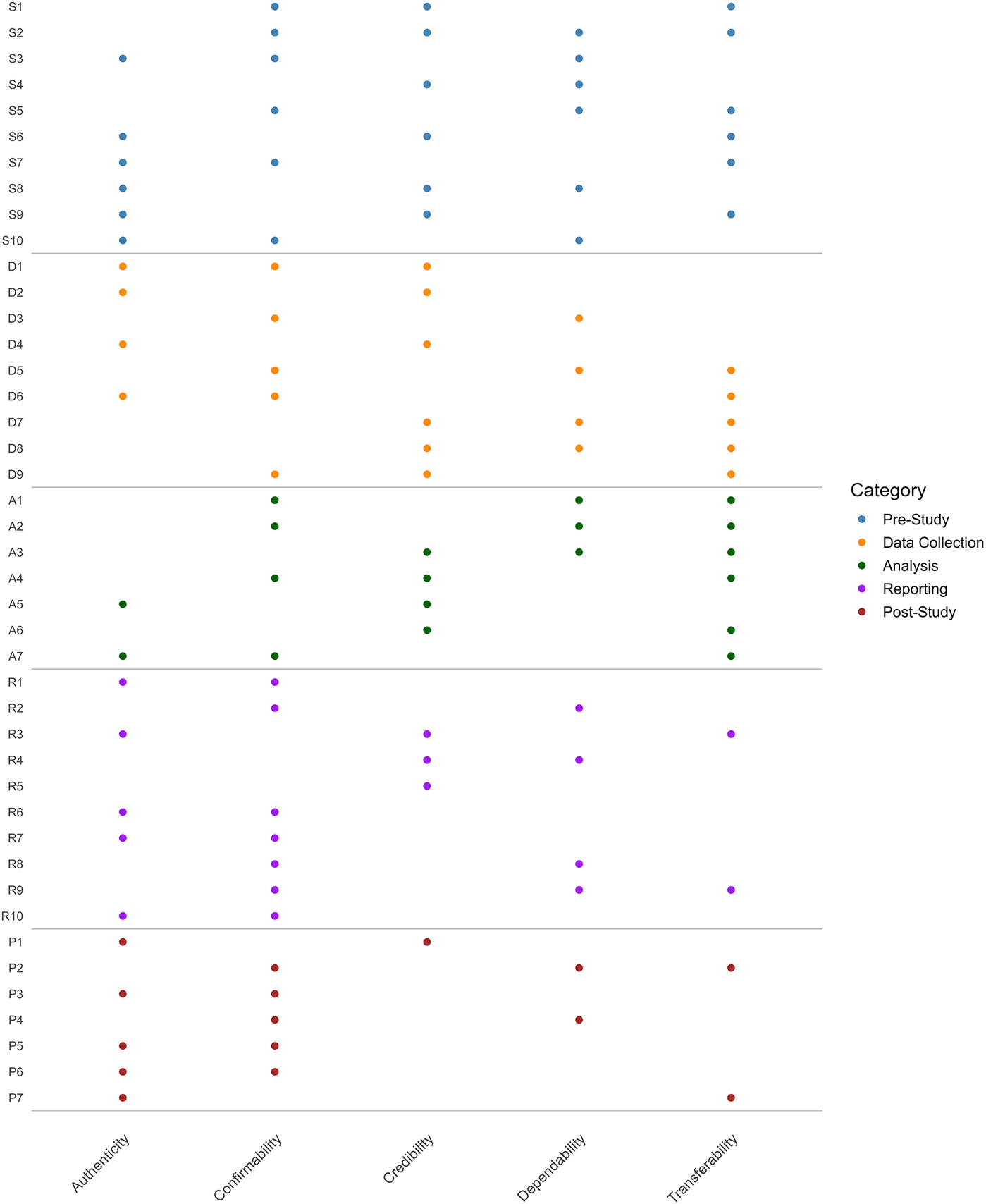
Figure 2. Long description
From the top, rows are grouped and labeled S1 to S10, D1 to D9, A1 to A7, R1 to R10, and P1 to P7, separated by horizontal lines. Columns at the bottom are labeled authenticity, confirmability, credibility, dependability, and transferability. Each cell contains a colored dot or is empty. Dot colors correspond to category: blue for pre-study, orange for data collection, green for analysis, purple for reporting, and red for post-study, as indicated in the legend at the lower right. Within each group, dots are distributed variably across columns. For example, S1 has blue dots under authenticity, confirmability, credibility, and dependability. D1 has orange dots under authenticity, confirmability, and credibility. A1 has green dots under authenticity, confirmability, and credibility. R1 has purple dots under authenticity, confirmability, and credibility. P1 has red dots under authenticity, confirmability, and credibility. Some rows have dots in all columns, while others have fewer. The pattern shows how each trustworthiness criterion is addressed across different study phases and categories.
Appendix B
Three documents were randomly selected and independently coded by two authors using the agreed coding framework. A third author reviewed and resolved any discrepancies. Table B1 presents the intercoder agreement percentages and Kappa values. This high level of agreement is expected given that the responses came from a structured questionnaire organized around predefined phase-based categories, and the coding framework was directly derived from these phases.
Intercoder agreement.

Table 7. Long description
The table contains five columns labeled Document ID, Agreements, Disagreements, Percent, and Kappa R K. The first row lists C4 with 93 agreements, 12 disagreements, 88.57 percent, and Kappa 0.89. The second row lists C5 with 98 agreements, 7 disagreements, 93.33 percent, and Kappa 0.93. The third row lists C7 with 95 agreements, 10 disagreements, 90.48 percent, and Kappa 0.90. The final row is labeled Total with 286 agreements, 29 disagreements, 90.79 percent, and Kappa N slash A.
Appendix C
Table C1 provides detailed profiles (self-reported) of the core panel members based on their mode of participation (interview or survey).
Detailed summary: participation mode.

Table 8. Long description
From left to right, the first column lists variables: experience with L2 research, experience with qualitative research, areas of expertise in L2 research, and type of data participants engage with. The second column details interview participant distributions: for L2 research, less than 2 years (n equals 3), 11 to 15 years (n equals 1), greater than 15 years (n equals 1); for qualitative research, 2 to 5 years (n equals 1), 11 to 15 years (n equals 3), greater than 15 years (n equals 1); areas of expertise include applied linguistics and language education, sociolinguistics. The third column shows survey participant distributions: for L2 research, less than 2 years (n equals 1), 2 to 5 years (n equals 5), 6 to 10 years (n equals 3); for qualitative research, less than 2 years (n equals 4), 2 to 5 years (n equals 3), 6 to 10 years (n equals 2); areas of expertise include language education, phonetics and phonology, morphology, sociolinguistics, bilingualism and language attrition, and language-specific studies such as L2 French, Hebrew SLA, Phoenician toponyms. The final row, merged across both participant groups, lists types of data: linguistic data (interviews, essays, recordings, classroom interactions), non-linguistic data (diaries, reflection journals, observation notes, questionnaires, test scores), multimodal and digital inputs (video, maps, social media content), document-based sources (curricula, syllabi), and qualitative methodological approaches (narrative, phenomenology, ethnography, grounded theory).
Note. *This category was merged across interview and survey participants, as researchers in L2 studies typically engage with multiple and overlapping data types rather than mutually exclusive categories
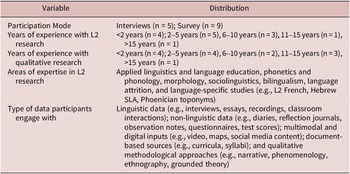
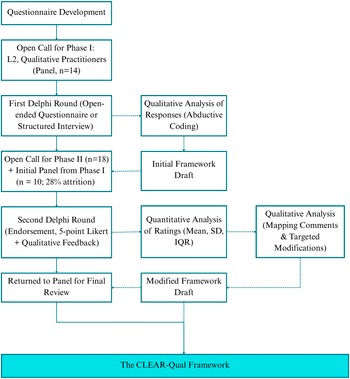
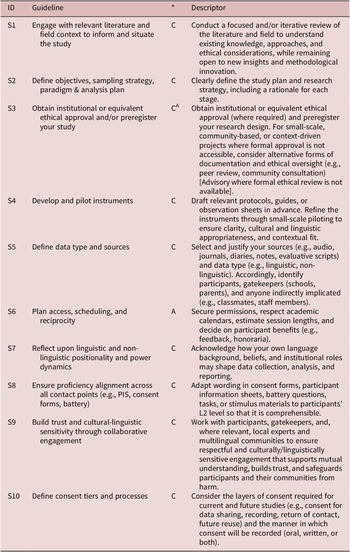
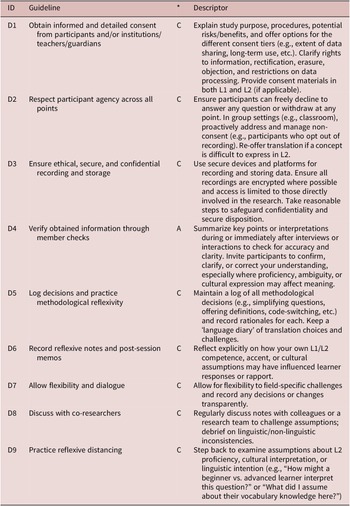
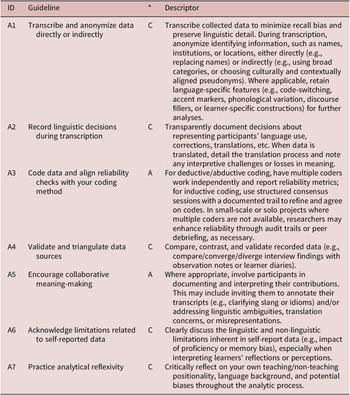
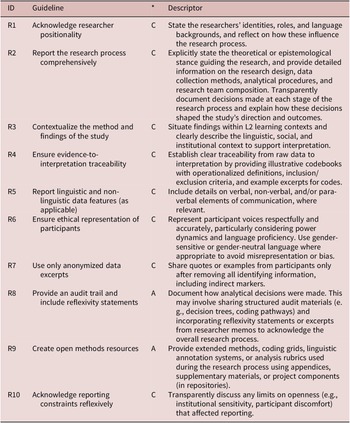
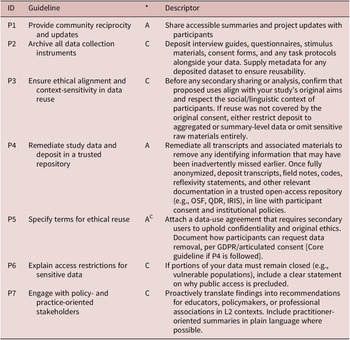
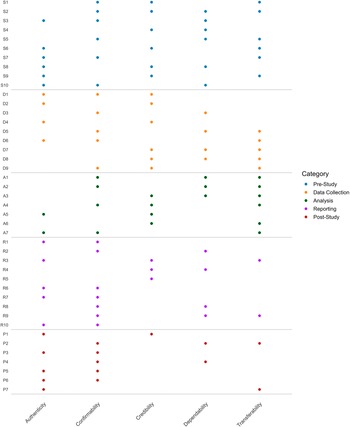

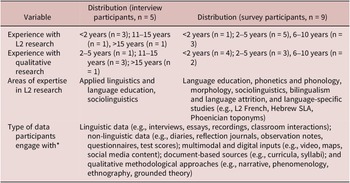


 Open access

