


1. Introduction
The mechanism of basal motion and subglacial drainage is fundamental to the understanding of many of the dramatic phenomena exhibited by glaciers and ice sheets. Within the context of fast glacier flow, surging glaciers (Reference Clarke, Collins and ThompsonClarke and others, 1984), surging ice sheets (MacAyeal, 1993), ice streams (Reference BentleyBentley, 1987) and receding tidewater glaciers (Reference Meier and PostMeier and Post, 1987) are all able to attain their rapid ice velocities by means of water-assisted basal motion.
There are two main conceptual paradigms available to understand how such rapid motion occurs. These are the sliding of ice over a rough surface (which might be bedrock, or stiff till) (Reference LliboutryLliboutry, 1979; Reference WeertmanWeertman, 1979), and the deformation of water-saturated till at high pore-water pressures (Reference Boulton and JonesBoulton and Jones, 1979; Reference ClarkeClarke, 1987). Because of the occurrence of layers of apparently deforming subglacial till in certain glaciers (e.g. Reference Clarke, Collins and ThompsonClarke and others, 1984; Reference Blankenship, Bentley, Rooney and AlleyBlankenship and others, 1987; Reference Truffer, Harrison and EchelmeyerTruffer and others, 2000), much of the attention of modellers has shifted from earlier “hard-bed” studies to the study of subglacial till deformation, and its consequence for glacier motion.
The subject of this paper is the rheology of till: what is the best flow law to describe sediment motion and transport? Various theoretical studies have used a power law advocated by Reference Boulton and R. C. A.Boulton and Hindmarsh (1987) of the form

in which ἑij is the strain-rate tensor, τij is the deviatoric stress tensor and N is the effective (overburden minus pore-water) pressure. Equation (1.1) is not the most general viscous law one could suggest. For an isotropic material, / is in general a function of the first (N), second (τ) and also third invariant of the effective-stress tensor. For an anisotropic material, this may not be the case. Boulton and Hindmarsh proposed a power law of the form

but the reliability of this law has never been demonstrated. Nevertheless, it has been used frequently in theoretical models of subglacial processes (e.g. Reference Alley, Blankenship, Rooney and BentleyAlley and others, 1987; Hind-marsh, 1998; Reference Fowler, A. J., Hubbard and HambreyFowler, 2000; Reference NgNg, 2000), at least partly because of its conceptual simplicity. It also enshrines the apparently reasonable expectation that till deformation should increase with increasing shear stress, and decrease with increasing effective pressure.
However, till is a granular material, and as such can be expected to have the characteristics of an elastic–plastic material, with a yield stress determined by a Mohr– Coulomb failure criterion due to internal frictional slip (e.g. Reference HarrisHarris, 1992). Indeed, much recent work has demonstrated that a plastic flow law is better suited to the description of subglacial till (Reference KambKamb, 1991; Reference Hooke, Le, Hanson, Iverson, Jansson and FischerHooke and others, 1997; Reference Iverson, Baker and HooyerIverson and others, 1997; Reference Tulaczyk, Kamb and EngelhardtTulaczyk and others, 2000; Reference Kamb, Alley and BindschadlerKamb, 2001).
In this paper, I examine the implications of this for the flow of till, in particular because deformation of till with depth is commonly inferred, or observed, to occur (Reference Boulton and DobbieBoulton and Dobbie, 1998; Reference Alley, Maltman and HubbardandAlley, 2000; Reference Truffer, Harrison and EchelmeyerTruffer and others, 2000; Reference Porter and MurrayPorter and Murray, 2001), and it is not intrinsically obvious how such observations can be used to distinguish plastic rheology from an effectively viscous behaviour. Indeed, Reference HindmarshHindmarsh (1997) suggested (without any justification) that local plastic behaviour might become apparently viscous at larger scales of observation. Reference N. R. and IversonIverson and Iverson (2001) showed that a model based on discrete slip events of a Coulomb plastic material could lead to distributed deformation. A different attempt in this direction is that of Reference Tulaczyk, Kamb and EngelhardtTulaczyk and others (2000); see also Reference Tulaczyk, Mickelson and AttigTulaczyk (1999).
2. Plasticity Theory
In this section we discuss some classical continuum models of plasticity. An alternative approach is that of distinct-element modelling (Reference Cundall and StrackCundall and Strack, 1979; Reference Morgan and BoettcherMorgan and Boettcher, 1999), in which direct simulation of “particle” motion using Newton’s law together with suitable friction rules is done. This approach is similar in some ways to that used by Reference N. R. and IversonIverson and Iverson (2001). The basic theory of plasticity is enunciated by Reference HillHill (1950). A more recent text which discusses plasticity for soils is that of Reference Chen and MizunoChen and Mizuno (1990). An elastic–plastic material is one for which the rheology is elastic for stresses “below” a yield surface in (six-dimensional) stress space. If σij is the stress tensor and τij is the deviatoric stress tensor, then frame indifference must allow us to write the yield surface in the form

where I, J2 and J3 are first, second and third stress invariants defined by

and we employ the summation convention over repeated indices. A plastic material is one whose stresses cannot go beyond the yield surface. Thus, deformation is purely elastic until the yield surface is reached, and then plastic deformation occurs along the yield surface. In general, an increment of stress daij causes an increment in strain  where
where  is the increment of elastic strain, and
  is the increment of plastic strain (which must be determined). An ideal plastic material is one for which the yield surface f(σij) is fixed (i.e. is not state-dependent), and in which there is an associated flow rule, said to satisfy the normality condition:

As we discuss further below, soils (and tills) do not satisfy either of these conditions. Because of the extra condition on the stress, the quantity A in Equation (2.3) is unknown, and acts as a Lagrange multiplier. It follows from the usual constitutive equations of elasticity that

and consistency (f is constant) requires

Note that for f = f (I1, J2, J3), we have

Various yield criteria are commonly used in plasticity theory, and these must be written in terms of the invariants of the stress. The Von Mises criterion is J2 = k2, the Tresca criterion is σ1 – σ3 = 2k, and the Coulomb model can be written in the form  sinϕ + cos ϕ, where σ1 > σ2 > σ3 are the principal stress components, 0 is the internal angle of friction, and c is the cohesion. In terms of invariants, these are messy, and take the form

in the first of which

In this form, the Coulomb model is so ugly that a simplified version (the Drucker–Prager model) is often used:
Drucker-Prager:

where, roughly, α ~ ϕ andk ∼ c. The plastic stress–strain relation for the Drucker–Prager law is then

Hardening plasticity: critical-state soil mechanics
Metals are often modelled using the Tresca or Von Mises perfectly plastic yield stress, but granular materials such as soils or till are usually thought to have state-dependent yield stresses, and are called strain-hardening or strain-softening materials. It is evident, for example, that a granular medium becomes harder to compress as it is compressed. On the other hand, tills in laboratory ring-shear devices have a tendency to reduce their strength (i.e. yield stress) at large strains (Reference Iverson, Baker and HooyerIverson and others, 1997, Reference Iverson, Hooyer and Baker1998; Reference Tulaczyk, Kamb and EngelhardtTulaczyk and others, 2000). However, similar tests which allow pore pressure to vary show that both hardening and softening behaviour can occur, depending on the initial porosity (Reference IversonIverson and others, 2000; Reference Moore and IversonMoore and Iverson, 2002). Such dilatant hardening can lead to stable shear, while softening behaviour leads to catastrophic failure.
Hardening plasticity is modelled by taking the yield surface to be dependent on the plastic strain. For example, in isotropic hardening, we take the yield surface to be of the form

Typically, we do not assume that strain increments are normal to the yield surface (the normality rule), but we might still assume (again, perhaps incorrectly (Reference Mandl and LuqueMandl and Luque, 1970)) that the plastic-strain increment tensor  is parallel to the stress increment tensor dσij (the assumption of coaxiality), in which case it follows that there is a plastic potential function g(σij), and

consistency (Equation (2.11) is satisfied) allows us to write this in the form

where h is the hardening modulus, and is in general a function of stress and plastic strain, given by
We expect h > 0 for strain-hardening materials, but h < 0 for softening materials, and it seems likely that unstable failure would be the result (as occurs in practice (e.g. Reference IversonIverson and others, 2000)).
A particular example of a hardening plasticity model is the Cam-clay model, which is best described by a diagram (Fig. 1). The yield surface consists of three parts: a tension failure surface, the (hardening) Hvorslev surface and the (softening) Roscoe surface. Generalized models of this type are called cap models, where in Figure 1 the Roscoe surface is the cap which prevents the dilatant Hvorslev surface extending to large stresses. Extensive discussion of the Cam-clay model is given by Reference ClarkeClarke (1987).
A schematic representation of the Cam-clay yield surf ace in conditions of plane strain. The stress space is described by the normal (effective) stress pe and the shear stress τ, and the state dependence (plastic strain) is described by the void ratio e = ϕ/(1 - ϕ), where 0 is the porosity. The yield surface intersects the zero shear-stress plane at the normal consolidation line (NCL) and the Roscoe and Hvorslev yield surfaces intersect at the critical-state line (CSL).

Finite strain
An essential complication associated with shearing flow is that the plastic strains are large. In such cases, one can often neglect the small elastic strains, and we have the Levy–Mises model, in which 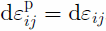 However, there is now an issue in describing how the strain and stress tensors evolve in time. The simplest situation is in ideal plasticity, where we use Equation (2.3). Simply dividing by dt, we have

where the Lagrange multiplier ∧ = λ is to be determined. This constitutes seven equations for the six stress-tensor components σ i j , i ≤ j, and ¤, and in principle we can solve them to find
and the plastic flow region is essentially described by a non-linear form of Stokes’ equations for slow viscous flow.

There are two particular difficulties associated with finite strain (or with creep). The first of these is that we would want the Stokes equations,

which describe slow creeping flow, to form an elliptic set of equations for the velocities u i, when Equation (2.16) is used as a constitutive law. In hardening plasticity, this is not always the case. The second complication is that, in hardening plasticity, we can see from Equation (2.13) that increments of strain depend on increments of stress, so that division by dt will lead to a constitutive relation which involves time derivatives of stress. It is well known that the ordinary material time derivative of the stress tensor is not objective, that is to say it is not frame-indifferent, and therefore the time derivative of stress must be modified to allow this to be so. There is no unique way to do this. A popular choice is to define the Jaumann derivative

where ω is the spin tensor

and ᓃ
i
j
denotes the ordinary material derivative. Typical constitutive relations to relate ἑij to  are complicated and fundamentally non-linear (Reference Rudnicki and RiceRudnicki and Rice, 1975; Reference Nemat-Nasser and ZhangNemat-Nasser and Zhang, 2002), and the Jaumann derivative itself is non-linear. Therefore it is by no means obvious how even a simple shear flow will behave.
Plastic shear flow; shear bands
This can be illustrated with the very simplest kind of flow law, the Levy–Mises equation for the Von Mises yield stress law Equation (2.7) 3. Dividing by dt leads to the viscous flow law
where ∧ = λ̇ must be consistent with the Von Mises yield stress. For the apparently physically sensible problem of a shear flow driven by a shear stress τ, we have J2 = τ2, thus τ=k, and the shear velocity profile is given by

and ∧ is completely unconstrained. This simple example suggests that something is amiss with the problem formulation. Reference Mandl and LuqueMandl and Luque (1970) suggest other fundamental difficulties with this model, which they associate with the choice of an associative flow rule.
In fact, it is well known that in granular flows, deformation often occurs through the formation of shear bands, which are thin zones, typically of width about ten grain diameters (Reference Li and RichmondLi and Richmond, 1997; Reference Francois, F. and HerrmannFrancois and others, 2002). It is thought that shear bands arise through an instability which is associated with a transition of the equation type from elliptic to hyperbolic (and thus ill-posedness) (Reference BurnsBurns, 1989; Reference LeeLee, 1989; Reference Schaeffer, Shearer and PitmanSchaeffer and others, 1990; Reference SchaefferSchaeffer, 1992; Reference VardoulakisVardoulakis, 1996). In particular, instability occurs before the ill-posedness (Reference Schaeffer, Shearer and PitmanSchaeffer and others, 1990), something which also occurs in two-phase flow (Reference Prosperetti, Satrape, Joseph and SchaeferProsperetti and Satrape, 1990). What appears not to be so clear is how one should model the subsequent deformation. It seems clear that the formation of shear bands will lead to distributed deformation, and some efforts to deal with this have been made in the context of subglacial till (Reference Iverson, Hooyer and BakerIverson and others, 1998); Reference N. R. and IversonIverson and Iverson (2001) pose a model of slip deformation which leads to effective shear with depth. Such efforts deserve to be continued in the search for an effective averaged flow law.
3. Discussion
It is clear from the numerous laboratory experimental studies that till behaves like other granular materials, and is probably best modelled as a plastic material. However, it is not at all clear from the theoretical studies of plastic shear flow how the resulting deformation should be modelled. It is clearly consistent with observations of shear banding that deformation should occur at depth, but it is completely unclear whether this can be effectively modelled via a viscous flow law, as suggested by Hind-marsh (1997). The more obvious recipe, that the effective basal boundary condition for a deforming till layer should be a prescribed shear stress, may be confounded by the necessity, in hardening models for example, to introduce non-linear Jaumann stress derivatives, which generate normal stresses in a shear flow.
Nor is it clear from laboratory experiments themselves what the yield stress should be. The observation that shear bands tend to have a thickness of the order of ten grain diameters (Reference Francois, F. and HerrmannFrancois and others, 2002) suggests that small-scale tests in thin shearing layers may not reflect the true yield stress, and this is also suggested by the necessity in such experiments of removing too large clasts. On the other hand, the existence of a yield stress for till is consistent with many field studies, where of course clast removal is not an issue (e.g. Reference Fischer and ClarkeFischer and Clarke, 2001; Reference Kamb, Alley and BindschadlerKamb, 2001).
A further confounding effect is the dependence of yield stress on effective normal pressure. In a glacier, this will vary on rapid time-scales because of the effect of pore-water pressure. Reference Tulaczyk, Mickelson and AttigTulaczyk (1999) used this to build a model of deformation with depth. A better approach may be to use experimentally derived friction laws for fault gouge (Reference MaroneMarone, 1998) to provide a description for shear stress.
There are two major results that theoreticians require from a model of basal deformation. These are prescriptions for till flux and basal ice velocity (the “sliding law”) in terms of basal stress and effective pressure. If we assume a plastic flow law given by standard formulations such as that of hardening plasticity, it seems from our discussion here that there will be effective deformation with depth, and the resultant sliding law and till flux may well appear to derive from an apparent rheology in which strain rate varies locally with stress. Simply to state that till is plastic does not of itself preclude the formulation of distributed basal deformation over long time-scales as an effectively viscous process.



