


Introduction
The Alpheus armatus Rathbun, 1901 species complex is a clade of five decapod crustaceans, commonly referred to as pistol snapping shrimps, whose members form obligate symbiotic associations with sea anemones on coral reefs in the Tropical Western Atlantic (TWA) (Rathbun, Reference Rathbun1901; Knowlton and Keller, Reference Knowlton and Keller1983, Reference Knowlton and Keller1985; Almeida and Anker, Reference Almeida and Anker2011; Hurt et al., Reference Hurt, Silliman, Anker and Knowlton2013). Alpheid shrimps receive their common name due to an enlarged cheliped capable of a rapid strike that famously produces cavitation bubbles (Versluis et al., Reference Versluis, Schmitz, Von der Heydt and Lohse2000). Members of the A. armatus complex use these to defend their host anemone and for intra- and interspecific competition (e.g. Knowlton and Keller, Reference Knowlton and Keller1982; McCammon and Brooks, Reference McCammon and Brooks2014).
Three members of the A. armatus complex (A. armatus, A. immaculatus Knowlton and Keller, Reference Knowlton and Keller1983, and A. polystichtus Knowlton and Keller, Reference Knowlton and Keller1985) have fully overlapping, sympatric distributions in the Caribbean Sea, TWA, and Gulf of Mexico (Hurt et al., Reference Hurt, Silliman, Anker and Knowlton2013; Duarte et al., Reference Duarte, Hermoso-Salazar, Anker and Simões2014). All are obligate associates of the corkscrew sea anemone Bartholomea annulata (Le Sueur, 1817) that have diversified ecologically (Hurt et al., Reference Hurt, Silliman, Anker and Knowlton2013). Alpheus immaculatus occupies anemones in fore reef habitats, while A. armatus and A. polystichtus are found in shallower back-reef rubble zones and near mangroves (Hurt et al., Reference Hurt, Silliman, Anker and Knowlton2013). A fourth member of this species complex, A. roquensis Knowlton and Keller, 1985, speciated via host switch to the knobby sea anemone Laviactis lucidia (Duchassaing de Fombressin & Michelotti, 1860) and is only found in the Southern Caribbean (Knowlton and Keller, Reference Knowlton and Keller1985; Hurt et al., Reference Hurt, Silliman, Anker and Knowlton2013). The fifth and final species in this complex, A. rudolphi Almeida and Anker, 2011 has an allopatric distribution and is known only from Brazil (Almeida and Anker, Reference Almeida and Anker2011; Cunha et al., Reference Cunha, Soledade, Boos and Almeida2015). All species in the A. armatus complex form male/female breeding pairs in their host anemones and never have more than two individuals residing in a single host (e.g. Knowlton and Keller, Reference Knowlton and Keller1982, Reference Knowlton and Keller1983, Reference Knowlton and Keller1985).
Despite having a multi-week pelagic larval stage (Knowlton and Keller, Reference Knowlton and Keller1986) that would seem to facilitate dispersal, and despite the abundance of their obligate host B. annulata in Bermuda, none of the members of the Alpheus armatus complex are known from the Bermudan Archipelago. The coral reefs surrounding Bermuda are isolated and high latitude. They are ∼1500 km from the nearest coral reefs in the Western Atlantic. Yet Bermudan reef biodiversity has lower rates of endemism than its isolation would suggest (reviewed by Locke et al., Reference Locke, Coates, Bilewitch, Holland, Pitt, Smith, Trapido-Rosenthal and Sheppard2013). This is largely due to the Gulf Stream current, a deep, fast-moving ocean current that transports water (and pelagic larvae) from the Caribbean north to Bermuda. A total of 172 occurrences and 18 species of Alpheus have been documented from Bermuda according to the Global Biodiversity Information Facility (GBIF), with the last major natural history collecting efforts for the genus coming in the 1980s. Here we report the occurrence of the first member of the Alpheus armatus species complex from the Bermudan Archipelago. We use molecular techniques to verify the identity of this species and explore whether this occurrence represents a chance long-distance colonization event or a previously unidentified and established population that has persisted in Bermuda long term.
Materials and methods
In May 2014, a single individual from the Alpheus armatus species complex was observed in association with the corkscrew sea anemone B. annulata on a patch reef in the Bermudan Archipelago (32°24′03″ N, 64°48′02″ W; Figure 1). The reef was situated at ∼8 m depth on the Bermudan platform. Accurate in situ species identification is difficult for the A. armatus complex because the shrimp occupies a microhabitat in the sand underneath their anemone tentacles, obscuring most of their body and useful phenotypic traits required to make identifications (e.g. presence/absence of neon yellow spots on claws and dorsal white stripe, cheliped coloration, dorsal white stripe completeness; Figure 1; Hurt et al., Reference Hurt, Silliman, Anker and Knowlton2013; Pérez-Botello et al., Reference Pérez-Botello, Mascaró and Simões2021; Titus et al., Reference Titus, Froehlich, Vondriska, Baker and Caves2025). Thus, only two long red and white antennae are typically exposed and visible underwater. We were unable to collect the observed individual whole due to the small size of the crevice the anemone resided in. Using forceps, we did manage to collect one antenna and transported the sample in a whirl-pak collecting bag back to the Bermuda Institute of Ocean Science where it was preserved in 95% EtOH. We thus took a molecular approach to identify the individual to the species level. Following our initial observation, we surveyed nine other coral reef habitats surrounding Bermuda including Paget Island (32°22′36.60″ N, 64°39′32.77″ W), Harrington Sound (32°20′02.16″ N, 64°43′28.37″ W), South Breakers (32°14′21.16″ N, 64°49′58.29″ W), North Rock (32°28′26.09″ N, 64°46′10.99″ W), and five patch reefs on the inner lagoonal shelf: LS1 (32°24′03″ N, 64°48’02″ W), LS2 (32°26′51.29″ N, 64°45′59.11″ W), LS3 (32°23′21.12″ N, 64°50′03.25″ W), LS4 (32°25′09.19″N, 64°49′17.81″ W), and LS5 (32°25′09.19″ N, 64°49′17.81″ W). We encountered >200 B. annulata anemones and did not observe any other individual that hosted a member of the A. armatus complex. Our observation was uploaded to the citizen science database iNaturalist (observation ID 346183425).
Representative image and geographic range of the sympatric members of the Alpheus armatus species complex (A. armatus, A. immaculatus, A. polystictus). Teal squares represent citizen science observations adapted from iNaturalist and the Global Biodiversity Information Facility (GBIF). Red square represents new geographic record from Bermuda.

Following preservation, we extracted total genomic DNA using Qiagen DNeasy Blood and Tissue Kits and stored gDNA at −20°C. DNA degradation was assessed using gel electrophoresis. DNA was quantified (ng/µL) using a Qubit 2.0 (Thermo Fisher) fluorometer and dsDNA broad-range assay kits. We amplified a ∼650 bp long fragment of the cytochrome c oxidase subunit I (COI) DNA barcode using polymerase chain reaction (PCR). We used the universal primers LCO1490 (5′-GGTCAACAAATCATAAAGATATTGG-3′ and HCO2198 (5′-TAAACTTCAGGGTGACCAAAAAATCA-3′). COI PCR run conditions are as follows: 94°C for 5 min, 15 cycles of 94°C for 45 s, 40°C for 45 s, 72°C for 60 s; 25 cycles of 94°C for 45 s, 55°C for 45 s, 72°C for 60 s, and a final extension of 72°C for 5 min. Reactions were carried out in 25 µl volumes using Illustra™ PuReTaq™ Ready-To-Go™ PCR beads (GE Healthcare) with final concentrations of 25–40 ng template DNA, 200 µM of each deoxyribonucleotide triphosphate (i.e. dATP, dCTP, dGTP, dTTP), 10 µM Tris–HCL, 50 µM KCL, 1.5 µM MgCl2, 2.5 U PuReTaq DNA polymerase and reaction buffer, and 0.2 µM each of primers LCO1490 and HCO2198. Samples were cycle sequenced in both directions at Beckman Coulter Genomics (Danvers, MA, USA) and consensus sequences created in Sequencher 4.9 (Gene Codes Corp., Ann Arbor, MI, USA). Final sequences were aligned using Muscle in MEGA 7.0 (Kumar et al., Reference Kumar, Stecher and Tamura2016) and translated into amino acids to look for stop codons in the open reading frame, as nuclear pseudogenes are common in crustaceans (Buhay, Reference Buhay2009). No stop codons or pseudogenes were encountered in the open reading frame of any sequence.
To verify the identity of the alpheid species, we performed a nucleotide BLAST search in GenBank along with a Bayesian phylogenetic analysis in BEAST v1.8.2 (Drummond et al., Reference Drummond, Suchard, Xie and Rambaut2012). In BEAST, we included an additional N = 28 A. immaculatus COI barcode sequences that we had previously collected, sequenced, and positively identified from throughout the entire range of this species including from the Florida Keys (Accession Numbers KX926149, KX926171, KX926150, KX926170, KX926151, KX926172), Bahamas (PX455322, PX455323, PX455324), US Virgin Islands (PX455393, PX455394), Barbados (PX455341, PX455342, PX455327), Curacao (PX455370, PX455371, PX455372), Panama (PX455353), Honduras (PX455413, PX455403, PX455397, PX455412, PX455401, PX455411), and Mexico (PX455345, PX455346, PX455347). We also included voucher sequences from A. armatus (N = 2; GenBank Accession Numbers P X461497-PX461498), A. polystictus (N = 3; GenBank Accession Numbers MN515479, KF131521, KF131520), and A. roquensis (N = 3; GenBank Accession Numbers: MN515481, KF131533, KF131532). The final dataset consisted of N = 37 individuals.
For our phylogenetic analyses, the best-fit model of nucleotide substitution was determined in MEGA using the Akaike information criterion (AIC). In BEAST, we used the nucleotide substitution model General Time Reversible (GTR) as determined by AIC, a Yule model on the distribution of node heights, and a tree prior assuming a constant population size. We conducted 300 million Markov Chain Monte Carlo generations, 10% of which were discarded as burn-in. Trees were sampled every 30,000 generations, and BEAST runs were checked for convergence in Tracer 1.6 (Rambaut et al., Reference Rambaut, Drummond, Xie, Baele and Suchard2018). Runs were considered to have converged when the effective sample size exceeded 200. The resulting maximum clade credibility tree was calculated in TreeAnnotator and visualized in FigTree.
Finally, because Bermuda is isolated and known to harbour endemic cryptic species and/or differentiated genetic populations (e.g. Andras et al., Reference Andras, Rypien and Harvell2013; Locke et al., Reference Locke, Coates, Bilewitch, Holland, Pitt, Smith, Trapido-Rosenthal and Sheppard2013; Titus et al., Reference Titus, Gibbs, Simões and Daly2024), we conducted two single-locus species delimitation analyses to determine whether our newly collected sample is genetically differentiated from the rest of the Caribbean. A genetically differentiated sample would indicate either a new undescribed cryptic species or a population that has persisted in Bermuda long term. To test these scenarios, we used two single locus species delimitation approaches: (1) pairwise sequence divergence using the program Automatic Barcode Gap Discovery (ABGD; Puillandre et al., Reference Puillandre, Lambert, Brouillet and Achaz2012) and (2) statistical parsimony networks using the program TCS v2.1 (Clement et al., Reference Clement, Posada and Crandall2000). Neither program uses a priori species assignments to guide delimitations and thus each presents a broad snapshot of the genetic divergence within a sample of sequences that can then be more rigorously tested to determine whether distinct genetic groups are divergent enough to warrant status as separate species. A 3% pairwise sequence divergence estimate was used as a threshold in ABGD to distinguish putative intraspecific and interspecific divergence, following common practice for crustaceans (Plaisance et al., Reference Plaisance, Knowlton, Paulay and Meyer2009). In TCS, we used the default 95% parsimoniously plausible branch connections to distinguish putative species because cryptic diversity within a sample of sequences that exceed this threshold forms unconnected networks and has been found to represent true species-level divergence (Hart and Sunday, Reference Hart and Sunday2007).
Results
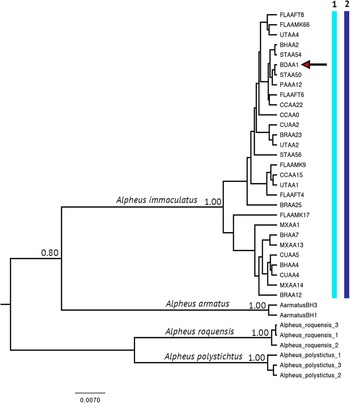
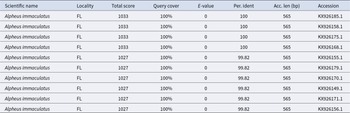
Sequence assembly, alignment, and trimming resulted in a final sequence length of 559 base pairs (GenBank Accession Number PX651792). Nucleotide BLAST search unambiguously identified our newly collected sample as the spotless snapping shrimp Alpheus immaculatus (Table 1). The top 10 BLAST search results are A. immaculatus sequences from the Florida Keys that we had previously collected (Table 1; Titus and Daly, Reference Titus and Daly2017). Bayesian phylogenetic analyses in BEAST further support the identification of our sample as A. immaculatus (Figure 2). Single locus species delimitation analyses (ABGD and TCS) indicate that A. immaculatus is a single species throughout the TWA (Figure 2). Intraspecific p-distances for A. immaculatus throughout the TWA, including our new sample from Bermuda, ranged from 0 to 2.7%. TCS haplotype network construction returned only a single network, a result that aligns with the ABGD interpretation that A. immaculatus represents a single species (Figure 2). Phylogenetic analyses show no discernible geographic structure throughout the range of A. immaculatus (Figure 2). Our newly discovered Bermudan sample is not divergent from any other sample locality and sits nested in the phylogeny with samples from Panama, US Virgin Islands, and Florida.
Results from cytochrome c oxidase subunit I (COI) Bayesian phylogenetic reconstruction in BEAST for the Alpheus armatus species complex, identifying the newly observed and collected Alpheus sp. Sample from Bermuda (red arrow) as Alpheus immaculatus. Node labels represent posterior probabilities. Solid bars to the right of tip labels represent molecular species delimitation results from single-locus species discovery methods (1) ABGD and (2) statistical parsimony network in TCS. Each indicates A. immaculatus is a single species throughout the Tropical Western Atlantic.

Results from a cytochrome c oxidase subunit I (COI) nucleotide BLAST search on GenBank for the newly collected and sequenced Alpheus sp. Sample from Bermuda. Presented results reflect the top 10 BLAST hits, species identity, their locality, BLAST total score, query cover, E-value, percent identity, accuracy length (in base pairs), and accession number

Discussion
Our results provide the first record of Alpheus immaculatus from the Bermudan Archipelago, extending the known range of this species by more than 1500 km. Our analyses further confirm that A. immaculatus represents a single species throughout the TWA, with no additional cryptic diversification in Bermuda or elsewhere. Given the lack of genetic differentiation between our Bermudan sample and the Greater Caribbean, we interpret this to indicate that the A. immaculatus individual from Bermuda arrived via a long-distance dispersal event and is not an indication of a previously unidentified and persistent population of this species in Bermuda. No other Alpheus sp. snapping shrimps were observed in association with B. annulata in Bermuda, although we visited ∼100 corkscrew sea anemones throughout the archipelago. Other field locations around Bermuda that we surveyed included sheltered locations within Harrington Sound, Paget Island, fore reef habitats exposed to open the ocean on the north and south shores, and additional patch reefs scattered throughout the lagoon. The presence of A. immaculatus in Bermuda, but apparently not an established population, indicates that long-distance dispersal is possible for this species, but likely rare. Previous work on larval duration and recruitment for this species complex characterized members of A. armatus to have larvae with highly localized recruitment but the potential for long-distance dispersal (Knowlton and Keller, Reference Knowlton and Keller1986).
Bermuda appears to operate in an ‘all or nothing’ capacity when it comes to coral reef biodiversity. With little endemic marine fauna, there is enough regular dispersal from the Caribbean to homogenize populations and reduce speciation rates (Locke et al., Reference Locke, Coates, Bilewitch, Holland, Pitt, Smith, Trapido-Rosenthal and Sheppard2013). Simultaneously, Bermuda’s marine biodiversity is a reduced subset of the diversity found in the Greater Caribbean. It is devoid of 12 of the most common shallow water scleractinian coral species, including the important reef-building branching corals in the genus Acropora and the boulder brain coral Colopophyllia natans (reviewed by Locke et al., Reference Locke, Coates, Bilewitch, Holland, Pitt, Smith, Trapido-Rosenthal and Sheppard2013). Bermuda also lacks ecologically important cleaner gobies in the genus Elacatinus that remove parasites from reef fishes (Walsh et al., Reference Walsh, Pinheiro, Rocha and Goodbody‐Gringley2017). Other crustaceans that form symbiotic relationships with the corkscrew anemone are also missing from Bermuda. The spotted cleaner shrimp Periclimenes yucatanicus is not known from Bermuda. A second common associate, Pederson’s cleaner shrimp Ancylomenes pedersoni, is one of the few species that has undergone an endemic diversification event and may no longer function as a cleaner in Bermuda. Originally described as Periclimenes anthophilus and recognized as a Bermudan endemic, the species was synonymized with A. pedersoni (Okuno and Bruce, Reference Okuno and Bruce2010). Titus et al (Reference Titus, Palombit and Daly2017; 2024) confirmed the Bermudan lineage was endemic and highly distinct from A. pedersoni in the Caribbean using genomic approaches. In contrast, other anemone symbionts, including the yellowline arrow crab Stenorhynchus seticornis and the Caribbean sexy shrimp Thor dicaprio, are abundant in Bermuda (Titus et al., Reference Titus, Daly, Hamilton, Berumen and Baeza2018). In the case of A. immaculatus and other members of the A. armatus species complex, dispersal to Bermuda is possible, and host anemones are abundant. Yet on balance, Bermuda appears situated just far enough away from source populations in the Caribbean to keep this species complex from being able to establish persistent populations. It is possible that as warming oceans and changing climates push tropical fauna to higher latitudes that dispersal to Bermuda becomes regular, which might result in these snapping shrimps becoming members of the Bermudan coral reef communities in the future.
Acknowledgements
We thank Alex Hunter, Eric Witt, and the Bermuda Institute of Ocean Sciences for logistical support in the field. Comments from Heather Bracken-Grissom and one anonymous reviewer improved the final version of this manuscript.
Author contributions
BMT performed field and laboratory work and conducted data analysis. BMT and MD funded the research and wrote the manuscript.
Funding
This research was funded by a National Science Foundation Doctoral Dissertation Improvement grant DEB‐1601645 to BMT and MD; the Explorer’s Club Youth Activity Fund; Otterbein University Department of Biology and Earth Science; and the Trautman Fund of the Museum of Biological Diversity, The Ohio State University.
Competing interests
The authors declare no conflicts of interests.
Data availability
All newly generated data in this study are publicly available on GenBank (GenBank Accession Number PX651792).
Ethical standards
Samples were collected under the authorization of the Bermudan Government, Department of Environmental Protection permit #140408.


 Open access

