

Prehispanic Oaxacans were no strangers to living with the detritus of the past and negotiating social relationships alongside material residues (rubble or vestiges) of past things, places, and other humans. They interpreted vestiges in multiple, changing ways, including as evidence of previous ages of creation (Hamann Reference Hamann2002) and the living spaces of ancestors. Contemporary ethnographic examples in Oaxaca (Leathem Reference Leathem2019a, Reference Leathem2019b; Pitrou Reference Pitrou2015) suggest that ruins are places where important and necessary life-forming encounters with spirit beings take place. In some cases, ruins can positively and negatively affect people who live near them. These and other examples in Mesoamerica (Palka Reference Palka2014) point to the ways that people mitigate(d) relationships with ruins and spirit beings through material culture, including emplacing offerings of incense or food, marking rock walls with paint or carvings, and constructing shrines.
Our archaeological research in the Nejapa region has produced multiple forms of evidence to show that people have repeatedly treated ruins and natural landscape features as having vibrancy or animate force, imbuing them with potency and sacredness. This report highlights how the many archaeological ruins located across Nejapa were and still are considered to be occupied or inhabited spaces, despite people no longer actively living within their constructed buildings. Ruins in Nejapa are often considered to retain vibrancy, like the many vital materials described by Bennett (Reference Bennett2010), and thus are typically treated respectfully and carefully, with reverence, nostalgia, ambivalence, or caution. Some, like Los Picachos and Cerro del Convento, were charged with a spiritual valency that required petitions, made visible in the form of people placing offerings at the site or placing a ballcourt directly on top of earlier vestiges. Two sites, Casa Vieja and Pueblo Bonito, have been revisited over generations, viewed with reverence and nostalgia, while others like the long-abandoned site of La Baeza are treated with caution or avoided outright even though the original residents have long since passed away or left. The different palimpsests entailed in each of these ruins highlights both the ongoing relationship that people have with ruins and their changing relationships with ancestors, spirits, the past, and the present, through time and space.
Ruins, Time, and Meaning
In many ways, the conception of ruins that best resonates with our data was recently outlined in the introduction to Erikson and Vapnarsky’s (Reference Erikson, Vapnarsky, Erikson and Vapnarsky2022) volume Living Ruins, wherein the authors explore the deeper meaning of ruins from an Amerindian ideological perspective. They suggest that ruins—the remains of formerly occupied or used spaces—are spaces that have a life or vibrancy of their own that become emblematic of history and ancestors. Importantly, they argue that natural landscape features alongside ruins should be considered to have vibrancy and are made meaningful to people through commemoration and ritual. For this reason, they propose calling all these spaces—be they ruins or natural landscape features—“vestiges.” They also suggest that the sacredness of vestiges stems from their association with history and memory. History and memory don’t have to be direct or lineal for value to be ascribed to vestiges. In many ways, ruins both hold intrinsic “aliveness” and are continually “brought to life.”
Working in the Mixe highlands, in a municipality north of Nejapa, Pitrou (Reference Pitrou2015) argues that the Mixe don’t necessarily view everything as being intrinsically alive, but that through engagement with spirit entities, spaces and places are “made liv[ing]” or imbued with life/potential life that is made active through human petition and intercession. People seek to establish covenants with these entities when things are uncertain and during critical politico-religious events (e.g., political inaugurations or life-cycle rituals), which entail a series of proscribed acts in particular spaces. In these ways, past and contemporary peoples of this region view landscape features and places with vestiges of human occupation along a continuum of place types that are important ritual locations, without a sharp division between “natural” places and “ruined” constructions (Palka Reference Palka2014). Such perspectives are found throughout Oaxaca. People from the city and municipality of Tehuantepec, to the southeast of Nejapa, view the nearby Guiengola mountain and archaeological site as both a place of ancestors and ancestral (Ramón Celis Reference Ramón Celis2024), much like the people of Mitla believe that the archaeological ruins there had been built by ancestral beings/forces (Barabas et al. Reference Barabas, Winter, Castillo Cisneros and Moreno2005; Parsons Reference Parsons1936). In both, relationships with ruins and the spirit beings/ancestors that inhabit them require actions and petitions.
Dale and Burrell (Reference Dale and Burrell2011) approach ruins as a process, a continuum of negotiated and redefined understandings of people to those places. These places may acquire and dictate different interactions from local and nonlocal people including ambivalence, petition, descendance, avoidance, and extraction. The life of a place and people’s interactions with those places do not start with the construction, marking, or the transportation of things to that place, nor does it end with an act of destruction or even abandonment. Instead, there is a transition to other life stages. The use of “life stage” here is intentional, as we seek to blend archaeological observations with interpretations that consider the potential for non-Western distinctions between living and nonliving beings. These interpretations allow for the intentionality and agency of nonhumans, including the spaces as well as the ancestors, supranatural beings, gods, spirits, and ghosts that occupy those places (see also Kopytoff Reference Kopytoff and Appadurai1986).
Ruination is an active process that is as much about creation as it is about destruction (see Hamann Reference Hamann2020). Stoler (Reference Stoler2008) has argued that just as ruination decomposes, it also composes or “reactivates” and opens the possibilities of different futures. Sites and artifacts—those things “in ruins”—hold power precisely because they come into being as new or renewed objects. In the process, they collapse time, folding the present and past together (Gell Reference Gell1998; Harries Reference Harries2017). Ruins thus can be viewed as productive forces through which new meaning(s) are created in the present, drawing the present and the past together, and providing the basis for action and inspiring new forms of engagement and disengagement. This collapsing of time allows people to connect with the past or multiple pasts through ruins and tap into the power of that generalized history to inspire action in the present. It doesn’t matter if the places were left abandoned, purposively demolished, or were in the process of slowing decaying, and it doesn’t matter what exactly was there originally or how mundanely the materials may have been reused later—all ruins retain(ed) vibrancy, power, and meaning.
The meanings of ruins also shift through time. Multiple studies have shown that archaeological work and heritage management in the last century have caused major changes in local conceptions of ruins (Baird Reference Baird2020; Covey and Aráoz Silva Reference Covey and Aráoz Silva2019; Stoler Reference Stoler2008). Leathem (Reference Leathem2019a) deftly shows that the advent of national heritage management protocols that barred local residents of Mitla from having regular access to prehispanic ruins transformed their relationship with ruins. As a result, the ruins in their midst have come alive in a different sort of way. They are still vibrant, for sure, but they are also dangerous and capricious, filled with ghosts and supernatural powers that can cause spiritual and bodily harm. Some of this, of course, could be argued to be the filter of Christianity whereby sacred vibrancy is equated with negative, devil-inspired forces; however, Leathem’s work demonstrates that the hauntings started when the site became an archaeological zone managed by the government. This example shows how ruins can play active roles in human communities, affect changes in social relationships, and be simultaneously powerful, alive, tricky, and dangerous. Ultimately, dispossession caused the ruins to haunt.
In whatever form, ruins were and are vibrant sacred places and active agents at the same time, providing opportunities for both positive and troubled social relations. Thus, we concur with the special section editors (Joyce and Rosado-Ramirez Reference Joyce and Rosado-Ramirez2025) that the metaphysical approach and Native ontological approach toward understanding ruins should be considered side by side, if such a separation is required at all.
The Nejapa Evidence
The Nejapa Valley is the drainage basin formed by the confluence of two rivers, the Río Grande and Río de Ceniza, which flow from the northwest and south respectively and exit together to the northeast, eventually draining all the way to the Isthmus of Tehuantepec. The Mixe, Chontal, and Zapotec language speaking peoples who settled across this Sierra Sur region constructed their homes in various locations—on the valley floor, on low hills surrounding the valley, in secluded canyons carved by seasonal river drainages, and on remote mountain spurs and ridgelines that form the region’s (ecologically defined) borders (Figure 1). Archaeological sites range from large densely occupied centers with temples, plazas, ballcourts, and residential areas, dispersed residential sites, ridgeline terraced sites with defensive walls, isolated ballcourts in more rural mountain locations with associated ceremonial and residential settlement, to archaeological vestiges found at natural landscape features like large boulders and rockshelters throughout the mountains, side valleys, and canyons where people painted rock art, carved stone images, or visited as part of pilgrimages to burn incense and make offerings.
Map of the Nejapa region, with sites and landmarks mentioned in the text labeled. Map compiled by Stacie King.

Different communities of people living at different sites across the basin and the surrounding mountains were likely composed of speakers of multiple languages (King Reference King, Oland, Hart and Frink2012, Reference King, Beaule and Douglass2020; King and Zborover Reference King, Zborover, Scheiber and Zedeño2015). Further, each community likely negotiated its own access to traded goods and materials and managed its social and political relationships (King and Konwest Reference King, Konwest and Alexander2019; Konwest Reference Konwest2017). During the height of occupation in the Postclassic period (AD 1000–1521), there does not seem to have been one dominant center that controlled the distribution of goods or managed political affairs (King et al. Reference King, Konwest, Workinger, Badillo, Stoll, Ponce de León and Jarquín Enriquez2022). Various multiethnic communities coexisted across the region, retaining unique and varied everyday practices resulting in part from their residents’ unique histories. At the same time, their cohabitation and everyday coexistence contributed toward building a wider common, shared sense of belonging (Konwest Reference Konwest2017).
Regular communications, mobility to and from other communities, trade routes, agricultural fields, and ritual and religious interactions across Nejapa were regular mechanisms that served to bring people together. The evidence of ballcourts located in many rural, outlying mountain sites suggests rural centers became destinations for the ballgame, bringing together people from across the region—and even perhaps from farther away—to participate in regular politico-religious and ceremonial events (Stoll Reference Stoll2018). Even if the audience was composed primarily of local elites (see Stark and Stoner (Reference Stark and Stoner2017) on viewership and games), ballgames and the various events associated with them would have been important opportunities for social interactions. The ballgame might have thus served as a mechanism for building a wider sense of regional identity and creating and maintaining regional socioeconomic and political connections. The placement of ballcourts in Nejapa was important. Often, they are located on high mountaintop locations, many on saddles between peaks, such as those at El Sitial, La Puerta, Cerro del Convento, La Baeza, and Los Picachos. Other times, they are found in association with water or water features and petroglyphs or even in isolated locations.
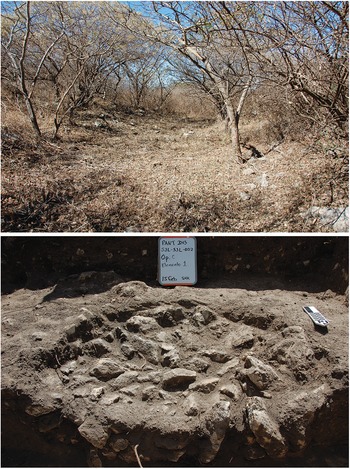
The rather simple ruins of a ballcourt belie the importance of the mesa-top site of Cerro del Convento and the repeated visits that people made there. The ballcourt is one of several buildings constructed on the mesa, which also includes a temple and residences radiocarbon dated to the Late Postclassic (cal AD 1300–1466). (All radiocarbon dates are reported in King et al. [Reference King, Konwest, Workinger, Badillo, Stoll, Ponce de León and Jarquín Enriquez2019] and most are published in King Reference King, Hendon, Overholtzer and Joyce2021). On the cliffs surrounding the mesa where this architecture is located, within and in front of rockshelters and small caves, we found the remains of offerings and rock paintings, attesting to the ancient and ongoing use of the site as a destination for ritual pilgrimage from the Formative to the early colonial period (cal 359 BC–AD 1635; King Reference King, Hendon, Overholtzer and Joyce2021). Our excavations in the center of the ballcourt revealed that the structure was constructed immediately above a large hearth with burnt wood charcoal radiocarbon dated to centuries earlier (cal AD 430–643; King Reference King, Beaule and Douglass2020). The hearth lies less than 50 cm below the prepared playing surface of the ballcourt and measures nearly a meter in diameter and 70 cm in depth, lined with stone and burnt adobe (King et al. Reference King, Konwest, Workinger, Badillo, Stoll, Ponce de León and Jarquín Enriquez2019; Figure 2). Its large size suggests some sort of collective use, perhaps during larger ceremonial gatherings or feasts, for both cooking and performing ceremonies. Although we don’t know the exact context in which the hearth was embedded, its position directly under the center of the ballcourt suggests that it was still visible to later visitors long after falling into disuse. When, centuries later, people decided to build a formal (though simple) ballcourt, they intentionally did so directly above this large hearth, even though there were other locations that they could have chosen.
The Late Postclassic period ballcourt at Cerro del Convento (top) and the hearth from centuries earlier lying below the center of its playing field (below). Photographs by Stacie King. (Color online)

This perhaps suggests that the ruins of the hearth were not just covered over and forgotten, but that the sacred power embodied by the “ruined” hearth may have been intentionally harnessed in the court’s construction and use, “breathing” vital forces into it. The builders of the ballcourt thus might be capitalizing on the vitality of Cerro del Convento’s vestiges. Unfortunately, due to limited excavation (we only excavated a 2 × 2 m unit in this location, and the hearth was in the center), we are unable to provide contextual information for the hearth. However, if do we read the centering of the ballcourt over the hearth as intentional, then we can imagine that when playing the ballgame in this space, players were reaching back or gesturing to the times, and therefore the power, of sacred ancestors (see Stoll Reference Stoll2024). The site, we know, was and still is believed to be powerful, evident in shattered incense burners from recent visits by pilgrims and by the long-standing retention of such a meaningful place-name into the present (“hill of the sacred place”). It became a primary target in later Spanish efforts to stamp out idolatry owing to its long-standing and widespread fame as a destination for sacred pilgrimage (Burgoa Reference Burgoa1934 [1674]:242–243). The historical evidence of ceramic incense burners attests to these ongoing visits and the continued power of the site into the historic period (exact timing unknown).
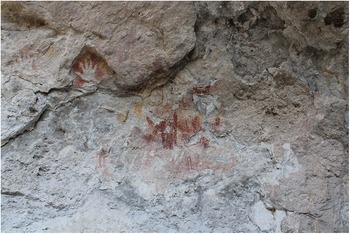
A different kind of reuse and reference to palimpsestic remains is present at a site in the mountains to the west of the valley floor. Casa Vieja, as the locals know it, is a geologically stunning canyon carved out by a small, now intermittent stream with multiple rockshelters from which the place gets its name, two of which feature more extensive rock art panels. The northern shelter boasts multiple panels of rock art and scatterings of chert flakes and ceramic sherds. The first panel features at least six negatively painted red and yellow handprints; more handprints were painted in various locations elsewhere, some in places that would have required ladders or scaffolding to reach. A second panel features more complex painted designs of pseudo-glyphs, figures, and other elements. Among the identifiable painted elements on the rock art panels are two shell glyphs, typically linked to sound-making and petition rituals. A third figure depicts a person’s face, with a sound scroll emitting from the mouth indicating that someone is speaking. The recognizable glyphs date to the Late International Style of the thirteenth to sixteenth centuries, or the Middle and Late Postclassic periods (Javier Urcid, personal communication 2022). Several lines of evidence point to a much longer interaction with these rockshelters. The superimposition of some of the representations and the paintings drawn on eroded and exfoliated older drawings on another panel show that the art was painted over several episodes. Concentrations of ceramic sherds in several paste types and forms are found on the surface, many diagnostic to different time periods including the Late Formative (500–100 BC). Chert flakes and debitage are also prevalent throughout. Modern refuse is present too, including the remains of a small wooden structure likely used for storage and scraps of plastic containers. Future excavations may yet reveal additional cultural material. The southern rockshelter also has painted figures along with ceramic sherds, chert debitage, modern refuse, and carbon from a recent fire on the shelter floor.
The geographic characteristics of this area, such as the position of the shelters and the narrowness of the riverine canyon, greatly amplify different sounds, especially people’s voices at normal speaking volume. The most recognizable glyphs invoke sound, which are, in turn, marked as precious by associated shell and jewel motifs. Several studies demonstrate a relationship between sound and the placement of rock or cave art (Boivin et al. Reference Boivin, Brumm, Lewis, Robinson and Korisetter2007; Till Reference Till2014) in Mesoamerica. The repeated use and reuse of the rockshelters, the continual erosion of the rockface, the environmental effects on the rock paintings, and the acoustic properties of the arroyo create an ephemeral place that was constantly in ruination and in transition (Figure 3). Moreover, it was clearly recognized as such in the past, as people would have observed how it changed over time as they visited. They consciously and continually chose this place, leaving behind a mix of material that might look like random trash but isn’t.
Rock art at Casa Vieja. Photograph by Marijke Stoll. (Color online)

In another case, we see evidence of later people visiting an abandoned ridgeline community on the southeastern edge of Nejapa and leaving ceramic vessel offerings. Los Picachos is a residential site dating to the Middle to Late Postclassic period (after cal AD 1143; King Reference King, Hendon, Overholtzer and Joyce2021) and is comprised of more than 75 terraces constructed along a 2.5 km stretch of mountain ridgeline, protected by defensive walls and sheer drops on either side. People living in the region during the early colonial period continued to visit the previously occupied town to make offerings as part of regular pilgrimages. In one location, someone constructed an impressive and formal adobe-walled building that likely dates to the early colonial period on the periphery of the Late Postclassic period site center with its monumental platform and temple architecture, taking advantage of a wide terrace and an impressive view. People also placed ceramic vessels in exposed locations on top of terraces, presumably marking spaces where rites were performed and petitions were made (Figure 4).
A ceramic vessel offering placed on a terrace wall ruin at the site of Los Picachos. Photograph by Stacie King. (Color online)

We suspect that the people visiting and leaving offerings at Los Picachos were residents of the early colonial period site of Majaltepec, located about 250 m below the Picachos ridgeline. Recent Bayesian modeling narrows the primary occupation of Majaltepec to between AD 1575 and 1640 (95.4% hpd; Kowalewski et al. Reference Kowalewski, Birch, Feinman, Nicholas, Faulseit, King and Leigh2025). A small town with a rural Catholic church, Majaltepec was relatively isolated from other contemporaneous towns. Colonial documents show that Dominican church authorities in Nejapa were trying desperately to control the town’s “Mixe Indian” residents in the late 1500s and early 1600s, who in turn lodged various complaints against Spanish colonial powers in the court system, even fighting Spanish efforts to relocate their town to the valley below (see King Reference King2025). Their repeated visits to their forbears’ home, then in ruins, to make petitions and sometimes to seek refuge—and incidentally a place from which their ancestors had likely evaded Zapotec conquerors a century earlier—were perhaps reflective of their desire to capture the sacred power from the ancestors located in the ruins (King and Higelin Ponce de León Reference King and Higelin Ponce de León2017; Konwest et al. Reference Konwest, King and Ponce de León2020). Their petitions may have had the goal of harnessing that power for strength in dealing with the Spanish and face their new challenge. For those Indigenous residents of Majaltepec, the ruins of Los Picachos were creative, empowering spaces, full of strength and vibrancy and worthy of regular visit and consultation.
Interestingly, we have found no evidence so far of later descendants leaving offerings at the mountain ridge site of La Baeza in the mountains to the west. Located on the summit of the Cerro San Antonio about an hour away on foot from the modern town of San Antonio, this complex residential site was occupied from the Late Classic to Early Postclassic (AD 650–1200), during a period of large-scale population movements and intergroup conflict in the Sierra Sur region. Based on site preservation, we believe that the structures observable on the surface date to the Early Postclassic. While some individuals or small groups may have continued to live there in the Late Postclassic, there is no clear evidence for post-abandonment reoccupation. Today, the San Antonio residents refer to the remains of the site as ruinas and are not particularly attached to them. Yet, many are cautious about visiting the location at night and try to avoid doing so.
At La Baeza, there is a small amount of looting, but it is unclear how long ago the looting occurred. Much like the historic ceramic incense burners found in Cerro del Convento, our guides from San Antonio were at least sure that their grandfathers were not responsible (Stoll Reference Stoll2018). What we do see at La Baeza is evidence of regular stone extraction. Throughout the main core of the site, we see gaps where stones have been removed from room foundations. Some are found stacked in piles, as if someone meant to come back for them later (Figure 5). One guide explained that the stone blocks were reused to build the house foundations of the Pueblo Viejo, serving the same purpose as they had in their previous life, “las obtenían de las ruinas” [they obtained them from the ruins]. The Pueblo Viejo was one of three ranchos abandoned in the 1930s when people were forced to consolidate to San Antonio. The Pueblo Viejo was likely settled sometime after 1702, when the lands that form the modern pueblo’s territory were purchased by Alfonso Nolasco, a Spanish criollo from Guatemala. Criminal proceedings and civil records from the “portillo [or mountain pass] de Baeza,” just east of where the ruins of Pueblo Viejo are located, in 1752 and “Baeza” in 1786 (APJO Index Yautepec Criminal and Index Yautepec Civil, transcribed by Stacie M. King) suggest that this extraction of stone likely began in the colonial era.
Stacked stone blocks extracted and abandoned at La Baeza. Photograph by Marijke Stoll. (Color online)

These are the ruins the people of San Antonio feel most connected to, rather than the ruinas on the mountain summit. Only a small number of architectural elements remain at Pueblo Viejo including a few stone foundations, an earthen and stone mound, the crumbling walls of an adobe church, and a few stone tombs in the cemetery, most of the interments having been transported to their new location closer to San Antonio. The church is a tiny structure, large enough for perhaps 20 people or so (Figure 6). One elder woman in the modern pueblo was baptized in the adobe church, the last person to have received the rite there. The land is now divided up between different owners, repurposed for growing maize and other staple crops (Figure 7). To reach the adobe church, we had to follow our guide through milpas of maize and under several barbed wire fences. For the people who once resided in the Pueblo Viejo, borrowing stones from the ruinas was apparently permissible without the need to petition the spirits; however, in other ways the site remains remarkably untouched. Many of the piles of extracted stones encountered throughout the years of survey are still there, still waiting to be taken down the mountain.
Remains of standing walls of the adobe church at Pueblo Viejo. Photograph by Marijke Stoll. (Color online)

Maize fields where houses once were at the Pueblo Viejo. Photograph by Marijke Stoll. (Color online)

The final site that we want to highlight is the remains of the colonial period mine in the territory of San Antonio (given that it is currently a sensitive topic in the community, we are protecting its location and not discussing what was mined). According to local oral history, when the mine collapsed, it trapped people from the local community and region inside to their death; it was then abandoned not long after. It is unclear how old the mine is and when it was in operation, but it seems to date to prior to anyone’s living relatives, as local stories specifically mention Spanish authorities. Today, the mine is regarded as a site of historical tragedy and rarely visited. The avoidance of the mine may be due to its traumatic history linked to a colonial system that did harm. As such, it is a visual reminder of that troubled history and a symbol of danger. To visit or tread near this space and repurpose it for new owners would place people, and by extension the community, at risk. We argue that the site has been left alone precisely because the mine ruins remain a vibrant space, the sacred tomb of relatives who tragically perished. Beyond any environmental concern, there is a reluctance associated with going back to and engaging with the mine in any way. Time has not diminished this concern; disturbing the ruins might incite malevolence—whether it be the ancestors who perished there, the gods, or other forces. As Erikson and Vapnarsky (Reference Erikson, Vapnarsky, Erikson and Vapnarsky2022:18) state, ruins are endowed with a “moral and supernatural agency” that inspire people to act in particular ways. If not, these ancestors would potentially enact punishment. The mine is potentially delicate and dangerous, and people avoid going near to limit their risk.
Discussion
Ruins in Nejapa have various meanings. Some of the variation in meaning stems from the kinds of events that take place at these locations and their associations. The stories that enfolded in those sites prior to ruination tell part of the story of later engagements, determining how ruins, spirit beings, and ancestors guide the ways that people engage with them. We see varied forms of engagement between people and ruins across Nejapa, evident archaeologically in the form of offerings as at Los Picachos and the careful placement of the ballcourt directly above a hearth at Cerro del Convento. Where people left offerings and how they left offerings show us that many kinds of spaces were viewed as spirit-filled or alive. People living at early colonial Majaltepec likely climbed up to Los Picachos to petition ancestors for strength as they faced ongoing battles with Spanish authorities. It didn’t matter where at the site they left offerings or performed their rites, as the whole site was endowed with this spiritual potency and ancestors could be called into action from various locations. Engaging with ruins and natural landscape features connected people to history and memories, and in this case might have recalled their ancestors’ previous encounters with outsiders, encounters in which they were victorious and withstood conquest.
Casa Vieja and Pueblo Viejo, two very different sites with different histories, are perceived as places of home, shelter, and refuge, indicating a much more amiable relationship with any animated forces present. By contrast, La Baeza may be imbued with vibrancy, but it is also sometimes viewed as untouchable and potentially fraught and dangerous. Perhaps painful tragedies, long forgotten, occurred at La Baeza and this is why we see little evidence of later occupants returning to the site to leave offerings. Today, people regard the ruins as haunted, especially during nighttime hours. Clearly, part of what makes these and other ruins in Nejapa powerful and meaningful is their association with noteworthy and memorable historical events.
People in the Nejapa region had variable relationships with the different ruins in their landscape. Visits to Los Picachos might have been viewed as opportunities for encounters with ancestors and gaining power, just as visiting Cerro del Convento and participating in the ballgame brought expanded opportunities for harnessing sacred forces. The ruins of the Casa Vieja and the Pueblo Viejo entailed a different form of engagement. People regularly visit(ed) both sites of these former inhabited spaces, for ritual purposes and later shelter in the case of the Casa Vieja and for planting maize and providing sustenance after the town was abandoned in the case of the Pueblo Viejo. They did not contribute to the ongoing ruination of the remains of earlier occupations by purposely dismantling the structures. Instead, they view these remains with nostalgia of times long ago, recalling ancestors and memories of the past alongside their hopes and dreams for the future. Returning to sites and extracting stone was as much about taking something associated with ancestors to live in a new place, as much as it was about accessing favorable construction material.
Lastly, the residents of San Antonio consciously and purposefully ignore certain ruins, respecting and avoiding engagement precisely because they retain a haunted vibrancy. While the mine is seldom visited with no trails that pass it, the ruinas of La Baeza and other sites with ruins, such as Cerro El Gallo and Aguas Frias, are avoided specifically at night, becoming haunted places as the sun sets. A rooster that crows at night from El Gallo incites the pueblo’s roosters to create their own ruckus, so the stories go (other such hills with mysterious roosters are found throughout Nejapa). For San Antonio, the power these ruins have has the potential to become dangerous with real consequences, in part because of their association with problematic histories and individuals. But also, much like Mitleños’s perceptions of the ruins of Mitla (Leathem Reference Leathem2019a), the ruins have become embodied with (or even as) powerful agents that can cause harm. While on a walk with a resident of San Antonio to see some ruins that are part of the regular route to his milpa, vestigios (vestiges) he called them, Stoll was told his grandfather had looted two tombs there and then later fell sick. We both agreed that the spirits had punished him for disturbing their tombs. In general, ruins should be approached with caution and treated carefully, and in some cases, avoided altogether. In all these examples, ruins and natural landscape features have an aliveness—perhaps connected to spirit entities—that must be respected and appreciated.
Whether they view ruins with awe or caution, or even both at the same time, many generations of people across Nejapa have been negotiating their interactions with a continuum of ruined constructed places and landscape features. Although much more research remains to be done, the layered relationships between people and ruins in Nejapa stretch far back into the past and manifest in different ways with different people. Perhaps the one common thread running through time is that ruins always had a vibrancy or impact on people, potentially positive or negative. Several times during survey, we have been asked if we would be scared to camp overnight in the mountains near ruins. The person asking always expresses some trepidation at the idea of spending the night. One time, one of our field crew members was so spooked he left the rest of the crew first thing in the morning: he asked, “No tienes miedo? Hay fantasmas” (You aren’t scared? There are ghosts).
If nothing else, our work in Nejapa has given us the chance to reflect on our own archaeological practices. This has inspired us to think more deeply about how we engage in archaeological fieldwork because we are actors in these unfolding stories of ruins. When we undertake archaeological fieldwork, we are working in these vibrant and delicate spaces, and we should therefore assume that our actions too are being monitored and tested. We must take care in how we engage and show the same kind of reverence, respect, and deference.
Acknowledgments
First and foremost, we thank the people of the municipalities of Santa Ana Tavela, Nejapa de Madero, San Juan Lajarcia, San Bartolo Yautepec, and San Carlos Yautepec, and specifically people in San Antonio La Baeza for sharing their time and expertise with us and supporting our work since the Nejapa Tavela Archaeological Project’s inception. Likewise, this research would not have been possible without the support and permission of the Consejo de Arqueología of Mexico’s Instituto Nacional de Antropología e Historia and the Centro INAH Oaxaca. Lastly, we thank Pamela Lara Tufiño for her help with the Spanish translation and Robert Rosaldo-Ramírez and Arthur Joyce for their invitation to present this work at the Society for American Archaeology meeting, their careful feedback, and for facilitating our introduction to colleagues working across Mesoamerica.
Funding Statement
This work was supported by the National Science Foundation (Grant #1015392) and Indiana University’s Office for the Vice Provost for Research New Frontiers in the Arts and Humanities program in grants to King and by the National Science Foundation (Grants #1519653 and #2102310) to Stoll.
Data Availability Statement
The archaeological data used in this report are compiled in reports submitted to the government of Mexico, available upon request from the authors and in the archives of INAH (King Reference King2010; King et al. Reference King, Konwest and Badillo2012, Reference King, Zborover, Scheiber and Zedeño2015, Reference King, Konwest and Alexander2019, Reference King, Konwest, Workinger, Badillo, Stoll, Ponce de León and Jarquín Enriquez2022; Stoll Reference Stoll2018).
Competing Interests
The authors declare none.



 Open access

