




Introduction
Dairy farmers serve important economic, nutritional, and cultural roles in the communities they exist within. Dairy and other agricultural systems impact their surroundings through externalities, necessitating jobs related to agriculture, and by providing access to local foods and knowledge of farming (Moss et al., Reference Moss, Smith, Null, Roth and Tragoudas2013). Simultaneously, dairy farmers face issues that make the current and future economic, cultural, and environmental sustainability of their farms uncertain. Dairy farm viability is impacted by climate change, consumer perception of dairy farming and purchasing habits, milk price volatility, and more (Frick and Sauer, Reference Frick and Sauer2021; Wemette et al., Reference Wemette, Safi, Wolverton, Beauvais, Shapiro, Moroni, Welcome and Ivanek2021; Lopez et al., Reference Lopez, Laughton, Kim and Suh2022). Farmer decision-making in adaptation to and anticipation of these variables is an important perspective to consider when discussing long-term dairy industry viability. This research was designed to investigate farmers’ perception of three alternative management practices that may impact farm viability. The scope of this inquiry was focused on the Northeastern United States, including Maine, Vermont, Rhode Island, New York, and Pennsylvania.
In this study, we explored farmers’ willingness to adopt three main alternative management practices to adapt to consumer demands and environmental realities. These practices—selling into alternative markets, becoming certified organic, and grazing—were selected for their prevalence in policy and research suggestions as ways for farmers to adapt to a changing agricultural system (Cardoso et al., Reference Cardoso, Hötzel, Weary, Robbins and von Keyserlingk2016; VSJF, 2019). Using qualitative research methods, we explored themes relating to the practicality and scale of these management practices and the potential market opportunities that can be derived from these themes.
Adoption of alternative management practices
Previous research has explored some of the nuances in farmer adoption of alternative management practices. Dairy farmers may adopt, or be driven to adopt, certain management practices to make their farm more resilient, including adapting to environmental changes, consumer demands, and evolving market opportunities (Wang et al., Reference Wang, Parsons, Colby and Castle2016; Nilsson, Hansson and Lagerkvist, Reference Nilsson, Hansson and Lagerkvist2017). Alternatively, Knowler and Bradshaw (Reference Knowler and Bradshaw2007) identified a few unifying variables in farmers’ adoption of conservation agriculture practices, acknowledging the difficulty in finding overarching adoption strategies. Later research identified some unifying variables, including external and monetary incentives (Greiner, Patterson and Miller, Reference Greiner, Patterson and Miller2009; Stock et al., Reference Stock, Forney, Emery and Wittman2014), farmers’ perception of their own capacity and self-efficacy to implement practices (Niles, Brown and Dynes, Reference Niles, Brown and Dynes2016), and farm size and farmer demographics (Niles et al., Reference Niles, Horner, Chintala and Tricarico2019).
Research focused on sustainable agricultural production has been increasing in prevalence since the boom in extractive agriculture in the 1980s. This type of research often aims to increase the capacity of farming systems for sustainability under one or multiple pillars, including social, economic, and environmental sustainability. Beyond the scope of technical elements of sustainable agricultural practices, there has been an increased interest in research aimed at understanding the factors that drive farmers to implement those practices. Several comprehensive literature reviews have investigated this topic to find common motivational threads.
One such review investigated over 17,000 studies of sustainable agriculture adoption, analyzing the programs incentivizing farmers’ adoption (Piñeiro et al., Reference Piñeiro, Arias, Dürr, Elverdin, Ibáñez, Kinengyere, Opazo, Owoo, Page, Prager and Torero2020). It was found that short-term economic benefit was a more effective motivator than positive environmental effects. However, over a longer period, the greatest motivators were a perception that the adoption of sustainable agricultural production would have a positive impact on their farm or the environment. This review also found strong associations between the presence of technical assistance and extension services in the role of adoption.
Another review of literature focused on farmer behavior change and decision-making in relation to sustainable agricultural practices (Foguesatto, Borges and Machado, Reference Foguesatto, Borges and Machado2020). While this review found common themes in the literature of external motivators in the adoption process, the main finding was the lack of previous studies in assessing farmers’ internal motivations, including the constructs and perceptions that shape farmers’ decision-making processes. This review acknowledged the prevalence and importance of external motivators, similar to what was identified by Piñero et al., but suggested future research with a systematic approach aimed at linking farmers’ demographic and socioeconomic characteristics with their inherent social constructs.
Adoption of alternative markets
The first strategy we examined, selling into alternative markets, is characterized by farmers selling their milk outside of the cooperative model. Previous research determined that smaller (<30 lactating cows) farms from their survey of Vermont farmers were most likely to be involved in value-added production, likely due to the high level of labor required to manage this type of operation. In contrast, the largest farms in this study (>70 lactating cows) were most likely to be certified organic, and least likely to be interested in value-added production, while farms with around 50 lactating cows were most likely to be interested in entering the value-added market. They attributed this nuance to the higher pay price that organic farmers were receiving for their commodity milk, while conventional farmers might be interested in value-added systems to reclaim some value for their products (Wang et al., Reference Wang, Parsons, Colby and Castle2016).
In Tennessee, farms already engaged in value-added production reported that off-farm income contributed only a small portion (9%) of total income, whereas farms considering a transition to value-added systems relied heavily on off-farm income (62%). This suggests that value-added production may reduce dependence on external income sources, potentially buffering farms against volatility in the commodity milk market (Frick and Sauer, Reference Frick and Sauer2021; Zaring et al., Reference Zaring, Jensen, Hughes, Morgan, Holland, Pepper, Leffew, Ivey and Eckelkamp2024). These findings underscore the need to further research the factors influencing farmers’ movement into alternative markets in the Northeast, particularly the roles of farm scale and exposure to commodity price fluctuation.
Adoption of organic certification
The origins of organic agriculture are based on a rejection of the extractive and intensive practices that rose to prominence in the 1980s (Kirchmann et al., Reference Kirchmann, Thorvaldsson, Bergström, Gerzabek, Andrén, Eriksson and Winninge2009). Early adopters of organic agriculture may have transitioned due to ethical or moral beliefs. However, some argue that the organic market has now matured to a place where the organic label has been commodified and lost its original ethical underpinning (De Wit and Verhoog, Reference De Wit and Verhoog2007).
Consumer acceptability of organic milk has been established both through economic analysis of the growth of the organic milk market (Nehring et al., Reference Nehring, Gillespie, Greene and Law2021) and qualitative analysis of consumer opinion (Harwood and Drake, Reference Harwood and Drake2018). This acceptability can be attributed to consumers’ willingness to spend more on dairy products produced without antibiotics on organic farms, where they believe cattle will be treated better (Wemette et al., Reference Wemette, Safi, Wolverton, Beauvais, Shapiro, Moroni, Welcome and Ivanek2021). However, some research on consumer demand reflects this shift, showing a change in consumer preference away from organic food toward locally produced food, as consumers believe local foods more accurately reflect their ethical and sustainability goals (Adams and Salois, Reference Adams and Salois2010). From 2018 to 2019, the demand for organic milk had risen by 2.1%, while the demand for conventional milk had fallen by 2.4% (USDA AMS, 2019). By 2024, the demand for organic milk had fallen by 2.9%, while the demand for conventional milk had fallen by 3.4% from 2023 (USDA AMS, 2024). Using survey methods, Constance and Choi (Reference Constance and Choi2010) established that 40% of conventional farmers in their sample of 469 farmers had considered, to some degree, transitioning to organic practices, but this group perceived barriers in the uncertainty around organic marketing and certification requirements, and the lack of government support to quell this uncertainty.
This research established consumer acceptance and demand for farmers’ adoption of organic practices, and some instances of farmers’ willingness to adopt organic dairy production. Further research is needed to more accurately understand the point of view of Northeastern farmers, how changing organic milk markets have changed farmers’ willingness to transition to organic certification, and how consumer demands impact farmers’ willingness to transition.
Adoption of grazing practices
Grazing and pasture access have historically been important components of dairy systems in the United States, valued not only for their economic potential but also for their capacity to provide improved animal welfare and subsequent impact on consumer acceptability of grass-fed dairy products. Consumers often associate pasture access with improved animal health and well-being, while farmers and industry stakeholders view grazing systems as a viable economic strategy within a diverse production model (Cardoso, von Keyserlingk and Hötzel, Reference Cardoso, von Keyserlingk and Hötzel2019). Using survey methods, Schuppli, von Keyserlingk and Weary (Reference Schuppli, von Keyserlingk and Weary2014) established that the majority of their 414 Canadian participants, both involved and not involved in the dairy industry, viewed pasture access as an important practice for animal health and healthy milk production. Similarly, Cardoso et al. (Reference Cardoso, Hötzel, Weary, Robbins and von Keyserlingk2016) determined that their sample of consumers referenced pasture access as an important aspect of an ideal dairy farm. Further research is needed to understand the perspective, specifically that of Northeastern dairy farmers, of adoption of grazing practices, and how consumer perception, economics, and scale impact their adoption.
In the context of this research, we use the term ‘grazing’ to cover the range of feed management practices that incorporate pasture into a dairy cow’s diet. Pasture has historically been an important feed source for livestock, including in the Northeast United States (Parker, Muller and Buckmaster, Reference Parker, Muller and Buckmaster1992). The umbrella of grazing practices includes feeding pasture to dry (non-lactating) animals to reduce dependence on imported feed, and using Management Intensive Rotational Grazing as a highly specialized feed source for high-producing dairy cows. Though intensive rotational grazing is widely adopted in other high-producing dairy systems, such as Ireland and New Zealand, this feeding strategy is still considered an alternative practice in the United States (O’Hara et al., Reference O’Hara, Reyes, Knight and Brown2023).
Factors influencing the adoption of alternative management practices
Consumer demand for changes to dominant dairy farming systems is well researched. Research has identified that consumers idealize farms that minimize greenhouse gas emissions, graze cows, minimize or eliminate antibiotic use, and contribute to the local food system (Hu et al., Reference Hu, Batte, Woods and Ernst2012; Cardoso et al., Reference Cardoso, Hötzel, Weary, Robbins and von Keyserlingk2016; Schiano et al., Reference Schiano, Harwood, Gerard and Drake2020). While consumer demand plays an important role in marketing (Brooker, Eastwood and Gray, Reference Brooker, Eastwood and Gray1994), we identified a need for research that seeks to understand how farmers make decisions considering consumer demand, their own experience, and expert consultation. Consumer demand is the flip side of dairy marketing: private labels may capitalize on what they know consumers want to see from the industry and use these insights in their advertising (Schiano et al., Reference Schiano, Harwood, Gerard and Drake2020). Similarly, policy and advocacy efforts often promote these alternative management practices as pathways for farmers to enhance their viability by improving market access and consumer appeal. A brief from the Vermont Sustainable Jobs Fund outlining market opportunities for Vermont dairy farmers outlined these three management practices and postulated that a transition of the Vermont dairy food system at large to these practices could bolster economic and social sustainability (VSJF, 2019).
Less is known about farmers’ own perception of alternative management practices. We can reasonably theorize that farmers are limited to practical decisions that work on their own farm. For example, a farmer might not be able to transition to organic certification if they have no access to organic grain. We also know that farmers are less likely to be concerned about environmental threats than socioeconomic dangers like international trade issues, declining commodity prices, and agribusiness consolidation (Waldman et al., Reference Waldman, Giroux, Farmer, Heaberlin, Blekking and Todd2021). This research seeks to understand the practical and values-based reasoning of farmer decision-making and the innovative ways farmers adapt socioeconomic demands to create their own niche markets. We sought to understand the extent to which farmers are willing to adopt alternative management practices, what drives that willingness, and how farmers adapt to outside pressures to maintain viability.
Materials and methods
Reflexivity statement
The primary researcher earned a B.S. in Animal Science and spent 4 years working and studying on a research dairy farm with a conventional herd, gaining firsthand experience in dairy farming. She had no previous experience of dairy farming. Reflexivity was achieved through a continuous evaluation of the researchers’ own experiences throughout the research process, influencing the formation of research questions, participant selection, data analysis, and communication of results. The researcher reflected on her values and norms that would impact subjectivity and recognized that the intention of qualitative research is not to generate objective facts, but to develop a unique subjective interpretation that could have only come from herself and her interaction with farmer participants.
Interview development
A semi-structured interview protocol was developed that would allow the researchers to develop an understanding of farmer values, social realities, and attitudes toward specific practices. Participants were asked to complete a pre-survey comprised of demographic and firmographic questions to demonstrate variability in farm and farmer characteristics. The semi-structured interview format was chosen to allow us to ask all participants to answer the same overarching questions and ask unique follow-up questions when appropriate. The flow of questions first asked farmers to describe their farm and their background in farming to build rapport (Lindlof and Taylor, Reference Lindlof and Taylor2011). They were then asked to describe their relationship to their community and how their values impacted their work as farmers. Farmers were then asked to share their willingness and attitude toward the adoption of alternative practices, including barriers, past consideration of these practices, and their perception of other farmers’ attitudes toward the practice. Finally, they were asked to describe any novel practices they used and if they had questions for the researcher.
Interview implementation
Interview recruitment began once the interview protocol was developed and approved by The University of Vermont’s Institutional Review Board (study #00003179). To gain access to farmer communities, we identified sponsors, or influential, respected, and connected members of individual farming communities, as described by Lindlof and Taylor (Reference Lindlof and Taylor2011). Sponsors acted as a reference between the interviewer and interview participants, giving trust and credibility to the research itself. Sponsors were chosen based on their embeddedness in their community and varied based on geographical region. Some sponsors were also interview participants.
Purposeful sampling was used to intentionally select research participants based on the belief that their reality is necessary to understanding and answering the research questions (Schwandt, Reference Schwandt1997). Maximum variability sampling was used (Sandelowski, Reference Sandelowski1995; Lindlof and Taylor, Reference Lindlof and Taylor2011) to find a participant population with intentionally diverse characteristics. Farmers were identified through sponsors, based on their use of the three alternative management practices, age, gender, and farm size. Twenty-five interviews were administered until saturation, when new data collected did not uniquely contribute to the development of theory and understanding (Lindlof and Taylor, Reference Lindlof and Taylor2011). Participants were contacted through email, where the interviewer and participants were connected through the sponsor. Initial consent was obtained.
Interviews were conducted in person on the participants’ farm or creamery, and lasted between 25 and 150 min. Participants were compensated for their participation with a $50 Visa gift card.
Interview analysis
Thematic analysis (Braun and Clarke, Reference Braun and Clarke2006) was performed with the resulting interview transcripts. We chose to identify semantic themes within the data. This means that we were identifying surface-level, or explicit themes, without drawing further interpretation from the data. This is not to say that interpretation of those themes did not happen, rather, that interpretation happened after the themes were identified. Interpretation occurs in the discussion of the themes, in how they relate to each other, and how they relate to the literature. Themes that dealt with motivation, experience, and meaning were key in this approach, as their structure facilitates the organization of the data that can then be transformed and embedded with further meaning through interpretation. These themes were organized to facilitate the theorization of participants’ motivations, experiences, and meanings without the formation of a unique theory.
Thematic analysis was performed by the main researcher. First, interview transcripts are read through to correct any transcription errors and to gain familiarity with the data. Then, initial codes were generated, where interesting features of the data were identified. Using those codes, initial themes were outlined. Here, themes are the coalescence of codes under the umbrella of a theme, like data points within a dataset. There, themes were iteratively reviewed, through which some themes were discarded, and some new themes were identified, until a list of strong, unified themes was settled on. Next, those themes were identified and named. The wider research team, including the main researcher and three committee members, was involved in theme development, review, and organization. This process resulted in a hierarchical coding tree that visually organizes the themes and gives order to the written description of themes and their codes. Finally, direct and indirect quotes were chosen from the text to allow the reader to experience the themes described from the participants’ point of view.
Results
Farmer characteristics
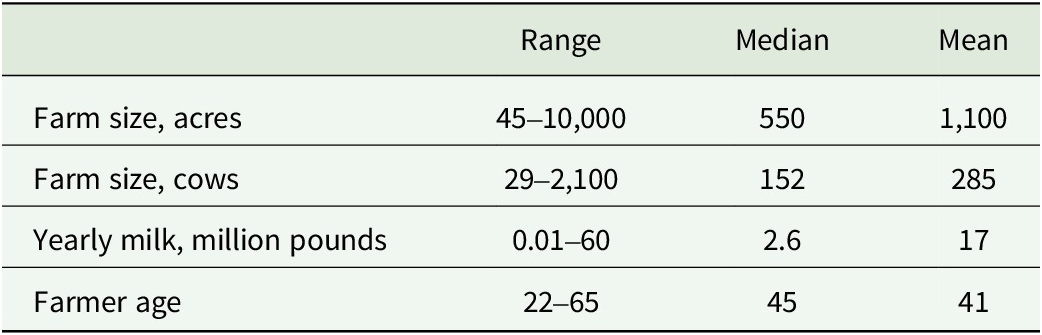
Twenty-five farmers participated in interviews for primary data collection. Eight farms were located in New York, six in Vermont, five in Maine, five in Pennsylvania, and one in Rhode Island. Farms were between 45 and 10,000 acres with a median size of 550 acres. Farms had between 29 and 2,100 lactating cows, with a median herd size of 175 lactating cows. Yearly milk production ranged from 0.85 to 60 million pounds, with a median of about 2.8 million pounds. There were 13 female farmers and 12 male farmers interviewed. Farmers’ ages ranged from 22 to 65 years old, with a median age of 45. All but one farmer, who identified as mixed-race, identified as white.
Farms selected had a range of implementation of the three alternative management practices in question. Thirteen farms exclusively sold their milk on the commodity market to dairy cooperatives. Seven farms sold most of their milk to a dairy cooperative, and kept a portion of milk, ranging from <1% to 20% of their total production, on farm to be sold on the value-added market. Three farms sold their milk exclusively on the value-added market. Two farms sold their milk to a local farmer-owned processing plant, identified as a ‘cooperative alternative’. Four of the 25 farms interviewed were certified organic. Thirteen farms used a confinement system where their herd received no nutrition from pasture. Nine farms used a ‘majority grazing’ system, where their cows received a majority of their nutritional requirements from pasture. Three farms used ‘situational grazing’, where lactating cows did not receive a majority of their nutritional requirements from pasture. Here, dry cows or heifers were grazed, and lactating cows were grazed for exercise rather than to meet nutritional requirements. Additional farmer characteristics can be found in Tables 1 and 2.
Farm and farmer characteristics1

1 Farmers were not required to answer all questions: one farmer declined to provide their age and number of cows, and one declined to provide their number of cows.
Farm characteristics
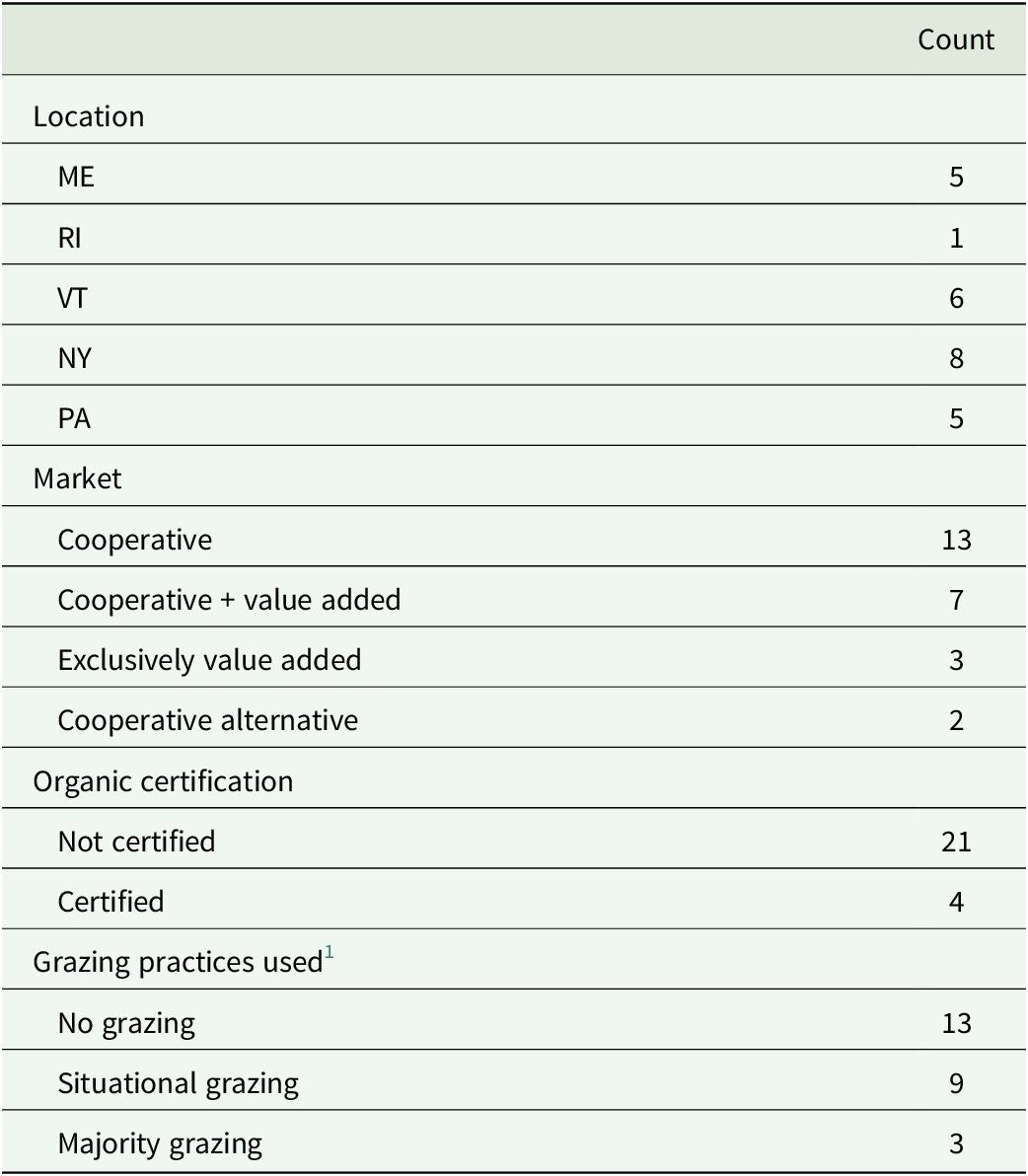
1 Situational grazing refers to feeding systems where cattle receive most of their nutrition from TMR but are supplemented with pasture as heifers, in the dry period, or for exercise. Majority grazing refers to feeding systems where cattle receive most of their nutrition from pasture when possible in their environment.
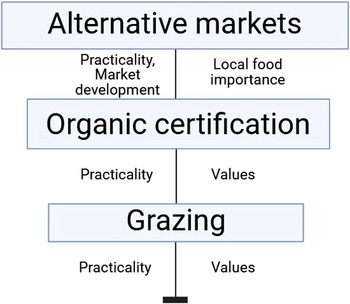
Thematic analysis of farmer interviews yielded main themes of practicality and values, and the interplay between these motivators within farmer decision-making. Results were organized by alternative management practice, with themes described within each practice. This research yielded themes of innovation, market development, and farmer singularity. Themes are portrayed in the applied interview hierarchical coding tree in Fig. 1.
Hierarchical coding tree. Created using Biorender.

Alternative markets
Farmers in this study had complex views of dairy markets. Some felt that they were in a corner: they had one market available to them, and if they wished to keep farming, they did their best to hold on to that market and to direct their farm to perform as well in that market as possible. In terms of alternative markets, or selling outside of a cooperative, some farmers felt that they had practical barriers to this option. Either they had physical distance from consumers, no access to transportation and storage, or not enough time and labor to effectively create and run a value-added brand. Farmers who sell to alternative markets found them to be a necessity, even when the added labor included in reaching that market was sometimes a burden. They had added a value-added outlet to generate extra income, which they saw as being necessary for business viability. Lastly, some farmers found alternative markets to be a truly fulfilling creative outlet. Their alternative markets allowed them to excel in a specialty product, often cheese making, and create a connection with their customers. This is not to say that other groups of farmers did not find other ways to create a connection with their community. This section explored how farmers’ views of alternative markets contribute to their understanding of their farm’s viability and future.
Practicality: access and labor
Some farmers described the practical limitations to entering the alternative market. One farmer in a particularly rural area simply said, ‘We’re on the edge of civilization, so there’s no market’. Another said, ‘Labor is a huge one. We’re already pretty shorthanded’. These comments described some of the practical limitations of selling into alternative markets. This contributes to the perceived benefits for farmers of selling to an established cooperative with hauling and distribution pathways. In those systems, farmers do not have to divert time and labor to the front end of milk marketing.
Market development: Innovation and novelty
Some farmers, often those closer to a city or venue, to market their products, saw an evolution into alternative markets as a natural or unavoidable next step in developing their business and remaining viable. One farmer said, ‘I think there’s more opportunity, and then you’re setting your own market…adding a stream of income’. In such cases, farmers saw alternative markets as a route to reclaim agency over the market and recapture the value of their inputs that are undervalued in a commodity system.
Additionally, some farmers saw alternative markets as a genuinely creative outlet, adding enjoyment as well as value to their business. One farmer said, ‘Providing that joy to customers…I really liked doing that because I am creative… it’s exciting and fun’. Farmers saw that not only can alternative markets help reclaim value in their products, but they can also be an opportunity to bring joy and excitement to their work—an angle that some farmers expressed as missing from their experience.
Farmers of varying size and market also discussed the value of individuality and ‘letting farmers do what they’re good at’. For some farmers, this meant a highly specified product and market; for others, this meant vertical integration and market power through owning inputs. One farmer said about their vertically integrated process, ‘We cut out a lot of the middle… the efficiency factors are phenomenal’. Their idea of alternative markets came well before processing in the production chain, but worked practically for them. Within this theme, farmers alluded to their desire for more freedom and the ability to curate their systems and markets. One farmer said, ‘There’s options out there… even if the co-op doesn’t want (us) to mess with them’.
Local food importance
Through farmers’ understandings of novelty, market development, and opportunity (or lack thereof) came a recurring theme of the importance of local foods, though farmers did not describe a unifying definition of local in their eyes. Farmers see local food importance as a marketing inroad, a justification for their presence to the community, and an opportunity for connection and education. One farmer described this importance, ‘I’m giving people an option to buy more local food…there’s a positiveness there…just more local food so I think that’s a good image for the community’. Here, alternative, value-added systems allow farmers to tap in externalities like community interaction.
Organic certification
Organic discussions are framed under alternative markets, considering the certification label itself is a type of alternative market, even when organic milk is sold on the commodity market. Both organic and conventional farmers were interviewed for this research. Conventional farmers often saw practical barriers to becoming certified organic. They cited the inability to treat sick cows with antibiotics, the grazing requirements, and the less-than-ideal organic milk market as barriers to organic practices. Some conventional farmers felt that the once special organic market had fully matured and would be unable to be capitalized on. Others argued that, since, in their view, conventional agriculture had made great strides in animal health and environmental sustainability, conventional agriculture was on par with consumers’ perceived ethics of organic agriculture.
It is important to note that in the United States, farmers managing certified organic dairy herds may not withhold appropriate antibiotic treatment from animals who require them. In the United States, organic dairy cows that are treated with antibiotics are permanently removed from the organic herd. In contrast, European organic regulations allow organic dairy farmers to treat their animals with antibiotics and rejoin the herd after an extended milk withholding period (USDA National Organic Program, 2012; European Union, 2018).
Organic farmers largely cited values-based reasons for their conversion. All organic farmers interviewed had transitioned more than 10 years ago, when the pay price for organic milk was significantly higher than conventional milk. These farmers said that they found organic practices to be ethically fulfilling, especially in terms of land stewardship. They did acknowledge that when they transitioned, the higher pay price for organic milk was compelling, and that they might not make the transition in the current market. Some organic farmers found issues with organic milk marketing techniques from organic cooperatives and brands. Specifically, they worried that marketing that frames organic milk as healthier for consumers and the environment would negatively impact dairy acceptability at large by implying conventional milk is unhealthy or unsafe. They said that the overall future of dairy products should be supported over the organic label, and they perceived a false dichotomy between organic and conventional milk portrayed in marketing and branding.
Conventional farmers who described no interest in transitioning to organic practices primarily discussed practical barriers. Farmers cited the inability to use antibiotics, synthetic fertilizers, and pesticides as major practical barriers to conversion. Farmers described the importance of practicality, saying ‘we (have) more things in our toolbox that we’ll use when we need to, such as antibiotics’ and ‘the only thing that would stop us from being organic is spraying our corn’. Conventional farmers also addressed how they saw the lackluster organic milk market as a practical barrier to adoption. Farmers described how, not only does the current pay price not cover the cost of organic inputs, but that conventional practices have advanced to the point that they could fetch similar prices with lower input costs by selling on the conventional market. One farmer said, ‘I could increase my butter fat…and protein a little and get close to that, on you know, twice as much milk’. When farmers can reach a similar market value for the milk without overhauling their system to become certified organic, the likelihood of that transition becomes even less likely.
Largely, farmers’ initial reactions to the possibility of transitioning to organic practices were a list of practical barriers. While some acknowledged that those barriers could be avoided or worked through, conventional farmers’ universal reference to practical barriers alluded to a deep value and belief that conventional farming should be sufficient in consumers’ eyes, and that they view conventional agriculture as a superior method of farming. To them, the practicality of conventional farming was a value in itself.
Beyond practical considerations of organic conversion, farmers described the values they associated with organic practices and how, for conventional farmers, those values would be at odds with organic farming. Namely, every single conventional farmer, when asked about the adoption of organic practices, said they were morally opposed to not being able to treat their animals with antibiotics. One farmer said, ‘on some level, it’s not right for the animals. If your child was sick, you would take them to the doctor and give antibiotics to make it better. And you’re not allowed to (treat animals) in that situation’.
Farmers went on to describe how they viewed organic practices as harming the overall acceptability of dairy farming, saying, ‘There’s a lot of misleading information out there…organic will say there’s no antibiotics in their milk. There’s no antibiotics in our milk either’. This farmer also referenced their view of organic farms through their professional lens, saying, ‘the worse dairies consistently that I see will forever be organic farms in terms of cleanliness and welfare’. This sentiment reflects a wider view gleaned from interviews, that conventional farmers see organic practices as not only being practically and ethically inferior, but that organic agriculture has the potential to damage long-term industry optics, and in turn, cultural acceptability of dairy farming. They saw the land and inputs needed to farm organically as incongruous with their current production practices, and the advancements they made in their conventional system—often associated with scaling up and intensification—made them far more successful than organic practices would.
Organic farmer perspectives
Conventional farmers referenced both practical and values-based reasoning for their chosen production practices. The organic farmers who participated in this research referenced a similar split of practical and values-based reasoning, albeit with different examples.
These organic farmers had become certified over 10 years prior. These farmers explained that when they converted, their preexisting low-input, pasture-based production system allowed them to convert without changing their model drastically. One farmer said, ‘we were just already doing almost all the (organic) stuff…and we might as well get paid the extra money’. Along with the ability to receive higher milk prices, this lowered practical barrier aided adoption for these farmers.
Their original and continued interest in organic systems also had deep roots in their values. To these farmers, the practices associated with organic farming were integral to their self-image and worth as farmers. To them, maximizing feed from forage, outdoor access, and rejection of antibiotics, synthetic fertilizers, and pesticides went beyond management practices that made practical sense, to aspects of their farming practice that were integral to their roles as farmers. One farmer said, ‘It just feels like being an organic farmer is…that’s my identity rather than just being a farmer’. While the higher pay price and ability to market their farm and products with an additional label contribute to the importance of organic certification for these farmers, they felt a deeper, integral connection to their status as organic farmers that spoke to value beyond economic success.
Grazing
Grazing in this context refers both to the practice of actively managing pasture to meet the nutritional requirements of dairy cows and the act of releasing cows onto pasture for exercise. Farmers who participated in this research used a variety of grazing systems, from absolutely no pasture access, only grazing dry cows or heifers, allowing lactating cows out to graze occasionally, letting lactating cows out daily while they received most of their nutrition from a Total Mixed Ration (TMR), to intensive rotational grazing. While conversations of organic practices occasionally received defensive responses in interviews, farmers largely responded to questions about grazing with a neutral-appearing attitude, perhaps alluding to their overarching acceptance of the practice.
It is important to note that to be certified organic, dairy farmers are required to provide their herd with no less than 120 days of pasture access annually, and pasture must be at least 30% of the herd’s dry matter intake (DMI) (USDA National Organic Program, 2012). While grazing is required in organic practices, organic marketing may capitalize on the added value of grazing, and conventional farmers who graze their cows may also capitalize on grass-fed advertising. To achieve grass-fed organic certification, the dairy herd must receive 60% or 150 days of their DMI from pasture (NOFA-NY, 2022). Grass-fed organic certification and labeling are available on a state-by-state basis; while organic milk has a regulated label and required production practices, there is no federally mandated certification or label for grass-fed milk.
As with alternative markets and organic certification, most farmers began their responses to the possibility of grazing within a practical conceptualization. Many farmers referenced the additional time and labor constraints of grazing, along with the reduced milk quantity produced by cows that graze, as barriers. They also referenced how grazing would divert land they depended on for growing crops, or how they did not have the ability to provide adequate pasture for their cows in proximity to their barns.
Within this explanation of practicality, some farmers revealed that they use grazing practices as a practical choice. One farmer said, ‘basically brush hogs is what (the cows) are. They just maintain the land that we can’t drive on’. Some farmers also explained how they graze their cows to some extent to give them exercise and contribute to positive animal welfare.
Farmers who used grazing practices as a large portion of their feeding system felt the practical and economic motivation to do so. In these cases, farmers were able to capitalize on the reduced input costs associated with grazing, the improved component profile of their milk, and the additional market value associated with grass-fed milk. One farmer explained, ‘grazing is very important to us…it works really well as an energy source and…keeps the butterfat (content) up…It’s kind of our marketing angle’.
The theme of values was also identified in terms of farmers’ acceptance and use of grazing practices. Unlike their values relating to alternative markets and organic certification, both farmers who used and did not use grazing practices had a positive value association with grazing. Farmers who used grazing practices felt the practical application was intertwined with their values around grazing practices. Farmers who did not use any grazing practices still referred to grazing as almost an ideal but unattainable system, with a nostalgic view of the practice.
Farmers who used grazing practices felt their values aligned with the practice. Interestingly, many farmers who did not use grazing practices, or used them in a limited capacity, still had positive and emotional connections to the practice. One farmer said, ‘I would love to see, I mean there’s nothing more natural; we all love to see milk cows out on pasture’. Another said, ‘I like seeing cows on pasture just as much as everyone else’. While these farmers did not use grazing practices with their lactating cows, their views portrayed an idealized vision of the practice. Farmers across interviews saw grazing dairy cows as the most natural and ideal type of dairy farming, often because of their association of this practice with their childhood and their family’s past practices, even when the practice would not practically work in their system.
Discussion and conclusion
Farmers’ views of the alternative management practices presented in this research were largely broken down by practicality versus values. Within each practice—alternative marketing, organic certification, and grazing—farmers had practical and value-based reasons for their use or non-use of these practices. At face value, this separation makes sense. Farmers who do not have enough land close to their barn(s) and milking parlor to graze their herd would not decide to use this practice. Other farmers who have established community connections by educating consumers on the value of grazing would not stop the practices to increase their production. However, our interpretation of which decisions are made based on values and which are made based on practicality reveals deeper meaning in farmer motivation.
Both the practical and values-based reasoning described by farmers was based on their connection of these themes to their farm’s viability. Their practical understanding of the adoption of these practices was based on the capacity of those practices to contribute to future farm viability. Their values-based understanding was related to their understanding of how the practice supported social sustainability, and therefore the viability of their farm. The practical barriers and facilitators mirror previously identified variables in the adoption of management practices, including farm size and farmer perception of their own ability to implement the practices (Niles, Brown and Dynes, Reference Niles, Brown and Dynes2016; Niles et al., Reference Niles, Horner, Chintala and Tricarico2019).
Many of the farmers who participated in this research operated within a conventional dairy management paradigm that aligns with the dominant, capitalist economic system the United States and global economy operate within (Havens et al., Reference Havens, Hooks, Mooney and Pfeffer2019). Within this economic system, farmers saw intensification as a logical and practical means to attain viability. Agricultural intensification, often associated with an increase in land, number of cows, and total milk production through highly specified and optimized management, is inherently incongruous with the three alternative management practices. Generating more income through higher milk production does not fulfil alternative market goals, where marketing is based on product specialty and individual high prices. Farmers working toward intensification align more closely with the low-price, generalizable goals of the commodity market. Similarly, the specialization requirements of organic certification and the lower production of cows fed pasture (Wang et al., Reference Wang, Jin, Kreuter and Teague2021) do not align with intensification.
We know that farmers who exist in the middle ground of intensification and adding value, also known as agriculture of the middle, are a disappearing group (Carrillo, Reference Carrillo2008). What is practical and what is valuable to these farmers may not hinge on the practices themselves, but on the scale the practices lend themselves to. The practicality of intensification and scaling up was expressed by the larger farmers in this sample, but includes most of the mid-sized (300–600 lactating cows) farms. Carrillo (Reference Carrillo2008) argued that only farms that exist on the small, direct-to-consumer end of the scale spectrum contribute meaningfully to their community, and that large farms only serve the global food system. While this research did not quantify the material or economic contributions of farmers to their communities, it refutes Carrillo (Reference Carrillo2008) argument. Here, farmers, both conventional and intensified, and alternative and specialized, described the integral importance of their communities to their farm and future viability.
Farmers also identified their view of the importance of various types of farms in their local food system, noting that farms across the spectrum of practices and size helped stabilize the local dairy food system. While Carrillo (Reference Carrillo2008) accurately describes the variation in agricultural scale and the difficulties those in the middle face, they fail to recognize the value of farms of all types and sizes. Future research could track and investigate the management decisions mid-sized farmers end up making—do they go big and generalized, or small and specialized? Did certain values align with the direction they chose?
Without adding too many layers of complexity, we can also consider farmers’ insistence and defense of practicality as a value in itself. Farmers, who maximize what they can do with what they have, who are the original reducers, re-users, and recyclers, consider their practicality a virtue, and see decisions made with practicality in mind as values-based as well. When farmers look to intensification to secure viability, they exhibit this view of practicality rooted in their own values.
Both specialized and generalized farmers and the corresponding conceptualization of their values contain reference to how those values legitimize, defend, or account for their existence. Farmers who scale up and generalize their farm see this as a service to their community, in their expansion of the products contributed to their food system. Farmers who specialize and operate on a small scale see their efforts in environmental and social sustainability as their worth in their community.
Alternative markets
Previous literature described some of the economic advantages of selling into value-added markets and how smaller farms might be more interested in this type of opportunity. Our inquiry widened the idea of value-added to alternative markets, which largely includes value-added operations, but farmers also described novel markets for their raw bulk milk, making some ventures not value-added. These findings also contrast with the conclusions from Wang et al. (Reference Wang, Parsons, Colby and Castle2016), that large and organic farms are less likely to consider selling their milk outside of the commodity market. In this research, farmers of almost all sizes, locations, and management systems had at least considered the possibility of entering alternative markets, with many making concrete plans to do so.
Farmers cited the ability to reclaim some of their input value and connect with their local community by bypassing the commodity market as their motivation for considering an alternative market entrance. Those who had not yet, or would not enter, alternative markets described practical barriers, like time, labor, and infrastructure needs. Regardless, even farmers who cited practical barriers to selling into alternative markets described some interest in doing so. Farmers saw the diversification of their milk market away from the commodity market as a way to combat milk price volatility and unpredictability (Frick and Sauer, Reference Frick and Sauer2021). Farmers also described a desire to increase their impact on their community and influence education and marketing processes, showing the non-monetary value of entrance into alternative markets. These findings suggest a need for the development of market pathways and systems for dairy farmers to sell outside of the commodity market, and the flexibility to do so without fully entering a value-added system.
Organic certification
Organic and conventional farmers described conflicting parameters of what constituted values or practicality. For a conventional farmer, their practical decision revolved around the maximization of available resources to increase production. For an organic farmer, their practical decision means capturing the market value placed by consumers on organic milk. One of the objectives of this research was to identify and describe the values that impact farmers’ adoption of alternative management practices. Organic farmers placed high value on their specific practices, including rejection of antibiotic use, while conventional farmers placed high value on their use of antibiotics. While values and practicality were both integral criteria for farmer adoption of alternative practices, individual descriptions of that practicality and values depend on each group’s own beliefs and norms.
Past literature has established the demand from consumers for organic products through economic analysis of market demand, and analysis of consumer perception of organic and conventional dairy products (Harwood and Drake, Reference Harwood and Drake2018; Nehring et al., Reference Nehring, Gillespie, Greene and Law2021). Older research began to understand the practical barriers dairy farmers face in entering organic production (Constance and Choi, Reference Constance and Choi2010), but the progression of the organic market and recent decrease in organic milk demand (USDA AMS, 2024) have made this research outdated. Conventional farmers in this research had strong practical and values-based reasoning for their commitment to conventional farming, going so far as to say they saw organic transition as the first step in exiting dairy farming altogether. Organic farmers explained how their dedication to organic practices was tied to consumer demand and their existence in that niche, but that their strongest motivation was their deeply held self-image of being an organic farmer.
Organic milk also occupies an odd middle ground between being a commodity and a value-added product. In the early days of organic certification, around the turn of the century, organic practices were viewed as a rejection of dominant extractive practices that served intensification goals (Kirchmann et al., Reference Kirchmann, Thorvaldsson, Bergström, Gerzabek, Andrén, Eriksson and Winninge2009). Through the lifecycle of organic production and economic maturation of the market, organic practices have reached a level of intensity, generalization, and globalization not unlike conventional milk. This generalization can be seen in consumers’ adapting preference for local foods over organic foods, as consumers find the sustainability and ethicality of local food preferable to organic certification that abandons its original ethos as it expands (Adams and Salois, Reference Adams and Salois2010). Farmers framed their reluctance to adopt organic certification in this change in consumer acceptability, the overall reduction in demand for organic dairy, and their view of organic management as a mature and therefore unworthy market.
When first presented with the question of adoption of organic practices and certification, conventional farmers’ first reactions were largely related to the economic trade-offs associated with organic systems. They acknowledged that, while organic milk has historically had a higher market value to offset the cost of production, they could achieve the same or higher profits by focusing on increasing total volume and component levels in their milk. Conventional and organic milk markets operate through complex analysis of longitudinal data, incorporating milk production and demand (Bolotova, Reference Bolotova2023). Milk price volatility (Frick and Sauer, Reference Frick and Sauer2021) and a generally depressed milk market might signal to farmers and industry that increasing production will further this feedback loop of overproduction, leading to decreased value of milk. While farmers are aware of this relationship between overproduction and poor milk prices, they continue to use this economic explanation, perhaps as a cover for more deeply held notions around what it would mean to them personally to adopt organic or other alternative practices.
Further research could seek to understand the connection between consumer demand for organic dairy products and consumers’ actual impact on organic pay prices for farmers. Future policy action could address the economic issue of overproduction as a means to increase farm viability, working toward a dairy system where socially, economically, and environmentally responsible practices are tailored to accurately serve market demand for dairy. Additionally, outreach and marketing support could expand economic and market understanding resources for farmers considering transition.
Grazing
Farmers’ reasoning for adoption or non-adoption of grazing practices was similarly split between practicality and scale. Grazing has been established as an important consumer ideal in dairy systems, with acknowledgement from farmers and industry actors that grazing can increase the value of milk when included in marketing (Cardoso, von Keyserlingk and Hötzel, Reference Cardoso, von Keyserlingk and Hötzel2019). While this research investigates the adoption of practices, farmers largely described a process of moving away from, rather than toward, grazing practices. While grass-fed labeling may be a potential added niche, and it is a point that organic dairy farmers and marketers are able to highlight, farmers who aim to maximize and intensify their system have largely moved to TMR or similar feeding systems (Schingoethe, Reference Schingoethe2017).
We established that, in this regression away from grazing as opposed to progression toward, say, organic certification, farmers reflected on grazing practices with nostalgic fondness. They described grazing practices as an impractical but morally ideal system. This idealization of grazing practices stemmed from farmers’ association of the practice with their childhood experiences of farming, and with their image of farm systems of days past.
While consumers, stakeholders, and farmers view grazing practices positively, and some research showed a trend in the Northeast toward intensely managed grazing systems (Winsten et al., Reference Winsten, Kerchner, Richardson, Lichau and Hyman2010), practical barriers still prove to be inescapable for some farmers. These practical barriers, including the time, labor, and land required to graze, and the lowered milk production of pasture-fed dairy animals, are tied to farmers’ devotion to intensification. Farmers who reject grazing practices, even if they agree with them morally, see intensification as the more promising route to viability under the dominant capitalist economic system.
Additionally, the farmer perspective and previous research show different reasoning in the adoption of grazing practices between farmers and the industry at large. While farmers in this research had positive views of grazing tempered by practical barriers, stakeholders—those involved in dairy research, marketing, and advertising—saw grazing as an economic opportunity for the industry to capitalize on (Schuppli, von Keyserlingk and Weary, Reference Schuppli, von Keyserlingk and Weary2014; Cardoso, von Keyserlingk and Hötzel, Reference Cardoso, von Keyserlingk and Hötzel2019), perhaps not fully recognizing the paradoxical situation adoption of grazing would leave farmers in. Stakeholders see advertising based on grazing as a tool for the industry and farmers to fetch higher prices for dairy products, while some farmers reject grazing practices on the grounds that they would not be able to make as much money from their lowered milk production. Farmers are aware of this paradox, calling out the bucolic scenes cooperatives use in advertisements, while farmers see grazing as an idealized practice that can only be used when it makes practical sense in their system.
Of the farmers interviewed for this research, nine fed their herds with a majority grass-based diet, while three farms used what we call situational grazing, letting their dry cows or heifers graze to reduce feed input costs. Since this spectrum of nutrition strategies is represented in this research by the term grazing, and the interview questions followed this logic, we did not delve into the nuances between intensive rotational grazing and situational grazing. It is important to note that, in other high-producing dairy systems, intensive rotational grazing is a widely adopted practice and would not be considered an alternative. Additionally, the practice of situational grazing is fluid in nature, and it would not be uncommon for a farm to use or not use this practice on or off, or some years rather than others. A notable finding from this research is the potential of grazing and pasture access not just as a feed source, but as an animal welfare practice and marketing strategy. Thus, the focus of this analysis is not necessarily on the shades of adoption of grazing practices, but on the perception of the practices as a whole.
The three-legged stool model of sustainability (Newport, Chesnes and Lindner, Reference Newport, Chesnes and Lindner2003) can allow researchers, advocates, and consumers to visualize elements of sustainability, but the application of this concept is never so straightforward. Farms may use grazing practices to work toward social, economic, and environmental sustainability (von Keyserlingk et al., Reference von Keyserlingk, Martin, Kebreab, Knowlton, Grant, Stephenson, Sniffen, Harner, Wright and Smith2013), but the realized sustainability of the practice differs based on each farm’s individual circumstance. The environmental benefits of grazing dairy cows may differ according to the environmental sustainability metric used, like water use versus greenhouse gas emissions. This difference makes comparing the sustainability of confinement dairy systems, measured by milk production per cow, to grazed dairy systems, measured by milk production per unit of land, difficult (Bargo et al., Reference Bargo, Muller, Kolver and Delahoy2003; Rotz et al., Reference Rotz, Holly, de Long, Egan and Kleinman2020). Similarly, the economic sustainability of grazing might be realized in the marketing and advertising portion of the supply chain (Schuppli, von Keyserlingk and Weary, Reference Schuppli, von Keyserlingk and Weary2014), but not at the individual farmer level. Additionally, this economic benefit hinges on the social sustainability of consumer perception of grass-fed products, showing the interconnectedness of the legs of the stool.
Future research could investigate the emotional connection farmers across farm types have with grazing practices, and how agronomic and animal nutrition research could find synergies between advanced feeding and grazing systems to benefit from the perception, both from farmers and consumers, that grazing is what is best for dairy cattle. Additionally, future research could delve deeper into the nuances between the adoption of intensive rotational grazing as a specialized feeding strategy for high-producing dairy herds and opportunistic grazing, such as for dry cows and heifers. The continued viability of the Northeast dairy industry is vital for the food security, economic development, and cultural well-being of the area.
Dairy farmers in the region face a feedback loop of climate, market, and perception challenges. Considering the heightened importance of food system sustainability in our collective effort to feed the world’s growing population, while addressing the massive contribution of agriculture to global climate change and environmental degradation, hundreds of previous research projects have worked to understand the factors contributing to farmers’ adoption of alternative management practices. As this previous research suggests (Foguesatto, Borges and Machado, Reference Foguesatto, Borges and Machado2020), there is a need to understand not just the material factors impacting farmers’ adoption, but to capture the nuance of farmers’ perception of these practices. This research sought to contribute to this area of understanding, providing insights into the internal motivations, constructs, and perceptions that impact Northeastern dairy farmers’ adoption of alternative management practices. This research used interview methods to gain access to these highly personal insights. Main themes derived through thematic analysis reveal that farmers make decisions through both practical and values-based reasoning. Additionally, farmers expressed the importance of their contribution to their local food system and connection with their communities in retaining long-term societal and, therefore, economic viability.
Data availability statement
The data that support the findings of this study are available on request from the corresponding author, B.C. The data are not publicly available due to their containing information that could compromise the privacy of research participants.
Acknowledgments
The authors thank the farmers who participated in this research, the William H. Miner Agricultural Research Institute, and the University of Vermont.
Funding statement
Funding and a graduate assistantship for the project were provided through the William H. Miner Agricultural Research Institute.

 Open access

