


Madagascar is a recognized biodiversity hotspot, and home to a highly endemic palm flora (Callmander et al., Reference Callmander, Phillipson, Schatz, Andriambololonera, Rabarimanarivo and Rakotonirina2011; Antonelli et al., Reference Antonelli, Smith, Perrigo, Crottini, Hackel and Testo2022). Of the 208 native palm species, 98% are endemic, making them an integral part of the island’s unique ecosystems (Rakotoarinivo et al., Reference Rakotoarinivo, Dransfield, Bachman, Moat and Baker2014). However, ongoing habitat loss as a result of deforestation, tavy (slash-and-burn agriculture) and illegal logging have placed many of these species at risk (Green & Sussman, Reference Green and Sussman1990; Ralimanana et al., Reference Ralimanana, Perrigo, Smith, Borrell, Faurby and Rajaonah2022) and 83% of Madagascar’s palm species are threatened with extinction (Rakotoarinivo et al., Reference Rakotoarinivo, Dransfield, Bachman, Moat and Baker2014). Palms are used for food, construction and crafts, often through destructive harvesting that threatens species (Dransfield & Beentje, Reference Dransfield and Beentje1995), including some Ravenea species documented to have traditional uses (Decary, Reference Decary1964; Hogg et al., Reference Hogg, Funnell, Shrum, Ellis and Tsimijaly2013; Bussmann et al., Reference Bussmann, Paniagua Zambrana, Kuhlman, Rakotoarivony, Razanatsima and Rakotoarivelo2015).
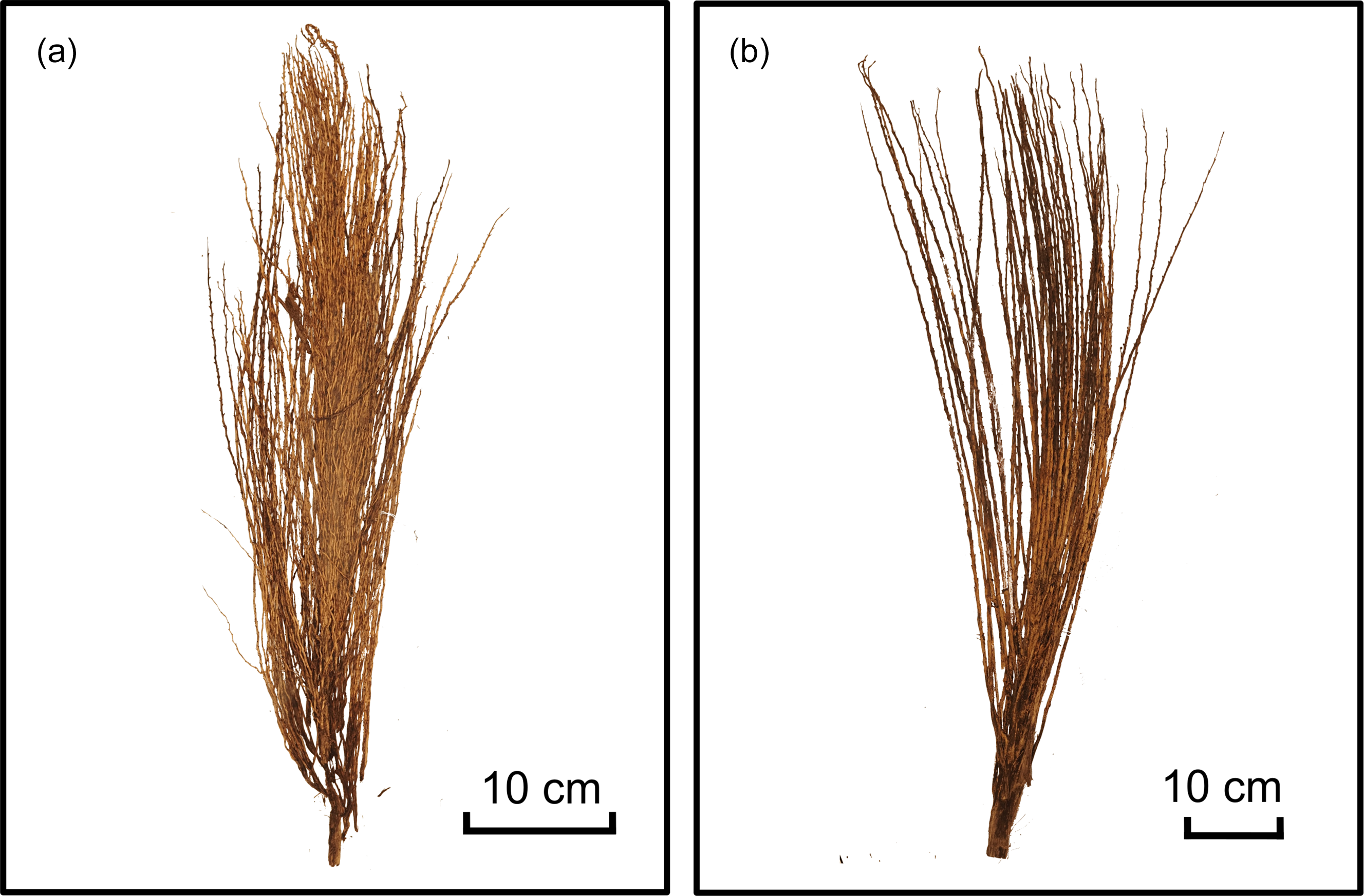
Ravenea latisecta Jum., described in 1927 from a single specimen collected by Perrier de la Bâthie in the Analamazaotra forest at c. 900 m elevation (H. Perrier de la Bâthie 12008: MARS), had not been confirmed in the wild since its original discovery (Jumelle, Reference Jumelle1927). With no evidence of its continued existence and no individuals in cultivation, it fitted the definition of a lost species (Long & Rodríguez, Reference Long and Rodríguez2022). Although some collections were labeled as R. latisecta (H.J. Beentje & H.R. Andriampaniry 4686, 4776: K, TAN; H.J. Beentje, J. Dransfield & H.R. Andriampaniry 4657: K, P, TAN), our examination revealed these are Ravenea madagascariensis Becc. or Ravenea robustior Jum. & H. Perrier. Only one specimen, with broad leaflets, remains uncertain, collected in 1992 in Mantadia (H.J. Beentje, J. Dransfield & H.R. Andriampaniry 4652: K, TAN). However, the field notes are brief, and no inflorescences were observed; it may correspond to a small R. robustior. According to Jumelle (Reference Jumelle1927), R. latisecta is distinguished, among other criteria, by its inflorescence morphology and leaflets. Male inflorescences are large, featuring long rachillae measuring 15–20 cm, females have a long peduncle (c. 60 cm) with rachillae 35–45 cm long, and the broad median leaflets measure 5–7 cm.
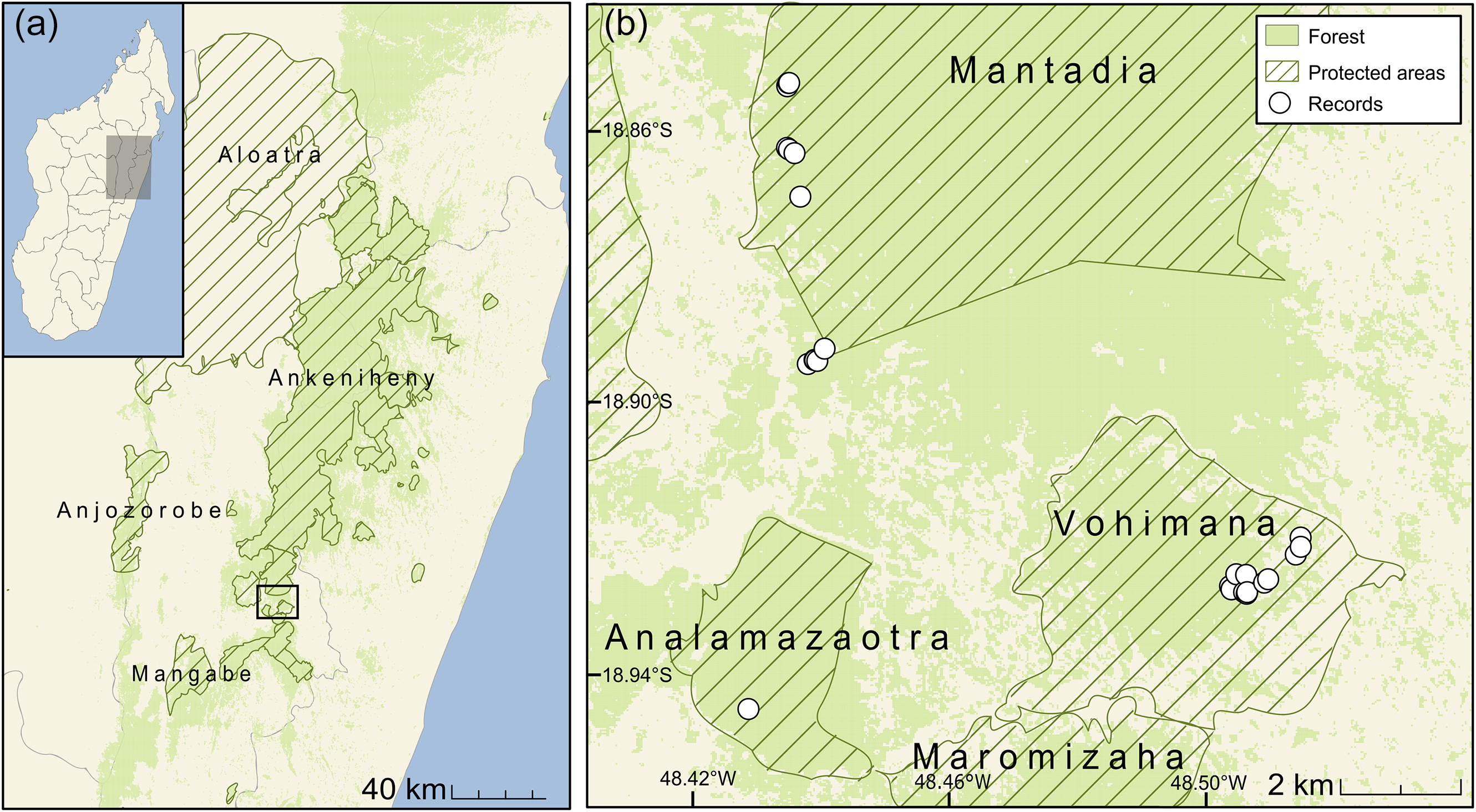
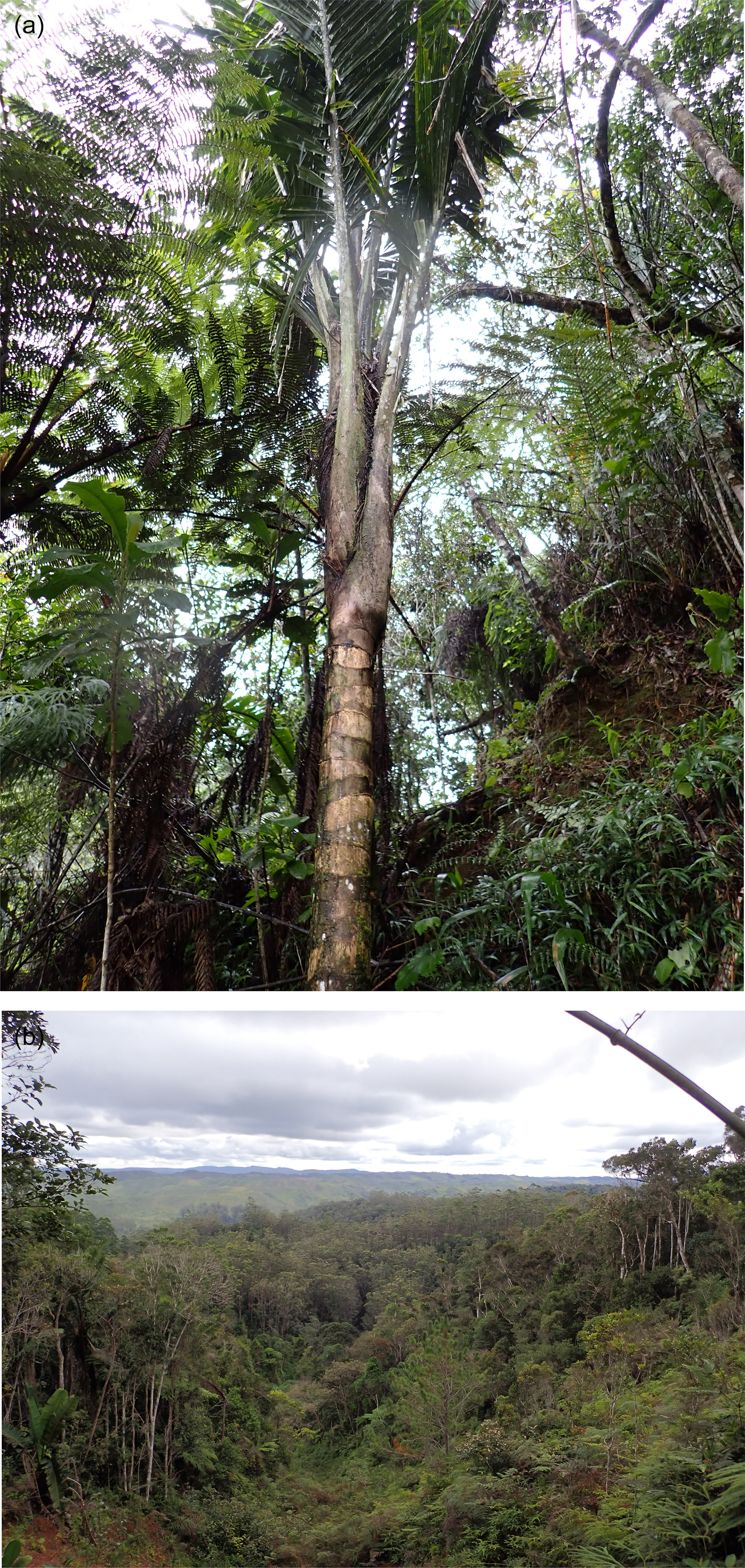
During fieldwork in April and May 2024, we rediscovered R. latisecta at four sites (Plate 1, Fig. 1): Vohimana Reserve, Analamazoatra National Park, Mantadia National Park and Vakona Forest private reserve (south-west Mantadia). These sites, in Madagascar’s eastern humid forests at 800–1,200 m, match the habitat described in Perrier’s original diagnosis of R. latisecta. Such refuges far from human habitation often harbour species presumed extinct as a result of anthropogenic pressure (Crowley, Reference Crowley2011). In total, we found 28 R. latisecta in the Andasibe region and surrounding areas, most of them within protected areas (Fig. 1); we collected 11 specimens (L. Aureglia & B. Vila LA246, LA280, LA281, LA301, LA302, LA318, LA322, LA329, LA330, LA332, LA333: MARS, TAN). Identification of R. latisecta was based on morphological characteristics, particularly its notably broad leaflets, a key diagnostic feature, as well as observations of male and female specimens in the field (Plate 2).
(a) Regional context for the location of Ravenea latisecta in central-eastern Madagascar, with forest and protected areas for reference. (b) The 28 records of the species in Andasibe, mostly within protected areas in the Mantadia–Vohimana region. Protected area boundaries and forest cover are based on UNEP-WCMC & IUCN (2025) and Hansen et al. (Reference Hansen, Potapov, Moore, Hancher, Turubanova and Tyukavina2013), respectively.
(a) Habit of Ravenea latisecta, and (b) the species’ typical habitat in southern Mantadia forest, within the Vakona Forest private reserve. Photographs: L. Aureglia.
(a) Male inflorescence (LA246) and (b) female inflorescence (LA333) of R. latisecta, shown without peduncles, displaying only the rachillae.
We recorded each subpopulation in the four sites in an area of < 5 km². GeoCAT analysis (Bachman et al., Reference Bachman, Moat, Hill, De La Torre and Scott2011) gave an extent of occurrence of 50.2 km² and an area of occupancy of 28.0 km². As < 50 mature individuals are known, we recommend the species be categorized as Critically Endangered based on criterion D (IUCN Standards and Petitions Committee, 2024). Should future surveys locate > 50 mature plants, it could then meet the thresholds for Endangered under criteria B1ab(iii)+2ab(iii), extent of occurrence < 100 km² (B1), area of occupancy < 500 km² (B2), a small number of locations (a) and a continuing decline in habitat quality (b)(iii). These small populations remain vulnerable to threats such as tavy and illegal exploitation, which sometimes occur even within reserve boundaries. Although we observed no local use, the vulnerability of palms and documented use of other Malagasy species make future impacts plausible (Rakotoarinivo et al., Reference Rakotoarinivo, Andriambololonera, Beentje, Couvreur, Rafidison and Rahanitriniaina2020; Frappier-Brinton & Lehman, Reference Frappier-Brinton and Lehman2022). Further fieldwork is needed to confirm the full extent of the distribution, population structure and any threats. Nonetheless, the available information points to high conservation concern for R. latisecta.
Although fire is less frequent inside protected areas, edge effects and limited management still pose risks (Waeber et al., Reference Waeber, Rafanoharana, Andry Rasamuel, Wilmé, Naqiyuddin Bakar and Nazip Suratman2020; Frappier-Brinton & Lehman, Reference Frappier-Brinton and Lehman2022), but the presence of R. latisecta across national parks, community-managed and private reserves is encouraging for its conservation. To secure its long-term survival, the priorities are to investigate flowering phenology and population-level sex ratios in this dioecious palm, as the current absence of fruiting individuals constrains ex situ conservation. In parallel, an integrated strategy, strengthening in situ protection, ex situ seed-banking, and engagement of local communities, follows approaches advocated for other extremely narrowly endemic plants (Wu et al., Reference Wu, Wu and Zhang2023). The rediscovery of R. latisecta highlights Andasibe’s overlooked botanical richness and demonstrates the value of targeted surveys in other priority Key Biodiversity Areas where additional species presumed lost may persist (Rakotoarinivo et al., Reference Rakotoarinivo, Andriambololonera, Beentje, Couvreur, Rafidison and Rahanitriniaina2020). Ravenea latisecta could serve as a local flagship for ecotourism and conservation. The conservation implications of our rediscovery include the need to strengthen management of protected areas, pursue ex situ propagation and engage local communities to mitigate threats such as tavy and illegal exploitation.
Author contributions
Study design, fieldwork: LA, BV; data analysis, writing: all authors.
Acknowledgements
We thank our Malagasy colleagues and the staff of Analamazoatra–Mantadia National Park, Vohimana Reserve and Vakona Forest private reserve for their expertise and assistance; the Direction Régionale de l’Environnement et du Développement Durable of Moramanga for their collaboration and for authorization to conduct this research; and the herbarium staff at TAN, K and P. Fieldwork was made possible thanks to funding from Institut de Recherche et Développement. This work is part of LA’s PhD, funded by the Ministère de l’Enseignement supérieur, de la Recherche et de l’Innovation, France, through the doctoral school ED 251 in Environmental Sciences at Aix-Marseille University.
Conflicts of interest
None.
Ethical standards
This research complied with the Oryx ethical standards. Permission for plant collection and export was granted by Madagascar National Parks and the Madagascan Ministry of the Environment under permit No. 085/24/MEEF/SG/DGGE/DAPRNE/SCB.Re.
Data availability
The occurrence data for R. latisecta have been shared with the management teams of all protected areas where the species was recorded. Location data are not publicly available, to preserve the species, but can be provided upon reasonable request.


 Open access

