









1 Introduction
A major problem in mathematical fluid mechanics is to describe the inviscid limit of Navier-Stokes flows in the presence of a boundary. This is due to the mismatch of boundary conditions for the Navier-Stokes velocity field (the “no-slip” or Dirichlet boundary condition), and that of a generic Euler velocity field (the “no penetration” condition). In order to aptly characterize the inviscid limit (in suitably strong norms), in [Reference PrandtlPr1904] Prandtl proposed, in the precise setting of 2D, stationary flows considered here, the existence of a thin “boundary layer”, $(\bar {u}_p, \bar {v}_p)$
, which transitions the Dirichlet boundary condition to an outer Euler flow.
$(\bar {u}_p, \bar {v}_p)$
, which transitions the Dirichlet boundary condition to an outer Euler flow.
The introduction of the Prandtl ansatz has had a monumental impact in physical and engineering applications, specifically in the 2D, steady setting, which is used to model flows over an airplane wing, design of golf balls, etc. (see [Reference Schlichting and GerstenSch00], for instance). However, its mathematical validity has largely been in question since its inception. Validating the Prandtl ansatz is an issue of asymptotic stability of the profiles $(\bar {u}_p, \bar {v}_p)$
:
$(\bar {u}_p, \bar {v}_p)$
: $u^\varepsilon \rightarrow \bar {u}_p$
and
$u^\varepsilon \rightarrow \bar {u}_p$
and $v^\varepsilon \rightarrow \bar {v}_p$
as the viscosity,
$v^\varepsilon \rightarrow \bar {v}_p$
as the viscosity, $\varepsilon $
, tends to zero (again, in an appropriate sense). Establishing this type of stability (or instability) has inspired several works, which we shall detail in Section 1.5. The main purpose of this work is to provide an affirmation of Prandtl’s ansatz, in the precise setting of his seminal 1904 work (2D, stationary flows), most notably globally in the variable, x, (with asymptotics as
$\varepsilon $
, tends to zero (again, in an appropriate sense). Establishing this type of stability (or instability) has inspired several works, which we shall detail in Section 1.5. The main purpose of this work is to provide an affirmation of Prandtl’s ansatz, in the precise setting of his seminal 1904 work (2D, stationary flows), most notably globally in the variable, x, (with asymptotics as $x \rightarrow \infty $
) which plays the role of a “time” variable in this setting.
$x \rightarrow \infty $
) which plays the role of a “time” variable in this setting.
Section 1.3 will contain more discussion on the role of the tangential variable, x. Physically, the importance of this “time” variable dates back to Prandtl’s original work, in which he says:
“The most important practical result of these investigations is that, in certain cases, the flow separates from the surface at a point [ $x_\ast $
] entirely determined by external conditions… As shown by closer consideration, the necessary condition for the separation of the flow is that there should be a pressure increase along the surface in the direction of the flow.” (L. Prandtl, 1904, [Reference PrandtlPr1904])
$x_\ast $
] entirely determined by external conditions… As shown by closer consideration, the necessary condition for the separation of the flow is that there should be a pressure increase along the surface in the direction of the flow.” (L. Prandtl, 1904, [Reference PrandtlPr1904])
In this work, we provide the first rigorous confirmation, for the Navier-Stokes equations, that in the conjectured stable regime (in the absence of a pressure increase), the flow does not separate as $x \rightarrow \infty $
. Rather, we prove that the flow relaxes back to the classical self-similar Blasius profiles, introduced by H. Blasius in [Reference BlasiusBlas1908], which we also introduce and discuss in Section 1.3.
$x \rightarrow \infty $
. Rather, we prove that the flow relaxes back to the classical self-similar Blasius profiles, introduced by H. Blasius in [Reference BlasiusBlas1908], which we also introduce and discuss in Section 1.3.
1.1 The setting
First, we shall introduce the particular setting of our work in more precise terms. We consider the Navier-Stokes (NS) equations, with viscosity parameter $\varepsilon> 0$
, posed on the domain
$\varepsilon> 0$
, posed on the domain $\mathcal {Q} := (0, \infty ) \times (0, \infty )$
:
$\mathcal {Q} := (0, \infty ) \times (0, \infty )$
:
 $$ \begin{align} &u^\varepsilon u^\varepsilon_x + v^\varepsilon u^\varepsilon_Y + P^\varepsilon_x = \varepsilon \Delta u^\varepsilon, \end{align} $$
 $$ \begin{align} &u^\varepsilon v^\varepsilon_x + v^\varepsilon v^\varepsilon_Y + P^\varepsilon_Y = \varepsilon \Delta v^\varepsilon, \end{align} $$
 $$ \begin{align} &u^\varepsilon_x + v^\varepsilon_Y = 0.\end{align} $$
This system is supplemented with the following vertical boundary conditions
 $$ \begin{align} &[u^\varepsilon, v^\varepsilon]|_{Y = 0} = [0,0], \qquad [u^\varepsilon(x,Y), v^\varepsilon(x,Y)] \xrightarrow{Y \rightarrow \infty} [u_E(x,\infty), v_E(x,\infty)]. \end{align} $$
The condition at $\{Y = 0\}$
is the classical no-slip boundary condition, and the condition as
$\{Y = 0\}$
is the classical no-slip boundary condition, and the condition as $Y \rightarrow \infty $
is known as the Euler matching condition. We now fix the Euler flow to be
$Y \rightarrow \infty $
is known as the Euler matching condition. We now fix the Euler flow to be
 $$ \begin{align} [u_E, v_E] := [1, 0], \qquad P_E = 0. \end{align} $$
Indeed, it is easy to see that $[u_E, v_E, p_E]$
solve the steady, Euler equations (
$[u_E, v_E, p_E]$
solve the steady, Euler equations ( $\varepsilon = 0$
in (1.1)–(1.3)). The matching condition as
$\varepsilon = 0$
in (1.1)–(1.3)). The matching condition as $Y \rightarrow \infty $
above now reads
$Y \rightarrow \infty $
above now reads $[u^\varepsilon , v^\varepsilon ] \xrightarrow {Y \rightarrow \infty } [1, 0]$
.
$[u^\varepsilon , v^\varepsilon ] \xrightarrow {Y \rightarrow \infty } [1, 0]$
.
Typically, there is a discrepancy of boundary conditions at $\{Y = 0\}$
between the viscous flow, (1.4), which satisfies the no-slip condition, and that of an ideal, inviscid flow, which usually satisfies the no-penetration condition,
$\{Y = 0\}$
between the viscous flow, (1.4), which satisfies the no-slip condition, and that of an ideal, inviscid flow, which usually satisfies the no-penetration condition, $v^E|_{Y = 0} = 0$
. It is therefore not expected to have convergence of the type
$v^E|_{Y = 0} = 0$
. It is therefore not expected to have convergence of the type $[u^\varepsilon , v^\varepsilon ] \rightarrow [1, 0]$
as
$[u^\varepsilon , v^\varepsilon ] \rightarrow [1, 0]$
as $\varepsilon \rightarrow \infty $
in suitably strong norms, for instance in the
$\varepsilon \rightarrow \infty $
in suitably strong norms, for instance in the $L^\infty $
sense. To appropriately describe the inviscid limit, Ludwig Prandtl proposed his famous boundary layer ansatz in his seminal 1904 paper, [Reference PrandtlPr1904]. Physically, it says that one needs to add a corrector term to
$L^\infty $
sense. To appropriately describe the inviscid limit, Ludwig Prandtl proposed his famous boundary layer ansatz in his seminal 1904 paper, [Reference PrandtlPr1904]. Physically, it says that one needs to add a corrector term to $[1, 0]$
which is effectively supported in a thin layer of size
$[1, 0]$
which is effectively supported in a thin layer of size $\sqrt {\varepsilon }$
near
$\sqrt {\varepsilon }$
near $\{Y = 0\}$
. Mathematically, this can be represented by an ansatz of the type
$\{Y = 0\}$
. Mathematically, this can be represented by an ansatz of the type
 $$ \begin{align} u^\varepsilon(x, Y) = 1 + u^0_p(x, \frac{Y}{\sqrt{\varepsilon}}) + O(\sqrt{\varepsilon}) = \bar{u}^0_p(x, \frac{Y}{\sqrt{\varepsilon}}) + O(\sqrt{\varepsilon}), \end{align} $$
The quantity $\bar {u}^0_p$
is the classical Prandtl boundary layer, whereas we will refer to the
$\bar {u}^0_p$
is the classical Prandtl boundary layer, whereas we will refer to the $O(\sqrt {\varepsilon })$
term as “the remainder”. The purpose of this paper is to rigorously prove that the remainder is, indeed,
$O(\sqrt {\varepsilon })$
term as “the remainder”. The purpose of this paper is to rigorously prove that the remainder is, indeed, $O(\sqrt {\varepsilon })$
. It is natural to introduce the boundary layer variable,
$O(\sqrt {\varepsilon })$
. It is natural to introduce the boundary layer variable,
 $$ \begin{align} y := \frac{Y}{\sqrt{\varepsilon}}. \end{align} $$
We now rescale the Navier-Stokes velocity field via
 $$ \begin{align} U^\varepsilon(x, y) := u^\varepsilon(x, Y), \qquad V^\varepsilon(x, y) := \frac{v^\varepsilon(x, Y)}{\sqrt{\varepsilon}}. \end{align} $$
The rescaled field satisfies the following rescaled version of the Navier-Stokes system,
 $$ \begin{align} &U^\varepsilon U^\varepsilon_x + V^\varepsilon U^\varepsilon_y + P^\varepsilon_x = \Delta_\varepsilon U^\varepsilon, \end{align} $$
 $$ \begin{align}&U^\varepsilon V^\varepsilon_x + V^\varepsilon V^\varepsilon_y + \frac{P^\varepsilon_y}{\varepsilon} = \Delta_\varepsilon V^\varepsilon, \end{align} $$
 $$ \begin{align} &U^\varepsilon_x + V^\varepsilon_y = 0. \end{align} $$
Above, we have denoted the scaled Laplacian operator,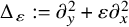 $\Delta _\varepsilon := \partial _y^2 + \varepsilon \partial _x^2$
.
$\Delta _\varepsilon := \partial _y^2 + \varepsilon \partial _x^2$
.
The main upshot of the ansatz (1.6), is that the Prandtl boundary layer, $\bar {u}^0_p$
, satisfies a much simpler reduced equation known as the Prandtl system,
$\bar {u}^0_p$
, satisfies a much simpler reduced equation known as the Prandtl system,
 $$ \begin{align} &\bar{u}^0_p \partial_x \bar{u}^0_p + \bar{v}^0_p \partial_y \bar{u}^0_p - \partial_y^{2} \bar{u}^0_p + P^{0}_{px} = 0, \qquad P^0_{py} = 0, \qquad \partial_x \bar{u}^0_p + \partial_y \bar{v}^0_p = 0, \end{align} $$
which are supplemented with the boundary conditions
 $$ \begin{align} &\bar{u}^0_p|_{x = 0} = \bar{U}^0_p(y), \qquad \bar{u}^0_p|_{y = 0} = 0, \qquad \bar{u}^0_p|_{y = \infty} = 1, \qquad \bar{v}^0_p = - \int_0^y \partial_x \bar{u}^0_p. \end{align} $$
This reduced system is simpler than the full Navier-Stokes system, (1.9) - (1.11), in many ways. First, due to the condition $P^0_{py} = 0$
, we obtain that the pressure is constant in y (and then in x due to the Bernoulli’s equation). This is known as Bernoulli’s law, and the main consequence is that (1.12) is really a scalar equation, which is a major simplification mathematically (for instance, it allows the use of maximum principle techniques, which are difficult to use for the Navier-Stokes system). Second, the scaling of the equation changes. Indeed, by formally identifying
$P^0_{py} = 0$
, we obtain that the pressure is constant in y (and then in x due to the Bernoulli’s equation). This is known as Bernoulli’s law, and the main consequence is that (1.12) is really a scalar equation, which is a major simplification mathematically (for instance, it allows the use of maximum principle techniques, which are difficult to use for the Navier-Stokes system). Second, the scaling of the equation changes. Indeed, by formally identifying $\bar {u}^0_p \partial _x \approx \partial _{yy}$
, one concludes that (1.13) is in fact, a parabolic equation in x, which is in stark contrast to the elliptic system (1.9)–(1.11). Therefore, for the boundary layer, the tangential variable x behaves as a time-like variable, whereas the vertical variable y behaves space-like. Therefore, one usually treats (1.12)–(1.13) as one would a typical Cauchy problem, with inflow datum at
$\bar {u}^0_p \partial _x \approx \partial _{yy}$
, one concludes that (1.13) is in fact, a parabolic equation in x, which is in stark contrast to the elliptic system (1.9)–(1.11). Therefore, for the boundary layer, the tangential variable x behaves as a time-like variable, whereas the vertical variable y behaves space-like. Therefore, one usually treats (1.12)–(1.13) as one would a typical Cauchy problem, with inflow datum at $\{x = 0\}$
serving as initial data. The relevant questions then become that of local (in x) wellposedness and regularity theory, global (in x) wellposedness, finite-x singularity formation, development beyond a singularity, decay and asymptotics, etc,…
$\{x = 0\}$
serving as initial data. The relevant questions then become that of local (in x) wellposedness and regularity theory, global (in x) wellposedness, finite-x singularity formation, development beyond a singularity, decay and asymptotics, etc,…
1.2 Asymptotics as $\varepsilon \rightarrow 0$

The primary objective of our work is to provide a definitive theorem on the validity of the boundary layer theory in the $L^\infty $
inviscid limit (which we state somewhat imprecisely for the moment)
$L^\infty $
inviscid limit (which we state somewhat imprecisely for the moment)
 $$ \begin{align} \| u^{\varepsilon} - \bar{u}^0_p \|_{L^\infty} \lesssim \varepsilon^{\frac 1 2}, \qquad \| v^{\varepsilon} \|_{L^\infty} \lesssim \varepsilon^{\frac 1 2}, \end{align} $$
which is a central open problem in mathematical fluid mechanics. Although (1.14) is a classical ansatz (in fact, Prandtl’s original proposal [Reference PrandtlPr1904] was in precisely this setting of 2D stationary flows over a plate), the rigorous justification of (1.14) in the steady setting has only been obtained very recently, see [Reference Guo and IyerGI18a], [Reference Guo and IyerGI18c], [Reference Gerard-Varet and MaekawaGVM18], [Reference Guo and NguyenGN14] for instance. All of these works crucially required $x << 1$
to prove the inviscid limit, (1.14). In the present paper, we are interested in proving the inviscid limit globally in the x variable.
$x << 1$
to prove the inviscid limit, (1.14). In the present paper, we are interested in proving the inviscid limit globally in the x variable.
One way to establish the stability (1.14) is to propose an expansion of the rescaled solution, $(U^\varepsilon , V^\varepsilon )$
as
$(U^\varepsilon , V^\varepsilon )$
as
 $$ \begin{align} \begin{aligned} &U^\varepsilon := 1 + u^0_p + \sum_{i = 1}^{N_{1}} \varepsilon^{\frac{i}{2}} (u^i_E + u^i_p) + \varepsilon^{\frac{N_2}{2}} u =: \bar{u} + \varepsilon^{\frac{N_2}{2}} u \\ &V^\varepsilon := v^0_p + v^1_E + \sum_{i = 1}^{N_{1}-1} \varepsilon^{\frac i 2} (v^i_p + v^{i+1}_E) + \varepsilon^{\frac{N_{1}}{2}} v^{N_{1}}_p + \varepsilon^{\frac{N_2}{2}} v =: \bar{v} + \varepsilon^{\frac{N_2}{2}} v, \\ &P^\varepsilon := \sum_{i = 0}^{N_1+1} \varepsilon^{\frac{i}{2}} P^i_p + \sum_{i = 1}^{N_{1}} \varepsilon^{\frac{i}{2}} P^i_E + \varepsilon^{\frac{N_2}{2}} P = \bar{P} + \varepsilon^{\frac{N_2}{2}}P. \end{aligned} \end{align} $$
Above,
 $$ \begin{align} [u^0_E, v^0_E] := [1, 0], \qquad [u^i_p, v^i_p] = [u^i_p(x, y), v^i_p(x, y)], \qquad [u^i_E, v^i_E] = [u^i_E(x, Y), v^i_E(x, Y)], \end{align} $$
and the expansion parameters $N_{1}, N_2$
will be specified in Theorem 1.1 for the sake of precision. Our goal in this work is not to optimize these parameters, and hence we chose them large for simplicity.
$N_{1}, N_2$
will be specified in Theorem 1.1 for the sake of precision. Our goal in this work is not to optimize these parameters, and hence we chose them large for simplicity.
The basic strategy to establish the convergence (1.14) consists of first constructing an approximate solution, $[\bar {u}, \bar {v}]$
, and second in controlling the remainders
$[\bar {u}, \bar {v}]$
, and second in controlling the remainders $[u, v]$
from (1.15). In our setting, the construction of the approximate solution has been done in [Reference Iyer and MasmoudiIM21], whereas the current manuscript is devoted to the remainder analysis. Constructing the approximate solutions involves studying the Prandtl layer,
$[u, v]$
from (1.15). In our setting, the construction of the approximate solution has been done in [Reference Iyer and MasmoudiIM21], whereas the current manuscript is devoted to the remainder analysis. Constructing the approximate solutions involves studying the Prandtl layer, $[\bar {u}^0_p, \bar {v}^0_p]$
(and the corresponding linearized equations), as well as Euler profiles. Importantly, these Prandtl layers are scalar equations. Indeed, it is well-known that one of the main simplifications of the Prandtl ansatz is that the Prandtl system is scalar (the pressure is absent) whereas the Navier-Stokes system is vectorial. For this reason, the study of the remainders
$[\bar {u}^0_p, \bar {v}^0_p]$
(and the corresponding linearized equations), as well as Euler profiles. Importantly, these Prandtl layers are scalar equations. Indeed, it is well-known that one of the main simplifications of the Prandtl ansatz is that the Prandtl system is scalar (the pressure is absent) whereas the Navier-Stokes system is vectorial. For this reason, the study of the remainders $[u, v]$
is substantially more nontrivial (and requires different tools). A fundamental difficulty in controlling the remainders
$[u, v]$
is substantially more nontrivial (and requires different tools). A fundamental difficulty in controlling the remainders $(u, v, P)$
in (1.15) is that they inherit the vectorial system from the full Navier-Stokes system, which imposes significant constraints on the available tools.
$(u, v, P)$
in (1.15) is that they inherit the vectorial system from the full Navier-Stokes system, which imposes significant constraints on the available tools.
The commonality between the works [Reference Guo and IyerGI18a] and [Reference Gerard-Varet and MaekawaGVM18] is, in a sense, to split the linearized Navier-Stokes system, classically known as the Orr-Sommerfeld (OS) operator (see below, (1.45)–(1.46) for the precise form of this operator), governing the remainders $(u, v)$
into two favorable pieces. These two pieces, which will be discussed more precisely in Section 1.6 once we introduce the relevant operators, are the linearized transport (Rayleigh) and the diffusion (Airy). In [Reference Gerard-Varet and MaekawaGVM18], this is done explicitly using a delicate Rayleigh-Airy iteration, whereas in [Reference Guo and IyerGI18a] this is done more implicitly through an involved series of virial-type weighted energy estimates. Nevertheless, both works rely on the ability to (essentially) split the linearized (OS) operator into separate pieces that can be analyzed explicitly. The procedure of putting this iteration together, or closing the various estimates, requires crucially that
$(u, v)$
into two favorable pieces. These two pieces, which will be discussed more precisely in Section 1.6 once we introduce the relevant operators, are the linearized transport (Rayleigh) and the diffusion (Airy). In [Reference Gerard-Varet and MaekawaGVM18], this is done explicitly using a delicate Rayleigh-Airy iteration, whereas in [Reference Guo and IyerGI18a] this is done more implicitly through an involved series of virial-type weighted energy estimates. Nevertheless, both works rely on the ability to (essentially) split the linearized (OS) operator into separate pieces that can be analyzed explicitly. The procedure of putting this iteration together, or closing the various estimates, requires crucially that $x << 1$
(short time) in both works. We emphasize that both of the works, [Reference Guo and IyerGI18a] and [Reference Gerard-Varet and MaekawaGVM18] dealing with the
$x << 1$
(short time) in both works. We emphasize that both of the works, [Reference Guo and IyerGI18a] and [Reference Gerard-Varet and MaekawaGVM18] dealing with the $x << 1$
inviscid limit are very delicate and involved.
$x << 1$
inviscid limit are very delicate and involved.
Our starting point is a new way of producing estimates for the classical Orr-Sommerfeld linearized operator, which avoids this splitting and instead capitalizes on a cancellation between the two components, Rayleigh and Airy, which produces a damping as $x \rightarrow \infty $
. This damping mechanism is inspired by the classical von-Mise transform that is known for the Prandtl equations, but has yet to be exploited in the OS framework and in the inviscid limit.
$x \rightarrow \infty $
. This damping mechanism is inspired by the classical von-Mise transform that is known for the Prandtl equations, but has yet to be exploited in the OS framework and in the inviscid limit.
1.2.1 Prescribed data
The data for the Navier-Stokes velocity field, $[U^\varepsilon , V^\varepsilon ]$
is prescribed through the expansion, which means that we prescribe the data that is required in order for each term in the expansion (1.15) to be constructed. We refer the reader to [Reference Iyer and MasmoudiIM21] for a more detailed discussion of the terms appearing in (1.15), although we review the essential facts again here. Vertically, we enforce
$[U^\varepsilon , V^\varepsilon ]$
is prescribed through the expansion, which means that we prescribe the data that is required in order for each term in the expansion (1.15) to be constructed. We refer the reader to [Reference Iyer and MasmoudiIM21] for a more detailed discussion of the terms appearing in (1.15), although we review the essential facts again here. Vertically, we enforce
 $$ \begin{align} &u^i_p(x, 0) = - u^i_E(x, 0), & &v^j_E(x, 0) = - v^{j-1}_p(x, 0), & &[u, v]|_{y = 0} = 0, \end{align} $$
 $$ \begin{align} &v^i_p(x, \infty) = u^i_p(x, \infty) = 0, & & u^j_E(x, \infty) = v^j_E(x, \infty) = 0, & &[u, v]|_{y = \infty} = 0. \end{align} $$
for $i = 0,...N_1$
,
$i = 0,...N_1$
, $j = 1, ... N_1$
. It is easy to see that in so doing, the no-slip boundary condition is ensured for
$j = 1, ... N_1$
. It is easy to see that in so doing, the no-slip boundary condition is ensured for $[U^\varepsilon , V^\varepsilon ]$
at
$[U^\varepsilon , V^\varepsilon ]$
at $y = 0, \infty $
. We note that our convention is to define
$y = 0, \infty $
. We note that our convention is to define $v^i_p$
to vanish at
$v^i_p$
to vanish at $y = \infty $
(
$y = \infty $
(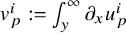 $v^i_p := \int _y^\infty \partial _x u^i_p$
), whereas we denote by
$v^i_p := \int _y^\infty \partial _x u^i_p$
), whereas we denote by $\bar {v}^i_p$
to be the more conventional choice which vanishes at
$\bar {v}^i_p$
to be the more conventional choice which vanishes at $y = 0$
, (
$y = 0$
, (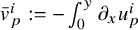 $\bar {v}^i_p := -\int _0^y \partial _x u^i_p$
).
$\bar {v}^i_p := -\int _0^y \partial _x u^i_p$
).
The expansion (1.15) is, in a sense, part of the data. That is, we assume that the Navier-Stokes velocity field $[U^\varepsilon , V^\varepsilon ]$
attains the expansion (1.15) initially at
$[U^\varepsilon , V^\varepsilon ]$
attains the expansion (1.15) initially at $\{x = 0\}$
, and then aim to prove that this expansion propagates for
$\{x = 0\}$
, and then aim to prove that this expansion propagates for $x> 0$
. We refer the reader to works [Reference Guo and IyerGI18a], [Reference Guo and NguyenGN14] in the stationary setting or [Reference Sammartino and CaflischSC98], [Reference Sammartino and CaflischSC98] in the dynamical setting where this is done (and discussed more). Indeed, in all these works, one assumes the prescribed data is in the form of an asymptotic expansion. Then the main result is to show that this expansion persists (in the stationary setting this means for
$x> 0$
. We refer the reader to works [Reference Guo and IyerGI18a], [Reference Guo and NguyenGN14] in the stationary setting or [Reference Sammartino and CaflischSC98], [Reference Sammartino and CaflischSC98] in the dynamical setting where this is done (and discussed more). Indeed, in all these works, one assumes the prescribed data is in the form of an asymptotic expansion. Then the main result is to show that this expansion persists (in the stationary setting this means for $x> 0$
, whereas in the dynamical setting this means for
$x> 0$
, whereas in the dynamical setting this means for $t> 0$
), and that the resulting unknown quantities can be controlled.
$t> 0$
), and that the resulting unknown quantities can be controlled.
Given this, there are two categories of “prescribed data” for the problem at hand:
-
(1) the inviscid Euler profiles,
-
(2) initial datum at
$\{x = 0\}$
(for relevant quantities from (1.15)).

As discussed above, we take the inviscid Euler profile to be the simplest shear flow,
 $$ \begin{align} [u^0_E, v^0_E, P^0_E] := [1, 0, 0]. \end{align} $$
At $\{x=0\}$
, we prescribe
$\{x=0\}$
, we prescribe
 $$ \begin{align} u^i_p|_{x = 0} =: U^i_P(y), \qquad v^j_E|_{x = 0} =: V^j_E(Y), \end{align} $$
for $i = 0,...,N_1$
, and
$i = 0,...,N_1$
, and $j = 1,..,N_1$
. These profiles can be interpreted physically as “in-flow” data. Since
$j = 1,..,N_1$
. These profiles can be interpreted physically as “in-flow” data. Since $u^i_p$
obeys an evolution in x, the in-flow data at
$u^i_p$
obeys an evolution in x, the in-flow data at $\{x = 0\}$
will be sufficient to construct the solution. The Euler profiles
$\{x = 0\}$
will be sufficient to construct the solution. The Euler profiles $[u^i_E, v^i_E]$
for
$[u^i_E, v^i_E]$
for $i = 1,..,N_1$
are constructed by solving an elliptic problem for
$i = 1,..,N_1$
are constructed by solving an elliptic problem for $v^i_E$
, which requires only the datum for
$v^i_E$
, which requires only the datum for $v^i_E$
. We refer the reader to [Reference Iyer and MasmoudiIM21] for the construction of the various terms in the alternating Euler-Prandtl expansion.
$v^i_E$
. We refer the reader to [Reference Iyer and MasmoudiIM21] for the construction of the various terms in the alternating Euler-Prandtl expansion.
1.3 Blasius self-similar profiles
The large x behavior of both the Prandtl equations and the Navier-Stokes equations in the stationary setting is important from a mathematical standpoint due to the analogy with global wellposedness versus singularity formation in a variety of other equations. However, it is also important from a physical standpoint due to the possibility of boundary layer separation, which is a large x phenomena, [Reference PrandtlPr1904]. The following dichotomy was proposed by Prandtl in [Reference PrandtlPr1904]:
-
(1) Favorable pressure gradient (
$\partial _x P^E \le 0$
): the boundary layer exists globally in x, and becomes asymptotically self-similar, -
(2) Unfavorable pressure gradient (
$\partial _x P^E> 0$
): the boundary layer may “separate.”


Clearly, all shear outer Euler flows (our particular choice of $[1, 0]$
is the simplest such shear flow), are x-independent and satisfy
$[1, 0]$
is the simplest such shear flow), are x-independent and satisfy $\partial _x p^E = 0$
. Therefore, our setting in this paper is in the favorable pressure gradient case.
$\partial _x p^E = 0$
. Therefore, our setting in this paper is in the favorable pressure gradient case.
Oleinik, [Reference Oleinik and SamokhinOS99], [Reference OleinikOl67], established the first mathematical results on the stationary Prandtl system, (1.12)–(1.13). She showed that solutions to (1.12)–(1.13) are locally (in x) well-posed in both regimes (1) and (2), and globally (in x) well-posed in regime (1) (under suitable hypothesis on the datum).
In 1908, H. Blasius introduced the classical “Blasius boundary layer”, [Reference BlasiusBlas1908], which are self-similar solutions to the Prandtl system defined as follows,
 $$ \begin{align} &[\bar{u}_\ast^{x_0}, \bar{v}_\ast^{x_0}] = [f'(z), \frac{1}{\sqrt{x + x_0}} (z f'(z) - f(z)) ], \end{align} $$
 $$ \begin{align} &z := \frac{y}{\sqrt{x + x_0}} \end{align} $$
 $$ \begin{align} &ff" + f"' = 0, \qquad f'(0) = 0, \qquad f'(\infty) = 1, \qquad \frac{f(z)}{z} \xrightarrow{z \rightarrow \infty} 1. \end{align} $$
Above, we use the notation $f' = \partial _z f(z)$
and
$f' = \partial _z f(z)$
and $x_0$
is a free parameter. Physically,
$x_0$
is a free parameter. Physically, $x_0$
has the interpretation that
$x_0$
has the interpretation that $x = - x_0$
is “leading edge” of a plate (which is the reason for the apparent singularity at
$x = - x_0$
is “leading edge” of a plate (which is the reason for the apparent singularity at $x = - x_0$
). The analysis in this paper will treat any fixed
$x = - x_0$
). The analysis in this paper will treat any fixed $x_0> 0$
(one can think, without loss of generality, that
$x_0> 0$
(one can think, without loss of generality, that $x_0 = 1$
, after which we will denote by
$x_0 = 1$
, after which we will denote by $\langle x \rangle := x + 1$
). Therefore, we will adopt the following notational convention:
$\langle x \rangle := x + 1$
). Therefore, we will adopt the following notational convention:
 $$ \begin{align} [\bar{u}_\ast, \bar{v}_\ast] := [\bar{u}_\ast^{1}, \bar{v}_\ast^{1}]. \end{align} $$
The profile $f(z)$
has the property that
$f(z)$
has the property that $f'(z)$
converges exponentially to
$f'(z)$
converges exponentially to $1$
as
$1$
as $z \rightarrow \infty $
, [Reference SerrinSer66]. Physically, this corresponds to a rapid convergence of the tangential velocity,
$z \rightarrow \infty $
, [Reference SerrinSer66]. Physically, this corresponds to a rapid convergence of the tangential velocity, $\bar {u}_\ast $
to the outer Euler velocity.
$\bar {u}_\ast $
to the outer Euler velocity.
The Blasius solutions are known to have demonstrated strong agreement with experiments on laminar flows over a plate, [Reference Schlichting and GerstenSch00]. Mathematically, they are self-similar, large-x attractors for the Prandtl dynamics (which is referred to as “downstream” dynamics). Indeed, a classical result of Serrin, [Reference SerrinSer66], obtains the large x convergence:
 $$ \begin{align} \lim_{x \rightarrow \infty} \| \bar{u}^0_p - \bar{u}_\ast \|_{L^\infty_y} \rightarrow 0 \end{align} $$
for a general class of solutions, $[\bar {u}^0_p, \bar {v}^0_p]$
of (1.12). We note that this convergence is at the level of the Prandtl system.
$[\bar {u}^0_p, \bar {v}^0_p]$
of (1.12). We note that this convergence is at the level of the Prandtl system.
Our main contribution in this work is to prove the inviscid limit, (1.14), not only uniformly in x but also asymptotic as $x \rightarrow \infty $
for “initial data” near the Blasius self-similar profile. Our main theorem below establishes two pieces of asymptotic information as
$x \rightarrow \infty $
for “initial data” near the Blasius self-similar profile. Our main theorem below establishes two pieces of asymptotic information as $x \rightarrow \infty $
:
$x \rightarrow \infty $
:
 $$ \begin{align} \| u^\varepsilon - \bar{u}^0_p \|_{L^\infty_y} \lesssim \sqrt{\varepsilon} \langle x \rangle^{- \frac 1 4 + \sigma_\ast}, \qquad \| \bar{u}^0_p - \bar{u}_\ast \|_{L^\infty_y} \le o(1) \langle x \rangle^{- \frac 1 4 + \sigma_\ast}. \end{align} $$
1.4 Main theorem
The main result of our work is the following.
Theorem 1.1. Fix $N_{1} = 400$
and
$N_{1} = 400$
and $N_2 = 200$
in (1.15). Fix the outer Euler flow as follows:
$N_2 = 200$
in (1.15). Fix the outer Euler flow as follows:
 $$ \begin{align} [u^0_E, v^0_E, P^0_E] := [1, 0, 0]. \end{align} $$
Assume the following data at $\{x = 0\}$
are given for
$\{x = 0\}$
are given for $i = 0,...,N_{1}$
, and
$i = 0,...,N_{1}$
, and $j = 1,...N_1$
,
$j = 1,...N_1$
,
 $$ \begin{align} u^i_p|_{x = 0} =: U^i_p(y), && v^j_E|_{x = 0} =: V_E^j(Y) \end{align} $$
where we make the following assumptions on the initial datum (1.28):
-
(1) For
$i = 0$
, the boundary layer datum
$\bar {U}^0_p(y)$
is in a neighborhood of Blasius, defined in (1.21): (1.29)where
$$ \begin{align} \| (\bar{U}^0_p(y) - \bar{u}_\ast(0, y) ) \langle y \rangle^{m_0} \|_{C^{\ell_0}} \le \delta_\ast, \end{align} $$
$0 < \delta _\ast << 1$
is small relative to universal constants, where
$m_0, \ell _0$
, are large, explicitly computable numbers. Assume also the difference
$\bar {U}^0_p(y) - \bar {u}_\ast (0, y)$
satisfies generic parabolic compatibility conditions at
$y = 0$
.
-
(2) For
$i = 1,..,N_1$
, the boundary layer datum,
$U^i_p(\cdot )$
is sufficiently smooth and decays rapidly: (1.30)where
$$ \begin{align} \| U^i_p \langle y \rangle^{m_i} \|_{C^{\ell_i}} \lesssim 1, \end{align} $$
$m_i, \ell _i$
are large, explicitly computable constants (for instance, we can take
$m_0 = 10,000$
,
$\ell _0 = 10,000$
and
$m_{i+1} = m_i - 5$
,
$\ell _{i + 1} = \ell _i - 5$
), and satisfies generic parabolic compatibility conditions at
$y = 0$
.Footnote 1
-
(3) The Euler datum
$V^i_E(Y)$
satisfies generic elliptic compatibility conditions.Footnote 2 -
(4) Assume Dirichlet datum for the remainders, that is
(1.31)
$$ \begin{align} [u, v]|_{x = 0} = [u, v]|_{x = \infty} = 0. \end{align} $$













Then there exists an $\varepsilon _0 << 1$
small relative to universal constants such that for every
$\varepsilon _0 << 1$
small relative to universal constants such that for every $0 < \varepsilon \le \varepsilon _0$
, there exists a unique solution
$0 < \varepsilon \le \varepsilon _0$
, there exists a unique solution $(u^\varepsilon , v^\varepsilon )$
to system (1.1)–(1.3), which satisfies the expansion (1.15) in the quadrant,
$(u^\varepsilon , v^\varepsilon )$
to system (1.1)–(1.3), which satisfies the expansion (1.15) in the quadrant, $\mathcal {Q}$
. Each of the intermediate quantities in the expansion (1.15) satisfies the following estimates for
$\mathcal {Q}$
. Each of the intermediate quantities in the expansion (1.15) satisfies the following estimates for $i = 1,...,N_1$
 $$ \begin{align} &\| \partial_x^k \partial_y^j u^i_p \langle z \rangle^M \|_{L^\infty_y} \le C_{M, k, j} \langle x \rangle^{- \frac 1 4 - k - \frac j 2 + \sigma_{\ast}} && \| v^i_p \|_{L^\infty_y} \le C_{M, k, j} \langle x \rangle^{- \frac 3 4 - k - \frac j 2 + \sigma_\ast} \end{align} $$
 $$ \begin{align} &\| \partial_x^k \partial_Y^j u^i_E \|_{L^\infty_y} \le C_{k,j} \langle x \rangle^{- \frac 1 2 - k - j} && \| v^i_E \|_{L^\infty_y} \le C_{k,j} \langle x \rangle^{- \frac 1 2 - k - j}, \end{align} $$
where $\sigma _\ast := \frac {1}{10,000}$
. Finally, the remainder
$\sigma _\ast := \frac {1}{10,000}$
. Finally, the remainder $(u, v)$
exists globally in the quadrant,
$(u, v)$
exists globally in the quadrant, $\mathcal {Q}$
, and satisfies the following estimates
$\mathcal {Q}$
, and satisfies the following estimates
 $$ \begin{align} \| u, v \|_{\mathcal{X}} \lesssim 1, \end{align} $$
where the space $\mathcal {X}$
will be defined precisely in (3.10).
$\mathcal {X}$
will be defined precisely in (3.10).
As an immediate corollary, we obtain the following asymptotics, which are valid uniformly for $\varepsilon \le \varepsilon _0$
and for all
$\varepsilon \le \varepsilon _0$
and for all $x> 0$
.
$x> 0$
.
Corollary 1.2. The solution $(u^\varepsilon , v^\varepsilon )$
to (1.1)–(1.3) satisfies the following asymptotics
$(u^\varepsilon , v^\varepsilon )$
to (1.1)–(1.3) satisfies the following asymptotics
 $$ \begin{align} \| u^\varepsilon - \bar{u}^0_p \|_{L^\infty_y} \lesssim \sqrt{\varepsilon} \langle x \rangle^{- \frac 1 4 + \sigma_\ast} \qquad \| v^\varepsilon - \sqrt{\varepsilon} (v^0_p + v^1_E) \|_{L^\infty_y} \lesssim \varepsilon \langle x \rangle^{- \frac 1 2}. \end{align} $$
Remark 1.3 (Generalizations)
There are several ways in which our result, as stated in Theorem 1.1, can easily be generalized, but we have foregone this generality for the sake of clarity and concreteness. We list these here.
-
(1) As stated, the leading order boundary layer,
$\bar {u}^0_p$
will be near the self-similar Blasius profile. This is ensured by the assumption (1.29) (and proven rigorously in our construction). In reality, our proof uses only mild properties of the Blasius profile, and we can therefore generalize the type of boundary layers we consider. The most general class of boundary layers that we can treat would be those (globally defined)
$\bar {u}^0_p$
that can be expressed as
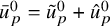
$\bar {u}^0_p = \tilde {u}^0_p + \hat {u}^0_{p}$
, where
$\tilde {u}_{pyy} \le 0$
,
$\tilde {u}^0_{py} \ge 0$
,
$\tilde {u}^0_p$
satisfies estimates (2.2)–(2.4), and
$\hat {u}^0_p$
satisfies estimates (1.38). -
(2) We have taken, again to make computations simpler, the leading order Euler vector field
$[u_E, v_E] = [1, 0]$
. It would not require new ideas to generalize our work to general shear flows
$[u_E, v_E] = [b(Y), 0]$
, where
$b(Y)$
satisfies mild hypotheses (for instance,
$b \in C^\infty , \frac 1 2 \le b \le \frac 3 2$
,
$\partial _Y^k b(Y)$
decays rapidly as
$Y \rightarrow \infty $
for
$k \ge 1$
), though it would make the expressions more complicated. The case of Euler flows that are not shear flows, however, poses more challenges and would require some new ideas. The primary reason for this is that in the case of x-dependent Euler flows, the vertical boundary layer velocity
$\bar {v}^0_p$
will have a growth of y as
$y \rightarrow \infty $
. The interested reader can consult [Reference IyerIy17] which addresses x dependent background Euler flows (albeit in a dramatically simpler setting). -
(3) The datum assumed at
$\{x = 0\}$
for the remainders, (1.31), can easily be generalized to any smooth vector-field,
$[u, v]|_{x = 0} = [b_1(y), \sqrt {\varepsilon } b_2(y)]$
, where
$b_1, b_2$
are smooth, rapidly decaying functions.












It is convenient to think of Theorem 1.1 in two parts: the first is a result on the construction of the approximate solution, $[\bar {u}, \bar {v}]$
from (1.15), given all of the necessary initial/ boundary datum described in Theorem 1.1. The second is a result on asymptotic stability of
$[\bar {u}, \bar {v}]$
from (1.15), given all of the necessary initial/ boundary datum described in Theorem 1.1. The second is a result on asymptotic stability of $[\bar {u}, \bar {v}]$
, which amounts to controlling the differences from (1.15),
$[\bar {u}, \bar {v}]$
, which amounts to controlling the differences from (1.15), $u := \varepsilon ^{- \frac {N_2}{2}} (U^\varepsilon - \bar {u}), v := \varepsilon ^{- \frac {N_2}{2}} (V^\varepsilon - \bar {v})$
. We state these two steps as two distinct theorems, which, when combined, yield the result of Theorem 1.1.
$u := \varepsilon ^{- \frac {N_2}{2}} (U^\varepsilon - \bar {u}), v := \varepsilon ^{- \frac {N_2}{2}} (V^\varepsilon - \bar {v})$
. We state these two steps as two distinct theorems, which, when combined, yield the result of Theorem 1.1.
Theorem 1.4 (Construction of Approximate Solution)
Assume the boundary and initial conditions are prescribed as specified in Theorem 1.1. Define $\sigma _\ast = \frac {1}{10,000}$
. Then for
$\sigma _\ast = \frac {1}{10,000}$
. Then for $i = 1,...,N_1$
, for
$i = 1,...,N_1$
, for $M \le m_i$
and
$M \le m_i$
and $2k+j \le \ell _i$
, the quantities
$2k+j \le \ell _i$
, the quantities $[u^i_p, v^i_p]$
and
$[u^i_p, v^i_p]$
and $[u^i_E, v^i_E]$
exist globally,
$[u^i_E, v^i_E]$
exist globally, $x> 0$
, and the following estimates are valid
$x> 0$
, and the following estimates are valid
 $$ \begin{align} &\| \partial_x^k \partial_y^j ( \bar{u}^0_p - \bar{u}_\ast) \langle z \rangle^M \|_{L^\infty_y} \lesssim \delta_\ast \langle x \rangle^{- \frac 1 4 - k - \frac j 2 + \sigma_\ast}, \end{align} $$
 $$ \begin{align} &\| \partial_x^k \partial_y^j ( \bar{v}^0_p - \bar{v}_\ast) \langle z \rangle^M \|_{L^\infty_y} \lesssim \delta_\ast \langle x \rangle^{- \frac 3 4 - k - \frac j 2 + \sigma_\ast} \end{align} $$
 $$ \begin{align} &\| \langle z \rangle^M \partial_x^k \partial_y^j u_p^{i} \|_{L^\infty_y} \lesssim \langle x \rangle^{- \frac 1 4 - k - \frac j 2 + \sigma_\ast} \end{align} $$
 $$ \begin{align} &\| \langle z \rangle^M \partial_x^k \partial_y^j v_p^{i} \|_{L^\infty_y} \lesssim \langle x \rangle^{- \frac 3 4 - k - \frac j 2 + \sigma_\ast}, \end{align} $$
 $$ \begin{align} &\|(Y \partial_Y)^l \partial_x^k \partial_Y^j v^{i}_E \|_{L^\infty_Y} \lesssim \langle x \rangle^{- \frac 1 2 - k - j}, \end{align} $$
 $$ \begin{align} &\| (Y \partial_Y)^l \partial_x^k \partial_Y^j u^{i}_E \|_{L^\infty_Y} \lesssim \langle x \rangle^{- \frac 1 2 - k - j}. \end{align} $$
Moreover, the more precise estimates stated in Assumptions (2.3)–(2.5) are valid. Finally, define the contributed forcing by:
 $$ \begin{align} \begin{aligned} F_R & := \varepsilon^{- \frac{N_2}{2}}((U^\varepsilon U^\varepsilon_x + V^\varepsilon U^\varepsilon_y + P^\varepsilon_x - \Delta_\varepsilon U^\varepsilon ) - (\bar{u} \bar{u}_x + \bar{v} \bar{u}_y + \bar{P}_x - \Delta_\varepsilon \bar{u})) \\ G_R & := \varepsilon^{-\frac{N_2}{2}}((U^\varepsilon V^\varepsilon_x + V^\varepsilon V^\varepsilon_y + \frac{P^\varepsilon_y}{\varepsilon} - \Delta_\varepsilon V^\varepsilon ) - (\bar{u} \bar{v}_x + \bar{v} \bar{v}_y + \frac{\bar{P}_y}{\varepsilon} - \Delta_\varepsilon \bar{v})). \end{aligned} \end{align} $$
Then the following estimates hold on the contributed forcing:
 $$ \begin{align} \| \partial_x^j \partial_y^k F_R \langle x \rangle^{\frac{11}{20}+ j + \frac k 2} \| + \sqrt{\varepsilon} \| \partial_x^j \partial_y^k G_R \langle x \rangle^{\frac{11}{20}+ j + \frac k 2} \| \le \varepsilon^{5}. \end{align} $$
Theorem 1.5 (Stability of Approximate Solution)
Assume the boundary and initial conditions are prescribed as specified in Theorem 1.1. There exists a unique, global solution, $[u, v]$
, to the problem (2.17)–(2.19), where the modified unknowns
$[u, v]$
, to the problem (2.17)–(2.19), where the modified unknowns $(U, V)$
defined through (2.22) satisfy the estimate
$(U, V)$
defined through (2.22) satisfy the estimate
 $$ \begin{align} \| U, V \|_{\mathcal{X}} \lesssim \varepsilon^{5}, \end{align} $$
where the $\mathcal {X}$
norm is defined precisely in (3.10).
$\mathcal {X}$
norm is defined precisely in (3.10).
Of these two steps, by far the most challenging is the second step, the stability analysis of Theorem 1.5. This paper is devoted exclusively to this stability analysis, whereas the first step, construction of approximate solutions, is obtained in a companion paper, [Reference Iyer and MasmoudiIM21]. As a result, for the remainder of this paper, we will take Theorem 1.4 as given and use it as a “black-box”. This serves to more effectively highlight the specific new techniques we develop for this stability result. Our main new ideas will be discussed below in Section 1.6.
Remark 1.6. When we use the word “stability” we are, in general, referring to the stability as $\varepsilon \rightarrow 0$
and as
$\varepsilon \rightarrow 0$
and as $x \rightarrow \infty $
within the stationary setting. From a physics point of view, the very important question of dynamic stability (even for short time) near the Blasius profile is an outstanding and important open problem. We do remark however, that at an experimental level instabilities in the dynamical flow tend to occur at very high Reynolds number (say
$x \rightarrow \infty $
within the stationary setting. From a physics point of view, the very important question of dynamic stability (even for short time) near the Blasius profile is an outstanding and important open problem. We do remark however, that at an experimental level instabilities in the dynamical flow tend to occur at very high Reynolds number (say $10^5$
and higher). Because our result is uniform in
$10^5$
and higher). Because our result is uniform in $\nu $
for viscosities small enough, it is likely that there exists a range of intermediate viscosities that are dynamically stable and also to which our result applies. We believe such a study will necessarily be quite delicate, and the answer will depend on the complex relation between the viscosity,
$\nu $
for viscosities small enough, it is likely that there exists a range of intermediate viscosities that are dynamically stable and also to which our result applies. We believe such a study will necessarily be quite delicate, and the answer will depend on the complex relation between the viscosity, $\varepsilon $
, the time scale, and the tangential length scale.
$\varepsilon $
, the time scale, and the tangential length scale.
1.5 Existing literature
The boundary layer concept was introduced by Prandtl in his 1904 paper, [Reference PrandtlPr1904], in precisely the setting of this article: 2D, stationary flows over a plate (at $Y = 0$
). Overall, there are two categories of questions one may pose:
$Y = 0$
). Overall, there are two categories of questions one may pose:
-
(PR) These are questions regarding the Prandtl system (1.12). Normally, these types of results use the scalar, parabolic nature of the Prandtl system, and as a result, the types of questions mimic what one would ask for any evolution equation (local existence, regularity, global existence, singularity formation, etc…).
-
(NS) These are questions regarding the validity or invalidity of the inviscid limit as
$\varepsilon \rightarrow 0$
of the boundary layer ansatz, (1.6). The current paper falls into this category. There are fewer results in this category compared to (PR), due to the much more complicated nature of the Navier-Stokes system (in particular, it is a system compared to a scalar equation).

First, we will provide an overview of the available results in (PR). The local theory was initiated by Oleinik in [Reference Oleinik and SamokhinOS99]. For local-in-x behavior, the work [Reference Guo and IyerGI18b] established higher regularity for (1.12)–(1.13) through energy methods, and the work of [Reference Wang and ZhangWZ19] obtains global $C^\infty $
regularity using maximum principle methods. Regarding large x dynamics, Serrin was the first to study this problem in [Reference SerrinSer66], and categorize the Blasius solutions (and more generally the family of so-called Falkner-Skan profiles) as large x attractors. Several follow ups have subsequently taken place in recent years, see [Reference IyerIy19], [Reference Wang and ZhangWZ22], [Reference IyerIy24], [Reference Jia, Lei and YuanJLY24]. The problem of boundary layer separation, which takes place in the presence of an adverse pressure gradient, is a very important and rich area of research. We point the reader towards [Reference Dalibard and MasmoudiDM15] for a study of separation in the steady setting, using modulation and blowup techniques, and the work of [Reference Shen, Wang and ZhangSWZ21] which establishes boundary layer separation using parabolic maximum principle techniques. More recently, there have been some advances regarding the problem of reversed flows after the separation point, [Reference Iyer and MasmoudiIM22], and see also [Reference Dalibard, Marbach and RaxDMR22], [Reference JingJ25] for related works on forward-backward mixed type problems. Moreover, the dynamics near the separation point are thought to require more refined reduced models, such as the Triple-Deck system, which has recently been studied in the stationary setting in [Reference Iyer and MaekawaIM24].
$C^\infty $
regularity using maximum principle methods. Regarding large x dynamics, Serrin was the first to study this problem in [Reference SerrinSer66], and categorize the Blasius solutions (and more generally the family of so-called Falkner-Skan profiles) as large x attractors. Several follow ups have subsequently taken place in recent years, see [Reference IyerIy19], [Reference Wang and ZhangWZ22], [Reference IyerIy24], [Reference Jia, Lei and YuanJLY24]. The problem of boundary layer separation, which takes place in the presence of an adverse pressure gradient, is a very important and rich area of research. We point the reader towards [Reference Dalibard and MasmoudiDM15] for a study of separation in the steady setting, using modulation and blowup techniques, and the work of [Reference Shen, Wang and ZhangSWZ21] which establishes boundary layer separation using parabolic maximum principle techniques. More recently, there have been some advances regarding the problem of reversed flows after the separation point, [Reference Iyer and MasmoudiIM22], and see also [Reference Dalibard, Marbach and RaxDMR22], [Reference JingJ25] for related works on forward-backward mixed type problems. Moreover, the dynamics near the separation point are thought to require more refined reduced models, such as the Triple-Deck system, which has recently been studied in the stationary setting in [Reference Iyer and MaekawaIM24].
We now discuss the available results in the (NS) category, which have only recently been achieved in the stationary setting. The works [Reference Guo and IyerGI18a], [Reference Guo and IyerGI18b], [Reference Guo and IyerGI18c], [Reference Gerard-Varet and MaekawaGVM18] were the first to address the classical, no-slip boundary condition. While [Reference Guo and IyerGI18a]–[Reference Guo and IyerGI18c] are concerned with x-dependent boundary layers, such as the Blasius profile, on the channel domain $(0, L) \times \mathbb {R}_+$
, the work [Reference Gerard-Varet and MaekawaGVM18] is concerned with shear flow profiles (which are solutions to the forced boundary layer equation) and hence work in the periodic setting. Both of the works [Reference Guo and IyerGI18a], [Reference Gerard-Varet and MaekawaGVM18] are local-in-x results, which can demonstrate the validity of expansion (1.15) for
$(0, L) \times \mathbb {R}_+$
, the work [Reference Gerard-Varet and MaekawaGVM18] is concerned with shear flow profiles (which are solutions to the forced boundary layer equation) and hence work in the periodic setting. Both of the works [Reference Guo and IyerGI18a], [Reference Gerard-Varet and MaekawaGVM18] are local-in-x results, which can demonstrate the validity of expansion (1.15) for $0 \le x << 1$
, (but of course, the x scale is fixed relative to the viscosity,
$0 \le x << 1$
, (but of course, the x scale is fixed relative to the viscosity, $\varepsilon $
). As we have mentioned, the smallness of the “timescale”,
$\varepsilon $
). As we have mentioned, the smallness of the “timescale”, $x << 1$
, in both [Reference Guo and IyerGI18a] and [Reference Gerard-Varet and MaekawaGVM18] is (at a very high level) a consequence of the requirement to couple two types of (individually delicate and highly nontrivial) analyses: one involving the Rayleigh operator and one which involves the diffusive term. The work of [Reference Gao and ZhangGZ20], which generalized the work of [Reference Guo and IyerGI18a]–[Reference Guo and IyerGI18b] to the case of Euler flows which are not shear for
$x << 1$
, in both [Reference Guo and IyerGI18a] and [Reference Gerard-Varet and MaekawaGVM18] is (at a very high level) a consequence of the requirement to couple two types of (individually delicate and highly nontrivial) analyses: one involving the Rayleigh operator and one which involves the diffusive term. The work of [Reference Gao and ZhangGZ20], which generalized the work of [Reference Guo and IyerGI18a]–[Reference Guo and IyerGI18b] to the case of Euler flows which are not shear for $0 < x << 1$
, can also handle for shear flows
$0 < x << 1$
, can also handle for shear flows $0 < x < L$
, where L can be arbitrary, but not global in x. Finally, we point the reader towards the recent, interesting work which handles so-called nozzle domains, [Reference Gao and XinGX23]. We also refer the reader towards the earlier series of works [Reference Guo and NguyenGN14], [Reference IyerIy15], [Reference IyerIy16a]–[Reference IyerIy16c], and [Reference IyerIy17], which are under the assumption of a moving boundary at
$0 < x < L$
, where L can be arbitrary, but not global in x. Finally, we point the reader towards the recent, interesting work which handles so-called nozzle domains, [Reference Gao and XinGX23]. We also refer the reader towards the earlier series of works [Reference Guo and NguyenGN14], [Reference IyerIy15], [Reference IyerIy16a]–[Reference IyerIy16c], and [Reference IyerIy17], which are under the assumption of a moving boundary at $\{Y = 0\}$
.
$\{Y = 0\}$
.
One can pose related questions when the domain is closed (for example, a disk or an annulus). In this case, it turns out that the inviscid limit cannot take place to an arbitrarily prescribed Euler flow, but rather the Euler flow needs to be selected. This process is known as “vorticity selection”, and is the subject of active recent research, specifically in the stationary Navier-Stokes setting, [Reference Drivas, Iyer and NguyenDIN24], [Reference Fei, Gao, Lin and TaoFGLT23], [Reference Fei, Gao, Lin and TaoFGLT24].
We now turn to the dynamical, t-dependent problem, for which there is a large literature in both the (PR) and (NS) categories. Let us first discuss the category of (PR). The work [Reference Oleinik and SamokhinOS99] proved global in time solutions on $[0, L] \times \mathbb {R}_+$
for
$[0, L] \times \mathbb {R}_+$
for $L << 1$
and local in time solutions for any
$L << 1$
and local in time solutions for any $L < \infty $
. Here, the main structural condition is monotonicity of the initial datum,
$L < \infty $
. Here, the main structural condition is monotonicity of the initial datum, $\partial _y u|_{t = 0}> 0$
. The paper [Reference Xin and ZhangXZ04] removed the smallness condition
$\partial _y u|_{t = 0}> 0$
. The paper [Reference Xin and ZhangXZ04] removed the smallness condition $L <<1$
, and obtained global in time weak solutions for any
$L <<1$
, and obtained global in time weak solutions for any $L < \infty $
. These works use the so-called Crocco transform, which is a nonlinear change of variables that is only well-defined due to the monotonicity condition. The work [Reference Alexandre, Wang, Xu and YangAWXY15] proves local existence, again under the monotonicity assumption, via a Nash-Moser type iterative scheme, whereas [Reference Masmoudi and WongMW15] introduced a good unknown which enjoys an extra cancellation and obeys good energy estimates. The importance of the works [Reference Alexandre, Wang, Xu and YangAWXY15] and [Reference Masmoudi and WongMW15] is that they do not rely on the Crocco transform, which is largely unavailable in the (NS) setting. The work of [Reference Kukavica, Masmoudi, Vicol and WongKMVW14] replace monotonicity with multiple monotonicity regions.
$L < \infty $
. These works use the so-called Crocco transform, which is a nonlinear change of variables that is only well-defined due to the monotonicity condition. The work [Reference Alexandre, Wang, Xu and YangAWXY15] proves local existence, again under the monotonicity assumption, via a Nash-Moser type iterative scheme, whereas [Reference Masmoudi and WongMW15] introduced a good unknown which enjoys an extra cancellation and obeys good energy estimates. The importance of the works [Reference Alexandre, Wang, Xu and YangAWXY15] and [Reference Masmoudi and WongMW15] is that they do not rely on the Crocco transform, which is largely unavailable in the (NS) setting. The work of [Reference Kukavica, Masmoudi, Vicol and WongKMVW14] replace monotonicity with multiple monotonicity regions.
Without monotonicity of the datum, the wellposedness results require higher regularity, that is either analytic or Gevrey datum; see, for example, [Reference Dietert and Gerard-VaretDiGV18], [Reference Gerard-Varet and MasmoudiGVM13], [Reference Ignatova and VicolIV16], [Reference Kukavica and VicolKV13], [Reference Lombardo, Cannone and SammartinoLCS03], [Reference Li, Masmoudi and YangLMY20], [Reference Sammartino and CaflischSC98]–[Reference Sammartino and CaflischSC98], [Reference Iyer and VicolIV19] for some results in this direction. In Sobolev spaces without the assumption of monotonicity, the unsteady Prandtl equations are, in general, illposed: [Reference Gerard-Varet and DormyGVD10], [Reference Gerard-Varet and NguyenGVN12]. The important issue of unsteady boundary layer separation has been studied in [Reference Collot, Ghoul and MasmoudiCGM18], [Reference Collot, Ghoul, Ibrahim and MasmoudiCGIM18], [Reference Collot, Ghoul and MasmoudiCGM19] using blowup techniques and modulation theory. Related finite time blowup results have also been obtained in [Reference Weinan and EngquistEE97], [Reference Kukavica, Vicol and WangKVW15], [Reference Hong and HunterHH03]. We also mention here an interesting recent result which proves the time asymptotic stability of the stationary Blasius solution to the unsteady Prandtl system, [Reference Guo, Wang and ZhangGWZ23]. As in the stationary setting, there are other models that serve to incorporate higher order effects from the Navier-Stokes dynamics near the separation point in the unsteady setting. Two important models are the Interactive Boundary Layer (IBL) model, which has been studied in [Reference Dalibard, Dietert, Gerard-Varet and MarbachDDGM18], and the unsteady Triple-Deck model, which has been studied in the works [Reference Iyer and VicolIV19], [Reference Dietert and Gerard-VaretDiGV22], [Reference Gerard-Varet, Iyer and MaekawaGIM23].
We now discuss the category (NS) for the time-dependent setting. First, in the analyticity setting, for small time, the papers [Reference Sammartino and CaflischSC98], [Reference Sammartino and CaflischSC98] establish the stability of expansions (1.15). This was extended to Gevrey regularity in [Reference Gerard-Varet, Maekawa and MasmoudiGVMM16], [Reference Gerard-Varet, Maekawa and MasmoudiGVMM20]. We also mention the paper [Reference MaekawaMae14], which establishes stability in the Sobolev regularity under the condition that the initial vorticity is supported away from the boundary. The interested reader should also refer to the papers [Reference Liu, Xie and YangLXY17], [Reference Mazzucato and TaylorMT08], [Reference Temam and WangTW02], [Reference Wang, Wang and ZhangWWZ17].
There are several instability or invalidity results as well, which demonstrate expansions of the type (1.15) are false. Due to the previous discussion, these results must be in the Sobolev setting. A few works in this direction are [Reference GrenierG00], [Reference Grenier, Guo and NguyenGGN15a], [Reference Grenier, Guo and NguyenGGN15b], [Reference Grenier, Guo and NguyenGGN15c], [Reference Guo and NguyenGN11]. Finally, we point the reader towards the remarkable series of works [Reference Grenier and NguyenGrNg17a], [Reference Grenier and NguyenGrNg17b], [Reference Grenier and NguyenGrNg18] which establish invalidity in Sobolev spaces of expansions of the type (1.15). These invalidity results point towards a nuanced secondary instability mechanism, which has been studied recently in [Reference Bian and GrenierBG24]. We point the reader towards the recent work, [Reference Bian, Grenier, Masmoudi and ZhaoBGMZ24] which obtains an instability result near the Couette flow. The separate question of $L^2$
(in space) convergence of Navier-Stokes flows to Euler, which does not necessitate the study of the boundary layer, has also been studied at length, for example, in [Reference Constantin, Elgindi, Ignatova and VicolCEIV17], [Reference Constantin, Kukavica and VicolCKV15], [Reference Constantin and VicolCV18], [Reference KatoKa84], [Reference MasmoudiMas98], and [Reference SueurSu12].
$L^2$
(in space) convergence of Navier-Stokes flows to Euler, which does not necessitate the study of the boundary layer, has also been studied at length, for example, in [Reference Constantin, Elgindi, Ignatova and VicolCEIV17], [Reference Constantin, Kukavica and VicolCKV15], [Reference Constantin and VicolCV18], [Reference KatoKa84], [Reference MasmoudiMas98], and [Reference SueurSu12].
It is also striking to compare our result to what is expected in the unsteady setting. In the unsteady setting, certain well-known “geometric” criteria exist, for instance monotonicity, to ensure (local in time) wellposedness in Sobolev spaces for the Prandtl equations. However, these criteria (even one adds concavity) are not enough to establish a stability result of the type $U^\varepsilon \rightarrow \bar {u}$
due to the well-known Tollmien-Schlichting instability (see, for instance [Reference Grenier, Guo and NguyenGGN15b]). For this reason, the sharpest known stability results are in Gevrey spaces (see, for instance [Reference Gerard-Varet, Maekawa and MasmoudiGVMM16], [Reference Gerard-Varet, Maekawa and MasmoudiGVMM20]). Part of the novelty of our work is to rigorously establish that there is no analogue of even weak Tollmien-Schlichting instabilities that occur in the steady setting (which would only be seen as
$U^\varepsilon \rightarrow \bar {u}$
due to the well-known Tollmien-Schlichting instability (see, for instance [Reference Grenier, Guo and NguyenGGN15b]). For this reason, the sharpest known stability results are in Gevrey spaces (see, for instance [Reference Gerard-Varet, Maekawa and MasmoudiGVMM16], [Reference Gerard-Varet, Maekawa and MasmoudiGVMM20]). Part of the novelty of our work is to rigorously establish that there is no analogue of even weak Tollmien-Schlichting instabilities that occur in the steady setting (which would only be seen as $x \rightarrow \infty $
, should they exist).
$x \rightarrow \infty $
, should they exist).
The above discussion is not comprehensive, and emphasizes more the stationary theory. We refer to the review articles, [Reference WeinanE00], [Reference Gie, Jung and TemamTe77] and references therein for a more complete discussion of other aspects of the boundary layer theory.
1.6 Main ingredients of our approach
We will now describe the main ideas that enter our analysis. In order to do so, we need to describe the equation that is satisfied by the remainders, $(u, v)$
, in the expansion (1.15), which is the following,
$(u, v)$
, in the expansion (1.15), which is the following,
 $$ \begin{align} &\mathcal{L}[u, v] + \begin{pmatrix} \partial_x \\ \frac{\partial_y}{\varepsilon} \end{pmatrix} P = \mathcal{N}(u,v) + \text{Forcing }, \qquad u_x + v_y = 0, \text{ on } \mathcal{Q}, \end{align} $$
where the forcing term that exists due to the fact that $(\bar {u}, \bar {v})$
is not an exact solution to the Navier-Stokes equations, (we leave it undefined now, as it does not play a central role in the present discussion), and
$(\bar {u}, \bar {v})$
is not an exact solution to the Navier-Stokes equations, (we leave it undefined now, as it does not play a central role in the present discussion), and $\mathcal {N}(u, v)$
contains quadratic terms. The operator
$\mathcal {N}(u, v)$
contains quadratic terms. The operator $\mathcal {L}[u, v]$
is a vector-valued linearized operator around
$\mathcal {L}[u, v]$
is a vector-valued linearized operator around $[\bar {u}, \bar {v}]$
, and is defined precisely via
$[\bar {u}, \bar {v}]$
, and is defined precisely via
 $$ \begin{align} \begin{aligned} \mathcal{L}[u, v] := \begin{cases} \mathcal{L}_1 := \bar{u} u_x + \bar{u}_{y} v + \bar{u}_{x} u + \bar{v} u_y - \Delta_\varepsilon u \\ \mathcal{L}_2 := \bar{u} v_x + u \bar{v}_{x} + \bar{v} v_y + \bar{v}_{y} v - \Delta_\varepsilon v.\end{cases} \end{aligned} \end{align} $$
The main goal in the study of (1.45) is to obtain an estimate of the form $\| u, v \|_{\mathcal {X}} \lesssim \| \text {Forcing} \|_{X_{source}}$
, for an appropriately defined space
$\| u, v \|_{\mathcal {X}} \lesssim \| \text {Forcing} \|_{X_{source}}$
, for an appropriately defined space $\mathcal {X}$
(which importantly needs to control the
$\mathcal {X}$
(which importantly needs to control the $L^\infty $
norm), and a corresponding norm
$L^\infty $
norm), and a corresponding norm $X_{source}$
on the source term (which we need not specify at this time). We note that this is a variable-coefficients operator, for which Fourier analysis is not conducive for obtaining estimates.
$X_{source}$
on the source term (which we need not specify at this time). We note that this is a variable-coefficients operator, for which Fourier analysis is not conducive for obtaining estimates.
1.6.1 The new point of view
We will discuss our point of view as compared to prior works on the Navier-Stokes to Prandtl stability ([Reference Guo and IyerGI18a], [Reference Guo and IyerGI18c], [Reference Gerard-Varet and MaekawaGVM18], [Reference Guo and NguyenGN14], [Reference Gao and ZhangGZ20]). These prior works require either smallness or finiteness in the tangential direction, x. In some sense, these papers all introduce a transform or change of unknown which factors the vectorial Rayleigh operator,
 $$ \begin{align} \mathcal{R}[u, v] := \begin{pmatrix} \bar{u} \partial_x u + \bar{u}_y v \\ \bar{u} \partial_x v + \bar{v}_y v \end{pmatrix} = \begin{pmatrix} - \bar{u}^2 \partial_y \{ \frac{v}{\bar{u}} \} \\ \bar{u}^2 \partial_x \{ \frac{v}{\bar{u}} \} \end{pmatrix} \end{align} $$
as a (almost) divergence-form operator on a modified unknown, $\frac {v}{\bar {u}}$
. The primary purpose of the change of unknown is to avoid losing x derivatives, (since high frequencies in x were being considered). This gives one starting point to study the vector valued operator (1.46) (for instance, to design virial type multipliers), though this point of view alone breaks down for large x.
$\frac {v}{\bar {u}}$
. The primary purpose of the change of unknown is to avoid losing x derivatives, (since high frequencies in x were being considered). This gives one starting point to study the vector valued operator (1.46) (for instance, to design virial type multipliers), though this point of view alone breaks down for large x.
There is a mechanism by which the linearized transport operator (Rayleigh) and the diffusion actually “talk to each-other” in (1.46) and produce a damping effect as $x \rightarrow \infty $
(discussed in Point (1) below). This damping phenomenon requires us to introduce renormalized velocity unknowns that we specifically define below in (1.49). These renormalized velocities (1) interact favorably with the system aspect of the Navier-Stokes equations and simultaneously (2) result in a special cancellation between the Rayleigh and Airy components of the linearized operator (see below, (1.52)). We note that the concavity of the background Blasius profile
$x \rightarrow \infty $
(discussed in Point (1) below). This damping phenomenon requires us to introduce renormalized velocity unknowns that we specifically define below in (1.49). These renormalized velocities (1) interact favorably with the system aspect of the Navier-Stokes equations and simultaneously (2) result in a special cancellation between the Rayleigh and Airy components of the linearized operator (see below, (1.52)). We note that the concavity of the background Blasius profile $\bar {u}_{\ast }" \le 0$
is used crucially to produce this damping effect. This damping mechanism can be thought of as a way of realizing the von-Mise mechanism for the Prandtl equations, [Reference IyerIy19], in the classical OS operator.
$\bar {u}_{\ast }" \le 0$
is used crucially to produce this damping effect. This damping mechanism can be thought of as a way of realizing the von-Mise mechanism for the Prandtl equations, [Reference IyerIy19], in the classical OS operator.
Due to the presence of singular weights of $\frac {1}{\bar {u}}$
in the renormalized unknowns (1.49) as compared to the original velocities
$\frac {1}{\bar {u}}$
in the renormalized unknowns (1.49) as compared to the original velocities $(u, v)$
, we need to introduce a completely new functional framework and scheme of estimates to control the remainders
$(u, v)$
, we need to introduce a completely new functional framework and scheme of estimates to control the remainders $(u, v)$
globally in x with decay rates, which constitutes the majority of the innovation in this manuscript. At a very high-level, one can see that certain necessary estimates from (1.56)–(1.58) lose derivatives in
$(u, v)$
globally in x with decay rates, which constitutes the majority of the innovation in this manuscript. At a very high-level, one can see that certain necessary estimates from (1.56)–(1.58) lose derivatives in $x \partial _x$
. Part of the novelty of our work is the design and global control of several interdependent norms that can handle the presence of these singular weights. In addition to a completely novel functional framework, we also need to introduce nonlinear changes of variables (at the top order of derivative) which exploit further cancellations of the fastest growing quantities as
$x \partial _x$
. Part of the novelty of our work is the design and global control of several interdependent norms that can handle the presence of these singular weights. In addition to a completely novel functional framework, we also need to introduce nonlinear changes of variables (at the top order of derivative) which exploit further cancellations of the fastest growing quantities as $x \rightarrow \infty $
. We now describe in more detail the ingredients involved in our approach.
$x \rightarrow \infty $
. We now describe in more detail the ingredients involved in our approach.
1.6.2 Specific discussion of main ingredients
-
(1) Damping Mechanism via Rayleigh-Airy Cancellation: We will extract the “main part” of
$\mathcal {L}_1$
, (1.46), as the operator (1.48)The perspective taken in [Reference Guo and IyerGI18a] is to view the operator
$$ \begin{align} \mathcal{L}_{main}[u, v] := \begin{pmatrix} \bar{u} u_x + \bar{u}_y v \\ \bar{u} v_x + \bar{v}_y v \end{pmatrix} - \begin{pmatrix} \Delta_\varepsilon u \\ \Delta_\varepsilon v \end{pmatrix} =: \begin{pmatrix} \mathcal{L}_{main}^{(1)}[u, v] \\[3pt] \mathcal{L}_{main}^{(2)}[u, v] \end{pmatrix}, \end{align} $$
$\mathcal {L}_{main}$
as being comprised of two separate operators, the Rayleigh piece, (1.47), and the diffusion. Crucially, [Reference Guo and IyerGI18a] was able to establish that one could obtain coercivity of
$\mathcal {L}_{main}$
for “short time”,
$x << 1$
, using a new “quotient estimate” by applying the multiplier
$\partial _x \frac {v}{\bar {u}}$
to the x-differentiated version of
$\mathcal {L}_{main}$
. We also draw a parallel to the approach of [Reference Gerard-Varet and MaekawaGVM18] where their “Rayleigh-Airy iteration” is comprised of viewing the Rayleigh piece of
$\mathcal {L}_{main}$
, and the Airy (or diffusive) piece as two separate operators.
Using this perspective, these prior results are able to generate inequalities of the form
$\|U, V \|_{X_0} \lesssim L \|U, V \|_{X_{\frac 1 2}}$
and
$\|U, V \|_{X_{\frac 1 2}} \lesssim \|U, V \|_{X_0}$
(where
$0 \le x \le L$
, and for appropriately defined spaces
$X_0, X_{\frac 1 2}$
, not necessarily the ones we have selected here). For this reason, the work [Reference Guo and IyerGI18a] requires
$x << 1$
to close their scheme.There is, in fact, a mechanism by which both components of
$\mathcal {L}_{main}$
actually “talk to each other” (and, in fact, this is a damping mechanism as
$x \rightarrow \infty $
). This link between the two components of
$\mathcal {L}_{main}$
is provided by way of a change of unknown at the velocity level. The calculations in our case are inspired by a change of coordinates known as the von-Mise transform that is employed in the setting of the Prandtl equations (see, for instance, [Reference IyerIy19]). We also mention the work [Reference Gao and ZhangGZ20] where a calculation in a similar spirit occurs at the stream function level.We define the following “Renormalized Good Velocities”:
(1.49)where the stream function,
$$ \begin{align} U := \frac{1}{\bar{u}} (u - \frac{\bar{u}_y}{\bar{u}} \psi), \qquad V := \frac{1}{\bar{u}} (v + \frac{\bar{u}_x}{\bar{u}} \psi ), \end{align} $$
$\psi $
, is defined as
$\psi (x, y) = \int _0^y u(x, y') dy'$
. For the unknowns
$(U, V)$
, the system effectively reads (upon invoking the Prandtl equation for the coefficients
$\bar {u}, \bar {v})$
(1.50)where the transport operators are defined by
$$ \begin{align} \mathcal{L}_{main}[u, v] + \nabla_\varepsilon P= \begin{pmatrix} \mathcal{T}_1[U] \\ \mathcal{T}_2[V] \end{pmatrix} - \begin{pmatrix} \Delta_\varepsilon u \\ \Delta_\varepsilon v \end{pmatrix} + \nabla_\varepsilon P = \text{Forcing + Nonlinear}, \end{align} $$
(1.51)On these good unknowns, we have the following favorable estimate with damping
$$ \begin{align} \begin{pmatrix} \mathcal{T}_1[U] \\ \mathcal{T}_2[V] \end{pmatrix} := \begin{pmatrix} \bar{u}^2 U_x + \bar{u} \bar{v} U_y + 2 \bar{u}_{yy} U \\ \bar{u}^2 V_x + \bar{u} \bar{v} V_y + \bar{u}^0_{pyy}V \end{pmatrix} \end{align} $$
(1.52)where we have omitted several harmless terms (hence the
$$ \begin{align} \nonumber \int \mathcal{L}^{(1)}_{main}[u,v] U \,\mathrm{d} y & = \int \mathcal{T}_1[U] U \,\mathrm{d} y + \int \partial_y (\bar{u} U + \frac{\bar{u}_y}{\bar{u}} \psi) U_y \,\mathrm{d} y \\\nonumber & \approx \frac{\partial_x}{2} \int \bar{u}^2 U^2 \,\mathrm{d} y + \frac 3 2\int \bar{u}_{yy} U^2 \,\mathrm{d} y + \int \bar{u} U_y^2 \,\mathrm{d} y - \int 2 \bar{u}_{yy} U^2 \,\mathrm{d} y \\& \approx \frac{\partial_x}{2} \int \bar{u}^2 U^2 \,\mathrm{d} y + \int \bar{u} U_y^2 \,\mathrm{d} y - \int \frac 1 2 \bar{u}_{yy} U^2 \,\mathrm{d} y, \end{align} $$
$\approx $
). The point is that the dangerous Rayleigh contribution
$\int \frac 3 2 \bar {u}_{yy}U^2$
is cancelled out by the diffusive commutator term
$- 2 \bar {u}_{yy} U^2$
, leaving an excess factor of
$- \frac 1 2 \int \bar {u}_{yy} U^2$
. This term acts as a damping term as
$x \rightarrow \infty $
due to the property of the background Blasius profile that
$\bar {u}_{yy} \le 0$
. Note that, if this were not the case, we would see growth as
$x \rightarrow \infty $
.
Therefore, our starting point is working with the “good variables” (1.49), but in a robust enough manner to extend to the full Navier-Stokes system, and to capture large-x dynamics.
The use of different unknowns than the traditional
$(u, v)$
velocity field is a common strategy used in several works, such as [Reference Guo and IyerGI18a] and [Reference Gao and ZhangGZ20], where quotient estimates are performed either on v or on
$\psi $
. We view our good variables as mimicking the von-Mise transform for linearized Prandtl. We may recognize the first component of
$\mathcal {L}_{main}$
,
$\mathcal {L}_{main}^{(1)}$
, as having similar structures to the operator which controls the scattering of Prandtl to Blasius, (1.25). Indeed, to understand (1.25), following the von-Mise transform, we define the maps: (1.53)Subsequently, we consider the “good difference”:
$$ \begin{align} (\psi, \bar{u}^0_p) \mapsto y = y(\psi; \bar{u}^0_p) \iff \psi = \int_0^{y(\psi; \bar{u}^0_p)} \bar{u}^0_p. \end{align} $$
(1.54)which we interpret as a “twisted subtraction” because we wish to compare
$$ \begin{align} \phi(x, \psi) := |\bar{u}^0_p(x, y(\psi; \bar{u}^0_p))|^2 - |\bar{u}_\ast(x, y(\psi; \bar{u}_\ast))|^2, \end{align} $$
$\bar {u}^0_p$
and
$\bar {u}_\ast $
at two different y values, depending on the solutions themselves. Rewriting (1.54) in the spatial coordinates
$(x, y)$
(which needs to be done for the Navier-Stokes setting) then motivates our choice of good variables (1.49). We note that, as in the von-Mise transform for the Prandtl equations, the fact that the background profile
$\bar {u}$
solves the nonlinear Prandtl equation (at least approximately) is important to extract the damping coefficient in (1.52).
-
(2)
$\underline{\text{Sharp } L^\infty \text{ decay and the design of the space }\|U, V \|_{\mathcal {X}}\!\!:}$
A consideration of the nonlinear part of
$\mathcal {N}(u, v)$
in (1.45) demonstrates that, at the very least, one needs to control a final norm that is strong enough to encode pointwise decay of the form (1.55)This is due to having to control trilinear terms of the form
$$ \begin{align} |\sqrt{\varepsilon} v | \langle x \rangle^{\frac 1 2} \lesssim \|U, V \|_{\mathcal{X}}. \end{align} $$
$\int B(x, y) v u_y u_x \langle x \rangle $
, where
$B(x, y)$
is a bounded function. This baseline requirement motivates our choice of space
$\mathcal {X}$
, defined in (3.10), which contains enough copies of the
$x \partial _x$
scaling vector-field of the solution in order to obtain the crucial decay estimate (1.55). This is a sharp requirement, and our norm
$\mathcal {X}$
is just barely strong enough to control this decay.
-
(3)
$\underline{\text{ Linearized energy estimates and the scaling vector field } S = x \partial _x\!\!:}$
In order to control the designer norm
$\| U, V \|_{\mathcal {X}}$
, we perform a sequence of estimates which results in the following loop (the reader is encouraged to consult (3.2) - (3.7) for the definitions of these spaces), for
$n= 0, 1, ..., 10$
Footnote 3: (1.56)
$$ \begin{align} &\| U, V \|_{X_0}^2 \lesssim \mathcal{F}_0 + \mathcal{N}_0,\end{align} $$
(1.57)
$$ \begin{align} &\| U, V \|_{X_{n + \frac 1 2} \cap Y_{n + \frac 1 2}}^2 \lesssim C_\delta \| U, V \|_{X_{\le n}}^2 + \delta \|U, V \|_{X_{n+1}}^2 + \mathcal{F}_{n+ \frac 1 2} + \mathcal{N}_{n + \frac 1 2}, \end{align} $$
(1.58)for a small number
$$ \begin{align} &\|U, V \|_{X_{n+1}}^2 \lesssim \|U, V \|_{X_{\le n + \frac 1 2}}^2 + \mathcal{F}_{n + 1} + \mathcal{N}_{n+1}, \end{align} $$
$0 < \delta << 1$
, and where the implicit constant above is independent of the chosen
$\delta $
. Above the
$\mathcal {F}$
terms represent forcing terms, which depend on the approximate solution, and the
$\mathcal {N}$
terms represent quadratic terms. The coupling of these estimates is required by the vector aspect of the full linearized Navier-Stokes operator
$\mathcal {L}$
. To keep matters simple, the reader can identify these spaces with “regularity of
$x \partial _x$
”. That is,
$X_0$
is a baseline norm,
$X_{\frac 1 2}, Y_{\frac 1 2}$
contain (in a sense made precise by the definitions of these norms) estimates on
$(x\partial _x)^{\frac 1 2}$
of the quantities in
$X_0$
,
$X_1$
is basically
$\| (x \partial _x) U, (x \partial _x) V\|_{X_0}$
.
It turns out that estimation of the nonlinear terms schematically work in the following manner:
(1.59)The difficulty in closing our scheme becomes clear upon comparing the linear estimates in (1.56)–(1.58) and the estimation of the nonlinearity from (1.59): the linear estimates lose half
$$ \begin{align} |\mathcal{N}_n| \lesssim \varepsilon \|U, V \|_{X_n}^2 \|U, V \|_{X_{n+\frac 1 2}} , \qquad |\mathcal{N}_{n + \frac 1 2}| \lesssim \varepsilon \|U, V \|_{X_{\le n + \frac 1 2}}^3 \end{align} $$
$x \partial _x$
derivative for half-integer order spaces, whereas the nonlinear estimates lose a half
$x \partial _x$
derivative for integer order spaces. This is a new obstacle that has only appeared in the present work. We shall now discuss the origin of both the “linear loss of derivative”, appearing in (1.57), and the “nonlinear loss of derivative”, appearing in (1.59), together with our technique to eliminate these losses.
-
(4)
$\underline{\text{Loss of } x \partial _x \text{ derivative due to degeneracy of } \bar {u} \text{ and weights of } x\!\!:}$
The “loss of half-
$x\partial _x$
derivative” at the linearized level, that is (1.57), is due to degeneracy of
$\bar {u}$
at
$y= 0$
. The reader is invited to consult, for instance, the estimation of term (4.45) in our energy estimates, which displays such a loss. To summarize, we have to estimate the following integral when performing the estimate of
$X_{\frac 12}$
, (1.57) (1.60)A consultation with the
$$ \begin{align} I_{sing} := |\int x \bar{u}_y U_x U_y \,\mathrm{d} y \,\mathrm{d} x|. \end{align} $$
$X_{\frac 1 2}$
and the previously controlled
$X_0$
norm shows that this quantity is out of reach due to the confluence of two issues: the degeneracy of the weight
$\bar {u}$
(and the lack of degeneracy of the coefficient
$\bar {u}_y$
) and the weight of x appearing in
$I_{sing}$
. We emphasize that this type of “loss-of-
$x \partial _x$
” is a confluent issue: it only appears if one is concerned with global-in-x matters in the presence of the degenerate weights
$\bar {u}$
.
We note that the extra positive terms appearing from the viscosity in the
$X_{n+ \frac 1 2}, Y_{n + \frac 1 2}$
norms do not help control this term due to relatively weak x weights that appear in the viscosity terms.Due to this peculiarity, we design the scheme (and our norm
$\mathcal {X}$
, see (3.10)) to terminate at the
$X_{11}$
stage, as opposed to what appears to the be the more natural stopping point of
$X_{11.5}, Y_{11.5}$
. -
(5) Nonlinear Change of Variables (and nonlinearly modified norms): There is a major price to pay for the truncation of our energy scheme at the
$X_{11}$
level, which comes from the nonlinear loss of
$x \partial _x$
derivative displayed in (1.59). Let us explain further the reason for this loss, temporarily setting
$n = 11$
in the first inequality of (1.59). Indeed, considering the trilinear quantity (1.61)and comparing to the controls provided by the
$$ \begin{align} T_{sing} := \int u_y \partial_x^{11} v \partial_x^{11} U \langle x \rangle^{22} \,\mathrm{d} y \,\mathrm{d} x, \end{align} $$
$\| \cdot \|_{\mathcal {X}}$
norm, such a quantity is out of reach (due to growth as
$x \rightarrow \infty $
). Estimating this type of quantity would not be out of reach if we had the right to include
$X_{11.5}, Y_{11.5}$
into the
$\mathcal {X}$
-norm, but due to the issue raised above, we must truncate our energy scheme at the
$X_{11}$
level.
To contend with this difficulty, we introduce a further nonlinear change of variables that has the effect of cancelling out these most singular terms at the top order. This amounts to replacing the linearized good variables (1.49) with another, nonlinear version, which is defined in (5.7). We note that this difficulty does not appear in any previous work, due to the ability, for bounded values of x, to appeal to the positive contributions of the tangential viscosity.
In turn, the energy estimate for the new nonlinear good unknown requires estimation of several trilinear terms in the nonlinearly modified norms
$\Theta _{11}$
, defined in (5.18). We subsequently establish the equivalence of measuring the nonlinear good unknown in the modified norm
$\Theta _{11}$
to measuring the original good unknown in our original space
$\mathcal {X}$
(see, for instance, the analysis in Section 5.2).We emphasize that, in order to establish the equivalence of measuring the new nonlinear good unknowns in the nonlinearly modified norm to the full
$\mathcal {X}$
norm, we need to rely upon the full strength of the
$\mathcal {X}$
-norm. -
(6)
$\underline{\text{Weighted in } x \text{ and } \bar {u} \text{ mixed } L^p_xL^q_y \text{embeddings:}}$
Due to the inherent nonlinear nature of this top order analysis for
$\Theta _{11}$
, we rely upon several mixed-norm estimates of
$L^p_x L^q_y$
with precise weights in x and
$\bar {u}$
in order to close our analysis of
$\Theta _{11}$
. This requirement is amplified upon noting that
$u_{yy}$
(1) lacks the regularity in y that the background
$\bar {u}_{yy}$
has, due to the lack of higher-order y derivative quantities in our
$\|\cdot \|_{\mathcal {X}}$
(which appear to be difficult to achieve due to
$\{y = 0\}$
boundary effects) and (2) lacks decay as
$y \rightarrow \infty $
(we do not control weights in y in our
$\mathcal {X}$
space). Thus we must always place
$u_{yy}$
in
$L^2_y$
in the vertical direction, and develop the appropriate weighted in
$\bar {u}$
and
$x L^p_x L^q_y$
embeddings. These, in turn, are developed in Sections 3.3, 3.4, 5.2, and again, rely upon the full strength of our
$\mathcal {X}$
norm in order to close. Again, we emphasize that these analyses are completely new.








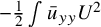






















1.7 Notational conventions
We first define (in contrast with the typical bracket notation) $\langle x \rangle := 1+ x$
. We also define
$\langle x \rangle := 1+ x$
. We also define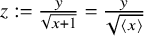 $z := \frac {y}{\sqrt {x + 1}} = \frac {y}{\sqrt {\langle x \rangle }}$
, due to our choice that
$z := \frac {y}{\sqrt {x + 1}} = \frac {y}{\sqrt {\langle x \rangle }}$
, due to our choice that $x_0 = 1$
(which we are again making without loss of generality). The cut-off function
$x_0 = 1$
(which we are again making without loss of generality). The cut-off function $\chi (\cdot ): \mathbb {R}_+ \rightarrow \mathbb {R}$
will be reserved for a particular decreasing function,
$\chi (\cdot ): \mathbb {R}_+ \rightarrow \mathbb {R}$
will be reserved for a particular decreasing function, $0 \le \chi \le 1$
, satisfying
$0 \le \chi \le 1$
, satisfying
 $$ \begin{align} \chi(z) = \begin{cases} 1 \text{ for } 0 \le z \le 1 \\ 0 \text{ for } 2 \le z < \infty \end{cases} \end{align} $$
Regarding norms, we define for functions $u(x, y)$
,
$u(x, y)$
,
 $$ \begin{align} \| u \| := \|u \|_{L^2_{xy}} = \Big( \int u^2 \,\mathrm{d} x \,\mathrm{d} y \Big)^{\frac 1 2}, \qquad \|u \|_\infty := \sup_{(x,y) \in \mathcal{Q}} |u(x, y)|. \end{align} $$
We will often need to consider “slices”, whose norms we denote in the following manner
 $$ \begin{align} \| u \|_{L^p_y} := \Big( \int u(x, y)^p \,\mathrm{d} y \Big)^{\frac 1 p}. \end{align} $$
We use the notation $a \lesssim b$
to mean
$a \lesssim b$
to mean $a \le Cb$
for a constant C, which is independent of the parameters
$a \le Cb$
for a constant C, which is independent of the parameters $\varepsilon , \delta _\ast $
. We define the following scaled differential operators
$\varepsilon , \delta _\ast $
. We define the following scaled differential operators
 $$ \begin{align} \nabla_\varepsilon := \begin{pmatrix} \partial_x \\ \frac{\partial_y}{\sqrt{\varepsilon}} \end{pmatrix}, \qquad \Delta_\varepsilon := \partial_{yy} + \varepsilon \partial_{xx}. \end{align} $$
For derivatives, we will use both $\partial _x f$
and
$\partial _x f$
and $f_x$
to mean the same thing. For integrals, we will use
$f_x$
to mean the same thing. For integrals, we will use $\int f := \int _0^\infty \int _0^\infty f(x, y) \,\mathrm {d} y \,\mathrm {d} x$
. These conventions are taken unless otherwise specified (by appending a
$\int f := \int _0^\infty \int _0^\infty f(x, y) \,\mathrm {d} y \,\mathrm {d} x$
. These conventions are taken unless otherwise specified (by appending a $\,\mathrm {d} y$
or a
$\,\mathrm {d} y$
or a $\,\mathrm {d} x$
), which we sometimes need to do.
$\,\mathrm {d} x$
), which we sometimes need to do.
We will often use the parameter $\delta $
to be a generic small parameter, that can change in various instances. The constant
$\delta $
to be a generic small parameter, that can change in various instances. The constant $C_\delta $
will refer to a number that may grow to
$C_\delta $
will refer to a number that may grow to $\infty $
as
$\infty $
as $\delta \downarrow 0$
.
$\delta \downarrow 0$
.
1.8 Plan of the paper
Throughout the paper, we take the construction of the approximate solution, Theorem 1.4, as a “black box”. It is proven in the companion paper, [Reference Iyer and MasmoudiIM21]. Section 2 is devoted to introducing the Navier-Stokes system satisfied by the remainders, $(u, v)$
, and proving basic properties of the associated linearized operator. Section 3 is devoted to developing the space
$(u, v)$
, and proving basic properties of the associated linearized operator. Section 3 is devoted to developing the space $\mathcal {X}$
, in which we analyze the remainders,
$\mathcal {X}$
, in which we analyze the remainders, $(u, v)$
. Section 4 is devoted to providing the energy estimates to control
$(u, v)$
. Section 4 is devoted to providing the energy estimates to control $\|U, V \|_{X_n}$
and
$\|U, V \|_{X_n}$
and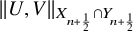 $\|U, V \|_{X_{n + \frac 1 2} \cap Y_{n + \frac 1 2}}$
for
$\|U, V \|_{X_{n + \frac 1 2} \cap Y_{n + \frac 1 2}}$
for $n = 0,...,10$
. Section 5 contains our top order analysis, which notably includes our nonlinear change of variables and nonlinearly modified norms. Section 6 contains the nonlinear analysis to close the complete
$n = 0,...,10$
. Section 5 contains our top order analysis, which notably includes our nonlinear change of variables and nonlinearly modified norms. Section 6 contains the nonlinear analysis to close the complete $\mathcal {X}$
norm estimate for
$\mathcal {X}$
norm estimate for $(U, V)$
.
$(U, V)$
.
2 The remainder system
2.1 Presentation of equations
2.1.1 Background profiles,
$[\bar {u}, \bar {v}]$

We recall the definition of $[\bar {u}, \bar {v}]$
from (1.15). In addition, for a few of the estimates in our analysis, we will require slightly more detailed information on these background profiles, in the form of decomposing into an Euler and Prandtl component. Indeed, define
$[\bar {u}, \bar {v}]$
from (1.15). In addition, for a few of the estimates in our analysis, we will require slightly more detailed information on these background profiles, in the form of decomposing into an Euler and Prandtl component. Indeed, define
 $$ \begin{align} \bar{u}_p &:= \bar{u}^0_p + \sum_{i = 1}^{N_1} \varepsilon^{\frac i 2} u^i_p , & \bar{u}_E &:= \sum_{i = 1}^{N_{1}} \varepsilon^{\frac{i}{2}} u^i_E. \end{align} $$
We now collect estimates on $[\bar {u}, \bar {v}]$
that we will be using in the analysis of (2.18)–(2.19).
$[\bar {u}, \bar {v}]$
that we will be using in the analysis of (2.18)–(2.19).
First, let us recall now the Blasius profiles, defined in (1.21)–(1.23), which are a family (due to the parameter $x_0$
) of exact solutions to (1.12)–(1.13). Recall also that, without loss of generality, we set
$x_0$
) of exact solutions to (1.12)–(1.13). Recall also that, without loss of generality, we set $x_0 = 1$
. We now record the following quantitative estimates on the Blasius solution:
$x_0 = 1$
. We now record the following quantitative estimates on the Blasius solution:
Lemma 2.1. For any $k, j, M \ge 0$
,
$k, j, M \ge 0$
,
 $$ \begin{align} &\| \langle z \rangle^M \partial_x^k \partial_y^j (\bar{u}_\ast - 1) \|_{L^\infty_y} \le C_{M, k, j} \langle x \rangle^{- k - \frac j 2}, \end{align} $$
 $$ \begin{align} &\| \langle z \rangle^M \partial_x^k \partial_y^j (\bar{v}_\ast - \bar{v}_\ast(x, \infty)) \|_{L^\infty_y} \le C_{M, k, j} \langle x \rangle^{ - \frac 1 2- k - \frac j 2}, \end{align} $$
 $$ \begin{align} &\| \partial_x^k \partial_y^j \bar{v}_\ast \|_{L^\infty_y} \le C_{k,j} \langle x \rangle^{- \frac 1 2 - k - \frac j 2}. \end{align} $$
We also have the following properties of the Blasius profile, which are well known and which will be used in our analysis.
Lemma 2.2. For $[\bar {u}_\ast , \bar {v}_\ast ]$
defined in (1.21), the following estimates are valid
$[\bar {u}_\ast , \bar {v}_\ast ]$
defined in (1.21), the following estimates are valid
 $$ \begin{align} &|\partial_y \bar{u}_\ast(x, 0)| \gtrsim \langle x \rangle^{- \frac 1 2}, \qquad \partial_{yy}\bar{u}_{\ast} \le 0. \end{align} $$
We will now state the estimates we will be using about our approximate solution. Note that we state these estimates as assumptions for the purpose of this present paper. However, they are established rigorously in our companion paper according to Theorem 1.4.
Assumption 2.3. For $0 \le j,m,k, M, l \le 20$
, the following estimates are valid
$0 \le j,m,k, M, l \le 20$
, the following estimates are valid
 $$ \begin{align} & \| \partial_x^j (y\partial_y)^m \partial_y^k \bar{u} x^{j + \frac k 2} \|_\infty + \| \frac{1}{\bar{u}} \partial_x^j \bar{u} x^j \|_{\infty} \le C_{k,j} , \end{align} $$
 $$ \begin{align} & \| \partial_x^j (y\partial_y)^m \partial_y^k \bar{v} x^{j + \frac k 2 + \frac 1 2} \|_\infty + \| \frac{1}{\bar{u}} \partial_x^j \bar{v} x^{j + \frac 1 2} \|_\infty \le C_{k,j}, \end{align} $$
 $$ \begin{align} &\varepsilon^{- \frac 1 2}\| \partial_x^j (Y \partial_Y)^l \partial_Y^k \bar{u}_E \langle x \rangle^{j+k + \frac 1 2} \|_\infty + \| \partial_x^j (Y \partial_Y)^l \partial_Y^k \bar{v}_E \langle x \rangle^{j+k + \frac 1 2} \|_\infty \le C_{k,j} , \end{align} $$
 $$ \begin{align} &\| \partial_x^j (y\partial_y)^k \partial_y^l \bar{u}_p \langle z \rangle^M \langle x \rangle^{j + \frac l 2}\|_\infty \le C_{k,j,M} \end{align} $$
 $$ \begin{align} &\| \partial_x^j (y\partial_y)^k \partial_y^l \bar{v}_p \langle z \rangle^M \langle x \rangle^{j + \frac l 2+ \frac 1 2}\|_\infty \le C_{k,j,M}. \end{align} $$
We will need estimates which amount to showing that $\bar {u}$
remains a small perturbation of
$\bar {u}$
remains a small perturbation of $\bar {u}^0_p$
.
$\bar {u}^0_p$
.
Assumption 2.4. Define a monotonic function $b(z) := \begin {cases} z \text { for } 0 \le z \le \frac {3}{4} \\ 1 \text { for } 1 \le z \end {cases}$
, where
$b(z) := \begin {cases} z \text { for } 0 \le z \le \frac {3}{4} \\ 1 \text { for } 1 \le z \end {cases}$
, where $b \in C^\infty $
. Then
$b \in C^\infty $
. Then
 $$ \begin{align} &\| \partial_y^j \partial_x^k (\bar{u} - \bar{u}^0_p) \langle x \rangle^{\frac j 2 + k + \frac{1}{50}} \|_{\infty} \le C_{k,j} \sqrt{\varepsilon}, \end{align} $$
 $$ \begin{align} &1 \lesssim \frac{\bar{u}^0_p}{b(z)} \lesssim 1 \text{ and } 1 \lesssim \Big| \frac{\bar{u}}{\bar{u}^0_p} \Big| \lesssim 1, \end{align} $$
 $$ \begin{align} &|\bar{u}_y|_{y = 0}(x)| \gtrsim \langle x \rangle^{- \frac 1 2}. \end{align} $$
We will need to remember the equations satisfied by the approximate solutions, $[\bar {u}, \bar {v}]$
, which we state in the following assumption.
$[\bar {u}, \bar {v}]$
, which we state in the following assumption.
Assumption 2.5. Define the auxiliary quantities,
 $$ \begin{align} &\zeta := \bar{u} \bar{u}_x + \bar{v} \bar{u}_y - \bar{u}^0_{pyy}, \qquad \alpha := \bar{u} \bar{v}_x + \bar{v} \bar{v}_y, \end{align} $$
For any $j, k, m \ge 0$
, the following estimates hold:
$j, k, m \ge 0$
, the following estimates hold:
 $$ \begin{align} |(x\partial_x)^k (y\partial_y)^m \zeta| + |(x \partial_x)^k (x^{\frac 1 2} \partial_y)^j \zeta| &\lesssim\sqrt{\varepsilon} \langle x \rangle^{- (1 + \frac{1}{50})} \end{align} $$
 $$ \begin{align} |(x \partial_x)^k (y \partial_y)^m \alpha| &\lesssim \bar{u} \langle x \rangle^{-\frac 3 2}. \end{align} $$
2.1.2 System on
$[u, v]$

We are now going to study the nonlinear problem for the remainders, $[u, v]$
. We define the linearized operator in velocity form via
$[u, v]$
. We define the linearized operator in velocity form via
 $$ \begin{align} \begin{aligned} \mathcal{L}[u, v] := \begin{cases} \mathcal{L}_1 := \bar{u} u_x + \bar{u}_{y} v + \bar{u}_{x} u + \bar{v} u_y - \Delta_\varepsilon u \\ \mathcal{L}_2 := \bar{u} v_x + u \bar{v}_{x} + \bar{v} v_y + \bar{v}_{y} v - \Delta_\varepsilon v\end{cases} \end{aligned} \end{align} $$
Our objective is to study the problem
 $$ \begin{align} &\mathcal{L}[u, v] + \begin{pmatrix} P_x \\ \frac{P_y}{\varepsilon} \end{pmatrix} = \begin{pmatrix} F_R \\ G_R \end{pmatrix} + \begin{pmatrix} \mathcal{N}_1(u, v) \\ \mathcal{N}_2(u, v) \end{pmatrix}, \qquad u_x + v_y = 0, \text{ on } \mathcal{Q} \end{align} $$
 $$ \begin{align} &[u, v]|_{y = 0} = [u, v]|_{y \uparrow \infty} = 0, \qquad [u,v]|_{x = 0} = [u, v]|_{x \uparrow \infty} = 0. \end{align} $$
Above, the forcing terms $F_R$
and
$F_R$
and $G_R$
are defined in (1.42), and obey estimates (1.43). The nonlinear terms are given by
$G_R$
are defined in (1.42), and obey estimates (1.43). The nonlinear terms are given by
 $$ \begin{align} \mathcal{N}_1(u, v) := \varepsilon^{\frac{N_2}{2}} (uu_x + vu_y), \qquad \mathcal{N}_2(u, v) := \varepsilon^{\frac{N_2}{2}} (uv_x + vv_y). \end{align} $$
In vorticity form, the operator is
 $$ \begin{align} \begin{aligned} \mathcal{L}_{vort}[u, v] & := - u_{yyy} + 2 \varepsilon v_{xxy} + \varepsilon^2 v_{xxx} - \bar{u} \Delta_\varepsilon v + v \Delta_\varepsilon \bar{u} - u \Delta_\varepsilon \bar{v} + \bar{v} \Delta_\varepsilon u. \end{aligned} \end{align} $$
2.2 The good unknowns
We first introduce the unknowns
 $$ \begin{align} \qquad q = \frac{\psi}{\bar{u}}, \qquad U = \partial_y q = \frac{1}{\bar{u}} (u - \frac{\bar{u}_y}{\bar{u}} \psi), \qquad V := -\partial_x q = \frac{1}{\bar{u}} (v + \frac{\bar{u}_x}{\bar{u}} \psi), \end{align} $$
from which it follows that
 $$ \begin{align} u = \bar{u} U + \bar{u}_y q , \qquad v = \bar{u} V - \bar{u}_x q. \end{align} $$
An algebraic computation using (2.23) yields the following
 $$ \begin{align*} \bar{u} u_x + \bar{u}_y v + \bar{v} u_y + \bar{u}_x u = \mathcal{T}_1[U] + \bar{u}^0_{pyyy} q + 2\zeta U + \zeta_y q, \end{align*} $$
where we define the operator $\mathcal {T}_1[U]$
via
$\mathcal {T}_1[U]$
via
 $$ \begin{align} &\mathcal{T}_1[U] := \bar{u}^2 U_x + \bar{u} \bar{v} U_y + 2 \bar{u}^0_{pyy} U. \end{align} $$
We now perform a similar computation for the transport terms in $\mathcal {L}_2$
. Again, a computation using (2.23) yields the following identity
$\mathcal {L}_2$
. Again, a computation using (2.23) yields the following identity
 $$ \begin{align*} \nonumber \bar{u} v_x + u \bar{v}_x + \bar{v} v_y + \bar{v}_y v = \mathcal{T}_2[V] + \alpha U + \alpha_y q + \zeta V, \end{align*} $$
where we have defined the operator $\mathcal {T}_2[V]$
via
$\mathcal {T}_2[V]$
via
 $$ \begin{align} &\mathcal{T}_2[V] := \bar{u}^2 V_x + \bar{u} \bar{v} V_y + \bar{u}^0_{pyy}V. \end{align} $$
We thus write our simplified system as
 $$ \begin{align} &\mathcal{T}_1[U] + 2 \zeta U + \zeta_y q - \Delta_\varepsilon u + \bar{u}^0_{pyyy} q + P_x = F_R + \mathcal{N}_1, \end{align} $$
 $$ \begin{align} &\mathcal{T}_2[V] + \alpha U + \alpha_y q + \zeta V + \frac{P_y}{\varepsilon} - \Delta_\varepsilon v = G_R + \mathcal{N}_2, \end{align} $$
 $$ \begin{align} &U_x + V_y = 0, \end{align} $$
and we note crucially that due to division by a factor of $\bar {u}$
, we do not get a Dirichlet boundary condition at
$\bar {u}$
, we do not get a Dirichlet boundary condition at $\{y = 0\}$
for U, although we retain that
$\{y = 0\}$
for U, although we retain that $V|_{y = 0} = 0$
. Summarizing the boundary conditions on
$V|_{y = 0} = 0$
. Summarizing the boundary conditions on $[U, V]$
, we have
$[U, V]$
, we have
 $$ \begin{align} U|_{x = 0} = V|_{x = 0} = 0, \qquad U|_{y = \infty} = V|_{y = \infty} = 0, \qquad U|_{x = \infty} = V|_{x = \infty} = 0, \qquad V|_{y = 0} = 0. \end{align} $$
Despite not having a Dirichlet condition at $y = 0$
, U will be bounded as
$y = 0$
, U will be bounded as $y \rightarrow 0$
. Qualitatively, this is a consequence of the vanishing
$y \rightarrow 0$
. Qualitatively, this is a consequence of the vanishing $u|_{y = 0}$
, the second order vanishing of
$u|_{y = 0}$
, the second order vanishing of $\psi $
as
$\psi $
as $y \rightarrow 0$
, and the second relation in (2.22). Quantitatively, we will control the trace,
$y \rightarrow 0$
, and the second relation in (2.22). Quantitatively, we will control the trace, $U|_{y = 0}$
as part of our norm (see below, (3.2)).
$U|_{y = 0}$
as part of our norm (see below, (3.2)).
It will be convenient also to introduce the vorticity formulation, which we will use to furnish control over the $Y_{n + \frac 1 2}$
norms, which reads
$Y_{n + \frac 1 2}$
norms, which reads
 $$ \begin{align} \nonumber &\partial_y \mathcal{T}_1[U] - \varepsilon \partial_x \mathcal{T}_2[V] - u_{yyy} - 2 \varepsilon u_{xxy} + \varepsilon^2 v_{xxx} + \partial_y^4 (\bar{u}^0_{pyyy}q) \\ & = 2 (\zeta U)_y + (\zeta_y q)_y - \varepsilon (\alpha U)_x - \varepsilon (\alpha_y q)_x - \varepsilon (\zeta V)_x + \partial_y F_R - \varepsilon \partial_x G_R + \partial_y \mathcal{N}_1 - \varepsilon \partial_x \mathcal{N}_2. \end{align} $$
We also now apply $\partial _x^{(n)}$
to (2.26)–(2.28), which produces the system for
$\partial _x^{(n)}$
to (2.26)–(2.28), which produces the system for $U^{(n)} := \partial _x^n U, V^{(n)} := \partial _x^n V$
,
$U^{(n)} := \partial _x^n U, V^{(n)} := \partial _x^n V$
,
 $$ \begin{align} &\mathcal{T}_1[U^{(n)}] + 2 \zeta U^{(n)} + \zeta_y q^{(n)} - \Delta_\varepsilon u^{(n)} + \bar{u}^0_{pyyy} q^{(n)} + P^{(n)}_x = \partial_x^n F_R + \partial_x^n \mathcal{N}_1 - \mathcal{C}_1^n , \end{align} $$
 $$ \begin{align} &\mathcal{T}_2[V^{(n)}] + \alpha U^{(n)} + \alpha_y q^{(n)} + \zeta V^{(n)} + \frac{P^{(n)}_y}{\varepsilon} - \Delta_\varepsilon v^{(n)} = \partial_x^n G_R + \partial_x^n \mathcal{N}_2 - \mathcal{C}_2^n, \end{align} $$
 $$ \begin{align} &U^{(n)}_x + V^{(n)}_y = 0, \end{align} $$
where the quantities $\mathcal {C}_1^n, \mathcal {C}_2^n$
contain lower order commutators, and are specifically defined by
$\mathcal {C}_1^n, \mathcal {C}_2^n$
contain lower order commutators, and are specifically defined by
 $$ \begin{align} \mathcal{C}_1^n & := \sum_{k = 0}^{n-1} \binom{n}{k} ( \partial_x^{n-k} \zeta U^{(k)} - \partial_x^{n-k} \zeta_y q^{(k)} + \partial_x^{n-k}(\bar{u}^2) U^{(k+1)} + \partial_x^{n-k}(\bar{u} \bar{v}) U^{(k)}_y \nonumber\\ & \qquad + 2 \partial_x^{n-k} \bar{u}^0_{pyy} U^{(k)}), \end{align} $$
 $$ \begin{align} \mathcal{C}_2^n & := \sum_{k = 0}^{n-1} \binom{n}{k} ( \partial_x^{n-k} \alpha U^{(k)} + \partial_x^{n-k} \alpha_y q^{(k)} + \partial_x^{n-k} \zeta V^{(k)} + \partial_x^{n-k}(\bar{u}^2) V^{(k+1)} \nonumber\\ & \qquad + \partial_x^{n-k}(\bar{u} \bar{v}) V^{(k)}_y + \partial_x^{n-k}(\bar{u}^0_{pyy}) V^{(k)}). \end{align} $$
3 The space
$\mathcal {X}$

In this section, we provide the basic functional framework for the analysis of the remainder equation, (2.18)–(2.19). In particular, we define our space $\mathcal {X}$
and develop the associated embedding theorems that we will need.
$\mathcal {X}$
and develop the associated embedding theorems that we will need.
3.1 Definition of norms
To define the basic energy norm, we will define the following weight function
 $$ \begin{align} g(x)^2 := 1 + \langle x \rangle^{-\frac{1}{100}}. \end{align} $$
Define the basic energy norm via
 $$ \begin{align} \nonumber \|U, V \|_{X_0}^2 & := \| \sqrt{\bar{u}} U_y g \|^2 + \| \sqrt{\varepsilon} \sqrt{\bar{u}} U_x g \|^2 + \| \varepsilon \sqrt{\bar{u}} V_x g\|^2 + \| \sqrt{-\bar{u}_{yy}} U g \|^2 \\ &\quad + \varepsilon \| \sqrt{-\bar{u}_{yy}} V g \|^2+ \| \sqrt{\bar{u}_y} U g \|_{y = 0}^2 + \| \bar{u} U \langle x \rangle^{-\frac{1}{2} - \frac{1}{200} } \|^2 + \| \sqrt{\varepsilon} \bar{u} V \langle x \rangle^{-\frac12 - \frac{1}{200}} \|. \end{align} $$
Remark 3.1. Although the function $g(x)$
is bounded above and below, it is decreasing and therefore will provide some coercive terms when
$g(x)$
is bounded above and below, it is decreasing and therefore will provide some coercive terms when $-\partial _x$
acts on it. These coercive terms are exactly the final two terms in (3.2), and this calculation is in (4.7), (4.23).
$-\partial _x$
acts on it. These coercive terms are exactly the final two terms in (3.2), and this calculation is in (4.7), (4.23).
To define higher-order norms, we need to define increasing cut-off functions, $\phi _n(x)$
, for
$\phi _n(x)$
, for $n = 1,...,12$
, where
$n = 1,...,12$
, where $0 \le \phi _n \le 1$
, and which satisfies
$0 \le \phi _n \le 1$
, and which satisfies
 $$ \begin{align} \phi_n(x) = \begin{cases} 0 \text{ on } 0 \le x \le 200 + 10n \\ 1 \text{ on } x \ge 205 + 10n. \end{cases} \end{align} $$
The “half-level” norms will be defined as (for $n = 0,...,10$
),
$n = 0,...,10$
),
 $$ \begin{align} \| U, V \|_{X_{n + \frac 1 2}} &:= \| \bar{u} U^{(n)}_x x^{n + \frac 1 2} \phi_{n+1} \| + \sqrt{\varepsilon} \| \bar{u} V^{(n)}_x x^{n + \frac 1 2} \phi_{n+1} \|,\end{align} $$
 $$\begin{align*}\| U, V \|_{Y_{n+ \frac 1 2}} &:= \| \sqrt{\bar{u}} U^{(n)}_{yy} x^{n + \frac 1 2} \phi_{n+1} \| + \| \sqrt{\bar{u}} \sqrt{\varepsilon} U^{(n)}_{xy} x^{n + \frac 1 2} \phi_{n+1} \| \end{align*}$$
 $$ \begin{align} &\quad + \| \sqrt{\bar{u}} \varepsilon U^{(n)}_{xx} x^{n + \frac 1 2} \phi_{n+1} \| + \| \sqrt{\bar{u}_y} U^{(n)}_y x^{n+\frac 1 2} \phi_{n+1} \|_{y = 0}, \end{align} $$
 $$ \begin{align} \| U, V \|_{X_{n + \frac 1 2} \cap Y_{n + \frac 1 2}} &:= \| U, V \|_{X_{n + \frac 1 2}} + \| U, V \|_{Y_{n + \frac 1 2}}. \end{align} $$
We would now like to define higher order versions of the $X_0$
norm, which we do via
$X_0$
norm, which we do via
 $$ \begin{align} \nonumber \| U, V \|_{X_n} & := \| \sqrt{\bar{u}} U^{(n)}_{y} x^n \phi_n \|^2 + \| \sqrt{\varepsilon} \sqrt{\bar{u}} U^{(n)}_{x} x^n \phi_n \|^2 + \| \varepsilon \sqrt{\bar{u}} V^{(n)}_{x} x^n \phi_k\|^2 \\ &\quad + \| \sqrt{-\bar{u}_{yy}} U^{(n)} x^n \phi_n \|^2 + \varepsilon \| \sqrt{-\bar{u}_{yy}} V^{(n)} x^n \phi_n \|^2+ \| \sqrt{\bar{u}_y} U^{(n)} x^n \phi_n \|_{y = 0}^2, \end{align} $$
We will need “local” versions of the higher-order norms introduced above. According to (3.3), since $\phi _1 = 1$
only on
$\phi _1 = 1$
only on $x \ge 215$
, we will need higher regularity controls for
$x \ge 215$
, we will need higher regularity controls for $0 \le x \le 215$
. Define now a sequence of parameters,
$0 \le x \le 215$
. Define now a sequence of parameters, $\rho _j$
, according to
$\rho _j$
, according to
 $$ \begin{align} \rho_2 = 0, \qquad \rho_j = \rho_{j-1} + 5 \end{align} $$
Set now the cut-off functions $\psi _2(x) = 1$
, and
$\psi _2(x) = 1$
, and
 $$ \begin{align} \psi_j(x) := \begin{cases} 0 \text{ for } x < \rho_j \\ 1 \text{ for } x \ge \rho_{j} + 1 \end{cases} \text{ for } 3 \le j \le 11 \end{align} $$
Our complete norm will be
 $$ \begin{align} \| U, V \|_{\mathcal{X}} & := \sum_{n = 0}^{10} \Big( \| U, V \|_{X_n} + \| U, V \|_{X_{n + \frac 1 2}} + \| U, V \|_{Y_{n + \frac 1 2}} \Big) + \| U, V \|_{X_{11}} + \| U, V \|_E, \end{align} $$
where quantity $\|U, V\|_E$
will be defined below, in (3.13). We will also set the parameter
$\|U, V\|_E$
will be defined below, in (3.13). We will also set the parameter $M_1 = 24$
.
$M_1 = 24$
.
It will be convenient to introduce the following notation to simplify expressions, where $k = 1, ..., 11$
,
$k = 1, ..., 11$
,
 $$ \begin{align} \| U, V \|_{\mathcal{X}_{\le k}} &:= \sum_{j = 0}^{k} \| U, V \|_{X_j} + \sum_{j = 0}^{k-1} \| U, V \|_{X_{j + \frac 1 2} \cap Y_{j + \frac 1 2}}, \end{align} $$
 $$ \begin{align} \| U, V \|_{\mathcal{X}_{\le k - \frac 1 2}} &:= \sum_{j = 0}^{k-1} \| U, V \|_{X_j} + \sum_{j = 0}^{k-1} \| U, V \|_{X_{j + \frac 1 2} \cap Y_{j + \frac 1 2}}, \end{align} $$
and the “elliptic” part of the norm, (3.10) via
 $$ \begin{align} \| U, V \|_{E} := \sum_{k = 1}^{11} \varepsilon^k \| (\partial_x^k u_y, \sqrt{\varepsilon} \partial_x^k u_x, \varepsilon \partial_x^k v_x ) \psi_{k+1} \| + \sum_{k = 1}^{11} \varepsilon \| (\partial_x^k u_y, \sqrt{\varepsilon} \partial_x^k u_x, \varepsilon \partial_x^k v_x ) \gamma_{k-1,k} \|. \end{align} $$
Above, the functions $\gamma _{k,k+1}(x)$
are additional cut-off functions defined by
$\gamma _{k,k+1}(x)$
are additional cut-off functions defined by
 $$ \begin{align} \gamma_{k-1,k}(x) := \begin{cases} 0 \text{ on } x \le 197 + 10k \\ x \ge 198 + 10k \end{cases}\kern-12pt . \end{align} $$ $\gamma _{k-1,k}$
is supported on the set where
$\gamma _{k-1,k}$
is supported on the set where $\phi _{k-1} =1$
and
$\phi _{k-1} =1$
and $\phi _k$
is supported on the set when
$\phi _k$
is supported on the set when $\gamma _{k-1,k} = 1$
. The inclusion of the
$\gamma _{k-1,k} = 1$
. The inclusion of the $\| U, V \|_E$
norm above is to provide information near
$\| U, V \|_E$
norm above is to provide information near $\{x = 0\}$
.
$\{x = 0\}$
.
3.2 Hardy-type inequalities
We first recall that $z = \frac {y}{\sqrt {x + 1}}$
. We now prove the following lemma.
$z = \frac {y}{\sqrt {x + 1}}$
. We now prove the following lemma.
Lemma 3.2. For $0 < \gamma << 1$
, and for any function
$0 < \gamma << 1$
, and for any function $f \in H^1_y$
, for all
$f \in H^1_y$
, for all $x \ge 0$
, the following inequality is valid:
$x \ge 0$
, the following inequality is valid:
 $$ \begin{align} \| f \|_{L^2_y}^2 \lesssim \gamma \| \sqrt{ \bar{u}^0_p} f_y \langle x \rangle^{\frac 1 2} \|_{L^2_y}^2 + \frac{1}{\gamma^2} \| \bar{u}^0_p f \|_{L^2_y}^2. \end{align} $$
Proof. We square the left-hand side of (3.15) and localize the integral based on z via
 $$ \begin{align} \int f^2 \,\mathrm{d} y = \int f^2 \chi(\frac{z}{\gamma}) \,\mathrm{d} y + \int f^2 (1 - \chi(\frac{z}{\gamma})) \,\mathrm{d} y. \end{align} $$
For the localized component, we integrate by parts in y via
 $$ \begin{align} \int f^2 \chi(\frac{z}{\gamma}) \,\mathrm{d} y = \int \partial_y (y) f^2 \chi(\frac{z}{\gamma}) \,\mathrm{d} y = - \int 2 y f f_y \chi(\frac{z}{\gamma}) \,\mathrm{d} y - \frac{1}{\gamma} \int \frac{y}{\sqrt{x}} f^2 \chi'(\frac{z}{\gamma}) \,\mathrm{d} y. \end{align} $$
We estimate each of these terms via
 $$ \begin{align} \Big| \int y f f_y \chi(\frac{z}{\gamma})\,\mathrm{d} y \Big| &\lesssim \| f \|_{L^2_y} \| \sqrt{x} \sqrt{\bar{u}^0_p} \sqrt{\gamma} f_y \|_{L^2_y} \le \delta \| f \|_{L^2_y}^2 + C_\delta \gamma x \| \sqrt{\bar{u}^0_p} f_y \|_{L^2_y}^2, \end{align} $$
 $$ \begin{align} \Big| \frac{1}{\gamma} \int \frac{y}{\sqrt{x}} f^2 \chi'(\frac{z}{\gamma}) \,\mathrm{d} y \Big| &= \Big| \frac{1}{\gamma} \int z^2 \frac{1}{z} f^2 \chi'(\frac{z}{\gamma}) \,\mathrm{d} y \Big| \lesssim \frac{1}{\gamma^2} \| \bar{u}^0_p f \|_{L^2_y}^2, \end{align} $$
where above, we have used (2.12). For the far-field term, we estimate again by invoking (2.12) via
 $$ \begin{align} |\int f^2 (1 - \chi(\frac{z}{\gamma})) \,\mathrm{d} y| = |\int \frac{1}{|\bar{u}^0_p|^2} |\bar{u}^0_p|^2 f^2 (1 - \chi(\frac{z}{\gamma})) \,\mathrm{d} y| \lesssim \frac{1}{\gamma^2} \| \bar{u}^0_p f \|_{L^2_y}^2. \end{align} $$
We have thus obtained
 $$ \begin{align} \| f \|_{L^2_y}^2 \le \delta \| f \|_{L^2_y}^2 + C_\delta \gamma x \| \sqrt{\bar{u}^0_p} f_y \|_{L^2_y}^2 + \frac{C}{\gamma^2} \| \bar{u}^0_p f \|_{L^2_y}^2, \end{align} $$
and the desired result follows from taking $\delta $
small relative to universal constants and absorbing to the left-hand side.
$\delta $
small relative to universal constants and absorbing to the left-hand side.
We will often use estimate (3.15) in the following manner
Corollary 3.3. For any $k \ge 0$
,
$k \ge 0$
, $0 < \gamma << 1$
, the following inequalities are valid:
$0 < \gamma << 1$
, the following inequalities are valid:
 $$ \begin{align} & \| U^{(k)}_y \phi_{k+1} \langle x \rangle^k \| + \| \sqrt{\varepsilon} U^{(k)}_x\phi_{k+1}\langle x \rangle^k\| + \| \varepsilon V^{(k)}_x \phi_{k+1}\langle x \rangle^k\| \le \gamma \| U, V \|_{Y_{k + \frac 1 2}} + C_\gamma \| U, V \|_{X_k}, \end{align} $$
 $$ \begin{align} &\| U^{(k)}_x \langle x \rangle^{k + \frac 1 2} \phi_{k+1}\| \le \gamma \| \sqrt{\bar{u}} U^{(k+1)}_y \langle x \rangle^{k+1} \phi_{k+1}\| + C_{\gamma} \| \bar{u} U^{(k)}_x \langle x \rangle^{k +\frac 1 2}\phi_{k+1} \|, \end{align} $$
 $$ \begin{align} &\| \sqrt{\varepsilon}V^{(k)}_x \langle x \rangle^{k + \frac 1 2} \phi_{k+1} \| \le \gamma \| \sqrt{\bar{u}} \sqrt{\varepsilon} V^{(k+1)}_y \langle x \rangle^{k+1}\phi_{k+1} \| + C_{\gamma} \| \sqrt{\varepsilon} \bar{u} V^{(k)}_x \langle x \rangle^{k+\frac 1 2} \phi_{k+1}\|. \end{align} $$
Proof. Estimate (3.22) follows immediately upon taking $f = U^{(k)}_y \phi _{k+1}\langle x \rangle ^k$
,
$f = U^{(k)}_y \phi _{k+1}\langle x \rangle ^k$
, $\sqrt {\varepsilon } U^{(k)}_x \phi _{k+1}\langle x \rangle ^k$
, or
$\sqrt {\varepsilon } U^{(k)}_x \phi _{k+1}\langle x \rangle ^k$
, or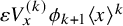 $\varepsilon V^{(k)}_x \phi _{k+1}\langle x \rangle ^k$
in (3.15). Estimates (3.23) and (3.24) follow upon choosing
$\varepsilon V^{(k)}_x \phi _{k+1}\langle x \rangle ^k$
in (3.15). Estimates (3.23) and (3.24) follow upon choosing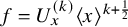 $f = U^{(k)}_x \langle x \rangle ^{k + \frac 1 2}$
and
$f = U^{(k)}_x \langle x \rangle ^{k + \frac 1 2}$
and $f = \sqrt {\varepsilon }V^{(k)}_x \langle x \rangle ^{k + \frac 1 2}$
, respectively.
$f = \sqrt {\varepsilon }V^{(k)}_x \langle x \rangle ^{k + \frac 1 2}$
, respectively.
We will need to state another corollary, which applies only to the lowest order terms.
Corollary 3.4. The following inequalities are valid:
 $$ \begin{align} &\| U \langle x \rangle^{- \frac12 - \frac{1}{200}} \| + \| \sqrt{\varepsilon}V \langle x \rangle^{-\frac12 - \frac{1}{200}} \| + \| \sqrt{\varepsilon}q \langle x \rangle^{-\frac32 -\frac{1}{200}} \| \lesssim \| U, V \|_{X_0} \end{align} $$
Proof. The U and V bounds follow upon choosing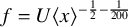 $f = U \langle x \rangle ^{-\frac 12 - \frac {1}{200}}$
in (3.15), whereas the q bound follows from the standard Hardy inequality valid as
$f = U \langle x \rangle ^{-\frac 12 - \frac {1}{200}}$
in (3.15), whereas the q bound follows from the standard Hardy inequality valid as $q|_{x = 0} = 0$
:
$q|_{x = 0} = 0$
: $\| \sqrt {\varepsilon }q \langle x \rangle ^{-\frac 32 - \frac {1}{200}} \| \lesssim \| \sqrt {\varepsilon } q_x \langle x \rangle ^{-\frac 12 - \frac {1}{200}} \| = \| \sqrt {\varepsilon } V \langle x \rangle ^{-\frac 12 - \frac {1}{200}} \|$
.
$\| \sqrt {\varepsilon }q \langle x \rangle ^{-\frac 32 - \frac {1}{200}} \| \lesssim \| \sqrt {\varepsilon } q_x \langle x \rangle ^{-\frac 12 - \frac {1}{200}} \| = \| \sqrt {\varepsilon } V \langle x \rangle ^{-\frac 12 - \frac {1}{200}} \|$
.
We now need to record a Hardy-type inequality in which the precise constant is important. More precisely, the fact that the first coefficient on the right-hand side below is very close to $1$
will be important.
$1$
will be important.
Lemma 3.5. For any function $f(x): \mathbb {R}_+ \rightarrow \mathbb {R}$
satisfying
$f(x): \mathbb {R}_+ \rightarrow \mathbb {R}$
satisfying $f(0) = 0$
and
$f(0) = 0$
and $f \rightarrow 0$
as
$f \rightarrow 0$
as $x \rightarrow \infty $
, there exists a
$x \rightarrow \infty $
, there exists a $C> 0$
such that
$C> 0$
such that
 $$ \begin{align} \int \langle x \rangle^{-3.01} \bar{u}^2 f^2 \,\mathrm{d} x \le \frac{1}{1.01} \int \langle x \rangle^{-1.01} \bar{u}^2 f_x^2 \,\mathrm{d} x + \frac{2}{1.01} |\int \langle x \rangle^{-2.01} \bar{u} \bar{u}_x f^2 \,\mathrm{d} x|. \end{align} $$
Proof. We compute the quantity on the left-hand side of above via
 $$ \begin{align} \nonumber \int \langle x \rangle^{-3.01} \bar{u}^2 f^2 \,\mathrm{d} x & = - \int \frac{\partial_x}{2.01} \langle x \rangle^{-2.01} \bar{u}^2 f^2 \,\mathrm{d} x \\ \nonumber & = \frac{2}{2.01} \int \langle x \rangle^{-2.01} \bar{u}^2 f f_x \,\mathrm{d} x + \frac{2}{2.01} \int \langle x \rangle^{-2.01} \bar{u} \bar{u}_x f^2 \,\mathrm{d} x \\ & \le \frac{1}{2.01} \int \langle x \rangle^{-3.01} \bar{u}^2 f^2 \,\mathrm{d} x + \frac{1}{2.01} \int \langle x \rangle^{-1.01} \bar{u}^2 f_x^2 \,\mathrm{d} x + \frac{2}{2.01} \int \langle x \rangle^{-2.01} \bar{u} \bar{u}_x f^2 \,\mathrm{d} x, \end{align} $$
which, upon bringing the first term on the right-hand side to the left, gives the inequality (3.26) with the precise constants.
3.3
$L^p_x L^q_y$
embeddings

We will now state some $L^p_x L^q_y$
type embedding theorems on
$L^p_x L^q_y$
type embedding theorems on $(U, V)$
using the specification of
$(U, V)$
using the specification of $\| U, V \|_{\mathcal {X}}$
. The reader should recall the notational convention that
$\| U, V \|_{\mathcal {X}}$
. The reader should recall the notational convention that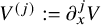 $V^{(j)} := \partial _x^j V$
.
$V^{(j)} := \partial _x^j V$
.
Lemma 3.6. For $1 \le j \le 10$
,
$1 \le j \le 10$
,
 $$ \begin{align} \varepsilon^{\frac 1 4}\| V^{(j)} \langle x \rangle^j \phi_{j+1} \|_{L^2_x L^\infty_y} &\lesssim \| U, V \|_{\mathcal{X}_{\le j+1}}, \end{align} $$
 $$ \begin{align} \varepsilon^{\frac 1 4}\| \bar{u} V^{(j)} \langle x \rangle^j \phi_{j+1} \|_{L^2_x L^\infty_y} &\lesssim \| U, V \|_{\mathcal{X}_{\le j + \frac 1 2}} \end{align} $$
Proof. We begin with (3.28). For this, we first freeze x and integrate from $y = \infty $
to obtain
$y = \infty $
to obtain
 $$ \begin{align} \nonumber \varepsilon^{\frac 1 2}|V^{(j)}|^2 \langle x \rangle^{2j} \phi_{j+1}^2 &= 2 \varepsilon^{\frac 1 2} |\int_y^\infty V^{(j)} V^{(j)}_y\langle x \rangle^{2j} \phi_{j+1}^2 \,\mathrm{d} y' | \lesssim \| \varepsilon^{\frac 1 2} V^{(j)} \langle x \rangle^{j - \frac 1 2} \phi_{j+1} \|_{L^2_y} \| U^{(j)}_x \langle x \rangle^{j+ \frac 1 2} \phi_{j+1} \|_{L^2_y} \\ & = \| \varepsilon^{\frac 1 2} V^{(j-1)}_x \langle x \rangle^{(j-1)+ \frac 1 2} \phi_{j+1} \|_{L^2_y} \| U^{(j)}_x \langle x \rangle^{j + \frac 1 2} \phi_{j+1} \|_{L^2_y}. \end{align} $$
We now take $L^2_x$
and appeal to (3.23)–(3.24).
$L^2_x$
and appeal to (3.23)–(3.24).
Similarly, we compute
 $$ \begin{align} \nonumber \varepsilon^{\frac 1 2}\bar{u}_\ast^2 |V^{(j)}|^2 \langle x \rangle^{2j} \phi_{j+1}^2 &\le 2 \varepsilon^{\frac 1 2} \bar{u}_\ast^2 |\int_y^\infty V^{(j)} V^{(j)}_y\langle x \rangle^{2j} \phi_{j+1}^2 \,\mathrm{d} y' | \lesssim \varepsilon^{\frac 1 2} \int_y^\infty \bar{u}_\ast^2| V^{(j-1)}_x ||U^{(j)}_x|\langle x \rangle^{2j} \phi_{j+1}^2 \,\mathrm{d} y' \\ &\lesssim \varepsilon^{\frac 1 2} \| \bar{u}_\ast V^{(j-1)}_x \langle x \rangle^{j - \frac 1 2} \phi_{j+1}\| \| \bar{u}_\ast U^{(j)}_x \langle x \rangle^{j + \frac 1 2} \phi_{j+1} \| \end{align} $$
where above we have used that $\bar {u}_\ast (y') \ge \bar {u}_\ast (y) \ge 0$
when
$\bar {u}_\ast (y') \ge \bar {u}_\ast (y) \ge 0$
when $y' \ge y$
to bring the
$y' \ge y$
to bring the $\bar {u}_\ast ^2$
factor inside the integral. We now use (2.12) to conclude.
$\bar {u}_\ast ^2$
factor inside the integral. We now use (2.12) to conclude.
We will now need to translate the information on $(U, V)$
from the norms stated above to information regarding
$(U, V)$
from the norms stated above to information regarding $(u, v)$
.
$(u, v)$
.
Lemma 3.7. For $2 \le j \le 10$
,
$2 \le j \le 10$
, $0 \le k \le 10$
,
$0 \le k \le 10$
, $1 \le m \le 11$
, and for any
$1 \le m \le 11$
, and for any $0 < \delta << 1$
,
$0 < \delta << 1$
,
 $$ \begin{align} \| u^{(k)}_x x^{k+ \frac 1 2} \phi_{k+1} \| + \| \sqrt{\varepsilon} v^{(k)}_x x^{k + \frac 1 2} \phi_{k+1} \| & \le C_\delta \| U, V \|_{\mathcal{X}_{\le k + \frac 1 2}} + \delta \| U, V\|_{\mathcal{X}_{\le k+1}} \end{align} $$
 $$ \begin{align} \| u^{(m)}_y x^{m} \phi_m \| +\sqrt{\varepsilon} \| u^{(m)}_x x^m \phi_{m} \| + \varepsilon \| v^{(m)}_x x^{m} \phi_{m} \| &\lesssim \| U, V \|_{\mathcal{X}_{\le m}} \end{align} $$
 $$ \begin{align} \| \frac{1}{\bar{u}} \partial_x^j v \langle x\rangle^{j } \phi_{j+1} \|_{L^2_x L^\infty_y} &\lesssim \| U, V \|_{\mathcal{X}_{\le j + 1}}, \end{align} $$
 $$ \begin{align} \| \partial_x^j v \langle x\rangle^{j } \phi_{j+1} \|_{L^2_x L^\infty_y} &\lesssim \| U, V \|_{\mathcal{X}_{\le j + \frac 1 2 }}. \end{align} $$
Proof. To prove these estimates, we simply use (2.23) to express $(u, v)$
in terms of
$(u, v)$
in terms of $(U, V)$
. We do this now, starting with (3.32). Differentiating (2.23)
$(U, V)$
. We do this now, starting with (3.32). Differentiating (2.23) $k+1$
times in x, we obtain
$k+1$
times in x, we obtain
 $$ \begin{align*} \| u^{(k)}_x x^{k+ \frac 1 2} \phi_{k+1} \| \le I_1 + I_2, \end{align*} $$
where
 $$ \begin{align*} I_1 & := \sum_{l = 0}^{k} \binom{k+1}{l} ( \| \partial_x^l \bar{u} \partial_x^{k - l} U_x x^{k+\frac 1 2} \phi_{k+1} \| + \| \partial_x^{l} \bar{u}_y \partial_x^{k-l}V x^{k + \frac 1 2} \phi_{k+1} \| ), \\ I_2 & := \| \partial_x^{k+1} \bar{u} U x^{k+ \frac 1 2} \phi_{k+1} \| + \| \partial_x^{k+1} \bar{u}_y q x^{k+ \frac 1 2} \phi_{k+1} \| \end{align*} $$
We first estimate $I_1$
as follows
$I_1$
as follows
 $$ \begin{align} \nonumber I_1 & \le \sum_{l = 0}^{k} \binom{k+1}{l} ( \| \partial_x^l \bar{u} \partial_x^{k - l} U_x x^{k+\frac 1 2} \phi_{k+1} \| + \| \partial_x^{l} \bar{u}_y \partial_x^{k-l}V x^{k + \frac 1 2} \phi_{k+1} \| ) \\ \nonumber &\lesssim \sum_{l = 0}^{k} \| \frac{\partial_x^l \bar{u}}{ \bar{u}} x^l \|_\infty \| \bar{u} \partial_x^{k-l} U_x \langle x \rangle^{k - l + \frac 1 2} \phi_{k+1} \| + \| \partial_x^l \bar{u}_y y x^l \|_\infty \| \partial_x^{k-l} V_y x^{k-l + \frac 1 2} \phi_{k+1} \| \\ \nonumber & \le \sum_{l = 0}^{k}C_\delta \| \bar{u} \partial_x^{k-l} U_x \langle x \rangle^{k - l + \frac 1 2} \phi_{k+1} \| + C_\delta \| \bar{u} \partial_x^{k-l} V_y x^{k-l + \frac 1 2} \phi_{k+1} \| +\delta \| \sqrt{\bar{u}} \partial_x^{k+1-l} U_y x^{k+1 -l} \phi_{k+1} \| \\ & \le \sum_{l = 0}^{k} ( C_\delta\| U, V \|_{\mathcal{X}_{\le k-l + \frac 1 2}} + \delta \| U, V \|_{\mathcal{X}_{\le k+1-l}} ), \end{align} $$
where we have invoked (3.23).
We turn to $I_2$
, which requires a different estimate. We recall the splitting of the background profile into Euler and Prandtl components, (2.1). For the Eulerian piece, we estimate as follows
$I_2$
, which requires a different estimate. We recall the splitting of the background profile into Euler and Prandtl components, (2.1). For the Eulerian piece, we estimate as follows
 $$ \begin{align*} I_{2,E} & := \| \partial_x^{k+1} \bar{u}_E U x^{k+ \frac 1 2} \phi_{k+1} \| + \| \partial_x^{k+1} \partial_y\bar{u}_E q x^{k+ \frac 1 2} \phi_{k+1} \| \\ &\lesssim (\| x^{k + \frac32} \partial_x^{k+1}\bar{u}_E \|_{L^\infty} + \| x^{k + \frac32} (y \partial_y) \partial_x^{k+1}\bar{u}_E \|_{L^\infty} ) \| U \langle x \rangle^{-1} \| \lesssim \| U, V \|_{X_0}. \end{align*} $$
For the Prandtl component, we estimate as follows
 $$ \begin{align*} I_{2,P} & := \| \partial_x^{k+1} \bar{u}_p U x^{k+ \frac 1 2} \phi_{k+1} \| + \| \partial_x^{k+1} \partial_y\bar{u}_p q x^{k+ \frac 1 2} \phi_{k+1} \| \\ &\lesssim \| \partial_x^{k+1} \bar{u}_p (U - U(x, 0)) x^{k+ \frac 1 2} \phi_{k+1} \| + \| \partial_x^{k+1} \bar{u}_p U(x, 0) x^{k+ \frac 1 2} \phi_{k+1} \| \\ &\quad + \| \partial_x^{k+1} \partial_y\bar{u}_p (q - y U(x, 0)) x^{k+ \frac 1 2} \phi_{k+1}\| + \| \partial_x^{k+1} \partial_y\bar{u}_p y U(x, 0) x^{k+ \frac 1 2} \phi_{k+1} \| \\ &\lesssim \| \partial_x^{k+1} \bar{u}_p y x^{k + \frac12} \|_{L^\infty} \| \frac{U - U(x, 0)}{y} \| + \| \partial_x^{k+1} \bar{u}_p x^{k + \frac34} \|_{L^\infty_x L^2_y} \| U(x, 0) \langle x \rangle^{-\frac14} \|_{L^2_x} \\ &\quad + \| \partial_x^{k+1} \partial_y \bar{u}_p y^2 x^{k + \frac12} \|_{L^\infty} \| \frac{q - y U(x, 0)}{y^2} \| + \| \partial_x^{k+1} y \partial_y \bar{u}_p x^{k + \frac34} \|_{L^\infty_x L^2_y} \| U(x, 0) \langle x \rangle^{-\frac14} \|_{L^2_x} \\ &\lesssim ( \| \partial_x^{k+1} \bar{u}_p y x^{k + \frac12} \|_{L^\infty} + \| \partial_x^{k+1} \partial_y \bar{u}_p y^2 x^{k + \frac12} \|_{L^\infty}) \| U_y \| \\ &\quad +( \| \partial_x^{k+1} \bar{u}_p x^{k + \frac34} \|_{L^\infty_x L^2_y} +\| \partial_x^{k+1} y\partial_y \bar{u}_p x^{k + \frac34} \|_{L^\infty_x L^2_y} ) \| U(x, 0) \langle x \rangle^{-\frac14} \|_{L^2_x} \\ &\lesssim \| U, V \|_{Y_{\frac12}} + \| U, V \|_{X_0}, \end{align*} $$
where we have used the inequality (3.22). This establishes the bound of the first quantity in (3.32). The analogous proof works for the second quantity in (3.32).
For the first quantity in (3.33), we obtain the identity
 $$ \begin{align} u_y^{(m)} = \sum_{l =0}^m \binom{m}{l} (\partial_x^l \bar{u} \partial_x^{m-l} U_y + 2 \partial_x^l \bar{u}_y \partial_x^{m-l} U + \partial_x^l \bar{u}_{yy} \partial_x^{m-l} q). \end{align} $$
We now estimate
 $$ \begin{align} \nonumber \| u_y^{(m)} x^m \phi_m \| &\lesssim\sum_{l = 0}^m \Big\| \frac{\partial_x^l \bar{u}}{\bar{u}} \langle x \rangle^l \Big\|_\infty \| \sqrt{\bar{u}} \partial_x^{m-l} U_y \langle x \rangle^{m-l} \phi_{m-l} \| \\ \nonumber &\quad + \sum_{l = 0}^{m-1} \| \partial_x^l \bar{u}_y \langle x \rangle^{l + \frac 1 2}\|_\infty \| \partial_x^{m-1-l} U_x \langle x \rangle^{m-1-l +\frac 1 2} \phi_{m-1-l} \| \\ \nonumber &\quad + \| \partial_x^m \bar{u}_y y x^m \|_\infty \Big\| \frac{U - U(x, 0)}{y} \Big\| + \| \partial_x^m \bar{u}_y \langle x \rangle^{m+\frac 1 4} \|_{L^\infty_x L^2_y} \| U(x, 0) \langle x \rangle^{-\frac 1 4} \|_{L^2_x} \\ \nonumber &\quad + \sum_{l = 0}^{m-1} \| \partial_x^l \bar{u}_{yy} \langle x \rangle^{l + \frac 1 2} y \|_\infty \| \partial_x^{m-1-l} \frac{q_x}{y} \langle x \rangle^{m-1-l +\frac 1 2} \phi_{m-1-l} \| \\ &\quad + \| \partial_x^m \bar{u}_{yy} y^2 x^m \|_\infty \| \frac{q - y U(x, 0)}{\langle y \rangle^2} \| + \| \partial_x^m y \bar{u}_{yy} \langle x \rangle^{m+\frac 1 4} \|_{L^\infty_x L^2_y} \| U(x, 0) \langle x \rangle^{-\frac 1 4} \|_{L^2_x}, \end{align} $$
where we use above that $m \ge 1$
in (3.33).
$m \ge 1$
in (3.33).
We now arrive at the mixed norm estimates in (3.34). An immediate computation gives
 $$ \begin{align} \nonumber \| \frac{1}{\bar{u}} \partial_x^j v \langle x \rangle^j \phi_j \|_{L^2_x L^\infty_y} &\lesssim\sum_{l = 0}^{j-1} \Big\| \frac{\partial_x^l \bar{u}}{ \bar{u}} \langle x \rangle^l \Big\|_\infty \| \partial_x^{j-l} V \langle x \rangle^{j-l} \phi_{j} \|_{L^2_x L^\infty_y} \\ \nonumber &\quad + \sum_{l = 0}^{j-2} \Big\| \frac{\partial_x^{l+1} \bar{u}}{ \bar{u}} \langle x \rangle^{l+1} \Big\|_\infty \| \partial_x^{j-l} q \langle x \rangle^{j-l-1} \phi_{j} \|_{L^2_x L^\infty_y} \\ \nonumber &\quad + \| \partial_x^j \bar{u} \langle x \rangle^{j - \frac 1 2} y \|_\infty \Big\| \frac{V}{y} \langle x \rangle^{\frac 1 2} \phi_j\Big\|_{L^2_x L^\infty_y} + \| \partial_x^{j+1} \bar{u} y \langle x \rangle^{j + \frac 1 2} \|_\infty \Big\| \frac{q}{y} \langle x \rangle^{- \frac 1 2} \phi_j \Big\|_{L^2_x L^\infty_y} \\ &\lesssim \sum_{l = 0}^{j-1} \| U, V \|_{\mathcal{X}_{\le l+1}} + \Big\| \frac{V}{y} \langle x \rangle^{\frac 1 2} \phi_j \Big\|_{L^2_x L^\infty_y} +\Big\| \frac{q}{y} \langle x \rangle^{- \frac 1 2} \phi_j \Big\|_{L^2_x L^\infty_y}, \end{align} $$
where we have invoked (3.28). To conclude, we need to estimate the final two terms appearing above. First, we have by using $V|_{y = 0} = 0$
,
$V|_{y = 0} = 0$
,
 $$ \begin{align} \Big\| \frac{V}{y} \langle x \rangle^{\frac 1 2} \phi_j \Big\|_{L^2_x L^\infty_y} \lesssim \| U_x \langle x \rangle^{\frac 1 2} \phi_j \|_{L^2_x L^\infty_y} \lesssim \| U, V \|_{\mathcal{X}_{\le 1.5}}, \end{align} $$
where above we have used the estimate
 $$ \begin{align*} \nonumber \langle x \rangle U_x^2 & = |\int_y^\infty \langle x \rangle U^{(1)} U^{(1)}_{y} \,\mathrm{d} y'| \lesssim \| U_x \langle x \rangle^{\frac 1 2} \|_{L^2_y} \| U_{xy} \langle x \rangle \|_{L^2_y} \\ \nonumber &\lesssim (\| \bar{u} U_x \langle x \rangle^{\frac 1 2} \|_{L^2_y} + \| \sqrt{\bar{u}} U_{xy} \langle x \rangle \|_{L^2_y} )(\| \sqrt{\bar{u}} U^{(1)}_y \langle x \rangle \|_{L^2_y} + \| \sqrt{\bar{u}} U^{(1)}_{yy} \langle x \rangle^{\frac 3 2} \|_{L^2_y} ), \end{align*} $$
which, upon taking supremum in y and subsequently integrating in x, yields $\| U_x \langle x \rangle ^{\frac 1 2}\phi _j \|_{L^2_x L^\infty _y}^2 \lesssim \| U, V \|_{\mathcal {X}_{\le 1.5}}^2.$
An analogous estimate applies to the third term from (3.39). The estimate (3.35) works in a nearly identical manner, invoking (3.29) instead of (3.28).
$\| U_x \langle x \rangle ^{\frac 1 2}\phi _j \|_{L^2_x L^\infty _y}^2 \lesssim \| U, V \|_{\mathcal {X}_{\le 1.5}}^2.$
An analogous estimate applies to the third term from (3.39). The estimate (3.35) works in a nearly identical manner, invoking (3.29) instead of (3.28).
3.4 Pointwise decay estimates
A crucial feature of space $\mathcal {X}$
is that it is strong enough to control sharp pointwise decay rates of various quantities, which are in turn used to control the nonlinearity. To be precise, we need to treat large values of x (the more difficult case) in a different manner than small values of x. Large values of x will be treated through the weighted norms in (3.10), whereas small values of x will be treated with the
$\mathcal {X}$
is that it is strong enough to control sharp pointwise decay rates of various quantities, which are in turn used to control the nonlinearity. To be precise, we need to treat large values of x (the more difficult case) in a different manner than small values of x. Large values of x will be treated through the weighted norms in (3.10), whereas small values of x will be treated with the $\dot {H}^k$
component of (3.10), at an expense of
$\dot {H}^k$
component of (3.10), at an expense of $\varepsilon ^{-M_1}$
. We recall from (3.3) that
$\varepsilon ^{-M_1}$
. We recall from (3.3) that $\phi _{12}(x)$
is only nonzero when
$\phi _{12}(x)$
is only nonzero when $\phi _{j} = 1$
for
$\phi _{j} = 1$
for $1 \le j \le 11$
.
$1 \le j \le 11$
.
Lemma 3.8. For $0 \le k \le 8$
, and for
$0 \le k \le 8$
, and for $j = 0, 1$
,
$j = 0, 1$
,
 $$ \begin{align} &\| \bar{u}^j \partial_y^j U^{(k)} \langle x \rangle^{k + \frac 1 4 + \frac j 2} \phi_{12}\|_{L^\infty_y} \lesssim \| U, V \|_{\mathcal{X}}, &&\| \sqrt{\varepsilon} V^{(k)} \langle x \rangle^{k + \frac 1 2} \phi_{12} \|_{L^\infty_y} \lesssim \| U, V \|_{\mathcal{X}}. \end{align} $$
Proof. We first establish the U decay via
 $$ \begin{align} \nonumber U_x^2 \langle x \rangle^{\frac 5 2} \phi_{12}^2 &= \Big| - \int_y^\infty 2 U_x U_{xy} \langle x \rangle^{\frac 5 2} \phi_{12}^2 \Big|\\ \nonumber &\le \Big| \int_y^\infty \int_x^\infty 2 U_{xx} U_{xy} \langle x \rangle^{\frac 5 2} \phi_{12}^2 \Big| + \Big| 2 \int_y^\infty \int_x^\infty U_x U_{xxy} \langle x \rangle^{\frac 5 2} \phi_{12}^2\Big| \\ \nonumber &\quad + 5 \Big| \int_y^\infty \int_x^\infty U_x U_{xy} \langle x \rangle^{\frac 3 2}\phi_{12}^2 \Big| + \Big| \int_y^\infty \int_x^\infty 4 U_x U_{xy} \phi_{12} \phi_{12}' \Big| \\ \nonumber &\lesssim \| U_{xx} \langle x \rangle^{\frac 3 2} \phi_{12} \| \| U_{xy} \langle x \rangle \phi_{12} \| + \| U_x \langle x \rangle^{\frac 1 2} \phi_{12} \| \| U_{yxx} \langle x \rangle^2 \phi_{12} \| \\ &\quad + \| U_x \langle x \rangle^{\frac 1 2} \phi_{12}\| \| U_{xy} \langle x \rangle \phi_{12} \| + \| U_x \phi_{11} \| \| U_{xy} \phi_{11} \|. \end{align} $$
We now perform the same calculation for the V decay in (3.41). We begin with $V_x$
, via
$V_x$
, via
 $$ \begin{align} \nonumber \varepsilon V_x^2 \langle x \rangle^{3} \phi_{12}^2 &= \Big| \int_y^\infty 2 \varepsilon V_x V_{xy} \langle x \rangle^3 \phi_{12}^2 \,\mathrm{d} y' \Big| \\ \nonumber &\le \int_y^\infty \int_x^\infty 2 \varepsilon | V_{xx} | | V_{xy} | \langle x \rangle^{3} \phi_{12}^2 \,\mathrm{d} y' \,\mathrm{d} x' + \int_y^\infty \int_x^\infty 2 \varepsilon | V_{x} | | V_{xxy} | \langle x \rangle^{3} \phi_{12}^2 \,\mathrm{d} y' \,\mathrm{d} x' \\ \nonumber &\quad + \int_y^\infty \int_x^\infty 6 \varepsilon | V_{x} | | V_{xy} | \langle x \rangle^{2} \phi_{12}^2 \,\mathrm{d} y' \,\mathrm{d} x' + |\int_y^\infty \int_x^\infty 4\varepsilon |V_x| |V_{xy}| \langle x \rangle^{3} \phi_{12} \phi_{12}' \,\mathrm{d} y' \,\mathrm{d} x' \\ \nonumber &\lesssim \sqrt{\varepsilon} \| \sqrt{\varepsilon} V^{(1)}_x \langle x \rangle^{\frac 3 2} \phi_{12}\| \| U^{(1)}_x \langle x \rangle^{\frac 3 2} \phi_{12} \| + \sqrt{\varepsilon} \| \sqrt{\varepsilon} V_x \langle x \rangle^{\frac 1 2} \phi_{12} \| \| U^{(2)}_x \langle x \rangle^{2.5} \phi_{12} \| \\ &\quad + \sqrt{\varepsilon} \| \sqrt{\varepsilon} V_x \langle x \rangle^{\frac 1 2} \phi_{12} \| \| U^{(1)}_x \langle x \rangle^{\frac 3 2} \phi_{12} \| + \sqrt{\varepsilon} \| \sqrt{\varepsilon} V_x \langle x \rangle^{\frac 1 2} \phi_{11} \| \| U^{(1)}_x \langle x \rangle^{\frac 3 2} \phi_{11} \|. \end{align} $$
From here the result follows upon invoking (3.23)–(3.24). The same computation can be done for higher derivatives, and for $U, V$
themselves we use the estimate
$U, V$
themselves we use the estimate
 $$ \begin{align} U \phi_{12} = \phi_{12} \int_x^\infty U_x \lesssim \|U, V \|_{\mathcal{X}} \int_x^\infty \langle x' \rangle^{- \frac 5 4} \,\mathrm{d} x' \lesssim \langle x \rangle^{- \frac 1 4} \| U, V \|_{\mathcal{X}}, \end{align} $$
and similarly for V, we integrate
 $$ \begin{align} V \phi_{12} = \phi_{12} \int_x^\infty V_x \lesssim \varepsilon^{- \frac 1 2} \|U, V \|_{\mathcal{X}} \int_x^\infty \langle x' \rangle^{- \frac 3 2} \,\mathrm{d} x' \lesssim \langle x \rangle^{- \frac 1 2} \varepsilon^{- \frac 1 2} \| U, V \|_{\mathcal{X}}. \end{align} $$
This concludes the proof.
It is also necessary that we establish decay estimates on the original unknowns $(u, v)$
. For this purpose, we define another auxiliary cut-off function in the following manner
$(u, v)$
. For this purpose, we define another auxiliary cut-off function in the following manner
 $$ \begin{align} \psi_{12}(x) := \begin{cases} 0 \text{ for } 0 \le x \le 60 \\ 1 \text{ for } x \ge 61 \end{cases} \end{align} $$
The main point in specifying $\psi _{12}$
in this manner is so that its support is contained where
$\psi _{12}$
in this manner is so that its support is contained where $\psi _j = 1$
for
$\psi _j = 1$
for $j = 2,...,11$
and simultaneously
$j = 2,...,11$
and simultaneously $\psi _{12} = 1$
on the set where
$\psi _{12} = 1$
on the set where $\phi _1$
is supported. Then, we have the following lemma.
$\phi _1$
is supported. Then, we have the following lemma.
Lemma 3.9. For $1 \le k \le 8$
, and
$1 \le k \le 8$
, and $j = 1, 2$
,
$j = 1, 2$
,
 $$ \begin{align} \| u^{(k)} x^{k + \frac 1 4} \psi_{12} \|_\infty &+ \| u^{(k)}_y x^{\frac 3 4} \psi_{12} \|_\infty + \| \frac{1}{\bar{u}} u^{(k)} x^{k + \frac 1 4} \psi_{12}\|_\infty \lesssim \varepsilon^{-M_1} \| U, V \|_{\mathcal{X}} \end{align} $$
 $$ \begin{align} &\quad \| v^{(k)} x^{k + \frac 1 2} \psi_{12} \|_\infty + \| \frac{v^{(k)}}{\bar{u}} x^{k + \frac 1 2} \psi_{12} \|_\infty \lesssim \varepsilon^{-M_1} \| U, V \|_{\mathcal{X}} \end{align} $$
 $$ \begin{align} &\qquad\qquad\qquad \| \partial_y^j u^{(k)} x^{k + \frac j 2} \psi_{12}\|_{L^\infty_x L^2_y} \lesssim \varepsilon^{-M_1} \| U, V \|_{\mathcal{X}}, \end{align} $$
where we recall that have made a concrete choice for the parameter $M_1 = 24$
after (3.10). In addition,
$M_1 = 24$
after (3.10). In addition,
 $$ \begin{align} \| u \langle x \rangle^{\frac 1 4} \|_\infty + \| \sqrt{\varepsilon} v \langle x \rangle^{\frac 1 2} \|_\infty \lesssim \varepsilon^{-M_1} \| U, V \|_{\mathcal{X}} \end{align} $$
Proof. We note that standard Sobolev embeddings gives $\| u^{(k)} \psi _{12} \|_\infty \lesssim \| u^{(k)} \psi _{12} \|_{H^2} \lesssim \varepsilon ^{-M_1} \| U, V \|_{\mathcal {X}}$
, and similarly for the remaining quantities in (3.47)–(3.49). Next, we appeal to (2.23) to obtain
$\| u^{(k)} \psi _{12} \|_\infty \lesssim \| u^{(k)} \psi _{12} \|_{H^2} \lesssim \varepsilon ^{-M_1} \| U, V \|_{\mathcal {X}}$
, and similarly for the remaining quantities in (3.47)–(3.49). Next, we appeal to (2.23) to obtain
 $$ \begin{align*} \nonumber \| u^{(k)} x^{k + \frac 1 4} \phi_{12} \|_{\infty} & \le \sum_{l = 0}^k \binom{k}{l} (\| \partial_x^l \bar{u} \partial_x^{k-l} U x^{k + \frac 1 4} \phi_{12} \|_\infty + \| \partial_x^l \bar{u}_y \partial_x^{k-l} q x^{k + \frac 1 4} \phi_{12} \|_\infty) \\ \nonumber &\lesssim \sum_{l = 0}^k \| \partial_x^l \bar{u} x^l \|_\infty \| \partial_x^{k-l} U x^{k-l + \frac 1 4} \phi_{12} \|_\infty + \| \partial_x^l \bar{u}_y y x^{l} \|_\infty \| \partial_x^{k-l} \frac{q}{y} x^{k-l + \frac 1 4} \phi_{12} \|_\infty \\ \nonumber &\lesssim\sum_{l = 0}^k \| \partial_x^{k-l} U x^{k-l + \frac 1 4} \phi_{12} \|_\infty \lesssim \| U, V \|_{\mathcal{X}}, \end{align*} $$
where we have invoked estimate (3.41) as well as the bound (applied to $\partial _x^{k-l} q$
):
$\partial _x^{k-l} q$
):
 $$ \begin{align*} \| \frac{f}{y} \|_{L^\infty} = \| \frac{1}{y} \int_0^y f_y \|_{L^\infty} \lesssim \| \frac{1}{y} y \| f_y \|_{L^\infty} \|_{L^\infty} \lesssim \| f_y \|_{L^\infty}, \end{align*} $$
for a generic function $f(y)$
satisfying
$f(y)$
satisfying $f(0) = 0$
. To conclude, by using that
$f(0) = 0$
. To conclude, by using that $x < 400$
is bounded on the set
$x < 400$
is bounded on the set $\{\psi _{12} = 1 \} \cap \{ \phi _{12} < 1 \}$
, we have
$\{\psi _{12} = 1 \} \cap \{ \phi _{12} < 1 \}$
, we have
 $$ \begin{align} \nonumber \| u^{(k)} x^{k + \frac 1 4} \psi_{12} \|_\infty & \le \| u^{(k)} x^{k + \frac 1 4} \psi_{12} (1 - \phi_{12}) \|_\infty + \| u^{(k)} x^{k + \frac 1 4} \psi_{12} \phi_{12} \|_\infty \\ &\lesssim \varepsilon^{-M_1} \| U, V \|_{\mathcal{X}} + \| u^{(k)} x^{k + \frac 1 4} \phi_{12} \|_\infty \lesssim \varepsilon^{-M_1} \| U, V \|_{\mathcal{X}}. \end{align} $$
The remaining estimates in (3.47)–(3.50) work in largely the same manner.
4 Global a-priori bounds
In this section, we perform our main energy estimates, which control the $\|U, V \|_{X_0}, \|U, V \|_{X_{\frac 1 2}}, \|U, V \|_{Y_{\frac 1 2}}$
, and their higher order counterparts, up to
$\|U, V \|_{X_0}, \|U, V \|_{X_{\frac 1 2}}, \|U, V \|_{Y_{\frac 1 2}}$
, and their higher order counterparts, up to $\|U, V \|_{X_{10}}, \|U, V \|_{X_{10.5}}, \|U, V \|_{Y_{10.5}}$
. When we perform these estimates, we recall the notational convention for this section, which is that, unless otherwise specified
$\|U, V \|_{X_{10}}, \|U, V \|_{X_{10.5}}, \|U, V \|_{Y_{10.5}}$
. When we perform these estimates, we recall the notational convention for this section, which is that, unless otherwise specified $\int g := \int _0^\infty \int _0^\infty g(x, y) \,\mathrm {d} y \,\mathrm {d} x$
. For this section, we define the operator
$\int g := \int _0^\infty \int _0^\infty g(x, y) \,\mathrm {d} y \,\mathrm {d} x$
. For this section, we define the operator
 $$ \begin{align} \text{div}_\varepsilon(\mathbf{M}) := \partial_x M_1 + \frac{\partial_y}{\varepsilon} M_2, \text{ where } \mathbf{M} = (M_1, M_2). \end{align} $$
4.1
$X_0$
estimates

Lemma 4.1. Let $(U, V)$
be a solution to (2.26)–(2.28). Then the following estimate is valid,
$(U, V)$
be a solution to (2.26)–(2.28). Then the following estimate is valid,
 $$ \begin{align} \| U, V \|_{X_{0}}^2 \lesssim |\mathcal{T}_{X_0}| + |\mathcal{F}_{X_0}|, \end{align} $$
where
 $$ \begin{align} \mathcal{T}_{X_0} &:= \int \mathcal{N}_1 U g(x)^2 + \int \varepsilon \mathcal{N}_2 (V g(x)^2 + \frac{1}{100} q \langle x \rangle^{-1 - \frac{1}{100}}), \end{align} $$
 $$ \begin{align} \mathcal{F}_{X_0} &:= \int F_R U g(x)^2 + \int \varepsilon G_R (V g(x)^2 + \frac{1}{100} q \langle x \rangle^{-1 - \frac{1}{100}}). \end{align} $$
Proof. We apply the multiplier
 $$ \begin{align} \mathbf{M}_{X_0} := [U g^2, \varepsilon V g^2 - \varepsilon q \partial_x (g^2)] = [U g^2, \varepsilon V g^2 + \varepsilon \frac{1}{100} q \langle x \rangle^{-1 - \frac{1}{100}}] \end{align} $$
to the system (2.26)–(2.28). This produces the long identity
 $$ \begin{align*} \nonumber \text{Pressure}_{X_0} + \text{Transport}_{X_0} + \text{Error}_{X_0} + \text{Diffusion}_{X_0} = \mathcal{T}_{X_0} + \mathcal{F}_{X_0}. \end{align*} $$
We now provide the definition of each of these terms appearing on the left-hand side.
 $$ \begin{align*} \text{Pressure}_{X_0} & := \int P_x U g^2 \,\mathrm{d} y \,\mathrm{d} x+ \int \frac{P_y}{\varepsilon} (\varepsilon V g^2 + \varepsilon \frac{1}{100} q \langle x \rangle^{-1 - \frac{1}{100}} ) \,\mathrm{d} y \,\mathrm{d} x, \\ \text{Transport}_{X_0} & := \int \mathcal{T}_1[U] U g(x)^2 \,\mathrm{d} y \,\mathrm{d} x + \int \mathcal{T}_2[V] (\varepsilon V g^2 + \varepsilon (.01) q \langle x \rangle^{-1.01} ) \,\mathrm{d} y \,\mathrm{d} x \\ \text{Diffusion}_{X_0} & := \int \Big( - \partial_y^2 u + \bar{u}^0_{pyyy} q \Big)U g^2 \,\mathrm{d} y \,\mathrm{d} x- \int \varepsilon u_{xx} U g(x)^2 \,\mathrm{d} y \,\mathrm{d} x\\ &\quad - \int v_{yy} (\varepsilon V g^2 + \varepsilon \frac{1}{100} q \langle x \rangle^{-1 - \frac{1}{100}}) \,\mathrm{d} y \,\mathrm{d} x- \int \varepsilon^2 v_{xx} V g^2 \,\mathrm{d} y \,\mathrm{d} x\\ \text{Error}_{X_0} & := \int 2 \zeta U^2 g^2 \,\mathrm{d} y \,\mathrm{d} x + \int \zeta_y q U g^2 \,\mathrm{d} y \,\mathrm{d} x+ \int \varepsilon \alpha UV g^2 \,\mathrm{d} y \,\mathrm{d} x \\ &\quad + \int \varepsilon \alpha_y q V g^2 \,\mathrm{d} y \,\mathrm{d} x + \int \varepsilon \zeta V^2 g^2 \,\mathrm{d} y \,\mathrm{d} x + \frac{1}{100} \int \varepsilon \alpha U q \langle x \rangle^{-1 - \frac{1}{100}} \,\mathrm{d} y \,\mathrm{d} x \\ &\quad + \frac{1}{100} \int \varepsilon \alpha_y q^2 \langle x \rangle^{-1 - \frac{1}{100}} \,\mathrm{d} y \,\mathrm{d} x + \frac{1}{100} \int \varepsilon \zeta V q \langle x \rangle^{-1 - \frac{1}{100}} \,\mathrm{d} y \,\mathrm{d} x. \end{align*} $$
We observe that $\text {div}_\varepsilon (\mathbf{M}_{X_0}) = 0$
, and moreover that the normal component vanishes at
$\text {div}_\varepsilon (\mathbf{M}_{X_0}) = 0$
, and moreover that the normal component vanishes at $y = 0, y = \infty $
. Therefore, the
$y = 0, y = \infty $
. Therefore, the $\text {Pressure}_{X_0}$
term vanishes via
$\text {Pressure}_{X_0}$
term vanishes via
 $$ \begin{align*} \nonumber \int P_x U g^2 + \int \frac{P_y}{\varepsilon} (\varepsilon V g^2 + \varepsilon \frac{1}{100} q \langle x \rangle^{-1 - \frac{1}{100}} ) = - \int P \text{div}_\varepsilon (\mathbf{M}_{X_0})= 0. \end{align*} $$
The strategy of the proof will now be to establish the following bounds
 $$ \begin{align} |\text{Error}_{X_0}| &\lesssim \sqrt{\varepsilon} \| U, V \|_{X_0}^2, \qquad \text{Transport}_{X_0} + \text{Diffusion}_{X_0} \ge c \| U, V \|_{X_0}^2 - C ( \sqrt{\varepsilon} + \delta_\ast) \| U, V \|_{X_0}^2, \end{align} $$
for two constants $c, C> 0$
which are independent of
$c, C> 0$
which are independent of $\varepsilon $
and
$\varepsilon $
and $\delta _\ast $
. This will then give the desired inequality, (4.2) for small enough values of
$\delta _\ast $
. This will then give the desired inequality, (4.2) for small enough values of $\varepsilon , \delta _\ast $
.
$\varepsilon , \delta _\ast $
.
Over the course of the many calculations appearing in this lemma, several subtle cancellations need to be obtained between the $\text {Transport}_{X_0}$
and the
$\text {Transport}_{X_0}$
and the $\text {Diffusion}_{X_0}$
term (which is why we keep them together in (4.6)). Due to the interaction between the terms in
$\text {Diffusion}_{X_0}$
term (which is why we keep them together in (4.6)). Due to the interaction between the terms in $\mathcal {T}_1[U]$
and the terms in
$\mathcal {T}_1[U]$
and the terms in $\text {Diffusion}_{X_0}$
, we treat these first (Steps 1 and 2), and postpone the treatment of the
$\text {Diffusion}_{X_0}$
, we treat these first (Steps 1 and 2), and postpone the treatment of the $\mathcal {T}_2[V]$
component of
$\mathcal {T}_2[V]$
component of $\text {Transport}_{X_0}$
until Step 3 below. We treat the
$\text {Transport}_{X_0}$
until Step 3 below. We treat the $\text {Error}_{X_0}$
contributions in Step 4 below.
$\text {Error}_{X_0}$
contributions in Step 4 below.
Step 1: $\mathcal {T}_1[U]$
Terms: We now arrive at the transport terms from
$\mathcal {T}_1[U]$
Terms: We now arrive at the transport terms from $\mathcal {T}_1$
, defined in (2.24),
$\mathcal {T}_1$
, defined in (2.24),
 $$ \begin{align} \nonumber \int \mathcal{T}_1[U] U g(x)^2 \,\mathrm{d} y \,\mathrm{d} x & = \int (\bar{u}^2 U_x + \bar{u} \bar{v} U_y + 2 \bar{u}^0_{pyy} U) U g^2 \,\mathrm{d} y \,\mathrm{d} x \\ \nonumber & = \frac{1}{200}\int \bar{u}^2 U^2 \langle x \rangle^{-1-\frac{1}{100}} - \int \bar{u} \bar{u}_x U^2 g^2 - \frac 12 \int \partial_y (\bar{u} \bar{v}) U^2 g^2 + \int 2 \bar{u}^0_{pyy} U^2 g^2 \\\nonumber & = \frac{1}{200} \int \bar{u}^2 U^2 \langle x \rangle^{-1 - \frac{1}{100}} - \frac 1 2 \int (\bar{u} \bar{u}_x + \bar{v} \bar{u}_y) U^2 g^2 + \int 2 \bar{u}^0_{pyy} U^2 g^2 \\ & = \frac{1}{200} \int \bar{u}^2 U^2 \langle x \rangle^{-1 - \frac{1}{100}} + \frac 3 2 \int \bar{u}^0_{pyy} U^2 g^2 - \frac 1 2 \int \zeta U^2 g^2 =: \sum_{i = 1}^3 T^0_i, \end{align} $$
where we have invoked (2.14). The term $T^0_1$
is a positive contribution towards the
$T^0_1$
is a positive contribution towards the $X_0$
norm. The term
$X_0$
norm. The term $T^0_2$
will be cancelled out below, see (4.10), and so we do not need to estimate it now. The third term from (4.7),
$T^0_2$
will be cancelled out below, see (4.10), and so we do not need to estimate it now. The third term from (4.7), $T^0_3$
, will be estimated via
$T^0_3$
, will be estimated via
 $$ \begin{align} \Big| \int \zeta U^2 g^2 \Big| &\lesssim \sqrt{\varepsilon} \int U^2 \langle x \rangle^{-(1+\frac{1}{50})} \lesssim \sqrt{\varepsilon} \| U, V \|_{X_0}^2, \end{align} $$
where we have invoked the pointwise estimates (2.15), as well as the Hardy-type inequality (3.25).
Step 2: Diffusive Terms We would now like to treat the diffusive terms from (2.26)–(2.27). We group the term $\bar {u}^0_{pyyy}q$
from (2.26) with this treatment for the purpose of achieving a cancellation. More precisely, we will begin by treating the following quantity, for which several integrations by parts produce
$\bar {u}^0_{pyyy}q$
from (2.26) with this treatment for the purpose of achieving a cancellation. More precisely, we will begin by treating the following quantity, for which several integrations by parts produce
 $$ \begin{align} \nonumber \int \Big( - \partial_y^2 u + \bar{u}^0_{pyyy} q \Big)U g^2 & = \int u_y U_y g^2 + \int_{y = 0} u_y U g^2 \,\mathrm{d} x - \frac 1 2 \int \bar{u}^0_{pyyyy} q^2 g^2 \\ \nonumber & = \int \bar{u} U_y^2 g^2- 2\int \bar{u}_{yy} U^2 g^2 + \frac 1 2 \int \partial_y^4 (\bar{u} - \bar{u}^0_p) q^2 g^2+ \int_{y = 0} \bar{u}_y U^2 g^2 \,\mathrm{d} x \\ & = D^0_1 + D^0_2 + D^0_3 + D^0_4. \end{align} $$
We have used that $u_y|_{y = 0} = ( \bar {u} U_y + 2 \bar {u}_y U + \bar {u}_{yy}q)|_{y = 0} = 2 \bar {u}_y U|_{y = 0}$
. Both
$u_y|_{y = 0} = ( \bar {u} U_y + 2 \bar {u}_y U + \bar {u}_{yy}q)|_{y = 0} = 2 \bar {u}_y U|_{y = 0}$
. Both $D^0_1, D^0_4$
are positive contributions, thanks to (2.13). We now note that the main contribution from the
$D^0_1, D^0_4$
are positive contributions, thanks to (2.13). We now note that the main contribution from the $D^0_2$
term cancels the contribution
$D^0_2$
term cancels the contribution $T^0_2$
, and generates a positive damping term of
$T^0_2$
, and generates a positive damping term of
 $$ \begin{align} \nonumber T^0_2 + D^0_2 & = \frac 3 2 \int \bar{u}^0_{pyy} U^2 g^2 - 2 \int \bar{u}_{yy} U^2 g^2 = - \frac 1 2 \int \bar{u}^0_{pyy} U^2 g^2 - 2 \int (\bar{u}_{yy} - \bar{u}^0_{pyy}) U^2 g^2 \\& = - \frac 1 2 \int \partial_{yy} \bar{u}_\ast U^2 g^2 - \frac 1 2 \int \partial_y^2 (\bar{u}^0_{p} - \bar{u}_\ast) U^2 g^2 - 2 \int (\bar{u}_{yy} - \bar{u}^0_{pyy}) U^2 g^2 \\\nonumber &=: D^0_{2,1} + D^0_{2,2} + D^0_{2,3}. \end{align} $$
The first term on the right-hand side above, due to $\bar {u}_\ast $
, is a positive contribution due to (2.5). For the term
$\bar {u}_\ast $
, is a positive contribution due to (2.5). For the term $D^0_{2,2,}$
, we estimate via
$D^0_{2,2,}$
, we estimate via
 $$ \begin{align*} | \frac 1 2 \int \partial_y^2 (\bar{u}^0_{p} - \bar{u}_\ast) U^2 g^2| \lesssim \delta_\ast \int \langle x \rangle^{- \frac 5 4+ \sigma_\ast} U^2 \lesssim \delta_\ast \|U, V \|_{X_0}^2, \end{align*} $$
where we have appealed to estimate (1.36), as well as (3.25).
The remaining contribution, $D^0_{2,2}$
, we estimate by invoking the pointwise estimate
$D^0_{2,2}$
, we estimate by invoking the pointwise estimate $|\bar {u}_{yy} - \bar {u}^0_{pyy}| \lesssim \sqrt {\varepsilon } \langle x \rangle ^{-1-\frac {1}{50}}$
due to (2.11). The third term from (4.9),
$|\bar {u}_{yy} - \bar {u}^0_{pyy}| \lesssim \sqrt {\varepsilon } \langle x \rangle ^{-1-\frac {1}{50}}$
due to (2.11). The third term from (4.9), $D^0_3$
, is estimated by
$D^0_3$
, is estimated by
 $$ \begin{align} |\int \partial_y^4 (\bar{u} - \bar{u}^0_p) q^2 g^2| \lesssim \sqrt{\varepsilon} \| \frac{q}{y} \langle x \rangle^{- \frac 1 2 - \frac{1}{100}} \|^2 \lesssim \sqrt{\varepsilon} \| U \langle x \rangle^{- \frac 1 2 - \frac{1}{100}} \|^2 \lesssim \sqrt{\varepsilon} \| U, V \|_{X_0}^2, \end{align} $$
where we have invoked estimate (2.11) and subsequently the standard Hardy inequality in y, as $q|_{y = 0} = 0$
, as well as (3.25).
$q|_{y = 0} = 0$
, as well as (3.25).
The next diffusive term is
 $$ \begin{align} - \int \varepsilon u_{xx} U g(x)^2 = \int \varepsilon u_x U_x g(x)^2 + 2 \int \varepsilon u_x U g(x) g'(x). \end{align} $$
upon using that $U|_{x = 0} = 0$
. The
$U|_{x = 0} = 0$
. The $g'$
term above is easily controlled by
$g'$
term above is easily controlled by $\sqrt {\varepsilon } \| U \langle x \rangle ^{- \frac 1 2 - \frac {1}{200}} \|^2 + \sqrt {\varepsilon } \| \sqrt {\varepsilon } \sqrt {\bar {u}} U_x g \|^2 + \sqrt {\varepsilon } \| \sqrt {\varepsilon }V \langle x \rangle ^{- \frac 1 2 - \frac {1}{200}} \|^2$
upon consulting the definition of g to compute
$\sqrt {\varepsilon } \| U \langle x \rangle ^{- \frac 1 2 - \frac {1}{200}} \|^2 + \sqrt {\varepsilon } \| \sqrt {\varepsilon } \sqrt {\bar {u}} U_x g \|^2 + \sqrt {\varepsilon } \| \sqrt {\varepsilon }V \langle x \rangle ^{- \frac 1 2 - \frac {1}{200}} \|^2$
upon consulting the definition of g to compute $g'$
, and definition (2.23) to expand
$g'$
, and definition (2.23) to expand $u_x$
in terms of
$u_x$
in terms of $(U, V, q)$
.
$(U, V, q)$
.
We now address the first term on the right-hand side of (4.12), which yields,
 $$ \begin{align} \nonumber \int \varepsilon u_x U_x g^2 & = \int \varepsilon \partial_x (\bar{u} U + \bar{u}_y q) U_x g^2 \\ \nonumber & = \int \varepsilon \bar{u} U_x^2 g^2- \frac 1 2 \int \varepsilon \bar{u}_{xx} U^2g^2 + \frac 1 2 \int \varepsilon \bar{u}_{xxyy} q^2 g^2 + \int \varepsilon \bar{u}_{xy} UV g^2 \\ &\quad - \frac 1 2\int \varepsilon \bar{u}_{yy} V^2 g^2 + \int \varepsilon \bar{u}_{xyy} q^2 gg' - \varepsilon \int \bar{u}_x g g' U^2 = \sum_{i = 1}^7 D^1_i. \end{align} $$
We observe that $D^1_1$
is a positive contribution. We estimate
$D^1_1$
is a positive contribution. We estimate $D^1_7$
via
$D^1_7$
via
 $$ \begin{align} |\varepsilon \int \bar{u}_x gg' U^2| \lesssim \varepsilon \| U \langle x \rangle^{-1} \|^2 \lesssim \varepsilon \| U, V \|_{X_0}^2, \end{align} $$
and similarly for $D^1_6$
, where we have invoked the pointwise decay estimate on
$D^1_6$
, where we have invoked the pointwise decay estimate on $\bar {u}_x$
in (2.6). The remaining terms,
$\bar {u}_x$
in (2.6). The remaining terms, $D^1_2,...,D^1_5$
will be placed into the term
$D^1_2,...,D^1_5$
will be placed into the term $\mathcal {J}_1$
defined below in (4.21).
$\mathcal {J}_1$
defined below in (4.21).
We now arrive at the $v_{yy}$
diffusive term from (2.27), which reads after integrating by parts in y,
$v_{yy}$
diffusive term from (2.27), which reads after integrating by parts in y,
 $$ \begin{align} - \int v_{yy} (\varepsilon V g^2 + \varepsilon \frac{1}{100} q \langle x \rangle^{-1 - \frac{1}{100}}) = \int \varepsilon v_y V_y g^2 - \frac{1}{100} \int \varepsilon v U_y \langle x \rangle^{- 1 - \frac{1}{100}}. \end{align} $$
The second contribution on the right-hand side above is easily estimated by appealing to (2.23) and estimate (2.7), which generates
 $$ \begin{align*} \nonumber |\int \varepsilon (\bar{u} V - \bar{u}_x q) U_y \langle x \rangle^{- 1- \frac{1}{100}}| &\lesssim \sqrt{\varepsilon} \Big( \| \sqrt{\varepsilon} V \langle x \rangle^{- \frac 1 2 - \frac{1}{200}} \| + \sqrt{\varepsilon} \| \bar{u}_{x} y \|_\infty \| U \langle x \rangle^{- \frac 1 2 - \frac{1}{200}} \| \Big)\| \sqrt{\bar{u}} U_y \| \\ \nonumber &\lesssim \sqrt{\varepsilon} \|U, V \|_{X_0} \|U, V \|_{X_0}, \end{align*} $$
where we have invoked the Hardy type inequality, (3.15) to estimate the $U, V$
terms in parenthesis above, and the definition of the
$U, V$
terms in parenthesis above, and the definition of the $\|U, V \|_{X_0}$
norm which contains the term
$\|U, V \|_{X_0}$
norm which contains the term $\| \sqrt {\bar {u}} U_y \|$
.
$\| \sqrt {\bar {u}} U_y \|$
.
For the first contribution on the right-hand side of (4.15), we have the following identity
 $$ \begin{align} \nonumber \int \varepsilon v_y V_y g^2& = \int \varepsilon \bar{u} V_y^2 g^2 - \frac 1 2 \int \varepsilon \bar{u}_{yy} V^2 g^2 + \frac 1 2 \int \varepsilon \bar{u}_{xxyy} q^2 g^2+ \int \varepsilon \bar{u}_{xy} UV g^2 \\ &\quad- \frac 1 2 \int \varepsilon \bar{u}_{xx} U^2 g^2 + \int \varepsilon \bar{u}_{xyy} q^2 gg' - \int \varepsilon \bar{u}_x U^2 gg' = \sum_{i = 1}^7 D^2_i. \end{align} $$
We observe that $D^2_1$
is a positive contribution, whereas
$D^2_1$
is a positive contribution, whereas $D^2_6, D^2_7$
are estimated identically to
$D^2_6, D^2_7$
are estimated identically to $D^1_6, D^1_7$
. The remaining terms,
$D^1_6, D^1_7$
. The remaining terms, $D^2_2,...,D^2_5$
will be placed into the term
$D^2_2,...,D^2_5$
will be placed into the term $\mathcal {J}_1$
, defined below in (4.21).
$\mathcal {J}_1$
, defined below in (4.21).
We now arrive at the final diffusive term, for which we first integrate by parts using the boundary condition $V|_{x = 0} = q|_{x = 0} = 0$
,
$V|_{x = 0} = q|_{x = 0} = 0$
,
 $$ \begin{align} &\int - \varepsilon^2 v_{xx} V g^2 - 2 \int \varepsilon^2 v_{xx} q gg' = \int \varepsilon^2 v_x V_x g^2 + \int 2 \varepsilon^2 v_x q (gg')'. \end{align} $$
The second term above, which contains a $g'$
factor, is easily controlled by a factor of
$g'$
factor, is easily controlled by a factor of $\sqrt {\varepsilon } \| U, V \|_{X_0}^2$
by again appealing to the definition of g and (2.23). For the first term on the right-hand side of (4.17), we have
$\sqrt {\varepsilon } \| U, V \|_{X_0}^2$
by again appealing to the definition of g and (2.23). For the first term on the right-hand side of (4.17), we have
 $$ \begin{align} \nonumber \int \varepsilon^2 v_x V_x g^2& = \int \varepsilon^2 \bar{u} V_x^2 g^2 - 2 \int \varepsilon^2 \bar{u}_{xx} V^2 g^2+ \frac 1 2\int \varepsilon^2 \bar{u}_{xxxx} q^2 g^2 \\ &\quad + \int \varepsilon^2 \bar{u}_{xx} q^2 (gg')' + \int 2 \varepsilon^2 \bar{u}_{xxx} q^2 gg' - \int 2 \varepsilon^2 \bar{u}_{xx} V^2 g^2 = \sum_{i = 1}^6 D^3_i. \end{align} $$
The terms with $g'$
above are easily controlled by a factor of
$g'$
above are easily controlled by a factor of $\sqrt {\varepsilon } \| U, V \|_{X_0}^2$
by again appealing to the definition of g and estimate (2.6).
$\sqrt {\varepsilon } \| U, V \|_{X_0}^2$
by again appealing to the definition of g and estimate (2.6).
We now expand the damping terms, which are terms $D^1_5$
and
$D^1_5$
and $D^2_2$
,
$D^2_2$
,
 $$ \begin{align} D^1_5 + D^2_2 & = - \int \varepsilon \bar{u}_{yy} V^2 g^2 = - \int \varepsilon \bar{u}^0_{pyy} V^2 g^2 - \int \varepsilon^2 (\bar{u}_{yy} - \bar{u}^0_{pyy}) V^2 g^2. \end{align} $$
We estimate the latter term above via an appeal to (2.11), which gives
 $$ \begin{align} \Big| \int \varepsilon^2 (\bar{u}_{yy} - \bar{u}^0_{pyy}) V^2 g^2 \Big| \lesssim \varepsilon \| \sqrt{\varepsilon} V \langle x \rangle^{- \frac 1 2 - \frac{1}{100}} \|^2 \lesssim \varepsilon \| U, V \|_{X_0}^2. \end{align} $$
We now consolidate the remaining terms from (4.13), (4.16), (4.18). Specifically, we obtain
 $$ \begin{align*} D^1_2 + D^1_3 + D^1_4 + D^2_3 + D^2_4 + D^2_5 + D^3_2 + D^3_3 + D^3_6 = \mathcal{J}_1, \end{align*} $$
where we have defined
 $$ \begin{align} \mathcal{J}_1 := - \int \varepsilon \bar{u}_{xx} U^2 g^2 - 2 \int \varepsilon^2 \bar{u}_{xx} V^2 g^2+ \int 2 \varepsilon \bar{u}_{xy} UV g^2+ \int \Big( \varepsilon \bar{u}_{xxyy} + \frac 1 2 \varepsilon^2 \bar{u}_{xxxx} \Big) q^2 g^2. \end{align} $$
To estimate these contributions, we simply use the fact that $\| \bar {u}_{xx} \langle x \rangle ^2 \|_\infty \lesssim 1$
,
$\| \bar {u}_{xx} \langle x \rangle ^2 \|_\infty \lesssim 1$
,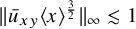 $\| \bar {u}_{xy} \langle x \rangle ^{\frac 3 2} \|_\infty \lesssim 1$
,
$\| \bar {u}_{xy} \langle x \rangle ^{\frac 3 2} \|_\infty \lesssim 1$
, $\| y^2 (\bar {u}_{xxyy} + \bar {u}^P_{xxxx}) \langle x \rangle ^2 \|_\infty \lesssim 1$
, and
$\| y^2 (\bar {u}_{xxyy} + \bar {u}^P_{xxxx}) \langle x \rangle ^2 \|_\infty \lesssim 1$
, and $\| \bar {u}_{E xxxx} \|_{L^\infty _y} \lesssim \sqrt {\varepsilon } \langle x \rangle ^{-\frac 9 2}$
according to the estimates (2.6)–(2.7). Upon invoking these pointwise bounds, we estimate
$\| \bar {u}_{E xxxx} \|_{L^\infty _y} \lesssim \sqrt {\varepsilon } \langle x \rangle ^{-\frac 9 2}$
according to the estimates (2.6)–(2.7). Upon invoking these pointwise bounds, we estimate
 $$ \begin{align*} |\mathcal{J}_1| &\lesssim \varepsilon \|U \langle x \rangle^{- 1} \|^2 + \varepsilon \|\sqrt{\varepsilon}V \langle x \rangle^{- 1} \|^2 + \sqrt{\varepsilon} \|U \langle x \rangle^{-\frac34} \| \| \sqrt{\varepsilon} V \langle x \rangle^{-\frac34} \| + \varepsilon \| \frac{q}{y} \langle x \rangle^{-1} \|^2 + \varepsilon \|\sqrt{\varepsilon} q \langle x \rangle^{-2} \|^2 \\ &\lesssim \sqrt{\varepsilon} \|U, V \|_{X_0}^2, \end{align*} $$
upon invoking the Hardy-type inequality (3.25).
Step 3: $\mathcal {T}_2[V]$
Terms We now treat the terms arising from
$\mathcal {T}_2[V]$
Terms We now treat the terms arising from $\mathcal {T}_2[V]$
, which has been defined in (2.25). Specifically, the result of applying the multiplier (4.5) is
$\mathcal {T}_2[V]$
, which has been defined in (2.25). Specifically, the result of applying the multiplier (4.5) is
 $$ \begin{align} \nonumber &\int \mathcal{T}_2[V] (\varepsilon V g^2 + \varepsilon (.01) q \langle x \rangle^{-1.01} ) \\\nonumber & \quad = \int \varepsilon \mathcal{T}_2[V] V g^2 + \varepsilon (.01) \int \bar{u}^2 V_x q \langle x \rangle^{-1.01} + \varepsilon (.01) \int (\bar{u} \bar{v} V_y + \bar{u}^0_{pyy} V) q \langle x \rangle^{-1.01} \\& \quad =: \tilde{T}^1_1 + \tilde{T}^1_2 + \tilde{T}^1_3. \end{align} $$
For the first term on the right-hand side of (4.22), $\tilde {T}^1_1$
, we have the following identity
$\tilde {T}^1_1$
, we have the following identity
 $$ \begin{align} \nonumber \tilde{T}^1_1 = \int \varepsilon \mathcal{T}_2[V] V g^2 & = \int \varepsilon \bar{u}^2 V_x V g^2 + \int \varepsilon \bar{u} \bar{v} V_y V g^2 + \int \varepsilon \bar{u}^0_{pyy} V^2 g^2 \\ & = \frac 1 2 \int \varepsilon \bar{u}^0_{pyy} V^2 g^2 - \frac 1 2 \int \varepsilon \zeta V^2 g^2 + \frac{1}{200} \int \varepsilon \bar{u}^2 V^2 \langle x \rangle^{-1 - \frac{1}{100}} = \sum_{i = 1}^3 T^1_i, \end{align} $$
where we have invoked (2.14). The term $T^1_2$
is estimated in an analogous manner to (4.8), whereas
$T^1_2$
is estimated in an analogous manner to (4.8), whereas $T^1_3$
is a positive contribution to the
$T^1_3$
is a positive contribution to the $X_0$
norm. On the other hand,
$X_0$
norm. On the other hand, $T^1_1$
combines with
$T^1_1$
combines with $D^1_5 + D^2_2$
to produce a damping term of the form
$D^1_5 + D^2_2$
to produce a damping term of the form $- \frac 12 \int \bar {u}^0_{pyy} \varepsilon V^2 g^2$
.
$- \frac 12 \int \bar {u}^0_{pyy} \varepsilon V^2 g^2$
.
We now need to address the contribution of $\tilde {T}^1_2$
. Integrating by parts, we get
$\tilde {T}^1_2$
. Integrating by parts, we get
 $$ \begin{align} \nonumber \tilde{T}^1_2 & = .01 \int \varepsilon \bar{u}^2 V^2 \langle x \rangle^{-1.01} -2 (.01) \int \varepsilon \bar{u} \bar{u}_x V q \langle x \rangle^{-1.01} + (.01)(1.01) \int \varepsilon \bar{u}^2 V q \langle x \rangle^{-2.01} \\ \nonumber & = .01 \int \varepsilon \bar{u}^2 V^2 \langle x \rangle^{-1.01} -2 (.01) \int \varepsilon \bar{u} \bar{u}_x V q \langle x \rangle^{-1.01} \\ &\quad - \frac 1 2 (.01)(1.01) (2.01) \int \varepsilon \bar{u}^2 q^2 \langle x \rangle^{-3.01} - \frac 1 2 (.01)(1.01) (2.01) \int \varepsilon \bar{u} \bar{u}_x q^2 \langle x \rangle^{-2.01} \\ \nonumber & = \tilde{T}^1_{2,1} + \tilde{T}^1_{2,2} + \tilde{T}^1_{2,3} + \tilde{T}^1_{2,4}. \end{align} $$
Of these, the third term, $\tilde {T}^1_{2,3}$
is very dangerous due to a lack of decay in z for the coefficient. To treat it, we combine
$\tilde {T}^1_{2,3}$
is very dangerous due to a lack of decay in z for the coefficient. To treat it, we combine $\tilde {T}^1_{2,1}, \tilde {T}^1_{2,3}$
and
$\tilde {T}^1_{2,1}, \tilde {T}^1_{2,3}$
and $T^1_3$
to obtain the expression
$T^1_3$
to obtain the expression
 $$ \begin{align} \nonumber \tilde{T}^1_{2,1} + \tilde{T}^1_{2,3} + T^1_3 & = \frac{3}{2}(.01) \int \varepsilon \bar{u}^2 V^2 \langle x \rangle^{-1.01} - \frac{(.01)(1.01)(2.01)}{2} \int \varepsilon \bar{u}^2 q^2 \langle x \rangle^{-3.01} \\ \nonumber & \ge \Big(\frac{3}{2}(.01) - \frac{(.01)(1.01)(2.01)}{2} \frac{1}{1.01} \Big) \int \varepsilon \bar{u}^2 V^2 \langle x \rangle^{-1.01}\\ \nonumber &\quad - \frac{(.01)(1.01)(2.01)}{2} \frac{2}{1.01} \int \langle x \rangle^{-2.01} \bar{u} \bar{u}_x q^2 \\ & \ge \frac{.01}{2} \int \varepsilon \bar{u}^2 V^2 \langle x \rangle^{-1.01} - (.01)(2.01) \int \varepsilon \langle x \rangle^{-2.01} \bar{u} \bar{u}_x q^2, \end{align} $$
where we have used the precise constants appearing in (3.26).
We now estimate the error term from (4.25) by now splitting $\bar {u} = \bar {u}_p + \bar {u}_E$
, according to (2.1). First, we have
$\bar {u} = \bar {u}_p + \bar {u}_E$
, according to (2.1). First, we have
 $$ \begin{align} |\int \varepsilon \langle x \rangle^{-2.01} \bar{u} \bar{u}_{px} q^2| \lesssim \| \bar{u}_{px} y^2 \|_\infty \varepsilon \| \frac{q}{y} \langle x \rangle^{-1.01} \|^2 \lesssim \varepsilon \| U \langle x \rangle^{-1.01} \|^2 \lesssim \varepsilon \| U, V \|_{X_0}^2, \end{align} $$
where we have used estimate (2.9). For the $\bar {u}_E$
component, we may use the small amplitude and importantly the enhanced decay in x from (2.8) to obtain
$\bar {u}_E$
component, we may use the small amplitude and importantly the enhanced decay in x from (2.8) to obtain
 $$ \begin{align} |\int \varepsilon \langle x \rangle^{-2.01} \bar{u} \bar{u}_{Ex} q^2| \lesssim \varepsilon^{\frac 3 2} | \int \langle x \rangle^{- 3.51} q^2| \lesssim \varepsilon^{\frac 1 2} \| \sqrt{\varepsilon}V \langle x \rangle^{- \frac 3 4} \|^2 \lesssim \sqrt{\varepsilon} \| U, V \|_{X_0}^2. \end{align} $$
The error terms $\tilde {T}^1_{2,2}$
and
$\tilde {T}^1_{2,2}$
and $\tilde {T}^1_{2,4}$
are estimated in a nearly identical manner.
$\tilde {T}^1_{2,4}$
are estimated in a nearly identical manner.
We now address the third terms from (4.22), $\tilde {T}^1_3$
, which upon integration by parts in y gives
$\tilde {T}^1_3$
, which upon integration by parts in y gives
 $$ \begin{align} \nonumber &\varepsilon (.01) |\int (\bar{u} \bar{v} V_y + \bar{u}^0_{pyy} V) q \langle x \rangle^{-1.01}| \lesssim \varepsilon | \int (\bar{u}^0_{pyy} - (\bar{u} \bar{v})_y) V q \langle x \rangle^{-1.01}| + \varepsilon | \int \bar{u} \bar{v} V U \langle x \rangle^{-1.01}| \\ &\lesssim \sqrt{\varepsilon} \Big( \| (\bar{u}^0_{pyy} - (\bar{u} \bar{v})_y) y \langle x \rangle^{\frac 1 2} \|_\infty + \| \bar{v} \langle x \rangle^{\frac 1 2} \|_\infty \Big) \| U \langle x \rangle^{- \frac 3 4} \| \| \sqrt{\varepsilon} V \langle x \rangle^{- \frac 3 4} \| \lesssim \sqrt{\varepsilon} \|U, V \|_{X_0}^2, \end{align} $$
where we have appealed to the estimates (2.6) as well as (3.25).
Step 4: $\text {Error}_{X_0}$
Terms The first term in
$\text {Error}_{X_0}$
Terms The first term in $\text {Error}_{X_0}$
is identical to (4.8), which has already been bounded above by a factor of
$\text {Error}_{X_0}$
is identical to (4.8), which has already been bounded above by a factor of $\sqrt {\varepsilon }\| U, V \|_{X_0}^2$
. We next move to the second term in
$\sqrt {\varepsilon }\| U, V \|_{X_0}^2$
. We next move to the second term in $\text {Error}_{X_0}$
:
$\text {Error}_{X_0}$
:
 $$ \begin{align} \Big| \int \zeta_y q U g^2 \Big| \lesssim \sqrt{\varepsilon} \| \frac{q}{y} \langle x \rangle^{- \frac 1 2 - \frac{1}{100}} \| \| U \langle x \rangle^{- \frac 1 2 - \frac{1}{100}} \| \lesssim \sqrt{\varepsilon} \| U \langle x \rangle^{- \frac 1 2 - \frac{1}{100}} \|^2 \lesssim \sqrt{\varepsilon} \|U, V \|_{X_0}^2, \end{align} $$
where we have invoked the pointwise estimates (2.15) on the quantity $|y \partial _y \zeta |$
, and used the standard Hardy inequality in y, admissible as
$|y \partial _y \zeta |$
, and used the standard Hardy inequality in y, admissible as $q|_{y = 0} = 0$
. We next treat the third and fourth terms from
$q|_{y = 0} = 0$
. We next treat the third and fourth terms from $\text {Error}_{X_0}$
, which we estimate via
$\text {Error}_{X_0}$
, which we estimate via
 $$ \begin{align} \Big| \int \varepsilon \alpha UV g^2\Big| \lesssim \varepsilon \int \langle x \rangle^{- \frac 3 2}|UV| \lesssim \sqrt{\varepsilon} \| U \langle x \rangle^{- \frac 3 4} \| \| \sqrt{\varepsilon} V \langle x \rangle^{- \frac 3 4} \| \lesssim \sqrt{\varepsilon} \|U, V \|_{X_0}^2, \end{align} $$
 $$ \begin{align} \Big| \int \varepsilon \alpha_y qV g^2\Big| \lesssim \varepsilon \int \langle x \rangle^{- \frac 3 2}|\frac{q}{\langle y \rangle}|V| \lesssim \sqrt{\varepsilon} \| \frac{q}{y} \langle x \rangle^{- \frac 3 4} \| \| \sqrt{\varepsilon} V \langle x \rangle^{- \frac 3 4} \| \lesssim \sqrt{\varepsilon} \|U, V \|_{X_0}^2. \end{align} $$
Above we have relied on the coefficient estimate in (2.16). The fifth term in $\text {Error}_{X_0}$
is treated analogously to the first term. For the remaining terms, we estimate as follows
$\text {Error}_{X_0}$
is treated analogously to the first term. For the remaining terms, we estimate as follows
 $$ \begin{align*} |\text{Error}_{X_0}^{(6)}| &\lesssim \sqrt{\varepsilon} \| \alpha \langle x \rangle^{\frac32} \|_\infty \| U \langle x \rangle^{-\frac34} \| \| \sqrt{\varepsilon}q \langle x \rangle^{-\frac74} \| \lesssim \sqrt{\varepsilon} \|U, V \|_{X_0}^2, \\ |\text{Error}_{X_0}^{(7)}| &\lesssim \sqrt{\varepsilon} \| \alpha_y y \langle x \rangle^{\frac32} \|_\infty \| \frac{q}{y} \langle x \rangle^{-\frac34} \| \| \sqrt{\varepsilon}q \langle x \rangle^{-\frac74} \| \lesssim \sqrt{\varepsilon} \|U, V \|_{X_0}^2\\ |\text{Error}_{X_0}^{(8)}| &\lesssim \sqrt{\varepsilon} \| \frac{\zeta}{\sqrt{\varepsilon}}\langle x \rangle^{1 + \frac{1}{50}} \|_\infty \| \sqrt{\varepsilon}V \langle x \rangle^{-\frac12 - \frac{1}{100}} \| \| \sqrt{\varepsilon} q \langle x \rangle^{-\frac32 - \frac{1}{100}} \| \lesssim \sqrt{\varepsilon} \|U, V \|_{X_0}^2, \end{align*} $$
where we have repeatedly appealed to the coefficient estimates (2.16) as well as the Hardy-type inequality (3.25).
Step 5: Conclusion The bounds in Step 4 establish that $|\text {Error}_{X_0}| \lesssim \sqrt {\varepsilon } \|U, V \|_{X_0}^2$
. We now consolidate the
$|\text {Error}_{X_0}| \lesssim \sqrt {\varepsilon } \|U, V \|_{X_0}^2$
. We now consolidate the $\text {Transport}_{X_0} + \text {Diffusion}_{X_0}$
bounds. Recall the definition of the
$\text {Transport}_{X_0} + \text {Diffusion}_{X_0}$
bounds. Recall the definition of the $X_0$
norm, (3.2). The first three quantities in (3.2) are controlled by
$X_0$
norm, (3.2). The first three quantities in (3.2) are controlled by $D^0_1$
, (4.9),
$D^0_1$
, (4.9), $D^1_1$
, (4.13),
$D^1_1$
, (4.13), $D^2_1$
, (4.16), and
$D^2_1$
, (4.16), and $D^3_1$
, (4.18). The fourth and fifth terms appearing in
$D^3_1$
, (4.18). The fourth and fifth terms appearing in $X_0$
are damping terms, which are found in (4.10) and (4.19). The boundary trace term appearing in
$X_0$
are damping terms, which are found in (4.10) and (4.19). The boundary trace term appearing in $X_0$
is controlled by
$X_0$
is controlled by $D^0_4$
appearing in (4.9). Finally, the
$D^0_4$
appearing in (4.9). Finally, the $U, \sqrt {\varepsilon }V$
terms appearing in
$U, \sqrt {\varepsilon }V$
terms appearing in $X_0$
are controlled by the lower bound in (4.25) as well as
$X_0$
are controlled by the lower bound in (4.25) as well as $T^0_1$
in (4.7). Therefore, all components of the
$T^0_1$
in (4.7). Therefore, all components of the $X_0$
norm have been controlled from above by
$X_0$
norm have been controlled from above by $\text {Transport}_{X_0} + \text {Diffusion}_{X_0}$
. All of the (many) remaining contributions from
$\text {Transport}_{X_0} + \text {Diffusion}_{X_0}$
. All of the (many) remaining contributions from $\text {Transport}_{X_0} + \text {Diffusion}_{X_0}$
have been shown to be bounded above by
$\text {Transport}_{X_0} + \text {Diffusion}_{X_0}$
have been shown to be bounded above by $\sqrt {\varepsilon } \|U, V \|_{X_0}^2$
or by
$\sqrt {\varepsilon } \|U, V \|_{X_0}^2$
or by $\delta _\ast \|U, V \|_{X_0}^2$
. This then establishes the inequalities in (4.6), and therefore concludes the proof of Lemma 4.1.
$\delta _\ast \|U, V \|_{X_0}^2$
. This then establishes the inequalities in (4.6), and therefore concludes the proof of Lemma 4.1.
4.2
$\frac 1 2$
level estimates

We now provide estimates on the two half-level norms, $\|U, V \|_{X_{\frac 1 2}}$
and
$\|U, V \|_{X_{\frac 1 2}}$
and $\|U, V \|_{Y_{\frac 1 2}}$
.
$\|U, V \|_{Y_{\frac 1 2}}$
.
Lemma 4.2. Let $(U, V)$
be a solution to (2.26)–(2.29). There exists a universal constant
$(U, V)$
be a solution to (2.26)–(2.29). There exists a universal constant $C> 0$
such that for any
$C> 0$
such that for any $0 < \delta << 1$
, the following bound holds:
$0 < \delta << 1$
, the following bound holds:
 $$ \begin{align} \| U, V \|_{X_{\frac 1 2}}^2 \le C C_\delta \| U, V \|_{X_0}^2 + \delta \| U, V \|_{X_1}^2 + \delta \| U, V \|_{Y_{\frac 1 2}}^2 + C|\mathcal{T}_{X_{\frac 1 2}}| + C|\mathcal{F}_{X_{\frac 1 2}}|, \end{align} $$
where
 $$ \begin{align} \mathcal{T}_{X_{\frac 1 2}} & := \int \mathcal{N}_1 U_x x \phi_1^2 + \int \mathcal{N}_2 ( \varepsilon V_x x \phi_1(x)^2 + \varepsilon V \phi_1(x)^2 + 2\varepsilon V x \phi_1 \phi_1'), \end{align} $$
 $$ \begin{align} \mathcal{F}_{X_{\frac 1 2}} & := \int F_R U_x x \phi_1^2 + \int G_R ( \varepsilon V_x x \phi_1(x)^2 + \varepsilon V \phi_1(x)^2 + 2\varepsilon V x \phi_1 \phi_1').\end{align} $$
Proof. We apply the weighted in x vector-field
 $$ \begin{align} \mathbf{M}_{X_{\frac 1 2}} := [U_x x \phi_1(x)^2 , \varepsilon V_x x \phi_1(x)^2 + \varepsilon V \phi_1(x)^2 + 2\varepsilon V x \phi_1 \phi_1'] \end{align} $$
as a multiplier to (2.26)–(2.28). We first of all notice that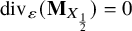 $\text {div}_\varepsilon (\mathbf{M}_{X_{\frac 1 2}}) = 0$
, and thus,
$\text {div}_\varepsilon (\mathbf{M}_{X_{\frac 1 2}}) = 0$
, and thus,
 $$ \begin{align*} \nonumber \int P_x U_x x \phi_1^2 + \int \frac{P_y}{\varepsilon} (\varepsilon V_x x \phi_1^2 + \varepsilon V \phi_1^2 + 2 \varepsilon V x \phi_1 \phi_1') = - \int P \text{div}_\varepsilon(\mathbf{M}_{X_{\frac 1 2}}) = 0, \end{align*} $$
where we use that $V|_{y = 0} = V_x|_{y = 0} = 0$
and
$V|_{y = 0} = V_x|_{y = 0} = 0$
and $\phi _1$
to eliminate any contributions from
$\phi _1$
to eliminate any contributions from $\{x = 0\}$
.
$\{x = 0\}$
.
Step 1: $\mathcal {T}_1[U]$
terms: We address the terms from
$\mathcal {T}_1[U]$
terms: We address the terms from $\mathcal {T}_1$
which produces the identity
$\mathcal {T}_1$
which produces the identity
 $$ \begin{align} \nonumber \int \mathcal{T}_1[U] U_x x \phi_1^2 & = \int \bar{u}^2 U_x^2 x \phi_1^2+ \int \bar{u} \bar{v} U_y U_x x \phi_1^2- \int \bar{u}_{yy} U^2 \phi_1^2- \int \bar{u}_{xyy} x U^2 \phi_1^2 \\ &\quad - 2\int \bar{u}_{yy} U^2 x \phi_1 \phi_1' = :\sum_{i = 1}^5 T^{(2)}_i. \end{align} $$
First, we observe $T^{(2)}_1$
is a positive contribution. We estimate
$T^{(2)}_1$
is a positive contribution. We estimate $T^{(2)}_2$
via
$T^{(2)}_2$
via
 $$ \begin{align} &|\int \bar{v} \bar{u} U_y U_x x \phi_1^2 | \lesssim \| \frac{\bar{v}}{\bar{u}} x^{\frac 1 2} \|_\infty \| \sqrt{\bar{u}} U_y \| \| \bar{u} U_x x^{\frac 1 2} \phi_1 \| \le \delta \| \bar{u} U_x x^{\frac 1 2} \phi_1 \|^2 + C_\delta \| \sqrt{\bar{u}} U_y \|^2, \end{align} $$
where above we have invoked estimate (2.7) for $\bar {v}$
.
$\bar {v}$
.
For $T^{(2)}_3$
, we need to split
$T^{(2)}_3$
, we need to split $U = U(x, 0) + (U - U(x, 0))$
, and subsequently estimate via
$U = U(x, 0) + (U - U(x, 0))$
, and subsequently estimate via
 $$ \begin{align} \nonumber |\int \bar{u}_{yy} U^2 \phi_1^2 | &\lesssim \int |\bar{u}_{yy}| (U - U(x, 0))^2 \phi_1^2 + \int |\bar{u}_{yy}| U(x, 0)^2 \phi_1^2 \\ \nonumber &\lesssim \| y^2 \bar{u}_{yy} \|_\infty \Big\| \frac{U - U(x, 0)}{y} \phi_1 \Big\|^2 +\Big( \sup_x \int |\bar{u}_{yy} | x^{\frac 1 2} \,\mathrm{d} y \Big) \| U x^{-\frac 1 4} \|_{L^2(x = 0)}^2 \\ &\lesssim \| U_y \phi_1\|^2 + \| U, V \|_{X_0}^2 \le C_\delta \| U, V \|_{X_0}^2 + \delta \| U, V \|_{Y_{\frac 1 2}}^2, \end{align} $$
where above, we used Hardy inequality in y, which is admissible as $(U - U(x, 0))|_{y = 0} = 0$
, as well as the inequality (3.22).
$(U - U(x, 0))|_{y = 0} = 0$
, as well as the inequality (3.22). $T^{(2)}_4$
works in an analogous manner, and so we omit it. For
$T^{(2)}_4$
works in an analogous manner, and so we omit it. For $T^{(2)}_5$
, we note that the support of
$T^{(2)}_5$
, we note that the support of $\phi _1'$
is bounded in x, and so this term can trivially be controlled by
$\phi _1'$
is bounded in x, and so this term can trivially be controlled by $\| U, V \|_{X_0}^2$
.
$\| U, V \|_{X_0}^2$
.
Step 2: $\mathcal {T}_2[V]$
terms: We now address the contributions from
$\mathcal {T}_2[V]$
terms: We now address the contributions from $\mathcal {T}_2[V]$
. For this, we first note that, examining the multiplier (4.35), the contribution from
$\mathcal {T}_2[V]$
. For this, we first note that, examining the multiplier (4.35), the contribution from $\varepsilon V$
has already been treated in Lemma 4.1, and we therefore just need to estimate the contribution from the principal term,
$\varepsilon V$
has already been treated in Lemma 4.1, and we therefore just need to estimate the contribution from the principal term, $\varepsilon V_x x$
. More precisely, we have already established the following estimate,
$\varepsilon V_x x$
. More precisely, we have already established the following estimate,
 $$ \begin{align} |\int \mathcal{T}_2[V] \varepsilon (V \phi_1^2 + 2 V x \phi_1 \phi_1' )| \lesssim \|U, V \|_{X_0}^2. \end{align} $$
We now estimate the contribution of the principal term, $\varepsilon V_x x$
. For this, recall the definition (2.25),
$\varepsilon V_x x$
. For this, recall the definition (2.25),
 $$ \begin{align*} \nonumber \int \varepsilon \mathcal{T}_2[V] V_x x \phi_1^2 & = \int \varepsilon \Big( \bar{u}^2 V_x + \bar{u} \bar{v} V_y + \bar{u}_{yy} V \Big) V_x x \phi_1^2 \\ \nonumber & = \int \varepsilon \bar{u}^2 V_x^2 x \phi_1^2 + \int \varepsilon \bar{u} \bar{v} V_y V_x x \phi_1^2 - \frac 1 2 \int \varepsilon \partial_x (x \bar{u}_{yy}) V^2 \phi_1^2 - \int \varepsilon x \bar{u}_{yy} V^2 \phi_1 \phi_1' \\ \nonumber & = T^{(3)}_1 + ... + T^{(3)}_4. \end{align*} $$
We observe that $T^{(3)}_1$
is a positive contribution. The integrand in the term
$T^{(3)}_1$
is a positive contribution. The integrand in the term $T^{(3)}_4$
has a bounded support of x and so can immediately be controlled by
$T^{(3)}_4$
has a bounded support of x and so can immediately be controlled by $\|U, V \|_{X_0}^2$
. We may estimate
$\|U, V \|_{X_0}^2$
. We may estimate $T^{(3)}_2$
, and
$T^{(3)}_2$
, and $T^{(3)}_3$
via
$T^{(3)}_3$
via
 $$ \begin{align} &|\int \varepsilon \bar{u} \bar{v} V_y V_x x \phi_1^2| \lesssim \sqrt{\varepsilon} \| \frac{ \bar{v}}{\bar{u}} x^{\frac 1 2} \|_\infty \| \bar{u} U_x x^{\frac 1 2} \phi_1 \| \sqrt{\varepsilon} \bar{u} V_x x^{\frac 1 2}\phi_1 \| \lesssim \sqrt{\varepsilon} \| U, V \|_{X_{\frac 1 2}}^2, \end{align} $$
 $$ \begin{align} &|\int \varepsilon \partial_x (x \bar{u}_{yy}) V^2 \phi_1^2| \lesssim \| y^2 \partial_x (x \bar{u}_{yy}) \|_\infty \varepsilon \Big\| \frac{V}{y} \phi_1\Big\|^2 \lesssim \varepsilon \| V_y \phi_1\|^2 \le C_\delta \| U, V \|_{X_0}^2 + \delta \| U, V \|_{Y_{\frac 1 2}}^2,\end{align} $$
where we have invoked the Hardy inequality (3.15).
Step 3: Diffusive Terms We now address the main diffusive term, which is the contribution of $- u_{yy}$
in (2.26). We, again, group the term
$- u_{yy}$
in (2.26). We, again, group the term $\bar {u}^0_{pyyy}q$
from (2.26) with this term. More precisely, after a long series of integrations by parts, we have the following identity
$\bar {u}^0_{pyyy}q$
from (2.26) with this term. More precisely, after a long series of integrations by parts, we have the following identity
 $$ \begin{align} \nonumber \int \Big(- u_{yy} &\quad + \bar{u}^0_{pyyy} q \Big) U_x x\phi_1^2 \\ \nonumber & = - \int 2 x \bar{u}_y U_x U_y\phi_1^2 + \frac 3 2 \int \partial_x (x \bar{u}_{yy}) U^2 \phi_1^2- \frac 1 2 \int (\bar{u} + x \bar{u}_x ) U_y^2\phi_1^2 \\ \nonumber &\quad - \int_{y = 0} \partial_x (x \bar{u}_y) U^2 \phi_1^2 \,\mathrm{d} x -\int (\bar{u}_{yyy} - \bar{u}^0_{pyyy}) qU_x x \phi_1^2 + \int x \bar{u}_{yy} U^2 \phi_1 \phi_1' \\ &\quad -2 \int_{y = 0} U^2 x \bar{u}_y \phi_1 \phi_1' - \int \bar{u} x U_y^2 \phi_1 \phi_1' - \int 4 \bar{u}_y UU_y x \phi_1 \phi_1' = \sum_{i = 1}^{9} D^{(4)}_i. \end{align} $$
For the first term above, $D^{(4)}_1$
, we localize in z using the cutoff function
$D^{(4)}_1$
, we localize in z using the cutoff function $\chi (\cdot )$
(see (1.62)), via
$\chi (\cdot )$
(see (1.62)), via
 $$ \begin{align} D_1^{(4)} = - \int 2 x \bar{u}_y U_x U_y\phi_1^2 (1 - \chi(z)) - \int 2 x \bar{u}_y U_x U_y\phi_1^2 \chi(z). \end{align} $$
The far-field component is controlled easily via
 $$ \begin{align} |\int x \bar{u}_y U_x U_y (1- \chi(z)) \phi_1^2| \lesssim \| \bar{u}_y x^{\frac 1 2} \|_{\infty} \| \bar{u} U_x x^{\frac 1 2} \phi_1 \| \| \sqrt{\bar{u}} U_y \| \le \delta \| U, V \|_{X_{\frac 1 2}}^2 + C_\delta \| U, V \|_{X_0}^2, \end{align} $$
where we have used $\bar {u} \gtrsim 1$
when
$\bar {u} \gtrsim 1$
when $z \gtrsim 1$
, according to (2.12).
$z \gtrsim 1$
, according to (2.12).
The localized piece requires the use of higher order norms, and we estimate it via
 $$ \begin{align} \nonumber |\int x \bar{u}_y U_x U_y \chi(z) \phi_1^2| &\lesssim \| \sqrt{x} \bar{u}_y \|_\infty \| U_x x^{\frac 1 2} \chi(z) \phi_1 \| \| U_y \phi_1 \| \\ \nonumber &\lesssim ( \| \sqrt{\bar{u}} U_{xy} x\phi_1 \| + \| \bar{u} U_x \sqrt{x} \phi_1\| ) ( \delta \| U, V \|_{Y_{\frac 1 2}} + C_\delta \| U, V \|_{X_0} ) \\ &\lesssim \delta \| U, V \|_{X_1}^2 + \delta \| U, V \|_{X_{\frac 1 2}}^2 + \delta \| U, V \|_{Y_{\frac 1 2}}^2 + C_\delta \| U, V \|_{X_0}^2, \end{align} $$
where above, we have appealed to both (3.22) as well as (3.23). For $D^{(4)}_2$
, we estimate in the same manner as (4.38), whereas
$D^{(4)}_2$
, we estimate in the same manner as (4.38), whereas $D^{(4)}_3$
can easily be controlled upon using
$D^{(4)}_3$
can easily be controlled upon using $\| \bar {u} + x \partial _x \bar {u} \|_\infty \lesssim 1$
, according to (2.6). The term
$\| \bar {u} + x \partial _x \bar {u} \|_\infty \lesssim 1$
, according to (2.6). The term $D^{(4)}_4$
is immediately controlled by
$D^{(4)}_4$
is immediately controlled by $\|U, V \|_{X_0}^2$
. The term
$\|U, V \|_{X_0}^2$
. The term $D^{(4)}_5$
we estimate via
$D^{(4)}_5$
we estimate via
 $$ \begin{align} \nonumber |\int (\bar{u}_{yyy} - \bar{u}^0_{pyyy}) q U_x x \phi_1^2| &\lesssim \| (\bar{u}_{yyy} - \bar{u}^0_{pyyy}) y x^{1.01} \|_\infty \| U \langle x \rangle^{-1.01} \| \| U_x \langle x \rangle^{\frac 1 2} \phi_1 \| \\ &\lesssim \sqrt{\varepsilon} (\|U, V \|_{X_0}^2 + \| U, V \|_{X_{\frac 1 2}}^2 + \| U, V \|_{X_1}^2), \end{align} $$
where we have invoked (2.11). Finally, for the remaining four terms from (4.42), $D^{(4)}_k$
,
$D^{(4)}_k$
, $k = 6,7,8,9$
, due to the presence of
$k = 6,7,8,9$
, due to the presence of $\phi _1'$
, the x weights are all bounded, and these terms can thus be easily controlled by
$\phi _1'$
, the x weights are all bounded, and these terms can thus be easily controlled by $\|U, V \|_{X_0}^2$
.
$\|U, V \|_{X_0}^2$
.
We now move to the contribution of the tangential diffusive term, $-\varepsilon u_{xx}$
, which produces the following identity
$-\varepsilon u_{xx}$
, which produces the following identity
 $$ \begin{align} \nonumber - \int \varepsilon u_{xx} U_x x \phi_1^2 & = \int \varepsilon u_x U_{xx} x \phi_1^2 + \int \varepsilon u_x U_x \phi_1^2 + 2 \int \varepsilon u_x U_x x \phi_1 \phi_1' \\ \nonumber & = \frac 1 2 \int \varepsilon \bar{u} U_x^2 \phi_1^2 - \frac 3 2 \int \varepsilon x \bar{u}_x U_x^2 \phi_1^2 + \int \varepsilon (\bar{u}_{xx} + \frac{1}{2} \bar{u}_{xxx}x) U^2 \phi_1^2 + \int \varepsilon \bar{u}_{xyy} q V_x \phi_1^2 \\ \nonumber &\quad + \int \varepsilon \bar{u}_{xy} U V_x x \phi_1^2 - \int \varepsilon \bar{u}_x U V_y \phi_1^2 - \int \varepsilon \bar{u}_{xy} q V_y \phi_1^2 + \frac{\varepsilon}{2} \int \bar{u}_{xyy} x V^2 \phi_1^2 \\ &\quad + \int \varepsilon \bar{u}_y V_y V_x x \phi_1^2 + E_{loc}^{(1)} =: \sum_{i = 1}^{9} D^{(5)}_i + E^{(1)}_{loc}, \end{align} $$
where $E_{loc}^{(1)}$
contains localized terms and satisfies
$E_{loc}^{(1)}$
contains localized terms and satisfies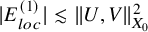 $|E_{loc}^{(1)}| \lesssim \|U, V \|_{X_0}^2$
. We now estimate each of the remaining terms in (4.47).
$|E_{loc}^{(1)}| \lesssim \|U, V \|_{X_0}^2$
. We now estimate each of the remaining terms in (4.47). $D^{(5)}_1$
and
$D^{(5)}_1$
and $D^{(5)}_2$
are controlled by the right-hand side of (4.32) upon invoking (3.22) and upon using
$D^{(5)}_2$
are controlled by the right-hand side of (4.32) upon invoking (3.22) and upon using $\| \bar {u} + x \bar {u}_x \|_\infty \lesssim 1$
. We estimate
$\| \bar {u} + x \bar {u}_x \|_\infty \lesssim 1$
. We estimate $D^{(5)}_3$
by noting that
$D^{(5)}_3$
by noting that $|\bar {u}_{xx}| + |x \bar {u}_{xxx}| \lesssim \langle x \rangle ^{-2}$
, after which it is easily controlled by
$|\bar {u}_{xx}| + |x \bar {u}_{xxx}| \lesssim \langle x \rangle ^{-2}$
, after which it is easily controlled by $\| U, V \|_{X_0}$
.
$\| U, V \|_{X_0}$
.
For the fourth term, we estimate via localizing in z using the cut-off $\chi $
, defined in (1.62), via
$\chi $
, defined in (1.62), via
 $$ \begin{align*} D^{(5)}_4 = \int \varepsilon \bar{u}_{xyy} q V_x \phi_1^2 \chi(z) + \int \varepsilon \bar{u}_{xyy} q V_x \phi_1^2 (1- \chi(z)) =: D^{(5)}_{4, near} + D^{(5)}_{4,\mathit{far}} \end{align*} $$
First for the far-field component, we have
 $$ \begin{align*} \nonumber | D^{(5)}_{4,\mathit{far}} | \lesssim \sqrt{\varepsilon} \| \bar{u}_{xyy} y x^{\frac 3 2} \|_\infty \| \sqrt{\varepsilon} \bar{u} V_x x^{\frac 1 2} \phi_1\| \| \frac{q}{y} \langle x \rangle^{-1} \| \lesssim \sqrt{\varepsilon} \| U, V \|_{X_{\frac 1 2}} \| U \langle x \rangle^{-1} \|, \end{align*} $$
which is an admissible contribution according to Hardy type inequality (3.23). For the localized component, we have
 $$ \begin{align} \nonumber | D^{(5)}_{4, near}| &= | \int \varepsilon \bar{u}_{xyy} \frac{q}{y} \frac{y}{\sqrt{x}} V_x x^{\frac 32} \phi_1^2 \chi(z)| \lesssim \int \varepsilon |\bar{u}_{xyy}| |\frac{q}{y}| \bar{u} V_x x^{\frac 32} \phi_1^2| \\ &\lesssim \sqrt{\varepsilon} \| U \langle x \rangle^{-1} \| \| \sqrt{\varepsilon} \bar{u} V_x \langle x \rangle^{\frac 1 2} \phi_1 \| \lesssim \sqrt{\varepsilon} \| U, V \|_{X_0}^2 + \sqrt{\varepsilon} \| U, V \|_{X_{\frac 12}}^2, \end{align} $$
where we have used the pointwise decay estimate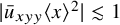 $|\bar {u}_{xyy} \langle x \rangle ^2| \lesssim 1$
, according to (2.6). The fifth term,
$|\bar {u}_{xyy} \langle x \rangle ^2| \lesssim 1$
, according to (2.6). The fifth term, $D^{(5)}_5$
, follows by a nearly identical calculation.
$D^{(5)}_5$
, follows by a nearly identical calculation.
For the sixth term from (4.47), $D^{(5)}_6$
, it is convenient to integrate by parts in x, which produces
$D^{(5)}_6$
, it is convenient to integrate by parts in x, which produces
 $$ \begin{align*} \nonumber |\int \varepsilon \bar{u}_{xy} U V_x x \phi_1^2| & = | \int \varepsilon \bar{u}_{xxy} U V x \phi_1^2 + \int \frac{\varepsilon}{2} \bar{u}_{xyy} V^2 x \phi_1^2 + \int \varepsilon \bar{u}_{xy} UV \phi_1^2 - \int \varepsilon \bar{u}_{xy} UV x 2 \phi_1 \phi_1' | \\ \nonumber &\lesssim \sqrt{\varepsilon} (\| \bar{u}_{xxy} x^{2+2\sigma} \|_\infty + \| \bar{u}_{xy} x^{1+2\sigma} \|_\infty ) \| U \langle x \rangle^{- \frac 1 2 - \sigma} \| \| \sqrt{\varepsilon} V \langle x \rangle^{-\frac 1 2 - \sigma} \| \\ \nonumber &\quad + \| \bar{u}_{xyy} y^2 x \|_\infty \Big\| \sqrt{\varepsilon} \frac{V}{y} \phi_1 \Big\|^2 \\ \nonumber &\lesssim \sqrt{\varepsilon} ( \| U, V \|_{X_0} + \| U, V \|_{X_{\frac 1 2}} ) + C_\delta \| U, V \|_{X_0} + \delta \| U, V\|_{Y_{\frac 1 2}}^2. \end{align*} $$
We estimate $D^{(5)}_7$
via
$D^{(5)}_7$
via
 $$ \begin{align} |\int \varepsilon \bar{u}_{xy} q V_y \phi_1^2| \lesssim \sqrt{\varepsilon} \| y x \bar{u}_{xy} \|_\infty \| \sqrt{\varepsilon} U_x \phi_1 \| \| \frac{q}{y} \langle x \rangle^{-1} \| \lesssim \sqrt{\varepsilon} \| \sqrt{\varepsilon}U_x \phi_1\| \| U \langle x \rangle^{-1} \|, \end{align} $$
which is an admissible contribution according to (3.23).
We estimate $D^{(5)}_8$
via
$D^{(5)}_8$
via
 $$ \begin{align} |\int \varepsilon x \bar{u}_{xyy} V^2 \phi_1^2| \le \| x \bar{u}_{xyy} y^2 \|_\infty \Big\| \sqrt{\varepsilon} \frac{V}{y} \phi_1 \Big\|^2 \lesssim \| \sqrt{\varepsilon} V_y \phi_1\|^2, \end{align} $$
upon which we invoke (3.22).
Finally, we estimate $D^{(5)}_9$
via
$D^{(5)}_9$
via
 $$ \begin{align} \nonumber |\int \varepsilon \bar{u}_y V_y V_x x \phi_1^2| &\lesssim \| \bar{u}_y x^{\frac 1 2} \|_\infty \| \sqrt{\varepsilon} U_x \phi_1 \| \| \sqrt{\varepsilon} V_x x^{\frac 1 2}\phi_1 \| \\ \nonumber & \le (C_{\delta_1} \| U, V \|_{X_0} + \delta_1 \| U, V \|_{Y_{\frac 1 2}} )( C_{\delta_2} \| U, V \|_{X_{\frac 1 2}} + \delta_2 \| U, V \|_{X_1} ) \\ & \le \delta \| U, V \|_{Y_{\frac 1 2}}^2 + \delta \| U, V \|_{X_1}^2 + C_\delta \| U, V \|_{X_0}^2 + \delta \| U, V \|_{X_{\frac 1 2}}^2. \end{align} $$
We move to the third diffusive term, by which we mean
 $$ \begin{align} - \varepsilon \int v_{yy} (V_x x \phi_1^2 + V \phi_1^2 + 2 V x \phi_1 \phi_1') = - \int \varepsilon v_{yy} V_x x \phi_1^2 + \int \varepsilon v_y V_y \phi_1^2 + \int 2 \varepsilon v_y V_y x \phi_1 \phi_1'. \end{align} $$
We easily estimate the final two terms above via
 $$ \begin{align} |\int \varepsilon v_y V_y \phi_1^2 + \int 2 \varepsilon v_y V_y x \phi_1 \phi_1' | \lesssim \|U, V \|_{X_0}^2. \end{align} $$
We thus deal with the principal contribution, which gives the following integrations by parts identity
 $$ \begin{align} \nonumber - \varepsilon \int v_{yy} V_x x \phi_1^2 & = - \int \frac{\varepsilon}{2} \partial_x (x \bar{u}) V_y^2 \phi_1^2 - \int \varepsilon \bar{u}_y V_y V_x x\phi_1^2 + \frac 1 2 \int \varepsilon \partial_x (x \bar{u}_{yy}) V^2 \phi_1^2\\ \nonumber &\quad + \int \varepsilon \bar{u}_{xyy} q V_x x \phi_1^2 + \int \varepsilon \bar{u}_{xy} U V_x x \phi_1^2+ \int \varepsilon \bar{u}_x U_y V_x x \phi_1^2 \\ &\quad - \int \varepsilon x \bar{u} V_y^2 \phi_1 \phi_1' + \frac 1 2 \int \varepsilon x \bar{u}_{yy} V^2 \phi_1 \phi_1'. \end{align} $$
These terms are largely identical to those in (4.47). The only slightly different term is the sixth term of (4.54), which is estimated as
 $$ \begin{align} |\varepsilon \int \bar{u}_x U_y V_x x| \lesssim \| \frac{\bar{u}_x}{\bar{u}} x \|_\infty \| \sqrt{\bar{u}} U_y \| \| \varepsilon \sqrt{\bar{u}} V_x \| \lesssim \| U, V \|_{X_0}^2. \end{align} $$
We now move to the fourth and final diffusive term, by which we mean
 $$ \begin{align} - \varepsilon^2 \int v_{xx} V_x x \phi_1^2 - \int \varepsilon^2 v_{xx} V \phi_1^2 -2 \int \varepsilon^2 v_{xx} V x \phi_1 \phi_1', \end{align} $$
An integration by parts in x demonstrates that the final two terms above are estimated above by $\|U, V \|_{X_0}^2$
. The first term above gives
$\|U, V \|_{X_0}^2$
. The first term above gives
 $$ \begin{align} \nonumber - \varepsilon^2 \int v_{xx} V_x x \phi_1^2 & = \int \varepsilon^2 v_x V_{xx} x \phi_1^2 + \int \varepsilon^2 v_x V_x \phi_1^2 + 2\int \varepsilon^2 v_x V_x x \phi_1 \phi_1' \\ \nonumber & = \int \varepsilon^2 \partial_x (\bar{u} V - \bar{u}_x q) V_{xx} x \phi_1^2+ \int \varepsilon^2 \partial_x (\bar{u} V - \bar{u}_x q) V_x \phi_1^2 + 2 \int \varepsilon^2 v_x V_x x \phi_1 \phi_1' \\ & = \tilde{D}^{(6)}_1 + \tilde{D}^{(6)}_2 + \tilde{D}^{(6)}_3. \end{align} $$
The term $\tilde {D}^{(6)}_3$
is easily controlled by a factor of
$\tilde {D}^{(6)}_3$
is easily controlled by a factor of $\|U, V \|_{X_0}^2$
. A few integrations by parts produces for the first term,
$\|U, V \|_{X_0}^2$
. A few integrations by parts produces for the first term, $\tilde {D}^{(6)}_1$
, the following identity
$\tilde {D}^{(6)}_1$
, the following identity
 $$ \begin{align} \nonumber \tilde{D}^{(6)}_1 & = - \frac{\varepsilon^2}{2} \int (x \bar{u})_x V_x^2 \phi_1^2- 2 \varepsilon^2 \int x \bar{u}_x V_x^2 \phi_1^2 + \varepsilon^2 \int (x \bar{u}_x)_{xx} V^2 \phi_1^2 \\ \nonumber &\quad + \int \varepsilon^2 V_x q \partial_x (x \bar{u}_{xx}) \phi_1^2+ \varepsilon^2 \int \partial_x (x \bar{u}_{xx}) V^2 \phi_1^2 - 4 \int \varepsilon^2 \bar{u}_x x V V_x \phi_1 \phi_1' \\ &\quad + 2 \int \varepsilon^2 \bar{u}_{xx} q V_x x \phi_1 \phi_1' =: \sum_{i = 1}^{7} D^{(6)}_i. \end{align} $$
We now proceed to estimate all the terms above. The first term of (4.58), $D^{(6)}_1$
, we estimate via
$D^{(6)}_1$
, we estimate via
 $$ \begin{align} |\frac{\varepsilon^2}{2} \int (x \bar{u})_x V_x^2| \lesssim \| \partial_x (x \bar{u}) \|_\infty \varepsilon^2 \| V_x \|^2 \lesssim \| U, V \|_{X_0}^2. \end{align} $$ $D^{(6)}_2$
and
$D^{(6)}_2$
and $D^{(6)}_3$
are estimated in an analogous manner. For
$D^{(6)}_3$
are estimated in an analogous manner. For $D^{(6)}_4$
and
$D^{(6)}_4$
and $D^{(6)}_6$
, we invoke the Hardy type inequality (3.24) coupled with the estimate
$D^{(6)}_6$
, we invoke the Hardy type inequality (3.24) coupled with the estimate $\| \partial _x^2(x \bar {u}_x) x^2\|_\infty \lesssim 1$
. We estimate
$\| \partial _x^2(x \bar {u}_x) x^2\|_\infty \lesssim 1$
. We estimate $D^{(6)}_5$
via
$D^{(6)}_5$
via
 $$ \begin{align} \nonumber |\int \varepsilon^2 V_x q \partial_x (x \bar{u}_{xx})| &\lesssim \varepsilon \Big\| \frac{\partial_x (x \bar{u}_{xx})}{\bar{u}} x y \Big\|_\infty \| \| \frac{q}{y} x^{-1} \| \| \varepsilon \sqrt{\bar{u}} V_x \| \lesssim \varepsilon \| U \langle x \rangle^{-1} \| \| \varepsilon \sqrt{\bar{u}} V_x \| \\ &\lesssim \varepsilon ( \| U, V \|_{X_0} + \| U, V \|_{X_{\frac 1 2}} ) \| U, V \|_{X_0}, \end{align} $$
where we have invoked the Hardy-type inequality (3.23).
For the second term from (4.57), $\tilde {D}^{(6)}_2$
, we expand and integrate by parts to generate
$\tilde {D}^{(6)}_2$
, we expand and integrate by parts to generate
 $$ \begin{align} \nonumber |\int \varepsilon^2 \partial_x (\bar{u} V - \bar{u}_x q) V_x | & =| \int \varepsilon^2 \bar{u} V_x^2 - \int 2 \varepsilon^2 \bar{u}_{xx} V^2 + \frac 1 2 \int \varepsilon^2 \bar{u}_{xxxx} q^2 | \\ \nonumber &\lesssim \| \sqrt{\bar{u}} \varepsilon V_x \|^2 + \varepsilon \| \bar{u}_{xx} x^2 \|_\infty \| \sqrt{\varepsilon} V \langle x \rangle^{-1} \|^2 + \varepsilon^2 \| \bar{u}_{xxxx} y^2 x^2 \| \frac{q}{y} \langle x \rangle^{-1} \|^2 \\ &\lesssim \| U, V \|_{X_0}^2 + \varepsilon (\| U, V \|_{X_0}^2 + \| U, V \|_{X_{\frac 1 2}}^2), \end{align} $$
where we have invoked (3.23)–(3.24).
Step 4: Error Terms We now move to the remaining error terms, the first of which is the $\zeta U$
term from (2.26). For this, we estimate via
$\zeta U$
term from (2.26). For this, we estimate via
 $$ \begin{align} \nonumber \Big| \int \zeta U U_x x \phi_1^2 \Big| &\lesssim \sqrt{\varepsilon} \int \langle x \rangle^{- (1 + \frac{1}{50})} |U| |U_x| x \phi_1^2 \lesssim \sqrt{\varepsilon} \| U \langle x \rangle^{- \frac 1 2 - \frac{1}{50}} \| \| U_x x^{\frac 1 2} \phi_1 \| \\ \nonumber &\lesssim \sqrt{\varepsilon} ( \| \bar{u} U \langle x \rangle^{- \frac 1 2 - \frac{1}{200}} \| + \| \sqrt{\bar{u}} U_y \| ) ( \| \bar{u} U_x x^{\frac 1 2} \phi_1 \| + \| \sqrt{\bar{u}} U_{xy} x \phi_1 \| ) \\ &\lesssim \sqrt{\varepsilon} \| U, V \|_{X_0} (\| U, V\|_{X_{\frac 1 2}} + \| U, V \|_{X_1} ), \end{align} $$
where we have invoked estimate (2.15) for pointwise decay of $\zeta $
. The
$\zeta $
. The $\zeta _y q$
term from (2.26) and
$\zeta _y q$
term from (2.26) and $\zeta V$
term from (2.27) is estimated in an identical manner.
$\zeta V$
term from (2.27) is estimated in an identical manner.
We now address the remaining error terms in equation (2.27). The first of these is the term
 $$ \begin{align*} \Big| \int \varepsilon \alpha U (V_x x + V ) \phi_1^2 \Big| \lesssim \sqrt{\varepsilon} \| U \langle x \rangle^{-\frac 3 4} \| ( \| \sqrt{\varepsilon} \bar{u} V_x x^{\frac 1 2} \phi_1 \| + \| \sqrt{\varepsilon} \bar{u} V \langle x \rangle^{- \frac 3 4} \| ) \lesssim \sqrt{\varepsilon} \| U, V \|_{X_0} \| U, V \|_{X_{\frac 1 2}}, \end{align*} $$
where we have invoked the pointwise decay estimate on $\alpha $
from (2.16). The estimate on the
$\alpha $
from (2.16). The estimate on the $\alpha _y q$
term follows in an identical manner. This concludes the proof of Lemma 4.2.
$\alpha _y q$
term follows in an identical manner. This concludes the proof of Lemma 4.2.
Lemma 4.3. Let $(U, V)$
be a solution to (2.26)–(2.29). There exists a universal constant
$(U, V)$
be a solution to (2.26)–(2.29). There exists a universal constant $C> 0$
such that for any
$C> 0$
such that for any $0 < \delta << 1$
, the following bound holds:
$0 < \delta << 1$
, the following bound holds:
 $$ \begin{align} \| U, V \|_{Y_{\frac 1 2}}^2 \le C C_\delta \| U, V \|_{X_0}^2 + C C_{\delta} \|U, V \|_{E}^2+ \delta \| U, V \|_{X_{\frac 1 2}}^2 + \delta \| U, V \|_{X_1}^2 +C| \mathcal{T}_{Y_{\frac 1 2}}| +C| \mathcal{F}_{Y_{\frac 1 2}}|, \end{align} $$
where
 $$ \begin{align} \mathcal{T}_{Y_{\frac 1 2}} & := \int ( \partial_y \mathcal{N}_1 - \varepsilon \partial_x \mathcal{N}_2) U_y x \phi_1^2, \qquad \mathcal{F}_{Y_{\frac 1 2}} := \int (\partial_y F_R - \varepsilon \partial_x G_R) U_y x \phi_1^2. \end{align} $$
Proof. For this proof, it is convenient to work in the vorticity formulation, (2.30). We apply the multiplier $U_y x \phi _1(x)^2$
to (2.30).
$U_y x \phi _1(x)^2$
to (2.30).
Step 1: $\mathcal {T}_1$
Terms We first note that since
$\mathcal {T}_1$
Terms We first note that since $\mathcal {T}_1[U](x, 0) = 0$
, we may integrate by parts in y to view the product in the velocity form, and subsequently integrate by parts several times in y and x to produce
$\mathcal {T}_1[U](x, 0) = 0$
, we may integrate by parts in y to view the product in the velocity form, and subsequently integrate by parts several times in y and x to produce
 $$ \begin{align} \nonumber \int \partial_y \mathcal{T}_1[U] U_y x \phi_1^2& = \int 2 \bar{u} \bar{u}_y U_x U_y x \phi_1^2 - \frac 1 2 \int \bar{u}^2 U_y^2 \phi_1^2 - \int \bar{u} \bar{u}_x U_y^2 x \phi_1^2 + \frac 1 2 \int (\bar{u} \bar{v})_y U_y^2 x \phi_1^2 \\ &\quad + \int 2 \bar{u}^0_{pyy} U_y^2 x - \int \partial_y^4 \bar{u}^0_p U^2 x - \int \bar{u}^2 U_y^2 x \phi_1 \phi_1' =: \sum_{i = 1}^7 A^{(1)}_i. \end{align} $$
Note that above, we used the integration by parts identity
 $$ \begin{align} - \int 2 \bar{u}^0_{pyy} U U_{yy} x \phi_1^2 & = \int 2 \bar{u}^0_{pyy} U_y^2 x \phi_1^2 - \int \bar{u}^0_{pyyyy} U^2 x \phi_1^2, \end{align} $$
which is available due to the condition that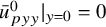 $\bar {u}^0_{pyy}|_{y = 0} = 0$
and
$\bar {u}^0_{pyy}|_{y = 0} = 0$
and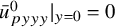 $\bar {u}^0_{pyyy}|_{y = 0} = 0$
.
$\bar {u}^0_{pyyy}|_{y = 0} = 0$
.
We now estimate each of the terms in (4.65), starting with $A^{(1)}_1$
, which is controlled by
$A^{(1)}_1$
, which is controlled by
 $$ \begin{align} \nonumber |\int 2\bar{u} \bar{u}_y U_x U_y x \phi_1^2| &\lesssim \| \bar{u}_y x^{\frac 1 2} \|_\infty \| \bar{u} U_x x^{\frac 1 2} \phi_1\| \| U_y \phi_1 \| \le C_{\delta_1} \| U_y \phi_1 \|^2 + \delta_1 \| U, V \|_{X_{\frac 1 2}}^2 \\ \nonumber & \le C_{\delta_1} C_{\delta_2} \| \sqrt{\bar{u}} U_y \|^2 + C_{\delta_1} \delta_2 \| U, V \|_{Y_{\frac 1 2}}^2 + \delta_1 \| U, V \|_{X_{\frac 1 2}}^2 \\ & \le C_\delta \| U, V \|_{X_0}^2 + \delta \| U, V \|_{Y_{\frac 1 2}}^2 + \delta \| U, V \|_{X_{\frac 1 2}}^2, \end{align} $$
where we have invoked (3.22).
For $A^{(1)}_2$
,
$A^{(1)}_2$
, $A^{(1)}_3$
,
$A^{(1)}_3$
, $A^{(1)}_4$
, and
$A^{(1)}_4$
, and $A^{(1)}_5$
, we appeal to the coefficient estimate
$A^{(1)}_5$
, we appeal to the coefficient estimate
 $$ \begin{align} \|\frac{1}{2} \bar{u}^2\|_\infty + \| \bar{u} \bar{u}_x x \|_\infty + \frac 1 2 \| x \partial_y (\bar{u} \bar{v}) \|_\infty + \| 2 \bar{u}_{yy} x \|_\infty \lesssim 1, \end{align} $$
to control these terms by $C_\delta \| U, V \|_{X_0}^2 + \delta \| U, V \|_{Y_{\frac 1 2}}^2$
.
$C_\delta \| U, V \|_{X_0}^2 + \delta \| U, V \|_{Y_{\frac 1 2}}^2$
.
We estimate $A^{(1)}_6$
via
$A^{(1)}_6$
via
 $$ \begin{align} \nonumber |\int \partial_y^4 \bar{u}^0_p U^2 x \phi_1^2| &\lesssim |\int \partial_y^4 \bar{u}^0_p \mathring{U}^2 x \phi_1^2| + |\int \partial_y^4 \bar{u}^0_p U(x, 0)^2 x \phi_1^2| \\ \nonumber &\lesssim \| \partial_y^4 \bar{u}^0_p x y^2 \|_\infty \| U_y \phi_1 \|^2 + \| \partial_y^4 \bar{u}^0_p x^{\frac 32} \|_{L^\infty_x L^1_y} \| U(x, 0) x^{-\frac 1 4} \|_{x = 0}^2 \\ & \le C_\delta \| U, V \|_{X_0}^2 + \delta \| U, V \|_{Y_{\frac 1 2}}^2. \end{align} $$
The final term in (4.65), $A^{(1)}_7$
, is localized in x, and is clearly bounded above by a factor of
$A^{(1)}_7$
, is localized in x, and is clearly bounded above by a factor of $\| U, V \|_{X_0}^2$
.
$\| U, V \|_{X_0}^2$
.
Step 2: $\mathcal {T}_2$
Terms: We now estimate the contributions from
$\mathcal {T}_2$
Terms: We now estimate the contributions from $\mathcal {T}_2$
via first integrating by parts in x to produce
$\mathcal {T}_2$
via first integrating by parts in x to produce
 $$ \begin{align} - \varepsilon \int \partial_x \mathcal{T}_2[V] U_y x \phi_1^2 = \int \varepsilon \mathcal{T}_2[V] U_{xy} x \phi_1^2 + 2\int \varepsilon \mathcal{T}_2[V] U_y \phi_1 \phi_1'. \end{align} $$
We now appeal to the definition of $\mathcal {T}_2[V]$
in (2.25) to produce the identity
$\mathcal {T}_2[V]$
in (2.25) to produce the identity
 $$ \begin{align} \nonumber \int \varepsilon \mathcal{T}_2[V] U_{xy} x \phi_1^2 & = \int 2 \varepsilon \bar{u} \bar{u}_y V_x V_y x \phi_1^2 - \int \frac 1 2 \varepsilon \bar{u}^2 V_y^2 \phi_1^2 - \int \varepsilon \bar{u} \bar{u}_x V_y^2 x \phi_1^2 \\ \nonumber &\quad + \frac 1 2 \int \varepsilon (\bar{u} \bar{v})_y V_y^2 x \phi_1^2 + \int \varepsilon \bar{u}_{yy} V_y^2 x \phi_1^2 - \int \frac{\varepsilon}{2} \bar{u}_{yyyy} V^2 x \phi_1^2 - \int \varepsilon \bar{u}^2 V_y^2 x \phi_1 \phi_1' \\ & = A^{(2)}_1 + ... + A^{(2)}_7. \end{align} $$
For the first term, $A^{(2)}_1$
, we estimate via
$A^{(2)}_1$
, we estimate via
 $$ \begin{align} \nonumber | \int \varepsilon \bar{u} \bar{u}_y V_x V_y x \phi_1^2 | &\lesssim\| \bar{u}_y x^{\frac 1 2} \|_\infty \| \sqrt{\varepsilon} V_y \phi_1 \| \| \sqrt{\varepsilon} \bar{u} V_x x^{\frac 1 2} \phi_1 \| \\ & \le C_\delta \| U, V \|_{X_0}^2 + \delta \| U, V \|_{Y_{\frac 1 2}}^2 + \delta \| U, V \|_{X_{\frac 1 2}}^2. \end{align} $$
For $A^{(2)}_2, A^{(2)}_3, A^{(2)}_4, A^{(2)}_5$
, we estimate using (4.68). We estimate
$A^{(2)}_2, A^{(2)}_3, A^{(2)}_4, A^{(2)}_5$
, we estimate using (4.68). We estimate $A^{(2)}_6$
via
$A^{(2)}_6$
via
 $$ \begin{align*} \nonumber |\int \varepsilon \bar{u}_{yyyy} V^2 x| \lesssim \| \bar{u}_{yyyy} xy^2 \|_\infty \| \sqrt{\varepsilon} V_y \|^2 \le C_\delta \| U, V \|_{X_0}^2 + \delta \| U, V \|_{Y_{\frac 1 2}}^2. \end{align*} $$
The final term, $A^{(2)}_7$
, can be controlled by
$A^{(2)}_7$
, can be controlled by $\|U, V \|_{X_0}^2$
upon invoking the bounded support of
$\|U, V \|_{X_0}^2$
upon invoking the bounded support of $\phi _1'$
.
$\phi _1'$
.
Step 3: Diffusive Terms: We now compute (in the vorticity form) via a long series of integrations by parts the following identity
 $$ \begin{align} \nonumber - \int \partial_y^3 u U_y x \phi_1^2& = \int \bar{u} U_{yy}^2 x \phi_1^2 - \frac 9 2 \int \bar{u}_{yy} U_y^2 x \phi_1^2+ \int 3 \bar{u}_{yyyy} U^2 x \phi_1^2- \int \frac 1 2 \partial_y^6 \bar{u} q^2 x \phi_1^2 \\ &\quad + \frac 3 2 \int_{y = 0} \bar{u}_y U_y^2 x \phi_1^2 \,\mathrm{d} x + \frac 3 2 \int_{y = 0} \bar{u}_{yy} UU_y x \phi_1^2 = \sum_{i = 1}^6 B^{(1)}_i. \end{align} $$
We first notice that $B^{(1)}_1$
and
$B^{(1)}_1$
and $B^{(1)}_5$
are positive contributions.
$B^{(1)}_5$
are positive contributions. $B^{(1)}_2$
is easily estimated by
$B^{(1)}_2$
is easily estimated by $\| U, V \|_{X_0}^2$
upon using
$\| U, V \|_{X_0}^2$
upon using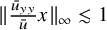 $\|\frac {\bar {u}_{yy}}{\bar {u}}x \|_\infty \lesssim 1$
. We estimate
$\|\frac {\bar {u}_{yy}}{\bar {u}}x \|_\infty \lesssim 1$
. We estimate $B^{(1)}_3$
by
$B^{(1)}_3$
by
 $$ \begin{align} \nonumber |\int 3 \bar{u}_{yyyy} U^2 x \phi_1^2| &\lesssim |\int \bar{u}_{yyyy} (U - U(x, 0))^2 x \phi_1| + |\int \bar{u}_{yyyy} U(x, 0)^2 x| \\ \nonumber &\lesssim \| \bar{u}_{yyyy} x y^2 \|_\infty \Big\| \frac{U - U(x, 0)}{y} \phi_1 \Big\|^2 + \| \bar{u}_{yyyy} x^{\frac 3 2} \|_{L^\infty_x L^1_y} \| U(x, 0) x^{-\frac 1 4} \|_{y = 0}^2 \\ &\lesssim \| U_y \|^2 + \| U(x, 0) x^{-\frac 1 4} \|_{y = 0}^2 \le C_\delta \|U, V \|_{X_0}^2 + \delta \|U, V \|_{Y_{\frac 1 2}}^2. \end{align} $$
The term $B^{(1)}_4$
is estimated in an entirely analogous manner. The term
$B^{(1)}_4$
is estimated in an entirely analogous manner. The term $B^{(1)}_6$
is estimated by
$B^{(1)}_6$
is estimated by
 $$ \begin{align} |\int_{y = 0} \bar{u}_{yy} UU_y x \phi_1^2| \lesssim \varepsilon^{\frac 1 2} \| U \langle x \rangle^{- \frac 1 4} \|_{y = 0} \| U_y \phi_1 \langle x \rangle^{\frac 1 4} \|_{y = 0} \lesssim \varepsilon^{\frac 1 2} \| U, V\|_{X_0} \|U, V \|_{Y_{\frac 1 2}}, \end{align} $$
upon invoking the bound $|\bar {u}_{yy}(x, 0)| \lesssim \varepsilon ^{\frac 1 2} \langle x \rangle ^{-1}$
due to (2.6) coupled with the fact that
$|\bar {u}_{yy}(x, 0)| \lesssim \varepsilon ^{\frac 1 2} \langle x \rangle ^{-1}$
due to (2.6) coupled with the fact that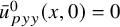 $\bar {u}^0_{pyy}(x, 0) = 0$
.
$\bar {u}^0_{pyy}(x, 0) = 0$
.
In addition to this term, we need to estimate the term $\bar {u}^0_{p yyy}q$
from (2.26), we do so via
$\bar {u}^0_{p yyy}q$
from (2.26), we do so via
 $$ \begin{align*} \nonumber \int \partial_y (\bar{u}^0_{pyyy} q) U_y x = \int \bar{u}^0_{p yyyy} q U_y x + \int \bar{u}^0_{p yyy} UU_y x = \frac 1 2 \int \partial_y^6 \bar{u}^0_p q^2 x - \frac 1 2 \int \partial_y^4 \bar{u}^0_p U^2 x, \end{align*} $$
which we estimate in an identical manner to (4.74).
The next diffusive term is
 $$ \begin{align} - 2 \int \varepsilon u_{xxy} U_y x \phi_1^2& = \int 2 \varepsilon \partial_{xy} (\bar{u} U + \bar{u}_y q) U_{xy} x \phi_1^2 + \int 2 \varepsilon \partial_x (\bar{u} U + \bar{u}_y q) U_y \phi_1^2\\ \nonumber &\quad + \int 4 \varepsilon u_{xy} U_y x \phi_1 \phi_1' =: \sum_{i = 1}^{5} \tilde{B}^{(2)}_i. \end{align} $$
Due to the localization in x of $\phi _1'$
that the term
$\phi _1'$
that the term $\tilde {B}^{(2)}_5$
above is estimated by
$\tilde {B}^{(2)}_5$
above is estimated by
 $$ \begin{align} |\int \varepsilon u_{xy} U_y x \phi_1 \phi_1'| \lesssim \| \varepsilon u_{xy} \phi_1' \| \| U_y \phi_1 \| \lesssim \|U, V \|_E (C_\delta \|U, V \|_{X_0} + \delta \|U, V \|_{Y_{\frac 1 2}}). \end{align} $$
Due to the length of the forthcoming expressions, we handle each of the remaining four terms in (4.76), $\tilde {B}^{(2)}_k$
,
$\tilde {B}^{(2)}_k$
, $k = 1,2,3,4$
, individually. First, integration by parts yields for
$k = 1,2,3,4$
, individually. First, integration by parts yields for $\tilde {B}^{(2)}_1$
,
$\tilde {B}^{(2)}_1$
,
 $$ \begin{align} \nonumber \int 2 \varepsilon \partial_{xy}(\bar{u} U) U_{xy} x \phi_1^2 & = \int 2 \varepsilon \bar{u} U_{xy}^2 x\phi_1^2 - \int 4 \varepsilon \bar{u}_{xxy} UU_y x \phi_1^2 - \int 4 \varepsilon \bar{u}_{xy} U_x U_y x \phi_1^2- \int 4 \varepsilon \bar{u}_{xy} U U_y \phi_1^2\\ \nonumber &\quad - \int \varepsilon \partial_x (x \bar{u}_x) U_y^2 \phi_1^2 - \int 4 \varepsilon \bar{u}_{yy} U_x^2 x \phi_1^2- \int_{y = 0} 2 \varepsilon \bar{u}_y U_x(x, 0)^2 x \phi_1^2 \,\mathrm{d} x \\ &\quad + \int \varepsilon \bar{u}_{yyyy} V^2 x \phi_1^2+ \int 2 \varepsilon \bar{u}_{xyy} q U_{xy}x \phi_1^2 + E_{loc}^{(2)} =: \sum_{i = 1}^{9} B^{(2)}_i + E_{loc}^{(2)}, \end{align} $$
where $E_{loc}^{(2)}$
are localized contributions that can be controlled by a large factor of
$E_{loc}^{(2)}$
are localized contributions that can be controlled by a large factor of $\| U, V \|_{X_0}^2 + \|U, V \|_E^2$
.
$\| U, V \|_{X_0}^2 + \|U, V \|_E^2$
.
The first term, $B^{(2)}_1$
, is a positive contribution. The terms
$B^{(2)}_1$
, is a positive contribution. The terms $B^{(2)}_2$
and
$B^{(2)}_2$
and $B^{(2)}_4$
are estimated via
$B^{(2)}_4$
are estimated via
 $$ \begin{align} \nonumber | \int 4 \varepsilon \bar{u}_{xxy} UU_y x \phi_1^2| + |\int 4 \varepsilon \bar{u}_{xy} UU_y \phi_1^2| &\lesssim \varepsilon \Big( \| \bar{u}_{xxy} x^2 \|_\infty + \| \bar{u}_{xy} x \|_\infty \Big) \| U \langle x \rangle^{-1} \phi_1 \| \| U_y \phi_1 \| \\ &\lesssim \varepsilon (\| U, V \|_{X_0}^2 + \| U, V \|_{Y_{\frac 1 2}}^2 + \| U, V \|_{X_{\frac 1 2}}^2), \end{align} $$
where we have appealed to (3.22) and (3.23).
The terms $B^{(2)}_3$
,
$B^{(2)}_3$
, $B^{(2)}_5$
,
$B^{(2)}_5$
, $B^{(2)}_6$
, and
$B^{(2)}_6$
, and $B^{(2)}_8$
are estimated via
$B^{(2)}_8$
are estimated via
 $$ \begin{align*} \nonumber &|\int 4 \varepsilon \bar{u}_{xy} U_x U_y x \phi_1^2| \lesssim \sqrt{\varepsilon} \| \bar{u}_{xy} x \|_\infty \| \sqrt{\varepsilon} U_x \phi_1 \| \| U_y \phi_1 \| \lesssim \sqrt{\varepsilon} \Big( \| U, V \|_{X_0}^2 + \| U, V \|_{Y_{\frac 1 2}}^2 \Big), \\ \nonumber &|\int \varepsilon \partial_x (x \bar{u}_x) U_y^2 \phi_1^2| \lesssim \| \partial_x (x \bar{u}_x) \|_\infty \varepsilon \| U_y \phi_1 \|^2 \lesssim \varepsilon \Big( \| U, V \|_{X_0}^2 + \| U, V \|_{Y_{\frac 1 2}}^2 \Big) \\\nonumber &|\int 4 \varepsilon \bar{u}_{yy} U_x^2 x \phi_1^2 | \lesssim \| \bar{u}_{yy} x \|_\infty \| \sqrt{\varepsilon} U_x \phi_1 \|^2 \le C_\delta \| U, V \|_{X_0}^2 + \delta \| U, V \|_{Y_{\frac 1 2}}^2, \\ \nonumber &|\int \varepsilon \bar{u}_{yyyy} V^2 x \phi_1^2| \lesssim \varepsilon \| \bar{u}_{yyyy} x y^2 \|_\infty \Big\| \frac{V}{y} \phi_1 \Big\|^2 \le C_\delta \| U, V \|_{X_0}^2 + \delta \| U, V \|_{Y_{\frac 1 2}}^2, \end{align*} $$
and $B^{(2)}_9$
is estimated via
$B^{(2)}_9$
is estimated via
 $$ \begin{align} \nonumber | \int\varepsilon \bar{u}_{xyy} q U_{xy} x \phi_1^2| &\lesssim\sqrt{\varepsilon} \| \bar{u}_{xyy} x^{\frac 3 2} y \|_\infty \Big\| \frac{q}{y} \langle x \rangle^{-1} \phi_1 \Big\| \| \sqrt{\varepsilon} \sqrt{\bar{u}} U_{xy} x^{\frac 1 2} \phi_1 \| \\ \nonumber &\lesssim \sqrt{\varepsilon} \| U \langle x \rangle^{-1} \| \| \sqrt{\varepsilon} \sqrt{\bar{u}} U_{xy} x^{\frac 1 2} \phi_1 \| \\ &\lesssim \sqrt{\varepsilon} ( \| U, V \|_{X_0} + \| U, V \|_{X_{\frac 1 2}} ) \| U, V \|_{Y_{\frac 1 2}}. \end{align} $$
The term $B^{(2)}_7$
requires us to use the
$B^{(2)}_7$
requires us to use the $X_1$
norm, albeit with a prefactor of
$X_1$
norm, albeit with a prefactor of $\varepsilon $
and with a weaker weight in x:
$\varepsilon $
and with a weaker weight in x:
 $$ \begin{align} |\int_{y = 0} \varepsilon \bar{u}_y U_x(x, 0)^2 x \phi_1^2 \,\mathrm{d} x| \lesssim \varepsilon \| \sqrt{\bar{u}_y} U_x(x, 0) x \phi_1 \|_{x = 0}^2 \lesssim \varepsilon \| U, V \|_{X_1}^2, \end{align} $$
where we use that the choice of $\phi _1$
is the same as that of
$\phi _1$
is the same as that of $\| \cdot \|_{X_1}$
. This concludes treatment of
$\| \cdot \|_{X_1}$
. This concludes treatment of $\tilde {B}^{(2)}_1$
.
$\tilde {B}^{(2)}_1$
.
The second term from (4.76), $\tilde {B}^{(2)}_2$
, gives
$\tilde {B}^{(2)}_2$
, gives
 $$ \begin{align} \nonumber \int 2 \varepsilon \partial_{xy}( \bar{u}_y q) U_{xy} x \phi_1^2 & = \int 2 \varepsilon \bar{u}_{xyy} q U_{xy} x \phi_1^2 - \int 2 \varepsilon \bar{u}_{xy} U_x U_y x \phi_1^2 - \int 2 \varepsilon \bar{u}_{xy} UU_y \phi_1^2 \\ \nonumber &\quad - \int 2 \varepsilon \bar{u}_{xxy} x UU_y \phi_1^2 - \int 2 \varepsilon \bar{u}_{yy} V_y^2 x \phi_1^2 + \int \varepsilon \bar{u}_{yyyy} V^2 x \phi_1^2\\ &\quad - \int_{y = 0} \varepsilon \bar{u}_y U_x(x, 0)^2 x \phi_1^2 \,\mathrm{d} x - 4 \int \varepsilon \bar{u}_{xy} U U_y x \phi_1 \phi_1' = : \sum_{i = 1}^8 J_i. \end{align} $$
The final term above, $J_8$
, is localized in x contribution, can easily be controlled by
$J_8$
, is localized in x contribution, can easily be controlled by $\| U, V \|_{X_0}^2$
.
$\| U, V \|_{X_0}^2$
. $J_1$
is treated in the same manner as (4.80).
$J_1$
is treated in the same manner as (4.80). $J_2, J_3$
, and
$J_2, J_3$
, and $J_4$
are estimated by
$J_4$
are estimated by
 $$ \begin{align*} \nonumber &|\int \varepsilon \bar{u}_{xy} U_x U_y x \phi_1^2| \lesssim \sqrt{\varepsilon} \| \bar{u}_{xy} x \|_\infty \| \sqrt{\varepsilon} U_x \phi_1 \| \| U_y \phi_1 \| \lesssim \sqrt{\varepsilon} (\| U, V \|_{X_0}^2 + \| U, V \|_{Y_{\frac 1 2}}^2), \\ \nonumber &|\int \varepsilon (x \bar{u}_{xy})_x UU_y \phi_1| \lesssim \varepsilon \| \bar{u}_{xy} x \|_\infty \| U \langle x \rangle^{-1} \phi_1 \| \| U_y \phi_1 \| \lesssim \varepsilon (\| U, V \|_{X_0}^2 + \| U, V \|_{X_{\frac 1 2}}^2+ \| U, V \|_{Y_{\frac 1 2}}^2). \end{align*} $$
Terms $J_5$
,
$J_5$
, $J_6$
,
$J_6$
, $J_7$
are identical to
$J_7$
are identical to $B^{(2)}_6$
,
$B^{(2)}_6$
, $B^{(2)}_8$
, and
$B^{(2)}_8$
, and $B^{(2)}_7$
. This concludes treatment of
$B^{(2)}_7$
. This concludes treatment of $\tilde {B}^{(2)}_2$
.
$\tilde {B}^{(2)}_2$
.
The third and fourth terms from (4.76), $\tilde {B}^{(2)}_3$
and
$\tilde {B}^{(2)}_3$
and $\tilde {B}^{(2)}_4$
together give the identity
$\tilde {B}^{(2)}_4$
together give the identity
 $$ \begin{align} \int 2\varepsilon \partial_x (\bar{u} U + \bar{u}_y q) U_y \phi_1^2 = \int 2 \varepsilon \bar{u} U_x U_y \phi_1^2+ \int 2 \varepsilon \bar{u}_{xy} q U_y \phi_1^2+ \int 2 \varepsilon \bar{u}_{yy} UV \phi_1^2 + \int 2 \varepsilon \bar{u}_y U^2 \phi_1 \phi_1'. \end{align} $$
The first and final terms from (4.83) can easily be estimated by $\sqrt {\varepsilon } \| U, V \|_{X_0}^2$
, while the second term (4.83)
$\sqrt {\varepsilon } \| U, V \|_{X_0}^2$
, while the second term (4.83)
 $$ \begin{align*} \nonumber |\int 2 \varepsilon \bar{u}_{xy} q U_y \phi_1^2| \lesssim \varepsilon \| \bar{u}_{xy} y x \|_\infty \| \frac{q}{y} \langle x \rangle^{-1} \phi_1 \| \| U_y \phi_1 \| \lesssim \varepsilon \| U \langle x \rangle^{-1} \| \| U_y \phi_1 \| \end{align*} $$
and the third term from (4.83) can be estimated via
 $$ \begin{align} |\int 2 \varepsilon \bar{u}_{yy} UV \phi_1^2| &\lesssim \varepsilon | \int \bar{u}_{yy} \mathring{U} V \phi_1^2| + \varepsilon |\int \bar{u}_{yy} U(x, 0) V \phi_1^2| \\ \nonumber &\lesssim \sqrt{\varepsilon} \| \bar{u}_{yy} y^2 \|_\infty \| U_y \phi_1 \| \| \sqrt{\varepsilon} V_y \phi_1 \| + \sqrt{\varepsilon} \| \bar{u}_{yy} y x^{- \frac 1 4} \|_{L^\infty_x L^1_y} \| U(x, 0) x^{\frac 1 4} \|_{L^2(x = 0)} \| \sqrt{\varepsilon} V_y \phi_1 \|. \end{align} $$
We now arrive at the final diffusive term, which we integrate by parts in x via
 $$ \begin{align} \nonumber \int \varepsilon^2 v_{xxx} U_y x \phi_1^2 & = - \varepsilon^2 \int v_{xx} U_{xy} x \phi_1^2- \int \varepsilon^2 v_{xx} U_y \phi_1^2 - 2 \varepsilon^2 \int v_{xx} U_y x \phi_1 \phi_1' \\ \nonumber & = \int \varepsilon^2 v_{xx} V_{yy} x \phi_1^2 - \int \varepsilon^2 v_x V_{yy} \phi_1^2 + 2 \int \varepsilon^2 v_x U_y \phi_1 \phi_1' - 2 \varepsilon^2 \int v_{xx} U_y x \phi_1 \phi_1' \\ & = \tilde{P}_1 + \tilde{P}_2 + \tilde{P}_3 + \tilde{P}_4. \end{align} $$
Again, the terms with $\phi _1'$
above,
$\phi _1'$
above, $\tilde {P}_3, \tilde {P}_4$
, are easily estimated above by a factor of
$\tilde {P}_3, \tilde {P}_4$
, are easily estimated above by a factor of $\| U, V \|_{X_0}^2 + \|U, V \|_E^2$
due to the localization in x, in an analogous manner to (4.77).
$\| U, V \|_{X_0}^2 + \|U, V \|_E^2$
due to the localization in x, in an analogous manner to (4.77).
For the second term on the right-hand side of (4.85), $\tilde {P}_2$
, we produce the following identity
$\tilde {P}_2$
, we produce the following identity
 $$ \begin{align} \nonumber - \int \varepsilon^2 v_x V_{yy} \phi_1^2& = \int \varepsilon^2 \bar{u}_y V_x V_y \phi_1^2- \frac 3 2 \int \varepsilon^2 \bar{u}_x V_y^2\phi_1^2 - \int \varepsilon^2 \bar{u}_{xyy} V^2 \phi_1^2- \frac{\varepsilon^2}{2} \int \bar{u}_{xxx} U^2 \phi_1^2\\ \nonumber &\quad + \int \varepsilon^2 \bar{u}_{xxy} UV \phi_1^2 + \frac{\varepsilon^2}{2} \int \bar{u}_{xxxyy} q^2 \phi_1^2- \int \varepsilon^2 \bar{u} V_y^2 \phi_1 \phi_1' + \int \varepsilon^2 \bar{u}_{xxyy} q^2 \phi_1 \phi_1' \\ &\quad - \int \varepsilon^2 \bar{u}_{xx} U^2 \phi_1 \phi_1' = \sum_{i = 1}^{9} P^{(1)}_i. \end{align} $$
Again, the terms with a $\phi _1'$
,
$\phi _1'$
,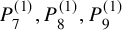 $P^{(1)}_7, P^{(1)}_8, P^{(1)}_9$
, are easily controlled by a factor of
$P^{(1)}_7, P^{(1)}_8, P^{(1)}_9$
, are easily controlled by a factor of $\| U, V \|_{X_0}^2$
.
$\| U, V \|_{X_0}^2$
.
We now proceed to estimate each of the remaining terms above via
 $$ \begin{align*} &|\int \varepsilon^2 \bar{u}_y V_x V_y \phi_1^2| \lesssim \sqrt{\varepsilon} \| \varepsilon V_x \phi_1\| \| \sqrt{\varepsilon} V_y \phi_1 \| \lesssim \sqrt{\varepsilon} (\| U, V \|_{X_0}^2 + \| U, V \|_{Y_{\frac 1 2}}^2), \\ &|\int \varepsilon^2 \bar{u}_x V_y^2 \phi_1^2| \lesssim \varepsilon \| \sqrt{\varepsilon} V_y \phi_1 \|^2 \lesssim \varepsilon (\| U, V \|_{X_0}^2 + \| U, V \|_{Y_{\frac 1 2}}^2), \\ &|\int \varepsilon^2 \bar{u}_{xyy} V^2 \phi_1^2| \lesssim \varepsilon \| \bar{u}_{xyy} y^2 \|_\infty \Big\| \sqrt{\varepsilon} \frac{V}{y} \phi_1 \Big\|^2 \lesssim \varepsilon \| \sqrt{\varepsilon} V_y \phi_1\|^2 \lesssim \varepsilon (\| U, V \|_{X_0}^2 + \| U, V \|_{Y_{\frac 1 2}}^2), \\ &|\int \varepsilon^2 \bar{u}_{xxx} U^2 \phi_1^2| \lesssim \varepsilon^2 \| \bar{u}_{xxx} x^2 \|_\infty \| U \langle x \rangle^{-1} \|^2 \lesssim \varepsilon^2 (\| U, V \|_{X_0}^2 + \| U, V \|_{X_{\frac 1 2}}^2), \\ &|\int \varepsilon^2 \bar{u}_{xxy} UV \phi_1^2| \lesssim \varepsilon^{\frac 32} \| U \langle x \rangle^{-1} \| \| \sqrt{\varepsilon} V_y \phi_1\| \lesssim \varepsilon^{\frac 3 2} (\| U, V \|_{X_0}^2 + \| U, V \|_{X_{\frac 1 2}}^2 + \| U, V \|_{Y_{\frac 1 2}}^2), \\ &| \frac{\varepsilon^2}{2} \int \bar{u}_{xxxyy} q^2 \phi_1^2| \lesssim \varepsilon^2 \| \bar{u}_{xxxyy} x^2 y^2 \|_\infty \| U \langle x \rangle^{-1} \|^2 \lesssim \varepsilon^2 (\| U, V \|_{X_0}^2 + \| U, V \|_{X_{\frac 1 2}}^2). \end{align*} $$
This concludes the treatment of $\tilde {P}_2$
.
$\tilde {P}_2$
.
We now treat $\tilde {P}_1$
. We further integrate by parts using that
$\tilde {P}_1$
. We further integrate by parts using that $v = \bar {u} V - \bar {u}_x q$
, which produces the following identity
$v = \bar {u} V - \bar {u}_x q$
, which produces the following identity
 $$ \begin{align} \tilde{P}_1 = \int \varepsilon^2 v_{xx} V_{yy} x \phi_1^2& = \int \varepsilon^2 \partial_{xx} (\bar{u} V - \bar{u}_x q) V_{yy} x \phi_1^2\\ \nonumber & = \int \varepsilon^2 (\bar{u} V_{xx} + 3 \bar{u}_x V_x + 3 \bar{u}_{xx} V - \bar{u}_{xxx} q) V_{yy} x \phi_1^2 =: \tilde{P}_{1,1} + \tilde{P}_{1,2} + \tilde{P}_{1,3} + \tilde{P}_{1,4}. \end{align} $$
For $\tilde {P}_{1,1}$
, we integrate by parts several times in x and y to produce the identity
$\tilde {P}_{1,1}$
, we integrate by parts several times in x and y to produce the identity
 $$ \begin{align} \nonumber \int \varepsilon^2 \bar{u} V_{xx} V_{yy} x \phi_1^2 & = \int \varepsilon^2 \bar{u} V_{xy}^2 x \phi_1^2 - \varepsilon^2 \frac 1 2 \int \partial_x (x \bar{u}_x) V_y^2 \phi_1^2 - \frac 1 2 \int \varepsilon^2 \bar{u}_x V_y^2 \phi_1^2 \\ \nonumber &\quad + \int \varepsilon^2 \bar{u}_y V_x V_y \phi_1^2+ \int \varepsilon^2 \bar{u}_{xy} V_x V_y x\phi_1^2 - \int \frac{\varepsilon^2}{2} \bar{u}_{yy} V_x^2 x \phi_1^2 \\ \nonumber &\quad - \int \varepsilon^2 \bar{u} V_y^2 \phi_1 \phi_1' - \int \varepsilon^2 x \bar{u}_x V_y^2 \phi_1 \phi_1' + 2\int \varepsilon^2 \bar{u} V_{xy} V_y x \phi_1 \phi_1' \\ &\quad + 2 \int \varepsilon^2 \bar{u}_y V_x V_y x \phi_1 \phi_1' =: \sum_{i = 1}^{10} H^{(1)}_i. \end{align} $$
All of the terms with $\phi _1'$
can again be controlled by a factor of
$\phi _1'$
can again be controlled by a factor of $\| U, V \|_{X_0}^2 + \|U, V \|_E^2$
. The first term,
$\| U, V \|_{X_0}^2 + \|U, V \|_E^2$
. The first term, $H^{(1)}_1$
, is a positive contribution.
$H^{(1)}_1$
, is a positive contribution. $H^{(1)}_2$
and
$H^{(1)}_2$
and $H^{(1)}_3$
are easily estimated above by
$H^{(1)}_3$
are easily estimated above by $ \varepsilon (\| U, V \|_{X_0}^2 + \| U, V \|_{Y_{\frac 1 2}}^2)$
, while the
$ \varepsilon (\| U, V \|_{X_0}^2 + \| U, V \|_{Y_{\frac 1 2}}^2)$
, while the $H^{(1)}_4, H^{(1)}_5$
and
$H^{(1)}_4, H^{(1)}_5$
and $H^{(1)}_6$
are estimated via
$H^{(1)}_6$
are estimated via
 $$ \begin{align*} &| \int \varepsilon^2 \partial_x (x \bar{u}_y) V_x V_y\phi_1^2 | \lesssim \sqrt{\varepsilon} \| \partial_x (x \bar{u}_y) \|_\infty \| \varepsilon V_x \| \| \sqrt{\varepsilon} V_y \| \lesssim \sqrt{\varepsilon} (\| U, V \|_{X_0}^2 + \| U, V \|_{Y_{\frac 1 2}}^2), \\ &|\int \varepsilon^2 \bar{u}_{yy} V_x^2 x\phi_1^2| \lesssim \| \bar{u}_{yy} x \|_\infty \| \varepsilon V_x \|^2 \le \delta \| U, V \|_{Y_{\frac 1 2}}^2 + \| U, V \|_{X_0}^2. \end{align*} $$
This concludes the treatment of $\tilde {P}_{1,1}$
.
$\tilde {P}_{1,1}$
.
The terms $\tilde {P}_{1,k}$
,
$\tilde {P}_{1,k}$
, $k = 2, 3, 4$
, are equivalent to
$k = 2, 3, 4$
, are equivalent to
 $$ \begin{align} \nonumber &\varepsilon^2 \int (3 \bar{u}_x V_x + 3 \bar{u}_{xx} V - \bar{u}_{xxx} q) V_{yy} x \phi_1^2\\ \nonumber & = - \int 3 \varepsilon^2 \bar{u}_{xy} V_x V_y x \phi_1^2+ \frac 3 2 \int \varepsilon^2 \partial_x (x\bar{u}_{x}) V_y^2 x \phi_1^2 - \int 3 \varepsilon^2 \bar{u}_{xx} V_y^2 x \phi_1^2 \\ &\quad + \frac 3 2 \int \varepsilon^2 \bar{u}_{xxyy} V^2 x \phi_1^2 + \int \varepsilon^2 \bar{u}_{xxxy} q V_y x + \int \varepsilon^2 \bar{u}_{xxx} U V_y x \phi_1^2. \end{align} $$
We estimate each of these contributions in a nearly identical fashion to the terms from (4.88), and so omit repeating these details.
Step 4: Error Terms We estimate the terms on the right-hand side of (2.30), starting with
 $$ \begin{align} \int \partial_y(\zeta U) U_y x \phi_1^2 & = \int \zeta U_y^2 x \phi_1^2 - \frac 1 2 \int \partial_y^2 \zeta U^2 x - \frac 1 2 \int_{y = 0} \partial_y \zeta U^2 x \phi_1^2. \end{align} $$
The first term above is estimated via
 $$ \begin{align*} \nonumber |\int \zeta U_y^2 x \phi_1^2| \lesssim \sqrt{\varepsilon} \| U_y \phi_1 \|^2 \lesssim \sqrt{\varepsilon} (\| U, V \|_{X_0}^2 + \| U, V \|_{Y_{\frac 1 2}}^2), \end{align*} $$
where we have appealed to the estimate (2.15) as well as the Hardy type inequality (3.22).
For the second and third terms from (4.90), we estimate via
 $$ \begin{align} |\int \partial_y^2 \zeta U^2 x| + |\int_{y = 0} \partial_y \zeta U^2 x \phi_1^2| \lesssim \sqrt{\varepsilon} \| U \langle x \rangle^{- \frac 1 2 - \frac{1}{100}} \|^2 + \sqrt{\varepsilon} \| U \langle x \rangle^{- \frac 1 2} \|_{y = 0}^2 \lesssim \sqrt{\varepsilon} \| U, V \|_{X_0}^2, \end{align} $$
where we have appealed to (2.15).
The $(\zeta _y q)_y$
and
$(\zeta _y q)_y$
and $(\zeta V)_x$
terms on the right-hand side of (2.30) are estimated in a completely analogous manner. We now estimate the term
$(\zeta V)_x$
terms on the right-hand side of (2.30) are estimated in a completely analogous manner. We now estimate the term
 $$ \begin{align} \nonumber | \int \varepsilon (\alpha U)_x U_y x \phi_1^2 | & \le |\int \varepsilon \alpha U_x U_y x \phi_1^2| + |\int \varepsilon \alpha_x U U_y x \phi_1^2| \\ \nonumber &\lesssim \sqrt{\varepsilon} \| \sqrt{\varepsilon} U_x \phi_1 \| \| U_y \phi_1 \| + \varepsilon \| U \langle x \rangle^{-1} \| \| U_y \phi_1 \| \\ &\lesssim \sqrt{\varepsilon} (\| U, V \|_{X_0}^2 + \| U, V \|_{Y_{\frac 1 2}}^2) + \varepsilon \| U, V \|_{X_0}^2, \end{align} $$
where we have appealed to estimate (2.16) to estimate the coefficient $\alpha $
. The remaining term with
$\alpha $
. The remaining term with $(\alpha _y q)_x$
is estimated in a completely analogous manner. This concludes the proof of Lemma 4.3.
$(\alpha _y q)_x$
is estimated in a completely analogous manner. This concludes the proof of Lemma 4.3.
4.3
$X_n$
estimates,
$1 \le n \le 10$


It is convenient to estimate the commutators, $\mathcal {C}_1^n, \mathcal {C}_2^n$
, defined in (2.34)–(2.35).
$\mathcal {C}_1^n, \mathcal {C}_2^n$
, defined in (2.34)–(2.35).
Lemma 4.4. The quantities $\mathcal {C}_1^{n}, \mathcal {C}_2^{n}$
satisfy the following estimates for
$\mathcal {C}_1^{n}, \mathcal {C}_2^{n}$
satisfy the following estimates for $j = 0, 1$
.
$j = 0, 1$
.
 $$ \begin{align} \| \partial_y^j \mathcal{C}_1^{n} \langle x \rangle^{n + \frac 1 2 + \frac j 2} \phi_n \| + \| \sqrt{\varepsilon} \partial_y^j \mathcal{C}_2^{n} \langle x \rangle^{n + \frac 1 2 + \frac j 2} \phi_n \| \lesssim \| U, V \|_{\mathcal{X}_{\le n- \frac12 + \frac j 2}}, \end{align} $$
Proof. We start with the estimation of $\mathcal {C}_1^n$
, defined in (2.34), which we do via
$\mathcal {C}_1^n$
, defined in (2.34), which we do via
 $$ \begin{align} \nonumber \| \mathcal{C}_1^n \langle x \rangle^{n + \frac 1 2} \phi_n \| &\lesssim \sum_{k = 0}^{n-1} ( \| \partial_x^{n-k} \zeta \langle x \rangle^{(n-k) + 1.01} \|_\infty \| U^{(k)} \langle x \rangle^{k - \frac 1 2 - .01} \| \\ \nonumber &\quad + \| \partial_x^{n-k} \partial_y \zeta \langle x \rangle^{(n-k) + 1.01} y \|_\infty \| \frac{q^{(k)}}{y} \langle x \rangle^{k - \frac 1 2 - .01} \| \\ \nonumber &\quad + \| \frac{\partial_x^{n-k}(\bar{u}^2)}{\bar{u}} \langle x \rangle^{n-k} \|_{\infty} \| \bar{u} U^{(k)}_x \langle x \rangle^{k + \frac12} \phi_n \| \\ \nonumber &\quad + \| \frac{\partial_x^{n-k}(\bar{u} \bar{v})}{\sqrt{\bar{u}}} x^{n-k + \frac12} \|_{\infty} \| \sqrt{\bar{u}} U^{(k)}_y x^k \phi_n \| )\\ &\quad + \sum_{k = 1}^{n-1} \| \frac{\partial_x^{n-k} \bar{u}^0_{pyy}}{\bar{u}} \langle x \rangle^{n-k + 1} \|_\infty \| \bar{u} U^{(k-1)}_x \langle x \rangle^{k - \frac12} \phi_n \| + \| \partial_x^{n} \bar{u}^0_{pyy} U \langle x \rangle^{n + \frac12} \phi_n \| \end{align} $$
 $$ \begin{align} &\lesssim\|U, V \|_{\mathcal{X}_{\le n-\frac12}}, \end{align} $$
where we have appealed to estimate (2.15) for the coefficient of $\zeta $
. For the final term on the right-hand side of (4.94), we have proceeded in an identical manner to estimate (4.38).
$\zeta $
. For the final term on the right-hand side of (4.94), we have proceeded in an identical manner to estimate (4.38).
We now address the terms in $\mathcal {C}_2^{n}$
via
$\mathcal {C}_2^{n}$
via
 $$ \begin{align} \nonumber \| \sqrt{\varepsilon} \mathcal{C}_2^n \langle x \rangle^{n + \frac 1 2} \phi_n \| &\lesssim \sum_{k = 0}^{n-1} \sqrt{\varepsilon} \| \partial_x^{n-k} \alpha \langle x \rangle^{(n-k) + \frac 3 2} \|_\infty \| U^{(k)} \langle x \rangle^{k-1} \phi_n \| \\ \nonumber &\quad + \sqrt{\varepsilon} \| \partial_x^{n-k} \alpha_y \langle x \rangle^{(n-k) + \frac 3 2} y \|_\infty \| \frac{ q^{(k)} }{y} \langle x \rangle^{k-1} \phi_n \| \\ \nonumber &\quad + \| \partial_x^{n-k} \zeta \langle x \rangle^{(n-k) + 1.01} \|_\infty \| \sqrt{\varepsilon} V^{(k)} \langle x \rangle^{k - \frac 1 2 - .01} \| \\ \nonumber &\quad + \| \frac{\partial_x^{n-k}(\bar{u}^2)}{\bar{u}} \langle x \rangle^{n-k} \|_\infty \| \sqrt{\varepsilon} \bar{u} V^{(k)}_x \langle x \rangle^{k + \frac12} \phi_n \| \\ \nonumber &\quad + \| \frac{\partial_x^{n-k}(\bar{u} \bar{v})}{\sqrt{\bar{u}}} \langle x \rangle^{n-k + \frac12} \|_\infty \| \sqrt{\varepsilon} \sqrt{\bar{u}} V^{(k)}_y \langle x \rangle^{k} \phi_n \| \\ &\quad + \| \partial_x^{n-k} \bar{u}^0_{pyy} \langle x \rangle^{n - k + \frac12}y \|_\infty \| \sqrt{\varepsilon} V^{(k)}_y \langle x \rangle^{k} \phi_n \| \lesssim \|U, V \|_{\mathcal{X}_{\le n-\frac12}}, \end{align} $$
where we have appealed to estimate (2.16) to estimate the coefficient $\alpha $
. The higher order y derivative works in an identical manner.
$\alpha $
. The higher order y derivative works in an identical manner.
Lemma 4.5. For any $n \ge 1$
,
$n \ge 1$
,
 $$ \begin{align} \| U, V \|_{X_n}^2 \lesssim \| U, V \|_{\mathcal{X}_{\le n-\frac 1 2}}^2 + \mathcal{T}_{X_{n}} + \mathcal{F}_{X_{n}}, \end{align} $$
where
 $$ \begin{align} \nonumber \mathcal{T}_{X_n} & := \int \partial_x^{n} \mathcal{N}_1(u, v) U^{(n)} \langle x \rangle^{2n} \phi_n^2 + \int \partial_x^n \mathcal{N}_2(u, v) \Big( \varepsilon V^{(n)} \langle x \rangle^{2n} \phi_n^2 + 2n \varepsilon V^{(n-1)} \langle x \rangle^{2n-1} \phi_n^2 \\ &\quad + 2 \varepsilon V^{(n-1)} \langle x \rangle^{2n} \phi_n \phi_n' \Big), \end{align} $$
 $$ \begin{align} \nonumber \mathcal{F}_{X_n} & := \int \partial_x^n F_R U^{(n)} \langle x \rangle^{2n} \phi_n^2 + \int \partial_x^n G_R \Big( \varepsilon V^{(n)} \langle x \rangle^{2n} \phi_n^2 + 2n \varepsilon V^{(n-1)} \langle x \rangle^{2n-1} \phi_n^2 \\ &\quad + 2 \varepsilon V^{(n-1)} \langle x \rangle^{2n} \phi_n \phi_n' \Big). \end{align} $$
Proof. We apply the multiplier
 $$ \begin{align} [U^{(n)} \langle x \rangle^{2n} \phi_{n}^2, \varepsilon V^{(n)} \langle x \rangle^{2n} \phi_n^2 + 2n \varepsilon V^{(n-1)} \langle x \rangle^{2n-1} \phi_n^2+ 2 \varepsilon V^{(n-1)} \langle x \rangle^{2n} \phi_n \phi_n'] \end{align} $$
to the system (2.31)–(2.33). The interaction of the multipliers (4.100) with the left-hand side of (2.31)–(2.32) is essentially identical to that of Lemma 4.1. As such, we treat the new commutators arising from the $\mathcal {C}_1^n, \mathcal {C}_2^n$
terms, defined in (2.34)–(2.35). First, we have
$\mathcal {C}_1^n, \mathcal {C}_2^n$
terms, defined in (2.34)–(2.35). First, we have
 $$ \begin{align*} \nonumber |\int \mathcal{C}_1^{n} U^{(n)} \langle x \rangle^{2n} \phi_n^2| \lesssim \| \mathcal{C}_1^{n} \langle x \rangle^{n + \frac 1 2} \phi_n \| \| U^{(n)} \langle x \rangle^{n - \frac 1 2} \phi_n \| \lesssim \|U, V \|_{\mathcal{X}_{\le n - \frac12}}^2. \end{align*} $$
Next,
 $$ \begin{align*} \nonumber |\int \varepsilon \mathcal{C}_2^{n} V^{(n)} \langle x \rangle^{2n} \phi_n^2| \lesssim \| \sqrt{\varepsilon} \mathcal{C}_2^{n} \langle x \rangle^{n + \frac 1 2} \phi_n \| \| \sqrt{\varepsilon} V^{(n)} \langle x \rangle^{n - \frac 1 2} \phi_n \| \lesssim \|U, V \|_{\mathcal{X}_{\le n - \frac12}}^2. \end{align*} $$
The identical estimate works as well for the middle term from the multiplier in (4.100), whereas the final term with $\phi _n'$
is localized in x, lower order, and trivially bounded by
$\phi _n'$
is localized in x, lower order, and trivially bounded by $\|U, V\|_{\mathcal {X}_{\le n - \frac 1 2}}^2$
.
$\|U, V\|_{\mathcal {X}_{\le n - \frac 1 2}}^2$
.
4.4
$X_{n + \frac 1 2} \cap Y_{n + \frac 1 2}$
estimates,
$1 \le n \le 10$
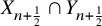

We now provide estimates on the higher order $X_{n + \frac 1 2}$
and
$X_{n + \frac 1 2}$
and $Y_{n + \frac 1 2}$
norms. Notice that these estimates still “lose a derivative”, due to degeneracy at
$Y_{n + \frac 1 2}$
norms. Notice that these estimates still “lose a derivative”, due to degeneracy at $y = 0$
.
$y = 0$
.
Lemma 4.6. For any $0 < \delta << 1$
,
$0 < \delta << 1$
,
 $$ \begin{align} \| U, V \|_{X_{n + \frac 1 2 }}^2 & \le C_\delta \|U, V \|_{\mathcal{X}_{\le n}}^2 + \delta \| U, V \|_{X_{n+1}}^2 + \delta \| U, V \|_{Y_{n + \frac 1 2}}^2 + \mathcal{T}_{X_{n+ \frac 1 2}} + \mathcal{F}_{X_{n+ \frac 1 2}}, \end{align} $$
where we define
 $$ \begin{align} \nonumber \mathcal{T}_{X_{n + \frac 1 2}} & := \int \partial_x^{n} \mathcal{N}_1(u, v)U^{(n)}_x \langle x \rangle^{1+2n} \phi_{n+1}^2 + \int \varepsilon \partial_x^n \mathcal{N}_2(u, v) \Big( V^{(n)}_x \langle x \rangle^{1+2n} \phi_{n+1}^2 \\ &\quad + (1 + 2n) V^{(n)} \langle x \rangle^{2n} \phi_{n+1}^2 + 2 V^{(n)} \langle x\rangle^{1+2n} \phi_{n+1} \phi_{n+1}' \Big) \end{align} $$
 $$ \begin{align}\nonumber \mathcal{F}_{X_{n + \frac 1 2}} & := \int \partial_x^{n}F_R U^{(n)}_x \langle x \rangle^{1+2n} \phi_{n+1}^2 + \int \varepsilon \partial_x^n G_R \Big( V^{(n)}_x \langle x \rangle^{1+2n} \phi_{n+1}^2 \\ &\quad + (1 + 2n) V^{(n)} \langle x \rangle^{2n} \phi_{n+1}^2 + 2 V^{(n)} \langle x\rangle^{1+2n} \phi_{n+1} \phi_{n+1}' \Big). \end{align} $$
Proof. We apply the multiplier
 $$ \begin{align} [U^{(n)}_x \langle x \rangle^{1+2n} \phi_{n+1}^2, \varepsilon V^{(n)}_x \langle x \rangle^{1+2n} \phi_{n+1}^2 + \varepsilon (1 + 2n) V^{(n)} \langle x \rangle^{2n} \phi_{n+1}^2 + 2\varepsilon V^{(n)} \langle x\rangle^{1+2n} \phi_{n+1} \phi_{n+1}'] \end{align} $$
to the system (2.31)–(2.33). Again, the interaction of these multipliers with the left-hand side of (2.31)–(2.33) is nearly identical to that of Lemma 4.2, and so we proceed to treat the commutators arising from $\mathcal {C}_1^{n}, \mathcal {C}_2^{n}$
. We also may clearly estimate the contribution of the
$\mathcal {C}_1^{n}, \mathcal {C}_2^{n}$
. We also may clearly estimate the contribution of the $\phi _{n+1}'$
term by a factor of
$\phi _{n+1}'$
term by a factor of $\|U, V \|_{\mathcal {X}_{\le n}}$
. We have
$\|U, V \|_{\mathcal {X}_{\le n}}$
. We have
 $$ \begin{align} \nonumber |\int \mathcal{C}_1^{n} U^{(n)}_x \langle x \rangle^{1+2n} \phi_{n+1}^2| &\lesssim \| \mathcal{C}_1^{n} \langle x \rangle^{n + \frac 1 2} \phi_{n+1} \| \| U_x^{(n)} \langle x \rangle^{n + \frac 1 2} \phi_{n+1} \| \\ &\lesssim \|U \|_{\mathcal{X}_{\le n-\frac12}} ( \|U \|_{X_{n+\frac 1 2}} + \|U, V \|_{X_{n+1}} ) \end{align} $$
and similarly
 $$ \begin{align} \nonumber &|\int \mathcal{C}_2^{n} (\varepsilon V^{(n)}_x \langle x \rangle^{1+2n} \phi_{n+1}^2 + \varepsilon (1 + 2n) V^{(n)} \langle x \rangle^{2n} \phi_{n+1}^2 )| \\ \nonumber &\lesssim \| \sqrt{\varepsilon} C_2^{n} \langle x \rangle^{n + \frac 12} \phi_{n+1} \| ( \| \sqrt{\varepsilon} V^{(n)}_x \langle x \rangle^{n + \frac 1 2} \phi_{n+1} \| + \| \sqrt{\varepsilon} V^{(n)} \langle x \rangle^{n - \frac 12} \phi_{n+1} \| ) \\ &\lesssim \|U \|_{\mathcal{X}_{\le n-\frac12}} ( \|U \|_{X_{n+\frac 1 2}} + \|U, V \|_{X_{n+1}} ), \end{align} $$
where above we have invoked estimate (4.93). From here, the conclusion of the lemma follows from an application of Young’s inequality for products.
Lemma 4.7. For any $0 < \delta << 1$
,
$0 < \delta << 1$
,
 $$ \begin{align} \| U, V \|_{Y_{n + \frac 1 2 }}^2 & \le C_\delta \|U, V \|_{\mathcal{X}_{\le n}}^2 + C_\delta \|U, V \|_E^2+ \delta \| U, V \|_{X_{n+1}}^2 + \delta \| U, V \|_{X_{n + \frac 1 2}}^2 + \mathcal{T}_{Y_{n+ \frac 1 2}} + \mathcal{F}_{Y_{n+ \frac 1 2}}, \end{align} $$
where
 $$ \begin{align} \mathcal{T}_{Y_{n + \frac 1 2}} & := \int \Big( \partial_x^n \partial_y \mathcal{N}_1(u, v) - \varepsilon \partial_x^{n+1} \mathcal{N}_2(u, v) \Big) U^{(n)}_y \langle x \rangle^{1 + 2n} \phi_{n+1}^2, \end{align} $$
 $$ \begin{align} \mathcal{F}_{Y_{n + \frac 1 2}} & := \int \Big( \partial_x^n \partial_y F_R - \varepsilon \partial_x^{n+1} G_R \Big) U^{(n)}_y \langle x \rangle^{1 + 2n} \phi_{n+1}^2. \end{align} $$
Proof. We again only need to estimate the commutator terms, which are
 $$ \begin{align} \nonumber |\int ( \partial_y \mathcal{C}_1^n - \varepsilon \partial_x \mathcal{C}_2^n) U^{(n)}_y\langle x \rangle^{1 + 2n} \phi_{n+1}^2| &\lesssim\| ( \partial_y \mathcal{C}_1^n - \varepsilon \partial_x \mathcal{C}_2^n) \langle x \rangle^{n + 1} \phi_{n+1} \| U^{(n)}_y \langle x \rangle^{n } \phi_{n+1} \| \\ &\lesssim \|U, V \|_{\mathcal{X}_{\le n }} \|U, V \|_{\mathcal{X}_{\le n + \frac 1 2}}, \end{align} $$
with the help again of estimate (4.93). The conclusion again follows from an application of Young’s inequality for products.
5 Top order estimates
In this section, we provide an estimate for $\| U, V \|_{X_{11}}$
, defined in (3.7). To establish this, we need to first perform a nonlinear change of variables and to define auxiliary norms which are nonlinear (these will eventually control the
$\| U, V \|_{X_{11}}$
, defined in (3.7). To establish this, we need to first perform a nonlinear change of variables and to define auxiliary norms which are nonlinear (these will eventually control the $\| U, V \|_{X_{11}}$
).
$\| U, V \|_{X_{11}}$
).
5.1 Nonlinear change of variables
We group the linearized and nonlinear terms from (2.18) via
 $$ \begin{align} \mathcal{L}_1[u, v] + \mathcal{N}_1(u, v) = \mu_s u_x + \mu_{sy} v + \bar{v} u_y + \bar{u}_x u , \end{align} $$
where we define the following nonlinear coefficients ( $\nu _s$
will appear shortly)
$\nu _s$
will appear shortly)
 $$ \begin{align} \mu_s := \bar{u} + \varepsilon^{\frac{N_2}{2}}u, \qquad \nu_s := \bar{v} + \varepsilon^{\frac{N_2}{2}}v. \end{align} $$
We now apply $\partial _x^{11}$
to (5.1), which produces the identity
$\partial _x^{11}$
to (5.1), which produces the identity
 $$ \begin{align} \partial_x^{11} ( \mathcal{L}[u, v] + \mathcal{N}_1(u, v) ) = \mu_s u^{(11)}_x + \mu_{sy} v^{(11)} + \sum_{i = 1}^3 \mathcal{R}^{(i)}_1[u, v], \end{align} $$
where we have isolated those terms with twelve x derivatives, and the remainder terms above have fewer than twelve x derivatives on u, and are defined by
 $$ \begin{align} \mathcal{R}_1^{(1)}[u, v] :& = \sum_{j = 1}^{10} \binom{11}{j} ( \partial_x^j \mu_s \partial_x^{11-j} u_x + \partial_x^{11-j} \bar{u}_x \partial_x^j u + \partial_x^j \nu_s \partial_x^{11-j} u_y + \partial_x^{11-j} \bar{u}_y \partial_x^j v ), \end{align} $$
 $$ \begin{align} \mathcal{R}_1^{(2)}[u, v] & := \mu_{sx} u^{(11)} + \nu_s u^{(11)}_y, \end{align} $$
 $$ \begin{align}\mathcal{R}_1^{(3)}[u, v] & := u \partial_x^{12} \bar{u} + u_y \partial_x^{11} \bar{v} + v \partial_y \bar{u}^{(11)} + u_x \partial_x^{11} \bar{u}. \end{align} $$
The key point is that by allowing the coefficients $[\mu _s, \nu _s]$
in (5.2) to depend on the solution, we have grouped all terms of highest order in the first two transport terms in (5.3), and the remaining quantities in
$[\mu _s, \nu _s]$
in (5.2) to depend on the solution, we have grouped all terms of highest order in the first two transport terms in (5.3), and the remaining quantities in $\mathcal {R}^{(i)}_1[u, v]$
are all lower order. This allows us to avoid any nonlinear losses of derivative at this highest order of analysis.
$\mathcal {R}^{(i)}_1[u, v]$
are all lower order. This allows us to avoid any nonlinear losses of derivative at this highest order of analysis.
We now introduce the change of variables, which is adapted to the first two terms on the right-hand side of (5.3). The basic objects are
 $$ \begin{align} Q := \frac{\psi^{(11)}}{\mu_s}, \qquad \tilde{U} := \partial_y Q, \qquad \tilde{V} := - \partial_x Q. \end{align} $$
From here, we derive the identities
 $$ \begin{align} &u^{(11)} = \partial_x^{11} u = \partial_y \psi^{(11)} = \partial_y (\mu_s Q) = \mu_s \tilde{U} + \partial_y \mu_s Q, \end{align} $$
 $$ \begin{align} &v^{(11)} = \partial_x^{11} v = - \partial_x \psi^{(11)} = - \partial_x (\mu_s Q) = \mu_s \tilde{V} - \partial_x \mu_s Q. \end{align} $$
We thus rewrite the primary two terms from (5.3) as
 $$ \begin{align*} \nonumber \mu_s u^{(11)}_x + \mu_{sy} v^{(11)} = \mu_s^2 \tilde{U}_x + \mu_s \mu_{sx} \tilde{U} + (\mu_s \mu_{sxy} - \mu_{sx} \mu_{sy}) Q. \end{align*} $$
We may subsequently rewrite (5.3) via
 $$ \begin{align} \partial_x^{11} ( \mathcal{L}_1[u, v] + \mathcal{N}_1(u, v) ) = \mu_s^2 \tilde{U}_x + \mu_s \mu_{sx} \tilde{U} + (\mu_s \mu_{sxy} - \mu_{sx} \mu_{sy}) Q + \sum_{i = 1}^3 \mathcal{R}_1^{(i)}[u, v]. \end{align} $$
We now address the second equation, for which we similarly record the identity
 $$ \begin{align} \partial_x^{11} (\mathcal{L}_{2}[u, v] + \mathcal{N}_2(u, v)) & = \mu_s v^{(11)}_x + \nu_s v^{(11)}_y + \mathcal{R}_2^{(1)}[u, v] + \mathcal{R}_2^{(2)}[u, v] + \mathcal{R}_2^{(3)}[u, v], \end{align} $$
where we again define the lower order terms appearing above via
 $$ \begin{align} \mathcal{R}^{(1)}_2[u, v] & := \sum_{j = 1}^{10} \binom{11}{j} ( \partial_x^j \mu_s \partial_x^{11-j} v_x + \partial_x^{11-j} \bar{v}_x \partial_x^j u + \partial_x^j \nu_s \partial_x^{11-j} v_y + \partial_x^{11-j} \bar{v}_y \partial_x^j v ), \end{align} $$
 $$ \begin{align} \mathcal{R}_2^{(2)}[u, v] & := \nu_{sx} u^{(11)} + \nu_{sy} v^{(11)}, \end{align} $$
 $$ \begin{align} \mathcal{R}_2^{(3)}[u, v] & := v \partial_x^{11} \bar{v}_y + u \partial_x^{12} \bar{v} + v_x \partial_x^{11} \bar{u} + v_y \partial_x^{11}\bar{v}.\end{align} $$
We will now rewrite the first two terms from (5.11) by using (5.8)–(5.9) so as to produce
 $$ \begin{align*} \nonumber \mu_s v^{(11)}_x + \nu_s v^{(11)}_y = \mu_s^2 \tilde{V}_x + \mu_s \nu_s \tilde{V}_y + (2 \mu_s \mu_{sx} + \nu_s \mu_{sy}) \tilde{V} - \mu_{sx} \nu_s \tilde{U} - (\mu_s \mu_{sxx} + \nu_s \mu_{sxy})Q. \end{align*} $$
Continuing then from (5.11), we obtain
 $$ \begin{align} \nonumber \partial_x^{11} (\bar{\mathcal{L}}_{2}[u, v] + \mathcal{N}_2(u, v)) & = \mu_s^2 \tilde{V}_x + \mu_s \nu_s \tilde{V}_y + (2 \mu_s \mu_{sx} + \nu_s \mu_{sy}) \tilde{V} - \mu_{sx} \nu_s \tilde{U} \\ &\quad -(\mu_s \mu_{sxx} + \nu_s \mu_{sxy})Q + \sum_{i = 1}^3 \mathcal{R}_2^{(i)}[u, v]. \end{align} $$
We now summarize the full nonlinear equation upon introducing these new quantities:
 $$ \begin{align} \mu_s^2 \tilde{U}_x + \mu_s \mu_{sx} \tilde{U} - \Delta_\varepsilon (\partial_x^{11} u) + (\mu_s \mu_{sxy} - \mu_{sx} \mu_{sy}) Q + \sum_{i = 1}^3 \mathcal{R}_1^{(i)}[u, v] + \partial_x^{11} P_x = \partial_x^{11} F_R, \end{align} $$
and the second equation which reads
 $$ \begin{align} \nonumber \mu_s^2 \tilde{V}_x& + \mu_s \nu_s \tilde{V}_y - \Delta_\varepsilon (\partial_x^{11} v) + (2 \mu_s \mu_{sx} + \nu_s \mu_{sy}) \tilde{V} - \mu_{sx} \nu_s \tilde{U} - (\mu_s \mu_{sxx} + \nu_s \mu_{sxy})Q \\&+ \sum_{i = 1}^3 \mathcal{R}_2^{(i)}[u, v] + \partial_x^{11}\frac{P_y}{\varepsilon} = \partial_x^{11} G_R. \end{align} $$
5.2 Nonlinearly modified norms
While our objective is to control $\| U, V \|_{X_{11}}$
, we will need to change the weights appearing in this norm from
$\| U, V \|_{X_{11}}$
, we will need to change the weights appearing in this norm from $\bar {u}$
to
$\bar {u}$
to $\mu _s$
. Define thus
$\mu _s$
. Define thus
 $$ \begin{align} \| \tilde{U}, \tilde{V} \|_{\Theta_{11}} := \| \sqrt{\mu_s} \tilde{U}_y x^{11} \phi_{11} \| + \sqrt{\varepsilon} \| \sqrt{\mu_s} \tilde{U}_x x^{11} \phi_{11} \| + \varepsilon \| \sqrt{\mu_s} \tilde{V}_x x^{11} \phi_{11} \| + \| \mu_{sy} \tilde{U} x^{11} \phi_{11} \|_{y = 0}. \end{align} $$
We now prove
Lemma 5.1. The following estimates are valid, for $j = 0, 1$
,
$j = 0, 1$
,
 $$ \begin{align} \| \sqrt{\varepsilon}Q x^{9.5} \phi_{10} \| &\lesssim \|U, V \|_{\mathcal{X}_{\le 10}}, \end{align} $$
 $$ \begin{align}\| \sqrt{\varepsilon} Q x^{10} \phi_{11} \|_{L^2_x L^\infty_y} &\lesssim \|U, V \|_{\mathcal{X}}, \end{align} $$
 $$ \begin{align} \| \mu_s \tilde{U} x^{10.5} \phi_{11} \| + \sqrt{\varepsilon} \| \mu_s \tilde{V} x^{10.5} \phi_{11} \| &\lesssim\varepsilon^{\frac{N_2}{2}- M_1 - 5}\|U, V \|_{\mathcal{X}} + \|U, V \|_{\mathcal{X}_{\le 10.5}}, \end{align} $$
and, for any $0 < \delta << 1$
,
$0 < \delta << 1$
,
 $$ \begin{align} \| \tilde{U} x^{10.5} \phi_{11} \| + \sqrt{\varepsilon} \| \tilde{V} x^{10.5} \phi_{11} \| & \le \delta \| \tilde{U}, \tilde{V} \|_{\Theta_{11}} + C_\delta \|U, V \|_{\mathcal{X}_{\le 10.5}} + \varepsilon^{\frac{N_2}{2}- M_1 - 5} \|U, V \|_{\mathcal{X}}. \end{align} $$
Proof. We use the formulas (5.7) to write
 $$ \begin{align} \mu_s Q = \partial_x^{11} \psi = \partial_x^{11} (\bar{u} q) = \bar{u} \partial_x^{11} q + \sum_{k = 1}^{11} \binom{11}{k} \partial_x^k \bar{u} \partial_x^{11-k} q. \end{align} $$
We divide through both sides by $\mu _s$
, multiply by
$\mu _s$
, multiply by $\sqrt {\varepsilon } x^{9.5} \phi _{10}$
, and compute the
$\sqrt {\varepsilon } x^{9.5} \phi _{10}$
, and compute the $L^2$
norm, which gives
$L^2$
norm, which gives
 $$ \begin{align} \nonumber \| \sqrt{\varepsilon} Q x^{9.5} \phi_{10} \| &\lesssim \| \sqrt{\varepsilon} V^{(9)}_x x^{9.5} \phi_{10} \| + \sum_{k = 1}^9 \| \frac{\partial_x^k \bar{u}}{\bar{u}} x^k \|_\infty \| \sqrt{\varepsilon} V^{(9-k)}_x x^{9-k + \frac 1 2} \phi_{11} \| \\ \nonumber &\quad + \| \partial_x^{10} \bar{u}_p x^9 y \|_\infty \| \sqrt{\varepsilon} \frac{V}{y} x^{\frac 1 2} \phi_{11} \| + \| \partial_x^{10} \bar{u}_E x^{10.5} \|_\infty \| \sqrt{\varepsilon} V \langle x \rangle^{-1} \| \\ \nonumber &\quad + \| \partial_x^{11} \bar{u}_p x^{10.5}y \|_\infty \| \sqrt{\varepsilon} \frac{q}{y} \langle x \rangle^{-1} \| + \| \partial_x^{11} \bar{u}_E x^{11.5} \|_\infty \| \sqrt{\varepsilon} q \langle x \rangle^{-2} \| \\ &\lesssim \|U, V \|_{\mathcal{X}_{\le 10}}, \end{align} $$
where we need to treat the lower order terms corresponding to $k = 9, 10$
in the sum (5.23) differently, in order to avoid using the critical Hardy inequality. We have invoked estimates (3.24), (2.8), (2.9).
$k = 9, 10$
in the sum (5.23) differently, in order to avoid using the critical Hardy inequality. We have invoked estimates (3.24), (2.8), (2.9).
We now address the second inequality, (5.20). We divide (5.23) by $\mu _s$
, multiply by
$\mu _s$
, multiply by $\sqrt {\varepsilon } x^{10} \phi _{11}$
, and compute the
$\sqrt {\varepsilon } x^{10} \phi _{11}$
, and compute the $L^2_x L^\infty _y$
norm, which gives
$L^2_x L^\infty _y$
norm, which gives
 $$ \begin{align} \nonumber \| \sqrt{\varepsilon} Q x^{10} \phi_{11} \|_{L^2_x L^\infty_y} &\lesssim \| V^{(10)} x^{10} \phi_{11} \|_{L^2_x L^\infty_y} + \sum_{k = 1}^9 \| \frac{\partial_x^{k} \bar{u}}{\bar{u}} x^{k} \|_{\infty} \| V^{(10-k)} x^{10-k} \phi_k \|_{L^2_x L^\infty_y} \\ \nonumber &\quad + \| \partial_x^{10} \bar{u}_p x^{9.5} y \|_{\infty} \| \frac{V}{y} x^{\frac 1 2} \|_{L^2_x L^\infty_y} + \| \partial_x^{10} \bar{u}_E x^{10.5} \|_\infty \| V \langle x \rangle^{- \frac 1 2} \|_{L^2_x L^\infty_y} \\ &\quad + \| \partial_x^{11} \bar{u}_p x^{10.5} y \|_{\infty} \| \frac{q}{y} x^{-\frac 1 2} \|_{L^2_x L^\infty_y} + \| \partial_x^{11} \bar{u}_E x^{11.5} \|_\infty \| q \langle x \rangle^{- \frac 3 2} \|_{L^2_x L^\infty_y} \\ \nonumber &\lesssim \|U, V \|_{\mathcal{X}}, \end{align} $$
where we have again invoked estimates (2.8), (2.9) for the $\bar {u}$
terms, the mixed norm estimate (3.28), as well as the following Sobolev interpolation estimates
$\bar {u}$
terms, the mixed norm estimate (3.28), as well as the following Sobolev interpolation estimates
 $$ \begin{align} &\| \frac{V}{y} x^{\frac 1 2} \phi_{11} \|_{L^2_x L^\infty_y} \lesssim \| V_y x^{\frac 1 2} \phi_{11} \|_{L^2_x L^\infty_y} \lesssim \| V_y x^{\frac 1 2} \phi_{11} \|^{\frac 1 2} \| U^{(1)}_y x^{\frac 1 2} \phi_{11} \|^{\frac 1 2} \lesssim \|U, V \|_{\mathcal{X}_{\le 1.5}}, \end{align} $$
 $$ \begin{align} &\| \sqrt{\varepsilon} V \langle x \rangle^{- \frac 1 2} \|_{L^2_x L^\infty_y} \lesssim \| \sqrt{\varepsilon} V \langle x \rangle^{-1} \phi_{11} \|^{\frac 1 2} \| \sqrt{\varepsilon} U_x \phi_{11} \| \lesssim \| U, V \|_{\mathcal{X}_{\le 1}}, \end{align} $$
and the analogous estimates for q instead of V for the final two terms from (5.25).
Dividing through by $\mu _s$
and differentiating in y yields
$\mu _s$
and differentiating in y yields
 $$ \begin{align} \tilde{U} = \frac{\bar{u}}{\mu_s} U^{(11)} - \partial_y ( \frac{\bar{u}}{\mu_s} ) V^{(10)} + \sum_{k = 1}^{11} \binom{11}{k} \partial_y ( \frac{\partial_x^k \bar{u}}{\mu_s} ) \partial_x^{11-k} q + \sum_{k = 1}^{11} \binom{11}{k} \frac{\partial_x^k \bar{u}}{\mu_s} U^{(11-k)}, \end{align} $$
and similarly, dividing through by $\mu _s$
and differentiating in x yields
$\mu _s$
and differentiating in x yields
 $$ \begin{align} \tilde{V} = \frac{\bar{u}}{\mu_s} V^{(11)} + \partial_x (\frac{\bar{u}}{\mu_s}) V^{(10)} + \sum_{k = 1}^{11} \binom{11}{k} \frac{\partial_x^k \bar{u}}{\mu_s} V^{(11-k)} - \sum_{k = 1}^{11} \binom{11}{k} \partial_x (\frac{\partial_x^k \bar{u}}{\mu_s}) \partial_x^{11-k} q. \end{align} $$
We first establish the following auxiliary estimate, which will be needed in forthcoming calculations due to the second term from (5.28).
 $$ \begin{align*} \nonumber \partial_y (\frac{\bar{u}}{\mu_s}) = \partial_y (\frac{\mu_s - \varepsilon^{\frac{N_2}{2}} u }{\mu_s}) = - \varepsilon^{\frac{N_2}{2}} \partial_y (\frac{u}{\mu_s}) = - \varepsilon^{\frac{N_2}{2}} \partial_y ( \frac{u}{\bar{u}} \frac{\bar{u}}{\mu_s} ) = - \varepsilon^{\frac{N_2}{2}} \frac{\bar{u}}{\mu_s} \partial_y (\frac{u}{\bar{u}}) - \varepsilon^{\frac{N_2}{2}} \frac{u}{\bar{u}} \partial_y (\frac{\bar{u}}{\mu_s}), \end{align*} $$
which, rearranging for the quantity on the left-hand side, yields the identity
 $$ \begin{align} \partial_y (\frac{\bar{u}}{\mu_s}) = - \frac{\varepsilon^{\frac{N_2}{2}}}{1 + \varepsilon^{\frac{N_2}{2}} \frac{u}{\bar{u}} } \frac{\bar{u}}{\mu_s} \partial_y (\frac{u}{\bar{u}}),\\[-24pt]\nonumber \end{align} $$
from which we estimate
 $$ \begin{align} \| \partial_y (\frac{\bar{u}}{\mu_s}) x^{\frac 12} \psi_{12} \|_{L^\infty_x L^2_y} &\lesssim \varepsilon^{\frac{N_2}{2}} \| \frac{\bar{u}}{\mu_s} \|_{L^\infty} \frac{1}{1 - \varepsilon^{\frac{N_2}{2}} \| \frac{u}{\bar{u}} \|_{L^\infty} } \| \partial_y (\frac{u}{\bar{u}}) x^{\frac 1 2} \psi_{12} \|_{L^\infty_x L^2_y} \lesssim \varepsilon^{\frac{N_2}{2}-M_1} \|U,V \|_{\mathcal{X}}, \end{align} $$
where we have invoked estimates (3.49) and (3.50).
From these formulas, we provide the estimate (5.22) via
 $$ \begin{align} \nonumber \| \mu_s \tilde{U} x^{10.5} \phi_{11} \| & \lesssim \| \bar{u} U^{(10)}_x x^{10.5} \phi_{11} \| + \| \partial_y ( \frac{\bar{u}}{\mu_s}) x^{\frac 1 2} \psi_{12} \|_{L^\infty_x L^2_y} \| V^{(10)} x^{10} \phi_{11} \|_{L^2_x L^\infty_y} \\ \nonumber &\quad + \sum_{k = 1}^{10} \| \frac{\bar{u}}{\mu_s} \|_{\infty} \| \partial_y (\frac{\partial_x^{k} \bar{u}}{\bar{u}}) y \langle x \rangle^k \|_{\infty} \| \frac{\partial_x^{11-k} q}{y} \langle x \rangle^{11-k - \frac 1 2} \| \\ \nonumber &\quad + \| \frac{\bar{u}}{\mu_s} \|_\infty \| \partial_y (\frac{\partial_x^{11} \bar{u}_p}{\bar{u}}) y^2 \langle x \rangle^{10.5} \|_\infty \| \frac{q - y U(x, 0)}{\langle y \rangle^2} \| + \| \frac{\bar{u}}{\mu_s} \|_\infty \| \partial_y (\frac{\partial_x^{11} \bar{u}_E}{\bar{u}}) y \langle x \rangle^{11.5} \|_\infty \| U \langle x \rangle^{-1} \| \\ \nonumber &\quad + \sum_{k = 1}^{10} \| \frac{\bar{u}}{\mu_s} \|_\infty \| \frac{\partial_x^k \bar{u}}{\bar{u}} x^k \|_\infty \| U^{(11-k)} \langle x \rangle^{(11-k- \frac 1 2)} \| + \| \frac{\bar{u}}{\mu_s} \|_\infty \| \frac{\partial_x^{11} \bar{u}_p}{\bar{u}} y \langle x \rangle^{10.5} \|_\infty \| \frac{U - U(x, 0)}{\langle y \rangle} \| \\ \nonumber &\quad + \| \frac{\bar{u}}{\mu_s} \|_\infty \| \frac{\partial_x^{11} \bar{u}_p}{\bar{u}} \langle x \rangle^{11-\frac 1 4} \|_{L^\infty_x L^2_y} \| U(x, 0) \langle x \rangle^{- \frac 1 4} \|_{L^2_x} + \| \frac{\partial_x^{11} u_E}{\bar{u}} \langle x \rangle^{11.5} \|_\infty \| U \langle x \rangle^{-1} \| \\ & \lesssim \| U, V \|_{\mathcal{X}_{\le 10.5}} + \varepsilon^{\frac{N_2}{2} - M_1} \| U, V \|_{\mathcal{X}}, \end{align} $$
where we have invoked estimates (2.6), (2.8), (2.9), (5.31), and (3.28). An essentially identical proof applies also to the $\tilde {V}$
quantity from (5.21), so we omit repeating these details. This establishes estimate (5.21), with (5.22) following similarly, upon using the Hardy-type inequality (3.23).
$\tilde {V}$
quantity from (5.21), so we omit repeating these details. This establishes estimate (5.21), with (5.22) following similarly, upon using the Hardy-type inequality (3.23).
As long as we have sufficiently strong control on lower-order quantities, it will turn out that the $\Theta _{11}$
norm will control the
$\Theta _{11}$
norm will control the $X_{11}$
norm. This is the content of the following lemma.
$X_{11}$
norm. This is the content of the following lemma.
Lemma 5.2. Assume $\| U, V \|_{\mathcal {X}} \le 1$
. Then,
$\| U, V \|_{\mathcal {X}} \le 1$
. Then,
 $$ \begin{align} \| U, V \|_{\mathcal{X}} \lesssim \| \tilde{U}, \tilde{V} \|_{\Theta_{11}}+ \| U, V \|_{\mathcal{X}_{\le 10.5}} \lesssim \| U, V \|_{\mathcal{X}}. \end{align} $$
Proof. Dividing through equation (5.23) by $\bar {u}$
and computing
$\bar {u}$
and computing $\partial _y^2$
gives
$\partial _y^2$
gives
 $$ \begin{align} \nonumber U^{(11)}_y & = \frac{\mu_s}{\bar{u}} \tilde{U}_y + 2\partial_y (\frac{\mu_s}{\bar{u}}) \tilde{U} + \partial_y^2 (\frac{\mu_s}{\bar{u}}) Q - \sum_{k = 1}^{11} \binom{11}{k} \partial_y^2 (\frac{\partial_x^k \bar{u}}{\bar{u}}) \partial_x^{11-k} q \\ &\quad - 2 \sum_{k = 1}^{11} \binom{11}{k} \partial_y^2 (\frac{\partial_x^k \bar{u}}{\bar{u}} ) \partial_x^{11-k} U - \sum_{k = 1}^{11} \binom{11}{k} \frac{\partial_x^k \bar{u}}{\bar{u}} \partial_x^{11-k} U_y \end{align} $$
From here, we obtain the estimate
 $$ \begin{align} \nonumber \| \sqrt{\bar{u}} U^{(11)}_y x^{11} \phi_{11} \| &\lesssim \| \sqrt{ \frac{\mu_s}{\bar{u}} } \|_\infty \| \sqrt{\mu_s} \tilde{U}_y x^{11} \phi_{11} \| + \| \sqrt{\bar{u}} \partial_y (\frac{\mu_s}{\bar{u}}) x^{\frac 1 2} \|_\infty \| \tilde{U} x^{10.5} \phi_{11} \| \\ \nonumber &\quad + \varepsilon^{\frac{N_2}{2}} \| \bar{u} \partial_y^2 (\frac{u}{\bar{u}}) x \psi_{12} \|_{L^\infty_x L^2_y} \| \frac{ Q }{\sqrt{\bar{u}}} x^{10} \phi_{11} \|_{L^2_x L^\infty_y} \\ \nonumber &\quad + \sum_{k = 1}^{11} \| \partial_y^2(\frac{\partial_x^k \bar{u}}{\bar{u}}) y x^{k + \frac 1 2} \|_\infty \| \frac{\partial_x^{11-k} q}{y} x^{11-k - \frac 1 2} \phi_{11} \| \\ \nonumber &\quad + \sum_{k = 1}^{11} \| \frac{\partial_x^k \bar{u}}{\bar{u}} x^k \|_\infty \| U^{(11-k)}_y x^{11-k} \phi_{11} \| \\ &\lesssim \| \tilde{U}, \tilde{V} \|_{\Theta_{11}} + \| U, V \|_{\mathcal{X}_{\le 10.5}} + \varepsilon^{\frac{N_2}{2} - M_1} \| U, V \|_{\mathcal{X}} \| U, V \|_{\mathcal{X}_{\le 10.5}}, \end{align} $$
where we have invoked (3.50), (3.49), (5.20), and (3.22).
An essentially identical calculation applies to the remaining terms from the $\| U, V \|_{X_{11}}$
norm, and also an essentially identical computation enables us to prove the second inequality in (5.33). We note, however, that to compare the quantities
$\| U, V \|_{X_{11}}$
norm, and also an essentially identical computation enables us to prove the second inequality in (5.33). We note, however, that to compare the quantities $ \| \mu _{sy} \tilde {U} x^{11} \phi _{11} \|_{y = 0}$
and
$ \| \mu _{sy} \tilde {U} x^{11} \phi _{11} \|_{y = 0}$
and $\| \bar {u}_y U^{(11)} x^{11} \phi _{11} \|_{y = 0}$
, we also need to demonstrate boundedness of the coefficients
$\| \bar {u}_y U^{(11)} x^{11} \phi _{11} \|_{y = 0}$
, we also need to demonstrate boundedness of the coefficients $|\frac {\bar {u}_y}{\mu _{sy}}| \phi _{11}$
and
$|\frac {\bar {u}_y}{\mu _{sy}}| \phi _{11}$
and $|\frac {\mu _{sy}}{\bar {u}_y}| \phi _{11}$
. For this purpose, we estimate
$|\frac {\mu _{sy}}{\bar {u}_y}| \phi _{11}$
. For this purpose, we estimate
 $$ \begin{align} \nonumber |\mu_{sy}(x, 0) - \bar{u}^0_{py}(x, 0)| \phi_{11} & \le \sum_{i = 1}^{N_1} \varepsilon^{\frac i 2} (\sqrt{\varepsilon} \| u^i_{EY} \|_{L^\infty_y} + \| u^i_{py} \|_{L^\infty_y} ) + \varepsilon^{\frac{N_2}{2}} \| u_y \psi_{12} \|_{L^\infty_y} \\ &\lesssim \sum_{i = 1}^{N_1} \varepsilon^{\frac i 2} (\sqrt{\varepsilon} \langle x \rangle^{- \frac 3 2} + \langle x \rangle^{- \frac 3 4 + \sigma_\ast}) + \varepsilon^{\frac{N_2}{2}- M_1} \langle x \rangle^{- \frac 3 4} \| U, V \|_{\mathcal{X}} \lesssim \varepsilon^{\frac 1 2} \langle x \rangle^{- \frac 3 4 + \sigma_\ast}, \end{align} $$
where we have invoked estimates (1.41), (1.38), (3.47), the identity that $\phi _{11} = \psi _{12} \phi _{11}$
, the fact that
$\phi _{11} = \psi _{12} \phi _{11}$
, the fact that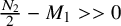 $\frac {N_2}{2} - M_1>> 0$
, and finally the assumption that
$\frac {N_2}{2} - M_1>> 0$
, and finally the assumption that $\|U, V \|_{\mathcal {X}} \le 1$
.
$\|U, V \|_{\mathcal {X}} \le 1$
.
We will need the following interpolation estimates to close the nonlinear estimates below.
Lemma 5.3. Let $\tilde {W} \in \{ \tilde {U}, \tilde {V}\}$
. The following estimates are valid:
$\tilde {W} \in \{ \tilde {U}, \tilde {V}\}$
. The following estimates are valid:
 $$ \begin{align} \| \bar{u}^{\frac 1 2} \tilde{W} \langle x \rangle^{10.75} \phi_{11} \|_{L^2_x L^\infty_y}^2 &\lesssim \| \bar{u} \tilde{W} \langle x \rangle^{10.5} \phi_{11} \|^2 + \| \sqrt{\bar{u}} \tilde{W}_y \langle x \rangle^{11} \phi_{11} \|^2, \end{align} $$
 $$ \begin{align} \| \tilde{W} \langle x \rangle^{10.5} \phi_{11} \|_{L^2_x L^4_y}^2 &\lesssim \| \bar{u} \tilde{W} \langle x \rangle^{10.5} \phi_{11} \|^2 + \| \sqrt{\bar{u}} \tilde{W}_y \langle x \rangle^{11} \phi_{11} \|^2.\end{align} $$
Proof. We begin with the first estimate, (5.37). For this, we consider
 $$ \begin{align} \nonumber \bar{u} \tilde{W}^2 \langle x \rangle^{21.5} & \le \langle x \rangle^{21.5} |\int_y^\infty 2 \bar{u} \tilde{W} \tilde{W}_y(y') \,\mathrm{d} y' | + \langle x \rangle^{21.5} |\int_y^\infty 2 \tilde{W}^2 \bar{u}_y \,\mathrm{d} y' | \\ &\lesssim \| \tilde{W} \langle x \rangle^{10.5} \|_{L^2_y} \| \sqrt{\bar{u}} \tilde{W}_y \langle x \rangle^{11} \|_{L^2_y} + \| \bar{u}_y \langle x \rangle^{\frac 1 2} \|_\infty \| \tilde{W} \langle x \rangle^{10.5} \|_{L^2_y}^2. \end{align} $$
Multiplying both sides by $\phi _{11}^2$
and placing both sides in
$\phi _{11}^2$
and placing both sides in $L^2_x$
gives estimate (5.37).
$L^2_x$
gives estimate (5.37).
We turn now to (5.38). We split
 $$ \begin{align} \| \tilde{W} \langle x \rangle^{10.5} \phi_{11} \|_{L^2_x L^4_y}^2 \le \| \tilde{W} \langle x \rangle^{10.5} \phi_{11} \chi(z) \|_{L^2_x L^4_y}^2 + \| \tilde{W} \langle x \rangle^{10.5} \phi_{11} (1 - \chi(z)) \|_{L^2_x L^4_y}^2 \end{align} $$
We first consider the z-localized contribution above. To compute the $L^4_y$
, we raise to the fourth power and integrate by parts via
$L^4_y$
, we raise to the fourth power and integrate by parts via
 $$ \begin{align} \nonumber \| \tilde{W} \langle x \rangle^{10.5} \chi(z) \|_{ L^4_y}^4 & = \int \tilde{W}^4 \chi(z)^4 \langle x \rangle^{42} \,\mathrm{d} y = \int \partial_y (y) \tilde{W}^4 \chi(z)^4 \langle x \rangle^{42} \,\mathrm{d} y \\ & = - \int 4 y \tilde{W}^3 \tilde{W}_y \chi(z)^4 \langle x \rangle^{42} - \int 4 y \tilde{W}^4 \frac{1}{\sqrt{x}} \chi^3 \chi'(z) \langle x \rangle^{42} \,\mathrm{d} y, \end{align} $$
from which we deduce that (using that $\sqrt {a + b} \le \sqrt {a} + \sqrt {b}$
for
$\sqrt {a + b} \le \sqrt {a} + \sqrt {b}$
for $a, b \ge 0$
)
$a, b \ge 0$
)
 $$ \begin{align} \| \tilde{W} \langle x \rangle^{10.5} \chi(z) \|_{ L^4_y}^2 \le |\int 4 y \tilde{W}^3 \tilde{W}_y \chi(z)^4 \langle x \rangle^{42} |^{\frac12} + | \int 4 y \tilde{W}^4 \frac{1}{\sqrt{x}} \chi(z)^3 \chi'(z) \langle x \rangle^{42} \,\mathrm{d} y|^{\frac12}. \end{align} $$
We will first handle the first integral above. Using that $z \le 1$
on the support of
$z \le 1$
on the support of $\chi (z)$
, we can estimate via
$\chi (z)$
, we can estimate via
 $$ \begin{align} \nonumber |\int 4y \tilde{W}^3 \tilde{W}_y \chi(z) \langle x \rangle^{42}|^{\frac12} &\lesssim (\int |\tilde{W}|^3 \bar{u} |\tilde{W}_y| \langle x \rangle^{42.5} \chi^4 \,\mathrm{d} y)^{\frac12} \\ \nonumber &\lesssim (\| \sqrt{\bar{u}} \tilde{W} \langle x \rangle^{10.5} \|_{L^\infty_y} \| \tilde{W} \langle x \rangle^{10.5} \chi \|_{L^4_y}^2 \| \sqrt{\bar{u}} \tilde{W}_y \langle x \rangle^{11} \|_{L^2_y})^{\frac12} \\ & \le \frac{1}{100} \| \tilde{W} \langle x \rangle^{10.5}\chi \|_{L^4_y}^2 + C \| \sqrt{\bar{u}} \tilde{W} \langle x \rangle^{10.5}\|_{L^\infty_y} \| \sqrt{\bar{u}} \tilde{W}_y \langle x \rangle^{11} \|_{L^2_y} \end{align} $$
The term with $1/100$
prefactor gets absorbed to the left-hand side of (5.42). For the remaining term on the right-hand side above, we multiply by
$1/100$
prefactor gets absorbed to the left-hand side of (5.42). For the remaining term on the right-hand side above, we multiply by $\phi _{11}^2$
, integrate over x, and appeal to (5.37) to give the desired estimate.
$\phi _{11}^2$
, integrate over x, and appeal to (5.37) to give the desired estimate.
For the far-field integral from (5.41), we estimate it by first noting that $1 \lesssim |y/\sqrt {x}| \lesssim 1$
on the support of
$1 \lesssim |y/\sqrt {x}| \lesssim 1$
on the support of $\chi '$
. Thus,
$\chi '$
. Thus,
 $$ \begin{align} \nonumber |\int \tilde{W}^4 \langle x \rangle^{42} z \chi'(z) \,\mathrm{d} y|^{\frac12} &\lesssim ( \| \bar{u} \tilde{W} \langle x \rangle^{10.5} \|_{L^\infty_y}^2 \| \bar{u} \tilde{W} \langle x \rangle^{10.5} \|_{L^2_y}^2)^{\frac12} \\ \nonumber &\lesssim \| \bar{u} \tilde{W} \langle x \rangle^{10.5} \|_{L^2_y}^{\frac32} \| \sqrt{\bar{u}} \tilde{W}_y \langle x \rangle^{10.5} \|_{L^2_y}^{\frac12} \\ &\lesssim \| \bar{u} \tilde{W} \langle x \rangle^{10.5} \|_{L^2_y}^{2} + \| \sqrt{\bar{u}} \tilde{W}_y \langle x \rangle^{10.5} \|_{L^2_y}^2. \end{align} $$
Multiplying by $\phi _{11}^2$
, integrating over x, and appealing to (5.37) gives the desired estimate. The
$\phi _{11}^2$
, integrating over x, and appealing to (5.37) gives the desired estimate. The $1 - \chi (z)$
contribution from (5.40) is treated similarly to the
$1 - \chi (z)$
contribution from (5.40) is treated similarly to the $\chi '$
term.
$\chi '$
term.
5.3 Complete
$\|\tilde {U}, \tilde {V} \|_{\Theta _{11}}$
estimate

Before performing our main top order energy estimate in Lemma 5.5, we first record an estimate on the lower-order error terms.
Lemma 5.4. Assume $\| U, V \|_{\mathcal {X}} \le 1$
. Let
$\| U, V \|_{\mathcal {X}} \le 1$
. Let $\mathcal {R}_1^{(1)}$
and
$\mathcal {R}_1^{(1)}$
and $\mathcal {R}_2^{(1)}$
be defined as in (5.4) and (5.12). Then the following estimate is valid, for any
$\mathcal {R}_2^{(1)}$
be defined as in (5.4) and (5.12). Then the following estimate is valid, for any $0 < \delta << 1$
,
$0 < \delta << 1$
,
 $$ \begin{align} \| \mathcal{R}_{1}^{(1)} \langle x \rangle^{11.5} \phi_{11} \| + \| \sqrt{\varepsilon} \mathcal{R}_2^{(1)} \langle x \rangle^{11.5} \phi_{11} \| \le \delta \| U, V \|_{\mathcal{X}} + C_\delta \| U, V \|_{\mathcal{X}_{\le 10.5}}. \end{align} $$
Proof. We begin first with $\mathcal {R}_1^{(1)}$
, defined in (5.4). For the first term in (5.4), we assume
$\mathcal {R}_1^{(1)}$
, defined in (5.4). For the first term in (5.4), we assume $1 \le j \le 6$
, in which case we bound
$1 \le j \le 6$
, in which case we bound
 $$ \begin{align} \nonumber \| \partial_x^j \mu_s \partial_x^{11-j} u_x \langle x \rangle^{11.5} \phi_{11} \| &\lesssim \| \partial_x^j \mu_s \langle x \rangle^j \psi_{12} \|_\infty \| \partial_x^{11-j} u_x \langle x \rangle^{11-j+\frac 1 2} \phi_{11} \| \\ &\lesssim (1 + \varepsilon^{\frac{N_2}{2} - M_1} \| U, V \|_{\mathcal{X}})(C_\delta \| U, V \|_{\mathcal{X}_{\le 10.5}} + \delta \| U, V \|_{\mathcal{X}}), \end{align} $$
where we have invoked estimates (2.6), (3.47), and (3.32). We have also invoked the identity $\psi _{12} \phi _{11} = \phi _{11}$
to insert the cut-off function
$\psi _{12} \phi _{11} = \phi _{11}$
to insert the cut-off function $\psi _{12}$
freely above. The remaining case
$\psi _{12}$
freely above. The remaining case $j> 6$
can be treated symmetrically, as can the second term from (5.4). For the third term from (5.4), we first treat the case when
$j> 6$
can be treated symmetrically, as can the second term from (5.4). For the third term from (5.4), we first treat the case when $1 \le j \le 6$
, which we estimate via
$1 \le j \le 6$
, which we estimate via
 $$ \begin{align} \nonumber \| \partial_x^j \nu_s \partial_x^{11-j} u_y \langle x \rangle^{11.5} \phi_{11} \| &\lesssim\| \partial_x^j \nu_s \langle x \rangle^{j + \frac 12} \psi_{12} \|_\infty \| \partial_x^{11-j} u_y \langle x\rangle^{11-j} \phi_{11} \| \\ &\lesssim (1 + \varepsilon^{\frac{N_2}{2}- M_1} \| U, V \|_{\mathcal{X}} ) \| U, V \|_{\mathcal{X}_{\le 10}}, \end{align} $$
where above we have invoked (2.7), (3.48), and (3.33), and again the ability to insert freely the cut-off $\psi _{12}$
in the presence of
$\psi _{12}$
in the presence of $\phi _{11}$
. In the case
$\phi _{11}$
. In the case $6 < j \le 10$
, we estimate the nonlinear component via
$6 < j \le 10$
, we estimate the nonlinear component via
 $$ \begin{align} \nonumber \varepsilon^{\frac{N_2}{2}} \| \partial_x^j v \partial_x^{11-j} u_y \langle x \rangle^{11.5} \phi_{11} \| &\lesssim \varepsilon^{\frac{N_2}{2}} \| \partial_x^{11-j} u_y \langle x \rangle^{11-j + \frac 1 2} \psi_{12} \|_{L^\infty_x L^2_y} \| \partial_x^j v \langle x \rangle^j \phi_{11}\|_{L^2_x L^\infty_y} \\ &\lesssim \varepsilon^{\frac{N_2}{2} - M_1} \|U, V \|_{\mathcal{X}} \| U, V \|_{\mathcal{X}_{\le 10.5}} \end{align} $$
where we have used the mixed-norm estimates in (3.35) and (3.49).
We now move to $\mathcal {R}_2^{(1)}$
. The first term here is estimated, in the case when
$\mathcal {R}_2^{(1)}$
. The first term here is estimated, in the case when $j \le 6$
, via
$j \le 6$
, via
 $$ \begin{align} \nonumber \sqrt{\varepsilon} \| \partial_x^j \mu_s \partial_x^{11-j} v_x \langle x \rangle^{11.5} \phi_{11} \| &\lesssim\| \partial_x^j \mu_s \langle x \rangle^j \psi_{12} \|_\infty \| \sqrt{\varepsilon} \partial_x^{11-j} v_x \langle x \rangle^{11-j+ \frac 1 2} \phi_{11}\| \\ &\lesssim (1 + \varepsilon^{\frac{N_2}{2}-M_1} \| U, V \|_{\mathcal{X}}) (C_\delta \|U, V \|_{\mathcal{X}_{\le 10.5}} + \delta \| U, V \|_{\mathcal{X}}), \end{align} $$
where we have invoked (2.6), (3.32), (3.47).
In the case when $6 < j \le 10$
, we estimate the nonlinear term via
$6 < j \le 10$
, we estimate the nonlinear term via
 $$ \begin{align} \nonumber \sqrt{\varepsilon} \varepsilon^{\frac{N_2}{2}} \| \partial_x^j u \partial_x^{11-j} v_x \langle x \rangle^{11.5} \phi_{11} \| &\lesssim\varepsilon^{\frac{N_2}{2}} \| \sqrt{\varepsilon} \partial_x^{12-j} v \langle x \rangle^{12-j + \frac 1 2} \psi_{12} \|_\infty \| \partial_x^{j-1} u_x \langle x \rangle^{j-1 + \frac 1 2} \phi_{11} \|, \\ &\lesssim \varepsilon^{\frac{N_2}{2}-M_1} \| U, V \|_{\mathcal{X}} \| U, V \|_{\mathcal{X}_{\le 10}} \end{align} $$
where we have invoked (3.48) and (3.32).
The same estimates work for the second term in $\mathcal {R}_2^{(1)}$
, and so we move to the third term. In the case when
$\mathcal {R}_2^{(1)}$
, and so we move to the third term. In the case when $j \le 6$
, we can estimate the third term via
$j \le 6$
, we can estimate the third term via
 $$ \begin{align} \nonumber \sqrt{\varepsilon} \| \partial_x^j \nu_s \partial_x^{11-j} v_y \langle x \rangle^{11.5} \phi_{11} \| &\lesssim \sqrt{\varepsilon} \| \partial_x^j \nu_s \langle x \rangle^{j + \frac 1 2} \psi_{12}\|_\infty \| \partial_x^{12-j} u \langle x \rangle^{11-j + \frac 1 2} \phi_{11} \| \\ &\lesssim (1 + \varepsilon^{\frac{N_2}{2}-M_1} \| U, V \|_{\mathcal{X}}) (C_\delta \| U, V \|_{\mathcal{X}_{\le 10.5}} + \delta \| U, V \|_{\mathcal{X}}), \end{align} $$
where we have invoked (3.48), (3.32).
The same estimate will apply even when $j \ge 7$
, for the
$j \ge 7$
, for the $\bar {v}$
contribution from
$\bar {v}$
contribution from $\nu _s$
for this term. It remains to treat the nonlinear contribution when
$\nu _s$
for this term. It remains to treat the nonlinear contribution when $7 \le j \le 10$
, for which we estimate via
$7 \le j \le 10$
, for which we estimate via
 $$ \begin{align}\nonumber \varepsilon^{\frac{N_2}{2}}\| \sqrt{\varepsilon} \partial_x^j v \partial_x^{12-j} u \langle x \rangle^{11.5} \phi_{11} \| &\lesssim \varepsilon^{\frac{N_2}{2}} \| \partial_x^{12-j} u \langle x \rangle^{12-j } \psi_{12} \|_\infty \| \sqrt{\varepsilon} \partial_x^{j-1}v_x \langle x\rangle^{j-1 + \frac 1 2} \phi_{11}\| \\ &\lesssim \varepsilon^{\frac{N_2}{2}-M_1} \| U, V \|_{\mathcal{X}} \| U, V \|_{\mathcal{X}_{\le 10}}, \end{align} $$
where we have invoked (3.47) and (3.32). The identical estimate applies also to the fourth term from (5.12). This concludes the proof.
Lemma 5.5. Let $[\tilde {U}, \tilde {V}]$
satisfy (5.16)–(5.17), and suppose that
$[\tilde {U}, \tilde {V}]$
satisfy (5.16)–(5.17), and suppose that $\| U, V \|_{\mathcal {X}} \le 1$
.
$\| U, V \|_{\mathcal {X}} \le 1$
.
 $$ \begin{align} \| \tilde{U}, \tilde{V} \|_{\Theta_{11}}^2 \lesssim \sum_{k = 0}^{10} \| U, V \|_{X_k}^2 + \| U, V \|_{X_{k + \frac 1 2} \cap Y_{k + \frac 1 2}}^2+ \mathcal{F}_{X_{11}} + \varepsilon^{\frac{N_2}{2}-M_1-5} \|U, V \|_{\mathcal{X}}^2, \end{align} $$
where we define $\mathcal {F}_{X_{11}}$
to contain the forcing terms from this estimate,
$\mathcal {F}_{X_{11}}$
to contain the forcing terms from this estimate,
 $$ \begin{align} \mathcal{F}_{X_{11}} := \int \partial_x^{11} F_R \tilde{U} x^{22} \phi_{11}^2 + \int \partial_x^{11} G_R \Big( \varepsilon \tilde{V} x^{22} \phi_{11}^2- 22 \varepsilon Q x^{21} \phi_{11}^2 - 2 \varepsilon Q x^{22} \phi_{11} \phi^{\prime}_{11} \Big)x^{22} \phi_{11}^2. \end{align} $$
Proof. We apply the multiplier
 $$ \begin{align} \int (5.16) \times \tilde{U} x^{22} \phi_{11}^2 + \int (5.17) \times (\varepsilon \tilde{V} x^{22} \phi_{11}^2- 22 \varepsilon Q x^{21} \phi_{11}^2 - 2 \varepsilon Q x^{22} \phi_{11} \phi^{\prime}_{11}). \end{align} $$
We note that the multiplier above is divergence free and moreover that $\tilde {V}|_{y = 0} = Q|_{y = 0} = 0$
, and hence the pressure contribution will vanish.
$\tilde {V}|_{y = 0} = Q|_{y = 0} = 0$
, and hence the pressure contribution will vanish.
We compute the first two terms from (5.16), which yields
 $$ \begin{align} \nonumber |\int (\mu_s^2 \tilde{U}_x + \mu_s \mu_{sx} \tilde{U}) \tilde{U} x^{22} \phi_{11}^2| & = |- 11 \int \mu_s^2 \tilde{U}^2 x^{21}\phi_{11}^2 - \int \mu_s^2 \tilde{U}^2 x^{22} \phi_{11} \phi_{11}'| \\ &\lesssim \| \mu_s \tilde{U} x^{10.5} \|^2 \lesssim \| U, V \|_{\mathcal{X}_{\le 10.5}}^2 + \varepsilon^{\frac{N_2}{2}-M_1 - 5} \|U, V \|_{\mathcal{X}}^2, \end{align} $$
upon invoking (5.21).
We now compute the Q terms from (5.16). The first we split based on the definition of $\mu _s$
 $$ \begin{align} \nonumber &\Big| \int \mu_s \mu_{sxy} Q \tilde{U} x^{22} \phi_{11}^2 \Big| = \Big| \int \mu_s (\bar{u}_{xy} + \varepsilon^{\frac{N_2}{2}} u_{xy}) Q \tilde{U} x^{22} \phi_{11}^2 \Big| \\ \nonumber &\lesssim \| \bar{u}_{xy} xy \|_\infty \| \frac{Q}{y} x^{10.5} \phi_{11} \| \| \mu_s \tilde{U} x^{10.5} \phi_{11} \| + \varepsilon^{\frac{N_2}{2}} \| u_{xy} x^{\frac 3 2} \psi_{12} \|_{L^\infty_x L^2_y} \| Q x^{10} \phi_{10} \|_{L^2_x L^\infty_y} \| \mu_s \tilde{U} x^{10.5} \phi_{11} \| \\ \nonumber &\lesssim \| \bar{u}_{xy} xy \|_\infty \| \tilde{U} x^{10.5} \phi_{11} \| \| \mu_s \tilde{U} x^{10.5} \phi_{11} \| + \varepsilon^{\frac{N_2}{2}} \| u_{xy} x^{\frac 3 2} \psi_{12} \|_{L^\infty_x L^2_y} \| Q x^{10} \phi_{10} \|_{L^2_x L^\infty_y} \| \mu_s \tilde{U} x^{10.5} \phi_{11} \| \\ &\lesssim (C_\delta\| U, V \|_{\mathcal{X}_{\le 10.5}} + \delta \| \tilde{U}, \tilde{V} \|_{\Theta_{11}} ) \| U, V \|_{\mathcal{X}_{\le 10.5}} + \varepsilon^{\frac{N_2}{2} - M_1} \| U, V \|_{\mathcal{X}}^3, \end{align} $$
where we have invoked estimate (2.6) for $\bar {u}$
, (5.22), (5.21), (5.20), as well as the embedding (3.49). Note that we have used that
$\bar {u}$
, (5.22), (5.21), (5.20), as well as the embedding (3.49). Note that we have used that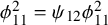 $\phi _{11}^2 = \psi _{12} \phi _{11}^2$
, according to the definition (3.46). The remaining Q term works in an identical manner.
$\phi _{11}^2 = \psi _{12} \phi _{11}^2$
, according to the definition (3.46). The remaining Q term works in an identical manner.
We now address the terms in $\mathcal {R}_1^{(1)}$
, which are defined in (5.4). For this, we invoke (5.45) as well as (5.22) to estimate
$\mathcal {R}_1^{(1)}$
, which are defined in (5.4). For this, we invoke (5.45) as well as (5.22) to estimate
 $$ \begin{align*} \nonumber \Big| \int \mathcal{R}_1^{(1)} \tilde{U} \langle x \rangle^{22} \phi_{11}^2 \Big| \lesssim \| \mathcal{R}_1^{(1)} \langle x \rangle^{11.5} \phi_{11} \| \| \tilde{U} \langle x \rangle^{10.5} \phi_{11} \| \lesssim \| U, V \|_{\mathcal{X}} (\delta \| \tilde{U}, \tilde{V} \|_{\Theta_{11}} + C_\delta \| U, V \|_{\mathcal{X}_{\le 10.5}}), \end{align*} $$
where we have invoked estimates (5.22) and (5.45).
We now address the terms in $\mathcal {R}_1^{(2)}$
, which are defined in (5.5). We estimate these terms via
$\mathcal {R}_1^{(2)}$
, which are defined in (5.5). We estimate these terms via
 $$ \begin{align} \nonumber |\int \mathcal{R}_1^{(2)} \tilde{U} x^{22} \phi_{11}^2| & \le |\int \mu_{sx} u^{(11)} \tilde{U} x^{22} \phi_{11}^2| + |\int \nu_{s} u^{(11)}_y \tilde{U} x^{22} \phi_{11}^2| \\ \nonumber &\lesssim \| \mu_{sx} x \psi_{12} \|_\infty \| u^{(11)} x^{10.5} \phi_{11} \| \| \tilde{U} x^{10.5} \phi_{11} \| + \| \frac{\nu_s}{\bar{u}} x^{\frac 1 2} \psi_{12} \|_\infty \| u^{(11)}_y x^{11} \phi_{11} \| \| \bar{u} \tilde{U} x^{10.5} \phi_{11} \| \\ \nonumber &\lesssim (1 + \varepsilon^{\frac{N_2}{2} - M_1} \| U, V \|_{\mathcal{X}_{\le 10}} ) \| U, V \|_{\mathcal{X}_{\le 10}} (C_\delta \| U, V \|_{\mathcal{X}_{\le 10}} + \delta \| \tilde{U}, \tilde{V} \|_{\Theta_{11}} ) \\ &\quad + (1 + \varepsilon^{\frac{N_2}{2} - M_1} \| U, V \|_{\mathcal{X}_{\le 10.5}} ) \| U, V \|_{X_{11}} \| U, V \|_{\mathcal{X}_{\le 10}}, \end{align} $$
where we have invoked the estimate (2.6), (2.7), (3.32), (5.22), (3.48), and (5.21), and again the identity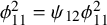 $\phi _{11}^2 = \psi _{12} \phi _{11}^2$
.
$\phi _{11}^2 = \psi _{12} \phi _{11}^2$
.
We now move to $\mathcal {R}_1^{(3)}$
, defined in (5.6), which we estimate the first two terms via
$\mathcal {R}_1^{(3)}$
, defined in (5.6), which we estimate the first two terms via
 $$ \begin{align} \nonumber \Big| \int ( u \partial_x^{12} \bar{u} + u_y \partial_x^{11} \bar{v} ) \tilde{U} x^{22} \phi_{11}^2 \Big| &\lesssim \| \partial_x^{12} \bar{u} x^{11.5} y \|_\infty \| \frac{u}{y} \| \| \tilde{U} x^{10.5} \| + \| \partial_x^{11} \bar{v} x^{11.5} \|_\infty \| u_y \| \| \tilde{U} x^{10.5} \| \\ &\lesssim \| u_y \| \| \tilde{U} x^{10.5}\| \le C_\delta \| U, V \|_{\mathcal{X}_{\le 10.5}} + \delta \| U, V \|_{\Theta_{11}}^2, \end{align} $$
where we have invoked (2.6), (3.33) and (5.22). The final two terms of $\mathcal {R}_1^{(3)}$
are estimated via
$\mathcal {R}_1^{(3)}$
are estimated via
 $$ \begin{align} \nonumber \Big| \int ( v \partial_y \partial_x^{11} \bar{u} + u_x \partial_x^{11} \bar{u} ) \tilde{U} x^{22} \phi_{11}^2 \Big| &\lesssim( \| \partial_y \partial_x^{11} \bar{u} y x^{11} \|_\infty \| \frac{v}{y} x^{\frac 1 2} \| + \| \partial_x^{11} \bar{u} x^{11} \|_\infty \| u_x x^{\frac 1 2} \| ) \| \tilde{U} x^{10.5} \phi_{11} \| \\ &\lesssim \| v_y x^{\frac 1 2} \phi_{11} \| \| \tilde{U} x^{10.5} \phi_{11} \| \le C_\delta \| U, V \|_{\mathcal{X}_{\le 10.5}} + \delta \| \tilde{U}, \tilde{V}\|_{\Theta_{11}}^2, \end{align} $$
where we have invoked (2.6), (3.33), and (5.22).
We now move to the diffusive terms, starting with the $- u^{(11)}_{yy}$
term, for which one integration by parts yields
$- u^{(11)}_{yy}$
term, for which one integration by parts yields
 $$ \begin{align} - \int u^{(11)}_{yy} \tilde{U} x^{22} \phi_{11}^2 & = \int u^{(11)}_y \tilde{U}_y x^{22} \phi_{11}^2+ \int_{y = 0} u^{(11)}_y \tilde{U} x^{22} \phi_{11}^2 \,\mathrm{d} x. \end{align} $$
We now use (5.8) to expand the first term on the right-hand side of (5.61), via
 $$ \begin{align} \nonumber \int u^{(11)}_y \tilde{U}_y x^{22} \phi_{11}^2 & = \int ( \mu_s \tilde{U}_y + 2 \mu_{sy} \tilde{U} + \mu_{syy} Q ) \tilde{U}_y x^{22} \phi_{11}^2 \\ & = \int \mu_s \tilde{U}_y^2 x^{22} \phi_{11}^2 - \int \mu_{syy} \tilde{U}^2 x^{22}\phi_{11}^2 - \int_{y =0} \mu_{sy} \tilde{U}^2 x^{22} \phi_{11}^2+ \int \mu_{syy} Q \tilde{U}_y x^{22} \phi_{11}^2. \end{align} $$
We also expand the second term on the right-hand side of (5.61), again by using (5.8), which gives
 $$ \begin{align} \int_{y = 0} u^{(11)}_y \tilde{U} x^{22} \phi_{11}^2 \,\mathrm{d} x = \int_{y = 0} ( \mu_s \tilde{U}_y + 2 \mu_{sy} \tilde{U} + \mu_{syy} Q ) \tilde{U} x^{22} \phi_{11}^2 \,\mathrm{d} x = 2 \int_{y = 0} \mu_{sy} \tilde{U}^2 x^{22}\phi_{11}^2 \,\mathrm{d} x. \end{align} $$
Hence, we obtain
 $$ \begin{align} \nonumber - \int u_{yy}^{(11)} \tilde{U} x^{22} \phi_{11}^2& = \int \mu_s \tilde{U}_y^2 x^{22} \phi_{11}^2+ \int_{y = 0} \mu_{sy} \tilde{U}^2 x^{22} \phi_{11}^2 \,\mathrm{d} x - \int \mu_{syy} \tilde{U}^2 x^{22} \phi_{11}^2\\ &\quad + \int \mu_{syy} Q \tilde{U}_y x^{22} \phi_{11}^2. \end{align} $$
The first two terms from (5.64) are positive contributions towards the $\Theta _{11}$
norm, whereas the third and fourth terms need to be estimated. We first estimate the third term from (5.64) via
$\Theta _{11}$
norm, whereas the third and fourth terms need to be estimated. We first estimate the third term from (5.64) via
 $$ \begin{align} \nonumber \Big| \int \mu_{syy} \tilde{U}^2 x^{22} \phi_{11}^2\Big| &\lesssim\| \bar{u}_{yy} x \|_\infty \| \tilde{U} x^{10.5}\phi_{11}\|^2 + \varepsilon^{\frac{N_2}{2}} \| u_{yy} x \psi_{12} \|_{L^\infty_x L^2_y} \| \tilde{U} x^{10.5} \phi_{11}\|_{L^2_x L^4_y}^2 \\ \nonumber &\lesssim \delta \| \tilde{U}, \tilde{V} \|_{\Theta_{11}}^2 + C_\delta \| U, V \|_{\mathcal{X}_{\le 10.5}}^2 + \varepsilon^{\frac{N_2}{2} - M_1 } \| U, V \|_{\mathcal{X}} ( \| \bar{u} \tilde{U} \langle x \rangle^{10.5} \phi_{11} \|^2 \\ &\quad + \| \sqrt{\bar{u}} \tilde{U}_y \langle x \rangle^{11} \phi_{11} \|^2 ), \end{align} $$
where we have invoked (5.22), as well as (3.49) and (5.38).
We now address the fourth term from (5.64), for which we split the coefficient $\mu _s$
. In the case of
$\mu _s$
. In the case of $\bar {u}_{yy}$
, we may integrate by parts in y to obtain
$\bar {u}_{yy}$
, we may integrate by parts in y to obtain
 $$ \begin{align*} \nonumber \int \bar{u}_{yy} Q \tilde{U}_y x^{22} \phi_{11}^2 = - \int \bar{u}_{yy} \tilde{U}^2 x^{22} \phi_{11}^2 + \frac 1 2 \int \bar{u}_{yyyy} Q^2 x^{22} \phi_{11}^2, \end{align*} $$
both of which are estimated in an identical manner to (5.65). In the case of $u_{yy}$
, we split into the regions where
$u_{yy}$
, we split into the regions where $z \le 1$
and
$z \le 1$
and $z \ge 1$
. First, the localized contribution is estimated via
$z \ge 1$
. First, the localized contribution is estimated via
 $$ \begin{align} \nonumber \varepsilon^{\frac{N_2}{2}} | \int u_{yy} Q \tilde{U}_y x^{22} \phi_{11}^2 \chi(z) | &\lesssim \varepsilon^{\frac{N_2}{2}} \| u_{yy} x \psi_{12} \|_{L^\infty_x L^2_y} \| \frac{Q}{\sqrt{y}} x^{10.25} \chi(z) \phi_{11}\|_{L^2_x L^\infty_y} \| \sqrt{\bar{u}} \tilde{U}_y x^{11} \| \\ &\lesssim \varepsilon^{\frac{N_2}{2}-M_1} \|U, V \|_{\mathcal{X}}^3, \end{align} $$
where we have invoked (3.49), as well as the inequality
 $$ \begin{align*} \nonumber |Q| \chi(z) = \chi(z) |\int_0^y \tilde{U} \,\mathrm{d} y'| = \chi(z)| \int_0^y \tilde{U} (y')^{\frac 1 2} (y')^{-\frac 1 2} \,\mathrm{d} y'| \lesssim \chi(z) y^{\frac 1 2} x^{\frac 1 4} \| \sqrt{\bar{u}} \tilde{U} \|_{L^\infty_y}, \end{align*} $$
from which we obtain $\|\frac {Q}{\sqrt {y}} \chi (z) \langle x \rangle ^{10.5} \phi _{11}\|_{L^2_x L^\infty _y} \lesssim \|U, V \|_{\mathcal {X}}$
, after using the interpolation inequality
$\|\frac {Q}{\sqrt {y}} \chi (z) \langle x \rangle ^{10.5} \phi _{11}\|_{L^2_x L^\infty _y} \lesssim \|U, V \|_{\mathcal {X}}$
, after using the interpolation inequality
 $$ \begin{align} \| \bar{u}^{\frac{1}{2}} \tilde{U} x^{10.75} \phi_{11} \|_{L^2_x L^\infty_y} \lesssim \|\tilde{U} x^{10.5} \phi_{11} \| ^{\frac 1 2} \| \bar{u} \tilde{U}_y x^{11} \phi_{11} \|_{L^2_y}^{\frac 1 2} \lesssim \|U, V \|_{\mathcal{X}}. \end{align} $$
For the far-field contribution, we estimate via
 $$ \begin{align} \varepsilon^{\frac{N_2}{2}} | \int u_{yy} Q \tilde{U}_y x^{22} \phi_{11}^2 (1- \chi(z)) | &\lesssim \varepsilon^{\frac{N_2}{2}} \| u_{yy} x \psi_{12} \|_{L^\infty_x L^2_y} \| Q x^{10} \phi_{11} \|_{L^2_x L^\infty_y} \| \mu_s \tilde{U}_y x^{11} \phi_{11} \| \end{align} $$
 $$ \begin{align} &\lesssim \varepsilon^{\frac{N_2}{2}- M_1- \frac 1 2} \|U, V \|_{\mathcal{X}}^3, \end{align} $$
where we have invoked the mixed-norm estimates (3.49), (5.20).
We now address the $- \varepsilon u^{(11)}_{xx}$
terms from (5.16). This produces
$- \varepsilon u^{(11)}_{xx}$
terms from (5.16). This produces
 $$ \begin{align} \nonumber &\quad - \int \varepsilon u^{(11)}_{xx} \tilde{U} x^{22} \phi_{11}^2 - \int \varepsilon v^{(11)}_{yy} \varepsilon \tilde{V} x^{22} \phi_{11}^2 + 22 \int \varepsilon v^{(11)}_{yy} Q x^{21} + 2 \int \varepsilon v^{(11)}_{yy} Q x^{22} \phi_{11} \phi_{11}' \\ & = 2 \int \varepsilon u^{(11)}_x \tilde{U}_x x^{22} \phi_{11}^2 + 44 \int \varepsilon u^{(11)}_x \tilde{U} x^{21} \phi_{11}^2 + 4 \int \varepsilon u^{(11)}_x \tilde{U} x^{22} \phi_{11} \phi_{11}'. \end{align} $$
We first estimate easily the second and third terms from (5.70). First,
 $$ \begin{align} |\int \varepsilon u^{(11)}_x \tilde{U} x^{21} \phi_{11}^2| &\lesssim \sqrt{\varepsilon} \| \sqrt{\varepsilon} u^{(11)}_x x^{11} \phi_{11} \| \| \tilde{U} x^{10} \phi_{11} \| \lesssim \sqrt{\varepsilon} \|U, V \|_{\mathcal{X}_{11}}^2, \end{align} $$
 $$ \begin{align} |\int \varepsilon u^{(11)}_x \tilde{U} x^{22} \phi_{11} \phi_{11}'| &\lesssim \| \sqrt{\varepsilon} u_x^{(11)} x^{11} \phi_{11} \| \| \tilde{U} x^{10} \phi_{10} \| \le \delta \|U, V \|_{\mathcal{X}_{11}} + C_\delta \|U, V \|_{\mathcal{X}_{\le 10}},\end{align} $$
where we have invoked (3.33) and (5.22), and for estimate (5.72), we use that $\phi _{10} = 1$
on the support of
$\phi _{10} = 1$
on the support of $\phi _{11}$
.
$\phi _{11}$
.
We now treat the primary term, which is the first term from (5.70), using the formula (5.8), which gives
 $$ \begin{align} \nonumber 2 \int \varepsilon u^{(11)}_x \tilde{U}_x x^{22} \phi_{11}^2& = \int 2 \varepsilon \mu_s \tilde{U}_x^2 x^{22} \phi_{11}^2 - \int \varepsilon \partial_{xx} \mu_s \tilde{U}^2 x^{22} \phi_{11}^2 - \int 22 \varepsilon \partial_x \mu_s \tilde{U}^2 x^{21} \phi_{11}^2 \\ \nonumber &\quad - \int 2 \varepsilon \partial_x \mu_s \tilde{U}^2 x^{22} \phi_{11} \phi_{11}' + \int 2 \varepsilon \partial_y^2 \partial_x \mu_s Q \tilde{V} x^{22} \phi_{11}^2 + \int 2 \varepsilon \partial_{xy} \mu_s \tilde{U} \tilde{V} x^{22} \phi_{11} \\ &\quad - \int \varepsilon \partial_y^2 \mu_s \tilde{V}^2 x^{22} \phi_{11}^2. \end{align} $$
The first term in (5.73) is a positive contribution. For the second and third terms, we estimate via
 $$ \begin{align} |\int \varepsilon \partial_{xx} \mu_s \tilde{U}^2 x^{22} \phi_{11}^2| + |\int 22 \varepsilon \partial_x \mu_s \tilde{U}^2 x^{21} \phi_{11}^2| \lesssim \varepsilon ( \| \frac{ \partial_{xx} \mu_s}{\mu_s} x \psi_{12}\|_\infty + \| \partial_x \mu_s \psi_{12}\|_\infty) \| \sqrt{\mu_s} \tilde{U} x^{10.5} \|^2, \end{align} $$
whereas for the fifth term, it is advantageous for us to split up the coefficient via
 $$ \begin{align} \int 2 \varepsilon \partial_y^2 \partial_x \mu_s Q \tilde{V} x^{22} \phi_{11}^2 = \int 2 \varepsilon \partial_y^2 \partial_x \bar{u} Q \tilde{V} x^{22} \phi_{11}^2 + \varepsilon^{\frac{N_2}{2} + 1} \int u_{xyy} Q \tilde{V} x^{22} \phi_{11}^2, \end{align} $$
after which we estimate the first term from (5.75) via
 $$ \begin{align} |\int 2 \varepsilon \bar{u}_{xyy} Q \tilde{V} x^{22} \phi_{11}^2| \lesssim \sqrt{\varepsilon} \| \bar{u}_{xyy} y x^{\frac 3 2} \|_\infty \| \frac{Q}{y} x^{10.5} \| \| \sqrt{\varepsilon} \tilde{V} x^{10.5} \|, \end{align} $$
and for the second term from (5.75), we obtain
 $$ \begin{align} \varepsilon^{\frac{N_2}{2}} |\int u_{xyy} Q \tilde{V} x^{22} \phi_{11}^2| \lesssim \varepsilon^{\frac{N_2}{2}} \| u_{xyy} x^2 \psi_{12} \|_{L^\infty_x L^2_y} \| Q x^{10} \phi_{11} \|_{L^2_x L^\infty_y} \| \tilde{V} x^{10.5} \phi_{11} \| \end{align} $$
We now estimate the sixth term from (5.73) via
 $$ \begin{align*} \nonumber | \int 2 \varepsilon \partial_{xy} \mu_s \tilde{U} \tilde{V} x^{22} \phi_{11}| \lesssim \| \partial_{xy} \mu_s \langle x \rangle^{\frac 3 2} \psi_{12}\|_\infty \| \tilde{U} \langle x \rangle^{10.5} \phi_{11} \| \| \sqrt{\varepsilon} \tilde{V} \langle x \rangle^{10.5} \phi_{11} \| \end{align*} $$
The seventh term from (5.73) is fairly tricky. First, the contribution arising from the $\bar {u}_{yy}$
component of
$\bar {u}_{yy}$
component of $\partial _y^2 \mu _s$
is straightforward, and we estimate it via
$\partial _y^2 \mu _s$
is straightforward, and we estimate it via
 $$ \begin{align} |\int \varepsilon \partial_y^2 \bar{u} \tilde{V}^2 x^{22} \phi_{11}^2 | \lesssim \| \bar{u}_{yy} \langle x \rangle \|_\infty \| \sqrt{\varepsilon} \tilde{V} \langle x \rangle^{10.5} \phi_{11} \|^2, \end{align} $$
which is an admissible contribution according to (5.22).
To handle the $\varepsilon ^{\frac {N_2}{2}}u_{yy}$
contribution from
$\varepsilon ^{\frac {N_2}{2}}u_{yy}$
contribution from $\partial _y^2 \mu _s$
, we first localize in z. The far-field contribution is handled via
$\partial _y^2 \mu _s$
, we first localize in z. The far-field contribution is handled via
 $$ \begin{align*} \nonumber |\varepsilon^{\frac{N_2}{2}} \int \varepsilon u_{yy} \tilde{V}^2 x^{22} \phi_{11}^2 (1- \chi(z))| &\lesssim \varepsilon^{\frac{N_2}{2}+1} \| u_{yy} \langle x \rangle \psi_{12} \|_{L^\infty_x L^2_y} \| \tilde{V} \langle x \rangle^{10.5} \phi_{11} (1- \chi(z)) \|_{L^2_x L^\infty_y} \\ \nonumber & \times \| \tilde{V} \langle x \rangle^{10.5} \phi_{11} (1- \chi(z)) \|\\ \nonumber &\lesssim \varepsilon^{\frac{N_2}{2}+1 - M_1} \| U, V \|_{\mathcal{X}} \| \bar{u} \tilde{V} \langle x \rangle^{10.5} \phi_{11}\|_{L^2_x L^\infty_y} \| \bar{u} \tilde{V} \langle x \rangle^{10.5} \phi_{11}\| \\ \nonumber &\lesssim \varepsilon^{\frac{N_2}{2}+1 - M_1} \| U, V \|_{\mathcal{X}} \| \bar{u} \tilde{V}_y \langle x \rangle^{10.5} \phi_{11}\|^{\frac 1 2} \| \bar{u} \tilde{V} \langle x \rangle^{10.5} \phi_{11} \|^{\frac 3 2}, \end{align*} $$
where we have used the presence of $(1 - \chi (z))$
to insert factors of
$(1 - \chi (z))$
to insert factors of $\bar {u}$
above, as well as (3.49).
$\bar {u}$
above, as well as (3.49).
To handle this same contribution for $z \le 1$
, we use Holder’s inequality in the following manner
$z \le 1$
, we use Holder’s inequality in the following manner
 $$ \begin{align*} |\varepsilon^{\frac{N_2}{2}} \int \varepsilon u_{yy} \tilde{V}^2 x^{22} \phi_{11}^2 \chi(z)| &\lesssim\varepsilon^{\frac{N_2}{2}+1} \| u_{yy} \langle x \rangle \psi_{12} \|_{L^\infty_x L^2_y} \| \tilde{V} \langle x \rangle^{10.5} \chi(z) \phi_{11}\|_{L^2_x L^4_y}^2 \end{align*} $$
from which the result follows from an application of (3.49) and (5.38).
We now move to the final diffusive term, which contributes the following
 $$ \begin{align} \nonumber &\quad - \int \varepsilon^2 v^{(11)}_{xx} (\tilde{V} x^{22} \phi_{11}^2 - 22 Q x^{21} \phi_{11}^2 - 2 Q x^{22} \phi_{11} \phi_{11}' ) \\ \nonumber & = \int \varepsilon^2 v^{(11)}_x \tilde{V}_x x^{22} \phi_{11}^2 + 44 \int \varepsilon^2 v^{(11)}_x \tilde{V} x^{21} \phi_{11}^2 - 462 \int \varepsilon^2 v^{(11)}_x Q x^{20} \phi_{11}^2 \\ &\quad + 2 \int \varepsilon^2 v^{(11)}_x \tilde{V} x^{22} \phi_{11} \phi_{11}' - 44 \int \varepsilon^2 v^{(11)}_x Q x^{21} \phi_{11} \phi_{11}'- 2 \int \varepsilon^2 v^{(11)}_x ( Q x^{22} \phi_{11} \phi_{11}')_x \end{align} $$
We will now analyze the first term from (5.79), which gives upon appealing to (5.8),
 $$ \begin{align} \nonumber \int \varepsilon^2 v^{(11)}_x \tilde{V}_x x^{22} \phi_{11}^2 & = \int \varepsilon^2 \partial_x (\mu_s \tilde{V} - \partial_x \mu_s Q) \tilde{V}_x x^{22} \phi_{11}^2 \\ & = \int \varepsilon^2 \mu_s \tilde{V}_x^2 x^{22} \phi_{11}^2 + 2 \int \varepsilon^2 \partial_x \mu_s \tilde{V} \tilde{V}_x x^{22} \phi_{11}^2 - \int \varepsilon^2 \partial_{xx} \mu_s Q \tilde{V}_x x^{22} \phi_{11}^2 \end{align} $$
The first term in (5.80) is a positive contribution, and the second two can easily be estimated via
 $$ \begin{align} \nonumber &|2 \int \varepsilon^2 \partial_x \mu_s \tilde{V} \tilde{V}_x x^{22} \phi_{11}^2 - \int \varepsilon^2 \partial_{xx} \mu_s Q \tilde{V}_x x^{22} \phi_{11}^2 | \\ \nonumber &\lesssim \sqrt{\varepsilon} \| \partial_x \mu_s x \psi_{12} \|_\infty \| \sqrt{\varepsilon} \tilde{V} x^{10.5} \phi_{11} \| \| \varepsilon \sqrt{\mu_s} \tilde{V}_x x^{11} \phi_{11} \| \\ &\quad + \sqrt{\varepsilon} \| \partial_{xx} \mu_s x^2 \psi_{12} \|_\infty \| \sqrt{\varepsilon} Q x^{9.5} \phi_{11}\| \| \varepsilon \sqrt{\mu_s} \tilde{V}_x x^{11} \phi_{11} \|. \end{align} $$
We now estimate the remaining terms in (5.79). The contributions from $\phi _{11}'$
are supported for finite x, and can be estimated by lower order norms. The second term from (5.79) is bounded by
$\phi _{11}'$
are supported for finite x, and can be estimated by lower order norms. The second term from (5.79) is bounded by
 $$ \begin{align*} \nonumber |\int \varepsilon^2 v_x^{(11)} \tilde{V} x^{21} \phi_{11}^2 | \lesssim \sqrt{\varepsilon} \| \varepsilon v_x^{(11)} \phi_{11} x^{11} \| \| \sqrt{\varepsilon} \tilde{V} \phi_{11} x^{10.5} \|, \end{align*} $$
and the third term from (5.79) by
 $$ \begin{align*} \nonumber | \int \varepsilon^2 v^{(11)}_x Q x^{20} \phi_{11}^2 | \lesssim \sqrt{\varepsilon} \| \varepsilon v^{(11)}_x \phi_{11} \langle x \rangle^{11} \| \| \sqrt{\varepsilon}Q \phi_{10} x^{9} \|, \end{align*} $$
both of which are acceptable contributions according to estimates (3.33), (5.19), and (5.22).
We now arrive at the remaining terms from (5.17), which will all be treated as error terms. We first record the identity
 $$ \begin{align} \nonumber &\int \mu_s^2 \tilde{V}_x (\varepsilon \tilde{V} x^{22} \phi_{11}^2 - 2 \varepsilon Q x^{21} \phi_{11}^2 - 2 \varepsilon Q x^{22} \phi_{11} \phi_{11}' ) \\ \nonumber & = - \varepsilon \int \mu_s \partial_x \mu_s \tilde{V}^2 x^{22} \phi_{11}^2 - 33 \int \varepsilon \mu_s^2 \tilde{V}^2 x^{21} \phi_{11}^2 - \int \varepsilon \mu_s^2 \tilde{V}^2 x^{22} \phi_{11} \phi_{11}' \\ \nonumber &\quad - 44 \int \varepsilon \tilde{V} Q \mu_s \partial_x \mu_s x^{21} \phi_{11}^2 + 462 \int \varepsilon \mu_s^2 \tilde{V} Q x^{20} \phi_{11}^2 + 44 \int \varepsilon \mu_s^2 \tilde{V} Q x^{21} \phi_{11} \phi_{11}' \\ &\quad + 2 \int \varepsilon \tilde{V} \partial_x (\mu_s^2 Q x^{22} \phi_{11} \phi_{11}'). \end{align} $$
To estimate these, we simply note that due to the pointwise estimates $|\partial _x \mu _s \langle x \rangle \psi _{12} | \lesssim \bar {u}$
, we have
$|\partial _x \mu _s \langle x \rangle \psi _{12} | \lesssim \bar {u}$
, we have
 $$ \begin{align} \varepsilon |\int \mu_s \partial_x \mu_s \tilde{V}^2 x^{22} \phi_{11}^2| \lesssim \| \sqrt{\varepsilon} \bar{u} \tilde{V} x^{10.5} \phi_{11} \|^2, \end{align} $$
and similarly for the second term from (5.82). An analogous estimate applies to the fourth and fifth terms from (5.82).
We next move to
 $$ \begin{align} \nonumber &\int \mu_s \nu_s \tilde{V}_y (\varepsilon \tilde{V} x^{22} \phi_{11}^2 - 2 \varepsilon Q x^{21} \phi_{11}^2 - 2 \varepsilon Q x^{22} \phi_{11} \phi_{11}' ) \\ \nonumber & = - \frac 1 2 \int \varepsilon (\mu_s \nu_s)_y \tilde{V}^2 x^{22} \phi_{11}^2 + 2 \int \varepsilon \mu_s \nu_s \tilde{V} \tilde{U} x^{21} \phi_{11}^2 + \int \varepsilon (\mu_s \nu_s)_y \tilde{V} Q x^{21} \phi_{11}^2 \\ &\quad + 2 \int \varepsilon \mu_s \nu_s \tilde{V} \tilde{U} x^{22} \phi_{11} \phi_{11}' + 2 \int \varepsilon (\mu_s \nu_s)_y \tilde{V} Q x^{22} \phi_{11} \phi_{11}'. \end{align} $$
To estimate these terms, we proceed via
 $$ \begin{align} \nonumber &|\int \frac 1 2 \varepsilon (\mu_s \nu_s)_y \tilde{V}^2 x^{22} \phi_{11}^2| + 2| \int \varepsilon \mu_s \nu_s \tilde{V} \tilde{U} x^{21} \phi_{11}^2| + | \int \varepsilon (\mu_s \nu_s)_y \tilde{V} Q x^{21} \phi_{11}^2| \\ \nonumber &\lesssim \| \partial_y (\mu_s \nu_s) x \psi_{12}\|_\infty \| \sqrt{\varepsilon} \tilde{V} x^{10.5} \phi_{11} \|^2 + \sqrt{\varepsilon}\| \nu_s x^{\frac 1 2} \psi_{12} \|_\infty \| \tilde{U} x^{10.5} \phi_{11}\| \| \tilde{V} x^{10.5} \phi_{11} \| \\ &\quad + \| (\mu_s \nu_s)_y x \psi_{12} \|_\infty \| \sqrt{\varepsilon} \tilde{V} x^{10.5} \phi_{11} \| \sqrt{\varepsilon} Q x^{9.5} \phi_{11} \|, \end{align} $$
all of which are acceptable contributions according to the pointwise decay estimates (3.47)–(3.50), and according to (5.19)–(5.22).
We now arrive at the three error terms from (5.17) which are of the form $(2 \mu _s \mu _{sx} + \nu _s \mu _{sy}) \tilde {V} - \mu _{sx} \nu _s \tilde {U} - (\mu _s \mu _{sxx} + \nu _s \mu _{sxy})Q$
. To estimate these contributions it suffices to note that the coefficient in front of
$(2 \mu _s \mu _{sx} + \nu _s \mu _{sy}) \tilde {V} - \mu _{sx} \nu _s \tilde {U} - (\mu _s \mu _{sxx} + \nu _s \mu _{sxy})Q$
. To estimate these contributions it suffices to note that the coefficient in front of $\tilde {V}$
satisfies the estimate
$\tilde {V}$
satisfies the estimate $|2 \mu _s \mu _{sx} + \nu _s \mu _{sy}| \lesssim \langle x \rangle ^{-1}$
, and similarly the coefficient in front of
$|2 \mu _s \mu _{sx} + \nu _s \mu _{sy}| \lesssim \langle x \rangle ^{-1}$
, and similarly the coefficient in front of $\tilde {U}$
satisfies
$\tilde {U}$
satisfies $|\mu _{sx}\nu _s| \lesssim \langle x \rangle ^{-1}$
. Third, the coefficient in front of Q satisfies
$|\mu _{sx}\nu _s| \lesssim \langle x \rangle ^{-1}$
. Third, the coefficient in front of Q satisfies $|\mu _s \mu _{sxx} + \nu _s \mu _{sxy}| \lesssim \langle x \rangle ^{-2}$
. Thus, we may apply an analogous estimate to (5.85).
$|\mu _s \mu _{sxx} + \nu _s \mu _{sxy}| \lesssim \langle x \rangle ^{-2}$
. Thus, we may apply an analogous estimate to (5.85).
We now estimate the error terms in $\mathcal {R}_2^{(i)}[u, v]$
, for
$\mathcal {R}_2^{(i)}[u, v]$
, for $i = 1,2, 3$
, beginning first with those of
$i = 1,2, 3$
, beginning first with those of $\mathcal {R}_2^{(1)}$
. For this, we invoke (5.45) as well as (5.22) to estimate
$\mathcal {R}_2^{(1)}$
. For this, we invoke (5.45) as well as (5.22) to estimate
 $$ \begin{align} \nonumber \Big| \int \varepsilon \mathcal{R}_2^{(1)} \tilde{V} \langle x \rangle^{22} \phi_{11}^2 \Big| &\lesssim \|\sqrt{\varepsilon} \mathcal{R}_2^{(1)} \langle x \rangle^{11.5} \phi_{11} \| \| \sqrt{\varepsilon} \tilde{V} \langle x \rangle^{10.5} \phi_{11} \| \\ &\lesssim (\delta \|U, V \|_{\mathcal{X}} + C_\delta \|U, V \|_{X_{\le 10.5}})(\delta \|U, V \|_{\mathcal{X}} + C_\delta \|U, V \|_{X_{\le 10.5}}). \end{align} $$
We now estimate the contributions from $\mathcal {R}_2^{(2)}[u, v]$
, defined in (5.13), for which we first have
$\mathcal {R}_2^{(2)}[u, v]$
, defined in (5.13), for which we first have
 $$ \begin{align} \nonumber &|\int \nu_{sx} u^{(11)} (\varepsilon \tilde{V} x^{22} \phi_{11}^2 - 2 \varepsilon Q x^{21} \phi_{11}^2 - 2 \varepsilon Q x^{22} \phi_{11} \phi_{11}' )| \\ \nonumber &\lesssim \sqrt{\varepsilon} \| \nu_{sx} x \psi_{12} \|_\infty \| u^{(11)} x^{10.5} \phi_{11}\| ( \| \sqrt{\varepsilon} \tilde{V} x^{10.5} \phi_{11} + \| \sqrt{\varepsilon} Q x^{9.5} \phi_{10} \|) + \sqrt{\varepsilon} \|U, V \|_{\mathcal{X}_{\le 10.5}} \\ &\lesssim \sqrt{\varepsilon} (1 + \varepsilon^{\frac{N_2}{2}-M_1} \|U, V \|_{\mathcal{X}}) (C_\delta \| U, V \|_{\mathcal{X}_{\le 10.5}} + \delta \| U, V\|_{\mathcal{X}}) (C_\delta \| U, V \|_{\mathcal{X}_{\le 10.5}} + \delta \| U, V\|_{\mathcal{X}}), \end{align} $$
where we have invoked (3.48), (3.32), (5.22).
and similarly for the second term from $\mathcal {R}_2^{(2)}$
, we have
$\mathcal {R}_2^{(2)}$
, we have
 $$ \begin{align} \nonumber &|\int \nu_{sy} v^{(11)} (\varepsilon \tilde{V} x^{22} \phi_{11}^2 - 2 \varepsilon Q x^{21} \phi_{11}^2 - 2 \varepsilon Q x^{22} \phi_{11} \phi_{11}' )| \\ \nonumber &\lesssim \| \nu_{sy} x \|_\infty \| \sqrt{\varepsilon} v^{(11)} x^{10.5} \phi_{11}\| ( \| \sqrt{\varepsilon} \tilde{V} x^{10.5} \phi_{11} + \| \sqrt{\varepsilon} Q x^{9.5} \phi_{10} \|) + \sqrt{\varepsilon} \|U, V \|_{\mathcal{X}_{\le 10.5}} \\ &\lesssim (1 + \varepsilon^{\frac{N_2}{2}-M_1} \| U, V \|_{\mathcal{X}} )( C_\delta \|U, V \|_{\mathcal{X}_{\le 10.5}} + \delta \|U, V \|_{\mathcal{X}_{11}} ) ( C_\delta \|U, V \|_{\mathcal{X}_{\le 10.5}} + \delta \|U, V \|_{\mathcal{X}_{11}} ), \end{align} $$
where we have used (3.47), (3.32), and (5.22).
We now move to the error terms from $\mathcal {R}_2^{(3)}$
, First, we estimate using the definition (5.14),
$\mathcal {R}_2^{(3)}$
, First, we estimate using the definition (5.14),
 $$ \begin{align*} \nonumber \| \sqrt{\varepsilon} \mathcal{R}_2^{(3)} x^{11.5} \phi_{11}\| &\lesssim\sqrt{\varepsilon} \| \partial_x^{11} \bar{v}_y y x^{11.5} \|_\infty \| v_y \phi_{11} \| + \| \partial_x^{12} \bar{v} x^{12.5} \|_\infty \| u \langle x \rangle^{-1}\phi_{11} \| \\ \nonumber &\quad + \| \partial_x^{11} \bar{u} x^{11} \|_\infty \| \sqrt{\varepsilon} v_x x^{\frac 1 2}\phi_{11} \| + \| \partial_x^{11} \bar{v} x^{11.5} \|_\infty \| v_y \phi_{11}\| \lesssim \| U, V \|_{\mathcal{X}_{\le 4}}. \end{align*} $$
From this, we estimate simply
 $$ \begin{align} \nonumber &|\int \mathcal{R}_2^{(3)} (\varepsilon \tilde{V} x^{22} \phi_{11}^2 - 2 \varepsilon Q x^{21} \phi_{11}^2 - 2 \varepsilon Q x^{22} \phi_{11} \phi_{11}' )| \\ \nonumber &\lesssim \| \sqrt{\varepsilon} \mathcal{R}_2^{(3)} x^{11.5} \phi_{11} \| ( \| \sqrt{\varepsilon} \tilde{V} x^{10.5} \phi_{11} \| + \| \sqrt{\varepsilon} Q x^{9.5} \phi_{10} \|+ \sqrt{\varepsilon} \|U, V \|_{\mathcal{X}_{\le 10.5}}) \\ &\lesssim \| U, V \|_{\mathcal{X}_{\le 4}} ( \delta \| \tilde{U}, \tilde{V} \|_{\Theta_{11}} + C_\delta \|U, V \|_{\mathcal{X}_{\le 10.5}} ), \end{align} $$
where we have invoked estimate (5.22). This concludes the proof.
6 Nonlinear analysis
We first obtain estimates on the “elliptic” component of the $\mathcal {X}$
-norm, defined in (3.13). For this component of the norm, the mechanism is entirely driven by elliptic regularity.
$\mathcal {X}$
-norm, defined in (3.13). For this component of the norm, the mechanism is entirely driven by elliptic regularity.
Lemma 6.1. Let $(u, v)$
solve (2.18)–(2.19). Then the following estimate is valid
$(u, v)$
solve (2.18)–(2.19). Then the following estimate is valid
 $$ \begin{align} \|U, V \|_E^2 &\lesssim\| U, V \|_{X_0}^2 + \mathcal{F}_{Ell}, \end{align} $$
where we define
 $$ \begin{align} \mathcal{F}_{Ell} & := \sum_{k = 1}^{11} \| \partial_x^{k-1} F_R \|^2 + \| \sqrt{\varepsilon} \partial_x^{k-1} G_R \|^2, \end{align} $$
Proof. This is a consequence of standard elliptic regularity. Indeed, rewriting (2.18)–(2.19) as a perturbation of the scaled Stokes operator, we obtain
 $$ \begin{align} &\quad - \Delta_\varepsilon u + P_x = F_R + \mathcal{N}_1 - (\bar{u} u_x + \bar{u}_y v + \bar{u}_x u + \bar{v} u_y), \end{align} $$
 $$ \begin{align}&\quad - \Delta_\varepsilon v + \frac{P_y}{\varepsilon} = G_R + \mathcal{N}_2 - (\bar{u} v_x + \bar{v}_y v + \bar{v}_x u + \bar{v} v_y), \end{align} $$
 $$ \begin{align} &u_x + v_y = 0, \end{align} $$
with boundary conditions (2.19). From here, we apply standard $H^2$
estimates for the Stokes operator on the quadrant, [Reference Blum and RannacherBR80], and subsequently bootstrap elliptic regularity for the Stokes operator away from
$H^2$
estimates for the Stokes operator on the quadrant, [Reference Blum and RannacherBR80], and subsequently bootstrap elliptic regularity for the Stokes operator away from $\{x = 0\}$
in the standard manner (see, for instance, [Reference IyerIy16a]–[Reference IyerIy16c]), which immediately results in (6.1). We note that a fixed factor of
$\{x = 0\}$
in the standard manner (see, for instance, [Reference IyerIy16a]–[Reference IyerIy16c]), which immediately results in (6.1). We note that a fixed factor of $\varepsilon $
is included in the second part of the elliptic norm, (3.13) due to the presence of the cutoffs
$\varepsilon $
is included in the second part of the elliptic norm, (3.13) due to the presence of the cutoffs $\gamma _{k-1,k}$
, which allows us to use the
$\gamma _{k-1,k}$
, which allows us to use the $X_n$
norms (which are order one even for higher tangential derivatives) to control the right-hand sides of (6.3)–(6.4).
$X_n$
norms (which are order one even for higher tangential derivatives) to control the right-hand sides of (6.3)–(6.4).
We now analyze the nonlinear terms. Define the total trilinear contribution via
 $$ \begin{align} \mathcal{T} := \sum_{k = 0}^{10} \Big( \mathcal{T}_{X_k} + \mathcal{T}_{X_{k + \frac 1 2}} + \mathcal{T}_{Y_{k + \frac 1 2}} \Big), \end{align} $$
where the quantities appearing on the right-hand side of (6.6) are defined in (4.3), (4.33), (4.64), (4.98), and (4.102). Our main proposition regarding the trilinear terms will be
Proposition 6.1. The trilinear quantity $\mathcal {T}$
obeys the following estimate
$\mathcal {T}$
obeys the following estimate
 $$ \begin{align} | \mathcal{T} | \lesssim \varepsilon^{\frac{N_2}{2} -M_1 - 5} \| U, V \|_{\mathcal{X}}^3. \end{align} $$
Lemma 6.2. The quantity $\mathcal {T}_{X_0}$
, defined in (4.3), obeys the following estimate
$\mathcal {T}_{X_0}$
, defined in (4.3), obeys the following estimate
 $$ \begin{align} |\mathcal{T}_{X_0}| \lesssim \varepsilon^{\frac{N_2}{2} - M_1 - 5} \| U, V \|_{\mathcal{X}}^3. \end{align} $$
Proof. We recall the definition of $\mathcal {T}_{X_0}$
from (4.3). We first address the terms from
$\mathcal {T}_{X_0}$
from (4.3). We first address the terms from $\mathcal {N}_1$
, which give
$\mathcal {N}_1$
, which give
 $$ \begin{align} \nonumber \int \mathcal{N}_1 U g^2 & = \varepsilon^{\frac{N_2}{2}} \int \bar{u} u U U_x g^2+ \varepsilon^{\frac{N_2}{2}} \int \bar{u}_x u U^2 g^2+ \varepsilon^{\frac{N_2}{2}} \int \bar{u}_{xy} u q Ug^2- \varepsilon^{\frac{N_2}{2}} \int \bar{u}_y u VUg^2 \\ &\quad + \varepsilon^{\frac{N_2}{2}} \int \bar{u} v U_y U g^2+ 2 \varepsilon^{\frac{N_2}{2}} \int \bar{u}_y v U^2 g^2 + \varepsilon^{\frac{N_2}{2}} \int \bar{u}_{yy} v q U g^2. \end{align} $$
We now proceed to estimate
 $$ \begin{align}\nonumber \varepsilon^{\frac{N_2}{2}} |\int \bar{u} u U U_x g^2 | &\lesssim \varepsilon^{\frac{N_2}{2}} \| u x^{\frac 14} \|_\infty \| U \langle x \rangle^{- \frac 3 4} \| \| U_x \langle x \rangle^{\frac 1 2} \| \\ &\lesssim \varepsilon^{\frac{N_2}{2} - M_1} \|U, V \|_{\mathcal{X}}^2 \|\bar{u}U_x \langle x \rangle^{\frac 1 2} \| \lesssim \varepsilon^{\frac{N_2}{2} - M_1 -1}\|U, V \|_{\mathcal{X}}^3, \end{align} $$
where we have invoked estimate (3.50). To conclude the final inequality above, we estimate the final term appearing in (6.10) by splitting $\| \bar {u}U_x \langle x \rangle ^{\frac 1 2} \| \lesssim \| \bar {u}U_x (1 - \phi _{12}) \| + \| \bar {u}U_x \langle x \rangle ^{\frac 1 2} \phi _{12}\|$
, where we have used that the support of
$\| \bar {u}U_x \langle x \rangle ^{\frac 1 2} \| \lesssim \| \bar {u}U_x (1 - \phi _{12}) \| + \| \bar {u}U_x \langle x \rangle ^{\frac 1 2} \phi _{12}\|$
, where we have used that the support of $(1 - \phi _{12})$
is bounded in x, and so we can get rid of the weight in x for this term. For the x large piece, we use that
$(1 - \phi _{12})$
is bounded in x, and so we can get rid of the weight in x for this term. For the x large piece, we use that $\phi _1 = 1$
in the support of
$\phi _1 = 1$
in the support of $\phi _{12}$
, and so
$\phi _{12}$
, and so $\| U_x \langle x \rangle ^{\frac 1 2} \phi _{12} \| \le \| U_x \langle x \rangle ^{\frac 1 2} \phi _{1} \| \lesssim \|U, V \|_{\mathcal {X}}$
. For the “near
$\| U_x \langle x \rangle ^{\frac 1 2} \phi _{12} \| \le \| U_x \langle x \rangle ^{\frac 1 2} \phi _{1} \| \lesssim \|U, V \|_{\mathcal {X}}$
. For the “near $x = 0$
” case, we simply estimate by using
$x = 0$
” case, we simply estimate by using $\| \sqrt {\bar {u}} U_x \| \le \varepsilon ^{- 1} \|U, V \|_{X_0}$
.
$\| \sqrt {\bar {u}} U_x \| \le \varepsilon ^{- 1} \|U, V \|_{X_0}$
.
The second and third terms from (6.9) follows in the same manner, via
 $$ \begin{align} \varepsilon^{\frac{N_2}{2}} | \int \bar{u}_x u U^2 g^2| + | | \lesssim \varepsilon^{\frac{N_2}{2}} \| \bar{u}_x x \|_\infty \| u x^{\frac 1 4} \|_\infty \| U \langle x \rangle^{- \frac 5 8} \|^2 \lesssim \varepsilon^{\frac{N_2}{2} - M_1} \|U, V \|_{\mathcal{X}}^3. \end{align} $$
For the sixth term from (6.9), we first decompose $\bar {u}$
into its Euler and Prandtl components via
$\bar {u}$
into its Euler and Prandtl components via
 $$ \begin{align} \varepsilon^{\frac{N_2}{2}} \int \bar{u}_y v U^2 g^2= \varepsilon^{\frac{N_2}{2}} \int \partial_y \bar{u}_p v U^2 g^2+ \varepsilon^{\frac{N_2+1 }{2}} \int \partial_Y \bar{u}_E v U^2 g^2. \end{align} $$
For the Euler component, we can use the enhanced x-decay available from (2.8) to estimate
 $$ \begin{align} \varepsilon^{\frac{N_2+1 }{2}} |\int \partial_Y \bar{u}_E v U^2 g^2| \lesssim \varepsilon^{\frac{N_2+1 }{2}} \int \langle x \rangle^{- \frac 3 2} U^2 \lesssim \varepsilon^{\frac{N_2 + 1}{2}} \| U \langle x \rangle^{- \frac 3 4} \|^2. \end{align} $$
For the Prandtl component of (6.12), we do not get strong enough x-decay, but rather must rely on self-similarity coupled with the sharp decay of v. More specifically, we need to first decompose $U = U(x, 0) + (U - U(x, 0))$
, after which we obtain
$U = U(x, 0) + (U - U(x, 0))$
, after which we obtain
 $$ \begin{align} \nonumber &\varepsilon^{\frac{N_2}{2}} | \int \bar{u}_{py} v U^2 g^2| \le \varepsilon^{\frac{N_2}{2}} | \int \bar{u}_{py} v U(x, 0)^2| + \varepsilon^{\frac{N_2}{2}} | \int \bar{u}_{py} v (U - U(x, 0))^2| \\ &\lesssim \varepsilon^{\frac{N_2}{2}} \sup_x \| \bar{u}_{py} \|_{L^1_y} \| v \langle x \rangle^{\frac 1 2} \|_\infty \| U(x, 0) \langle x \rangle^{- \frac 1 2} \|_{y = 0}^2 + \varepsilon^{\frac{N_2}{2}} \| \bar{u}_{py} y^2 x^{- \frac 1 2} \|_\infty \| v \langle x \rangle^{\frac 1 2} \|_\infty \| \frac{U - U(x, 0)}{y} \|^2. \end{align} $$
We now address the terms from $\mathcal {N}_2$
, which gives
$\mathcal {N}_2$
, which gives
 $$ \begin{align} \nonumber \int \varepsilon \mathcal{N}_2 ( V g^2 + \frac{1}{100} q \langle x \rangle^{- 1 - \frac{1}{100}} )& = \varepsilon^{\frac{N_2}{2} + 1} \int u v_x V g^2 + \varepsilon^{\frac{N_2}{2} + 1} \int v v_y V g^2 \\ &\quad + \frac{1}{100} \varepsilon^{\frac{N_2}{2}+ 1} \int u v_x q \langle x \rangle^{- 1 - \frac{1}{100}} + \frac{1}{100} \varepsilon^{\frac{N_2}{2}+ 1} \int v v_y q \langle x \rangle^{- 1 - \frac{1}{100}}. \end{align} $$
We estimate these terms directly via,
 $$ \begin{align} \varepsilon^{\frac{N_2}{2}+1} |\int u v_x V g^2| &\lesssim \varepsilon^{\frac{N_2}{2}} \| u \langle x \rangle^{\frac 1 4}\|_\infty \| \sqrt{\varepsilon} v_x \langle x \rangle^{\frac 1 2} \| \| \sqrt{\varepsilon} V \langle x \rangle^{- \frac 3 4} \|, \end{align} $$
 $$ \begin{align} \varepsilon^{\frac{N_2}{2}+1} |\int v v_y V g^2| &\lesssim \varepsilon^{\frac{N_2}{2}} \| v \langle x \rangle^{\frac 1 2} \|_\infty \| v_y \langle x \rangle^{\frac 1 2} \| \| \sqrt{\varepsilon} V \langle x \rangle^{-1} \| \end{align} $$
 $$ \begin{align} \varepsilon^{\frac{N_2}{2}+1} |\int u v_x q \langle x \rangle^{-1 - \frac{1}{100}} | &\lesssim \varepsilon^{\frac{N_2}{2}} \| u \langle x \rangle^{\frac 1 4} \|_\infty \| \sqrt{\varepsilon} v_x \langle x \rangle^{\frac 1 2} \| \| \sqrt{\varepsilon} q \langle x \rangle^{- \frac 7 4} \|, \end{align} $$
 $$ \begin{align} \varepsilon^{\frac{N_2}{2}+ 1} | \int v v_y q \langle x \rangle^{- 1 - \frac{1}{100}}| &\lesssim \varepsilon^{\frac{N_2}{2}} \| v \langle x \rangle^{\frac 1 2} \|_\infty \| v_y \langle x \rangle^{\frac 1 2} \| \| \sqrt{\varepsilon} q \langle x \rangle^{ -2 } \|. \end{align} $$
All of these quantities are bounded by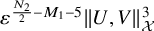 $\varepsilon ^{\frac {N_2}{2} - M_1 - 5} \| U, V \|_{\mathcal {X}}^3$
, which completes the proof of the lemma.
$\varepsilon ^{\frac {N_2}{2} - M_1 - 5} \| U, V \|_{\mathcal {X}}^3$
, which completes the proof of the lemma.
We note that in the estimation of the trilinear terms, $\mathcal {T}_{X_{\frac 1 2}}$
and
$\mathcal {T}_{X_{\frac 1 2}}$
and $\mathcal {T}_{Y_{\frac 1 2}}$
, we do not need to integrate by parts to find extra structure. In fact, it is a bit more convenient to state a general lemma first, which simplifies the forthcoming estimates.
$\mathcal {T}_{Y_{\frac 1 2}}$
, we do not need to integrate by parts to find extra structure. In fact, it is a bit more convenient to state a general lemma first, which simplifies the forthcoming estimates.
Lemma 6.3. For $0 \le k \le 10$
,
$0 \le k \le 10$
,
 $$ \begin{align} \| \frac{1}{\bar{u}} \partial_x^k \mathcal{N}_1 \langle x \rangle^{k + \frac 1 2} \phi_1 \| + \sqrt{\varepsilon} \| \frac{1}{\bar{u}} \partial_x^k \mathcal{N}_2 \langle x \rangle^{k + \frac 34} \phi_1 \| \lesssim \varepsilon^{\frac{N_2}{2} - 2M_1} \| U, V \|_{\mathcal{X}}^2. \end{align} $$
Proof. First, regarding the cutoff function $\phi _1$
present in (6.20), we will rewrite it as
$\phi _1$
present in (6.20), we will rewrite it as $\phi _1 = \phi _1 \psi _{12} = \phi _1 (\psi _{12} - \phi _{12} ) + \phi _1 \phi _{12}$
, according to the definitions (3.3) and (3.46). As a result, we separate the estimation of (6.20) into
$\phi _1 = \phi _1 \psi _{12} = \phi _1 (\psi _{12} - \phi _{12} ) + \phi _1 \phi _{12}$
, according to the definitions (3.3) and (3.46). As a result, we separate the estimation of (6.20) into
 $$ \begin{align} \nonumber &\| \frac{1}{\bar{u}} \partial_x^k \mathcal{N}_1 \langle x \rangle^{k + \frac 1 2} \phi_1 \| + \sqrt{\varepsilon} \| \frac{1}{\bar{u}} \partial_x^k \mathcal{N}_2 \langle x \rangle^{k + \frac 1 2} \phi_1 \| \\ \nonumber & \le \| \frac{1}{\bar{u}} \partial_x^k \mathcal{N}_1 \langle x \rangle^{k + \frac 1 2} (\psi_{12} - \phi_{12}) \| + \sqrt{\varepsilon} \| \frac{1}{\bar{u}} \partial_x^k \mathcal{N}_2 \langle x \rangle^{k + \frac 1 2} (\psi_{12} - \phi_{12}) \| \\ &\quad + \| \frac{1}{\bar{u}} \partial_x^k \mathcal{N}_1 \langle x \rangle^{k + \frac 1 2} \phi_{12} \| + \sqrt{\varepsilon} \| \frac{1}{\bar{u}} \partial_x^k \mathcal{N}_2 \langle x \rangle^{k + \frac 1 2} \phi_{12} \|. \end{align} $$
The quantities with $\psi _{12} - \phi _{12}$
are supported in a finite region of x, and are thus estimated by
$\psi _{12} - \phi _{12}$
are supported in a finite region of x, and are thus estimated by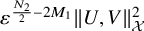 $\varepsilon ^{\frac {N_2}{2} - 2M_1} \|U, V \|_{\mathcal {X}}^2$
. We must thus consider the more difficult case of large x, in the support of
$\varepsilon ^{\frac {N_2}{2} - 2M_1} \|U, V \|_{\mathcal {X}}^2$
. We must thus consider the more difficult case of large x, in the support of $\phi _{12}$
.
$\phi _{12}$
.
We first treat the two terms arising from $\mathcal {N}_1$
. Applying the product rule yields
$\mathcal {N}_1$
. Applying the product rule yields
 $$ \begin{align} \partial_x^k \mathcal{N}_1 = \sum_{j = 0}^k \binom{k}{j} (\partial_x^j u \partial_x^{k-j+1} u + \partial_x^j v \partial_x^{k-j} \partial_y u ) \end{align} $$
Let us first treat the first quantity in the sum. As $0 \le k \le 10$
, either j or
$0 \le k \le 10$
, either j or $k - j + 1$
must be less than
$k - j + 1$
must be less than $6$
. By symmetry of this term, we assume that
$6$
. By symmetry of this term, we assume that $j \le 6$
and then
$j \le 6$
and then $k \le 10$
. In this case, note that
$k \le 10$
. In this case, note that $k-j+1 \le 11$
, and so we estimate via
$k-j+1 \le 11$
, and so we estimate via
 $$ \begin{align} \varepsilon^{\frac{N_2}{2}}\| \frac{1}{ \bar{u} } \partial_x^j u \partial_x^{k-j+1}u \langle x \rangle^{k+ \frac 1 2} \phi_{12} \| &\lesssim \varepsilon^{\frac{N_2}{2}}\| \frac{1}{\bar{u}} \partial_x^j u \langle x \rangle^{j + \frac 1 4} \psi_{12} \|_\infty \| \partial_x^{k-j+1} u \langle x \rangle^{k-j+\frac 12} \phi_{12} \| \lesssim \varepsilon^{\frac{N_2}{2}- M_1} \|U, V \|_{\mathcal{X}}^2, \end{align} $$
where we have invoked (3.47) and (3.32).
We now move to the second term from (6.22), which is not symmetric and thus we consider two different cases. First, we assume that $j \le 6$
and
$j \le 6$
and $k \le 10$
. In this case, we estimate
$k \le 10$
. In this case, we estimate
 $$ \begin{align} \nonumber \varepsilon^{\frac{N_2}{2}} \| \frac{1}{\bar{u}} \partial_x^j v \partial_x^{k-j} \partial_y u \langle x \rangle^{k + \frac 1 2} \phi_{12}\| &\lesssim \varepsilon^{\frac{N_2}{2}}\| \frac{1}{\bar{u}} \partial_x^j v \langle x \rangle^{j + \frac 1 2} \psi_{12}\|_\infty \| \partial_x^{k-j} \partial_y u \langle x \rangle^{k-j} \phi_{12}\| \\ &\lesssim \varepsilon^{\frac{N_2}{2}-M_1} \|U, V \|_{\mathcal{X}}^2, \end{align} $$
where we have invoked (3.48) and (3.33).
We next consider the case that $0 \le k-j \le 6$
and
$0 \le k-j \le 6$
and $6 \le j \le 10$
. In this case, we estimate via
$6 \le j \le 10$
. In this case, we estimate via
 $$ \begin{align} \nonumber \varepsilon^{\frac{N_2}{2}} \| \frac{1}{\bar{u}}\partial_x^j v \partial_x^{k-j} \partial_y u \langle x \rangle^{k + \frac 1 2} \phi_{12} \| &\lesssim\varepsilon^{\frac{N_2}{2}} \| \partial_x^{k-j} \partial_y u \langle x \rangle^{k-j + \frac 1 2} \psi_{12}\|_{L^\infty_x L^2_y} \| \frac{1}{\bar{u}} \partial_x^j v \langle x\rangle^{j } \phi_{12} \|_{L^2_x L^\infty_y} \\ &\lesssim \varepsilon^{\frac{N_2}{2}- M_1} \| U, V \|_{\mathcal{X}}^2 \end{align} $$
where we have used the mixed-norm estimates in (3.48) and (3.34) (and crucially that $j \le 10$
to be in the range of admissible exponents for (3.34)).
$j \le 10$
to be in the range of admissible exponents for (3.34)).
We now consider the second quantity in (6.20), for which we again apply the product rule:
 $$ \begin{align} \partial_x^k \mathcal{N}_2 = \sum_{j = 0}^{k} \binom{k}{j} ( \partial_x^j u \partial_x^{k-j+1} v + \partial_x^j v \partial_x^{k-j} \partial_y v ) \end{align} $$
We again treat two cases. In the case that $j \le 6$
, so
$j \le 6$
, so $1 \le k-j+1 \le 11$
,
$1 \le k-j+1 \le 11$
,
 $$ \begin{align} \nonumber \varepsilon^{\frac{N_2}{2}} \| \frac{1}{\bar{u}} \partial_x^j u \sqrt{\varepsilon} \partial_x^{k+1} v \langle x \rangle^{k + \frac 34} \phi_{12} \| &\lesssim \varepsilon^{\frac{N_2}{2}} \| \frac{1}{\bar{u}} \partial_x^j u \langle x \rangle^{j + \frac 1 4} \psi_{12} \|_\infty \| \sqrt{\varepsilon} \partial_x^{k-j+1} v \langle x \rangle^{k-j+ \frac 1 2} \phi_{12}\| \\ &\lesssim \varepsilon^{\frac{N_2}{2}- M_1} \| U, V \|_{\mathcal{X}}^2, \end{align} $$
where we have invoked (3.32) and (3.47).
Second, we assume that $1 \le k-j+1 \le 4$
and
$1 \le k-j+1 \le 4$
and $j \ge 7$
, in which case we estimate by
$j \ge 7$
, in which case we estimate by
 $$ \begin{align} \sqrt{\varepsilon} \| \frac{1}{\bar{u}} \partial_x^j u \partial_x^{k-j+1} v \langle x \rangle^{k + \frac 34} \phi_{12} \| \lesssim \sqrt{\varepsilon} \| \frac{1}{\bar{u}} \partial_x^{k-j+1} v \langle x\rangle^{k-j+1 + \frac 1 2} \psi_{12} \|_\infty \| \partial_x^j u \langle x \rangle^{j - \frac 1 2} \phi_{12}\|. \end{align} $$
For the second contribution from (6.26), we again split into two cases. For the first case, we assume that $j \le 6$
, in which case
$j \le 6$
, in which case
 $$ \begin{align} \sqrt{\varepsilon} \| \frac{1}{\bar{u}} \partial_x^j v \partial_x^{k-j} \partial_y v \langle x \rangle^{k + \frac 34} \phi_{12}\| \lesssim \| \frac{1}{\bar{u}} \partial_x^j v \langle x \rangle^{j + \frac 1 2} \psi_{12} \|_\infty \| \partial_x^{k-j} u_x \langle x \rangle^{k-j+\frac 1 2} \phi_{12}\|. \end{align} $$
In the second case, we assume that $7 \le j \le 10$
, in which case
$7 \le j \le 10$
, in which case $k-j+1 \le 4$
, and so we put
$k-j+1 \le 4$
, and so we put
 $$ \begin{align} \sqrt{\varepsilon} \| \frac{1}{\bar{u}} \partial_x^{j} v \partial_x^{k-j} \partial_y v \langle x \rangle^{k + \frac 34} \phi_{12} \| \lesssim \sqrt{\varepsilon} \| \partial_x^j v \langle x \rangle^{j - \frac 1 2}\phi_{12} \| \|\frac{1}{\bar{u}} \partial_x^{k-j+1} u \langle x \rangle^{k-j+1 + \frac 1 4} \psi_{12} \|_\infty. \end{align} $$
This concludes the proof of the lemma.
Corollary 6.4. The following estimate is valid:
 $$ \begin{align} \Big| \sum_{k = 1}^{10} \mathcal{T}_{X_k} + \sum_{k = 0}^{10} \mathcal{T}_{X_{k + \frac 1 2}} + \mathcal{T}_{Y_{k + \frac 1 2}} \Big| \lesssim \varepsilon^{\frac{N_2}{2} - 2M_1-5} \| U, V \|_{\mathcal{X}}^3. \end{align} $$
Proof. This is an immediate corollary of (6.20) and the definitions of $\mathcal {T}_{X_k}, \mathcal {T}_{X_{k + \frac 1 2}}$
, and
$\mathcal {T}_{X_k}, \mathcal {T}_{X_{k + \frac 1 2}}$
, and $\mathcal {T}_{Y_{k + \frac 1 2}}$
. Recall the definition (4.98). We have for
$\mathcal {T}_{Y_{k + \frac 1 2}}$
. Recall the definition (4.98). We have for $1 \le k \le 10$
,
$1 \le k \le 10$
,
 $$ \begin{align*} |\mathcal{T}_{X_k}| &\lesssim|\int \partial_x^{k} \mathcal{N}_1(u, v) U^{(k)} \langle x \rangle^{2k} \phi_k^2| + |\int \partial_x^k \mathcal{N}_2(u, v) \Big( \varepsilon V^{(k)} \langle x \rangle^{2k} \phi_k^2 + 2k \varepsilon V^{(k-1)} \langle x \rangle^{2k-1} \phi_k^2 \\ &\quad + 2 \varepsilon V^{(k-1)} \langle x \rangle^{2k} \phi_k \phi_k' \Big)| \\ &\lesssim \| \frac{1}{\bar{u}} \partial_x^k \mathcal{N}_1 \langle x \rangle^{k + \frac12} \phi_1 \| \| \bar{u} U^{(k-1)}_x \langle x \rangle^{(k-1) + \frac12} \phi_k \| \\ &\quad + \| \sqrt{\varepsilon}\frac{1}{\bar{u}} \partial_x^k \mathcal{N}_2 \langle x \rangle^{k + \frac12} \phi_1 \| \| \sqrt{\varepsilon} \bar{u} V^{(k-1)}_x \langle x \rangle^{(k-1) + \frac12} \phi_k \| \\ &\quad + \| \sqrt{\varepsilon}\frac{1}{\bar{u}} \partial_x^k \mathcal{N}_2 \langle x \rangle^{k + \frac34} \phi_1 \| \| \sqrt{\varepsilon} \bar{u} V^{(k-1)} \langle x \rangle^{(k-1) - \frac34} \phi_k \| \\ &\quad + \| \sqrt{\varepsilon}\frac{1}{\bar{u}} \partial_x^k \mathcal{N}_2 \langle x \rangle^{k + \frac34} \phi_1 \| \| \sqrt{\varepsilon} \bar{u} V^{(k-2)}_x \langle x \rangle^{(k-2) + \frac12} \phi_{k-1} \| \lesssim \varepsilon^{\frac{N_2}{2} - 2M_1} \| U, V \|_{\mathcal{X}}^2 \| U, V \|_{\mathcal{X}}, \end{align*} $$
where we have appealed to the bounds (6.20). Essentially the identical computations apply to $\mathcal {T}_{X_{k + \frac 1 2}}$
, and
$\mathcal {T}_{X_{k + \frac 1 2}}$
, and $\mathcal {T}_{Y_{k + \frac 1 2}}$
, so we avoid repeating these bounds.
$\mathcal {T}_{Y_{k + \frac 1 2}}$
, so we avoid repeating these bounds.
Remark 6.5. We note that we prove a sharper bound than the claim due to the extra $\varepsilon ^{-5}$
factor appearing in (6.31). This factor has been included simply for consistency with (6.8) (which itself is a weaker claim than we actually prove).
$\varepsilon ^{-5}$
factor appearing in (6.31). This factor has been included simply for consistency with (6.8) (which itself is a weaker claim than we actually prove).
The proof of the main theorem, Theorem 1.5, is now essentially immediate:
Proof of Theorem 1.5
We now add together estimates (4.2), (4.32), (4.63), (4.97), (4.101), (4.107), (5.53), (6.1), and invoke the equivalence (5.33), from which we obtain
 $$ \begin{align} \| U, V \|_{\mathcal{X}}^2 \le \sum_{k =0}^{11} \mathcal{F}_{X_k} + \sum_{k = 0}^{10} \mathcal{F}_{X_{k + \frac 1 2}} + \mathcal{F}_{Y_{k + \frac 1 2}} + \mathcal{F}_{Ell} + \mathcal{T}. \end{align} $$
Appealing to estimate (6.7) and the established estimates on the forcing quantities, (1.43) gives the main a-priori estimate, which reads
 $$ \begin{align} \| U, V \|_{\mathcal{X}}^2 \lesssim \varepsilon^5 + \varepsilon^{\frac{N_2}{2} - 2M_1-5} \| U, V \|_{\mathcal{X}}^3. \end{align} $$
From here, the existence and uniqueness follows from a contraction mapping argument via an approximation procedure, as in the one performed in [Reference IyerIy16c]. We omit repeating these details.
Acknowledgments
S.I. is grateful for the hospitality and inspiring work atmosphere at NYU Abu Dhabi, where this work was initiated.
Competing interest
The authors have no competing interest to declare.
Financial support
The work of S.I. is partially supported by NSF grants DMS-2306528 and CAREER award DMS-2442781. The work of N.M. is supported by NSF grant DMS-1716466 and by Tamkeen under the NYU Abu Dhabi Research Institute grant of the center SITE.


 Open access

