




1 Introduction
Francoprovençal (henceforth, FP) is a severely endangered, highly fragmented language spoken in parts of France, Italy and Switzerland (Kasstan & Nagy Reference Kasstan and Nagy2018). To date, FP remains under-described and documented. In the area of phonology and phonetics, specifically, there is scholarly work available that focuses on describing the diachronic changes that have resulted in the synchronic sound system (see Hinzelin Reference Hinzelin2018 and references therein). However, there is very little work on the synchronic phonological and phonetic patterns in FP, and no existing studies that provide an acoustic description of any aspect of the FP sound system, with the exception of one small illustration (Kasstan Reference Kasstan2015). This study makes use of data gathered from among four native speakers as part of a larger project on language variation and change in FP. We provide the first acoustic description of FP, focussing on the relatively rich voiceless fricative inventory (/f/, /s/, /ʃ/ and /ɬ/) of one variety spoken in the commune of Nendaz, in the Canton of Valais (Switzerland). The aims of this study are twofold. First, we examine which acoustic measures differentiate the different places of articulation in FP voiceless fricatives. Second, we provide further acoustic description of the lateral fricative in Nendaz FP, a speech sound that is typologically rare, particularly in Romance, and which shows significant variability cross-linguistically where it is found (e.g. Maddieson & Emmorey Reference Maddieson and Emmorey1984, Gordon, Barthmaier & Sands Reference Gordon, Barthmaier and Sands2002). Specifically, we make use of proportion of pre-voicing and relative intensity measures to suggest that the FP lateral fricative cannot be straightforwardly categorised into either a voiceless lateral fricative or voiceless lateral approximant.
In the sections that follow, we first provide an overview of the linguistic context of FP, including its current status and its phonological system, before turning to specifics about the diachronic development of the lateral fricative in FP more broadly, and in Nendaz FP specifically. We then discuss the existing work on fricative acoustics, before introducing our current study.
1.1 Overview of language context
The glottonym ‘Francoprovençal’ (ISO-639-3; frp) is used by linguists to refer to a grouping of Romance varieties which are spoken in Europe across French, Italian, and Swiss borders (see Figure 1).Footnote 1 Varieties of FP are spoken too in southern Italy (predominantly in Apulia), and as a transplanted heritage language in parts of North America (see Kasstan & Nagy Reference Kasstan and Nagy2018).
Francoprovençal-speaking regions in Europe.

FP is endangered in all sites where it is spoken. In Europe, the language is spoken by significantly less than 0.1 $\%$
of the total regional population, although levels of vitality can depend on the region. For instance, while language shift is well-advanced in France, with FP restricted to the most intimate domains of usage among an increasingly elderly inter-war generation, in the Aosta Valley (an autonomous region of northern Italy) the language is still a prominent part of the linguistic ecology. The Swiss context (the focus of this article) represents a halfway house between the French and Italian contexts. Unlike in France, where the French state’s chequered history with regards to its regional languages is well-documented (for a detailed, most recent overview see Harrison & Joubert Reference Harrison and Joubert2019), Switzerland’s confederate structure promotes a more pluricentric approach to the territory’s languages in policy and practice. In Switzerland, while FP does not constitute one of the named official (or four national) languages, some protection is afforded under Article 70.2 of the Federal Constitution, and there is today little in the way of top–down control over the use of regional languages such as FP in the public domain or in the media; television and radio programming with components in the language can regularly be found (for an overview, see Diémoz Reference Diémoz2018). However, FP is nonetheless also severely endangered in Switzerland. Intergenerational transmission of FP in Switzerland largely ceased through top–down language planning efforts in most regions in the late 1940s, and participants for this study frequently report that speaking FP was forbidden in schools.Footnote 2 While institutional attitudes towards the language are now more favourable than they once were, this has not arrested a terminal decline in speakers. Zulato, Kasstan & Nagy (Reference Zulato, Kasstan and Nagy2018: 24) cite census data reported in Meune (Reference Meune2009) to suggest that 16,000 speakersFootnote 3 remained in Switzerland at the time of writing – a likely over-estimate – out of a population, now, of ∼8.5 million (suggesting a proportion of speakers relative to the population of 0.19
$\%$
of the total regional population, although levels of vitality can depend on the region. For instance, while language shift is well-advanced in France, with FP restricted to the most intimate domains of usage among an increasingly elderly inter-war generation, in the Aosta Valley (an autonomous region of northern Italy) the language is still a prominent part of the linguistic ecology. The Swiss context (the focus of this article) represents a halfway house between the French and Italian contexts. Unlike in France, where the French state’s chequered history with regards to its regional languages is well-documented (for a detailed, most recent overview see Harrison & Joubert Reference Harrison and Joubert2019), Switzerland’s confederate structure promotes a more pluricentric approach to the territory’s languages in policy and practice. In Switzerland, while FP does not constitute one of the named official (or four national) languages, some protection is afforded under Article 70.2 of the Federal Constitution, and there is today little in the way of top–down control over the use of regional languages such as FP in the public domain or in the media; television and radio programming with components in the language can regularly be found (for an overview, see Diémoz Reference Diémoz2018). However, FP is nonetheless also severely endangered in Switzerland. Intergenerational transmission of FP in Switzerland largely ceased through top–down language planning efforts in most regions in the late 1940s, and participants for this study frequently report that speaking FP was forbidden in schools.Footnote 2 While institutional attitudes towards the language are now more favourable than they once were, this has not arrested a terminal decline in speakers. Zulato, Kasstan & Nagy (Reference Zulato, Kasstan and Nagy2018: 24) cite census data reported in Meune (Reference Meune2009) to suggest that 16,000 speakersFootnote 3 remained in Switzerland at the time of writing – a likely over-estimate – out of a population, now, of ∼8.5 million (suggesting a proportion of speakers relative to the population of 0.19 $\%$
). The levels of vitality within Switzerland can also vary by region: FP has traditionally been spoken in the Cantons of Fribourg, Neuchâtel, Valais, Vaud, and in more remote parts of Geneva. However, some of these regions have now undergone complete language shift (Geneva, Neuchâtel and Vaud in particular), and speakers now remain most numerous in the Canton of Valais.
$\%$
). The levels of vitality within Switzerland can also vary by region: FP has traditionally been spoken in the Cantons of Fribourg, Neuchâtel, Valais, Vaud, and in more remote parts of Geneva. However, some of these regions have now undergone complete language shift (Geneva, Neuchâtel and Vaud in particular), and speakers now remain most numerous in the Canton of Valais.
FP in Switzerland is also highly fragmented, so much so that the literature is inconsistent on the extent to which speakers find dialects to be mutual intelligible across and within cantons (see Jeanjaquet Reference Jeanjaquet1931, Burger Reference Burger and Valdman1979, Pannatier Reference Pannatier1999). In Valais, this variation is often pegged to geographical boundaries (which also promote other levels of social differentiation, e.g. political and religious, Burger Reference Burger and Valdman1979: 262). In terms of geography, major dialect boundaries run along the rivers of the Morge and the Rhône (see Figure 2). Owing to these natural borders, Jeanjaquet (Reference Jeanjaquet1931: 37–38) distinguishes two broad dialectal zones in Valais: (i) those varieties West of the Morge, reaching as far as Lac Léman (also known in French as the Valais savoyard), and (ii) those to the East of the Morge, from Sion and reaching up to the language boundary with Alemannic varieties (conversely, Valais épiscopal). Strikingly, there is little in the way of transitional zones between these two broad dialectal groupings, and the extent of the regional variation is such that speakers can (and do) opt for French over FP when travelling across dialect boundaries. In addition to the dialectal zones West and East of the Morge, salient differences also emerge distinguishing varieties North of the Rhône from varieties South of the Rhône (and into the Val de Bagnes, see Figure 2).
Canton of Valais, with geographical and political boundaries highlighted (taken from Schüle Reference Schüle1998: XII).

Commune of Nendaz relative to the rivers of the Morge and the Rhône (taken from Schüle Reference Schüle1998: XIII).

This article focuses specifically on the variety of FP spoken in the commune of Nendaz, which is considered to belong to the eastern Valaisan (épiscopal) dialects, but with notable features characteristic of the southern Val de Bagnes region, too, given its location below the Rhône (see Jeanjaquet Reference Jeanjaquet1931, Schüle Reference Schüle1998) (see Figures 2 and 3). Nendaz is made up of twelve villages, but, much like the surrounding communes, these villages do not constitute a salient level of social or linguistic differentiation in themselves. Indeed, Nendards (residents of Nendaz) can and do articulate shared membership in one clearly defined, local linguistic community (Schüle Reference Schüle1998: XI), rather than seeing themselves as belonging to a wider linguistic system that linguists call FP, a denomination unrecognised by most FP speakers (see Kasstan Reference Kasstan, Harrison and Joubert2019a).
1.2 Phonology and phonetics of Francoprovençal
This section offers a brief overview of the sound inventory of FP in order to orient the reader for the discussion to follow. However, some initial commentary is necessary. First, there is no widely accepted standard or prestige variety of FP. Second, as we have said, FP is highly fragmented, and there is substantial regional variation in the inventories of these varieties. Third, FP remains largely under-documented, which complicates the task of offering a complete picture of the phonology and phonetics of this severely endangered language. While there is scholarship available on the phonology of the language in diachrony, little is available on the synchronic shape of the FP sound system (Hinzelin Reference Hinzelin2018: 50). These caveats aside, the consonantal (excluding consonantal allophony; Table 1) and vocalic inventories below are based on the available impressionistic work and grammatical sketches in the FP-speaking region (principally Bert Reference Bert2001, Duraffour Reference Duraffour1932, Martinet Reference Martinet1956 [1939], Bjerrome Reference Bjerrome1957, Gardette Reference Gardette1983, Krier Reference Krier1985, Stich Reference Stich1998, Nagy Reference Nagy2000, Tuaillon Reference Tuaillon2007, Kasstan Reference Kasstan2015), as well as proposed standards (Stich Reference Stich1998, Martin Reference Martin2005). These materials are further supplemented with recordings gathered between 1994 and 2001 as part of the audio-visual linguistic atlas of Valais (Atlas linguistique audiovisuel du francoprovençal valaisan – ALAVAL; Diémoz & Kristol Reference Diémoz and Kristol2018). Thereafter, we provide a more detailed account of the phonemic inventory of Nendaz FP, including pertinent allophonic features.
Table 1 illustrates a large consonantal inventory, but it should be stressed that a comparison across varieties, such as that proposed by Hinzelin (Reference Hinzelin2018), makes it difficult to define ‘typical’ FP phonemes. For example, while more conservative FP varieties spoken in Savoie (e.g. Hauteville) or the Canton of Valais (e.g Saint Luc) feature interdental fricatives and palatal plosives, those spoken in France (e.g. Monts du Lyonnais) do not (see Kasstan Reference Kasstan2015, Hinzelin Reference Hinzelin2018). Table 1 thus gives an indicative view of the shape of the consonantal inventory of FP.
Francoprovençal consonantal inventory.

Concerning vowels, Stich (Reference Stich1998) broadly characterises FP’s vocalic inventory as comprising seventeen phonemic monophthongs /i ĩ y e ø ɛ ɛ̃ œ a ɑ ɑ̃ ə u ũ o ɔ ɔ̃/. In addition, phonemic vowel length is retained in FP for /iː ɑː ɛː oː uː/. However, in practice, impressionistic accounts describe vowel lengthening in some parts of the FP-speaking region as a levelled feature (e.g. Bert 2011: 361). Further, rising and falling diphthongs, which are formed by the glides /w j/ + a syllable nucleus, are particularly variable in FP (for a discussion, see e.g. Duraffour Reference Duraffour1932, Bjerrome Reference Bjerrome1957). Finally, as far as word-level prosody is concerned, FP retains from Latin a number of final monophthongs /i e a o ɔ ɔ̃/ which can carry grammatical functions (e.g. case morphology) or phonemic distinctions, and which tend not to carry stress. Accordingly, the stress pattern in FP can vary, and can fall on either penultimate or final syllables. As final vowels are often unstressed, there is in practice significant variation in their realisation, and in some regions, the vowel sounds /e/ and /o ɔ/ in particular are argued to be undergoing some merger (Stich Reference Stich1998: 65).
1.2.1 Nendaz Francoprovençal
Having given a brief account of the phonology and phonetics of FP, the discussion turns next to the Nendaz variety of FP (Table 2), the focus of the present paper, and in particular the fricative system. Unlike a number of other Swiss varieties of FP common to the Valais savoyard region, the consonantal inventory of Nendaz FP does not include interdental consonants and palatal fricatives, and, in this respect, it is not dissimilar from the superordinate contact variety, Modern French, save for some important exceptions. For instance, Latin /k/ + a and /ɡ/ + a palatalisation in Nendaz FP has resulted in the affricates /ʦ/ and /ʣ/ rather than /ʃ/ and /ʒ/ as in Modern French. In the val de Bagnes more broadly, the affricates have been described as operating in variation, with younger speakers, who are French-dominant, tending towards [s z] (Bjerrome Reference Bjerrome1957: 45).
Nendaz FP consonantal inventory.
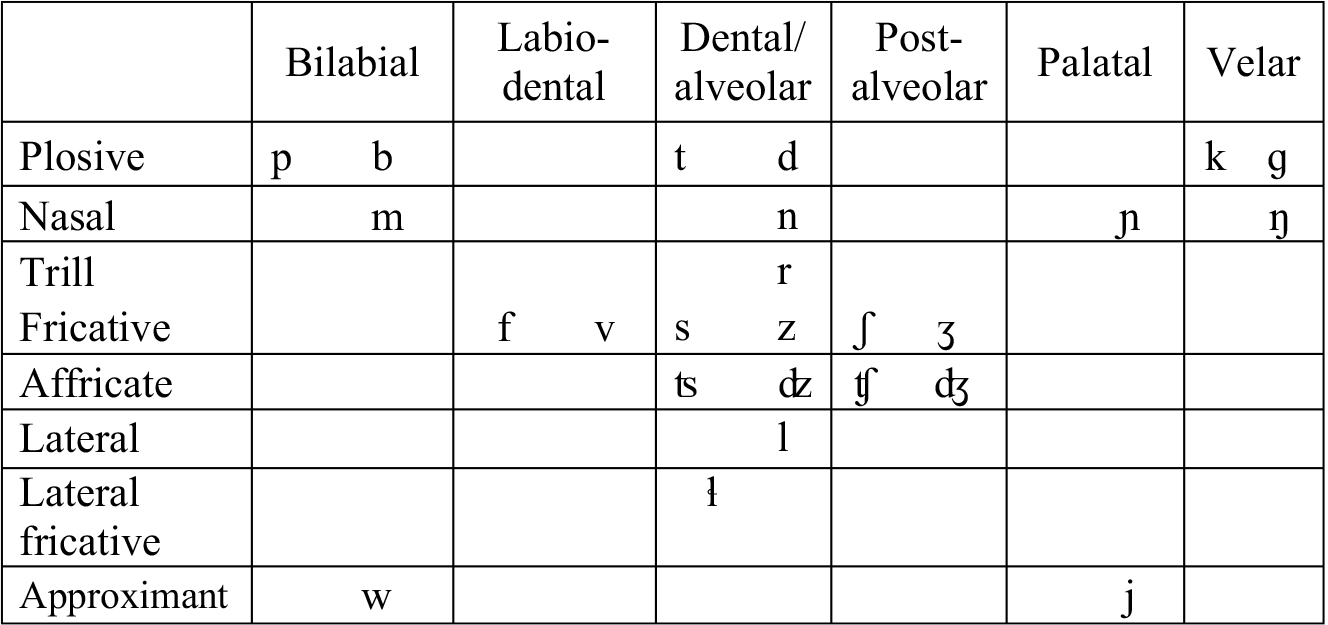
In terms of allophony, in Nendaz FP there is variation in the realisation of /ɲ/, which tends to be realised as [n] word-finally. Liquids also demonstrate significant variability. For example, /r/ is trilled before or following a consonant, but its corresponding allophone [ʁ] is produced word-initially. Much like the neighbouring variety spoken in Savièse, [ʁ] also varies with [ɾ] in intervocalic position (see Schüle Reference Schüle1998). Like many other varieties both East and West of the Morge and down into the val de Bagnes, Nendaz FP is characterised too by the presence of the lateral fricative phoneme. Rare among the world’s languages, /ɬ/ is particularly unusual in Romance. It is attested as an allophone of /s ɾ l/ before coronal stops in Northwestern Sardinian (Contini Reference Contini1982, Reference Contini1987; see also discussion in Müller Reference Müller2011), but it is not attested in any surrounding Romance varieties. In what follows we describe the historical development of the lateral fricative in the FP context.
1.3 Historical development of /ɬ/ in Francoprovençal
That /ɬ/ is unusual for Romance can be attested by the fact that European-language scholars have tended to compare or describe the acoustic impression to/as alveolar, alveo-palatal, and palatal fricatives. For example, Müller (Reference Müller2011: 119), cites Contini (Reference Contini1982, Reference Contini1987) who considers the lateral fricative of Sardinian as being closer to /s ç ʃ/ than to any of the lateral approximants. Indeed, Contini (Reference Contini1987: 337–338, cited in Müller Reference Müller2011: 119) compares the Sardinian phone to the Welsh lateral fricative, which can demonstrate regional variation with /ç/. This anecdotal evidence is borne out too by early 20th-century dialectological evidence in the FP-speaking region, where /ç/ is often found (see e.g. summary accounts in Stich Reference Stich1998). Conversely, linguists such as Bjerrome (Reference Bjerrome1957), in describing the FP variety of Bagnes (an adjacent variety with a similar phonemic inventory to that of Nendaz), rejects this account and argues instead that the feature, transcribed orthographically as <hl> in the region, as in other languages (e.g. Chadic, Newman Reference Newman, Newman and Leyden1977), is clearly produced – unvoiced – in the same place of articulation as the alveolar lateral approximant /l/:
hl est une latérale sourde et forte ; le souffle d’air doit […] être assez puissant afin de produire, en passant des deux côtés de la langue, le bruit caractéristique de cette consonne. Dans les Tableaux phonétiques hl est transcrit de manière à donner l’impression erronée qu’il s’agit de la fricative palatale ç (comme dans l’allemand « ich »), suivi de l plus ou moins palatalise. En réalité hl s’articule exactement au même endroit que l, c.-à-d. avec la pointe de la langue contre les alvéoles, sans aucune trace de mouillure. (Bjerrome Reference Bjerrome1957: 43)
[hl is a voiceless lateral ; the airstream must be released – on both sides of the tongue – with sufficient force in order to produce the characteristic noise associated with this consonant. In phonetic tables hl is transcribed in such a way as to give the erroneous impression that the sound is a palatal fricative ç (as in the German “ich”), followed by a more or less palatalised l. In fact hl is articulated in exactly the same place as l, that is with the tongue tip at the alveolar ridge, without any gestural palatalisation.] (authors’ translation)
In diachrony, the emergence of /ɬ/ in FP stems from sound changes that emerged from ‘palatalisation’ in Romance.Footnote 4 In FP, as in other Romance languages, the historical development of palatalisation has had far reaching effects on the phonology and phonetics of the language, and significant space in the literature is dedicated to the outcomes of palatalisation both in FP (e.g. Duraffour Reference Duraffour1932) and Romance more broadly (e.g. Pope Reference Pope1952). We focus here on two specific waves of palatalisation that have resulted synchronically in /ɬ/ as found in phonemic inventory of Nendaz FP: the sound changes resulting from palatalisation of initial and medial /k/ before Latin front vowels e-i, and (ii) obstruent + lateral clusters /kl ɡl pl bl fl/ (i.e Latin clusters cl gl pl bl fl).
1.3.1 Initial and medial /k/ + e-i
Evidence from Romance languages has shown that the velar plosive /k/ before e-i in Latin came to be pronounced as a palatal stop. In intervocalic position, following palatalisation, this phone also affricated (for details, see e.g. Price Reference Price1984: 49–51). The outcomes of palatalisation affecting such clusters appearing word initially or following a consonant in Nendaz FP have both resulted synchronically in /ɬ/. These sound changes leading to /ɬ/ are documented in Duraffour (Reference Duraffour1932) as beginning with a stage of affrication followed by a subsequent leniting of the initial occlusive segment. In articulatory terms, Duraffour describes this process as one rendering a ‘complex’ phone ultimately ‘leading to l, preceded by h’, emerging as ‘a sort of aspiration which is produced as this complex articulation’ (authors’ translation), and which he annotates as <ç̑> (see Figure 4, an adaptation of Duraffour’s (Reference Duraffour1932: 231) schematisation for /k/ + e-i,).
Adaptation of Duraffour’s (Reference Duraffour1932) schematisation of sound change resulting from /k/ $ + $
e-i.
$ + $
e-i.

Returning to Jeanjaquet’s (Reference Jeanjaquet1931) two broad dialectal zones outlined above, the sound changes that emerged from initial and medial /k/ + e-i, and that resulted in /ɬ/ in Nendaz, is described as one feature among other distinguishing the Valais savoyard from the Valais épiscopal. However, Diémoz & Kristol (Reference Diémoz and Kristol2018) demonstrate that the lateral fricative is in fact quite widespread throughout the Canton of Valais, from Isérable (West) to Montana (East). Further, Jeanjaquet (Reference Jeanjaquet1931: 40) lists the variants <çl çl̬ ç>, illustrating too the weakening or leniting of the affricate.
1.3.2 Obstruent + lateral clusters /kl ɡl pl bl fl/
Lateral approximants in FP, as in other Romance varieties, underwent palatalisation in clusters containing initial obstruents, a process known in the Romance literature as /l/-palatalisation. However, once clusters had become palatalised, they developed in a host of directions, which included loss of one of the elements of the cluster or change in place or mode of articulation for either element. Stich (Reference Stich1998) offers an overview of the patchwork of variation attested in the FP-speaking region (Table 3), where, as can be seen, /l/-palatalisation also comprises a number of other subsequent sound changes that have impact upon the obstruent + lateral cluster in FP (for a detailed historical account of these developments, see Müller Reference Müller2011).
Attested variants in obstruent + lateral clusters, with lateral fricatives in bold (taken from Kasstan Reference Kasstan2019b: 693, after Stich Reference Stich1998: 47–50).

As Table 3 shows, first, all five clusters can palatalise in FP, although this can depend on the variety, too. For example, while only the velar + lateral clusters palatalised in some regions (e.g. the Lyonnais area), in others palatalisation in the labial + lateral sets can also be found (as in Nendaz and other varieties spoken in Valais). Conversely, in some FP varieties, palatalisation of /l/ before obstruents has been lost altogether (e.g. Savièse, Canton of Valais). Second, in addition to approximants, a number of fricative articulations are present, which are secondary changes following palatalisation, including the emergence of the lateral fricative, highlighted in Table 3. In Nendaz, as in other regions, the development of /ɬ/ has been uneven. For example, the outcomes of /l/-palatalisation has resulted in the loss of the first segment and subsequent fricativisation of /l/ in the /kl/ and /fl/ sets (Latin cl and fl), whereas the /bl pl gl/ clusters (bl pl gl) remain intact; consider examples (1) and (2):

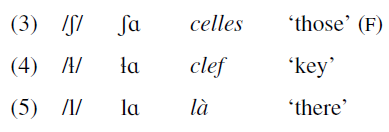
Phonologically speaking, /ɬ/ is contrastive with /l/ in Nendaz FP, as well as with other fricatives, as the minimal pairs in (3)–(5) demonstrate. Owing to the syllabic structure of the language as described above, as well as the historical origins of /ɬ/, phonotactically /ɬ/ appears in syllable onsets but not in codas.
Having given an overview of the FP linguistic context and sound system, in the next sections we review previous work examining acoustic correlates to place of articulation in voiceless fricatives, before turning to the study’s own sample.
1.4 Acoustic correlates of place of frication
Previous work has shown that a number of acoustic parameters can distinguish between different places of articulation of fricatives. Most of this work has concentrated on English, and other European languages, though two notable larger-scale, cross-linguistic studies are presented in Nartey (Reference Nartey1982) and Gordon et al. (Reference Gordon, Barthmaier and Sands2002). In this paper, we leave aside voicing cues for fricatives, and focus on previous work on cues to place of articulation in voiceless fricatives. Chief amongst these cues relates to spectral characteristics of the fricative noise (spectral peak location and spectral moments).
The overall shape of the noise spectrum is largely determined by the size and shape of the oral cavity that is in front of the point of constriction, with the longer the anterior cavity resulting in a more defined spectrum (e.g. Stevens Reference Stevens1998). Consequently, dental and labiodental fricatives without an anterior cavity typically show relatively flat spectra lacking any pronounced peaks. On the other hand, those that do, such as alveolar and post-alveolar fricatives, show a sharper peak (Strevens Reference Strevens1960, Behrens & Blumstein Reference Behrens and Blumstein1988, Gordon et al. Reference Gordon, Barthmaier and Sands2002). Typically, post-alveolar fricatives show a mid-frequency spectral peak of 2500–3000 Hz whereas alveolar fricatives show a peak at higher frequencies between 3500 Hz and 5000 Hz (e.g. Behrens & Blumstein Reference Behrens and Blumstein1988). Fricatives without a front cavity like [f] and [θ] tend to show energy diffused across the entire frequency range from 1500 Hz to 8500 Hz (Behrens & Blumstein Reference Behrens and Blumstein1988, Jongman, Wayland & Wong Reference Jongman, Wayland and Wong2000).
In order to characterise both the local and global features of the spectrum to classify fricatives, and obstruents more generally, previous work has utilized spectral moments analysis (Forrest et al. Reference Forrest, Weismer, Milenkovic and Dougall1988). Each fast Fourier transform (FFT) of the speech signal is treated as a random probability distribution from which the first four moments are calculated (Moment 1: Spectral mean, Moment 2: Variance, Moment 3: Skewness, and Moment 4: Kurtosis). The first moment, the mean or centre-of-gravity measure (CoG), characterises the average concentration of the frequency distribution, while the variance (usually reported in terms of standard deviation, the second moment) reflects the extent to which energy is concentrated tightly around the mean or more widely spread over a wider frequency range. Skewness (the third moment) reflects the extent to which frequencies are concentrated in the lower or higher ends of the frequency range, with positive skewness (negative spectral tilt) suggestive of a higher concentration of energy in the lower frequencies, and negative skewness (positive spectral tilt) suggestive of a higher concentration of energy in the higher frequencies. The final (fourth) moment, kurtosis, is a measure of the ‘peaked-ness’ of the distribution, with positive values indicating more peaked distributions, and negative values indicating flatter distributions.
Typically, studies that use spectral moments tend to focus on the mean (i.e. CoG) of the frequency distribution. CoG tends to be correlated with the frontness of the constriction. In line with this, past work has shown that /s/ has the highest CoG in English (e.g. Jongman et al. Reference Jongman, Wayland and Wong2000), Mandarin Chinese (Svantesson Reference Svantesson1983) and in almost all the languages surveyed by Gordon et al. (Reference Gordon, Barthmaier and Sands2002). /ʃ/ in English is reported to have the lowest CoG (Shadle & Mair Reference Shadle and Mair1996, Jongman et al. Reference Jongman, Wayland and Wong2000). In Gordon et al. (Reference Gordon, Barthmaier and Sands2002), they found that /ʃ/ and the lateral fricative /ɬ/ showed a high degree of interlanguage variation in their relative CoG values, a point to which we return below in the discussion on the acoustics of /ɬ/. Sibilant fricatives also tend to have lower variance than non-sibilants (Tomiak Reference Tomiak1990, Jongman et al. Reference Jongman, Wayland and Wong2000). With respect to the third moment, skewness, Jongman et al. (Reference Jongman, Wayland and Wong2000) found that English voiceless fricatives all differ in terms of skewness and kurtosis, with /s/ having a more negative skewness (i.e. more energy in the higher frequencies), and /ʃ/ having a more positive skewness. The non-sibiliant /f/ and /θ/ had skewness values close to zero. These results both conform with previous results (e.g. Nittrouer Reference Nittrouer1995), but also contrast with previous work by Tomiak (Reference Tomiak1990) who found the reverse relation, a greater positive skewness for /s/ than /ʃ/. Finally, Jongman et al. (Reference Jongman, Wayland and Wong2000) found a large positive kurtosis value for /s/ and a small value for /ʃ/, also in line with previous work (e.g. Tomiak Reference Tomiak1990, Nittrouer Reference Nittrouer1995). Jongman et al. (Reference Jongman, Wayland and Wong2000) concluded based on their study that the four places of articulation in English tend to be distinguished by the spectral-moments measures, although previous work has suggested that classification based on spectral moments tends to yield better results for sibilants vs. non-sibilant fricatives (Forrest et al. Reference Forrest, Weismer, Milenkovic and Dougall1988, Tomiak Reference Tomiak1990).
Apart from spectral characteristics, previous work has also examined the extent to which duration and amplitude of frication noise differentiate between different fricative categories. In English, at least, sibilant fricatives ([s] and [ʃ]) have been found to be longer in duration that non-sibilants ([f] and [θ]) (Behrens & Blumstein Reference Behrens and Blumstein1988, Jongman et al. Reference Jongman, Wayland and Wong2000). When a larger set of languages are sampled, however, duration turns out to be a poor predictor of fricative place of articulation (Gordon et al. Reference Gordon, Barthmaier and Sands2002, see also Nirgianaki Reference Nirgianaki2014 on Greek). Sibilant fricatives (in English) have also been shown to have a higher amplitude than non-sibilants (Behrens & Blumstein Reference Behrens and Blumstein1988), although Jongman et al. (Reference Jongman, Wayland and Wong2000) found that all four voiceless fricatives in English show significantly different overall and relative amplitudes. Further, it has been suggested that the formant transitions into the following vowel (particularly F2) serve to distinguish between different fricative places of articulation. Jongman et al. (Reference Jongman, Wayland and Wong2000) found for example that dental fricatives showed a higher F2 onset than labiodentals and alveolars which in turn showed higher F2 values than post-alveolars; there was no difference between labiodentals and alveolars. In Gordon et al. (Reference Gordon, Barthmaier and Sands2002), formant transitions (F1 and F2) were primarily useful for distinguishing between dorsal fricatives in their sample. They suggest that formant transitions are most useful in distinguishing between fricatives with similar spectral characteristics. However, more recent work on Greek (Nirgianaki Reference Nirgianaki2014) showed that F1 onset did not distinguish between some of the places of articulation, while F2 consistently did across all places of articulation. Further results from perception studies suggest that the use of formant cues in fricative identification is somewhat equivocal (e.g. Harris Reference Harris1958, Heinz & Stevens Reference Heinz and Stevens1961, Klaassen-Don Reference Klaassen-Don1983), and might depend on specifics of the fricative inventory of the language, in particular, whether there are perceptually confusable pairs (Wagner, Ernestus & Cutler Reference Wagner, Ernestus and Cutler2006).
To summarise, previous work has shown that place of articulation in voiceless fricatives can be distinguished using spectral measures (peak location and spectral moments), duration and amplitude, as well as formant transitions, although the degree to which each of these measures distinguishes between fricative categories in a given language can differ.
Next, we turn to previous work examining lateral fricatives specifically. In terms of lateral–fricative typology, as mentioned above, this segment is not typical of Romance languages, though it has been documented in other European languages, most notably in Scottish Gaelic (Ladefoged et al. Reference Ladefoged, Ladefoged, Hind and Skilton1998), Welsh (Ball & Williams Reference Ball and Williams2001, Jones & Nolan Reference Jones and Nolan2007) and Icelandic (Árnason Reference Árnason2011), and Estonian Swedish (Schötz, Nolan & Asu Reference Schötz, Nolan and Liina Asu2014, Asu, Francis & Schötz Reference Asu, Nolan and Schötz2015). Having said this, lateral fricatives are relatively rare in the world’s languagesFootnote 5, and distinguishing lateral fricatives from devoiced lateral approximants has been the subject of some prior study. Maddieson & Emmorey (Reference Maddieson and Emmorey1984: 181) examined the acoustic correlates of word-initial lateral fricatives and voiceless lateral approximants in Navajo, Zulu, Taishan Chinese, Burmese and Tibetan. They observe a voicing lag in the fricative, with higher amplitude, and a greater amount of energy at the higher frequency levels (in the fricative between 3150 Hz and 6400 Hz, contra the devoiced lateral in the 2700–3150 Hz range). Ladefoged & Maddieson (Reference Ladefoged and Maddieson1996) further suggest that devoiced lateral approximants tend to show more prevocalic anticipatory voicing, which is less common in lateral fricatives. Others, however, have pointed to a range of variation within voiceless lateral segments, instead of a discrete categorical distinction (Asu et al. Reference Asu, Nolan and Schötz2015). Asu et al. (Reference Asu, Nolan and Schötz2015) examined a small corpus of Icelandic, Welsh and Estonian Swedish speakers, who have a voiceless lateral that contrasts with a voiced lateral approximant. In Icelandic, this segment is typically analysed as a voiceless lateral approximant, whereas in Welsh, it is generally analysed as a lateral fricative. Asu et al. (Reference Asu, Nolan and Schötz2015) observed that Welsh and Icelandic show prototypical features associated with their respective segment type, with Icelandic voiceless laterals showing considerable prevocalic anticipatory voicing (‘pre-voicing’, as expected for approximants), and Welsh voiceless laterals showing no pre-voicing at all (in line with the fricative analysis for Welsh). Conversely, Estonian Swedish exhibited both patterns, leading the authors to suggest that Estonian Swedish’s voiceless lateral represents an intermediate case between a canonical lateral approximant (Icelandic) and a canonical lateral fricative (Welsh).
In spite of these acoustic features and differences, there is a general consensus that no language would appear to contrast a devoiced lateral approximant and a voiceless lateral fricative (Maddieson & Emmorey Reference Maddieson and Emmorey1984: 187; Ladefoged & Johnson Reference Ladefoged and Johnson2011: 270). In terms of distribution, however, Maddieson & Emmorey (Reference Maddieson and Emmorey1984) do argue that, while lateral fricatives may appear in all syllable positions, devoiced lateral approximants are argued to be restricted to syllable-initial position only.
As far as spectral properties are concerned, Gordon et al. (Reference Gordon, Barthmaier and Sands2002) calculate an average CoG value of 4456 Hz for the lateral fricative, which they average over tokens from samples of speakers of Chickasaw, Western Apache, Western Aleut, Montana Salish, Hupa, and Toda. Gordon et al. (Reference Gordon, Barthmaier and Sands2002) also report that /ɬ/ showed considerable interlanguage variation in terms of spectral CoG as well as diffuseness. In particular, the authors point to considerable interlanguage variation in terms of the relative CoG measures between /ɬ/ and /ʃ/, with some languages, like Montana Salish, showing a higher value for /ɬ/, whereas others, like Western Apache and Western Aleut, showed the opposite pattern. Conversely languages like Chickasaw and Hupa showed no reliable differences between the two sounds. Gordon et al. (Reference Gordon, Barthmaier and Sands2002) attribute this degree of variation to the likely cross-linguistic articulatory differences similar to those involved in the production of the lateral approximant (see Ladefoged & Maddieson Reference Ladefoged and Maddieson1996 for discussion of articulatory variability of lateral segments).
1.5 Parameters of the current study
Owing to the paucity of acoustic-phonetic and synchronic phonological investigations on FP, our goals in this study are to provide the first descriptive acoustic examination of this language, focusing on the fricative system of Nendaz FP. In particular, we examine which acoustic measures distinguish between fricative categories. It is however first necessary to make a further terminological clarification regarding ‘place of articulation’, especially as it relates to the alveolar lateral fricative /ɬ/. Based on the IPA chart, the difference between /ɬ/ and /s/ is primarily one of manner of articulation, since these segments are in different rows belonging to the same column. However, these columns force the interpretation that the place of articulation of /ɬ/ is alveolar. This is true to the extent that /ɬ/ is alveolar in terms of place of constriction (i.e. contact between passive and active articulators). Yet we highlight that this is not where frication is presumably generated (point of frication noise). For most fricative systems, like those examined in the previous work discussed above, without a difference in airflow channel (i.e. without a lateral fricative), the point of constriction and point of frication are conflated. However, in the case of a lateral fricative these cues are distinct. There is a constriction with the tip/blade at the alveolar ridge (hence the alveolar place of articulation/constriction), but the source/point of frication is the side channel, not at the alveolar ridge per se (Ladefoged & Maddieson Reference Ladefoged and Maddieson1996). On the IPA chart, this central vs. lateral channel distinction is captured as a manner articulation distinction (rows) which conflates a number of different distinctions not just involving the degree of constriction (e.g. nasality). In our analysis, instead of conducting comparisons separately of place and manner as indicated by the IPA chart, we adopt Gordon et al. (Reference Gordon, Barthmaier and Sands2002)’s approach in comparing the fricative system as a whole to address which acoustic measures capture the distinctions within the broader manner class of voiceless fricatives.
We limit our examination to the internal spectral (spectral moments and peak location), intensity and durational cues, in addition to formant transitions into the following vowel, focussing on just the voiceless fricatives produced in similar phonological contexts. We then investigate the nature of the lateral fricative in FP, comparing its features to previous studies of voiceless lateral fricatives to further our understanding of the cross-linguistic variation in the phonetic implementation of this segment. We examine its durational properties relative to other obstruent–lateral clusters as well as to the proportion of voicing relative to noise, and relative intensity. We also compare zero-crossing ratios as a measure of the relative noisiness of the signal to examine how ‘approximant’ or ‘fricative’ like the lateral fricative is on this measure (see Martínez Celdrán Reference Martínez Celdrán2015, Patience Reference Patience2018). The results of this study, therefore, not only contribute to the acoustic description of part of the phonetic system of an underexamined and severely endangered language variety, but also serve to contribute to our understanding of fricative acoustics, including of the lateral fricative, cross-linguistically.
2 Research design
2.1 Speakers and sampling
Fieldwork was conducted in the commune of Nendaz as part of a larger study into language variation and change in FP. Sampling took place through the second author’s personal networks and through snowball sampling. Data for this exploratory study were elicited from four speakers (one female: F10, three male: M12, M13, M14) aged between 70 and over 80 years. All speakers were born and raised in Nendaz, and are sequentially bilingual (i.e. they acquired FP as their first language and French as a second language through the education system, though all speakers are now French-dominant). For all speakers, FP now remains confined largely to the most intimate domains of usage. None of the speakers reported any hearing loss nor did they wear hearing aids. However, given the age of this population, any age-related hearing degradation cannot be ruled out.
2.2 Materials and elicitation
A wordlist translation task was devised to elicit instances of fricative and lateral clusters. The wordlist was made up of 48 target items (see appendix Table A1) embedded, where possible, in a carrier phrase. The typical carrier phrase is as follows, in both Nendard orthography and IPA.
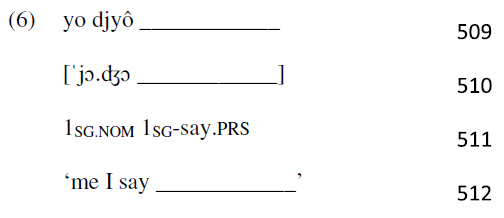
Given that the current study is an initial phonetic examination of FP, we limited the surrounding contexts for the target segments, with all word-initial targets occurring before the low vowels: [a] and [ɑ]. This therefore controls for any possible anticipatory coarticulatory effects on the target segments due to following vocalic environment (see e.g. Soli Reference Soli1981, Jongman et al. Reference Jongman, Wayland and Wong2000,).
Participant interviews were recorded on a Tascam DR-100MKIII at a sampling rate of 44.1k, using Shure SM10A head-mounted microphone. As the vast majority of fluent speakers are now only to be found among an increasingly elderly, frail, and isolated inter-war generation, there are important methodological considerations from the perspective of data elicitation in this community. First, it is neither possible nor appropriate to bring participants to a laboratory setting, and so data collection took place in the field. Second, very often data elicitation took place in the participants’ own homes, particularly where independent transportation was not an option, as is often the case (itself a cumbersome logistical issue in mountainous terrain). Third, research participants can and do express their discomfort with the rigorous protocols associated with elicitation tasks, a practice sanitised of any social cues for these speakers, who are also illiterate in a language that has no widely accepted orthography. The extent of the quality of natural speech recordings is therefore balanced against the practicalities of eliciting data under the circumstances (see Nagy Reference Nagy2015: 324–325). Owing to these considerations, elicitation could not be conducted as would traditionally be the case with speakers purely reading from a list of sentences. Instead, elicitation of target words within a carrier phrase occurred in the context of semi-structured sociolinguistic interviews, although carrier phrases were at times inconsistently produced by participants. The authors acknowledge here the constraints that the nature of the data places on the discussion and interpretation of findings. The resulting corpus consisted of 150 word-initial fricative tokens that we examine in the main acoustic analysis below in Section 3. One speaker’s /s/ tokens were excluded entirely for reasons we detail below. Table 4 shows a breakdown of the number of tokens represented per fricative category.
Token counts by fricative category and vowel context.

2.3 Data preparation and analysis
Recordings were resampled to 22.5 kHz and were segmented in Praat (Boersma & Weenink Reference Boersma and Weenink2019). For singleton fricatives (/f/, /s/, /ʃ/ and /ɬ/), the onset of high frequency frication noise was segmented at the offset of periodicity in the waveform, with the offset placed at the onset of periodicity associated with the following vowel or lateral (see below). In some tokens of /f/, a stop-like gesture was observed either preceding or following the frication noise, i.e. these were produced more like [p͡f] or [f͡p]. The stop portion of these segments was segmented separately from the frication noise (see appendix Figure A1). In some tokens of /s/ and /ʃ/, a period of post-aspiration was observed prior to the vocalic gesture, indicative of a period of frication without a supralaryngeal gesture (i.e. [h]). In these cases, aspiration was segmented separately from the rest of the fricative based on changes in the waveform and spectrogram, with the onset of aspiration corresponding to visibly more distributed spectrum across the frequency range, including more lower frequency noise; the offset was placed as above. These were carried out such that spectral measures will only be conducted on the portion with a supralaryngeal gesture (i.e. the target gesture).
The onset of the boundary for voiced lateral approximant was placed at the onset of dip in waveform amplitude from the previous vowel, or onset periodicity if preceded by silence. The offset of lateral segments was placed at the onset of vowel-based intensity and formant characteristics based on visual inspection of the waveform and spectrogram, respectively.
For obstruent + lateral clusters, segmentation of each component was conducted in the same manner as for singleton consonants above. For stop + lateral clusters, the onset of the stop closure was placed at the first period of silence, or for voiced stops, the offset of higher frequency energy in formants. The offset was placed in the first period of voicing in the following /l/ after the stop burst. For the lateral fricative /ɬ/, the noise and voiced lateral component were segmented out separately as per the criteria above. For stops, we excluded utterance initial tokens for which it was impossible to place the start of the boundary since there is no visible trace of the initiation of closure for voiceless stops. For voiced stops, this was placed at the onset of voicing as evidenced by a visible voicing bar in the spectrogram.
We extracted duration and intensity measures of each segmented interval (total duration includes the sum of the duration of all components for a given target segment or sequence) using a custom Praat script. Duration was log-transformed prior to analysis. Spectral measures (Moment 1: CoG, Moment 2: variance, Moment 3: skewness, Moment 4: kurtosis and spectral peak location) over the frication noise were extracted using a custom R script (Chodroff & Wilson Reference Chodroff and Wilson2014, Reference Chodroff and Wilson2020), from a multitaper spectrum (Blacklock Reference Blacklock2004, Shadle Reference Shadle, Cohn, Fougeron and Huggman2012) at the middle 50 $\%$
of the fricative to best approximate the ‘steady-state’ of fricative noise. For tokens with post-aspiration, measurements were only made over the portion that contained a supralaryngeal gesture. The multitaper approach (Blacklock Reference Blacklock2004) relies less on the FFT assumptions of a periodic spectrum (see also Shadle Reference Shadle, Cohn, Fougeron and Huggman2012). Following previous work, recordings for this part of the analysis were first band-pass filtered with a 550 Hz low cut-off and 10,000 Hz high-cut off. The low cut-off was used to exclude low-frequency noise that can result from ambient room noise or voicing. The high-cut off follows the approximate upper-limit that is perceptually relevant for fricative perception (Stelmachowicz et al. Reference Stelmachowicz, Pittman, Hoover and Lewis2001), and follows a similar upper-cut off used in previous work on fricative acoustics (e.g. Gordon et al. Reference Gordon, Barthmaier and Sands2002, Nirgianaki Reference Nirgianaki2014, Kochetov Reference Kochetov2017). Finally, formant measures were obtained using the LPC Burg algorithm in Praat using a 0.025 Gaussian window. F1, F2 and F3 values at the onset of the vowel were extracted using a custom Praat script.
$\%$
of the fricative to best approximate the ‘steady-state’ of fricative noise. For tokens with post-aspiration, measurements were only made over the portion that contained a supralaryngeal gesture. The multitaper approach (Blacklock Reference Blacklock2004) relies less on the FFT assumptions of a periodic spectrum (see also Shadle Reference Shadle, Cohn, Fougeron and Huggman2012). Following previous work, recordings for this part of the analysis were first band-pass filtered with a 550 Hz low cut-off and 10,000 Hz high-cut off. The low cut-off was used to exclude low-frequency noise that can result from ambient room noise or voicing. The high-cut off follows the approximate upper-limit that is perceptually relevant for fricative perception (Stelmachowicz et al. Reference Stelmachowicz, Pittman, Hoover and Lewis2001), and follows a similar upper-cut off used in previous work on fricative acoustics (e.g. Gordon et al. Reference Gordon, Barthmaier and Sands2002, Nirgianaki Reference Nirgianaki2014, Kochetov Reference Kochetov2017). Finally, formant measures were obtained using the LPC Burg algorithm in Praat using a 0.025 Gaussian window. F1, F2 and F3 values at the onset of the vowel were extracted using a custom Praat script.
In order to assess whether each measure distinguished between the fricative categories, we constructed individual linear-mixed effects models with each measure as a dependent variable and fricative category (reference level = /f/) as a predictor using the lme4 package (Bates et al. Reference Bates, Mächler, Bolker and Walker2015) in R (R Core Team 2021), with significance values obtained using Sattherthwaite method from the lmerTest package (Kuznetsova et al. Reference Kuznetsova, Brockhoff and Christensen2017). We also accounted for any vowel effects by including following vowel identity as an additional factor, in addition to the interaction with fricative category. Each model also contained random intercepts for speaker and word where possible. Models with a random slope of fricative category nested within speaker did not converge. Significance testing was conducted through model comparison using the anova() function, comparing the full model against a subset model without segment as a fixed effect. Pairwise comparisons were conducted using the emmeans() function from the emmeans package (Lenth et al. Reference Lenth, Henrik Singmann, Buerkner and Hervé2019), with Bonferroni’s adjustment for multiple comparisons. In the final analysis, in order to examine how all the different measures together distinguish between all four fricative categories, we used Linear Discriminant Analysis (LDA), a dimension reducing technique, to assess the degree of category separation when all measures are considered at once. We report the details of the LDA analysis below.
Finally, we were also interested in further examining four specific characteristics of the lateral fricative: (i) the proportion of voicing during the target gesture; (ii) the proportion of tokens that show pre-voicing, compared to other obstruent + lateral clusters (/pl/, /bl/ and /fl/). By pre-voicing, we mean anticipatory voicing that occurs prior to the release of the lateral consonant into the following vowel (see Asu et al. Reference Asu, Nolan and Schötz2015). We also compare: (iii) the relative intensity between the fricative and the following vowel vs. a voiced lateral and the following vowel; and (iv) the ratio of zero-crossings which some scholars have previously investigated as a means of examining the degree of periodicity in the signal (Martinez Céldran Reference Martínez Celdrán2015, Patience Reference Patience2018). A custom Praat script (based on that of Elvira-García Reference Elvira-García2014) was used to extract the number of zero-crossings in the target fricative or lateral, and the following vowel. A ratio was then calculated by dividing the number of zero-crossings on the target over that on the vowel. A higher zero-crossing ratio indicates a noisier, less periodic signal (i.e. more zero-crossings), indicative of more fricative like productions.
3 Results: Fricative categories
3.1 Spectral measures: Peak location and spectral moments
Long-term average spectra (LTAS) for all four fricatives by speaker is shown in Figure 5. The spectral shape for each fricative is largely consistent across the four speakers in our sample. /f/ is characterised by a broad and diffuse spectral shape without a sharp peak. /s/ and /ʃ/ are characterised by high energy spectral peaks, with /s/’s peak between 4000 Hz and 5000 Hz and /ʃ/’s much lower at around 1500 Hz. /ɬ/ is similarly characterised by a sharp peak, though with overall lower energy, at around 2500–2700 Hz. The /s/ productions of speaker M13, however, show a much flatter spectrum overall when compared to the /s/ productions of the other speakers, as well as what we would expect of /s/ cross-linguistically. Auditory checking of tokens from this speaker revealed that these were often produced with an /f/-like quality, which is consistent with the diffuse and broad spectral shape observed in Figure 5. Given the qualitatively different nature of these tokens, we excluded these from the quantitative analyses below (we have provided an example spectrogram in appendix Figure A1). Spectrograms from one speaker of all for fricatives are shown in Figure 6. Here, /ɬ/ in (6b) shows a clear double articulation, i.e. [ɬ͡l].
LTAS for all four fricatives by speaker (‘hl’ = /ɬ/ and ‘sh’ = /ʃ/).

Spectrograms of all four fricatives: (a) /f/, (b) /ɬ/, (c) /s/ and (d) /ʃ/. /ɬ/ shows a clear double articulation, i.e. [ɬ͡l].

Mean spectral peak location for each fricative collapsed across speaker and vowel context is shown in Figure 7. On average, /s/ was characterised as having the highest mean peak location (4591 Hz) and /ʃ/ had the lowest (1667 Hz). Both labiodental /f/ and lateral fricative /ɬ/ had intermediate values (2818 Hz and 2655 Hz, respectively). The model only contained a random intercept by speaker.Footnote 6 Model comparison revealed no significant interaction between vowel context and fricative ( $\chi$
2(3) = 2.69, p = .44), and no significant main effect of vowel context (
$\chi$
2(3) = 2.69, p = .44), and no significant main effect of vowel context ( $\chi$
2(1) = 1.98, p = .16). A significant main effect of fricative (
$\chi$
2(1) = 1.98, p = .16). A significant main effect of fricative ( $\chi$
2(3) = 77.06, p < .0001) was found, with post-hoc pairwise comparisons indicating that the peak location for /f/ was not significantly different from /ɬ/ (p = 1.00). Peak location between all other pairs were significantly different (see supplementary materials online for full results).
$\chi$
2(3) = 77.06, p < .0001) was found, with post-hoc pairwise comparisons indicating that the peak location for /f/ was not significantly different from /ɬ/ (p = 1.00). Peak location between all other pairs were significantly different (see supplementary materials online for full results).
Spectral peak location (Hz) by fricative category.

Turning to the four spectral moments, the mean values for each spectral moment for each fricative category averaged across speaker is shown in Table 5. We discuss model results for each spectral moment in turn. Overall, /s/ had the highest CoG and /ʃ/ the lowest, with /f/ and /ɬ/ having intermediate values (Figure 8 left). There was no significant interaction between vowel context and fricative ( $\chi$
2(3) = 4.59, p = .20). There was a significant main effect of vowel context (
$\chi$
2(3) = 4.59, p = .20). There was a significant main effect of vowel context ( $\chi$
2(1) = 6.59, p = .01), with CoG being slightly higher overall before [ɑ]. There was a significant effect of fricative (
$\chi$
2(1) = 6.59, p = .01), with CoG being slightly higher overall before [ɑ]. There was a significant effect of fricative ( $\chi$
2(3) = 35.25, p < .0001) with post-hoc comparisons indicated that all pairs of fricatives were distinguished along this measure, except for /f/ and /ɬ/ (p = .79).
$\chi$
2(3) = 35.25, p < .0001) with post-hoc comparisons indicated that all pairs of fricatives were distinguished along this measure, except for /f/ and /ɬ/ (p = .79).
Mean values for spectral moments by fricative category.

(left) Moment 1: Spectral Centre-of-Gravity (CoG; Hz) and (right) Moment 2: Variance (standard deviation) by fricative category. (‘hl’ = /ɬ/ and ‘sh’ = /ʃ/).

For the second moment, /f/ had the highest variance (standard deviation), and /ʃ/ the lowest, with /s/ and /ɬ/ having intermediate values (see Figure 8 right). The model contained only a by-speaker random intercept as one including a by-word one failed to converge. There was no significant interaction ( $\chi$
2(3) = 5.51, p =.14) nor a significant main effect of vowel context (
$\chi$
2(3) = 5.51, p =.14) nor a significant main effect of vowel context ( $\chi$
2(1) = 0.80, p = .37). There was a significant effect of fricative on spectral variance (
$\chi$
2(1) = 0.80, p = .37). There was a significant effect of fricative on spectral variance ( $\chi$
2(3) = 45.57, p < .0001). Post-hoc comparisons indicated that there was no significant difference between /ɬ/ and /s/ (p = .93) or /s/ and /ʃ/ (p = .08). All other pairs were significantly different from each other.
$\chi$
2(3) = 45.57, p < .0001). Post-hoc comparisons indicated that there was no significant difference between /ɬ/ and /s/ (p = .93) or /s/ and /ʃ/ (p = .08). All other pairs were significantly different from each other.
Figure 9 left shows the distribution of skewness values (moment three) for each fricative category. Overall, /ʃ/ has the highest skewness of all four fricative categories, indicating more energy in the lower frequencies (see also Figure 5 above). This descriptive observation was confirmed by the significant effect of fricative on skewness ( $\chi$
2(3) = 20.19, p = .0002), with pairwise comparisons revealing that /ʃ/ was significantly different in skewness from all other fricatives (vs. /f/, p = .003; vs. /ɬ/, p = .005; vs. /s/, p = .003); no other pairs were significantly different from each other. There was no significant interaction of vowel context and fricative (
$\chi$
2(3) = 20.19, p = .0002), with pairwise comparisons revealing that /ʃ/ was significantly different in skewness from all other fricatives (vs. /f/, p = .003; vs. /ɬ/, p = .005; vs. /s/, p = .003); no other pairs were significantly different from each other. There was no significant interaction of vowel context and fricative ( $\chi$
2(3) = 2.53, p = .47), nor significant effect of vowel context (
$\chi$
2(3) = 2.53, p = .47), nor significant effect of vowel context ( $\chi$
2(1) = 0.04, p = .857).
$\chi$
2(1) = 0.04, p = .857).
(left) Moment 3: Skewness and (right) Moment 4: Kurtosis by fricative category (‘hl’ = /ɬ/ and ‘sh’ = /ʃ/).

Finally, overall, /ʃ/ also had the highest values for kurtosis, indicating a more peaked distribution (Figure 9 right). There was no significant interaction ( $\chi$
2(3) = 2.19, p = .53) or effect of vowel context (
$\chi$
2(3) = 2.19, p = .53) or effect of vowel context ( $\chi$
2(1) = 0.71, p = .40), but there was a significant effect of fricative on kurtosis (
$\chi$
2(1) = 0.71, p = .40), but there was a significant effect of fricative on kurtosis ( $\chi$
2(3) = 9.37, p = .02). Post-hoc pairwise comparisons revealed that /ʃ/ had higher values for kurtosis compared to the three other fricatives although these differences did not survive under p-value adjustment for multiple comparisons (vs. /f/, p = .08; vs. /ɬ/, p = .14; vs. /s/, p = .20), likely due to lack of statistical power in the relatively small dataset.
$\chi$
2(3) = 9.37, p = .02). Post-hoc pairwise comparisons revealed that /ʃ/ had higher values for kurtosis compared to the three other fricatives although these differences did not survive under p-value adjustment for multiple comparisons (vs. /f/, p = .08; vs. /ɬ/, p = .14; vs. /s/, p = .20), likely due to lack of statistical power in the relatively small dataset.
To summarise, spectral CoG and spectral peak location distinguished between most fricative categories, although /f/ was not well distinguished from /ɬ/ for the peak location or CoG measure. Spectral variance distinguished between three broad places of frication: those fricatives articulated at the front in the oral cavity (/f/), those in the alveolar region (/s/ and /ɬ/), and those in the post-alveolar region (/ʃ/). Both skewness and kurtosis values seem to primarily distinguish /ʃ/ from all other fricatives.
3.2 Formant transitions
Table 6 shows the mean across speaker and vowel context, and standard deviation for the first three formants at the onset of the vowel following the fricative target. Recall that all fricatives in the dataset were followed by either [a] or [ɑ] which should primarily differ in F2. For F1, there was no significant interaction of vowel context and fricative ( $\chi$
2(3) = 1.33, p = .72), nor a significant main effect of vowel context (
$\chi$
2(3) = 1.33, p = .72), nor a significant main effect of vowel context ( $\chi$
2(1) = 0.54, p = .46). Importantly, there was no significant effect of fricative (
$\chi$
2(1) = 0.54, p = .46). Importantly, there was no significant effect of fricative ( $\chi$
2(3) = 7.19, p = .07).
$\chi$
2(3) = 7.19, p = .07).
Mean values (Hz) for F1, F2 and F3 (standard deviations in parentheses) by fricative category collapsed over speaker and vowel context.

For F2, the model did not include a random intercept for word. There was no significant interaction of vowel context and fricative ( $\chi$
2(3) = 1.41, p = .70). There was, however, a significant effect for both vowel context (
$\chi$
2(3) = 1.41, p = .70). There was, however, a significant effect for both vowel context ( $\chi$
2(1) = 9.39, p = .002) and fricative (
$\chi$
2(1) = 9.39, p = .002) and fricative ( $\chi$
2(3) = 40.84, p < .0001). F2 was higher when the following vowel was [a] vs. [ɑ] as would be expected given the difference in the front/back dimension. /f/ had a significantly lower F2 compared to /s/ (p < .0001), /ɬ/ (p < .0001) and /ʃ/ (p = .003); no other pairs were significantly different from each other.
$\chi$
2(3) = 40.84, p < .0001). F2 was higher when the following vowel was [a] vs. [ɑ] as would be expected given the difference in the front/back dimension. /f/ had a significantly lower F2 compared to /s/ (p < .0001), /ɬ/ (p < .0001) and /ʃ/ (p = .003); no other pairs were significantly different from each other.
Finally, the model for F3 did not contain a random intercept for word. There was no significant interaction of vowel context and fricative ( $\chi$
2(3) = 7.53, p = .06) nor a significant effect of vowel context (
$\chi$
2(3) = 7.53, p = .06) nor a significant effect of vowel context ( $\chi$
2(1) = 1.47, p = .23). There was a significant effect of fricative (
$\chi$
2(1) = 1.47, p = .23). There was a significant effect of fricative ( $\chi$
2(3) = 142.64, p < .0001). /f/ had a significantly lower F3 compared to /s/ (p = .003), but not /ɬ/ (p = 1.00). /ʃ/ had a significantly lower F3 compared to /f/ (p < .0001), /s/ (p < .0001) and /ɬ/ (p < .0001), while /ɬ/ had a significantly lower F3 than /s/ (p = .04).
$\chi$
2(3) = 142.64, p < .0001). /f/ had a significantly lower F3 compared to /s/ (p = .003), but not /ɬ/ (p = 1.00). /ʃ/ had a significantly lower F3 compared to /f/ (p < .0001), /s/ (p < .0001) and /ɬ/ (p < .0001), while /ɬ/ had a significantly lower F3 than /s/ (p = .04).
In sum, fricative categories were mostly distinguished in terms F3 dimensions, with F2 mostly differentiating between /f/ and other fricatives.
3.3 Duration and relative intensity
Figure 10 left shows the (raw) duration of fricatives at each place of frication. Duration was log-transformed prior to analysis. There was no significant interaction of vowel context and fricative ( $\chi$
2(3) = 6.84, p = .08) and no significant effect of vowel context (
$\chi$
2(3) = 6.84, p = .08) and no significant effect of vowel context ( $\chi$
2(1) = 0.12, p = .73). There was, however, a significant effect of fricative on (log) duration (
$\chi$
2(1) = 0.12, p = .73). There was, however, a significant effect of fricative on (log) duration ( $\chi$
2(3) = 16.96, p < .0001). Post hoc pairwise comparisons revealed that this is driven primarily by the significantly shorter duration of /f/ relative to all the other fricatives (vs. /s/, p = 0.046 and /ɬ/, p = .01) – the difference between /f/ and /ʃ/ was not significant (p = .09). No other pairs showed significant differences in duration.
$\chi$
2(3) = 16.96, p < .0001). Post hoc pairwise comparisons revealed that this is driven primarily by the significantly shorter duration of /f/ relative to all the other fricatives (vs. /s/, p = 0.046 and /ɬ/, p = .01) – the difference between /f/ and /ʃ/ was not significant (p = .09). No other pairs showed significant differences in duration.
(left) Total duration and (right) relative intensity by fricative category (‘hl’ = /ɬ/ and ‘sh’ = /ʃ/).

Finally, average relative intensity (intensity of the following vowel – intensity of the fricative) of fricatives is shown in Figure 10 right. There was significant interaction of vowel context and fricative ( $\chi$
2(3) = 23.61, p < .0001). This was driven primarily by the larger intensity difference between /f/ compared to /s/ and /ʃ/ before [ɑ] (see supplementary materials online for full details).
$\chi$
2(3) = 23.61, p < .0001). This was driven primarily by the larger intensity difference between /f/ compared to /s/ and /ʃ/ before [ɑ] (see supplementary materials online for full details).
In summary, duration distinguishes between /f/ and most other fricatives. Relative intensity, however, seemed to primarily distinguish /f/ from /s/ and /ʃ/ but only when the following vowel was [ɑ].
Classification accuracy of voiceless fricatives. Bold marks indicate number of accurately classified tokens (percentages provided in parentheses).

Coefficients of each linear discriminant (LD) function (bold indicates main parameters for each LD), and proportion of variance accounted for by each LD.

3.4 Linear Discriminant Analysis
In order to examine how well all of the acoustic parameters examined above (spectral measures, all three formants, duration and amplitude) together distinguish between the different fricatives in the FP system, we conducted a linear discriminant analysis using the lda() function from the MASS package (Venables & Ripley Reference Venables and Ripley2003) with all measures above (peak location, all four spectral moments, all three formants, duration and relative amplitude) as predictor variables for fricative category. The data were partitioned into a training and test set using a 60–40 split, and all measures were standardised prior to the analysis.
The overall classification accuracy of the model (Table 7) was 78.8 $\%$
, with classification accuracy highest for /f/ and lowest for /ɬ/. There was primarily confusion of /ʃ/ and /ɬ/, although errors for classification of /ɬ/ were spread across all three other categories. The coefficients for each of the three linear discriminant functions are shown in Table 8 along with the contribution each function plays in explaining the class-variance. Ninety-three per cent of the variance is explained by the first two discriminant functions, with both spectral variance and spectral CoG being the main parameters used for fricative classification. The final 7
$\%$
, with classification accuracy highest for /f/ and lowest for /ɬ/. There was primarily confusion of /ʃ/ and /ɬ/, although errors for classification of /ɬ/ were spread across all three other categories. The coefficients for each of the three linear discriminant functions are shown in Table 8 along with the contribution each function plays in explaining the class-variance. Ninety-three per cent of the variance is explained by the first two discriminant functions, with both spectral variance and spectral CoG being the main parameters used for fricative classification. The final 7 $\%$
of the variance is explained by the third discriminant function, with spectral skewness being the main parameter for classification (see supplementary materials online for full details).
$\%$
of the variance is explained by the third discriminant function, with spectral skewness being the main parameter for classification (see supplementary materials online for full details).
In summary, when all the acoustic parameters examined above are considered, the three main parameters used for fricative classification are the first three spectral moments. Another LDA constructed with just those three measures (spectral CoG, variance and skewness) performs at a similar overall accuracy (80.7 $\%$
), further confirming the primacy of these three measures in determining fricative classification.
$\%$
), further confirming the primacy of these three measures in determining fricative classification.
4 Further examination of lateral fricatives
Having examined the acoustic parameters that distinguish between the voiceless fricatives at in FP, here, we turn our attention to providing further acoustic description of the lateral /ɬ/ in FP. Auditory impressions of /ɬ/ tokens in our corpus suggest that the lateral fricative is not a sibilant in quality, and sounds very close to a palatal fricative [ç] in quality which is perhaps in line with Ladefoged & Maddieson’s (Reference Ladefoged and Maddieson1996) description that these sounds typically involve frication through the side channels, just behind the alveolar ridge, in the front part of the hard palate. To our ears, the FP /ɬ/ sounds similar to prototypical /ɬ/ documented in other languages described by Gordon et al. (Reference Gordon, Barthmaier and Sands2002), based on sound samples available on the UCLA Phonetics Lab Archive (Ladefoged & Maddieson n.d.).
Following Schötz et al. (Reference Schötz, Nolan and Liina Asu2014), we address the following questions based on the data in our corpus:
-
(i) Is the duration of /ɬ/ more similar to other voiceless obstruent + lateral clusters or singleton fricative consonants?
-
(ii) Does /ɬ/ show more characteristics typical of a voiceless lateral fricative or a voiceless lateral approximant?
For the latter question, we examine the proportion and rate of pre-voicing in /ɬ/ (vs. other clusters), and we further compare the relative intensity of /ɬ/ (relative to the following vowel) in FP against what has been published in previous work by Maddieson & Emmorey (Reference Maddieson and Emmorey1984) and Schötz et al. (Reference Schötz, Nolan and Liina Asu2014). Owing to the fact that we cannot directly compare our measures to those published in previous work, we provide here a descriptive and qualitative analysis of how our measures relate to those previously published. For this analysis, we had n = 179 tokens of productions of /pl/, /fl/, /l/, as well as /s/ and /ɬ/. In word-initial position, these were predominantly produced before [a] and [ɑ] as above. Here we also included both word-initial tokens of /ɬ/ that were recorded which had [ɔ] (n = 2) and [e] (n = 4) following. We further included word-medial intervocalic /ɬ/ tokens (n = 12); the latter were included to preliminarily examine if there any position effects on the realisation of /ɬ/. A total token count for word-initial tokens is shown in Table 9 (a full token count by speaker can be found in the supplementary materials online).
Figure 11 shows the average duration of /ɬ/ compared to other voiceless obstruent + lateral clusters (/pl/ and /fl/), as well as singleton /s/ and /l/, as a representative singleton fricative that is articulated in a similar section of the oral cavity. On the whole, the duration of /ɬ/ is longer than a singleton /l/ and seems to be similar in magnitude to the obstruent + lateral clusters. These observations on their own suggest that /ɬ/ might be better analysed as a consonant cluster. In fact, the duration of FP /ɬ/ is similar to those reported by Schötz et al. (Reference Schötz, Nolan and Liina Asu2014) for Estonian Swedish, whose voiceless lateral shares a similar historical trajectory. We note, however, that /ɬ/ in FP does have a similar duration to /s/. Moreover, in our analysis reported in Section 3.2 above, there was no significant differences between the duration of these two categories. Thus, while /ɬ/ is relatively long in duration for a singleton consonant, within the FP system it has similar values as other singleton coronal fricatives, making it difficult on duration alone to conclude as to whether /ɬ/ still behaves like a cluster.
Next, we examine the extent to which the FP lateral fricative shows more prototypical characteristics of voiceless fricatives or voiceless approximants. Figure 12 shows the average proportion of prevocalic anticipatory voicing (e.g. [ɬ͡l]) in the voiceless lateral compared to other voiceless obstruent + lateral clusters (/pl/ and /fl/). On average, when voicing is present, the duration of the voice [l] component is 42 ms relative to the 141 ms for the voiceless [ɬ]. The average proportion of anticipatory voicing in voiceless laterals in FP is ∼22 $\%$
, between those reported in Maddieson & Emmorey (Reference Maddieson and Emmorey1984) for Tibetan and Burmese, which are analysed as having a lateral approximant [l̥] rather than a fricative. Ladefoged & Maddieson (Reference Ladefoged and Maddieson1996) and Maddieson & Emmorey (Reference Maddieson and Emmorey1984) suggest that anticipatory voicing is greater in voiceless approximants than fricatives. Thus, on this basis, the lateral fricative in FP might be better classified as a voiceless approximant instead. However, when we look at the percentage of pre-voiced tokens in our dataset, we find that anticipatory voicing does not occur all the time in FP, and does seem to show some positional effects when we also examine word-medial tokens of /ɬ/. In word-initial position, anticipatory voicing occurs around 96
$\%$
, between those reported in Maddieson & Emmorey (Reference Maddieson and Emmorey1984) for Tibetan and Burmese, which are analysed as having a lateral approximant [l̥] rather than a fricative. Ladefoged & Maddieson (Reference Ladefoged and Maddieson1996) and Maddieson & Emmorey (Reference Maddieson and Emmorey1984) suggest that anticipatory voicing is greater in voiceless approximants than fricatives. Thus, on this basis, the lateral fricative in FP might be better classified as a voiceless approximant instead. However, when we look at the percentage of pre-voiced tokens in our dataset, we find that anticipatory voicing does not occur all the time in FP, and does seem to show some positional effects when we also examine word-medial tokens of /ɬ/. In word-initial position, anticipatory voicing occurs around 96 $\%$
of the time, a rate which drops to 63
$\%$
of the time, a rate which drops to 63 $\%$
in medial position (although these differences need to be interpreted cautiously due to the low token count for medial position). Spectrograms of example tokens of a word-initial and word-medial tokens without anticipatory voicing are shown below in Figure 13.
$\%$
in medial position (although these differences need to be interpreted cautiously due to the low token count for medial position). Spectrograms of example tokens of a word-initial and word-medial tokens without anticipatory voicing are shown below in Figure 13.
Token count by segment/cluster and vowel context for initial tokens.

Duration of lateral fricatives (‘hl’ = /ɬ/) vs. clusters, /s/ and /l/.

We turn next to a comparison of the relative intensity of /ɬ/ to previously reported values in the literature, in particular the values reported in Asu et al. (Reference Asu, Nolan and Schötz2015). Figure 14 left shows the relative intensity of the voiceless lateral relative to the following vowel, compared to the same measure for /l/ and /s/. The average relative intensity is in the similar order of magnitude reported by Asu et al. (Reference Asu, Nolan and Schötz2015) for Icelandic, which has been argued to have /l̥/, and is larger than observed for Welsh, which has been argued to have a prototypical /ɬ/. Thus, on face value, the larger intensity difference for /ɬ/ suggests that it is more approximant like, as in Icelandic. However, in the FP context, all fricatives have a similar larger intensity difference (see Section 3.2), thus it is unlikely that this intensity difference can be the basis of classifying /ɬ/ as an approximant.
Proportion pre-voicing (lateral) by target type (‘hl’ = /ɬ/).

Spectrograms of (top) /ɬ/ in initial position (F10) and (bottom) /ɬ/ in medial position without pre-voicing (M13).

(left) Relative intensity of lateral fricatives (‘hl’ = /ɬ/) compared to /l/ and /s/. (right) Zero-crossing ratio of lateral fricatives compared to /f/, /l/ and /s/.

Finally, we compare the zero-crossing ratio between /l/, /s/ and /ɬ/. Here we have also included /f/ as an example of a non-sibilant fricative. Figure 14 right shows the zero-crossing ratios for each sound. Recall that a value closer to 1 indicates more vowel-like productions, and higher values indicate noisier, more fricative-like productions. /l/ has a zero-crossing ratio closer to 1 indicating more vowel-like productions typical of an approximant. /s/, on the other hand, has the highest zero-crossing ratio, indicating noisier productions, as expected for a sibilant fricative. Both /ɬ/ and /f/ show intermediate values, indicative of noisier productions than /l/ but not as noisy as the sibilant fricative. To examine if these differences are statistically meaningful, a linear mixed effects model was fit to zero-crossing ratio with target segment (reference = /f/) as a predictor, and random intercepts for speaker and word. Here, we have left out vowel context as a predictor and leave that for future investigation. The results revealed a significant effect of target segment ( $\chi$
2(3) = 36.27, p < .0001), with all pairs showing significantly different zero-crossing ratios, except for /f/ and /ɬ/.
$\chi$
2(3) = 36.27, p < .0001), with all pairs showing significantly different zero-crossing ratios, except for /f/ and /ɬ/.
To summarise the results, it has been shown that FP /ɬ/ has a similar duration to other singleton fricative consonants, and has similar intensity properties compared with what has previously been reported for voiceless approximants. /ɬ/ also shows a high proportion of anticipatory voicing when voicing does occur, although anticipatory voicing does not occur all the time, and we tentatively conclude here that this is prosodically conditioned. Finally, when zero-crossing ratios were analysed, the results indicated that /ɬ/ has a similar value to /f/, a non-sibilant fricative, and had a higher value than the voiced approximant /l/, but a lower value than /s/ as a sibilant fricative. We return to the implications of these findings for a classification of /ɬ/ below.
5 Discussion & conclusion
This study set out to provide the first in-depth acoustic description of FP’s voiceless fricative system. Our secondary goal was to further examine the acoustic properties of the voiceless lateral fricative, a typologically unusual segment, which, as has been shown, has generated some disagreement in the wider literature. The analysis presented here shows that spectral parameters were the predominant measures that distinguished between fricative categories in Nendaz FP. Spectral peak location was shown to differentiate the most pairs of fricatives (five out of six pairwise comparisons). However, /f/ and /ɬ/ are not well distinguished on this dimension. This mostly aligns with previous work (e.g. Nirgianaki Reference Nirgianaki2014: 12), although the relationship between each fricative category is different. For example, in this study, /f/ was shown to have a lower spectral peak than is reported in English (e.g. Jongman et al. Reference Jongman, Wayland and Wong2000).
Our results for the first spectral moment, spectral mean or CoG, largely conform to previous results. CoG of /s/ is the highest and /ʃ/ the lowest, as has been shown in numerous other languages (e.g. Jongman et al. Reference Jongman, Wayland and Wong2000, Gordon et al. Reference Gordon, Barthmaier and Sands2002). In our dataset, /f/ is not well distinguished on this measure. This is contrary to Nirgianaki (Reference Nirgianaki2014) who found that CoG differentiated all the fricatives categories in Greek, and echoes Jongman et al. (Reference Jongman, Wayland and Wong2000) who found that /f/ in English is in between alveolar /s/ and postalveolar /ʃ/.
Our findings regarding spectral variance largely conforms to previous results reported for Greek (Nirgianaki Reference Nirgianaki2014) and English (Jongman et al. Reference Jongman, Wayland and Wong2000), with labiodentals showing the highest spectral variance when compared with both alveolar fricatives (/s/ and /ɬ/) and postalveolar /ʃ/. In our dataset, however, /ʃ/ has a lower variance than both alveolar fricatives, contrary to those found in Greek and English where /s/ has the lowest variance.
The last two spectral moments, spectral skewness and kurtosis, served primarily to distinguish between /ʃ/ from all other places of articulation. /ʃ/ had the highest skewness values indicating more energy in the lower frequencies. Here, again, our findings echo those found in previous studies in English, where /ʃ/ was also found to have the highest (and always positive) skewness values relative to the other places of articulation (Jongman et al. Reference Jongman, Wayland and Wong2000). Similarly, in Greek (Nirgianaki Reference Nirgianaki2014), the palatal fricative (the closest analogue to the postalveolar in FP) has a higher skewness than fricatives articulated in the front of the oral cavity. Finally, spectral kurtosis was highest for /ʃ/, indicating that /ʃ/ had more clearly defined peaks, although these differences were not robust in our dataset, likely due to lack of statistical power in a small set of data.
As far as formant transitions are concerned, we found that FP fricatives were not distinguished by the F1 values at the onset of the following vowel. Conversely, F2 – the formant most examined by previous work on fricative place of constriction – was highest for /s/ and /ɬ/, indicating a higher tongue bodyFootnote 7 relative to /ʃ/, while /f/ had the lowest F2 value. Statistically, however, F2 seemed primarily to distinguish /f/ from all other fricatives. Our results, therefore, do not replicate the general finding that F2 onset is higher as the place of constriction goes further back in the oral cavity (e.g. Wilde Reference Wilde1993 on English fricatives, Lee & Malandraki Reference Lee and Malandraki2004, Nirgianaki Reference Nirgianaki2014 on Greek fricatives). In this sense, our results are in line with those from Jongman et al. (Reference Jongman, Wayland and Wong2000) who found that F2 transitions failed to statistically distinguish amongst the set of English fricatives in their study. If anything, our results show that FP fricatives are mostly distinguished by F3, with /s/ showing the highest F3, and /ʃ/ the lowest, and /f/ and /ɬ/ showing intermediate values. Previous research has shown that F3 is often lowered when articulations involve sublingual cavities formed by retroflexion (Stevens & Blumstein Reference Stevens and Blumstein1975, Dart Reference Dart1991). It is possible then that the low F3 value for /ʃ/ might involve some degree of retroflexion. Future work would seek to examine the role of formant transitions in a wider range of vowel contexts than examined here, as well as the role played by perception.
While previous work has shown that duration primarily distinguishes between sibilants and non-sibilants in languages like English (Jongman et al. Reference Jongman, Wayland and Wong2000) and Greek (Nirgianaki Reference Nirgianaki2014), in our current data duration only serves to distinguish between /f/ and all other fricatives, suggesting it is a poor differentiator of fricative categories (see also Gordon et al. Reference Gordon, Barthmaier and Sands2002). Relative amplitude did not serve to robustly differentiate between any fricatives in our data set, contrary to previous results in other languages that show it distinguishes between sibilants and non-sibilants (see Nirgianaki Reference Nirgianaki2014).
Examining all the measures together in an LDA confirmed the individual analyses insofar as the primary measures across that distinguish between the four fricative categories in FP in the three discriminant dimensions were spectral moments 1, 2 and 3 (spectral mean/CoG, variance and skewness, respectively). In fact, a model trained on just these three measures alone is as accurate in classifying fricative categories as one trained on all the measures put together. This suggests that, for FP fricatives, characteristics of the fricative noise are the primary correlates for fricative categories. Future work would aim to test how these cues are weighted in perception and identification of FP fricatives.
As to our second goal, our investigation into further acoustic properties of the lateral fricative revealed that /ɬ/ has a similar duration to other obstruent + lateral clusters though with similar duration to other singleton fricatives as well. In general, the segment seems to be produced, more often than not, as a phonetically complex segment, best transcribed as [ɬ͡l], but patterns phonologically as a singleton. Further, on the question of whether or not this segment should be better categorised as a voiceless approximant or fricative, our results are less conclusive. When compared to reported values in the literature, we found similar values in intensity differences with what has been reported for the Icelandic voiceless approximant (Asu et al. Reference Asu, Nolan and Schötz2015). On the other hand, when we examined both proportion of voicing duration and the percentage of pre-voiced tokens, our findings of some variability across speakers suggests that FP lateral fricatives are in between what we would expect for a prototypical lateral fricative (like Welsh which never has pre-voicing) and a prototypical lateral approximant (like Icelandic which has almost 100 $\%$
pre-voicing; see Asu et al. Reference Asu, Nolan and Schötz2015). We also examined zero-crossing ratios (e.g. Martinéz Celdrán Reference Martínez Celdrán2015) as an index of how approximant-like or fricative-like /ɬ/ is when compared to /l/ and other fricatives in FP. Our results showed that while /ɬ/ has a higher zero-crossing ratio than /l/, and a lower value than sibilant /s/, it nonetheless had a similar zero-crossing ratio to /f/, a non-sibilant fricative. Thus, our results suggest that /ɬ/ patterns with non-sibilant fricatives on this measure. In addition, we found that the percentage of pre-voicing differed between position in a word with more pre-voicing occurring in word-initial vs. medial position. While the number of tokens remain small, this presents an interesting avenue for future research to examine the extent to which degree and rate of pre-voicing is affected by prosodic position.
$\%$
pre-voicing; see Asu et al. Reference Asu, Nolan and Schötz2015). We also examined zero-crossing ratios (e.g. Martinéz Celdrán Reference Martínez Celdrán2015) as an index of how approximant-like or fricative-like /ɬ/ is when compared to /l/ and other fricatives in FP. Our results showed that while /ɬ/ has a higher zero-crossing ratio than /l/, and a lower value than sibilant /s/, it nonetheless had a similar zero-crossing ratio to /f/, a non-sibilant fricative. Thus, our results suggest that /ɬ/ patterns with non-sibilant fricatives on this measure. In addition, we found that the percentage of pre-voicing differed between position in a word with more pre-voicing occurring in word-initial vs. medial position. While the number of tokens remain small, this presents an interesting avenue for future research to examine the extent to which degree and rate of pre-voicing is affected by prosodic position.
On the balance of evidence presented above, we conclude that /ɬ/ in FP bears the most resemblance in characteristics to the voiceless lateral in Estonian Swedish, as examined by Schötz et al. (Reference Schötz, Nolan and Liina Asu2014) and Asu et al. (Reference Asu, Nolan and Schötz2015), which they argued to be somewhat intermediate between a prototypical voiceless approximant and voiceless fricative. Future work, especially from a comparative typology perspective, would shed light on the degree to which discrete IPA categories of [l̥] and [ɬ] are truly distinct. The results of the current study, which provide a first step in the acoustic documentation of obsolescent FP, help form the basis for future comparative work cross-linguistically.
Acknowledgements
The authors thank Maurice Michelet for his help in securing participant interviews as part of this project. We are indebted to the speakers from whom the data presented here have come. Thanks also to Eleanor Chodroff for sharing the R script used for the multitaper spectrum analysis, and to David Hall and Michela Russo for their consultation. We would also like to thank Marc Garellek for discussions about various aspects of this work, as well as Oliver Niebuhr and two anonymous reviewers for their helpful comments and feedback. This work was supported by second author’s Leverhulme Trust Early Career Fellowship (ECF-2017-584). All remaining faults are our own.
Supplementary material
To view supplementary material for this article, please https://doi.org/10.1017/S0025100322000147.
Appendix
List of target words.

Example spectrogram of /f/ production involving a stop gesture.


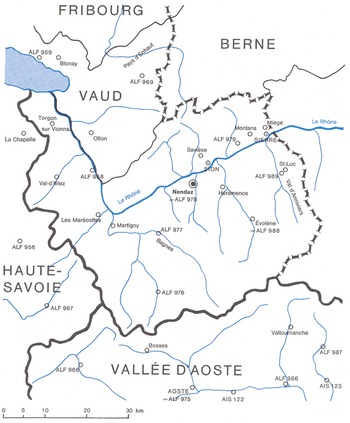
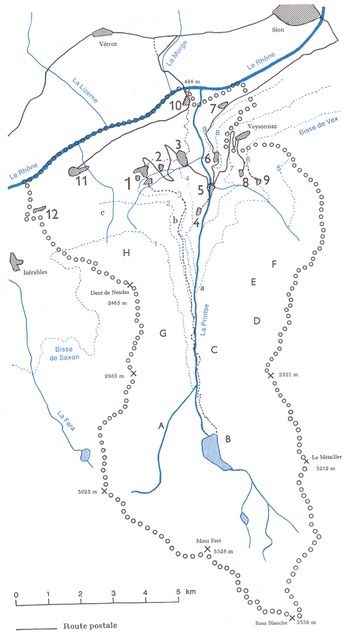


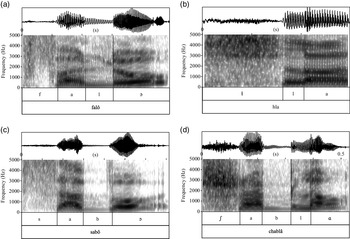


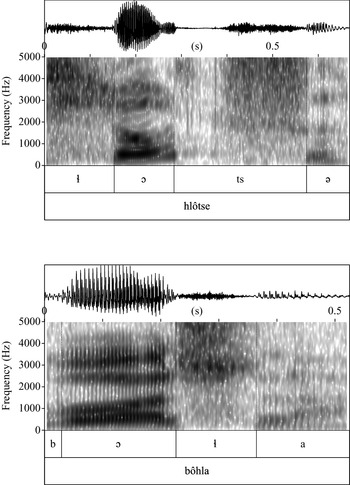


 Open access

