


Trigeminal neuralgia (TN) is an uncommon, but well-described phenomenon in patients with multiple sclerosis (MS). It is estimated to occur in up to 6% of MS patients,Reference Putzki, Pfriem and Limmroth 1 and is rarely the first symptom of disease. Although associated with a pathologically distinct disease process, MS-associated TN may be indistinguishable from classical TN. The medical community has been aware of the cooccurrence of these two diseases for more than 120 years.
Methods and Materials
The authors reviewed original publications regarding MS-associated TN. English translations from German and French publications were provided by one of the authors (PJK). Neurology textbooks with relevant descriptions were also reviewed, using either original or reprint editions. Contemporary studies regarding in vivo diagnosis were also identified for comparison.
Results
Descriptions of TN can be found as far back as ancient Greece, with a more complete clinical account being given by John Fothergill in 1773.Reference Pearce 2 More time would pass before the first pathological descriptions of MS surfaced in 1838 with the publication of Robert Carswell’s Illustrations of the Elementary Forms of Disease. Reference Compston 3 Clinical depictions followed in the ensuing years, culminating in Jean-Martin Charcot’s publications in the 1860s.Reference Compston 4 As disease recognition increased, TN and MS eventually crossed paths.
Renowned German neurologist Hermann Oppenheim (Figure 1) first noted “sensory disturbance in the quintus nerve” associated with MS in 1887, and highlighted the presence of sclerotic plaques in multiple cranial nerve structures, including the “ascending trigeminus root.”Reference Oppenheim 5 He did not describe TN at the time. In 1894, Oppenheim published his quintessential neurology textbook Lehrbuch der Nervenkrankheiten für Ärzte und Studirende (Figure 2). This contained the first description of TN in association with MS. In discussing pain symptoms in MS, Oppenheim observed:
The patient is often complaining of pain of stabbing, piercing, pulling character in the limbs, in the joint areas, in the intercostal region; but these are only rarely prominent among the complaints and hardly ever have the lancinating character. Uncommonly, they reach such an intensity in a determined nerve area, that one may speak of a neuralgia. In this way I observed a case, in which a trigeminal neuralgia belonged to the first and lasting symptoms of sclerosis, here at postmortem a sclerotic focus at the seat where the trigeminus leaves.Reference Oppenheim 6
Portrait of Hermann Oppenheim (1858-1919). Reproduced with permission from the collection of author CJB.

Title page of Hermann Oppenheim’s Lehrbuch der Nervenkrankheiten für Ärzte und Studirende, first published in 1894. From https://archive.org/details/lehrbuchdernerve00oppe.

Note that Oppenheim highlighted where the trigeminus exited the brainstem, whereas today we call it the trigeminal root entry zone. In the first English-language translations in 1900 and 1904,Reference Oppenheim and Mayer 7 , Reference Oppenheim and Mayer 8 translated from the second and third German editions of 1898 and 1902, respectively,Reference Oppenheim 9 , Reference Oppenheim 10 this concept was removed from the MS section of the textbook despite being retained in their German counterparts. The graphical depiction of a plaque affecting the trigeminal root remained in place, but the clinicopathologic association was not distinctly made. MS-associated TN was retained in passing in the neuralgia section, which noted “neuralgic symptoms occur sometimes in multiple sclerosis also; I saw a case in which a severe trigeminal neuralgia was one of the first symptoms,” and later commenting as part of a list of etiologies of TN about “sclerotic processes at the places of exit of the trigeminus.”Reference Oppenheim and Mayer 7 , Reference Oppenheim and Mayer 8 The 1911 English-language third edition subsequently reconciled the clinicopathologic association more distinctly within the MS section, similar to all of the earlier German editions.
Oppenheim’s description of MS-associated TN was unique in that it not only outlined the clinical entity, but also pathologic findings, including a graphic depiction (Figure 3). Other clinical cases were reported in the first part of the 20th century by multiple authors (Table 1).Reference Berger 11 - Reference Harris 15 These were all primarily limited descriptions of single or small numbers of patients. Of these, only Marburg in 1906 described an associated demyelinating plaque, stating, “…the trigeminus showed the same foci as in the central nervous system.” Marburg commented that his case revealed the same pathologic findings at the trigeminal root entry zone that Oppenheim’s original patient did, citing the 1905 edition of Oppenheim’s Lehrbuch der Nervenkrankheiten.Reference Marburg 12
Sclerotic lesions in the pons; one at the trigeminal root entry zone (arrow inserted by the authors), from sections stained by the Weigert method.Reference Oppenheim 6

Notable early descriptions of MS-associated TN
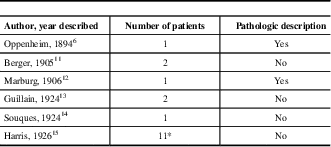
* Harris described 17 patients with TN and “chronic spastic paraplegia,” of which he was confident that 11 had multiple sclerosis
In 1928, Harry Lee Parker, an Irish neurologist practicing in America, published a series of four patients with MS-associated TN.Reference Parker 16 One patient died suddenly following sectioning of the left trigeminal nerve to treat his pain and went to autopsy. Parker reported the findings:
As traced upward each root took the myelin stain well and did not seem at all degenerated, but just at the point of emergence of the left root two plaques appeared and engulfed its fibres. On the right side the root seemed normal. Study of the left root in its extrapontine course showed that the sclerotic process extended outward a short distance within its substance, and then the root became seemingly normal again up to the point of its severance by the surgeon…Reference Parker 16 (Figure 4)
Photograph of the pons from Harry Lee Parker’s 1928 description of multiple sclerosis and trigeminal neuralgia. Parker stated, “Section through the pons at the level of the emergence of the left trigeminal nerve root. Two plaques are to be seen invading the emerging fibres of the root [arrows inserted by authors]. The right fifth nerve root at this level is normal.”Reference Berger 11

The left trigeminal sensory nucleus was normal. Parker also found a sclerotic plaque in the upper cervical spinal and lower medullary portions of the right trigeminal descending tract and nucleus. In addition, there was a plaque that enveloped and surrounded the right trigeminal sensory nucleus, but its nuclear cells were intact. The right trigeminal root entry zone was without plaque. The patient did not experience right-sided symptoms. Similar to Marburg, Parker also credited Oppenheim with the first description of MS-associated TN, but instead referenced the 1911 English edition of Oppenheim’s book, entitled Textbook of Nervous Diseases for Physicians and Students.Reference Parker 16 This 1911 English edition was translated from the 1908 fifth edition of Lehrbuch der Nervenkrankheiten.Reference Oppenheim and Bruce 17
Wilfred Harris perhaps had more experience in the diagnosis and treatment of TN than most, if not all, of his contemporaries. Harris was an English neurologist with special interest in TN (as well as early English silver spoons). 18 In 1950, at the age of 81, he published his experience with nearly 2000 cases of TN.Reference Harris 19 He expounded on 1622 cases in particular, outlining that approximately 4% of these were MS-associated TN. Harris hypothesized that sclerotic plaques within the descending trigeminal nucleus of the brainstem acted as an “added source of irritability” in instances where patients had concurrent dental infections, thereby resulting in TN.Reference Harris 20
Harris also acknowledged Oppenheim’s description of a sclerotic plaque at the “exit” of the trigeminal nerve, like Parker referencing the 1911 English edition Textbook of Nervous Diseases.Reference Harris 15 Despite his belief in the necessity of a central lesion, Harris did recognize the importance of peripheral generators, opining, “if the lesion causing this neuralgia is on the central side of the Gasserian ganglion, it is difficult to understand how such cases can be relieved by alcohol injection performed at the foramina of exit…from the skull.”Reference Harris 15
The concept of MS-associated TN has not been without controversy. Charles Frazier, a prominent American neurosurgeon, published more than 2100 cases in 1934. He did not implicate MS as a cause in any of his patients.Reference Frazier 21 In the 1940 classic text Neurology, Samuel Alexander Kinnier Wilson acknowledged the observations of multiple authors, as well as his own observation of “at least a dozen personal cases” of MS-associated TN. At the same time, he remained skeptical of their relationship:
I am far, indeed, from being convinced that every case of this conjunction belongs to the class of polysclerosis … A sclerotic plaque was found by Oppenheim in his case at the point where the fifth emerged from the pons (and also by Parker), though the lesion can scarcely account for the symptom.Reference Kinnier Wilson and Bruce 22
By the 1960s, more than 130 cases of MS-associated TN had been reported in the literature, though few had descriptive pathology.Reference Mallin 23 Demyelination at the site of the trigeminal nerve root entry zone, as first described by Oppenheim in 1894, subsequently became much easier to identify as magnetic resonance imaging gained popularity through the 1980s and 1990s, and is considered potentially causative for TN either alone or in combination with other pathology, including vascular compression.Reference Gruccu, Biasiotta and Di Rezze 24 , Reference Truini, Prosperini and Calistri 25 With this in mind, MS-associated TN with coexisting vascular compression may be significantly helped with microvascular decompression, but with lower success rates compared to TN without coexisting MS.Reference Broggi, Ferroli, Franzini, Servello and Dones 26
Discussion
TN is a long-recognized complication of MS. Oppenheim has been credited as first describing the association, either in 1905Reference Marburg 12 or 1911,Reference Harris 15 , Reference Parker 16 , Reference Mallin 23 with all authors referencing his Lehrbuch der Nervenkrankheiten or its English-language counterpart despite the association being mentioned in the 1894 first edition. Several more editions were published through the early 20th century, with the 1908 German fifth edition being translated into English in 1911. This was a very prominent neurology text, and over time was additionally translated into Russian, Spanish, and Italian. The book was so influential that when asked if he would write a textbook of his own, American neurologist William Gibson Spiller commented, “When I can write a better book than Oppenheim’s, I’ll do so.”Reference Pearce 27
Oppenheim (Figure 5) was born in Warburg, Westphalia (now part of Germany) in 1858. He completed his medical degree in 1881, primarily through studies at the University of Bonn. By 1883, he settled into practice at the Charité in Berlin. Oppenheim was favored to succeed Carl Westphal after his death in 1890, but the appointment was denied by the Prussian Secretary of Education, largely believed to be due to anti-Semitism.Reference Pearce 27 Oppenheim instead left the hospital and established his own practice. His private clinic would be influential in the neurologic education of a number of physicians training in Europe.Reference van Gijn 28
Hermann Oppenheim at his desk. Reproduced with permission from the collection of author CJB.

It is notable then that a number of German authors made mention of the MS-TN association early in the 20th century.Reference Berger 11 , Reference Marburg 12 , Reference Fritsche 29 It is possible that because Oppenheim was a prominent European neurologist, other continental neurologists, and particularly German neurologists, received the disseminated knowledge either from Oppenheim himself or his pupils. Marburg specifically is known to have trained with Oppenheim.Reference Triarhou 30
The 1911 English translation by Alexander Bruce of the fifth edition of Nervenkrankheiten was more comprehensive and faithful to the German edition than the two prior English translations of 1900 and 1904 (from the second and third German editions, respectively).Reference Oppenheim and Mayer 7 , Reference Oppenheim and Mayer 8 For example, in the 1900 and 1904 English editions, translator Edward Mayer failed to include Oppenheim’s comments about TN being associated with MS secondary to a plaque at the trigeminal root entry zone in the multiple sclerosis section of the textbook. Meyer translated only that “neuralgic pains are often present” in the MS section,Reference Oppenheim and Mayer 7 , Reference Oppenheim and Mayer 8 and decided to leave out the following sentence, which we have translated: “In this way I observed a case, in which a TN belonged to the first and lasting symptoms of sclerosis, here at postmortem a sclerotic focus at the seat where the trigeminus leaves.”Reference Oppenheim 9 , Reference Oppenheim 10 The 1911 English version, and the 1894 original, were listed by the historian of neurology Lawrence C. McHenry, Jr., as “classical, original, and standard works in neurology.”Reference McHenry 31 The other two English translations did not make this list. McHenry described the 1894 and 1911 books as landmarks in neurology.Reference McHenry 31 The influence that the 1911 English edition had on the neurologic community may explain why Wilfred Harris and Harry Lee Parker considered this as an early description. While all of these authors were correct in giving Oppenheim priority as the first to describe the entity, in reality this description occurred in the 1894 first edition of Nervenkrankheiten, much earlier than credited.
Limited pathological descriptions followed, and some disputed the claimed association.Reference Frazier 21 , Reference Kinnier Wilson and Bruce 22 With the advent of magnetic resonance imaging, more extensive evaluations of TN could be performed in living patients. Advanced imaging may show dual pathology contributing to TN etiology in MS patients, including vascular compression,Reference Gruccu, Biasiotta and Di Rezze 24 , Reference Truini, Prosperini and Calistri 25 and lower success rates of microvascular decompression in MS patients suggest that demyelination can serve as a primary TN etiology.Reference Broggi, Ferroli, Franzini, Servello and Dones 26 These in vivo studies have lent support to Oppenheim’s description a century later.Reference Gass, Kitchen, MacManus, Moseley, Hennerici and Miller 32 , Reference Chen, DeSouza, Hayes, Davis, O’Connor and Hodale 33
Disclosures
The authors do not have anything to disclose.
Statement of Authorship
DBB was involved in conceptualizing the study, collection and interpretation of data, drafting and revising the manuscript, and approving the final version. PJK was involved in translation and interpretation of data, revising and manuscript for intellectual content, and approving the final version. CJB was involved in conceptualizing the study, collection and interpretation of data, revising the manuscript for intellectual content, and approving the final version.



