

It stopped COVID, it stopped everything.
–Donald Trump, inspecting a section of concrete wall on the US-Mexico border, 23 June 2020Footnote 1Pandemics are imbued with the politics of bordering. For centuries, border closures and restrictions on foreign travelers have been the most persistent and pervasive means by which states have responded to global health crises. The ubiquity of these policies is not driven by any clear scientific consensus about their utility in the face of myriad pandemic threats. Instead it is a reflection of their palliative impact on societies predisposed to express concern about that which is foreign in times of crisis. In this way, the pervasive use of external border controls in the face of the coronavirus reflects growing anxieties about border security in the modern international system.
Pandemics reveal national character under radical uncertainty. Leaders may decide to rewrite their crisis playbook or may deploy well-worn tropes that have provided reassurance in the past. The COVID-19 crisis has supplied plenty of evidence of the latter. Under uncertainty—and despite the recommendations of global health authorities—states that had already chosen to invest in border security have, on average, doubled down on that response to the pandemic. The politics that produce border security as a proper response to external threats have guided the COVID-19 response in many states as well. In this respect, pandemics—no less than migration waves or terrorist attacks—involve border politics.
As evidence of this claim, we analyze states’ initial policy responses to the coronavirus spread. Borrowing from the interdependence literature, we consider policies of external versus internal adjustment. Policies can focus on externalizing the costs of pandemic control (by restricting travel and closing borders, for example) and/or they can internalize these costs (by regulating social distance, contact tracing, and regulating where and how many people gather). In responding to the coronavirus pandemic, states have enacted a panoply of protective policies, but none more pervasive or persistent than international border controls.Footnote 2 Political leaders clearly attempt to frame the options and to manipulate public opinion. For some, borders become a political resource and securing them is the policy of choice. Such impulses are conditioned by the underlying script states follow when they embrace or filter The Other.
The COVID-19 pandemic is a rare opportunity to examine national politics in response to a (nearly) exogenous transnational shock. Pandemic politics provide subtle but suggestive evidence of international borders’ important domestic role. As border scholars, we are especially concerned with how pre-existing routines of border governance influence the balance between policies of internalization and externalization. The initial policy mix is highly informative for understanding how international bordering is used to cope with major transnational shocks. States that have invested in the symbols and structures of border security are likely to respond to a pandemic with international travel restrictions, border closure, and potentially even international defection. And though there is no necessary tradeoff, the comfort states take in externalizing and scapegoating may undercut the national will to fight a pandemic from within.
For these reasons, we examine responses to the coronavirus pandemic through the lens of border politics. The first section demonstrates how common such externalization strategies are historically. Cooperative international efforts germinated in the nineteenth century but have been notoriously difficult to maintain. Hardening international borders in the face of perceived health threats is historically states’ first (and sometimes only) move. The second section makes the case that domestic publics tend to be amenable to externalization strategies, and many politicians find it easy to oblige. We argue that this urge to close borders is often better characterized by political calculations made at a time of uncertainty and fueled by fear, rather than responsive to the scientific evidence alone.
The third section is the empirical heart of the paper. Here we present a preliminary foray into the evidence connecting border governance, internal mitigation policies, and externalization through border restrictions. We suggest that pre-existing scripts for security tend to resurface in the face of pandemic uncertainty: physical border investments are strongly associated with border restrictions in the face of the COVID-19 pandemic, but are weakly, perhaps even negatively associated with stringent internal mitigation strategies. These trends—and the variation around them—inform a much richer understanding of the broad ramifications of domestic and international border politics. We conclude that the coronavirus crisis underscores a need to refocus the international relations literature on broad issues of border governance currently salient in many parts of the world.Footnote 3 In terms of policy, closed borders and unilateral action are poor substitutes for international cooperation and meaningful domestic health policies.
Border Control and Closure: The Historical Pandemic Policy Default
Pandemic threats require sudden and consequential decision-making by state leaders. Which types of policies are most likely to reduce the spread of the disease? Should actions be taken internally, at international borders, or both? How are the public health benefits weighed against their economic impact? The answers to these questions should depend first and foremost on the nature of the biological threat, its etiology, mode of transmission, fatality rate, and the capability of modern medicine to reduce its impact on the affected. At the time of outbreak, however, policy makers are operating with incomplete information as the scientific community works rapidly to better understand the threat. As a result, state leaders reach for tools through which they can most readily assert authority. For the past several centuries, this has meant controls at territorial borders.
The historical record provides clear evidence that pandemic responses have been concentrated at the territorial borders of political authority. The term “quarantine,” for example, originates from the Italian quaranta giorni or forty days, the amount of time foreign ships were required to anchor offshore during the fourteenth century outbreak of the bubonic plague. Italian city states continued to use systems of armed patrol ships, observation posts, and horse patrols to enforce disease controls that lasted until the 1850s.Footnote 4 Prior to the nineteenth century, countries often responded to pandemics through unilaterally applied and often redundant quarantine measures, whose inefficiency threatened international trade routes.Footnote 5 Responses to two devastating cholera outbreaks in the mid-nineteenth century and outbreaks of yellow fever in North America were also notable for their emphasis on combatting transmission through focused measures taken at the edges of each state's territorial jurisdiction.
This pattern of responding to pandemics through increased border control has persisted for centuries. A series of international conferences and conventions aimed at coordinating containment efforts focused on the use of quarantine measures, despite a dearth of scientific information to inform whether such measures would prove effective. Four international public health organizations were formed between 1850 and 1951,Footnote 6 marking a new scientific and public health information sharing and monitoring function but retaining their at-the-border focus.Footnote 7 These measures almost always prioritized state authority. This “Westphalian system of public health” coordinated quarantines to protect trade rather than public health and was carefully calibrated to protect territorial sovereignty.Footnote 8 Border regions remained focal for pandemic control, even though the effectiveness of these measures remained speculative.
Some militarized approaches have moderated over the years. For the most part states have abandoned the extreme cordons sanitaires—the use of military troops to contain disease at the border—used by France in the Pyrenees in 1821 in the face of an aggressive fever, at the border between Poland and Russia in 1918 to stop typhus from spreading west, and most recently during the Ebola outbreak in West Africa in 2014.Footnote 9 Diseases thought to be uncontrollable were not targeted by border measures. Richard Cooper relates how the international organizations of the twentieth century largely ignored diseases that could not be quarantined, in addition to those like smallpox, which were assumed to be universal.Footnote 10
Some scholars have observed important turning points in the latter part of the twentieth century. The League of Nations’ specialized agencies were reputed to have performed better than its security organs, but beyond some localized successes (notable for their time) had limited health impact.Footnote 11 In 1948 the World Health Organization (WHO) was founded and in 1951 it passed International Sanitary Regulations which created a single but narrow set of rules for quarantine.Footnote 12 The idea was again to control disease with a minimum of interference with world travel and trade.Footnote 13 These rules were expanded into the International Health Regulations (IHR) in 1969Footnote 14 and again in 2005Footnote 15 to cover a growing range of diseases and risks. The IHR also called on WHO members to buttress public health capabilities at ports and airports “in ways that are commensurate with … public health risks and which avoid unnecessary interference with international traffic and trade.”Footnote 16 Notably, the IHR has had difficulty anticipating the internal measures that would be appropriate for novel public health threats.
Multilateral accomplishments in pandemic control were modest for most of the twentieth century. The eradication of smallpox, which was responsible for some 300 million deaths worldwide during the twentieth century, was no small feat but was more of a Third World intervention led by the superpowers than a broader cooperative response.Footnote 17 Not until the AIDS epidemic of the late 1980s and the SARS outbreak of 2003 did interstate organizations actively promulgate internal measures to combat novel pandemics, often at the behest of non-state actors.Footnote 18 Development support for domestic pandemic control replaced some of the singular emphasis on international borders as a control strategy. To some observers, the WHO's more active role signaled a turning point. According to David Fidler, “The SARS case study not only illuminates governance shifts in public health but helps highlight changes that may be occurring to the general structure and dynamics of international relations in the era of globalization.”Footnote 19 Even so, no state has surrendered or even significantly pooled its sovereignty over public health. Some even go as far as Indonesia to assert “viral sovereignty”—the right to any medical developments that are made on the basis of a flu strain originating within their territorial jurisdiction.Footnote 20 Clearly, and in light of recent allegations of Chinese noncooperation and US withdrawal from the WHO, it is premature to pronounce the death of a “Westphalian” model of pandemic policy response.
Almost every analysis of the global response to pandemics mentions state sovereignty and social sensitivities over public health issues. Hygiene, norms of contact, trust in science, and personal rights and privacy are often fraught social issues, yet disease control may require domestically costly changes in beliefs and behavior. Lack of (or resistance to) scientific knowledge has made it easier to rely on border controls than on internal mitigation strategies. We believe a case can be made for the attractions of border security in the case of COVID-19, especially for states invested in a narrative of the need for defense at the border.
The Case of COVID-19
Border policies have been a big part of the response to containing viruses that know no boundaries. But why? In this section we set the stage for an answer. Our central claim is that despite the intensification of globalization, and (often) despite scientific evidence, unilateral border control is a very tempting tool for sovereign states to wield in the face of a pandemic. A remarkable 186 countries responded to COVID-19 with external border restrictions, targeting travel from an average of 163 countries.Footnote 21 By contrast, only 127 countries have enacted social distancing provisions, and often with much weaker enforcement.Footnote 22 Land borders have also been particularly focal. By our count, ninety-two countries had fully or partially closed their land borders by 24 March 2020. Even the internal borders of the European Union saw a return to border controls rare since the establishment of the Schengen Zone.Footnote 23 Rhetorical bordering is also on the rise with several state leaders speculating about the foreign origin of the virus, often in derogatory terms.
Such an overwhelming response might be understandable if science spoke with a clear voice about border restrictions. However, the choice to institute border controls and closures are not generally driven by the data. A review of the scientific evidence available before the COVID-19 outbreak suggests that border controls, as they are generally implemented, are a rather ineffective way to control pandemics.Footnote 24 Most of these studies demonstrate that controls at the border must be implemented very early in the spread of the pandemic—often well before the available evidence clearly indicates a threat. Studies have shown that social distancing is more effective than border controls for delaying the peak of pandemic infections.Footnote 25 There may be a limited case for small isolated island states such as New ZealandFootnote 26 or Taiwan, but border closure alone has not been shown to be effective and has been recommended against by the World Health Organization.Footnote 27 In short, even though travel bans and border restrictions are of limited utility—very stringent ones at best buying a week or so to put domestic measures in placeFootnote 28—they are the policy of choice in most countries around the world.
Pandemics and the Problem of Uncertainty
Why reach for border restrictions? One reason is that pandemics almost always introduce radical uncertainty into decision making. Experience bears this out. The emergence of the novel H1N1 virus compounded a list of unknowns: the scale of the problem, the range of (initially) small-scale trade-offs, uncertainty around detection and treatment, and of course the probability that modest numbers of cases will result in widespread outbreak.Footnote 29 And what is learned from previous experience is not always relevant across the range of pandemic cases; influenzas alone involve so much genetic variation that it is difficult to predict their behavior, leading virologists to characterize pandemic influenzas as “certain uncertainties.”Footnote 30 Importantly, uncertainty has consequences for whether, when, and which policy actions are taken. Uncertainty was probably a central reason for official decisional paralysis in the Ebola crisis, for example.Footnote 31
Then there are the uncertainties introduced by governance structures and policy communication. Whether uncertainty is acknowledged can differ across governance levels, illustrated by the confusion between federal state and local authorities in the United States, Mexico, and Brazil, not to mention among the member states of the EU and the European Commission.Footnote 32 Communicating uncertainty is a sensitive policy problem: to frankly admit uncertainty can undermine public confidence.Footnote 33 One study found that the communication of uncertainty undermined collective action by “personalizing” responses to pandemic risks.Footnote 34 Others have emphasized that the first-order problems associated with scientific and policy uncertainty are compounded when they reverberate throughout the economy,Footnote 35 rendering the assessment of trade-offs even more problematic.
International borders are a handy heuristic for decision-making under uncertainty. They are focal and represent authoritative national power. Restricting them tends to impose lower costs on residents than internal restrictions on movement or business closures. Border restrictions are in this sense a good political bet for most leaders: they are fast and frugal.Footnote 36
Border Anxiety—a New Pandemic?
Why and under what conditions are border restrictions considered a prudent policy choice? One possibility is that publics and politicians have been priming a narrative of “dangerous others.” Contagious foreign disease is just one more example of the broad and deep border anxieties that we have seen evidenced across a spectrum of issues over the past few decades.Footnote 37 This anxiety has been on display, for example, in debates in the United Nations General Assembly, where border issues are drastically on the rise as a proportion of all official public discourse, and have trended decisively negative over the past decade.Footnote 38 It is possible that the general anxiety around non-state forces at the border has simply been reproduced as a motivated response to the COVID-19 pandemic.
Border anxieties are also reflected in changes to the built environment along international borders. It is well known that states have constructed walls and fences along these zones.Footnote 39 Border crossings increasingly bristle with the infrastructural capacity to filter a broad range of threats—from smuggled goods to unwanted migrants to local militias and neighboring militaries. Land borders provide a stark visual impression of this development. Figure 1 displays the thickening of filtering capacity at the US-Mexico border over two decades, but the trend is worldwide. Satellite and high-altitude imagery reveal the uneven but unmistakable build up of official buildings, gates and barriers, and pull-out lanes where pedestrians and vehicles can be held for inspection.Footnote 40
Example of the build-up of “filtering capacity” at the US-Mexico border near Laredo/Nuevo Laredo in 1995 (top left), 2002 (top right), 2010 (bottom left), 2015 (bottom right)
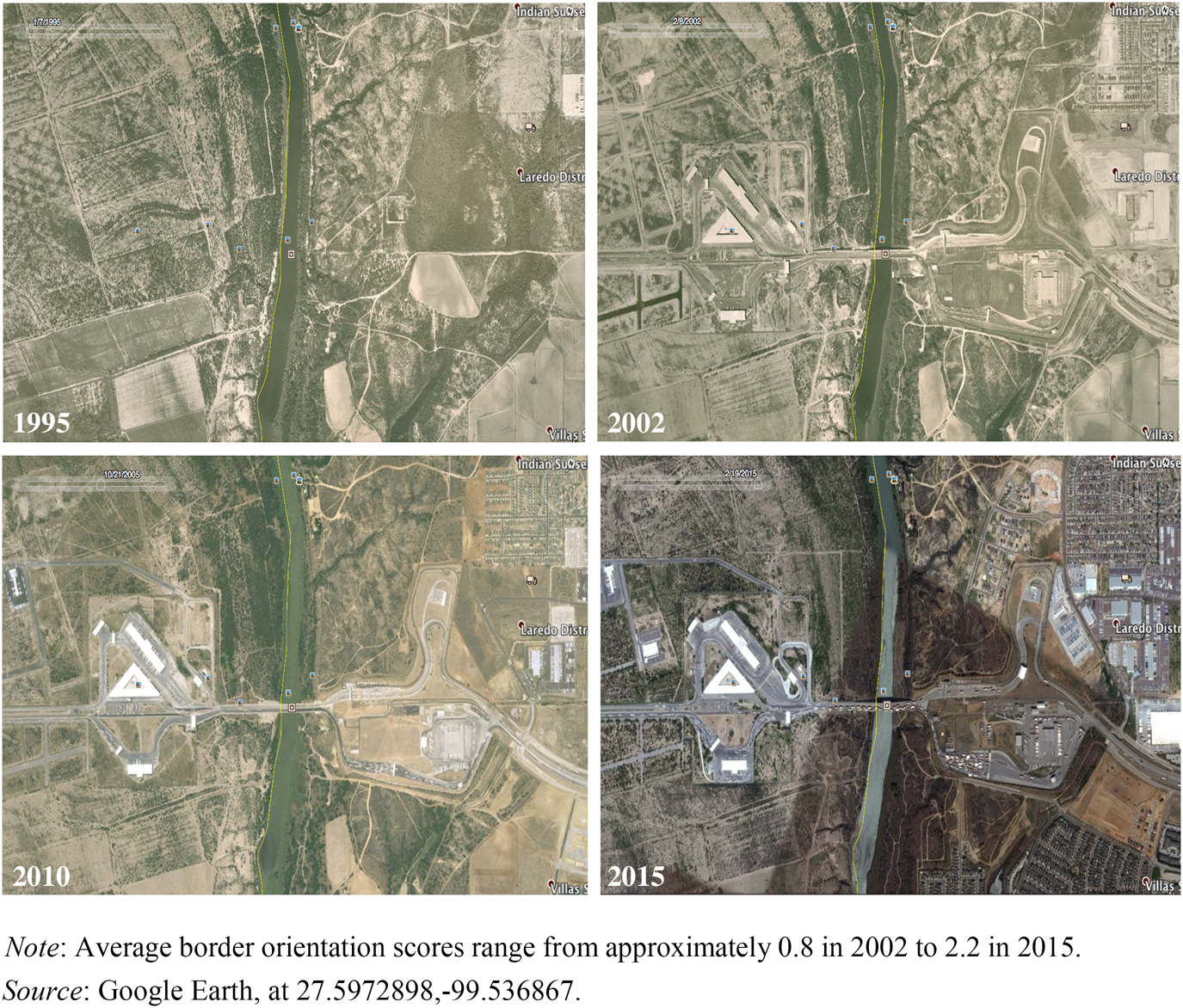
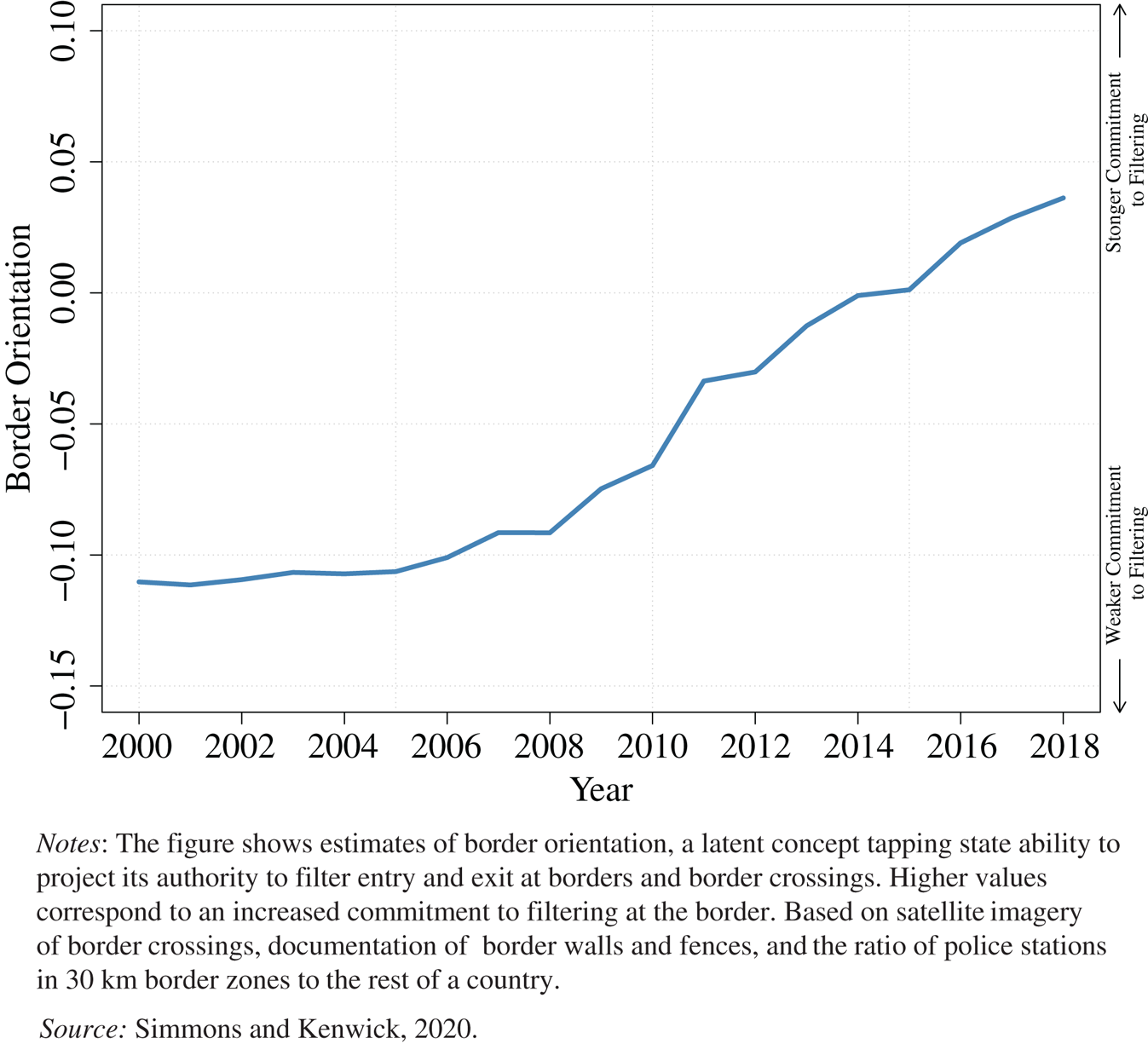
The erection of walls, police stations, and filtering infrastructure at interstate borders demonstrates how focal borders have become for enacting national security policies. The concept of border orientation helps to summarize this trend over time and space.Footnote 41 It taps the extent to which the State is committed to filtering the movement of goods and people into and out of its territory. Border orientation ranges from very permissive, where few means are taken to project control of state borders, to very controlling, where countries make large investments to assert control over ports of entry and the border region. Like many political traits, border orientation is latent and cannot be observed directly; it can, however, be inferred based on the physical investments manifest in the built environment. In our previous work, we have generated an estimate of border orientation using a latent variable modeling framework based on: (1) whether a country has built inspection facilities along roads crossing international borders,Footnote 42 (2) whether a country disproportionately polices its borders relative to the interior region, and (3) whether a country has built border walls facing its neighbors.Footnote 43 The scores generated by a latent model of observed infrastructural investments represent a commitment to display authority at the border, with higher scores representing more controlling border orientations.
Over the past twenty years, countries have increasingly displayed controlling orientations, reflecting a concern about real and perceived threats across international borders. As displayed in Figure 2, we estimate that average border orientation has increased over the past two decades, with an inflection point that coincides with the 2008 financial crisis.Footnote 44 This growth indicates that countries were already primed to see their borders as a means of defense even before the risk of transnational contagion emerged. Not only have border closures spread more quickly than the virus did across borders, we are also seeing more unilateralism and fewer attempts to coordinate internationally than we did in previous historical eras. It is perhaps no wonder then that the “post-Westphalian” at-the-source responses Fidler associated with AIDS and SARS have given way to retrenchment.Footnote 45
Average global border orientation is intensifying, 2000–2018
Borders are focal for pandemic policy, since they are an “obvious” starting point for a state to exert its authority.Footnote 46 Border controls satisfy the need to do something quickly, decisively, and without raising questions of a state's legitimate right to act. This is clearly not true for actions taken by the WHO,Footnote 47 nor for internal regulations to stay home: witness the protests that have sprung up around the United States but also in Europe, South Asia, Africa, and the Middle East.Footnote 48 Border controls inconvenience relatively few nationals, yet satisfy the need for the State to appear to provide security. Meanwhile, border restrictions preserve possibly fictitious ideas that the threat is foreign, the State is competent, and the domestic population is and can be kept wholesome and healthy. For these reasons, border restrictions are attractive in a pandemic, especially for states that have invested in the symbols and structures of control.
Public Opinion: Demand from Within
While border orientation is a characteristic of states, it often has a foundation in the fears and anxieties of the public. How does mass opinion about border politics set the stage for pandemic response? It is often much easier to sell externalized adjustments through border restrictions to domestic audiences than it is to sell them orders to cancel activities, socially distance, and stay at home. Not to mention those emasculating masks!Footnote 49 Publics experience many of the same uncertainties and anxieties that their leaders do. In addition, they can readily be primed to accept border closures by leaders who are incentivized to engage in blame avoidance by framing pandemics as foreign invasions.Footnote 50 Under these conditions, externalization is likely to be an easier sell than tough internal mitigation measures.
Available polls bear this out. Polls conducted in mid-March 2020 across twelve countries and sampling 12,000 people show that significant majorities—some reaching 80%—support border closures as a response to the COVID-19 pandemic (Figure 3). Such high figures are surprising given the wording of the question: “We should close the borders of [my country] and not allow anyone in or out until the virus is proven to be contained.” (Emphasis added.) Sixty-two percent of Americans agreed with this statement, even though it was worded to include a self-restriction (anyone). That proportion is about as high as support for border restrictions on migrants (not citizens) right after the 9/11 attacks.Footnote 51 People appear to favor even stronger border restrictions in the current pandemic than they did following the dramatic terrorist attacks in 2001.
Public opinion in twelve countries on border closure as a response to the COVID-19 pandemic, March 12–14, 2020
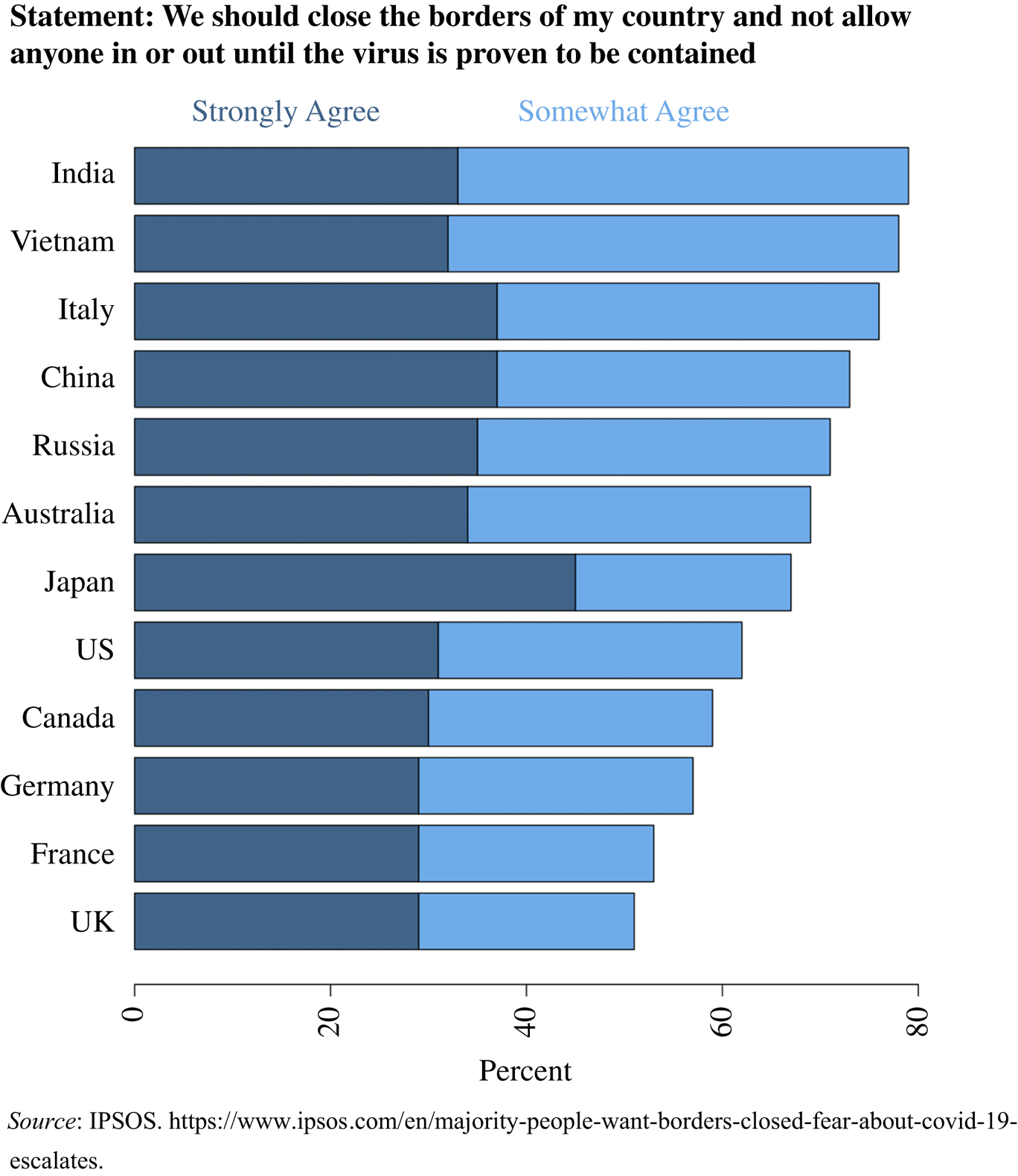
At the time these polls were taken, mid-March 2020, the United States already had about 1,300 confirmed cases and forty COVID-19 deaths within its borders. The virus was already within US borders. Almost all scientifically informed advice was that it was imperative to implement serious internal mitigation measures. Nonetheless, within three days of the poll, the United States government closed the Mexican and Canadian land borders (despite lower infection rates and deaths in those countries) to all non-essential traffic.
Extremely high majorities of the American public—about eight out of ten—favored travel bans against China and Europe in late March of 2020. Fewer—but still a majority—supported school closures and cancelling events, but of the 26% who said these internal measures were an overreaction, nearly three-quarters still supported travel bans.Footnote 52 Despite clear evidence that the virus was already in the US, and as news of its spread mounted, more Americans favored travel bans than domestic mitigation policies.
Of course, we do not view domestic attitudes about border restrictions as independent of elite cues and national politics. The need to externalize can be stoked by divisive rhetoric and nationalism. In some cases, public health policies become securitizedFootnote 53 in familiar ways. War allusions have peppered the speeches of leaders from the Queen of EnglandFootnote 54 to the US presidentFootnote 55 to the Secretary General of the United Nations.Footnote 56 Policy responses have in many cases displayed traces of such militarized rhetoric. Arguably, the securitization of pandemic influenza since the mid-1990s has resulted in policies “driven by national priorities and not the need for a coherent global public health response,”Footnote 57 among them border closures, especially by states whose authority was already cast to enhance border control.
In many countries, public opinion demands border protection in the face of the inherent uncertainty pandemics bring. A growing number of states are prepared to accommodate these fears with the authoritative symbols and structures of border security. The combination has consequences for how states have responded to the COVID-19 pandemic, as we will illustrate.
Border Closures and COVID: An Empirical Investigation
The COVID-19 pandemic has brought together the demand for protection from “foreign” virus threats with the supply of authoritative investments at the border to torque policy responses away from internal adjustments and toward externalization in the form of border closures. To illustrate the plausibility of at least the supply half of this claim, we use border orientation as a key explanatory variable, and rely on data provided by the Oxford COVID-19 Government Response Tracker as the dependent variable.Footnote 58 This response tracker records information on whether and when governments have enacted various policies to combat COVID-19. At present, the data range is from 1 January to 17 June 2020. While these data are clearly not suitable to make broad claims about how the COVID-19 crisis will be resolved, they are uniquely suited to exploring states’ initial responses.
We make use of two measures derived from these data. First, to identify measures directed primarily toward foreign populations, we rely on the data set's international travel control indicator, which includes five ordered categories: no measures taken, screening, quarantine arrivals from high-risk regions, ban on arrivals from some regions, and ban on all regions or total border closures. While these measures impact both foreign populations and citizens returning from abroad, they nevertheless approximate external control measures implemented at international ports of entry.Footnote 59 Second, we construct a weighted average of the internal measures countries take to mitigate the domestic spread of the virus. These include school closures, workplace closures, cancellation of public events, restrictions on gatherings, closure of public transport, stay at home requirements, restrictions on internal movement, and public information campaigns.Footnote 60 Although the external control index is an ordinal five-point scale and the internal control index is virtually continuous, we transform each to range from zero, corresponding to minimum control, to 100, reflecting maximal controls. Comparing the stringency of response across these two dimensions approximates the balance of policies a country adopts that fall disproportionately on domestic and foreign populations.
Figure 4 displays the global mean values for internal and external control measures across time. While these two variables are measured on separate scales, their relationship to each other over time is telling. Countries responded to the global outbreak first with external controls, and only secondarily with internal control measures. That these external controls were often implemented at a time when the WHO recommended against their use further underscores the return to at-the-border controls as pandemic response, perhaps reflecting the intensifying concern about border security over the past two decades. However, this might also reflect a reasonable impulse to contain the virus before more painful mitigation strategies become necessary—after all, studies have shown that to be effective, restrictions such as travel bans must be imposed early.Footnote 61 Yet some countries continued to ratchet up external controls even after containment had failed, as did the United States at its land borders with Canada and Mexico. Figure 4 reveals that countries have eased external controls more slowly than internal controls. This evidence is consistent with the externalization processes described in the previous section—in times of pandemic, there is an inclination to disproportionately implement costly policies that affect international actors relative to domestic constituents.
External control measures are implemented faster and last longer than internal control

Our central claim is that pandemic policy is shaped by border politics. By this we mean by the prior degree of investment a country had previously made in bolstering its authoritative presence at international land borders (border orientation). While virtually all countries have now adopted some form of restrictions on international movement, they have varied considerably both in the time it took them to implement these measures, and, crucially, the extent to which they were paired with other policies to mitigate the spread of the virus internally (the policy mix). This is important because studies show that border control does little more than buy precious days to implement much more effective mitigation policies nationally. Descriptively, border politics shape this critical mix: countries otherwise highly concerned with border security investments are faster in adopting controls that target foreign travel, but this alacrity is not always mirrored domestically.
Figure 5 compares the average stringency of internal and external response measures to 2018 estimates of border orientation, with positive values corresponding to increased commitment to filtering movement along international borders. Border orientation is more highly correlated with the adoption of external measures (ρ = 0.395) than with internal control measures (ρ = 0.184).
Border orientation is more strongly associated with external rather than internal control measures to combat COVID-19
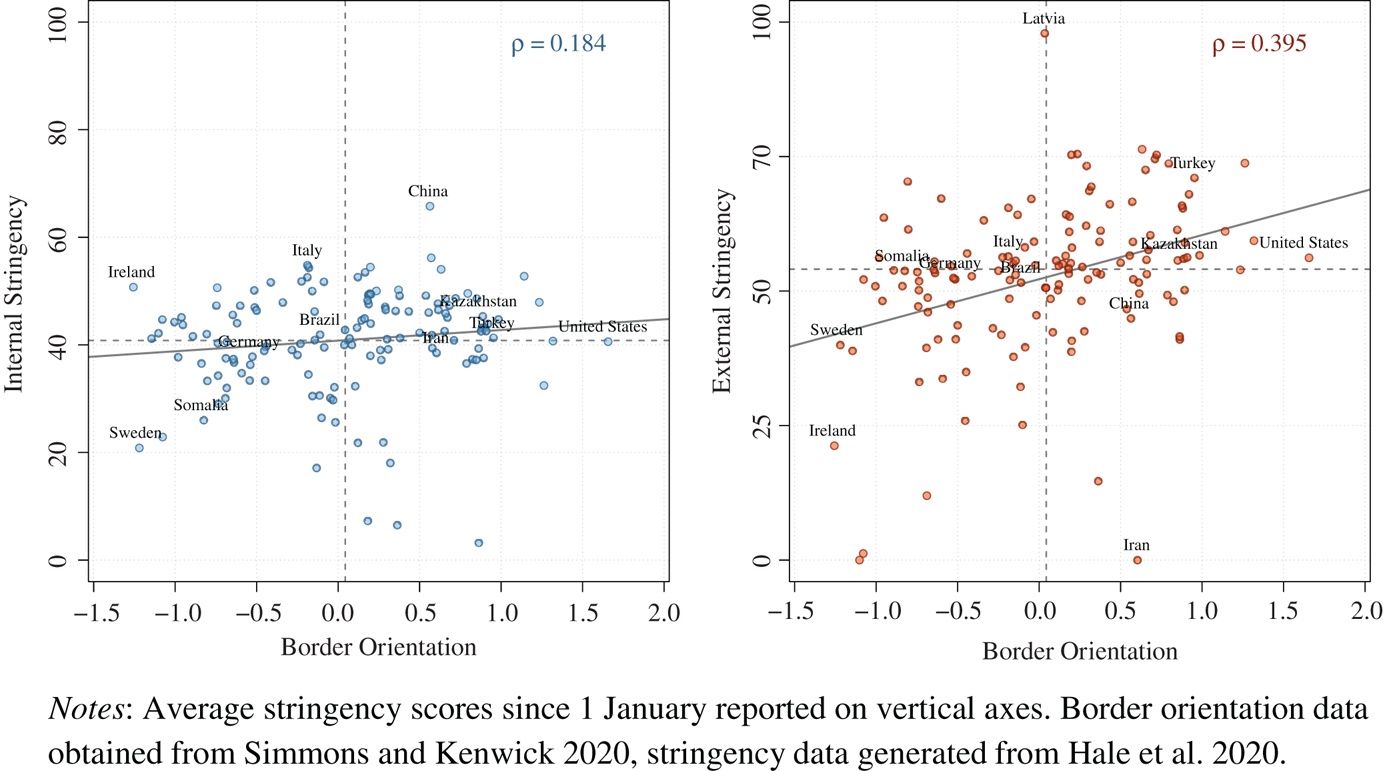
Figure 6 compares the average degree of internal and external stringency across time. The left panel compares internal stringency to the days preceding or since a country's first confirmed death to adjust for the degree of exposure to the virus. The right panel tracks calendar date since external measures are more responsive to the global, rather than to domestic outbreak. In the latter case, countries with more controlling border orientations (red) implemented external controls more quickly and maintained them for longer than countries with intermediate (black) or permissive (green) border orientations. By contrast, there is less variation in the application of internal control measures, and here these countries were slightly slower to implement restrictions in the early days of the virus, at least compared to countries with average border orientation scores.
Countries with controlling border orientations implement external controls more quickly relative to internal control measures

Several mitigating factors complicate the interpretation of Figures 5 and 6, the most obvious of which is that border orientation tends to covary with wealth. While there are notable exceptions, richer countries tend to invest more to project control over their borders than do lower income countries.Footnote 62 It is therefore difficult to disentangle whether some of the low-level responses observed among countries with permissive orientations (i.e., the green lines in Figure 6) were driven by a lack of will or a lack of capacity.
We therefore perform a simple regression analysis, reported in Table 1, to control for a small set of potential confounders. The dependent variable is the average stringency of COVID response measures throughout the observation period, with average internal stringency reported in models 1–4, and average external stringency in models 5–8. In addition to logged GDP per capita we report models that control for a country's liberal democracy score and its logged population.Footnote 63 We also include a quadratic interaction term for GDP to account for the fact that low-level responses to coronavirus have been observed at both low and high levels of the development spectrum.
Correlates of COVID-19 stringency measures

Notes: Intercepts omitted. *p < .05
The results present a striking picture. Across all model specifications, countries with prior investments projecting control over their borders were significantly more likely to implement rigid external control measures in response to the virus than those without such investments. By contrast, the relationship between border orientation and internal stringency is never significant. Mirroring Figure 5, when border orientation is run in a bivariate regression with the stringency of internal control measures, there is a positive, albeit insignificant association. After controlling for wealth, however, the association actually becomes negative, and remains so in all subsequent regressions.Footnote 64
That countries predisposed to displaying authority at their borders are more likely to implement external restrictions is perhaps not surprising, but that these measures were not paired with commensurate action at home points to two worrying possibilities. The first is that external controls may be either explicitly or implicitly seen as policy substitutes, a regrettable conclusion when the coronavirus has already permeated virtually every border in the world.Footnote 65 The second is that border orientation may be associated with externalizing public health adjustment costs onto foreigners, undermining beneficial transactions, stoking blame, and reducing possibilities for international cooperation in the future.
These results must be interpreted with caution—both the political and global health environments are still in flux, and policy responses are rapidly evolving. Nevertheless, this analysis is intended to characterize whether countries concerned with border security adopted externalizing policy responses to COVID-19, and indeed this appears to be the case. Additional testing is clearly necessary to isolate the causal mechanisms underlying these correlations and to explore any possible impacts of doubling down on border security for the future of global pandemic control.
Conclusion
When responding to the H5N1 virus, then-senators Barack Obama and Richard Lugar warned that “exotic killer diseases are not isolated health problems half a world away, but direct and immediate threats to security and prosperity here at home.”Footnote 66 How states respond to such “exotic killers” impacts millions of lives worldwide. One hopes that these responses are informed by science, but it is clear that they are formulated under uncertainty and shaped by fear. Leaders are paramount in providing appropriate information and assuaging these fears, but our research suggests that they are also likely to draw from some of the same narratives, symbols and capabilities in which the state has invested in the past.
Pandemic responses are imbued with border politics. States that have invested heavily in border security tend to want to redeploy those investments in fighting global pandemics. As we have shown, border anxiety seems to be on the rise worldwide. Residents in some states seem very willing to close borders before staying home, even though the virus is already spreading domestically. Under these conditions, closing an international border may assuage some anxiety at low personal cost.
We have argued that polities have latent traits that become manifest in their investments in the built environment along international borders. This border orientation is associated with a distinctive externally-focused response to pandemics. There is even some suggestive evidence that it may be associated with policy substitution—the avoidance of more effective domestic mitigation strategies. Much more research should be done to understand how narratives and structures from past border investments and security debates play into public health responses. The concept of border orientation is useful in this regard: it allows us to explore the extent to which states return to old scripts in the face of novel threats. Responses to this particular crisis may have been shaped as much by pre-existing anxieties as by scientific innovation. The concept of border orientation gives special insights into these choices.
Two broader points can be made about what scholars of international relations can learn about international borders from this global public health crisis. First, borders are not going away anytime soon. Long before the onset of the coronavirus pandemic, many scholars were grappling with the rise and apparent demise of globalization and its ramifications for the broader study of global politics and the neoliberal international order.Footnote 67 While it is too soon to make firm declarations about the full impact of the coronavirus pandemic, it seems to have accelerated trends toward border hardening that predate COVID-19. While the increased pace of movement wrought by globalization may one day return, it appears that the current pandemic has hastened movement away from international cooperation and reinvigorated a my-nation-first approach.
Second, we suggest that in addition to the traditional study of interstate border claims, researchers should view international borders as a potential domestic political resource. The current crisis shows how convenient it is, and how well it resonates politically, to assure domestic audiences that national leaders are taking prudent measures to protect them while minimizing the impact on daily life. International border politics is a useful tool in this regard. Clearly, border policies are at the nexus of comparative and international politics and involve security as well as political economy concerns. A better understanding of these policies will require both objective data and the application of intersubjective concepts.
Data Availability Statement
Replication files for this research note may be found at <https://doi.org/10.7910/DVN/J0PGNY>.
Acknowledgments
We are grateful for helpful comments from Michael Horowitz, Kathleen McNamara, Erik Voeten, and participants in the International Organization/University of Pennsylvania Perry World House workshop hosted in June 2020. For research assistance, we thank Jasmine Rawson and the Borders and Boundaries research labs at Rutgers University and the University of Pennsylvania.
Funding
This work was supported by the National Science Foundation, award number 1917573.



