



The consumption of sugar-sweetened beverages (SSB), which generally include soft drinks, fruit drinks and sports drinks, is increasing worldwide in youth and adults( Reference Kit, Fakhouri and Park 1 – Reference Barquera, Hernandez-Barrera and Tolentino 3 ). Many clinical studies have reported the link between high consumption of SSB and increased obesity and diabetes mellitus( Reference Hu and Malik 4 ). Recent epidemiological studies have shown that SSB consumption is associated with risk of the metabolic syndrome (MetS) in adults( Reference Barrio-Lopez, Martinez-Gonzalez and Fernandez-Montero 5 ). However, most studies on the association between soft drink consumption and the MetS have been performed in Western populations, although the prevalence of the MetS is rapidly increasing among Asian populations( Reference Chung, Ha and Lee 6 ). A few studies have been conducted in Asians( Reference Chung, Ha and Lee 6 , Reference Chan, Lin and Huang 7 ), but their cross-sectional designs could not conclude a cause–effect relationship between soft drink consumption and the risk of developing the MetS.
In Korea, dietary habits have gradually changed from a traditional diet to more a Westernised diet including meat and sweet foods such as desserts and sugary beverages( Reference Kim, Jo and Joung 8 ). Soft drink consumption is increasing in the Korean population( Reference Lee, Kwon and Yon 9 , Reference Ogden, Kit and Carroll 10 ), although the amount is still lower than that in Western populations. The Korea National Health and Nutrition Examination Survey found that sweetened beverage consumption has doubled from 58 to 101 g over the past 3 years, and soft drinks are the major source of sugar intake from processed foods among Koreans( Reference Lee, Kwon and Yon 9 ). Although soft drink consumption and the prevalence of the MetS are increasing among Koreans, no prospective study has been carried out on the relationship between soft drink consumption and incidence of the MetS.
Moreover, sex-specific associations between soft drink consumption and risk of incident MetS have not been examined, although sex difference has been suggested to play a role in the risk of chronic diseases including the MetS related to dietary factors( Reference Kang and Kim 11 ).
Therefore, we evaluated the sex-specific association between soft drink consumption and risk of incident MetS and its components, considering the influence of multiple lifestyle factors using data from the Korean Genome and Epidemiology Study (KoGES), which is a large community-based cohort study.
Methods
Study subjects
The KoGES, a large-scale, community-based cohort study, was initiated in 2001. Initially, the target population consisted of 10 030 Korean adults aged 40–69 years and living in Ansan (urban) and Ansung (rural) areas. All participants responded to a baseline examination (2001–2002) with questionnaires including demographic information, socio-economic status, lifestyle, dietary intake, medical history, health examinations and biochemical measurements. Follow-up examinations were performed every 2 years over a 10-year period (2009–2010). The present study was approved by the Institutional Review Board of the Korea Centers for Disease Control and Prevention (KCDC). Informed written consent was obtained from all participants.
Of the original 10 030 participants, participants without the MetS (n 7053) at baseline were included. We excluded participants who refused to participate in follow-up examinations (n 747), those who provided insufficient information (n 313), those who did not respond to dietary examination (n 59) and those who had CVD or cancer (n 137). After exclusion, a total of 5797 participants (3027 men and 2770 women) were included in the analysis during the 10-year period. A follow-up rate of 63·3 % was achieved, resulting in 33 269 person-years accrued. The average follow-up period was 5·7 years (68·8 months).
Dietary assessment
Trained dietitians examined dietary intake both at baseline and at the second follow-up examination (2005–2006) using a 103-item, semi-quantitative FFQ. The FFQ was developed and validated by the KCDC( Reference Ahn, Kwon and Shim 12 ). In the FFQ, participants reported the frequency and portion sizes of soft drink consumption during the past year. Soft drink consumption was estimated by the questions ‘How often do you consume soft drinks (carbonated beverages, e.g., Cola and Sprite)?’ for frequency and ‘How much soft drink do you consume at once?’ for portion size. The original responses for frequency included none or rarely, once/month, two to three times per month, one to two times per week, three to four times per week, five to six times per week, one to two times per d, three to four times per d and ≥5 times/d. The response options for portion size were as follows: 1/2 cup (100 ml), one cup (200 ml – one serving) and two or more cups (≥400 ml). For analysis, the nine response items were converted to frequency per week, and the serving per week was calculated on the basis of frequency and portion size (mean frequency/week×0·5 for 1/2 cup, ×1·0 for one cup, ×2·0 for two or more cups) and then categorised into four groups: none or rarely, <1 serving/week, ≥1 serving/week to <4 servings/week and ≥4 servings/week. Nutrient intakes were measured using a database developed by the Rural Development and Administration.
Health examination
Trained professionals conducted a comprehensive health examination under the KCDC protocol. Height and body weight were measured to the nearest 0·1 cm and 0·1 kg, respectively, with no shoes and while wearing light clothing. BMI was defined as weight (kg)/height squared (m2). Waist circumference (WC) measurements were repeated three times, and then averaged after measuring to the nearest 0·1 cm at the narrowest point between the lowest rib and the right iliac crest. Blood pressure (BP) was measured after participants had rested for more than 5 min in a sitting position (Baumanometer-Standby; W.A. Baum Co. Inc.)( 13 ). Systolic blood pressure (SBP) and diastolic blood pressure (DBP) were calculated at Korotkoff phase I and Korotkoff phase V, respectively. Averaged values of left and right arms were measured a few times at 30-s intervals. Blood samples were collected to measure fasting blood glucose (FBG), TAG and HDL-cholesterol. The blood samples were collected after at least 8 h of fasting at baseline and during every follow-up examination. The concentrations of glucose, TAG and HDL-cholesterol in plasma were enzymatically measured using an autoanalyzer (ADVIA 1650; Bayer HealthCare)( 14 ). Incidence of the MetS was diagnosed at the follow-up examination by a physician.
Definition of the metabolic syndrome
The MetS was diagnosed using criteria based on the National Cholesterol Education Program Adult Treatment Panel III definitionReference Alberti, Eckel and Grundy (15) . The MetS is defined as the presence of more than three of the following indicators: (1) abdominal obesity (WC≥90 cm for men or ≥80 cm for women), (2) elevated BP (SBP≥130 mmHg or DBP≥85 mmHg), use of antihypertensive medication, hypertension diagnosis by a physician, (3) high blood glucose (FBG≥5.6 mmol/l), current use of insulin or oral hypoglycaemic medication, diabetes diagnosis by a physician, (4) hypertriacylglycerolaemia (TAG ≥1.7 mmol/l) and (5) low HDL-cholesterol (HDL-cholesterol <1.0 mmol/l in men or <1.3 mmol/l in women).
Other measurements
Demographic characteristics, socio-economic status and lifestyle factors were examined from the baseline questionnaires. Income level was divided into four groups: <1 million KRW, 1–2 million KRW, 2–3 million KRW and ≥3 million KRW. Education level was categorised into three groups: ≤6 years (elementary school level), 7–12 years (middle/high school level) and >12 years (college level) of education. Smoking status was classified as follows: non-smoker, former smoker or current smoker. Alcohol intake was classified as follows: non-drinker, former drinker or current drinker. Physical activity was self-reported by a questionnaire. The questionnaire asked how many hours per day was spent performing physical activities according to its intensity (sedentary, very light, light, moderate, vigorous). Physical activities are presented as metabolic equivalents.
Statistical analysis
All the data were analysed using SAS software version 9.3 (SAS Institute). The results are expressed as percentages (categorical) or as means with their standard deviations (continuous). Differences in baseline characteristics by sex were examined by the χ 2 test for categorical variables or Student’s t test for continuous variables. Differences in characteristics across soft drink consumption were evaluated by the χ 2 tests or a generalised linear model with post hoc Tukey’s honestly significant difference test.
Time-dependent Cox proportional hazard models were used as a method of survival analysis to examine the hazard ratios (HR) and 95 % CI for the incident risk of the MetS and its individual components according to soft drink consumption. Survival analysis was performed separately in men and women. In multivariable adjusted models, model 1 was adjusted for age and model 2 was adjusted for age, income level, education level, alcohol consumption, smoking status, physical activity, BMI, energy intake, percentage of fat from energy, fibre intake and the presence of diseases (diabetes and hypertension). For the selection of variables for adjustment in the multivariable model, potential confounders from the previously published scientific literature were taken into account with the statistical approach, such as stepwise procedures or comparing adjusted and unadjusted effect estimates( Reference Hernan, Hernandez-Diaz and Werler 16 ). Individuals with hypertension or diabetes at baseline were excluded from the survival analysis to examine the risk of incident elevated BP and high blood glucose, respectively.
The proportional hazards assumption was assessed graphically using log–log plots and statistically using Schoenfeld’s residuals( Reference Schoenfeld 17 ). No violation of the proportional hazard assumption was detected. Tests for linear trends were performed on the basis of the median value of each category. All P values<0·05 were considered statistically significant.
Results
Characteristics of subjects at baseline
Among 5797 subjects, a total of 2129 (1046 men and 1083 women) developed the MetS. Table 1 shows the baseline characteristics of subjects by the presence of the MetS. Subjects with the MetS were older, more likely to be women, to live in the rural areas, to be exercisers, to have lower income and less likely to be educated compared with subjects without the MetS. In addition, subjects with the MetS had higher intakes of energy from carbohydrate as well as lower intakes of energy from fat compared with subjects without the MetS.
Characteristics of the study subjects at baseline (Numbers and percentages (categorised variables); mean values and standard deviations (continuous variables))

MetS, metabolic syndrome.
Characteristics of subjects according to soft drink consumption
Table 2 shows the characteristics of subjects according to soft drink consumption. Men consuming ≥4 servings/week of soft drinks were younger, more likely to have higher income, more likely to be educated and current smokers compared with rare consumers (none or rarely). Women consuming ≥4 servings/week of soft drinks were younger and more likely to have higher income, more likely to be educated and current drinkers compared with rare consumers. Regardless of sex, frequent consumers had higher intakes of energy, mostly energy from fat, along with lower intakes of energy from carbohydrates compared with rare consumers.
Characteristics of the study subjects according to soft drink consumption (Numbers and percentages (categorised variables); mean values and standard deviations (continuous variables))

a,b,c Multiple comparisons are given by post hoc Tukey’s HSD test (P<0·05).
Association between soft drink consumption and incidence of the metabolic syndrome and its individual components
The relative risks for the MetS and its components according to soft drink consumption by sex are shown in Table 3. There was no association between soft drink consumption and risk of the MetS or its components in men. The risk of incident MetS increased significantly in women consuming ≥4 servings/week of soft drinks compared with rare consumers after adjustment for potential confounding factors such as age, income, education, smoking status, alcohol intake, physical activity, BMI, intakes of energy, percentage of fat, fibre intake and the presence of diseases (HR 1·82; 95 % CI 1·24, 2·68, P for trend=0·0005). Women consuming ≥4 servings/week of soft drinks also had greater risks of elevated BP (HR 1·97; 95 % CI 1·23, 3·14, P for trend=0·0242) and hypertriacylglycerolaemia (HR 1·90; 95 % CI 1·22, 2·96, P for trend=0·0030) compared with rare consumers after adjustment for confounders.
Incidence of the metabolic syndrome (MetS) and its components according to soft drink consumption by sexFootnote * (Hazard ratios (HR) and 95 % confidence intervals)
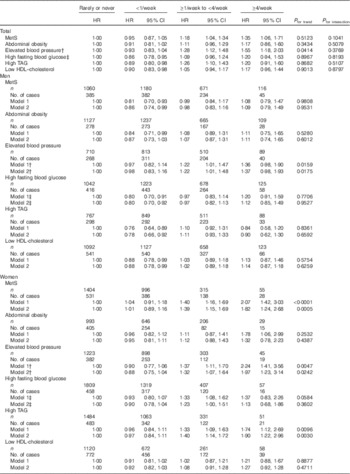
* Model 1 was adjusted for age. Model 2 was adjusted for age, income level, education level, alcohol consumption, smoking status, physical activity, BMI, energy intake, percentage of fat, fibre intake and the presence of diseases.
† Excluded those who have hypertension at baseline from the analysis.
‡ Excluded those who have diabetes mellitus at baseline from the analysis.
The relative risks for the MetS and its components according to soft drink consumption and area of residence are shown in Table 4. There was no association between soft drink consumption and risk of the MetS or its components either in the rural area or in the urban area in men (data not shown). In addition, in women living in the rural area, there was no association between soft drink consumption and risk of the MetS and its components. However, in women living in the urban area, the risk of incident MetS increased significantly with consuming ≥4 servings/week of soft drinks compared with rare consumers after adjustment for potential confounding factors such as age, income, education, smoking status, alcohol intake, physical activity, BMI, intakes of energy, percentage of fat, fibre intake and the presence of diseases (HR 1·71; 95 % CI 0·84, 3·47, P for trend=0·0021). Women living in the urban area and consuming ≥4 servings/week of soft drinks also had greater risks of hypertriacylglycerolaemia (HR 1·76; 95 % CI 0·83, 3·74, P for trend=0·0004) compared with rare consumers after adjustment for confounders.
Incidence of the metabolic syndrome (MetS) and its components according to soft drink consumption by area of residence in womenFootnote * (Hazard ratios (HR) and 95 % confidence intervals)

* Model 1 was adjusted for age. Model 2 was adjusted for age, income level, education level, alcohol consumption, smoking status, physical activity, BMI, energy intake, % fat, fibre intake and the presence of diseases.
† Excluded those who have hypertension at baseline from the analysis.
‡ Excluded those who have diabetes mellitus at baseline from the analysis.
Discussion
We found that soft drink consumption was associated with a higher risk of the MetS only in women. In women, frequent consumption of soft drinks (≥4 servings/week) increased the risk of incident MetS by 80 % compared with rare consumers after adjustment for potential confounders. Frequent consumption of soft drinks also significantly increased the risks of incident elevated BP and hypertriacylglycerolaemia in women. In particular, a strong association between soft drink consumption and risk of the MetS or hypertriacylglycerolaemia was shown in women living in the urban area. However, in men, no association was found between soft drink consumption and risk of incident MetS or its components regardless of area of residence. These findings suggest sex differences in the associations between dietary factors and metabolic risks.
Our results are consistent with previous findings. In the Framingham Heart study, the incidence of the MetS was 44 % higher among middle-aged adults who consumed ≥1 soft drink/d compared with those who consumed <1 soft drink/d during 4 years of follow-up. In addition, frequent consumers of soft drinks had 25–32 % higher risk of incidence of abdominal obesity, impaired fasting glucose, hypertriacylglycerolaemia and low HDL-cholesterol compared with infrequent consumers( Reference Dhingra, Sullivan and Jacques 18 ). Among young university graduates, participants in the highest quintile of SSB consumption had a 2-fold higher risk of developing the MetS compared with those in the lowest quintile during 6 years of follow-up. Increased intake of SSB was also associated with a greater risk of high BP, obesity and hypertriacylglycerolaemia( Reference Barrio-Lopez, Martinez-Gonzalez and Fernandez-Montero 5 ).
Several mechanisms can explain the higher risk of the MetS associated with greater consumption of soft drinks. First, high consumption of added nutritive sweeteners such as high-fructose maize syrup (the primary sweetener in soft drinks) may be associated with metabolic traits. High-fructose maize syrup used in beverages contains about 55 % fructose. A human study showed that fructose over-feeding for 6 d led to stimulation of hepatic de novo lipogenesis and to a substantial increase in plasma TAG in young subjects( Reference Faeh, Minehira and Schwarz 19 ). High fructose intake in the form of added sugars (≥74 g/d) was associated with a 26–77 % higher risk of elevated BP in US adults( Reference Jalal, Smits and Johnson 20 ).
The mechanism by which fructose causes elevated BP or hyperlipidaemia is not fully understood, but some possibilities have been suggested. Increased sympathetic nervous system activity, possibly triggered by insulin resistance, could lead to an increase in BP( Reference Hwang, Ho and Hoffman 21 , Reference De Angelis, Senador and Mostarda 22 ). Another possibility includes increased activity of the renin–angiotensin system. A rat study showed that BP and TAG levels were significantly greater in fructose-fed rats than in control rats. The level of angiotensin II type 1 receptor mRNA was significantly higher in adipose tissue from fructose-fed rats than in tissue from control rats( Reference Giacchetti, Sechi and Griffin 23 ).
Second, dietary habits and lifestyle behaviours among individuals consuming soft drinks might be associated with the risk of the MetS. Frequent consumers of soft drinks had dietary habits characterised by greater intakes of energy content and fat with low intakes of dietary fibre, as well as unhealthy lifestyles including smoking and alcohol consumption. Although these dietary and lifestyle factors are adjusted for in the analysis, other factors not adjusted for in the present analysis, such as dietary pattern, might influence the incidence of the MetS and its individual components. Data from the National Health and Nutrition Examination Survey showed that adults who ate more snacks, high-fat foods and fast food had a higher possibility of drinking energetically sweetened beverages such as soda, fruit drinks and coffee( Reference Duffey and Popkin 24 ).
Of particular interest, soft drink consumption was positively associated with the incident risk of the MetS, hypertriacylglycerolaemia and elevated BP in women only. Similarly, frequent consumption of soft drinks was related to a higher prevalence of the MetS, elevated BP and hypertriacylglycerolaemia in women only( Reference Chung, Ha and Lee 6 ). Sex might be a factor in determining the degree of association with the MetS or its components, particularly with hypertension and dyslipidaemia( Reference Regitz-Zagrosek, Lehmkuhl and Weickert 25 ). The sex difference may be associated with sex hormones( Reference Reckelhoff 26 ). Sex hormones such as oestrogen might participate in the activation pathway of protein kinase C, which might influence vascular smooth muscle contraction or relaxation by increasing nitric oxide release( Reference Khalil 27 ). Oestrogen also affects the renin–angiotensin system, which might be regulated differently in men and women, with endogenous oestrogen suppressing angiotensin receptor type 1 expression and angiotensinogen synthesis( Reference Nickenig 28 ). Besides, oestrogen enhances fat transport and increases the levels of TAG and lipoprotein in the blood, whereas androgen has the opposite effect of oestrogen( Reference Knopp, Paramsothy and Retzlaff 29 ). Therefore, lipid levels could be differently regulated between men and women. The levels of TAG and lipoproteins appear to be more sensitive to perturbations in dietary carbohydrates or fats in women than in men. Li et al. reported that a low-fat, high-carbohydrate diet for 6 weeks v. an average American diet increased TAG levels only in women( Reference Li, Otvos and Lamon-Fava 30 ). In the present study, changes in lipid metabolism caused by sex hormones might have contributed to a greater association between soft drink consumption and hypertriacylglycerolaemia/MetS in women.
A positive association between soft drink consumption and risk of the MetS or hypertriacylglycerolaemia was stronger in women living in the urban area than those living in the rural area. The urban/rural differences may be due to the differences in dietary habits, physical activity and education of subjects( Reference Tripathy, Thakur and Jeet 31 ). If women living in the urban area had a healthy, balanced diet and a healthy lifestyle compared with those living in the rural area, frequent consumption of soft drinks as an unhealthy dietary habit would have had a greater impact on the MetS/hypertriacylglycerolaemia in women living in the urban area.
To the best of our knowledge, this is the first prospective study to investigate associations between soft drink consumption and incident MetS or its components in an Asian population. The study identified sex differences in the association between soft drink intake and risk of the MetS using data from a large-scale, cohort study, and the analysis considered multiple confounders including lifestyle factors and nutrient intakes. Despite these strengths, this study has some limitations. Confounding factors such as lifestyle or dietary patterns that were not considered in the analysis might affect the metabolic risks associated with soft drink consumption. The present study did not examine the consumption of diet soft drinks, which might have affected the metabolic risks. Our findings cannot be generalised to other age groups because the cohort comprised middle-aged Korean adults.
In conclusion, frequent soft drink consumption is associated with increased risk of developing the MetS and its components such as elevated BP and hypertriacylglycerolaemia in middle-aged Korean women living in the urban area. Further studies are required to determine the effect of sex on the metabolic risks related to dietary factors and to enable the most appropriate dietary intervention by sex for the prevention and management of the MetS.
Acknowledgements
Epidemiological data used in this study were obtained from the KoGES (4851–302) of Korea Centers for Disease Control and Prevention, Republic of Korea.
This study was supported by the Basic Science Research Program of the National Research Foundation of Korea (NRF), funded by the Ministry of Education, Science and Technology (NRF2016R1D1A1B03931307). The NRF had no role in the study design, data analysis or writing of this article.
Y. K. helped with data acquisition, analysis and interpretation of the data and wrote the paper; J. K. contributed to the study design, analysis and interpretation of the data, wrote the paper and had primary responsibility for the final content. All the authors read and approved the final manuscript.
The authors declare that they have no competing interests.



