As cheaper energy compared to protein, lipid is not only an efficient energy provider but also supplements fish with essential fatty acids that affect fish growth and performance(Reference Jobling1–Reference Xie, Yin and Tian3). By reducing protein while increasing lipid levels, the protein-sparing effect can be achieved, and nitrogen emissions can be reduced(Reference Boujard, Gélineau and Covès4–Reference Li, Song and Huang6). Thus, high-fat diets (HFD) are often designed in the aquaculture industry to pursue the economic benefits and reduce nitrogen waste(Reference Vial, Dubouchaud and Couturier7). However, on the other hand, increasing evidence has highlighted the harmful effects of HFD-induced threats on fish health(Reference Doré and Blottière8–Reference Wang, Liu and Feng10). It has been well demonstrated that HFD caused abnormal lipid accumulation in viscera and tissues, causing metabolic disturbances to fish and ultimately inhibiting their growth performance, which could even lead to a high mortality rate in fish(Reference Jia, Cao and Du11–Reference Lu, Xu and Wang13). Accordingly, it is important to develop appropriate nutritional strategies to mitigate the adverse effects of HFD on fish.
With the growing concern regarding the unhealthy consequences on fish caused by the abuse of HFD in aquaculture, increasing attention has been focused towards functional green feed additives(Reference Yin, Xie and Zhuang14). Creatine is a nonproteinogenic organic acid that plays a crucial role in tissues with high energy demands(Reference Kazak, Chouchani and Jedrychowski15,Reference Kazak and Cohen16) . Previous studies have shown that dietary creatine supplementation improves growth and physical performance in farmed fish(Reference Borchel, Verleih and Rebl17,Reference Schrama, de Magalhães and Cerqueira18) . Studies have shown that the addition of creatine to the feed can significantly increase the weight gain (WG), specific growth rate (SGR) and protein deposition rate of juvenile tilapia (Oreochromissp.) and promote the growth of fish(Reference Wardani, Alimuddin and Junior19). Creatine itself has a certain basis for existence in fish(Reference Michiels, Maertens and Buyse20). Compared with antibiotics, it has less residue in the environment and negative effects on the ecosystem. The products it produces after metabolism in fish are relatively safe and do not cause serious ecological and food safety problems like antibiotic residues. Thus, creatine is recognised as a promising green feed additive that is able to substitute antibiotics in fish. Creatine has the ability to regenerate ATP and can be mixed with phosphoric acid to create phosphocreatine(Reference Villasante, Ramírez and Figueroa Villalobos21). In fish muscle activity, when ATP is broken down into ADP to release energy, phosphocreatine is able to rapidly transfer its phosphate group to ADP, thereby regenerating ATP(Reference Wyss and Kaddurah22). Second, creatine can improve metabolic efficiency. Creatine is involved in intracellular energy metabolism and produces more energy for growth, tissue repair and physiological functions. By using this efficient metabolism, the fish can make better use of the nutrients in the feed, which promotes their growth. This improves the growth performance of fish. However, specific mechanisms by which creatine promotes growth performance and whether dietary creatine could attenuate HFD-caused adverse effects remain poorly understood.
Systemic metabolic homeostasis is regulated by inter-organ metabolic cycles involving multiple organs or tissues(Reference Houten, Watanabe and Auwerx23). The intestine, liver and muscle are the important organs or tissues for metabolic homeostasis and growth performance in farmed fish(Reference Chen, Hogstrand and Luo24). First, the intestine is an essential and main organ responsible for digesting and absorbing nutrients from feed. Meanwhile, the intestine is highly susceptible to damage, and its healthy status adversely impacts nutrients digestion and absorption(Reference Chen, Hogstrand and Luo24,Reference Chen, Song and Zhao25) . Studies have revealed that the histological features, antioxidant capacity and tight junctions serve as critical indicators of the intestinal health of fish(Reference Dawood26–Reference Saraiva, Costa and Eiras28). Second, the liver, as key metabolic organs, plays a central role in lipid metabolism. Disorders of liver lipid metabolism caused by HFD can easily lead to fatty liver in farmed fish, leading to a large number of deaths(Reference Chatzifotis, Panagiotidou and Papaioannou29,Reference Zhou, Guo and Tang30) . In general, hepatic lipid accumulation results from the balance between de novo synthesis of fatty acids (lipogenesis) and lipid catabolism via lipolysis and β-oxidation, and many key enzymes and transcription factors are involved in the process(Reference Zhang and Edwards31). Last and most important, muscle is the most important edible tissue of farmed fish, whose growth and quality are known as the key factors that affect the economic value of fish(Reference Wang, Liu and Feng10). The development and growth of muscle are tightly regulated by myogenic regulatory factors, paired box protein family and myocyte enhancer binding factor 2 (MEF2)(Reference Buckingham and Rigby32,Reference Johnston, Bower and Macqueen33) . Apart from fish muscle growth, the flesh quality also attracts a lot of attention from researchers in aquaculture. With the improvement of living standards, consumer requests aquatic products of higher quality. Paradoxically, the use of artificial aquafeeds and the popularisation of intensive farming patterns have induced deteriorations in fish flesh quality(Reference Yu, Fu and Wang34,Reference Zhang, Wang and Tang35) . Therefore, the declined fish quality has been one of the most urgent issues that should be addressed. The flesh quality mainly refers to the nutritive values, flesh texture and flavour(Reference Zhang, Wang and Tang35). To our best knowledge, the adverse effects of HFD on intestinal health, hepatic lipid metabolism homeostasis and muscle growth and quality have already been well-recognised. However, there is few information concerning the relief effect of creatine on HFD-caused impairment, although sporadic research has reported that creatine promoted growth performance in fish(Reference Schrama, de Magalhães and Cerqueira18,Reference Burns and Gatlin36) .
Largemouth bass (Micropterus salmoides) is a commercially important carnivorous freshwater fish widely cultured in China. Since largemouth bass exhibits a poor utilisation of dietary starch compared with other carnivorous fish(Reference Coyle, Tidwell and Webster37,Reference Pei, Song and Zhu38) , dietary lipid is considered as a cost-effective energy source. However, largemouth bass is susceptible to lipid peroxidation when fed with high-fat diet (HFD)(Reference Guo, Zhou and Zhao39). Thus, it has been reported that the HFD caused impairment of growth and hepatic metabolism, as well as induced oxidative stress and inflammation in largemouth bass(Reference Yin, Xie and Zhuang40). On the other hand, creatine, as a promising green feed additive, has shown the potential to promote growth in fish(Reference Schrama, de Magalhães and Cerqueira18). The purpose of this study is to evaluate the alleviating effects of creatine on HFD-induced growth performance, liver lipid metabolism and gut health damage, as well as creatine’s potential promoting effect on muscle mass in juvenile largemouth bass. Our conclusions are supposed to provide precise approaches for improving the growth, health and quality of farmed fish based on the creatine supplementation, which will offer novel insights into the function of creatine as a green feed additive in the aquaculture industry.
Materials and methods
Reagents
Creatine (> 99·9 % in purity) was purchased from Shanghai Sinopharm Co. Ltd and added in the form of creatine hydrate. MS-222 was from Sigma-Aldrich. Kits were utilized to determine protein concentration and assess the activities of catalase (CAT), glutathione peroxidase (GPx), superoxide dismutase (SOD), and total antioxidative capacity. Malondialdehyde (MDA) levels were obtained from Nanjing Jiancheng Bioengineering Institute, China. Trizol reagent for RNA extraction was from Thermo Fisher Science (10296028). Reverse transcription kit was from TaKaRa (6110 A). Anti-Nrf2 (1:500, Proteintech, 163961-AP), anti-Cpt1 (1:10000, Cell Signaling Technology), anti-Fas (1:10000, Cell Signaling Technology), anti-Keap1 (1:10000, Cell Signaling Technology), anti-Nrf2 (1:10000, Cell Signaling Technology), anti-Myog (1:10000, Cell Signaling Technology), anti-Mef2a (1:10000, Cell Signaling Technology) and anti-Gapdh (1:10000, Cell Signaling Technology) were used together with goat antirabbit secondary antibody (1:20,000, Li-Cor Biosciences) or HRP-conjugated antirabbit IgG antibody (1:2000, Cell Signaling Technology). Other reagents belong to analytical reagents and were from Shanghai Sinopharm Co. Ltd, China.
Largemouth bass feeding, management and sample collection
Based on previous literature research, at 2 % creatine, fish are at optimal growth levels(Reference Kazak and Cohen16–Reference Schrama, de Magalhães and Cerqueira18). Therefore, in this study, 2 % was selected as the amount of creatine added. Feed formulation in this experiment was shown in online Supplementary Table S1: the control diet (10·20 % lipid, control), high-fat diet (18·31 % lipid, HFD) and high-fat diet supplemented with 2 % creatine (HFD + creatine), respectively. The diets were prepared as previously described(Reference Yin, Xie and Zhuang40), and ingredients were ground, weighed and well-mixed. Lipid and water (35 % of dry ingredients) were then added and thoroughly mixed. The 2·5-mm diameter pellets were extruded using a twin-screw cooking extruder with a screw diameter 52 mm. The processing conditions were as follows: ingredients tempering temperature 90–100°C, extrusion temperature 120°C, screw speed 100 rpm and pressure 3–4 atm. The diets were air-dried and stored at –20°C until used.
The feeding trial was conducted at the experimental facilities of Fishery Base of HZAU. Largemouth bass juveniles were from a commercial fish farm. The experimental largemouth bass were first acclimatised for 10 d under laboratory conditions by feeding the control diet. After acclimatisation, 270 juvenile largemouth bass (3·73 (sem 0·01) g, mean (sem) were stocked in nine circular tanks (300 L water volume), with thirty fish in each tank. The tanks are arranged in a closed circulating water system with a biofilter. Each tank was covered with fine wire to prevent fish from escaping the tank and was equipped with continuous aeration and heating for fresh water. The experiment was carried out under a natural photoperiod of about 12 h light/12 h darkness. The fish were fed with their respective diet until visual satiety, twice a day (08.30 and 16.30 h) and 7 days per week for 10 weeks. Each diet was assigned to three replicate tanks. The uneaten feed and faeces were removed by siphoning. Uneaten feed was collected, dried and weighed after each meal for the calculation of daily feed intake. Largemouth bass were weighed in bulk at every 2-week interval to check the growth and health condition, and mortality was recorded daily. During the feeding experiment, the parameters in water quality were followed: dissolved oxygen 6·55 (sem 0·16) mg/l; water temperature 27·8 (sem 0·4)°C; pH 7·83 (sem 0·11) and NH4-N 0·064 (sem 0·003) mg/l.
At the end of the feeding experiment, all largemouth bass were fasted for 24 h before sampling. MS-222 was used to kill the experimental largemouth bass. Then, all largemouth bass were counted and weighed to measure WG, SGR and feed conversion rate (FCR). The calculation formula is as follows:
IBW (g/fish), initial mean body weight;
FBW (g/fish), final mean body weight;
WG (%) = (FBW − IBW)/IBW × 100;
SGR (% /d) = 100 × [ln (FBW) − ln (IBW)]/d;
FCR (feed conversion rate) = dry food fed (g)/wet WG (g).
Take twelve fish in each tank. The intestine, liver and muscle tissues from six fish were cut, frozen in liquid nitrogen and stored in a −80°C refrigerator for analysis of enzymatic activities and MDA content. The intestine, liver and muscle tissues from another six fish were frozen in liquid nitrogen and stored in a −80°C refrigerator for analysis of proximate composition, quantitative real-time PCR analysis and western blot.
Sample analysis
Muscle proximate composition
Diet and muscle moisture, lipid, crude protein and ash contents were analysed according to the standard Association of Official Analytical Chemists(Reference Zhang, Wang and Tang35). Moisture content of samples was tested by oven drying at 105°C to constant weight. Ash content was determined by incineration in a muffle furnace at 550°C for 12 h. A Kjeltec 8400 Analyzer Unit machine (FOSS Tecator) was used to measure crude protein content. Crude lipid content was determined through ether extraction using a Soxtec system (Soxtec™ 2005, FOSS Tecator). We followed the methods of Yin et al.(Reference Yin, Xie and Huo41).
Oil red O and haematoxylin and eosin observation
Oil red O and haematoxylin and eosin (H&E) staining tests were conducted according to the description in our publication(Reference Zhao, Lv and Hogstrand42). For histological observation, sagittal sections of 6–8 μm thickness were stained with H&E and then prepared for light microscopy. For the statistical evaluation of hepatic vacuole areas in H&E-stained sections and lipid droplet areas in oil-red O-stained sections. We randomly selected three samples from each group for slicing, and two slices were produced from each sample. A total of thirty-six slices were stained with oil-red O or H&E staining. We examined ten microscope fields for each sample, and the results from individual observations were then combined for the overall results. All the images were evaluated by a double-blind method.
Determination of TAG, analysis of FA β-oxidation rate and Cpt1 activity
The contents of TAG were determined by commercial kits (A110-1-1; Nanjing Jiancheng, Nanjing, China) according to the manufacturer’s instructions. Soluble protein content was analysed based on protocols by Bradford(Reference Bradford43).
Analysis of mitochondrial Fatty acids (FA) β-oxidation rate and Cpt1 activity according to our previously published protocol(Reference Wang, Qiao and Zhang44). Briefly, mitochondrial FA oxidation rate was determined using labelled (1–14 C) PA (NEC075H050UC; PerkinElmer) as a substrate. As for Cpt1 activity assay, mitochondria were isolated from the liver or hepatocytes according to Morash et al. (Reference Morash, Bureau and McClelland45). Cpt1 activity was determined using the method of Wei et al.(Reference Wei, Luo and Hogstrand46) based on measurement of the initial CoA-SH formation by the 5,5-dithio-bis-(2-nitrobenzoic acid) reaction from palmitoyl-CoA by mitochondrial samples with L-carnitine at 412 nm. One unit of Cpt1 activity was defined as 1 μmol of product formed per min per mg of mitochondrial protein at 25°C.
For FAS activity assays, the liver and cell samples were homogenised in three volumes of ice-cold buffer (0·02 M Tris–HCl, 0·25 M sucrose, 2 M MEDTA, 0·1 M sodium fluoride, 0·5 mM phenylmethylsulphonyl fluoride, 0·01 M β-mercaptoethanol and pH 7·4) and centrifuged at 20 000 × g at 4°C for 30 min. The supernatant was diluted several times at 25°C until the final volume was 1 ml and was started by the addition of malonyl-CoA. The enzyme activity was calculated after subtraction of the non-specific oxidation of NADPH in the absence of malonyl-CoA. 2 mol NADPH formed were taken to correspond to 1 mol malonyl-CoA utilised. The reaction was started by the addition of the tissue extract. The changes in absorbance at 340 nm were monitored at intervals of 15 s for 3 min.
Measurement of antioxidant capacity
The activities of antioxidant enzymes, including SOD (#S0101S), catalase (CAT, #S0056), GPx (#S0051), and the levels of MDA (#S0131S) were determined via the corresponding commercial kits (Beyotime Biotechnology).
Amino acid composition measurements
For analysis of hydrolysed amino acids according to Xi et al.(Reference Zhang, Shen and Qi47) muscle samples were hydrolysed in 6 NHCl at 110°C for 24 h. The hydrolysates were evaporated, and the remaining materials were dissolved in citric acid buffer solution. The samples were then analysed using HPLC with an ODS Hypersil column (250 × 4·6 mm, 5 µm) (HPLC, AG1100). Pre-column derivatisation with o-phthalaldehyde and 9-fluorenylmethyl chloroformate was used to identify the Free fatty acids. Liquid nitrogen was added to the muscle sample, and the mixture was rapidly triturated and sonicated in 5 % trichloroacetic acid for 20 min. After standing for 1 h, the mixture was centrifuged at 10 000 × g for 10 min. The supernatant was filtered through a 0·22-µm membrane filter and subjected to HPLC.
pH and water-holding capacity measurements
Muscle pH was measured using a Testo 205 pH meter (Testo AG, Lenzkirch, Germany). Water-holding capacity of the samples was measured by drip loss, flesh leaching loss and liquid loss according to Zhang et al.(Reference Zhang, Wang and Tang35). To eliminate the effects of different parts of the muscle on the water holding capacity, we used 5 (sem 0·5) g of muscle taken from the same location of each fish for the analyses.
Texture measurements
The texture of the muscle samples was evaluated using a TA-XT Plus Micro texture profile analysis device (Stable Micro Systems) equipped with a flat-bottomed cylindrical probe P/36R and a load cell of 250 N. The assay was performed following the method described by Ma et al.(Reference Ma, Feng and Wu48). Texture profile analysis and shear force testing were performed at room temperature. Five fish were used per group, and each fish had three parallel samples. Texture curves were generated, and the maximum force was determined as an average of the three measurements.
RNA isolation and quantitative real-time PCR analysis
Total RNA was isolated by using the Trizol (R0016; Beyotime) reagent and then transcribed into the cDNA by using the Reverse Transcription Kit (RK20432; Abclonal, BSN). Analyses on gene transcript levels were conducted through the real-time quantitative PCR method described earlier(Reference Yin, Xie and Huo41). The primer sequences used in this analysis are given in online Supplementary Table S2. A set of nine housekeeping genes (gapdh, b2m, ef1a, 18s rRNA, tuba, rpl7, hprt and ubce) was selected from our transcriptome database to test their transcription stability. Our pilot experiment indicated that gapdh and ef1a (M = 0·28) showed the most stable levels of expression across the experimental conditions, as suggested by geNorm (https://genorm.cmgg.be/). Thus, the relative expression levels were normalised to the geometric mean of the combination of gapdh and β-actin and calculated using the 2−ΔΔCt method.
Western blot
To identify the protein levels of Cpt1α, Fas, Keap1, Mfn2, Myog and Mef2a, western blot analysis was performed according to our previous study. In brief, the protein was loaded onto the SDS-PAGE gel and then transferred to the Polyvinylidene fluoride membrane (88518; Thermo Fisher Scientific). Membranes were blocked with 5 % skimmed milk (LP0033B; Thermo Fisher Scientific) and then incubated overnight at 4°C with one of the following primary antibodies: anti-Cpt1α, anti-Fas, anti-Keap1, anti-Mfn2, anti-Myog, anti-Mef2a and anti-Gapdh (1:10000, 1:10000, Cell Signaling Technology), respectively. The secondary antibodies, including an HRP-conjugated anti-rabbit IgG antibody, were then incubated with the membranes. The membranes were seen by Enhanced chemiluminescence (1705060; Bio-Rad, Hercules) after additional washing. The membranes were seen using enhanced chemiluminescence, and Image J was used to measure the densitometry of these bands. We followed the methods of Chen et al.(Reference Chen, Hogstrand and Luo24).
Statistical analysis
All data were expressed as mean (standard error of means (sem)). The normality of data distribution and the homogeneity of variances were analysed using the Kolmogorov–Smirnov test and Bartlett’s test, respectively. Then, to detect the differences between control diet with HFD or creatine diet, and also differences between HFD with creatine diet, Student t test for independent samples was used for normally distributed continuous data. A significance level of P < 0·05 was applied for all analyses. Significant differences between control with HFD or HFD + creatine were labelled as ‘∗’. Significant differences between HFD with HFD + creatine were labelled as ‘#’.
Results
Dietary creatine ameliorates the adverse effects of high-fat diet on growth performance and feed utilisation
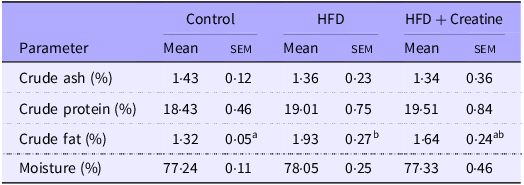
A 10-week feeding trial was designed to first evaluate the relief effect of creatine on HFD-caused impairment of growth performance and feed utilisation of largemouth bass. After the feeding trial, we found that there was no significant difference in survival rate and final mean body weight among control, HFD and HFD + creatine groups (Table 1). Compared with HFD group, the WG and SGR were both significantly increased, while the FCR was significantly decreased in the HFD + creatine groups (Table 1). We further assayed the common nutritional component contents in the muscle of experimental fish. The results showed that there was no significant difference in the crude ash, crude protein and moisture contents of muscle among control, HFD and HFD + creatine groups (Table 2). Nevertheless, the crude lipid contents of muscle showed a downward trend in the HFD + creatine group, compared with those in the HFD group (Table 2). These data suggest that dietary creatine supplementation improved the growth performance and feed utilisation while reducing the muscle crude lipid content of largemouth bass.
Effect of dietary creatine supplementation on growth performance, feed utilisation and morphological parameters of juvenile largemouth bass fed high-fat diets (HFD)

All data were expressed as mean (sem) (n 3). A significance level of P < 0·05 was applied for all analyses. Values without the same letter indicate significant differences among the three treatments (P < 0.05).
IBW (g/fish), initial mean body weight.
FBW (g/fish), final mean body weight.
WG (weight gain, %) = (FBW − IBW)/IBW × 100.
SGR (specific growth rate, % /d) = 100 × [ln (FBW) − ln (IBW)]/d.
FCR (feed conversion rate) = dry food fed (g)/wet WG (g).
Effect of dietary creatine supplementation on common nutritional component contents in the muscle of juvenile largemouth bass fed high-fat diets (HFD)

All data were expressed as mean (sem) (n 3). A significance level of P < 0·05 was applied for all analyses. Values without the same letter indicate significant differences among the three treatments (P < 0.05).
Dietary creatine supplementation promoted the intestinal health of largemouth bass
First, creatine supplementation alleviated the HFD-induced damage to the intestinal histology. The H&E staining procedure showed that the HFD disrupted the normal tissue structure of the intestine, evidenced by an increased intestinal villi gap and a decreased villi height and muscular layer thickness (Figure 1(a)–(c)). Second, a tight junction is also considered as an indicator of intestinal health(Reference Bradford43,Reference Li, Li and Ning49) . In this study, the intestinal mRNA expression of genes related to tight junctions was analysed. The mRNA expression of the genes that are associated with the tight junctions was markedly downregulated by the HFD (Figure 1(d)), including claudin1,2,3,5a, zo1b and occluding. Meanwhile, creatine supplementation obviously alleviated HFD-induced damage to the intestinal histology and the decline of these gene expressions. Lastly, dietary creatine attenuated the HFD-caused oxidative stress in the intestine. As shown in Figure 1(e), the protein expression of Keap1 was markedly increased, but the protein expression of Nrf2 was significantly decreased in the HFD group. Further, HFD markedly reduced the intestinal expressions of genes related to antioxidant capacity, including Cu/Zn-sod, Mn-sod, cat, gpx1 and nrf2, and also decreased the activities of antioxidant enzymes T-SOD and CAT but increased the MDA content (Figure 1(f)–(j)). These data suggested that HFD induced an intestinal oxidative stress in largemouth bass. Creatine supplementation significantly alleviated the HFD-induced changes to gene mRNA abundance, protein expression and the enzymatic activities that are relevant to antioxidant responses, indicating that creatine supplementation attenuated the HFD-induced intestinal oxidative stress. In summary, dietary creatine supplementation obviously relieved HFD-caused damage to intestinal health of largemouth bass.
Dietary creatine supplementation promoted the intestinal health and antioxidant ability of largemouth bass. (a) Representative images of intestine tissues stained by H & E; 100× magnification. scale bars, 100 μm. (b) Quantification of intestinal muscular layer thickness. (c) Quantification of intestinal villi length. (d) The mRNA levels of genes involved in intestinal health. (e) Western blot analysis of Keap1 and Nrf2. (f) T-SOD activity. (g) The mRNA levels of genes involved in intestine antioxidant responses. (h) GPX activity. (i) CAT activity. (J) MDA content. All data were expressed as mean (sem) (n 3). A significance level of P < 0·05 was applied for all analyses. Significant differences between control with HFD or HFD + creatine were labelled as ‘∗’; significant differences between HFD with HFD + creatine were labelled as ‘#’. HFD, high-fat diet.

Dietary creatine supplementation alleviated high-fat diet-induced excessive hepatic lipid deposition
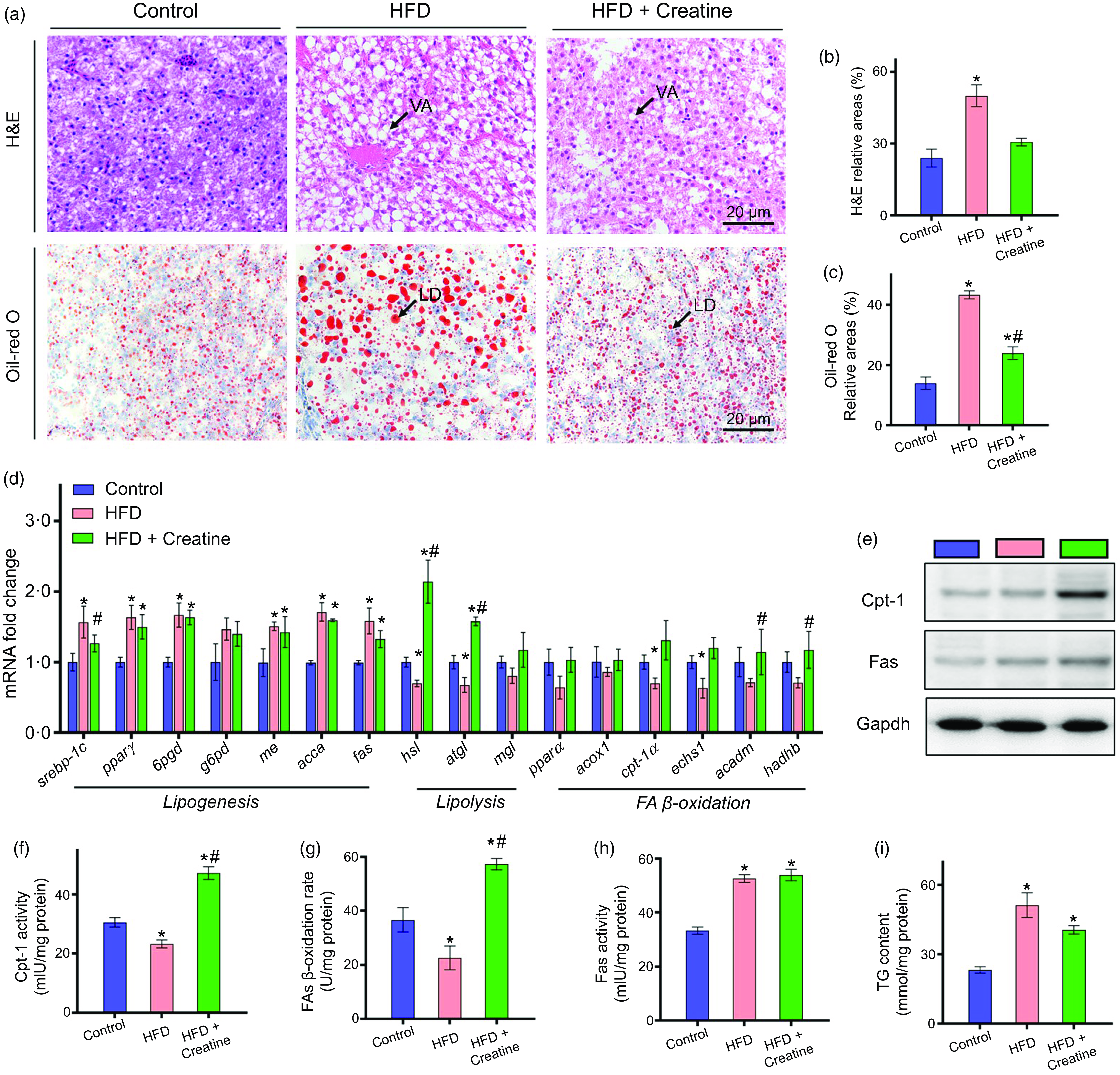
In this study, when compared with the control group, HFD caused hepatic excessive lipid deposition; however, dietary creatine supplementation significantly alleviated the HFD-induced hepatic excessive lipid deposition, which was supported by the vacuoles in H&E and lipid droplets in Oil Red O (Figure 2(a)–(c)). Interestingly, further study indicated de lipid catabolism (lipolysis and β-oxidation) was the main driver for creatine supplementation alleviating HFD-induced hepatic excessive lipid deposition, not the lipogenesis. This notion was supported by the significant upregulation of genes involved in lipolysis and β-oxidation in the creatine supplementation group, including hsl, atgl, cpt1a, echs1, acadm and hadhb, when compared with HFD groups (Figure 2(d)). This was further confirmed by FA β-oxidation rate and the protein expression and enzymatic activities of Cpt-1 (Figure 2(e)–(g)), which is considered to be the main regulatory and limiting enzyme in mitochondrial FA β-oxidation(Reference Morash, Bureau and McClelland45). Conversely, no differences were found in the mRNA abundance of lipogenic genes between creatine supplementation and HFD groups, including pparγ, 6pgd, me, acca and fas. In addition, the protein expression and enzymatic activities of Fas and TAG content further supported this concept (Figure 2(e), (h)–(i)). All these results clearly indicated dietary creatine supplementation alleviated HFD-induced hepatic excessive lipid deposition mainly via the activation of lipolysis and β-oxidation in largemouth bass.
Dietary creatine supplementation alleviated HFD-induced muscle growth retardation
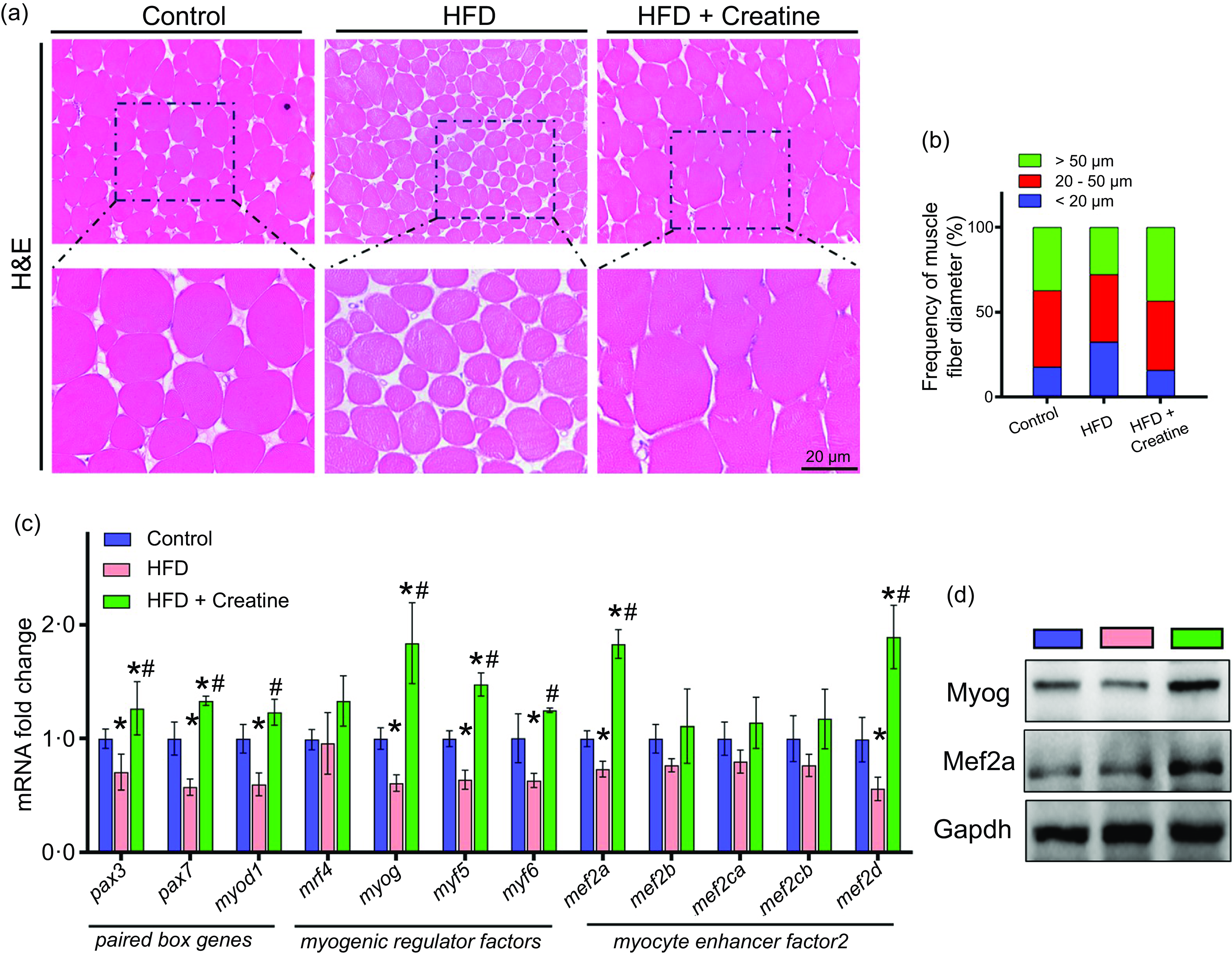
Histological analysis of muscle HE staining revealed that a HFD significantly impaired the muscle development of largemouth bass, as evidenced by a notable reduction in muscle fiber diameter compared to the control group (Figure 3(a,b)). However, dietary creatine supplementation markedly alleviated this adverse effect, restoring muscle fiber diameter to levels comparable to those observed in the normal diet group. Furthermore, both mRNA and protein expression levels of key muscle development-related genes (e.g., Myod, Myog, and Mef2a) were significantly suppressed in the HFD group, indicating impaired myogenesis. In contrast, creatine supplementation effectively counteracted these inhibitory effects, upregulating the expression of these critical regulators of muscle growth (Figure 3(c,d)). These findings collectively suggest that creatine plays a protective role in mitigating HFD-induced muscle developmental deficits in largemouth bass.
Dietary creatine supplementation alleviated HFD-induced hepatic excessive lipid deposition of juvenile largemouth bass. (a) Representative images of liver tissues stained by H & E; 200× magnification. scale bars, 20 μm. (b), (c) Relative areas for hepatic vacuoles in H&E staining and LD in Oil Red O staining. (d) mRNA levels of the genes related to hepatic lipid metabolism. (e) Western blot analysis of Cpt-1 and Fas. (f) Cpt-1 activity. (g) FA β-oxidation rate. (h) Fas activity. (i) TAG content. A significance level of P < 0·05 was applied for all analyses. Significant differences between control with HFD or HFD + creatine were labelled as ‘∗’; significant differences between HFD with HFD + creatine were labelled as ‘#’. HFD, high-fat diet.

Dietary creatine improved muscle growth of juvenile largemouth bass fed high-fat diets (HFD). (a) Representative images of muscle tissues stained by H & E; 200× magnification. scale bars, 20 μm. (b) Frequency of muscle fibre diameter. (c)The mRNA levels of genes involved in muscle growth. (d)–(f) Western blot analysis of Myog and Mef2a. A significance level of P < 0·05 was applied for all analyses. Significant differences between control with HFD or HFD + creatine were labelled as ‘∗’; significant differences between HFD with HFD + creatine were labelled as ‘#’. HFD, high-fat diet.

Dietary creatine supplementation enhanced the flesh quality in the muscle of largemouth bass
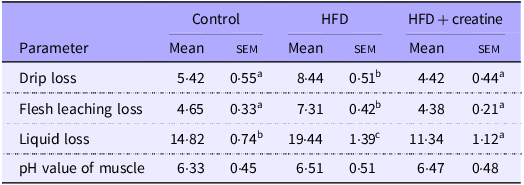
The intensive farming and high yield of largemouth bass are accompanied by declined flesh quality, which has been one of the most concerning issues in aquaculture(Reference Houten, Watanabe and Auwerx23). We therefore evaluated the adverse effects of HFD on flesh quality and also tested whether dietary creatine supplementation improved the flesh quality in the muscle of largemouth bass. The results showed that HFD significantly increased the drip loss, flesh leaching loss and liquid loss of the largemouth bass muscle, while it did not change the pH value of the muscle, compared to control group (Table 3). On the other hand, the drip loss, flesh leaching loss and liquid loss were markedly lower in the largemouth bass muscle of fish fed a creatine supplementation diet compared with those fed HFD (Table 3). These data mean that HFD significantly reduced muscle water-holding capacity, while creatine supplementation attenuated these adverse effects in the muscle of largemouth bass.
Effect of dietary creatine supplementation on muscle pH and water holding capacity of juvenile largemouth bass fed high-fat diet (HFD)

All data were expressed as mean (sem) (n 3). A significance level of P < 0·05 was applied for all analyses. Values without the same letter indicate significant differences among the three treatments (P < 0.05).
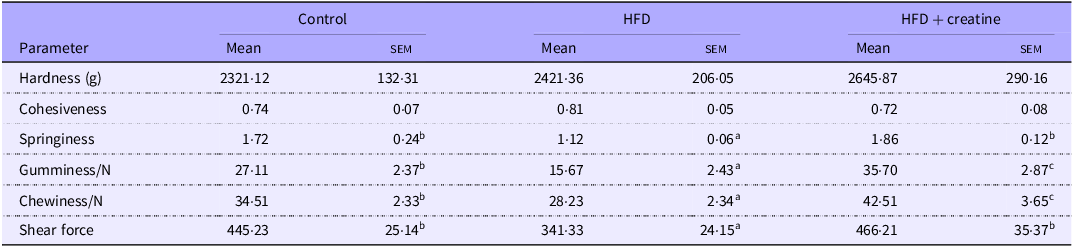
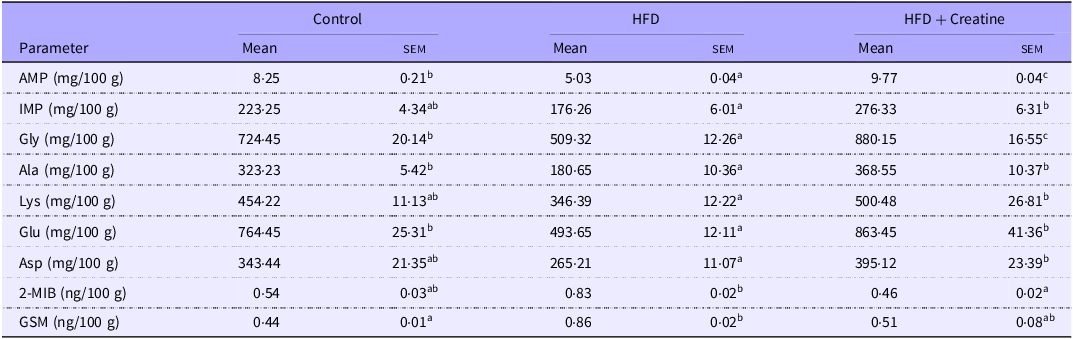
Furthermore, in the muscle texture properties, we found that creatine supplementation significantly increased the springiness, gumminess, chewiness and shear force of the largemouth bass muscle, compared with the HFD group (Table 4). These data mean that creatine supplementation alleviated HFD-caused adverse effects on the muscle texture properties of largemouth bass, although there was no change in the hardness and cohesiveness among three groups (Table 4). We further analysed the profiles of the flavour compounds and the key odorant compounds in largemouth bass muscle. Compared to the control group, the flavour nucleotides (AMP and IMP) and flavour amino acids, including umami taste amino acids (Glu, Asp) and sweet taste amino acids (Gly, Ala) contents of the largemouth bass muscle were all significantly decreased by HFD (Table 5). Moreover, we found that HFD significantly increased the key odorants compounds (2-methylisoborneol, 2-MIB and geosmin, GSM) of the largemouth bass muscle, compared to those in the control group (Table 5). These data mean that HFD significantly reduced the muscle flavour of largemouth bass. Fortunately, our present study clearly showed that the HFD-induced adverse effects on muscle flavour were significantly withdrawn by dietary creatine supplementation (Table 5). Collectively, these data highlight the mitigative role of dietary creatine supplementation for HFD-induced adverse effects on flesh quality in the muscle of largemouth bass.
Effect of dietary creatine supplementation on muscle texture properties of juvenile largemouth bass fed high-fat diets (HFD)

All data were expressed as mean (sem) (n 3). A significance level of P < 0·05 was applied for all analyses. Values without the same letter indicate significant differences among the three treatments (P < 0.05).
Effect of dietary creatine supplementation on flavour nucleotides, amino acids and key odorants compounds in muscle of juvenile largemouth bass fed high-fat diets (HFD)

All data were expressed as mean (sem) (n 3). A significance level of P < 0·05 was applied for all analyses. Values without the same letter indicate significant differences among the three treatments (P < 0.05).
IMP, inosinemonphosphate; MIB, methylisoborneol; GSM, geosmin.
Discussion
HFD is widely applied in the aquaculture industry to pursue the economic benefits; however, increasingly more attention has been paid to the HFD-caused damage to farmed fish(Reference Yin, Xie and Zhuang40). Therefore, it is of significance to develop appropriate nutritional strategies for the alleviation of HFD-induced adverse effects on fish. Creatine as a promising green feed additive has shown potential promoted effects on the growth and physical performances in farmed fish(Reference Burns and Gatlin36). However, how creatine contributes to the growth performance and whether dietary creatine supplementation could attenuate HFD-caused adverse effects in fish remain poorly understood. The intestine, liver and muscle are the important organs or tissues responsible for metabolic homeostasis and growth performance in farmed fish(Reference Houten, Watanabe and Auwerx23). Thus, in this study, we formulated an HFD and creatine supplementation diet to evaluate the mitigative effect of dietary creatine on HFD-induced adverse impact on growth performance, hepatic lipid metabolism and intestinal health, as well as muscle quality of juvenile largemouth bass. This study from the comprehensive multi-organ or tissue perspective provided the first evidence for creatine ameliorating HFD-induced adverse effects in farmed fish.
Creatine was a promising feed additive in aquaculture, especially in fish fed low-fishmeal diets. Studies have found that adding 3 % creatine to a diet high in vegetable protein can significantly increase the level of Clarias gariepinus Weight gain rate and SGR(Reference Adeshina and Abdel-Tawwab50). Our present study indicated dietary creatine supplementation ameliorated HFD-induced adverse effects on the growth performance by promoting the muscle fibre growth in largemouth bass. First, here we demonstrated that HFD clearly suppressed the WG and SGR, suggesting the HFD-induced adverse effects on growth performance in juvenile largemouth bass, which is similar to previous studies(Reference Yin, Xie and Zhuang40 , Reference Adeshina and Abdel-Tawwab50 , Reference Gao, Chen and Zhang51) ,,. Then, notably, 2 % creatine supplementation has withdrawn HFD-caused suppression in the WG and SGR of the juvenile largemouth bass. These data were consistent with a study in red drum (Sciaenops ocellatus) and a study in spotted seabass (Lateolabrax maculatus) fed with low-fishmeal diets. Both showed that the optimal dietary creatine supplementation improved the growth performance of farmed fish(Reference Burns and Gatlin36,Reference Perez, Duran and Zanella52) . Last, the micro process of fish growth performance is the muscle fibre growth, including hypertrophy and hyperplasia(Reference Perez, Duran and Zanella52). The conversion of muscle fibre types that affect fish muscles contributes to the growth and development of white muscle fibres, and the addition of creatine enhances their viability and competitiveness. Different types of myofibers differ in metabolic type and composition, resulting in different flavours. Red muscle fibres contain more myoglobin and mitochondria, and their oxidative metabolism is stronger, which generally produces a richer and mellower flavour; white muscle fibres mainly rely on glycolysis for energy, and the flavour is relatively light. In grass carp, dietary creatine reduced myofiber diameter and promoted phosphorylation of the mTOR protein(Reference Tian, Cheng and Yu53). Here, we found that creatine supplementation ameliorated HFD-induced adverse effects, increasing the muscle fibre diameter (hypertrophy), via promoting the gene or protein expression of myogenic regulatory factors, paired box genes and Mef2 in the juvenile largemouth bass, that was partially confirmed by the study in spotted seabass (Lateolabrax maculatus)(Reference Lin, Liao and Li54). However, a recent study in largemouth bass (Micropterus salmoides) was in contrast to our data, which indicated that dietary creatine increased the muscle fibre hyperplasia but decreased the muscle fibre hypertrophy(Reference Yu, He and Qin55). We speculated it was due to the different fish species of different muscle growth patterns(Reference Koganti, Yao and Cleveland56). Nevertheless, the mechanism for creatine-induced expression of muscle growth-related genes needs further investigation.
The intestine is the primary organ for absorbing nutrients derived from the diet. Meanwhile, the intestine is extremely vulnerable, and its healthy status adversely impacts nutrient digestion and absorption(Reference Liang, Cao and Chen57,Reference Ling, Zhuo and Zhang58) , which also directly determines the FCR. The present findings indicate that HFD increased the FCR, consistent with findings from previous studies(Reference Lindholm, Koskela and Kaseva59). Meanwhile, creatine supplementation has withdrawn this trend, suggesting creatine supplementation could function as feed additive to improve feed utilisation efficiency, which has also been proved in other fish(Reference Schrama, de Magalhães and Cerqueira18). However, less research has been done on the contribution of intestinal health in creatine-promoting feed utilisation efficiency. First, intestinal histology is a crucial physiological indicator for assessing the health status of the intestine(Reference Chen, Hogstrand and Luo24,Reference Chen, Song and Zhao25) . This study found that largemouth bass fed diets containing creatine exhibited greater intestinal villi areas and height compared with HFD group. The areas and height of villi are closely linked with the intestinal absorption area(Reference Eiras, Campelo and Moura60). Therefore, our results indicate that creatine promotes an increase in the intestinal absorption area to alleviate HFD-induced adverse impact. Second, it was revealed that tight junctions are closely influenced by intestinal histology(Reference Chen, Song and Zhao25). The tight junction, located in the most apical region of the cell, plays key roles in cell proliferation and barrier function(Reference Garcia, Nelson and Chavez61). This present study exhibited that largemouth bass fed a creatine diet showed the higher mRNA abundance of claudins and occludin in comparison to those fed HFD. This indicates that creatine supplementation promotes the enhancement of the tight junction and alleviates HFD-induced adverse effects. Last, the intestinal antioxidant capacity also functions as a valuable index for intestinal health in fish(Reference Chen, Hogstrand and Luo24,Reference Xu, Jia and Zhao62) . We revealed that largemouth bass fed the elevated intestinal antioxidant-related enzyme (T-SOD, CAT and GPX) activities and lower MDA levels compared with the HFD group. SOD, CAT and GPX are the essential antioxidant enzymes. SOD is responsible for catalysing the dismutation of superoxide radicals to H2O2, and then CAT and GPx metabolised H2O2 to H2O and O2 (Reference Chen, Hogstrand and Luo24,Reference Fattman, Schaefer and Oury63) . MDA, as the end product of lipid peroxidation, is used as an indicator of oxidative stress commonly(Reference Zhou, Guo and Tang30,Reference Guo, Zhou and Zhao39) . Thus, the upregulation of their activities and downregulation of MDA content displayed by creatine supplementation could improve the antioxidant capacity. Taken together, our findings suggest that dietary creatine supplementation ameliorated HFD-induced adverse effects on the intestinal health by promoting the intestinal histological features, antioxidant capacity and tight junctions, which contribute to the higher feed utilisation efficiency in largemouth bass.
The liver is the key metabolic hub for lipid metabolism(Reference Yin, Xie and Zhuang14,Reference Yin, Xie and Zhuang40) . With the widespread use of HFD in aquaculture(Reference Yin, Xie and Zhuang14), the HFD-induced hepatic excessive lipid deposition has also attracted people’s attention(Reference Lu, Xu and Liu12,Reference Yin, Xie and Zhuang14) , since this is easy to induce mass mortality in fish. Not surprisingly, our findings also indicated that HFD caused excessive hepatic lipid deposition. These results are consistent with those of previous reports(Reference Yin, Xie and Zhuang14,Reference Yin, Xie and Zhuang40,Reference Zhao, Chen and Zhang64) . In this study, we found that creatine supplementation rescued HFD-induced excessive hepatic lipid deposition. Similarly, Chen et al.(Reference Chen, Song and Zhao25) indicated that creatine supplementation relieved HFD-induced body WG and hepatic TAG accumulation. In general, hepatic lipid accumulation results from the balance between lipogenesis and lipid catabolism via lipolysis and β-oxidation(Reference Lu, Xu and Liu12). It was worth noting that in our present study creatine supplementation showed no significant alleviating effect on HFD-caused hepatic lipogenesis. However, conversely, the hepatic lipolysis and β-oxidation were significantly activated. Creatine induces changes in intracellular signalling pathways that can promote the expression of genes related to fat metabolism and stimulate the expression of genes related to muscle protein synthesis. The above findings first proposed the notion that the activation of lipolysis and β-oxidation are the main drivers for creatine improving HFD-caused hepatic excessive lipid deposition. Again, some studies show that creatine can activate signalling molecules such as AMPK (adenylate-activated protein kinase), promote fatty acid oxidation, and lower muscle fat(Reference Yu, He and Qin55).
Improving the flesh quality of farmed fish has emerged as an important issue in aquaculture, as consumers demand for the high-quality aquatic products beyond the expanded yield(Reference Chen, Jiang and Cui65). Here, we showed that HFD reduced the flesh quality, while creatine supplementation significantly rescued these adverse effects in largemouth bass, which mainly referred to the texture properties. Flesh texture is a crucial sensory property that includes firmness, tenderness, chewiness, adhesiveness, resilience, etc (Reference Schrama, de Magalhães and Cerqueira18). Few studies evaluate the effects of dietary creatine on the flesh texture of fish, while we demonstrated that creatine supplementation elevated some of the texture properties (springiness, gumminess, chewiness and shear force) in this study. In farmed fish muscle, the high-quality flesh is characterised with firm and cohesive texture.(Reference Schrama, de Magalhães and Cerqueira18) We therefore concluded that dietary creatine supplementation improved the flesh texture of largemouth bass. Creatine helps with the recovery of muscle fibre diameter, but the recovery of muscle fibre diameter does not necessarily mean that muscle stiffness changes. This is because muscle stiffness is not only determined by the size of the muscle fibres but also by the arrangement and proportions of the internal components of the muscle fibres. However, Denise et al.(Reference Schrama, de Magalhães and Cerqueira18) pointed out that there are no significant differences regarding the texture properties in European seabass (Dicentrarchus labrax) after fed creatine creatine-supplemented diet. This suggested creatine improved the flesh texture of fish in species-dependent manner, and further studies are required to elucidate the relevant mechanisms.
In fish growth and development, creatine provides additional energy for muscle cells, prompting cells to take in nutrients such as amino acids more efficiently, thereby accelerating muscle protein synthesis. The flavour is another important evaluation indicator for fish flesh quality. Enhance the nutritional value of fish by increasing the protein content, total amino acids, and essential amino acids in muscle tissue. Flavour components mainly consist of flavour nucleotides and flavour amino acids (umami and sweet taste amino acids)(Reference Du, Lv and Xu66). The present study demonstrated that HFD reduced the flesh flavour of largemouth bass, while creatine supplementation elevated the flesh flavour of largemouth bass, which was supported by the alteration in the deposition of flavour nucleotides and amino acids in muscle. In this study, there is one possible approach to increase amino acid deposition. That is, the creatine supplementation may preserve glycine by cutting down the endogenous creatine synthesis(Reference Liyana, Shahidi and Whittick67,Reference Borchel, Verleih and Rebl68) , while the other is that creatine supplementation may reduce the consumption of energy-supplying amino acids, since creatine is an important energy source in muscle(Reference Wang, Chen and Yang69). However, the reason for creatine-induced flavour nucleotides deposition needs further investigation. Moreover, the odour is a negative factor for fish flesh, which mainly includes two odorants, 2-MIB and GSM(Reference Borchel, Verleih and Kühn70). In this study, we unexpectedly found that creatine supplementation decreased the odorant compounds (2-MIB and GSM) in the muscle of largemouth bass. The deposition of 2-MIB and GSM are closely related to the tissue lipid content(Reference Zhang, Xiong and Yu71). Here, we found that the creatine supplementation reduced the hepatic lipid content by increasing the lipolysis/FA β-oxidation. We therefore speculated that the decrease of 2-MIB and GSM deposition was derived from the whole lipid reduction in largemouth bass.
As an important energy buffer, creatine improves energy supply and utilisation efficiency. In addition, creatine can increase the hardness, toughness and chewiness of muscles, make fish firmer, reduce meat quality loss during processing and transportation, improve the commodity value of fish and meet consumer demand for high-quality fish products.
Conclusions
Through a 10-week feeding trial with HFD and dietary creatine supplementation in largemouth bass, this study showed that creatine supplementation significantly ameliorated the HFD-induced adverse effects on hepatic lipid metabolism, intestinal health and muscle growth. All these improvements in turn contribute to the promoted role of creatine supplementation on growth performance and feed utilisation in largemouth bass. We further demonstrated that creatine supplementation also reduced HFD-induced adverse effects on the flesh quality of largemouth bass. Based on these conclusions, from the comprehensive multi-organ or tissue perspective, this study provides a feasible approach for developing appropriate nutritional strategies for alleviation of HFD-induced adverse effects on farmed fish.
Acknowledgements
The authors would like to express deep gratitude to the open fund of China (Guangxi)-ASEAN Key Laboratory of Comprehensive Exploitation and Utilization of Aquatic Germplasm Resources, Ministry of Agriculture and Rural Affairs; Key Laboratory of Aquaculture genetic and breeding and Healthy Aquaculture of Guangxi Academy of Fishery Sciences, Nanning 530021, China and Fundamental Research Funds for the Central Universities, China.
This study was supported by the open fund of China (Guangxi)-ASEAN Key Laboratory of Comprehensive Exploitation and Utilization of Aquatic Germplasm Resources, Ministry of Agriculture and Rural Affairs; Key Laboratory of Aquaculture genetic and breeding and Healthy Aquaculture of Guangxi Academy of Fishery Sciences, Nanning 530021, China (grant No. GXKEYLA-2023-02-6) and Fundamental Research Funds for the Central Universities, China (grant No. 20062023SCYJ003).
Y-F. S. and J-N. L. designed the experiment. G-L. F. conducted the experiment and data analysis with the help of X-H. L., N-J. H. and Y-F. S. drafted the manuscript. All the authors reviewed and approved the manuscript.
The authors declared that they had no conflicts of interest with the contents of this article.
All experiments were conducted according to the institutional ethical guidelines of Huazhong Agricultural University (HZAU) on the care and use of experimental animals. Animal research in this study gained approval from the Ethical Committee of HZAU (identification code: Fish-2023-08-34).
Supplementary material
For supplementary material/s referred to in this article, please visit https://doi.org/10.1017/S0007114525000315