




Historic houses throughout the US have traditionally served to immortalize a hyperbolized and romantically exaggerated retelling of antebellum life, centering elaborate mansions and beautiful artifacts. These sites, born from the inherent dichotomy between agricultural business driven by enslaved labor and the wealth and luxury of an aristocratic manor, have maintained their cultural prominence, continually evolving in shifting social and political landscapes.Footnote 1 Today, as these former agribusinesses have transformed into juggernauts of the heritage industry, they increasingly act as instruments of power, both through their direct articulation of knowledge production and throughout the web of information created about them. In 1994, anthropological archaeologist Laurie A. Wilkie detailed the power dynamics of plantation studies through a blend of neo-Marxist and neohistoricist ideologies. She argued that “different types of power are wielded by different groups [forcing an] interaction of power relationships that shapes society,” citing studies including Mark Leone et al. to stress the “importance of recognizing that the past can be interpreted in a number of ways depending upon the perceptions of the interpreter and their political agenda.”Footnote 2 Through a focussed case study of a single plantation, Wilkie advocated for scholars to “reconsider how they [scholars] portray ethnicity, community, and race relations in the plantation setting to gain a fuller understanding of social processes and changes within that context.”Footnote 3 Though written over thirty years ago, this sentiment and call to action remain increasingly relevant as scholars continually leverage the power of creating an archive of specific interventions and advancements within this field of study.
Plantation sites, once singular in their representational discourse, have increasingly engaged with the history of slavery. This shift has led scholars to mark such advancements, frequently labeling these initiatives as “counternarratives” – or as representational inclusions meant to delineate the space’s racialized environment within the constraints of the site’s original narrative. However, applying this terminology sweepingly reinforces the normativity of specific (white) historical narratives. Framing Black experiences as supplemental or “counter” narratives can inadvertently perpetuate a hierarchical understanding of American history and reinforce prejudicial stereotypes. This article examines tangible departures from the antiquated binary of “narrative” and “counternarrative” established within scholarly discourse, using Whitney Plantation in Louisiana as a case study.Footnote 4 Whitney advances a transformed idea of a “plantation museum,” often presented as a singular structure emboldened as a monument to antebellum life, into a multifaceted memorial commemorating the lives of those lost to slavery and its legacies.Footnote 5 Unlike sites that center the owner’s narrative and offer piecemeal, and often underdeveloped, references to slavery or the enslaved, or sparse details of individuals with singular histories skewed to benefit their enslavers’ memory, Whitney establishes a representational structure that places slavery as the museum’s foundational narrative. Maintaining a plantation-focussed depiction of American history, the site weaves together discourse commemorating the past to catalyze activism in the present, dismantling history as nostalgic ideology through a multilayered discourse surrounding race, gender, preservation, heritage, and storytelling. This article will demonstrate that all targeted curatorial practices aren’t simply countering past interpretations but systematically expanding the parameters of representational practice to prioritize the identity, community, and experiences of those forced to live and labor on the site, and should be evaluated as such. In turn, this article marks a significant departure from the scholarship by foregrounding a memorial-informed analysis of representational techniques in conversation with scholastic interventions to enable a fairer and more equitable discourse in the study of plantation museums.
This article interrogates the evolution of historic house museums, as reflected in shifting scholarly interventions used to frame interpretive development. In the early nineteenth century, plantations began to sporadically transition into heritage sites, elevating their status through what scholar Patricia West describes as the burgeoning “aesthetic moralism,” which was used to “mold character and stabilize the American Public.”Footnote 6 This created an early interpretation of American history among plantation museums that capitalized on the cultural influence and authority associated with national heritage. The “public” that early sites aimed to impact was a very specific group. Tourism during this period was almost exclusively generated by white individuals and communities, and by organizations for white tourists. In the South, plantations created what scholars have deemed “settings in which southerners performed their ‘southernness’” by emphasizing characteristics like romance and gentility, becoming a primary emblem of the region’s identity.Footnote 7 The influence of this particular reconstruction of history permeated throughout the nation as a form of “collective memory,” defined by Maurice Halbwachs as operating “based on shared information or notions … [moving] ceaselessly and reciprocally from one to another.”Footnote 8 This specific narrative was curated by “powerful institutions … providing patterns and examples of how individuals could and should remember and stimulate memory” in the years immediately following the Civil War.Footnote 9
As southern plantations and elaborate townhouses increasingly opened their doors to visitors to stimulate lost finances following the war, a narrative celebrating the Old South was solidified. Designated the “Lost Cause,” it “nurtured a public memory of the Confederacy that placed their wartime sacrifice and shattering defeat in the best possible light” and became the “dominant ideology of southern culture in both the North and South by the 1890s.”Footnote 10 This doctrine was infused into many aspects of southern life, including the interpretation of heritage sites, representing a historical narrative that depicted antebellum plantations as idyllic locations through ornate mansions, emphasizing their romance, beauty, and nostalgia, along with ownership by heroic and genteel southerners. As preservation efforts continued to expand into the twentieth century, the selection of sites to be conserved versus those left to decay or destroyed emulated “the nation’s sense of identity,” as both institutions and citizens played a role in preserving heritage sites around the country, introducing an era of “traditional” discourse through the inclusion of “hoop-skirted hostesses and a pageant saturated in sentimental Lost Cause imagery” (see Figure 1).Footnote 11 This effort was seen throughout the South and, in some cases, across the nation, creating an influential narrative of loss and sacrifice with a life over twenty times longer than the Confederacy itself. Heritage plantations soon evolved into a substantial element of the tourist sector. They multiplied throughout the nation, becoming a leading representation of the antebellum period.Footnote 12 In 2015, it was estimated that “no less than 375 plantations are open for tour,” with the “largest concentrations found in the states of North Carolina, Virginia, Louisiana, South Carolina, and Georgia.”Footnote 13
House tour and guided experience at Stanton Hall, Natchez, Mississippi. As of 2023, tours of the home remain the premier experience as guides in “period dress” articulate the beauty, wealth, and romance of the antebellum period. This tour encapsulates a representation of what this article refers to as “traditional representation.” Taken by the author (2023). Source: Stanton Hall, Natchez Pilgrimage Garden Club.

Even though the fortunes of these former plantations were acquired due to the labour of enslaved humans, there was a virtual silence surrounding slavery in the museological sector prior to the 1980s. This even occurred in spaces where slavery was blatantly historically present, which relegated the limited discourse of the topic to the margins of American historical sites.Footnote 14 The past three decades, however, have seen a monumental turn in interpretive practice, ushering in a movement toward a more nuanced representation of American history. Interventions to reframe singular and romantic views have taken varying forms, including the creation of distinct tours and exhibitions, descendant-driven and coproduced curatorial expansions, and the development of more comprehensive narratives throughout the site.Footnote 15 This transformation has left scholars from a multitude of backgrounds working to understand and articulate the means, methods, and impact of varying interpretive changes around the presentation of slavery at historic sites, leading to the prominence of specific classification systems for museum practice. Specifically, researchers sought a way to articulate the emergence of narratives, whether detailed or diminutive, of slavery within plantation sites. Eventually, scholars adopted the term “counternarrative” to refer to interpretive inclusions within past singular and whitewashed representations. While a critical step in evolving contemporary practice, increased academic focus on these efforts has led to a trend that consistently defines new and innovative practices as a way to “counter” antiquated discourse, even in sites curated without a prominent enslaver-focussed narrative to balance, like the Whitney Plantation.
The once accurate grouping of revisionary presentations of slavery as “counternarratives” is now an overgeneralization that unintentionally perpetuates a stratified portrayal of American history. In a 2009 speech entitled “The Danger of a Single Story,” novelist Chimamanda Ngozi Adichie discussed the effect of nkali, an Igbo noun loosely translated to mean “to be greater than another.” She used this term and the accompanying presentation to warn against the prominence and acceptance of a hierarchical form of storytelling, specifically questioning “how they are told, who tells them, when they’re told, how many stories are told, are dependent on power.”Footnote 16 She advocates that single stories create stereotypes, those that are untrue and incomplete, yet still become the dominant and often only story. Whether intentional or not, the continued use of “counternarrative” to universally describe slavery discourse within a plantation setting reinforces the impact of nkali or hierarchy of historical perspectives, ultimately skewing the critical evolution of museological representation for future scholars and researchers. Through an examination of this prominent classification method in conversation with a contemporary case study, this article demonstrates how an outdated and oversaturated lexicological term impacts academic discourse and ultimately distorts the memory and legacy of heritage sites.
This article approaches plantation discourse and impact through the influence of scholastic interventions, both tangibly and academically, including the overuse of the concept of “counternarrative.” This article argues that Whitney Plantation’s purpose, message, and memorial landscape surpass this practice by embedding slavery as the foundational experience from the outset, thus moving beyond merely confronting past interpretive absences and instead working to redefine the process of plantation curation. Additionally, it will articulate the reciprocity of this relationship, specifically how scholars, as Jackson asserts, “are active participants in creating and interpreting representations of postbellum plantations,” constantly expanding and redefining the context of the space, “dismantling entrenched systems of representation.”Footnote 17 To facilitate this analysis, this study begins by collating and investigating a body of contemporary scholarship carried out by researchers interested in plantation tourism, museum studies, slavery, memory, and heritage, identifying trends of interpretive discourse from the turn of the millennium – since the history of slavery became an expansive feature on plantation tours and within published sources. Using the case study of the Whitney Plantation, the article will then explore how their interpretive methodology serves as a tangible milestone of evolving research and praxis, substantially departing from the traditional “plantation museum.”
Whitney employs numerous strategies that separate it from more traditional sites discussing America’s antebellum history; the most effective tactics stem from the reinvention of the traditional plantation visit. This is accomplished through a structural reorientation of a “plantation” and further supported by the integration of both memorials and memorialization techniques, conceived with an expansive historical focus.Footnote 18 Sørensen et al. define “memorials” as “objects of material culture … used for the remembrance of a person(s) or event(s),” and “memorialization” as a “performative act linked to remembrance.”Footnote 19 As argued by the authors, in combination these forms of remembrance “are important socio-cultural ‘tools’ that play central roles in societies’ historical self-understanding and in their claims about identity and community.”Footnote 20 This article will analyze the interpretive practice of both manifestations – through a focus on the built environment (memorial) and interpretive acts (memorialization) – currently utilized at Whitney. As will be demonstrated, Whitney Plantation is not a “counternarrative” site; it has not been infused with a nuanced view of history to combat and unpack previously restricted discourse, nor does it stand solely to combat years of incomplete and nostalgic narratives. It is a museum that “educates the public about the history and legacy of slavery in the United States” in the space and place and on the soil in which the practice was perpetuated.Footnote 21 By exploring how Whitney Plantation transcends the limitations of the dichotomous “narrative” and “counternarrative” regimes, this article illuminates a crucial interpretive shift in contemporary representation. This shift, in turn, empowers scholars to move beyond polarizing terms, cultivating a deeper understanding of historic slavery by enabling a more nuanced articulation of its history for the future of heritage interpretation.
Developing scholarship of curatorial practice
For over twenty years, academics have documented the growth of slavery representation within historic house narratives, with many highlighting and critiquing the evolving interpretive techniques.Footnote 22 In 2001, David Butler was among the first scholars to articulate how plantation tourist sites had been systematically “white-washed.” His study found that the terms or discussions surrounding “‘slavery,’ ‘slaves,’ and ‘slave cabins’ occurred less than the subsequent discussions of ‘owners’, ‘landscapes’, and ‘furnishings.’”Footnote 23 In the decades following, researchers have worked to further classify representational techniques at historic houses, highlighting specific conventions that reinforce a site’s traditional narrative. These tropes include centering the plantation home, often referred to as the “Big House,” as a way of highlighting the story of the white plantation-owning family while minimizing that of the enslaved population that lived, worked, and died on the same property.Footnote 24 Additional publications argue that when slavery, or discourse surrounding the lives of those enslaved, is included in plantation tours, it is often in a “peripheral manner,” without equal attention, and in many cases, the enslaved are depicted as “less than fully human subjects” or as “domesticated others.”Footnote 25 Scholars have tracked the inclusion of empathetic language in plantation tourism, criticizing the disparity between the (enslaver) white and (enslaved) Black narratives in house tours. According to geographer E. Arnold Modlin and his coauthors, “this inequality is not just about whether docents talk about the planter class more than the enslaved, but also the unevenness in how tourists are encouraged to connect with these historical groups emotionally.”Footnote 26 Curatorial practice has similarly been studied and critiqued by professionals in the field, including the underrepresentation of plantations as “dynamic and diasporic spaces” due to “the production of knowledge about plantations articulated from a plantation owner perspective – typically that of the white male elite.”Footnote 27 Calls for change included the integration of voices from the descendants of the enslaved to produce critical and dynamic narratives of American history on a national scale.Footnote 28 Sporadic uptake of these calls began in the early 2000s and persisted across the nation, yet no plantation fully realigned its narrative around slavery until Whitney’s public opening in 2014.Footnote 29
Studies of plantation heritage sites have stretched to regions across the nation; within the greater focus on the South, Louisiana has remained a critical arena for the examination of the evolving discourse of slavery representation, establishing a hub of scholastic documentation and making it the ideal area for analysis of developing lexicological trends. The expanse of the heritage sector in the nineteenth and twentieth centuries led historic houses across the South to create a unique identity. In Louisiana, home to a prominent string of lavish plantations along the River Road, estates stressed the opulence, grandeur, and beauty of the antebellum South to such an extent that it was later marketed as the “Hollywood South” by the entertainment industry.Footnote 30 This term greatly impacted how these historic sites established their narratives and inserted themselves into contemporary culture. In 2002, scholars Jennifer Eichstedt and Stephen Small created a seminal study to assess presentation at plantation museums.Footnote 31 Through a systematic categorization of representation techniques utilized throughout plantations in Louisiana, Eichstedt and Small summarized that “there is a strong focus on the ‘grand, romantic and luxurious’ civil society that flourished in the state.”Footnote 32 Since this analysis was conducted, over two decades ago, a wave of scholars have critically examined the state’s evolving curatorial practice and interpretive outcomes, noting that, “to varying degrees, Louisiana River Road plantations have made an effort to incorporate the memory of enslavement into guided tours, brochures, websites, and the material landscape of artifacts, exhibit spaces, and preserved/reconstructed historical structures and buildings.”Footnote 33 In 2019, Small additionally acknowledged this evolution, stating that the organization of sites within the established symbolic tropes is more evenly distributed today, although, unfortunately, they continue to “avoid, disregard or side-line mentions of slavery and the experiences of the enslaved, with information and details a very distant second in volume to the lives of the elite whites.”Footnote 34 Even with critical curatorial advancements, or “counternarratives” within the constraints of established antebellum discourse, detailing or celebrating the master enslaver while including only piecemeal and uneven references to slavery perpetuates the colonial structure of the plantation system, extending the racialized environment from its active operation to its museum representation.
Louisiana’s heritage industry provides an ideal case study for the evolution of historic-house narrative, including the transformation of interpretive practice, commonly referred to as the employment of “counternarrative.” As the trends toward further incorporation of slavery within heritage sites and, in turn, the evolving discourse of scholars highlighting this inclusion increased, specific terminology was introduced to identify the transitioning practice. Eichstedt and Small originally used “counternarrative” to describe discourse “not in plantation museum sites” but separate institutions “organized by, and often for, African Americans,” with a narrative focussed on “African American history in general, rather than slavey in particular.”Footnote 35 Since then, the term has shifted to describe a change, often an increase, in slavery-related narratives offered within plantation heritage sites. In a 2008 study on “visitor interest in slavery at the plantation compared to other, more dominant narratives,” scholars exclusively referred to this intervention as the “counternarrative of slavery” throughout their study.Footnote 36 They defined the term as a means to “overload attempts to recreate the plantation as a nostalgic setting, a signifier of national unity, or the scene of an uncomplicated hierarchy.”Footnote 37 Alderman, Butler, and Hanna defined “counternarratives” as the incorporation of “slavery into docent-led tours, promotional materials, exhibits, and preserved structures.”Footnote 38 Studies in the past ten years have continued to delineate the term; it has been linked to the inclusion of “slave narratives and performances,” defined as a curatorial method used to “counter the mythologized representations” and embraced as a means to “challenge the dominant narratives that romanticize slavery.”Footnote 39 Adamkiewicz furthers this illustration of contemporary “counternarrative” efforts in sites that include a “broad and professional approach to contextualizing slavery that includes conferences and other scholarly efforts … [and] narratives of former slaves in their tours” and specialized tours which are “dedicated to the lives and cultures of African Americans who lived on the plantation.”Footnote 40 As curatorial practice continued to develop, entire plantation museums were soon bequeathed with the “counternarrative” moniker.
Since opening to the public on 7 December 2014, Whitney Plantation has garnered attention globally and become a central focus among academics due to its representation of antebellum life, a plantation museum about slavery. Whitney soon became an often-used case study in publications, news articles, blogs, social media pages, and other printed and online media forms that detailed the site’s unique representational techniques and discourse centering slavery throughout the property.Footnote 41 In a recent publication entitled Remembering Enslavement, Potter, Hanna, Alderman, Bright, and Butler noted how Whitney Plantation “reveal(s) a path of possibilities where the lives of the enslaved are interwoven and centered in the plantation assemblage.”Footnote 42 Throughout this chapter, the authors often referred to the space as a “counter-narrative site [that] embodied a reimagining” of the plantations’ assemblage through interpretive efforts to “place slavery and remembering the experiences of formerly enslaved people at the center of their narratives, landscapes, and performances.”Footnote 43 Others have described the Louisiana plantation as a “counternarrative site” predominantly through a discourse that advances the comparison of Whitney to other heritage sites that offer a more singular articulation of history.Footnote 44 Whitney has been described as depicting a “more inclusive counter-narrative to the traditional romanticized plantation tours” as well as an articulation of the past that works to “challenge the prevailing master accounts about the local history of slavery and the normative plantation visuals along Louisiana’s historic River Road.”Footnote 45 More directly, when using Whitney as an example of this practice, Cook defined the purpose of “counternarratives” as tools to “challenge the dominant narratives that romanticize slavery and educate the public.”Footnote 46 The notion of a “counternarrative” site critically undermines the original use of the term – to introduce discourse that complicates previously nostalgic representations within the constraints of the original narrative – and ultimately reinforces a hierarchy of representation through the “narrative-and-counternarrative” dichotomy.
By solely placing curatorial advancements in conversation with other traditional narratives, publications are actively pigeonholing the site’s influence and undermining this moment of significant development in the sector as a whole. The term “counternarrative” itself stems from critical race theory (CRT), in which “counternarratives” work to “undermine the claims of racial neutrality” and “reveal that racism and racial discrimination are neither aberrant nor occasional parts of the lives of people of color,” ultimately acting to “bridge the gaps in imagination and conception that give rise to the differend.”Footnote 47 As the interpretive methodology of historic houses continues to be a growing topic of critical intervention, scholars have rightfully praised interventions of representational discourse, connecting CRT’s practical work to what is happening in previously curated sites around the country. However, the overuse of this term can have the opposite effect. Epistemologically, this term emphasizes the wrong subject matter. By continually referring to advanced interpretation as a means of “countering” another, it places the rearticulation of the “plantation museum” outside the “Big House” as an antecedent to the power and prominence of the “normal” or whitewashed tours. This lexicological structure ultimately confines the evolution of this practice as the antithesis of another narrative instead of accurately depicting the agency of the work itself. In his 1995 publication, Silencing the Past, Michel-Rolph Trouillot wrote of the evolving nature of history, stating,
For what history is changes with time and place, or, better said, history reveals itself through the production of specific narratives. What matters most are the process and conditions of production of such narratives. Only a focus on that process can uncover the ways in which the two sides of historicity intertwine in a particular context.Footnote 48
At this time, in this moment, scholars are active agents in creating a repository of knowledge with the power to shape the way the heritage sites are remembered. We are what Laurie Wilkie would describe as “products of particular periods and specific historical context,” currently molding the memory of historic-house museums as we perpetuate discourse and advance critical interventions of this important moment in history.Footnote 49 Publications produced by researchers of all backgrounds and specialities must take into account the wider evolution of the heritage sector and reassess if those working tirelessly to advance interpretive practice and renegotiate the role of plantations, both historical and contemporary, are only working to undo past silences. As detailed by Ashley Rogers, executive director of Whitney Plantation, “These stories that we’ve been telling, they explain us to ourselves. You cannot understand the United States today without understanding our history with regard to race, slavery, relationships with Indigenous people, and the genocides … we have to understand them because they explain who we are today.”Footnote 50 Though working to disrupt colonial narratives, the continued reference to ongoing initiatives in this manner reinforces hierarchical paradigms and undermines advancements in the sector. Therefore, rather than suggest that Whitney Plantation, Louisiana employs a “counternarrative” fundamentally defined as opposing whitewashed interpretation, the next section will detail specific aspects of the site’s interpretive strategy, through a memorial lens, that work to expand the current parameters of American history tourism.
Whitney Plantation
Whitney, originally known as Habitation Haydel, was one of the largest sugar plantations in Louisiana, situated in St. John the Baptist Parish, a stretch of land on the Mississippi river inhabited by German settlers. The land was acquired by Ambroise Haydel in 1752 and slowly developed into a plantation empire that, in two generations, would become one of the most prosperous in Louisiana. A few years after Ambroise’s death, parts of his farm and other property were purchased by his youngest son, Jean Jacques Haydel Sr.Footnote 51 Under his ownership, Habitation Haydel grew exponentially in both size and profits. Expanding his father’s original eleven arpents (a French unit of measure equal to approximately 9.3 acres) to over eighty (67.5 acres) and with a workforce of over sixty enslaved laborers from the original twenty, he also constructed a grandiose plantation house that is still standing today.Footnote 52 It was during his tenure as owner of Habitation Haydel that the practice of growing indigo was replaced and a new cash crop was cultivated: sugar. The enslaved population at Habitation Haydel expanded in tandem with the plantation, producing a diverse community with members kidnapped from numerous countries and tribes around Africa. In the period of French rule in Louisiana, from 1699 to 1763, Africans who were forcibly transported to the new colony primarily came from Senegambia, the Bights of Benin and Biafra, and West Central Africa. As the colony came under the control of Spain and was then purchased by the United States in 1803, the number of enslaved people continued to grow and culminated in a diverse population. Seck, using inventories from 1819 to 1860, found names from fourteen different African cultures among the fifty-eight enslaved identified as African, including Congo, Mandingo, Kiamba (Chamba), Bambara, Soso (Susu), Kanga, Poullard, Mina, Igbo, Senegal, Nard, Temne, and Edo.Footnote 53
The final Haydel to own the Louisiana estate died in 1860. In the decades following the Civil War, it passed through many owners while continuing to function as an active sugar plantation. Due to the delay in judicial proceedings during wartime, the plantation was not purchased by auction until 15 November 1867, when millionaire businessman Bradish Johnson procured the site and renamed it Whitney Plantation in honor of his grandson, Harry Payne Whitney. After a brief tenure by the Johnson family, the plantation, which had returned to the prosperity that had marked the Haydels’ ownership, was sold to Pierre Edouard St. Martin and Théophile Perret in 1880.Footnote 54 During this time, the plantation was maintained by a group of workers under the sharecropping system. Though not deemed property on the plantation, many of the post-Emancipation workers were not paid a sufficient amount to alleviate the debt they owed to the site’s owners for the purchase of food and other items from the commissary which they were required to shop at, essentially forcing those who worked on the plantation to stay indefinitely in a state of debt peonage.Footnote 55 The site continued to run in this manner until 1975, when its owner, Maurice Taussin, left the historic home, and it began to deteriorate.Footnote 56 Whitney Plantation remained an old and dilapidated mansion with unkept grounds for fifteen years until Maurice’s widow sold the estate.
Unlike the majority of plantation museums in the US, managed by boards, families, and/or national organizations, Whitney Plantation was acquired by an individual who independently financed the curation of a heritage site. Litigator and property developer John Cummings purchased the property in the 1990s to expand his portfolio until he received extensive studies of the property, including its history as an active indigo and sugar plantation. He then sought input from prominent scholars in the field, including American historian Gwendolyn Midlo Hall and Senegalese historian Ibrahima Seck, to turn the site into a “museum about slavery.”Footnote 57 From the outset, Whitney was curated from the outside (fields) inward, highlighting the plantation’s ability to “serve as a primary site at which a distinctive [Black] American culture matured,” consciously departing from traditional practice.Footnote 58 This process created a unique sociocultural curatorial environment, representationally distinct from the prevalent use of plantation grounds, which are often marketed with the false luxury of nostalgia and further perpetuated through their contemporary use as spaces for romantic unions and celebrations.Footnote 59 Whitney Plantation advances a distinctive museological discourse, introduced by Jackson as “interpreting and profiling plantations as dynamic spaces of intricate and intimately connected communities of people actively engaged in developing strategies for living and surviving,” derived from a unique curatorial process and articulated through direct representational interventions.Footnote 60
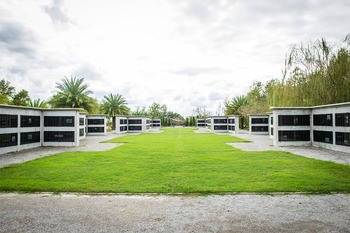
Today, Whitney offers a guided tour of the property, an experience that is underpinned by commemorative structures, monuments, and exhibitions constructed to commemorate the lives lost on the site and throughout the state. Currently, the heritage site consists of a visitor center and an outdoor guided experience essentially split into two sections, the first articulating slavery in Louisiana with original artwork and memorials, the second focussing on life and labor on the site, utilizing traditional buildings found in the antebellum South, including slave quarters, kitchens, barns, and the overseers’ house (Figures 2 and 3). Adopting a plantation narrative in its most elementary form, Whitney establishes a tour structure that displays an antebellum estate as a site of agrobusiness built on dehumanizing labor and production instead of a beautiful historic residence for the southern elite. In a 2004 study, interpretation educator and curator Julia Rose stated that visitors to plantation heritage sites begin their experience with an initial question that they expect to be answered, “Who lived here? Whose life experiences are represented at this place?”Footnote 61 In 2022, Jodi Skipper furthered this inquisition, crafting points of consideration for anyone engaged with heritage sites, from curator to visitor, including “Why does the site exist? What kind of work does it do? What kind of work do we want it to do?”Footnote 62 The curatorial landscape of Whitney Plantation, in conjunction with guided excursions, answers the proposed questions in a paradigm-shifting manner, highlighting the impact of the property’s natural and built landscape from the perspective of those who occupied the land.Footnote 63 By embracing the notion that “landscape and memory are constitutive to one another,” Whitney’s narrative works to demystify the “manipulated built environment” designed to assert planter dominance and authority both “physically and symbolically above their [enslaved population].”Footnote 64 The reorganization of the traditional plantation tour structure challenges the “power balance of heritage interpretation” and offers a different historical perspective within a saturated market, eradicating the generic “slaves-were-here” counternarratives with one that stimulates engagement with the lives and experiences of those enslaved (Figures 4 and 5).Footnote 65 The shift in educational concentration is not only apparent through structure but also grounded in the foundational purpose and throughout the narrative of the site. This is further supported by the inclusion of commemorative monuments and works of art, as well as the unique incorporation of “memorial” and “memorialization” techniques throughout the property, all contributing to the divergent “construction of notions of heritage and inheritance.”Footnote 66
Interpretive techniques employed at Whitney Plantation. Specifically, the Allèes Gwendolyn Midlo Hall memorial was created to celebrate the research and contributions to the field by Hall, as well as one of the slave cabins located on the property (Figure 3). Photograph taken by Elsa Hahne and provided by Whitney Plantation (2025), at https://whitneyplantation.org/media/#images.

One of the slave cabins located on the property. Photograph taken by Elsa Hahne and provided by Whitney Plantation (2025), at https://whitneyplantation.org/media/#images.

Whitney Plantation’s main interpretive focus: life outside the main house for the majority of those living on the plantation. Photograph taken by Elsa Hahne and provided by Whitney Plantation (2025), at https://whitneyplantation.org/media/#images.

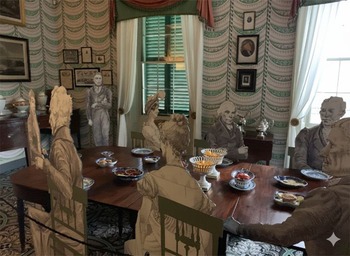
The premier guided experience at James Madison’s Montpelier, VA in 2024 – a rearticulated dining room with prominent individuals at the table and Paul Jennings, an enslaved man, in the corner (a form of “counternarrative”). Photograph taken by the author (2021). Source: James Madison’s Montpelier, the Montpelier Foundation and the National Trust for Historic Preservation.

Memorials: refocussing the plantation narrative through the built environment
The core of Whitney Plantation’s experience is its guided tour of the property. In contrast to many traditional “plantation landscapes” and house tours, “typically preserved and showcased as memorials to and testaments of elite power,” this experience takes place predominantly outdoors, away from the objects and architecture of luxury.Footnote 67 As guided tours begin, visitors are led into the Antioch Baptist Church, originally constructed after the Civil War in Paulina, Louisiana, located on the West Bank of the Mississippi river. Additional buildings were acquired from other plantations, including the slave quarters. Before the Civil War, Habitation Haydel had possessed twenty-two slave cabins on the property. Still, of those original buildings, only two remain due to their neglect and sporadic removal after Emancipation. To create a more accurate visual and cognitive memorial landscape, additional cabins were purchased and brought to the site from Myrtle Grove Plantation in Terrebonne Parish.Footnote 68 These additions to the structure of Whitney give visitors a better understanding of the historic layout of the plantation while simultaneously acting as a space to commemorate and pay tribute to the lives lost on the property. This curated configuration includes an amalgamation of contemporary artwork, commemorative structures, and historic buildings, obtained to create a cohesive, evocative environment. Though not originally constructed as a memorial for the plantation museum, these historic objects of material culture have “a language and means of affect” acquired and utilized specifically to commemorate a historic environment.Footnote 69
In conversation with the contemporary statues and artwork utilized throughout the tour at the Louisiana plantation, both the church and the cabins demonstrate a powerful manner of highlighting structures often left to decay – serving as material culture used to remember persons of the past. This environment, coined the “homespace” by American archaeologist Whitney Battle-Baptiste, has a distinct function on the property as a “complex household [where] activities are carried out collectively, and [serves as] the connection between household and yardscape where all of the action happens,” essentially functioning as the “nucleus of the complex household.”Footnote 70 The further importance of this established environment, specifically surrounding the creation of “households” within slave quarters, stems from their original purpose, to “function chiefly as shelters for people who, by definition, were not allowed to own homes,” amplifying the resistance and subsequent danger of creating a community on the plantation property, a topic historically missing from plantation museum tours.Footnote 71 Studies of slave cabins, traditionally curated separately, and in many cases years, if not decades, after the museological inauguration of the main house, have pinpointed antebellum dwellings as offering a “counternarrative” by representing “what is at stake,” standing as precarious counterpoints to challenge the narrative of the Big House.Footnote 72 The separated manner in which the cabins and the house are curated reinforces a hierarchical binary, inadvertently, or in some cases deliberately, placing the often underdeveloped discourse of slavery separate from the beauty of the main house, segregating and diminishing this history as an “add-on” or secondary experience. In direct contrast with this practice, the cabins and church brought to Whitney act as memorials or objects of “material culture used for remembrance of a person(s) or events(s)” on the plantation tour. These structures were identified, transported, and centered within the representational structure at the time of curation, grounding the themes and topics surrounding slavery as the meta-narrative of the tour – a practice that substantially departs from inclusions of slavery within the constraints of a nostalgic tour.
The use of slave cabins, in their capacity as physical structures and lived environments, enables the identification and continuous advancement of critical discourse surrounding the creation and lasting legacies of culture, heritage, art, religion, and identities within the United States. As Vlach states, “Within their settlements, slaves established strong family identities, created distinctive art forms, and developed meaningful religious rituals”; these spaces were centers of resistance where “slaves overturned the declared order of the plantation.”Footnote 73 Ultimately, he argues, “southern plantations can only be described accurately and analyzed fully if we remember the territorial prerogatives claimed and exercised repeatedly by slaves.”Footnote 74 This form of memory work, centering historic buildings alongside more customary memorial structures – like the prominent “Wall of Names” – aims to fill a substantial void in plantation tourism. It also moves beyond the uneven act of employing “counternarratives” to tours that have ignored this information, often creating secondary or trivial inclusions. Instead of “challenging the prevailing master accounts,” this representational discourse creates an experience that works to advance understanding of the lives and experiences of those on the property, while advocating for the demystification of the legacies of this history in the present. As Jodi Skipper argues, the “connections [made within heritage sites] can deepen our understanding of systemic racism” while the lack of engagement can create a risk of the “public’s inability to discriminate between sites designed to complicate history and those doing the work of silencing it.”Footnote 75 Through the weaving of historic buildings and powerful onomastic memorials, Whitney steps outside the shadow of the “narrative-and-counternarrative” binary by expanding the physical, interpretive, and change-driven dimensions to transform the notion of a plantation museum. In a nation that spends millions on the refurbishment, preservation, and beautification of ornate mansions to amuse and entertain, Whitney reconfigures the homes and lived spaces of the majority of plantation inhabitants, elucidating a built environment not only to advance the public’s understanding of American history, but also to promote the expansion of reparative justice.
Memorialization: reimagination of life at Haydel Plantation through performative interpretation
In conjunction with the memorial structures, guides infuse “performative acts linked to remembrance” within the tour to articulate aspects of life and labor at Habitation Haydel. This approach, unlike that of traditional plantation heritage sites that normally omit such details, allows guides to discuss the physical realities of sugar cultivation and offer visitors a small, tangible experience of harvesting sugarcane. Included in a majority of contemporary museological exhibitions, practical or hands-on activities allow visitors, particularly younger ones, to gain a deeper understanding of theoretical ideas or historical practices.Footnote 76 My guide at the Whitney utilized this tactic in an unprecedented manner to articulate the realities of cultivating sugar for production. They physically removed a cane stalk from the ground and allowed the entire group (including over twenty schoolchildren) to feel its sharp edges, articulating a small fraction of the pain enslaved field laborers would have felt during harvesting season. Such interpretive discourse represents a significant advancement beyond typical “counternarrative” work by fundamentally expanding the scope and complexity of plantation representation. This approach aligns with what Antoinette T. Jackson advances as “telling a bigger story” through the “active act of heritage resource management” as a continuous and “conscious decision to recover knowledge that has been subjugated.”Footnote 77 Consequently, Whitney places the emphasis not on infusing intermittent details into a problematic retelling of history but on constructing a “bigger, more critically interpretive story about U.S. American history and heritage.”Footnote 78 While the pain and arduous nature of field labor is a common theme of “counternarrative” discourse, this reorientation, achieved by focussed demonstration, transcends its usual parameters.
Experiential elements centering slavery stand in stark contrast to traditional plantation representation, where women in hoop skirts would present romanticized stories of wealthy plantation-owning families living in luxury. Antiquated, period dress as a form of “historic reenactment” remains a sustained feature of plantation tours around the country, centering amusement over accuracy. Discussed in 2005 by W. Fitzhugh Brundage, Oak Alley Plantation was referenced as a place where “tour guides wear period dress and visitors can sip mint juleps while they stroll the mansion’s manicured grounds,” whose “unapologetic” owner referred to this depiction of American history as “the better part of the story for us to tell.”Footnote 79 This interpretive tactic continued through the twenty-first century, detailed by Carter in a study of “narrative landscapes of southern plantation museums” where an interviewed guest gushed about a similar experience that made her “feel like a true southern belle.”Footnote 80 Whitney is at the forefront of transforming this practice, utilizing similar tactics to transport guests through time to unveil a divergent aspect of life in the antebellum period. However, practices such as these are up to the discretion of the tour guide.
Though working to present a narrative distinct from its River Road counterparts, Whitney is still, in essence, a plantation heritage site, a fact that makes it vulnerable to the practical drawbacks of museological interpretation, especially concerning the issue of curatorial/docent autonomy. Those giving guided tours are trained by the administration and site researchers, and work from a scripted narrative.Footnote 81 Yet guides maintain a degree of autonomy in delivering their tours with limited monitoring. Additionally, sites curated to encourage more individualized experiences, like many contemporary museums where visitors choose the route they wish to take, employ similar tactics of highlighting and minimizing certain aspects of history through panels, objects, text detail, and other strategies. The established procedure allows curators and guides to act as active agents instead of “passive participants,” often curating the tour or general experience based on their interests.Footnote 82Scholars have critiqued these systemic shortcomings for decades, contending that curatorial influence, exerted in layered mechanisms, dictates the narratives and ongoing legacy of plantation heritage sites across a diverse range of national contexts.Footnote 83 To combat this and the substantial inequalities in the creation, development, and management of national heritage, descendant communities are actively involved in running Whitney, a praxis that, as Jackson argued, positions “knowledge [dissemination as] a means of broadening ways of thinking about Africans in plantation spaces beyond fixed notions of labouring and social geographic expectations.”Footnote 84 As of 2019, Whitney Plantation has employed those descended from the enslaved community, both at the site itself and in the local Louisiana area, in nearly every position at the museum. This includes docents, front-of-house, administration, management, and director posts, including the site’s director of communication, Dr. Joy Banner, who is a direct descendant of an enslaved family at Whitney Plantation.Footnote 85
Despite still operating within the framework of a “plantation museum” with inherent practical imperfections, and acknowledging limitations in its narrative, Whitney Plantation has pushed the current parameters of plantation tourism.Footnote 86 The interpretive interventions detailed above, which separate from (memorials) or reconceptualize (memorialization) traditional museological experiences in a plantation setting, work in tandem to develop a history often overlooked or trivialized in this setting. Unlike sites that have evolved singular narratives and countered past interpretation with contemporary interventions, this site stands as a milestone of evolving practice accomplished in a unique historical moment, yet it was only possible due to the generations of effort and activism that created an environment where a plantation focussing on the history of slavery can exist. As Paul Shackel states, “The debate over the control of public history occurs at some of the most visible places on the landscape, and they are the places for negotiating meanings of the past. The meaning of sacred sites on the American landscape is continually being negotiated and reconstructed.”Footnote 87 The current historic juncture, where these advancements are celebrated, criticized, debated, and refined, is vital to the transforming heritage sector and requires careful documentation for future scholarship. By continually engaging with polarizing terminology, scholars reinforce colonial discourse, thus maintaining the racial environment of antebellum plantations through academic interventions.
Conclusion
We do not have to romanticize our past in order to be aware of how it seeds our future. We do not have to suffer the waste of an amnesia that robs us of the lessons of the past rather than permits us to read them with pride as well as a deep understanding.
Audre Lorde, 1982Footnote 88
This article has argued that the term “counternarrative,” used to describe the expanding interpretive practices at plantation heritage sites, is overused and undermines critical developments within the heritage sector. I have demonstrated that the continued use of this language unnecessarily and inaccurately places antiquated representations in a position of power, reinforcing the normativity of white narratives. This article also contributes to the ongoing discourse surrounding memorials and memorialization techniques that disrupt traditional plantation narratives, utilizing Whitney Plantation as a case study. As curators, academics, museum professionals, and researchers continue to assess dimensions of contemporary representation, their interrogation “requires attentiveness to the rigorous and active ways in which dialogue about plantations as national heritage sites is constructed today and why.”Footnote 89 I urge these experts in the fields of history, museum studies, heritage, and tourism to reflect on the evolution of these sites and their curatorial foundation to question whether those who present an expansive discourse of the nation’s history are solely working to “counter” traditional narratives.
Audiences generally associate plantation heritage sites with beautiful and ornate mansions when, in reality, a plantation is so much more than a house. By restructuring plantation tours outside the “Big House,” transforming the meta-narrative from one of beauty and luxury to a detailed retelling of the experiences of the majority of those who historically occupied the property, heritage sites can work toward a deeper understanding of antebellum life. Whitney has pushed the boundaries of plantation representation and “counternarrative” employment by utilizing contemporary interpretive practices, including the strategic embrace of a memorial landscape in conjunction with memorialization practice. Through the management of museological depictions of past atrocities, which the public consider to be “their most trusted source of historical information,” heritage professionals today have a responsibility to include a nuanced and complex depiction of history.Footnote 90 In the same vein, scholars have a responsibility to capture the moments of change and the influences of these sites, providing an up-to-date articulation for present and future researchers. Paul Shackel contends that memories “serve to legitimize the past and the present,” that heritage sites and other tangible forms of remembrance work to “foster myths that create a common history, allowing for divergent groups to find a common bond.”Footnote 91 Antoinette Jackson furthers this point, stating that “heritage professionals need to be more holistic in representing and interpreting sites … to avoid re-inscribing segregation in public memory as solely an issue or problem for marginalized communities.”Footnote 92 I assert that this same responsibility must be placed on the academics who document this evolving practice. As these transformations continue, it is critical to acknowledge and recognize the difference between singular interventions and a moment of substantial evolution as a matter of import for all involved in memory work.
At this moment, in real time, we are seeing the political dismantling of diversity, equality, and inclusion work established to substantially advance knowledge production and equity throughout the United States. Presidential influence has worked to specifically target Black history memory work through sites of heritage and commemoration, including Whitney Plantation. In February 2025, an eleven-mile stretch of land known as the Great River Road, which included the Whitney Plantation, was removed from consideration for National Historic Landmark designation following a multiyear review by the National Park Service.Footnote 93 Additional federal support has been rescinded, with Whitney Plantation bemoaned for “no longer serv[ing] the interest of the United States.”Footnote 94 It is more important now than ever before to recognize and detail the impact of evolving museological interpretations; throughout public discourse and within contemporary scholarship, we must collectively acknowledge the expansion of the sector. Researchers must refrain from using overgeneralized nomenclature and instead detail how and why these narratives are shaped to accurately capture and progress discourse. According to Andreas Huyssen, “the museum serves both as a burial chamber of the past – with all that entails in terms of decay, erosion, and forgetting – and as a site of possible resurrections, however, mediated and contaminated in the eye of the beholder.”Footnote 95 Previously demonstrating a discourse ranging from “collective amnesia to historical revision,” plantation heritage sites continuously adapt to the nation’s contemporary political, social, and cultural movements.Footnote 96 In this historical moment, the heritage industry has outgrown the singular practice of “countering” antiquated discourse. We must recognize that sites like Whitney Plantation are a disruption that pushes for further interrogation; they do not solely stand as the antithesis of discourse that works to recenter nostalgic narratives, but actively advance understanding of the nation’s history.
Competing interests
The author declares none.
Mary E. Booth is the Centre Manager of the Centre for the Study of International Slavery, a research centre created through a partnership between the University of Liverpool and the International Slavery Museum. She specializes in American and British studies, museum studies and heritage tourism studies. She is currently completing a monograph with Liverpool University Press, analysing the evolving interpretive practice at American plantations and British historic houses. She is also working with a team at the University of Liverpool and the University of Georgia on the intersection of technological advances, archival research, and community impact on the British Academy-funded project Ethical Digital Public Histories: Prisoners and the Legacy of Enslavement 1817–1970. Finally, she continues to contribute to the ongoing research surrounding university benefactors and their financial links to historic racial slavery in both Manchester and Liverpool. Dr. Booth wants to extend her deepest gratitude to the editors of the Journal of American Studies and the reviewers who provided support and feedback for this paper – their perspectives, advice, and guidance were immensely helpful. The author gratefully acknowledges the staff at Whitney Plantation, James Madison’s Montpelier, and Natchez Pilgrimage for granting permission to reproduce images in this article.




 Open access

