





Introduction
In the fall of 1925, the Turkish state prohibited the activities of Sufi lodges and orders via Decree 2413 and Law 677.Footnote 1 With the country under martial law, the state seized Sufi properties and financial endowments and, moreover, abolished all titles and positions in Sufi communities, such as shaykh, dede, baba, and postnişin. Approximately 800 Sufi lodges and complexes around the country were shuttered and their leaders were barred from practicing their occupations. The press and government issued scathing attacks on Sufi masters, calling them “parasites,” “charlatans,” and “peddlers of superstition and indolence” (Soileau Reference Soileau2018, Reference Soileau, Tee, Vicini and Dorroll2024). This discourse had its roots in the Second Constitutional Period (1908–1922) in which numerous intellectuals had called for a reform or abolition of the Sufi lodges.
Following an uprising in south-eastern Turkey known as the Shaykh Said revolt, the first president of the Turkish Republic, Mustafa Kemal, set the tone for Republican discourse on the shaykhs in his famous Kastamonu Speech (August 30, 1925).
Up until now, there have been those who have confused and numbed the minds of this nation with [a backwards] mentality. Surely, now the superstitions present in their minds will be completely eradicated. Unless they are removed, it is impossible to bring the light of truth to the mind … Gentlemen and people, know well that the Republic of Turkey cannot be a country of shaykhs and dervishes, disciples and followers.
Over the subsequent decades, the anti-Sufi rhetoric of the Turkish state became institutionalized with politicians, intellectuals, journalists, and academicians declaring the closure of the Sufi orders to be an important and successful element of the Turkish revolution, one of the key revolutionary reforms.
Dramatic events – such as the 1930, Menemen Incident in which violent protesters beheaded a soldier in a provincial town – intensified the pejorative view of Sufi shaykhs. In the 1940s, followers of a charismatic leader beheaded dozens of statues of Atatürk in a symbolic rejection of idolatry and secularization. A widely covered public trial ensued, resulting in the exile of the shaykh – Kemal Pilavoğlu (1906–1977) – to an Aegean island. State archival documents show that in the 1930s and 1940s, the police actively pursued secret meetings and ceremonies of Sufi groups. At the very end of the one-party period, in 1949, the penalties for the leaders of secret Sufi ceremonies were made harsher including the punishment of “exile for no less than one year.”Footnote 2
Understandably, a view crystallized that the early Republican state harshly persecuted former Sufi leaders, particularly among anti-secularist, devout intellectuals. Influential books such as Necip Fazıl Kısakürek’s Son Devrin Din Mazlumları (The Persecuted People of Faith in Recent Times) (Kısakürek Reference Kısakürek1969) cultivated a narrative of merciless state persecution of religious leaders, depicting the early Republic as exercising an uncompromising form of laicism. Adopted by Islamic political movements, this narrative remains foundational to their perception of the early Republic. From a secularist perspective, suppressing organized Sufism and disenfranchising its leaders were necessary to enable progress and modernization because early Republican leaders viewed Sufi leaders and institutions antithetical to the ethos of the new Republic (Soileau Reference Soileau, Tee, Vicini and Dorroll2024). Islamist and Kemalist historical narratives converged on the idea that a harsh suppression of Sufis had occurred, while they differed on whether this measure was justified or necessary.
With few exceptions, seminal scholarly works have echoed this narrative and claimed that the suppression of the lodges was a hallmark success (Lewis Reference Lewis1965; Shaw and Shaw Reference Shaw and Shaw1977, 387–388). Other historians of modern Turkey paid scant attention to the Sufi orders, making it one of the most enigmatic of the early revolutionary reforms (Brockett Reference Brockett2006; Zürcher Reference Zürcher1998). With little extant historiography on the post-1925 lives of Sufi leaders, scholars have not had much information to draw upon. A great deal of scholarship focuses on the Naqshbandi Sufi order due to the emergence of Islamic political movements from their ranks (Mardin Reference Mardin1989; Yavuz Reference Yavuz2003). However, this scholarship tends to ignore the Naqshbandi shaykhs who supported the new nation-state and became part of the Republican elite. Recent work has begun to discuss this and complicated the clean narrative of continual Naqshbandi opposition and persecution (Kara Reference Kara2020b; Özdemirci Reference Özdemirci2022). For other Sufi orders, the secondary literature remains thin and even recent works have struggled to incorporate the suppression of Sufism into their narratives of early Republican life and culture (Metinsoy Reference Metinsoy2021). Global histories of Sufism, likewise, rely upon a rather narrow range of scholarly works due to the paucity of published research in European languages (Green Reference Green2012).
This article offers a new perspective on the early Republic via the lives of post-1925 Sufi leaders. It challenges the discourse of unrelenting secular persecution by examining the successful careers and continuation of elite social status of Sufi shaykhs and families. The article asks: what happened to the last Sufi masters in the years following the legal prohibition of Sufism? Should we think about them as a persecuted class of religious professionals? And, finally, what do their careers tell us about the nature of the early Republican state and its approach to Sufi elites? Answers to these questions reveal a broad pattern of integration and inclusion with selective persecution.
Our research shows that most shaykhs found employment in government positions, working for the very state that ended their Sufi activities. This pattern has been noted by previous scholars but not pursued in depth (Küçük Reference Küçük and Atabaki2007). Contrary to the idea that the Turkish state harshly persecuted Sufi leaders, this article considers evidence of broad cooperation between them and the early Republican regime, allowing them to maintain relatively high status in the new nation-state. I argue that, to varying degrees, Sufi shaykhs remained a part of the intelligentsia and elite echelons of society as they were absorbed into the educational, cultural, and political institutions of the new nation-state. In addition to famous examples of persecution or tragic suffering, the history of this period must also account for the wide range of experiences as well as successes of post-1925 Sufi leaders.
New approaches to Turkish Sufi history
The lives of Sufi leaders offer a valuable prism for understanding the state-organized prohibition of Sufism and the relationship between the state and Islam in this period. The transmission of knowledge and comportment in Sufi orders through master–disciple lineages is the backbone of Sufi tradition, and the masters play a central role.Footnote 3 The experiences of Sufi leaders give us an indispensable perspective on the survival and transformation of the tradition in a new political context.
In recent years, the prohibition of Sufi orders in 1925 has attracted increased interest amid reevaluations of the early Republican reforms and piqued historical curiosity about the lives of Muslim leaders (Aytürk and Mignon Reference Aytürk and Mignon2013; Burak-Adli Reference Burak-Adli2024; Kara Reference Kara2010a). Scholarly literature has evolved, with studies examining the nature of early Republican reforms and their reception by citizens as well as the role of Islamic leaders therein (Brockett Reference Brockett2006; Türköz Reference Türköz2018; Yılmaz Reference Yilmaz2013). İsmail Kara and Mustafa Kara have researched many early Republican shaykhs’ biographies, painting a portrait of diversity and challenging conventional assumptions about their lives, ideas, and political involvements (Kara Reference Kara2010a; Kara Reference Kara2019). Another example is Fahri Maden’s work on Bektashi lodges and shaykhs that provides fine-grained information about Bektashi leaders in the early Republic (Maden Reference Maden, Aksoy and Taşğın2021, Reference Maden2023).
To paint a broad picture of these life trajectories, this article draws on a database of Sufi shaykhs and leaders who lived in the late Ottoman Empire and early Republic, the Sufi Shaykhs in Modern Turkey Database (SSMTD) (2024–). This database is an evolving project that has not yet been published. Based on a range of materials including encyclopedias, academic works, state archives, and memoirs, the database records information about the last generation of leaders who lived through the suppression of Sufism in 1925 and wrestled with the consequences of being a former shaykh in the new Republic.Footnote 4 To date, it has been possible to identify the professions pursued by 121 individuals. The database tracks their careers to make it possible to offer general observations about how these leaders fared in the post-1925 period. The methodology of the project is to gather biographical data from all possible sources, including birth–death dates, the lodge which they led prior to 1925, the order(s) with which they were affiliated, publications, whether they faced persecution, and, crucially, which occupations they pursued after the lodges were closed.
It must be mentioned that the matter of determining the leaders’ professions post-1925 has certain complications. Many worked in several different professional domains. Sometimes their posts were insecure, and they changed jobs several times. The database attempts to track all the positions that they held and weighs them equally, regardless of their duration. The database contains some degree of geographical bias, with more information about shaykhs from İstanbul than other regions of the country. While this is partly inevitable because İstanbul had the largest number of lodges, we are cognizant that the patterns observed here may be differently reflected in other areas of the country. Nevertheless, the database includes major lodges of all Sufi orders (tarikats) from as many regions as possible.
Despite its provisional nature, the database represents a valuable resource for establishing a prosopography of the last Ottoman shaykhs in the early Republic. However imperfect, it provides us with the broadest view to date of their fates and makes it possible to move beyond isolated biographies and offer better-informed observations. Presently, the database shows six main tendencies. In order of decreasing frequency, after 1925, Sufi leaders worked:
-
(1) as imams, muezzins, or preachers in mosques – 34.7 percent (forty-two of 121);
-
(2) in local government positions – 22.31 percent (twenty-seven of 121);
-
(3) in cultural fields: in libraries, museums, or musical ensembles – 15.7 percent (nineteen of 121);
-
(4) in the national government as members of Parliament or in ministries – 11.6 percent (fourteen of 121);
-
(5) in the education sector: from elementary to university level – 11.6 percent (fourteen of 121);
-
(6) as shaykhs in an unofficial capacity or via emigration, abroad – 4.1 percent (five of 121) (see Figure 1).
Figure 1.Professional domains of Sufi shaykhs in Turkey, 1925–1950. The figure shows the main areas of professional engagement pursued by Sufi shaykhs following the closure of Sufi lodges in 1925.
Source: Sufi Shaykhs in Modern Turkey Database (2024–) (unpublished)

Figure 1 Long description
The pie chart illustrates the main areas of professional engagement pursued by Sufi shaykhs following the closure of Sufi lodges in 1925. The chart is divided into six segments, each representing a different professional domain. The largest segment, labeled 'Mosques,' accounts for 34.7 percent of the pie chart. The next largest segments are 'Local government' at 22.3 percent, 'Cultural fields' at 15.7 percent, 'Education' and 'National government' each at 11.6 percent, and the smallest segment, 'Unofficial Shaykhs,' at 4.1 percent. The chart provides a visual representation of the distribution of professional domains among Sufi shaykhs during this period.
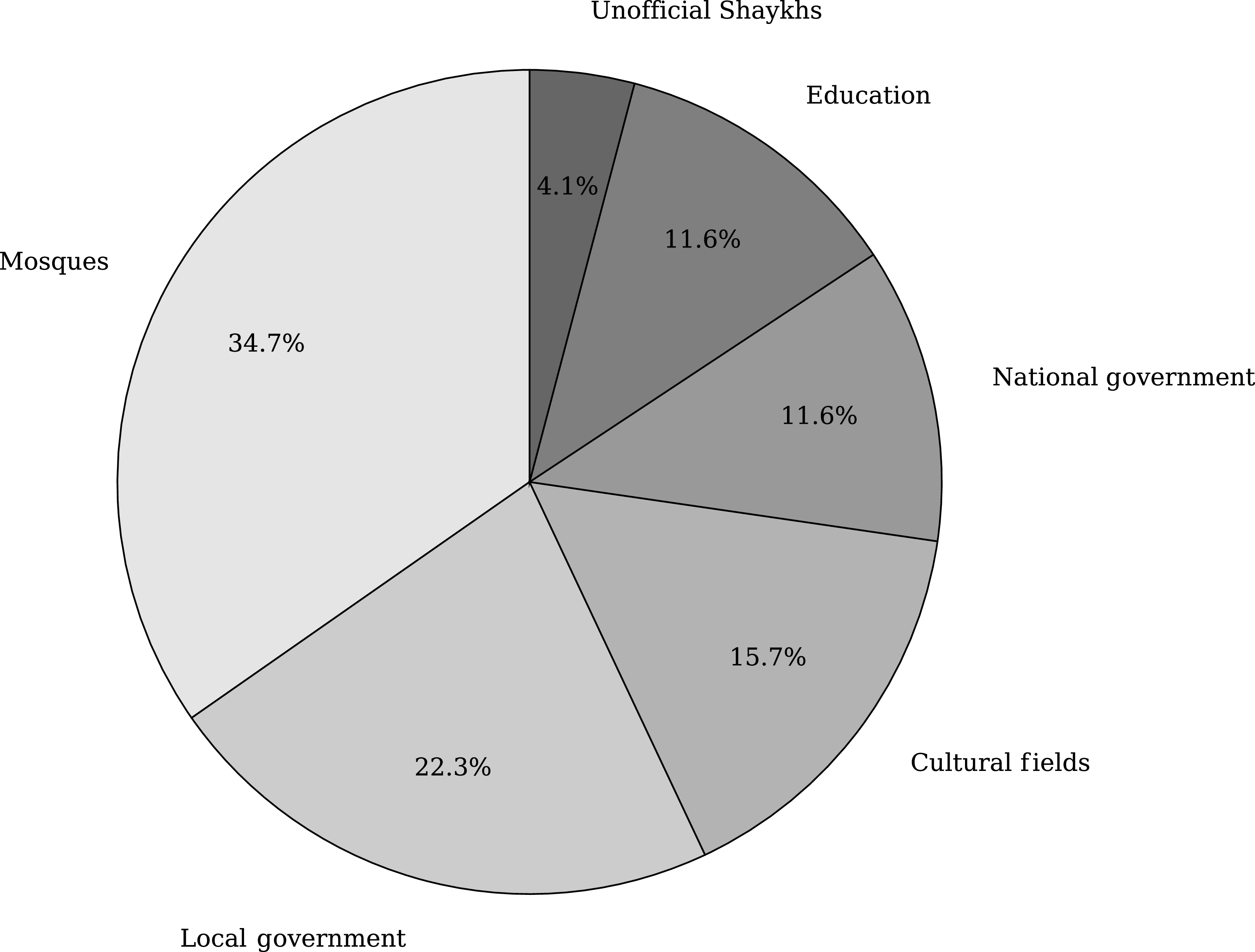
It must be highlighted that most of these positions are within the Turkish state. The largest proportion worked for the Directorate of Religious Affairs (Diyanet) (34.7 percent) and government agencies, local and national (33.9 percent). Combined, the cultural and educational sectors comprise the largest remaining proportion (27.3 percent). These findings reveal that Sufi shaykhs found employment in state institutions and remained a part of the intelligentsia. Many of them had long and successful careers. We also find individuals working outside of state institutions as craftsmen (7.4 percent), businessmen (4.1 percent), or in journalism (1.7 percent). However, these cases are relatively few, accounting for only 13.2 percent of the total.Footnote 5
Mosques
Many Sufi lodges contained a mosque. The 1925 law allowed these mosques to continue to operate, and a large percentage of Sufi shaykhs worked as imams or teachers in mosques in the wake of 1925. This tendency was particularly strong among the Naqshbandi leaders, but it was not limited to them. For example, the final shaykh of the Gümüşhanevi Lodge in İstanbul, Tekirdağlı Mustafa Feyzi (1851–1926), worked at the Beyazıt Mosque as a teacher giving open lessons to the public following 1925. His disciples took positions at mosques and cultivated Sufi followings within them, continuing the Halidi traditions within new contexts. Notable among them, Mehmed Zahid Kotku (1897–1980) worked for decades in the village mosque of İzvat near Bursa. He would return to İstanbul in 1952 to serve as an imam, first at the Ümmü Gülsüm Mosque and later, in 1958, establishing a powerful presence at the İskenderpaşa Mosque in the Fatih neighborhood (SSMTD 2024–).
This mosque became a center of Naqshbandi devotion, teaching, and political activism, which leading political figures visited to gain support and the blessing of its leader. For Kotku and others, working as an imam at a mosque made it possible to continue their Sufi leadership under legitimate auspices and with a salary from the state. In the Republic, several Naqshbandi shaykhs working for Diyanet established “communities” (cemaat) in and around mosques. Famous cases include Kotku’s İskenderpaşa community, the Erenköy Community, and the İsmailağa Community, all in İstanbul (İnanç Reference İnanç2023; Yavuz Reference Yavuz2003). These groups have had a strong influence on the Sunni–Islamic landscape in modern Turkey, not to mention the evolution of Islamic politics. Additionally, after the liberalization of laws on associations and foundations from the 1960s onwards, many former Sufi networks engaged in institution building, expanding their activities in business, industry, media, publishing, education, missionary work, and charity (Güner Reference Güner2024).
However, the phenomenon was not limited to Naqshbandis. Shaykhs from other tarikats also worked in mosques. For instance, the Celveti shaykh İbrahim Hakkı Güner became imam at the Mihriman Mosque. The Kadiri master Abdülkadir Bahrüddin Elçioğlu (1871–1954) of the Nişancı Lodge in Fatih served as imam at Kovacı Dede Mosque (SSMTD 2024–). In Bursa, the semahane of the Mevlevi Lodge was transformed into a mosque after 1925, and its last leader Mehmed Şemseddin Dede served as its imam until his death in 1930 (Şemseddin Reference Şemseddin1997).
This tendency illustrates some important realities about the broader context of late Ottoman Sufi life. For one, many Sufi shaykhs possessed an ulama education. Even some Bektashi lineages, often seen as antinomian, were closely linked with mainstream Islam and learning. The Nafi Baba Bektashi Lodge is an excellent example of the ulama–shaykh path: the graveyard contains numerous shaykhs who were educated in madrasas (Kut and Eldem Reference Kut and Eldem2010; Maden Reference Maden2023). The legal constraints in the post-1925 period pressured the transfer of Sufism into the mosques. Spatially and architecturally, the structure of many Sufi complexes facilitated this transition. While the semahanes, meydans, and tevhidhanes had to close, the mosques remained open and, in some cases, were suitable for taking on Sufi activities. It must be mentioned that most shaykhs led mosques without continuing master–disciple activities or establishing any Sufi community in the mosque context. In the database, only 4.1 percent of the former shaykhs are known to have continued their leadership activities among Sufi circles. The actual percentage may be higher, but the initial results suggest that only a small minority continued as active shaykhs.
Local government
As men with social prestige and high levels of education, many shaykhs took up positions as civil servants. The early Republican press published laudatory pieces on “modern” shaykhs, who had embraced the cultural reforms and prohibition of Sufism in 1925. These men represented Sufi compliance and support for the nation-building project as well as cultural alignment with European sartorial norms, especially the Hat Law of 1925. Such articles profiled Sufi leaders, including Sadettin Nüzhet Ergun, Kenan Rifai, Veled Çelebi, and Mehmet Nurettin Artam (Asrî bir şeyh ile mülâkat 1924). These figures blended into the new political and cultural environment of the Republic. They expressed support for the regime, did not speak against the closure of the lodges (in fact they praised it), and obtained various positions in the government.
Portraits of figures like Ali Nutki Baba, the final shaykh of the Tahir Baba Lodge in Çamlıca, İstanbul, illustrate the model Republican Sufi. In the last years of the Empire, Ali Nutki Baba had been the basis for a controversial novel about a Bektashi Sufi lodge in İstanbul, namely Yakup Kadri Karaosmanoğlu’s Nur Baba (1921/1922) (Karaosmanoğlu Reference Karaosmanoğlu2023). The novel was widely interpreted as an attack on the poor ethics, ignorance, and corruption of Sufi masters. Ali Nutki’s lodge is the setting in which a Bektashi baba named Nur Baba seduces disciples, drinks heavily, manipulates elites, and drains his followers’ financial resources (Karaosmanoğlu Reference Karaosmanoğlu2023; Wilson Reference Wilson2017). However, this fictional portrayal of Ali Nutki in 1922 did not prevent his rehabilitation in the early Republican years.
A newspaper article published in September 1925 shows Ali Nutki wearing a modern hat, suit, and tie and praising the reforms of the Republic (Garb’a gitmek, tevhide gitmektir 1925). After 1925, Ali Nutki was invited to meet Atatürk to discuss the novel at Çankaya, the presidential residence. He was awarded a posting to a government office in Mucur as kaymakam, the district in which the Hacı Bektaş tomb complex is located. Following his time in the limelight as a guest of Atatürk and suspected basis for the scandalous Nur Baba, Ali Nutki spent quiet days at a sleepy posting in Anatolia (Maden Reference Maden, Aksoy and Taşğın2021). This position, and others like it, were likely sinecures, honorific postings for disenfranchised but sympathetic Sufi leaders. Many shaykhs took similar jobs as clerks, inspectors, and officials at unglamorous positions, including property registration offices, customs border stations, and post offices (SSMTD 2024–).
Cultural endeavors and institutions
The conception of Sufi lodges as centers of culture and civilization was an idea with great currency for sympathizers of Sufism in the early Republic, such as Osman Nuri Ergin (1883–1961) (Ergin Reference Ergin1936). The traditions of scholarship, music, ritual, calligraphy, and painting cultivated in Sufi lodges lent themselves to sometimes elegant, sometimes forced, translations into modern cultural forms of the sort favored by the modern nation-state and European-influenced spheres more broadly. Many Sufis found employment in what we may roughly dub cultural endeavors in institutions such as libraries, public radio, and museums or as independent writers or actors. Among prominent former shaykhs, two occupations stand out: librarians and writers.
The impact of the Minister of Education from 1938 to 1946 – Hasan Ali Yücel – cannot be underestimated in the domain of cultural endeavors in the early Republic. Not a shaykh but a Mevlevi devotee close to the Yenikapı Mevlevi Lodge, Yücel was a powerful figure in the 1930s and 1940s and exercised a broad-minded, humanistic influence over the entire cultural sphere, from museums and literature to historical preservation. In various cases, Yücel involved former shaykhs or Sufi figures in cultural projects. It was he who enlisted Veled Çelebi to compose the first modern Turkish translation of the Mesnevi and secured a prominent post as the head librarian of Beyazıt Library for the impoverished shaykh–scholar Sadettin Nüzhet Ergun (Sayar Reference Sayar2002).
Sadettin Nüzhet Ergun (1899–1946), the final shaykh of the Hallaç Baba Lodge in İstanbul, was a man of books. As a writer and scholar, he contributed to the creation of the academic fields of Turkish literature, music, and of Sufi studies in Turkey. While he is primarily remembered as a historian of Turkish literature and culture, the majority of his works under the umbrella of national culture present Sufi traditions in modern form. For example, his book Bektashi Poets (Bektaşî Şairleri; Ergun Reference Ergun1930) represents the first modern collection of poetry from the Bektashi tradition. Likewise, his Anthology of Turkish Music: Religious Works (Türk Musiki Antolojisi; Ergun Reference Ergun1942, Reference Ergun1943) is an important contribution to the history of Ottoman–Turkish music that makes Sufi musical forms part and parcel of national culture. This two-volume work is “an encyclopedia of documentary material” on the musicians of the Sufi orders and their voluminous oeuvre (Feldman Reference Feldman and Lifchez1992). It contains the lyrics of hundreds of hymns from different Sufi traditions and is an essential resource for Ottoman Sufi culture.
In addition to being a prolific author, Ergun worked in the libraries of the new Republic. After teaching at a variety of schools and the University of İstanbul, he took a position as a librarian at the İstanbul Archaeological Museum, a major center of high culture in the former capital. In 1943, Yücel appointed Ergun as the director of the Beyazıt Public Library, the de facto national library of the late Empire, established by Abdülhamid II in 1884 as Kütüphane-i Umumi-i Osmani. As the new national library in Ankara was not fully functional until 1946, the Beyazıt Library remained the most important library in the Republic for many years (Bektaş Reference Çavuşoğlu and Mertoğlu2015–). Ergun’s elevation to this position marked an appreciation for his lifetime of achievements in scholarship and culture.
Other prominent Sufi leaders also spent their Republican careers in libraries. Originally from Kayseri, the Mevlevi leader Ahmet Remzi Akyürek (1872–1944) led the lodges in Kastamonu (1909) and Aleppo (1913) and, after the French occupation of Syria, he was appointed postnişin (1919) at the Üsküdar Mevlevi Lodge, an important waystation between the Mevlevi lodges in İstanbul and Anatolia. After 1925, he took up a position at the Üsküdar Hacı Selim Ağa Library, cataloging its collection until 1937 when he moved to Ankara. There he worked in another library, the Historical Manuscripts Library (Eski Eserler Kütüphanesi) (SSMTD 2024–). Skills in reading Persian, Arabic, and Ottoman Turkish still had their uses in the new Republic (Yılmaz Reference Yilmaz2013).
In Bursa, shaykhs took on similar roles as cultural figures. The Halveti–Mısri shaykh Mehmed Şemseddin Ulusoy (1867–1936) had been active in public and cultural life since 1908. He joined the Turkish History Council (Türk Tarih Encümeni) in 1911 and held several posts in the state bureaucracy simultaneously with his leadership of the Niyazi Mısri Lodge. It merits mention that many shaykhs held jobs outside of the lodges in the late Ottoman period. They did not live cloistered lives in their lodges. In his post-shaykh life, Ulusoy became an official at the Bursa Library in 1927. In the same year, when state officials came to confiscate the lodge’s collection of rare books and manuscripts, he refused to hand them over, claiming that the texts were personal property, not subject to the directive to transfer such books to national libraries. After his library position Ulusoy worked at the People’s House (Halkevi) of Bursa at its History, Language, and Literature branch. However, his main occupation was writings on the history of Bursa, leading Mustafa Kara to call him a leading “cultural historian” of the city (Kara Reference Kara2010b). He penned voluminous works about the city’s Sufi history and heritage.
Education
In 1913, one of the early proposals to close the Sufi lodges urged the state to transform them into schools and to employ qualified Sufi shaykhs as teachers (Hanioğlu Reference Hanioğlu1997). This suggestion had a solid basis since, as mentioned before, shaykhs were often well educated and knew foreign languages. Being the leader of a Sufi lodge involved teaching and instruction, in the form of sohbet and spiritual guidance as well as teaching certain texts and practices to disciples. Sufi biographies in İstanbul reveal that many attended elite institutions, including prestigious medreses as well as modern schools such as Galatasaray Lycée and Robert College (SSMTD 2024–).
Interesting cases of teaching shaykhs provide insight into the problems they encountered. For instance, the last shaykh of the Yenikapı Lodge in İstanbul, Abdülbaki Baykara (1883–1935), is notable. Well versed in Persian, he had taught the masterpiece of Jalaluddin Rumi, the Mesnevi, for nearly two decades in the important lodge complex. Mevlevis usually had good knowledge of Persian due to the centrality of studying the Mesnevi in their order. Abdülbaki Efendi was also a prolific poet. Post-1925, he worked brief stints at the Library Cataloguing Commission, as an official of the Republican People’s Party, and at the İstanbul branch of the nationalist organization the Turkish Hearths, which promoted the cultivation of Turkish culture, education, and nationalist thought. However, Baykara found himself unable to adjust to bureaucratic work and left each of these posts after a short period (SSMTD 2024–). His discomfort with office jobs reflected a larger sentiment that he felt, namely a sense of deep depression and loss of dignity following the closure of the lodges.
Baykara approached the head of İstanbul University, the well-known historian Fuat Köprülü (1890–1966), with the request to be appointed as an instructor in Persian language. The request was granted. However, when the university reform process in 1933 was carried out, the former shaykh was dismissed. Thereafter, he obtained a post teaching literature at the Armenian High School of Makriköy but was able to bear the demands of teaching high school students for only two months. He applied for another teaching position at the Maltepe Military School in İstanbul but passed away just one month later (Erdoğan Reference Erdoğan2003). Abdülbaki Baykara had a particularly difficult time adapting to life outside of the lodge and felt an irreparable loss of dignity and status. He composed a famous poem expressing his sadness and anger at the clothing reforms and closure of the tekkes (Erdoğan Reference Erdoğan2003).
However, Abdülbaki’s experience should not be generalized, as many shaykhs had successful careers in the teaching profession. Former shaykhs had a wide range of experiences at different institutions. Hacı Fehmi Efendi (d. 1937), an open-minded Naqshbandi shaykh of the Kaptan Paşa Lodge in Eyüp, taught at the prestigious Galatasaray Lycée in İstanbul (Koç Reference Koç2021). Another Naqshbandi, Nazikizade Mehmed Hilmi Bey, taught at the İcadiye in Üsküdar and at the Nersesyan Yermonyan Armenian school (SSMTD 2024–). After his retirement from the Ministry of Education, Kenan Rifai taught Turkish and French language and literature at the Fener Greek Boys’ Lycée as well as the Yuvakimyon Girls’ Lycée for thirteen years (Ayverdi et al. Reference Ayverdi, Araz, Erol and Huri2003). Sadettin Nüzhet Ergun taught at more than eight different schools, including at the University of İstanbul (Bektaş Reference Çavuşoğlu and Mertoğlu2015–).
These examples demonstrate the wide range of educational endeavors in which the last shaykhs engaged, in many cases drawing upon skills they had developed in their Sufi careers to teach the first generation of Republican school pupils. For some, the teaching profession was temporary, while others taught for the rest of their lives. Yet, the fit between traditional Sufi pedagogy and modern Turkish schooling was not always seamless. We observe in the professional biographies frequent changing of posts that suggests job insecurity as well as difficulty in adapting spiritual mentorship into the mold of primary, secondary, or university-level teaching.
National government
The early Republic faced challenges to its authority in the form of non-confrontational resistance and non-compliance as well as armed uprisings (Metinsoy Reference Metinsoy2021; Yilmaz Reference Yilmaz2013). Meanwhile, the national government needed intellectual talent, leadership experience, and social capital. Especially in the provinces far from state control, it needed the residual authority of men whose lineage and family networks as Sufi shaykhs commanded the authority and respect of the local populations. And so, in the new Republic, as in the late Ottoman period, the power of Sufi lineages often overlapped with political influence and landed wealth. In some areas, Sufi leaders were also local lords and land-owning elites. While the Kemalist Republic pursued policies to break up such “local tyrannies” and Ottoman forms of feudalism (derebeylik) as it saw them, it lacked the resources to do this in many regions. The state relied on loyal partners in the hinterland to ensure cooperation and avoid uprisings.
The war of independence drew on the abilities and resources of Sufi networks for support. The leaders of the national movement prayed at Ankara’s leading Sufi shrine and lodge complex, Hacı Bayram Veli. In a famous picture taken during the War of Independence, the head of the Bayrami order, Mehmed Şemseddin Bayramoğlu (1884–1946), is standing near Mustafa Kemal, holding the prayer beads of Hacı Bayram. Like other shaykhs, he had been a member of the Committee for Union and Progress. His father was a member of the Ottoman Parliament, and Şemseddin became a member of the new Grand National Assembly. He served in the first session but did not take a seat in the second session and retreated from politics thereafter (Beyinli Reference Beyinli2021).
Mustafa Saffet Yetkin (1866–1950) had a short but lively career in Republican politics. A shaykh from Urfa with an education from Al-Azhar in Cairo, he had served previously in the Ottoman Parliament and was for a time the head of the Council of Sufi Shaykhs (Meclis-i Meşayih), the Ottoman body tasked with governing the Sufi lodges in the Empire. In 1923, he was elected to represent Urfa for the second term of the Grand National Assembly and was an active member. Together with fifty-three colleagues, he proposed a law to abolish the Caliphate and send the Ottoman dynasty into exile, demonstrating his credentials as a nationalist. It is rarely acknowledged that a Sufi shaykh played a role in this historical measure to end the Islamic caliphate. However, following 1925, he was excluded to run for another term and went back to working as a mufti in his native city (Ülker Reference Ülker2015–).
Others had longer careers in the legislative body. The head of the Mevlevi order, Veled Çelebi İzbudak (1869–1953), held a seat in the Grand National Assembly for two decades. Between 1923 and 1939, he represented Kastamonu and from 1939 to 1943 was a deputy for Yozgat. Never a vocal member, he toed the Republican People’s Party line. In 1924, İzbudak had publicly defended the Mevlevi Sufi order from attacks in the nationalist press and criticized the government for not allowing Sufi lodges to receive sufficient income from their endowments. However, in 1925, he raised no opposition to the law outlawing the Sufi orders and lodges. He focused his energies on translation and linguistic work for the Ministry of Education and the Turkish Historical Society (Türk Tarih Kurumu), the institution tasked with producing national history. His main achievement was the first translation of the Mesnevi into modern Turkish, published in six volumes from 1942 to 1946 (Mevlana 1942–1946).
Some served even longer. The inheritor of the family lineage of the Ummi Sinan Lodge in the Eyüp neighborhood of İstanbul, Yahya Galip Kargı (1874–1942), was an active participant in the War of Independence and a close associate of Mustafa Kemal. He held a seat in the Grand National Assembly from 1920 to 1942, representing first Kırşehir and then Ankara. He was an active member of the body reflecting his high position in the party hierarchy and proximity to the inner circle of the Republican People’s Party (SSMTD 2024–).
Another interesting case of Sufis in Republican politics is that of Selahattin İnan (1887–1969), a Naqshbandi shaykh and local lord from Gayda near Bitlis in south-eastern Turkey. He came from a powerful family in the area that held both worldly and spiritual power. His father – Seyyid Ali – was executed in 1914 following a revolt (the Bitlis Rebellion; Bitlis İsyanı). In 1930, the Turkish state exiled many Kurdish notables from the area to various parts of western Anatolia. Selahattin Ali was sent to Bursa, far from his networks of power and influence. However, visitors from Bitlis continued to treat İnan as a demi-god. A journalist wrote: “The disciples who came from Bitlis practically worshipped Shaykh Selahattin. As a very close friend of Abidin [his son], many times I observed how the disciples from Bitlis threw themselves to the ground before his feet” (Kara Reference Kara, Çift and Karakaya2020a). The Mayor of Bursa, Haşim İşcan, protected the exiled shaykh, who lived together with his two wives, and employed him.
In 1950, İnan ran for a seat in the Grand National Assembly, representing Bitlis for the Republican People’s Party. The very same party that had exiled Selahattin İnan supported him as candidate due to his influence and popularity, and he emerged victorious. After winning the election, he immediately switched parties and joined the Democrat Party. When asked why, he answered, “in order to maintain our influence in our hometown, we always have to be with the party in power” (Kara Reference Kara, Çift and Karakaya2020a). He held the seat for three terms, spanning a decade, until the military coup of 1960, in which he was imprisoned on Yassıada and interrogated with other Democrat Party leaders. He died while imprisoned. Nevertheless, his sons followed in his footsteps, with Abidin İnan Gaydalı serving three terms in the Grand National Assembly and Kamran İnan holding office for four terms. The tradition, or vocation as it were, continued on to his grandchildren Edip Safder and Mahmut Celadet, who both had lengthy careers in national politics. In total, this Sufi lineage/political dynasty held one or more seats in the Grand National Assembly, in different political parties, over a period spanning from 1950 to 2018 (Kara Reference Kara, Çift and Karakaya2020a).
The local notable İbrahim Arvas (1884–1965) presents another interesting case of inherited charisma. He was the son of Shaykh Abdülhamid, a Kurdish Naqshbandi master based in the Van area who led a Hamidiye Cavalry battalion during the late Ottoman period. He came from a family of Kurdish notables and was the cousin of the well-known Khalidi–Naqshbandi Shaykh Abdülhakim Arvasi (1865–1943). İbrahim Arvas graduated from Galatasaray Lycée in 1912. In the Republic, he served eight terms in the Grand National Assembly – from 1923 to 1950 – representing districts in eastern Turkey, yet during the first three terms he did not utter a single word in the assembly (Kara Reference Kara2020b; Tunç Reference Tunç2019).
What do these cases tell us about the Republican relationship with Sufi authorities? Former shaykhs were welcomed under the Republican umbrella as men who wielded influence and supported the new state, which was badly in need of legitimacy in certain areas of the country, particularly the south-east. In several cases, we observe political relationships between shaykhs and politics that originate in the late Ottoman era and continue into the Republic. Viewing these careers in the Grand National Assembly, it becomes clear that the early Republic incorporated former Sufi shaykhs and welcomed those who threw in their lot with the national project. Talented leaders from Sufi backgrounds had a seat at the table of Republican national government.
Shaykhs continue as shaykhs
The legal ambiguity and arbitrariness of the early Republic combined with the state’s limited capacity to enforce such measures meant that many shaykhs continued to ply their trade in an unofficial or semi-official capacity. If they kept a low profile and demonstrated no hostility to the new regime, many maintained their activities in a clandestine format. As shown above, Sufi shaykhs, especially in cities or at prominent Sufi shrines, had close connections with or were part and parcel of the political and cultural elite. This sympathy between Sufis and political figures made possible a lenient implementation of new rules, allowing various traditions to continue.
A good example of this tendency is the life of Fahreddin Erenden (1885–1966) of the Nurredin Cerrahi Lodge at Karagümrük in İstanbul whose community continues to gather in the same location today. Following 1925, he continued to live in the residential quarters of the lodge and conducted his teaching and spiritual guidance in the same location until his death. He maintained a low profile as well as good relations with influential people in the bureaucracy. In 1940, the Pious Endowments Directorate (Evkaf) decided to rent out the worship hall (tevhidhane) of the lodge as a workshop for craftsmen. Erenden fought this decision through connections in the Republican People’s Party and succeeded in transferring ownership of the property to the General Directorate of Museums to protect it from repurposing (Azamat Reference Azamat2015). Stories of Erenden’s spiritual mentorship in the Republican era are well known. The shaykh received a salary from the state from 1925 until his death, the amounts of which can be seen in the state budget published by the Grand National Assembly (Vakıflar 1951). The Cerrahi lineage continues to this day under the guise of a cultural foundation, the Foundation for Research and Support of Turkish Sufi Music (Türk Tasavvuf Musikisini ve Folklorunu Araştırma ve Yaşatma Vakfı) founded in 1981.
An alternative version of continuing the profession was emigration to countries where Sufism remained legal. The cases of two prominent Sufi orders – the Mevlevi and the Bektashi – stand out as examples. In the case of the Mevlevi, one of the last postnişins of the Ottoman period, Abdülhalim Çelebi (1874–1925), lived a colorful life as spiritual leader and man of politics. He survived two major scandals, the first, being dismissed as the head of the Mevlevis for unethical behavior related to his nightlife in İstanbul and the second being exiled for committing treason during a revolt in the Konya region (Gölpınarlı Reference Gölpınarlı1983). Leaving Konya after the closure of his lodge in 1925, he died dramatically in İstanbul in 1925. The famous dede fell or jumped from the balcony of a hotel in Beyoğlu. Some viewed it as a suicide while other Mevlevis claimed that he was assassinated on orders from Mustafa Kemal Atatürk or murdered by one of his servants (Pacalioglu Reference Pacalioglu2019).
After this, his son Mehmed Bâkır Çelebi (1901–1944) assumed leadership of the order and emigrated with his family to Aleppo, Syria, where Sufism was still legal and which at the time was under the control of the French mandate (Gölpınarlı Reference Gölpınarlı1983). In this way, the Mevlevi order shifted its geographic center from Konya to Aleppo. While the tomb complex and lodge at Konya became a museum, Aleppo became the hub of actual Mevlevi leadership and practice.
The experience in Syria was anything but typical for a Mevlevi leader. At the time, Turkey and France contested the control of the Alexandretta province along the Turkish–Syrian border. The Mevlevi Lodge in Aleppo became a hub of espionage for the Turkish state and Mehmed Bâkır reportedly carried out “patriotic duties” for his country, namely, facilitating espionage in the effort to bring Alexandretta back under Turkish control. A controversial referendum in 1939 went in favor of Turkey and allowed Turkey to assume control of the area that was renamed Hatay. Following these events, the French authorities looked unfavorably on Mevlevi presence in Aleppo, and Mehmed Bâkır, who had gone on a trip to İstanbul, was not allowed to re-enter Syria and was separated from his family (Gölpınarlı Reference Gölpınarlı1983). Forced to stay in Turkey where he could not serve as head of the order, he lived a lonely existence in Konya and then İstanbul. And yet, the Turkish state awarded him a medal of honor for his service to the nation in Syria. Simultaneously, he was a national hero and an unemployed relic of an abolished system. As we know from the writings of his friends, the postnişin lived a lethargic and unhappy life in his final years. However, he certainly faced no persecution from the Turkish state. He never took up another occupation and passed away in İstanbul (Beyinli Reference Beyinli2020).
Another emigrant case, the Dedebaba Salih Niyazi (1876–1941), led the Bektashi order in the final years of the Empire at the Hacı Bektaş complex north of Nevşehir. Originally from Albania, he spent much of his adult life in İstanbul. In 1919, he welcomed Mustafa Kemal and other leaders of the nationalist movement at Hacı Bektaş and actively supported the independence movement (Küçük Reference Küçük2002). When the state closed the shrine complex in 1925, most of the Bektashi babas departed for Albania. However, Salih Niyazi remained and lived in the complex until 1926. Then, he moved to Ankara and ran a hotel in the Ulus neighborhood where he continued his activities as spiritual master. The hotel functioned as an underground Sufi lodge until 1927. Meanwhile, Niyazi received invitations from several post-Ottoman countries to come and lead Bektashi communities. The 1929 Bektashi Congress in Korca, Albania decided to open a World Bektashi Center with Salih Niyazi as its head (Hamzaj Reference Hamzaj2019). Niyazi emigrated to Albania in late 1930 with the intention of assuming a leadership position there. Yet upon his arrival, he found a more complicated situation than expected, as the local Bektashi leaders competed over positions of influence and prestige (Doja Reference Doja2006; Kara Reference Kara2019). Salih Niyazi met a dramatic end in 1941. During the Italian occupation of Albania, he was killed in his home by unknown assailants.
These high-profile Sufi leaders managed to emigrate and obtain positions of influence as shaykhs abroad. However, they were able to do so only with difficulty. Outside their traditional geographies of authority, they continued their spiritual guidance in uncertain circumstances. The last Mevlevi leader was repatriated, then retired, and the last Bektashi Dedebaba obtained a position in Albania, a place where the order was reorganizing itself along new lines and where he perished.
For those who remained in Turkey, a life of withdrawal and quiet spiritual mentorship was common. For instance, the famous Khalidi–Naqshbandi leader of the Kelami Lodge in İstanbul, Esad Erbili (1847–1931), took no new employment after 1925. He lived a reclusive life in Erenköy, İstanbul and continued his spiritual mentorship discreetly. Like other Naqshbandis, he modified traditional practices, eschewing zikr and initiation, while amplifying the role of sohbet, and met with disciples in his home. From 1925 to 1930, Esad Erbili faced no problems with the law, though his home was likely under police surveillance. As described by Zarcone (Reference Zarcone and Turner2001), the Sufi orders were “not so secret between 1925–1930.”
However, a small uprising in 1930 in Menemen, a town in western Anatolia, brought about an abrupt change. A man named Dervish Mehmed claimed to be the Mahdi, the Muslim messiah, and led a group to protest in front of the mayor’s office. When reservist soldiers were sent to disperse the protest, the followers of Mehmed attacked them, chanted slogans in support of the Caliphate, and beheaded a soldier. Within a few hours, reinforcements arrived to suppress the group and restored order. The blatant public defiance of state authority and the gruesome execution of a soldier in broad daylight ignited deep concern among the authorities in Ankara (Azak Reference Azak2010).
After this, the state detained Naqshbandi leaders and disciples as well as the shaykhs of other orders. Accused of being the head of a conspiratorial Naqshbandi network in the country, Esad Erbili, who was over eighty years old, was arrested in İstanbul and taken to Menemen for detention and interrogation. News of his imprisonment appeared on the front pages of daily newspapers, which depicted him as a leader of an anti-government plot. Evidence for this appears to be weak. Despite keeping a low profile and obeying the law, Erbili died a prisoner in a military hospital. Erbili’s son and leaders of the protest were executed. The regime broadcast its harsh treatment of the condemned. The daily newspaper Son Posta, for instance, published photographs of the executed men hanging on the gallows; twenty-eight men were executed (Son Posta 1931).Footnote 6
The Menemen incident prompted a crackdown on Sufi activities that pushed the orders deeper underground. The 1930s and 1940s witnessed many arrests at clandestine ceremonies and gatherings. The state archives post-1930, and especially in the early 1940s, contain many instances of police action against clandestine Sufi activities. It should be underlined that the state’s embrace of Sufi leaders did not include the Sufi orders (tarikatlar), which it rejected vehemently to the extent that the word tarikat remains a deeply loaded term even in the present.
The Islamist author Kısakürek depicts Erbili as a martyr of Republican secularism and crafts a master narrative of state persecution vis-à-vis Sufi and Islamic leaders from this case (Kısakürek Reference Kısakürek1969). Yet, though surveillance and control increased, the shaykhs working in government positions did not face discrimination and continued in their new professions. In other words, they did not face a wholesale purge after 1930. To be clear, I am not arguing that the early Republican state was gentle or benevolent; it is clear that many suffered because of the abolition of organized Sufism.
Nevertheless, I would like to argue that it is important to analyze the level of suppression in a fine-tuned manner. For instance, the police arrested shaykhs who held secret ceremonies but often gave them light punishments or let them off without any penalty. In a few cases, state officials targeted individual shaykhs for internal exile (sürgün), for example Abdülhakim Arvasi, a Naqshbandi shaykh who had a following in the Eyüp neighborhood of İstanbul. However, Sufi shaykhs were never rounded up as a group and imprisoned or executed en masse. Nor were they barred from holding public office. In the database, only 4.96 percent (six of 121) suffered persecution in the form of prison, internal exile, or execution.Footnote 7 The number of those who went or were forced into exile abroad is the same: 4.96 percent (six of 121). Altogether, less than 10 percent of shaykhs in our sample faced harsh forms of persecution.
Conclusion
The question of how the last shaykhs made their way in the early decades of the Republic begins to receive some contours in the light of a larger sample of biographies. Most Sufi leaders obtained work in state institutions, including ministries, libraries, schools, and mosques as well as the Grand National Assembly. Their stories and experiences vary widely, from poverty and depression to success and influence. As a professional class, this survey of their trajectories suggests that a narrative of constant Republican persecution of Sufi leaders is inaccurate or, at the very least, inadequate to understand their experiences.
The treatment of Sufi leaders in the early Republic cannot be equated with the persecution of clergy during the French Revolution – the historical model that appealed to many Turkish modernists – nor with contemporaneous state persecutions of religious leaders around the globe; for example, the Soviet treatment of Islamic leaders during from 1927 to 1941, involving widespread imprisonment and executions numbering in the tens of thousands. The Great Terror in Central Asia carried out some 40,000 executions (Khalid Reference Khalid2014). This persecution ended around 1941 and, from 1943, the Communist Party began to institutionalize Islam and incorporate Sufis into the Soviet Muslim nomenklatura (Sartori Reference Sartori2024; Tasar Reference Tasar2017).
As groups, Islamic ulama and Sufis for the Soviets and Catholic clergy for the Spanish Republicans were clearly defined enemies for certain periods. During the Spanish Civil War (1936–1939), for instance, roughly 7,000 priests, monks, and nuns were killed, often in group executions.
Most of the secular priests were individually hunted down, and either killed on the spot or shortly after, or rounded up and slaughtered in groups. Monks were nearly always slain in groups, since they lived in communes and, therefore, entire communities were seized. The mainly collective character of the attacks on the clergy provides a first piece of evidence that it was less a question of personal revenge than the punishment of an entire class regarded as the enemy (de la Cueva Reference De la Cueva1998, 356).
Attacks on the Spanish clergy and Soviet Muslim leaders were broader and more violent than what was observed in Turkey in the post-1925 period where relatively few Sufi leaders faced harsh measures and, if so, on an individual rather than a collective basis. For comparison, the Shaykh Said revolt and Menemen incident together led to a total of seventy-five executions, the majority of which were not Sufi shaykhs. In our database’s sample, only one individual was executed.
The Turkish state appears to have preferred incorporation over persecution even during the highwater mark of the cultural reforms in the 1920s and 1930s. Given that most former shaykhs were employed in state institutions during the period of revolutionary reforms, it seems that the early Republic wanted to use their talents and influence for the advancement of the nation-building project. While the Turkish state did execute or imprison selected Sufi leaders, it did not implement persecutory measures against shaykhs more broadly. And, at the same time, it enlisted former Sufis to serve in the Grand National Assembly, schools, libraries, museums, mosques, and various ministries. As such, the Sufi aspect of their profiles mattered far less than their support for the Republic and proximity in social class and education with political and cultural elites.
Why was this the case and what was the motivation of state authorities? This question can only be answered provisionally, as the authorities never spell out their reasons. However, three main issues likely drove this approach: first, since the Ottoman period, Sufi lodges had been tied to the state. Shaykhs and their families were intertwined with the late Ottoman and early Republican elites. They studied together in elite institutions and intermarried. That is, Sufis were part of the early Republican elite even if organized Sufism was illegal. Second, many Sufi lodges supported the Ankara government and Mustafa Kemal in the War of Independence, thereby earning their seats at the table of influence. Loyal former shaykhs were never seen as dangers to the Turkish nation-state but allies in the national struggle. Third, the Republic needed people with education, talent, and social clout, which many Sufi leaders possessed. A certain proportion of them were ready and willing to support the nation-building project, even if it meant a radical break with previous institutions and traditions. Therefore, no purges based solely on Sufi affiliation were seen as necessary.
The public rhetoric against shaykhs and tarikats should be understood as a message, not to loyal former shaykhs, but to those the early Republic considered “reactionary” shaykhs, who opposed the secular, modern character of the new Republic. This included those who protested against the Hat Law, gathered for secret ceremonies, and led uprisings against the state. While the “reactionary” shaykhs were condemned, loyal shaykhs were praised for supporting the Republic and adopting new lifestyles. The latter moved easily among the Republican circles, whether cultural or political, which many saw as nothing more than their own social class.
This brief treatment of a vast subject has attempted to open new lines of inquiry about the place of Sufi shaykhs in the early Republic. This article has demonstrated that while many Sufi shaykhs worked actively for the newly formed nation-state, others simply receded from the public eye, led disciples, and received salaries from the state. Even those who inwardly rejected the secular character of early Republican Turkey took up positions within Diyanet. These facts call for a nuanced approach to the history of state–Sufi relations in the Republic and further inquiry into the realities and contradictions of the suppression of Sufi institutions in 1925. By doing so, the field can gain a better understanding of the early Republic and the enduring character of prohibited traditions that continue to shape the religious, cultural, and political landscape.
Acknowledgments
I would like to thank Cristina Corduneanu-Huci, Yusuf Selman İnanç, Gökçen Beyinli-Dinç, Paolo Sartori, and Mark Soileau for their contributions to and insightful comments on this piece. Two anonymous reviewers as well as editor Biray Kolluoğlu provided thoughtful criticism that led to beneficial revisions.
Competing interests
There are no competing interests.

 Open access

