





Highlights
-
• Typological similarity effect traceable at the behavioural and neural level
-
• Small behavioural processing advantage for speakers of less similar languages
-
• P600 effect found in highly similar and less similar language combinations
-
• Larger P600 effect for speakers of highly similar versus less similar languages
-
• Asymmetry of typological similarity effect for behavioural versus neural patterns
1. Introduction
A fundamental characteristic of multilingual language comprehension is cross-linguistic influence (CLI) between the native language (L1) and the non-native language (Kroll et al., Reference Kroll, Dussias, Bice and Perrotti2015; Lago et al., Reference Lago, Mosca and Garcia2021; Lemhöfer et al., Reference Lemhöfer, Spalek and Schriefers2008). In this study, we considered individuals who were able to communicate in two or more languages as multilinguals (Cenoz, Reference Cenoz2013). In language comprehension, CLI is often conceptualised as the parallel activation of both the L1 and the non-native language (Hamers & Lambert, Reference Hamers and Lambert1972; Lago et al., Reference Lago, Mosca and Garcia2021), even when the circumstances only require the use of one language (Blumenfeld & Marian, Reference Blumenfeld and Marian2013; Lago et al., Reference Lago, Mosca and Garcia2021; Marian & Spivey, Reference Marian and Spivey2003; Nozari & Pinet, Reference Nozari and Pinet2020). CLI was demonstrated at the level of (morpho)syntax (Grüter et al., Reference Grüter, Lew-Williams and Fernald2012; Lemhöfer et al., Reference Lemhöfer, Spalek and Schriefers2008; Tolentino & Tokowicz, Reference Tolentino and Tokowicz2011; Zawiszewski et al., Reference Zawiszewski, Gutiérrez, Fernández and Laka2011), for grammatical gender (Lemhöfer et al., Reference Lemhöfer, Spalek and Schriefers2008; Paolieri et al., Reference Paolieri, Demestre, Guasch, Bajo and Ferré2020) and for cognate processing (Midgley et al., Reference Midgley, Holcomb and Grainger2011; Peeters et al., Reference Peeters, Dijkstra and Grainger2013). Moreover, CLI was reported for different ages of non-native acquisition (AoA), with some evidence suggesting that CLI may be more pronounced in early acquisition stages (Gillon-Dowens et al., Reference Gillon-Dowens, Vergara, Barber and Carreiras2010; Ringbom, Reference Ringbom1987; Sunderman & Kroll, Reference Sunderman and Kroll2006). One important question is whether CLI is modulated by typological similarity, that is, the structural similarities between the L1 and the non-native language (Foote, Reference Foote and Leung2009; Putnam et al., Reference Putnam, Carlson and Reitter2018; Tolentino & Tokowicz, Reference Tolentino and Tokowicz2011). In other words, does similarity at the level of, for example, grammatical gender or orthographic and phonological form overlap have an impact on non-native language processing? This is a critical issue because it is intimately linked to the functional organisationFootnote 1 of multilinguals’ languages and the question of how cross-language similarities can facilitate or hinder non-native processing (Tolentino & Tokowicz, Reference Tolentino and Tokowicz2011). As we will discuss below, it has long been proposed that typological similarity is a crucial factor in multilingual language processing (Casaponsa & Duñabeitia, Reference Casaponsa and Duñabeitia2016; MacWhinney, Reference MacWhinney, Kroll and De Groot2005; Odlin, Reference Odlin1989; Sabourin & Stowe, Reference Sabourin and Stowe2008; Tolentino & Tokowicz, Reference Tolentino and Tokowicz2011; Weinreich, Reference Weinreich1953; Zawiszewski & Laka, Reference Zawiszewski and Laka2020). Yet, there is a distinct lack of studies directly tackling the impact of typological similarity on some of the most fundamental cognitive aspects of multilingual language processing such as CLI.
This study focused on examining the role of typological similarity via two CLI effects in non-native speakers. The first CLI effect we investigated was the gender congruency effect, which reflects CLI at the level of grammatical gender (hereafter gender). Gender refers to a noun classification system that is featured in several Indo-European languages (Corbett, Reference Corbett1991). Among those languages are Italian, German and Spanish, which are the languages of interest in this study. The gender systems of both Italian and Spanish feature a feminine and masculine gender value, marked by [laF] and [ilM], and [laF] and [elM], respectively (Beatty-Martínez & Dussias, Reference Beatty-Martínez and Dussias2019; Formato, Reference Formato and Formato2019). In contrast to this two-way gender system, German has a three-way gender system characterised by a feminine, masculine and neuter gender value marked by [derM], [dieF] and [dasN], respectively (Schiller & Caramazza, Reference Schiller and Caramazza2003; Schiller & Costa, Reference Schiller and Costa2006; Schiller & Sá-Leite, Reference Schiller, Sá-Leite, Schiller and Kupischin press). Overt gender marking across determiners, nouns and adjectives features in all three languages German, Italian and Spanish, which are additionally all embedded within an accusative system. This is in contrast to languages such as Basque, for example, featured in Zawiszewski and Laka (Reference Zawiszewski and Laka2020), which is embedded in an ergative system; or English, where gender is only realised on pronouns (Wagner, Reference Wagner and Kortmann2008). Another common feature across the three languages is that noun gender assignment is somewhat arbitrary, but general rules and patterns exist for gender agreement. However, a difference between German and the two Romance languages from this study, Italian and Spanish, is that in the latter, articles, adjectives and verb forms (e.g., the participle) within a noun phrase change as a function of the noun’s gender. For example, native German learners of Spanish not only have to map their known three-value gender system onto the two-value Spanish gender system but additionally must overtly mark gender for verbs, which represents a notable contrast to their native language. In this, native German speakers face an additional challenge compared to native Italian speakers learning Spanish, whose native gender system is comparatively more similar to Spanish in that respect.
The so-called gender congruency effect manifests itself in more accurate and faster processing of gender congruent items, for example, [il M cane M ] and [el M perro M ] “the dog” compared to incongruent items, for example, [il M latte M ] and [la F leche F ] “the milk” in Italian and Spanish (Lemhöfer et al., Reference Lemhöfer, Spalek and Schriefers2008; Paolieri et al., Reference Paolieri, Padilla, Koreneva, Morales and Macizo2019; Sá-Leite et al., Reference Sá-Leite, Luna, Fraga and Comesaña2020). In other words, similarity at the level of gender results in a measurable processing advantage for gender congruent items versus incongruent items across the L1 and the non-native language.
The second CLI effect we examined in this study was the cognate facilitation effect. It reflects CLI at the level of orthographic and phonological overlap, for example, cognates. More specifically, this effect entails more accurate and faster processing of cognates, that is, words with a significant overlap in terms of orthographic and phonological word form, for example, [vulcano] and [volcan] “volcano”; compared to non-cognates, for example, [viso] and [cara] “face” in Italian and Spanish (Comesaña et al., Reference Comesaña, Soares, Ferré, Romero, Guasch and García-Chico2014; Costa et al., Reference Costa, Santesteban and Caño2005; Le mhöfer et al., Reference Lemhöfer, Spalek and Schriefers2008; Marian et al., Reference Marian, Blumenfeld and Boukrina2008; Midgley et al., Reference Midgley, Holcomb and Grainger2011). With respect to typological similarity, Marian et al. (Reference Marian, Blumenfeld and Boukrina2008) showed that a larger phonological overlap for native Russian speakers with high proficiency in English was linked to higher performance and shorter response times (RTs) in an auditory lexical decision task. In turn, this effect highlights the processing advantage for orthographically and phonologically similar word forms, that is, cognates compared to non-cognates. Taking both effects together, the gender congruency effect and the cognate facilitation effect tentatively indicate a processing advantage for typologically more similar structures compared to less similar structures, as reflected by higher accuracy and faster RTs for congruent items and cognates, compared to incongruent items and non-cognates.
In this study, we used both effects to closely examine the impact of typological similarity on non-native comprehension, specifically in terms of syntactic similarity at the level of gender, and orthographic and phonological word form overlap between the L1 and the non-native language. Directly relevant to this study is the Language Distance Hypothesis, LDH (Zawiszewski & Laka, Reference Zawiszewski and Laka2020), which provides a theoretical account of the interaction between typological similarity and CLI effects. The core prediction of this account is the modulation of CLI based on (morpho)syntactic similarity between the L1 and the non-native language. Concretely, the LDH predicts more native-like behavioural patterns and event-related components (ERPs) emerging in the non-native language for morphologically highly similar structures across the L1 and the non-native language compared to less similar structures. This would be reflected in higher accuracy, shorter RTs and larger ERP effects for morphologically similar structures compared to less morphologically similar structures across languages.
Zawiszewski and Laka (Reference Zawiszewski and Laka2020) systematically tested this account in a study on morphological processing in grammatical and ungrammatical sentences in highly proficient Basque-Spanish speakers and Spanish-Basque speakers. The critical manipulation was the presence or absence of a particular morphological feature in the non-native language compared to the L1. Consistent with the LDH, their results indicated a link between shorter RTs and larger ERP effects (i.e., more native-like ERP effects) in the non-native language for some morphologically similar structures compared to less similar structures. In turn, this suggested an overall processing advantage in the non-native language for morphologically similar structures. Critically, the authors also acknowledged that AoA and proficiency in the second language under investigation (henceforth: non-native proficiency) could modulate typological similarity effects. This is in line with previous studies which have highlighted the impact of non-native proficiency on typological similarity effects (Gillon-Dowens et al., Reference Gillon-Dowens, Vergara, Barber and Carreiras2010; Ringbom, Reference Ringbom1987; Tokowicz & MacWhinney, Reference Tokowicz and MacWhinney2005; Weber-Fox & Neville, Reference Weber-Fox and Neville1996). For example, Tokowicz and MacWhinney (Reference Tokowicz and MacWhinney2005) examined low proficient and highly proficient English-Spanish speakers and their sensitivity to the correctness of syntactic structures. In addition to non-native proficiency, the second critical manipulation was that some syntactic structures were similar across the languages (auxiliary marking), whereas the other structures were not (gender and number agreement). Results demonstrated that increased typological similarity was linked to shorter RTs, particularly for less proficient speakers. In contrast, highly proficient speakers in this study appeared to remain largely unaffected by typological similarity. This finding suggests that typological similarity effects may be more pronounced in earlier acquisition stages (Sunderman & Kroll, Reference Sunderman and Kroll2006; Zawiszewski & Laka, Reference Zawiszewski and Laka2020). Therefore, in this study we focused on late language learners with intermediate proficiency levels to examine typological similarity effects more closely, that is, individuals who acquired a non-native language later during development after the age of 14 (Rossi et al., Reference Rossi, Gugler, Friederici and Hahne2006).
Before the formulation of the LDH, earlier work by Sabourin and Stowe (Reference Sabourin and Stowe2008) examined the impact of typological similarity on gender processing. In their study, they compared gender agreement processing in Dutch across native Dutch speakers versus native German and Romance language speakers, who were all late learners of Dutch (AoA > 14 years of age). In terms of typological similarity, German and Dutch have a greater linguistic overlap compared to Romance languages and Dutch (Schepens et al., Reference Schepens, Dijkstra, Grootjen and Van Heuven2013; Van der Slik, Reference Van der Slik2010). Therefore, in their study, the German-Dutch speakers represented the typologically similar language pair, and the Romance language-Dutch speakers the typologically less similar language pair. Importantly, the authors also explored the effects of typological similarity on neural correlates of gender processing, with a specific focus on P600 component amplitudes. The P600 component is an event-related brain potential (ERP) and is characterised as a positive-going waveform reaching its peak approximately 600 ms after stimulus onset in centro-parietal regions (Friederici et al., Reference Friederici, Steinhauer and Frisch1999, Reference Friederici, Hahne and Saddy2002; Swaab et al., Reference Swaab, Ledoux, Camblin, Boudewyn, Luck and Kappenman2013). In contrast, the so-called P600 effect has been reported in the context of higher voltage amplitudes for syntactic violations such as [*la F volcán M ] versus syntactically correct structures such as [el M volcán M ] “the volcano” (Friederici et al., Reference Friederici, Gunter, Hahne and Mauth2004; Hagoort et al., Reference Hagoort, Brown and Groothusen1993; Hahne, Reference Hahne2001; Weber-Fox & Neville, Reference Weber-Fox and Neville1996). In their study, Sabourin and Stowe (Reference Sabourin and Stowe2008) reported a P600 component for syntactic violations and non-violations across both language pairs. More importantly, Sabourin and Stowe (Reference Sabourin and Stowe2008) also found that behavioural and P600 effects were modulated by syntactic similarity between the L1 and Dutch: behaviourally, the German-Dutch speakers outperformed the Romance language-Dutch speakers in terms of accuracy in gender assignment, which indicates differential CLI effects as a function of typological similarity. At the neural level, and despite both groups showing a P600 component, only native German speakers showed a clear P600 effect for syntactic violations in Dutch, whereas the native Romance language speakers did not. The results suggested that typologically similar languages (e.g., German-Dutch) were linked to enhanced sensitivity to gender violations in comparison to less typologically similar languages (e.g., Romance language-Dutch), as reflected in a larger P600 effect for the typologically more similar language pair. Taken together, the results are in line with the predictions by the LDH (Zawiszewski & Laka, Reference Zawiszewski and Laka2020) and are also compatible with studies linking increased CLI to typologically similar languages compared to typologically less similar languages (Mosca, Reference Mosca2017; Tolentino & Tokowicz, Reference Tolentino and Tokowicz2011).
In sum, current research strongly suggests that typological similarity plays a significant role in modulating both behavioural and neural measures of non-native language comprehension. More specifically, typological similarity was shown to influence non-native syntactic processing, for example, in terms of gender, as well as orthographic and phonological processing. In this, previous studies suggest the following: first, behavioural effects of typological similarity were found for cross-linguistic gender processing, suggesting a gender processing advantage for typologically similar languages compared to less similar languages (Paolieri et al., Reference Paolieri, Demestre, Guasch, Bajo and Ferré2020; Sabourin & Stowe, Reference Sabourin and Stowe2008). Secondly, typological similarity effects were also found for cross-linguistic cognate processing, whereby a higher typological similarity was linked to more efficient and faster processing of orthographically and phonologically similar structures (Comesaña et al., Reference Comesaña, Soares, Ferré, Romero, Guasch and García-Chico2014; Costa et al., Reference Costa, Santesteban and Caño2005; Lemhöfer et al., Reference Lemhöfer, Spalek and Schriefers2008). Critically, this suggests that CLI is influenced by typological similarity, with more pronounced CLI for typologically similar language combinations compared to less similar combinations (Sabourin & Stowe, Reference Sabourin and Stowe2008; Tolentino & Tokowicz, Reference Tolentino and Tokowicz2011). Third, studies have also reported a typological similarity effect on the neural correlates of cross-linguistic non-native gender processing. Specifically, larger P600 effects were linked to a higher typological similarity (Sabourin & Stowe, Reference Sabourin and Stowe2008).
1.1. The current study
The aim of the current study was to systematically investigate the effect of typological similarity on both syntactic violation processing and CLI in non-native comprehension in late language learners with intermediate non-native proficiency using behavioural measures (accuracy and RTs) and ERP measures (P600 component voltage amplitudes). For this, we tested two groups of late learners of Spanish speakers with a varying degree of typological similarity: representing the typologically similar group, we tested native Italian speakers; and representing the typologically less similar group, we tested native German speakers (Schepens et al., Reference Schepens, Dijkstra and Grootjen2012, Reference Schepens, Dijkstra, Grootjen and Van Heuven2013)Footnote 2 . Further, we focused on two CLI effects: the gender congruency effect, which reflects CLI of the gender systems (Lemhöfer et al., Reference Lemhöfer, Spalek and Schriefers2008; Paolieri et al., Reference Paolieri, Padilla, Koreneva, Morales and Macizo2019; Sá-Leite et al., Reference Sá-Leite, Luna, Fraga and Comesaña2020), and the cognate facilitation effect, reflecting CLI of the orthographic and phonological systems (Comesaña et al., Reference Comesaña, Soares, Ferré, Romero, Guasch and García-Chico2014; Costa et al., Reference Costa, Santesteban and Caño2005; Lemhöfer et al., Reference Lemhöfer, Spalek and Schriefers2008). To test these typological similarity effects, we employed a syntactic violation paradigm whereby participants judged the grammatical agreement within noun phrases, such as [el volcán] “the volcano” (non-violation trial) versus [*la volcán] (violation trial), while we recorded their ERPs.
1.1.1. Research questions
The research questions we sought to answer in this study were the following: first, is there a difference in performance between non-violation and violation trials for both the Italian-Spanish and the German-Spanish group in terms of accuracy, response times (i.e., a grammaticality effect) and P600 voltage amplitudes? Second, are these behavioural and electrophysiological effects larger for one group compared to the other, thereby reflecting an effect for typological similarity? Third, do CLI effects of gender congruency and cognate status vary across the two groups at the behavioural and at the neural level as a function of typological similarity?
1.1.2. Hypotheses
Taking the LDH by Zawiszewski and Laka (Reference Zawiszewski and Laka2020) as our theoretical basis, we predicted that speakers of typologically similar languages would bear a processing advantage in the non-native language compared to speakers of typologically less similar languages.
Behavioural hypotheses. With respect to our first research question, we expected participants to be significantly more accurate and faster for non-violation trials compared to violation trials, in line with previous research (Ellis, Reference Ellis1991; Mirault & Grainger, Reference Mirault and Grainger2020; Von Grebmer Zu Wolfsthurn et al., Reference Von Grebmer Zu Wolfsthurn, Pablos-Robles and Schiller2021), but see Paolieri et al. (Reference Paolieri, Demestre, Guasch, Bajo and Ferré2020). As discussed in Ellis (Reference Ellis1991), higher accuracy for non-violation trials is thought to reflect the notion of language learners making a grammaticality judgement more easily for grammatical compared to ungrammatical constructions as a function of the stage of acquisition of the non-native language. Critically, for our second research question, we predicted a typological similarity effect on processing syntactic (non-)violations, as reflected in an interaction effect of L1 (Italian vs. German) with violation type (non-violation vs. violation). In other words, consistent with the LDH and prior findings, we predicted that the Italian-Spanish group would be more accurate and faster at processing non-violation trials vs. violation trials compared to the German-Spanish group (Sabourin & Stowe, Reference Sabourin and Stowe2008). For our third research question, we first predicted CLI effects, as manifested in more accurate and faster processing of congruent and cognate items compared to incongruent and non-cognate items (Costa et al., Reference Costa, Santesteban and Caño2005; Lemhöfer et al., Reference Lemhöfer, Spalek and Schriefers2008; McGregor, Reference McGregor2016; Sá-Leite et al., Reference Sá-Leite, Luna, Fraga and Comesaña2020; Von Grebmer Zu Wolfsthurn et al., Reference Von Grebmer Zu Wolfsthurn, Pablos-Robles and Schiller2021). Importantly, to be consistent with our research questions and for increased interpretability of the statistical model, we combined our two main manipulations gender congruency (congruent vs. incongruent) and cognate status (cognate vs. non-cognate) into the variable condition with four levels: congruent/cognate, congruent/non-cognate, incongruent/cognate and incongruent/non-cognate items. In this, we investigated an interaction effect of L1 with condition. Critically, we hypothesised that the Italian-Spanish group would be statistically more accurate and faster at processing congruent and cognate items versus incongruent and non-cognate items compared to the German-Spanish group.
ERP hypotheses. In terms of our first research question, we expected a P600 effect, as indicated by smaller P600 voltage amplitudes for non-violation trials compared to violation trials, for both groups. For our second research question, we predicted a typological similarity effect on the P600 effect size in the form of an interaction effect between L1 and violation type. More specifically, in line with the LDH and prior results, we hypothesised a larger P600 effect for the Italian-Spanish group compared to the German-Spanish group. For our third research question, we predicted an effect of typological similarity on CLI, as reflected by an interaction effect between L1 and condition. Specifically, we expected to observe larger voltage amplitudes connected to larger CLI effects for the Italian-Spanish group compared to the German-Spanish group.
Taken together, these predicted behavioural and ERP findings would therefore not only reflect a typological similarity effect at the behavioural level in terms of accuracy and response times and at the neural level in terms of the P600 effect, but also a typological similarity effect on CLI between the native and the non-native language in behavioural and neural terms. In sum, we hypothesised a general processing advantage for the Italian-Spanish group compared to the German-Spanish group, with overall higher accuracy, shorter RTs and larger P600 amplitudes for this typologically similar language combination.
2. Methods
Before the experiment, participants filled out the Language Experience and Proficiency Questionnaire, LEAP-Q (Kaushanskaya et al., Reference Kaushanskaya, Blumenfeld and Marian2020; Marian et al., Reference Marian, Blumenfeld and Kaushanskaya2007). The LEAP-Q was used to establish proficiency and experience measures for the participants’ known languages. During the experimental session, participants completed the LexTALE-Esp (Izura et al., Reference Izura, Cuetos and Brysbaert2014), a lexical decision task that provides a vocabulary size score (LexTALE-Esp score) in Spanish. LexTALE-Esp scores were previously found to be highly correlated with overall proficiency levels, see Lemhöfer and Broersma (Reference Lemhöfer and Broersma2012). Subsequently, participants completed the syntactic violation paradigm.
2.1. Participants
We recruited and tested 33 native speakers of Italian (24 females) with M = 27.12 years of age (SD = 4.08). We also tested 33 native speakers of German (27 females) with M = 23.06 years of age (SD = 2.47), previously described in Von Grebmer Zu Wolfsthurn et al. (Reference Von Grebmer Zu Wolfsthurn, Pablos-Robles and Schiller2021). All participants had an intermediate B1/B2 proficiency level in Spanish according to the Common European Framework of Reference for Languages, CEFR (Council of Europe, 2001). We established this proficiency level using various linguistic variables of the LEAP-Q, the LexTALE-Esp score and by recruiting directly from foreign language courses aimed at the B1/B2 level. Participants had to meet the recruitment criteria to be eligible for the study: dominant right-handed, between 18 and 35 years of age, absence of psychological, reading or language impairments, no second language learnt before the age of five and an age of acquisition of Spanish of more than 14 years. We imposed additional recruitment criteria for the Italian-Spanish group because we tested them in the non-native environment: participants had to have lived in a Spanish-speaking country for less than one year and started learning Spanish shortly before or upon their arrival to Spain. We combined these criteria with the information of the LEAP-Q to establish our speakers within the category of late language learners with intermediate B1/B2 proficiency levels (Kaushanskaya et al., Reference Kaushanskaya, Blumenfeld and Marian2020). Note that not all participants were included in the data analyses, see section 3.4 for details about data exclusion.
2.1.1. Linguistic profile of participants
Below, we summarised several key linguistic variables related to Spanish from the LEAP-Q and the LexTALE-Esp (Table 1). We limited these descriptions to the participants included in the statistical analyses (section 3.4). In the Italian-Spanish group, 12 participants stated they perceived Spanish as their current first foreign language in terms of dominance, 13 participants stated Spanish as their second, three participants as their third and one participant as their fourth foreign language. For the German-Spanish group, four participants self-reported Spanish as their perceived first foreign language, 21 participants as their second, and three as their third foreign language. See Appendix A and Appendix B for a more detailed linguistic profile of the two groups.
Linguistic profile of Spanish for the Italian-Spanish group (n = 29) and the German-Spanish group (n = 28), including the LexTALE-Esp score

Note: Self-reported proficiency measures (speaking, comprehension and reading) were rated on a scale from 0 to 10 (10 equalling maximal proficiency).
2.2. Materials and design
We used the Italian and the German versions of the LEAP-Q for our two groups, respectively. Further, we generated scripts in E-prime, Version 2 (Schneider et al., Reference Schneider, Eschman and Zuccolotto2002) for the LexTALE-Esp and the syntactic violation paradigm.
2.2.1 Stimuli
LexTALE-Esp. In line with the original lexical decision task by Izura et al. (Reference Izura, Cuetos and Brysbaert2014), stimuli consisted of 60 Spanish words varying in terms of frequency, as well as 30 pseudowords with different degrees of similarity to real Spanish words, for example [alardio]. Therefore, the critical manipulation was condition (word vs. pseudoword), and we measured accuracy during this task.
Syntactic violation paradigm. The stimuli selection procedure for the Italian-Spanish and the stimuli for the German-Spanish group was as follows: we selected our stimuli nouns using the MultiPic database (Duñabeitia et al., Reference Duñabeitia, Crepaldi, Meyer, New, Pliatsikas, Smolka and Brysbaert2018). For each group, we selected highly frequent nouns which in the norming procedure had elicited the highest proportion of correct naming by the participants. We complemented this stimuli list with nouns taken from the Spanish Frequency Dictionary (Davies & Davies, Reference Davies and Davies2017). Each noun was assigned a gender congruency label (i.e., either congruent or incongruent across the respective native language and Spanish) as well as a cognate status (i.e., either cognate or non-cognate across the respective native language and Spanish) based on semantic, phonological and orthographic overlap. We did not include nouns with biological gender (e.g., the judge, the dancer), identical cognates (e.g., die Kiwi - el kiwi [the kiwi]), plural nouns (e.g., las gafas [the glasses]), English loanwords (e.g., der Boomerang – el boomerang [the boomerang]) and Spanish nouns with first-syllable stress starting with [a] and taking the masculine gender value (e.g., el ancla [the anchor]). Note that the selected stimuli differed between the two groups due to the constraints of our main manipulations: stimuli were selected separately for each group based on their gender congruency and cognate status across Italian and Spanish, and across German and Spanish. As a result, the stimuli were different for the Italian-Spanish compared to the German-Spanish group. We followed a 2 × 2 × 2 fully factorial design, with violation type (non-violation vs. violation), cross-linguistic gender congruency (congruent vs. incongruent), and cognate status (cognate vs. non-cognate) as our critical manipulations. See Appendix C for example stimuli. Half of all trials were violation trials, and the other half were non-violation trials. Half of our stimuli were gender congruent, and half were gender incongruent. In turn, half of the stimuli nouns were cognates, and the rest non-cognates. Therefore, each experimental condition contained 28 stimuli, adding to a total of 224 stimuli for each group. The task was a grammaticality judgment task embedded within a syntactic violation paradigm, whereby participants determined whether a noun phrase, for example, [el volcán] “the volcano” was grammatically correct. During the task, we recorded accuracy, RTs and participants’ EEG.
2.2.2. EEG recordings
Italian-Spanish group. We used 32 active electrodes in a standard 10/20 montage to collect EEG data at a sampling rate of 500 Hz via the BrainVision Recorder software, Version 1.10, by BrainProducts. We placed one electrode (FT9) under the participant’s left eye to record the vertical electrooculogram (VEOG), and one electrode (FT10) at the outer canthus of the left eye for the horizontal electrooculogram (HEOG). All electrodes were referenced to FCz. A ground electrode was positioned on the participant’s right cheek. We used BrainVision Recorder to keep our impedances for each electrode below 10 kΩ for an enhanced signal.
German-Spanish group. We sampled the EEG data from 32 passive electrodes configured in a 10/20 montage at a rate of 500 Hz and again using the BrainVision Recorder software, Version 1.23.0001. We placed one VEOG electrode underneath the left eye, two HEOG electrodes at the outer canthus of each eye, and the ground electrode on the right cheek of the participant. The original reference electrode was Cz. We used the actiCAP ControlSoftware, Version 1.2.5.3, to ensure that impedances were below 5 kΩ for the reference and ground electrode, and below 10 kΩ for the remaining electrodes.
2.3. Procedure
The experimental session was carried out on a computer screen in an experimental booth and took place in the CBC Laboratories at the Pompeu Fabra University for the Italian-Spanish group, and in the Neurolinguistic Laboratories at the University of Konstanz for the German-Spanish group. Prior to the start of the experiment, we provided participants with an information sheet and a consent form in their L1, complying with the ethics code for neurolinguistic research in the Faculty of Humanities at Leiden University. During the experiment, participants completed both the LexTALE-Esp and the syntactic violation paradigm. Written instructions for each task were provided on the screen in black font on a white background. The procedure for each task was identical for both groups, with the exception that the oral and written instructions were given in Italian to the Italian-Spanish group, and in German to the German-Spanish group. After the experiment, participants received a written and oral debrief in their L1, as well as monetary compensation for their participation.
2.3.1 LexTALE-Esp
Participants were shown a fixation cross for 1,000 ms. Next, a letter string of either a Spanish word or pseudoword appeared on the screen. Participants decided whether or not the letter string was a Spanish word via a button press. The next trial was initiated following the participant’s response. Prior to the experiment, we eliminated three-word stimuli due to overlap with the stimuli from the syntactic violation paradigm. Therefore, we presented participants with 57 word stimuli, and 30 pseudoword stimuli, adding to a total of 87 trials. Each stimulus was only presented once, and the trial order was fully randomised for each participant. In a final step, we calculated the LexTALE-Esp score in offline calculations by subtracting the percentage of incorrectly identified pseudowords from the correctly identified words for each participant (Izura et al., Reference Izura, Cuetos and Brysbaert2014).
2.3.2 Syntactic violation paradigm
The task procedure was identical for both groups and was as follows: participants were first presented with a fixation cross for 1,000 ms. Then, they were instructed that they would see a bare noun (e.g., [volcán] “volcano”) on the screen. Here they had to determine their familiarity with the noun by responding to a yes/no question during its presentationFootnote 3 . This was followed by the display of a fixation cross for 500 ms. We then visually presented participants with determiner + noun constructions, e.g., [el volcán] “the volcano” for a maximum time of 3,000 ms and asked participants to determine the grammatical correctness of each noun phrase as accurately and fast as possible via a button press. The next trial was initiated upon participant’s response. Each stimulus was only shown once within a noun phrase, adding to a total of 224 trials. Trial order was fully randomised, and we incorporated two self-paced breaks for our participants. At the beginning of the task, we included eight practise trials to familiarise participants with the trial procedure. Within-experiment instructions and prompts were displayed in Spanish. See Appendix D for example trials of this task.
3. Results
3.1. Behavioural data exclusion
We included the same participants in the behavioural analysis as in the EEG analysis (see section 3.4). This meant that we analysed data from 29 Italian-Spanish speakers after excluding four participants, and data from 28 German-Spanish speakers after excluding five participants, thereby analysing data from a total of 57 participants.
3.2. Behavioural data analysis
For the behavioural data analysis, we used a generalised linear mixed effects modelling (GLMM) approach to model accuracy and RTs for the grammaticality judgement task. All analyses were implemented in R, Version 4.1.2, and in RStudio, Version 2021.09.0 (R Core Team, 2020) using the lme4 package (Bates et al., Reference Bates, Mächler, Bolker, Walker, Christensen, Singmann, Dai, Scheipl, Grothendieck, Green, Fox, Bauer and Krivitsky2020). We specified a binomial distribution to model accuracy and a gamma distribution with an identity link function to model positively skewed RTs from correct trials (Lo & Andrews, Reference Lo and Andrews2015). In line with our hypotheses, we initially built a theoretically plausible maximal model with an elaborate fixed effects structure. This included the interaction effect for L1 (Italian vs. German) and violation type (violation vs. non-violation), as well as the interaction effect for L1 and condition (congruent/cognate vs. congruent non-cognate vs. incongruent/cognate vs. incongruent non-cognate), representing the CLI effects. Next, our model further included the covariates LexTALE-Esp score, order of acquisition of Spanish, terminal phoneme, target noun gender and word length. Finally, we included random intercepts for subject and item, as well as random slopes for violation type and condition for a maximal random effects structure (Barr, Reference Barr2013). Upon model non-convergence or singular fit, we simplified our random effects structure. We then tested for the relevance of each covariate and the significance of the other fixed effects terms by systematically examining their statistical significance in a model comparison approach using the anova() function. A significant χ 2-test indicated that a particular term significantly contributed to an improved goodness of fit and was subsequently kept in the model. For accuracy, the models were fitted with the Laplace approximation. For RTs, we used the default maximum likelihood estimation (Bates et al., Reference Bates, Mächler, Bolker, Walker, Christensen, Singmann, Dai, Scheipl, Grothendieck, Green, Fox, Bauer and Krivitsky2020) for unbiased estimates for the model comparisons, but re-fitted the final model with the restricted maximum likelihood method (Mardia et al., Reference Mardia, Southworth and Taylor1999). We determined treatment coding as our default contrast, and vigorously checked the model diagnostics using the DHARMa package (Hartig, Reference Hartig2020). P-values were derived using the lmerTest package (Kuznetsova et al., Reference Kuznetsova, Brockhoff, Christenson and Pødenphant-Jensen2020), and test statistics above ±1.96 were interpreted as significant at α = 0.05 (Alday et al., Reference Alday, Schlesewsky and Bornkessel-Schlesewsky2017). Note that we reported model parameters for accuracy as odds ratios.
3.3. Behavioural data results
We calculated mean accuracy and RTs for each condition and each group in Table 2.
Mean accuracy and mean RTs for each condition for each group (n = 57)

3.3.1. Accuracy
The maximal model for accuracy as described above in section 3.2 did not converge and was subsequently simplified. The simplified model contained both interaction effects but yielded an insignificant interaction effect for L1 and violation type with β = 0.946, z = −0.145, p = 0.885. We therefore compared this model to a model which included only the interaction effect between L1 and condition, but not L1 and violation type. There was no significant difference in model fit between these two models with χ 2(1, n = 57) = 0.021, p = 0.885, and we subsequently selected the simpler model as our best-fitting model (Appendix E). This best-fitting model included the interaction effect between L1 and condition, and main effects for L1 and violation type. Further, the model included LexTALE-Esp score and target noun gender as covariates, by-subject random slopes for violation type, and random intercepts for both subject and item (Appendix E).
Participants were more accurate for non-violation trials compared to violation trials with β = 0.412, 95% CI[0.279, 0.609], z = −4.45, p < 0.001. Further, there was a main effect of condition with participants being more accurate for congruent/cognate items compared to incongruent/cognate items with β = 0.258, 95% CI[0.132, 0.504], z = −3.96, p < 0.001 (Figure 1). Despite being included in the final model, the main effect for L1 was not significant with β = 1.50, 95% CI[0.673, 3.35], z = 0.993, p = 0.321 for the Italian-Spanish group compared to German-Spanish group. Critically, the interaction effect between L1 and condition was insignificant for all levels contrasted with the Italian-Spanish group and congruent/cognate items with β = 0.349, 95% CI[0.121, 1.01], z = −1.94, p = 0.052 for the German-Spanish group and congruent/non-cognate items, β = 1.68, 95% CI[0.631, 4.46], z = 1.04, p = 0.300 for the German-Spanish group and incongruent/cognate items, and finally, β = 0.661, 95% CI[0.238, 1.84], z = −0.792, p = 0.428 for the German-Spanish group and incongruent/non-cognate items. Taken together, we found a main effect of violation type and a small main effect for condition on accuracy. However, we found neither a significant interaction effect of L1 and violation type, nor of L1 and condition. We also did not find a main effect of L1 on accuracy, either. This indicated that accuracy levels were comparable for the two groups. See Appendix E for the full model parameters for accuracy.
Mean accuracy (%) for each group for each condition (n = 57).

3.3.2. Response times
The maximal model for RTs that included both interaction terms as described in section 3.2 yielded non-convergence. We subsequently simplified the random effects structure and also excluded LexTALE-Esp score as a covariate. This simplified model yielded an insignificant interaction effect for L1 and violation type with β = −1.51, t = −0.407, p = 0.684 for Italian and non-violation items compared to German and violation items. We then compared this model to a model which included only the interaction effect between L1 and condition, but not L1 and violation type. This comparison showed no difference in model fit with χ 2(1, n = 57) = 0.001, p = 0.971. We therefore declared the model containing the interaction effect between L1 and condition and main effects of L1 and violation type as our best-fitting model (Appendix F). Similar to the best-fitting model for accuracy, this model also included target noun gender as covariate, by-subject random slopes for violation type and random intercepts for subject and item (Appendix F).
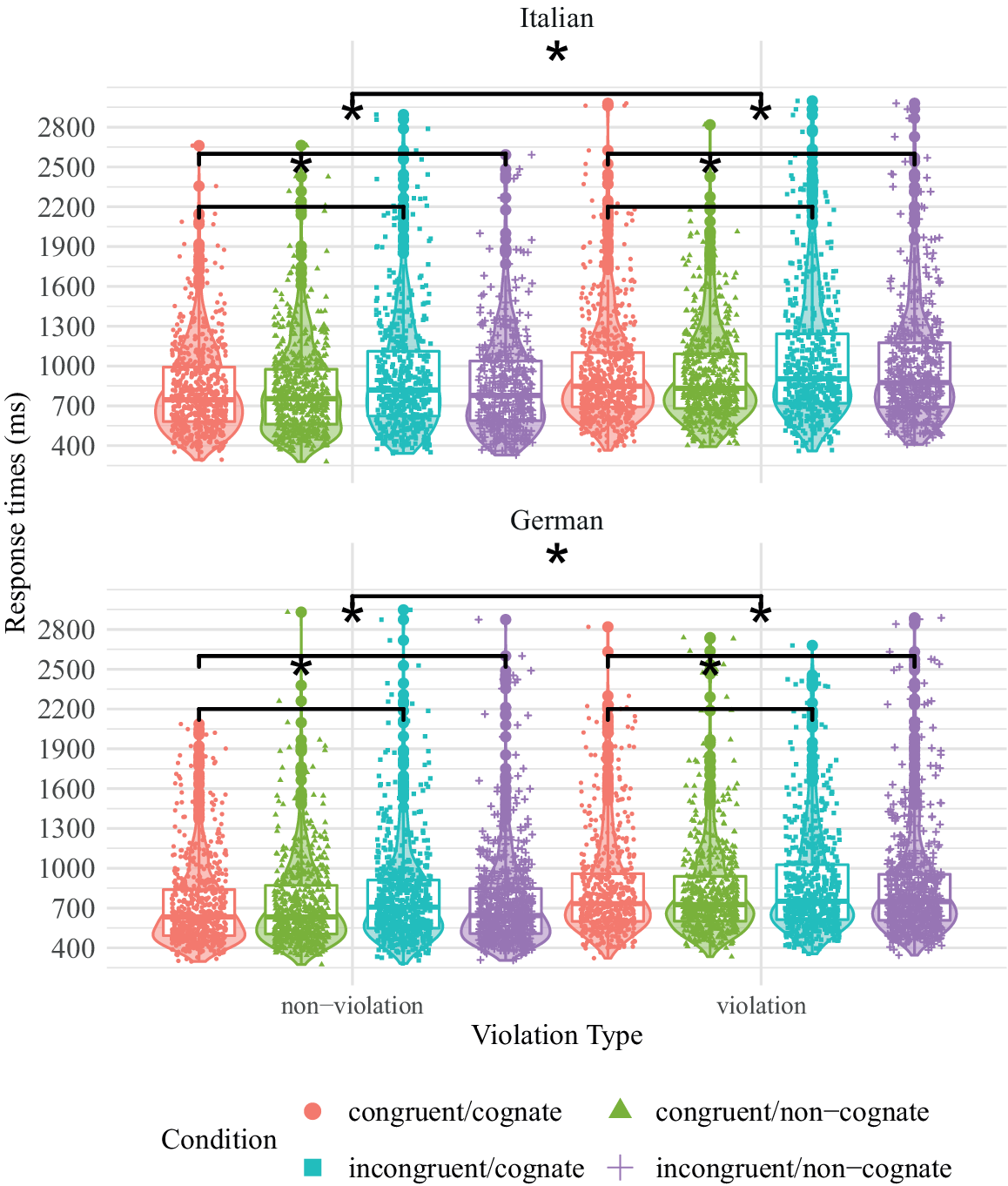
Participants were faster for non-violation trials compared to violation trials with β = 128.18, 95% CI[93.90, 162.45], t = 7.33, p < 0.001. Participants were also significantly faster for congruent/cognate items compared to incongruent/cognate items with β = 105.64, 95% CI[89.30, 121.98], t = 12.67, p < 0.001, and for incongruent/non-cognates with β = 36.02, 95% CI[25.35, 46.68], t = 6.62, p < 0.001. Importantly, participants in the German-Spanish group were statistically faster compared to the Italian-Spanish group with β = −82.55, 95% CI[−100.54, −64.56], t = −8.99, p < 0.001. Moreover, the interaction effect between L1 and condition was significant for Italian and congruent/cognate items compared to German and incongruent/cognate items with β = −63.19, 95% CI[102.50, −23.89], t = −3.15, p = 0.002, with Italian participants being significantly slower (Figure 2). In sum, we found first, that participants were faster for non-violation compared to violation items; second, that participants were faster for congruent/cognate items compared to incongruent/cognate and incongruent/non-cognate items; third, that the German-Spanish group was overall faster compared to the Italian-Spanish group; and fourth, that the German-Spanish group was faster for incongruent/cognate items than the Italian-Spanish group. The latter indicated an effect of L1 on CLI across the two groups for RTs. See Appendix F for the full model parameters for RTs.
Mean response times (ms) for each group for each condition (n = 57).
3.4. EEG data exclusion
EEG trials were excluded based on one of the following reasons: first, the participant had indicated that they were unfamiliar with the noun; second, the participant made an incorrect grammatical judgement; and third, the trial segment contained an artefact. Therefore, we only included familiar, correct and uncontaminated trials in our analysis, provided that the trial rejection threshold did not exceed 60% of trials per participant. Subsequently, we excluded four participants from the Italian-Spanish group, and four participants from the German-Spanish group. Moreover, one participant from the German-Spanish group was lost due to a recording failure. In total, we included 57 datasets, 29 from the Italian-Spanish group, and 28 from the German-Spanish group.
3.5. EEG data pre-processing
We pre-processed our EEG data before the statistical analysis using BrainVision Analyzer (Brain Products, GmbH, Munich). For both groups, we re-referenced to the mastoid electrodes TP9 and TP10 and re-used the original reference channel as a data channel. For the German-Spanish group, we additionally implemented linear derivation to obtain an average HEOG signal. Next, we applied a high-pass filter of 0.1 Hz and a low-pass filter of 30 Hz. We then corrected for residual drift using a maximum amplitude of ±200 μV for the HEOG channel, and ± 800 μV for the VEOG channel. We used ocular independent component analysis to correct blink activity using both the VEOG and the HEOG channel as a baseline. We performed artefact correction according to the following criteria: we allowed a maximal voltage step of 50 μV/ms for the gradient, a maximal difference in 100 ms – intervals of 200 μV; maximal amplitudes of ±200 μV, and the lowest allowable amplitude in 100 ms – intervals of 0.5 μV. Next, we segmented our data from −200 ms prior to the onset of the stimulus to 1,200 ms after the onset of the stimulus for familiar and correct trials. We applied a baseline correction to each segment using the signal in the 200 ms before stimulus onset. In the final step, we exported all available voltage amplitude samples for each time point, segment, data channel (excluding HEOG, VEOG, and the reference channels), and each participant to perform our statistical analysis. In this, we exported 29 data channels for the Italian-Spanish group (Fp1, Fp2, Fz, F3, F4, F7, F8, FCz, FC1, FC2, FC5, FC6, Cz, C3, C4, T7, T8, CP1, CP2, CP5, CP6, Pz, P3, P7, P4, P8, Oz, O1 and O2) and 31 channels for the German-Spanish group (Fp1, Fp2, AFz, Fz, F3, F4, F7, F8, FCz, FC3, FC4, FT7, FT8, Cz, CPz, CP3, CP4, C3, C4, T7, T8, TP7, TP8, Pz, P3, P4, P7, P8, Oz, O1 and O2). Each channel was assigned to one of the following topographic regions: left anterior, mid anterior, right anterior; left central, mid central, right central; and finally, left posterior, mid posterior and right posterior regions.
3.6. EEG data analysis
For the statistical analysis, we employed a data-driven approach to model voltage amplitudes over time. For this, we first conducted a permutation analysis to determine our region of interest (ROI) in terms of channels. Second, we used generalised additive mixed models (GAMMs) to establish our time window of interest for a potential P600 effect (Meulman et al., Reference Meulman, Wieling, Sprenger, Stowe and Schmid2015) and to model group differences in terms of the P600 effect and CLI effects.
To determine our ROI, we performed a cluster-based permutation analysis using the permutes package (Voeten, Reference Voeten2019) in R to highlight the potentially significant effects of violation type and condition on voltage amplitudes. We visualised the outcomes of the permutation analysis in Appendix G for the Italian-Spanish speakers, and in Appendix H for the German-Spanish speakers. Potentially significant effects of violation type and condition are highlighted in red colours. For the Italian-Spanish group, the outcome tentatively suggested channels C4, CP2, CP6, Pz, P3, P4, P7, and P8 as ROI, these channels were located in centro-parietal regions with a slight left lateralisation. In contrast, for the German-Spanish group, the outcome yielded CPz, CP3, CP4, TP7, TP8, Pz, P3, P4, P7, P8, Oz, O1, and O2 as a potential ROI. These electrodes were located in left posterior, central posterior, and right posterior regions, consistent with the classical topography of the P600 component (Steinhauer et al., Reference Steinhauer, White and Drury2009).
Pooling the ROI channels for both groups, we selected only channels that were present in the montage of each group, namely Pz, P3, P4, P7 and P8 as our ROI (Appendix I). In a second step, we modelled voltage amplitudes over time in our ROI using a GAMM to determine our time window of interest. A detailed discussion of this method and its application in EEG research can be found in Meulman et al. (Reference Meulman, Wieling, Sprenger, Stowe and Schmid2015) and in Tremblay and Newman (Reference Tremblay and Newman2015). Briefly, GAMMs not only allow for the inclusion of by-subject and by-item random effects (as do GLMMs) but are also robust against missing data following the missing-at-random mechanism and unbalanced observations per participant. Most importantly, GAMMs allow for non-linear terms to flexibly model the non-linear effects of voltage amplitudes over time, which cannot be captured with linear functions. Here, the non-linear term time is modelled flexibly using (penalised) splines, resulting in a smooth fit for the oscillatory trend of voltage amplitudes over time (Meulman et al., Reference Meulman, Wieling, Sprenger, Stowe and Schmid2015). To avoid over-fitting our data, we constructed a simpler, theoretically plausible model which included the interaction effect of L1 and violation type, the interaction effect of L1 and condition, as well as channel as a covariate. Next, we added a non-linear term for time and interaction effects between time and L1, time and violation type, time and condition, and time and channel. We further created additional model terms to test for our critical interaction effects over time, namely L1 and violation type, and L1 and condition. Finally, we added random intercepts for subject and item, random slopes for each subject for the effects of time, violation type, condition and channel; and random slopes for each item for the effects of time and channel. This model was fitted using the mgcv package (Wood, Reference Wood2021) with the fast restricted likelihood estimation (fREML) using a scaled t-distribution to account for heavy tails in the residuals (Meulman et al., Reference Meulman, Wieling, Sprenger, Stowe and Schmid2015) For storage efficiency reasons, we further applied discretisation. This is a built-in method in the mcgv package commonly used for particularly large data sets to extend the data set as well as the model size in line with the available computer memory (Wood, Reference Wood2021). We carefully checked the model diagnostics for problematic residual patterns, the appropriate number of basis functions (k-parameter), the goodness of fit, and for strong autocorrelation (De Cat et al., Reference De Cat, Klepousniotou and Baayen2015). Further, we assumed missing data to be following the missing-at-random mechanism (Ibrahim et al., Reference Ibrahim, Chen and Lipsitz2001).
To answer our first research question about the presence of a P600 effect in both groups, we used the itsadug package (Van Rij et al., Reference Van Rij, Wieling and Baayen2020) in R to plot the predicted differences in voltage amplitudes for non-violation versus violation trials separately for both groups. This also provided us with a precise time window of interest for the P600 component (Appendix K). For our second research question, we generated conditional plots for the interaction effect of L1 and violation type over time. To tackle our third research question, we created conditional plots for the interaction effect of L1 and condition over time.
3.6.1. EEG data results
We visualised raw voltage amplitudes for our ROI for each violation type for both groups in Figure 3A, which illustrates the oscillatory trend of voltage amplitudes over time. The first 250 ms post-stimulus onset show the early visual processing response typical for visual stimuli (Eulitz et al., Reference Eulitz, Hauk and Cohen2000). Critically, the signal yielded a deviation in voltage amplitudes around 450 ms post-stimulus onset across both groups. Descriptively speaking, voltage amplitudes appeared lower for non-violation trials compared to violation trials between 450 ms and 900 ms post-stimulus onset in both groups in Figure 3A, which tentatively suggested a P600 effect for both groupsFootnote 4 . In contrast, Figure 3B shows mean voltage amplitudes for each condition for the Italian-Spanish and the German-Spanish group. Importantly, Appendix J visualises the large variance and individual differences in the EEG signal across both groups, which is a critical aspect to keep in mind when dealing with large EEG datasets.
(A) The mean voltage amplitudes over time for each violation type for channels Pz, P3, P4, P7 and P8 for both groups. (B) The mean voltage amplitudes over time for each condition for channels Pz, P3, P4, P7 and P8 for both groups.

As described above, our fitted GAMM model was as follows: voltage amplitudes ∼ L1 * Violation type + L1 * Condition + Channel + s(Time, k = 20) + s(Time, by = L1, k = 20) + s(Time, by = Violation type, k = 20) + s(Time, by = Condition, k = 20) + s(Time, by = L1 * Violation type, k = 20) + s(Time, by = L1 * Condition, k = 20) + s(Time, by = Channel, k = 20) + s(Subject, Time, bs = “re”) + s(Subject, Violation type, bs = “re”) + s(Subject, Condition, bs = “re”) + s(Subject, Channel, bs = “re”) + s(Subject, bs = “re”) + s(Item, Time, bs = “re”) + s(Item, bs = “re”)Footnote 5 . See Appendix K for the exact model parameters. The model captured 9.61% of the variance in the data.
With respect to our first research question, we found a significant difference between non-violation and violation trials over time with F = 636.46, p < 0.001, which is indicative of a P600 effect. We examined this effect individually for each group and found a significant difference between non-violation and violation trials between 478 ms and 1,057 ms post-stimulus onset for the Italian-Spanish group (Figure 4A) and between 492 ms and 1,058 ms for the German-Spanish group (Figure 4B). The German-Spanish group also showed a small difference at 350 ms post-stimulus onset, which is likely linked to the early visual response. Taken together, we found a P600 effect for both the Italian-Spanish group and the German-Spanish group.
(A) The marginal plot of predicted differences in voltage amplitudes over time for violation versus non-violations for channels Pz, P3, P4, P7 and P8 for the Italian-Spanish group (n = 29), and (B) shows the marginal plot of predicted differences in voltage amplitudes over time for violation versus non-violations for channels Pz, P3, P4, P7 and P8 for the German-Spanish group (n = 28).

With respect to our second research question, the interaction effect of L1 and violation type was significant over time with F = 61.46, p < 0.001. The conditional plot indicated a small, but robust difference in the P600 effect between the two groups. Figure 5A visualises this difference in voltage amplitudes between non-violation trials vs. violations trials over time for the Italian-Spanish group compared to the German-Spanish group and shows a significant non-zero difference in P600 effects around 600 ms, with a larger P600 effect linked to the Italian-Spanish group compared to the German-Spanish group (Figure 5A). The effect difference was close to zero for the remaining time points and therefore not significant. Note that Figure 5A visually suggests a large difference in P600 effect size across the two groups but was in fact much smaller as predicted by the model (Appendix K). We captured this notion in Appendix L, which shows this small difference in P600 effects in relation to our original scale. Therefore, we found a larger P600 effect for the Italian-Spanish group compared to the German-Spanish group.
(A) shows the conditional plot of predicted differences of the P600 effect (amplitudes for violation trials – amplitudes for non-violation trials) over time for channels Pz, P3, P4, P7 and P8 across both groups (n = 57). The dashed lines represent the standard error. The difference in terms of the P600 effect across the two groups increases around 600 ms, indicating a larger P600 effect for the Italian-Spanish group compared to the German-Spanish group. (B) The conditional plot of predicted differences in voltage amplitudes over time for the CLI effects for channels Pz, P3, P4, P7 and P8 across both groups (n = 57). The dashed lines represent the standard error. The difference in terms of the CLI effects across the two groups increases around 400 ms and 800 ms, indicating larger voltage amplitudes for CLI effects for the Italian-Spanish group compared to the German-Spanish group.

With respect to our third and final research question, the interaction effect of L1 and condition was significant over time with F = 29.30, p < 0.001 (Appendix K). This suggested that CLI effects differed over time between the groups. The conditional plot for this effect showed a small difference at two separate time points post-stimulus onset (Figure 5B). More specifically, CLI effects were significantly larger around 400 ms and around 800 ms for the Italian-Spanish group compared to the German-Spanish group. For the remaining time points, the difference in voltage amplitudes linked to CLI effects was close to zero and therefore not significant. Importantly, as Appendix M shows, these differences in CLI effects across the two groups are small, but statistically significant according to the model. See Appendix K for the exact model parameters. Taken together, CLI effects were found to be larger for the Italian-Spanish group than for the German-Spanish group.
In summary, our ERP findings were the following: first, we found evidence for a P600 effect for both groups. This was indicated by higher voltage amplitudes for violation trials compared to non-violation trials. Second, results suggested a statistically larger P600 effect around 600 ms for the Italian-Spanish compared to the German-Spanish group over time. Finally, voltage amplitudes connected to CLI effects were statistically larger around 400 ms and around 800 ms for the Italian-Spanish compared to the German-Spanish group.
4. Discussion
The primary aim of the current study was to investigate typological similarity effects on syntactic violation processing and on cross-linguistic influence (CLI) at the behavioural and neural levels. More specifically, we examined typological similarity effects using a syntactic violation paradigm in speakers of typologically similar languages (Italian-Spanish) and of typologically less similar languages (German-Spanish), all of whom were late learners of Spanish. During the syntactic violation paradigm, we measured accuracy, RTs, and voltage amplitudes over time, with a particular focus on the P600 component and a connected P600 effect. We probed first, whether there was a grammaticality effect in terms of accuracy, RTs, and a P600 effect for violation versus non-violation trials across both groups; second, whether these behavioural grammaticality effects and electrophysiological effects were larger for one group compared to the other; and third, whether there were different CLI effects at the behavioural and neural level across the two groups. On the basis of the LDH (Zawiszewski & Laka, Reference Zawiszewski and Laka2020) outlined in the introduction, we predicted an overall processing advantage for the Italian-Spanish group as the typologically more similar language pair compared to the German-Spanish group.
From a behavioural perspective, we first predicted that speakers would be more accurate and faster for non-violation compared to violation trials, and for congruent/cognate items compared to incongruent/non-cognate items. Next, we hypothesised that the Italian-Spanish group would be more accurate and faster for non-violation than for violation trials compared to the German-Spanish group. Finally, we predicted that the Italian-Spanish group would be more accurate and faster at processing congruent/cognate items than incongruent/non-cognate items compared to the German-Spanish group. This would reflect first, an advantage for speakers of typologically similar languages (Italian-Spanish) in detecting syntactic violations compared to speakers of typologically less similar languages (German-Spanish); and second, more pronounced CLI effects for the Italian-Spanish group.
Behavioural results suggested the following: for accuracy, we found that participants were indeed more accurate for non-violation trials compared to violation trials, in line with our hypothesis. Next, we also found a small effect of condition, indicating a difference in accuracy as a function of CLI. Here, participants were more accurate for congruent/cognate items compared to incongruent/cognate items independently of the group, thereby suggesting a small effect of gender congruency. However, with respect to our second and third research question, results from accuracy indicated neither an influence of typological similarity on syntactic violation processing, nor on overall CLI effects as both critical interaction effects yielded non-significance.
In contrast, results from RTs provided us with a more extensive picture. Participants were faster for non-violation trials compared to violation items, and for congruent/cognate items compared to incongruent/cognate and incongruent/non-cognate items. This yields a processing advantage for congruent/cognates compared to incongruent/cognates at the level of RTs, which is in line with the findings from the accuracy data. One possible interpretation of this particular result could be that incongruent/cognates are potentially particularly difficult to process because of the simultaneous occurrence of similarity at the word form level and the unexpected mismatch at the gender level. Subsequently, the processing effort for incongruent/cognates may be comparatively high in contrast to cases where the similarity manifests itself at the word form level as well as at the gender level. Another critical finding was that Italian-Spanish speakers were overall slower compared to the German-Spanish speakers. This suggests a more general processing advantage for the typologically less similar German-Spanish pair compared to the Italian-Spanish pair in terms of RTs. Critically, with respect to our second research question about the differential processing of violation versus non-violation trials across groups, we did not find evidence for this notion, contrary to our behavioural predictions. As for our third research question about differential CLI effects across groups, we found a difference in CLI across the two groups, but in the opposite direction to what we had predicted: Italian-Spanish speakers were significantly slower for incongruent/cognates compared to the German-Spanish speakers.
Taken together, the main finding from our behavioural results was the small effect of typological similarity both on overall RTs and on CLI: the German-Spanish speakers, and not the Italian-Spanish speakers, displayed an overall behavioural processing advantage in this task. This was shown both in terms of faster RTs for the German-Spanish group when detecting syntactic violations and in terms of overall smaller CLI effects. This notion is contrary to the predictions made by the LDH (Zawiszewski & Laka, Reference Zawiszewski and Laka2020).
There are several possible interpretations of these findings: first, the processing advantage for the German-Spanish group could stem from the fact that there may have been less CLI for the German-Spanish speakers to begin with and therefore these speakers were less subject to CLI effects compared to the Italian-Spanish speakers. A second interpretation is that CLI was equally pronounced in both groups, but the German-Spanish speakers employed a more efficient strategy to mitigate CLI effects compared to the Italian-Spanish speakers. Finally, the predictions of the LDH (Zawiszewski & Laka, Reference Zawiszewski and Laka2020) may be limited to morphosyntactic similarity and may not apply to similarity at the level of gender in combination with word form overlap as tested in this study, at least in terms of behaviour. Our current design does not allow for the discrimination of these interpretations, but they should be subject to future research. Nevertheless, the current results provide evidence for an effect of typological similarity on CLI favouring speakers of typologically less similar languages. In what follows, we complemented these behavioural findings with the ERP findings to obtain a clearer picture of our overall findings.
In terms of ERPs, we first expected to find a P600 effect for both groups. In line with our predictions, we found significantly higher P600 component voltage amplitudes for violation trials compared to non-violation trials for both the Italian-Spanish and the German-Spanish group, reflecting the classical P600 effect (Friederici et al., Reference Friederici, Steinhauer and Frisch1999, Reference Friederici, Hahne and Saddy2002; Sabourin & Stowe, Reference Sabourin and Stowe2008; Swaab et al., Reference Swaab, Ledoux, Camblin, Boudewyn, Luck and Kappenman2013). In turn, this indicated that both groups were highly sensitive to syntactic violations at the level of gender. Notably, both groups displayed a highly similar onset of the P600 effect around 490 ms post-stimulus onset, as well as a comparable P600 effect latency until around 1,000 ms post-stimulus onset. Therefore, answering to our first research question, our data suggest a P600 effect for both the Italian and the German late learners of Spanish (Rossi et al., Reference Rossi, Gugler, Friederici and Hahne2006; Tokowicz & MacWhinney, Reference Tokowicz and MacWhinney2005).
For our second research question, we predicted a larger P600 effect for the typologically more similar Italian-Spanish group compared to the typologically less similar German-Spanish group, in line with the LDH (Zawiszewski & Laka, Reference Zawiszewski and Laka2020). Supporting this prediction, our data provided evidence for a small, but robust statistical difference in P600 effect sizes (around 600 ms post-stimulus onset), with a larger P600 effect for the Italian-Spanish group than for the German-Spanish group. This suggests a processing advantage for typologically more similar languages compared to less similar languages. Further, these findings are comparable to the results by Sabourin and Stowe (Reference Sabourin and Stowe2008), who reported a P600 effect for the typologically more similar language combination of German and Dutch but not for the combination of Romance languages and Dutch when processing syntactic violations in the non-native language Dutch, despite both groups showing a P600 component for the stimuli. By extension, the results from our study support the notion of enhanced sensitivity to syntactic violations in speakers of typologically more similar languages compared to less similar languages, that is, Italian-Spanish versus German-Spanish. Therefore, as for our second research question, we provide evidence that typological similarity directly impacts P600 effect sizes. This notion expands on work by Zawiszewski and Laka (Reference Zawiszewski and Laka2020), who demonstrated a modulation of ERP effects by morphological similarity in highly proficient speakers. Therefore, our study contributes novel findings about the facilitatory role of gender similarity and word form similarity to existing accounts on the role of morphosyntactic similarity on non-native comprehension.
For our third research question, we predicted larger CLI for the Italian-Spanish group compared to German-Spanish group, as reflected in larger voltage amplitudes for CLI effects for the typologically more similar group. In line with our predictions, we found that CLI effects were larger for the Italian-Spanish group compared to the German-Spanish group. Subsequently, this represents evidence for a modulation of CLI by typological similarity, as well as a processing advantage for typologically similar languages compared to less similar languages. These results extend the LDH by Zawiszewski and Laka (Reference Zawiszewski and Laka2020) in that we provide evidence that also similarity at the level of gender and orthographic and phonological form overlap (cognate status) elicited larger ERP components. Moreover, these results are also in line with studies suggesting overall larger CLI for typologically similar languages compared to less similar languages (Mosca, Reference Mosca2017; Sabourin & Stowe, Reference Sabourin and Stowe2008; Tolentino & Tokowicz, Reference Tolentino and Tokowicz2011).
Taking both the behavioural and the ERP data together, results suggest a general typological similarity effect on non-native comprehension. Interestingly, however, they indicate a typological effect in opposite directions: on the one hand, the behavioural data suggests a behavioural processing disadvantage for the Italian-Spanish group in the form of overall slower RTs and slower RTs for processing CLI compared to the German-Spanish group. This contrasts with our predictions on the basis of the LDH (Zawiszewski & Laka, Reference Zawiszewski and Laka2020). In turn, it could imply that the model’s behavioural predictions were only applicable to morphosyntactic similarity but not to the combined overlap at the level of gender, orthography and phonology. On the other hand, the ERP data suggest a processing advantage for the Italian-Spanish group at the neural level, with larger P600 effects and larger CLI effects compared to the German-Spanish group. These results support the predictions of the LDH (Zawiszewski & Laka, Reference Zawiszewski and Laka2020). Our interpretation is that the notion of larger ERPs for similar languages holds not only for morphological similarity at the level of gender, but also for orthographic and phonological word form similarity.
Differential findings across behavioural data and ERP data are not uncommon in the non-native language processing literature (Acheson et al., Reference Acheson, Ganushchak, Christoffels and Hagoort2012; Bosma & Pablos, Reference Bosma and Pablos2020; Jiao et al., Reference Jiao, Grundy, Liu and Chen2020) and have, for example, been previously reported in the specific context of object-verb agreement in Spanish and Basque in connection to a P600 effect (Zawiszewski et al., Reference Zawiszewski, Gutiérrez, Fernández and Laka2011). In this current study, behavioural findings support a processing advantage for typologically less similar languages, whereas neural findings support a processing advantage for typologically similar languages. Critically, we argue that this contrast highlights the complex association between behavioural and neural cognitive mechanism, which goes far beyond the more traditional interpretation that neural measures index ongoing processes and behavioural measures index the outcomes of those processes (White et al., Reference White, Genesee and Steinhauer2012). This notion is in line with previous work by Miller and Rothman (Reference Miller and Rothman2020), who have argued for the critical importance of combining offline and online measures to study both implicit, underlying processes (e.g., via EEG) as well as explicit responses (e.g., behavioural responses).
Moreover, our contrasting results could also indicate that typological similarity effects differ not only across behavioural and neural measures, but potentially also in terms of the different linguistic domains, such as phonological similarity, orthographic similarity or lexico-semantic similarity. Our study design and research questions did not allow for a more nuanced investigation of whether the typological similarity effect is in fact an interplay between several similarity effects across different linguistic domains. Therefore, more refined research is needed first, to tease apart a potentially differential impact of typological similarity on behaviour and neural correlates; and second, to characterise typological similarity effects not as a unitary effect, but as a combination of individual similarity effects.
Another interesting line of future research could be to investigate the role of typological similarity in combinations of languages where grammatical gender does not feature, e.g., Basque, Finnish or Estonian (Nyqvist & Lahtinen, Reference Nyqvist and Lahtinen2021; Vernich et al., Reference Vernich, Argus and Kamandulytė-Merfeldienė2017) and languages which do possess grammatical gender (e.g., Spanish, German, Italian). While there is some existing work on Basque on the acquisition and processing of grammatical gender in a non-native language (Zawiszewski & Laka, Reference Zawiszewski and Laka2020) or on a language where gender is not realised for nouns such as English (Ganushchak et al., Reference Ganushchak, Verdonschot and Schiller2011; Wagner, Reference Wagner and Kortmann2008), we argue that the predictions of the theoretical framework of the LDH should also be thoroughly tested across other language combinations that posit further questions for gender acquisition in L2 speakers.
An additional direction for future research is concerned with examining the exact role of proficiency in modulating typological similarity effects more closely. As discussed in the introduction, some studies suggested more pronounced typological similarity effects at lower proficiency levels (Tokowicz & MacWhinney, Reference Tokowicz and MacWhinney2005). However, more direct comparisons are needed between typological similarity effects at different levels of non-native proficiency and AoA. This was beyond the scope of the current study but will be essential for characterising the role of typological similarity on non-native processing more broadly and to model the potentially dynamic effects of typological similarity over time with evolving proficiency levels.
Returning to our broader question of whether typological similarity impacts non-native processing, the results of this study suggest an affirmative answer. In turn, this notion indicates that the L1 and the non-native language are intrinsically linked with each other in our late language learners at this specific proficiency level. However, since studies on this topic are scarce, we argue for the need of more comprehensive studies to tackle this question in a more nuanced manner.
5. Conclusions
In this study, we investigated typological similarity effects in non-native comprehension in Italian-Spanish speakers (typologically similar group) and German-Spanish speaker (typologically less similar pair). On the basis of the Language Distance Hypothesis, LDH (Zawiszewski & Laka, Reference Zawiszewski and Laka2020), we predicted a processing advantage for speakers of the typologically more similar language pair, as reflected in higher accuracy, shorter RTs and a larger P600 effect during a syntactic violation paradigm where we additionally manipulated gender congruency and cognate status. We found different typological similarity effects: on the one hand, the Italian-Spanish speakers were overall slower during the task compared to the German-Spanish speaker. On the other hand, ERP evidence showed a larger P600 effect for the Italian-Spanish speakers as well as larger voltage amplitudes for CLI compared to the German-Spanish speakers. This latter finding was in line with the LDH (Zawiszewski & Laka, Reference Zawiszewski and Laka2020). Therefore, our results indicate a general typological similarity effect at the level of both behavioural and neural measures. However, it is important to note that this typological similarity effect goes in different directions for the behavioural compared to the neural domain. Taken together, our results suggest an intimate functional link between the L1 and the non-native language in the multilingual brain during language processing. Yet, questions remain as to whether typological similarity effects are uniform across behavioural and neural measures and whether they are equally pronounced across different linguistic domains and proficiency levels.
Citation diversity statement
We included this statement to make readers aware of research suggesting that authors identifying as female or as members of a minority group are under-represented in the reference list of scientific studies (Dworkin et al., Reference Dworkin, Linn, Teich, Zurn, Shinohara and Bassett2020; Zurn et al., Reference Zurn, Bassett and Rust2020). This is a particularly important topic to consider in light of the recent global pandemic (Viglione, Reference Viglione2020). Our references included 24% woman/woman authors, 35% man/man, 24% woman/man and finally, 8% man/woman authors. This compares to 6.7% for woman/woman, 58.4% for man/man, 25.5% woman/man and lastly, 9.4% for man/woman authored references in the reference list of publications in the field of neuroscience (Dworkin et al., Reference Dworkin, Linn, Teich, Zurn, Shinohara and Bassett2020).
Data availability statement
The data that support the findings of this study are openly available in the Open Science Framework at https://osf.io/e6acy/?view_only=798087b3751b46d88654f76eaf26ec67.
Acknowledgements
We thank all members of the Neurolinguistics Laboratory at the University of Konstanz for their support, in particular Carsten Eulitz, Oleksiy Bobrow, Charlotte Englert, Khrystyna Oliynyk, Anna-Maria Waibel, Zeynep Dogan and Fangming Zhang. We also thank Núria Sebastián-Gallés and Ege Ekin Özer from the Speech Acquisition and Perception group at the Centre for Brain and Cognition at Pompeu Fabra University. We further thank Marjolein Fokkema, Julian Karch and Franz Wurm for their support in the statistical analyses. A special thanks goes to Frank Doornkamp and Willem Hoogerworst, who consulted on the analysis for the EEG data and implemented the initial GAMM analysis. The statistical analyses were performed using the computing resources from the Academic Leiden Interdisciplinary Cluster Environment (ALICE) provided by Leiden University. Finally, we also want to thank all of our participants for taking part in this research.
Author contribution
S.V.G.Z.W.: Conceptualisation, methodology, validation, investigation, formal analysis, data curation, writing – original draft, writing – review and editing, visualisation. L.P.: Conceptualisation, methodology, writing – review and editing, supervision. N.O.S.: Conceptualisation, writing – review and editing, supervision, funding acquisition.
Funding statement
This project has received funding from the European Union’s Horizon2020 research and innovation programme under the Marie Skłodowska-Curie grant agreement No 765556 – The Multilingual Mind.
Competing interest
The authors declare none.
Appendix
A. Linguistic profile: Italian-Spanish group
Overview of the native and non-native languages acquired by the Italian-Spanish group (n = 29).

B. Linguistic profile: German-Spanish group
Overview of the native and non-native languages acquired by the German-Spanish group (n = 28).

C. Syntactic violation paradigm: Example stimuli
Example stimuli for the violation paradigm task for the German-Spanish group, taken from Von Grebmer Zu Wolfsthurn et al. (Reference Von Grebmer Zu Wolfsthurn, Pablos-Robles and Schiller2021). The table illustrates the three manipulations: violation type, gender congruency and cognate status.

D. Syntactic violation paradigm: Task procedure
Example trial for the syntactic violation paradigm. Within-trial prompts in the figure were translated to English for convenience.

E. Model parameters: accuracy
Model parameters for best-fitting model for accuracy (n = 57).

F. Model parameters: response times
Model parameters for best-fitting model for RTs (n = 57).

G. Permutation test outcome: Italian-Spanish group
Permutation analysis outcome for the Italian-Spanish group (n = 29). Note that higher F-values are visualised in red colours, and lower F-values in yellow.

H. Permutation test outcome: German-Spanish group
Permutation analysis outcome for the German-Spanish group (n = 28). Note that higher F-values are visualised in red colours, and lower F-values are in yellow.

I. EEG data: region of interest
Region of interest and the corresponding channels Pz, P3, P4, P7 and P8 for the EEG analysis, shown in the shaded area in the montage of the Italian-Spanish group.

J. EEG data: by-violation type mean voltage amplitudes
Mean voltage amplitudes over time for each violation type for each participant for channels Pz, P3, P4, P7 and P8 (n = 57). Mean amplitudes for each violation type are shown as thicker lines.

K. Model parameters: P600 component
Model parameters of the GAMM model for the effect of L1 and time on voltage amplitudes for channels Pz, P3, P4, P7 and P8 (n = 57). Estimated degrees of freedom (edf) provide a measure for the complexity of the smooth terms. The edf parameters for our smooth terms suggested that voltage amplitudes follow a highly non-linear tendency.

L. P600 effect sizes: unscaled predicted differences
Conditional plot of predicted difference in voltage amplitudes over time for violations versus non-violations for channels Pz, P3, P4, P7 and P8 across both groups (n = 57) on the original scale. The dashed lines represent the standard error.

M. CLI effect sizes: unscaled predicted differences
Conditional plot of predicted difference in voltage amplitudes over time for the CLI effects for channels Pz, P3, P4, P7 and P8 across both groups (n = 57) on the original scale. The dashed lines represent the standard error.


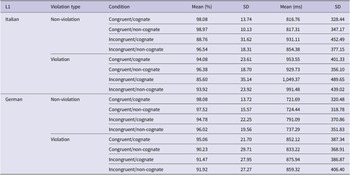
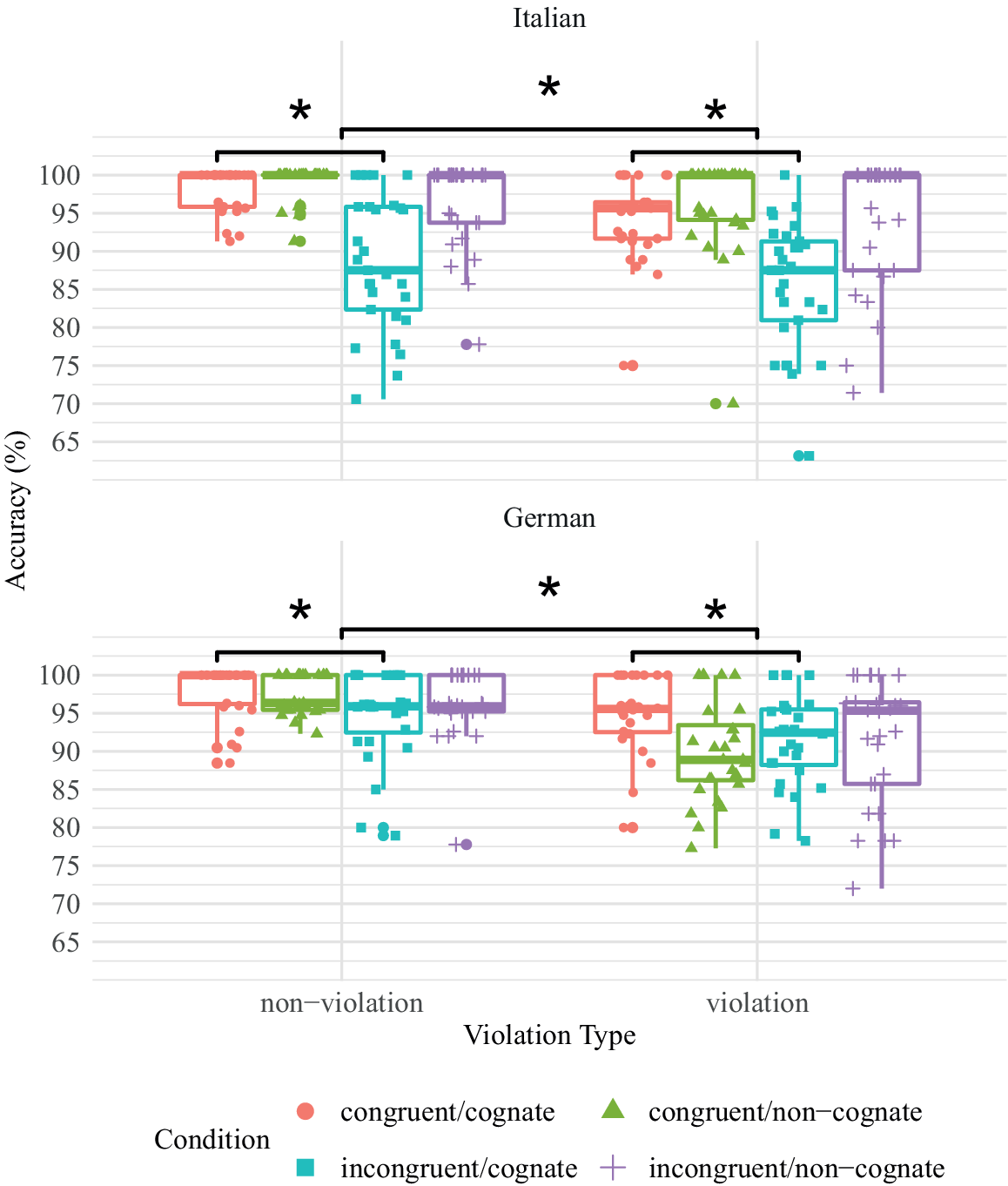

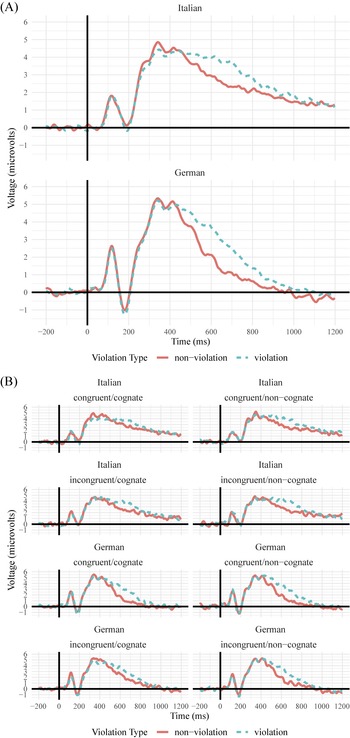
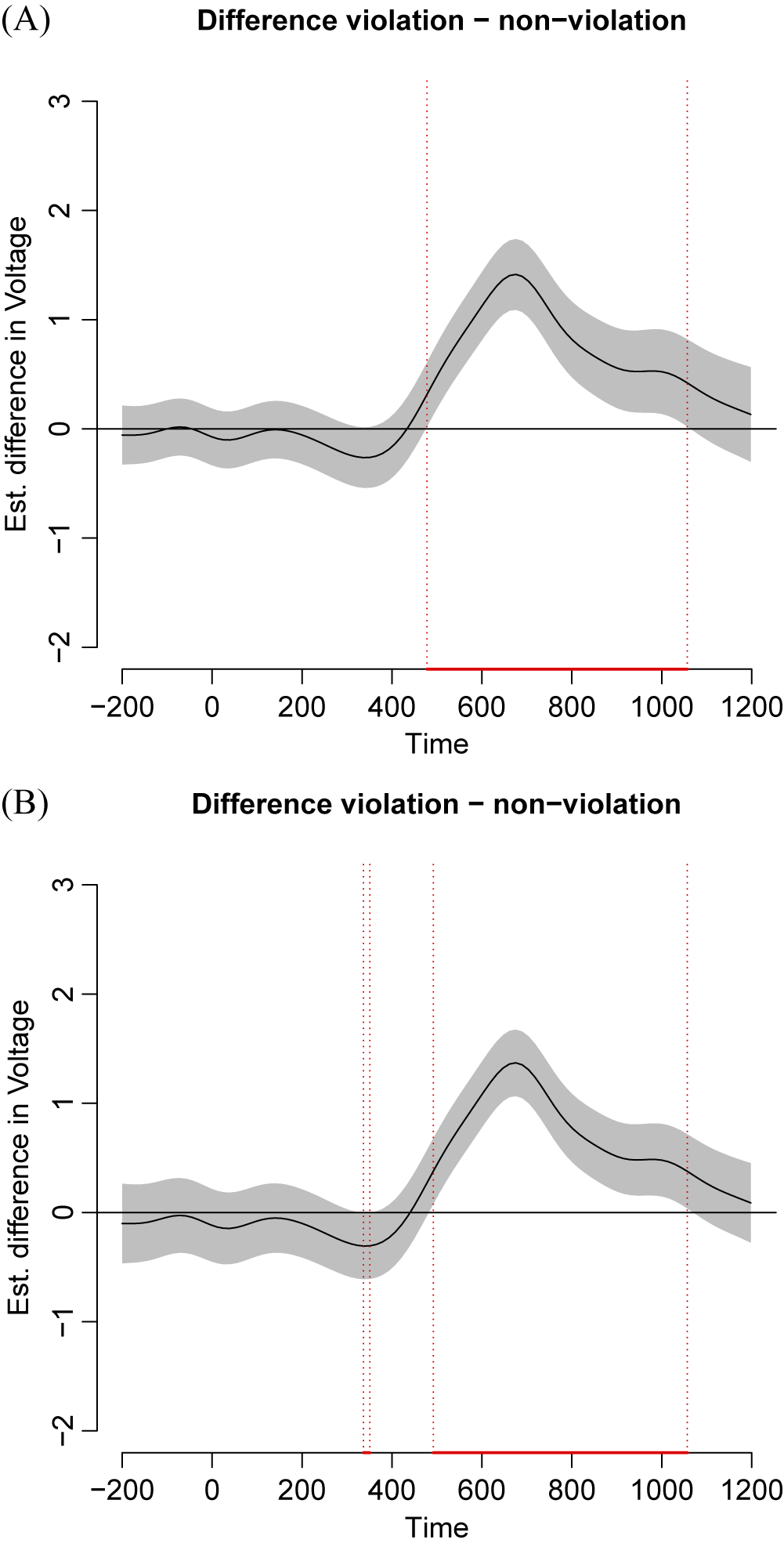
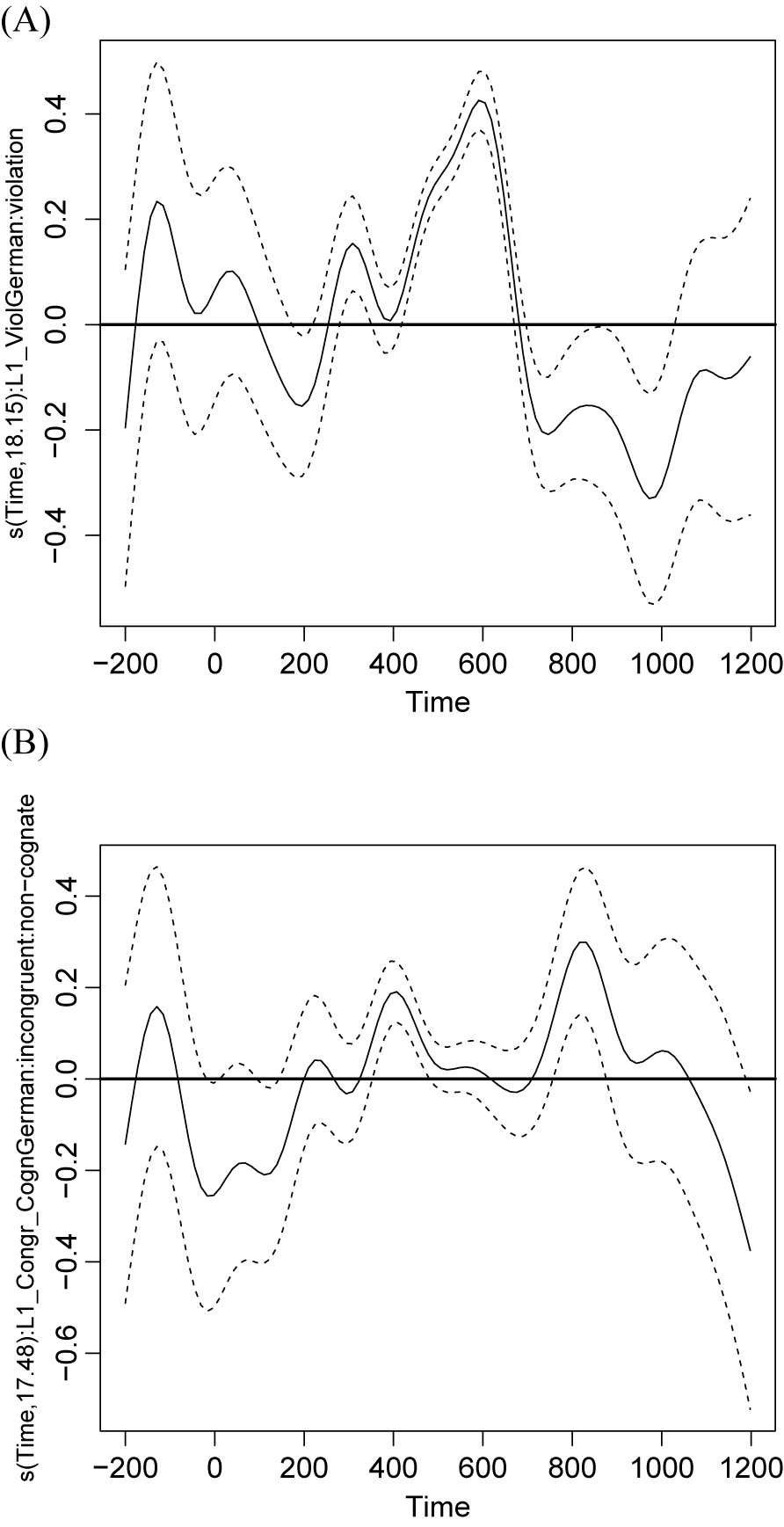

 Open access

