


Introduction
The explosive eruption of the Mount Pinatubo volcano (Luzon, Philippines; 15.14° N, 120.35° E) in June 1991 injected an estimated 18 ± 2x 10⁶ metric tons (1 Mt = 1 Tg = 1012 g) of SO2 directly into the atmosphere (Reference KruegerKrueger and others, 1995). In the atmosphere, the Pinatubo SO2 was rapidly converted to H2SO4 aerosol particles (Reference Bekki, Toumi and PyleBekki and others, 1993). The volcanic aerosol mass was dispersed gradually in the global atmosphere, covering the entire Earth by mid-1992 (Reference Hitchman, McKay and TrepteHitchman and others, 1995). The presence of volcano-derived H2SO4/water aerosol particles alters the atmospheric albedo, thereby affecting regional and global climate. Following the Pinatubo eruption, global tropospheric and surface temperatures decreased by 0.2-0.7°C (Reference McCormick, Thompson and TrepteMcCormick and others, 1995; Reference Jones, Kelly, Fiocco, Fu’a and ViscontiJones and Kelly, 1996).
Aerosol particle fallout and tephra (fine volcanic ash) from explosive volcanic eruptions are found in polar snow. Following a major explosive eruption, sudden increases in the concentrations of H2SO4 or SO4 2– in polar snow are usually observed during a short period (0-3 years) immediately following the eruption. Consequently, SO4 2– measurements in polar ice cores are used to reconstruct chronological records of global explosive volcanism (Reference Hammer, Clausen and DansgaardHammer and others, 1980; Reference Legrand and DelmasLegrand and Delmas, 1987; Reference ZielinskiZielinski and others, 1994, Reference Zielinski, Mayewski, Meeker, Whitlow and Twickler1996; Reference Cole-Dai, Mosley-Thompson and ThompsonCole-Dai and others, 1997a). Pinatubo volcanic signals were recently found in South Pole snow (Reference Dibb and WhitlowDibb and Whitlow, 1996; Reference Cole-Dai, Mosley-Thompson and ThompsonCole-Dai and others, 1997b). In a previous study (Reference Cole-Dai, Mosley-Thompson and ThompsonCole-Dai and others, 1997b), the volcanic SO4 2– flux in two 1994 shallow South Pole cores was quantified. In this study we seek to verify the previous results with South Pole snow samples collected in 1996 and, more importantly, to evaluate the local spatial variability of the Pinatubo signal as preserved in South Pole snow. Along with samples from multiple snow pits around the Amundsen-Scott South Pole station, a 42 m firn core was recovered during the 1996 field season. This core is used to detect and quantify volcanic signals of major volcanic eruptions during the past 300 years, and to estimate total atmospheric aerosol loadings (in S02) from these eruptions. These estimates can be used to assess the magnitude of volcanic forcing on climate, as the climatic impact is closely related to the amount of climatologically active volcanic aerosols generated by volcanic eruptions (Reference MinnisMinms and others, 1993; Reference ZielinskiZielinski, 1995).
Snow Sampling, Ice Goring and Analysis
A shallow core (42 m) was drilled and several snow pits were sampled during November and December 1996 at the South Pole station. The firn core was recovered with an electromechanical drill at a location 6 km upwind (grid 045°) from the station (Fig. 1). Snow pits to 2 m were excavated along the lines of an accumulation network (Fig. 1) established in 1992 to measure annual snowfall (Reference Mosley-ThompsonMosley-Thompson and others, 1995). A total of six pits were excavated and sampled. The following observations were made and snow sampling was conducted in each pit: (1) thin (a few cm) horizontal snow layers characterized by large snow grains and low density were visually identified and their depths were recorded; (2) beginning at the pit bottom, a vertically continuous sequence of 3 cm snow samples was collected using the following procedure: the sample collector wore a face mask and vinyl gloves and used stainless-steel spatulas to chisel samples from pit walls and to transfer samples to 120 mL polypropylene specimen cups (all gloves, tools and sample containers had been pre-cleaned and tested to prevent contamination); (3) in four of the six pits, a second set of samples was taken in parallel to the first set with a fixed-volume sampler for density measurements.
The Amundsen-Scott South Pole station area: the snow-accumulation network (solid lines) was established in 1992, and the 1996 snow pits and firn core were located near the survey lines of the network.

Snow-pit samples in specimen containers and the firn core were transported frozen to the Byrd Polar Research Center (BPRC) at The Ohio State University and were stored in a –30°C freezer until laboratory analysis. Individual samples averaging 2.5 cm in length were prepared from the firn core under stringent contamination control. All samples were melted at room temperature and analyzed by ion chromatography (IC) in the BPRC ice-core laboratory for concentrations of common inorganic ions (Na+, K+, Mg2+, Ca2+, CF, NO’3-, SO4 2–). Detailed procedures for ice-core sample preparation and IC analysis are described elsewhere (Reference Dai, Thompson and Mosley-ThompsonDai and others, 1995). The concentrations of methanesulfonic acid or MSA (CH3CHSO3H) in selected samples were determined with gradient IC according to published IC methods (Reference Saigne, Kirchner and LegrandSaigne and others, 1987).
Results
All SO4 2– data reported in this work are non-sea-salt (nss) SO4 2–, calculated from the total SO4 2– and Na+ concentrations in each sample. Data from an earlier study (Reference Cole-Dai, Mosley-Thompson and ThompsonCole-Dai and others, 1997b) and this work indicate that there is relatively little sea-salt-derived SO42- in South Pole snow, with nssSO42- representing >95% of the total SO42- concentration.
Snow-layer chronology
Previous studies (Reference Legrand and DelmasLegrand and Delmas, 1984; Reference Whitlow, Mayewski and DibbWhitlow and others, 1992) have found that concentrations of several ionic species in South Pole snow exhibit seasonal oscillations which can be used to date snow layers as a function of depth. During pit sampling, intermittent thin layers with large snow grains were observed in snow-pit stratigraphy. The gradual increase in snow density with depth is punctuated by these low-density thin layers (Fig. 2, top graph). These layers fit the definition of depth-hoar layers, first identified by Reference GowGow (1965), which appear annually in early summer snow. Dates are assigned to the annual depth-hoar layers at the beginning of the calendar year (top of Fig. 2). Matching these markers of summer snow (dashed lines in Fig. 2) with the concentration profiles of ionic species reveals that several species follow seasonal cycles. As seen in Figure 2, the concentrations of Na+, CF and Mg2 + are relatively high in winter snow and low in summer, while MSA concentrations generally reach a maximum during summer. These visible markers and seasonal concentration cycles, in agreement with observations by Reference Legrand and DelmasLegrand and Delmas (1984) and by Reference Whitlow, Mayewski and DibbWhitlow and others (1992), provide excellent tools for dating snow layers at South Pole.
Density profile and visually identified depth-hoar layers (vertical bars) in pit 6 are shown in the top graph. Concentrations of several ions are plotted on the same depth scale. The dashed vertical lines extending from the depth-hoar layers represent the beginning of the calendar year as marked. Seasonal cycles in CT, MSA, Na+ and Mg2+’ as ‘Cl–, MSA, Na+ and Mg2+ concentrations are identified based on comparison with the annual depth-hoar layers.

To convert snow-pit depth into water-equivalent (w.e.) depth, the density of each sample is needed. A second-order polynomial was fitted to the density-depth profile for pit 6 (Fig. 2, top graph) and was then used to calculate the density of each of the samples in all six snow pits. Annual snow-accumulation rates for the 6-8 years contained in the snow pits are obtained (Table 1) using the annual layer markers and seasonal cycles. The spatially and temporally averaged annual accumulation rate from 1990 to 1996 calculated from the six snow pits is 94 mm w.e. a-1 (251 mm snow a−1). This is slightly higher than, but not inconsistent with, the annual average of 84.5 mm w.e. from 1992 to 1996 based on the 236-pole accumulation network (Reference Mosley-Thompson, Paskievitch, Gow and ThompsonMosley-Thompson and others, 1999). Data shown in Table 1 suggest that the interannual variability can be high at a single pit site (relative standard deviation (RSD) as large as 40%). However, the spatial variability across the study area is relatively small (RSD∼7%) after the accumulation rates from each pit are temporally averaged.
Summary of results of the 1996 South Pole snow-pit study

The Hudson eruption
The August 1991 eruption of Cerro Hudson, southern Chile (45.92° S, 73.00° W), injected an estimated 1.5 Mt SO2 into the atmosphere (Reference Doiron, Bluth, Schnetzler, Krueger and WalterDoiron and others, 1991). Deposition of Hudson-derived SO4 2– in Antarctic snow is significant due to the relative proximity of Cerro Hudson to Antarctica and the rapid transport of its aerosols into the high southern latitudes (Reference Doiron, Bluth, Schnetzler, Krueger and WalterDoiron and others, 1991). Lidar observations over Antarctica (Reference Deshler, Adriani, Gobbi, Hofmann, di Donfrancesco and JohnsonDeshler and others, 1992; Cacciam and others, 1993) indicate that Hudson aerosols entered the polar atmosphere at the upper-troposphere/lower-stratosphere altitudes beneath the polar vortex in September and October 1991, prior to the arrival of the Pinatubo aerosol mass at higher altitudes. Reference Dibb and WhitlowDibb and Whitlow (1996) and Reference Cole-Dai, Mosley-Thompson and ThompsonCole-Dai and others (1997b) found apparent volcanic events in recent South Pole snow. Reference Cole-Dai, Mosley-Thompson and ThompsonCole-Dai and others (1997b) determined that two volcanic events were present in 1992-94 snow layers and that the earlier event is probably Hudson. In Figure 3 two volcanic events in a 1996 snow pit (pit 6) are shown at depths corresponding to 1992-94. Two similar events are found in all other 1996 snow pits. Following the conclusions by Reference Cole-Dai, Mosley-Thompson and ThompsonCole-Dai and others (1997b), the more recent event is assumed to be Pinatubo, and the earlier one to be Hudson. The snow-layer chronology suggests that Hudson aerosol deposition lasted from late 1991 to early or mid-1992 (<1 year) and Pinatubo deposition covered the period from early or mid-1992 to mid-1994 (-2.5 years).
Concentration of SO4 2–-inSouth Pole pit 6 is shown as a function of dePth.Horizontal dashed line represents the non-volconic background concentration. Increased SO4 2– concentrations (shaded area) above the background represent volcanic fallout from Pinatubo (dark shading) from early or mid-1992 to mid-1994 and Hudson (light shading) from late 1991 to early or mid-1992.

Calculation of background sulfate concentrations and volcanic flux
Non-volcanic or background SO4 2– in Antarctic snow is derived mainly from marine biogenic emissions of organic sulfur compounds dominated by dimethylsulfide or DMS (Reference Legrand and DelmasLegrand, 1995; Reference Legrand and MayewskiLegrand and Mayewski, 1997). It has been assumed that temporal variations of background SO4 2– concentrations in Antarctic snow are not systematically influenced by DMS emission rates from marine sources or by transport and depositional processes (Reference Cole-Dai, Mosley-Thompson and ThompsonCole-Dai and others, 1997a). Therefore, the typical background SO4 2– concentrations may be approximated using mean SO4 2– concentrations for an extended period free of significant volcanic input. Snow layers of 1-2 years prior to 1991 in the pits were deposited during a period of global volcanic quiescence (Reference Hitchman, McKay and TrepteHitchman and others, 1995). Consequently, in each pit the mean SO4 2– concentration below the 1991 snow layer is assumed to represent the non-volcanic or background SO4 2– concentration (Table 1). For the firn core, a background SO4 2– concentration of 1.12 μeq L−1 (std dev. 0.26 μeq L−1) is calculated by averaging SO42- concentration over the length of the core, after excluding samples associated with apparent volcanic events. Reference Delmas, Kirchner, Palais and PetitDelmas and others (1992) reported a very similar background SO4 2– concentration of 1.14 ± 0.24 μeq L−1 (55.0 ± 11.6 ng g−1) in an earlier South Pole core.
Volcanic SO4 2– flux in an individual sample is calculated by first subtracting background SO42- from the sample SO4 2– concentration and then multiplying by the sample length in water equivalent. Total volcanic flux for a volcanic event is simply the sum of the volcanic flux of all samples associated with that event. The volcanic fluxes of Hudson (< 1 year) and Pinatubo (-2.5 years) for all six pits are listed inTable 1.
Dating of the firn core
A time-scale is required for the 42 m core to estimate the ages of several prominent volcanic events found in the core. As all annual layers in the core have yet to be identified, the core dating can only be accomplished by assuming a constant accumulation rate. Reference Mosley-Thompson, Paskievitch, Gow and ThompsonMosley-Thompson and others (1999) reported a substantial increase (>30%) in snow-accumulation rates at South Pole during the past 40 years. Thus, the average accumulation rate of 94 mmw.e. a−1 obtained from the snow pits is not accurate for snow layers older than 40 years and may result in large dating errors for deeper parts of the core. Fortunately, two prominent volcanic events were found at 27.6 and 28.6 m in the core and are recognized as the Tambora eruption in 1815 and the eruption in 1809 of unknown origin, respectively, which are well documented in previous works (Reference Legrand and DelmasLegrand and Delmas, 1987; Reference Dai, Mosley-Thompson and ThompsonDai and others, 1991; Reference Delmas, Kirchner, Palais and PetitDelmas and others, 1992). The depths of these events in the 42 m core are consistent with those in a core drilled at South Pole in 1984 (Reference Delmas, Kirchner, Palais and PetitDelmas and others, 1992), after accounting for the 12 year additional accumulation. Using these two time markers, the average accumulation rate of 77.0 mm we. a−1 is obtained for 1810-1996. This accumulation rate is then used for the entire core, and the age at the bottom of the 42 m core is approximately 300 years (∼AD 1698)
Discussion
Local spatial variability of Pinatubo flux at South Pole
The six 1996 snow pits encompass an estimated 400 km2 area around the South Pole station (see Fig. 1). Data in Table 1 show that within this area the Pinatubo SO4 2– flux (8.37 ± 1.46 kg km−2 at the 95% confidence level) contains a maximum uncertainty of about 20%. This uncertainty can be attributed mainly to the large spatial and temporal variability of annual snow-accumulation rate at South Pole (Reference Mosley-ThompsonMosley-Thompson and others, 1995, Reference Mosley-Thompson, Paskievitch, Gow and Thompson1999). Primary factors responsible for the large accumulation variability include surface topographic irregularities and snow redistribution by wind after deposition. Another contributing factor is the large variability in the density of surface and shallow snow layers. Since flux calculations are dependent on density, large density variations can result in significant errors in flux calculation. Accurate flux calculation would require that the density of each sample be measured individually so that its volume can be converted to water equivalent using its own density. This was not possible in this study as density measurements are difficult for very small samples.
This uncertainty of volcanic flux due to local glaciological factors and inherent errors in measurements on snow samples may be termed glaciological variability. The errors in estimating volcanic aerosol mass loadings using ice-core data are dependent on the glaciological variability, among many factors.
Previous volcanic eruptions and estimating aerosol mass loadings
Continuous SO42- concentrations for the 42 m core are shown in Figure 4 as a function of time. Several outstanding volcanic SO4 2–- events are found in the core (Table 2). Most have been identified previously in Antarctic ice cores (Reference Delmas, Kirchner, Palais and PetitDelmas and others, 1992; Reference Cole-Dai, Mosley-Thompson and ThompsonCole-Dai and others, 1997a). The exception is the signal dated at approximately 1758, to be investigated in future work in order to identify the responsible volcanic eruption.
The continuous SO4 2–- concentration profile for the entire 42 m core is presented on a tine-scale. Dating of the 42 m firn core is accomplished by an average annual accumulation rate obtained from the identification of the 1815 Tambora eruption (see text for details). Outstanding volcanic events as marked with eruption dates are identified according to the years of their appearance in the core.

Prominent volcanic events found in the 1996 South Pole core (Fig. 4)
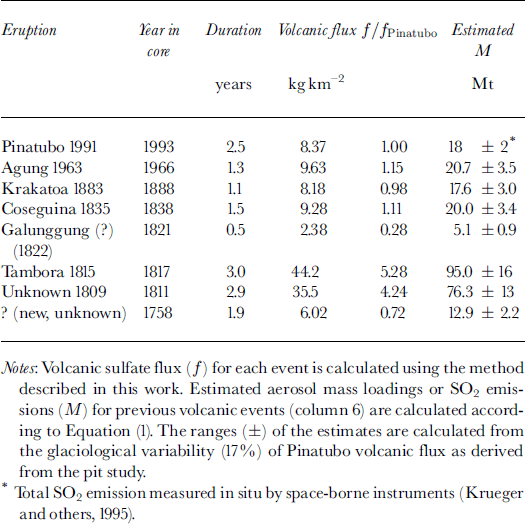
The volcanic flux for each of the events is calculated and listed inTable 2. The estimated volcanic flux for the 1815 Tarn-bora eruption in this work (47kgkm−2) is similar to that (43 kg km−2) reported by Reference Legrand and DelmasLegrand and Delmas (1987) in a 1978 core, but less than that (67 kg km−2) from a 1984 South Pole core (Reference Delmas, Kirchner, Palais and PetitDelmas and others, 1992). The difference appears to be larger than expected from the local spatial variability or glaciological variability of about 17% as estimated in this work (Table 1). The ratio of the volcanic flux of the unknown 1809 eruption to that of Tambora (0.80) is also larger than those reported for other Antarctic ice cores (e.g. 0.40 and 0.60 in two Antarctic Peninsula cores; see Reference Cole-Dai, Mosley-Thompson and ThompsonCole-Dai and others, 1997a), probably as a result of the low Tambora flux estimate from this 42 m core. This apparent discrepancy warrants further investigation in future research.
The volcanic flux of an eruption in polar snow is related to the atmospheric aerosol mass loading (in tons of SO2 or H2SO4 ) by that eruption. Several earlier studies (Reference Hammer, Clausen and DansgaardHammer and others, 1980; Reference Delmas, Legrand, Aristarain and ZanoliniDelmas and others, 1985; Reference Legrand and DelmasLegrand and Delmas, 1987) have attempted to estimate aerosol mass loadings from older volcanic eruptions found in ice cores by using debris fallout from atmospheric nuclear explosions. However, no error ranges were provided for estimates of aerosol mass loadings obtained this way.
Since its aerosol mass loading (18 ± 2 Mt SO2) has been determined in situ by satellite instruments, the Pinatubo eruption may be used as a calibrating tool for similar aerosol-loading estimates. This may be advantageous over the use of the nuclear-bomb fallout, for the atmospheric transport and deposition in snow of bomb debris are likely to be different from those of volcanic aerosols. To estimate aerosol mass loadings and the corresponding uncertainty, three important factors must be considered concerning the quantitative relationship between aerosol loadings and volcanic deposit in polar snow: (1) the efficiency of aerosol transport from the location of the volcano to the polar atmosphere; (2) the efficiency of aerosol deposition and/or scavenging by snow; and (3) the glaciological variability of the signal as defined earlier. The first two factors, although critical, are beyond the scope of this work, and therefore the same efficiency in aerosol transport and deposition for all events including Pinatubo is assumed for the following calculations. The assumption may not be valid since the atmospheric processes are poorly understood at this point. Errors due to these processes may be significant but are not included for the aerosol estimates in this study.
The aerosol mass loading (as S02) from an earlier volcanic event can be estimated by

where Mp and fb are the total SO2 emission and volcanic SO4 2– flux for Pinatubo, respectively, and f; is the volcanic SO4 2– flux for the event. Results listed in Table 2 show that the 1815 Tambora eruption injected approximately 95 Mt SO2 into the atmosphere. Earlier estimates for Tambora range from 120 to 170 Mt SO2 using ice cores from several Greenland locations (Reference Clausen and HammerClausen and Hammer, 1988). In Antarctica, the estimates range from 98 to 238 Mt (Reference Legrand and DelmasLegrand and Delmas, 1987; Reference Langway, Clausen and HammerLangway and others, 1988; Reference Delmas, Kirchner, Palais and PetitDelmas and others, 1992). None of the earlier studies provided an assessment of local spatial variability of the Tambora signal, which makes it difficult to compare these results. However, the estimate from this 1996 core is remarkably similar to that (-100 Mt) obtained by Reference Legrand and DelmasLegrand and Delmas (1987) who used a different calibration method.
Conclusions
Sulfate deposits from the Pinatubo eruption are found in recently (1996) collected South Pole snow samples. The new data confirm earlier findings and support the conclusion that Pinatubo SO42- deposition lasted from early or mid-1992 to mid-1994, preceded by a short deposition period (late 1991 to early or mid-1992) of volcanic aerosols from the Hudson eruption. Calculations show that the Pinatubo volcanic flux is similar to that of the 1963 Agung (Bali, Indonesia) eruption.
The deposition of Pinatubo volcanic SO4 2– appears to be locally consistent in the South Pole area, as volcanic signals are found in six snow pits distributed across a 400 km2 area. Results of the pit study indicate that spatial variability in Pinatubo SO4 2– flux may be as large as 20% at South Pole, probably due to spatial variations in annual net snow accumulation.
The Pinatubo eruption and many explosive volcanic eruptions during the past 300 years are also found in a shallow firn core. The atmospheric aerosol loadings by these past eruptions are estimated assuming atmospheric transport and deposition efficiencies similar to those of Pinatubo. In addition to the volcanic events reported in previous Antarctic ice cores, a new event is found around AD 1758. This event requires verification in other cores, and, if verified, the volcanic eruption responsible for this signal needs to be identified in future research.
Acknowledgements
We wish to thank the Polar Ice Goring Office, Fairbanks, Alaska, for drilling the firn core at South Pole, and R. Hellstrom for assistance with the fieldwork. We are grateful to two anonymous reviewers for their comments that helped improve the manuscript. This work is supported by U.S. National Science Foundation grant OPP-9526725 to The Ohio State University This is contribution No. 1107 of the Byrd Polar Research Center.



